Search Results: "ed"

24 October 2015

Dirk Eddelbuettel: rfoaas 0.1.8

A new release rfoaas is now on CRAN following up on the recent upstream release 0.1.8 of FOAAS. The rfoaas package provides an interface for R to the most excellent FOAAS service--which provides a modern, scalable and RESTful web service for the frequent need to tell someone to f$#@ off. Release 0.1.8 brings over a handfull new access points relative to the previous release 0.1.6: bday(), family_(), shutup(), zayn(), dalton(), dosomething(), retard(), and thumbs(). One of these may make a fine addition for beloved post-test comments in testthat:
R> library(rfoaas)
R> dosomething("Fix", "function", "testthat")
[1] "Fix the fucking function! - testthat"
R>
We did not make a release following version 0.1.7 of FOAAS: my testing revealed somewhat less consistent results for the language / i18n filter added in 0.1.6. So I filed issue ticket #95, but as it still lingers unanswered, I consider this feature to be unsupported for now; the tests for the language filter were disabled for now as well. As usual, CRANberries provides a diff to the previous CRAN release. Questions, comments etc should go to the GitHub issue tracker.

This post by Dirk Eddelbuettel originated on his Thinking inside the box blog. Please report excessive re-aggregation in third-party for-profit settings.

Vincent Sanders: It takes courage to sit on a jury. How many of us want to decide the fate of another person's life or freedom?

I think Regina Brett has a point although having now experienced being a juror in a British crown court I have a much better understanding of both the process and effectiveness of the jury system.

The actual process of becoming a juror on a case is something I had not been aware of previously. You simply receive a letter telling you to be at the court on a specific date and that you are required to be available for at least ten days, possibly more. The only qualification to receive the letter is to be on the electoral roll and it is an invitation with few options to refuse without serious repercussions.

When you arrive at the court you are directed to the Jury lounge (practical hint: take a book) where you notice there are over forty people, which would seem odd until you realise there are three courtrooms and they each need a jury, even then there are an excess of people which is because of the selection process.

The process of jury selection is fairly simple, an usher for a court comes and calls fourteen names which forms the jury in waiting. The group is taken up to the court waiting room (this room gets terribly familiar over the forthcoming weeks) and then twelve names are called.

As each person is called they enter the jury box in order which persists for the entire trial (practical hint:remember your juror number). Before each person is sworn or affirmed there is the possibility they will be found unsuitable and will be replaced by one of the previously unselected jurors. Any unselected jurors are then sent back to the jury lounge and become available for forming another jury in waiting.

Anyone unselected at the end of the process has to remain available to return to the court to form a jury in waiting when a previous trial ends until they have exhausted their duty. There were a few of these unfortunate people who were kept in a state of limbo for several days and I am relieved this did not happen to me.

Being a juror, from a purely practical perspective, felt like working an office job for ten days. Duties consisting of attending a series of meetings with strange rules and the typically understated British approach to mentioning the result of breaking them.

I participated in two cases, both of which were (almost by definition) unpleasant happenings, these were a case of Grievous bodily harm and an offence under section 7 of the Sexual Offences Act 2003.

Both cases were challenging in their own ways the first because of the way the case was presented and the second because of its subject matter. One of the most important rules is "Do not discuss anything with anyone as it might be perjury" so going along with that I will not be discussing any details. Because I cannot be specific this post has become a little impersonal, you will have to forgive me as I found I had to remove a great deal of more content which was not appropriate.

An important thing to note is that the trials bore no resemblance to TV courtroom drama. The trials proceed in a professional manner with very little theatrics. The prosecution barrister commences outlining the case against the accused, calling witnesses and reading into evidence uncontested material. The defence then gets to present their case, again calling witnesses and placing documents into evidence.

One of the striking things about this process is that if the barristers do not call a witness or present evidence that would seem to be pertinent, the jury must not draw inference from that omission, which is especially bizarre when a central witness referred to by almost everyone involved with the case is not called.

Once the case is presented the jury is sequestered in a room and must come to a unanimous decision on each of the charges. This was, for me, the most challenging part of the whole process. Twelve people with unique views on the information presented have to attempt to discuss the evidence and not simply go with their first impressions based on their preconceptions.

The jury is allowed to ask for some evidence to be repeated and if deliberations take some time the jury may be instructed that a majority of 10 to 2 may be accepted. I imagine at some point the jury will run out of time to make a decision and something else will happen but I did not experience this.

Overall the experience was enlightening if not enjoyable, I understand the process a lot more and am happy to have discharged my duty and am equally glad the responsibility will not come around again for at least a few years.

Russ Allbery: Review: Oathbreakers

Review: Oathbreakers, by Mercedes Lackey
Series: Vows and Honor #2
Publisher: DAW
Copyright: January 1989
ISBN: 0-88677-454-3
Format: Mass market
Pages: 318
The Tarma and Kethry stories tend to be stand-alone and are readable out of order, and this isn't an exception. But if you want their background, consider reading Oathblood or (less recommended) The Oathbound before reading this book. (Reading Oathblood first may require a bit of finesse, since some of the stories in that book come after this novel. Unfortunately, there is no good ordering or collection of these stories that maintains internal chronological order.) This is more like it. This is the Tarma and Kethry story that I remembered when calling them my favorite characters in the Valdemar universe. Following the short stories merged into The Oathbound fixup novel, Tarma and Kethry are still trying to gather the resources required to start a school and to rebuild Tarma's clan. That's led to them signing with a highly-respected mercenary company: Idra's Sunhawks. Idra renounced her claims to the Rethwellen line of royal succession to lead the Sunhawks, creating a mercenary band that's legendary for their quality and battlefield capabilities. The story opens with a campaign in Jkatha, on one side of a civil war, which is mostly an opportunity to get to know the Sunhawks and to see Tarma and Kethry show their competence. The real story starts later, when Idra is called back to Rethwellen for family business and something goes very wrong. I think Lackey is best at two types of stories: misunderstood young people who grow into themselves and their place in the world, and competent people displaying their competence. The Tarma and Kethry stories, and particularly Oathbreakers, are of the latter type. This is clearly wish fulfillment: Lackey's stories often lack nuance, there's rarely any doubt as to who the good and bad guys are, and, although very bad things can happen, you're probably going to get some sort of happy ending. But if you're in the mood for that sort of story, it's so satisfying. The Tarma and Kethry we see here are a mature, experienced fighter and mage team (plus Warrl, who provides vitally important magical and combat assistance, as well as some pointed advice). They know what they're doing, they care deeply for each other, and both their relationship patterns and their capabilities are well-understood. Both do a bit of growing over the course of this novel, but that's not really the point. The point is seeing them take on unfamiliar challenges and tricky investigations while being very good at what they do. In other words, this isn't bildungsroman or high fantasy; it's sword and sorcery, and an excellent example of the genre. Reading these books as part of the overall Valdemar series provides some enjoyable moments with the first explicit contact between Valdemar and its Heralds and Tarma and Kethry's world. The maps here firmly establish their home regions as well to the south of Valdemar and multiple kingdoms away, but Rethwellen (as previously established in earlier Herald-focused trilogies) is on Valdemar's southern border. Seeing Lackey's very separate magic and divinity systems cross and meet, with a bit of initial mutual suspicion, is a rather fun moment (if, at least, you're in the mood for a story in which the world has a vested interest in making sure all the good people like each other). Although I'm wondering why Kethry didn't get extremely uncomfortable when she crossed the border into Valdemar due to the trick that Vanyel pulled in his trilogy. (I seem to recall this is explained away at some point.) Be warned that this novel does contain other elements typical of early Lackey. There is, for example, the inevitable rape, although thankfully off-camera and not quite as central to the plot. (Although in a way that makes it worse since it felt gratuitous. I'm unconvinced that the rape was at all necessary to the story that Lackey was telling.) Revenge and eye-for-an-eye justice are hotly defended by the protagonists. This isn't a series to look to for subtle and complex solutions to political problems; instead, everything gets better if you just kill all the evil people. There isn't anything quite as egregious as the actions of the supposed good guys in The Oathbound, but you still have to read past a certain bloodthirstiness in the stated good side of a very black-and-white morality. That means this isn't a novel for all people or all moods. But within those genre conventions, which aren't that unusual for sword and sorcery, Oathbreakers is a lot of fun. It's one of the few Valdemar novels I've read during this re-read that lived up to my memory of it. Recommended if you like this sort of thing. Rating: 8 out of 10

23 October 2015

Clint Adams: Beware of typhoons or tsunamis

The 12 member nations of the Trans-Pacific Partnership pact have agreed to prohibit demands that companies reveal software source code*, a step that appears aimed at curbing efforts by China to gain access to this sensitive information, The Yomiuri Shimbun has learned. Source code is the confidential information for software and is a blueprint embedded in many commonly used products, such as vehicles, mobile phones and home appliances. Source code is usually tightly guarded because it conatins commands that make using the software easier. China requires foreign companies operating there to hand over source code, a move that has sparked sharp criticism from many countries. Observers believe the decision by TPP participants to ban demands to reveal this code is intended to restrain China's move. The TPP's electronic commerce chapter in principle prohibits the 12 member nations from demanding access to source code for mass-produced software. According to the Economy, Trade and Industry Ministry, the Japan-Mongolia economic partnership agreement signed in February contains a stipulation banning demands for such information, but there are very few other examples around the world. Japan, the United States and other nations that are home to many information technology companies want to make the stipulation effectively a global standard, and they are considering whether to incorporate such a condition in economic partnership agreements that will be inked in the future. Source code is an important corporate secret for development firms. *Source code A software program written in a language a computer understands. As well as containing expert details about the unique functions of the product, the software is essential for fixing glitches and making improvements. Hackers have attempted to access source code because gaining this information would make it easier to create viruses that could exploit any software defects. In the software business, it is rarely made public, as it is considered a corporate secret.

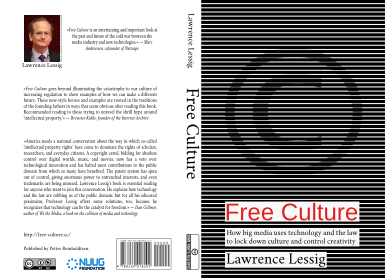
Petter Reinholdtsen: "Free Culture" by @lessig - The background story for Creative Commons - new edition available

Click here to buy the book. In 2004, as the Creative Commons movement gained momentum, its creator Lawrence Lessig wrote the book Free Culture to explain the problems with increasing copyright regulation and suggest some solutions. I read the book back then and was very moved by it. Reading the book inspired me and changed the way I looked on copyright law, and I would love it if more people would read it too. Because of this, I decided in the summer of 2012 to translate it to Norwegian Bokm l and publish it for those of my friends and family that prefer to read books in Norwegian. I translated the book using docbook and a gettext PO file, and a byproduct of this process is a new edition of the English original. I've been in touch with the author during by work, and he said it was fine with him if I also published an English version. So I decided to do so. Today, I made this edition available for sale on Lulu.com, for those interested in a paper book. This is the cover:

The Norwegian Bokm l version will be available for purchase in a few days. I also plan to publish a French version in a few weeks or months, depending on the amount of people with knowledge of French to join the translation project. So far there is only one active person, but the French book is almost completely translated but need some proof reading. The book is also available in PDF, ePub and MOBI formats from my github project page. Note the ePub and MOBI versions have some formatting problems I believe is due to bugs in the docbook tool dbtoepub (Debian BTS issues #795842 and #796871), but I have not taken the time to investigate. I recommend the PDF and ePub version for now, as they seem to show up fine in the viewers I have available. After the translation to Norwegian Bokm l was complete, I was able to secure some sponsoring from the NUUG Foundation to print the book. This is the reason their logo is located on the back cover. I am very grateful for their contribution, and will use it to give a copy of the Norwegian edition to members of the Norwegian Parliament and other decision makers here in Norway.

Enrico Zini: italian-fattura-elettronica-with-openssl

Italian Fattura Elettronica with OpenSSL I have had some success signing an Italian fattura elettronica with OpenSSL. I am amazed to realise that the software they gave me to do the job is of such bad quality that I felt like spending a few hours trying to do the same thing with OpenSSL instead.

Hideki Yamane: Are you still hungry?

Microsoft became Gold Sponsor of OpenBSD foundation, and LF became Platinum, for sustainable development of OpenSSH. However, Linux distribution leader Red Hat and Cloud giant AWS don't pay any money for it. Ansible doesn't work with ssh, it was acquired with huge money by Red Hat.

Why don't they donate to Core Infrastructure of their business? It's okay for its license, just Ethical thing. Not much for strategical benefit. But... you, leaders? I think you're enough to pay some money for it.

Russ Allbery: Review: Watchtower

Review: Watchtower, by Elizabeth A. Lynn
Series: Chronicles of Tornor #1
Publisher: Berkley
Copyright: February 1979
Printing: November 1982
ISBN: 0-425-06195-7
Format: Mass market
Pages: 226
Ryke is a soldier in service to Athor, lord of Tornor Keep. Or, at least, he was. Shortly before the opening lines of this book, Tornor Keep was taken by a southerner named Col Istor, and Athor was killed. Ryke is about to change sides under duress: his service to Col as a watch commander is the price of keeping Errel, Athor's son, alive. Alive does not mean treated with dignity, however; Errel's new place is to become court jester for Col's small domain. At the start of this book, I had no idea who Col Istor was or why he'd want to take over one of the border keeps that guard the country of Arun against its northern neighbor Anhard. At the end of this book, I still had little idea. Watchtower's relationship with world-building is not what you'd normally expect from a fantasy novel. There are only a few locations in this novel, and they're described in close detail but without much historical or strategic context. The narrative, despite being third person, follows Ryke very closely, and Ryke is not interested in thinking much about the history of his world that he knows and the reader doesn't. Or he may not care. Ryke does not come across as a curious or thoughtful person. He's a soldier, he lives to serve his lord, and that service transfers from Athor to Errel and simply stays there, with little discussion or argument. The opening section of this novel shows Ryke trying to take care of Errel while serving Col and listening to his plans to take over the rest of the northern keeps. I found it slow, claustrophobic, and not very interesting. It reads a bit like a day in the life in some grim medieval military, with little world-building or context. Watchtower is technically fantasy, but mostly because the geography and politics are imaginary. Magic is limited to a very tiny bit of (essentially) Tarot card reading and has little impact on the plot. The story does get somewhat more interesting when two green clan messengers enter the story, and Ryke and Errel escape. Lynn introduces another community and another way of life into the story than the one Ryke is used to, one that seemed modeled after monastic orders (but with the religion toned down to nearly nonexistent). I think the intended conflict of the story is between those ways of life, their draws and implications, but even that conflict is never clearly stated. Ryke seems to move from one inevitability to another, and while he does question some of his previous views and seems to open his mind a bit, actual growth is limited in this story. I reached the end of the book feeling the world was largely unchanged from its start. This story won the World Fantasy award for best novel in 1980. I have to admit I'm baffled, although partly that's because this is not really my thing. I prefer my fantasy to have more epic sweep and a lot more world-building. But perhaps the award was for the writing, which is evocative and fills the moments of the story with closely-observed detail. It has a distinctive, choppy feel, full of short declarative sentences:
The wind blew. Like some night creature caught in a trap, Col Istor's banner flapped on its pole. Ryke wondered where his wolfhound was. Sheltering, he hoped, in some warm and windless corner. He thrust his hands beneath his armpits to warm them. He entered the kitchen, nodding at the guard who stood there, and went toward the scullery. The kitchenboys huddled together in sleep like dogs in front of the oven. He stepped over their legs. The iron pots on the walls vibrated softly.
That's a paragraph chosen at random from the start of the book and should give you a good feel for the style. I think I would have liked this novel better if it had followed anyone other than Ryke. Not only did I not care for him and his simplistic loyalties, he's the least interesting character in this story. Everyone else Col, Errel, Sorren, Van, and others is more complex and more thoughtful than he is, and I think many of them would have made a better protagonist. He spends much of the center part of the book being suspicious and closed and incurious, which means the reader can only guess at what's going on between the other characters. I can't really recommend this book, but the writing is solid and it has some interesting properties for late 1970s fantasy, including both a frank look at the role of women in this society and same-sex relationships. If your taste in fantasy leans towards the gritty and realistic, you might like it more than I did. I may try the later books of the series in the hope that they have more interesting protagonists. Followed by Dancers of Arun. Rating: 6 out of 10

Joey Hess: propelling disk images

Following up on Then and Now ... In quiet moments at ICFP last August, I finished teaching Propellor to generate disk images. With an emphasis on doing a whole lot with very little new code and extreme amount of code reuse. For example, let's make a disk image with nethack on it. First, we need to define a chroot. Disk image creation reuses propellor's chroot support, described back in propelling containers. Any propellor properties can be assigned to the chroot, so it's easy to describe the system we want.
 nethackChroot :: FilePath -> Chroot
    nethackChroot d = Chroot.debootstrapped (System (Debian Stable) "amd64") mempty d
        & Apt.installed ["linux-image-amd64"]
        & Apt.installed ["nethack-console"]
        & accountFor gamer
        & gamer  hasInsecurePassword  "hello"
        & gamer  hasLoginShell  "/usr/games/nethack"
      where gamer = User "gamer"
Now to make an image from that chroot, we just have to tell propellor where to put the image file, some partitioning information, and to make it boot using grub.
 nethackImage :: RevertableProperty
    nethackImage = imageBuilt "/srv/images/nethack.img" nethackChroot
        MSDOS (grubBooted PC)
        [ partition EXT2  mountedAt  "/boot"
             setFlag  BootFlag
        , partition EXT4  mountedAt  "/"
             addFreeSpace  MegaBytes 100
        , swapPartition (MegaBytes 256)
        ]
The disk image partitions default to being sized to fit exactly the files from the chroot that go into each partition, so, the disk image is as small as possible by default. There's a little DSL to configure the partitions. To give control over the partition size, it has some functions, like addFreeSpace and setSize. Other functions like setFlag and extended can further adjust the partitions. I think that worked out rather well; the partition specification is compact and avoids unecessary hardcoded sizes, while providing plenty of control. By the end of ICFP, I had Propellor building complete disk images, but no boot loader installed on them.
Fast forward to today. After stuggling with some strange grub behavior, I found a working method to install grub onto a disk image. The whole disk image feature weighs in at: 203 lines to interface with parted
88 lines to format and mount partitions
90 lines for the partition table specification DSL and partition sizing
196 lines to generate disk images
75 lines to install grub on a disk image
652 lines of code total Which is about half the size of vmdebootstrap 1/4th the size of partman-base (probably 1/100th the size of total partman), and 1/13th the size of live-build. All of which do similar things, in ways that seem to me to be much less flexible than Propellor.
One thing I'm considering doing is extending this so Propellor can use qemu-user-static to create disk images for eg, arm. Add some u-boot setup, and this could create bootable images for arm boards. A library of configs for various arm boards could then be included in Propellor. This would be a lot easier than running the Debian Installer on an arm board. Oh! I only just now realized that if you have a propellor host configured, like this example for my dialup gateway, leech --
 leech = host "leech.kitenet.net"
        & os (System (Debian (Stable "jessie")) "armel")
        & Apt.installed ["linux-image-kirkwood", "ppp", "screen", "iftop"]
        & privContent "/etc/ppp/peers/provider"
        & privContent "/etc/ppp/pap-secrets"
        & Ppp.onBoot
        & hasPassword (User "root")
        & Ssh.installed
-- The host's properties can be extracted from it, using eg hostProperties leech and reused to create a disk image with the same properties as the host! So, when my dialup gateway gets struck by lightning again, I could use this to build a disk image for its replacement:
 import qualified Propellor.Property.Hardware.SheevaPlug as SheevaPlug
    laptop = host "darkstar.kitenet.net"
        & SheevaPlug.diskImage "/srv/images/leech.img" (MegaBytes 2000)
            (& propertyList "has all of leech's properties"
                (hostProperties leech))
This also means you can start with a manually built system, write down the properties it has, and iteratively run Propellor against it until you think you have a full specification of it, and then use that to generate a new, clean disk image. Nice way to transition from sysadmin days of yore to a clean declaratively specified system.

22 October 2015

Norbert Preining: CafeOBJ 1.5.4 released

Yesterday we have released CafeOBJ 1.5.4 with a long list of changes, and many more internal changes. Documentation pages have been updated with the latest reference manual (PDF, Html) as well as some new docs on CITP (in Japanese for now) and tutorials. cafeobj-logo To quote from our README:
CafeOBJ is a new generation algebraic specification and programming language. As a direct successor of OBJ, it inherits all its features (flexible mix-fix syntax, powerful typing system with sub-types, and sophisticated module composition system featuring various kinds of imports, parameterised modules, views for instantiating the parameters, module expressions, etc.) but it also implements new paradigms such as rewriting logic and hidden algebra, as well as their combination.
Changes Changes since the last release are as follows Availability Binary packages for Windows, MacOS, and Linux have been built, and can be found at the CafeOBJ download page. The source code can also be found on the download page, or directly from here: cafeobj-1.5.4.tar.gz. The CafeOBJ Debian package has been updated and is already included in Debian/sid. Macports file has also been updated, please see the above download/install page for details how to add our sources to your macport. Bug reports If you find a bug, have suggestions, or complains, please open an issue at the issue tracker for CafeOBJ. For other inquiries, please use info@cafeobj.org

Daniel Pocock: New planet sites for SIP

I've started syndicating some SIP-related blogs at planet.sip5060.net (English) and planet.sip5060.net/es (Spanish). If anybody would like to have their blog added or suggest other blogs that deserve recognition, please email me. If a blog is not entirely dedicated to SIP, it is better to use a tag or category with a dedicated RSS feed URL for SIP articles. Articles related to Asterisk, FreeSWITCH, SIP proxies and softphones are all welcome. Please also remember to create links to the planet sites from your own blogs and web sites, it helps solutions based on free software to become more prominent online. Streamlining planet-site management I'm also looking for feedback about how to streamline management of the planet sites, maybe providing a self-service portal or letting people add themselves with Github pull requests. Has anybody else seen solutions for this?

Pau Garcia i Quiles: FOSDEM Desktops DevRoom 2016

It is now official: KDE will be present again at FOSDEM in the 2016 edition, on the 30th and 31st of January, 2016. Talks will take place at the Desktops DevRoom, on Sunday the 31st, but not exclusively: in past years, there were Qt and KDE-related talks at the mobile devroom, lightning talks, distributions, open document editors and more. KDE will be sharing the room with other desktop environments, as usual: Gnome, Unity, Enlightenment, Razor, etc. Representatives from those communities will be helping me in managing and organizing the devroom: Christophe Fergeau, Michael Zanetti, Philippe Caseiro and J rome Leclanche. I would like to extend the invitation to any other free/open source desktop environment and/or related stuff. Check last year s schedule for an example. Closed-source shops (Microsoft, Apple, Oracle, etc) are ALSO invited, provided that you will talk about something related to open source. We will publish the Call for Talks for the Desktops DevRoom 2016 soon. Stay tuned. In the meanwhile, you can subscribe to the Desktops DevRoom mailing list to be informed of important and useful information, and talk about FOSDEM and specific issues of the Desktops DevRoom.

Russ Allbery: Review: What If?

Review: What If?, by Randall Munroe
Publisher: Houghton Mifflin Harcourt
Copyright: 2014
ISBN: 0-544-27299-4
Format: Hardcover
Pages: 295
This is another one of those reviews that's somewhat pointless to write, at least beyond telling people who for some strange reason aren't xkcd readers that this is a thing that exists in the world. What If? is a collection of essays from that feature on the xkcd web site and new essays in the same vein. (Over half are new to this collection.) If you've read them, you know what to expect; if you haven't, and have any liking at all for odd scientific facts or stick figures, you're in for a treat. So, short review: The subtitle is Serious Scientific Answers to Absurd Hypothetical Questions, and it's exactly what it says on the tin, except that "serious" includes a healthy dose of trademark xkcd humor. Go read what-if.xkcd.com for numerous samples of Munroe's essay style. If you like what you see, this is a whole book of that: a nice, high-quality hardcover (at least the edition I bought), featuring the same mix of text and cartoon commentary, and with new (and in some cases somewhat longer) material. You probably now have all the information necessary to make a purchasing decision. If you need more motivation, particularly to buy a physical copy, the inside of the dust jacket of the hardcover is a detailed, labeled map of the world after a drain in the Marianas Trench has emptied most of the oceans onto Mars. And the book inside the dust jacket is embossed with what happens after the dinosaur on the cover is lowered into, or at least towards, the Great Pit of Carkoon. This made me particularly happy, since too often hardcovers inside the dust jacket look just like every other hardcover except for the spine lettering. Very few of them have embossed Star Wars references. Personally, I think that's a great reason to buy the hardcover even if, like me, you've been following What If? on the web religiously since it started. But of course the real draw is the new material. There's enough of it that I won't try any sort of comprehensive list, but rest assured that it's of equal or better quality than the web-published essays we know and love. My favorite of the new pieces is the answer to the question "what would happen if you made a periodic table out of cube-shaped bricks, where each brick was made of the corresponding element?" As with so many What If? questions, it starts with killing everyone in the vicinity, and then things get weird. Another nice touch in this collection is what I'd call "rejected questions": questions that people submitted but that didn't inspire an essay. Most of these (I wish all) get a single cartoon of reaction to the question itself, which include some of the funniest (and most touching) panels in the book. Ebook formatting has gotten much better, so there's some hope that at least some platforms could do justice to this book with its embedded cartoons. Putting the footnotes properly at the bottom of each page (thank you!) might be a challenge, though. Writing mixed with art is one of the things I think benefits greatly from a physical copy, and the hardcover is a satisfying and beautiful artifact. (I see there's also an audio book, but I'm sure how well that could work; so much of the joy of What If? is the illustrations, and I'm dubious that one could adequately describe them.) Prior web readers will be relieved to know that the mouse-over text is preserved as italic captions under the cartoons, although sadly most cartoons are missing captions. (As I recall, that's also the case for the early web What If? essays, but later essays have mouse-over text for nearly every cartoon.) Anyway, this is a thing that exists. If you follow xkcd, you probably knew that already, given that the book was published last year and I only now got around to reading it. (My current backlog is... impressive.) If you were not previously aware of What If? or of xkcd itself, now you are, and I envy you the joy of discovery. A short bit of reading will tell you for certain whether this is something you want to purchase. If your relationship to physics is at all similar to mine, I suspect the answer will be yes. A small personal note: I just now realized how much the style of What If? resembles the mixed text and illustrations of One Two Three... Infinity. Given how foundational that book was to my love of obscure physics facts, my love of What If? is even less surprising. Rating: 10 out of 10

Joey Hess: propellor orchestration

With the disclamer that I don't really know much about orchestration, I have added support for something resembling it to Propellor. Until now, when using propellor to manage a bunch of hosts, you updated them one at a time by running propellor --spin $somehost, or maybe you set up a central git repository, and a cron job to run propellor on each host, pulling changes from git. I like both of these ways to use propellor, but they only go so far... All those scenarios are supported by propellor now! Well, I haven't actually implemented concurrently yet, but the point is that the conducts property can be used with any of propellor's property combinators, like before etc, to express all kinds of scenarios. The conducts property works in combination with an orchestrate function to set up all the necessary stuff to let one host ssh into another and run propellor there.
main = defaultMain (orchestrate hosts)
hosts = 
    [ master
    , webservers 
    , ...
    ]
The orchestrate function does a bunch of stuff: I've very pleased that I was able to add the Propellor.Property.Conductor module implementing this with only a tiny change to the rest of propellor. Almost everything needed to implement it was there in propellor's infrastructure already. Also kind of cool that it only needed 13 lines of imperative code, the other several hundred lines of the implementation being all pure code.

21 October 2015

Daniel Pocock: A mission statement for free real-time communications

At FOSDEM 2013, the RTC panel in the main track used the tag line "Can we finally replace Skype, Viber, Twitter and Facebook?" Does replacing something else have the right ring to it though? Or does such a goal create a negative impression? Even worse, does the term Skype replacement fall short of being a mission statement that gives people direction and sets expectations of what we would actually like to replace it with? Towards a clearer definition Lets consider what a positive statement might look like:
Making it as easy as possible to make calls to other people and to receive calls from other people for somebody who chooses only to use genuinely Free Software, open standards, a free choice of service providers and a credible standard of privacy.
If you agree with this or if you feel you can propose a more precise statement, please come and share your thoughts on the Free RTC email list. The value of a mission statement should not be underestimated. With the right mission statement, it should be possible to envision what the future will look like if we succeed and also if we don't. With the vision of success in mind, it should be easier for developers and the wider free software community to identify the steps that must be taken to make progress.

DebConf team: DebConf15 dates are set, come and join us! (Posted by DebConf15 team)

At DebConf14 in Portland, Oregon, USA, next year s DebConf team presented their conference plans and announced the conference dates: DebConf15 will take place from 15 to 22 August 2015 in Heidelberg, Germany. On the Open Weekend on 15/16 August, we invite members of the public to participate in our wide offering of content and events, before we dive into the more technical part of the conference during following week. DebConf15 will also be preceeded by DebCamp, a time and place for teams to gather for intensive collaboration. A set of slides from a quick show-case during the DebConf14 closing ceremony provide a quick overview of what you can expect next year. For more in-depth information, we invite you to watch the video recording of the full session, in which the team provides detailed information on the preparations so far, location and transportation to the venue at Heidelberg, the different rooms and areas at the Youth Hostel (for accommodation, hacking, talks, and social activities), details about the infrastructure that are being worked on, and the plans around the conference schedule. We invite everyone to join us in organising this conference. There are different areas where your help could be very valuable, and we are always looking forward to your ideas. Have a look at our wiki page, join our IRC channels and subscribe to our mailing lists. We are also contacting potential sponsors from all around the globe. If you know any organisation that could be interested, please consider handing them our sponsorship brochure or contact the fundraising team with any leads. Let s work together, as every year, on making the best DebConf ever!

Russell Coker: LUV Server Upgrade to Jessie

On Sunday night I started the process of upgrading the LUV server to Debian/Jessie from Debian/Wheezy. My initial plan was to just upgrade Apache first but dependencies required upgrading systemd too. One problem I ve encountered in the past is that the Wheezy version of systemd will often hang on an upgrade to a newer version. Generally the solution to this is to run systemctl daemon-reexec from another terminal. The problem in this case was that not all the libraries needed for systemd had been installed, so systemd could re-exec itself but immediately aborted. The kernel really doesn t like it when process 1 aborts repeatedly and apparently immediately hanging is the result. At the time I didn t know this, all I knew was that my session died and the server stopped responding to pings immediately after I requested a reexec. The LUV server is hosted at VPAC for free. As their staff have actual work to do they couldn t spend a lot of time working on the LUV server. They told me that the screen was flickering and suspected a VGA cable. I got to the VPAC server room with the spare LUV server (LUV had been given 3 almost identical Sun servers from Barwon Water) at 16:30. By 17:30 I had fixed the core problem (boot with init=/bin/bash , mount the root filesystem rw, finish the upgrade of systemd and it s dependencies, and then reboot normally). That got it into a stage where the Xen server for Wikimedia Au was working but most LUV functionality wasn t working. By 23:00 on Monday I had the full list server functionality working for users, this is the main feature that users want when it s not near a meeting time. I can t remember whether it was Monday night or Tuesday morning when I got the Drupal site going (the main LUV web site). Last night at midnight I got the last of the Mailman administrative interface going, I admit I could have got it going a bit earlier by putting SE Linux in permissive mode, but I don t think that the members would have benefited from that (I ll upload a SE Linux policy package that gets Mailman working on Jessie soon). Now it s Wednesday and I m still fixing some cron jobs. Along the way I noticed some problems with excessive disk space use that I m fixing now and I ve also removed some Wikimedia related configuration files that were obsolete and would have prevented anyone from using a wikimedia.org.au address to subscribe to the LUV mailing lists. Now I believe that everything is working correctly and generally working better than before. Lessons Learned While Sunday night wasn t a bad time to start the upgrade it wasn t the best. If I had started the upgrade on Monday morning there would have been less down-time. Another possibility might be to do the upgrade while near the VPAC office during business hours, I could have started the upgrade while at a nearby cafe and then visited the server room immediately if something went wrong. Doing an upgrade on a day when there s no meeting within a week was a good choice. It wasn t really a conscious choice as I m usually doing other LUV work near the meeting day which precludes doing other LUV work that doesn t need to be done soon. But in future it would be best to consciously plan upgrades for a date when users aren t going to need the service much. While the Wheezy systemd bug is unlikely to ever be fixed there are work-arounds that shouldn t result in a broken server. At the moment it seems that the best option would be to kill -9 the systemctl processes that hang until the packages that systemd depends on are installed. The problem is that the upgrade hangs while the new systemctl tries to tell the old systemd to restart daemons. If we can get past that to the stage where the shared objects are installed then it should be ok. The Apache upgrade from 2.2.x to 2.4.x changed the operation of some access control directives and it took me some time to work out how to fix that. Doing a Google search on the differences between those would have led me to the Apache document about upgrading from 2.2 to 2.4 [1]. That wouldn t have prevented some down-time of the web sites but would have allowed me to prepare for it and to more quickly fix the problems when they became apparent. Also the rather confusing configuration of the LUV server (supporting many web sites that are no longer used) didn t help things. I think that removing cruft from an installation before an upgrade would be better than waiting until after things break. Next time I do an upgrade of such a server I ll write notes about it while I go. That will give a better blog post about it if it becomes newsworthy enough to be blogged about and also more opportunities to learn better ways of doing it. Sorry for the inconvenience.

Antoine Beaupr : Proprietary VDSL2 Linux routers adventures

I recently bought a wireless / phone adapter / VDSL modem from my Internet Service Provider (ISP) during my last outage. It generally works fine as a VDSL modem, but unfortunately, I can't seem to get used to configuring the device through their clickety web user interface... Furthermore, I am worried that I can't backup the config in a meaningful way, that is: if the device fails, I will probably not find the same model again and because they run a custom Linux distributions, the chances of the backup being possible to restore on another machine are basically zero. No way i will waste my time configuring this black box. So I started looking at running a distribution like OpenWRT on it.
(Unfortunately, I don't even dare hoping to run a decent operating system like Debian on those devices, if only because of the exotic chipsets that require all sorts of nasty hacks to run...)
The machine is a SmartRG SR630n (specs). I am linking to third party site, because the SmartRG site doesn't seem to know about their own product (!). I paid extra for this device to get one that would do both Wifi and VoIP, so i could replace two machines: my current Soekris net5501 router and a Cisco ATA 186 phone adapter that seems to mysteriously defy the challenges of time. (I don't remember when I got that thing, but it's at least from 2006.) Unfortunately, it seems that SmartRG are running a custom, proprietary Linux distribution. According to my ISP, init is a complete rewrite that reads an XML config file (and indeed it's the format of the backup files) and does the configuration through a shared memory scheme (!?). According to DSL reports, the device seems to be running a Broadcom 63168 SOC (system on a chip) that is unsupported in Linux. There are some efforts to write drivers for those from scratch, but they have been basically stalled for years now. Here are more details on the sucker: Now the next step would logically be to "simply" build a new image with OpenWRT and install it in place. Then I would need to figure out a way to load the binary blobs into the OpenWRT kernel and run all the ADSL utilities as well. It's basically impossible: the odds of the binary modules being compatible with another arbitrary release of the Linux kernel are near zero. Furthermore, the userland tool are most likely custom as well. And worse of all: it seems that Bell Canada deployed a custom "Lucent Stinger" DSLAM which requires a custom binary firmware in the modem. This could be why the SmartRG is so bizarre in the first place. As long as the other end is non-standard, we are all screwed. And those Stinger DSLAM will stick around for a long time, thanks to bell.
See this other good explanation of Stinger.
Which means this machine is now yet another closed box sitting on the internet without firmware upgrades, totally handicapped. I will probably end up selling it back for another machine that has OpenWRT support for their VDSL modems. But there are very few such machines, and with a lot of those, VDSL support is often marked as "spotty" or "in progress". Some machines are supported but are basically impossible to find. There's the Draytek modems are also interesting because, apparently, some models run OpenWRT out of the box too, which is a huge benefit. This is because they use the more open Lantiq SOC. Which are probably not going to support Stinger lines. Still, there are some very interesting projects out there... The Omnia is one I am definitely interested in right now. I really like their approach... But then they don't have a VDSL chipset in there (I asked for one, actually). And the connectors are only mini-PCIe, which makes it impossible to connect a VDSL PCI card into it. I could find a single VDSL2 PCI card online, and it could be supported, but only the annex B is available, not the annex A, and it seems the network is using "annex A" according to the ADSL stats i had in 2015-05-28-anarcat-back-again. With such a card, I could use my existing Soekris net5501 router, slam a DSL card into it, and just use the SmartRG as a dumb wifi router/phone adapter. Then it will remain to see how supported are those VDSL cards in FreeBSD (they provide Linux source code, so that's cool). And of course, all this assumes the card works with the "Stinger" mode, which is probably not the case anyways. Besides, I have VDSL2 here, not the lowly ADSL2+. By the way, Soekris keeps on pushing new interesting products out: their net6501, with 2 extra Gig-E cards could be a really interesting high-end switch, all working with free software tools. A friend has a SmartRG 505n modem, which looks quite similar, except without the ATA connectors. And those modems are the ones that Teksavvy recommends ("You may use a Cellpipe 7130 or Sagemcom F@ST 2864 in lieu of our SmartRG SR505N for our DSL 15/10, DSL 25 or DSL 50 services."). Furthermore, Teksavvy provides a firmware update for the 505n - again, no idea if it works with the 630n. Of course, the 505n doesn't run OpenWRT either. So, long story short, again I got screwed by my ISP: I thought i would get a pretty hackable device, "running Linux" that my ISP said over the phone. I got weeks of downtime, no refund, and while i got a better line (more reliable, higher bandwidth), my costs doubled. And I have yet another computing device to worry about: instead of simplifying and reducing waste, I actually just added crap on top of my already cluttered desk. Next time, maybe I'll tell you about how my ISP overbilled me, broke IPv6 and drops large packets to the floor. I haven't had a response from them in months now... hopefully they will either answer and fix all of this (doubtful) or I'll switch to some other provider, probably Teksavvy. Many thanks to the numerous people in the DSL reports Teksavvy forum that have amazing expertise. They are even building a map of Bell COs... Thanks also to Taggart for helping me figure out how the firmware images work and encouraging me to figure out how my machine works overall.
Note: all the information shared here is presented in the spirit of the fair use conditions of copyright law.

20 October 2015

Russ Allbery: Review: The Oathbound

Review: The Oathbound, by Mercedes Lackey
Series: Vows and Honor #1
Publisher: DAW
Copyright: July 1988
ISBN: 0-88677-414-4
Format: Mass market
Pages: 302
This book warrants a bit of explanation. Before Arrows of the Queen, before Valdemar (at least in terms of publication dates), came Tarma and Kethry short stories. I don't know if they were always intended to be set in the same world as Valdemar; if not, they were quickly included. But they came from another part of the world and a slightly different sub-genre. While the first two Valdemar trilogies were largely coming-of-age fantasy, Tarma and Kethry are itinerant sword-and-sorcery adventures featuring two women with a soul bond: the conventionally attractive, aristocratic mage Kethry, and the celibate, goddess-sworn swordswoman Tarma. Their first story was published, appropriately, in Marion Zimmer Bradley's Swords and Sorceress III. This is the first book about Tarma and Kethry. It's a fix-up novel: shorter stories, bridged and re-edited, and glued together with some additional material. And it does not contain the first Tarma and Kethry story. As mentioned in my earlier Valdemar reviews, this is a re-read, but it's been something like twenty years since I previously read the whole Valdemar corpus (as it was at the time; I'll probably re-read everything I have on hand, but it's grown considerably, and I may not chase down the rest of it). One of the things I'd forgotten is how oddly, from a novel reader's perspective, the Tarma and Kethry stories were collected. Knowing what I know now about publishing, I assume Swords and Sorceress III was still in print at the time The Oathbound was published, or the rights weren't available for some other reason, so their first story had to be omitted. Whatever the reason, The Oathbound starts with a jarring gap that's no less irritating in this re-read than it was originally. Also as is becoming typical for this series, I remembered a lot more world-building and character development than is actually present in at least this first book. In this case, I strongly suspect most of that characterization is in Oathbreakers, which I remember as being more of a coherent single story and less of a fix-up of puzzle and adventure stories with scant time for character growth. I'll be able to test my memory shortly. What we do get is Kethry's reconciliation of her past, a brief look at the Shin'a'in and the depth of Tarma and Kethry's mutual oath (unfortunately told more than shown), the introduction of Warrl (again, a relationship that will grow a great deal more depth later), and then some typical sword and sorcery episodes: a locked room mystery, a caravan guard adventure about which I'll have more to say later, and two rather unpleasant encounters with a demon. The material is bridged enough that it has a vague novel-like shape, but the bones of the underlying short stories are pretty obvious. One can tell this isn't really a novel even without the tell of a narrative recap in later chapters of events that you'd just read earlier in the same book. What we also get is rather a lot of rape, and one episode of seriously unpleasant "justice." A drawback of early Lackey is that her villains are pure evil. My not entirely trustworthy memory tells me that this moderates over time, but early stories tend to feature villains completely devoid of redeeming qualities. In this book alone one gets to choose between the rapist pedophile, the rapist lord, the rapist bandit, and the rapist demon who had been doing extensive research in Jack Chalker novels. You'll notice a theme. Most of the rape happens off camera, but I was still thoroughly sick of it by the end of the book. This was already a cliched motivation tactic when these stories were written. Worse, as with the end of Arrow's Flight, the protagonists don't seem to be above a bit of "turnabout is fair play." When you're dealing with rape as a primary plot motivation, that goes about as badly as you might expect. The final episode here involves a confrontation that Tarma and Kethry brought entirely on themselves through some rather despicable actions, and from which they should have taken a lesson about why civilized societies have criminal justice systems. Unfortunately, despite an ethical priest who is mostly played for mild amusement, no one in the book seems to have drawn that rather obvious conclusion. This, too, I recall as getting better as the series goes along and Lackey matures as a writer, but that only helps marginally with the early books. Some time after the publication of The Oathbound and Oathbreakers, something (presumably the rights situation) changed. Oathblood was published in 1998 and includes not only the first Tarma and Kethry story but also several of the short stories that make up this book, in (I assume) something closer to their original form. That makes The Oathbound somewhat pointless and entirely skippable. I re-read it first because that's how I first approached the series many years ago, and (to be honest) because I'd forgotten how much was reprinted in Oathblood. I'd advise a new reader to skip it entirely, start with the short stories in Oathblood, and then read Oathbreakers before reading the final novella. You'd miss the demon stories, but that's probably for the best. I'm complaining a lot about this book, but that's partly from familiarity. If you can stomach the rape and one stunningly unethical protagonist decision, the stories that make it up are solid and enjoyable, and the dynamic between Tarma and Kethry is always a lot of fun (and gets even better when Warrl is added to the mix). I think my favorite was the locked room mystery. It's significantly spoiled by knowing the ending, and it has little deeper significance, but it's a classic sort unembellished, unapologetic sword-and-sorcery tale that's hard to come by in books. But since it too is reprinted (in a better form) in Oathblood, there's no point in reading it here. Followed by Oathbreakers. Rating: 6 out of 10

Ritesh Raj Sarraf: Controlling ill behaving applications with Linux Cgroups

For some time, I have been wanting to read more on Linux Cgroups to explore possibilities of using it to control Ill behaving applications. At this time, while I'm stuck in travel, it has given me some time to look into it. In our Free Software world, most of the things are do-o-cracy, i.e. when your use case is not the common one, it is typically you who has to explore possible solutions. It could be Bugs, Feature Requests or as is in my case, performance issues. But that is not to assume that we do not have better quality software in Free Software world. Infact, in my opinion, some of the tools available are far much more better than the competition in terms of features, and to add a sweetener (or nutritional facts) to it is the fact that Free Software liberates the user. One of my favorite tool, for photo management, is Digikam. Digikam is a big project, very featureful, and has some functionalities that may not be available in the competition. But as is with most Free Software projects, Digikam is a tool which underneath consumes many more subprojects from the Free Software ecosystem. For anyone who has used Digikam, may know some of the bugs that surface on it. Not necessarily a bug in Digikam, but maybe in one of the underneath libraries/tools that it consumes (Exiv, libkface, marble, OpenCV, libPGF etc). But the bottom line is that the overall Digikam experience (and if I may say: the overall GNU/Linux experience) takes a hit. Digikam has pretty powerful features for annotation, tagging, facial recognition. These features, together with Digikam, make it a compelling product. But the problem is that many of these projects are independent. Thus tight integration is a challenge. And at times, bugs can be hard to find, root cause and fix. Let's take a real example here. If you were to use Digikam today (version 4.13.0) with annotation, tagging and facial recognition as some of the core features for your use case, you may run into frustrating overall experience. Not just that, the bugs would also effect your overall GNU/Linux experience. The facial recognition feature, if triggered, will eat up all your memory. Thus leading you to uncover Linux's long old memory bug. The tagging feature, if triggered, again will lead to frequent I/O. Thus again leading to a stalled Linux system because of blocked CPU cycled, for nothing. So one of the items on my TODO list was to explore Linux Cgroups, and see if it was cleanly possible to tame a process to a confinement, so that even if it was ill behaving (for whatever reasons), your machine does not take the beating. And now that the cgroups consumer dust has kinda settled down, systemd was my first obvious choice to look at. systemd provides a helper utility, systemd-run, for similar tasks. With systemd-run, you could apply all the resource controller logic to the given process, typically cpu, memory and blkio. And restrict it to a certain set. You can also define what user to run the service as.
rrs@learner:/var/tmp/Debian-Build/Result$ systemd-run -p BlockIOWeight=10 find /
Running as unit run-23805.service.
2015-10-20 / 21:37:44         
rrs@learner:/var/tmp/Debian-Build/Result$ systemctl status -l run-23805.service
  run-23805.service - /usr/bin/find /
   Loaded: loaded
  Drop-In: /run/systemd/system/run-23805.service.d
            50-BlockIOWeight.conf, 50-Description.conf, 50-ExecStart.conf
   Active: active (running) since Tue 2015-10-20 21:37:44 CEST; 6s ago
 Main PID: 23814 (find)
   Memory: 12.2M
      CPU: 502ms
   CGroup: /system.slice/run-23805.service
            23814 /usr/bin/find /
Oct 20 21:37:45 learner find[23814]: /proc/3/net/raw6
Oct 20 21:37:45 learner find[23814]: /proc/3/net/snmp
Oct 20 21:37:45 learner find[23814]: /proc/3/net/stat
Oct 20 21:37:45 learner find[23814]: /proc/3/net/stat/rt_cache
Oct 20 21:37:45 learner find[23814]: /proc/3/net/stat/arp_cache
Oct 20 21:37:45 learner find[23814]: /proc/3/net/stat/ndisc_cache
Oct 20 21:37:45 learner find[23814]: /proc/3/net/stat/ip_conntrack
Oct 20 21:37:45 learner find[23814]: /proc/3/net/stat/nf_conntrack
Oct 20 21:37:45 learner find[23814]: /proc/3/net/tcp6
Oct 20 21:37:45 learner find[23814]: /proc/3/net/udp6
2015-10-20 / 21:37:51         
But, out of the box, graphical applications do not work. I haven't looked, but it should be doable by giving it the correct environment details.
Underneath, systemd is using the same Linux Control Groups to limit resources for individual applications. So, in cases where you have a requirement and do not have systemd, or you directly want to make use of cgroups, it could be easily done with basic cgroups tools like cgroup-tools.
With cgroup-tools, I now have a simple cgroups hierarchy set for my current use case, i.e. Digikam
rrs@learner:/var/tmp/Debian-Build/Result$ ls /sys/fs/cgroup/memory/rrs_customCG/
cgroup.clone_children           memory.kmem.tcp.limit_in_bytes      memory.numa_stat
cgroup.event_control            memory.kmem.tcp.max_usage_in_bytes  memory.oom_control
cgroup.procs                    memory.kmem.tcp.usage_in_bytes      memory.pressure_level
digikam/                        memory.kmem.usage_in_bytes          memory.soft_limit_in_bytes
memory.failcnt                  memory.limit_in_bytes               memory.stat
memory.force_empty              memory.max_usage_in_bytes           memory.swappiness
memory.kmem.failcnt             memory.memsw.failcnt                memory.usage_in_bytes
memory.kmem.limit_in_bytes      memory.memsw.limit_in_bytes         memory.use_hierarchy
memory.kmem.max_usage_in_bytes  memory.memsw.max_usage_in_bytes     notify_on_release
memory.kmem.slabinfo            memory.memsw.usage_in_bytes         tasks
memory.kmem.tcp.failcnt         memory.move_charge_at_immigrate
2015-10-20 / 21:45:38         
rrs@learner:/var/tmp/Debian-Build/Result$ ls /sys/fs/cgroup/memory/rrs_customCG/digikam/
cgroup.clone_children           memory.kmem.tcp.max_usage_in_bytes  memory.oom_control
cgroup.event_control            memory.kmem.tcp.usage_in_bytes      memory.pressure_level
cgroup.procs                    memory.kmem.usage_in_bytes          memory.soft_limit_in_bytes
memory.failcnt                  memory.limit_in_bytes               memory.stat
memory.force_empty              memory.max_usage_in_bytes           memory.swappiness
memory.kmem.failcnt             memory.memsw.failcnt                memory.usage_in_bytes
memory.kmem.limit_in_bytes      memory.memsw.limit_in_bytes         memory.use_hierarchy
memory.kmem.max_usage_in_bytes  memory.memsw.max_usage_in_bytes     notify_on_release
memory.kmem.slabinfo            memory.memsw.usage_in_bytes         tasks
memory.kmem.tcp.failcnt         memory.move_charge_at_immigrate
memory.kmem.tcp.limit_in_bytes  memory.numa_stat
2015-10-20 / 21:45:53         
rrs@learner:/var/tmp/Debian-Build/Result$ cat /sys/fs/cgroup/cpu/rrs_customCG/cpu.shares 
1024
2015-10-20 / 21:48:44         
rrs@learner:/var/tmp/Debian-Build/Result$ cat /sys/fs/cgroup/cpu/rrs_customCG/digikam/cpu.shares 
512
2015-10-20 / 21:49:05         
rrs@learner:/var/tmp/Debian-Build/Result$ cat /sys/fs/cgroup/memory/rrs_customCG/memory.limit_in_bytes 
9223372036854771712
2015-10-20 / 22:20:14         
rrs@learner:/var/tmp/Debian-Build/Result$ cat /sys/fs/cgroup/memory/rrs_customCG/digikam/memory.limit_in_bytes 
2764369920
2015-10-20 / 22:20:27         
rrs@learner:/var/tmp/Debian-Build/Result$ cat /sys/fs/cgroup/blkio/rrs_customCG/blkio.weight
500
2015-10-20 / 21:51:43         
rrs@learner:/var/tmp/Debian-Build/Result$ cat /sys/fs/cgroup/blkio/rrs_customCG/digikam/blkio.weight
10
2015-10-20 / 21:51:50         
The base group, $USER_customCG needs super admin privileges. Which once set appropriately, allows the user to further self-define sub-groups. And users can then also define separate limits per sub-group.
With the resource limitations set in place, my overall experience on very recent hardware (Intel Haswell Core i7, 8 GiB RAM, 500 GB SSHD, 128 GB SSD) has improved considerably. It still is not perfect, but it definitely is a huge improvement over what I had to go through ealire: A stalled machine for hours.
top - 21:54:38 up 1 day,  6:46,  1 user,  load average: 7.22, 7.51, 7.37
Tasks: 299 total,   1 running, 298 sleeping,   0 stopped,   0 zombie
%Cpu0  :  7.1 us,  3.0 sy,  1.0 ni, 11.1 id, 77.8 wa,  0.0 hi,  0.0 si,  0.0 st
%Cpu1  :  6.0 us,  4.0 sy,  2.0 ni, 49.0 id, 39.0 wa,  0.0 hi,  0.0 si,  0.0 st
%Cpu2  :  5.0 us,  2.0 sy,  0.0 ni, 24.8 id, 68.3 wa,  0.0 hi,  0.0 si,  0.0 st
%Cpu3  :  5.9 us,  5.0 sy,  0.0 ni, 21.8 id, 67.3 wa,  0.0 hi,  0.0 si,  0.0 st
MiB Mem : 7908.926 total,   96.449 free, 4634.922 used, 3177.555 buff/cache
MiB Swap: 8579.996 total, 3454.746 free, 5125.250 used. 2753.324 avail Mem 
PID to signal/kill [default pid = 8879] 
  PID  PPID nTH USER        PR  NI S %CPU %MEM     TIME+ COMMAND                           UID 
 8879  8868  18 rrs         20   0 S  8.2 31.2  37:44.64 digikam                          1000 
10255  9960   4 rrs         39  19 S  1.0  0.8  19:47.73 tracker-miner-f                  1000 
10157  9960   7 rrs         20   0 S  0.5  3.0  32:29.76 gnome-shell                      1000 
    7     2   1 root        20   0 S  0.2        0:53.48 rcu_sched                           0 
  401     1   1 root        20   0 S  0.2  1.3   0:54.93 systemd-journal                     0 
10269  9937   4 rrs         20   0 S  0.2  0.4   2:34.50 gnome-terminal-                  1000 
15316     1  14 rrs         20   0 S  0.2  3.7  30:05.96 evolution                        1000 
23777     2   1 root        20   0 S  0.2        0:05.73 kworker/u16:0                       0 
23814     1   1 root        20   0 D  0.2  0.0   0:02.00 find                                0 
24049     2   1 root        20   0 S  0.2        0:01.29 kworker/u16:3                       0 
24052     2   1 root        20   0 S  0.2        0:02.94 kworker/u16:4                       0 
    1     0   1 root        20   0 S       0.1   0:18.24 systemd                             0 
The reporting tools may not be correct here. Because from what is being reported above, I should be having a machine stalled, and heavily paging, while the kernel scanning its list of processes to find the best process to kill. From this approach of jailing processes, the major side effect I can see is that the process (Digikam) is now starved of resources and will take much much much more time than what it would have been usually. But in the usual cases, it takes up all, and ends up starving (and getting killed) for consuming all available resources. So I guess it is better to be on a balanced resource diet. :-)

Categories:

Keywords:

Like:

Next.

Previous.