Search Results: "ag"

10 April 2015

Andrew Shadura: Kallithea 0.2 released

This post is almost a carbon copy of the Kallithea 0.2 release notes. Kallithea project have just released Kallithea 0.2. Kallithea is a Python-based GPLv3 source code management software for web-based hosting of Mercurial and Git repositories. This release brings many changes since 0.1. Notably, pull requests system have been improved, making contributing changes more robust. The visual appearance has also been refined: modern font-based symbolic icons from FontAwesome and GitHub Octicons have replaced the previously used bitmap icons, and revision graphs are now drawn with HiDPI display support. Kallithea now supports Mercurial 3.3 and Dulwich 0.9.9. Several fixes in the database code boosted performance significantly. We have also updated our Javascript libraries: jQuery, CodeMirror and Mergely. Javascript and CSS code have been cleaned up, with less and less code depending on Yahoo UI library. Since 0.1 we have discovered two security issues, so all users are strongly recommended to upgrade. For more details on these issues, please see our Security Notices page For more information, see https://kallithea-scm.org/ or http://docs.kallithea-scm.org/. The summary of the changes since 0.1 release is below. Bug fixes: Features and improvements: Changes (might influence workflows): Cleanup:

Richard Hartmann: Release Critical Bug report for Week 15

Still on the road with shittynet; sorry for missing last week. The UDD bugs interface currently knows about the following release critical bugs: How do we compare to the Squeeze and Wheezy release cycles?
Week Squeeze Wheezy Jessie
43 284 (213+71) 468 (332+136) 319 (240+79)
44 261 (201+60) 408 (265+143) 274 (224+50)
45 261 (205+56) 425 (291+134) 295 (229+66)
46 271 (200+71) 401 (258+143) 427 (313+114)
47 283 (209+74) 366 (221+145) 342 (260+82)
48 256 (177+79) 378 (230+148) 274 (189+85)
49 256 (180+76) 360 (216+155) 226 (147+79)
50 204 (148+56) 339 (195+144) ???
51 178 (124+54) 323 (190+133) 189 (134+55)
52 115 (78+37) 289 (190+99) 147 (112+35)
1 93 (60+33) 287 (171+116) 140 (104+36)
2 82 (46+36) 271 (162+109) 157 (124+33)
3 25 (15+10) 249 (165+84) 172 (128+44)
4 14 (8+6) 244 (176+68) 187 (132+55)
5 2 (0+2) 224 (132+92) 175 (124+51)
6 release! 212 (129+83) 161 (109+52)
7 release+1 194 (128+66) 147 (106+41)
8 release+2 206 (144+62) 147 (96+51)
9 release+3 174 (105+69) 152 (101+51)
10 release+4 120 (72+48) 112 (82+30)
11 release+5 115 (74+41) 97 (68+29)
12 release+6 93 (47+46)
13 release+7 50 (24+26)
14 release+8 51 (32+19)
15 release+9 39 (32+7)
16 release+10 20 (12+8)
17 release+11 24 (19+5)
18 release+12 2 (2+0)
Graphical overview of bug stats thanks to azhag:

Dirk Eddelbuettel: drat 0.0.3: More features, more fixes, more documentation

Several weeks ago we introduced the drat package. Its name stands for drat R Archive Template, and it helps with easy-to-create and easy-to-use repositories for R packages. Two early blog posts describe drat: First Steps Towards Lightweight Repositories, and Publishing a Package, and since the previous release, a a guest post on drat was also added to the blog. Several people have started to use drat to publish their packages, and this is a very encouraging sign. I also created a new repository and may have more to say about this in another post once I get time to write something up. Today version 0.0.3 arrived on CRAN. It rounds out functionality, adds some fixes and brings more documentation: The work on the vignettes is clearly in progress as Colin's guest post isn't really finished yet, and I am not too impressed with how the markdown is rendered at CRAN so some may still become pdf files instead. Courtesy of CRANberries, there is a comparison to the previous release. More detailed information is on the drat page.

This post by Dirk Eddelbuettel originated on his Thinking inside the box blog. Please report excessive re-aggregation in third-party for-profit settings.

9 April 2015

Mario Lang: A C++ sample collection

I am one of those people that best learns from looking at examples. No matter if I am trying to learn a programming pattern/idiom, or a completely new library or framework. Documentation is good (if it is good!) for diving into the details, but to get me started, I always want to look at a self contained example so that I can get a picture of the thing in my head. So I was very excited when a few days ago, CppSamples was announced on the ISO C++ Blog. While it is a very young site, it already contains some very useful gems. It is maintained over at GitHub, so it is also rather easy to suggest new additions, or improve the existing examples by submitting a pull request. Give it a try, it is really quite nice. In my book, the best resource I have found so far in 2015. BTW, Debian has a standard location for finding examples provided by a package. It is /usr/share/doc/<package>/examples/. I consider that very useful.

Lars Wirzenius: DPL elections for 2015 are going on

The Debian Project Leader electsions are going on. This is the yearly election for the leader, where members of the project vote for a new leader for a year. The debate this year seemed to me to be quite quiet, and voting activity seems to not be very high, either. Pity. Many years ago, the election period used to be quite energetic, bringing up some quite good viewpoints. There seems to also not have been the usual repeat of the voting announcement, not sure what's going there. There's time until next Tuesday midnight (in the UTC time zone) to vote. Below are links to the vote page (with instructions for voting) and the (corrected) initial announcment. I voted for Neil as my top candidate. I think he's got the best background and personality for being the leader of this project of ours.

Daniel Pocock: Never fly Etihad again?

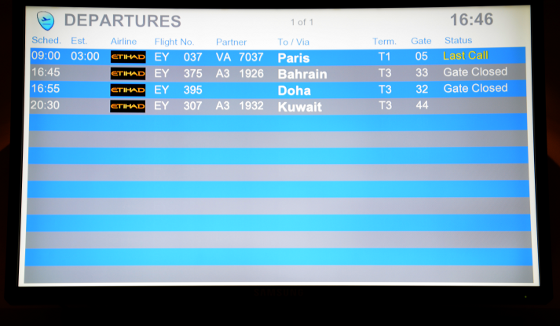
This is the first time we've flown out to Australia with Etihad and it may also be the last. We were due to fly back into Europe at CDG and head down to Lyon for the mini-DebConf this weekend. departure board, 18 hour delay for Paris Lets look at how our Etihad experience has worked out: 21:00 UTC Tuesday - waking up on Wednesday morning in Melbourne (UTC+10) 13:00 UTC Wednesday - leaving Melbourne about 11pm Wednesday night, a 12-13 hour flight to Abu Dhabi. We had heard about the air traffic control strikes in France (where we are going) and asked the airline if we should fly and they told us everything would be OK. 02:30 UTC Thursday - touchdown in Abu Dhabi, 6:30 am local time. Go to the transfer counter to ask for our boarding passes to CDG. At this stage, we were told that the connecting flight to CDG had been delayed 20 hours due to French strikes. As we are trying to reach Lyon for the mini-DebConf this weekend, we asked if we could leave Abu Dhabi on a 09:00 flight to Geneva. The Etihad staff told us to contact our travel agent (the flight was booked through Expedia) and for the next hour everybody's time was wasted making calls to Expedia who kept telling us to speak to Etihad. Whenever the Etihad customer service staff tried to speak to Expedia, the Expedia call center would hang up. Eventually, the Etihad staff told us that the deadline for putting us on the Geneva flight had passed and we would be stuck in Abu Dhabi for at least 20 hours. For flights to and from Europe, airlines have a responsibility to arrange hotels for passengers if there is a lengthy delay. If the airline is at fault, they must also pay some extra cash compensation but for a strike situation that is not applicable. Etihad has repeatedly fobbed us off. Initially we were given vouchers for Burger King or a pizza slice and told to hang around the transfer counter. By about 12:00 UTC (4pm local time, nine hours of waiting around the transfer counter) there was still no solution. One passenger was so upset that the airport security were called to speak to him and he was taken away. The airline staff kept giving excuses. Some passengers had been sent to a hotel but others left behind. I asked them again about our hotel and they kept trying to fob me off. Faced with the possibility that I would miss two nights of sleep and eight hours time difference coming into Europe, I continued asking the Etihad staff to own up to their responsibilities and they eventually offered us access to their airport lounge. We discovered some other passengers in the lounge too, including the passenger who had earlier been escorted away by security. This is unlike anything we've experienced with any other airline. At every opportunity (the check-in at Melbourne, or when the Geneva flight was boarding), the airline has failed to make arrangements that would have avoided cost and inconvenience. Assuming the flight goes ahead with a 20 hour delay, we will arrive in CDG some time Friday morning and not really sleep in a proper bed again until Friday night, about 70 hours after getting up in Melbourne on Wednesday morning. Thanks Etihad, you are a waking nightmare. The airline has been evasive about how they will deal with our onward travel from CDG to Lyon. We had booked a TGV train ticket already but it is not valid after such a long delay and it seems quite possible that trains will be busier than usual thanks to the air traffic control strike. So we don't even know if we will be loitering around a Paris airport or railway station for hours on Friday and nobody from the airline or Expedia really seems to care. Conclusion The only conclusion I can reach from this experience is that Etihad can't be trusted, certainly not for long journies such as Australia to Europe. Having flown through Singapore, Kuala Lumpur and Hong Kong, I know that air passengers have plenty of options available and there are many airlines that do go the extra mile to look after passengers especially on such long journeys. The airline missed opportunities to re-route us at every opportunity. It looks like they help some passengers (like those who did get to hotels) but leave many others high and dry just to stay within their budget.

8 April 2015

Gunnar Wolf: Guests in the classroom: C sar Y ez (@caesarcomptus) talks about memory assignation algorithms

Once again, on March 11 I had a great guest to save me some work and give a talk at my class! This time it was C sar Y ez, and he talked about memory management algorithms, emphasizing on ARC. The video is available, both at this server and in archive.org. Thanks a lot!

Steve McIntyre: More arm64 hardware for Debian - Applied Micro X-Gene

As a follow-up to my post about bootstrapping arm64 in Debian, we've had more hardware given to Debian for us to use in porting and building packages for arm64. Applied Micro sent me an X-Gene development machine to set up and use. Unfortunately, the timing was unlucky and the machine sat on my desk unopened for a few weeks while I was on long holiday in Australia. Once I was back, I connected it up and got it working. Out of the box, a standard Jessie arm64 installation worked using network boot (dhcp and tftp). I ran through d-i as normal and installed a working system, then handed it over to the DSA and buildd folks to get the machine integrated into our systems. Easy! The machine is now up and running as arm-arm-03.debian.org and has been building packages for a few weeks now. You can see the stats here on the buildd.debian.org site. In terms of installation, I also got the machine to boot using one of our netinst images on a USB stick, but that path didn't get very far. The USB drivers for this hardware have only quite recently gone into the mainline kernel, and haven't been backported to the Debian Jessie kernel yet. I'm hoping to get those included shortly. There's also an option to replace the U-Boot firmware that came with the X-Gene with UEFI instead, which would be much more helpful for a server platform like this. I'll look into doing that upgrade soon too, but probably after the Jessie release is done. I don't want to jinx things just now. *grin* Thanks to APM for their generous donation here, and particularly to Richard Zenkert for his help in getting this machine shipped to us.

Ben Hutchings: Call for testing: linux 3.16.7-ckt9-1

As it is nearly time to release Debian 8 (codename jessie), I've uploaded a new version of the Linux kernel to unstable which I hope will be the version to go into the initial release (8.0). The changes from the current version in testing are mostly bug fixes: Please test this new version (which should be on mirrors within the next 24 hours) and report any regressions you spot. It's now too late to add new hardware support for Debian 8.0, but we'll probably be able to improve it in subsequent point releases. So, please also report driver changes that should be backported from later kernel versions to improve hardware support, with severity of 'important'. If you can provide precise information about which upstream commits are needed, that makes things easier for us, and you should add the 'patch' tag.

7 April 2015

Wouter Verhelst: C11 function overloading

About four years ago, the ISO 9899:2011 "C11" standard was announced. At the time, I had a short look at (a draft version of) the standards document, and found a few interesting bits in there. Of course, however, due to it only very recently having been released, I did not have much hope of it being implemented to any reasonable amount anywhere yet. Which turned out to be the case. Even if that wasn't true, writing code that uses C11 features and expecting it to work just about anywhere else would have been a bad idea back then. We're several years down the line now, however, and now the standard has been implemented to a reasonable extent in most compilers. GCC claims its "support [for C11] is at a similar level of completeness to (...) C99 support" since GCC 4.9. Since my laptop has GCC 4.9, I looked at one feature in C11 that I have been wanting to use for a while: Generic selection.
#include <stdint.h>
#include <inttypes.h>
#include <stdio.h>
void say32(uint32_t i)  
    printf("32-bit variable: %" PRId32 "\n", i);
 
void say64(uint64_t i)  
    printf("64-bit variable: %" PRId64 "\n", i);
 
void sayother(int i)  
    printf("This is something else.\n");
 
#define say(X) _Generic((X), uint32_t: say32, uint64_t: say64, default: sayother)(X)
int main(void)  
    uint32_t v32 = 32;
    uint64_t v64 = 64;
    uint8_t v8 = 8;
    say(v32);
    say(v64);
    say(v8);
 
Output of the above:
32-bit variable: 32
64-bit variable: 64
This is something else.
or, "precompiler-assisted function overloading for C". Should be useful for things like:
#define ntoh(X) _Generic((X), int16_t: ntohs, uint16_t: ntohs, int32_t: ntohl, uint32_t: ntohl)(X)
#define hton(X) _Generic((X), int16_t: ntohs, uint16_t: htons, int32_t: ntohl, uint32_t: htonl)(X)
... and if one adds the ntohll found here, it can do 64 bit as well.

Thorsten Glaser: exciting news, or so

I implemented <? support (including <?php ) script embedding support for *.inc in MirWebseite today; the specific syntax was explicitely requested by Natureshadow. Ugh. My own hacking activities are progressing, even if slowly. I do some other interesting, funny, social, beneficial, etc. stuff in between, though. I ll even have to get some of my DD buddies to sponsor me some QA uploads of packages I formerly maintained, whereever changes are queued up such as better old-format repo compatibility in cvs(GNU) Though some of the stuff I do at work is currently done only there sorry. Also: prepare to be fully enlightened about just what evil (nice picture) Docker is. I especially liked the comparison of containers to a herd of cattle, mere numbers, replaceable, whereas VMs are cats, each with their individual name, lovely petted each day, etc. ObHint: Some may have noticed I do have a Twitter account now. I do not really use it much. I got it because I wanted to rant at someone who only gave Twitter as means to contact them (a European company running a lottery for USA citizens only). But I found one nice thing: @HourlyCats (though @FacesPics and @BahnAnsagen are funny too, and the Postillon anyway). The internet is there for cat content, anyway.
Ahem. Do not contact me there, use IRC, more specifically, the Freenode network, and possibly memoserv to mirabilos instead, I can t fit things into 140 chars, that s just ridiculous. Also, don t follow me. It may contain rants, it s NSFW, and I m not censoring there. As I said: I do not use it. So should you. (But kudos for having a mostly functional fallback site (the mobile one), which even works in PocketIE (Windows Mobile) and Opera 9, though not so much lynx(1) ) odc (from #!/bin/mksh on IRC) is hacking support to use mksh instead of GNU bash for bootstrapping pkgsrc (e.g. on Solaris). Nice! Good luck! propos mksh(1), dear Debian armel and armhf buildd maintainer colleagues, pretty please with strawberries and chocolate ice on top (I just had that on waffles at my favourite ice salon, so I may be biased), do like s390x and update your chroots and wanna-build give-back mksh, as we requested, so the privacy fix makes it into jessie. Thanks in advance! Oh, and Y_Plentyn and I both have been putting more and updated packages into my APT repository. XTaran held a talk at CLT 2015 mentioning it maybe I should write up some docs about how to use it for which purposes (e.g. how to avoid systemd but not get the other packages from it, or how to use it with systemd (trivial but has to be stated, it s freedom of choice after all), etc.)? Besides decent fanfiction (the stories in the Uzumaki Naruto universe seem, on average, to be much longer than those in the Harry Potter one), the weather is becoming good, so I ve already been enjoying going out for some geocaching and will have the bike fixed at the shop RSN (it suffers a bit each winter, as it stands outside, since our basement is mouldy, which is worse than a bit of rust IMHO) to get more activity in. Also planning to head to the GPS Maze in Mainz and, besides what time FrOSCon (including preparation) allows, heading to DebConf for a while. mirabilos  Waypoints

Wouter Verhelst: C11 operator overloading

C11 function overloading About four years ago, the ISO 9899:2011 "C11" standard was announced. At the time, I had a short look at (a draft version of) the standards document, and found a few interesting bits in there. Of course, however, due to it only very recently having been released, I did not have much hope of it being implemented to any reasonable amount anywhere yet. Which turned out to be the case. Even if that wasn't true, writing code that uses C11 features and expecting it to work just about anywhere else would have been a bad idea back then. We're several years down the line now, however, and now the standard has been implemented to a reasonable extent in most compilers. GCC claims its "support [for C11] is at a similar level of completeness to (...) C99 support" since GCC 4.9. Since my laptop has GCC 4.9, I looked at one feature in C11 that I have been wanting to use for a while: Generic selection.
#include <stdint.h>
#include <inttypes.h>
#include <stdio.h>
void say32(uint32_t i)  
    printf("32-bit variable: %" PRId32 "\n", i);
 
void say64(uint64_t i)  
    printf("64-bit variable: %" PRId64 "\n", i);
 
void sayother(int i)  
    printf("This is something else.\n");
 
#define say(X) _Generic((X), uint32_t: say32, uint64_t: say64, default: sayother)(X)
int main(void)  
    uint32_t v32 = 32;
    uint64_t v64 = 64;
    uint8_t v8 = 8;
    say(v32);
    say(v64);
    say(v8);
 
Output of the above:
32-bit variable: 32
64-bit variable: 64
This is something else.
or, "precompiler-assisted function overloading for C". Should be useful for things like:
#define ntoh(X) _Generic((X), int16_t: ntohs, uint16_t: ntohs, int32_t: ntohl, uint32_t: ntohl)(X)
#define hton(X) _Generic((X), int16_t: ntohs, uint16_t: htons, int32_t: ntohl, uint32_t: htonl)(X)
... and if one adds the ntohll found here, it can do 64 bit as well.

Mario Lang: I am sorry, but this looks insane

I am a console user. I really just started to use X11 again about two weeks ago, to sometimes test an a Qt application I am developing. I am not using Firefox or anything similar, all my daily work happens in shells and inside of emacs, in a console, not in X11. BRLTTY runs all the time, translating the screen content to something that my braille display can understand, sent out via USB. So the most important programs to me, are really emacs, and brltty. This is my desktop, that is up since 179 days.
PID   USER      PR  NI    VIRT    RES    SHR S  %CPU %MEM     TIME+ COMMAND
 1227 message+  20   0    7140   2860    672 S   0,0  0,1 153:33.10 dbus-daemon
21457 root      20   0   44456   1116    788 S   0,0  0,1 146:42.47 packagekitd
    1 root      20   0   24348   2808   1328 S   0,0  0,1 109:16.99 systemd
 7897 mlang     20   0  585776 121656   4188 S   0,0  6,0 105:22.40 emacs
13332 root      20   0   10744    432    220 S   0,0  0,0  91:55.96 ssh
19581 root      20   0    4924   1632   1076 S   0,0  0,1  53:33.56 systemd
19596 root      20   0   20312   9764   9660 S   0,0  0,5  48:10.76 systemd-journal
10172 root      20   0   85308   2472   1672 S   0,0  0,1  20:30.18 NetworkManager
   29 root      20   0       0      0      0 S   0,0  0,0  18:40.24 kswapd0
13334 root      20   0  120564   5748    304 S   0,0  0,3  16:20.89 sshfs
    7 root      20   0       0      0      0 S   0,0  0,0  15:21.15 rcu_sched
14245 root      20   0    7620    316    152 S   0,0  0,0  15:08.64 ssh
  438 root      20   0       0      0      0 S   0,0  0,0  12:14.80 jbd2/dm-1-8
11952 root      10 -10   42968   2028   1420 S   0,0  0,1  10:36.20 brltty
I am sorry, but this doesn't look right, not at all. I am not even beginning to talk about dbus-daemon and systemd. Why the HECK does packagekitd (which I definitely don't use actively) use up more then two hours of plain CPU time? What did it do, talk to NSA via an asymmetric cipher, or what?! I play music via sshfs, sometimes FLAC files. That barely consumed more CPU time then brltty, which is probably the most active daemon on my system, erm, it should be. I don't want to chime into any flamewars. I have accepted that we have systemd. But this does not look right! I remember, back in the good old days, emacs and brltty were my top CPU users.

Carl Chenet: Backup Checker, the ServerSpec for your backups

Follow me on Identi.ca or Twitter or Diaspora*diaspora-banner Sysadmins usually know ServerSpec, a tool allowing to check if your servers are correctly configured. The use of automated deployment tools makes deployments easier and easier, but lot of unexpected situations can come up using this tool, especially when more and more servers are implied. ServerSpec allows to verify that the result of your deployments are what you were expecting for and that no exception or unexpected event goes undetected. serverspec Backup Checker (Github stars appreciated :)) offers the same kind of controls, but for your backups. Once you have backups, you don t know if they contain what you are expecting for. And this is especially important because having broken backups mean losing your data after a major outage! Moreover if you think you are well protected with backups but they are eventually broken (corrupted archives, archives being filled with empty files, saving useless files ), you will perform your server or database upgrades without being really protected, leading to terrible situations.
github-logo

Backup Checker on github

Backup Checker offers lots of controls over backups: Use Backup Checker with Backup-Manager or Rsnapshot Starting from Backup Checker 1.7,if you use a backup tool like Backup-Manager or Rsnapshot, you ll be glad to know that Backup Checker perfectly works with them. The documentation is available on the Backup Checker Community page with the howtos to install and configure Backup Checker with Backup-Manager or with Rsnapshot. weneedyou What about you? Let us know in the comments what you think of Backup Checker and its features to connect with other backup tools. We would be happy to get your feedbacks about how you use Backup Checker or what you expect from a backup checking solution.

Olivier Berger: Publishing my papers as Linked Research

I intend to make the extra effort of republishing my own research papers as Linked Research, i.e. in a form readable by humans (HTML5), but also embedding meta-data (as RDF) for machine processing. I ve started with Authoritative Linked Data descriptions of Debian source packages using ADMS.SW (a good candidate, as it deals with Linked Data ;). You ll notice the menu which helps select different style sheets for preparing clean printable versions, not far from the LaTeX output usually converted to PDF. I hope this will pave the way to more Linked Research, and less opaque publications. The only hassle at the moment is the conversion from LaTeX to HTML5 which I m doing manually, in Emacs + nxml-mode. Update: Check the preprint links in my publications page, for more papers.

Mike Hommey: Announcing git-cinnabar 0.2.0

Git-cinnabar is a git remote helper to interact with mercurial repositories. It allows to clone, pull and push from/to mercurial remote repositories, using git. Get it on github. What s new since 0.1.1? What to expect next? If you want to follow the improvements more closely, I encourage you to switch to the next branch. I won t push anything there that hasn t been extensively tested on the above mentioned repositories. And as always, please report any issue you run into.

6 April 2015

Daniel Pocock: Dandenongs

The final part of our latest Australia trip took us to the Dandenong Ranges. To borrow a term from the Germans and Swiss, Mount Dandenong could be considered Melbourne's Hausberg or local mountain. On the south side of the mountain, tourists and children are impressed by the Puffing Billy railway at Belgrave: Keen runners can race the train in about May each year in a 13km course through the mountains. You need to stay at least thirty seconds ahead of the train to avoid being stuck at the level crossings. My own fastest time was about two minutes faster than the train. Leaving Belgrave, there is a short but steep drive up to the Mount Dandenong summit following the road towards Monbulk and Olinda. From the top, you can view the whole city, Port Philip Bay and various other mountain ranges in other directions:

Daniel Leidert: Motion picture capturing: Debian + motion + Logitech C910

Woodpecker near the windowWinter time is a good time for some nature observation. Yesterday I had a woodpecker (picture) in front of my kitchen window. During the recent weeks there were long-tailed tits, a wren and other rarely seen birds. So I thought, it might be a good idea to capture some of these events :) I still own a Logitech C910 USB camera which allows HD video capturing up to 1080p. So I checked the web for some software that would begin video capturing in the case of motion detection and found motion, already available for Debian users. So I gave it a try. I tested all available resolutions of the camera together with the capturing results. I found that the resulting framerate of both the live stream and the captured video is highly depending on the resolution and some few configuration options. Below is a summary of my tests and the results I've achieved so far.

Logitech C910 HD cameraJust a bit of data regarding the camera. AFAIK it allows for fluent video streams up to 720p.
$ dmesg
[..]
usb 7-3: new high-speed USB device number 5 using ehci-pci
usb 7-3: New USB device found, idVendor=046d, idProduct=0821
usb 7-3: New USB device strings: Mfr=0, Product=0, SerialNumber=1
usb 7-3: SerialNumber: 91CF80A0
usb 7-3: current rate 0 is different from the runtime rate 16000
usb 7-3: current rate 0 is different from the runtime rate 32000
uvcvideo: Found UVC 1.00 device (046d:0821)
input: UVC Camera (046d:0821) as /devices/pci0000:00/0000:00:1a.7/usb7/7-3/7-3:1.2/input/input17

$ lsusb
[..]
Bus 007 Device 005: ID 046d:0821 Logitech, Inc. HD Webcam C910
[..]

$ v4l2-ctl -V -d /dev/video1
Format Video Capture:
Width/Height : 1280/720
Pixel Format : 'YUYV'
Field : None
Bytes per Line: 2560
Size Image : 1843200
Colorspace : SRGB
Also the uvcvideo kernel module is loaded and the user in question is part of the video group. Installation and startInstallation of the software is as easy as always:
apt-get install motion
It is possible to run the software as a service. But for testing, I copied /etc/motion/motion.conf to ~/.motion/motion.conf, fixed its permissions (you cannot copy the file as user - it's not world readable) and disabled the daemon mode.
daemon off
Note that in my case the correct device is /dev/video1 because the laptop has a built-in camera, that is /dev/video0. Also the target directory should be writeable by my user:
videodevice /dev/video1
target_dir ~/Videos
Then running motion from the command line ...
$ motion
[..]
[0] [NTC] [ALL] motion_startup: Motion 3.2.12+git20140228 Started
[..]
[1] [NTC] [ALL] motion_init: Thread 1 started , motion detection Enabled
[0] [NTC] [ALL] main: Thread 1 is device: /dev/video1 input -1
[1] [NTC] [VID] v4l2_get_capability:
------------------------
cap.driver: "uvcvideo"
cap.card: "UVC Camera (046d:0821)"
cap.bus_info: "usb-0000:00:1a.7-1"
cap.capabilities=0x84000001
------------------------
[1] [NTC] [VID] v4l2_get_capability: - VIDEO_CAPTURE
[1] [NTC] [VID] v4l2_get_capability: - STREAMING
[1] [NTC] [VID] v4l2_select_input: name = "Camera 1", type 0x00000002, status 00000000
[1] [NTC] [VID] v4l2_select_input: - CAMERA
[..]
[1] [NTC] [ALL] image_ring_resize: Resizing pre_capture buffer to 1 items
... will begin to capture motion detection events and also output a live stream. CTRL+C will stop it again. Live streamThe live stream is available by pointing the browser to localhost:8081. However, the stream seems to run at 1 fps (frames per second) and indeed does. The stream gets more quality by this configuration:
stream_motion on
stream_maxrate 100
The first option is responsible, that the stream only runs at one fps if there is no motion detection event. Otherwise the framerate increases to its maximum value, which is either the one given by stream_maxrate or the camera limit. The quality of the stream picture can be increased a bit further too by increasing the stream_quality value. Because I neither need the stream nor the control feed I disabled both:
stream_port 0
webcontrol_port 0
Picture capturingBy default there is video and picture capturing if a motion event is detected. I'm not interested in these pictures, so I turned them off:
output_pictures off
FYI: If you want a good picture quality, then the value of quality should very probably be increased. Video capturingThis is the really interesting part :) Of course if I will "shoot" some birds (with the camera), then a small image of say 320x240 pixels is not enough. The camera allows for a capture resolution up to 1920x1080 pixels (1080p). It is advertised for fluent video streams up to 720p (1280x720 pixels). So I tried the following resolutions: 320x240, 640x480, 800x600, 640x360 (360p), 1280x720 (720p) and 1920x1080 (1080p). These are easily configured by the width and height variables. For example the following configures motion for 1280x720 pixels (720p):
width 1280
height 720
The result was really disappointing. No event is captured with more then 20 fps. At higher resolutions the framerate drops even further and at the highest resolution of 1920x1080 pixels, the framerate is only two(!) fps. Also every created video runs much too fast and even faster by increasing the framerate variable. Of course its default value of 2 (fps) is not enough for fluent videos. AFAIK the C910 can run with 30 fps at 1280x720 pixels. So increasing the value of framerate, the maximum framerate recorded, is a must-do. (If you wanna test yourself, check the log output for the value following event_new_video FPS.)The solution to the issue, that videos are running too fast, however is to increase the pre_capture value, the number of pre-captured (buffered) pictures from before motion was detected. Even small values like 3..5 result in a distinctive improvement of the situation. Though increasing the value further didn't have any effect. So the values below should almost get the most out of the camera and result in videos in normal speed.
framerate 100
pre_capture 5
Videos in 1280x720 pixels are still captured with 10 fps and I don't know why. Running guvcview, the same camera allows for 30 fps in this resolution (even 60 fps in lower resolutions). However, even if the framerate could be higher, the resulting video runs fluently. Still the quality is just moderate (or to be honest, still disappointing). It looks "pixelated". Only static pictures are sharp. It took me a while to fix this too, because I first thought, the reason is the camera or missing hardware support. It is not :) The reason is, that ffmpeg is configured to produce a moderate(?)-quality video. The relevant variables are ffmpeg_bps and ffmpeg_variable_bitrate. I got the best results just changing the latter:
ffmpeg_variable_bitrate 2
Finally the resulting video quality is promising. I'll start with this configuration setting up an observation camera for the bird feeding ground.There is one more tweak for me. I got even better results by enabling the auto_brightness feature.
auto_brightness on
Complete configurationSo the complete configuration looks like this (only those options changed to the original config file)
daemon off
videodevice /dev/video1
width 1280
height 720
framerate 100
auto_brightness on
ffmpeg_variable_bitrate 2
target_dir /home/user/Videos
stream_port 0 #8081
stream_motion on
stream_maxrate 100
webcontrol_port 0 #8080
Links Continue with part II ...

Daniel Leidert: Correct keyboard layout (QWERTZ) with Logitech K400 attached to an Android HDMI stick

I've bought an HDMI stick with Android 4.4.2 to connect a TV to the local network (stream, DLNA) and the internet (Video portals etc.). The stick comes with no input device whatsoever. So I decided for a wireless Logitech K400r keyboard. Unfortunately the keyboard layout used by Android seems to be American (QWERTY) although the language and location settings are set to German. So I neither get Umlauts nor special signs correct nor do the media keys of the K400 work. But there is an easy way to make all this work. I've recently seen some people suggesting to install an app called External Keyboard Helper to fix things, which comes in a demo and a pro version, the latter with costs. Fortunately I didn't need any of these for the Logitech keyboard plus I got all media keys of this keyboard to work in just three steps without any cost :) Step 1First I went to the Google Play Store and installed the Logitech Keyboard Plus app by Logitech Europe S.A. (See? No external stuff and without costs. Ignore anything that's written in its description about Bluetooth.)App Logitech Keyboard Plus shown at Google Play Store Step 2Then I opened the settings section and went for Settings > Language and Input (Einstellungen > Sprache und Eingabe). Under KEYBOARD & INPUT METHOD (TASTATUR & EINGABEMETHODEN) I activated the entry called Logitech keyboard (Logitech Tastatur) as shown below.Activate the entry &quote;Logitech keyboard&quote; under Settings > Language and Input Step 3Now a click on the field above that is called Default (Standard) and (here) defaults to Deutsch - Android-Tastatur (AOSP) ...Click on the field &quote;Default&quote;... opened a popup called Choose input method and there I've chosen Logitech keyboard (Logitech Tastatur) as shown below and confirmed it.Activate the Logitech keyboard on the popup called &quote;Choose input method&quote;The default now is the Logitech keyboard:The default keyboard now is the Logitech keyboard Finally ...... it's done. The keyboard now behaves as expected and also the media/function keys do work. It is however not possible to adjust or configure anything, because this presumes a confirmed Bluetooth pairing between the keyboard and the android device and the K400 is not a Bluetooth device. It would probably be a good idea for Logitech to make this app usable for all available Logitech keyboards, even USB and Unifying(TM) ones. Update: As of now it is possible to cancel the Bluetooth pairing attempt without leaving the application. So this app in fact can be used for USB and Unifying(TM)-based Logitech keyboards.

Jonathan Carter: Squashfs Performance Testing

Experiments Last week I discovered The Fan Club s Experiments page. It reminds me of the Debian Experiments community on Google+. I like the concept of trying out all kinds of different things and reporting back to the community on how it works. I ve been meaning to do more of that myself so this is me jumping in and reporting back on something I ve been poking at this weekend. Introducing Squashfs Squashfs is a read-only compressed filesystem commonly used on embedded devices, Linux installation media and remote file systems (as is done in LTSP). Typically, a system like tmpfs, unionfs or aufs is mounted over this read-only system to make it usable as a root filesystem. It has plenty of other use cases too but for the purposes of this entry we ll stick with those use cases in mind. It supports gzip, lzo and xz(lzma) as compression back-ends. It also supports block sizes from 4K up to 1M. Compression technique as well as block size can have major effects on both performance and file size. In most cases the defaults will probably be sufficient, but if you want to find a good balance between performance and space saving, then you ll need some more insight. My Experiment: Test effects of squashfs compression methods and block sizes I m not the first person to have done some tests on squashfs performance and reported on it. Bernhard Wiedemann and the Squashfs LZMA project have posted some results before, and while very useful I want more information (especially compress/uncompress times). I was surprised to not find a more complete table elsewhere either. Even if such a table existed, I probably wouldn t be satisfied with it. Each squashfs is different and it makes a big difference whether it contains already compressed information or largely uncompressed information like clear text. I d rather be able to gather compression ratio/times for a specific image rather than for one that was used for testing purposes once-off. So, I put together a quick script that takes a squashfs image, extracts it to tmpfs, and then re-compressing it using it all the specified compression techniques and block sizes and then uncompressing those same images for their read speeds. My Testing Environment For this post, I will try out my script on the Ubuntu Desktop 14.04.2 LTS squashfs image. It s a complex image that contains a large mix of different kinds of files. I m extracting it to RAM since I want to avoid having disk performance as a significant factor. I m compressing the data back to SSD and extracting from there for read speed tests. The SSD seems fast enough not to have any significant effect on the tests. If you have a slow storage, the results of the larger images (with smaller block sizes) may be skewed unfavourably. As Bernhard mentioned on his post, testing the speed of your memory can also be useful, especially when testing on different kinds of systems and comparing the results:
# dd if=/dev/zero of=/dev/null bs=1M count=100000
104857600000 bytes (105 GB) copied, 4.90059 s, 21.4 GB/s
CPU is likely to be your biggest bottleneck by far when compressing. mksquashfs is SMP aware and will use all available cores by default. I m testing this on a dual core Core i7 laptop with hyper-threading (so squashfs will use 4 threads) and with 16GB RAM apparently transferring around 21GB/s. The results of the squashfs testing script will differ greatly based on the CPU cores, core speed, memory speed and storage speed of the computer you re running it on, so it shouldn t come as a surprise if you get different results than I did. If you don t have any significant bottleneck (like slow disks, slow CPU, running out of RAM, etc) then your results should more or less correspond in scale to mine for the same image. How to Run It Create a directory and place the filesystem you d like to test as filesystem.squashfs, then:
$ apt-get install squashfs-tools 
$ wget https://raw.githubusercontent.com/highvoltage/squashfs-experiments/master/test-mksquashfs.sh
$ bash test-mksquashfs.sh
With the default values in that file, you ll end up with 18 squashfs images taking up about 18GB of disk space. I keep all the results for inspection, but I ll probably adapt/fix the script to be more friendly to disk space usage some time. You should see output that look something like this, with all the resulting data in the ./results directory.
* Setting up...
- Testing gzip
  * Running a squashfs using compression gzip, blocksize 4096
  * Running a squashfs using compression gzip, blocksize 8192
  * Running a squashfs using compression gzip, blocksize 16384
  ...
- Testing lzo
  * Running a squashfs using compression lzo, blocksize 4096
  * Running a squashfs using compression lzo, blocksize 8192
  * Running a squashfs using compression lzo, blocksize 16384
  ...
- Testing xz
  * Running a squashfs using compression xz, blocksize 4096
  * Running a squashfs using compression xz, blocksize 8192
  * Running a squashfs using compression xz, blocksize 16384
  ...
* Testing uncompressing times...
  * Reading results/squashfs-gzip-131072.squashfs...
  * Reading results/squashfs-gzip-16384.squashfs...
  * Reading results/squashfs-gzip-32768.squashfs...
  ...
* Cleaning up...
On to the Results The report script will output the results into CSV. Here s the table with my results. Ratio is percentage of the size of the original uncompressed data, CTIME and UTIME is compression time and uncompress time for the entire image.
Filename Size Ratio CTIME UTIME
squashfs-gzip-4096.squashfs 1137016 39.66% 0m46.167s 0m37.220s
squashfs-gzip-8192.squashfs 1079596 37.67% 0m53.155s 0m35.508s
squashfs-gzip-16384.squashfs 1039076 36.27% 1m9.558s 0m26.988s
squashfs-gzip-32768.squashfs 1008268 35.20% 1m30.056s 0m30.599s
squashfs-gzip-65536.squashfs 987024 34.46% 1m51.281s 0m35.223s
squashfs-gzip-131072.squashfs 975708 34.07% 1m59.663s 0m22.878s
squashfs-gzip-262144.squashfs 970280 33.88% 2m13.246s 0m23.321s
squashfs-gzip-524288.squashfs 967704 33.79% 2m11.515s 0m24.865s
squashfs-gzip-1048576.squashfs 966580 33.75% 2m14.558s 0m28.029s
squashfs-lzo-4096.squashfs 1286776 44.88% 1m36.025s 0m22.179s
squashfs-lzo-8192.squashfs 1221920 42.64% 1m49.862s 0m21.690s
squashfs-lzo-16384.squashfs 1170636 40.86% 2m5.008s 0m20.831s
squashfs-lzo-32768.squashfs 1127432 39.36% 2m23.616s 0m20.597s
squashfs-lzo-65536.squashfs 1092788 38.15% 2m48.817s 0m21.164s
squashfs-lzo-131072.squashfs 1072208 37.43% 3m4.990s 0m20.563s
squashfs-lzo-262144.squashfs 1062544 37.10% 3m26.816s 0m15.708s
squashfs-lzo-524288.squashfs 1057780 36.93% 3m32.189s 0m16.166s
squashfs-lzo-1048576.squashfs 1055532 36.85% 3m42.566s 0m17.507s
squashfs-xz-4096.squashfs 1094880 38.19% 5m28.104s 2m21.373s
squashfs-xz-8192.squashfs 1002876 34.99% 5m15.148s 2m1.780s
squashfs-xz-16384.squashfs 937748 32.73% 5m11.683s 1m47.878s
squashfs-xz-32768.squashfs 888908 31.03% 5m17.207s 1m43.399s
squashfs-xz-65536.squashfs 852048 29.75% 5m27.819s 1m38.211s
squashfs-xz-131072.squashfs 823216 28.74% 5m42.993s 1m29.708s
squashfs-xz-262144.squashfs 799336 27.91% 6m30.575s 1m16.502s
squashfs-xz-524288.squashfs 778140 27.17% 6m58.455s 1m20.234s
squashfs-xz-1048576.squashfs 759244 26.51% 7m19.205s 1m28.721s
Some notes:

Next.

Previous.