Search Results: "ron"

15 February 2008

Wouter Verhelst: ID papers

Bruce Schneier blogs about an issue that, in the context of the current vote craze in the US, seems to be pretty popular: the question of whether or not the US governments should give a drivers' license to illegal immigrants. Bruce argues in favour of giving a drivers' license to illegal immigrants, since requesting that the administration which issues drivers' licenses also check whether or not people are illegal immigrants is going to cost the government a lot of money (both from the extra amount of resources that needs to be spent on doing this job, and the lawsuits to make up for the errors). The fun bit is, I think that they are creating a problem where there is none. By not creating an official, designated, identification system, the US government is forcing people to look for alternatives, effectively giving a drivers' license a double function; that of an ID card, and that of a drivers' license. This can't be a good idea. Often the major argument against issuing ID cards is that it reduces people's privacy. I think this is wrong, for a very simple reason:
The US already has an ID card. It's called a drivers' license.
No, really. For all practical matters, that little piece of paper is an ID card. Better get done with it and issue a real ID card, then.

14 February 2008

Jordi Mallach: La Ruta del Carrilet

As Josep asks for it every now and then, and we really enjoyed this trip, it's time to write about the four days we spent cycling from Ripoll to Girona, through the Ruta del Carrilet, a Catalan via verda similar to the one we completed a year ago. I spent this year's 9 d'Octubre cycling trip with totally different trip mates, not related to my triathlon team. The extensive group was formed by Sabri, Mar, B rbara, Carles, Desi, Adela, N ria, Amador and myself. We started our journey by car from Val ncia to Mollet de Mar, where we parked the cars and take a regional train to Ripoll with our bikes, where the real journey would start.


Arrival at Ripoll When we got to Ripoll, it was quite late and dark, but we managed to find the start of the Ruta del Ferro rail trail which would take us to Sant Joan de les Abadesses. It was quite cold, but especially really humid, so we had to think twice before settling on a place to camp and setup our tents. We had to take special care of covering the bicycles as the air was really wet, and anything we left uncovered would appear soaking next morning. In part, my shoes suffered from this.

Early next morning we had breakfast on the wet grass and then started our way to Sant Joan through a deliciously well equipped and maintained cycling track, which unfortunately only lasts for 12 kilometres through a splendind landscape. After having breakfast in the old railway station in Sant Joan, we abandoned the Ruta del Ferro to take a road to Olot via Sant Pau de Seguries, where we had to climb a small mountain and then descend through the Vall de Bianya until we got to Olot.


Sant Joan de les Abadesses' railway station Asking the locals for the start of the Ruta del Carrilet was fun due to the strong oriental accent in the area and we sometimes wouldn't get a word of what we were told. An old man recommended us finding a big park in the outskirts of the town, where we prepared our entrepans for lunch, and after a little rest, we started cycling up the Carrilet, which would take us to Girona in two stages. This Catalan area is of volcanic origin, and there are several natural parks dedicated to the phenomenon. There are many mountains covered with forests and impossible peak shapes, which due to the time of the year were starting to go from green to brown and yellow, making fantastic colour schemes in the landscape.


Under a green ceiling in Olot Just after the few first kilometres, the railroad track starts to descend most of the way, which makes it easy for people who aren't too trained, and easier to enjoy your way chatting with people while you cycle. As we consumed the daylight, we came across a parish church party with lots of old and young people from the nearby town of Sant Miquel de Pineda. Amador and I were lagging behind a bit at that point, and when we got there, we found the rest of the group were already off their bikes and either having a curious look over the party, or directly following suit and dancing like the others. We had a peek into the small church and also into a small graveyard in the back, where I was surprised to find the enemies of my Catalan grandmother: Fam lia Matabosch , as one of the headstones revealed.


Partying at Sant Miquel de Pineda As it was getting late, we eventually started off again, but luckily B rbara spotted what seemed a good sleeping place for that night. To the right of the trail there was a hermitage (devoted to Santa Cec lia) up on the hill which, for bonus points, had a porch with a recently renewed roof which would help cover ourselves from humidity and rain, as we found soon after starting cooking dinner. While the cooks prepared our soup, some others went down to the Carrilet in order to find out if the next town was close so we could get some driking water for the dinner. Luckily, Sant Feliu was close enough, and we found a bar where we got some water... and two bottles of wine, which made some people back at the hermitage very happy. We were quite tired though, so we eventually went to sleep after reading some stories from a great tale book, with the sound of rain hitting the grass outside the porch. The rain was still with us when we started waking up, so we had breakfast and packed our stuff very slowly, in an attempt to avoid getting wet. But rain didn't stop, so we made a few hacks on our bicycle bagpacks to minimise the amount of rain wetting them. When we were finally ready to set off and had cycled around 3 kilometres under the light rain, it finally stopped raining, making the rest of the journey very pleasant.


Sleeping under the porch of Santa Cec lia's hermitage This part of the route is again quite beautiful, with impressive amounts of green vegetation at both sides of the track. There's a lot of water presence in the land, which makes the type of trees and bushes quite different to the ones we are used to find in the Valencian Country. After going by a few small towns, we arrived in the old railway station of Amer, hometown of the Puigdemonts. Even if it was a bit early, we decided to have lunch there, so a few of us went down to the centre of the town to buy bread and some other details to eat. Being in my friend Josep's town for the first time, I wanted to visit his family's bakery, but unfortunately it is closed on Mondays. We had lunch back at the cute station, and eventually kept going on our way to Girona. Outside Amer, the Carrilet was temporarily cut by the road, and there were two possible alternatives: using the road, with heavy lorry traffic, or diverting through a very steep track with very hard slopes. Most of the group preferred the road, but Mar, Amador and I went up that track, which was hard to climb and really fun to descend. Apparently, Amer locals call those 1.5 kilometres the Tourmalet . It's probably not so bad, though. :)


Amer's railway station Unfortunately, the Ruta del Carrilet starts getting uglier after Amer, and as you approach the more industrialised towns near the capital Girona. The area around Angl s wasn't that fun, with the track continuously being invaded by cars and other vehicles. Soon after we were in the farmland area surrounding Girona and its Devesa. Jonathan was waiting for us in the city, after his two month stay in Scotland, and we were all happy to meet him. We discarded continuing our way to the coast, which was the initial plan, and instead dropped our stuff in the house of one of Adela's friends, and went out to have dinner to a Wok restaurant, where the poor people running it suffered our childish behaviour involving the rotating central dish on our table and custard sucking contests. Jonathan guided us through the Cathedal and city wall areas of the town centre, which are impressive, and we climbed all of the wall towers to have great looks over the dark and quiet city. Eventually, we went to sleep, as Adela had to leave early, and we had to pack to get our train back to Barcelona. Back in Mollet, we cooked our last camping-gaz lunch in the park right next to the station, before noticing the place stinked of dog poo. After the careful operation of filling the three cars with 9 bicycles, we were finally on our way back to Val ncia, completing another great cycling journey. If you like bicycle tourism and can travel to this area in Catalonia, I highly recommend it, as there's many great places to visit, all of them accessible with bikes.


Having lunch in Mollet

Steve Kemp: Listen to me when I'm telling you

So today I'm a little bit lazy and I've got the day off work. As my previous plan suggested I wanted to spend at least some of the day tackling semi-random bugs. Earlier I picked a victim: less. less rocks, and I use it daily. I even wrote an introduction to less once upon a time. So lets take a look at two bugs from the long-neglected pile. These two issues are basically the same: They seem like simple ones to fix, with the same root cause. Here's an example if you want to play along at home:

 cp /dev/null testing
 gzip testing
 zless testing.gz
What do you see? I see this:
"testing.gz" may be a binary file.  See it anyway? 
When I select "y" I see the raw binary of the compressed file. So, we can reproduce it. Now to see why it happens. /bin/zless comes from the gzip package and is a simple shell script:
#!/bin/sh
# snipped a lot of text
LESSOPEN=" gzip -cdfq -- %s"; export LESSOPEN
exec less "$@"
So what happens if we run that?
$ LESSOPEN=" gzip -cdfq -- ~/testing.gz" /usr/bin/less ~/testing.gz
"/home/skx/testing.gz" may be a binary file.  See it anyway? 
i.e. it fails in the same way. Interestingly this works just fine:
gzip -cdfq -- ~/testing.gz   less
So we've learnt something interesting and useful. We've learnt that when LESSOPEN is involved we get the bug. Which suggests we should "apt-get source less" and then "rgrep LESSOPEN ~/less-*/". Doing so reveals the following function in filename.c:
	public char *
open_altfile(filename, pf, pfd)
	char *filename;
	int *pf;
	void **pfd;
 
/* code to test whether $LESSOPEN is set, and attempt to run the 
   command if it is */
		/*
		 * Read one char to see if the pipe will produce any data.
		 * If it does, push the char back on the pipe.
		 */
		f = fileno(fd);
		SET_BINARY(f);
		if (read(f, &c, 1) != 1)
		 
			/*
			 * Pipe is empty.  This means there is no alt file.
			 */
			pclose(fd);
			return (NULL);
		 
		ch_ungetchar(c);
		*pfd = (void *) fd;
		*pf = f;
		return (save("-"));
That might not be digestible, but basically less runs the command specified in $LESSOPEN. If it may read a single character of output from that command it replaces the file it was going to read with the output of the command instead! (i.e. Here less failed to read a single character, because our gzipped file was zero-bytes long! So instead it reverted to showing the binary gzipped file.) So we have a solution: If we want this to work we merely remove the "read a single character test". I can't think of circumstance in which that would do the wrong thing, so I've submitted a patch to do that. Bug(s) fixed. Incidentally if you like these kind of "debuggin by example" posts, or hate them, do let me know. So I'll know whether to take notes next time or not..

Romain Francoise: So what's wrong with 1975 programming?

I enjoyed reading the ArchitectNotes on the Varnish wiki:
Take Squid for instance, a 1975 program if I ever saw one: You tell it how much RAM it can use and how much disk it can use. It will then spend inordinate amounts of time keeping track of what HTTP objects are in RAM and which are on disk and it will move them forth and back depending on traffic patterns.

Well, today computers really only have one kind of storage, and it is usually some sort of disk, the operating system and the virtual memory management hardware has converted the RAM to a cache for the disk storage.

So what happens with squid's elaborate memory management is that it gets into fights with the kernel's elaborate memory management, and like any civil war, that never gets anything done.
Varnish was designed by FreeBSD developer Poul-Henning Kamp. There is something to be said about user-space apps designed by kernel developers: they're always super fast because kernel developers know how to make the most of the system, having spent hours optimizing the kernel itself for some usage patterns.

This is why git (designed by Linus Torvalds, for those of you who've lived under a rock for the past three years) is so much faster than other comparable systems, for example. It uses tricks such as giving the O_NOATIME flag to open() to avoid updating access times on files where it knows that they don't matter, and it's a "huge time-saver". (Of course, you can also just mount your partitions with noatime and enjoy a similar performance boost in all applications!)

12 February 2008

Eddy Petrișor: wpa2-psk with aes on a broadcom wlan0 (2.6.24)

Update: I managed to find out why the wpa_action stuff was needed. Please ignore the lines written like this; they are there just for reference.

One more update: it seems that the firmware needs to be in sync. I ended up using the wireless-2.6 kernel from the everything branch.


I just managed to get my wlan from my laptop to work with WPA2-PSK with AES with the free Broadcom driver (now named b43, formerly bcm43xx).

0b:00.0 Network controller: Broadcom Corporation BCM94311MCG wlan mini-PCI (rev 01)

0b:00.0 0280: 14e4:4311 (rev 01)

In order to do this I needed linux 2.6.24-1 from unstable and the b43 driver.
bounty:/home/eddy# lsmod   grep b43
b43 119976 0
rfkill 12816 3 rfkill_input,b43
mac80211 132236 1 b43
led_class 10120 1 b43
input_polldev 9872 1 b43
ssb 39428 2 b43,b44
pcmcia 45720 2 b43,ssb
pcmcia_core 46500 2 b43,pcmcia
firmware_class 15232 2 b43,pcmcia

The final trick was to convince wpasupplicat to reload the config with:
bounty:/home/eddy# wpa_action wlan0 reload
wpa_action: reloading wpa_supplicant configuration file via HUP signal

This is the wpasupplicant.conf file that I used:
bounty:/home/eddy# cat /etc/wpa_supplicant/wpasupplicant.conf   grep -v '^\s*#'   sed 's/psk=.*/psk=aaabbb___ENCRIPTED_SEE_wpa_password___cccddd/'
ctrl_interface=/var/run/wpa_supplicant
ap_scan=1
network=
ssid="toblerone"
scan_ssid=1
proto=RSN
key_mgmt=WPA-PSK
pairwise=CCMP
group=CCMP
psk=aaabbb___ENCRIPTED_SEE_wpa_password___cccddd


and this is the relevant interfaces area:
auto wlan0
allow-hotplug wlan0
iface wlan0 inet dhcp
wpa-driver wext
wpa-conf /etc/wpa_supplicant/wpasupplicant.conf
wpa-ap-scan 2


This is what it looks like when is working:

bounty:/home/eddy# iwconfig wlan0
wlan0 IEEE 802.11g ESSID:"toblerone"
Mode:Managed Frequency:2.412 GHz Access Point: 00:1B:FC:45:33:70
Bit Rate=48 Mb/s Tx-Power=27 dBm
Retry min limit:7 RTS thr:off Fragment thr=2346 B
Encryption key:1337-0000-C121-d73D-0207-RE41-0000-3210 [2]
Link Quality=98/100 Signal level=-36 dBm Noise level=-68 dBm
Rx invalid nwid:0 Rx invalid crypt:0 Rx invalid frag:0
Tx excessive retries:0 Invalid misc:0 Missed beacon:0
And here's the result of a scan (relevant section):
  Cell 02 - Address: 00:1B:FC:45:33:70
ESSID:"toblerone"
Mode:Master
Channel:1
Frequency:2.412 GHz (Channel 1)
Quality=93/100 Signal level=-42 dBm Noise level=-68 dBm
Encryption key:on
IE: IEEE 802.11i/WPA2 Version 1
Group Cipher : CCMP
Pairwise Ciphers (1) : CCMP
Authentication Suites (1) : PSK
Bit Rates:1 Mb/s; 2 Mb/s; 5.5 Mb/s; 11 Mb/s; 18 Mb/s
24 Mb/s; 36 Mb/s; 54 Mb/s; 6 Mb/s; 9 Mb/s
12 Mb/s; 48 Mb/s
Extra:tsf=0000000072ff542d
and here is proof it works:
bounty:/home/eddy# route -n
Kernel IP routing table
Destination Gateway Genmask Flags Metric Ref Use Iface
192.168.77.0 0.0.0.0 255.255.255.0 U 0 0 0 wlan0
0.0.0.0 192.168.77.254 0.0.0.0 UG 0 0 0 wlan0

bounty:/home/eddy# ping debian.org
PING debian.org (192.25.206.10) 56(84) bytes of data.
64 bytes from gluck.debian.org (192.25.206.10): icmp_seq=1 ttl=36 time=201 ms
64 bytes from gluck.debian.org (192.25.206.10): icmp_seq=2 ttl=36 time=199 ms
64 bytes from gluck.debian.org (192.25.206.10): icmp_seq=3 ttl=36 time=200 ms

--- debian.org ping statistics ---
3 packets transmitted, 3 received, 0% packet loss, time 1999ms
rtt min/avg/max/mdev = 199.691/200.519/201.046/0.786 ms

Woooohooo! :-)

Thanks to all people involved in b43 development and all the ones made this possible (Debian developers).

Posted from bed, via wlan.


Update: You need the firmware blob, which can be extracted from a Windows driver with bcm43xx-fwcutter (now called b43-fwcutter); I already had it from my previous attempts to configure wlan with bcm43xx. I am not sure if I should use the new tool. You really need the firmware and driver to be in sync.

Update: it seems the b43 driver page (the entire linuxwireless.org site) went down sometime yesterday evening, since yesterday afternoon I was browsing through the site without any issues. (Note: I live in Europe, for reference)

11 February 2008

Andrew Pollock: [life] Second trip to the ER

I don't think the first trip ever made a mention in either of our blogs. Funny how an exhausting trip tends to stem the care factor to write about it afterwards... Anyway, Sarah was in a fair bit of pain last night when she went to bed, and despite taking 800mg of Ibuprofen, some amount of Oxycodone, and some sleeping tablets, she was up again under 2 hours later, in agony. The main concern was that the staph infection she'd apparently had in the incision a few weeks prior hadn't been kicked fully by the antibiotics, and was coming back. So off we trotted to Stanford's ER, getting there around 1am. Fortunately it was very quiet (not that it matters when you mention the magic words "chest pain") and Sarah got straight in. They did the usual battery of tests and decided to keep her in for observation, so I trundled off home for some sleep at about 5am. They told her she could go home at about 1:30pm. Apparently the problem was muscle spasms, which can happen in some people after having heart surgery (even this long after the surgery). The solution? Valium. The poor girl's going to rattle soon with all these pills. They did some blood work and there's no sign of the staph infection. Whatever pain medication they gave Sarah intravenously today made her extremely nauseous, and she was still concerned about the state of the incision around the area that had been weeping previously, so we trekked back in to Stanford this afternoon to see the cardiologist, who wasn't concerned about the incision at all. In fact, he said the surgical doctor had been a bit generous with pronouncing a staph infection in the incision two weeks previously, saying that the swab they took at the time probably just picked it up off Sarah's skin, where it's quite common to be found. So she may never have had a staph infection in the first place.

10 February 2008

Neil Williams: Catching up with the crossbuild mass bug filing

Another half dozen or so bugs have been prepared in the long term mass bug filing for cross build support. (See http://lists.debian.org/debian-devel/2007/11/msg00116.html.)

Some of the other ones filed today have already been closed - thanks to Clint and Daniel for their quick work.
I've got another dozen to finalise before Fosdem and if #448615, #450483, #453267 and #439979 can be fixed before the soft freeze, Lenny could well release as a usable crossbuilding platform, at least for the core set of packages that people tend to want to cross build.
Most of these bugs are wishlist but I do take significant amounts of time to prepare and test patches before filing so there is no need to setup a crossbuilding toolchain on your own systems to fix the bugs. (I'm also adding some of my scripting to emdebian-tools to help others in the future. One tip: 'meld' is all but essential for this kind of work.)
Some of the older bugs from the mass filing will likely become delayed NMU's if I see no response before Fosdem. (Some are v.old, even one or two pre-dating Etch.)
Full list (with ages and links to the Emdebian patches) are available via the Emdebian website via SOAP.

Steve Kemp: I wish I could tie you up in chains

Today I've been mostly unwell. Although I have managed to write some minor new code, and watch a little bit of Doctor Who on DVD. Recently several people have been ranting about Ruby on Rails. I like it, but I wouldn't use it for personal development in a hurry. Deployment is fiddly, and upgrades are annoying. But one thing that I utterly condemn Rails for is helping to spread bad paging throughout the online world. So, what is "bad paging" and why is it important? Well cool URLs don't change, right? "Bad paging" is any user-interface which presents you with a limited view upon a changing list of items which is non-bookmarkable. Consider the following "list". Assume it represents your view of a collection of items numbering 100+. You may only view ten items at a time; clicking "next", or "previous", to navigate your viewport:
1.  first item
2.  second item
..
10. tenth item
[see next: /start/1] [see prev]
Whats wrong with this picture? It is subtle, but this list is broken. The issue is that when the list grows new items are prepended to the front, yet the navigation is linked to the starting page number. If that description wasn't clear consider what happens if you want to bookmark the page containing item 11. How can you? Right now it is at /start/1. If a ten new items are appended to the head of the list then it will instead become /start/2 - as items that are currently numbered 1-10 will be shifted forward to become items 11-20, and and they will be on page /start/1 instead. The solution is simple enough once you consider what you want to happen: So why does nobody do that? (As a counter example look at my website: Rather than the 'Show previous' items linking you to the changing link /start/1, it instead links you to /start/569 (for example).

William Pitcock: What a busy night

mmap()/vmsplice() root exploit and fun with Xen: Today has been a very busy day. First of all, a new exploit was discovered today that uses vmsplice to gain root access. Of course, there’s an unpleasant side effect to that exploit (so don’t try it on your machines!), it messes up the memory map and applications start crashing until you reboot your machine. When combined with Xen, things get worse: the hypervisor crashes and obviously takes out all of your domUs which is unpleasant. As a result, I upgraded my Xen-using stuff to 3.2, but the bug is still there. There’s a nice “feature” though: When the hypervisor crashes, it reboots so you can’t even get a crash log. Fantastic, except not. Xen 3.2 seems nice so far, I backported it to etch for use on my dom0’s. I haven’t noticed any major problems yet so that’s good. It’d be nice to have linux-image-2.6.23-xen backported to etch, that’ll probably be my next project (at the same time, I plan to patch out the vmsplice syscall so it can’t be exploited by users on my machines). Hopefully the backports.org maintainer will do a backport soon. dsyslog in NEW: dsyslog has been released (I did this yesterday actually), and is now in NEW as of today. For those of you who don’t know what dsyslog is, it’s a syslogging daemon I am writing from scratch for my needs. It has a 100% modular design; the core only provides a generic message processing and routing framework. Thanks to naoliv and dmb for collaborating on the packaging. upse 0.6.0 released: Today I also released upse 0.6.0, which adds the ability to use a PSone ROM instead of emulation so that you can listen to mods that require a replayer which depends random aspects of the ROM itself. Right now, this feature only works with upse123, but I will add support to the audacious plugin in 0.7.0. Please note that upse does not include a PSone ROM image as it’s pretty much guaranteed to be non-free. You can use a gameshark, or some sort of JTAG method to dump the ROM’s contents. (The ‘crash2′ replayer is especially a problem with this one.) Additionally, the new release features reworked modeling of the PSone’s SPU analog filters. srctool: A lot of people commented on my ideas for replacing srcinst with something more modern and powerful (presently called srctool). I’ll be sure to take a look at them over the next few days and comment back. freenode adopts DroneBL as part of their anti-trolling defense: LoRez notified me on freenode today that they are using DroneBL to help keep trolls and proxy abusers off the network. I wish them luck with their use of this, and recommend an additional blacklist as a supplement, dnsbl.anoxs.net. While I disagree with the way they have implemented their DNSBL, they do indeed get results.

9 February 2008

Axel Beckert: WTF per minutes and yet another popular Blosxom-alike I didn't know about

Today while reading Planet Webtuesday, I stumbled upon a nice cartoon about the one and only measurement of code quality: WTF per minute. Somehow I noticed that the blog in which this cartoon was posted in is powered by Blojsom, a Blosxom derivative written in Java (and nowadays database powered). I already have heard of a lot of blogging software which works similar to Blosxom and often is also named similar, e.g. Pyblosxom or Blosxonomy, but Blosjom hasn’t been noticed by yet although it is mentioned in Children of Blosxom where I first noticed Blosxonomy. So far, so good, but what really surprised me is that a blog engine developed after Blosxom’s ideas officially made into MacOS X 10.4 Server. (BTW at a time, I neither had a blog nor knew about Blosxom. :-)

Stefano Zacchiroli: installing debian on zonbu mini desktop

installing Debian on Zonbu mini desktop ... ... it's trivial! Me and godog have bought a Zonbu Mini Desktop to replace our previous noisy caseful server. The supposed duties of such a server are just running some P2P clients and a slimserver for a Squeezebox (so yes, the Zonbu will also need to proxy a very big USB disk). I've discovered the Zonbu mini thanks to a blog post by caesar, and I'm quite happy about the hardware. It's absolutely noiseless, small, eye catching. Though I don't need particular performances, the only aspect that worried my was the I/O on the CF card, which apparently is a non-concern. The only missing bit in the hardware is a video output (only VGA is provided), a must if you want to use the Zonbu as a multimedia station. But this kind of usage wasn't on my plans, so ... FWIW, before buying the Zonbu I've also tried to evaluate the cost of building something similar by myself, but the only cost of the mother board almost dominates the final price of the Zonbu. So apparently it's a good device also price-wise. I haven't even tried the on-board Gentoo-derived installation. Well, in fact I had, but considering that the only monitor I've at home is a B/W 15 years old CRT, my chances to see something vanished at the precise moment the frame buffer started, of course they did not get any better when X started. The minute after that, I've fired up D-I.
Debian Installer vs Zonbu mini Installing Debian on the Zonbu mini is actually trivial: /me happy about the new geeky gadget
Sad note: according to godog's tests, the provided wifi (which is optional to buy) works either with ndiswrapper or with a binary kernel module built against Fedora kernel, that sucks.

Neil Williams: Chatting at conferences

I don't know why this is appears to be a problem but AFAICT there is no particular impediment in talking to delegates at conferences, no matter what the gender.
Maybe it is just the way that such discussions are begun or the tone being used or maybe it is just that my RealLife(tm) world involves a radically different environment.
Various stats claim that IT is massively dominated by male workers.
Many stats show that pharmacy is massively dominated by female staff.
Maybe it is just an indication that a degree in a course other than IT is more of a benefit than would otherwise appear.
As a single guy, the pharmacy world is little different to IT as far as conversations with colleagues is concerned. To me, that is how it should be.
Maybe I'm just too old to be deemed "a problem".

Matthew Garrett

When I am at a conference I am unlikely to start a conversation with a woman who I don t know because it really offends me when I receive the I ve got a boyfriend type response

Doing. It. Wrong.

Gerfried Fuchs: My Efforts in Debian

... are still there, even if I don't blog about every single bit all the time. Most of the packages I care about are in good state, I even did jump on board of irssi co-maintaining and got its bugcount down a fair bit (though I won't rest at this stage, there are still some to go) and did jump onboard of the pkg-games Team. ... which brings me to wesnoth. For quite a while I am tracking the stable releases (1.2.x) of wesnoth in unstable while the development releases (1.3.x) are followed in experimental. With the upcoming stable release 1.4 this though will change. The development branch is feature frozen and thus will be (propably) compatible with the next stable release, and furthermore the current stable release isn't expected to receive any further update. My plan is thus to upload the next development release directly to unstable. If you want to give it some additional testing before that happens pull the package from experimental now and give your feedback, thanks. Furthermore I am also tracking some packages for backports.org. I usually do the packaging of it almost synchronous to its upload into unstable although it is only allowed onto backports.org when it entered testing. For the timegap in between you can usually find it on my website repository. Directories that aren't empty there have some upload to backports pending and you can feel free to test the packages and send me feedback on them. Currently this includes bacula, slony1 and postgresql-8.3. One last note, finally it happened: apache1 isn't anymore. There were two packages left in testing until recently which got their removal requests adjusted. Thanks to everyone involved in keeping track of this and helping cleaning up the archive.

8 February 2008

MJ Ray: GP Costa degli Etruschi

RAI Sport Sat (free-to-air 13e) have highlights of GP Costa degli Etruschi at 18:00-18:30 CET today (Saturday 9th). The CyclingNews start list (beware, results will appear higher up on that page) suggests it’s the first time for most of us to see some of the big names on TV this season, including a fairly strong Milram squad supporting Alessandro Petacchi, who’s looking for his fourth win in a row at this event.

William Pitcock: Thoughts on srcinst

As eddyp wrote on Planet Debian, there is indeed a tool to roll custom builds of source packages. However, as he also mentioned, it’s written in Haskell, and may be unmaintained. One of the most commonly heard complaints I have received about Debian (and Ubuntu) is that it does not allow for easily rebuilding source packages. So, I’m going to start writing a new debian package builder for this purpose soon. It’ll probably be a package similar to pbuilder, except aimed at end users instead of developers. Here’s my plan of action: Phase 1: Phase 2: Thoughts: Anyway, that’s just a project I have planned on the side over the next few months.

Lucas Nussbaum: dd + /dev/random fun

From Adrien Lebre, who seems to be having fun working on kDFS:
$ dd if=/dev/random of=file bs=1024 count=2
0+2 records in
0+2 records out
256 bytes (256 B) copied, 0.000705717 s, 363 kB/s
$ ls -l file
-rw-r--r-- 1 lucas lucas 256 2008-02-08 17:53 file
Can be easily explained using strace:
open("/dev/random", O_RDONLY O_LARGEFILE) = 0
[..]
open("file", O_WRONLY O_CREAT O_TRUNC O_LARGEFILE, 0666) = 1
[..]
read(0, "p(361241,360-330~M245y10=274U201c207v336a273"..., 1024) = 128
write(1, "p(361241,360-330~M245y10=274U201c207v336a273"..., 128) = 128
read(0, "362,LW5l.?2422225222320637510326335316374372"..., 1024) = 128
write(1, "362,LW5l.?2422225222320637510326335316374372"..., 128) = 128
close(0)                                = 0
close(1)                                = 0

Benjamin Mako Hill: Protest DRM at the Boston Public Library

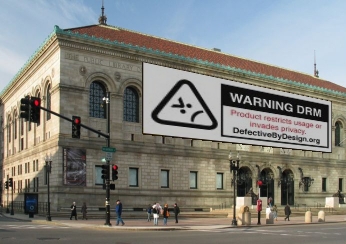
/copyrighteous/images/bpl_drm.jpg On Saturday February 9th, at 13:00, I'm going to be joining free software and anti-DRM activists to protest the use of DRM by the Boston Public Library on parts of its electronic collection. Those of us protesting are unhappy because the BPL has launched a new service powered by a company called OverDrive. The system gives BPL patrons access to books, music, and movies online -- but only if they use a Microsoft DRM system. There are lots of problems with the introduction of this system: it bars access to users of GNU/Linux and MacOS and creates a dependence on a single technology vendor for access. These are important issues, certainly. The worst problem, however, is much more fundamental. By adopting a DRM system for library content, the BPL is giving OverDrive, copyright holders, and Microsoft the ability to decide what, when, and how its patrons can and cannot read, listen, and watch these parts of the BPL collection. They are giving these companies veto power over the BPL's own ability to access this data -- both now and in the future. Cryptographically, BPL is quite literally handing over the keys to their collection. In the process, they are not only providing a disservice to their patrons. They are providing a disservice to themselves. The first-sale doctrine says that libraries can do essentially whatever they like with copies of books they purchase short of duplication, modification, or performance. Of course, copyright holders would prefer to charge a toll every time someone checks out a book. Public libraries were possible in spite of this desire because they were able to exploit power over the possession and control of their books in the interests of their patrons. With DRM, libraries will reduced to powerlessness. Of course, times have changed. As media and the ways we interact with it is increasingly digital, libraries have changed and will need to change more. But if public libraries are to succeed at their fundamental mission of spreading knowledge and serving communities, this change can't be at the expense of patrons' ability to control their own technology and libraries' ability to control their own collections. I've supported my academic library, MIT Libraries, as they took a risk and stood up to DRM when other institutions did not. And they won. BPL is the largest municipal library in the US and the third largest US library overall. It is the first library to be supported publicly, to be open to the public in the US, and to allow patrons to take home books to read and use them. BPL has an opportunity now to continue this history of leadership, of access, and of patron empowerment. If BPL stands up against DRM and in favor of its patrons' freedom and its own control of its technical destiny and collection, it may set an important precedent. If you're in or near Boston, please join me in Copley Square on Saturday to help make this happen. If you're not near Boston, please help put pressure on similar efforts in your own communities.

Romain Francoise: Quicksand, Saint-Michel, and a tip

My CC-licensed photo Quicksand is featured this morning on the front page of openDemocracy, illustrating this article about the US presence in Afghanistan and Iraq.

I took this picture in the summer of 2006 in Saint-Michel bay. At low tide it's possible to cross the bay on foot with a guide, from the shore to the island, a pleasant few kilometers of flat sand with a spectacular view of the Mont. Sadly, every year tourists attempt the trip unaccompanied, get stuck in the dangerous quicksands and drown when the rising tide enters the bay and completely fills it in mere minutes.

(If you ever get caught in that kind of quicksand, here's a survival tip: the key is to lie flat either on your back or on your stomach so that the bulk of your weight is supported by your upper body pressed flat against the sand. Then you just have to crawl forward with your arms and shoulders until your legs are freed from the sand.)

7 February 2008

Martin F. Krafft: The Penny & Martin adventure: phase 1

The first phase of the Penny and Martin adventure has come to an end: after a few days of Wellington, we are now sitting on the ferry to Picton, beginning our week-long road trip of the South Island. Penny and Martin in full diving gear We spent the first three days getting our PADI Open Water diving certification. After the obligatory pool session, in which we practiced certain basic skills, such as taking off and replacing the mask underwater and breathing from the partner s (buddy s) backup regulator, we were ready for the open water. Four dives at Kau Bay later, during which we played with sea horses^W ponies, captured and ate scallops (well, the others captured them ), and were chased by vicious jellyfish, we can now go diving whenever and wherever we want, down to 18 metres and intend to do so a few times during the coming week. Later on Tuesday, I accepted the invitation by the folks at the New Zealand Sea Adventures dive shop, Mike and Seamus, and joined them for another dive in the evening, with conditions even worse than the previous four descents. Together with my buddy Jess, a volcano researcher from London, I experienced close to zero visibility at about 12 metres of depth rain and strong winds made the water really murky. I can easily understand how one might get disoriented and uneasy in the pitch black, but with Jess keeping an excellent bearing, it was all hunky dory for me, tagging on to her side and swimming along. Later that night, accompanied by two popping ears, Penny and I joined two of her close friends, Lisa and Chris, for an evening of games, and was introduced to the card game 500 , which is rather similar to the Bavarian game Schafkopf . It thus didn t take me long to get a grasp and win! Wednesday was Waitangi day, the anniversary of the equinomial treaty, and Wellington celebrated it with the One Love festival. Our plans for the day eating breakfast in the tree, frolic at the festival, and chill on the beach started to fall apart when we found aforementioned tree to be trimmed beyond recognition (at least in terms of function). A whining, hung-over Chris in the backseat and a traffic jam then made us skip the festival in favour of breakfast at the Recovery Room (great name!), and general absence of summery temperatures caused us to settle in Penny s back yard for beers and the last rays of sun instead. A Thai dinner later, we slept. (This post is dedicated to Daren, lover of and then reports.)

Next.

Previous.