Search Results: "ina"

23 December 2010

Jonathan Wiltshire: RCBW, week two

This week: Not quite one fix per day, as zack s campaign originally called for. But true to his word, neither have I started receiving hate mail, so I must be doing something right. (I also made my first sponsoring upload an RC fix (#598945), for extra brownie points <g>)
Comments flattr this!

Julien Viard de Galbert: Triage X Bugs of the Christmas Week (TXBW7)

For some reason1 bug #607242 did not make it to the debian-x@d.o mailing list, I got aware of it only by the message shirish sent to my blog.
If he didn t write to me, this bug will have waited for what about 3 years until I got all the 800+ bugs triaged ? So please you can help triaging X bugs, first subscribe to the debian-x mailing list so you can get the feeling of what to respond to some bugs, and join the TXBW effort ;) The X Strike Force (still) needs you ! You can have a look at the X Strike Force Bug Closing Procedure and check XSF unstable bugs sorted by date. Note 1: The Xorg.0.log file was so huge that the mailing list did not accept the mail.

Rapha&#235;l Hertzog: People behind Debian: Mehdi Dogguy, release assistant

Mehdi Dogguy

Picture of Mehdi taken by Antoine Madet

Mehdi is a Debian developer for a bit more than a year, and he s already part of the Debian Release Team. His story is quite typical in that he started there by trying to help while observing the team do its work. That s a recurrent pattern for people who get co-opted in free software teams. Read on for more info about the release team, and Mehdi s opinion on many topics. My questions are in bold, the rest is by Mehdi (except for the additional information that I inserted in italics). Who are you? I m 27 years old. I grew up in Ariana in northern Tunisia, but have been living in Paris, France, since 2002. I m a PhD Student at the PPS laboratory where I study synchronous concurrent process calculi. I became interested in Debian when I saw one of my colleagues, Samuel Mimram (first sponsor and advocate) trying to resolve #440469, which is a bug reported against a program I wrote. We have never been able to resolve it but my intent to contribute was born there. Since then, I started to maintain some packages and help where I can. What s your biggest achievement within Debian? I don t think I had time to accomplish a lot yet :) I ve been mostly active in the OCaml team where we designed a tool to compute automatically the dependencies between OCaml packages, called dh-ocaml. This was a joint work with St phane Glondu, Sylvain Le Gall and Stefano Zacchiroli. I really appreciated the time spent with them while developing dh-ocaml. Some of the bits included in dh-ocaml have been included upstream in their latest release. I ve also tried to give a second life to the Buildd Status Pages because they were (kind of) abandoned. I intend to keep them alive and add new features to them. If you had a wand and could change one thing in Debian, what would that be? Make OCaml part of a default Debian installation :D But, since I m not a magician yet, I d stick to more realistic plans:
  1. A lot of desktop users fear Debian. I think that the Desktop installation offered by Debian today is very user-friendly and we should be able to attract more and more desktop users. Still, there is some work to be done in various places to make it even more attractive. The idea is trying to enhance the usability and integration of various tools together. Each fix could be easy or trivial but the final result would be an improved Desktop experience for our users. Our packaged software run well. So, each person can participate since the most difficult part is to find the broken scenarios. Fixes could be found together with maintainers, upstream or other interested people.

    I ll try to come up with a plan, a list of things that need polishing or fixes and gather a group of people to work on it. I d definitely be interested in participating in such a project and I hope that I ll find other people to help. If the plan is clear enough and has well described objectives and criteria, it could be proposed to the Release Team to consider it as a Release Goal for Wheezy.

  2. NMUs are a great way to make things move forward. But, sometimes, an NMU could break things or have some undesirable effects. For now, NMUers have to manually track the package s status for some time to be sure that everything is alright. It could be a good idea to be auto-subscribed to the bugs notifications of NMUed packages for some period of time (let s say for a month) to be aware of any new issues and try to fix them. NMUing a package is not just applying a patch and hitting enter after dput. It s also about making sure that the changes are correct and that no regressions have been introduced, etc

  3. Orphaned packages: It could be considered as too strict and not desired, but what about not keeping orphaned and buggy packages in Testing? What about removing them from the archive if they are buggy and still unmaintained for some period? Our ftp archive is growing. It could make sense to do some (more strict) housekeeping. I believe that this question can be raised during the next QA meeting. We should think about what we want to do with those packages before they rot in the archive.
[Raphael Hertzog: I would like to point out that pts-subscribe provided by devscripts makes it easy to temporarily subscribe to bug notifications after an Non-Maintainer Upload (NMU).] You re a Debian developer since August 2009 and you re already an assistant within the Release Management team. How did that happen and what is this about? In the OCaml team, we have to start a transition each time we upload a new version of the OCaml compiler (actually, for each package). So, some coordination with the Release Team is needed to make the transition happen. When we are ready to upload a new version of the compiler, we ask the Release Team for permission and wait for their ack. Sometimes, their reply is fast (e.g. if their is no conflicting transition running), but it s not always the case. While waiting for an ack, I used to check what was happening on debian-release@l.d.o. It made me more and more interested in the activities of the Release Team. Then (before getting my Debian account), I had the chance to participate in DebConf9 where I met Luk and Phil. It was a good occasion to see more about the tools used by the Release Team. During April 2010, I had some spare time and was able to implement a little tool called Jamie to inspect the relations between transitions. It helps us to quickly see which transitions can run in parallel, or what should wait. And one day (in May 2010, IIRC), I got offered by Adam to join the team. As members of the Release Team, we have multiple areas to work on:
  1. Taking care of transitions during the development cycle, which means making sure that some set of packages are correctly (re-)built or fixed against a specific (to each transition) set of packages, and finding a way to tell Britney that those packages can migrate and it would be great if she also shared the same opinion. [Raphael Hertzog: britney is the name of the software that controls the content of the Testing distribution.]
  2. Paying attention to what is happening in the archive (uploads, reported RC bugs, etc ). The idea is to try to detect unexpected transitions, blocked packages, make sure that RC bug fixes reach Testing in a reasonable period of time, etc
  3. During a freeze, making sure that unblock requests and freeze exceptions are not forgotten and try to make the RC bug count decrease.
There are other tasks that I ll let you discover by joining the game. Deciding what goes (or not) in the next stable release is a big responsibility and can be incredibly difficult at times. You have to make judgement calls all the time. What are your own criteria? That s a very hard to answer question (at least, for me). It really depends on the case . I try to follow the criteria that we publish in each release update. Sometimes, an unblock request doesn t match those criteria and we have to decide what to accept from the set of proposed changes. Generally, new features and non-fixes (read new upstream versions) changes are not the kind of changes that we would accept during the freeze. Some of them could be accepted if they are not intrusive, easy and well defended. When, I m not sure I try to ask other members of the Release Team to see if they share my opinion or if I missed something important during the review. The key point is to have a clear idea on what s the benefit of the proposed update, and compare it to the current situation. For example, accepting a new upstream release (even if it fixes some critical bugs) is taking a risk to break other features and that s why we (usually) ask for a backported fix. It s also worth noticing that (most of the time) we don t decide what goes in, but (more specifically) what version of a given package goes in and try to give to the contributors an idea on what kind of changes are acceptable during the freeze. There are some exceptions though. Most of them are to fix a critical package or feature. Do you have plans to improve the release process for Debian Wheezy? We do have plans to improve every bit in Debian. Wheezy will be the best release ever. We just don t know the details yet :) During our last meeting in Paris last October, the Release Team agreed to organize a meeting after Squeeze s release to discuss (among other questions) Wheezy s cycle. But the details of the meeting are not fixed yet (we still have plenty of time to organize it and other more important tasks to care about). We would like to be able to announce a clear roadmap for Wheezy and enhance our communication with the rest of the project. We certainly want to avoid what happened for Squeeze. Making things a bit more predictable for developers is one of our goals. Do you think the Constantly Usable Testing project will help? The original idea by Joey Hess is great because it allows d-i developers to work with a stable version of the archive. It allows them to focus on the new features they want to implement or the parts they want to fix (AIUI). It also allows to have constantly available and working installation images. Then, there is the idea of having a constantly usable Testing for users. The idea seems nice. People tend to like the idea behind CUT because they miss some software disappearing from Testing and because of the long delays for security fixes to reach Testing. If the Release Team has decided to remove a package from Testing, I think that there must be a reason for that. It either means that the software is broken, has unfixed security holes or was asked for the removal by its maintainer. I think that we should better try to spend some time to fix those packages, instead of throwing a broken version in a new suite. It could be argued that one could add experimental s version in CUT (or sid s) but every user is free to cherry-pick packages from the relevant suite when needed while still following Testing as a default branch. Besides, it s quite easy to see what was removed recently by checking the archive of debian-testing-changes or by querying UDD. IMO, It would be more useful to provide a better interface of that archive for our users. We could even imagine a program that alerts the user about installed software that got recently removed from Testing, to keep the user constantly aware any issue that could affect his machine. About the security or important updates, one has to recall the existence of Testing-security and testing-proposed-updates that are used specifically to let fixes reach Testing as soon as possible when it s not possible to go through Unstable. I m sure that the security team would appreciate some help to deal with security updates for Testing. We also have ways to speed migrate packages from Unstable to Testing. I have to admit that I m not convinced yet by the benefits brought by CUT for our users.
Thank you to Mehdi for the time spent answering my questions. I hope you enjoyed reading his answers as I did. Subscribe to my newsletter to get my monthly summary of the Debian/Ubuntu news and to not miss further interviews. You can also follow along on Identi.ca, Twitter and Facebook.

2 comments Liked this article? Click here. My blog is Flattr-enabled.

Christian Perrier: [life] Snooooooow

In such cases, most people use to say "never saw this" and such common sentences. However, really, this time this is true: it's now 30 years since I live in the Paris area, a place where climate is not known to be a snowy one: Paris and its region are not that far from the Channel and the influence of Atlantic Ocean is supposedly important. And, really, I never saw this. For such reasons, here, winters are not really "continental" and we often have few snow during an entire winter, if any. Indeed, during the 200* years, we had several winters without any snow at all. Last year was already different: we had 3 snow episodes. A quite big one on Dec 17th (about 15cm in the western area of the region), another in mid-January where snow lasted for about one week because of very low temperatures (below -10 C) and a final one in February. Still, the 2010-2011 winter is something I never saw before. In less than one month, we had 6 different snow episodes: Nov 28th (roughly), Dec 8th, Dec 17th, Dec 18th, Dec 20th and now Dec 22th. My area (the western part of the region) was hardly hit with 20cm on Dec 8th and about 15cm on Dec 20th and 22th....up to a cumulated 80cm height. Really something unusual. And what that happens in a region where about 12M people live, sometimes at rush hours, you can expect a giant mess (and a giant mess it was on Dec 8th). During these weeks, I personnally experimented my new way of commuting: run/train/run, which means running the 3km desert country road from my house to the train station, catching a train, then running the final 4km in suburbs close to Paris. Both runs do actually replace a standard bus ride. This prove to be convenient as buses are often stopped during snow episodes (hey, there are hills in the Paris area!). That made things that I'll really remember for the future: this morning's run in the country with 15cm of fresh snow, without any single step mark (except the rabbit or wild pig ones), with the light of my head lamp, no noise and an entirely white landscape....is special and nearly unique when you live only 30km away from the town. Nevertheless, that might prefigure what we will experience in the upcoming years or dozen of years: a generally much colder winter over western Europe, much closer to what Central Europe always had. Personnally, I like that, but we probably need to prepare our facilities to such events: last week-end in UK, Belgium, France, Germany, etc. was really a giant mess (Heathrow airport closed, Roissy nearly closed, Brussels flooded with derouted planes, Frankfurt stuck, Eurostars stopped, gee). Is that climate change (as a consequence of Gulf Stream vanishing) or just a collection of random events? We'll see.

22 December 2010

Andrew Pollock: [tech] Find of the day: pianobar

Cube-mate and friend, Kynan, put me on to pianobar today. This thing is 100% sheer awesome. A console Pandora client! No longer do I have to find the browser tab that Pandora is running in to pause it, or to see what the hell it is I'm listening to. Nor do I need to worry about Flash crashing. It's also extensible in that it can call out to an external program for various events, such as starting a new song. This makes desktop notifications of what the hell you're listening to trivial. It'll also read commands from a named pipe, so at work, where I have this crazy Microsoft Natural Keyboard with all sorts of multimedia keys, I've set up evrouter (which isn't in Debian for some strange reason) so that I can pause, skip and like/dislike using my keyboard (regardless of what application I'm in). So I can just kick off pianobar in a terminal somewhere and forget about it. This is so cool. Interestingly, it also doesn't play any advertising, so I've finally pulled my finger out and paid for a Pandora One account. Overall, this makes for a fantastic desktop Pandora client. Now I just need to figure out why I get weird HTTP errors from it at home...

21 December 2010

Martin Meredith: Why Google Apps might not be right for your Enterprise

A few months ago, my company made the decision to switch from our previous mail provider, to use Google Apps. It was a no-brainer really, most of the company were using it already, for the calendars, and Documents, and well we were a bit fed up with our previous mail provider. So we made the move. As an online retailer, we obviously get a lot of Financial related emails, and our Accountancy Department has an email address setup as a group, where the group sends to all the members in the Accounts Team. A pretty simple setup. However, for the last 2 months, I ve been fighting an uphill battle to get this to work properly. When an email gets delivered to a Google Group, it stops there, and then Google re-sends the email to the people in the group. Somehow, this triggers the receiving account to believe that it s originated from the Google Groups servers, rather than the actual originating server. Google Apps emails have a pretty nifty spam filtering service. For those well-known services on the web, it ll check whether it actually came from them (I think through some combination of DKIM and SPF), and bounce it if not. Can you see where I m going yet? Google Groups has a nifty feature to stop it attempting to send emails to addresses that don t exist. If an email address bounces at a certain rate, it ll flag it as undeliverable. If all the emails in a group are flagged as undeliverable, it ll bounce that email to the original party, so that they know no-one received it. The Accounts team are setup to receive information regarding Paypal Payments, Disputes, etc etc. A couple of days in, I had our Financial controller tell us that the Accounts team had stopped receiving emails. Well, being who I am I sent a test email out guess what I got back? Hello <redacted>, Your message could not be delivered because of previous failures during delivery attempts to this mailing list. Please update the list with valid addresses. This is an example of some of the bounces we received: ----------------------------------------------
Recipient: pa.......@mobilefun.co.uk 550 550 5.7.1 Unauthenticated email is not accepted from this domain. u22si29486554yba.55 (state 18).
Message-Id: <redacted> ----------------------------------------------
Recipient: ni........@mobilefun.co.uk 550 550 5.7.1 Unauthenticated email is not accepted from this domain. u22si29486554yba.55 (state 18).
Message-Id: <redacted> ----------------------------------------------
Recipient: lu..........@mobilefun.co.uk 550 550 5.7.1 Unauthenticated email is not accepted from this domain. u22si29486554yba.55 (state 18).
Message-Id: <redacted>
*sigh* time to play with the group. I change the members of the group to use one of our alias domains instead of the @mobilefun.co.uk this gets emails working again. 2 days later . our Financial Controller comes to me and complains that clients are complaining that they re receiving bounce emails when sending to his team I check, and once again, get the same message. Time to open a support ticket. That was in October since then we ve tried everything Changing to user-defined groups and switching off the spam filters, whitelisting the groups, setting up DKIM on our domain, changing the spam levels, clearing bounce statuses all to no avail I ve been back and forthing with Google Enterprise Support for 2 months and have still not found a suitable solution *sigh*. I must say however, that the person dealing with the case at Google (Josephine H) has been professional and helpful all the way along, even with my rising frustration at the issue. Today I ended up calling their service unusable number, after having tried a couple of times to change the groups so that the Accounts Team could receive emails again and finding that none of my previous tricks worked. While on hold, I found that I could use a local part extension to an email address, and the group would recognise it as a new email address and therefore have no bounce status. I ve now made a script using the Provisioning APIs, and a bit of python-fu that will generate a local part extension based on the current date/time, and replace the users in the group for the Accounts team with those. Say for example, the primary email address for a user was test@example.com it d add a user of test+20101221235641@example.com. This is set to run each day so it s pretty much the same as resetting the bounce status (which fixes things for a short while) on a daily basis. According to my latest email from Google Enterprise support:-
At the moment there is an incentive going on to fix this outright as messages from Paypal etc have been causing bounce s for other domains. This fix is supposedly due very early in the New Year and will solve this problem indefinitely.
I wait with baited breath but for now, I m happy with my hack. flattr this!

Andreas Metzler: exim testers

I would appreciate if you could test the proposed fixes for the exim4 privilege escalation bug CVE-2010-4345. Preliminary binary and source packages for squeeze/sid and lenny are available here:
deb http://www.bebt.de/debian/ sid exim4+cve
deb-src http://www.bebt.de/debian/ sid exim4+cve
deb http://www.bebt.de/debian/ lenny exim4+cve
deb-src http://www.bebt.de/debian/ lenny exim4+cve
You can also browse the changes in SVN (lenny and sid) or build your own binaries.
Changelog: NEWS entry: Exim versions up to and including 4.72 are vulnerable to CVE-2010-4345. This is a privilege escalation issue that allows the exim user to gain root privileges by specifying an alternate configuration file using the -C option. The macro override facility (-D) might also be misused for this purpose. In reaction to this security vulnerability upstream has made a number of user visible changes. This package includes these changes. If exim is invoked with the -C or -D option the daemon will not regain root privileges though re-execution. This is usually necessary for local delivery, though. Therefore it is generally not possible anymore to run an exim daemon with -D or -C options. However this version of exim has been built with TRUSTED_CONFIG_LIST=/etc/exim4/trusted_configs. TRUSTED_CONFIG_LIST defines a list of configuration files which are trusted; if a config file is owned by root and matches a pathname in the list, then it may be invoked by the Exim build-time user without Exim relinquishing root privileges. As a hotfix to not break existing installations of mailscanner we have also set WHITELIST_D_MACROS=OUTGOING. i.e. it is still possible to start exim with -DOUTGOING while being able to do local deliveries. If you previously were using -D switches you will need to change your setup to use a separate configuration file. The ".include" mechanism makes this easy. The system filter is run as exim_user instead of root by default. If your setup requies root privileges when running the system filter you will need to set the system_filter_user exim main configuration option.

20 December 2010

Jonathan McDowell: Contract free phones are the way forward

Russell complains about locked down phones and horrible telcos, in particular about not getting a discount on your monthly contract if you don't get a phone with it. This hasn't been my experience, either in the UK or since I moved to the US. In the UK I ended up on an O2 Simplicity (month-by-month) plan which provided more minutes, SMSes and data allowance that I needed for 20/month (note that I only use the data for the phone, I didn't tether it to my laptop). Originally I chose this because I wasn't sure about coverage where I lived (that's why I was changing provider), but it turned out to be a pretty good deal, saving me at least 10/month over a contract that I'd have been tied into. When the G1 was launched I wasn't interested in moving to T-Mobile, who I knew had no 3G coverage outside of Belfast, so I ended up with one off eBay (received as a gift) and kept my O2 contract. When I moved to the US I signed up to Simple Mobile mainly because I could get a SIM from eBay before I left the UK, and it was PAYG (so the fact I'd no credit record didn't matter) but still included unlimited voice/SMS/data. Significantly more expensive at $60/month than I was used to paying in the UK, but seemed to be the going rate even for a contract. Then the G2 launched back in October. I resisted for 2 or 3 weeks, then decided it had to be mine. The G1's battery was even worse than it had been (to be fair it had lasted 2 years), and although Cyanogen provided Android 2.2 the hardware isn't really up to it. I decided to go with T-Mobile; Simple Mobile use their network, so I knew the coverage would be fine, and I figured a contract was probably a good way to help get a credit record here. Except, the pricing was a bit weird. $200 for the phone with a 2 year $80/month contract or $500 for the phone with an identical contract but no tie in and $60/month. Er, what? I pay up front and I save $180 and I can walk away whenever I want? Ok. As it turned out this was the smart choice. Firstly $60/month means $60/month plus taxes[0], so I was paying more than I paid Simple Mobile. I figured I could bear that for a few months to get the credit history, plus the free network unlock after 3 months. Except then it became clear that international SMS wasn't included in the unlimited SMS (it is with Simple). Most of my SMS is international. Now, T-Mobile have a $5/month bolt on to cover that, but not if you're on their flexpay scheme because they found themselves unable to verify your SSN. So I cancelled the contract after the first month and moved back to Simple. I didn't even need to unlock the phone due to the fact it's the same network (though I have now in preparation for my trip back to the UK over Christmas). Surprisingly T-Mobile didn't try and keep me by sorting out the international SMS bolt on. I guess US mobile customers are used to being screwed over (certainly the pricing suggests that). Er, sorry, that turned into a bit of a T-Mobile rant. My original point was that all of my recent mobile contracts have been month by month, not involved a subsidised phone, and saved me money over being tied in. And even if they hadn't my experiences with the flexibility offered by not being tied in (worries about coverage, discovering the deal isn't as good as you thought) mean that I'm pretty much convinced that contract-free is the way to go anyway. [0] Dear America, for all your complaints about VAT it's not really a lot different from sales tax and at least the prices in shops/online actually include it. Also it's the same everywhere in the country.

19 December 2010

Gintautas Miliauskas: Mobile App Camp

On the last weekend my team and I participated in the Mobile App Camp (link in Lithuanian) organized by Omnitel, which is one of the dominant mobile operators in Lithuania. The event seems to be part of Omnitel's push for increasing the share of smartphones in the Lithuanian market, which has been lagging behind the European trends.

Our team consisted of Povilas Kytra, who is behind the TV.LT project, Mantas Kanaporis from A-Gain and me. In the weekend we built an app that shows the TV programme for the coming day for all the Lithuanian TV channels. (The app is not yet available on the Android Market, but we are working on it.)

Here's a screenshot of the main screen of the application:


The app was built using the standard Android Development Toolkit on Eclipse. The app gets the content from a Rails-based server containing a simple database and couple JSON views.

I had some experience of developing for Android before, but it was mostly about working with graphics on canvas, while in this app we used some standard GUI controls (with some nifty styling).

For the source control, we used a private repository on bitbucket.org. That one was a huge letdown: a 'hg push' or 'hg pull' would take ages (or at least that's how it seemed to me in comparison to GitHub), and we had no end of trouble with merging, partly due to the number of commands needed to get the repositories in sync (hg pull; hg update; hg merge; hg commit; hg push). Even Subversion would probably have worked better.

The event itself was great fun. It had been a while since I had last coded intensively for the entire weekend. There were quite a few decent ideas presented by the participants, and some of them were successfully implemented.

The rating system was somewhat disappointing though. The event was supposed to be a contest, with four predefined criteria for winning apps (still available on the website): uniqueness in the Lithuanian market, magnitude of the target group, value provided to the user and creativity. In the end, however, the jury nominated apps for three different awards (best app built on an existing database, best app built anew, and the "hope" nomination) with one app awarded from each category. Our app scored second in the first nomination, so we did not get an award, even though we would probably have been in the global top three, were the original criteria upheld.

To be fair, we did not stand much chance against the winner in our category, an app based on vaistai.lt, which sported a database of pharmaceuticals with detailed usage instructions, information about drug stores in Lithuania with maps and inventory status, and even a barcode scanner. Hats off to them. Another winner was "Alaus radaras" ("Beer radar") with locations of local beer bars and inventory info. The third one was "3 milijonai teis j " (Three million judges"), which, as far as I understood, was a conception for a basketball-throwing game (basketball is very big in Lithuania, it is a second national religion).

To conclude, it was a fun event and I wish we will be having more of those in Vilnius, even though the Monday after the long weekend was very unproductive.

Jonathan Wiltshire: The perfect gpg-agent setup

When I first started using Debian properly, I played with gpg-agent and pinentry but I didn t really understand the various bash initialisation scripts, and my botched setup annoyed me so much I disabled it again quite quickly (for example, if I left the machine logged in to GDM at home then logged in through SSH, pinentry dialogs stayed in GDM and had to be killed). Now I ve finally had time to get it sorted out, and this is part aide-memoire and part idiot check (hello, lazyweb). The brief: I assume appropriate packages are already installed at a minimum, gpg-agent and whichever pinentry you prefer. Installing gpg-agent drops a hook into /etc/X11/Xsession.d, but now there are both gpg-agent and ssh-agent running. Disable ssh-agent because we re going to let gpg-agent take care of everything: in /etc/X11/Xsession.options, comment out the line use-ssh-agent. In /etc/X11/Xsession.d/90gpg-agent, add the enable-ssh-support parameter so the STARTUP variable looks something like:
STARTUP="$GPGAGENT --daemon --sh --enable-ssh-support --write-env-file=$PID_FILE $STARTUP"
and also disable ssh in gnome-keyring:
$ gconftool-2 --set -t bool /apps/gnome-keyring/daemon-components/ssh false
Now (after restarting your X session) you can use ssh-add to import a key into gpg-agent, and you should see a pinentry dialog asking for a password. That takes care of X sessions, but it won t work for SSH. This is where the different bash login scripts matter: ~/.bashrc is run for all non-login shells (that is, ones spawned from e.g. gnome-terminal) but ~/.profile is only run for login shells (that is, ones where you have to authenticate, such as SSH connections). So, at the bottom of ~/.profile, we just start another gpg-agent who doesn t know about X:
eval $(gpg-agent --enable-ssh-support --daemon)
After restarting your SSH session and triggering a key operation, like signing a document, pinentry-curses should ask for your passphrase at the SSH shell and not leave dialogs stranded in the X session. Finally, that second agent shouldn t be left hanging around after we ve finished, or there ll be hundreds of them soon. Fortunately, the PID is recorded in the environment variable GPG_AGENT_INFO, but parsing that is a bit awkward when it s also recorded alone in SSH_AGENT_PID. So in ~/.bash_logout, we just
kill $SSH_AGENT_PID
(Most of the pointers for this setup came from http://wiki.kumina.nl/index.php/Managing_ssh_keys_with_gpg-agent and http://stefaanlippens.net/bashrc_and_others)
Comments flattr this!

18 December 2010

Joey Hess: dadagoogoo

The Google books ngram datasets are a nice resource for playing with text generation. I've created a program that will, given a starting phrase, blather on by connecting phrases from the datasets. The results are much more varied, and seem to more often make sense than most Markov text generators I've seen before, such as dadadodo. It had better be -- it's working with data derived from 4% of all books ever written! Some examples. Do they tell a story? (The starting phrase I entered is in italics.) I have cheated slightly by picking where to stop quoting the blather each time. It tends to go on for quite a while otherwise. Although it often does manage some kind of sense at length too:
This was accomplished using only 99 lines of code. I imported the datasets into Xapian databases using this program. And this program is the text generator. I threw out the metadata, to keep the Xapian databases of reasonable size. By which I mean, only a dozen gigabytes. It might be interesting to include the publication year data in Xapian, so that it could prefer ngrams that were published around the same time as the input text. I'm still importing data. I may put up a web interface later if there's interest. PS: PPS:

Felipe Sateler: CDBS -- An introduction

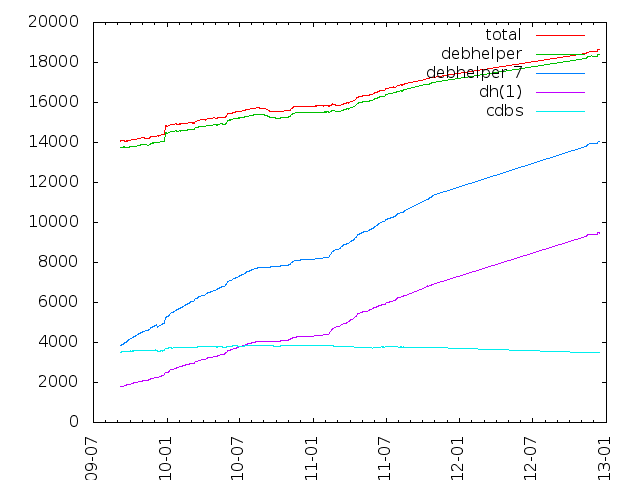
It seems the current trend is to use short-form dh. Some people have even thought that dh has superseded CDBS. Since I prefer CDBS for my own packaging, I will say that no, CDBS is not being deprecated and in fact has been active. Packaging with CDBS is very simple. I'll try to explain how it works, and how to package with it. This may turn into a blog post series, but I won't promise anything.

CDBS is a set of makefiles that do several tasks that are common while packaging software, so that you don't have to repeat them over and over on each package. The makefiles are classified into 2 groups: classes and rules. Classes implement the rules required for building and installing software. These are classes because they can and do inherit from others. For example, there is the makefile class, and the autotools, qmake and cmake classes inherit from it, and the gnome and kde (which is for kde 3) classes inherits from the autotools class. Rules implement several other general purpose rules that don't depend on the toolchain used to build the package. For example, there is the debhelper rules file, which takes care of creating the debian package using the usual dh_* commands. There are several rules files which do all sorts of useful stuff, from running license checks to downloading new upstream releases. If this post transforms into a series, we may look into some of them. For now, I'll demonstrate how to use CDBS to package some simple software (only the debian/rules file, of course).

The first task while running creating debian/rules is determining which build system the software uses. I will use qutecsound package as a guide. So, first things first, we start using CDBS!
#!/usr/bin/make -f

# Uncomment this to turn on verbose mode.
#export DH_VERBOSE=1

include /usr/share/cdbs/1/rules/debhelper.mk
include /usr/share/cdbs/1/class/qmake.mk


Now this would be all that is required if qutecsound where a standard qmake package where nothing needs to be customized. Alas, this is not the case. First, there are some variables that need to be passed to qmake to appropriately configure the build. Also, the projects .pro file is not standard-named. How do we fix this? The CDBS way of overriding this kind of behavior is through the use of variables. Since we are using the qmake class, we will be overriding variables named DEB_QMAKE_*:
DEB_QMAKE_CONFIG_VAL += build64
DEB_QMAKE_ARGS = qcs.pro


We add a configuration value (because CDBS is setting other config values), and we set the extra arguments to qmake.

Now, there is a problem: the resulting binary is not created with the name we want. How do we change that? We could patch the source to avoid that, but it is far easier to add a rule to the makefile to do that. We will modify the build to rename the file at the end (and then clean it up on clean because the upstream makefile will not spot it):
build/qutecsound::
[ -f bin/qutecsound ] mv bin/qutecsound-d bin/qutecsound

clean::
rm -f bin/qutecsound


So what did we just do? We extended the build and clean rules with extra stuff to do. In CDBS each package listed in debian/control gets a build/package rule (and several others at different stages of the build) so that one can add stuff specific to each package (this will be much more useful when dpkg finally learns about build-arch and build-indep).

For the final touch, we want to do a few more things. First, we want to ensure that we are using QT4's qmake, because the build will fail if QT3's is used. Second, since I created a manpage for the command, I want to install it. Finally, we want to use parallel building when the user has specified it, to build the project faster. How to do that? Again, via variables:
QMAKE = qmake-qt4
DEB_BUILD_PARALLEL = 1
DEB_INSTALL_MANPAGES_qutecsound = debian/qutecsound.1


CDBS creates several variables for each of the packages listed in debian/control, so we can customize each package build. In our case, this variable is passed to dh_installman from the debhelper rules file (CDBS will invoke the debhelper tools once for each binary package).

After all this we now have the complete debian/rules of a relatively simple package. How does it look like? Like this:
#!/usr/bin/make -f

# Uncomment this to turn on verbose mode.
#export DH_VERBOSE=1

include /usr/share/cdbs/1/rules/debhelper.mk
include /usr/share/cdbs/1/class/qmake.mk

QMAKE = qmake-qt4
DEB_QMAKE_CONFIG_VAL += build64
DEB_QMAKE_ARGS = qcs.pro
DEB_BUILD_PARALLEL = 1

DEB_INSTALL_MANPAGES_qutecsound = debian/qutecsound.1

build/qutecsound::
[ -f bin/qutecsound ] mv bin/qutecsound-d bin/qutecsound

clean::
rm -f bin/qutecsound

Tags: cdbs, packaging

17 December 2010

Andrew Pollock: [tech] Probable solution for Pandora 417 errors on Google TV

This has been bugging me ever since we got our Sony Internet TV, and I think I've finally figured out what's going on. Pandora hasn't been working on the Google TV ever since we got it, it just spits out Unexpected HTTP error occurred code: 417 while StartupAsyncTask and that's the end of that. I have vague recollections seeing this on my phone in the past also, but this doesn't appear to be the case any longer. My phone has version 1.5.2 on it, and the TV has 1.0, so I think I see the problem here. I took a full packet capture while starting up Pandora, and it was a lot more revealing. I could see that it was my Squid proxy (I transparently run all HTTP traffic through Squid) was barfing. That'd explain the errors I was seeing in Squid's cache.log
parseHttpRequest: Unsupported method ''
clientTryParseRequest: FD 153 (172.16.1.5:55001) Invalid Request
Looking at the headers of the HTTP request that the Pandora client is sending out, I see Expect: 100-Continue, and the text that accompanies a HTTP 417 error is "Expectation Failed", so I think this is the culprit. Searching for Expect: 100-Continue squid turns up information for an ignore_expect_100 directive, but this appears to only be available if Squid is compiled with --enable-http-violations, which the Debian Squid package doesn't appear to be compiled with. I may have to adjust my transparent proxying rules to not transparently proxy the TV, but this makes me a bit sad. Update I tried adding ignore_expect_100 on anyway, and Squid took it, and now Pandora isn't barfing. Yay!

Daniel Stone: new x.org multitouch patchset posted

So, I've been working on multitouch on and off the past few months (which have included a solid ten weeks of holiday), but have finally posted the third patch series, which I think should be pretty close to final, to the list today.

Touch events look kind of similar to standard Xi 2.1 events (DeviceMotionNotify and friends), but the implementation of grabbing and event delivery is quite different from the traditional X model that we all know and love.

Firstly, touch grabs are not strictly grabs as with other input events. When a synchronous pointer or keyboard grab activates, it 'freezes' the device, stopping delivery of all further events until the grabbing client has decided what to do. The client can either pass on the event to the next client (replay), opt to continue receiving all events with the device freezing again after each event (synchronous mode), or continue receiving all events with the device unfrozen (asynchronous). While this is happening, the grabbing client is the only one receiving events, hence the name.

Touch grabs break both of these assumptions. Firstly, the device never freezes: delivery of all events (pointer, keyboard, touch, whatever) continues at full tilt, and a touch grab never affects pointer or keyboard events, with the possible future exception of pointer events that are emulated from touch events. Secondly, all clients with grabs, as well as the client with the first selection we find<super>0</super>, receive the events. An 'owner' flag is set (or unset) to indicate to the client that it does, or does not, own the touch stream in question.

The owner principle is important: the theory is that all touch streams must be considered as a whole (i.e. from init, through all the motion events, to the touch stream ending), and cannot be separated into component parts. So a client which does not own a touch stream can do gesture recognition or whathaveyou in the background, but must not act upon it until it becomes the owner. We added an extra request, XIAllowTouchEvents, to control ownership: clients can either reject ownership, passing it on to the next in line, or assert their ownership and permanently remove all other clients from the delivery list.

So it's somewhat different, but (hopefully) not without reason. The motivation behind this was to keep latency as low as humanly possible, since people seem to demand lower latencies from direct touch-based devices. Sticking to the traditional grab model would have meant a flurry of round trips between all the clients in the stack and the server, as well as maintaining huge buffers in the server for every touch event, which each client would have to transfer in turn.

This model is a compromise between my original design and Ubuntu's suggested design; both of us had far more simple designs, but oriented towards different usecases. The original Ubuntu usecase was for a global gesture recognition system, which apps would only opt out of in rare cases. My primary usecase was exactly the reverse: apps doing their own gesture recognition, with a very small, if any, global system. Hopefully it's actually the best of both worlds, rather than the worst possible intersection: I guess we'll find out. :)

At the moment, it's all largely theoretical, but some of the Nokia Qt guys are working on a port and have provided really helpful feedback, and hopefully the GTK+ multitouch branch, which was written against a much earlier and, er, speculative, version of the spec, gets updated too.

Finally, some thanks: to both Nokia and my excellent employer Collabora for sponsoring my part of this work; to Chase Douglas from Canonical for his contributions and for not just giving us the finger and vanishing when we rejected the X Gesture Extension, but hanging around and working through it; and to Peter Hutterer, for spec work and review. There were also numerous others involved earlier (including, but not limited to, Henrik Rydberg working on mtdev and others) who deserve credit, so sorry if I forgot anyone.

If you want to get it and play around with it, the patches/repositories are all laid out in my initial mail linked to earlier, as well as the follow-up mail noting the evdev repository location. The spec has more details, and will hopefully be cleaned up to be a lot less clunkily-written.

[0]: The delivery order is unchanged. For grabs, we start at the root window and proceed down the window stack to the innermost child window, activating grabs in that order. For events selected for with XISelectEvents, we start at the innermost child window, work our way up towards the root window, and stop as soon as we find one.

Pietro Abate: debian git packaging with git upstream

Update There is an easier method to do all this using gbp-clone as described here. Ah ! Then to build the package, you just need to suggest git-buildpackage where to find the pristin-tar :
git-buildpackage --git-upstream-branch=upstream/master
or you could simply describe (as suggested) the layout in debian/gbp.conf. Easy !!!
I've found a lot of different recipes and howtos about git debian packaging, but I failed to find one simple recipe to create a debian package from scratch when upstream is using git. Of course the following is a big patchwork from many different sources. First we need to do a bit of administrative work to setup the repository :
mkdir yourpackage
cd yourpackage
git init --shared
Then, since I'm interested in tracking upstream development branch I'm going to add a remote branch to my repo:
git remote add upstream git://the.url/here.git
at this point I need to fetch upstream and create a branch for it.
git fetch upstream
git checkout -b upstream upstream/master
Now in my repo I have a master branch and an upstream branch. So far, so good. Let's add the debian branch based on master:
git checkout master
git checkout -b debian master
It's in the debian branch where I'm going to keep the debian related files. I'm finally read for hacking git add / git commit / git remove ... When I'm done, I can switch to master, merge the debian branch into it and use git-buildpackage to build the package.
git checkout master
git branch
debian
* master
upstream

git merge debian
git-buildpackage
Suppose I want to put everything on gitourious for example. I'll create an acocunt, set up my ssh pub key and then I've to add an origin ref in my .git/config . Something like :
[remote "origin"]
url = git@gitorious.org:debian-stuff/yourpackage.git
fetch = +refs/heads/*:refs/remotes/origin/*
[branch "master"]
remote = origin
merge = refs/heads/master
The only thing left to do is to push everything on gitourious. the --all is important.
git push --all
People willing to pull your work from girourious have to follow the following script :
$git clone git@gitorious.org:debian-stuff/yourpackage.git
$cd yourpackage
$git branch -a
* master
remotes/origin/HEAD -> origin/master
remotes/origin/debian
remotes/origin/master
remotes/origin/upstream
$git checkout -t origin/debian
$git checkout -t origin/upstream
$git branch -a
debian
master
* upstream
remotes/origin/HEAD -> origin/master
remotes/origin/debian
remotes/origin/master
remotes/origin/upstream
$git checkout master
$git-buildpackage
Maybe there is an easier way to pull all remote branches at once, but I'm not aware of it. Any better way ?

Alexander Reichle-Schmehl: Christmas for network administrators (Part 2)

After hearing several times, that it would make sense to use fibre cables for your Christmas tree, as you can illuminate it with them, I have been pointed to traceable network cords... which made me speechless...

Tiago Bortoletto Vaz: S o Paulo police treat street artists like criminals

This guy is very known by people who use to walk around the Paulista Avenue at night. This week Gilberto Kassab mayor of S o Paulo authorized the local police to arrest him and all other artists in order to replace them by one more crap christmas tree playing those well known depressed songs. SAD :_(
street artist treated like shit in S o Paulo - Brazil

street artist treated like shit in S o Paulo - Brazil


Rapha&#235;l Hertzog: Avoid a newbie packager mistake: don t build your Debian packages with dpkg -b

In the last years, I have seen many people try to use dpkg --build to create Debian packages. Indeed, if you look up dpkg s and dpkg-deb s manual pages, this option seems to be what you have to use:
-b, --build directory [archive directory] Creates a debian archive from the filesystem tree stored in directory. directory must have a DEBIAN subdirectory, which contains the control information files such as the control file itself. This directory will not appear in the binary package s filesystem archive, but instead the files in it will be put in the binary package s control information area.
And indeed, dpkg-deb is what ultimately creates the .deb files (aka binary packages). But it s a low-level tool that you should not call yourself. If you want to properly package a new software, you should rather create a Debian source package that will transform upstream source code into policy-compliant binary packages. Creating a source package also involves preparing a directory tree (but with a debian sub-directory), it s probably more complicated than calling dpkg -b on a manually crafted directory. But the result is much more versatile: the tools used bring value by dynamically analyzing/modifying the files within your package (for example, the dependencies on C libraries that your package needs are automatically inserted). If this is news to you, you might want to check out the New Maintainers Guide and the Debian Policy.
Found it useful? Be sure to not miss other packaging tips (or lessons), click here to subscribe to my free newsletter and get new articles by email.

10 comments Liked this article? Click here. My blog is Flattr-enabled.

Kees Cook: gcc-4.5 and -D_FORTIFY_SOURCE=2 with header structures

Recently gcc (4.5) improved its ability to see the size of various structures. As a result, the FORTIFY protections have suddenly gotten a bit stricter. In the past, you used to be able to do things like this:
struct thingy  
    int magic;
    char data[4];
 
void work(char *input)  
    char buffer[1000];
    int length;
    struct thingy *header;
    header = (struct thingy *)buffer;
    length = strlen(input);
    if (length > sizeof(buffer) - sizeof(*header) - 1) abort();
    strcpy(header->data, input);
    header->magic = 42;
    do_something_fun(header);
 
The problem here is that gcc thinks that header->data is only 4 bytes long. But gcc doesn t know we intentionally overruled this (and even did length checking), so due to -D_FORTIFY_SOURCE=2, the strcpy() checks kick in when input is more than 4 bytes. The fix, in this case, is to use memcpy() instead, since we actually know how long our destination is, we can replace the strcpy(...) line with:
    memcpy(header->data, input, length + 1); /* take 0-term too */
This kind of header and then data stuff is common for protocol handlers. So far, things like Wine, TFTP, and others have been experiencing problems with the change. Please keep an eye out for it when doing testing.

16 December 2010

Raphael Geissert: Introducing the "Debian's Automated Code Analysis" (DACA) project

It's been a while since I started working on this project and even longer
since I had the idea. It's therefore a pleasure to finally announce the DACA project.


What is DACA?

Automated Code Analysis helps detect and fix bugs and other issues in source
code. The project aims to give users easy access to a wide variety of tools to
improve quality of software distributed by Debian, while giving the tool's
developers a test bed, more visibility, and more feedback.
This is achieved by running those tools on the complete Debian archive.

http://qa.debian.org/daca/

What is there for everyone?

At the moment there are only partial reports from two tools, but the list of
tools to be evaluated and possibly included goes over twenty.

Current tools: cppcheck, and checkbashisms (at the source package level.)

Limitations

Most of the tools are CPU-bound, limiting considerably the number of tools and
time it takes to check the whole Debian archive. For example, with the typical
sid repository update (i.e. not during the freeze and with a working ftp-
master) it is impossible for the server running cppcheck to keep up with all
the changes.

How can you help?

* First of all you can go and squash bugs!
Please keep in mind what's in the notices at the bottom of the pages. They are
rather static now, but they may change later.

* Second, report false positives, fix bugs, improve the tools
Every report page (at the footer) should mention the version of the tool used
to generate it. They are usually the latest.

* Third, join the DACA project
More hands are needed to evaluate other tools, setup an infrastructure for
running them, and finally generating the web reports.
Discussing tools already available at DACA is also welcome.

There's a project request at Alioth pending its approval, but once accepted
access to the repository and mailing lists will be found at:

http://alioth.debian.org/projects/daca

(the contact email address at the DACA website will be updated accordingly)

* Fourth, donate hardware

If you have equipment with very powerful CPUs or other hardware you (or your
company) can donate, please take a look at the following page:

http://www.debian.org/donations#equipment_donations

Note that this may be handled by people unrelated to the DACA project, and as
such you should mention what you would prefer your hardware to be used for.

* And finally, figure out what I missed, provide feedback, and go back to step
one.


Thanks!

By the way, thanks to the DSA team for tolerating a few hiccups on the host running
cppcheck, and to those who previewed the website and provided feedback.

Next.

Previous.