Search Results: "tin"

3 December 2014

Gregor Herrmann: GDAC 2014/3

as russ wrote some weeks ago in an excellent mail to debian-vote, upstreams are the raison d' tre for linux distributions. my experience in collaborating with upstream authors is mostly very positive, the most recent example from today being #728345. thanks to all upstream authors for their passion in writing software & sharing it. & for caring about it later as well!
this posting is part of GDAC (gregoa's debian advent calendar), a project to show the bright side of debian & why it's fun for me to contribute.

Holger Levsen: 20141201-lts-november-2014

My LTS November In November I resumed work on Debian LTS and worked on the following packages: Thanks to everyone who is supporting Squeeze LTS in whatever form, according to the wide feedback there are quite many people appreciating the work! (As this was asked on IRC: if you are a maintainer preparing something for squeeze-lts, that's totally great, thanks!, just please tell us about it as this is the assumption we are working under: if noone tells the LTS team, we think we need to prepare upgrades for squeeze-lts.)

Diego Escalante Urrelo: Link pack #01

Following the lead of my dear friend Daniel and his fantastic and addictive Summing up series, here s a link pack of recent stuff I read around the web. Link pack is definitely a terrible name, but I m working on it.
How to Silence Negative Thinking
On how to avoid the pitfall of being a Negatron and not an Optimist Prime. You might be your own worst enemy and you might not even know it:
Psychologists use the term automatic negative thoughts to describe the ideas that pop into our heads uninvited, like burglars, and leave behind a mess of uncomfortable emotions. In the 1960s, one of the founders of cognitive therapy, Aaron Beck, concluded that ANTs sabotage our best self, and lead to a vicious circle of misery: creating a general mindset that is variously unhappy or anxious or angry (take your pick) and which is (therefore) all the more likely to generate new ANTs. We get stuck in the same old neural pathways, having the same negative thoughts again and again.
Meet Harlem s Official Street Photographer
A man goes around Harlem with his camera, looking to give instead of taking. Makes you think about your approach to people and photography, things can be simpler. Kinda like Humans of New York, but in Harlem. And grittier, and on film but as touching, or more:
I tell people that my camera is a healing mechanism, Allah says. Let me photograph it and take it away from you.
What Happens When We Let Industry and Government Collect All the Data They Want
Why having nothing to hide is not about the now, but about the later. It s not that someone is going to judge for pushing every detail of your life to Twitter and Instagram, it s just that something you do might be illegal a few years later:
There was a time when it was essentially illegal to be gay. There was a time when it was legal to own people and illegal for them to run away. Sometimes, society gets it wrong. And it s not just nameless bureaucrats; it s men like Thomas Jefferson. When that happens, strong privacy protections including collection controls that let people pick who gets their data, and when allow the persecuted and unpopular to survive.
The Sex-Abuse Scandal Plaguing USA Swimming
Abusive coaches and a bullying culture in sports training are the perfect storm for damaging children. And it s amazing the extent to which a corporation or institution is willing to look the other way, as long as they save face. Very long piece, but intriguing to read. What Cities Would Look Like if Lit Only by the Stars
Thierry Cohen goes around the world and builds beautiful and realistic composite images of how would big cities look like if lit only by stars. The original page has some more cities: Villes teintes (Darkened Cities). On Muppets & Merchandise: How Jim Henson Turned His Art into a Business
Lessons from how Jim Henson managed to juggle both art and business without selling out for the wrong reasons. Really interesting, and reminds you to put Henson in perspective as a very smart man who managed to convince everyone to give him money for playing with muppets. The linked video on How the Muppet Show is Made is also cool. Made me curious enough to get the book. Barbie, Remixed: I (really!) can be a computer engineer
Mattel launched the most misguided book about empowering Barbie to be anything but a computer engineer in a book about being a computer engineer. The internet did not disappoint and fixed the problem within hours. There s now even an app for that (includes user submitted pages).

Craig Small: WordPress 4.0.1 fixes for Debian stable

Previously I posted a short article about the WordPress package for Debian and how that SID was getting the updated WordPress 4.0.1 which had some security fixes. The question a lot of people were asking was: What about stable (or Wheezy). After way too much time due to other pressing issues, I have just uploaded the patched WordPress debian package for stable. The fixed version has the catchy number of 3.6.1~deb7u5. This package has all of the relevant patches that went in from WordPress 3.7.4 to 3.7.5 and there are even CVE IDs for this package (and 4.0.1 which all this stems from). Stolen from the 3.6.1 changelog, these are the fixes: I d like to thank the Debian security team especially Salvatore for their assistance and checking the package looked ok. Backporting and Git Part of the delay in getting the wordpress stable package out is that backporting is fiddly. I m currently using pdebuild with a custom pbuilderrc file that points to wheezy. Getting things to that point took a lot of trial and error; with one of the errors being that the pbuilder puts the files in a result directory, not the parent. This also means that the wheezy backports are out of the git repository. I see that there is a git-pbuild but to me it looks like yet another workflow which will slow me right down. Anyone got some good and simple suggestions on having a wheezy track (branch?) and requiring backporting that doesn t get complicated or broken quick? sbuild died in a wave of permission denieds within the chroot.

2 December 2014

Richard Hartmann: Tabletop games

Wood. I really like wood. Even more, I like working with wood. Touching it, following its grain, and contemplating that it was made mostly from thin air and water. Normally, I just turn trees into handy pieces of firewood. While that's already deeply satisfying in the sense that you actually get to see what you worked for, it's a mostly destructive task. You kill a tree, you chop it up, only to turn it back into (mostly) thin air. As chance would have it, I needed a new table. After dragging myself through way too many furniture stores, I realized that I wouldn't be happy with what's on offer. So I struck a deal with a local carpenter: I would buy from them, but only if I could help building my own table; I would finally create something larger than a carving from wood. After some scouting, the carpenter found five planks of oak which were 4+ meter long, about 40-60 cm wide, and 8+ cm thick: Five raw planks of oak If you think this wood looks old, worn, and broken: You should have seen it up close; it was worse than on the potato-cam picture ;) But that's another great thing about working with wood: by taking off a laughably thin layer of surface material, you can renew the whole thing. We cut off 10 cm from each side as that's what tends to split and tossed that away. Afterwards, we cut off 80 cm from the wider side for the legs. Again, the base tends to have more imperfections and as you don't need to cut long pieces, you have more freedom in deciding how to cut. Cutting is an art in itself; tiny imperfections in the wood's surface can hint at large fissures underneath. The fact that the wood looks worn and spotty does not help in figuring this out. After cutting to minimize waste, you end up with a pile like this: Planks after cutting And a surprising amount of waste, i.e. firewood: Leftovers After a lot of planing, the wood becomes cleaner and smoother: Planed planks Then, everything's fitted so that neighbouring planks have their heartwood running into different directions, and so that the upper surface gets (most of) the interesting features. This is another surprisingly involved process and took about two hours. And no, the potato-cam does not manage to capture the wood's beauty. Set planks After sanding the sides down to perfection to ensure the glue can bond really tightly, the table feet are glued and put into a hydraulic press: Table feet about to be pressed while the tabletop itself shines in all its 287 cm x 107 cm x 6.3 cm glory: Tabletop set and glued Tomorrow, we will sand down the top and bottom of the tabletop and prepare the feet. Grooves will be milled into the wood to glue steel bars into it, as well as another plank that will be glued to the bottom of the tabletop, running along the middle. Along with the alternating heartwood, this helps ensure that this beast of a table will not fold in on itself or otherwise succumb to internal torsion or gravity. The final steps will be to fit the feet, sand down the surface again and then apply two layers of oil. And while most people may not fancy taking a week off just to rise way too early and then do unpaid work, I love it. As I said: I like wood.

Sven Hoexter: Out of the comfort zone: Backporting net-snmp from CentOS 7 to CentOS 5 and 6

Lately I faced the requirement to create a backport of net-snmp 5.7.2, which is part of CentOS 7, to a largely CentOS 5 and 6 based infrastructure. Due to some prior adventures in the rpm world I already knew about Mock (the Fedora equivalent to pbuilder). The easy part was the backporting to CentOS 6. Here the major objectiv is ripping out the newly added systemd support. That boils down to just ripping out a patch, removing a configure flag, some %post, %preun, %postun script snippets and the corresponding %install magic from the spec file. Builds fine but leaves us with the issue that the init script ships in a package net-snmp-sysvinit but the whole chkconfig registration magic is gone. I put that aside for a moment and moved on to CentOS 5. It did not even start to build.
  1. There is no tcp_wrappers-devel in CentOS 5.
  2. The perl libraries are in the main perl package and not in perl-devel.
  3. lm_sensors-devel is not at version 3.
I lowered the versioned build-dep on lm_sensors, disabled via a spec file toggle the tcp-wrapper support and changed the perl build-dep. This time it failed in the configure script due to DTLS support issues with the ancient openssl in CentOS 5. Decided to drop that one as well from the list of configure flags since we do not use it. Tried to build it again, now it failed somewhere down the road post compilation when assembling the package. Not cool. At that time we pushed a few other ideas back and forth. We found an isolated patch for net-snmp 5.6 that could fix our most pressing issue and someone had a look if that could be backported to CentOS 5 easily. Nope, internal structure of net-snmp changed a lot in between. So back to backporting. After staring long enough at the build log I could understand that the variable % RPM_BUILD_ROOT is empty in the CentOS 5 world. And indeed the BuildRoot stanza is also gone from the spec file. So I reintroduced that one and later even found documentation in the Fedora Wiki about this issue. If you know it it's easy to work around it, so I just defined it by hand:
BuildRoot: % _tmppath /% name -% version -% release -root
%global RPM_BUILD_ROOT % buildroot 
About ten minutes later I had a set of rpm files for CentOS 5. Tried to install it, failed due to a depedency on libmysqlclient15 which is part of the mysql package in CentOS 5. Yes, eight years back RedHat did not split off the lib packages and that would mean for us to install a mysql database on every system. So no, we won't do it and we just removed the mysql support. Left with only the init script setup missing I tried to be clever and failed miserable. Be warned, this would've also been a bad idea in the Debian world. Since we have the init script in a seperate binary package I thought I could just use something like
Requires: net-snmp-sysvinit
in the main net-snmp package and re-add the old %post, %preun and %postun magic. Of course that failed at install time for a good reason. In the second (desperate) try to work around it I tried something similar to "PreDepends"
Requires(post): net-snmp-sysvinit 
That works at install time but still breaks on a removal/update. So I think I did the right thing in the end (after reading some more documentation) and just added the scripts to the net-snmp-sysvinit package. It's just about adding the package name to the %post macro invocation. My initial plan included the wish to have one spec file that is usable to build on CentOS 5 and 6 but now I'm left with a number of special cases for CentOS 5. I already knew about the %if %endif conditional macro you can use in rpm spec files, so what was missing was a proper variable to base my decisions on. Every CentOS release ships with a "/etc/rpm/" directory that includes several macro file. Within those one can find the % rhel variable that defines an int we can use.
%if % rhel  <= 5
BuildRequires: perl
%else
BuildRequires: perl-devel
%endif
And finally I could build from one spec file a backport for CentOS 5 and 6. My diff against the CentOS 7 spec is at https://sven.stormbind.net/centos/netsnmp-bp-el56/net-snmp-backport.from_el7.diff Drawbacks of the resulting packages:
  1. No tcp-wrapper support, we don't care but that should be just another package name issue for the conditional Requires, simililar to the perl isssue.
  2. No mysql support. We do not care, one could change that and/or make it conditional or build against newer mysql releases where the -lib package is split.
  3. No DTLS support on CentOS 5. We do not care and that is not easy to fix.
  4. You've to install the net-snmp-sysvinit script to get back the usual setup you'd expect.
  5. We ripped out the systemd support, I did not investigate yet if it's possible to keep that included and just not enable it.
By now CentOS 5 is old. It's painful to backport to it. But it's still possible. Another strategy someone tried was packaging the current net-snmp upstream release based on the CentOS 5 spec file. That would've meant throwing away all 106 patches RedHat includes in that package at the moment and to depend on new upstream releases for your own security support. In case we start using CentOS 7 we would also diverge on the version of snmpd we use. So we decided to stick with the RedHat sources and keep the version consistent on our infrastructure even if we can not keep feature parity. After all the issues one encounters while backporting packages in the rpm world are similar to those in the dpkg world. Still it feels different if you're not familar with the toolchain. For example
  1. If you build a src.rpm with mock you've to copy it out of the result directory before you rebuild it with mock to create the binary package. Mock deletes everything from the result directory when starting a new build. So I guess parallel builds for the same chroot will not work.
  2. Depedencies on files instead of packages are a strange thing.
  3. How on earth do you maintain a patchset of over a hundred patches without something like quilt? I guess you always have to apply them in a for loop on your source directory and then you create a copy of that to implement your modifications and create another patch. I'm pretty sure eight years ago Fedora was far away from using git so I would rule out patch branches in a VCS for the moment. Not sure what they invented inside RedHat to keep track of it.

Gregor Herrmann: GDAC 2014/2

after the GR is before the GR. the next one is about limiting the term of TC members. & it's a pleasure for me to watch how the proponents of different variants & other interested people work together most constructively in order to prepare the best possible ballot for the voters. hat tip to everyone involved!
this posting is part of GDAC (gregoa's debian advent calendar), a project to show the bright side of debian & why it's fun for me to contribute.

Dirk Eddelbuettel: RQuantLib 0.4.0

A new major release of RQuantLib is now on CRAN and getting to Debian. All C++ source files have been rewritten to take advantage of newer Rcpp features. Several Fixed Income functions have been added, or refreshed, thanks to contributions by Michele Salvadore. Calendar support was greatly expanded thanks to a contribution by Danilo Dias da Silva. All key changes are listed in detail below.
Changes in RQuantLib version 0.4.0 (2014-12-01)
  • Changes in RQuantLib code:
    • All function interfaces have been rewritten using Rcpp Attributes. No SEXP remain in the function signatures. This make the code shorter, more readable and more easily extensible.
    • The header files have been reorganized so that plugin use is possible. An impl.h files is imported once for each compilation unit: for RQuantLib from the file src/dates.cpp directory, from a sourced file via a #define set by the plugin wrapper.
    • as<>() and wrap() converters have added for QuantLib Date types.
    • Plugin support has been added, allowing more ad-hoc use via Rcpp Attributes.
    • Several Fixed Income functions have been added, and/or rewritten to better match the QuantLib signatures; this was done mostly by Michele Salvadore.
    • Several Date and Calendar functions have been added.
    • Calendar support has been greatly expanded thanks to Danilo Dias da Silva.
    • Exported curve objects are now more parsimonious and advance entries in the table object roughly one business month at a time.
    • The DiscountCurve and Bond curve construction has been fixed via a corrected evaluation date and omitted the two-year swap rate, as suggested by Luigi Ballabio.
    • The NAMESPACE file has a tighter rule for export of *.default functions, as suggested by Bill Dunlap
    • Builds now use OpenMP where available.
    • The package now depends on QuantLib 1.4.0 or later.
  • Changes in RQuantLib tests:
    • New unit tests for dates have been added.
    • C++ code for the unit tests has also been converted to Rcpp Attributes use; a helper function unitTestSetup() has been added.
    • Continuous Integration via Travis is now enabled from the GitHub repo.
  • Changes in RQuantLib documentation:
    • This NEWS file has been added. Better late than never, as they say.
Courtesy of CRANberries, there is also a diffstat report for the this release. As always, more detailed information is on the RQuantLib page. Questions, comments etc should go to the rquantlib-devel mailing list off the R-Forge page. Issue tickets can be filed at the GitHub repo.

This post by Dirk Eddelbuettel originated on his Thinking inside the box blog. Please report excessive re-aggregation in third-party for-profit settings.

Rapha&#235;l Hertzog: My Free Software Activities in November 2014

My monthly report covers a large part of what I have been doing in the free software world. I write it for my donators (thanks to them!) but also for the wider Debian community because it can give ideas to newcomers and it s one of the best ways to find volunteers to work with me on projects that matter to me. Debian LTS This month I have been paid to work 18 hours on Debian LTS (14h allocated by Freexian + 4h I did not spend last month). I did the following tasks: Updating the linux source package took a good half of the allocated time. We opted to update the kernel to the upstream version 2.6.32.64. I integrated the upstream patches and identified about 130 patches that we had to disable (because they were already integrated upstream). Then I updated our openvz flavor patch to apply on top of the new kernel. This required quite a bit of manual conflict resolution and there are even parts where I was not sure that I took the correct decision. I was not able to find an upstream openvz git tree on this kernel version to to double check. Instead I asked Ben Hutchings to review my patch. He told me that he did not volunteer to work on LTS, but that he would be open to contribute to it for money. Following this remark, as the coordinator of Freexian s offer, I offered him to join to the set of paid LTS contributors to take care of the kernel and he accepted. So hopefully we will be able to wrap this linux upload in the first week of december. We had no uploads of the kernel in Squeeze since July so it s good to know that we now have someone who will be able to handle it in priority. Distro Tracker No new developments this month. Instead I spent some time to import old historic news so that when you lookup removed packages you have some actual content instead of a 404 error. For example you can look at python2.1. Another thing that I did is to tag some bugs with the newly-announced tag newcomer . Those are easy bugs that are ideal targets for new contributors who d like to get started: here s the list. It s up to you now! ;-) DEP-14: Recommended layout for Git packaging repositories I have drafted an initial version of a document called Recommended layout for Git packaging repositories and submitted it for discussion on debian-devel. The discussion has been interesting and constructive (yes this is still possible in Debian!). I have a bunch of improvements in my local copy and needs to process a few more feedback before submitting an updated draft. It s not a revolution but it s a good step to try to standardize tags and branches naming conventions. Systemd, the tech-ctte and our mailing lists As an old-timer, I care a lot about the governance of Debian and it s annoying to see how the systemd debate brought back some of our old daemons in terms of hostile atmosphere on our mailing lists. We can disagree on a lot of things, but we must respect each other and we are here to work together on solutions for everybody. As such I wrote to the persons who cross the line to invite them to behave better. And I m glad that our listmasters are backing up our calls with bans when appropriate. I believe we must go further in that direction and I shared an idea (on a debian-private thread that should have never existed, much like most of the traffic on that list) that I shall formalize and share on debian-project@l.d.o at some point. At the same time, we also had another governance-related discussion with the idea to impose some turnover in the technical committee. I m glad to see that we will soon vote on this topic. This is a good thing in general even though we just had 3 tech-ctte members who retired. Misc stuff I sponsored an upload of galette and of 3 of its plugins. I reviewed jitsi-videobridge and jitsi-meet on mentors.debian.net. I filed a few bugs: Thanks See you next month for a new summary of my activities.

No comment Liked this article? Click here. My blog is Flattr-enabled.

Matthias Klumpp: How to build a cross-distro package with Limba

Disclaimer: Limba is stilllimba-small in a very early stage of development. Bugs happen, and I give to guarantees on API stability yet. Limba is a very simple cross-distro package installer, utilizing OverlayFS found in recent Linux kernels (>= 3.18). As example I created a small Limba package for one of the Qt5 demo applications, and I would like to share the process of creating Limba packages it s quite simple, and I could use some feedback on how well the resulting packages work on multiple distributions. I assume that you have compiled Limba and installed it how that is done is described in its README file. So, let s start. 1. Prepare your application The cool thing about Limba is that you don t really have to do many changes on your application. There are a few things to pay attention to, though: This needs to be done so your application will find its data at runtime. Additionally, you need to write an AppStream metadata file, and find out which stuff your application depends on. 2. Create package metadata & install software 1.1 Basics Now you can create the metadata necessary to build a Limba package. Just run
cd /path/to/my/project
lipkgen make-template
This will create a pkginstall directory, containing a control file and a metainfo.xml file, which can be a symlink to the AppStream metadata, or be new metadata. Now, configure your application with /opt/bundle as install prefix (-DCMAKE_INSTALL_PREFIX=/opt/bundle, prefix=/opt/bundle, etc.) and install it to the pkginstall/inst_target directory. 1.2 Handling dependencies If your software has dependencies on other packages, just get the Limba packages for these dependencies, or build new ones. Then place the resulting IPK packages in the pkginstall/repo directory. Ideally, you should be able to fetch Limba packages which contain the software components directly from their upstream developers. Then, open the pkginstall/control file and adjust the Requires line. The names of the components you depend on match their AppStream-IDs (<id/> tag in the AppStream XML document). Any version-relation (>=, >>, <<, <=, <>) is supported, and specified in brackets after the component-id. The resulting control-file might look like this:
Format-Version: 1.0

Requires: Qt5Core (>= 5.3), Qt5DBus (>= 5.3), libpng12
If the specified dependencies are in the repo/ subdirectory, these packages will get installed automatically, if your application package is installed. Otherwise, Limba depends on the user to install these packages manually there is no interaction with the distribution s package-manager (yet?). 3. Building the package In order to build your package, make sure the content in inst_target/ is up to date, then run
lipkgen build pkginstall/
This will build your package and output it in the pkginstall/ directory. 4. Testing the package You can now test your package, Just run
sudo lipa install package.ipk
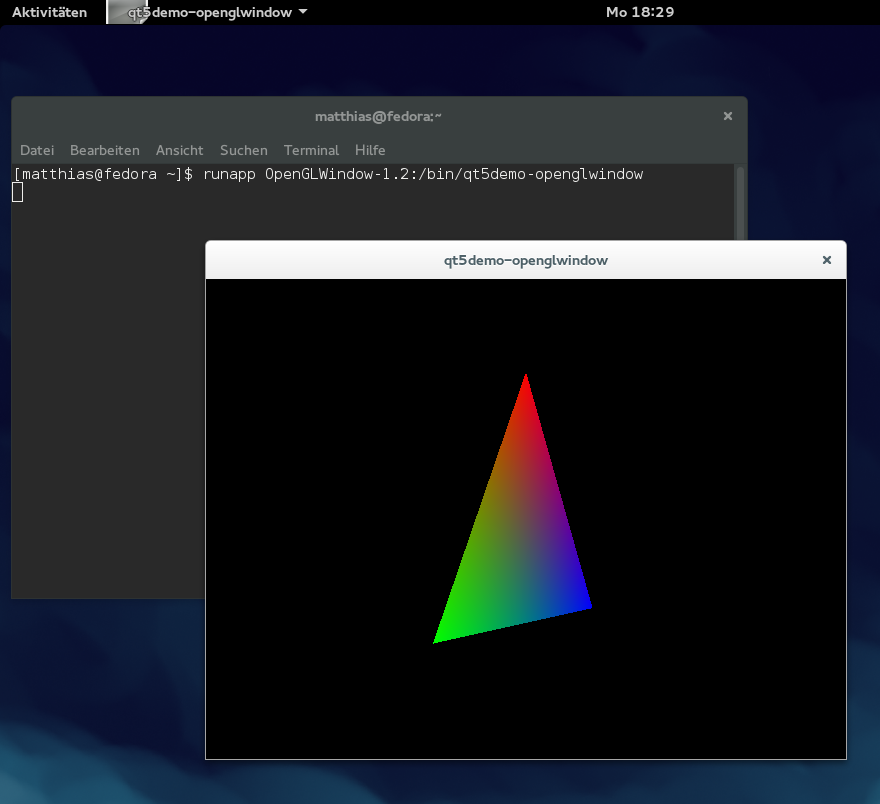
Your software should install successfully. If you provided a .desktop file in $prefix/share/applications, you should find your application in your desktop s application-menu. Otherwise, you can run a binary from the command-line, just append the version of your package to the binary name (bash-comletion helps). Alternatively, you can use the runapp command, which lets you run any binary in your bundle/package, which is quite helpful for debugging (since the environment a Limba-installed application is run is different from the one of other applications). Example:
runapp $ component_id -$ version :/bin/binary-name
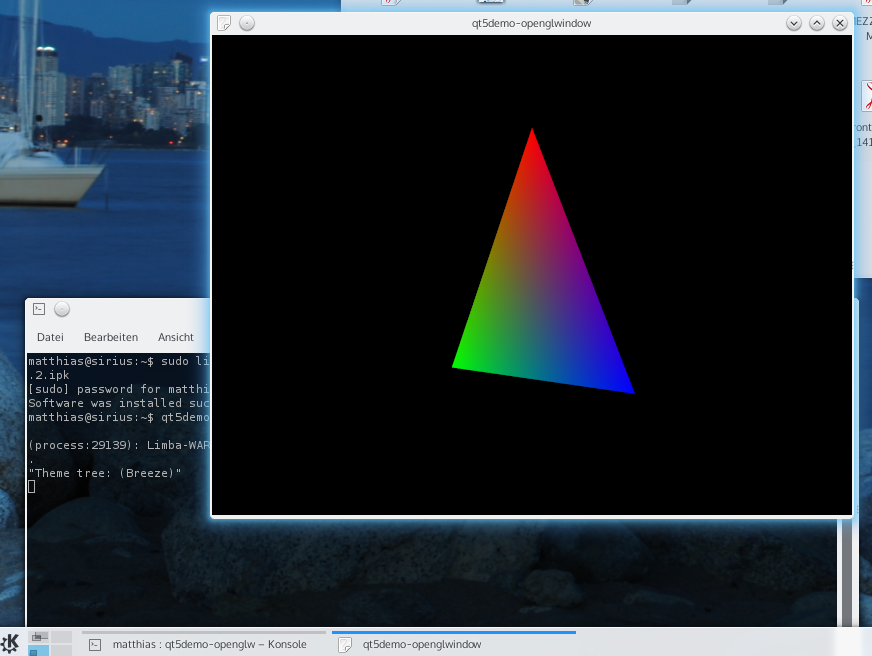
And that s it! :-) I used these steps to create a Limba package for the OpenGL Qt5 demo on Tanglu 2 (Bartholomea), and tested it on Kubuntu 15.04 (Vivid) with KDE, as well as on an up-to-date Fedora 21, with GNOME and without any Qt or KDE stuff installed: qt5demo-limba-kubuntuqt5demo-limba-fedora I encountered a few obstacles when building the packages, e.g. Qt5 initially didn t find the right QPA plugin that has been fixed by adjusting a config file in the Qt5Gui package. Also, on Fedora, a matching libpng was missing, so I included that as well. You can find the packages at Github, currently (but I am planning to move them to a different place soon). The biggest issue with Limba is at time, that it needs Linux 3.18, or an older kernel with OverlayFS support compiled in. Apart from that and a few bugs, the experience is quite smooth. As soon as I am sure there are now hidden fundamental issues, I can think of implementing more features, like signing packages and automatically updating them. Have fun playing around with Limba!

DebConf team: Sponsors for DebConf15 (Posted by Laura Arjona Reina)

The Debian project recently welcomed the first nine sponsors for Debconf15: credativ and sipgate as Gold sponsors, Google, Farsight Security, Inc., Martin Alfke / Buero 2.0 and Ubuntu as silver sponsors, and Logilab, Netways and Hetzner as Bronze-level. But things have kept moving! The Matanel Foundation just committed to support DebConf15 as Gold-level sponsor, and Mirantis as Silver-level. So, at the time of writing this, we have 11 sponsors. We are very thankful for that! The DebConf team aims to organize the Debian Conference as a self-sustaining event, despite its size and complexity (the Final Report for DebConf14 gives a good indication). The financial contributions by individuals, companies and organizations, as well as the support by our infrastructure sponsors, media partners, and volunteers, are pivotal to our success. There are many different possibilities to support DebConf. If you know any company or organization that could be interested, don t hesitate to point them at our sponsorship brochure (also available in German) or tell us about any leads.

Peter Eisentraut: ccache and clang, part 3

In part 1 and part 2 I investigated how to use ccache with clang. That was more than three years ago. I got an email the other day that ccache bug 8118, which I filed while writing part 1, was closed, as ccache 3.2 was released. The release notes of clang 3.2 contain several items related to clang. So it was time to give this another look. Basically, the conclusions from part 2 still stand: You cannot use ccache with clang without using CCACHE_CPP2. And it is now becoming clear to me that this is an issue that is not going to go away, and it s not really even Clang s fault. Warnings! The problem is that clang s -Wall can cause warnings when compiling the preprocessed version of otherwise harmless C code. This can be illustrated by this piece of C code:
int
foo()
 
        int *p, *q;
        p = q = 0;
        p = p;
        if (p == p)
                return 1;
        if ((p == q))
                return 2;
        return 0;
 
When compiled by gcc-4.9 -Wall, this gives no warnings. When compiled by clang-3.5 -Wall, this results in test.c:7:4: warning: explicitly assigning value of variable of type 'int *' to itself [-Wself-assign] test.c:8:8: warning: self-comparison always evaluates to true [-Wtautological-compare] test.c:10:9: warning: equality comparison with extraneous parentheses [-Wparentheses-equality] test.c:10:9: note: remove extraneous parentheses around the comparison to silence this warning test1.c:10:9: note: use '=' to turn this equality comparison into an assignment You wouldn t normally write code like this, but the C preprocessor could create code with self-assignments, self-comparisons, extra parentheses, and so on. This example represents the issues I saw when trying to compile PostgreSQL 9.4 with ccache and clang; there might be others. You can address this issue in two ways:
  1. Use CCACHE_CPP2, as discussed in part 2. With ccache 3.2, you can now also put this into a configuration file: run_second_cpp = true in ~/.ccache/ccache.conf
  2. Turn off the warnings mentioned above: -Wno-parentheses-equality, -Wno-tautological-compare, -Wno-self-assign (and any others you might find). One might think that these are actually useful warnings that one might want to keep, but GCC doesn t warn about them, and if you develop primarily with GCC, your code might contain these issues anyway. In particular, I have found that -Wno-tautological-compare is necessary for legitimate code.
I think CCACHE_CPP2 is the way to go, for two reasons. Firstly, having to add more and more options to turn off warnings is obviously somewhat stupid. Secondly and more importantly, there is nothing stopping GCC from adding warnings similar to Clang s that would trigger on preprocessed versions of otherwise harmless C code. Unless they come up with a clever way to annotate the preprocessed code to the effect of this code might look wrong to you, but it looked OK before preprocessing, so don t warn about it , in a way that creates no extra warnings and doesn t lose any warnings, I don t think this issue can be solved. Speed! Now the question is, how much would globally setting CCACHE_CPP2 slow things down? To test this, I have built PostgreSQL 9.4rc1 with clang-3.5 and gcc-4.8 (not gcc-4.9 because it creates some unrelated warnings that I don t want to deal with here). I have set export CCACHE_RECACHE=true so that the cache is not read but new cache entries are computed. That way, the overhead of ccache on top of the compiler is measured. Results: (There different percentages between gcc and clang arise because gcc is faster than clang (yes, really, more on that in a future post), but the overhead of ccache doesn t change.) 10% or so is not to be dismissed, but let s remember that this applies only if there is a cache miss. If everything is cached, both methods do the same thing. Also, if you use parallel make, the overhead is divided by the number of parallel jobs. With that in mind, I have decided to put the issue to rest for myself and have made myself a ~/.ccache/ccache.conf containing
run_second_cpp = true
Now Clang or any other compiler should run without problems through ccache. Color! There is one more piece of news in the new ccache release: Another thing I talked about in part 1 was that ccache will disable the colored output of clang, and I suggested workarounds. This was actually fixed in ccache 3.2, so the workarounds are no longer necessary, and the above configuration change is really the only thing to make Clang work smoothly with ccache.

Martin-&#201;ric Racine: GNOME is destroying the whole GTK universe

When GNOME 3.14 components were uploaded into Debian (just a few days before the Jessie freeze started), GNOME stopped working on two video platforms: Geode (xf86-video-geode) and NVIDIA (xf86-video-nouveau). On Geode, GDM launches into a black screen. On NVIDIA, GDM launches as expected, but then the GNOME session itself barfs with the dreaded "Oh No! Something went wrong. [Logout]" dialog during session initialization. Basically, components in GNOME have become too tightly dependent upon some video driver features. Thinking out loud, I figured that reverting to a desktop environment that is based upon GTK+3, without GNOME's bells and whistles, would at least restore operation on my NVDIA hosts. Alas, it does not: Cinnamon, too, barfs during session initialization. Great. Now what?

1 December 2014

Gregor Herrmann: GDAC 2014/1

this morning I received no less than two private "thank you" mails from fellow debian contributors. thanks guys, this made a good start into the week!
this posting is part of GDAC (gregoa's debian advent calendar), a project to show the bright side of debian & why it's fun for me to contribute.

Iustin Pop: SSD adventures

SSD adventures and fun times! TL;DR: Oh boy. Things work now, but I'm not sure exactly what happened :( When it all worked fine almost In June, I bought a new laptop, and a new SSD for it. I used that model of SSD before (Samsung 840 Evo), although not for a long time, so I wasn't expecting anything unusual. Since the laptop is a slower one, I installed Debian as follows: connect SSD to my workstation, do an install on it (via Virtualbox connected to the raw device), disconnect and install in the laptop. First sign of trouble was that the SSD didn't boot reliably. I said - maybe my Virtualbox method (new method) wasn't right - so I reinstalled on the laptop, and everything was mostly OK. Mostly OK because rarely the laptop had issues with seeing the SSD. Maybe not cold booting, requiring a restart, or giving some ATA errors on boot (bot nothing afterwards). I didn't use the laptop too much - I mostly use it when travelling - so I didn't investigate further. Trouble begins Fast forward to two weeks ago: I was preparing to leave on a trip, so I booted the laptop (everything OK), apt-get dist-upgrade, synced my git trees, etc. Everything was fine. The next day, in the airport between two flights, the laptop doesn't boot - doesn't see the SSD at all. I tried rebooting a gazillion times, nothing. I was quite upset - at the hardware, and at me for not paying attention to the unreliability signs before. Once I arrived at the destination, I opened the laptop, tried re-seating the SSD, nothing. I bought a SATA-to-USB bridge, and surprise! Boots from the first, no issues. Diagnosis A: Laptop SATA connector has issues. I work with this SATA-to-USB bridge for a couple of days, but it was quite slow (~20MB/s), so I buy a SATA-to-USB3 cradle, which should be much faster. But the SSD was not visible in this cradle. Not only that, but it was causing the laptop to hang in the POST screen - reliably. Turn the cradle off, the laptop passes POST, turn it on, the laptop took 2 minutes to pass the POST. OK, the cradle is broken. Connect the SSD back to the USB2 thing not booting For about five minutes, it was like "dead". After that, it booted and behaved normally. I didn't know what to think, I just put it aside. So worked for the rest of the week on the USB2 bridge, with no issues (once it the SSD dropped off, but I think that was just USB being USB). So at the end of the week, diagnosis (A) still was the main contender. On the flight back home, I worked from the plane for a good number of hours, again no issue. Laptop/SSD were fully powered off before the flight, powered with no issues, worked fine. At the end of the flight I completely shut down my laptop. Diagnosis A still on top. Real trouble now After getting home and sleeping a bit, I wanted to power up the laptop just to transfer the code I wrote on the plane. But it didn't power up. No problem, I said, now I actually have access to running Linux machines and I can check what's happening. And to my surprise, the SSD was behaving erratically: The looked like this (when connected over SATA):
20:22:57 kernel: ata2.00: ATA-9: Samsung SSD 840 EVO 500GB, EXT0BB6Q, max UDMA/133
20:22:57 kernel: ata2.00: 976773168 sectors, multi 1: LBA48 NCQ (depth 31/32), AA
20:22:57 kernel: ata2.00: configured for UDMA/133
20:22:57 kernel: scsi 3:0:0:0: Direct-Access     ATA      Samsung SSD 840  EXT0 PQ: 0 ANSI: 5
20:22:57 kernel: sd 3:0:0:0: [sdc] 488397168 512-byte logical blocks: (250 GB/232 GiB)
20:22:57 kernel: sd 3:0:0:0: [sdc] Write Protect is off
20:22:57 kernel: sd 3:0:0:0: [sdc] Mode Sense: 00 3a 00 00
20:22:57 kernel: sd 3:0:0:0: [sdc] Write cache: enabled, read cache: enabled, doesn't support DPO or FUA
20:22:57 kernel: ata2.00: exception Emask 0x0 SAct 0x2 SErr 0x400001 action 0x6 frozen
20:22:57 kernel: ata2: SError:   RecovData Handshk  
20:22:57 kernel: ata2.00: failed command: READ FPDMA QUEUED
20:22:57 kernel: ata2.00: cmd 60/08:08:68:01:00/00:00:00:00:00/40 tag 1 ncq 4096 in
20:22:57 kernel:         res 40/00:00:00:00:00/00:00:00:00:00/00 Emask 0x4 (timeout)
20:22:57 kernel: ata2.00: status:   DRDY  
20:22:57 kernel: ata2: hard resetting link
20:22:57 kernel: ata2: SATA link up 6.0 Gbps (SStatus 133 SControl 300)
20:22:57 kernel: ata2.00: failed to get NCQ Send/Recv Log Emask 0x1
20:22:57 kernel: ata2.00: configured for UDMA/133
20:22:57 kernel: ata2.00: device reported invalid CHS sector 0
20:22:57 kernel: ata2: EH complete
20:22:57 kernel: ata2.00: exception Emask 0x0 SAct 0x400000 SErr 0x400001 action 0x6
20:22:57 kernel: ata2.00: irq_stat 0x44000008
20:22:57 kernel: ata2: SError:   RecovData Handshk  
20:22:57 kernel: ata2.00: failed command: READ FPDMA QUEUED
20:22:57 kernel: ata2.00: cmd 60/08:b0:08:03:00/00:00:00:00:00/40 tag 22 ncq 4096 in
20:22:57 kernel:         res 41/84:00:08:03:00/00:00:00:00:00/00 Emask 0x410 (ATA bus error) <F>
20:22:57 kernel: ata2.00: status:   DRDY ERR  
20:22:57 kernel: ata2.00: error:   ICRC ABRT  
20:22:57 kernel: ata2: hard resetting link
20:22:57 kernel: ata2: SATA link up 6.0 Gbps (SStatus 133 SControl 300)
20:22:57 kernel: ata2.00: failed to get NCQ Send/Recv Log Emask 0x1
20:22:57 kernel: ata2.00: configured for UDMA/133
20:22:57 kernel: ata2: EH complete
Note that all of the messages were in short order (during boot, they show the same timestamp but I don't think it was actually the same second). I tried connecting the SSD over USB2 (partially working), over USB3 (not working!), and directly over SATA (initially not working). I connected another SSD I had around (same model, just smaller capacity) over all three, it worked (so the USB3 bridge was working, at least). Diagnosing (A) was out the door now, and the situation was very clear: SSD dying/dead/almost gone. So I connected both broken SSD and empty SSD to my workstation over SATA, and started copying data (once I managed to boot with the old one being visible and working). During the data copy, I saw that the "broken" SSD behaved erratically indeed: it was copying data off it with either ~40MB/s, ~70MB/s, and ~160MB/s. Not other speed, at least not for long time, just cycling between these three; and this is a very slow speed for this SSD model. And then I remembered that there is, for this model (Samsung 840 Evo), an advisory/firmware fix that old data gets harder to access (slower and slower), due to how TLC cells levels are read/etc. I don't know exactly what "old" means, but since the partition table was written only once, it should be the oldest thing written, which would make it the most susceptible to the slowdown, and could explain the cfdisk slowness. So after the data copy, I tested this: So yes, it is something related to this, probably. Diagnosis B: "just" the Samsung Evo bug. So I proceed to (try to) upgrade the firmware: Uh oh, so it's more than this - the SSD seems to be actually broken. I don't have much experience with SSDs, I used for many years an Intel X25-M and more recently I have a couple of Samsung 840 Pro, but I never had issues until now, so maybe the cheap Evo is just cheap and fast Note that during all this drama, SMART gives good info about SSD, and SMART tests are perfect (short/long). Just a number of UDMA CRC errors so thanks for nothing. I try to the firmware upgrade a few times, I give up. Diagnosis C: SSD is just plain broken. I'll send the SSD for a replacement/fix, so (even though it's encrypted), let's try to erase it first (as I can still read/write to it). And since just dd if=/dev/zero of=/dev/sdX is too common, let's try a builtin (ATA) erase! After fighting with hdparm and the fact that my BIOS does indeed "security freeze" on the drives (so you can't change the security settings nor erase the drives), and finding an article on the net that gives a few workaround, I manage to "unfreeze" it by not only live unplugging the SATA cable, but also the power cable, and plugging them back in. Time to erase. Side-note here: So, especially given the very fast ENHANCED erase, I now believe the SSD is truly broken. Diagnosis C rules. And finally, just confusion After the SSD erase, reading (the zeros) from the SSD is really fast: more than 500MB/s, as expected. I also try once more to upgrade the firmware for the Evo bug, and it works flawlessly this time. Even rebooting the machine many times works without problems, the SSD is seen every single time. I still can't make it work well over the USB3 bridge (but I'm not very convinced that device work well, since Linux does apply quirks when it detects it). But it doesn't give any ATA errors this time, and it works (read and write) consistently fast (as per the Evo specs). I still have to let it go through a long burnin with verification, but a short one works fine, so at this point I'm just very confused as what was (is?) the actual problem with this device, and why it behaves so strange Was the laptop broken? Clearly no. Was the SSD broken, or just impacted by the slowdown issue? Time will tell. I'll put it through the paces, and see. But unless I replace it, I'll keep this just for "fast cache" use cases, and not to hold real data. Yep, computers are fun!

Joey Hess: snowdrift - sustainable crowdfunding for free software development

In a recent blog post, I mentioned how lucky I feel to keep finding ways to work on free software. In the past couple years, I've had a successful Kickstarter, and followed that up with a second crowdfunding campaign, and now a grant is funding my work. A lot to be thankful for. A one-off crowdfunding campaign to fund free software development is wonderful, if you can pull it off. It can start a new project, or kick an existing one into a higher gear. But in many ways, free software development is a poor match for kickstarter-type crowdfunding. Especially when it comes to ongoing development, which it's really hard to do a crowdfunding pitch for. That's why I was excited to find Snowdrift.coop, which has a unique approach. Imagine going to a web page for a free software project that you care about, and seeing this button: 1283 patrons will donate MORE when you pledge That's a lot stronger incentive than some paypal donation button or flattr link! The details of how it works are explained on their intro page, or see the ever-insightful and thoughtful Mike Linksvayer's blog post about it. When I found out about this, I immediately sent them a one-off donation. Later, I got to meet one of the developers face to face in Portland. I've also done a small amount of work on the Snowdrift platform, which is itself free software. (My haskell code will actually render that button above!) Free software is important, and its funding should be based, not on how lucky or good we are at kickstarter pitches, but on its quality and how useful it is to everyone. Snowdrift is the most interesting thing I've seen in this space, and I really hope they succeed. If you agree, they're running their own crowdfunding campaign right now.

30 November 2014

Gregor Herrmann: RC bugs 2014/47-48

these are the RC bugs I've worked on during the last two weeks:

Enrico Zini: cxx11-talk-examples

C++11 talk examples On 2014-11-27 I gave a talk about C++ and new features introduced with C++11: these are the examples. They are all licensed under the wtfpli version 2. See cxx11-talk-notes for the talk notes. Note that the wrapper interfaces turns errors from the underlying libraries into exceptions, so the method calls just do what they should, without the need of documenting special return values for error messages, and removing the need for each library to implement yet another way of reporting errors. Also note that all wrapper objects do RAII: you create them and they clean after themselves when they go out of scope. The wrapper objects also have cast operators to make them behave as the pointer or handle that they are wrapping, so that they can be transparently passed to the underlying libraries. (note: I had to add U+2063 INVISIBLE SEPARATOR to prevent noreturn statements to be misinterpreted by the blog formatter. If you copypaste the code and encounter issues, you may want to delete the noreturn statements and retype them) A gcrypt hash class This class is a light wrapper around gcrypt's hashing functions. ezhash.h
#ifndef EZHASH_H
#define EZHASH_H
#include <string>
#include <gcrypt.h>
namespace ezhash  
class Hash
 
protected:
    // members can now be initialized just like this, without needing to repeat
    // their default assignment in every constructor
    gcry_md_hd_t handle = nullptr;
public:
    Hash(int algo, unsigned int flags=0);
    ~Hash();
    // Assign 'delete' to a method to tell the compiler not to generate it
    // automatically. In this case, we make the object non-copiable.
    Hash(const Hash&) = delete;
    Hash(const Hash&&) = delete;
    Hash& operator=(const Hash&) = delete;
    // Add a buffer to the hash
    void hash_buf(const std::string& buf);
    // Add the contents of a file to the hash
    void hash_file(int fd);
    // Get a string with the hexadecimal hash
    std::string read_hex(int algo=0);
    /// Pretend that we are a gcry_md_hd_t handle
    operator gcry_md_hd_t()   return handle;  
 ;
 
#endif
ezhash.cpp
#include "ezhash.h"
#include <unistd.h>
#include <errno.h>
#include <string>
#include <cstring>
#include <sstream>
#include <iomanip>
#include <stdexcept>
using namespace std;
namespace ezhash  
namespace  
// noreturn attribute, to tell the compiler that this function never returns
[ [noreturn]] void throw_gcrypt_error(gcry_error_t err)
 
    string msg;
    msg += gcry_strsource(err);
    msg += "/";
    msg += gcry_strerror(err);
    throw runtime_error(msg);
 
string errno_str(int error)
 
    char buf[256];
#if (_POSIX_C_SOURCE >= 200112L   _XOPEN_SOURCE >= 600) && ! _GNU_SOURCE
    strerror_r(errno, buf, 256);
    string res(buf);
#else
    string res(strerror_r(errno, buf, 256));
#endif
    return res;
 
[ [noreturn]] void throw_libc_error(int error)
 
    throw runtime_error(errno_str(error));
 
 
Hash::Hash(int algo, unsigned int flags)
 
    gcry_error_t err = gcry_md_open(&handle, algo, flags);
    if (err) throw_gcrypt_error(err);
 
Hash::~Hash()
 
    gcry_md_close(handle);
 
void Hash::hash_buf(const std::string& buf)
 
    gcry_md_write(handle, buf.data(), buf.size());
 
void Hash::hash_file(int fd)
 
    char buf[4096];
    while (true)
     
        ssize_t res = ::read(fd, buf, 4096);
        if (res < 0) ezfs::throw_libc_error();
        if (res == 0) break;
        gcry_md_write(handle, buf, res);
     
 
std::string Hash::read_hex(int algo)
 
    unsigned char* res = gcry_md_read(handle, algo);
    unsigned int len = gcry_md_get_algo_dlen(
            algo == 0 ? gcry_md_get_algo(handle) : algo);
    // Format the hash into a hex digit
    stringstream hexbuf;
    hexbuf << hex << setfill('0');
    for (unsigned i = 0; i < len; ++i)
        hexbuf << setw(2) << (unsigned)res[i];
    return hexbuf.str();
 
 
Example usage
        ezhash::Hash sha256(GCRY_MD_SHA256);
        sha256.hash_buf("ciao\n");
        sha256.hash_buf("foo\n");
        cout << sha256.read_hex() << endl;
Simple sqlite bindings Remarkably simple sqlite3 bindings based on lambda callbacks. ezsqlite.h
#ifndef EZSQLITE_H
#define EZSQLITE_H
#include <sqlite3.h>
#include <string>
#include <functional>
#include <stdexcept>
namespace ezsqlite  
/// RAII wrapper around a sqlite3 database handle
class DB
 
protected:
    sqlite3* handle = nullptr;
public:
    // Open a connection to a SQLite database
    DB(const std::string& filename, int flags=SQLITE_OPEN_READWRITE   SQLITE_OPEN_CREATE);
    DB(const DB&) = delete;
    DB(const DB&&) = delete;
    DB& operator=(const DB&) = delete;
    ~DB();
    /**
     * Execute a query, optionally calling 'callback' on every result row
     *
     * The arguments to callback are:
     *  1. number of columns
     *  2. text values of the columns
     *  3. names of the columns
     */
    // std::function can be used to wrap any callable thing in C++
    // see: http://en.cppreference.com/w/cpp/utility/functional/function
    void exec(const std::string& query, std::function<bool(int, char**, char**)> callback=nullptr);
    /// Pretend that we are a sqlite3 pointer
    operator sqlite3*()   return handle;  
 ;
 
#endif
ezsqlite.cpp
#include "ezsqlite.h"
namespace ezsqlite  
DB::DB(const std::string& filename, int flags)
 
    int res = sqlite3_open_v2(filename.c_str(), &handle, flags, nullptr);
    if (res != SQLITE_OK)
     
        // From http://www.sqlite.org/c3ref/open.html
        // Whether or not an error occurs when it is opened, resources
        // associated with the database connection handle should be
        // released by passing it to sqlite3_close() when it is no longer
        // required.
        std::string errmsg(sqlite3_errmsg(handle));
        sqlite3_close(handle);
        throw std::runtime_error(errmsg);
     
 
DB::~DB()
 
    sqlite3_close(handle);
 
namespace  
// Adapter to have sqlite3_exec call a std::function
int exec_callback(void* data, int columns, char** values, char** names)
 
    std::function<bool(int, char**, char**)> cb = *static_cast<std::function<bool(int, char**, char**)>*>(data);
    return cb(columns, values, names);
 
 
void DB::exec(const std::string& query, std::function<bool(int, char**, char**)> callback)
 
    char* errmsg;
    void* cb = callback ? &callback : nullptr;
    int res = sqlite3_exec(handle, query.c_str(), exec_callback, cb, &errmsg);
    if (res != SQLITE_OK && errmsg)
     
        // http://www.sqlite.org/c3ref/exec.html
        //
        // If the 5th parameter to sqlite3_exec() is not NULL then any error
        // message is written into memory obtained from sqlite3_malloc() and
        // passed back through the 5th parameter. To avoid memory leaks, the
        // application should invoke sqlite3_free() on error message strings
        // returned through the 5th parameter of of sqlite3_exec() after the
        // error message string is no longer needed. 
        std::string msg(errmsg);
        sqlite3_free(errmsg);
        throw std::runtime_error(errmsg);


Example usage
    // Connect to the database
    ezsqlite::DB db("erlug.sqlite");
    // Make sure we have a table
    db.exec(R"(
        CREATE TABLE IF NOT EXISTS files (
                name TEXT NOT NULL,
                sha256sum TEXT NOT NULL
        )
    )");
    // Read the list of files that we know
    map<string, string> files;
    db.exec("SELECT name, sha256sum FROM files", [&](int columns, char** vals, char** names)  
        if (columns != 2) return false;
        files.insert(make_pair(vals[0], vals[1]));
        return true;
     );
A fast Directory object This is a lightweight wrapper around O_PATH file descriptors for directories. I'd love to see a library of well-maintained and thin C++ bindings around libc, that do little more than turning errors into exceptions and making it also work with std::string buffers. ezfs.h
#ifndef EZFS_H
#define EZFS_H
#include <string>
#include <functional>
#include <memory>
#include <cerrno>
#include <sys/types.h>
#include <sys/stat.h>
#include <fcntl.h>
#include <unistd.h>
#include <dirent.h>
namespace ezfs  
class Directory
 
protected:
    int handle = -1;
public:
    Directory(const std::string& pathname, int flags=0);
    ~Directory();
    Directory(const Directory&) = delete;
    Directory(const Directory&&) = delete;
    Directory& operator=(const Directory&) = delete;
    /// List the directory contents
    void ls(std::function<void(const dirent&)> callback);
    int open(const std::string& relpath, int flags, mode_t mode=0777);
 ;
std::string errno_str(int error=errno);
[ [noreturn]] void throw_libc_error(int error=errno);
 
#endif
ezfs.cpp
#include "ezfs.h"
#include <stdexcept>
#include <memory>
#include <cstring>
#include <cstdlib>
#include <string>
#include <linux/limits.h>
using namespace std;
namespace ezfs  
string errno_str(int error)
 
    char buf[256];
#if (_POSIX_C_SOURCE >= 200112L   _XOPEN_SOURCE >= 600) && ! _GNU_SOURCE
    strerror_r(errno, buf, 256);
    string res(buf);
#else
    string res(strerror_r(errno, buf, 256));
#endif
    return res;
 
[ [noreturn]] void throw_libc_error(int error)
 
    throw runtime_error(errno_str(error));
 
Directory::Directory(const std::string& pathname, int flags)
 
    handle = ::open(pathname.c_str(), O_PATH   O_DIRECTORY   flags);
    if (handle < 0) throw_libc_error();
 
Directory::~Directory()
 
    ::close(handle);
 
void Directory::ls(std::function<void(const dirent&)> callback)
 
    int fd = openat(handle, ".", O_DIRECTORY);
    if (fd < 0) throw_libc_error();
    // RAII Self-cleaning DIR object
    unique_ptr<DIR, std::function<void(DIR*)>> dir(fdopendir(fd), [](DIR* dir)   if (dir) closedir(dir);  );
    if (!dir)
     
        // fdopendir(3): After a successful call to fdopendir(), fd is used
        // internally by the implementation, and should not otherwise be used
        // by the application.
        //
        // but if the fdopendir call was not successful, fd is not managed by
        // DIR, and we still need to close it, otherwise we leak a file
        // descriptor.
        //
        // However, close() may modify errno, so we take note of the errno set
        // by fdopendir and raise the exception based on that.
        int fdopendir_errno = errno;
        close(fd);
        throw_libc_error(fdopendir_errno);
     
    // Size the dirent buffer properly
    const unsigned len = offsetof(dirent, d_name) + PATH_MAX + 1;
    unique_ptr<dirent, std::function<void(void*)>> dirbuf((dirent*)malloc(len), free);
    while (true)
     
        dirent* res;
        int err = readdir_r(dir.get(), dirbuf.get(), &res);
        // End of directory contents
        if (err == 0)
         
            if (res)
                callback(*res);
            else
                break;
          else
            throw_libc_error(err);
     
 
int Directory::open(const std::string& relpath, int flags, mode_t mode)
 
    int res = openat(handle, relpath.c_str(), flags, mode);
    if (res < 0) throw_libc_error();
    return res;
 
 
Example usage
        // This is almost the equivalent of running "sha256sum ."
        ezfs::Directory dir(".");
        dir.ls([&](const dirent& d)  
            if (d.d_type != DT_REG) return;
            ezhash::Hash sha256(GCRY_MD_SHA256);
            // I have no RAII wrapper around file handles at the moment, so
            // I'll have to use a try/catch for cleaning up after errors
            int fd = dir.open(d.d_name, O_RDONLY);
            try  
                sha256.hash_file(fd);
                close(fd);
              catch (...)  
                close(fd);
                throw;
             
            cout << sha256.read_hex() << "  " << d.d_name << endl;
         );

Thorsten Alteholz: My Debian Activities in November 2014

FTP assistant In contrast to the last month, this month has been rather quiet and I really liked that :-) . The stress has moved to the next team. So all in all I marked 101 packages for accept and had to reject 27 packages. As I mostly reviewed really new packages, I didn t have to file any RC bug this month. Squeeze LTS This was my fifth month that I did some work for the Squeeze LTS initiative, started by Raphael Hertzog at Freexian. This month I got assigned a workload of 14.25h and I spent these hours to upload new versions of: I also uploaded [DLA 85-1] libxml-security-java security update, but as nobody of the LTS sponsors had any interest in this package, I did this in my spare time. A package with security in its name should not be affected by security issues. This month my failure of the month has been the binutils package. Although the security team prepared the way for finding the correct patches for all those CVEs, I somehow managed to not find them. This is embarassing I am also a bit disappointed by current LTS users. All important packages have been made available for testing before uploading them to the archive. Apart from some brave fellow DDs, no other feedback was reported on debian-lts. Complaints arrived only when the packages have been finally uploaded. Do admins have enough time nowadays and don t need to use some kind of testbed? Times are changing Other packages This month I even found some time to sponsor uploads, so please welcome a new version of fastaq in experimental and patiently wait for aegaen and kmc to pass NEW. At this point I also want to mention the Debian Med Advent Calendar, which was announced in this email and already mentioned by Andreas in his latest Debian Med bits. Everybody is invited to take care of as much as possible poor souls. Support If you would like to support my Debian work you could either be part of the Freexian initiative (see above) or consider to send some bitcoins to 1JHnNpbgzxkoNexeXsTUGS6qUp5P88vHej. Contact me at donation@alteholz.eu if you prefer another way to donate. Every kind of support is most appreciated.

Enrico Zini: cxx11-talk-notes

C++11 talk notes On 2014-11-27 I gave a talk about C++ and new features introduced with C++11: these are the talk notes. See cxx11-talk-examples for the examples. (note: I had to add U+2063 INVISIBLE SEPARATOR to prevent noreturn statements to be misinterpreted by the blog formatter. If you copypaste the code and encounter issues, you may want to delete the noreturn statements and retype them) Overview of programming languages
It has to be as fast as possible, so interpreted languages are out. You don't want to micro manage memory, so C is out. You don't want to require programmers to have a degree, so C++ is out. You want fast startup and not depend on a big runtime, so Java is out. [...] (Bram Moolenaar)
C++ secret cultist protip
Do not call up what you cannot put down.
C++ is a compiled language It is now possible to use the keyword constexpr to mark functions and objects that can be used at compile time:
/*
 * constexpr tells the compiler that a variable or function can be evaluated at
 * compile time.
 *
 * constexpr functions can also be run at run time, if they are called with
 * values not known at compile time.
 *
 * See http://en.cppreference.com/w/cpp/language/constexpr for more nice examples
 *
 * It can be used to avoid using constants in code, and using instead functions
 * for computing hardware bitfields or physical values, without losing in
 * efficiency.
 */
#include <iostream>
using namespace std;
constexpr int factorial(int n)
 
    return n <= 1 ? 1 : (n * factorial(n-1));
 
int main()
 
    cout << "Compile time factorial of 6: " << factorial(6) << endl;
    cout << "Enter a number: ";
    int a;
    cin >> a;
    cout << "Run time factorial of " << a << ": " << factorial(a) << endl;
 
See also this for more nice examples. See this and this for further discussion. Multiline strings
        const char* code = R"--(
          printf("foo\tbar\n");
          return 0;
        )--";
See this. C++ memory management protip RAII: Resource Acquisition Is Instantiation This is not new in C++11, but in my experience I have rarely seen it mentioned in C++ learning material, and it does make a huge difference in my code. See this and this for details. Constructors and member initializer lists Initializers in curly braces now have their own type: std::initializer_list:
#include <string>
#include <iostream>
#include <unordered_set>
using namespace std;
// std::initializer_list< >
//   will have as its value all the elements inside the curly braces
string join(initializer_list<string> strings)
 
    string res;
    for (auto str: strings)
     
        if (!res.empty())
            res += ", ";
        res += str;
     
    return res;
 
int main()
 
    unordered_set<string> blacklist  ".", "..", ".git", ".gitignore"  ;
    cout << join(  "antani", "blinda"  ) << endl;
 
See this for details, including the new uniform initialization trick of omitting parentesis in constructors so that you can call normal constructors and initializer_list constructors with the same syntax, which looks like an interesting thing when writing generic code in templates. Type inference I can now use auto instead of a type to let the compiler automatically compute the value of something I assign to:
        auto i = 3 + 2;
        // See also https://github.com/esseks/monicelli
        vector<string> names  "antani", "blinda", "supercazzola"  ;
        for (auto i = names.cbegin(); i != names.cend(); ++i)
            cout << i;
        template<typename T>
        T frobble(const T& stuff)
         
             // This will work whatever type is returned by stuff.read()
             auto i = stuff.read();
             //  
         
See this for more details. Range-based for loop C++ now has an equivalent of the various foreach constructs found in several interpreted languages!
        for (auto i: list_of_stuff)
                cout << i << endl;
        for (auto n:  0,1,2,3,4,5 )
                cout << n << endl;
        // This construct:
        for (auto i: stuff)
        // If stuff is an array, it becomes:
        for (i = stuff, i < stuff + sizeof(stuff) / sizeof(stuff[0]); ++i)
        // If stuff has .begin() and .end() methods it becomes:
        for (i = stuff.begin(); i != stuff.end(); ++i)
        // Otherwise it becomes:
        for (i = begin(stuff); i != end(stuff); ++i)
        // And you can define begin() and end() functions for any type you
        // want, at any time
See this and this for details. Lambda functions and expressions Lambdas! Closures! Something like this:
// JavaScript
var add = function(a, b)   return a + b;  
# Python
add = lambda a, b: a + b
Becomes this:
auto add = [](int a, int b)   return a + b;  
And something like this:
// JavaScript
var a = 0;
$.each([1, 2, 3, 4], function(idx, el)   a += el  );
Becomes this:
unsigned a = 0;
std::for_each(  1, 2, 3, 4  , [&a](int el)   return a += el;  );
See this, this and this. Tuple types C++ now has a std::tuple type, that like in Python can be used to implement functions that return multiple values:
        tuple<int, string, vector<string>> parse_stuff()
         
                return make_tuple(id, name, values);
         
        string name; vector<string> values;
        // std::ignore can be used to throw away a result
        tie(ignore, name, values) = parse_stuff();
        // std::tie can also be used to do other kind of
        // multi-operations besides assignment:
        return tie(a, b, c) < tie(a1, b1, c1);
        // Is the same as:
        if (a != a1) return a < a1;
        if (b != b1) return b < b1;
        return c < c1;
See here, here and here. Regular expressions We now have regular expressions!
        std::regex re(R"((\w+)\s+(\w+))");
        string s("antani blinda");
        smatch res;
        if (regex_match(s, res, re))
            cout << "OK " << res[1] << " -- " << res[2] << endl;
The syntax is ECMAScript by default and can be optionally changed to basic, extended, awk, grep, or egrep. See here and here. General-purpose smart pointers There is std::unique_ptr to code memory ownership explicitly, and std::shared_ptr as a reference counted pointer, and smart pointers can have custom destructors:
    unique_ptr<dirent, std::function<void(void*)>> dirbuf((dirent*)malloc(len), free);
See here and here. Miscellaneous other cool things Standard attribute specifiers
string errno_str(int error)
 
    char buf[256];
#if (_POSIX_C_SOURCE >= 200112L   _XOPEN_SOURCE >= 600) && ! _GNU_SOURCE
    strerror_r(errno, buf, 256);
    string res(buf);
#else
    string res(strerror_r(errno, buf, 256));
#endif
    return res;
 
[ [noreturn]] void throw_libc_error(int error)
 
    throw runtime_error(errno_str(error));
 
See here. Hash tables See here and look at the new containers unordered_set, unordered_map, unordered_multiset, and unordered_multimap. Multithreading There is a standard threading model, with quite a bit of library support: see here, here, here, and here for atomic data structures. Variadic templates Templates can now take variable number of arguments, and that opens possibilities for interesting code generation, like implementing a generic, type-safe printf statement, or something like this:
db.query(R"(
   INSERT INTO table NAMES (id, name, description)
     VALUES (?, ?, ?)
)", 4, "genio", "fantasia, intuizione, decisione, e velocit  di esecuzione");
See here and here. Essential tools You need at least g++ 4.8 or clang 3.3 to have full C++11 support. They will be both available in jessie, and for wheezy you can use the nightly clang packages repository. I cannot think of a good excuse not to use -Wall on new code. scan-build from clang is another nice resource for catching even more potential problems at compile time. valgrind is a great tool for runtime code analysis: valgrind --tool=memcheck (the default) will check your program for wrong memory accesses and memory leaks. valgrind --tool=callgrind will trace function calls for profiling, to be analyzed with kcachegrind. valgrind --tool=helgrind can check multi-threaded programs for suspicious concurrent memory accesse patterns. And of course gdb: a nice trick with C++ is to issue catch throw to get a breakpoint at the point where an exception is being thrown. help catch provides a list of other interesting catch examples. Coredump tips: ulimit -c to enable core dumps, triggering a core dump with ^\, opening a core with gdb program core, and more details on man 5 core. An extra gdb tip, which is not related to C++ but helped me considerably recently, is that it can be attached to running python programs to get a live Python traceback.

Next.

Previous.