Search Results: "tg"

13 October 2012

Timo Jyrinki: OpenPhoenux GTA04

Postman was on a kind mood yesterday. My OpenPhoenux GTA04 arrived! I had my newer Neo FreeRunner upgraded via the service from Golden Delicious.

First, something rare to behold in phones nowadays - Made in Bavaria:


As a sidenote, also rare now - my Nokia N9 is one of the last phones that had this:

It's sad that's now a thing of the past for both hardware assembly and software! But that's just a hint for new companies to step in.

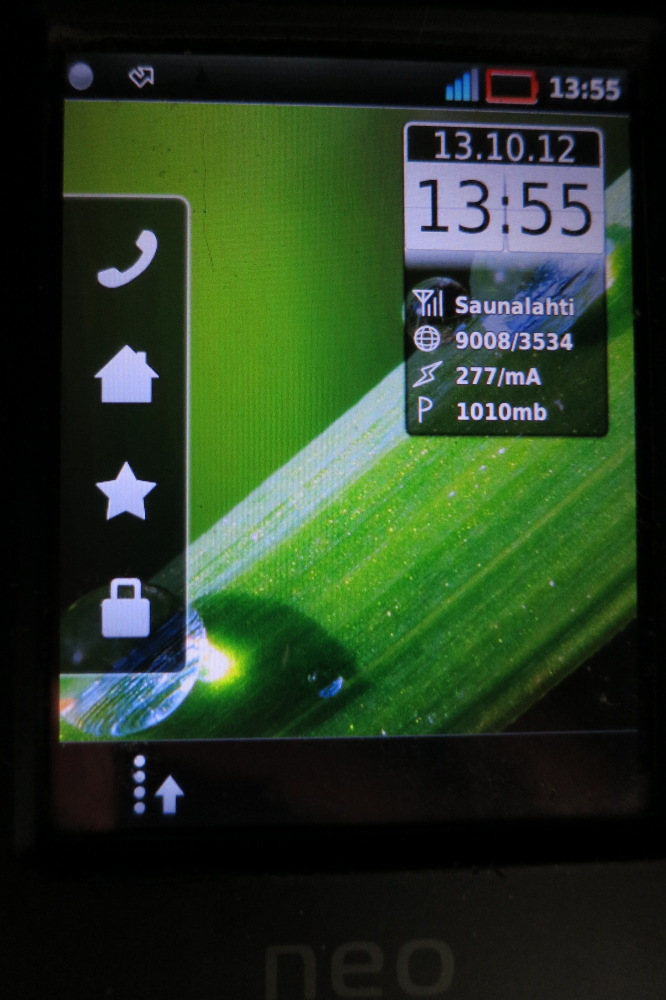
But back to GTA04 - a quick boot to the pre-installed Debian w/ LXDE:


And then as a shortcut unpacked and booted into QtMoko (well, it's also Debian) instead to test that phone functionality also works - and it does:


Next up: brewing something of my own!

3 October 2012

Stefano Zacchiroli: put some Debian salt in the Ubuntu charity marathon

Fellow geeks of the Canonical community team will be doing something pretty weird this week. They're fund-raising for charity, for causes ranging from environment to autism, from homeless support to kids education, from poverty fight to water supplies. But that's not weird. What's weird is that the fund-raising will culminate in a 24-hour work marathon stream live, which will kick off tomorrow (Thursday) at 10:00 UTC. As I like charity, and as I like contributing to Free Software, I gladly accepted to rely here a challenge to the Debian community by one of the marathon "horsemen", Michael Hall: Raising the stakes, Nick Skaggs has decided to propose a similar challenge: Wanna take the challenge? And how about the other 4 horsemen? No challenges to the Debian community? Feel free to leave a comment and I'll raise the stakes even more, updating the list above. Update 4/10/2012, 13:35 +0200: Daniel Holbach added his own challenge to the Debian community:

29 September 2012

Jonathan Carter: LLXC: My little python3-lxc based project


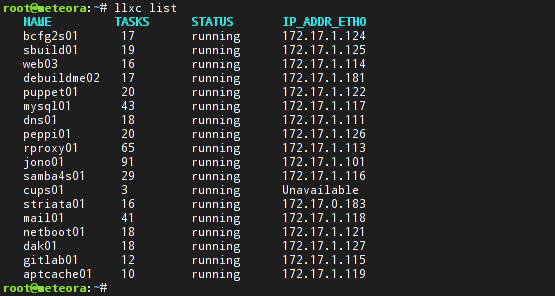
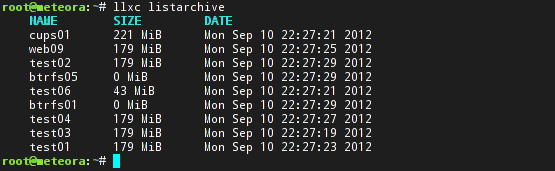
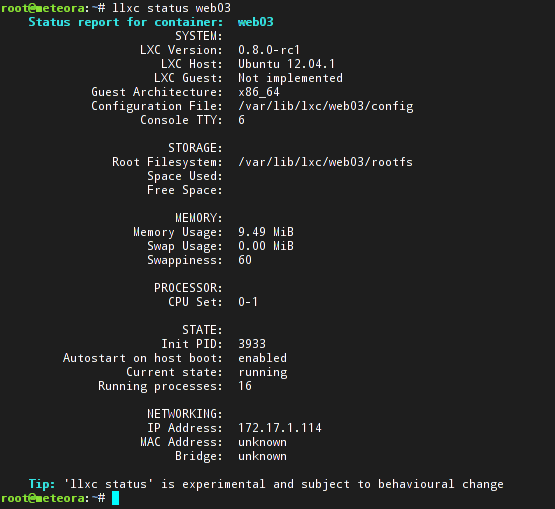
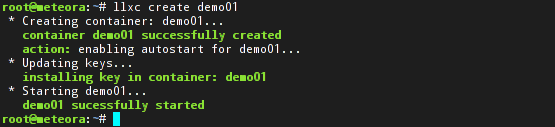
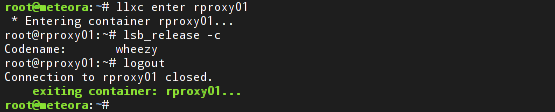
My foray into the world of LXC and RLXC A few months ago, I started trying out LXC (Linux Containers). Before that I used to use OpenVZ, which is an older and more mature contextualization implementation. I was pleased with how well LXC worked and started replacing my personal OpenVZ hosts with LXC. It worked great, but it had a few quirks. While LXC itself works well, the user scripts that ship with it has some space for improvement. The lxc-list command lists anything that s a directory in /var/lib/lxc, so if you have a lost+found directory, it will list it as a container (This has since been fixed upstream). Also, in some cases it would list containers twice or not at all. I was a bit annoyed with that, since OpenVZ s vzlist tool prints out a nice table of your containers along with their IP addresses and other information. Since it s very trivial to implement what I want in a shell script, I went ahead and did just that and called it RLXC. I also missed the vzctl exec <containername> command to execute commands in containers and vzctl enter <containername> to gain a shell inside the container, so I added some more functionality to it so that I could configure ssh keys for these containers and use rlxc enter and rlxc exec like I used to do with the OpenVZ tools, but by using SSH. I also realised that there are others too who wanted similar improvements in the LXC scripts and decided to continue improving RLXC and making it public. Enter LLXC I spoke to St phane about my ideas at the time and he introduced me to python3-lxc that he introduced on his blog yesterday. It provides Python bindings for liblxc, so I took the advantage of that and mostly re-implemented RLXC in Python and called it LLXC. The name doesn t particularly mean anything, I m open to suggestions for what to call it, if anyone cares. Here are some screenshots that explains some of it better than I could do in words: How to get it As St phane mentioned in the python3-lxc blog entry, the API hasn t yet been finalized and llxc itself is in an early state and many changes are planned, so it s definitely not meant for production use yet, but since we believe in release early, release often in the free software community, here goes Currently, llxc.py itself is *very* Ubuntu specific and its only been tested on Ubuntu 12.04, but that will be fixed once more of its kinks have been ironed out. Some people are also working on getting python3-lxc on other distributions, which will help a lot. The llxc.py script itself is hosted on Github: https://github.com/highvoltage/llxc For python3-lxc and friends, you need to enable St phane s experimental PPA: https://launchpad.net/~stgraber/+archive/experimental You will then need to install the following packages: lxc, python3-lxc, python3-crypto, lvm, btrfs-tools To generate the ssh keys used for ssh interaction between the containers, you need to run llxc gensshkeys . The enter and exec commands also rely on your containers being in dns or in your /etc/hosts file, at least for now, which you may have to configure manually. The Future There is a lot that I m planning to add, mostly to scratch my own itches. These include: I ll have some packaging for this available soon and work on making more things work right out of the box, updates will follow. Also, feedback and patches are very welcome!

24 September 2012

Diego Escalante Urrelo: WebKitGTK+ failing to build, argument list too long

The last few days I have been unable to build WebKitGTK+ from git. The problem is that make chokes the command line with an insanely long list of file names. You need a patched version of make.

Pictured: myself debugging WebKit build issues. Gustavo told me that WebKit has some handy jhbuild scripts that include a patched make. Being WebKit-scale I knew the scripts did a lot more than what I wanted, so I just reused its moduleset for a quick buildone command: $ cd WebKit/Tools/gtk/
$ jhbuild -m file:// pwd /jhbuild.modules buildone make
And yes, it works! Thanks Gustavo.

21 September 2012

Philipp Kern: IPv6 support in debian-installer, take 2

The IPv6 patch set for netcfg (part of debian-installer) has landed in Debian unstable. In follow-up uploads I diverged from the Ubuntu patch set a little bit:
Thanks to Michael Tokarev's recent upload of busybox, we now also have a more featureful ping and ping6 in debian-installer's environment.

Known bugs:
If you could take another look at a current d-i daily, install a system with it and look if the installed system has a correct network configuration, that would still be appreciated. I also need somebody to test the GNU/kFreeBSD image. I fixed it up to build there but the result might be entirely wrong.

My sincere thanks go to Bernhard Schmidt and Karsten Merker, who successfully completed installations over IPv6 in various environments!

10 September 2012

Martin Pitt: PostgreSQL 9.2 final available for Debian and Ubuntu

PostgreSQL 9.2 has just been released, after a series of betas and a release candidate. See for yourself what s new, and try it out! Packages are available in Debian experimental as well as my PostgreSQL backports PPA for Ubuntu 10.04 to 12.10, as usual. Please note that 9.2 will not land any more in the feature frozen Debian Wheezy and Ubuntu Quantal (12.10) releases, as none of the server-side extensions are packaged for 9.2 yet.

Craig Sanders: openstack, bridging, netfilter and dnat

I just posted the following question to ServerFault .and then realised there might be people out there in magical internetland who know the answer but never visit any of the SO sites, so i ve posted it here too. Feel free to respond here on on serverfault.
In a recent upgrade (from Openstack Diablo on Ubuntu Lucid to Openstack Essex on Ubuntu Precise), we found that DNS packets were frequently (almost always) dropped on the bridge interface (br100). For our compute-node hosts, that s a Mellanox MT26428 using the mlx4_en driver module.
We ve found two workarounds for this:
1. Use an old lucid kernel (e.g. 2.6.32-41-generic). This causes other problems, in particular the lack of cgroups and the old version of the kvm and kvm_amd modules (we suspect the kvm module version is the source of a bug we re seeing where occasionally a VM will use 100% CPU). We ve been running with this for the last few months, but can t stay here forever.
2. With the newer Ubuntu Precise kernels (3.2.x), we ve found that if we use sysctl to disable netfilter on bridge (see sysctl settings below) that DNS started working perfectly again. We thought this was the solution to our problem until we realised that turning off netfilter on the bridge interface will, of course, mean that the DNAT rule to redirect VM requests for the nova-api-metadata server (i.e. redirect packets destined for 169.254.169.254:80 to compute-node s-IP:8775) will be completely bypassed.
Long-story short: with 3.x kernels, we can have reliable networking and broken metadata service or we can have broken networking and a metadata service that would work fine if there were any VMs to service. We haven t yet found a way to have both.
Anyone seen this problem or anything like it before? got a fix? or a pointer in the right direction?
Our suspicion is that it s specific to the Mellanox driver, but we re not sure of that (we ve tried several different versions of the mlx4_en driver, starting with the version built-in to the 3.2.x kernels all the way up to the latest 1.5.8.3 driver from the mellanox web site. The mlx4_en driver in the 3.5.x kernel from Quantal doesn t work at all)
BTW, our compute nodes have supermicro H8DGT motherboards with built-in mellanox NIC:
02:00.0 InfiniBand: Mellanox Technologies MT26428 [ConnectX VPI PCIe 2.0 5GT/s - IB QDR / 10GigE] (rev b0)
We re not using the other two NICs in the system, only the Mellanox and the IPMI card are connected.
Bridge netfilter sysctl settings:
net.bridge.bridge-nf-call-arptables = 0
net.bridge.bridge-nf-call-iptables = 0
net.bridge.bridge-nf-call-ip6tables = 0
Since discovering this bridge-nf sysctl workaround, we ve found a few pages on the net recommending exactly this (including Openstack s latest network troubleshooting page and a launchpad bug report that linked to this blog-post that has a great description of the problem and the solution) .it s easier to find stuff when you know what to search for :), but we haven t found anything on the DNAT issue that it causes.

Update 2012-09-12: Something I should have mentioned earlier this happens even on machines that don t have any openstack or even libvirt packages installed. Same hardware, same everything, but with not much more than the Ubuntu 12.04 base system installed. On kernel 2.6.32-41-generic, the bridge works as expected. On kernel 3.2.0-29-generic, using the ethernet interface, it works perfectly.
Using a bridge on that same NIC fails unless net.bridge.bridge-nf-call-iptables=0 So, it seems pretty clear that the problem is either in the mellanox driver, the updated kernel s bridging code, netfilter code. or some interaction between them. Interestingly, I have other machines (without a mellanox card) with a bridge interface that don t exhibit this problem. with NICs ranging from cheap r8169 cards to better quality broadcom tg3 Gbit cards in some Sun Fire X2200 M2 servers and intel gb cards in supermicro motherboards. Like our openstack compute nodes, they all use the bridge interfaces as their primary (or sometimes only) interface with an IP address they re configured that way so we can run VMs using libvirt & kvm with real IP addresses rather than NAT. So, that indicates that the problem is specific to the mellanox driver, although the blog post I mentioned above had a similar problem with some broadcom NICs that used the bnx2 driver. openstack, bridging, netfilter and dnat is a post from: Errata

4 September 2012

Pietro Abate: Package Managers Comparison - take 2

On year ago, we (the mancoosi team) published a comparison study regarding the state of the art of dependency solving in debian. As few noticed, the data presented had few glitches that I promised to fix. So we've repeated our tests using exactly the same data we used one year ago, but now using the latest available versions of all package managers as available in debian unstable. During the last year, three out of four solver that we evaluated release a major upgrade so I expected many improvements in performances and accuracy. Mpm, our test-bench for new technologies, changed quite a bit under the wood as a consequence of the evolution of apt-cudf and the recent work done in apt-get to integrate external cudf dependency solvers. Overall the results of our study are not changed. All solvers but mpm, that is based on aspcud, are not scalable as the number of packages (and alternatives) grows. It seems that Smart is the solver that does not give up, incurring in a timeout (fixed at 60 seconds) most of the time. Aptitude is the solver that tried to give you a solution, doesn't matter what and as result providing solutions that do not satisfy the user request for one reason or the other. Apt-get does surprisingly well, but it gives up pretty often showing the incomplete nature of it's internal solver. Cupt sometimes timeout, sometimes gives up, but when it is able to provide an answer it is usually optimal and it is very fast ... Mpm consistently finds an optimal solution, but sometimes it takes really a long time to do it. Since mpm is written in python and not optimized for speed this is not a big problem for us. The technology used by mpm is now integrated in apt-get and I hope this will alleviate this problem. All the details of our study can be found one the Mancoosi Website as usual with a lot of details. For example here you can find the results when mixing four major releases : sarge-etch-lenny-squeeze. Comments are more then welcome.

28 August 2012

Martin Pitt: PostgreSQL 9.2 RC1 available for testing

The unstoppable PostgreSQL team just announced the first release candidate of 9.2, with several bug fixes since the Beta 4. If you haven t tested 9.2 yet, now is the time! Remember that you can run a copy of your 8.4 or 9.2 cluster in parallel for testing with pg_upgradecluster. If you use Debian, 9.2rc1 will be available in experimental in a few hours. For Ubuntu, you can get packages for all supported releases from my PostgreSQL backports PPA as usual. Enjoy!

27 August 2012

Michael Prokop: jenkins-debian-glue: Continuous Integration for Debian and Ubuntu made easy

jenkins-debian-glue is an open source project of mine which recently celebrated its first birthday and it s time to finally write about it. jenkins-debian-glue allows you to build Debian and Ubuntu packages directly from the Jenkins continuous integration system. It retrieves package sources from a version control repository, adjusts debian/changelog (handle version number + mention changes that took place) and builds according source and binary packages out of it. Its lintitan integration provides Q/A reports about the resulting source and binary Debian packages. It started as a small pet project of mine to get integration of Debian packaging inside Jenkins. I mainly had the needs for the Grml project in mind and starting with Grml 2011.12 every release (including also all the daily builds) was built using Jenkins since then. It turned out that my project would also be a perfect match for one of my customers, Sipwise GmbH. In December 2011 the sip:provider 2.4 was the first stable release that was built 100% through Jenkins and featuring jenkins-debian-glue. Thanks to special needs and the open source friendliness of Sipwise I could invest further time into the project. Recently the project got even some further drive thanks to interest by some fellow Debian Developers, most notably are the icinga, nagios-plugins, packages and the PostgreSQL in Debian Hackathon. Now if you re also interested in it: there s an automated deployment procedure available for your service to get started with the whole jenkins-debian-glue and Jenkins stack in less than 10 minutes, working just fine on Debian as well as Ubuntu. For further details please head over to jenkins-debian-glue.org or check out this 6:36min screencast (safe for work, no audio :) ): <iframe allowfullscreen="allowfullscreen" frameborder="0" height="315" src="http://www.youtube.com/embed/9asp2ZvH90A?autohide=1&amp;showinfo=0" width="560"></iframe> This embedded video doesn t work for you? Try heading over to YouTube.

Christoph Berg: PostgreSQL in Debian Hackathon

Almost a year has passed since my talk at pgconf.eu 2011 in Amsterdam on Connecting the Debian and PostgreSQL worlds, and unfortunately little has happened on that front, mostly due to my limited spare time between family and job. pgapt.debian.net is up and running, but got few updates and is lagging behind on PostgreSQL releases. Luckily, we got the project moving. Dimitri Fontaine and Magnus Hagander suggested to do a face-to-face meeting, so we got together at my house for two days last week and discussed ideas, repository layouts, build scripts, and whatnot to get all of us aligned for pushing the project ahead. My employer sponsored my time off work for that. We almost finished moving the repository to postgresql.org infrastructure, barring some questions of how to hook the repository into the existing mirror infrastructure; this should get resolved this week. The build server running Jenkins is still located on my laptop, but moving this to a proper host will also happen really soon now. We are using Mika Prokop's jenkins-debian-glue scripts for driving the package build from Jenkins. The big plus point about Jenkins is that it makes executing jobs on different distributions and architectures in parallel much easier than a bunch of homemade shell scripts could get us with reasonable effort. Here's a list of random points we discussed: We really aim at using unmodified packages from Debian as much as possible, and in fact this project doesn't mean to replace Debian's PostgreSQL packaging work, but to extend it beyond the number of server versions (and Debian and Ubuntu versions covered) supported. The people behind the Debian and Ubuntu packages, and this repository are mostly the same, so we will claim that "our" packages will be the same quality as the "original" ones. Big thanks go to Martin Pitt for maintaining the postgresql-common testsuite that really covers every aspect of running PostgreSQL servers on Debian/Ubuntu systems. Stay tuned for updates! :)

21 August 2012

Jon Dowland: Too Many Games

Recently I have succumbed to a number of indie games sales, in particular ones in humble bundles, despite the fact I rarely play games these days. I might have been encouraged somewhat by a bad habit I've picked up: reading the excellent Rock Paper Shotgun, discovered via Stuart Campbell. I've got a back log of iPhone games to try out too, most of which I discovered via Stuart or his "Free App Hero" app. So, enough is enough: no more games until I've played my way through this list. I may add my iPhone games to that list and play with the ordering. If you can vouch for anything on the list or would suggest which are worth playing first, leave a comment!

13 August 2012

Patrick Matth i: Logging packets with iptables and ULOG

Imagine you have got the following iptables rule set:
*filter
:INPUT ACCEPT [2:130]
:FORWARD ACCEPT [0:0]
:OUTPUT ACCEPT [119:14185]
-A INPUT -s 127.0.0.0/8 -j ACCEPT
-A INPUT -p tcp -m tcp dport 22 -j ACCEPT
-A INPUT -p tcp -m tcp dport 80 -j ACCEPT
-A INPUT -p tcp -m tcp tcp-flags FIN,SYN,RST,ACK SYN -j DROP
COMMIT
This would allow all traffic from 127.0.0.0/8, on port 22 and 80. Other (TCP/IP) SYN packages (so on all the other connections) would be dropped.
Now you see, that your counter for the SYN DROP rule is increasing and you want to know what is rejected, but how? The simple answer is ULOG the netfilter userspace logging daemon.
In Debian you have got various implementations/variants of it, the local logging one (which I will use here, just called ulogd) and the -postgres, -mysql and -sqlite3 one (that are not the exact package names), with that you also can log everything to a (remote) database.
An special variant is the -pcap one, it will write the logs in the .pcap format, so you can analyze the full traffic. So for our example it is enough to install the package:
apt-get install ulogd
And then add another rule BEFORE our SYN DROP:
-A INPUT -p tcp -m tcp tcp-flags FIN,SYN,RST,ACK SYN -j ULOG
-A INPUT -p tcp -m tcp tcp-flags FIN,SYN,RST,ACK SYN -j DROP
Now you will find in /var/log/ulog/syslogemu.log a log of all connections, which would be dropped, the log looks like this:
Aug 13 14:42:07 srv1 IN=eth0 OUT= MAC=00:0c:29:8c:2b:6c:00:d0:02:eb:e8:0a:08:00 SRC=75.125.70.194 DST=XXX.XXX.XXX.XXX LEN=40 TOS=00 PREC=0 00 TTL=54 ID=9566 PROTO=TCP SPT=57144 DPT=445 SEQ=2770468863 ACK=0 WINDOW=512 SYN URGP=0
Aug 13 14:45:29 srv1 IN=eth0 OUT= MAC=00:0c:29:8c:2b:6c:00:d0:02:eb:e8:0a:08:00 SRC=75.125.70.194 DST=XXX.XXX.XXX.XXX LEN=40 TOS=00 PREC=0 00 TTL=55 ID=13702 PROTO=TCP SPT=58528 DPT=445 SEQ=1217789951 ACK=0 WINDOW=512 SYN URGP=0
So you have got now the information about the full date, mac address (mostly it will be the one of your gateway), source and destination IP, source and destination port, length, protocol, etc. You also could use it to log outgoing connections to port 80 and the IRC ports:
-A OUTPUT -p tcp -m tcp dport 80 -j ULOG -A OUTPUT -p tcp -m tcp dport 6666:6669 -j ULOG
Whatever you want.

Robert Collins: minimising downtime for schema changes with postgresql

Two years ago Launchpad did schema changes once a month. Everyone would cross their fingers and hope while the system administrators took all the application servers offline, patched the database with a months worth of work and brought up the servers again running the new QA d codebase. This had two problems:
  1. due to the complexity of the system something like 300 processes have to be stopped or inhibited to take everything offline the downtime duration was often about 90 minutes long irrespective of the schema patch duration. [Some of the processes don't like being interrupted at all].
  2. We simply could not deliver any change in less than 1 week, with the on average latency for something that jumped all the queues still being 2 weeks.
About a year ago we wanted to increase the rate at which schema changes could be carried out the efforts to speed Launchpad up had consumed most low hanging fruit and more and more schema patches were required. We didn t want to introduce additional 90 minute downtime windows though. Adopting incremental migrations the sort of change process described in various places on the internet seemed like a good way to make it possible to apply the schema changes without this slow shutdown-and-restart step, which was required because the pre-patch codebase couldn t speak to the new schema. We could optimise each patch to be very fast by avoiding anything that causes a full table scan or table rewrite (such as adding indices, adding columns with a non-NULL default value). That would let us avoid the 90 minutes of downtime caused by stopping and restarting everything. However, that wasn t sufficient the reason Launchpad ended up doing monthly downtime is that previous attempts to do more frequent schema changes had too high a failure rate. A key reason for patch deployment time blowing out when everything wasn t shut down was due to Launchpad being a very busy system with the use of Slony, schema changes require an exclusive lock on all tables. [More recent versions of Slony only lock some tables, but it still requires very widespread locks for most DDL operations]. We re doing nearly 10 thousand transactions per minute, at any point in time there are always locks open on some table in the system: it was highly improbably and effectively impossible for slonik to get an exclusive lock on all tables in a reasonable timeframe. Background tasks that take many minutes to complete exacerbate this we can t just block new transactions long enough to deliver all the in-flight web pages and let locks clear that way. PGBouncer turns out to be an ideal tool here. If you route all your connections through PGBouncer, you have a single point you can deliberately interrupt to clear all database locks in a second or so (it takes time for backends to all notice that their clients have gone). So we combined these things to get what we called Fast Down Time or FDT. We set the following rules for developers:
  1. Any schema patch had to complete in <= 15 seconds in our schema staging environment (which has a full copy of the production DB), or we d roll it back and redesign.
  2. Any patch could change either code or schema, never both. schema patches were to land on a separate branch and would be promoted to trunk only after deployment. That branch also receives automated merges from trunk after every commit to trunk, so its running the latest code.
This meant that we could be confident in QA: we would QA the new schema and the application process with the current live code (we deploy trunk multiple times a day). We published some documentation about how to write fast schema patches to help socialise the approach. Then we wrote an automated tool that would:
  1. Check for known fragile processes and abort if any were found.
  2. Check for very long transactions and abort if any were found.
  3. Shutdown pgbouncer, disconnecting all clients instantly.
  4. Use slonik to apply one or more schema patches.
  5. Start pgbouncer back up again.
The code for this (call it FDTv1) is in the Launchpad source code history its pretty entangled but its there for grabbing if you need it. Read on to see why its only available in the history :) The result was wonderful we immediately were able to deploy schema changes with <= 90 seconds of downtime, which was significantly less than the 5 minutes our stakeholders had agreed to as a benchmark if we were under 5 minutes, we could schedule downtime once a day rather than once a month. We had to fix some API client code to retry more reliably, and likewise fix a few minor bugs in the database connection handling logic in the appservers, but all in all it was a pretty smooth project. Along the way we spun off a small python helper to run and control pgbouncer, which let us write effective tests for the connection handling code paths. In This gave us the following workflow for making schema changes:
  1. Land and deploy an incremental schema change.
  2. Land and deploy any indices that need to be added these are deployed live using CREATE INDEX CONCURRENTLY.
  3. Land and deploy code changes to populate any additional fields/tables from both application servers, and from cron we do a bulk backfill that does many small transactions while walking over the entire dataset that needs to be updated / populated.
  4. Land and deploy code changes to drop references to the old schema, whatever it was.
  5. Land and deploy an incremental schema change to finalise the change such as making a new column NOT NULL once the backfill is complete.
This looks long and unwieldy but its worth noting that its actually just repeated applications of a smaller primitive:
  1. Make a schema change that is fast and compatible with existing code.
  2. Change code to take advantage of the changed schema
Pretty much any change that is desired can be done using this single primitive. We wanted to go further though the multiple stages required for complex migrations became a burden with one change a day. Fortunately PostgreSQL now includes its own replication engine, which replicates the WAL logs rather than installing triggers on all tables like Slony. Stuart, our intrepid DBA migrated Launchpad to PostreSQL 9.1, updated the FDT tool to work with native replication, and migrated Launchpad off of Slony. The result is again wonderful the overhead in doing a schema patch, with all the protection I described above, is now ~5 seconds. We can do incremental changes in less time than it takes your browser to figure out that a given server is offline. We re now negotiating with the Launchpad stakeholders to get multiple downtime windows each day, with this almost unnoticable, super reliable process in place. Reliability wise, FDT has been superb. We ve had 2 failures: one where we believe we encountered a bug in Slony when dropping two tables at once, and one where we landed a patch that worked on staging but led to lock contention in production so the patch applied, but the system was very unhealthy after that until we fixed it. Thats after doing approximately 60 patches over a 1 year period. We re partway through extracting the patching logic from Launchpad s code base into a reusable tool, but the basic principles will apply to any PostgreSQL environment.

9 August 2012

C.J. Adams-Collier: Linus on Instantiation and Armadaification

I feel a sense of pride when I think that I was involved in the development and maintenance of what was probably the first piece of software accepted into Debian which then had and still has direct up-stream support from Microsoft. The world is a better place for having Microsoft in it. The first operating system I ever ran on an 08086-based CPU was MS-DOS 2.x. I remember how thrilled I was when we got to see how my friend s 80286 system ran BBS software that would cause a modem to dial a local system and display the application as if it were running on a local machine. Totally sweet. When we were living at 6162 NE Middle in the nine-eight 292, we got an 80386 which ran Doom. Yeah, the original one, not the fancy new one with the double barrel shotgun, but it would probably run that one, too. It was also totally sweet and all thanks to our armadillo friends down south and partially thanks to their publishers, Apogee. I suckered my brothers into giving me their allowance from Dad one time so that we could all go in on a Sound Blaster Pro 16 sound card for the family s 386. I played a lot of Team Fortress and Q2CTF on that rig. I even attended the Quake 3 Arena launch party that happened at Zoid s place. I recall that he ported the original quake to Linux. I also recall there being naughty remarks included in the README.txt. When my older brother, Aaron turned 16, he was gifted a fancy car. When asked what type of car I would like when I turned 16, I said that I d prefer a computer instead. So I got a high-end 80486 with math co-processor. It could compile the kernel in 15 minutes flat. With all the bits turned on on in /usr/src/linux/.config. But this was later. I hadn t even heard of linux when I got my system. I wanted to be entertained by the thing. I made sure to get a CD-Rom and a sound card. I got on the beta for Ultima Online and spent a summer as a virtual collier. Digging stuff out of mines north of Britannia and hauling them to town to make weapons and armor out of them. And then setting out in said armor only to be PK d because I forgot healing potions and I was no good at fighting. While I was in the middle of all this gaming, my friend Lucas told me that I should try out this lynx thing that they run at the University of Washington. He heard that it was reported to run doom faster than it ran on MS-DOS. It turns out that it did, but that it was not, in fact, called lynx. Or pine. The Doom engine ran so fast that the video couldn t keep up. This was probably because they didn t use double buffering for frame display, since they didn t want to waste the time maintaining and switching context. I think I downloaded the boot/root 3.5 disk pair and was able to get the system to a shell with an on-phone assist from the Rev. I then promptly got lost in bash and the virtual terminals (OMG! I GET SIX CONSOLES!?) and bought a book on the subject. It shipped with slackware. Which I ran. Until Debian came along. Lucas also recommended that I try out this IRC thing, so I did. And I m still doing it on #linpeople just like I did back then. I learned to write Pascal on dos. Then I learned c while they were trying to teach me c++. I learned emacs and vi when I was attending North Kitsap High School. I learned sed and only a little awk when I took Running Start classes in Lynnwood at Edmonds Community College and perl & x.509 while attending Olympic Community College and simultaneously jr-administering Sinclair Communications. I studied TCP/IP, UNP, APUE, C and algorithms & data structures while preparing for an interview with a company whose CEO claimed to have invented SCSI. I learned PGP and PHP while writing web-based adware for this company. I didn t want to write ads and instead wanted to work in security, so took a job with Security Portal. While there, I wrote what one might call a blogging platform. It worked and made it possible for authors to write prose and poetry. Editors didn t have to manage a database in order to review and publish the posts that were ready. Everyone but me was able to avoid html and cgi. Then I sold pizza. Then I helped bring the bombay company onto the interwebs using the Amazon ECS (now AWS) platform. Then I helped support MaxDB. Then I helped develop and maintain the Amazon blogging platform. And then attempted to reduce the load on the Amazon pager system by doing and enforcing code reviews. It turns out that they prefer to run their support team at full bore and a load average of 16.
<iframe allowfullscreen="" frameborder="0" height="288" scrolling="no" src="http://www.youtube.com/embed/MShbP3OpASA" width="448"></iframe>
I am now, still, fully employed in an effort to make hard things possible. The hard thing we re working on now is the implementation and ongoing operations of distributed x.500 infrastructure. This includes request handling, processing and delivery of response ( la HTTP, SMTP, IMAP, SIP, RTP, RTSP, OCSP) including authentication, authorization and auditing (AAA) of all transactions. It s a hard thing to get right, but our product development team gets it right. Consistently and reliably. We make mistakes sometimes (sorry Bago), but we correct them and make the product better. I m the newest member of an R and d team (note: big R, little d) called NTR, which sits behind the firewall that is Product Development, out of production space. In a manner that reminds me of Debian Testing. We try new things. Our current project is to allow users to compare their current (cloud-based or iron-based) IT system with what their system would be like with a BIG-IP in front of it. I can probably come up with a demo if anyone s interested in checking it out. I ll go work on that now.

31 July 2012

Martin Pitt: My impressions from GUADEC

I have had the pleasure of attending GUADEC in full this year. TL;DR: A lot of great presentations + lots of hall conversations about QA stuff + the obligatory be er,ach = . Last year I just went to the hackfest, and I never made it to any previous one, so GUADEC 2012 was a kind of first-time experience for me. It was great to put some faces and personal impressions to a lot of the people I have worked with for many years, as well as catching up with others that I did meet before. I discussed various hardware/software testing stuff with Colin Walters, Matthias Clasen, Lennart Poettering, Bertrand Lorentz, and others, so I have a better idea how to proceed with automated testing in plumbing and GNOME now. It was also really nice to meet my fellow PyGObject co-maintainer Paolo Borelli, as well as seeing Simon Schampier and Ignacio Casal Quinteiro again. No need to replicate the whole schedule here (see for yourself on the interwebs), so I just want to point out some personal highlights in the presentations: There were a lot of other good ones, some of them technical and some amusing and enlightening, such as Frederico s review of the history of GNOME. On Monday I prepared and participated in a PyGObject hackfest, but I ll blog about this separately. I want to thank all presenters for the excellent program, as well as the tireless GUADEC organizer team for making everything so smooth and working flawlessly! Great Job, and see you again in Strasbourg or Brno!

28 July 2012

Alberto Garc a: GUADEC 2012

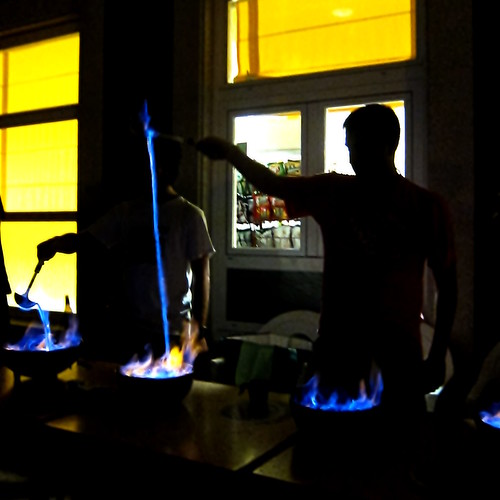
Third day of GUADEC already. And in Coru a! Coru a This is a very special city for me. I came here in 1996 to study Computer Science. Here I discovered UNIX for the first time, and spent hours learning how to use it. It s funny to see now those old UNIX servers being displayed in a small museum in the auditorium where the main track takes place. It was also here where I learnt about free software, installed my first Debian system, helped creating the local LUG and met the awesome people that founded Igalia with me. Then we went international, but our headquarters and many of our people are still here so I guess we can still call this home. So, needless to say, we are very happy to have GUADEC here this time. I hope you all are enjoying the conference as much as we are. I m quite satisfied with how it s been going so far, the local team has done a good job organising everything and taking care of lots of details to make the life of all attendees easier. I especially want to stress all the effort put into the network infrastructure, one of the best that I remember in a GUADEC conference. At Igalia we ve been very busy lately. We re putting lots of effort in making WebKit better, but our work is not limited to that. Our talks this year show some of the things we ve been doing: We are also coordinating 4 BOFs (a11y, GNOME OS, WebKit and Grilo) and hosted a UX hackfest in our offices before the conference. And we have a booth next to the info desk where you can get some merchandising and see our interactivity demos. WebKitGTK+ In case you missed the conference this year, all talks are being recorded and the videos are expected to be published really soon (before the end of the conference). So enjoy the remaining days of GUADEC, and enjoy Coru a! And of course if you re staying after the conference and want to know more about the city or about Galicia, don t hesitate to ask me or anyone from the local team, we ll be glad to help you. Queimada

21 July 2012

Siegfried Gevatter: A gentle introduction to Zeitgeist s Python API

In this post I ll make a quick introduction by example on how to use Zeitgeist s Python API for good and profit. If you re interested in using Zeitgeist from C instead, see the libzeitgeist examples; to use it with C++/Qt, Trever s a web browser in 4 steps may be of interest. First things first In case you re not familiar with Zeitgeist, it may prove helpful to first read Mikkel s introduction to Zeitgeist post. If that s too much to read, just should know that Zeitgeist is an event log. Like the history in your browser, it keeps track of what websites you open at which point in time. It also keeps track of when you close them, and of what browser you used, since it s a system-wide service. Furthermore, it does the same for files, conversations, e-mails, and anything else you want to insert into it. So Zeitgeist is a database of events, and an event can be pretty much anything. But what does it look like? It s main attributes are the following: Additionally, each event has one or more subjects, which have the following attributes: Retrieving recent data Okay, so let s say you want to know the last song you ve listened to (if you have a Zeitgeist-enabled music player). It s a simple as:
from zeitgeist.client import ZeitgeistClient
from zeitgeist.datamodel import *
 
zeitgeist = ZeitgeistClient()
 
def on_events_received(events):
    if events:
        song = events[0]
        print "Last song: %s" % song.subjects[0].uri
    else:
        print "You haven't listened to any songs."
 
template = Event.new_for_values(subject_interpretation=Interpretation.AUDIO)
zeitgeist.find_events_for_template(template, on_events_received, num_events=1)
 
# Start a mainloop - note: the Qt mainloop also works
from gi.repository import GLib
GLib.MainLoop().run()
This may need some explaining. We start by importing the Zeitgeist client and some associated data structures (such as Event and Interpretation), and create an instance of the client. The ZeitgeistClient class is a wrapper around Zeitgeist s D-Bus API which not only makes it much nicer to use, but also makes it easy to install monitors (as we will see later) and provides convenient functionality such as automatic reconnection if the connection to the engine is lost. To query for the most recent song, we just need to create a template with the restrictions we want to impose and submit it to Zeitgeist using the find_events_for_template call. If you haven t read Mikkel s post yet, please do so, as it introduces the structure of events and subjects (in short: an event has a timestamp, some other properties, and one or more subjects representing the resources -files, websites, people - involved in the event). The Python API is inherently asynchronous (if for some reason you need a synchronous API, you may still use the lower level ZeitgeistDBusInterface class), so we need to define a callback function to handle the results we receive from the Zeitgeist engine. Finally, we need to create a main loop so the asynchronous functions can run.
Now this was a pretty simple example. Let s make it more interesting. One song isn t much, so let s get the 5 most recent songs. Also, now we want both songs and videos. The first part is pretty easy, we just need to change the num_events parameter. For the second extension, we have to change the event template. In fact, now we need two different event templates and the find_events_for_templates function, which takes an arbitrary number of event templates and ORs them. The result is as follows:
from zeitgeist.client import ZeitgeistClient
from zeitgeist.datamodel import *
 
zeitgeist = ZeitgeistClient()
 
def on_events_received(events):
    for event in events:
        print "- %s" % event.subjects[0].uri
 
tmpl1 = Event.new_for_values(subject_interpretation=Interpretation.AUDIO)
tmpl2 = Event.new_for_values(subject_interpretation=Interpretation.VIDEO)
zeitgeist.find_events_for_templates([tmpl1, tmpl2],
                                    on_events_received, num_events=5)
 
# Start a mainloop
from gi.repository import GLib
GLib.MainLoop().run()
This will work, but unless you re lucky you re likely to get some duplicate line. Why is this? Well, other than that you may have used the same file twice, don t forget that what you are requesting are actually events. If you ve started playing a given song, you probably also stopped playing it, so that s actually two of them (an AccessEvent and a LeaveEvent). Since this isn t what we want, we ll change the query a bit:
zeitgeist.find_events_for_templates(
    [tmpl1, tmpl2],
    on_events_received,
    num_events=5,
    result_type=ResultType.MostRecentSubjects,
    storage_state=StorageState.Available)
By requesting the most recent subjects, vs. the most recent events, we can filter out events with duplicate URI. See the ResultType documentation for other modes you can use. Note particularly the MostPopularSubjects result type. I also used the chance to introduce the storage_state parameter. This one will filter out events for files Zeitgeist knows aren t available (this mostly means online resources won t be shown if you don t have a network connnection; there s also support for handling external storage media, but because of problems with GIO this is currently disabled). Last but not least, the find_events_for_* methods also accept a timerange parameter. It defaults to TimeRange.until_now(), but you may change it to TimeRange.always() (if for some reason you re working with events in the future) or to any other time range of your choice. Here it s important to note that Zeitgeist s timestamps use millisecond precision.
For more advanced queries, you can use more complex combinations of events and subject templates. The rule to keep in mind here is that events are OR d and subjects are ANDed. Additionally, some field (actor, origin, mimetype, uri and current_uri) may be prefixed with an exclamation mark ( ! ) for NOT, or you may append an asterisc ( * ) to them for prefix search. You can even combine the two operators together. Here s an example of a template you could build:
subj1 = Subject.new_for_values(interpretation=Interpretation.SOURCE_CODE,
                               uri="file:///home/rainct/Development/*")
subj2 = Subject.new_for_values(uri="!file:///home/rainct/Development/zeitgeist/*")
tmpl1 = Event.new_for_values(interpretation=Interpretation.MODIFY_EVENT,
                             subjects=[subj1, subj2])
templates = [tmpl1]
In my case, this template would fetch a list of the source code files I modified most recently but excluding those related to the Zeitgeist project. Working with big sets of data In case you re trying to do something crazy, you may end up with a Zeitgeist query complaining that it exceeded the memory limit. You re not supposed to do that. Instead, we provide some methods for working with large collections of events.
from zeitgeist.client import ZeitgeistClient
from zeitgeist.datamodel import *
 
zeitgeist = ZeitgeistClient()
 
def on_events_received(events):
    for event in events:
        print '- %s' % event.subjects[0].uri
 
def on_ids_received(event_ids):
    print 'A total of %d source code files were found.' % len(event_ids)
    print 'Fetching the first 100...'
    zeitgeist.get_events(event_ids[:100], on_events_received)
 
tmpl = Event.new_for_values(subject_interpretation=Interpretation.SOURCE_CODE)
zeitgeist.find_event_ids_for_templates(
    [tmpl],
    on_ids_received,
    num_events=10000, # you can use 0 for "all events", but do you really need to?
    timerange=TimeRange.from_seconds_ago(3600*24*30*3),
    result_type=ResultType.MostPopularSubjects)
 
# Start a mainloop
from gi.repository import GLib
GLib.MainLoop().run()
And there you have the source code files you worked with during the last 3 months, ordered from most to least popular (popularity is measured counting the number of events; for more precision, maybe you could limit the results to events with interpretation AccessEvent). Why do we provide this mechanism instead of querying with a simple offset? Well, this avoids problems when the log changes (events are inserted or deleted). Have you ever been exploring the latest posts in some website, and as you change to the next page some of the results from the previous page show up again (because new posts have been added in the meantime)? With Zeitgeist this won t happen. Receiving information in real time At this point you re an expert at requesting all sorts of data from Zeitgeist, but now you want to show a list of the last kitten images you ve viewed, updated in real time. Don t worry, Zeitgeist can provide for this:
from zeitgeist.client import ZeitgeistClient
from zeitgeist.datamodel import *
 
zeitgeist = ZeitgeistClient()
 
def on_insert(time_range, events):
    # do awesome stuff with the events here
    print events
 
def on_delete(time_range, event_ids):
    # a previously inserted event was deleted
    print event_ids
 
templates = [Event.new_for_values(subject_uri='file:///home/user/kittens/*',
                                  subject_interpretation=Interpretation.IMAGE)]
zeitgeist.install_monitor(TimeRange.always(), templates, on_insert, on_delete)
 
# Start a mainloop
from gi.repository import GLib
GLib.MainLoop().run()
It s important to note that on_delete won t be called when an image is deleted (that d be a newly inserted event with interpretation=DELETE_EVENT); rather, it s called when a previously inserted event is deleted (for example, using the forget recent history option in Activity Log Manager). In case you re curious: for best performance, this doesn t actually use D-Bus signals. Instead, this little call will setup a D-Bus object behind the scenes and register it with the Zeitgeist engine, so it can notify said object when (and only when) an event of its interest is registered. To stop receiving notifications for a template, you ll need the save the object returned by the install_monitor call:
m = zeitgeist.install_monitor(TimeRange.always(), templates, on_insert, on_delete)
zeitgeist.remove_monitor(m)
Pro Tip: You can use the Zeitgeist Explorer GUI to quickly try out different queries (note: it s still work in progress, so much funcionality is missing, but it does work somewhat). Contextual awesomeness: finding related events By now you re familiar with retrieving events and keeping them up to date. Now it s time for a little secret:
import time
from zeitgeist.client import ZeitgeistClient
from zeitgeist.datamodel import *
 
zeitgeist = ZeitgeistClient()
 
def on_related_received(uris):
    print 'Related URIs:'
    for uri in uris:
        print ' - %s' % uri
 
query_templates = [Event.new_for_values(
    subject_interpretation=Interpretation.SOURCE_CODE,
    subject_uri='file:///home/rainct/Development/zeitgeist/*',
    subject_mimetype="text/x-vala")]
 
result_templates = [Event.new_for_values(
    subject_interpretation=Interpretation.WEBSITE,
    subject_manifestation=Manifestation.WEB_DATA_OBJECT)]
 
now = time.time()*1000
zeitgeist.find_related_uris_for_events(
    query_templates,
    on_related_received,
    time_range=TimeRange(now - 1000*3600*24*30*6, now),
    result_event_templates=result_templates,
    num_events=10)
 
# Start a mainloop
from gi.repository import GLib
GLib.MainLoop().run()
This little query example will return up to 10 websites I used at the same time as the Vala files inside my Zeitgeist directory, considering only data from the last 6 months. Nice, huh? This is an experimental feature, and it doesn t work well when operating on big inputs, so it s usually better to use the find_related_uris_for_uris variant (which replaces the first query_templates parameter with a list of URIs). Advanced searching: the FTS extension Some people think prefix searches aren t good enough for them, and this is why the Zeitgeist engine ships by default with a FTS (Full Text Search) extension. Using the methods provided by this extension you can perform more advanced queries against subjects current_uri and text properties (unlike the name may suggest, the FTS extension doesn t index the content of the files, but just the information in the event). This is exposed as zeitgeist_index_search in libzeitgeist (the C library), but unfortunately isn t currently available in the Python API. If you still need it, you ll have to fallback to pretty much using the D-Bus interface (you still get reconnection support, though). Here s an example:
from zeitgeist.client import ZeitgeistClient
from zeitgeist.datamodel import *
 
zeitgeist = ZeitgeistClient()
index = zeitgeist._iface.get_extension('Index', 'index/activity')
 
query            = 'hello' # search query
time_range       = TimeRange.always()
event_templates  = []
offset           = 0
num_events       = 10
result_type      = 100 # magic number for "relevancy" (ResultType.* also work)
 
def on_reply(events, num_estimated_matches):
    print 'Got %d out of ~%d results.' % (len(events), num_estimated_matches)
    events = map(Event, events)
    for event in events:
        print ' - %s' % event.subjects[0].uri
 
def on_error(exception):
    print 'Error from FTS:', exception
 
index.Search(query, time_range, event_templates,
             offset, num_events, result_type,
             reply_handler=on_reply, error_handler=on_error)
 
# Start a mainloop
from gi.repository import GLib
GLib.MainLoop().run()
The most interesting thing here is the query parameter. Quoting from the C documentation:
The default boolean operator is AND. Thus the query foo bar will
be interpreted as foo AND bar. To exclude a term from the result
set prepend it with a minus sign - eg foo -bar. Phrase queries
can be done by double quoting the string "foo is a bar". You can
truncate terms by appending a *.
There are a few keys you can prefix to a term or phrase to search
within a specific set of metadata. They are used like key:value.
The keys name and title search strictly within the text field of
the event subjects. The key app searches within the application
name or description that is found in the actor attribute of the
events. Lastly you can use the site key to search within the
domain name of the subject URIs.
You can also control the results with the boolean operators AND
and OR and you may use brackets, ( and ), to control the operator
precedence.
Modifying the log So far we ve only queried Zeitgeist for information, let s get a bit more active. You can delete events from Zeitgeist with the following query:
from zeitgeist.client import ZeitgeistClient
 
zeitgeist = ZeitgeistClient()
 
def on_deleted(timerange):
    print 'Deleted events going from %s to %s' % (timerange[0], timerange[1])
 
event_ids = [50] # put the IDs of the events you want to delete here
 
zeitgeist.delete_events(event_ids, on_deleted)
 
# Start a mainloop
from gi.repository import GLib
GLib.MainLoop().run()
The confirmation callback will receive a timerange going from the first to the last event. If no events were deleted (because they didn t exist), you ll get (-1, -1).
And now for the interesting part. If your application involves resources (files, websites, contacts, etc.) of any sort, you ll probably want to let Zeitgeist know that you re using them. It s time that you write a data-source! We start by registering the data-source. Here we go:
import time
from gi.repository import GLib
from zeitgeist.client import ZeitgeistClient
from zeitgeist.datamodel import *
 
zeitgeist = ZeitgeistClient()
 
def on_status_changed_callback(enabled):
    """ This method will be called whenever someone enables or disables
        the data-source. """
    if enabled:
        print 'Data-source enabled and ready to send events!'
    else:
        print 'Data-source disabled; don\'t send event, they\'ll be ignored.'
 
def register():
    # Always use the same unique_id. Name and description can change
    # freely.
    unique_id = 'com.example.your.data.source'
    name = 'user visible name (may be translated)'
    description = 'user visible description (may be translated)'
 
    # Describe what sort of events will be inserted (optional)
    subject_template = Subject()
    subject_template.interpretation = Interpretation.PLAIN_TEXT_DOCUMENT
    subject_template.manifestation = Manifestation.FILE_DATA_OBJECT
    templates = []
    for interp in (Interpretation.ACCESS_EVENT, Interpretation.LEAVE_EVENT):
        event_template = Event()
        event_template.interpretation = interp
        event_template.manifestation = Manifestation.USER_ACTIVITY
        event_template.append_subject(subject_template)
        templates.append(event_template)
 
    zeitgeist.register_data_source(unique_id, name, description, templates,
                                   on_status_changed_callback)
Once that s done (and if it is enabled), we are free to send our events:
def log(title, uri, opened):
    subject = Subject.new_for_values(
        uri=uri,
        interpretation=Interpretation.PLAIN_TEXT_DOCUMENT,
        manifestation=Manifestation.FILE_DATA_OBJECT,
        origin=GLib.path_get_dirname(uri),
        mimetype='text/plain',
        text=title)
    event = Event.new_for_values(
        timestamp=time.time()*1000,
        manifestation=Manifestation.USER_ACTIVITY,
        actor='application://your_application_name.desktop',
        subjects=[subject])
    if opened:
        event.interpretation = Interpretation.ACCESS_EVENT
    else:
        event.interpretation = Interpretation.LEAVE_EVENT
 
    def on_id_received(event_ids):
        print 'Logged %s (%d) with event id %d.' % (title, opened, event_ids[0])
 
    zeitgeist.insert_events([event], on_id_received)
 
if __name__ == '__main__':
    register()
 
    log('test.txt', 'file:///tmp/test.txt', opened=True)
    log('another_file.txt', 'file:///tmp/another_file.txt', opened=True)
    log('another_file.txt', 'file:///tmp/another_file.txt', opened=False)
    log('test.txt', 'file:///tmp/test.txt', opened=False)
 
    # Start a mainloop
    GLib.MainLoop().run()
If you don t know what interpretation and manifestation your subject should have, you can use the following utility methods:
from zeitgeist.mimetypes import *
 
print get_interpretation_for_mimetype('text/plain')
print get_manifestation_for_uri('file:///tmp/test.txt')
Event better, with Zeitgeist 0.9 you can just leave the subject (but not event!) interpretation and manifestation fields empty, and they ll be guessed the same way as if you used those utility methods. Pro Tip: You can examine all registered data-sources and toggle whether they are enabled or not using the zeitgeist-data-sources-gtk.py tool. Conclusion Wow, I m impressed if you ve got this far. By now you should have quite a good idea on how to use the Zeitgeist API, and I m looking forward to seeing what you do with it in your next awesome project. If you have any problem with Zeitgeist, feel free to visit us on IRC (#zeitgeist on irc.freenode.net), or join our mailing list. We ll also be at GUADEC next week, so if you re there make sure to say hi! In case you missed them, here are some useful links:
No comments
Siegfried-Angel Gevatter Pujals, 2012. Permalink License Post tags: ,
flattr this!

20 July 2012

David Paleino: Editable QComboBox with QAbstractTableModel

Dear Lazyweb, I'm working on a personal PyQt4 project for my parents' office, and I need to autocomplete an editable QComboBox. I can't use a standard Qt model (I need to store python objects in it), so I subclassed QAbstractTableModel. Here it is, it's a fairly generic subclass of QAbstractTableModel, with variable number of columns:
class QGenericTableModel(QAbstractTableModel):
    def __init__(self, columns, parent=None, *args):
        super(QGenericTableModel, self).__init__(parent, *args)
        self.columns = columns
        self.headers =  
        self.table = []
    def rowCount(self, parent=QModelIndex()):
        return len(self.table)
    def columnCount(self, parent):
        return self.columns
    def row(self, row):
        return self.table[row]
    def setData(self, index, value, role):
        if index.isValid() and role == Qt.EditRole:
            row = index.row()
            t = self.table[row]
            if index.column() >= self.columns:
                return False
            if isinstance(value, QVariant):
                t[index.column()] = value.toString().simplified()
            else:
                t[index.column()] = value
            self.emit(SIGNAL('dataChanged'), index, index)
            return True
        return False
    def data(self, index, role = Qt.DisplayRole):
        if not index.isValid():
            return QVariant()
        if (index.row() >= len(self.table)) or (index.row() < 0):
            return QVariant()
        if role == Qt.DisplayRole:
            return QVariant(self.table[index.row()][index.column()])
        return QVariant()
    def insertRow(self, row, parent=QModelIndex()):
        self.insertRows(row, 1, parent)
    def insertRows(self, row, count, parent=QModelIndex()):
        self.beginInsertRows(parent, row, row+count-1)
        for i in xrange(count):
            self.table.insert(row, ['',]*self.columns)
        self.endInsertRows()
        return True
    def removeRow(self, row, parent=QModelIndex()):
        self.removeRows(row, 1, parent)
    def removeRows(self, row, count, parent=QModelIndex()):
        self.beginRemoveRows(parent, row, row+count-1)
        for i in reversed(xrange(count)):
            self.table.pop(row+i)
        self.endRemoveRows()
        return True
    def flags(self, index):
        if not index.isValid():
            return Qt.ItemIsEnabled
        return super(QGenericTableModel, self).flags(index)   Qt.ItemIsEditable
    def headerData(self, column, orientation, role = Qt.DisplayRole):
        if role != Qt.DisplayRole:
            return QVariant()
        if orientation == Qt.Horizontal:
            if column >= self.columns:
                return QVariant()
            return self.headers[column]
        return QVariant()
    def setHeaderData(self, column, orientation, value, role = Qt.EditRole):
        self.headers[column] = value
It might not be perfect, but it works, and it's all that matters at the moment (since it's my first serious PyQt4 project). Oh, well, it worked until I tried to use it with an editable QComboBox. And here's the app code (for the full working code, insert the above class right after the imports):
import sys
from PyQt4.QtGui import *
from PyQt4.QtCore import *
app = QApplication(sys.argv)
model = QStandardItemModel()
for i, word in enumerate(['saluton', 'gxis la revido', 'hello', 'goodbye']):
    item = QStandardItem(word)
    model.setItem(i, 0, item)
#model = QGenericTableModel(1)
#for i, word in enumerate(['saluton', 'gxis la revido', 'hello', 'goodbye']):
#    model.insertRow(i)
#    index = model.index(i, 0)
#    model.setData(index, word, Qt.EditRole)
combo = QComboBox()
filterModel = QSortFilterProxyModel(combo)
completer = QCompleter(combo)
filterModel.setFilterCaseSensitivity(Qt.CaseInsensitive)
filterModel.setSourceModel(model)
filterModel.setFilterKeyColumn(0)
completer.setModel(filterModel)
completer.setCompletionColumn(0)
completer.setCompletionMode(QCompleter.UnfilteredPopupCompletion)
combo.setEditable(True)
combo.setCompleter(completer)
combo.setModel(model)
combo.setModelColumn(0)
if combo.isEditable():
    app.connect(combo.lineEdit(), SIGNAL('textEdited(QString)'), filterModel.setFilterFixedString)
combo.setModel(model)
combo.setModelColumn(0)
combo.show()
sys.exit(app.exec_())
Now, try running it. It works well when I use a QStandardItemModel. Then, try decommenting the part where I use my subclassed model: it just doesn't work: clicking on any item makes the QComboBox not change its currentIndex, and this only happens if the combobox is editable. I suspect I'm forgetting to override some function in my model, but I don't know what exactly to override, and Google didn't help me. This is also backed up by the fact that the exact same behaviour shows up when, instead of a QComboBox, I try to autocomplete on a QLineEdit. So, dear readers: can anyone explain what is happening? Thanks in advance! UPDATE: it turned out that the culprit was the following bit inside data():
        if role == Qt.DisplayRole:
            return QVariant(self.table[index.row()][index.column()])
Adding also Qt.EditRole to the list of possible choices fixed the bug. YAY!

Next.

Previous.