Search Results: "tb"

10 February 2022

Russell Coker: Mouse and Teflon

I had a problem with my mouse. The slippery plastic bits on the bottom weren t glued on well and came off, which then gave more friction when moving on the desk. After asking advice on a mailing list the best suggestion was Teflon sticky tape. I bought a few meters of such tape (a lifetime supply for mouse repair) and used an 8cm strip on each side of the bottom of my mouse which made it slippery enough. Ebay seems like a good place to buy that, most of the offers are well below $20 for a reel of tape including postage. One thing to note is that they also sell non-adhesive teflon tape. I made the mistake of investigating the capabilities of teflon tape then buying the cheapest one on offer which turned out to be plumber s tape which doesn t have adhesive, fortunately it was well below $10. I now have a lifetime supply of plumber s tape if I can ever find a use for it.

7 February 2022

Russ Allbery: Review: Embers of War

Review: Embers of War, by Gareth L. Powell
Series: Embers of War #1
Publisher: Titan Books
Copyright: February 2018
ISBN: 1-78565-519-1
Format: Kindle
Pages: 312
The military leadership of the Outward faction of humanity was meeting on the forest world of Pelapatarn, creating an opportunity for the Conglomeration to win the war at a stroke. Resistance was supposed to be minimal, since the Outward had attempted to keep the conference secret rather than massing forces to protect it. But the Outward resistance was stronger than expected, and Captain Deal's forces would not be able to locate and assassinate the Outward leadership before they could escape. She therefore followed orders from above her and ordered the four incoming Carnivore heavy cruisers to jump past the space battle and bomb the planet. The entire planet. The Carnivores' nuclear and antimatter weaponry reduced the billion-year-old sentient jungle of Pelapatarn to ash. Three years later, Sal Konstanz is a ship captain for the House of Reclamation, a strictly neutral search and rescue force modeled after a long-vanished alien fleet that prioritizes preservation of life above all else. Anyone can join Reclamation, provided that they renounce their previous alliances and devote themselves to the Reclamation cause. Sal and her crew member Alva Clay were Outward. The ship medic was Conglomeration. So was the ship: the Trouble Dog, a sentient AI heavy cruiser built to carry an arsenal of weapons and three hundred crew, and now carrying three humans and a Druff mechanic. More precisely, the Trouble Dog was one of the four Carnivores that destroyed Pelapatarn. Meanwhile, Ona Sudak, a popular war poet, is a passenger on a luxury cruise on the liner Geest van Amsterdam, which is making an unscheduled stop in the star system known as the Gallery. The Gallery is the home of the Objects: seven planets that, ten thousand years earlier, were carved by unknown aliens into immense sculptures for unknown reasons. The Objects appear to be both harmless and mysterious, making them an irresistible tourist attraction for the liner passengers. The Gallery is in disputed space, but no one was expecting serious trouble. They certainly weren't expecting the Geest van Amsterdam to be attacked and brought down on the Object known as the Brain, killing nearly everyone aboard. The Trouble Dog is the closest rescue ship. This book was... fine. It's a perfectly serviceable science fiction novel that didn't stand out for me, which I think says more about the current excellent state of the science fiction field than about this book. When I was a teenager reading Asimov, Niven, and Heinlein, I would have devoured this. It compares favorably to minor Niven or Heinlein (The Integral Trees, for example, or Double Star), but the bar for excellent science fiction is just so much higher now. The best character in this book (and the reason why I read it) is the Trouble Dog. I love science fiction about intelligent space ships, and she did not disappoint. The AI ships in this book are partly made from human and dog neurons, so their viewpoint is mostly human but with some interesting minor variations. And the Trouble Dog would be a great character even if she weren't an intelligent ship: ethical, aggressive, daring, and introspective, with a nuanced relationship with her human crew. Unfortunately, Embers of War has four other viewpoint characters, and Powell chose to write them all in the first person. First person narration depends heavily on a memorable and interesting character because the reader is so thoroughly within their perspective. This works great for the Trouble Dog, and is fine for Nod, the Druff who serves as the ship mechanic. (Nod's perspective is intriguing, short, almost free-verse musings, rather than major story segments.) Sal, the ship captain, is a bit of a default character, but I didn't mind her much. Neither of the other two viewpoint characters are interesting enough to warrant the narrative attention. The Conglomerate agent Ashton Childe has such an uninteresting internal monologue that I would have liked the character better if he'd only been seen through other people's viewpoints, and although Powell needs some way to show Ona Sudak's view of events, I didn't think her thoughts added much to the story. The writing is adequate but a bit clunky: slightly flat descriptions, a bit too predictable at the sentence level, and rarely that memorable. There is a bit of fun world-building of the ancient artifact variety and a couple of decent set pieces (and one rather-too-obvious Matrix homage that I didn't think was as effective as the author did), but most of the story is focused on characters navigating their lives and processing trauma from the war. The story kept me turning the pages with interest, but I also doubt it will surprise anyone who has read much science fiction. I suspect a lot of it is setup for the following two books of the trilogy, and there are plenty of hooks for more stories in this universe. I really wanted a first-person story from the perspective of the Trouble Dog, possibly with some tight third-person interludes showing Ona Sudak's story. What I got instead was entertaining but not memorable enough to stand out in the current rich state of science fiction. I think I'm invested enough in this story to want to read the next book, though, so that's still a recommendation of sorts. Followed by Fleet of Knives. Rating: 6 out of 10

5 February 2022

Reproducible Builds: Reproducible Builds in January 2022

Welcome to the January 2022 report from the Reproducible Builds project. In our reports, we try outline the most important things that have been happening in the past month. As ever, if you are interested in contributing to the project, please visit our Contribute page on our website.
An interesting blog post was published by Paragon Initiative Enterprises about Gossamer, a proposal for securing the PHP software supply-chain. Utilising code-signing and third-party attestations, Gossamer aims to mitigate the risks within the notorious PHP world via publishing attestations to a transparency log. Their post, titled Solving Open Source Supply Chain Security for the PHP Ecosystem goes into some detail regarding the design, scope and implementation of the system.
This month, the Linux Foundation announced SupplyChainSecurityCon, a conference focused on exploring the security threats affecting the software supply chain, sharing best practices and mitigation tactics. The conference is part of the Linux Foundation s Open Source Summit North America and will take place June 21st 24th 2022, both virtually and in Austin, Texas.

Debian There was a significant progress made in the Debian Linux distribution this month, including:

Other distributions kpcyrd reported on Twitter about the release of version 0.2.0 of pacman-bintrans, an experiment with binary transparency for the Arch Linux package manager, pacman. This new version is now able to query rebuilderd to check if a package was independently reproduced.
In the world of openSUSE, however, Bernhard M. Wiedemann posted his monthly reproducible builds status report.

diffoscope diffoscope is our in-depth and content-aware diff utility. Not only can it locate and diagnose reproducibility issues, it can provide human-readable diffs from many kinds of binary formats. This month, Chris Lamb prepared and uploaded versions 199, 200, 201 and 202 to Debian unstable (that were later backported to Debian bullseye-backports by Mattia Rizzolo), as well as made the following changes to the code itself:
  • New features:
    • First attempt at incremental output support with a timeout. Now passing, for example, --timeout=60 will mean that diffoscope will not recurse into any sub-archives after 60 seconds total execution time has elapsed. Note that this is not a fixed/strict timeout due to implementation issues. [ ][ ]
    • Support both variants of odt2txt, including the one provided by the unoconv package. [ ]
  • Bug fixes:
    • Do not return with a UNIX exit code of 0 if we encounter with a file whose human-readable metadata matches literal file contents. [ ]
    • Don t fail if comparing a nonexistent file with a .pyc file (and add test). [ ][ ]
    • If the debian.deb822 module raises any exception on import, re-raise it as an ImportError. This should fix diffoscope on some Fedora systems. [ ]
    • Even if a Sphinx .inv inventory file is labelled The remainder of this file is compressed using zlib, it might not actually be. In this case, don t traceback and simply return the original content. [ ]
  • Documentation:
    • Improve documentation for the new --timeout option due to a few misconceptions. [ ]
    • Drop reference in the manual page claiming the ability to compare non-existent files on the command-line. (This has not been possible since version 32 which was released in September 2015). [ ]
    • Update X has been modified after NT_GNU_BUILD_ID has been applied messages to, for example, not duplicating the full filename in the diffoscope output. [ ]
  • Codebase improvements:
    • Tidy some control flow. [ ]
    • Correct a recompile typo. [ ]
In addition, Alyssa Ross fixed the comparison of CBFS names that contain spaces [ ], Sergei Trofimovich fixed whitespace for compatibility with version 21.12 of the Black source code reformatter [ ] and Zbigniew J drzejewski-Szmek fixed JSON detection with a new version of file [ ].

Testing framework The Reproducible Builds project runs a significant testing framework at tests.reproducible-builds.org, to check packages and other artifacts for reproducibility. This month, the following changes were made:
  • Fr d ric Pierret (fepitre):
    • Add Debian bookworm to package set creation. [ ]
  • Holger Levsen:
    • Install the po4a package where appropriate, as it is needed for the Reproducible Builds website job [ ]. In addition, also run the i18n.sh and contributors.sh scripts [ ].
    • Correct some grammar in Debian live image build output. [ ]
    • Shell monitor improvements:
      • Only show the offline node section if there are offline nodes. [ ]
      • Colorise offline nodes. [ ]
      • Shrink screen usage. [ ][ ][ ]
    • Node health check improvements:
      • Detect if live package builds encounter incomplete snapshots. [ ][ ][ ]
      • Detect if a host is running with today s date (when it should be set artificially in the future). [ ]
    • Use the devscripts package from bullseye-backports on Debian nodes. [ ]
    • Use the Munin monitoring package bullseye-backports on Debian nodes too. [ ]
    • Update New Year handling, needed to be able to detect real and fake dates. [ ][ ]
    • Improve the error message of the script that powercycles the arm64 architecture nodes hosted by Codethink. [ ]
  • Mattia Rizzolo:
    • Use the new --timeout option added in diffoscope version 202. [ ]
  • Roland Clobus:
    • Update the build scripts now that the hooks for live builds are now maintained upstream in the live-build repository. [ ]
    • Show info lines in Jenkins when reproducible hooks have been active. [ ]
    • Use unique folders for the artifacts from each live Debian version. [ ]
  • Vagrant Cascadian:
    • Switch the Debian armhf architecture nodes to use new proxy. [ ]
    • Misc. node maintenance. [ ].

Upstream patches The Reproducible Builds project attempts to fix as many currently-unreproducible packages as possible. In January, we wrote a large number of such patches, including:

And finally If you are interested in contributing to the Reproducible Builds project, please visit our Contribute page on our website. However, you can get in touch with us via:

Steve Kemp: Removing my last server?

In the past I used to run a number of virtual machines, or dedicated hosts. Currently I'm cut things down to only a single machine which I'm planning to remove. Email Email used to be hosted via dovecot, and then read with mutt-ng on the host itself. Later I moved to reading mail with my own console-based email client. Eventually I succumbed, and now I pay for Google's Workspace product. Git Repositories I used to use gitbucket for hosting a bunch of (mostly private) git repositories. A bad shutdown/reboot of my host trashed the internal database so that was broken. I replaced the use of gitbucket, which was very pretty, with gitolite to perform access-control, and avoid the need of a binary database. I merged a bunch of repositories, removed the secret things from there where possible, and finally threw them on a second github account. GPG-encryption added where appropriate. Static Hosts Static websites I used to host upon my own machine are now hosted via netlify. There aren't many of them, and they are rarely updated, I guess I care less. Dynamic Hosts That leaves only dynamic hosts. I used to have a couple of these, most notably the debian-administration.org, but that was archived and the final commercial thing I did was retired in January. I now have only one dynamic site up and running, https://api.steve.fi/, this provides two dynamic endpoints: Both of these are used by my tram-display device. Running these two services locally, in Docker, would probably be fine. However there is a third "secret" API - blog-comment submission. When a comment is received upon this blog it is written to a local filesystem, and an email is sent to me. The next time my blog is built rsync is used to get the remote-comments and add them to the blog. (Spam deleted first, of course). Locally the comments are added into the git-repository this blog is built from - and the remote files deleted now and again. Maybe I should just switch from writing the blog-comment to disk, and include all the meta-data in the email? I don't wanna go connecting to Gmail via IMAP, but I could probably copy and paste from the email to my local blog-repository. I can stop hosting the tram-APIs publicly, but the blog comment part is harder. I guess I just need to receive incoming FORM-submission, and send an email. Or maybe I drop blog-comments and sidestep the problem entirely? After all I wrote five posts in the whole of last year ..

1 February 2022

Russell Coker: First Flounder Meeting

Based on a comment from my previous post [1] I have named the new FOSS group for Australia and NZ Flounder. Here is the link to the agenda for the first meeting [2]. I am currently using a DNS name in my own domain for the group, but in the near future I ll move it to somewhere else under a zone I don t control. My aim is not to have personal control but to create an organisation for the community. But at the moment I m just doing things in the fastest way possible, I will setup HTTP redirects when I get a better DNS name.

Dirk Eddelbuettel: #35: apt install rstudio quarto

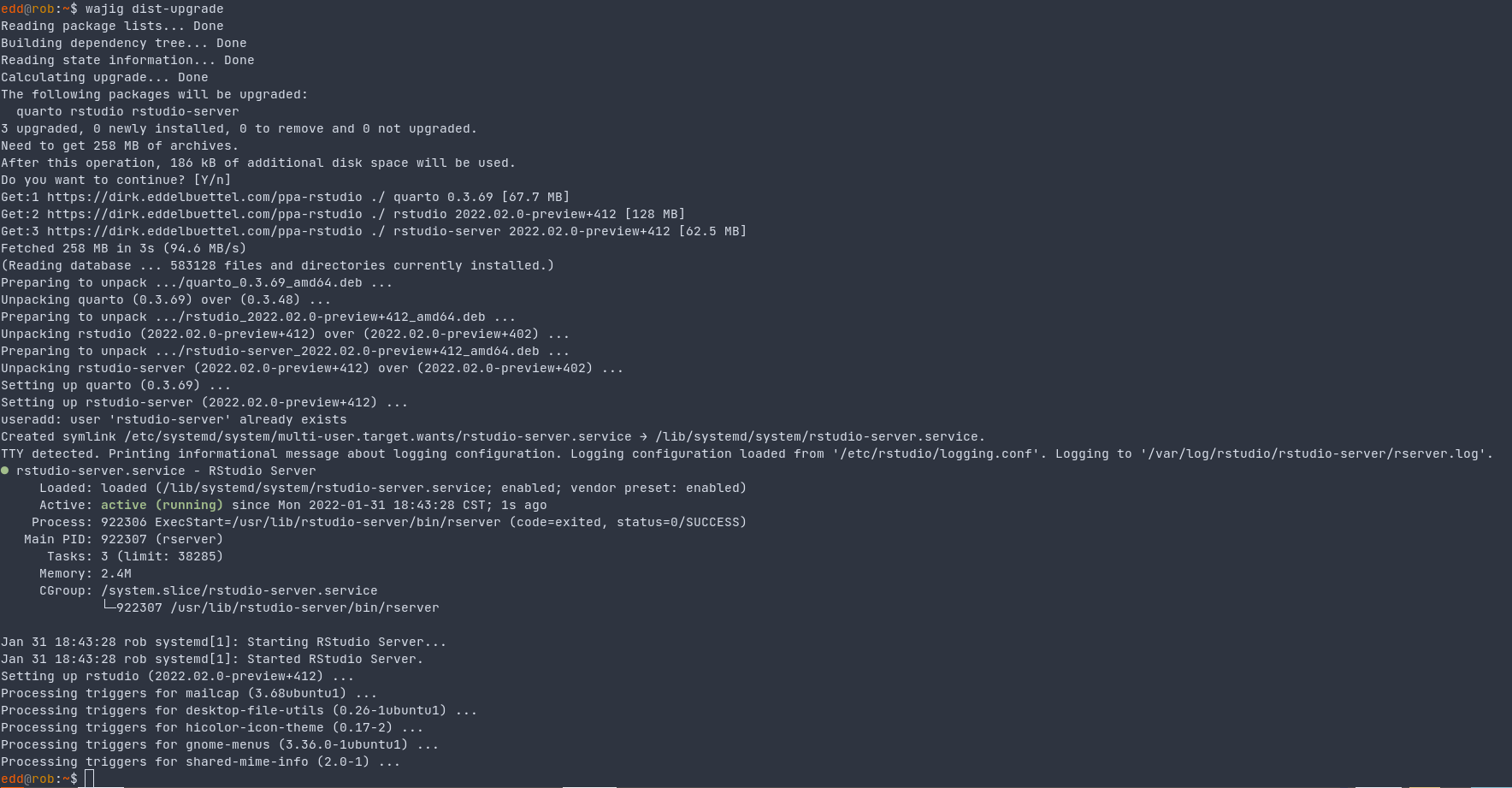
Welcome to the 35th post in the ravishingly rabiant R recommendations, or R4. Today s post is about apt and R tools. Many of us have been running RStudio off our local machines for as long as binaries have been provided. Which is by now probably a bit over a decade. Time flies. And as nice it is to have matching binaries, in my case in the .deb format used on Debian or Ubuntu, it is wee bit a painful to manually download a file and then install it. Twice the pain if you are lucky enough to be on a system where you can also run RStudio Server. And now three times as painful as you may need a matching quarto-cli binary for the nice quarto service. So wouldn t it be nice to have an apt-getable repo? And to autoMAGICall get updated versions when they are available? Oh yes. And I had been bugging JJ from day one. And JJ would almost listen intendly, nod briefly and firmly, and issue an assured we will look into it. Well, they are still looking Luckily, years ago, Carl wrote a helper script for our use in Rocker. I promptly adopted these and kept them in the littler examples directory as a pair of script getRStudioDesktop.r and getRStudioServer.r, later complemented by getQuartoCli.r. And I used these for years, somewhere between weekly and monthly. But it is still very manual: three script calls, one sudo dpkg -i call. And as our good friends at RStudio don t seem to be coming forward with a repo, I created one at GitHub thinking I could serve the files via GitHub Pages. Which of course I cannot as the .deb file for rstudio is well above the 100mb limit. So that seemed to be a bit of a setback. But after a bit of pondering, and recognizing that I am now in the fortunate position to have symmetric broadband access at home, I reckoned that until the bandwidth use gets excessive I will serve this as truly personal package archive (or tPPA) from here. Note that this is calibrated for my use so Ubuntu amd64 it is. Nothing else. And that it installs dailies . Which may cause issues for some people. You have warned. Reading tis paragraphs signifies agreement with the terms and limitations. Just kidding. A quick screenshot from an update earlier is here. Note that I use the fabulous wajig wrapper by Graham Williams here as my frontend to apt, dpkg and more as I have for even longer than I have use RStudio. Its use is tangential here; sudo apt upgrade would have done the same (and is essentially being called). And it demonstrates the main benefit: we are now automated as the cron scheduler launches an update of the PPA at which ever frequency you chose (currently twice a week for me) and after that it becomes part of the normal apt updates we do anyway (and which I do about daily). So that s main gist: automated apt upgrades of rstudio, rstudio-server, and quarto-cli. And you can find the underlying code in the GitHub repo ppa-rstudio which I put together a good week ago. I am currently updating the tPPA twice a week from crontab and have had two full upgrades already. And who knows, maybe with a bid of prodding RStudio may come around. One can always hope. If you like this or other open-source work I do, you can sponsor me at GitHub.

This post by Dirk Eddelbuettel originated on his Thinking inside the box blog. Please report excessive re-aggregation in third-party for-profit settings.

Paul Wise: FLOSS Activities January 2022

Focus This month I didn't have any particular focus. I just worked on issues in my info bubble.

Changes

Issues

Review

Administration
  • Debian BTS: unarchive/reopen/triage bugs for reintroduced packages
  • Debian servers: ping folks about mail forwarding issues
  • Debian wiki: unblock IP addresses, approve accounts

Communication
  • Respond to queries from Debian users and contributors on the mailing lists and IRC

Sponsors The oci-cli, oci-python-sdk, circuitbreaker, autoconf-archive, libpst, purple-discord, sptag work was sponsored. All other work was done on a volunteer basis.

31 January 2022

Russ Allbery: Review: The Story of the Treasure Seekers

Review: The Story of the Treasure Seekers, by E. Nesbit
Publisher: Amazon
Copyright: 1899
Printing: May 2012
ASIN: B0082ZBXSI
Format: Kindle
Pages: 136
The Story of the Treasure Seekers was originally published in 1899 and is no longer covered by copyright. I read the free Amazon Kindle version because it was convenient. My guess is that Amazon is republishing the Project Gutenberg version, but they only credit "a community of volunteers." There are six Bastable children: Dora, Oswald, Dicky, the twins Alice and Noel, and Horace Octavius (H.O.), the youngest. Their mother is dead and the family's finances have suffered in the wake of her death (or, as the first-person narrator puts it, "the fortunes of the ancient House of Bastable were really fallen"), which means that their father works long hours and is very absorbed with his business. That leaves the six kids largely to fend for themselves, since they can't afford school. Clearly the solution is to find treasure. This is a fix-up novel constructed from short stories that were originally published in various periodicals, reordered and occasionally rewritten for the collected publication. To be honest, calling it a fix-up novel is generous; there are some references to previous events, but the first fourteen chapters can mostly stand alone. The last two chapters are closely related and provide an ending. More on that in a moment. What grabs the reader's attention from the first paragraph is the writing style:
This is the story of the different ways we looked for treasure, and I think when you have read it you will see that we were not lazy about the looking. There are some things I must tell before I begin to tell about the treasure-seeking, because I have read books myself, and I know how beastly it is when a story begins, "Alas!" said Hildegarde with a deep sigh, "we must look our last on this ancestral home" and then some one else says something and you don't know for pages and pages where the home is, or who Hildegarde is, or anything about it.
The first-person narrator of The Story of the Treasure Seekers is one of the six kids.
It is one of us that tells this story but I shall not tell you which: only at the very end perhaps I will.
The narrator then goes on to elaborately praise one of the kids, occasionally accidentally uses "I" instead of their name, and then remembers and tries to hide who is telling the story again. It's beautifully done and had me snickering throughout the book. It's not much of a mystery (you will figure out who is telling the story very quickly), but Nesbit captures the writing style of a kid astonishingly well without making the story poorly written. Descriptions of events have a headlong style that captures a child's sense of adventure and heedless immortality mixed with quiet observations that remind the reader that kids don't miss as much as people think they do. I think the most skillful part of this book is the way Nesbit captures a kid's disregard of literary convention. The narrator in a book written by an adult tends to fit into a standard choice of story-telling style and follow it consistently. Even first-person narrators who break some of those rules feel like intentionally constructed characters. The Story of the Treasure Seekers is instead half "kid telling a story" and half "kid trying to emulate the way stories are told in books" and tends to veer wildly between the two when the narrator gets excited, as if they're vaguely aware of the conventions they're supposed to be following but are murky on the specifics. It feels exactly like the sort of book a smart and well-read kid would write (with extensive help from an editor). The other thing that Nesbit handles exceptionally well is the dynamic between the six kids. This is a collection of fairly short stories, so there isn't a lot of room for characterization. The kids are mostly sketched out with one or two memorable quirks. But Nesbit puts a lot of effort into the dynamics that arise between the children in a tight-knit family, properly making the group of kids as a whole and in various combinations a sort of character in their own right. Never for a moment does either the reader or the kids forget that they have siblings. Most adventures involve some process of sorting out who is going to come along and who is going to do other things, and there's a constant but unobtrusive background rhythm of bickering, making up, supporting each other, being frustrated by each other, and getting exasperated at each other's quirks. It's one of the better-written sibling dynamics that I've read. I somehow managed to miss Nesbit entirely as a kid, probably because she didn't write long series and child me was strongly biased towards books that were part of long series. (One book was at most a pleasant few hours; there needed to be a whole series attached to get any reasonable amount of reading out of the world.) This was nonetheless a fun bit of nostalgia because it was so much like the books I did read: kids finding adventures and making things up, getting into various trouble but getting out of it by being honest and kind, and only occasional and spotty adult supervision. Reading as an adult, I can see the touches of melancholy of loss that Nesbit embeds into this quest for riches, but part of the appeal of the stories is that the kids determinedly refuse to talk about it except as a problem to be solved. Nesbit was a rather famous progressive, but this is still a book of its time, which means there's one instance of the n-word and the kids have grown up playing the very racist version of cowboys and indians. The narrator also does a lot of stereotyping of boys and girls, although Nesbit undermines that a bit by making Alice a tomboy. I found all of this easier to ignore because the story is narrated by one of the kids who doesn't know any better, but your mileage may vary. I am always entertained by how anyone worth writing about in a British children's novel of this era has servants. You know the Bastables have fallen upon hard times because they only have one servant. The kids don't have much respect for Eliza, which I found a bit off-putting, and I wondered what this world looks like from her perspective. She clearly did a lot of the work of raising these motherless kids, but the kids view her as the hired help or an obstacle to be avoided, and there's not a lot of gratitude present. As the stories unfold, it becomes more and more clear that there's a quiet conspiracy of surrounding adults to watch out for these kids, which the kids never notice. This says good things about society, but it does undermine the adventures a little, and by the end of the book the sameness of the stories was wearing a bit thin. The high point of the book is probably chapter eight, in which the kids make their own newspaper, the entirety of which is reproduced in the book and is a note-perfect recreation of what an enterprising group of kids would come up with. In the last two stories, Nesbit tacks on an ending that was probably obligatory, but which I thought undermined some of the emotional subtext of the rest of the book. I'm not sure how else one could have put an ending on this book, but the ending she chose emphasized the degree to which the adventures really were just play, and the kids are rewarded in these stories for their ethics and their circumstances rather than for anything they concretely do. It's a bit unsatisfying. This is mostly a nostalgia read, but I'm glad I read it. If this book was not part of your childhood, it's worth reading if only for how well Nesbit captures a child's narrative voice. Rating: 7 out of 10

30 January 2022

Russell Coker: Links Jan 2022

Washington Post has an interesting article on how gender neutral language is developing in different countries [1]. pimaker has an interesting blog post about how they wrote a RISCV CPU emulator to boot a Linux kernel in a pixel shader in the VR Chat platform [2]. ZD has an interesting article about the new Solo Bumblebee platform for writing EBPF programs to run inside the Linux kernel [3]. EBPF is an interesting platform and it s good to have new tools to help people develop for it. Big Think has an interesting article about augmented reality suggesting that it could be worse than social media for driving disputes [4]. Some people would want tags of racial status on all people they see. Vice has an insightful article making the case for 8 hours of work per week [5]. The Guardian has an insightful article about how our attention is being stolen by modern technology [6]. Interesting article about the Ilobleed rootkit that targets the HP ILO server management system [7], it s apparently designed for persistent attacks as it bypasses the firmware upgrade process and updates only the version number so anyone who thinks that a firmware update will fix it is horribly mislead. Nick Bostrom wrote an insightful and disturbing article for Aeon titles None of Our Technologies has Managed to Destroy Humanity Yet [8] about the existential risk of new technologies and how they might be mitigated, much of which involves authoritarian governments unlike any we have seen before. As a counterpoint the novel A Deepness in the Sky claims that universal surveillance would be as damaging to the future of a society as planet-buster bombs. Euronews has an informative article about eco-fascism [9]. The idea that the solution to ecological problems is to have less people in the world and particularly less non-white people is a gateway from green politics to fascism. The developer of the colors and faker npm libraries (for NodeJS) recently uploaded corrupted versions of those libraries as a protest against companies that use them without paying him [10]. This is the wrong way to approach the issue, but it does demonstrate a serious problem with systems like NPM that allow automatic updates. It gives a better result to just use software packaged by a distribution which has QA checks applied including on security updates. VentureBeat has an interesting article on the way that AI is taking over jobs [11]. Lots of white collar jobs can be replaced by machine learning systems, we need to plan for the ways this will change the economy. The Atlantic has an interesting article about tapeworms that infect some ants [12]. The tapeworms make the ants live longer and produce pheromones to make the other ants serve them. This increases the chance that the ants will be eaten by birds which is the next stage in the tapeworm lifecycle.

29 January 2022

Sylvestre Ledru: An update on rust/coreutils

TLDR: we are making progress on the Rust implementation of the GNU coreutils. Well, it is an understatement to say my previous blog post interested many people. Many articles, blog posts and some podcasts talked about it! As we pushed coreutils 0.0.12 a few days ago and getting closer to the 10 000 stars on github, it is now time to give an update! This has brought a lot of new contributors to this project. Instead of 30 to 60 patches per month, we jumped to 400 to 472 patches every month. Similarly, we saw an increase in the number of contributors (20 to 50 per month from 3 to 8). Two new maintainers (Michael Debertol & Terts Diepraam) stepped in and have been doing a much better job than myself as reviewers now! As a silly metric, according to github, we had 5 561 clones of the repository over the last 2 weeks! The new contributors focused on: Closing the gap with GNU As far as I know, we are only missing stty (change and print terminal line settings) as a program. Thanks to some heroes, basenc, pr, chcon and runcon have been implemented. For example, for the two last programs, Koutheir Attouchi wrote new crates to manage SELinux properly. This crate has been used for some other utilities like cp, ls or id. Leveraging the GNU testsuite to test this implementation Because the GNU testsuite is excellent, we now have a proper CI using it to run the tests. It is pretty long on the Github action CI (almost two hours to run it) but it is an amazing improvement to the way we work. It was a joint work from a bunch of folks (James Robson, Roy Ivy III, etc). To achieve this, we also made it easier to run the GNU testsuite locally with the Rust implementation but also to ignore some tests or adjust some error messages (see build-gnu.sh and run-gnu-test.sh). Following a suggestion of Brian G, a colleague at Mozilla (he did the same for some Firefox major change), we are now collecting the history of fail/pass/error into a separate repository and generating a daily graph showing the evolution of regression. Evolution over time At this date, we have, with GNU/Coreutils 9.0:
Total 611 tests
Pass 214
Skip 84
Fail 298
Error 15
We are now automatically identifying new passing tests and regressions in the CI. For example:
Warning: Congrats! The gnu test tests/chmod/c-option is now passing!
<br />Warning: Congrats! The gnu test tests/chmod/silent is now passing!
<br />Warning: Congrats! The gnu test tests/chmod/umask-x is now passing!
<br />Error: GNU test failed: tests/du/long-from-unreadable. tests/du/long-from-unreadable is passing on 'master'. Maybe you have to rebase?
[...]
<br />Warning: Changes from master: PASS +4 / FAIL +0 / ERROR -4 / SKIP +0
This is also beneficial to GNU as, by implementing some options, Michael Debertol noticed some incorrect behaviors (with sort and cat) or an uninitialized variable (with chmod). Documentations Every day, we are generating the user documentation and of the internal coreutils. User documentation: https://uutils.github.io/coreutils-docs/user/ Example: ls or cp The internal documentation can be seen on: https://uutils.github.io/coreutils-docs/dev/uucore/
For example, the backup style is documented here: https://uutils.github.io/coreutils-docs/dev/uucore/backup_control/index.html More? Besides my work on Debian/Ubuntu, I have also noticed that more and more operating systems are starting to look at this: In parallel, https://github.com/uutils/findutils/, a rust dropped-in replacement for find, is getting more attention lately! Here, the graph showing the evolution of the program using the BFS testsuite (much better than GNU's). Evolution over time - BFS testsuite What is next?
  1. stty needs to be implemented
  2. Improve the GNU compatibility on key programs and reduce the gap
  3. Investigate how to reduce the size of the binaries
  4. Allow Debian and Ubuntu to switch by default without tricky manipulation
How to help? I have been maintaining a list of good first bugs for new comers in the repo! Don't hesitate to contribute, it is much easier than it seems and a terrific way to learn Rust!

27 January 2022

Russ Allbery: Review: I Didn't Do the Thing Today

Review: I Didn't Do the Thing Today, by Madeleine Dore
Publisher: Avery
Copyright: 2022
ISBN: 0-593-41914-6
Format: Kindle
Pages: 291
At least from my narrow view of it, the world of productivity self-help literature is a fascinating place right now. The pandemic overturned normal work patterns and exacerbated schedule inequality, creating vastly different experiences for the people whose work continued to be in-person and the people whose work could become mostly or entirely remote. Self-help literature, which is primarily aimed at the more affluent white-collar class, primarily tracked the latter disruption: newly-remote work, endless Zoom meetings, the impossibility of child care, the breakdown of boundaries between work and home, and the dawning realization that much of the mechanics of day-to-day office work are neither productive nor defensible. My primary exposure these days to the more traditional self-help productivity literature is via Cal Newport. The stereotype of the productivity self-help book is a collection of life hacks and list-making techniques that will help you become a more efficient capitalist cog, but Newport has been moving away from that dead end for as long as I've been reading him, and his recent work focuses more on structural issues with the organization of knowledge work. He also shares with the newer productivity writers a willingness to tell people to use the free time they recover via improved efficiency on some life goal other than improved job productivity. But he's still prickly and defensive about the importance of personal productivity and accomplishing things. He gives lip service on his podcast to the value of the critique of productivity, but then usually reverts to characterizing anti-productivity arguments as saying that productivity is a capitalist invention to control workers. (Someone has doubtless said this on Twitter, but I've never seen a serious critique of productivity make this simplistic of an argument.) On the anti-productivity side, as it's commonly called, I've seen a lot of new writing in the past couple of years that tries to break the connection between productivity and human worth so endemic to US society. This is not a new analysis; disabled writers have been making this point for decades, it's present in both Keynes and in Galbraith's The Affluent Society, and Kathi Weeks's The Problem with Work traces some of its history in Marxist thought. But what does feel new to me is its widespread mainstream appearance in newspaper articles, viral blog posts, and books such as Jenny Odell's How to Do Nothing and Devon Price's Laziness Does Not Exist. The pushback against defining life around productivity is having a moment. Entering this discussion is Madeleine Dore's I Didn't Do the Thing Today. Dore is the author of the Extraordinary Routines blog and host of the Routines and Ruts podcast. Extraordinary Routines began as a survey of how various people organize their daily lives. I Didn't Do the Thing Today is, according to the preface, a summary of the thoughts Dore has had about her own life and routines as a result of those interviews. As you might guess from the subtitle (Letting Go of Productivity Guilt), Dore's book is superficially on the anti-productivity side. Its chapters are organized around gentle critiques of productivity concepts, with titles like "The Hopeless Search for the Ideal Routine," "The Myth of Balance," or "The Harsh Rules of Discipline." But I think anti-productivity is a poor name for this critique; its writers are not opposed to being productive, only to its position as an all-consuming focus and guilt-generating measure of personal worth. Dore structures most chapters by naming an aspect, goal, or concern of a life defined by productivity, such as wasted time, ambition, busyness, distraction, comparison, or indecision. Each chapter sketches the impact of that idea and then attempts to gently dismantle the grip that it may have on the reader's life. All of these discussions are nuanced; it's rare for Dore to say that one of these aspects has no value, and she anticipates numerous objections. But her overarching goal is to help the reader be more comfortable with imperfection, more willing to live in the moment, and less frustrated with the limitations of life and the human brain. If striving for productivity is like lifting weights, Dore's diagnosis is that we've tried too hard for too long, and have overworked that muscle until it is cramping. This book is a gentle massage to induce the muscle to relax and let go. Whether this will work is, as with all self-help books, individual. I found it was best read in small quantities, perhaps a chapter per day, since it otherwise began feeling too much the same. I'm also not the ideal audience; Dore is a creative freelancer and primarily interviewed other creative people, which I think has a different sort of productivity rhythm than the work that I do. She's also not a planner to the degree that I am; more on that below. And yet, I found this book worked on me anyway. I can't say that I was captivated all the way through, but I found myself mentally relaxing while I was reading it, and I may re-read some chapters from time to time. How does this relate to the genre of productivity self-help? With less conflict than I think productivity writers believe, although there seems to be one foundational difference of perspective. Dore is not opposed to accomplishing things, or even to systems that help people accomplish things. She is more attuned than the typical productivity writer to the guilt and frustration that can accumulate when one has a day in which one does not do the thing, but her goal is not to talk you out of attempting things. It is, instead, to convince you to hold those attempts and goals more lightly, to allow them to move and shift and change, and to not treat a failure to do the thing today as a reason for guilt. This is wholly compatible with standard productivity advice. It's adding nuance at one level of abstraction higher: how tightly to cling to productivity goals, and what to do when they don't work out. Cramping muscles are not strong muscles capable of lifting heavy things. If one can massage out the cramp, one's productivity by even the strict economic definition may improve. Where I do see a conflict is that most productivity writers are planners, and Dore is not. This is, I think, a significant blind spot in productivity self-help writing. Cal Newport, for example, advocates time-block planning, where every hour of the working day has a job. David Allen advocates a complex set of comprehensive lists and well-defined next actions. Mark Forster builds a flurry of small systems for working through lists. The standard in productivity writing is to to add structure to your day and cultivate the self-discipline required to stick to that structure. For many people, including me, this largely works. I'm mostly a planner, and when my life gets chaotic, adding more structure and focusing on that structure helps me. But the productivity writers I've read are quite insistent that their style of structure will work for everyone, and on that point I am dubious. Newport, for example, advocates time-block planning for everyone without exception, insisting that it is the best way to structure a day. Dore, in contrast, describes spending years trying to perfect a routine before realizing that elastic possibilities work better for her than routines. For those who are more like Dore than Newport, I Didn't Do the Thing Today is more likely to be helpful than Newport's instructions. This doesn't make Newport's ideas wrong; it simply makes them not universal, something that the productivity self-help genre seems to have trouble acknowledging. Even for readers like myself who prefer structure, I Didn't Do the Thing Today is a valuable corrective to the emphasis on every-better systems. For those who never got along with too much structure, I think it may strike a chord. The standard self-help caveat still applies: Dore has the most to say to people who are in a similar social class and line of work as her. I'm not sure this book will be of much help to someone who has to juggle two jobs with shift work and child care, where the problem is more sharp external constraints than internalized productivity guilt. But for its target audience, I think it's a valuable, calming message. Dore doesn't have a recipe to sort out your life, but may help you feel better about the merits of life unsorted. Rating: 7 out of 10

26 January 2022

Timo Jyrinki: Unboxing Dell XPS 13 - openSUSE Tumbleweed alongside preinstalled Ubuntu

A look at the 2021 model of Dell XPS 13 - available with Linux pre-installed
I received a new laptop for work - a Dell XPS 13. Dell has been long famous for offering certain models with pre-installed Linux as a supported option, and opting for those is nice for moving some euros/dollars from certain PC desktop OS monopoly towards Linux desktop engineering costs. Notably Lenovo also offers Ubuntu and Fedora options on many models these days (like Carbon X1 and P15 Gen 2).
black box

opened box

accessories and a leaflet about Linux support

laptop lifted from the box, closed

laptop with lid open

Ubuntu running

openSUSE runnin
Obviously a smooth, ready-to-rock Ubuntu installation is nice for most people already, but I need openSUSE, so after checking everything is fine with Ubuntu, I continued to install openSUSE Tumbleweed as a dual boot option. As I m a funny little tinkerer, I obviously went with some special things. I wanted:
  • Ubuntu to remain as the reference supported OS on a small(ish) partition, useful to compare to if trying out new development versions of software on openSUSE and finding oddities.
  • openSUSE as the OS consuming most of the space.
  • LUKS encryption for openSUSE without LVM.
  • ext4 s new fancy fast_commit feature in use during filesystem creation.
  • As a result of all that, I ended up juggling back and forth installation screens a couple of times (even more than shown below, and also because I forgot I wanted to use encryption the first time around).
First boots to pre-installed Ubuntu and installation of openSUSE Tumbleweed as the dual-boot option:
(if the embedded video is not shown, use a direct link)
Some notes from the openSUSE installation:
  • openSUSE installer s partition editor apparently does not support resizing or automatically installing side-by-side another Linux distribution, so I did part of the setup completely on my own.
  • Installation package download hanged a couple of times, only passed when I entered a mirror manually. On my TW I ve also noticed download problems recently, there might be a problem with some mirror I need to escalate.
  • The installer doesn t very clearly show encryption status of the target installation - it took me a couple of attempts before I even noticed the small encrypted column and icon (well, very small, see below), which also did not spell out the device mapper name but only the main partition name. In the end it was going to do the right thing right away and use my pre-created encrypted target partition as I wanted, but it could be a better UX. Then again I was doing my very own tweaks anyway.
  • Let s not go to the details why I m so old-fashioned and use ext4 :)
  • openSUSE s installer does not work fine with HiDPI screen. Funnily the tty consoles seem to be fine and with a big font.
  • At the end of the video I install the two GNOME extensions I can t live without, Dash to Dock and Sound Input & Output Device Chooser.

Russell Coker: Australia/NZ Linux Meetings

I am going to start a new Linux focused FOSS online meeting for people in Australia and nearby areas. People can join from anywhere but the aim will be to support people in nearby areas. To cover the time zone range for Australia this requires a meeting on a weekend, I m thinking of the first Saturday of the month at 1PM Melbourne/Sydney time, that would be 10AM in WA and 3PM in NZ. We may have corner cases of daylight savings starting and ending on different days, but that shouldn t be a big deal as I think those times can vary by an hour either way without being too inconvenient for anyone. Note that I describe the meeting as Linux focused because my plans include having a meeting dedicated to different versions of BSD Unix and a meeting dedicated to the HURD. But those meetings will be mainly for Linux people to learn about other Unix-like OSs. One focus I want to have for the meetings is hands-on work, live demonstrations, and short highly time relevant talks. There are more lectures on YouTube than anyone could watch in a lifetime (see the Linux.conf.au channel for some good ones [1]). So I want to run events that give benefits that people can t gain from watching YouTube on their own. Russell Stuart and I have been kicking around ideas for this for a while. I think that the solution is to just do it. I know that Saturday won t work for everyone (no day will) but it will work for many people. I am happy to discuss changing the start time by an hour or two if that seems likely to get more people. But I m not particularly interested in trying to make it convenient for people in Hawaii or India, my idea is for an Australia/NZ focused event. I would be more than happy to share lecture notes etc with people in other countries who run similar events. As an aside I d be happy to give a talk for an online meeting at a Hawaiian LUG as the timezone is good for me. Please pencil in 1PM Melbourne time on the 5th of Feb for the first meeting. The meeting requirements will be a PC with good Internet access running a recent web browser and a ssh client for the hands-on stuff. A microphone or webcam is NOT required, any questions you wish to ask can be done with text if that s what you prefer. Suggestions for the name of the group are welcome.

17 January 2022

Matthew Garrett: Boot Guard and PSB have user-hostile defaults

Compromising an OS without it being detectable is hard. Modern operating systems support the imposition of a security policy or the launch of some sort of monitoring agent sufficient early in boot that even if you compromise the OS, you're probably going to have left some sort of detectable trace[1]. You can avoid this by attacking the lower layers - if you compromise the bootloader then it can just hotpatch a backdoor into the kernel before executing it, for instance.

This is avoided via one of two mechanisms. Measured boot (such as TPM-based Trusted Boot) makes a tamper-proof cryptographic record of what the system booted, with each component in turn creating a measurement of the next component in the boot chain. If a component is tampered with, its measurement will be different. This can be used to either prevent the release of a cryptographic secret if the boot chain is modified (for instance, using the TPM to encrypt the disk encryption key), or can be used to attest the boot state to another device which can tell you whether you're safe or not. The other approach is verified boot (such as UEFI Secure Boot), where each component in the boot chain verifies the next component before executing it. If the verification fails, execution halts.

In both cases, each component in the boot chain measures and/or verifies the next. But something needs to be the first link in this chain, and traditionally this was the system firmware. Which means you could tamper with the system firmware and subvert the entire process - either have the firmware patch the bootloader in RAM after measuring or verifying it, or just load a modified bootloader and lie about the measurements or ignore the verification. Attackers had already been targeting the firmware (Hacking Team had something along these lines, although this was pre-secure boot so just dropped a rootkit into the OS), and given a well-implemented measured and verified boot chain, the firmware becomes an even more attractive target.

Intel's Boot Guard and AMD's Platform Secure Boot attempt to solve this problem by moving the validation of the core system firmware to an (approximately) immutable environment. Intel's solution involves the Management Engine, a separate x86 core integrated into the motherboard chipset. The ME's boot ROM verifies a signature on its firmware before executing it, and once the ME is up it verifies that the system firmware's bootblock is signed using a public key that corresponds to a hash blown into one-time programmable fuses in the chipset. What happens next depends on policy - it can either prevent the system from booting, allow the system to boot to recover the firmware but automatically shut it down after a while, or flag the failure but allow the system to boot anyway. Most policies will also involve a measurement of the bootblock being pushed into the TPM.

AMD's Platform Secure Boot is slightly different. Rather than the root of trust living in the motherboard chipset, it's in AMD's Platform Security Processor which is incorporated directly onto the CPU die. Similar to Boot Guard, the PSP has ROM that verifies the PSP's own firmware, and then that firmware verifies the system firmware signature against a set of blown fuses in the CPU. If that fails, system boot is halted. I'm having trouble finding decent technical documentation about PSB, and what I have found doesn't mention measuring anything into the TPM - if this is the case, PSB only implements verified boot, not measured boot.

What's the practical upshot of this? The first is that you can't replace the system firmware with anything that doesn't have a valid signature, which effectively means you're locked into firmware the vendor chooses to sign. This prevents replacing the system firmware with either a replacement implementation (such as Coreboot) or a modified version of the original implementation (such as firmware that disables locking of CPU functionality or removes hardware allowlists). In this respect, enforcing system firmware verification works against the user rather than benefiting them.
Of course, it also prevents an attacker from doing the same thing, but while this is a real threat to some users, I think it's hard to say that it's a realistic threat for most users.

The problem is that vendors are shipping with Boot Guard and (increasingly) PSB enabled by default. In the AMD case this causes another problem - because the fuses are in the CPU itself, a CPU that's had PSB enabled is no longer compatible with any motherboards running firmware that wasn't signed with the same key. If a user wants to upgrade their system's CPU, they're effectively unable to sell the old one. But in both scenarios, the user's ability to control what their system is running is reduced.

As I said, the threat that these technologies seek to protect against is real. If you're a large company that handles a lot of sensitive data, you should probably worry about it. If you're a journalist or an activist dealing with governments that have a track record of targeting people like you, it should probably be part of your threat model. But otherwise, the probability of you being hit by a purely userland attack is so ludicrously high compared to you being targeted this way that it's just not a big deal.

I think there's a more reasonable tradeoff than where we've ended up. Tying things like disk encryption secrets to TPM state means that if the system firmware is measured into the TPM prior to being executed, we can at least detect that the firmware has been tampered with. In this case nothing prevents the firmware being modified, there's just a record in your TPM that it's no longer the same as it was when you encrypted the secret. So, here's what I'd suggest:

1) The default behaviour of technologies like Boot Guard or PSB should be to measure the firmware signing key and whether the firmware has a valid signature into PCR 7 (the TPM register that is also used to record which UEFI Secure Boot signing key is used to verify the bootloader).
2) If the PCR 7 value changes, the disk encryption key release will be blocked, and the user will be redirected to a key recovery process. This should include remote attestation, allowing the user to be informed that their firmware signing situation has changed.
3) Tooling should be provided to switch the policy from merely measuring to verifying, and users at meaningful risk of firmware-based attacks should be encouraged to make use of this tooling

This would allow users to replace their system firmware at will, at the cost of having to re-seal their disk encryption keys against the new TPM measurements. It would provide enough information that, in the (unlikely for most users) scenario that their firmware has actually been modified without their knowledge, they can identify that. And it would allow users who are at high risk to switch to a higher security state, and for hardware that is explicitly intended to be resilient against attacks to have different defaults.

This is frustratingly close to possible with Boot Guard, but I don't think it's quite there. Before you've blown the Boot Guard fuses, the Boot Guard policy can be read out of flash. This means that you can drop a Boot Guard configuration into flash telling the ME to measure the firmware but not prevent it from running. But there are two problems remaining:

1) The measurement is made into PCR 0, and PCR 0 changes every time your firmware is updated. That makes it a bad default for sealing encryption keys.
2) It doesn't look like the policy is measured before being enforced. This means that an attacker can simply reflash modified firmware with a policy that disables measurement and then make a fake measurement that makes it look like the firmware is ok.

Fixing this seems simple enough - the Boot Guard policy should always be measured, and measurements of the policy and the signing key should be made into a PCR other than PCR 0. If an attacker modified the policy, the PCR value would change. If an attacker modified the firmware without modifying the policy, the PCR value would also change. People who are at high risk would run an app that would blow the Boot Guard policy into fuses rather than just relying on the copy in flash, and enable verification as well as measurement. Now if an attacker tampers with the firmware, the system simply refuses to boot and the attacker doesn't get anything.

Things are harder on the AMD side. I can't find any indication that PSB supports measuring the firmware at all, which obviously makes this approach impossible. I'm somewhat surprised by that, and so wouldn't be surprised if it does do a measurement somewhere. If it doesn't, there's a rather more significant problem - if a system has a socketed CPU, and someone has sufficient physical access to replace the firmware, they can just swap out the CPU as well with one that doesn't have PSB enabled. Under normal circumstances the system firmware can detect this and prompt the user, but given that the attacker has just replaced the firmware we can assume that they'd do so with firmware that doesn't decide to tell the user what just happened. In the absence of better documentation, it's extremely hard to say that PSB actually provides meaningful security benefits.

So, overall: I think Boot Guard protects against a real-world attack that matters to a small but important set of targets. I think most of its benefits could be provided in a way that still gave users control over their system firmware, while also permitting high-risk targets to opt-in to stronger guarantees. Based on what's publicly documented about PSB, it's hard to say that it provides real-world security benefits for anyone at present. In both cases, what's actually shipping reduces the control people have over their systems, and should be considered user-hostile.

[1] Assuming that someone's both turning this on and actually looking at the data produced

comment count unavailable comments

16 January 2022

Chris Lamb: Favourite films of 2021

In my four most recent posts, I went over the memoirs and biographies, the non-fiction, the fiction and the 'classic' novels that I enjoyed reading the most in 2021. But in the very last of my 2021 roundup posts, I'll be going over some of my favourite movies. (Saying that, these are perhaps less of my 'favourite films' than the ones worth remarking on after all, nobody needs to hear that The Godfather is a good movie.) It's probably helpful to remark you that I took a self-directed course in film history in 2021, based around the first volume of Roger Ebert's The Great Movies. This collection of 100-odd movie essays aims to make a tour of the landmarks of the first century of cinema, and I watched all but a handul before the year was out. I am slowly making my way through volume two in 2022. This tome was tremendously useful, and not simply due to the background context that Ebert added to each film: it also brought me into contact with films I would have hardly come through some other means. Would I have ever discovered the sly comedy of Trouble in Paradise (1932) or the touching proto-realism of L'Atalante (1934) any other way? It also helped me to 'get around' to watching films I may have put off watching forever the influential Battleship Potemkin (1925), for instance, and the ur-epic Lawrence of Arabia (1962) spring to mind here. Choosing a 'worst' film is perhaps more difficult than choosing the best. There are first those that left me completely dry (Ready or Not, Written on the Wind, etc.), and those that were simply poorly executed. And there are those that failed to meet their own high opinions of themselves, such as the 'made for Reddit' Tenet (2020) or the inscrutable Vanilla Sky (2001) the latter being an almost perfect example of late-20th century cultural exhaustion. But I must save my most severe judgement for those films where I took a visceral dislike how their subjects were portrayed. The sexually problematic Sixteen Candles (1984) and the pseudo-Catholic vigilantism of The Boondock Saints (1999) both spring to mind here, the latter of which combines so many things I dislike into such a short running time I'd need an entire essay to adequately express how much I disliked it.

Dogtooth (2009) A father, a mother, a brother and two sisters live in a large and affluent house behind a very high wall and an always-locked gate. Only the father ever leaves the property, driving to the factory that he happens to own. Dogtooth goes far beyond any allusion to Josef Fritzl's cellar, though, as the children's education is a grotesque parody of home-schooling. Here, the parents deliberately teach their children the wrong meaning of words (e.g. a yellow flower is called a 'zombie'), all of which renders the outside world utterly meaningless and unreadable, and completely mystifying its very existence. It is this creepy strangeness within a 'regular' family unit in Dogtooth that is both socially and epistemically horrific, and I'll say nothing here of its sexual elements as well. Despite its cold, inscrutable and deadpan surreality, Dogtooth invites all manner of potential interpretations. Is this film about the artificiality of the nuclear family that the West insists is the benchmark of normality? Or is it, as I prefer to believe, something more visceral altogether: an allegory for the various forms of ontological violence wrought by fascism, as well a sobering nod towards some of fascism's inherent appeals? (Perhaps it is both. In 1972, French poststructuralists Gilles and F lix Guattari wrote Anti-Oedipus, which plays with the idea of the family unit as a metaphor for the authoritarian state.) The Greek-language Dogtooth, elegantly shot, thankfully provides no easy answers.

Holy Motors (2012) There is an infamous scene in Un Chien Andalou, the 1929 film collaboration between Luis Bu uel and famed artist Salvador Dal . A young woman is cornered in her own apartment by a threatening man, and she reaches for a tennis racquet in self-defence. But the man suddenly picks up two nearby ropes and drags into the frame two large grand pianos... each leaden with a dead donkey, a stone tablet, a pumpkin and a bewildered priest. This bizarre sketch serves as a better introduction to Leos Carax's Holy Motors than any elementary outline of its plot, which ostensibly follows 24 hours in the life of a man who must play a number of extremely diverse roles around Paris... all for no apparent reason. (And is he even a man?) Surrealism as an art movement gets a pretty bad wrap these days, and perhaps justifiably so. But Holy Motors and Un Chien Andalou serve as a good reminder that surrealism can be, well, 'good, actually'. And if not quite high art, Holy Motors at least demonstrates that surrealism can still unnerving and hilariously funny. Indeed, recalling the whimsy of the plot to a close friend, the tears of laughter came unbidden to my eyes once again. ("And then the limousines...!") Still, it is unclear how Holy Motors truly refreshes surrealism for the twenty-first century. Surrealism was, in part, a reaction to the mechanical and unfeeling brutality of World War I and ultimately sought to release the creative potential of the unconscious mind. Holy Motors cannot be responding to another continental conflagration, and so it appears to me to be some kind of commentary on the roles we exhibit in an era of 'post-postmodernity': a sketch on our age of performative authenticity, perhaps, or an idle doodle on the function and psychosocial function of work. Or perhaps not. After all, this film was produced in a time that offers the near-universal availability of mind-altering substances, and this certainly changes the context in which this film was both created. And, how can I put it, was intended to be watched.

Manchester by the Sea (2016) An absolutely devastating portrayal of a character who is unable to forgive himself and is hesitant to engage with anyone ever again. It features a near-ideal balance between portraying unrecoverable anguish and tender warmth, and is paradoxically grandiose in its subtle intimacy. The mechanics of life led me to watch this lying on a bed in a chain hotel by Heathrow Airport, and if this colourless circumstance blunted the film's emotional impact on me, I am probably thankful for it. Indeed, I find myself reduced in this review to fatuously recalling my favourite interactions instead of providing any real commentary. You could write a whole essay about one particular incident: its surfaces, subtexts and angles... all despite nothing of any substance ever being communicated. Truly stunning.

McCabe & Mrs. Miller (1971) Roger Ebert called this movie one of the saddest films I have ever seen, filled with a yearning for love and home that will not ever come. But whilst it is difficult to disagree with his sentiment, Ebert's choice of sad is somehow not quite the right word. Indeed, I've long regretted that our dictionaries don't have more nuanced blends of tragedy and sadness; perhaps the Ancient Greeks can loan us some. Nevertheless, the plot of this film is of a gambler and a prostitute who become business partners in a new and remote mining town called Presbyterian Church. However, as their town and enterprise booms, it comes to the attention of a large mining corporation who want to bully or buy their way into the action. What makes this film stand out is not the plot itself, however, but its mood and tone the town and its inhabitants seem to be thrown together out of raw lumber, covered alternatively in mud or frozen ice, and their days (and their personalities) are both short and dark in equal measure. As a brief aside, if you haven't seen a Roger Altman film before, this has all the trappings of being a good introduction. As Ebert went on to observe: This is not the kind of movie where the characters are introduced. They are all already here. Furthermore, we can see some of Altman's trademark conversations that overlap, a superb handling of ensemble casts, and a quietly subversive view of the tyranny of 'genre'... and the latter in a time when the appetite for revisionist portrays of the West was not very strong. All of these 'Altmanian' trademarks can be ordered in much stronger measures in his later films: in particular, his comedy-drama Nashville (1975) has 24 main characters, and my jejune interpretation of Gosford Park (2001) is that it is purposefully designed to poke fun those who take a reductionist view of 'genre', or at least on the audience's expectations. (In this case, an Edwardian-era English murder mystery in the style of Agatha Christie, but where no real murder or detection really takes place.) On the other hand, McCabe & Mrs. Miller is actually a poor introduction to Altman. The story is told in a suitable deliberate and slow tempo, and the two stars of the film are shown thoroughly defrocked of any 'star status', in both the visual and moral dimensions. All of these traits are, however, this film's strength, adding up to a credible, fascinating and riveting portrayal of the old West.

Detour (1945) Detour was filmed in less than a week, and it's difficult to decide out of the actors and the screenplay which is its weakest point.... Yet it still somehow seemed to drag me in. The plot revolves around luckless Al who is hitchhiking to California. Al gets a lift from a man called Haskell who quickly falls down dead from a heart attack. Al quickly buries the body and takes Haskell's money, car and identification, believing that the police will believe Al murdered him. An unstable element is soon introduced in the guise of Vera, who, through a set of coincidences that stretches credulity, knows that this 'new' Haskell (ie. Al pretending to be him) is not who he seems. Vera then attaches herself to Al in order to blackmail him, and the world starts to spin out of his control. It must be understood that none of this is executed very well. Rather, what makes Detour so interesting to watch is that its 'errors' lend a distinctively creepy and unnatural hue to the film. Indeed, in the early twentieth century, Sigmund Freud used the word unheimlich to describe the experience of something that is not simply mysterious, but something creepy in a strangely familiar way. This is almost the perfect description of watching Detour its eerie nature means that we are not only frequently second-guessed about where the film is going, but are often uncertain whether we are watching the usual objective perspective offered by cinema. In particular, are all the ham-fisted segues, stilted dialogue and inscrutable character motivations actually a product of Al inventing a story for the viewer? Did he murder Haskell after all, despite the film 'showing' us that Haskell died of natural causes? In other words, are we watching what Al wants us to believe? Regardless of the answers to these questions, the film succeeds precisely because of its accidental or inadvertent choices, so it is an implicit reminder that seeking the director's original intention in any piece of art is a complete mirage. Detour is certainly not a good film, but it just might be a great one. (It is a short film too, and, out of copyright, it is available online for free.)

Safe (1995) Safe is a subtly disturbing film about an upper-middle-class housewife who begins to complain about vague symptoms of illness. Initially claiming that she doesn't feel right, Carol starts to have unexplained headaches, a dry cough and nosebleeds, and eventually begins to have trouble breathing. Carol's family doctor treats her concerns with little care, and suggests to her husband that she sees a psychiatrist. Yet Carol's episodes soon escalate. For example, as a 'homemaker' and with nothing else to occupy her, Carol's orders a new couch for a party. But when the store delivers the wrong one (although it is not altogether clear that they did), Carol has a near breakdown. Unsure where to turn, an 'allergist' tells Carol she has "Environmental Illness," and so Carol eventually checks herself into a new-age commune filled with alternative therapies. On the surface, Safe is thus a film about the increasing about of pesticides and chemicals in our lives, something that was clearly felt far more viscerally in the 1990s. But it is also a film about how lack of genuine healthcare for women must be seen as a critical factor in the rise of crank medicine. (Indeed, it made for something of an uncomfortable watch during the coronavirus lockdown.) More interestingly, however, Safe gently-yet-critically examines the psychosocial causes that may be aggravating Carol's illnesses, including her vacant marriage, her hollow friends and the 'empty calorie' stimulus of suburbia. None of this should be especially new to anyone: the gendered Victorian term 'hysterical' is often all but spoken throughout this film, and perhaps from the very invention of modern medicine, women's symptoms have often regularly minimised or outright dismissed. (Hilary Mantel's 2003 memoir, Giving Up the Ghost is especially harrowing on this.) As I opened this review, the film is subtle in its messaging. Just to take one example from many, the sound of the cars is always just a fraction too loud: there's a scene where a group is eating dinner with a road in the background, and the total effect can be seen as representing the toxic fumes of modernity invading our social lives and health. I won't spoiler the conclusion of this quietly devasting film, but don't expect a happy ending.

The Driver (1978) Critics grossly misunderstood The Driver when it was first released. They interpreted the cold and unemotional affect of the characters with the lack of developmental depth, instead of representing their dissociation from the society around them. This reading was encouraged by the fact that the principal actors aren't given real names and are instead known simply by their archetypes instead: 'The Driver', 'The Detective', 'The Player' and so on. This sort of quasi-Jungian erudition is common in many crime films today (Reservoir Dogs, Kill Bill, Layer Cake, Fight Club), so the critics' misconceptions were entirely reasonable in 1978. The plot of The Driver involves the eponymous Driver, a noted getaway driver for robberies in Los Angeles. His exceptional talent has far prevented him from being captured thus far, so the Detective attempts to catch the Driver by pardoning another gang if they help convict the Driver via a set-up robbery. To give himself an edge, however, The Driver seeks help from the femme fatale 'Player' in order to mislead the Detective. If this all sounds eerily familiar, you would not be far wrong. The film was essentially remade by Nicolas Winding Refn as Drive (2011) and in Edgar Wright's 2017 Baby Driver. Yet The Driver offers something that these neon-noir variants do not. In particular, the car chases around Los Angeles are some of the most captivating I've seen: they aren't thrilling in the sense of tyre squeals, explosions and flying boxes, but rather the vehicles come across like wild animals hunting one another. This feels especially so when the police are hunting The Driver, which feels less like a low-stakes game of cat and mouse than a pack of feral animals working together a gang who will tear apart their prey if they find him. In contrast to the undercar neon glow of the Fast & Furious franchise, the urban realism backdrop of the The Driver's LA metropolis contributes to a sincere feeling of artistic fidelity as well. To be sure, most of this is present in the truly-excellent Drive, where the chase scenes do really communicate a credible sense of stakes. But the substitution of The Driver's grit with Drive's soft neon tilts it slightly towards that common affliction of crime movies: style over substance. Nevertheless, I can highly recommend watching The Driver and Drive together, as it can tell you a lot about the disconnected socioeconomic practices of the 1980s compared to the 2010s. More than that, however, the pseudo-1980s synthwave soundtrack of Drive captures something crucial to analysing the world of today. In particular, these 'sounds from the past filtered through the present' bring to mind the increasing role of nostalgia for lost futures in the culture of today, where temporality and pop culture references are almost-exclusively citational and commemorational.

The Souvenir (2019) The ostensible outline of this quietly understated film follows a shy but ambitious film student who falls into an emotionally fraught relationship with a charismatic but untrustworthy older man. But that doesn't quite cover the plot at all, for not only is The Souvenir a film about a young artist who is inspired, derailed and ultimately strengthened by a toxic relationship, it is also partly a coming-of-age drama, a subtle portrait of class and, finally, a film about the making of a film. Still, one of the geniuses of this truly heartbreaking movie is that none of these many elements crowds out the other. It never, ever feels rushed. Indeed, there are many scenes where the camera simply 'sits there' and quietly observes what is going on. Other films might smother themselves through references to 18th-century oil paintings, but The Souvenir somehow evades this too. And there's a certain ring of credibility to the story as well, no doubt in part due to the fact it is based on director Joanna Hogg's own experiences at film school. A beautifully observed and multi-layered film; I'll be happy if the sequel is one-half as good.

The Wrestler (2008) Randy 'The Ram' Robinson is long past his prime, but he is still rarin' to go in the local pro-wrestling circuit. Yet after a brutal beating that seriously threatens his health, Randy hangs up his tights and pursues a serious relationship... and even tries to reconnect with his estranged daughter. But Randy can't resist the lure of the ring, and readies himself for a comeback. The stage is thus set for Darren Aronofsky's The Wrestler, which is essentially about what drives Randy back to the ring. To be sure, Randy derives much of his money from wrestling as well as his 'fitness', self-image, self-esteem and self-worth. Oh, it's no use insisting that wrestling is fake, for the sport is, needless to say, Randy's identity; it's not for nothing that this film is called The Wrestler. In a number of ways, The Sound of Metal (2019) is both a reaction to (and a quiet remake of) The Wrestler, if only because both movies utilise 'cool' professions to explore such questions of identity. But perhaps simply when The Wrestler was produced makes it the superior film. Indeed, the role of time feels very important for the Wrestler. In the first instance, time is clearly taking its toll on Randy's body, but I felt it more strongly in the sense this was very much a pre-2008 film, released on the cliff-edge of the global financial crisis, and the concomitant precarity of the 2010s. Indeed, it is curious to consider that you couldn't make The Wrestler today, although not because the relationship to work has changed in any fundamentalway. (Indeed, isn't it somewhat depressing the realise that, since the start of the pandemic and the 'work from home' trend to one side, we now require even more people to wreck their bodies and mental health to cover their bills?) No, what I mean to say here is that, post-2016, you cannot portray wrestling on-screen without, how can I put it, unwelcome connotations. All of which then reminds me of Minari's notorious red hat... But I digress. The Wrestler is a grittily stark darkly humorous look into the life of a desperate man and a sorrowful world, all through one tragic profession.

Thief (1981) Frank is an expert professional safecracker and specialises in high-profile diamond heists. He plans to use his ill-gotten gains to retire from crime and build a life for himself with a wife and kids, so he signs on with a top gangster for one last big score. This, of course, could be the plot to any number of heist movies, but Thief does something different. Similar to The Wrestler and The Driver (see above) and a number of other films that I watched this year, Thief seems to be saying about our relationship to work and family in modernity and postmodernity. Indeed, the 'heist film', we are told, is an understudied genre, but part of the pleasure of watching these films is said to arise from how they portray our desired relationship to work. In particular, Frank's desire to pull off that last big job feels less about the money it would bring him, but a displacement from (or proxy for) fulfilling some deep-down desire to have a family or indeed any relationship at all. Because in theory, of course, Frank could enter into a fulfilling long-term relationship right away, without stealing millions of dollars in diamonds... but that's kinda the entire point: Frank needing just one more theft is an excuse to not pursue a relationship and put it off indefinitely in favour of 'work'. (And being Federal crimes, it also means Frank cannot put down meaningful roots in a community.) All this is communicated extremely subtly in the justly-lauded lowkey diner scene, by far the best scene in the movie. The visual aesthetic of Thief is as if you set The Warriors (1979) in a similarly-filthy Chicago, with the Xenophon-inspired plot of The Warriors replaced with an almost deliberate lack of plot development... and the allure of The Warriors' fantastical criminal gangs (with their alluringly well-defined social identities) substituted by a bunch of amoral individuals with no solidarity beyond the immediate moment. A tale of our time, perhaps. I should warn you that the ending of Thief is famously weak, but this is a gritty, intelligent and strangely credible heist movie before you get there.

Uncut Gems (2019) The most exhausting film I've seen in years; the cinematic equivalent of four cups of double espresso, I didn't even bother even trying to sleep after downing Uncut Gems late one night. Directed by the two Safdie Brothers, it often felt like I was watching two films that had been made at the same time. (Or do I mean two films at 2X speed?) No, whatever clumsy metaphor you choose to adopt, the unavoidable effect of this film's finely-tuned chaos is an uncompromising and anxiety-inducing piece of cinema. The plot follows Howard as a man lost to his countless vices mostly gambling with a significant side hustle in adultery, but you get the distinct impression he would be happy with anything that will give him another high. A true junkie's junkie, you might say. You know right from the beginning it's going to end in some kind of disaster, the only question remaining is precisely how and what. Portrayed by an (almost unrecognisable) Adam Sandler, there's an uncanny sense of distance in the emotional chasm between 'Sandler-as-junkie' and 'Sandler-as-regular-star-of-goofy-comedies'. Yet instead of being distracting and reducing the film's affect, this possibly-deliberate intertextuality somehow adds to the masterfully-controlled mayhem. My heart races just at the memory. Oof.

Woman in the Dunes (1964) I ended up watching three films that feature sand this year: Denis Villeneuve's Dune (2021), Lawrence of Arabia (1962) and Woman in the Dunes. But it is this last 1964 film by Hiroshi Teshigahara that will stick in my mind in the years to come. Sure, there is none of the Medician intrigue of Dune or the Super Panavision-70 of Lawrence of Arabia (or its quasi-orientalist score, itself likely stolen from Anton Bruckner's 6th Symphony), but Woman in the Dunes doesn't have to assert its confidence so boldly, and it reveals the enormity of its plot slowly and deliberately instead. Woman in the Dunes never rushes to get to the film's central dilemma, and it uncovers its terror in little hints and insights, all whilst establishing the daily rhythm of life. Woman in the Dunes has something of the uncanny horror as Dogtooth (see above), as well as its broad range of potential interpretations. Both films permit a wide array of readings, without resorting to being deliberately obscurantist or being just plain random it is perhaps this reason why I enjoyed them so much. It is true that asking 'So what does the sand mean?' sounds tediously sophomoric shorn of any context, but it somehow applies to this thoughtfully self-contained piece of cinema.

A Quiet Place (2018) Although A Quiet Place was not actually one of the best films I saw this year, I'm including it here as it is certainly one of the better 'mainstream' Hollywood franchises I came across. Not only is the film very ably constructed and engages on a visceral level, I should point out that it is rare that I can empathise with the peril of conventional horror movies (and perhaps prefer to focus on its cultural and political aesthetics), but I did here. The conceit of this particular post-apocalyptic world is that a family is forced to live in almost complete silence while hiding from creatures that hunt by sound alone. Still, A Quiet Place engages on an intellectual level too, and this probably works in tandem with the pure 'horrorific' elements and make it stick into your mind. In particular, and to my mind at least, A Quiet Place a deeply American conservative film below the surface: it exalts the family structure and a certain kind of sacrifice for your family. (The music often had a passacaglia-like strain too, forming a tombeau for America.) Moreover, you survive in this dystopia by staying quiet that is to say, by staying stoic suggesting that in the wake of any conflict that might beset the world, the best thing to do is to keep quiet. Even communicating with your loved ones can be deadly to both of you, so not emote, acquiesce quietly to your fate, and don't, whatever you do, speak up. (Or join a union.) I could go on, but The Quiet Place is more than this. It's taut and brief, and despite cinema being an increasingly visual medium, it encourages its audience to develop a new relationship with sound.

Russell Coker: SSD Endurance

I previously wrote about the issue of swap potentially breaking SSD [1]. My conclusion was that swap wouldn t be a problem as no normally operating systems that I run had swap using any significant fraction of total disk writes. In that post the most writes I could see was 128GB written per day on a 120G Intel SSD (writing the entire device once a day). My post about swap and SSD was based on the assumption that you could get many thousands of writes to the entire device which was incorrect. Here s a background on the terminology from WD [2]. So in the case of the 120G Intel SSD I was doing over 1 DWPD (Drive Writes Per Day) which is in the middle of the range of SSD capability, Intel doesn t specify the DWPD or TBW (Tera Bytes Written) for that device. The most expensive and high end NVMe device sold by my local computer store is the Samsung 980 Pro which has a warranty of 150TBW for the 250G device and 600TBW for the 1TB device [3]. That means that the system which used to have an Intel SSD would have exceeded the warranty in 3 years if it had a 250G device. My current workstation has been up for just over 7 days and has averaged 110GB written per day. It has some light VM use and the occasional kernel compile, a fairly typical developer workstation. It s storage is 2*Crucial 1TB NVMe devices in a BTRFS RAID-1, the NVMe devices are the old series of Crucial ones and are rated for 200TBW which means that they can be expected to last for 5 years under the current load. This isn t a real problem for me as the performance of those devices is lower than I hoped for so I will buy faster ones before they are 5yo anyway. My home server (and my wife s workstation) is averaging 325GB per day on the SSDs used for the RAID-1 BTRFS filesystem for root and for most data that is written much (including VMs). The SSDs are 500G Samsung 850 EVOs [4] which are rated at 150TBW which means just over a year of expected lifetime. The SSDs are much more than a year old, I think Samsung stopped selling them more than a year ago. Between the 2 SSDs SMART reports 18 uncorrectable errors and btrfs device stats reports 55 errors on one of them. I m not about to immediately replace them, but it appears that they are well past their prime. The server which runs my blog (among many other things) is averaging over 1TB written per day. It currently has a RAID-1 of hard drives for all storage but it s previous incarnation (which probably had about the same amount of writes) had a RAID-1 of enterprise SSDs for the most written data. After a few years of running like that (and some time running with someone else s load before it) the SSDs became extremely slow (sustained writes of 15MB/s) and started getting errors. So that s a pair of SSDs that were burned out. Conclusion The amounts of data being written are steadily increasing. Recent machines with more RAM can decrease storage usage in some situations but that doesn t compare to the increased use of checksummed and logged filesystems, VMs, databases for local storage, and other things that multiply writes. The amount of writes allowed under warranty isn t increasing much and there are new technologies for larger SSD storage that decrease the DWPD rating of the underlying hardware. For the systems I own it seems that they are all going to exceed the rated TBW for the SSDs before I have other reasons to replace them, and they aren t particularly high usage systems. A mail server for a large number of users would hit it much earlier. RAID of SSDs is a really good thing. Replacement of SSDs is something that should be planned for and a way of swapping SSDs to less important uses is also good (my parents have some SSDs that are too small for my current use but which work well for them). Another thing to consider is that if you have a server with spare drive bays you could put some extra SSDs in to spread the wear among a larger RAID-10 array. Instead of having a 2*SSD BTRFS RAID-1 for a server you could have 6*SSD to get a 3* longer lifetime than a regular RAID-1 before the SSDs wear out (BTRFS supports this sort of thing). Based on these calculations and the small number of errors I ve seen on my home server I ll add a 480G SSD I have lying around to the array to spread the load and keep it running for a while longer.

Russ Allbery: Review: The Brightest Fell

Review: The Brightest Fell, by Seanan McGuire
Series: October Daye #11
Publisher: DAW
Copyright: 2017
ISBN: 0-698-18352-5
Format: Kindle
Pages: 353
This is the eleventh book in the October Daye urban fantasy series, not counting various novellas and side stories. You really cannot start here, particularly given how many ties this book has to the rest of the series. I would like to claim there's some sort of plan or strategy in how I read long series, but there are just a lot of books to read and then I get distracted and three years have gone by. The advantage of those pauses, at least for writing reviews, is that I return to the series with fresh eyes and more points of comparison. My first thought this time around was "oh, these books aren't that well written, are they," followed shortly thereafter by staying up past midnight reading just one more chapter. Plot summaries are essentially impossible this deep into a series, when even the names of the involved characters can be a bit of a spoiler. What I can say is that we finally get the long-awaited confrontation between Toby and her mother, although it comes in an unexpected (and unsatisfying) form. This fills in a few of the gaps in Toby's childhood, although there's not much there we didn't already know. It fills in considerably more details about the rest of Toby's family, most notably her pure-blood sister. The writing is indeed not great. This series is showing some of the signs I've seen in other authors (Mercedes Lackey, for instance) who wrote too many books per year to do each of them justice. I have complained before about McGuire's tendency to reuse the same basic plot structure, and this instance seemed particularly egregious. The book opens with Toby enjoying herself and her found family, feeling like they can finally relax. Then something horrible happens to people she cares about, forcing her to go solve the problem. This in theory requires her to work out some sort of puzzle, but in practice is fairly linear and obvious because, although I love Toby as a character, she can't puzzle her way out of a wet sack. Everything is (mostly) fixed in the end, but there's a high cost to pay, and everyone ends the book with more trauma. The best books of this series are the ones where McGuire manages to break with this formula. This is not one of them. The plot is literally on magical rails, since The Brightest Fell skips even pretending that Toby is an actual detective (although it establishes that she's apparently still working as one in the human world, a detail that I find baffling) and gives her a plot compass that tells her where to go. I don't really mind this since I read this series for emotional catharsis rather than Toby's ingenuity, but alas that's mostly missing here as well. There is a resolution of sorts, but it's the partial and conditional kind that doesn't include awful people getting their just deserts. This is also not a good series entry for world-building. McGuire has apparently been dropping hints for this plot back at least as far as Ashes of Honor. I like that sort of long-term texture to series like this, but the unfortunate impact on this book is a lot of revisiting of previous settings and very little in the way of new world-building. The bit with the pixies was very good; I wanted more of that, not the trip to an Ashes of Honor setting to pick up a loose end, or yet another significant scene in Borderland Books. As an aside, I wish authors would not put real people into their books as characters, even when it's with permission as I'm sure it was here. It's understandable to write a prominent local business into a story as part of the local color (although even then I would rather it not be a significant setting in the story), but having the actual owner and staff show up, even in brief cameos, feels creepy and weird to me. It also comes with some serious risks because real people are not characters under the author's control. (All the content warnings for that link, which is a news story from three years after this book was published.) So, with all those complaints, why did I stay up late reading just one more chapter? Part of the answer is that McGuire writes very grabby books, at least for me. Toby is a full-speed-ahead character who is constantly making things happen, and although the writing in this book had more than the usual amount of throat-clearing and rehashing of the same internal monologue, the plot still moved along at a reasonable clip. Another part of the answer is that I am all-in on these characters: I like them, I want them to be happy, and I want to know what's going to happen next. It helps that McGuire has slowly added characters over the course of a long series and given most of them a chance to shine. It helps even more that I like all of them as people, and I like the style of banter that McGuire writes. Also, significant screen time for the Luidaeg is never a bad thing. I think this was the weakest entry in the series in a while. It wrapped up some loose ends that I wasn't that interested in wrapping up, introduced a new conflict that it doesn't resolve, spent a bunch of time with a highly unpleasant character I didn't enjoy reading about, didn't break much new world-building ground, and needed way more faerie court politics. But some of the banter was excellent, the pixies and the Luidaeg were great, and I still care a lot about these characters. I am definitely still reading. Followed by Nights and Silences. Continuing a pattern from Once Broken Faith, the ebook version of The Brightest Fell includes a bonus novella. (I'm not sure if it's also present in the print version.) "Of Things Unknown": As is usual for the short fiction in this series, this is a side story from the perspective of someone other than Toby. In this case, that's April O'Leary, first introduced all the way back in A Local Habitation, and the novella focuses on loose ends from that novel. Loose ends are apparently the theme of this book. This was... fine. I like April, I enjoyed reading a story from her perspective, and I'm always curious to see how Toby looks from the outside. I thought the plot was strained and the resolution a bit too easy and painless, and I was not entirely convinced by April's internal thought processes. It felt like McGuire left some potential for greater plot complications on the table here, and I found it hard to shake the impression that this story was patching an error that McGuire felt she'd made in the much earlier novel. But it was nice to have an unambiguously happy ending after the more conditional ending of the main story. (6) Rating: 6 out of 10

11 January 2022

Russ Allbery: Review: Hench

Review: Hench, by Natalie Zina Walschots
Publisher: William Morrow
Copyright: September 2020
ISBN: 0-06-297859-4
Format: Kindle
Pages: 403
Anna Tromedlov is a hench, which means she does boring things for terrible people for money. Supervillains need a lot of labor to keep their bases and criminal organizations running, and they get that labor the same way everyone else does: through temporary agencies. Anna does spreadsheets, preferably from home on her couch. On-site work was terrifying and she tried to avoid it, but the lure of a long-term contract was too strong. The Electric Eel, despite being a creepy sleazeball, seemed to be a manageable problem. He needed some support at a press conference, which turns out to be code for being a diversity token in front of the camera, but all she should have to do is stand there. That's how Anna ends up holding the mind control device to the head of the mayor's kid when the superheroes attack, followed shortly by being thrown across the room by Supercollider. Left with a complex fracture of her leg that will take months to heal, a layoff notice and a fruit basket from Electric Eel's company, and a vaguely menacing hospital conversation with the police (including Supercollider in a transparent disguise) in which it's made clear to her that she is mistaken about Supercollider's hand-print on her thigh, Anna starts wondering just how much damage superheroes have done. The answer, when analyzed using the framework for natural disasters, is astonishingly high. Anna's resulting obsession with adding up the numbers leads to her starting a blog, the Injury Report, with a growing cult following. That, in turn, leads to a new job and a sponsor: the mysterious supervillain Leviathan. To review this book properly, I need to talk about Watchmen. One of the things that makes superheroes interesting culturally is the straightforwardness of their foundational appeal. The archetypal superhero story is an id story: an almost pure power fantasy aimed at teenage boys. Like other pulp mass media, they reflect the prevailing cultural myths of the era in which they're told. World War II superheroes are mostly all-American boy scouts who punch Nazis. 1960s superheroes are a more complex mix of outsider misfits with a moral code and sarcastic but earnestly ethical do-gooders. The superhero genre is vast, with numerous reinterpretations, deconstructions, and alternate perspectives, but its ur-story is a good versus evil struggle of individual action, in which exceptional people use their powers for good to defeat nefarious villains. Watchmen was not the first internal critique of the genre, but it was the one that everyone read in the 1980s and 1990s. It takes direct aim at that moral binary. The superheroes in Watchmen are not paragons of virtue (some of them are truly horrible people), and they have just as much messy entanglement with the world as the rest of us. It was superheroes re-imagined for the post-Vietnam, post-Watergate era, for the end of the Cold War when we were realizing how many lies about morality we had been told. But it still put superheroes and their struggles with morality at the center of the story. Hench is a superhero story for the modern neoliberal world of reality TV and power inequality in the way that Watchmen was a superhero story for the Iran-Contra era and the end of the Cold War. Whether our heroes have feet of clay is no longer a question. Today, a better question is whether the official heroes, the ones that are celebrated as triumphs of individual achievement, are anything but clay. Hench doesn't bother asking whether superheroes have fallen short of their ideal; that answer is obvious. What Hench asks instead is a question familiar to those living in a world full of televangelists, climate denialism, manipulative advertising, and Facebook: are superheroes anything more than a self-perpetuating scam? Has the good superheroes supposedly do ever outweighed the collateral damage? Do they care in the slightest about the people they're supposedly protecting? Or is the whole system of superheroes and supervillains a performance for an audience, one that chews up bystanders and spits them out mangled while delivering simplistic and unquestioned official morality? This sounds like a deeply cynical premise, but Hench is not a cynical book. It is cynical about superheroes, which is not the same thing. The brilliance of Walschots's approach is that Anna has a foot in both worlds. She works for a supervillain and, over the course of the book, gains access to real power within the world of superheroic battles. But she's also an ordinary person with ordinary problems: not enough money, rocky friendships, deep anger at the injustices of the world and the way people like her are discarded, and now a disability and PTSD. Walschots perfectly balances the tension between those worlds and maintains that tension straight to the end of the book. From the supervillain world, Anna draws support, resources, and a mission, but all of the hope, true morality, and heart of this book comes from the ordinary side. If you had the infrastructure of a supervillain at your disposal, what would you do with it? Anna's answer is to treat superheroes as a destructive force like climate change, and to do whatever she can to drive them out of the business and thus reduce their impact on the world. The tool she uses for that is psychological warfare: make them so miserable that they'll snap and do something too catastrophic to be covered up. And the raw material for that psychological warfare is data. That's the foot in the supervillain world. In descriptions of this book, her skills with data are often called her superpower. That's not exactly wrong, but the reason why she gains power and respect is only partly because of her data skills. Anna lives by the morality of the ordinary people world: you look out for your friends, you treat your co-workers with respect as long as they're not assholes, and you try to make life a bit better for the people around you. When Leviathan gives her the opportunity to put together a team, she finds people with skills she admires, funnels work to people who are good at it, and worries about the team dynamics. She treats the other ordinary employees of a supervillain as people, with lives and personalities and emotions and worth. She wins their respect. Then she uses their combined skills to destroy superhero lives. I was fascinated by the moral complexity in this book. Anna and her team do villainous things by the morality of the superheroic world (and, honestly, by the morality of most readers), including some things that result in people's deaths. By the end of the book, one could argue that Anna has been driven by revenge into becoming an unusual sort of supervillain. And yet, she treats the people around her so much better than either the heroes or the villains do. Anna is fiercely moral in all the ordinary person ways, and that leads directly to her becoming a villain in the superhero frame. Hench doesn't resolve that conflict; it just leaves it on the page for the reader to ponder. The best part about this book is that it's absurdly grabby, unpredictable, and full of narrative momentum. Walschots's pacing kept me up past midnight a couple of times and derailed other weekend plans so that I could keep reading. I had no idea where the plot was going even at the 80% mark. The ending is ambiguous and a bit uncomfortable, just like the morality throughout the book, but I liked it the more I thought about it. One caveat, unfortunately: Hench has some very graphic descriptions of violence and medical procedures, and there's an extended torture sequence with some incredibly gruesome body horror that I thought went on far too long and was unnecessary to the plot. If you're a bit squeamish like I am, there are some places where you'll want to skim, including one sequence that's annoyingly intermixed with important story developments. Otherwise, though, this is a truly excellent book. It has a memorable protagonist with a great first-person voice, an epic character arc of empowerment and revenge, a timely take on the superhero genre that uses it for sharp critique of neoliberal governance and reality TV morality, a fascinatingly ambiguous and unsettled moral stance, a gripping and unpredictable plot, and some thoroughly enjoyable competence porn. I had put off reading it because I was worried that it would be too cynical or dark, but apart from the unnecessary torture scene, it's not at all. Highly recommended. Rating: 9 out of 10

9 January 2022

Russell Coker: Video Conferencing (LCA)

I ve just done a tech check for my LCA lecture. I had initially planned to do what I had done before and use my phone for recording audio and video and my PC for other stuff. The problem is that I wanted to get an external microphone going and plugging in a USB microphone turned off the speaker in the phone (it seemed to direct audio to a non-existent USB audio output). I tried using bluetooth headphones with the USB microphone and that didn t work. Eventually a viable option seemed to be using USB headphones on my PC with the phone for camera and microphone. Then it turned out that my phone (Huawei Mate 10 Pro) didn t support resolutions higher than VGA with Chrome (it didn t have the advanced settings menu to select resolution), this is probably an issue of Android build features. So the best option is to use a webcam on the PC, I was recommended a Logitech C922 but OfficeWorks only has a Logitech C920 which is apparently OK. The free connection test from freeconference.com [1] is good for testing out how your browser works for videoconferencing. It tests each feature separately and is easy to run. After buying the C920 webcam I found that it sometimes worked and sometimes caused a kernel panic like the following (partial panic log included for the benefit of people Googling this Logitech C920 problem):
[95457.805417] BUG: kernel NULL pointer dereference, address: 0000000000000000
[95457.805424] #PF: supervisor read access in kernel mode
[95457.805426] #PF: error_code(0x0000) - not-present page
[95457.805429] PGD 0 P4D 0 
[95457.805431] Oops: 0000 [#1] SMP PTI
[95457.805435] CPU: 2 PID: 75486 Comm: v4l2src0:src Not tainted 5.15.0-2-amd64 #1  Debian 5.15.5-2
[95457.805438] Hardware name: HP ProLiant ML110 Gen9/ProLiant ML110 Gen9, BIOS P99 02/17/2017
[95457.805440] RIP: 0010:usb_ifnum_to_if+0x3a/0x50 [usbcore]
...
[95457.805481] Call Trace:
[95457.805484]  
[95457.805485]  usb_hcd_alloc_bandwidth+0x23d/0x360 [usbcore]
[95457.805507]  usb_set_interface+0x127/0x350 [usbcore]
[95457.805525]  uvc_video_start_transfer+0x19c/0x4f0 [uvcvideo]
[95457.805532]  uvc_video_start_streaming+0x7b/0xd0 [uvcvideo]
[95457.805538]  uvc_start_streaming+0x2d/0xf0 [uvcvideo]
[95457.805543]  vb2_start_streaming+0x63/0x100 [videobuf2_common]
[95457.805550]  vb2_core_streamon+0x54/0xb0 [videobuf2_common]
[95457.805555]  uvc_queue_streamon+0x2a/0x40 [uvcvideo]
[95457.805560]  uvc_ioctl_streamon+0x3a/0x60 [uvcvideo]
[95457.805566]  __video_do_ioctl+0x39b/0x3d0 [videodev]
It turns out that Ubuntu Launchpad bug #1827452 has great information on this problem [2]. Apparently if the device decides it doesn t have enough power then it will reconnect and get a different USB bus device number and this often happens when the kernel is initialising it. There s a race condition in the kernel code in which the code to initialise the device won t realise that the device has been detached and will dereference a NULL pointer and then mess up other things in USB device management. The end result for me is that all USB devices become unusable in this situation, commands like lsusb hang, and a regular shutdown/reboot hangs because it can t kill the user session because something is blocked on USB. One of the comments on the Launchpad bug is that a powered USB hub can alleviate the problem while a USB extension cable (which I had been using) can exacerbate it. Officeworks currently advertises only one powered USB hub, it s described as USB 3 but also maximum speed 480 Mbps (USB 2 speed). So basically they are selling a USB 2 hub for 4* the price that USB 2 hubs used to sell for. When debugging this I used the cheese webcam utility program and ran it in a KVM virtual machine. The KVM parameters -device qemu-xhci -usb -device usb-host,hostbus=1,hostaddr=2 (where 1 and 2 are replaced by the Bus and Device numbers from lsusb ) allow the USB device to be passed through to the VM. Doing this meant that I didn t have to reboot my PC every time a webcam test failed. For audio I m using the Sades Wand gaming headset I wrote about previously [3].

Fran ois Marier: Removing an alias/domain from a Let's Encrypt certificate managed by certbot

I recently got an error during a certbot renewal:
Challenge failed for domain echo.fmarier.org
Failed to renew certificate jabber-gw.fmarier.org with error: Some challenges have failed.
The following renewals failed:
  /etc/letsencrypt/live/jabber-gw.fmarier.org/fullchain.pem (failure)
1 renew failure(s), 0 parse failure(s)
due to the fact that I had removed the DNS entry for echo.fmarier.org. I tried to find a way to remove that name from the certificate before renewing it, but it seems like the only way to do it is to create a new certificate without that alternative name. First, I looked for the domains included in the certificate:
$ certbot certificates
...
  Certificate Name: jabber-gw.fmarier.org
    Serial Number: 31485424904a33fb2ab43ab174b4b146512
    Key Type: RSA
    Domains: jabber-gw.fmarier.org echo.fmarier.org fmarier.org
    Expiry Date: 2022-01-04 05:28:57+00:00 (VALID: 29 days)
    Certificate Path: /etc/letsencrypt/live/jabber-gw.fmarier.org/fullchain.pem
    Private Key Path: /etc/letsencrypt/live/jabber-gw.fmarier.org/privkey.pem
Then, deleted the existing certificate:
$ certbot delete jabber-gw.fmarier.org
and finally created a new certificate with all other names except for the obsolete one:
$ certbot certonly -d jabber-gw.fmarier.org -d fmarier.org --duplicate

Next.

Previous.