Search Results: "rul"

29 November 2016

Mike Hommey: Announcing git-cinnabar 0.4.0 release candidate

Git-cinnabar is a git remote helper to interact with mercurial repositories. It allows to clone, pull and push from/to mercurial remote repositories, using git. Get it on github. These release notes are also available on the git-cinnabar wiki. What s new since 0.4.0b3? And since I realize I didn t announce beta 3: What s new since 0.4.0b2?

28 November 2016

Michal Čihař: phpMyAdmin security issues

You might wonder why there is so high number of phpMyAdmin security announcements this year. This situations has two main reasons and I will comment a bit on those. First of all we've got quite a lot of attention of people doing security reviews this year. It has all started with Mozilla SOS Fund funded audit. It has discovered few minor issues which were fixed in the 4.6.2 release. However this was really just the beginning of the story and the announcement has attracted quite some attention to us. In upcoming weeks the security@phpmyadmin.net mailbox was full of reports and we really struggled to handle such amount. Handling that amount actually lead to creating more formalized approach to handling them as we clearly were no longer able to deal with them based on email only. Anyway most work here was done by Emanuel Bronshtein, who is really looking at every piece of our code and giving useful tips to harden our code base and infrastructure. Second thing which got changed is that we release security announcements for security hardening even when there might not be any practical attack possible. Typical example here might be PMASA-2016-61, where using hash_equals is definitely safer, but even if the timing attack would be doable here, the practical result of figuring out admin configured allow/deny rules is usually not critical. Many of the issues also cover quite rare setups (or server misconfigurations, which we've silently fixed in past) like PMASA-2016-54 being possibly caused by server executing shell scripts shipped together with phpMyAdmin. Overall phpMyAdmin indeed got safer this year. I don't think that there was any bug that would be really critical, on the other side we've made quite a lot of hardenings and we use current best practices when dealing with sensitive data. On the other side, I'm pretty sure our code was not in worse shape than any similarly sized projects with 18 years of history, we just become more visible thanks to security audit and people looked deeper into our code base. Besides security announcements this all lead to generic hardening of our code and infrastructure, what might be not that visible, but are important as well:

Filed under: Debian English phpMyAdmin SUSE 0 comments

21 November 2016

Steve Kemp: Detecting fraudulent signups?

I run a couple of different sites that allow users to sign-up and use various services. In each of these sites I have some minimal rules in place to detect bad signups, but these are a little ad hoc, because the nature of "badness" varies on a per-site basis. I've worked in a couple of places where there are in-house tests of bad signups, and these usually boil down to some naive, and overly-broad, rules: Some places penalise users based upon location too: At the moment I've got a simple HTTP-server which receives a JSON post of a new users' details, and returns "200 OK" or "403 Forbidden" based on some very very simple critereon. This is modeled on the spam detection service for blog-comments server I use - something that is itself becoming less useful over time. (Perhaps time to kill that? A decision for another day.) Unfortunately this whole approach is very reactive, as it takes human eyeballs to detect new classes of problems. Code can't guess in advance that it should block usernames which could collide with official ones, for example allowing a username of "admin", "help", or "support". I'm certain that these systems have been written a thousand times, as I've seen at least five such systems, and they're all very similar. The biggest flaw in all these systems is that they try to classify users in advance of them doing anything. We're trying to say "Block users who will use stolen credit cards", or "Block users who'll submit spam", by correlating that behaviour with other things. In an ideal world you'd judge users only by the actions they take, not how they signed up. And yet .. it is better than nothing. For the moment I'm continuing to try to make the best of things, at least by centralising the rules for myself I cut down on duplicate code. I'll pretend I'm being cool, modern, and sexy, and call this a micro-service! (Ignore the lack of containers for the moment!)

15 November 2016

Antoine Beaupr : The Turris Omnia router: help for the IoT mess?

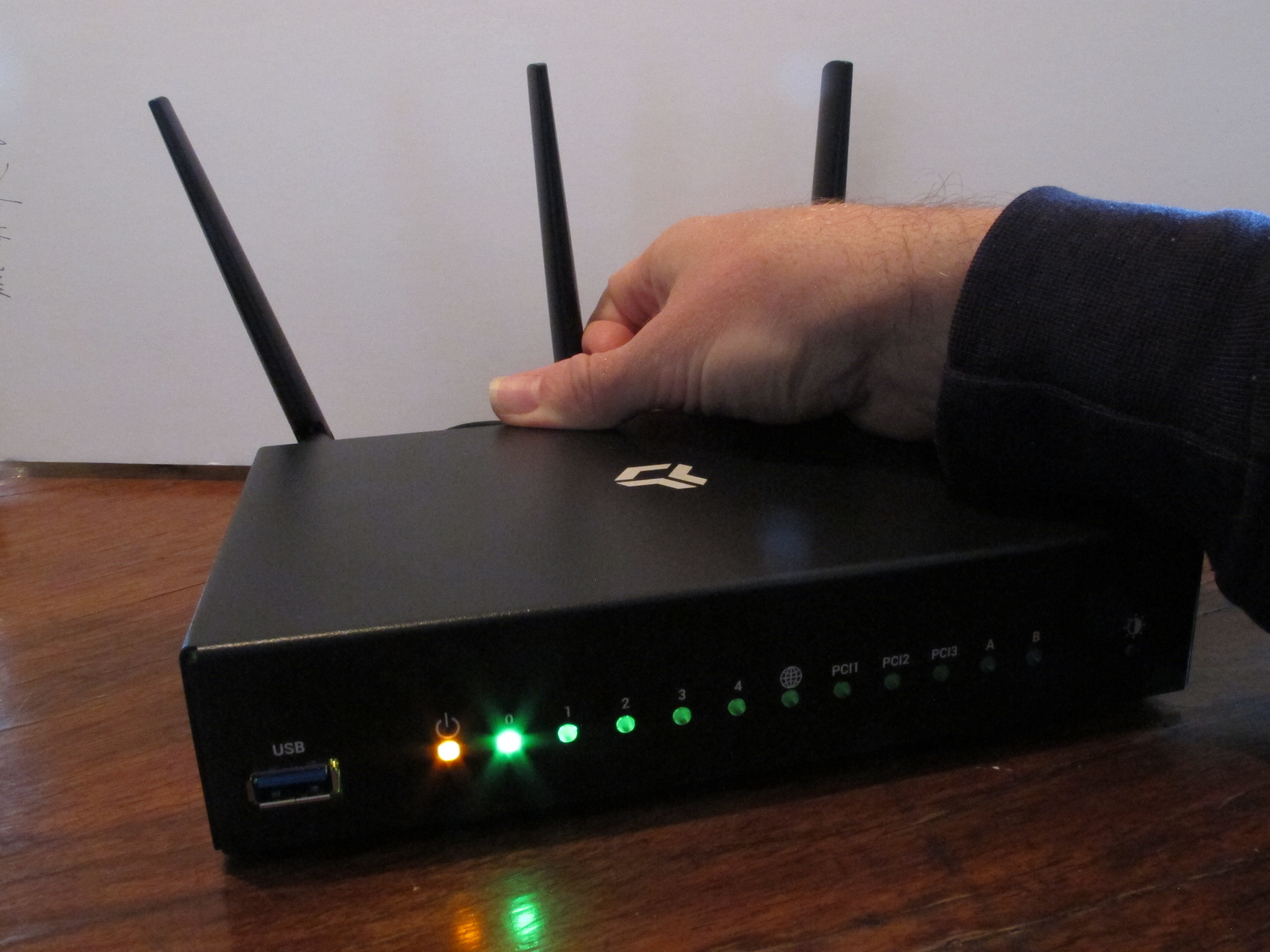
The Turris Omnia router is not the first FLOSS router out there, but it could well be one of the first open hardware routers to be available. As the crowdfunding campaign is coming to a close, it is worth reflecting on the place of the project in the ecosystem. Beyond that, I got my hardware recently, so I was able to give it a try.

A short introduction to the Omnia project The Turris Omnia Router The Omnia router is a followup project on CZ.NIC's original research project, the Turris. The goal of the project was to identify hostile traffic on end-user networks and develop global responses to those attacks across every monitored device. The Omnia is an extension of the original project: more features were added and data collection is now opt-in. Whereas the original Turris was simply a home router, the new Omnia router includes:
  • 1.6GHz ARM CPU
  • 1-2GB RAM
  • 8GB flash storage
  • 6 Gbit Ethernet ports
  • SFP fiber port
  • 2 Mini-PCI express ports
  • mSATA port
  • 3 MIMO 802.11ac and 2 MIMO 802.11bgn radios and antennas
  • SIM card support for backup connectivity
Some models sold had a larger case to accommodate extra hard drives, turning the Omnia router into a NAS device that could actually serve as a multi-purpose home server. Indeed, it is one of the objectives of the project to make "more than just a router". The NAS model is not currently on sale anymore, but there are plans to bring it back along with LTE modem options and new accessories "to expand Omnia towards home automation". Omnia runs a fork of the OpenWRT distribution called TurrisOS that has been customized to support automated live updates, a simpler web interface, and other extra features. The fork also has patches to the Linux kernel, which is based on Linux 4.4.13 (according to uname -a). It is unclear why those patches are necessary since the ARMv7 Armada 385 CPU has been supported in Linux since at least 4.2-rc1, but it is common for OpenWRT ports to ship patches to the kernel, either to backport missing functionality or perform some optimization. There has been some pressure from backers to petition Turris to "speedup the process of upstreaming Omnia support to OpenWrt". It could be that the team is too busy with delivering the devices already ordered to complete that process at this point. The software is available on the CZ-NIC GitHub repository and the actual Linux patches can be found here and here. CZ.NIC also operates a private GitLab instance where more software is available. There is technically no reason why you wouldn't be able to run your own distribution on the Omnia router: OpenWRT development snapshots should be able to run on the Omnia hardware and some people have installed Debian on Omnia. It may require some customization (e.g. the kernel) to make sure the Omnia hardware is correctly supported. Most people seem to prefer to run TurrisOS because of the extra features. The hardware itself is also free and open for the most part. There is a binary blob needed for the 5GHz wireless card, which seems to be the only proprietary component on the board. The schematics of the device are available through the Omnia wiki, but oddly not in the GitHub repository like the rest of the software.

Hands on I received my own router last week, which is about six months late from the original April 2016 delivery date; it allowed me to do some hands-on testing of the device. The first thing I noticed was a known problem with the antenna connectors: I had to open up the case to screw the fittings tight, otherwise the antennas wouldn't screw in correctly. Once that was done, I simply had to go through the usual process of setting up the router, which consisted of connecting the Omnia to my laptop with an Ethernet cable, connecting the Omnia to an uplink (I hooked it into my existing network), and go through a web wizard. I was pleasantly surprised with the interface: it was smooth and easy to use, but at the same time imposed good security practices on the user. Install wizard performing automatic updates For example, the wizard, once connected to the network, goes through a full system upgrade and will, by default, automatically upgrade itself (including reboots) when new updates become available. Users have to opt-in to the automatic updates, and can chose to automate only the downloading and installation of the updates without having the device reboot on its own. Reboots are also performed during user-specified time frames (by default, Omnia applies kernel updates during the night). I also liked the "skip" button that allowed me to completely bypass the wizard and configure the device myself, through the regular OpenWRT systems (like LuCI or SSH) if I needed to. The Omnia router about to rollback to latest snapshot Notwithstanding the antenna connectors themselves, the hardware is nice. I ordered the black metal case, and I must admit I love the many LED lights in the front. It is especially useful to have color changes in the reset procedure: no more guessing what state the device is in or if I pressed the reset button long enough. The LEDs can also be dimmed to reduce the glare that our electronic devices produce. All this comes at a price, however: at \$250 USD, it is a much higher price tag than common home routers, which typically go for around \$50. Furthermore, it may be difficult to actually get the device, because no orders are being accepted on the Indiegogo site after October 31. The Turris team doesn't actually want to deal with retail sales and has now delegated retail sales to other stores, which are currently limited to European deliveries.

A nice device to help fight off the IoT apocalypse It seems there isn't a week that goes by these days without a record-breaking distributed denial-of-service (DDoS) attack. Those attacks are more and more caused by home routers, webcams, and "Internet of Things" (IoT) devices. In that context, the Omnia sets a high bar for how devices should be built but also how they should be operated. Omnia routers are automatically upgraded on a nightly basis and, by default, do not provide telnet or SSH ports to run arbitrary code. There is the password-less wizard that starts up on install, but it forces the user to chose a password in order to complete the configuration. Both the hardware and software of the Omnia are free and open. The automatic update's EULA explicitly states that the software provided by CZ.NIC "will be released under a free software licence" (and it has been, as mentioned earlier). This makes the machine much easier to audit by someone looking for possible flaws, say for example a customs official looking to approve the import in the eventual case where IoT devices end up being regulated. But it also makes the device itself more secure. One of the problems with these kinds of devices is "bit rot": they have known vulnerabilities that are not fixed in a timely manner, if at all. While it would be trivial for an attacker to disable the Omnia's auto-update mechanisms, the point is not to counterattack, but to prevent attacks on known vulnerabilities. The CZ.NIC folks take it a step further and encourage users to actively participate in a monitoring effort to document such attacks. For example, the Omnia can run a honeypot to lure attackers into divulging their presence. The Omnia also runs an elaborate data collection program, where routers report malicious activity to a central server that collects information about traffic flows, blocked packets, bandwidth usage, and activity from a predefined list of malicious addresses. The exact data collected is specified in another EULA that is currently only available to users logged in at the Turris web site. That data can then be turned into tweaked firewall rules to protect the overall network, which the Turris project calls a distributed adaptive firewall. Users need to explicitly opt-in to the monitoring system by registering on a portal using their email address. Turris devices also feature the Majordomo software (not to be confused with the venerable mailing list software) that can also monitor devices in your home and identify hostile traffic, potentially leading users to take responsibility over the actions of their own devices. This, in turn, could lead users to trickle complaints back up to the manufacturers that could change their behavior. It turns out that some companies do care about their reputations and will issue recalls if their devices have significant enough issues. It remains to be seen how effective the latter approach will be, however. In the meantime, the Omnia seems to be an excellent all-around server and router for even the most demanding home or small-office environments that is a great example for future competitors.
Note: this article first appeared in the Linux Weekly News.

13 November 2016

Daniel Pocock: Are all victims of French terrorism equal?

Some personal observations about the terrorist atrocities around the world based on evidence from Wikipedia and other sources The year 2015 saw a series of distressing terrorist attacks in France. 2015 was also the 30th anniversary of the French Government's bombing of a civilian ship at port in New Zealand, murdering a photographer who was on board at the time. This horrendous crime has been chronicled in various movies including The Rainbow Warrior Conspiracy (1989) and The Rainbow Warrior (1993). The Paris attacks are a source of great anxiety for the people of France but they are also an attack on Europe and all civilized humanity as well. Rather than using them to channel more anger towards Muslims and Arabs with another extended (yet ineffective) state of emergency, isn't it about time that France moved on from the evils of its colonial past and "drains the swamp" where unrepentant villains are thriving in its security services? Fran ois Hollande and S gol ne Royal. Royal's brother G rard Royal allegedly planted the bomb in the terrorist mission to New Zealand. It is ironic that Royal is now Minister for Ecology while her brother sank the Greenpeace flagship. If Fran ois and S gol ne had married (they have four children together), would G rard be the president's brother-in-law or terrorist-in-law? The question has to be asked: if it looks like terrorism, if it smells like terrorism, if the victim of that French Government attrocity is as dead as the victims of Islamic militants littered across the floor of the Bataclan, shouldn't it also be considered an act of terrorism? If it was not an act of terrorism, then what is it that makes it differ? Why do French officials refer to it as nothing more than "a serious error", the term used by Prime Minister Manuel Valls during a recent visit to New Zealand in 2016? Was it that the French officials felt it was necessary for Libert , galit , fraternit ? Or is it just a limitation of the English language that we only have one word for terrorism, while French officials have a different word for such acts carried out by those who serve their flag? If the French government are sincere in their apology, why have they avoided releasing key facts about the atrocity, like who thought up this plot and who gave the orders? Did the soldiers involved volunteer for a mission with the code name Op ration Satanique, or did any other members of their unit quit rather than have such a horrendous crime on their conscience? What does that say about the people who carried out the orders? If somebody apprehended one of these rogue employees of the French Government today, would they be rewarded with France's highest honour, like those tourists who recently apprehended an Islamic terrorist on a high-speed train? If terrorism is such an absolute evil, why was it so easy for the officials involved to progress with their careers? Would an ex-member of an Islamic terrorist group be able to subsequently obtain US residence and employment as easily as the French terror squad's commander Louis-Pierre Dillais? When you consider the comments made by Donald Trump recently, the threats of violence and physical aggression against just about anybody he doesn't agree with, is this the type of diplomacy that the US will practice under his rule commencing in 2017? Are people like this motivated by a genuine concern for peace and security, or are these simply criminal acts of vengence backed by political leaders with the maturity of schoolyard bullies?

1 November 2016

Jaldhar Vyas: Sal Mubarak 2073!

Wishing every one a happy Gujarati New Year, Vikram Samvat 2073 named Kilaka and hoping the upcoming year will be yuuge for you. These next couple of paragraphs are totally not an excuse for why it will take a few more days for me to reach seven blog posts. Reading reports about Diwali in the American press, I see a bit of confusion whether Diwali is one day or five. Well, technically it is just one (Sunday 30th this year.) but there are a number of other observances around it which could be classed as subsidiaries if you want to look at it that way. The season commenced last Wednesday with Rama Ekadashi. (where the Gujarati name is different I'll use that and put the Sanskrit name in parentheses.) That's a fast day and therefore not much fun. Thursday was Vagh Barash (vyaghra dvadashi) which as the name suggests is something to do with tigers but we don't in my experience particularly do anything special that day. Friday, things began in earnest with Dhan Terash (dhana trayodashi) when Lakshmi the Goddess of prosperity is worshipped. It is also a good day to buy gold. Saturday was Kali Chaudash (Kali Chaturdashi or Naraka Chaturdashi) On this day many Gujarati families including mine worship their Kuladevi (patron Goddess of the family) even if She is not an aspect of Kali. (Others observe this on the Ashtami of Navaratri.) The day is also associated with the God Hanuman. Some people say it is His Jayanti (birthday) though we observe it in Chaitra (March-April.) It is also the best day for learning mantras and I initiated a couple of people including my son into a mantra I know. Sunday was Diwali (Deepavali) proper. As a Brahmana I spent much of the day signing blessings in the account books of shopkeepers. Well, nowadays only a few old people have actual account books so usually the print out a spreadsheet and I sign that. But home is where the main action is. Lights are lit, fireworks are set off, and prayers are offered to Lakshmi. But most important of all, this is the day good boys and girls get presents. Unfortunately I have nothing interesting to report; just the usual utilitarian items of clothing. Fireworks by the way are technically illegal in New Jersey not that that ever stopped anyone from getting them. The past few years, Jersey City has attempted to compromise by allowing a big public fireworks display. Although it was nice and sunny all day, by nighttime we had torrential rain and the firework display got washed out. So I'm glad I rebelled against the system with my small cache of sparklers. Today (or yesterday by the time this gets posted.) was the Gujarati New Years Day. There is also the commemoration of the time the God Krishna lifted up Mt Govardhan with one finger which every mandir emulates by making an annakuta or mountain of food. Tuesday is Bhai Beeja (Yama Dvitiya in Sanskrit or Bhai Duj in Hindi) when sisters cook a meal for their brothers. My son is also going to make something (read: microwave something) for his sister. So those are the five days of Diwali. Though many will not consider it to be truly over until this Saturday, the lucky day of Labh Pancham (Labha panchami.) And if I still haven't managed to write seven blog posts by then, there is always Deva Diwali...

31 October 2016

Chris Lamb: Free software activities in October 2016

Here is my monthly update covering what I have been doing in the free software world (previously):

Debian & Reproducible builds

Whilst anyone can inspect the source code of free software for malicious flaws, most GNU/Linux distributions provide binary (or "compiled") packages to end users. The motivation behind the Reproducible Builds effort is to allow verification that no flaws have been introduced either maliciously and accidentally during this compilation process by promising identical binary packages are always generated from a given source.

  • Presented a talk entitled "Reproducible Builds" talk at Software Freedom Kosova, in Prishtina, Republic of Kosovo.

  • I filed my 2,500th bug in the Debian BTS: #840972: golang-google-appengine: accesses the internet during build.

  • In order to build packages reproducibly, one not only needs identical sources but also some external and sharable definition of the environment used for a particular build, stipulating such things such as the version numbers of the required build-dependencies. It is not currently clear how to handle these .buildinfo files after the archive software has processed them and how to make them available to the world so I started development on a proof-of-concept server to see what issues arise in practice. It is available at buildinfo.debian.net.

  • Chaired an IRC meeting and ran a poll to determine a regular time .

  • Submitted two design proposals to our wiki page.

  • Improvements to our tests.reproducible-builds.org testing framework:

    • Move regular "Scheduled in..." messages to the #debian-reproducible-changes IRC channel.
    • Use our log_info method instead of manual echo calls.
    • Correct an "all sources packages" "all source packages" typo.
    • Submit .buildinfo files to buildinfo.debian.net.
    • Create GPG key on nodes for buildinfo.debian.net at deploy time, not "lazily".

My work in the Reproducible Builds project was also covered in our weekly reports. (#75, #76, #77 & #78).

I also submitted 14 patches to fix specific reproducibility issues in bio-eagle, cf-python, fastx-toolkit, fpga-icestorm, http-icons, lambda-align, mypy, playitslowly, seabios, stumpwm, sympa, tj3, wims-help & xotcl.
Debian LTS

This month I have been paid to work 13 hours on Debian Long Term Support (LTS). In that time I did the following:
  • Seven days of "frontdesk" duties, triaging CVEs, etc.
  • Issued DLA 647-1 for freeimage correcting an out-of-bounds write vulnerability in the XMP image handling functionality.
  • Issued DLA 649-1 for python-django fixing a possible CSRF protection bypass on sites that use Google Analytics.
  • Issued DLA 654-1 for libxfixes preventing an integer overflow when a malicious client sent INT_MAX as a "length".
  • Issued DLA 662-1 for quagga correcting a programming error where two constants were confused that could cause stack overrun in IPv6 routing code.
  • Issued DLA 688-1 for cairo to prevent a DoS attack where a malicious SVG could generate invalid pointers.

Uploads
  • gunicorn:
    • 19.6.0-7 Set supplementary groups when changing uid, add an example systemd .service file to gunicorn-examples, and expand README.Debian to make it clearer what to do now that /etc/gunicorn.d has been removed.
    • 19.6.0-8 Correct previous supplementary groups patch to be compatible with Python 3.
  • redis:
    • 3:3.2.4-2 Ensure that sentinel's configuration actually writes to a pidfile location so that systemd can detect that the daemon has started.
    • 3:3.2.5-1 New upstream release.
  • libfiu:
    • 0.94-8 Fix FTBFS under Bash due to lack of && in debian/rules.
    • 0.94-9 Ensure the build is reproducible by sorting injected modules.
  • aptfs (2:0.8-2) Minor cosmetic changes.

NMUs
  • libxml-dumper-perl (0.81-1.2) Move away from a unsupported debhelper compat level 4.
  • netatalk (2.2.5-1.1) Drop build-dependency on hardening-includes.

QA uploads
  • anon-proxy (00.05.38+20081230-4) Move to a supported debhelper compatibility level 9.
  • ara (1.0.32) Make the build reproducible.
  • binutils-m68hc1x (1:2.18-8) Make the build reproducible & move to a supported debhelper compatibility level.
  • fracplanet (0.4.0-5) Make the build reproducible.
  • libnss-ldap (265-5) Make the build reproducible.
  • python-uniconvertor (1.1.5-3) Fix an "option release requires an argument" FTBFS. (#839375)
  • ripole (0.2.0+20081101.0215-3) Actually include the ripole binary in package. (#839919) & enable hardening flags.
  • twitter-bootstrap (2.0.2+dfsg-10) Fix incorrect copyright formatting when building under Bash. (#824592)
  • zpaq (1.10-3) Make the build reproducible.


Debian FTP Team

As a Debian FTP assistant I ACCEPTed 147 packages: ace-link, amazon-s2n, avy, basez, bootstrap-vz, bucklespring, camitk, carettah, cf-python, debian-reference, dfcgen-gtk, efivar, entropybroker, fakesleep, gall, game-data-packager, gitano, glare, gnome-panel, gnome-shell-extension-dashtodock, gnome-shell-extension-refreshwifi, gnome-shell-extension-remove-dropdown-arrows, golang-github-gogits-go-gogs-client, golang-github-gucumber-gucumber, golang-github-hlandau-buildinfo, golang-github-hlandau-dexlogconfig, golang-github-hlandau-goutils, golang-github-influxdata-toml, golang-github-jacobsa-crypto, golang-github-kjk-lzma, golang-github-miekg-dns, golang-github-minio-sha256-simd, golang-github-nfnt-resize, golang-github-nicksnyder-go-i18n, golang-github-pointlander-compress, golang-github-pointlander-jetset, golang-github-pointlander-peg, golang-github-rfjakob-eme, golang-github-thecreeper-go-notify, golang-github-twstrike-gotk3adapter, golang-github-unknwon-goconfig, golang-gopkg-dancannon-gorethink.v1, golang-petname, haskell-argon2, haskell-binary-parsers, haskell-bindings-dsl, haskell-deriving-compat, haskell-hackage-security, haskell-hcwiid, haskell-hsopenssl-x509-system, haskell-megaparsec, haskell-mono-traversable-instances, haskell-prim-uniq, haskell-raaz, haskell-readable, haskell-readline, haskell-relational-record, haskell-safe-exceptions, haskell-servant-client, haskell-token-bucket, haskell-zxcvbn-c, irclog2html, ironic-ui, lace, ledger, libdancer2-plugin-passphrase-perl, libdatetime-calendar-julian-perl, libdbix-class-optimisticlocking-perl, libdbix-class-schema-config-perl, libgeo-constants-perl, libgeo-ellipsoids-perl, libgeo-functions-perl, libgeo-inverse-perl, libio-async-loop-mojo-perl, libmojolicious-plugin-assetpack-perl, libmojolicious-plugin-renderfile-perl, libparams-validationcompiler-perl, libspecio-perl, libtest-time-perl, libtest2-plugin-nowarnings-perl, linux, lua-scrypt, mono, mutt-vc-query, neutron, node-ansi-font, node-buffer-equal, node-defaults, node-formatio, node-fs-exists-sync, node-fs.realpath, node-is-buffer, node-jison-lex, node-jju, node-jsonstream, node-kind-of, node-lex-parser, node-lolex, node-loud-rejection, node-random-bytes, node-randombytes, node-regex-not, node-repeat-string, node-samsam, node-set-value, node-source-map-support, node-spdx-correct, node-static-extend, node-test, node-to-object-path, node-type-check, node-typescript, node-unset-value, nutsqlite, opencv, openssl1.0, panoramisk, perl6, pg-rage-terminator, pg8000, plv8, puppet-module-oslo, pymoc, pyramid-jinja2, python-bitbucket-api, python-ceilometermiddleware, python-configshell-fb, python-ewmh, python-gimmik, python-jsbeautifier, python-opcua, python-pyldap, python-s3transfer, python-testing.common.database, python-testing.mysqld, python-testing.postgresql, python-wheezy.template, qspeakers, r-cran-nleqslv, recommonmark, rolo, shim, swift-im, tendermint-go-clist, tongue, uftrace & zaqar-ui.

28 October 2016

Alessio Treglia: The logical contradictions of the Universe

Ouroboros

Ouroboros

Is Erwin Schr dinger s wave function which did in the atomic and subatomic world an operation altogether similar to the one performed by Newton in the macroscopic world an objective reality or just a subjective knowledge? Physicists, philosophers and epistemologist have debated at length on this matter. In 1960, theoretical physicist Eugene Wigner has proposed that the observer s consciousness is the dividing line that triggers the collapse of the wave function[1], and this theory was later taken up and developed in recent years. The rules of quantum mechanics are correct but there is only one system which may be treated with quantum mechanics, namely the entire material world. There exist external observers which cannot be treated within quantum mechanics, namely human (and perhaps animal) minds, which perform measurements on the brain causing wave function collapse [2]. The English mathematical physicist and philosopher of science Roger Penrose developed the hypothesis called Orch-OR (Orchestrated objective reduction) according to which consciousness originates from processes within neurons, rather than from the connections between neurons (the conventional view). The mechanism is believed to be a quantum physical process called objective reduction which is orchestrated by the molecular structures of the microtubules of brain cells (which constitute the cytoskeleton of the cells themselves). Together with the physician Stuart Hameroff, Penrose has suggested a direct relationship between the quantum vibrations of microtubules and the formation of consciousness.

<Read More [by Fabio Marzocca]>

26 October 2016

Joachim Breitner: Showcasing Applicative

My plan for this week s lecture of the CIS 194 Haskell course at the University of Pennsylvania is to dwell a bit on the concept of Functor, Applicative and Monad, and to highlight the value of the Applicative abstraction. I quite like the example that I came up with, so I want to share it here. In the interest of long-term archival and stand-alone presentation, I include all the material in this post.1

Imports In case you want to follow along, start with these imports:
import Data.Char
import Data.Maybe
import Data.List
import System.Environment
import System.IO
import System.Exit

The parser The starting point for this exercise is a fairly standard parser-combinator monad, which happens to be the result of the student s homework from last week:
newtype Parser a = P (String -> Maybe (a, String))
runParser :: Parser t -> String -> Maybe (t, String)
runParser (P p) = p
parse :: Parser a -> String -> Maybe a
parse p input = case runParser p input of
    Just (result, "") -> Just result
    _ -> Nothing -- handles both no result and leftover input
noParserP :: Parser a
noParserP = P (\_ -> Nothing)
pureParserP :: a -> Parser a
pureParserP x = P (\input -> Just (x,input))
instance Functor Parser where
    fmap f p = P $ \input -> do
	(x, rest) <- runParser p input
	return (f x, rest)
instance Applicative Parser where
    pure = pureParserP
    p1 <*> p2 = P $ \input -> do
        (f, rest1) <- runParser p1 input
        (x, rest2) <- runParser p2 rest1
        return (f x, rest2)
instance Monad Parser where
    return = pure
    p1 >>= k = P $ \input -> do
        (x, rest1) <- runParser p1 input
        runParser (k x) rest1
anyCharP :: Parser Char
anyCharP = P $ \input -> case input of
    (c:rest) -> Just (c, rest)
    []       -> Nothing
charP :: Char -> Parser ()
charP c = do
    c' <- anyCharP
    if c == c' then return ()
               else noParserP
anyCharButP :: Char -> Parser Char
anyCharButP c = do
    c' <- anyCharP
    if c /= c' then return c'
               else noParserP
letterOrDigitP :: Parser Char
letterOrDigitP = do
    c <- anyCharP
    if isAlphaNum c then return c else noParserP
orElseP :: Parser a -> Parser a -> Parser a
orElseP p1 p2 = P $ \input -> case runParser p1 input of
    Just r -> Just r
    Nothing -> runParser p2 input
manyP :: Parser a -> Parser [a]
manyP p = (pure (:) <*> p <*> manyP p)  orElseP  pure []
many1P :: Parser a -> Parser [a]
many1P p = pure (:) <*> p <*> manyP p
sepByP :: Parser a -> Parser () -> Parser [a]
sepByP p1 p2 = (pure (:) <*> p1 <*> (manyP (p2 *> p1)))  orElseP  pure []
A parser using this library for, for example, CSV files could take this form:
parseCSVP :: Parser [[String]]
parseCSVP = manyP parseLine
  where
    parseLine = parseCell  sepByP  charP ',' <* charP '\n'
    parseCell = do
        charP '"'
        content <- manyP (anyCharButP '"')
        charP '"'
        return content

We want EBNF Often when we write a parser for a file format, we might also want to have a formal specification of the format. A common form for such a specification is EBNF. This might look as follows, for a CSV file:
cell = '"',  not-quote , '"';
line = (cell,  ',', cell    ''), newline;
csv  =  line ;
It is straightforward to create a Haskell data type to represent an EBNF syntax description. Here is a simple EBNF library (data type and pretty-printer) for your convenience:
data RHS
  = Terminal String
    NonTerminal String
    Choice RHS RHS
    Sequence RHS RHS
    Optional RHS
    Repetition RHS
  deriving (Show, Eq)
ppRHS :: RHS -> String
ppRHS = go 0
  where
    go _ (Terminal s)     = surround "'" "'" $ concatMap quote s
    go _ (NonTerminal s)  = s
    go a (Choice x1 x2)   = p a 1 $ go 1 x1 ++ "   " ++ go 1 x2
    go a (Sequence x1 x2) = p a 2 $ go 2 x1 ++ ", "  ++ go 2 x2
    go _ (Optional x)     = surround "[" "]" $ go 0 x
    go _ (Repetition x)   = surround " " " " $ go 0 x
    surround c1 c2 x = c1 ++ x ++ c2
    p a n   a > n     = surround "(" ")"
            otherwise = id
    quote '\'' = "\\'"
    quote '\\' = "\\\\"
    quote c    = [c]
type Production = (String, RHS)
type BNF = [Production]
ppBNF :: BNF -> String
ppBNF = unlines . map (\(i,rhs) -> i ++ " = " ++ ppRHS rhs ++ ";")

Code to produce EBNF We had a good time writing combinators that create complex parsers from primitive pieces. Let us do the same for EBNF grammars. We could simply work on the RHS type directly, but we can do something more nifty: We create a data type that keeps track, via a phantom type parameter, of what Haskell type the given EBNF syntax is the specification:
newtype Grammar a = G RHS
ppGrammar :: Grammar a -> String
ppGrammar (G rhs) = ppRHS rhs
So a value of type Grammar t is a description of the textual representation of the Haskell type t. Here is one simple example:
anyCharG :: Grammar Char
anyCharG = G (NonTerminal "char")
Here is another one. This one does not describe any interesting Haskell type, but is useful when spelling out the special characters in the syntax described by the grammar:
charG :: Char -> Grammar ()
charG c = G (Terminal [c])
A combinator that creates new grammar from two existing grammars:
orElseG :: Grammar a -> Grammar a -> Grammar a
orElseG (G rhs1) (G rhs2) = G (Choice rhs1 rhs2)
We want the convenience of our well-known type classes in order to combine these values some more:
instance Functor Grammar where
    fmap _ (G rhs) = G rhs
instance Applicative Grammar where
    pure x = G (Terminal "")
    (G rhs1) <*> (G rhs2) = G (Sequence rhs1 rhs2)
Note how the Functor instance does not actually use the function. How should it? There are no values inside a Grammar! We cannot define a Monad instance for Grammar: We would start with (G rhs1) >>= k = , but there is simply no way of getting a value of type a that we can feed to k. So we will do without a Monad instance. This is interesting, and we will come back to that later. Like with the parser, we can now begin to build on the primitive example to build more complicated combinators:
manyG :: Grammar a -> Grammar [a]
manyG p = (pure (:) <*> p <*> manyG p)  orElseG  pure []
many1G :: Grammar a -> Grammar [a]
many1G p = pure (:) <*> p <*> manyG p
sepByG :: Grammar a -> Grammar () -> Grammar [a]
sepByG p1 p2 = ((:) <$> p1 <*> (manyG (p2 *> p1)))  orElseG  pure []
Let us run a small example:
dottedWordsG :: Grammar [String]
dottedWordsG = many1G (manyG anyCharG <* charG '.')
*Main> putStrLn $ ppGrammar dottedWordsG
'', ('', char, ('', char, ('', char, ('', char, ('', char, ('',  
Oh my, that is not good. Looks like the recursion in manyG does not work well, so we need to avoid that. But anyways we want to be explicit in the EBNF grammars about where something can be repeated, so let us just make many a primitive:
manyG :: Grammar a -> Grammar [a]
manyG (G rhs) = G (Repetition rhs)
With this definition, we already get a simple grammar for dottedWordsG:
*Main> putStrLn $ ppGrammar dottedWordsG
'',  char , '.',  char , '.' 
This already looks like a proper EBNF grammar. One thing that is not nice about it is that there is an empty string ('') in a sequence ( , ). We do not want that. Why is it there in the first place? Because our Applicative instance is not lawful! Remember that pure id <*> g == g should hold. One way to achieve that is to improve the Applicative instance to optimize this case away:
instance Applicative Grammar where
    pure x = G (Terminal "")
    G (Terminal "") <*> G rhs2 = G rhs2
    G rhs1 <*> G (Terminal "") = G rhs1
    (G rhs1) <*> (G rhs2) = G (Sequence rhs1 rhs2)
	 
Now we get what we want:
*Main> putStrLn $ ppGrammar dottedWordsG
 char , '.',  char , '.' 
Remember our parser for CSV files above? Let me repeat it here, this time using only Applicative combinators, i.e. avoiding (>>=), (>>), return and do-notation:
parseCSVP :: Parser [[String]]
parseCSVP = manyP parseLine
  where
    parseLine = parseCell  sepByP  charG ',' <* charP '\n'
    parseCell = charP '"' *> manyP (anyCharButP '"') <* charP '"'
And now we try to rewrite the code to produce Grammar instead of Parser. This is straightforward with the exception of anyCharButP. The parser code for that inherently monadic, and we just do not have a monad instance. So we work around the issue by making that a primitive grammar, i.e. introducing a non-terminal in the EBNF without a production rule pretty much like we did for anyCharG:
primitiveG :: String -> Grammar a
primitiveG s = G (NonTerminal s)
parseCSVG :: Grammar [[String]]
parseCSVG = manyG parseLine
  where
    parseLine = parseCell  sepByG  charG ',' <* charG '\n'
    parseCell = charG '"' *> manyG (primitiveG "not-quote") <* charG '"'
Of course the names parse are not quite right any more, but let us just leave that for now. Here is the result:
*Main> putStrLn $ ppGrammar parseCSVG
 ('"',  not-quote , '"',  ',', '"',  not-quote , '"'    ''), '
' 
The line break is weird. We do not really want newlines in the grammar. So let us make that primitive as well, and replace charG '\n' with newlineG:
newlineG :: Grammar ()
newlineG = primitiveG "newline"
Now we get
*Main> putStrLn $ ppGrammar parseCSVG
 ('"',  not-quote , '"',  ',', '"',  not-quote , '"'    ''), newline 
which is nice and correct, but still not quite the easily readable EBNF that we saw further up.

Code to produce EBNF, with productions We currently let our grammars produce only the right-hand side of one EBNF production, but really, we want to produce a RHS that may refer to other productions. So let us change the type accordingly:
newtype Grammar a = G (BNF, RHS)
runGrammer :: String -> Grammar a -> BNF
runGrammer main (G (prods, rhs)) = prods ++ [(main, rhs)]
ppGrammar :: String -> Grammar a -> String
ppGrammar main g = ppBNF $ runGrammer main g
Now we have to adjust all our primitive combinators (but not the derived ones!):
charG :: Char -> Grammar ()
charG c = G ([], Terminal [c])
anyCharG :: Grammar Char
anyCharG = G ([], NonTerminal "char")
manyG :: Grammar a -> Grammar [a]
manyG (G (prods, rhs)) = G (prods, Repetition rhs)
mergeProds :: [Production] -> [Production] -> [Production]
mergeProds prods1 prods2 = nub $ prods1 ++ prods2
orElseG :: Grammar a -> Grammar a -> Grammar a
orElseG (G (prods1, rhs1)) (G (prods2, rhs2))
    = G (mergeProds prods1 prods2, Choice rhs1 rhs2)
instance Functor Grammar where
    fmap _ (G bnf) = G bnf
instance Applicative Grammar where
    pure x = G ([], Terminal "")
    G (prods1, Terminal "") <*> G (prods2, rhs2)
        = G (mergeProds prods1 prods2, rhs2)
    G (prods1, rhs1) <*> G (prods2, Terminal "")
        = G (mergeProds prods1 prods2, rhs1)
    G (prods1, rhs1) <*> G (prods2, rhs2)
        = G (mergeProds prods1 prods2, Sequence rhs1 rhs2)
primitiveG :: String -> Grammar a
primitiveG s = G (NonTerminal s)
The use of nub when combining productions removes duplicates that might be used in different parts of the grammar. Not efficient, but good enough for now. Did we gain anything? Not yet:
*Main> putStr $ ppGrammar "csv" (parseCSVG)
csv =  ('"',  not-quote , '"',  ',', '"',  not-quote , '"'    ''), newline ;
But we can now introduce a function that lets us tell the system where to give names to a piece of grammar:
nonTerminal :: String -> Grammar a -> Grammar a
nonTerminal name (G (prods, rhs))
  = G (prods ++ [(name, rhs)], NonTerminal name)
Ample use of this in parseCSVG yields the desired result:
parseCSVG :: Grammar [[String]]
parseCSVG = manyG parseLine
  where
    parseLine = nonTerminal "line" $
        parseCell  sepByG  charG ',' <* newline
    parseCell = nonTerminal "cell" $
        charG '"' *> manyG (primitiveG "not-quote") <* charG '"
*Main> putStr $ ppGrammar "csv" (parseCSVG)
cell = '"',  not-quote , '"';
line = (cell,  ',', cell    ''), newline;
csv =  line ;
This is great!

Unifying parsing and grammar-generating Note how simliar parseCSVG and parseCSVP are! Would it not be great if we could implement that functionality only once, and get both a parser and a grammar description out of it? This way, the two would never be out of sync! And surely this must be possible. The tool to reach for is of course to define a type class that abstracts over the parts where Parser and Grammer differ. So we have to identify all functions that are primitive in one of the two worlds, and turn them into type class methods. This includes char and orElse. It includes many, too: Although manyP is not primitive, manyG is. It also includes nonTerminal, which does not exist in the world of parsers (yet), but we need it for the grammars. The primitiveG function is tricky. We use it in grammars when the code that we might use while parsing is not expressible as a grammar. So the solution is to let it take two arguments: A String, when used as a descriptive non-terminal in a grammar, and a Parser a, used in the parsing code. Finally, the type classes that we except, Applicative (and thus Functor), are added as constraints on our type class:
class Applicative f => Descr f where
    char :: Char -> f ()
    many :: f a -> f [a]
    orElse :: f a -> f a -> f a
    primitive :: String -> Parser a -> f a
    nonTerminal :: String -> f a -> f a
The instances are easily written:
instance Descr Parser where
    char = charP
    many = manyP
    orElse = orElseP
    primitive _ p = p
    nonTerminal _ p = p
instance Descr Grammar where
    char = charG
    many = manyG
    orElse = orElseG
    primitive s _ = primitiveG s
    nonTerminal s g = nonTerminal s g
And we can now take the derived definitions, of which so far we had two copies, and define them once and for all:
many1 :: Descr f => f a -> f [a]
many1 p = pure (:) <*> p <*> many p
anyChar :: Descr f => f Char
anyChar = primitive "char" anyCharP
dottedWords :: Descr f => f [String]
dottedWords = many1 (many anyChar <* char '.')
sepBy :: Descr f => f a -> f () -> f [a]
sepBy p1 p2 = ((:) <$> p1 <*> (many (p2 *> p1)))  orElse  pure []
newline :: Descr f => f ()
newline = primitive "newline" (charP '\n')
And thus we now have our CSV parser/grammar generator:
parseCSV :: Descr f => f [[String]]
parseCSV = many parseLine
  where
    parseLine = nonTerminal "line" $
        parseCell  sepBy  char ',' <* newline
    parseCell = nonTerminal "cell" $
        char '"' *> many (primitive "not-quote" (anyCharButP '"')) <* char '"'
We can now use this definition both to parse and to generate grammars:
*Main> putStr $ ppGrammar2 "csv" (parseCSV)
cell = '"',  not-quote , '"';
line = (cell,  ',', cell    ''), newline;
csv =  line ;
*Main> parse parseCSV "\"ab\",\"cd\"\n\"\",\"de\"\n\n"
Just [["ab","cd"],["","de"],[]]

The INI file parser and grammar As a final exercise, let us transform the INI file parser into a combined thing. Here is the parser (another artifact of last week s homework) again using applicative style2:
parseINIP :: Parser INIFile
parseINIP = many1P parseSection
  where
    parseSection =
        (,) <$  charP '['
            <*> parseIdent
            <*  charP ']'
            <*  charP '\n'
            <*> (catMaybes <$> manyP parseLine)
    parseIdent = many1P letterOrDigitP
    parseLine = parseDecl  orElseP  parseComment  orElseP  parseEmpty
    parseDecl = Just <$> (
        (,) <*> parseIdent
            <*  manyP (charP ' ')
            <*  charP '='
            <*  manyP (charP ' ')
            <*> many1P (anyCharButP '\n')
            <*  charP '\n')
    parseComment =
        Nothing <$ charP '#'
                <* many1P (anyCharButP '\n')
                <* charP '\n'
    parseEmpty = Nothing <$ charP '\n'
Transforming that to a generic description is quite straightforward. We use primitive again to wrap letterOrDigitP:
descrINI :: Descr f => f INIFile
descrINI = many1 parseSection
  where
    parseSection =
        (,) <*  char '['
            <*> parseIdent
            <*  char ']'
            <*  newline
            <*> (catMaybes <$> many parseLine)
    parseIdent = many1 (primitive "alphanum" letterOrDigitP)
    parseLine = parseDecl  orElse  parseComment  orElse  parseEmpty
    parseDecl = Just <$> (
        (,) <*> parseIdent
            <*  many (char ' ')
            <*  char '='
            <*  many (char ' ')
            <*> many1 (primitive "non-newline" (anyCharButP '\n'))
	    <*  newline)
    parseComment =
        Nothing <$ char '#'
                <* many1 (primitive "non-newline" (anyCharButP '\n'))
		<* newline
    parseEmpty = Nothing <$ newline
This yields this not very helpful grammar (abbreviated here):
*Main> putStr $ ppGrammar2 "ini" descrINI
ini = '[', alphanum,  alphanum , ']', newline,  alphanum,  alphanum ,  ' ' 
But with a few uses of nonTerminal, we get something really nice:
descrINI :: Descr f => f INIFile
descrINI = many1 parseSection
  where
    parseSection = nonTerminal "section" $
        (,) <$  char '['
            <*> parseIdent
            <*  char ']'
            <*  newline
            <*> (catMaybes <$> many parseLine)
    parseIdent = nonTerminal "identifier" $
        many1 (primitive "alphanum" letterOrDigitP)
    parseLine = nonTerminal "line" $
        parseDecl  orElse  parseComment  orElse  parseEmpty
    parseDecl = nonTerminal "declaration" $ Just <$> (
        (,) <$> parseIdent
            <*  spaces
            <*  char '='
            <*  spaces
            <*> remainder)
    parseComment = nonTerminal "comment" $
        Nothing <$ char '#' <* remainder
    remainder = nonTerminal "line-remainder" $
        many1 (primitive "non-newline" (anyCharButP '\n')) <* newline
    parseEmpty = Nothing <$ newline
    spaces = nonTerminal "spaces" $ many (char ' ')
*Main> putStr $ ppGrammar "ini" descrINI
identifier = alphanum,  alphanum ;
spaces =  ' ' ;
line-remainder = non-newline,  non-newline , newline;
declaration = identifier, spaces, '=', spaces, line-remainder;
comment = '#', line-remainder;
line = declaration   comment   newline;
section = '[', identifier, ']', newline,  line ;
ini = section,  section ;

Recursion (variant 1) What if we want to write a parser/grammar-generator that is able to generate the following grammar, which describes terms that are additions and multiplications of natural numbers:
const = digit,  digit ;
spaces =  ' '   newline ;
atom = const   '(', spaces, expr, spaces, ')', spaces;
mult = atom,  spaces, '*', spaces, atom , spaces;
plus = mult,  spaces, '+', spaces, mult , spaces;
expr = plus;
The production of expr is recursive (via plus, mult, atom). We have seen above that simply defining a Grammar a recursively does not go well. One solution is to add a new combinator for explicit recursion, which replaces nonTerminal in the method:
class Applicative f => Descr f where
     
    recNonTerminal :: String -> (f a -> f a) -> f a
instance Descr Parser where
     
    recNonTerminal _ p = let r = p r in r
instance Descr Grammar where
     
    recNonTerminal = recNonTerminalG
recNonTerminalG :: String -> (Grammar a -> Grammar a) -> Grammar a
recNonTerminalG name f =
    let G (prods, rhs) = f (G ([], NonTerminal name))
    in G (prods ++ [(name, rhs)], NonTerminal name)
nonTerminal :: Descr f => String -> f a -> f a
nonTerminal name p = recNonTerminal name (const p)
runGrammer :: String -> Grammar a -> BNF
runGrammer main (G (prods, NonTerminal nt))   main == nt = prods
runGrammer main (G (prods, rhs)) = prods ++ [(main, rhs)]
The change in runGrammer avoids adding a pointless expr = expr production to the output. This lets us define a parser/grammar-generator for the arithmetic expressions given above:
data Expr = Plus Expr Expr   Mult Expr Expr   Const Integer
    deriving Show
mkPlus :: Expr -> [Expr] -> Expr
mkPlus = foldl Plus
mkMult :: Expr -> [Expr] -> Expr
mkMult = foldl Mult
parseExpr :: Descr f => f Expr
parseExpr = recNonTerminal "expr" $ \ exp ->
    ePlus exp
ePlus :: Descr f => f Expr -> f Expr
ePlus exp = nonTerminal "plus" $
    mkPlus <$> eMult exp
           <*> many (spaces *> char '+' *> spaces *> eMult exp)
           <*  spaces
eMult :: Descr f => f Expr -> f Expr
eMult exp = nonTerminal "mult" $
    mkPlus <$> eAtom exp
           <*> many (spaces *> char '*' *> spaces *> eAtom exp)
           <*  spaces
eAtom :: Descr f => f Expr -> f Expr
eAtom exp = nonTerminal "atom" $
    aConst  orElse  eParens exp
aConst :: Descr f => f Expr
aConst = nonTerminal "const" $ Const . read <$> many1 digit
eParens :: Descr f => f a -> f a
eParens inner =
    id <$  char '('
       <*  spaces
       <*> inner
       <*  spaces
       <*  char ')'
       <*  spaces
And indeed, this works:
*Main> putStr $ ppGrammar "expr" parseExpr
const = digit,  digit ;
spaces =  ' '   newline ;
atom = const   '(', spaces, expr, spaces, ')', spaces;
mult = atom,  spaces, '*', spaces, atom , spaces;
plus = mult,  spaces, '+', spaces, mult , spaces;
expr = plus;

Recursion (variant 2) Interestingly, there is another solution to this problem, which avoids introducing recNonTerminal and explicitly passing around the recursive call (i.e. the exp in the example). To implement that we have to adjust our Grammar type as follows:
newtype Grammar a = G ([String] -> (BNF, RHS))
The idea is that the list of strings is those non-terminals that we are currently defining. So in nonTerminal, we check if the non-terminal to be introduced is currently in the process of being defined, and then simply ignore the body. This way, the recursion is stopped automatically:
nonTerminalG :: String -> (Grammar a) -> Grammar a
nonTerminalG name (G g) = G $ \seen ->
    if name  elem  seen
    then ([], NonTerminal name)
    else let (prods, rhs) = g (name : seen)
         in (prods ++ [(name, rhs)], NonTerminal name)
After adjusting the other primitives of Grammar (including the Functor and Applicative instances, wich now again have nonTerminal) to type-check again, we observe that this parser/grammar generator for expressions, with genuine recursion, works now:
parseExp :: Descr f => f Expr
parseExp = nonTerminal "expr" $
    ePlus
ePlus :: Descr f => f Expr
ePlus = nonTerminal "plus" $
    mkPlus <$> eMult
           <*> many (spaces *> char '+' *> spaces *> eMult)
           <*  spaces
eMult :: Descr f => f Expr
eMult = nonTerminal "mult" $
    mkPlus <$> eAtom
           <*> many (spaces *> char '*' *> spaces *> eAtom)
           <*  spaces
eAtom :: Descr f => f Expr
eAtom = nonTerminal "atom" $
    aConst  orElse  eParens parseExp
Note that the recursion is only going to work if there is at least one call to nonTerminal somewhere around the recursive calls. We still cannot implement many as naively as above.

Homework If you want to play more with this: The homework is to define a parser/grammar-generator for EBNF itself, as specified in this variant:
identifier = letter,  letter   digit   '-' ;
spaces =  ' '   newline ;
quoted-char = non-quote-or-backslash   '\\', '\\'   '\\', '\'';
terminal = '\'',  quoted-char , '\'', spaces;
non-terminal = identifier, spaces;
option = '[', spaces, rhs, spaces, ']', spaces;
repetition = ' ', spaces, rhs, spaces, ' ', spaces;
group = '(', spaces, rhs, spaces, ')', spaces;
atom = terminal   non-terminal   option   repetition   group;
sequence = atom,  spaces, ',', spaces, atom , spaces;
choice = sequence,  spaces, ' ', spaces, sequence , spaces;
rhs = choice;
production = identifier, spaces, '=', spaces, rhs, ';', spaces;
bnf = production,  production ;
This grammar is set up so that the precedence of , and is correctly implemented: a , b c will parse as (a, b) c. In this syntax for BNF, terminal characters are quoted, i.e. inside ' ', a ' is replaced by \' and a \ is replaced by \\ this is done by the function quote in ppRHS. If you do this, you should able to round-trip with the pretty-printer, i.e. parse back what it wrote:
*Main> let bnf1 = runGrammer "expr" parseExpr
*Main> let bnf2 = runGrammer "expr" parseBNF
*Main> let f = Data.Maybe.fromJust . parse parseBNF. ppBNF
*Main> f bnf1 == bnf1
True
*Main> f bnf2 == bnf2
True
The last line is quite meta: We are using parseBNF as a parser on the pretty-printed grammar produced from interpreting parseBNF as a grammar.

Conclusion We have again seen an example of the excellent support for abstraction in Haskell: Being able to define so very different things such as a parser and a grammar description with the same code is great. Type classes helped us here. Note that it was crucial that our combined parser/grammars are only able to use the methods of Applicative, and not Monad. Applicative is less powerful, so by giving less power to the user of our Descr interface, the other side, i.e. the implementation, can be more powerful. The reason why Applicative is ok, but Monad is not, is that in Applicative, the results do not affect the shape of the computation, whereas in Monad, the whole point of the bind operator (>>=) is that the result of the computation is used to decide the next computation. And while this is perfectly fine for a parser, it just makes no sense for a grammar generator, where there simply are no values around! We have also seen that a phantom type, namely the parameter of Grammar, can be useful, as it lets the type system make sure we do not write nonsense. For example, the type of orElseG ensures that both grammars that are combined here indeed describe something of the same type.

  1. It seems to be the week of applicative-appraising blog posts: Brent has posted a nice piece about enumerations using Applicative yesterday.
  2. I like how in this alignment of <*> and <* the > point out where the arguments are that are being passed to the function on the left.

21 October 2016

Iain R. Learmonth: PATHspider 1.0.0 released!

In today s Internet we see an increasing deployment of middleboxes. While middleboxes provide in-network functionality that is necessary to keep networks manageable and economically viable, any packet mangling whether essential for the needed functionality or accidental as an unwanted side effect makes it more and more difficult to deploy new protocols or extensions of existing protocols. For the evolution of the protocol stack, it is important to know which network impairments exist and potentially need to be worked around. While classical network measurement tools are often focused on absolute performance values, PATHspider performs A/B testing between two different protocols or different protocol extensions to perform controlled experiments of protocol-dependent connectivity problems as well as differential treatment. PATHspider is a framework for performing and analyzing these measurements, while the actual A/B test can be easily customized. Late on the 21st October, we released version 1.0.0 of PATHspider and it s ready for production use (whatever that means for Internet research software). Our first real release of PATHspider was version 0.9.0 just in time for the presentation of PATHspider at the 2016 Applied Networking Research Workshop co-located with IETF 96 in Berlin earlier this year. Since this release we have made a lot of changes and I ll talk about some of the highlights here (in no particular order):

Switch from twisted.plugin to straight.plugin While we anticipate that some plugins may wish to use some features of Twisted, we didn t want to have Twisted as a core dependency for PATHspider. We found that straight.plugin was not just a drop-in replacement but it simplified the way in which 3rd-party plugins could be developed and it was worth the effort for that alone.

Library functions for the Observer PATHspider has an embedded flow-meter (think something like NetFlow but highly customisable). We found that even with the small selection of plugins that we had we were duplicating code across plugins for these customisations of the flow-meter. In this release we now provide library functions for common needs such as identifying TCP 3-way handshake completions or identifying ICMP Unreachable messages for flows.

New plugin: DSCP We ve added a new plugin for this release to detect breakage when using DiffServ code points to achieve differentiated services within a network.

Plugins are now subcommands Using the subparsers feature of argparse, all plugins including 3rd-party plugins will now appear as subcommands to the PATHspider command. This makes every plugin a first-class citizen and makes PATHspider truly generalised. We have an added benefit from this that plugins can also ask for extra arguments that are specific to the needs of the plugin, for example the DSCP plugin allows the user to select which code point to send for the experimental test.

Test Suite PATHspider now has a test suite! As the size of the PATHspider code base grows we need to be able to make changes and have confidence that we are not breaking code that another module relies on. We have so far only achieved 54% coverage of the codebase but we hope to improve this for the next release. We have focussed on the critical portions of data collection to ensure that all the results collected by PATHspider during experiments is valid.

DNS Resolver Utility Back when PATHspider was known as ECNSpider, it had a utility for resolving IP addresses from the Alexa top 1 million list. This utility has now been fully integrated into PATHspider and appears as a plugin to allow for repeated experiments against the same IP addresses even if the DNS resolver would have returned a different addresss.

Documentation Documentation is definitely not my favourite activity, but it has to be done. PATHspider 1.0.0 now ships with documentation covering commandline usage, input/output formats and development of new plugins.
If you d like to check out PATHspider, you can find the website at https://pathspider.net/. Debian packages will be appearing shortly and will find their way into stable-backports within the next 2 weeks (hopefully). Current development of PATHspider is supported by the European Union s Horizon 2020 project MAMI. This project has received funding from the European Union s Horizon 2020 research and innovation programme under grant agreement No 688421. The opinions expressed and arguments employed reflect only the authors view. The European Commission is not responsible for any use that may be made of that information.

17 October 2016

Arturo Borrero Gonz lez: nftables in Debian Stretch

Debian - Netfilter The next Debian stable release is codenamed Stretch, which I would expect to be released in less than a year. The Netfilter Project has been developing nftables for years now, and the status of the framework has been improved to a good point: it s ready for wide usage and adoption, even in high-demand production environments. The last released version of nft was 0.6, and the Debian package was updated just a day after Netfilter announced it. With the 0.6 version the software framework reached a good state of maturity, and I myself encourage users to migrate from iptables to nftables. In case you don t know about nftables yet, here is a quick reference: To run nftables in Debian Stretch you need several components:
  1. nft: the command line interface
  2. libnftnl: the nftables-netlink library
  3. linux kernel: a least 4.7 is recommended
A simple aptitude run will put your system ready to go, out of the box, with nftables:
root@debian:~# aptitude install nftables
Once installed, you can start using the nft command:
root@debian:~# nft list ruleset
A good starting point is to copy a simple workstation firewall configuration:
root@debian:~# cp /usr/share/doc/nftables/examples/syntax/workstation /etc/nftables.conf
And load it:
root@debian:~# nft -f /etc/nftables.conf
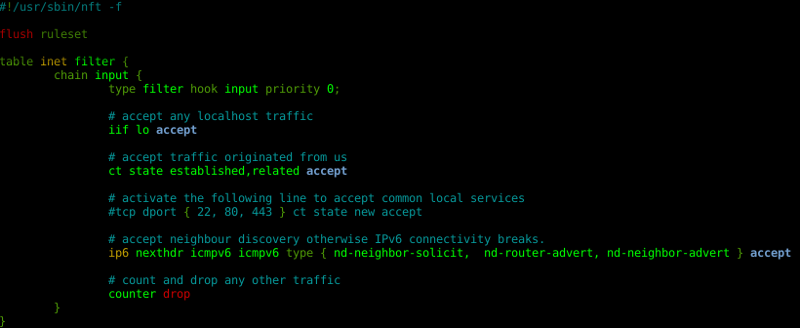
Your nftables ruleset is now firewalling your network:
root@debian:~# nft list ruleset
table inet filter  
        chain input  
                type filter hook input priority 0;
                iif lo accept
                ct state established,related accept
                ip6 nexthdr icmpv6 icmpv6 type   nd-neighbor-solicit,  nd-router-advert, nd-neighbor-advert   accept
                counter drop
         
 
Several examples can be found at /usr/share/doc/nftables/examples/. A simple systemd service is included to load your ruleset at boot time, which is disabled by default. If you are running Debian Jessie and want to give a try, you can use nftables from jessie-backports. If you want to migrate your ruleset from iptables to nftables, good news. There are some tools in place to help in the task of translating from iptables to nftables, but that doesn t belong to this post :-) nft The nano editor includes nft syntax highlighting. What are you waiting for to use nftables?

14 October 2016

Daniel Silverstone: Gitano - Approaching Release - Changes

Continuing on from the previous article, here is a (probably incomplete) list of the critical changes to Gitano which have been, or will be, worked on during the run toward a 1.0 release. Each of these will have a blog posting to discuss what the changes mean for current and future users. Sometimes I'll aggregate postings, sometimes I won't. The following are some highlights from the past little while of development which has been undertaken by Richard and myself. Each item is, I feel, important enough to warrant commentary, even for those who already use Gitano. Any number of smaller things have been done which fall below some arbitrary barrier for telling you about. If you're aware of any of them and feel they are worthwhile telling the world about, then please prod me and I'll add an article to the series. Finally it's worth noting that the effort to get all this into Debian Stretch proceeds apace. Of the eight packages needed, at the time of posting: one was already in and has been updated (luxio), three have been accepted into Debian already (supple, clod, lua-scrypt), two are in NEW (gall and lace), and that leaves the newest library (tongue) and then Gitano itself still to go. The Debian FTP team have been awesome in helping me with all this, so thanks go to them.

13 October 2016

Michal &#268;iha&#345;: Announcing SimpleMath

For quite some time we've been relying on using eval() function in phpMyAdmin in two places. One of them is gettext library, where we have to evaluate plural forms and second of them is MySQL configuration advisor, which does it's suggestions based on text file (the original idea was to make this file shared with other tools, but it never really worked out). Using eval() in PHP is something what is better to avoid, but we were using it on data we ship, so it was considered safe. On the other side, there are hostings which deny using eval() altogether (as many of exploits are using this function), so it's better to avoid that. I've been looking for options for replacing eval() in motranslator (library we use for handling Gettext MO files) for quite some time, but never found library which would support all operators needed in Gettext plural formulas. Yesterday I finally came to conclusion that writing own library to do this is best approach. This way it can in future extended to work with Advisor as well. Also we can make it pretty lightweight without additional dependencies (what was problem in some existing libraries I've found). To make the story short, this is how SimpleMath was born. As of now, it has grown to version 0.2 (you can use Packagist to install it). For now it's really simple and it can be probably confused by various strange inputs, but it seems for work pretty well for our case. Currently supported features: Maybe it will be usable for somebody else as well, but even if not, it's the way for us to get rid of using eval() in our codebase. Update It seems that Symfony ExpressionLanguage Component is doing pretty much same, but more flexible and faster, so SimpleMath will be probably dead soon and we will switch to using Symphony component.

Filed under: Debian English phpMyAdmin 4 comments

9 October 2016

Craig Sanders: Converting to a ZFS rootfs

My main desktop/server machine (running Debian sid) at home has been running XFS on mdadm raid-1 on a pair of SSDs for the last few years. A few days ago, one of the SSDs died. I ve been planning to switch to ZFS as the root filesystem for a while now, so instead of just replacing the failed drive, I took the opportunity to convert it. NOTE: at this point in time, ZFS On Linux does NOT support TRIM for either datasets or zvols on SSD. There s a patch almost ready (TRIM/Discard support from Nexenta #3656), so I m betting on that getting merged before it becomes an issue for me. Here s the procedure I came up with: 1. Buy new disks, shutdown machine, install new disks, reboot. The details of this stage are unimportant, and the only thing to note is that I m switching from mdadm RAID-1 with two SSDs to ZFS with two mirrored pairs (RAID-10) on four SSDs (Crucial MX300 275G at around $100 AUD each, they re hard to resist). Buying four 275G SSDs is slightly more expensive than buying two of the 525G models, but will perform a lot better. When installed in the machine, they ended up as /dev/sdp, /dev/sdq, /dev/sdr, and /dev/sds. I ll be using the symlinks in /dev/disk/by-id/ for the zpool, but for partition and setup, it s easiest to use the /dev/sd? device nodes. 2. Partition the disks identically with gpt partition tables, using gdisk and sgdisk. I need: ZFS On Linux uses partition type bf08 ( Solaris Reserved 1 ) natively, but doesn t seem to care what the partition types are for ZIL and L2ARC. I arbitrarily used bf08 ( Solaris Reserved 2 ) and bf09 ( Solaris Reserved 3 ) for easy identification. I ll set these up later, once I ve got the system booted I don t want to risk breaking my existing zpools by taking away their ZIL and L2ARC (and forgetting to zpool remove them, which I might possibly have done once) if I have to repartition. I used gdisk to interactively set up the partitions:
# gdisk -l /dev/sdp
GPT fdisk (gdisk) version 1.0.1
Partition table scan:
  MBR: protective
  BSD: not present
  APM: not present
  GPT: present
Found valid GPT with protective MBR; using GPT.
Disk /dev/sdp: 537234768 sectors, 256.2 GiB
Logical sector size: 512 bytes
Disk identifier (GUID): 4234FE49-FCF0-48AE-828B-3C52448E8CBD
Partition table holds up to 128 entries
First usable sector is 34, last usable sector is 537234734
Partitions will be aligned on 8-sector boundaries
Total free space is 6 sectors (3.0 KiB)
Number  Start (sector)    End (sector)  Size       Code  Name
   1              40            2047   1004.0 KiB  EF02  BIOS boot partition
   2            2048         2099199   1024.0 MiB  EF00  EFI System
   3         2099200         6293503   2.0 GiB     8300  Linux filesystem
   4         6293504        14682111   4.0 GiB     8200  Linux swap
   5        14682112       455084031   210.0 GiB   BF07  Solaris Reserved 1
   6       455084032       459278335   2.0 GiB     BF08  Solaris Reserved 2
   7       459278336       537234734   37.2 GiB    BF09  Solaris Reserved 3
I then cloned the partition table to the other three SSDs with this little script: clone-partitions.sh
#! /bin/bash
src='sdp'
targets=( 'sdq' 'sdr' 'sds' )
for tgt in "$ targets[@] "; do
  sgdisk --replicate="/dev/$tgt" /dev/"$src"
  sgdisk --randomize-guids "/dev/$tgt"
done
3. Create the mdadm for /boot, the zpool, and and the root filesystem. Most rootfs on ZFS guides that I ve seen say to call the pool rpool, then create a dataset called "$(hostname)-1" and then create a ROOT dataset under that. so on my machine, that would be rpool/ganesh-1/ROOT. Some reverse the order of hostname and the rootfs dataset, for rpool/ROOT/ganesh-1. There might be uses for this naming scheme in other environments but not in mine. And, to me, it looks ugly. So I ll use just $(hostname)/root for the rootfs. i.e. ganesh/root I wrote a script to automate it, figuring I d probably have to do it several times in order to optimise performance. Also, I wanted to document the procedure for future reference, and have scripts that would be trivial to modify for other machines. create.sh
#! /bin/bash
exec &> ./create.log
hn="$(hostname -s)"
base='ata-Crucial_CT275MX300SSD1_'
md='/dev/md0'
md_part=3
md_parts=( $(/bin/ls -1 /dev/disk/by-id/$ base *-part$ md_part ) )
zfs_part=5
# 4 disks, so use the top half and bottom half for the two mirrors.
zmirror1=( $(/bin/ls -1 /dev/disk/by-id/$ base *-part$ zfs_part    head -n 2) )
zmirror2=( $(/bin/ls -1 /dev/disk/by-id/$ base *-part$ zfs_part    tail -n 2) )
# create /boot raid array
mdadm "$md" --create \
    --bitmap=internal \
    --raid-devices=4 \
    --level 1 \
    --metadata=0.90 \
    "$ md_parts[@] "
mkfs.ext4 "$md"
# create zpool
zpool create -o ashift=12 "$hn" \
    mirror "$ zmirror1[@] " \
    mirror "$ zmirror2[@] "
# create zfs rootfs
zfs set compression=on "$hn"
zfs set atime=off "$hn"
zfs create "$hn/root"
zpool set bootfs="$hn/root"
# mount the new /boot under the zfs root
mount "$md" "/$hn/root/boot"
If you want or need other ZFS datasets (e.g. for /home, /var etc) then create them here in this script. Or you can do that later after you ve got the system up and running on ZFS. If you run mysql or postgresql, read the various tuning guides for how to get best performance for databases on ZFS (they both need their own datasets with particular recordsize and other settings). If you download Linux ISOs or anything with bit-torrent, avoid COW fragmentation by setting up a dataset to download into with recordsize=16K and configure your BT client to move the downloads to another directory on completion. I did this after I got my system booted on ZFS. For my db, I stoppped the postgres service, renamed /var/lib/postgresql to /var/lib/p, created the new datasets with:
zfs create -o recordsize=8K -o logbias=throughput -o mountpoint=/var/lib/postgresql \
  -o primarycache=metadata ganesh/postgres
zfs create -o recordsize=128k -o logbias=latency -o mountpoint=/var/lib/postgresql/9.6/main/pg_xlog \
  -o primarycache=metadata ganesh/pg-xlog
followed by rsync and then started postgres again. 4. rsync my current system to it. Logout all user sessions, shut down all services that write to the disk (postfix, postgresql, mysql, apache, asterisk, docker, etc). If you haven t booted into recovery/rescue/single-user mode, then you should be as close to it as possible everything non-esssential should be stopped. I chose not to boot to single-user in case I needed access to the web to look things up while I did all this (this machine is my internet gateway). Then:
hn="$(hostname -s)"
time rsync -avxHAXS -h -h --progress --stats --delete / /boot/ "/$hn/root/"
After the rsync, my 130GB of data from XFS was compressed to 91GB on ZFS with transparent lz4 compression. Run the rsync again if (as I did), you realise you forgot to shut down postfix (causing newly arrived mail to not be on the new setup) or something. You can do a (very quick & dirty) performance test now, by running zpool scrub "$hn". Then run watch zpool status "$hn". As there should be no errorss to correct, you should get scrub speeds approximating the combined sequential read speed of all vdevs in the pool. In my case, I got around 500-600M/s I was kind of expecting closer to 800M/s but that s good enough .the Crucial MX300s aren t the fastest drive available (but they re great for the price), and ZFS is optimised for reliability more than speed. The scrub took about 3 minutes to scan all 91GB. My HDD zpools get around 150 to 250M/s, depending on whether they have mirror or RAID-Z vdevs and on what kind of drives they have. For real benchmarking, use bonnie++ or fio. 5. Prepare the new rootfs for chroot, chroot into it, edit /etc/fstab and /etc/default/grub. This script bind mounts /proc, /sys, /dev, and /dev/pts before chrooting: chroot.sh
#! /bin/sh
hn="$(hostname -s)"
for i in proc sys dev dev/pts ; do
  mount -o bind "/$i" "/$ hn /root/$i"
done
chroot "/$ hn /root"
Change /etc/fstab (on the new zfs root to) have the zfs root and ext4 on raid-1 /boot:
/ganesh/root    /         zfs     defaults                                         0  0
/dev/md0        /boot     ext4    defaults,relatime,nodiratime,errors=remount-ro   0  2
I haven t bothered with setting up the swap at this point. That s trivial and I can do it after I ve got the system rebooted with its new ZFS rootfs (which reminds me, I still haven t done that :). add boot=zfs to the GRUB_CMDLINE_LINUX variable in /etc/default/grub. On my system, that s:
GRUB_CMDLINE_LINUX="iommu=noagp usbhid.quirks=0x1B1C:0x1B20:0x408 boot=zfs"
NOTE: If you end up needing to run rsync again as in step 4. above copy /etc/fstab and /etc/default/grub to the old root filesystem first. I suggest to /etc/fstab.zfs and /etc/default/grub.zfs 6. Install grub Here s where things get a little complicated. Running install-grub on /dev/sd[pqrs] is fine, we created the type ef02 partition for it to install itself into. But running update-grub to generate the new /boot/grub/grub.cfg will fail with an error like this:
/usr/sbin/grub-probe: error: failed to get canonical path of  /dev/ata-Crucial_CT275MX300SSD1_163313AADD8A-part5'.
IMO, that s a bug in grub-probe it should look in /dev/disk/by-id/ if it can t find what it s looking for in /dev/ I fixed that problem with this script: fix-ata-links.sh
#! /bin/sh
cd /dev
ln -s /dev/disk/by-id/ata-Crucial* .
After that, update-grub works fine. NOTE: you will have to add udev rules to create these symlinks, or run this script on every boot otherwise you ll get that error every time you run update-grub in future. 7. Prepare to reboot Unmount proc, sys, dev/pts, dev, the new raid /boot, and the new zfs filesystems. Set the mount point for the new rootfs to / umount-zfs-root.sh
#! /bin/sh
hn="$(hostname -s)"
md="/dev/md0"
for i in dev/pts dev sys proc ; do
  umount "/$ hn /root/$i"
done
umount "$md"
zfs umount "$ hn /root"
zfs umount "$ hn "
zfs set mountpoint=/ "$ hn /root"
zfs set canmount=off "$ hn "
8. Reboot Remember to configure the BIOS to boot from your new disks. The system should boot up with the new rootfs, no rescue disk required as in some other guides the rsync and chroot stuff has already been done. 9. Other notes 10. Useful references Reading these made it much easier to come up with my own method. Highly recommended. Converting to a ZFS rootfs is a post from: Errata

8 October 2016

Joachim Breitner: T430s T460s

Earlier this week, I finally got my new machine that came with my new position at the University of Pennsylvania: A shiny Thinkpad T460s that now replaces my T430s. (Yes, there is a pattern. It continues with T400 and T41p.) I decided to re-install my Debian system from scratch and copy over only the home directory a bit of purification does not hurt. This blog post contains some random notes that might be useful to someone or alternative where I hope someone can tell me how to fix and improve things.

Installation The installation (using debian-installer from a USB drive) went mostly smooth, including LVM on an encrypted partition. Unfortunately, it did not set up grub correctly for the UEFI system to boot, so I had to jump through some hoops (using the grub on the USB drive to manually boot into the installed system, and installing grub-efi from there) until the system actually came up.

High-resolution display This laptop has a 2560 1440 high resolution display. Modern desktop environments like GNOME supposedly handle that quite nicely, but for reasons explained in an earlier post, I do not use a desktop envrionment but have a minimalistic setup based on Xmonad. I managed to get a decent setup now, by turning lots of manual knobs:
  • For the linux console, setting
    FONTFACE="Terminus"
    FONTSIZE="12x24"
    in /etc/default/console-setup yielded good results.
  • For the few GTK-2 applications that I am still running, I set
    gtk-font-name="Sans 16"
    in ~/.gtkrc-2.0. Similarly, for GTK-3 I have
    [Settings]
    gtk-font-name = Sans 16
    in ~/.config/gtk-3.0/settings.ini.
  • Programs like gnome-terminal, Evolution and hexchat refer to the System default document font and System default monospace font . I remember that it was possible to configure these in the GNOME control center, but I could not find any way of configuring these using command line tools, so I resorted to manually setting the font for these. With the help from Alexandre Franke I figured out that the magic incarnation here is:
    gsettings set org.gnome.desktop.interface monospace-font-name 'Monospace 16'
    gsettings set org.gnome.desktop.interface document-font-name 'Serif 16'
    gsettings set org.gnome.desktop.interface font-name 'Sans 16'
  • Firefox seemed to have picked up these settings for the UI, so that was good. To make web pages readable, I set layout.css.devPixelsPerPx to 1.5 in about:config.
  • GVim has set guifont=Monospace\ 16 in ~/.vimrc. The toolbar is tiny, but I hardly use it anyways.
  • Setting the font of Xmonad prompts requires the sytax
    , font = "xft:Sans:size=16"
    Speaking about Xmonad prompts: Check out the XMonad.Prompt.Unicode module that I have been using for years and recently submitted upstream.
  • I launch Chromium (or rather the desktop applications that I use that happen to be Chrome apps) with the parameter --force-device-scale-factor=1.5.
  • Libreoffice seems to be best configured by running xrandr --dpi 194 before hand. This seems also to be read by Firefox, doubling the effect of the font size in the gtk settings, which is annoying. Luckily I do not work with Libreoffice often, so for now I ll just set that manually when needed.
I am not quite satisfied. I have the impression that the 16 point size font, e.g. in Evolution, is not really pretty, so I am happy to take suggestions here. I found the ArchWiki page on HiDPI very useful here.

Trackpoint and Touchpad One reason for me to sticking with Thinkpads is their trackpoint, which I use exclusively. In previous models, I disabled the touchpad in the BIOS, but this did not seem to have an effect here, so I added the following section to /etc/X11/xorg.conf.d/30-touchpad.conf
Section "InputClass"
        Identifier "SynPS/2 Synaptics TouchPad"
        MatchProduct "SynPS/2 Synaptics TouchPad"
        Option "ignore" "on"
EndSection
At one point I left out the MatchProduct line, disabling all input in the X server. Had to boot into recovery mode to fix that. Unfortunately, there is something wrong with the trackpoint and the buttons: When I am moving the trackpoint (and maybe if there is actual load on the machine), mouse button press and release events sometimes get lost. This is quite annoying I try to open a folder in Evolution and accidentially move it. I installed the latest Kernel from Debian experimental (4.8.0-rc8), but it did not help. I filed a bug report against libinput although I am not fully sure that that s the culprit. Update: According to Benjamin Tissoires it is a known firmware bug and the appropriate people are working on a work-around. Until then I am advised to keep my palm of the touchpad. Also, I found the trackpoint too slow. I am not sure if it is simply because of the large resolution of the screen, or because some movement events are also swallowed. For now, I simply changed the speed by writing
SUBSYSTEM=="serio", DRIVERS=="psmouse", ATTRS speed ="120"
to /etc/udev/rules.d/10-trackpoint.rules.

Brightness control The system would not automatically react to pressing Fn-F5 and Fn-F6, which are the keys to adjust the brightness. I am unsure about how and by what software component it should be handled, but the solution that I found was to set
Section "Device"
        Identifier  "card0"
        Driver      "intel"
        Option      "Backlight"  "intel_backlight"
        BusID       "PCI:0:2:0"
EndSection
so that the command line tool xbacklight would work, and then use Xmonad keybinds to perform the action, just as I already do for sound control:
    , ((0, xF86XK_Sleep),       spawn "dbus-send --system --print-reply --dest=org.freedesktop.UPower /org/freedesktop/UPower org.freedesktop.UPower.Suspend")
    , ((0, xF86XK_AudioMute), spawn "ponymix toggle")
    , ((0, 0x1008ffb2  - xF86XK_AudioMicMute - ), spawn "ponymix --source toggle")
    , ((0, xF86XK_AudioRaiseVolume), spawn "ponymix increase 5")
    , ((0, xF86XK_AudioLowerVolume), spawn "ponymix decrease 5")
    , ((shiftMask, xF86XK_AudioRaiseVolume), spawn "ponymix increase 5 --max-volume 200")
    , ((shiftMask, xF86XK_AudioLowerVolume), spawn "ponymix decrease 5")
    , ((0, xF86XK_MonBrightnessUp), spawn "xbacklight +10")
    , ((0, xF86XK_MonBrightnessDown), spawn "xbacklight -10")
The T460s does not actually have a sleep button, that line is a reminiscence from my T430s. I suspend the machine by pressing the power button now, thanks to HandlePowerKey=suspend in /etc/systemd/logind.conf.

Profile Weirdness Something strange happend to my environment variables after the move. It is clearly not hardware related, but I simply cannot explain what has changed: All relevant files in /etc look similar enough. I use ~/.profile to extend the PATH and set some other variables. Previously, these settings were in effect in my whole X session, which is started by lightdm with auto-login, followed by xmonad-session. I could find no better way to fix that than stating . ~/.profile early in my ~/.xmonad/xmonad-session-rc. Very strange.

7 October 2016

Petter Reinholdtsen: Isenkram, Appstream and udev make life as a LEGO builder easier

The Isenkram system provide a practical and easy way to figure out which packages support the hardware in a given machine. The command line tool isenkram-lookup and the tasksel options provide a convenient way to list and install packages relevant for the current hardware during system installation, both user space packages and firmware packages. The GUI background daemon on the other hand provide a pop-up proposing to install packages when a new dongle is inserted while using the computer. For example, if you plug in a smart card reader, the system will ask if you want to install pcscd if that package isn't already installed, and if you plug in a USB video camera the system will ask if you want to install cheese if cheese is currently missing. This already work just fine. But Isenkram depend on a database mapping from hardware IDs to package names. When I started no such database existed in Debian, so I made my own data set and included it with the isenkram package and made isenkram fetch the latest version of this database from git using http. This way the isenkram users would get updated package proposals as soon as I learned more about hardware related packages. The hardware is identified using modalias strings. The modalias design is from the Linux kernel where most hardware descriptors are made available as a strings that can be matched using filename style globbing. It handle USB, PCI, DMI and a lot of other hardware related identifiers. The downside to the Isenkram specific database is that there is no information about relevant distribution / Debian version, making isenkram propose obsolete packages too. But along came AppStream, a cross distribution mechanism to store and collect metadata about software packages. When I heard about the proposal, I contacted the people involved and suggested to add a hardware matching rule using modalias strings in the specification, to be able to use AppStream for mapping hardware to packages. This idea was accepted and AppStream is now a great way for a package to announce the hardware it support in a distribution neutral way. I wrote a recipe on how to add such meta-information in a blog post last December. If you have a hardware related package in Debian, please announce the relevant hardware IDs using AppStream. In Debian, almost all packages that can talk to a LEGO Mindestorms RCX or NXT unit, announce this support using AppStream. The effect is that when you insert such LEGO robot controller into your Debian machine, Isenkram will propose to install the packages needed to get it working. The intention is that this should allow the local user to start programming his robot controller right away without having to guess what packages to use or which permissions to fix. But when I sat down with my son the other day to program our NXT unit using his Debian Stretch computer, I discovered something annoying. The local console user (ie my son) did not get access to the USB device for programming the unit. This used to work, but no longer in Jessie and Stretch. After some investigation and asking around on #debian-devel, I discovered that this was because udev had changed the mechanism used to grant access to local devices. The ConsoleKit mechanism from /lib/udev/rules.d/70-udev-acl.rules no longer applied, because LDAP users no longer was added to the plugdev group during login. Michael Biebl told me that this method was obsolete and the new method used ACLs instead. This was good news, as the plugdev mechanism is a mess when using a remote user directory like LDAP. Using ACLs would make sure a user lost device access when she logged out, even if the user left behind a background process which would retain the plugdev membership with the ConsoleKit setup. Armed with this knowledge I moved on to fix the access problem for the LEGO Mindstorms related packages. The new system uses a udev tag, 'uaccess'. It can either be applied directly for a device, or is applied in /lib/udev/rules.d/70-uaccess.rules for classes of devices. As the LEGO Mindstorms udev rules did not have a class, I decided to add the tag directly in the udev rules files included in the packages. Here is one example. For the nqc C compiler for the RCX, the /lib/udev/rules.d/60-nqc.rules file now look like this:
SUBSYSTEM=="usb", ACTION=="add", ATTR idVendor =="0694", ATTR idProduct =="0001", \
    SYMLINK+="rcx-%k", TAG+="uaccess"
The key part is the 'TAG+="uaccess"' at the end. I suspect all packages using plugdev in their /lib/udev/rules.d/ files should be changed to use this tag (either directly or indirectly via 70-uaccess.rules). Perhaps a lintian check should be created to detect this? I've been unable to find good documentation on the uaccess feature. It is unclear to me if the uaccess tag is an internal implementation detail like the udev-acl tag used by /lib/udev/rules.d/70-udev-acl.rules. If it is, I guess the indirect method is the preferred way. Michael asked for more documentation from the systemd project and I hope it will make this clearer. For now I use the generic classes when they exist and is already handled by 70-uaccess.rules, and add the tag directly if no such class exist. To learn more about the isenkram system, please check out my blog posts tagged isenkram. To help out making life for LEGO constructors in Debian easier, please join us on our IRC channel #debian-lego and join the Debian LEGO team in the Alioth project we created yesterday. A mailing list is not yet created, but we are working on it. :) As usual, if you use Bitcoin and want to show your support of my activities, please send Bitcoin donations to my address 15oWEoG9dUPovwmUL9KWAnYRtNJEkP1u1b.

5 October 2016

Russ Allbery: Review: Uprooted

Review: Uprooted, by Naomi Novik
Publisher: Del Rey
Copyright: 2015
Printing: 2016
ISBN: 0-8041-7904-2
Format: Kindle
Pages: 465
Agnieszka lives in a small peasant village on the border of the Wood. The malevolent forest is the source of dark corruption, illnesses that turn people into ravaging monsters, and lures and traps for the unwary who disappear into the Wood. Or, worse, return and appear the same, and then do horrific things, smiling all the time. This neighboring storehouse of horrors is not what occupies Agnieszka's thoughts at the start of the book, however. Instead, it's the village's protector against the Wood: the Dragon. The Dragon is not a flying lizard; he's a man, a wizard who has lived in his tower for living memory and fights back against the Wood with magic. And, once every ten years, he takes a girl from a village. They go to his tower and serve him for ten years, and then leave, generally to move to some far-away city and never return to their village. Each says afterwards that the Dragon never did anything untoward to them. No one entirely believes them. Agnieszka was born in the year that makes her one of the candidates for being taken by the Dragon. But that's not what she's worried about. She's known for certain since she was a small child that her best friend, Kasia, would be the one taken by the Dragon. Kasia was always the exceptional one: the most beautiful, the most talented, the one who stood out among all the girls in the neighboring villages. And she's about to be taken out of Agnieszka's life, to a mysterious and unknown fate. It will hopefully surprise no fantasy reader (and hence not be much of a spoiler) that awkward Agnieszka, who can't keep her dress unstained for more than five minutes and has none of the skills that Kasia has, is the one the Dragon chooses. I think a warning is important here, since I'm about to recommend this book highly. However, it is very fond of its stereotypes. Most of the other wizards are men, and they focus on books and formal understanding of magic. The one female wizard whose magic we see in some detail is a smith described as wearing male clothing. Uprooted then introduces a different type of magic that's much more intuitive, described largely through natural metaphors, and doesn't play well with formal rules... and is practiced by a woman. This is, unfortunately, persistently gendered, although the book never comes right out and calls it female magic. There are also quite a few traditional gender roles scattered through the rest of the book (although it does get a bit of a pass due to its obvious deep roots in traditional fairy tales). Uprooted is still an excellent book despite this, but it's best read when you're in the mood to tolerate this sort of story. If you go in feeling irritated about gender stereotypes, you'll probably get frustrated by the book, overwhelming its merits. Best saved for a forgiving mood (or skipped entirely if this style of story just doesn't sound fun). The beginning of Uprooted is about Agnieszka finding her feet in her bizarre arrangement with the Dragon, who turns out to be nothing like what either her or the reader expected. I think her panic and confusion drags on a little long, but Novik makes up for that by the delightful descriptions of Agnieszka's eventual understanding and the Dragon's frustrated consternation. Fantasy is full of prickly, arrogant wizards, but few have felt quite so human to me as the Dragon. Agnieszka is clearly nothing like he expected or like he's dealt with before, and his path from arrogant contempt to outrage to prickly confusion to uncomfortable respect is a delight. This is, of course, a coming-of-age story for Agnieszka, and by the end the book deals with both the origins of the Wood and some sort of resolution. But the path there wanders through an exploration of a rather interesting magic system, quite a lot of court intrigue, and Agnieszka persistently defying everyone's expectations. As with the introductory panic and confusion, I could have done with less of her awkward bumbling at court (in general, I think the book could have been a bit tighter), but once I reached the second half of the book I couldn't put it down. I've previously read a fair chunk of Novik's Temeraire series, which were fun (at least in spots), but Uprooted is definitely better. There is a fair bit of horror-tinged stuff in this book, as well as the stereotypes mentioned above, so it won't be for everyone. But I usually hate horror of any kind, and I still loved this. Agnieszka is sufficiently positive and solution-focused that the story never falls into the constant fear and panic and disgust that I particularly dislike in horror. If you're in the mood for a good fantasy coming-of-age story coupled with delightful disruption of the life of a prickly, cynical, but surprisingly ethical wizard, give this one a try. Rating: 8 out of 10

3 October 2016

Markus Koschany: My Free Software Activities in September 2016

Welcome to gambaru.de. Here is my monthly report that covers what I have been doing for Debian. If you re interested in Android, Java, Games and LTS topics, this might be interesting for you. Debian Android Debian Games Debian Java Debian LTS This was my eight month as a paid contributor and I have been paid to work 12,25 hours on Debian LTS, a project started by Rapha l Hertzog. In that time I did the following: Non-maintainer uploads Misc

2 October 2016

Russ Allbery: Review: Winds of Change

Review: Winds of Change, by Mercedes Lackey
Series: Mage Winds #2
Publisher: DAW
Copyright: August 1993
ISBN: 0-88677-563-9
Format: Mass market
Pages: 475
Winds of Change is a direct sequel to Winds of Fate. This is a more closely connected trilogy than the previous Valdemar books. It's not the sort of thing you want to read out of order. The events of Winds of Fate predictably left the multiple protagonists united and with some breathing space, but none of their problems are resolved. The Heartstone is still a mess; in fact, it may be getting worse. Elspeth needs to learn how to wield the magical power she apparently has. And there are a lot of interpersonal tensions, lingering hurt feelings, and (in the case of Elspeth and Darkwind) a truly prodigious quantity of whining that has to be worked through before the protagonists can feel safe and happy. Winds of Change is the training montage book, and wow did my memory paper over a lot of flaws in this series. This is 475 pages of not much happening, occasionally in very irritating ways. Yes, we do finally meander to a stronger conclusion than the last book, and there is much resolving of old hurts and awkward interactions, as well as a bit of discovery of true love (this is Lackey, after all). But far, far too much of the book is Elspeth and Darkwind sniping at each other, being immature, not communicating, and otherwise being obnoxious while all the people around them try to gently help. Lackey's main characterization flaw for me is that she tends to default into generating characters who badly need to be smacked upside the head, and then does so in ways and for things at odd angles to the reasons why I think they should be smacked. It can make for frustrating reading. The introduction of Firesong as a character about halfway through this book does not help. Firesong is a flamboyant, amazingly egotistical, and stunningly arrogant show-off who also happens to be a magical super-genius and hence has "earned" his arrogance. This is an intentional character design, not my idiosyncratic reaction to the character, since every other character in the book finds him insufferable as well at first. But he's also a deeply insightful healing Adept by, honestly, authorial fiat, so by the end of the novel he's helped patch up everyone's problems and the other characters have accepted his presentation as a character quirk. Sigh. So, okay, one doesn't read popcorn fantasy for its deep characterization or realistic grasp of human subtlety. But this is just way more than I can swallow. Lackey's concept of a healing Adept (which I like a great deal as a bit of world-building) necessarily involves both deep knowledge and deep empathy and connection with other people. Firesong is so utterly full of himself that there's simply no way that he could have the empathy required to do what he is shown to do here. (Lackey does try to explain this away in the book, but the explanation didn't work for me.) Every time he successfully intervenes in other people's emotional lives, he does so with a sudden personality change, some stunning insight that he previously showed no evidence of ability to understand, and somehow only enough arrogance in his presentation to prickle but not to close people's mind to whatever he's trying to say. That's not how this works. That's not how any of this works. Lackey always treats psychology as a bit of a blunt instrument, and one either learns to tolerate that or gives up on her series, but Firesong is flatly the most unbelievable emotional mentor figure in any of her books I've read. (One of the more satisfying, if slight, bits of this series comes up in the next book, where Firesong runs into someone else who can do the same thing but has actually earned the empathy the hard way, and is a bit taken aback by it.) My other complaint with this book is that Lackey adds more chapters from the viewpoint of the big bad of the series. These are deeply unpleasant, since he's a deeply unpleasant person, and seem largely unnecessary. It's vaguely interesting to follow the magical maneuverings from both sides, but there are more of these scenes than strictly necessary for that purpose, and the sheer unmitigated evil of Lackey's evil characters is a bit hard to take. Also, he somehow has vast resources of staff and assistants, and much suspension of disbelief is required to believe that anyone would continue working for this person. It's one thing to imagine people being drawn to a charismatic Hitler type; it's quite another when the boss is a brooding, imperious asshole who roams the hallways and tortures random people to death whenever he's bored. Fear and magic only go so far in maintaining a large following when you do that, and he generates dead bodies at a remarkable rate. The best characters in this series continue to be Nyara, Need, and the gryphons. I'd rather read a book just about them. Need does use a bit too much of Lackey's tough love technique (another recurring theme of this larger series), but from Need that's wholly believable; her gruff and dubious empathy is in line with her character and history and fits a talking sword extremely well. But they, despite having a bit of their own training montage, are a side story here. The climax of the story is moderately satisfying, but the book takes far too long to get to it. I remember liking this series when I first read it, and I still like some aspects of Lackey's world-building and a few of the characters, but it's much weaker than I had remembered. I can't really recommend it. Followed by Winds of Fury. Rating: 5 out of 10

Next.

Previous.