Search Results: "pini"

24 February 2009

Matt Brown: The government listened!

I was very pleased to wake up this morning to the news that National has delayed the introduction of S92A via an order-in-council. It s a nice short-term victory, but I ll save the champagne until the law is fundamentally rewritten. The most pleasing aspect of the decision is simply that it was made at all. Within two weeks, a small band of protesters were able to harness the power of the Internet to direct international attention and place enough pressure on a Government, whose Prime Minister admitted to not having read the bill prior, that he then took the time to understand the issues and personally announce the delay in implementation of the law. We owe much thanks to the Creative Freedom Foundation for all the effort they put into co-ordinating the protest and ensuring that a single coherent message was presented. Just a little bit of my cynicism and belief that politicians never listen to public opinion outside of election campaigns was chipped away today. The reason I m not breaking out the champagne yet is that we ve only achieved a temporary reprieve in the commencement of the law. While those present at the press conference seem somewhat confident that John Key didn t like what he found in the law and would have repealed it if given the chance, all that has actually been done is delay it in the hopes of an agreement between the TCF and the rights holders (aka big media companies) on how to implement the still fundamentally broken law. The Government has given until late March for that to occur. To put this into a more global context. My happiness as I took the bus to work after reading about the decision to delay the law was short lived as the front page of the local paper declared that Eircom (Ireland s equivalent of Telecom) has voluntarily agreed to block sites such as The Pirate Bay upon request by the media companies (this comes a week after they also announced an agreement to, again voluntarily , implement a 3-strikes S92A style policy). Now, with the biggest ISP in their pocket (so to speak), the media companies have sent threatening letters to the remaining ISPs in the country demanding they implement the same procedure. To me, this illustrates one of the fundamental problems with S92. The concept that an ISP is liable for the conduct of its users, or for policing where on the Internet users should and shouldn t be able to connect to does not belong in our laws. Most ISPs already have provision to disconnect customers for illegal activity in their terms and conditions. If an end-user is doing something illegal, that is an issue between the rights holder and the end-user to take up in the courts just like every other sector of society must do when wronged, at which point the existing ISP terms and conditions can be invoked and access terminated. The big media companies, having decided that it is too expensive/hard/inconvenient to follow standard legal procedures to resolve their grievances are launching multi-pronged attacks to shift the playing field in their favour. In countries like New Zealand, where our politicians yearn for a Free Trade Agreement with America, they use their lobbyists to ensure that S92 style laws are part of the conditions. In other jurisdictions, like Ireland, they use strong-arm, divide and conquer style bully tactics outside of the political and legal process. I don t support copyright infringement. I rely on copyright to protect much of the work I place on the Internet, I want strong laws that protect me when my rights have been infringed. I don t believe that such laws should come at the expense of due process, our legal tradition and the basic principle of fairness! I don t believe that copyright infringement is such a heinous crime that it demands punishments stronger than those we deliver to paedophiles, stalkers or any other class of criminal who uses the Internet to enable their crimes. To me, today s (yesterday s - depending on your timezone) decision is only the first step in clawing New Zealand back from the dangerous path that the big media companies have been leading our law makers down. From here we need to press on and demonstrate to the Government over the next month that even if the TCF and rights holders are able to come up with some sort of workable code of practice, the law is still fundamentally flawed. It is based on premise that we are guilty by accusation. Even if guilt were to be proved by a competent legal body (eg. court or copyright tribunal) we don t need laws placing further liabilites onto ISPs (and remember the definition of ISP under this amendment act includes businesses who provide Internet access to staff, libraries, schools and hospitals) when their existing terms and conditions already prohibit illegal activity. Finally, and most importantly of all, we need to remember that laws exist to serve all sectors of society. Yes, copyright infringement is against the law and rights holders are reasonable in expecting the law to protect their content and allow them to make a fair profit. On the other side of the fence, average New Zealanders are not being unreasonable in their desire to have media available electronically, on demand and non-inhibited by DRM following a legal purchase. The failure of the media businesses to adequately cater to this change in market demand and usage of technology is obviously a contributing factor to the widespread copyright problems that they are facing today. Obviously, I m not condoning copyright infringement simply because the media companies are failing to address demand. Even stupid laws must be obeyed (and the concept of copyright is far from stupid). What I want to see is the Government acknowledging that the problem is not solely with consumers infringing copyright for malicious purposes, and therefore that the solutions do not lie solely in increasing the enforcement and punishments available. Copyright has always been a balancing act between the rights of content producers and consumers. S92 and the act it is contained within are taking us far too far down the road of catering to big business and their outdated business models with far too little concern for the rights of the individual consumer. Despite the many submissions made on this act last year when it was first passing through parliament, there was no comprehensive debate on what copyright means and how it should balance the rights of content producers and consumers in our digital century where copying is a zero-cost, zero-thought activity. Without such a debate we re doomed to continue wasting time arguing over the symptoms of the problem, like S92. So, I m saving my champagne for the day when we as a country address these issues and come up with a fair and workable interpretation of what copyright means today.

Bernd Zeimetz: why you should use gpsd over gypsy

While working on the Debian packages of navit I stumbled upon gypsy, as the libgypsy is used by navit to listen to notifications about location changes via D-Bus. As maintainer of the gpsd package I started to wonder what the opinion of the gpsd developers about gypsy is - especially after reading that "Gypsy was designed to fix the numerous design flaws found in GPSD". Well, here is their answer, which I support fully. I'm blogging about it as I think it is important to know about this details if you plan to do something useful with a gps device, for example on mobile phones like the OpenMoko Freerunner. gpsd works very well on embedded devices, and if there's a feature missing just contact the developers. They're very responsive and like to implement useful features, if they can get a spec to do so (and even better, the hardware to test it). So I'm really wondering if it wouldn't make sense to replace the minimal NMEA/UBX implementation in the FSO Framework Daemon by gpsd, even if that means to compile code instead of writing Python code, which is much faster for rapid prototyping, of course.

19 February 2009

Andrew Pollock: [opinion] Oh the irony

The website for Tourism Queensland's extremely popular promotion to find someone to be paid $150,000 to be an island caretaker for 6 months is hosted by a Canberra company on a server in Canberra. So much for supporting local business. (Small world, one of the Executive Directors was briefly my manager at CyberTrust, but that's the Canberra IT scene for you)

14 February 2009

Wouter Verhelst: Debian @ FOSDEM 2009: Postmortem

Well, no, neither FOSDEM nor Debian are dead. But FOSDEM '09 is gone, over, and dealt with. It was a breeze, for the most part. I'm still not very happy with the booth; that needs to be done better next year. Help and suggestions in that area are more than welcome. One thing that more than deserves a follow-up is Lucas' post about FOSDEM:
On a more sad note, the worst talk of the week-end was without any possible doubt Frans Pop's release team bashing. Nobody is claiming that the release management of the lenny release cycle was perfect: there's always room for improvement. But given the context and the constraints, I think that they did a very good job. Frans' talk boiled down to: "The release team doesn't know what they are doing, I would have done much better because I'm so qualified."
As the person responsible for allowing Frans on the schedule in the first place, while being fully aware of the relationship between Frans and the release team (not at first, but certainly in time to kick him off if I'd have wanted to), I'd like to comment on that. First of all, I do not agree that the last statement in the above is true. Frans showed a few stories of things that went on in the release team, and gave his opinion on what he believed went wrong. He also explicitly said, at the beginning of the talk, that none of the talk was meant personally; that he wanted to offer some constructive criticism instead. I believe he did not fail in doing that, but of course YMMV. Secondly, and more importantly, I do not believe it is healthy for Debian (or any project, for that matter) to reject criticism. Indeed, nobody is claiming perfection. I do not believe any venue where talks can be had should be a good news show. People in a position of power not just the release team, but also, say, the DPL, ftp-masters, buildd maintainers and whatnot have received our trust to do what they need to do to the best of their abilities. If someone in the project would believe that I can significantly improve my work as buildd maintainer, it is not just their right, but indeed their duty to inform me of that fact. This is exactly what Frans was attempting to do, and there is nothing wrong with that. It is also not as if he's not tried reasoning with the release team first. He has made suggestions, which have gotten ignored. I feel that talking to more people about what he feels is right, to see whether they agree with him, is the next logical step to take, and that this it is exactly what Frans was attempting to do at FOSDEM. Having said that, I agree that finishing the talk late was a very bad thing. If anything, a talk on a subject like this should have more, not less, time for discussion. So while I do not agree that his intentions were wrong, I do agree that the execution could have been better. There, that was criticism too. Now, what's next? Oh yes, suggestions. If people have suggestions on how to improve the Debian presence at FOSDEM next year (especially, as above, ideas for creative use of the booth would be welcome), then please send me an email, making sure the subject contains the word 'FOSDEM', so my mailfilters know what to do with it. You'll preferably do so now, while FOSDEM is still somewhat fresh in your memory; I'll take notes and use those for doing better next year. Thanks,

11 February 2009

MJ Ray: SPI February 2009

The monthly board meeting of SPI will take place on irc.oftc.net #spi tonight (Wed 11 Feb) at 20:00 UTC. Members may have seen that the meeting announcement came out on time - hooray! It looks like minutes may also catch up to last meeting, too. There are two new associated project currently under discussion: the Helios Initiative and OpenWRT. I think both of them had been waiting for a legal opinion. I may still be travelling and without a stable network connection during the meeting, or I might have made it home by then. Either way, watch the comments below this article for a link to the summary when posted.

9 February 2009

Lucas Nussbaum: Ultimate Debian Database talk at FOSDEM

Of course, I was in Brussels this week-end, for FOSDEM. I gave a talk about Ultimate Debian Database (slides here) in the Debian devroom. The conclusion was UDD is ready, go play with it! so you know what you should do now! FOSDEM in general was great and huge (see the video from Quim Gil if you still doubt that) as usual. On a more sad note, the worst talk of the week-end was without any possible doubt Frans Pop s release team bashing. Nobody is claiming that the release management of the lenny release cycle was perfect: there s always room for improvement. But given the context and the constraints, I think that they did a very good job. Frans talk boiled down to: The release team doesn t know what they are doing, I would have done much better because I m so qualified. Giving such talks at FOSDEM, in front of an audience with many people not involved in Debian development, is really insulting. To make things worse, he finished the talk late, not leaving any time for questions/discussion, so the audience might be left with the impression that his opinions are representative of the opinions of DDs.

3 February 2009

Aigars Mahinovs: Superbowl 2009

It has become a hidden tradition for me to watch Superbowl every year, despite disappointment in the game and coverage quality in the years before. It started as before: pre-game show, pre-pre-game show, coin toss show and kick-off show It is clear that the show is planned by and for advertisers and not for the viewers. That is a shame and a disgrace - the viewer must be the master of the TV programming and NOT the advertisers. In soccer the program starts, you see the captains exchange a handshake, you see the referee throw a coin and 10-15 seconds later the game is going full steam. Why do you need 3 ad breaks and 2 songs before the game is beyond me - get to the game! The camera work and NBC commentary is MUCH better than last year - stable shots with good close-ups and explanations that actually make sense even to people that are not American football experts. Oh and they actually use units - saying they won x out of y games this season and not they are x in y this season , mostly at least. The game had more fun than usual in the beginning, but the legal things slow it up again - it is weird that a guy got over the line but was called beck because of the knee touching and then a penalty for a false start ? Too much rules and regulations. Soon you ll have a team of lawyers on the sidelines and lawyer drafts will be more important than player drafts. And then again holding and chopping - isn t that what the blockers are supposed to do? Is that some kind of sissy sport? Maybe not. 100 yard interception return run I am speechless. Now that was a great, great play. That episode alone made watchig this thing worth it. Not the best sport thing I ve seen, but the best American football moment for sure. I like the basis of the game, it is a good game, but there is way too much fluff on it. That game needs to be cut down - less rules, less breaks, less interruption, less advertisements, less time to think and relax for the players. 10 seconds of play and 5 minutes of players chatting is not a sport, even curling has more action. The whole Superbowl should be over in 1 hour real time. If the TV transmission starts at 17:00, it should be done before 18:00. There is no content there to justify anything longer than that. Why is there a limited number of challenges? Do the referees make only a limited number of mistakes per game? No. Illogical. And when I though it was done and sealed, Arizona does a great drive and get a great touchdown. One more drive like that and the game could go either way. Now that is a good game. But again penalties spoil the whole game Fitsgerald gets a touchdown, another great play to turn the game around, but only because of the holding penalty giving Arizona safety score. Not deserving in my opinion. And the Steelers drive back AMAZING game! Now this is actually close to the best sports game that I have ever seen. I sure was not expecting that. And Arizona tries to drive back again. I was sleepy when I started to watch this, no sleep now. That was a great game. Despite all the commercialization, it is still a great game and it is very watchable if you download it from the Internet or watch it with TiVo and can skip the adds and the slow parts.

1 February 2009

Obey Arthur Liu: Debian Summer of Code 08 : Where are they now (part 2.5/3)

I ve so far been going through the list of projects that were done last year (part 1, part 2) in a somewhat dry fashion so I m going to make a little pause here and tell where I m going from with these posts. As I went through the 2008 Summer of Code at Debian, I moved from being a nearly total outsider student to something more of a developer. I ve been contributing to Aptitude since the end of the Summer of Code (well, trying to find time to contribute more, as with many people..) and will be going to FOSDEM. I can t say I m an insider yet: I haven t met a lot of people, most people have no idea who I am, I ve been active here for, like 9 months and I m not even in new-maintainer yet (though I plan to apply when I feel I ll have contributed significantly to Debian). The Student point of view See, I m a student in Computer Science. I use free software, I d like to participate but it s intimidating and you never know where to start. You know the drill. Then comes the Google Summer of Code. Let s review its stated goals, as per its FAQ:
Google Summer of Code has several goals:
  • Get more open source code created and released for the benefit of all;
  • Inspire young developers to begin participating in open source development;
  • Help open source projects identify and bring in new developers and committers;
  • Provide students in Computer Science and related fields the opportunity to do work related to their academic pursuits (think flip bits, not burgers );
  • Give students more exposure to real-world software development scenarios (e.g., distributed development, software licensing questions, mailing-list etiquette).
I m going to start with these goals and provide some of my opinions in something of a candid way. Inspire young developers to begin participating in open source development I have been playing with the idea of making a GUI for Aptitude ever since I dropped Synaptic, about 2 months into its use. It felt like when I bought a high-school required Texas Instruments TI-83+, that I dropped for a TI-89 within a month. Since back in 2005, every time I would see someone using Synaptic, I would pitch Aptitude as a better tool. The main reason for not doing so was that Aptitude was scary-looking. See, it s a lot of blocky text and wacky colors. With life and cool stuff like CPGE, I never had time to really code so I left it at that. In 2008, for the first time I was free the whole summer and so, I tried to get into the Summer of Code program and into Debian. Actually, it wasn t the first try. One popular way to get acquainted with Debian is to go to wnpp, adopt a package (new or orphaned) and find a mentor to upload it. In January 2008, I did try to package a set of geocaching tools I used at that time. But I didn t find a mentor to upload it. I didn t try very hard though and the package had some minor issues anyway. I reckon that Debian-mentor is a good idea to bring in new Debian Maintainers but the whole process is still quite technical. It is true that the minimal technical level for good packaging is not trivial in itself and the process should filter out unserious people, but the technicality curve could be adjusted to be more welcoming. I think the Debian website could be improved in this area (ok, it s a quite long-standing bug). Holger Levsen mentioned the way Fedora and Sugar presented avenues of collaboration to prospective developers. The crux here is that it should feel much easier to identify areas to get involved into and who to contact if needed. Help open source projects identify and bring in new developers and committers Actually, it would rather be the other way around: help students identify and integrate into open source projects. For the Summer of Code, I only postulated at two organizations, Debian and Freenet (the ones working on an anonymous darknet, remember ?). I got accepted at both and ultimately chose Debian (was my first choice from the beginning). The Debian developers community is quite unique in the way it is very decentralized, independent and fluid. There are teams in some areas (Kernel, KDE, Translation, Edu, Publicity, whatever) but much of what makes up Debian is done by individual developers working on their own. The downside of this is that for a newcomer, it s a little off-putting. Organized teams are not the way all things are done within Debian so there are often no smaller circle of people one gets to know. Going to Debian meetings and not knowing most of the people is a little intimidating. Keeping up with all the faces is a little hard too :). Many other organizations participated into the Summer of Code and many would feel arguably different. Many may be more corporate-like, more hierarchical, more centralized. I preferred Debian because it was less formal in its structure. I felt that I didn t want to get into something that looked too much like work with supervisors and the like. It is indeed how it felt, there were no one up there to decide what we had to do. We were quite independent. I can say that the Summer of Code is quite a good way to get a feeling of how a particular organization works in the inside. Give students more exposure to real-world software development scenarios As said earlier, many parts of Debian are independent, which is a result of the work separation through packages. In my work on Aptitude, it is a pity that I didn t have to interact a lot with other members of the Debian community. Aptitude talks with the rest of the Debian packaging ecosystem through mature library interfaces so there s not much need to ask questions beyond them, and even more so because my Daniel Burrows, my mentor and developer of Aptitude participated in their development. Also, I was working on bringing a graphical interface to it, so I didn t have to modify a lot of core code that interacted with the outside world. Despite this, I still met a few people interested with future developments in the area of package managers. One example is Enrico Zini who pushed his work with Xapian APT Index. Over the summer, my mentor integrated packages search through Xapian which was interesting with the expanded possibilities of a graphical interface such as search as you type, drop down suggestions and so on. Because of the short duration of the Summer of Code, most projects can t complete a full development cycle. The proposed work in my proposal was quite imposing. In the end, I managed to produce an (probably not even) alpha quality version of a graphical interface. My branch (if I remember correctly) was merged into the main trunk at the end of the summer and a version landed in Experimental at the end of the year. One aspect that I missed was beta-testing feedback. During summer, only a handful people popped up on the mailing-list giving feedback on the GUI I was writing, although I knew through stats on my mercurial repository that dozens of people cloned it and followed it. Debian has no testing team , or any kind of semi-organized group of people who try stuff, which would be very useful to have an idea of how well I was doing. So, did the Summer of Code at Debian give me real-world software development scenarios ? Not really in my case but by staying longer into Debian, I think caught up a little with that. Here is some advice for the future Summer of Code student at Debian: To conclude, despite all the difficulties, I would say that the Summer of Code at Debian was awesome. Although Debian is quite different from many other organizations, it was a very fruitful experience. And that s why I m still here. Coming next is the rest of the projects reviews and a more concise and substantive list of recommendations for the handling of the next Summer of Code at Debian. And of course, see you at FOSDEM.

28 January 2009

Obey Arthur Liu: Debian Summer of Code 08 : Where are they now (part 2/3)

Here s for the second installment of my review of this past year s Summer of Code at Debian. See the previous part here: Debian Summer of Code 08 : Where are they now (part 1/3). I apologize for being so late at getting this second part out but I have been very busy. Still, I ll get the last part out before FOSDEM. Those of you who ever had to write a Java compiler (ok, Java subset, but the OOP part was here ) in brainfucking Ada will understand what I went through working on two of my most loathed languages. Debian NAS, improve support of Debian on NAS devices Presentation There is a large range of inexpensive Network storage devices available on the market. For some of them, such as Linksys NSLU-2 and Thecus N2100, we have added support, but there is many many more devices we could support. For this summer we look forward at supporting multiple Marvell Orion based devices (as outlined in Martin Michlmayr s talk Running Debian on Inexpensive Network Storage Devices), such as Revogear Kuro Box Pro, Buffalo Linkstation, QNAP TS-109+, If you don t have old computers lying around to turn into NAS servers, you need to sleep at night without the soothing sound of computer fans or if you actually pay your own electricity bill, you might want to have a look at standalone NAS devices. They re cheap and can be made vastly more capable by slapping a Debian on it. If you ever heard of DD-WRT, you know the spirit. The project was mentored by Riku Voipio, with help from Martin Michlmayr. The project proposal (sorry, Google cache) was introduced by Martin, who did a presentation about it the previous year at FOSDEM. Student Per Andersson was a 24 year old student working towards a MSc in computer science at Chalmers University of Technology in Sweden. He had been looking for ways to join Debian but with school still being priority one, he didn t find time to dive in. Result This project was successful. The Kurobox Pro is now supported and several useful tools were packaged to make life easier with these NAS devices. Martin Michlmayer is still working on Debian NAS related stuff. Per was happy to be invited to the Emdebian work session in Extremadura and has been active within debian, maintaining the packages he created during the Summer of Code. Cran2deb, generate Debian packages from R packages Presentation GNU R has become the preeminent platform for computing with data . The CRAN archives contain over 1300 source packages of very high-quality, and BioConductor has again almost as many focuses on bioinformatics. We want more of these in Debian, and going beyond the 50+ packages we currently have suggests more scripting and automation. R is a pretty big among statisticians and all of them they wasted no time writing their own package to work on particular research subject. It s a lot like Perl with CPAN or LaTeX with CTAN. It s always a pain to discovery that a particular R package is not wihtin Debian and having to resort to unmanaged installation of said packages. The project was mentored by Dirk Eddelbuetel. The project proposal (which is nowhere to be found but seemed to be good) was introduced by Dirk, along with another proposal he did for R. Student Charles Blundell is a research student at.. hum.. didn t do my homework about that. Anyway, you can find him around R related projects. Result This project was successful. Cran2deb is happilly turning more than 1400 of the ~1500 CRAN R packages, all with correct dependencies. The work has since been moved to R-Forge. It s working, we re almost there. We just need it to be polished and we ll get a whole bunch of new packages into Debian. Charles pinged me about the status of Cran2Deb after the previous post. He admits that he hasn t done much about cran2deb recently because of his new position as a research student but hopes to commit again to it soon. I do encourage him to get these R packages into Debian. I had to manually install some packages myself when I had to use R for school because they weren t into Debian and it s not pretty. Mergemaster, interactively merge changes in configuration files Presentation FreeBSD has a shellscript called mergemaster which is used to interactively merge changes in configuration files, based on 3-way diffs. Debian s approach to configuration file differences is much more primitive: either keep the original file, or blow it away (including all local changes) and use the Debian-provided file. It would be nice to get a system such as mergemaster into Debian. Important is to remember that Debian contains two often-used configuration file management systems: ucf, and conffiles; porting mergemaster in such a way that it will be used in both cases would be great. The handling of configuration files during upgrades has always been a little.. brutal, with the user being asked at gunpoint to make a good decision, lest the upgrade won t continue or configuration files get borked (ever tried automerging nagios configuration files?). Having a less stressful upgrade experience is a good thing since the point of Debian is to make package management a stressless thing. The project was mentored by, hum, Manoj Srivastava. I have no idea who came up at first with the proposal. UPDATE: Wouter Verhelst mailed to say that he made the original proposal. Student Max Wiehle was a physics student at the University of Heidelberg. He did a Summer of Code stint (Archive.org copy..) as a student for Beagle Project in 2006 which, I suppose, was successful. He s been active in the past with Gnome and desktop related projects. Result This project was somewhat successful. He posted an update one month into the program with repositories with code to test. Last commit to the mergecf branch of project was September 19th but it was never merged in. According to Steve McIntyre, it s dead, Jim. I couldn t find any further public involvement of Max within Debian. PAS NSS Debian Installer, improve support of PAM and NSS at install-time Presentation It would be very important for the Debian allowing the user to configure additional PAM and NSS modules (eg. LDAP, NIS) during the installation process inside the Debian Installer. To do this, we have to provide tools and helpers to modify /etc/nsswitch.conf and /etc/pam.d/common-*, as well as changing the maintainer scripts for the packages libpam-* and libnss-* to apply the required changes at install time using debconf and these helpers. To be honest, I will probably never use this. I don t do that many coordinated installs in the same place to warrant doing funny authentication with PAM and NSS, and if I did, I would probably use a more elaborate tool to personalize the install, like FAI. On the other hand, I can see the appeal of being done with authentication mechanisms before the first boot. The project was mentored by Fabio Tranchitella. The proposal came from the student. Student Juan Luis Belmonte was a computer science student. He worked in a couple of companies in the area of Sarragossa. He is now founding debug_mode=ON. Result This was quite a disappointement after seemingly good work. Although Juan was satisfied with the project, the PAM package maintainer (Steve Vorlon Langasek) was not. He was never asked about this project (but didn t intervene timely either when the accepted projects were announced though). In his words, it was the wrong solution to the problem . You can find his lenghty rationale on the wontfix bug report that resulted from the project. It really was a problem of communication with the Debian developpers since Juan could certainly have done the right work if pointed to it. Juan didn t ask thoroughly for existing work and Steve didn t publicize his (enough). That s all for now. The information is quite fragmented I admit. Most of it was pulled from Google, mailing lists, commit logs, blogs, whatever. If some projects are lacking in information here, it s because I couldn t find it readily (which is an issue in itself!). In my next post, I ll try to give a student point of view of the Summer of Code in general, and more specifically, at Debian. It will be post 2.5/3 since it s getting a little longer than I planned. Release early, release often, as the say.
If you re a student or a mentor mentioned above, feel free to fill any of the blanks in my report. It s much appreciated. You re not a student or mentor mentioned above and have an opinion on how to improve the next Debian Summer of Code ? Feel free to comment.

Wouter Verhelst: FOSDEM and Novell

Sigh. I'm not part of the FOSDEM organisation team, and this is by choice. I know that I wouldn't find the time to help organize a conference of the scale of FOSDEM, since I'm rather liable to forget to do important things at times. Having said that, I happen to run a company together with Philip Paeps, who is now one of the main FOSDEM organizers; apart from that, I've also managed the Debian presence there for the past few years (lost count how many exactly), and arranged the key signing party for a few years with Joost Van Baal taking over for me starting this year. As such, I'd like to believe that although I'm not exactly in to all their secrets, I do have a front-row seat when it comes to how things are going there. FOSDEM is the "Free and Open Source Developers' European Meeting". It has been that since 2001, and will always remain so. Yes, originally it was called "OSDEM", because frankly, the organisation of the original OSDEM was done by a group of people who like Open Source, without necessarily subscribing to the Free Software ideals. The core group of the organisation is a rather diverse group; for instance, Philip has been known to be rather... negative... about Ubuntu, while Mark (one of the press contacts) has done some activism and translation work for Ubuntu. The change of name from OSDEM to FOSDEM was done not because the organisation's ideas about software were changed overnight by a mail from Richard Stallman or anyone else from the FSF; but rather, because they were open-minded enough to understand that having a name which only says 'Open Source' would be excluding a considerable part of the community that encompasses both Free and Open Source people. This is why the name wasn't changed in FSDEM; it is FOSDEM. I'm quite sure that the fact that FOSDEM is so open-minded about many of the controversial issues that have separated our community over the years not just Open Source vs Free Software, but so many other things as well is one of the main reasons why FOSDEM is so popular today: because everyone, and I truly mean everyone, will find something that he or she likes. That is why I'm so saddened that some people seem to find it necessary to not only whine, but also boycott a conference, because they believe that FOSDEM should not take money from a big Free Software/Open Source contributor, just because they also happen to be a company, and as such make business deals with Microsoft. Note that I'm not either defending or condemning Novell's attitude here; but it is a fact that not everyone in the larger Free and Open Source community feels the same way about the whole Novell/Microsoft deal (else there wouldn't be an openSUSE anymore), and as such they still deserve a place on FOSDEM. Over the history of the organisation of FOSDEM, it's always been a place where everyone could get their opinion out; whether it be the opinion that "Free Software Must Rule The World", or that "It's All About The Way You Do Things"; as long as your opinion is shared by a large enough number of people in the larger FLOSS community, it is welcome. I feel that blocking one organization from sponsoring the event, just because they have made some deals which a significant group of people, one which nevertheless does not encompass the whole of the FLOSS community, disapprove of, would set a dangerous precendent that might jeopardize the very core of what makes FOSDEM so great: its impartiality. Thank god that didn't happen.

25 January 2009

John Goerzen: Review: The Economist

A few months ago, I asked for suggestions for magazines to subscribe to. I got a lot of helpful suggestions, and subscribed to three: The New Yorker, The Atlantic, and The Economist. Today, I m reviewing the only one of the three that I m disappointed in, and it s The Economist. This comes as something of a surprise, because so many people (with the exception of Bryan O Sullivan) recommended it. Let s start with a quote from the issue that found its way to my mailbox this week:
A crowd of 2m or more is making its way to Washington, DC, to witness the inauguration of Mr Obama. Billions more will watch it on television. [link]
Every issue, I see this sort of thing all over. An estimate, or an opinion, presented as unquestioned fact, sometimes pretty clearly wrong or misleading. For weeks before Jan. 20, and even the day before, the widely-reported word from officials was that they had no idea what to expect, but if they had to guess, they d say that attendance would be between 1-2 million. In the end, the best estimates have placed attendance at 1.8 million. Would it have killed them to state that most estimates were more conservative, and to cite the source of their particular estimate? That s all I want, really, when they do things like this. I knew going into it that the magazine (to American eyes) essentially editorializes throughout, and I don t have a problem with that. But it engages in over-generalization far too often and that s just when I catch it. This was just a quick example from the first article I read in this issue; it s more blatant other places, but quite honestly I m too lazy to go look some more examples up at this hour. I do remember, though, them referring to members of Obama s cabinet as if they were certain to be, back before Obama had even announced their pick, let alone their confirmation hearings happening. One of my first issues of The Economist had a lengthy section on the global automobile market. I learned a lot about how western companies broke into markets in Asia and South America. Or at least I think I did. I don t know enough about that subject to catch them if they are over-generalizing again. The end result is that I read each issue with a mix of fascination and distrust; the topics are interesting, but I can never really tell if I m being given an accurate story. It often feels like the inside scoop, but then when I have some bit of knowledge of what the scoop is, it s often a much murkier shade of gray than The Economist s ever-confident prose lets on. Don t get me wrong; there are things about the Economist I like. But not as much as with the New Yorker or the Atlantic, so I ll let my subscription lapse after 6 months but keep reading it until then.

22 January 2009

Benjamin Mako Hill: Annual Free Software Foundation Fundraiser

When I explain the importance of free software, I often use some variation of the following example:
Suppose I see a beautiful sunset and I want to describe it to a loved one on the other side of the world. Today's communication technology makes this possible. In the process, however, the technology in question puts constraints on message communicated. For example, if I pick up my cellphone, my description of the sunset will be limited to words and sounds that can be transmitted by phone. If I happen to have a camera phone and the ability to send a picture message, I will be able to communicate a very different type of description. If I'm limited to 150 characters in an SMS message, my message will be constrained differently again.
The point of the example is this: the technology I use to communicate puts limits and constraints on my communication. Technology defines what I can say, how I can say it, when I can say it, and even who I can say it to. This is neither good nor bad. It is simply the nature of technology. But it means that those who control our technology control us, to some degree. As information technology becomes increasingly central to our lives, the way we experience, understand, and act in the world is increasingly controlled by technology and, by extension, by those who control technology. I believe that the single most important struggle for freedom in the twenty first century is over the question of who will set these terms. Who will control the technology that controls our lives? Free software can be understood as an answer to this question: An answer in the form of an unambiguous statement that technology must be under the control of its users. When free software triumphs, we will live in a world where users control their technological destiny. We simply cannot afford to fail. The Free Software Foundation is the most important organization fighting for the rights of users in this struggle. Here are some of the ways that I plan to direct the FSF to support software freedom in the coming year:
Network Services Last year, the FSF organized a meeting on software freedom and network services that lead to the creation of the Autonomo.us group and the release of the Franklin Street Statement on Freedom and Network Services. As network services --- like those built by Facebook, Google, and others --- continue rise in popularity, progress in this conversation is of increasing importance. This year, I will direct the FSF to build on the work of Autonomo.us to launch the first of what I hope will be several FSF position statements on software freedom and network services. More importantly, the FSF will begin to provide support and planning for solutions --- technologies, social campaigns, and legal steps --- that will protect computer users whose freedom is currently threatened by network services. Enforcing free software licenses Early on, people who decided to work on free software did so because they agreed with --- or, at the very least, were willing to abide by --- the principles and rules laid out in our licenses. In our push for software freedom, we have created software of immense value and attracted companies and individuals to our community who are less willing, or simply less interested, in protecting users' freedom. In December 2008, the FSF went to court for the first time in the organization's history to force Cisco to uphold the freedom of the users of FSF copyrighted software. This lawsuit asks Cisco to live up to its obligations under the GPL and to ensure that it does so in the future. The FSF needs the support of its community in this and in future enforcement actions. The FSF has operated a compliance lab for several years and has ensured software freedom for countless users. As free software becomes more successful in the next year, the FSF will be playing an increased role in protecting software freedom from those who do not share its principles. Continuing the fight against software patents As I said last year, one cannot write non-trivial software today without running a serious risk of infringing patents. The software patent minefield we've found ourselves in is a very fundamental threat to the success of free software and we've already begun to see the first casualties and costs. We must eliminate software patents. Now. The FSF will continue its work toward this end. The FSF's End Software Patents project's major contribution this year was a brief submitted in the In Re Bilski case at the U.S. Court of Appeals for the Federal Circuit. Recently, an opinion was issued which seems to mark an important shift away from broad protection for software patents. With this victory, now is the time to keep up this momentum. The FSF is drawing up a strategy to do just this and will be announcing the relaunch of its campaign on February 9,2009 led by Ciaran O'Riordan.
Every recent fundraising appeal seems to mention the difficult economic climate and it seems to cliche to do so here. That said, the effect of a bad economy is, in fact, felt most strongly in non-profits dependent on donations. The FSF is not immune. The FSF's work is essential for success on the issues I've described here and on all of its other campaigns and projects. Although the cost of a membership or donation may be less easy to afford this year for many of you, the free software movement cannot afford a weakened FSF at this important moment. If you are not an FSF associate member, now is the time to become one. If you are already a member, please join me in giving generously through a tax-deductible donation. The FSF is a very lean, very humble organization of passionate and dedicated individuals working tirelessly for software freedom. Every single gift makes a difference.

Adrian von Bidder: The Most Important Announcement of 2008

... and I completely missed it. I've been ranting on and off about the Linux desktop world needing a shakeup, about non-techies shaking their head and not understanding why a Linux Desktop needs further clarification so that anybody knows what it means. Seems I'm absolutely not the only one: KDE's aKademy conference and GNOME's GUADEC are to be held side by side as the Gran Canaria Desktop Summit 2009 in early July this year. I finally saw this in connection with LWN's coverage (subscriber only at this time, sorry) of the recent Qt relicensing by Nokia. The true Year of the Linux Desktop finally? I doubt it, seeing that many people with little computer skills are still completely unaware of what's happening. And currently, I share the pessimism about OpenOffice.org's future as shown in Michael Meeks' interpretation of the commit stats. A real killer in the collaboration platform space is still missing, as well: there are numerous commercial players, quite a few commercial pseudo-opensource packages, tons of real opensource frameworks, but none that can be recommended, in my opinion, without its share of doubts, either about the features, the licensing, or the future. Still, it's been the year of the Linux desktop for me since about 1997 (and that means Debian since not long after that), and I do see the situation improving year for year, so here's a big thank you to all working on it.

21 January 2009

MJ Ray: SPI January 2009

The monthly board meeting of SPI will take place on irc.oftc.net #spi tonight (Wed 21 Jan) at 20:00 UTC. Members may have seen that the meeting announcement is delayed because the secretary has been ill and it seems that none of the other board members has stepped in to take over. I think the only new associated project currently under discussion is waiting for a legal opinion, so your guess about the meeting contents is probably as good as mine. My guesses: there will probably be a treasurer s report; Martin Zobel-Helas has been filling in the gaps in the 2007-8 minutes, so there ll be two or three sets for approval; the secretary may report on website redevelopment progress; Privoxy might have taken up the offer of associated project status from the SPI December 2008 meeting; and there might be a report on Tux4Kids trademarks. Watch the comments below this article for a link to the summary when posted.

20 January 2009

Obey Arthur Liu: Debian Summer of Code 08 : Where are they now (part 1/3)

It s been a while now since the 2008 Summer of Code ended. This year, twelve (?) projects were selected. That s twelve students working full time on a Debian-related project during the summer. The Google Summer of Code has sometimes been criticized in the past for having a poor student-developer retention rate inside the host projects. One of the goals of the program has always been to bring new people to budding or established free software organizations and it s a pity that some would leave the project as soon as the program ends. On the other end, poor integration of created code within the project leads to work that is hard to merge in, or worse, doesn t get merged in at all. That s a waste of time and resources and a probably cause of global warming as well. Hopefully, it s not always the case. Some people choose to stay committed within the organization in the long-term. Useful code gets merged in and pushed to the public. I am going to give a talk about this at FOSDEM (go to FOSDEM!) so I m giving you a little preview. I need your help to collect information for my talk. As you know, information is always hard to come by with these kinds of projects so anything can be useful. Without further ado, let s have a look at the cast of the Debian Google Summer of Code 2008: Netconf, a network configuration management system Presentation Netconf is a network configuration management system designed with modern network infrastructures and the needs of roaming users in mind. It is a personal project of Martin Krafft that he started in 2007. He did some presentations about it that you can find on the dev website. The project proposal was introduced by the mentor. The work was mainly about completing the roadmap items for version 1.0. Most of the design was done and code fleshed out. The stated goal was to have netconf ready for lenny. Martin noted that due to lack of regular free time, he couldn t reach that goal by himself. Student Jonathan Roes was a computer science graduate student from the University of North Carolina at Charlotte. He had programming experience as a hobby for a long time and wrote some free games and libraries for the Nintendo DS and some proprietary webapps. He submitted a few little patches in mid-march right after the publication of accepted mentoring organizations and went on to work from mid-may to mid-august. He wrote a lot of code right into the trunk since the whole project was a prototype. Result The last commit by Jonathan was also the last to date in the main netconf git repository. No further progress has been made and obviously netconf didn t get into lenny. I couldn t find any further public involvement of Jonathan within Debian. The ultimate Debian database, all things Debian in a SQL database Presentation The Ultimate Debian database wants to reunite all Debian data sources in a SQL database The project was mentored by Lucas Nussbaum and co-mentored by Stefano Zacchiroli and Marc HE Brockschmidt. The project proposal was introduced by Lucas. Student Christian Neronus Von Essen is.. well, there wasn t much information readily available on him. Result The whole project is coded up and working well with a whole bunch of data sources. There will be a talk at FOSDEM about this so I ll leave it to Lucas to talk about it in detail. I couldn t find any further public involvement of Christian within Debian. Security-beta, a beta testing for Debian security updates Presentation The task is to improve the quality assurance process for security updates by providing a public security update beta test program in addition to the existing QA done for security updates. During the preparation of security updates, there s an inherent delay between the initial upload of the fixed packages and the time until the packages have been built on porter machines. This time gap will be used for a new security update beta program. The project was supposed to be mentored by Moritz M hlenhoff. Student The project was supposed to be done by Nico Nion Golde. He is studying computer sciences at the Technical University of Berlin. He s also a DD. Result There s no nothing. Nico, what happened ? And obviously, he s still developing for Debian. Debgraph, a generic infrastructure for the development of packages management tools Presentation In a large software ecosystem such as Debian Linux, there is the potential for dependencies among software packages to create complex management and technical problems. For example, dependency loops (cycles) in which a package directly or indirectly depends on itself can confuse package management tools as they determine the proper order of package installation. debgraph helps developers to solve this problem by enabling generic queries (e.g., Give me all the nodes that depend on package X ) against the graph of packages and thus automating much of the manual labor that is typically involved in resolving dependency problems. The project was mentored by Robert Lemmen, who introduced the project proposal. The project was already started and the C++ code foundation was done by the time it was proposed. Student The project was executed by Adam Jensen, research assistant in the Software Engineering and Network Systems Laboratory at Michigan State University. Result Adam maintained a blog about his progress and finished ahead of schedule. However, the resulting work seems to be unused, which is a pity since the code could be used within other programs (package managers?). I couldn t find any further public involvement of Adam within Debian.
That s all for now. The information is quite fragmented I admit. Most of it was pulled from Google, mailing lists, commit logs, blogs, whatever. If some projects are lacking in information here, it s because I couldn t find it readily (which is an issue in itself!). In my next post, I ll try to analyze the success and failures to extract some insight. Teaser: pet projects!
If you re a student or a mentor mentioned above, feel free to fill any of the blanks in my report. It s much appreciated. You re not a student or mentor mentioned above and have an opinion on how to improve the next Debian Summer of Code ? Feel free to comment.
Sledge, ping! Here s a list of projects to be described in my next posts:

19 January 2009

Gunnar Wolf: About the recent events and possible outcomes in Israel and Palestine

Several friends, from different groups and backgrounds and with different points of view regarding the current war in Israel (and regarding the Arab-Israeli conflict in general) have asked me for an explanation on what is happening there, what is (my view of) the real conflict, its causes... and any possible answers. And yet I am quite far from being an authority, I do want to write something about it. Be prepared, as this post is quite long.
And yet, after writing frankly a lot more than what I expected... It is by far not enough. I have still much more to add, but I have to say "stop" at some point. So, here you have it: My points of view, as well as some explanation on why are we standing where we currently are.
I am writing this based just on my personal experiencie and, of course, my personal point of view. Furthermore, I wrote a good part of this text while riding a bus, with no network access, so I am offering very few references - In any case, it will allow me to make much more progress. References always take as much time as the text itself! About me Why am I writing this? Why do people ask for my opinion? I must start by explaining who I am, so the rest of this makes sense. I am a Mexican Jew. That means, I was born in a Jewish (albeit secular) family, and grew up in an environment with general Jewish culture. My direct family (say, my parents and brother, and to a lesser degree my closest cousins) are not at all religious, I'd even venture to say most of us are complete atheists. Yet, besides the cultural belonging (which is a mixture of a Eastern European culture with lots of Idish words and dishes and general humor), my family has a strong national identification - In other words, I grew up in a fully Zionist environment, which traces back to Poland.
My grandmother was member of Hashomer Hatzair in Poland, since the early years of its existence, late 1910s and early 1920s. What is it? To make it short, a Zionist Socialist, Kibbutzian youth movement. It has many similarities (and somewhat stems indirectly from) the Scouts many of you will be familiar with, but -obviously- has a way lengthier agenda. And, yes, nowadays I feel it is somewhat out of reach with the current state of the world - It was founded in 1913, and only slightly adjusted its principles since then.
I will talk more about Hashomer later on.
My grandmother arrived in the late 1920s to Mexico, for familiar and economic reasons, but still dreamt about living in Israel for a long time. As they grew up, first my uncle joined Hashomer in Mexico in the late 1940s, when it still pursued a very much Soviet-style ideals for Israel (one of the core points that changed during the 1950s); both my father and my mother joined in the late 1950s (in fact, that's where they met). My cousins and myself were very active in the 1980s and 1990s.
The Iszaevich family has something very unusual, I'd say, engraved in our genes. We live very deeply our ideologies. That's the only explanation I can find to the way we all have led our lives. I won't go into the other family members' details, but just into mine: I was fully convinced of all we taught to our younger members and what we discussed among ourselves. I am among the very few people who really learnt Hebrew at my school, and that was only because I really cared - I know some people that just after 12 years of pseudo-learning could maybe utter a few phrases.
After finishing high school I went with my Hashomer group, together with people my age from other similar-minded Mexican Zionist youth groups, to live and learn for a year in Israel, on what is usually known as shnat hajshar - A year to get ready. To get ready to what? But of course, to come and give back go the younger groups of the movement, and finally go back to Israel and settle there definitively. I came back to Mexico, and after one year I did the only thing that was logical: I became an Israeli and went to live to a kibutz - Zikim, a beautiful place just between Ashkelon and Gaza, very near the sea shore. It was a beautiful period in my life, and I really enjoyed it - But it didn't last for very long - I quickly grew to hate the Israeli society at large. A society full of rage, of hatred. Not just between Arabs and Israelis, as many would think from the outside, but between religious and seculars. And between immigrants and locals. And between leftists and rightists (in several dimensions, as it is one of the countries where you can most easily be a economic leftist while being a political rightist - a complex society it is). A society full of disrespect and intolerance. A very hypocritical society. And one of the things that most shocked me: I wanted to live in a society of proud of its existence, that's what I had learnt Israel was - But Israelis aspire and dream of being anything else (and mostly US-Americans) in a way that made me sick, more than anything I had previously seen in Mexico.
I loved the life at the Kibutz, and I loved being an agricultor, doing hard work every day and literally getting the fruit of it. However, I cannot live isolated to a 300-people universe - At least once a week you have to go to the city if you don't want to become insane. And I could not stand the sick Israeli society.
Anyway, to make things short: After six months as an Israeli, I came back to Mexico. I went through a long period of finding myself, as I could not uphold anymore my Hashomer ideology (if I am not going to live by it, how can I continue teaching it?). Many people do anyway, but for the first months, where my Hashomer work was basically all of my life, I felt really uncomfortable. So, in short, I severed all of my relations to the Jewish community, and even denied for a long time my Jewishness until I found a (I think) better balance.
Today I am at peace. But anyway, I wanted to talk about myself in the critical period that marked me in this regard: The 1990s. Enough, lets get down to business. Zionism 1870-1920 Many people argue that the Jews invaded the Palestinians homeland - And yes, nowadays I cannot counter this. But we cannot judge what happened then based on what we see now.
Modern Zionism started around the 1870s. The Jewish history is full of pogroms and persecution, in different countries all over Europe - And a group of young people decided the only solution was to build a place to call their own. And yes, this was full of idealism and in no small part the foolishness of youth. For several centuries and up to 1920, all of current Middle East were provinces of the Ottoman Empire. Before Zionism began, the population of today-Israel was very sparse, not more than 400,000 people - up to 5% of them Jewish, around 10% Christian Arabs, and the remainder, Muslim Arabs. Of course, the low population was mostly because the country was mostly hostile - A desert in the South, mostly swamps in the North, and some minor towns mostly in the hills. It was a mostly forgotten province, away from the central Turkish rule, and there had been no frictions with the local population. It was a nice place to go, thinking -again- as a fool youngster, or as an idealist. They said, lets take a folk without a land to a land without a folk.
The number of accomplishing Zionists (this is, people who actually went to Israel instead of just talking about doing so) was not high during the first decades. But towards the 1890s, it gained critical mass. The political Zionist movement was born, with Theodor Herzl as a leader, and they started pushing -politically- for different governments to concede a territory to Jews. They went to the Turks, and didn't really get much echo. Went to other colonial powers of the time, and got unfeasible promises with no real backing (i.e. Birobidjan in Eastern Russia, Uganda in Africa)... And, as it happens in strongly ideologized movements, the movement started splitting into different groups with slightly different positions.
And no, I am not talking about the People Front for the Liberation of Judea and the People Judean Liberation Front, but I very well could. Sometimes the differences are as ridiculous as that. But hey, I take that most of my readers are acquinted with the Free Software issues, right? Think BSD vs. GPL vs. OpenSource. To give a broad idea - Only in Mexico City, with a very small Jewish community (~30,000 people), in the mid-1990s we had over 10 such movements, with 50-150 youngsters attending each. And even though some were local, and even though some very important ideologies are not represented in this country, they are all different enough to exist as separate entities. British Mandate The Ottoman empire was divided after the first World War. Its possesions in Europe became independent states, while in Asia (and Africa, if you take the semi-independent Egypt and part of Sudan into account) they were taken over as colonies or protectorates by France and the UK - Evidently, attempting to secure a long-term dominion over the area. In some aspects, they failed. In some aspects, they were (and still are) tremendously successful. The division of people by setting arbitrary boundaries has led to countries sustainable only by force and a harsh rule (such as Iraq, Lebanon and Syria), or doomed to poverty (and thus submission) due to lack of natural resources (as Jordan). Focusing on Israel/Palestine, the UK entered the area by making mutually incompatible promises to arabs and Jews - i.e. the Hussein-McMahon letters and the Balfour declaration, both ambiguous enough to lead to... Well, today. The UK rule was disastrous to the region, both in giving (and taking away) power from all sorts of puppet regimes, and swiftly going away as soon as things started looking too complicated. Yes, typical colonialism.
So, while up to the 1920s there was no real animosity between Arabs and Jews (as i.e. the Faisal-Weizmann agreement shows), during the next decades the seeds of hatred started growing, from both sides.
Many people still quote the 1947 partition plan as the direct antecedent towards Israel's real existence - That was not the first partition plan that existed. Ten years earlier, the Peel commision suggested a similar partition involving forceful population transfer. And many people see the separation of Transjordan (now Jordan) from Palestine in 1922 as a first partition. It is understandable that both partition plans (much more the 1947 than the 1937 one) were accepted by Zionists: Going from having nothing to having something (and against all odds in the environment they lived) is acceptable.
From the Zionist side, two main groups rejected the partitions: The right-wing and religious groups, insisting that the whole of the Mandate should become Israel, and the left-wing groups, which advocated for a single, bi-national state, with equal rights for all of its population. Go over and read this last link, as it was quite interesting (to me at least) to see how this solution has kept existing and regarded by (relatively) many people, and has many interesting links. 1948 onwards: Where did the refugees come from? The November 1947 partition didn't exactly translate to a planned, smooth Israeli independence - It led to six months of revolts (basically, a civil war). By mid May, the UK government and troops abandoned the territory, and one day later, Israel declared its independence. And, of course, all neighbouring countries (and Iraq) sent their troops to invade Israel. The war lasted for over six months (cease-fire was signed in January 1949). There was an intense Arab campaign indicating the armies would enter Israel and devastate it, leaving no stone in place, indicating Arab population to temporarily leave the Jewish-destined areas. The war, they said, would not take more than a couple of months, and they would be able to go back home.
Only that... When the war ended, the results were far from what the Arab governments expected. Not only Israel continued to exist, but it conquered important territories.
Of course, the Israelis were not innocent from said exodus: During the 1947-1948 civil war, and the independence war, some of the existing so-called self-defense forces (some of them were really defensive, while some were quite aggressive, even terrorist) attacked Arab villages in strategic or predominantly Jewish areas to prompt them to leave - yes, what we today call ethnic cleansing.
I had (in my head) the number of 650,000 Arabs (from a total of slightly over a million) fleeing to neighbouring countries. Wikipedia states that it is somewhere between 367,000 and 950,000. A similar number of Jews were expelled from Arab countries, many of which arrived to settle at Israel (and many others went elsewhere - For instance, a good part of the Mexican Jewish community is from Syrian origins - Many of them fleed in those years). Israel didn't accept back the (relatively few) Arabs that requested to resettle, as they were seen as hostile population - but neither did the countries that "temporarily" accepted the Palestinians accepted them as citizens. The Palestinian refugee camps today, mainly in in Lebanon, Syria, and the occupied territories held by Israel have terrible living conditions, and its population -despite living there for over 60 years- have no civil rights at all. Note that I'm omitting Jordan here, although it has several camps as well, as their situation is way better.
The Arab population that didn't leave did receive full Israeli citizenship. No, their living standards are not up to level with the average Israeli. The country and the society do have a sensible degree of racism and segregation. But the situation is nowhere as terrible as it is in the camps.
The areas which were originally to become Palestinian and were not conquered by Israel -this is, current-day West Bank and Gaza- bacame respectively Jordan and Egyptian territory. While Jordan did fully extend its soverignty covering the West Bank, Egypt didn't - Gaza is, since 1949, occupied military territory. Gaza, among the most densely populated areas in the world, has had their inhabitants under military rule ever since. When Israel returned the Sinai after signing the peace treaty with President Sadat, Egypt didn't accept Gaza back - And that's where today's greatest problem is born.
Now, Israel conquered those territories in 1967, along with the very sparsely populated Sinai and Golan. For the first ten years, the territories were basically only administered (yes, under a military rule). In 1977, with the first right-wing Israeli government, an extensive settlement policy began (and led partly to today's seemingly unsolvable situation). In 1980-1982, Israel withdrew from the Sinai. In 1981, Israel claimed full soverignty over the whole of Jerusalem and the Golan. In 1993, the "Oslo Agreement" was signed between Israel and the PLO, and it seemed we were heading towards a bright future. I lived in Israel between 1994 and 1996 - Yes, the most hope-filled period in the country's life.
Since 1996, I have tried to keep up to date with the country's evolution. All in all, even if I won't live there again, it is a country I learnt to love, a society I have long studied (even if in the end I did include many references, I wrote most of this text just off the top of my head, with the data I remember - so it might have several big errata). And yes, I keep the political stand I had 12 years ago: The only solution is to dialogue, to treat the current enemies -and not only their governments- with respect, recognizing their dignity and right to life, to self-determination. Only then we will change the status quo. How not to fight hatred Since 1993, the dream of peaceful coexistence seems to have faded. What we saw during the past three weeks, along to what we saw in Lebanon in 2006, is plainly a gross mistake if the goal is to achieve good, lasting peace.
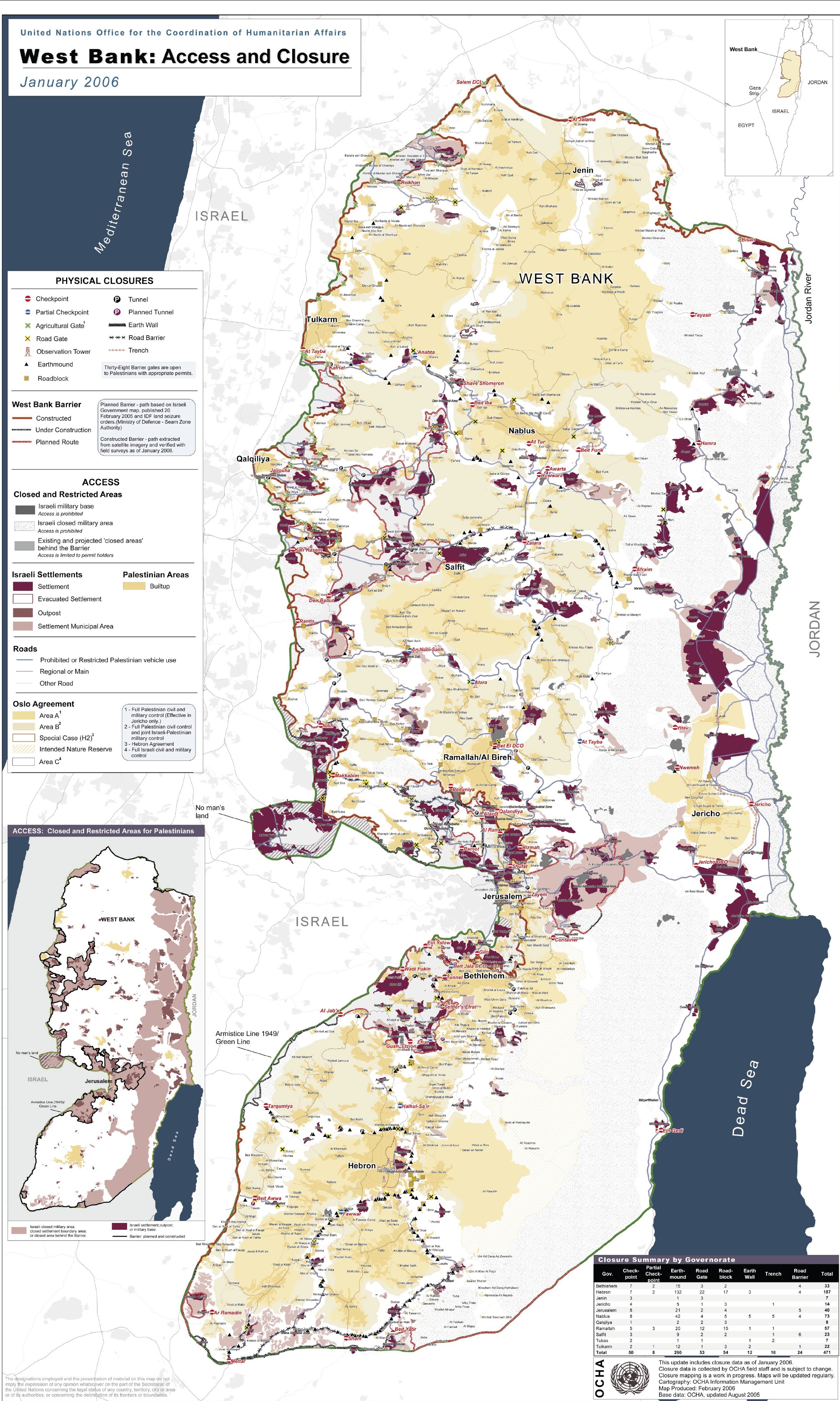
Try to imagine how could life in Gaza be, even in the total absence of Israeli attacks. Just to set some numbers first: The Gaza strip hosts almost 1.5 million people on 360 km . When I lived in Israel, I was constantly surprised at how small a country it is - Israel tops at 550Km North to South, 150Km east to West (it is amazing, almost wherever you stand, except in the middle of the Negev, you can see the country's borders. Yes, I recognize as the border the so-called Green Line); over half of the territory is a desert, and it hosts seven million inhabitants. And it is hard to imagine how that country can be economically viable.
I do not find it feasible to imagine Gaza and the West Bank integrating a single country, and not only because they are separated by ~40Km, but because they are so sociologically different. People in the West Bank, yes, live opressed under military rule and subject to a much more constant, more visible apartheid-like state (as the territory is truly sprinkled with Jewish outposts which many Israelis refuse to recognize as their own, but still, which have incredibly higher living standards). The best land has been taken away from them, yes, but they have some space between cities to have some farming, to communicate, to... Breathe. Besides, West Bank inhabitants -even those in refugee camps- have much better living standards than anybody in Gaza. It is still an overpopulated area, but not nearly as much as Gaza.
Gazan population have been driven towards extremism. And yes, there was a civil war between Palestinian factions, as the world views between both populations are completely different - However hostile a Jenin inhabitant can be towards Israel, he does not lead the life -if it can so be called- you see at Khan Yunis.
But back to Gaza... What Israel is doing (and not only during this military operation terror campaign is wrong, from any rational point of view. Israel wants Hamas to become weaker? Then don't drive the population into supporting them!
Palestinians started giving over 50% of their support to Fatah (ex-PLO), and under 20% to Hamas. That was less than 15 years ago. However, Fatah has shown to be corrupt and inefficient at building infrastructure and improving life conditions, ineffective at negotiating a permanent agreement which secures dignity and sustainability to their people. Hamas stands as a religious, righteous organization. There are no serious corruption charges against any Hamas leaders. Hamas is clearly still at war - They didn't subscribe any peace agreement so far, and their stated #1 goal is to build a Muslim State in the whole of Israel. And the Hamas movement -like Hizbollah in Lebanon- has built quite a bit of infrastructure in the areas they control - Mainly housing. Yes, housing where they mix their own offices, many will accuse, getting human shields for free. But still, they are benefactors to a dehumanized, pauperized population.
I find it obvious that, if living conditions were at a basic level in the region, support of Hamas would decrease. Even more, of course, if they improved due to Israeli support. Israel controls this territory, so it is responsible for the well-being of its population, like it or not. And Gaza is simply too small and low on resources to survive by itself.
I was a bit surprised to find mention -although very brief- of a three state solution - And yes, this is close to what I would expect as a viable outcome. It is clear that Israel will not ever grant full citizenship to the Palestinians, as they would -euphemistically speaking- challenge the Jewish character of the State. Dropping the euphemism, Israel relies on apartheid in order not to become an Arab majority country. I might have some numbers wrong, but AFAIK, there are ~7 million Israelis, 20% of which are Arab citizens (which means, 1.4 million Arabs and probably 5 million Jews, with many other minor denominations for the difference), and ~4 million Palestinians live in the territories. Today, the country is already predominantly Arab, or at least is close to being so. So, Israel should permanently, formally disengage from all of the occupied territories. And in order to ensure violence stops, start a comprehensive, unconditional, long-term aid program. Start with giving them autonomy to regain their sea, as the Gaza port has long been closed. Allow the airport to operate again. Instead of bombing tunnels in the Egypt-Gaza borders, allow Gaza to trade with Egypt - Perhaps even to integrate territorialy, if the conditions are met. Treat their people with respect, and help them ease the terrible situation they have lived for so many decades - and then, undoubtely, terror will stop.
The West Bank? Possibly it could become a Palestinian state by itself. Possibly, it could integrate back to Jordan. That would be up to Jordans and Palestinians to decide. Of course, Jordan has already a large segment of its population defining itself as Palestinians, which counts both for and against. So, I won't venture into this supposition.
But anyway - Back to what prompted me to write this text -yes, a very or maybe even too long text - I hope somebody even takes the time to read it!- is to explain what is my point of view on the current situation, and why.
Today, a cease-fire was announced, after 23 days of murder and destruction. I sadly do not hold very high hopes for it to be lasting, much the less to be enough, to lead to what they call a de-escalation of the conflict. The most I can currently do is to voice my opinion, and hope that mine is just one more voice pointing to a sane solution, to a permanent, dignifying way out, for all people involved. Every people has the right for survival and for safety. We cannot deny this to any others. And certainly, we cannot expect anybody not to fight for their right to live.

18 January 2009

Wouter Verhelst: Filesystems: the saga continues

Bernhard comes up with a few arguments in support of multiple filesystems which, in my arrogant opinion, make no sense. The first argument (about hardlinking a file to your homedirectory until something bad is discovered in one of the binaries) has been sufficiently debunked by Joey Hess. The second and third arguments are the same, really. Repeating your argument won't buy you any beer, sorry. Finally, all your arguments talk about server. I was talking about laptop. I don't know about you, but me, I'm not in the habit of loaning out my laptop to someone I don't trust. I'm not even in the habit of loaning out my laptop to someone I do trust, come to think of it. I do run some servers on my laptop, but I also have a firewall on my laptop that refuses incoming connections. This is a laptop. Not a machine in a data center. As such, the only person with access to my machine is me. Now I don't say I trust each and every bit of software that I run on my laptop, but I do trust myself. I won't start scanning my laptop's hard disk for rogue SetUID hardlinks in another user's home directory, because there isn't another user, stupid! Paranoid security is nice and dandy and totally useless. Security is all about trade-offs. Even Bruce says so: if the cost of a security measure (having to deal with with 73 filesystems) does not outweigh its benefit (protection against cosmic rays changing not only my firewall configuration, but also writing a suid CGI binary and installing that in /usr/lib/cgi-bin), then it's just not worth it. Now of course you might argue that 'having to deal with 73 filesystems' is no cost at all, in which case it would be worth it. But to me, it certainly is a cost, and one I'm not willing to take even if it did protect me against a real-life problem. And if someone were to break into my system, I'll just reformat it and recover from back-ups. I won't even have to revoke my GPG key, this time, since it's no longer on the disk.

14 January 2009

David Welton: Hosting, Commodities, and "The Cloud"

Anyone connected to the world of IT has been bludgeoned over the head with "cloud" news lately, to the point where the term has become vague and mostly a buzzword. There is, however, something behind the phenomenon, described in Nick Carr's book The Big Switch, with more computing power being centralized at large data centers where economies of scale come into play. I had an interesting chat with Marco D'Itri a while back, about hosting and commodities. It's clear that there is some commoditization going on, but he maintains that hosting is not a commodity. I've been thinking about it and the conclusion I've come to is that some parts of the business are certainly commodities: disk space, memory, bandwidth, and processor cycles. Those things, are, ultimately, what we want to buy when we buy 'hosting'. However, the bits and pieces between that, and people who build on top of those services (i.e. someone who runs a web site) are not really a commodity, yet. Customer service, for instance, might vary a great deal between providers. What will happen in that space, will we see a baseline price for the commodities, and hosting resellers built on top of that that offer different levels of service? I do think that the "mom and pop" hosting type of situations will gradually disappear in favor of larger data centers that can take advantage of economics of scale, though. Also, as I've written about in the past, in Web Hosting - A Market for Lemons, there are some serious information asymmetry issues - how do you know the people providing your service are serious? How do you know they're using good components that wont' break often, rather than cheap junk that will lead to frequent outages? If you have the resources, you can build a system like Google's, where it doesn't matter what fails, it just works around it, but the basic tools that most of us are working with right now aren't that high level. I was reminded of the information asymmetry issue by this article, written by the Dreamhost folks, Web Hosting's Dirty Laundry, which describes how they caught a 'review' site trying to get money from Dreamhost for positive reviews, which is interesting in light of the lemon problem. Wikipedia has some criteria for a lemon market here: http://en.wikipedia.org/wiki/The_Market_for_Lemons#Criteria, which include the following:
Deficiency of effective public quality assurances (by reputation or regulation and/or of effective guarantees / warranties
If it's difficult to get real, honest, impartial reviews of hosting services, that is a push in the direction of 'lemons'. Of course, it's not impossible to get this information, but it seems that a lot of us still go by "hearsay" - what others we know use and report to be ok. To compare it with another product, I'd probably ask around to friends prior to purchasing a new car, but whatever I get is likely to work ok, even if it's not the absolute best. On the other hand, the wrong hosting provider might be very much a "fly by night" operation that leads to a lot of downtime, so I'm far more likely to listen to what other people have to say, and be far more cautious about buying "any old thing". Opinions? Comments? Thoughts? Where do you see this industry going?

8 January 2009

Adam Rosi-Kessel: The Great Urban Chicken Debate at the Supreme Court

of Nova Scotia. My past and future colleague Trevor Smedley just lost his appeal to the Supreme Court of Nova Scotia of his criminal conviction for having pet chickens. As the Supreme Court noted in Trevor J. Smedley and Her Majesty the Queen:
They are not just any chickens - they are special chickens. They are heritage chickens that are brought to this province from Quebec.
Indeed, the court agreed with Mr. Smedley that there was nothing wrong with the chickens:
The trial judge found that they are in every way inoffensive. There is no excessive or even noticeable noise, no odour. The way in which they are kept is not unsightly. The chickens remain on their property seemingly doing no harm to either the aesthetic qualities or the quiet enjoyment of the property of the immediate neighbours. So finds the trial judge.
As I haven t seen much news about this case in the mainstream media, I m posting a copy of the complete opinion here to shed public light on the matter. I know very little about Canadian chicken law, so I m not sure whether further appeals are possible, but I hope Mr. Smedley can keep up the fight.

Next.

Previous.