Search Results: "mt"

30 August 2015

Russ Allbery: Review: Pound Foolish

Review: Pound Foolish, by Helaine Olen
Publisher: Penguin
Copyright: 2012, 2013
Printing: 2013
ISBN: 1-59184-679-X
Format: Trade paperback
Pages: 241
For at least the last six years, it's not been surprising news that the relationship between the average person and the US financial system is tense at best, and downright exploitative at worst. The collapse of the housing bubble revealed a morass of predatory lending practices, spectacularly poor (or spectacularly cynical) investment decisions, and out-of-control personal debt coupled with erosion of bankruptcy law. Despite this, there's always a second story in all discussions of the finances of the US population: the problem isn't with financial structures and products, but with us. We're too stupid, or naive, or emotional, or uninformed, or greedy, or unprincipled, or impatient. Finances are complicated, yes, but that just means we have to be more thoughtful. All of these complex financial products could have been used properly. Helaine Olen's Pound Foolish is a systemtic, biting, well-researched, and pointed counter to that second story. The short summary of this book is that it's not us. We're being set up for failure, and there is a large and lucrative industry profiting off of that failure. And many (although not all) people in that industry know exactly what they're doing. Pound Foolish is one of my favorite forms of non-fiction: long-form journalism. This is an investigative essay into the personal finance and investment industry, developed to book length. Readers of Michael Lewis will feel right at home. Olen doesn't have Lewis's skill with characterization and biography, but she makes up for it in big-picture clarity. She takes a wealth of individual facts about who is involved in personal finance, how they make money, what they recommend, and who profits, and develops it into a clear and coherent overview. If you have paid any attention to US financial issues, you'll know some of this already. Frontline has done a great job of covering administrative fees in mutual funds. Lots of people have warned about annuities. The spectacular collapse of the home mortgage is old news now. But Olen does a great job of finding the connections between these elements and adding some less familiar ones, including an insightful and damning analysis of financial literacy campaigns and the widespread belief that these problems are caused by lack of consumer understanding. I've read and watched a lot of related material, including several full-book treatments of the mortgage crisis, so I think it's telling that I never got bored in the middle of Olen's treatment. I find the deep US belief in the power of personal improvement fascinating. It feels like one of the defining characteristics of US culture, for both good and for ill. We're very good at writing compelling narratives of personal improvement, and sometimes act on them. We believe that everyone can and should improve themselves. But that comes coupled to a dislike and distrust of expertise, even when it is legitimate and earned (Hofstadter's Anti-Intellectualism in American Life develops this idea at length). And I believe we significantly overestimate the ability of individuals to act despite systems that are stacked against us, and significantly overestimate our responsibility for the inevitable results. This was the main message I took from Pound Foolish: we desperately want to believe in the myth of personal control. We want to believe that our financial troubles are something we can fix through personal education, more will power, better decisions, or just the right investment. And so, we turn to gurus like Suze Orman and buy their mix of muddled financial advice and "tough love" that completely ignores broader social factors. We're easy marks for psychologically-trained investment sellers who mix fear, pressure, and a fantasy of inside knowledge and personal control. We're fooled by a narrative of empowerment and stand by while a working retirement system (guaranteed benefit pensions) is undermined and destroyed in favor of much riskier investment schemes... riskier for us, at least, but loaded with guaranteed profits for the people who "advise" us. And we cling to financial literacy campaigns that are funded by exactly the same credit card companies who fight tooth and nail against regulations that would require they provide simple, comprehensible descriptions of loan terms. One wonders if they support them precisely because they know they don't work. Olen mentions, in passing, the Stanford marshmallow experiment, which is often used as a foundation for arguments about personal responsibility for financial outcomes, but she doesn't do a detailed critique. I wish she had, since I think it's such a good example of the theme of this book. The Stanford marshmallow experiment was a psychological experiment from the late 1960s and early 1970s in delayed gratification. Children were put in a room in front of some treat (marshmallows, cookies, pretzels) and told that they could eat it if they wished. But if they didn't eat the treat before the monitor came back, they would get two of the treat instead. Long-term follow-up studies found that the children who refrained from eating the treat and got the reward had better life outcomes along multiple metrics: SAT scores, educational attainment, and others. On the surface, this seems to support everything US culture loves to believe about the power of self-control, self-improvement, and the Protestant work ethic. People who can delay gratification and save for a future reward do better in the world. (The darker interpretation, also common since the experiment was performed on children, is that the ability to delay gratification has a genetic component, and some people are just doomed to make poor decisions due to their inability to exercise self-control.) However, I can call the traditional interpretation into question with one simple question that the experimenters appeared not to ask: under what circumstances would taking the treat immediately be the rational and best choice? One answer, of course, is when one does not trust the adult to produce the promised reward. If the adult might come back, take the treat away, and not give any treat, it's to the child's advantage to take the treat immediately. Even if the adult left the treat but wouldn't actually double it, it's to the child's advantage to take the treat immediately. The traditional interpretation assumes the child trusts the adults performing the experiment a logical assumption for those of us whose childhood experience was that adults could generally be trusted and that promised rewards would materialize. If the child instead came from a chaotic family where adults weren't reliable, or just one where frequent unexpected money problems meant that promised treats often didn't materialize, the most logical assumption may be much different. One has to ask if such a background may have more to do with the measured long-term life outcomes than the child's unwillingness to trust in a future reward. And this is one of the major themes of this book. Problems the personal finance industry attributes to our personal shortcomings (which they're happy to take our money to remedy) are often systematic, or at least largely outside of our control. We may already be making the most logical choices given our personal situations. We're in worse financial shape because we're making less money. Our retirements are in danger because our retirement systems were dismantled and replaced with risky and expensive alternatives. And where problems are attributed to our poor choices, one can find entire industries that focus on undermining our ability to make good choices: scaring us, confusing us, hiding vital information, and exploiting known weaknesses of human psychology to route our money to them. These are not problems that can be solved by watching Suze Orman yell at us to stop buying things. These are systematic social problems that demand a sweeping discussion about regulation, automatic savings systems, and social insurance programs to spread risk and minimize the weaknesses of human psychology. Exactly the kind of discussion that the personal finance industry doesn't want us to have. Those who are well-read in these topics probably won't find a lot new here. Those who aren't in the US will shake their heads at some of the ways that the US fails its citizens, although many of Olen's points apply even to countries with stronger social safety nets. But if you're interested in solid long-form journalism on this topic, backed by lots of data on just how badly a focus on personal accountability is working for us, I recommend Pound Foolish. Rating: 8 out of 10

28 August 2015

Dimitri John Ledkov: Go enjoy Python3

Given a string, get a truncated string of length up to 12.

The task is ambiguous, as it doesn't say anything about whether or not 12 should include terminating null character or not. None the less, let's see how one would achieve this in various languages.
Let's start with python3

import sys
print(sys.argv[1][:12])

Simple enough, in essence given first argument, print it up to length 12. As an added this also deals with unicode correctly that is if passed arg is , it will correctly print . (note these are just random Unicode strings to me, no idea what they stand for).

In C things are slightly more verbose, but in essence, I am going to use strncpy function:

#include <stdio.h>
#include <string.h>
void main(int argc, char *argv[])
char res[12];
strncpy(res,argv[1],12);
printf("%s\n",res);

This treats things as byte-array instead of unicode, thus for unicode test it will end up printing just . But it is still simple enough.
Finally we have Go
package main

import "os"
import "fmt"
import "math"

func main()
fmt.Printf("%s\n", os.Args[1][:int(math.Min(12, float64(len(os.Args[1]))))])

This similarly treats argument as a byte array, and one needs to cast the argument to a rune to get unicode string handling. But there are quite a few caveats. One cannot take out of bounds slices. Thus a na ve os.Args[1][:12] can result in a runtime panic that slice bounds are out of range. Or if a string is known at compile time, a compile time error. Hence one needs to calculate length, and do a min comparison. And there lies the next caveat, math.Min() is only defined for float64 type, and slice indexes can only be integers and thus we end up writing ]))))])...

12 points for python3, 8 points for C, and Go receives nul points Eurovision style.

EDIT: Andreas R ssland and James Hunt are full of win. Both suggesting fmt.Printf("%.12s\n", os.Args[1]) for go. I like that a lot, as it gives simplicity & readability without compromising the default safety against out of bounds access. Hence the scores are now: 14 points for Go, 12 points for python3 and 8 points for C.

EDIT2: I was pointed out much better C implementation by Keith Thompson - http://pastebin.com/5i7rFmMQ in essence it uses strncat() which has much better null termination semantics. And Ben posted a C implementation which handles wide characters http://www.decadent.org.uk/ben/blog/truncating-a-string-in-c.html. I regret to inform you that this blog post got syndicated onto hacker news and has now become the top viewed post on my blog of all time, overnight. In retrospect, I regret awarding points at the end of the blog post, as that's just was merely an expression of opinion and is highly subjective measure. But this problem statement did originate from me reviewing go code that did "if/then/else" comparison and got it wrong to truncate a string and I thought surely one can just do [:12] which has lead me down the rabbit hole of discovering a lot about Go; it's compile and runtime out of bounds access safeguards; lack of universal Min() function; runes vs strings handling and so on. I'm only a beginner go programmer and I am very sorry for wasting everyone's time on this. I guess people didn't have much to do on a Throwback Thursday.

The postings on this site are my own and don't necessarily represent Intel s positions, strategies, or opinions.

27 August 2015

Ritesh Raj Sarraf: Laptop Mode Tools - 1.68

I am please to announce the release of Laptop Mode Tools, version 1.68. This release is mainly focused on integration with the newer init system, systemd. Without the help from the awesome Debian systemd maintainers, this would not have been possible. Thank you folks. While the focus now is on systemd, LMT will still support the older SysV Init. With this new release, there are some new files: laptop-mode.service, laptop-mode.timer and lmt-poll.service. All the files should be documented well enough for users. lmt-poll.service is the equivalent of the module battery-level-polling, should you need it. Filtered git log:
1.68 - Thu Aug 27 22:36:43 IST 2015
    * Fix all instances for BATTERY_LEVEL_POLLING
    * Group kill the polling daemon so that its child process get the same signal
    * Release the descriptor explicitly
    * Add identifier about who's our parent
    * Narrow down our power_supply subsystem event check condition
    * Fine tune the .service file
    * On my ultrabook, AC as reported as ACAD
    * Enhance lmt-udev to better work with systemd
    * Add a timer based polling for LMT. It is the equivalent of battery-polling-daemon,
      using systemd
    * Disable battery level polling by default, because most systems will have systemd running
    * Add documentation reference in systemd files
The md5 checksum for the tarball is 15edf643990e08deaebebf66b128b270

Categories:

Keywords:

Like:

25 August 2015

Lunar: Reproducible builds: week 17 in Stretch cycle

A good amount of the Debian reproducible builds team had the chance to enjoy face-to-face interactions during DebConf15.
Names in red and blue were all present at DebConf15
Picture of the  reproducible builds  talk during DebConf15
Hugging people with whom one has been working tirelessly for months gives a lot of warm-fuzzy feelings. Several recorded and hallway discussions paved the way to solve the remaining issues to get reproducible builds part of Debian proper. Both talks from the Debian Project Leader and the release team mentioned the effort as important for the future of Debian. A forty-five minutes talk presented the state of the reproducible builds effort. It was then followed by an hour long roundtable to discuss current blockers regarding dpkg, .buildinfo and their integration in the archive. Picture of the  reproducible builds  roundtable during DebConf15 Toolchain fixes Reiner Herrmann submitted a patch to make rdfind sort the processed files before doing any operation. Chris Lamb proposed a new patch for wheel implementing support for SOURCE_DATE_EPOCH instead of the custom WHEEL_FORCE_TIMESTAMP. akira sent one making man2html SOURCE_DATE_EPOCH aware. St phane Glondu reported that dpkg-source would not respect tarball permissions when unpacking under a umask of 002. After hours of iterative testing during the DebConf workshop, Sandro Knau created a test case showing how pdflatex output can be non-deterministic with some PNG files. Packages fixed The following 65 packages became reproducible due to changes in their build dependencies: alacarte, arbtt, bullet, ccfits, commons-daemon, crack-attack, d-conf, ejabberd-contrib, erlang-bear, erlang-cherly, erlang-cowlib, erlang-folsom, erlang-goldrush, erlang-ibrowse, erlang-jiffy, erlang-lager, erlang-lhttpc, erlang-meck, erlang-p1-cache-tab, erlang-p1-iconv, erlang-p1-logger, erlang-p1-mysql, erlang-p1-pam, erlang-p1-pgsql, erlang-p1-sip, erlang-p1-stringprep, erlang-p1-stun, erlang-p1-tls, erlang-p1-utils, erlang-p1-xml, erlang-p1-yaml, erlang-p1-zlib, erlang-ranch, erlang-redis-client, erlang-uuid, freecontact, givaro, glade, gnome-shell, gupnp, gvfs, htseq, jags, jana, knot, libconfig, libkolab, libmatio, libvsqlitepp, mpmath, octave-zenity, openigtlink, paman, pisa, pynifti, qof, ruby-blankslate, ruby-xml-simple, timingframework, trace-cmd, tsung, wings3d, xdg-user-dirs, xz-utils, zpspell. The following packages became reproducible after getting fixed: Uploads that might have fixed reproducibility issues: Some uploads fixed some reproducibility issues but not all of them: Patches submitted which have not made their way to the archive yet: St phane Glondu reported two issues regarding embedded build date in omake and cduce. Aur lien Jarno submitted a fix for the breakage of make-dfsg test suite. As binutils now creates deterministic libraries by default, Aur lien's patch makes use of a wrapper to give the U flag to ar. Reiner Herrmann reported an issue with pound which embeds random dhparams in its code during the build. Better solutions are yet to be found. reproducible.debian.net Package pages on reproducible.debian.net now have a new layout improving readability designed by Mattia Rizzolo, h01ger, and Ulrike. The navigation is now on the left as vertical space is more valuable nowadays. armhf is now enabled on all pages except the dashboard. Actual tests on armhf are expected to start shortly. (Mattia Rizzolo, h01ger) The limit on how many packages people can schedule using the reschedule script on Alioth has been bumped to 200. (h01ger) mod_rewrite is now used instead of JavaScript for the form in the dashboard. (h01ger) Following the rename of the software, debbindiff has mostly been replaced by either diffoscope or differences in generated HTML and IRC notification output. Connections to UDD have been made more robust. (Mattia Rizzolo) diffoscope development diffoscope version 31 was released on August 21st. This version improves fuzzy-matching by using the tlsh algorithm instead of ssdeep. New command line options are available: --max-diff-input-lines and --max-diff-block-lines to override limits on diff input and output (Reiner Herrmann), --debugger to dump the user into pdb in case of crashes (Mattia Rizzolo). jar archives should now be detected properly (Reiner Herrman). Several general code cleanups were also done by Chris Lamb. strip-nondeterminism development Andrew Ayer released strip-nondeterminism version 0.010-1. Java properties file in jar should now be detected more accurately. A missing dependency spotted by St phane Glondu has been added. Testing directory ordering issues: disorderfs During the reproducible builds workshop at DebConf, participants identified that we were still short of a good way to test variations on filesystem behaviors (e.g. file ordering or disk usage). Andrew Ayer took a couple of hours to create disorderfs. Based on FUSE, disorderfs in an overlay filesystem that will mount the content of a directory at another location. For this first version, it will make the order in which files appear in a directory random. Documentation update Dhole documented how to implement support for SOURCE_DATE_EPOCH in Python, bash, Makefiles, CMake, and C. Chris Lamb started to convert the wiki page describing SOURCE_DATE_EPOCH into a Freedesktop-like specification in the hope that it will convince more upstream to adopt it. Package reviews 44 reviews have been removed, 192 added and 77 updated this week. New issues identified this week: locale_dependent_order_in_devlibs_depends, randomness_in_ocaml_startup_files, randomness_in_ocaml_packed_libraries, randomness_in_ocaml_custom_executables, undeterministic_symlinking_by_rdfind, random_build_path_by_golang_compiler, and images_in_pdf_generated_by_latex. 117 new FTBFS bugs have been reported by Chris Lamb, Chris West (Faux), and Niko Tyni. Misc. Some reproducibility issues might face us very late. Chris Lamb noticed that the test suite for python-pykmip was now failing because its test certificates have expired. Let's hope no packages are hiding a certificate valid for 10 years somewhere in their source! Pictures courtesy and copyright of Debian's own paparazzi: Aigars Mahinovs.

24 August 2015

Iustin Pop: Finally, systemd!

Even though Debian has moved to systemd as default a long while ago now, I've stayed with sysv as I have somewhat custom setups (self-built trimmed down kernels, separate /usr not pre-mounted by initrd, etc.). After installing a new system with Jessie and playing a bit with systemd on it a couple of months ago, I said it's finally time to upgrade. Easier said than starting to actually do it . The first system I upgraded was a recent (~1 year old) install. It was a trimmed-down system with Debian's kernel, so everything went smoothly. So smoothly that I soon forgot I made the change, and didn't do any more switches for a while. Systemd was therefore out of my mind until this recent Friday when I got a bug report about mt's rcS init script and shipping a proper systemd unit. The first step should be to actually start using systemd, so I said - let's convert some more things! During the weekend I upgraded one system, still a reasonably small install, but older - probably 6-7 years. First reboot into systemd flagged the fact that I had some forced-load modules which no longer exist, fact that was too easy to ignore with sysv. Nice! The only downside was that there seems to be some race condition between and ntp, as it fails to start on boot (port listen conflict). I'll see if it repeats. Another small issue is that systemd doesn't like duplicate fstab entries (i.e. two devices which both refer to the same mount point), while this works fine for mount itself (when specifying the block device). I said that after that system, I'll wait a while until to upgrade the next. But so it happened that today another system had an issue and I had to reboot it (damn lost uptimes!). The kernel was old so I booted into a newer one (this time compiled with the required systemd options), so I had a though - what if I take the opportunity and also switch to systemd on this system? Caution said to wait, since this was the oldest system - installed sometime during or before 2004. Plus it doesn't use an initrd (long story), and it has a split /usr. Caution excitement caution lost and I proceeded. It turns out that systemd does warn about split /usr but itself has no problems. I learned that I also had very old sysfs entries that no longer exist, and which I didn't know about as sysv doesn't make it obvious. I also had a crypttab entry which was obsolete, and I forgot about it, until I met the nice red moving ASCII bar which fortunately had a timeout. To be honest, I believed I'll have to rescue boot and fix things on this "always-unstable" machine, on which I install and run random things, and which has a hackish /etc/fstab setup. I'm quite surprised it just worked. On unstable. So thanks a lot to the Debian systemd team. It was much simpler than I thought, and now, on to exploring systemd! P.S.: the sad part is that usually I'm a strong proponent of declarative configuration, but for some reason I was reluctant to migrate to systemd also on account on losing the "power" of shell scripts. Humans

19 August 2015

Andrew Cater

Poetry for Debconf15 poetry night

Debian's reached the age of 22
I wish I could be there with you
In Heidelberg, fair German city
To share, in person, this my ditty

Rhonda's worked hard - the work is done
With poems now begins the fun
While others play cards or hack new code
Or dream of running down the road

Free software, arguments, warmth, good cheer
Too soon all over 'til next year
All of the best are there / on 'Net
Here's hope that it's the best Debconf yet


8 August 2015

Craig Small: Be careful with errno

I m getting close to releasing version 3.3.11 of procps. When it gets near that time, I generally browse again the Debian Bug Tracker for procps bugs. Bug number #733758 caught my eye. With the free command if you used the s option before the c option, the s option failed, seconds argument N failed where N was the number you typed in. The error should be for you trying to type letters for number of seconds. Seemed reasonably simple to test and simple to fix. Take me to the code The relevant code looks like this:
   case 's':
            flags  = FREE_REPEAT;
            args.repeat_interval = (1000000 * strtof(optarg, &amp;endptr));
            if (errno   optarg == endptr   (endptr &amp;&amp; *endptr))
                xerrx(EXIT_FAILURE, _("seconds argument  %s' failed"), optarg);
Seems pretty stock-standard sort of function. Use strtof() to convert the string into the float. You need to check both errno AND optarg == endptr because: At first I thought the logic was wrong, but tracing through it was fine. I then compiled free using the upstream git source, the program worked fine with s flag with no c flag. Doing a diff between the upstream HEAD and Debian s 3.3.10 source showed nothing obvious. I then shifted the upstream git to 3.3.10 too and re-compiled. The Debian source failed, the upstream parsed the s flag fine. I ran diff, no change. I ran md5sum, the hashes matched; what is going on here? I ll set when I want The man page says in the case of under/overflow ERANGE is stored in errno . What this means is if there isn t and under/overflow then errno is NOT set to 0, but its just not set at all. This is quite useful when you have a chain of functions and you just want to know something failed, but don t care what. Most of the time, you generally would have a Have I failed? test and then check errno for why. A typical example is socket calls where anything less than 0 means failure. You check the return value first and then errno. strtof() is one of those funny ones where most people check errno directly; its simpler than checking for +/- HUGE_VAL. You can see though that there are traps. What s the difference? OK, so a simple errno=0 above the call fixes it, but why would the Debian source tree have this failure and the upstream not? Even with the same code? The difference is how they are compiled. The upstream compiles free like this:
gcc -std=gnu99 -DHAVE_CONFIG_H -I. -include ./config.h -I./include -DLOCALEDIR=\"/usr/local/share/locale\" -Iproc -g -O2 -MT free.o -MD -MP -MF .deps/free.Tpo -c -o free.o free.c
mv -f .deps/free.Tpo .deps/free.Po
/bin/bash ./libtool --tag=CC --mode=link gcc -std=gnu99 -Iproc -g -O2 ./proc/libprocps.la -o free free.o strutils.o fileutils.o -ldl
libtool: link: gcc -std=gnu99 -Iproc -g -O2 -o .libs/free free.o strutils.o fileutils.o ./proc/.libs/libprocps.so -ldl
While Debian has some hardening flags:
gcc -std=gnu99 -DHAVE_CONFIG_H -I. -include ./config.h -I./include -DLOCALEDIR=\"/usr/share/locale\" -D_FORTIFY_SOURCE=2 -Iproc -g -O2 -fstack-protector-strong -Wformat -Werror=format-security -MT free.o -MD -MP -MF .deps/free.Tpo -c -o free.o free.c
mv -f .deps/free.Tpo .deps/free.Po
/bin/bash ./libtool --tag=CC --mode=link gcc -std=gnu99 -Iproc -g -O2 -fstack-protector-strong -Wformat -Werror=format-security ./proc/libprocps.la -Wl,-z,relro -o free free.o strutils.o fileutils.o -ldl
libtool: link: gcc -std=gnu99 -Iproc -g -O2 -fstack-protector-strong -Wformat -Werror=format-security -Wl,-z -Wl,relro -o .libs/free free.o strutils.o fileutils.o ./proc/.libs/libprocps.so -ldl
It s not the compiling of free itself that is doing it, but the library. Most likely something that is called before the strtof() is setting errno which this code then falls into. In fact if you run the upstream free linked to the Debian procps library it fails. Moral of the story is to set errno before the function is called if you are going to depend on it for checking if the function succeeded.

Wouter Verhelst: Backing up with tar

The tape archiver, better known as tar, is one of the older backup programs in existence. It's not very good at automated incremental backups (for which bacula is a good choice), but it can be useful for "let's take a quick snapshot of the current system" type of situations. As I'm preparing to head off to debconf tomorrow, I'm taking a backup of my n-1 laptop (which still contains some data that I don't want to lose) so it can be reinstalled and used by the Debconf video team. While I could use a "proper" backup system, running tar to a large hard disk is much easier. By default, however, tar won't preserve everything, so it is usually a good idea to add some extra options. This is what I' mrunning currently:
sudo tar cvpaSf player.local:carillon.tgz --rmt-command=/usr/sbin/rmt --one-file-system /
which breaks down to create tar archive, verbose output, preserve permissions, automatically determine compression based on file extension, handle Sparse files efficiently, write to a file on a remote host using /usr/sbin/rmt as the rmt program, don't descend into a separate filesystem (since I don't want /proc and /sys etc to be backed up), and back up my root partition. Since I don't believe there's any value to separate file systems on a laptop, this will back up the entire contents of my n-1 laptop to the carillon.tgz in my home directory on player.local.

7 August 2015

John Goerzen: Detailed Smart Card Cryptographic Token Security Guide

After my first post about smartcards under Linux, I thought I would share some information I ve been gathering. This post is already huge, so I am not going to dive into much specific commands, but I am linking to many sources with detailed instructions. I ve reviewed several types of cards. For this review, I will focus on the OpenPGP card and the Yubikey NEO, since the Cardomatic Smartcard-HSM is not supported by the gpg version in Jessie. Both cards are produced by people with strong support for the Free Software ecosystem and have strong cross-platform support with source code. OpenPGP card: Basics with GnuPG The OpenPGP card is well-known as one of the first smart cards to work well on Linux. It is a single-application card focused on use with GPG. Generally speaking, by the way, you want GPG2 for use with smartcards. Basically, this card contains three slots: decryption, signing, and authentication slots. The concept is that the private key portions of the keys used for these items are stored only on the card, can never be extracted from the card, and the cryptographic operations are performed on the card. There is more information in my original post. In a fairly rare move for smartcards, this card supports 4096-byte RSA keys; most are restricted to 2048-byte keys. The FSF Europe hands these out to people and has a lot of good information about them online, including some HOWTOs. The official GnuPG smart card howto is 10 years old, and although it has some good background, I d suggest using the FSFE instructions instead. As you ll see in a bit, most of this information also pertains to the OpenPGP mode of the Yubikey Neo. OpenPGP card: Other uses Of course, this is already pretty great to enhance your GPG security, but there s a lot more that you can do with this card to add two-factor authentication (2FA) to a lot of other areas. Here are some pointers: OpenPGP card: remote authentication with ssh You can store the private part of your ssh key on the card. Traditionally, this was only done by using the ssh agent emulation mode of gnupg-agent. This is still possible, of course. Now, however, the OpenSC project now supports the OpenPGP card as a PKCS#11 and PKCS#15 card, which means it works natively with ssh-agent as well. Try just ssh-add -s /usr/lib/x86_64-linux-gnu/pkcs11/opensc-pkcs11.so if you ve put a key in the auth slot with GPG. ssh-add -L will list its fingerprint for insertion into authorized_keys. Very simple! As an aside: Comments that you need scute for PKCS#11 support are now outdated. I do not recommend scute. It is quite buggy. OpenPGP card: local authentication with PAM You can authenticate logins to a local machine by using the card with libpam-poldi here are some instructions. Between the use with ssh and the use with PAM, we have now covered 2FA for both local and remote use in Unix environments. OpenPGP card: use on Windows Let s move on to Windows environments. The standard suggestion here seems to be the mysmartlogon OpenPGP mini-driver. It works with some sort of Windows CA system, or the local accounts using EIDAuthenticate. I have not yet tried this. OpenPGP card: Use with X.509 or Windows Active Directory You can use the card in X.509 mode via these gpgsm instructions, which apparently also work with Windows Active Directory in some fashion. You can also use it with web browsers to present a certificate from a client for client authentication. For example, here are OpenSC instructions for Firefox. OpenPGP card: Use with OpenVPN Via the PKCS#11 mode, this card should be usable to authenticate a client to OpenVPN. See the official OpenVPN HOWTO or these other instructions for more. OpenPGP card: a note on PKCS#11 and PKCS#15 support You ll want to install the opensc-pkcs11 package, and then give the path /usr/lib/x86_64-linux-gnu/pkcs11/opensc-pkcs11.so whenever something needs the PKCS#11 library. There seem to be some locking/contention issues between GPG2 and OpenSC, however. Usually killing pcscd and scdaemon will resolve this. I would recommend doing manipulation operations (setting PINs, generating or uploading keys, etc.) via GPG2 only. Use the PKCS#11 tools only to access. OpenPGP card: further reading Kernel Concepts also has some nice readers; you can get this card in a small USB form-factor by getting the mini-card and the Gemalto reader. Yubikey Neo Introduction The Yubikey Neo is a fascinating device. It is a small USB and NFC device, a little smaller than your average USB drive. It is a multi-application device that actually has six distinct modes: There is a ton to digest with this device. Yubikey Neo Basics By default, the Yubikey Neo is locked to only a subset of its features. Using the yubikey-personalization tool (you ll need the version in stretch; jessie is too old), you can use ykpersonalize -m86 to unlock the full possibilities of the card. Run that command, then unplug and replug the device. It will present itself as a USB keyboard as well as a PC/SC-compatible card reader. It has a capacitive button, which is used to have it generate keystrokes to input validation information for HOTP or HMAC validation. It has two slots that can be configured with HMAC and HOTP; a short button press selects the default slot #1 and a long press selects slot #2. But before we get into that, let s step back at some basics. opensc-tool list-algorithms claims this card supports RSA with 1024, 2048, and 3072 sizes, and EC with 256 and 384-bit sizes. I haven t personally verified anything other than RSA-2048 though. Yubikey Neo: OpenPGP support In this mode, the card is mostly compatible with the physical OpenPGP card. I say mostly because there are a few protocol differences I ll get into later. It is also limited to 2048-byte keys. Support for this is built into GnuPG and the GnuPG features described above all work fine. In this mode, it uses firmware from the Yubico fork of the JavaCard OpenPGP Card applet. There are Yubico-specific tutorials available, but again, most of the general GPG stuff applies. You can use gnupg-agent to use the card with SSH as before. However, due to some incompatibilities, the OpenPGP applet on this card cannot be used as a PKCS#11 card with either scute or OpenSC. That is not exactly a huge problem, however, as the card has another applet (PIV) that is compatible with OpenSC and so this still provides an avenue for SSH, OpenVPN, Mozilla, etc. It should be noted that the OpenPGP applet on this card can also be used with NFC on Android with the OpenKeychain app. Together with pass (or its Windows, Mac, or phone ports), this makes a nicely secure system for storing passwords. Yubikey Neo: PKCS#11 with the PIV applet There is also support for the PIV standard on the Yubikey Neo. This is supported by default on Linux (via OpenSC) and Windows and provides a PKCS#11-compabible store. It should, therefore, be compatible with ssh-agent, OpenVPN, Active Directory, and all the other OpenPGP card features described above. The only difference is that it uses storage separate from the OpenPGP applet. You will need one of the Yubico PIV tools to configure the key for it; in Debian, the yubico-piv-tool from stretch does this. Here are some instructions on using the Yubikey Neo in PIV mode: A final note: for security, it s important to change the management key and PINs before deploying the PIV mode. I couldn t get this to work with Firefox, but it worked pretty much everywhere else. Yubikey Neo: HOTP authentication This is the default mode for your Yubikey; all other modes require enabling with ykpersonalize. In this mode, a 128-bit AES key stored on the Yubikey is used to generate one-time passwords (OTP). (This key was shared in advance with the authentication server.) A typical pattern would be for three prompts: username, password, and Yubikey HOTP. The user clicks in the Yubikey HOTP field, touches the Yubikey, and their one-time token is pasted in. In the background, the service being authenticated to contacts an authentication server. This authentication server can be either your own (there are several open source implementations in Debian) or the free Yubicloud. Either way, the server decrypts the encrypted part of the OTP, performs validity checks (making sure that the counter is larger than any counter it s seen before, etc) and returns success or failure back to the service demanding authentication. The first few characters of the posted auth contain the unencrypted key ID, and thus it can also be used to provide username if desired. Yubico has provided quite a few integrations and libraries for this mode. A few highlights: You can also find some details on the OTP mode. Here s another writeup. This mode is simple to implement, but it has a few downsides. One is that it is specific to the Yubico line of products, and thus has a vendor lock-in factor. Another is the dependence on the authentication server; this creates a potential single point of failure and can be undesireable in some circumtances. Yubikey Neo: OATH and HOTP and TOTP First, a quick note: OATH and OAuth are not the same. OATH is an authentication protocol, and OAuth is an authorization protocol. Now then Like Yubikey HOTP, OATH (both HOTP and TOTP) modes rely on a pre-shared key. (See details in the Yubico article.) Let s talk about TOTP first. With TOTP, there is a pre-shared secret with each service. Each time you authenticate to that service, your TOTP generator combines the timestamp with the shared secret using a HMAC algorithm and produces a OTP that changes every 30 seconds. Google Authenticator is a common example of this protocol, and this is a drop-in replacement for it. Gandi has a nice description of it that includes links to software-only solutions on various platforms as well. With the Yubikey, the shared secrets are stored on the card and processed within it. You cannot extract the shared secret from the Yubikey. Of course, if someone obtains physical access to your Yubikey they could use the shared secret stored on it, but there is no way they can steal the shared secret via software, even by compromising your PC or phone. Since the Yubikey does not have a built-in clock, TOTP operations cannot be completed solely on the card. You can use a PC-based app or the Android application (Play store link) with NFC to store secrets on the device and generate your TOTP codes. Command-line users can also use the yubikey-totp tool in the python-yubico package. OATH can also use HOTP. With HOTP, an authentication counter is used instead of a clock. This means that HOTP passwords can be generated entirely within the Yubikey. You can use ykpersonalize to configure either slot 1 or 2 for this mode, but one downside is that it can really only be used with one service per slot. OATH support is all over the place; for instance, there s libpam-oath from the OATH toolkit for Linux platforms. (Some more instructions on this exist.) Note: There is another tool from Yubico (not in Debian) that can apparently store multiple TOTP and HOTP codes in the Yubikey, although ykpersonalize and other documentation cannot. It is therefore unclear to me if multiple HOTP codes are supported, and how.. Yubikey Neo: Challenge-Response Mode This can be useful for doing offline authentication, and is similar to OATH-HOTP in a sense. There is a shared secret to start with, and the service trying to authenticate sends a challenge to the token, which must supply an appropriate response. This makes it only suitable for local authentication, but means it can be done fairly automatically and optionally does not even require a button press. To muddy the waters a bit, it supports both Yubikey OTP and HMAC-SHA1 challenge-response modes. I do not really know the difference. However, it is worth noting that libpam-yubico works with HMAC-SHA1 mode. This makes it suitable, for instance, for logon passwords. Yubikey Neo: U2F U2F is a new protocol for web-based apps. Yubico has some information, but since it is only supported in Chrome, it is not of interest to me right now. Yubikey Neo: Further resources Yubico has a lot of documentation, and in particular a technical manual that is actually fairly detailed. Closing comments Do not think a hardware security token is a panacea. It is best used as part of a multi-factor authentication system; you don t want a lost token itself to lead to a breach, just as you don t want a compromised password due to a keylogger to lead to a breach. These things won t prevent someone that has compromised your PC from abusing your existing ssh session (or even from establishing new ssh sessions from your PC, once you ve unlocked the token with the passphrase). What it will do is prevent them from stealing your ssh private key and using it on a different PC. It won t prevent someone from obtaining a copy of things you decrypt on a PC using the Yubikey, but it will prevent them from decrypting other things that used that private key. Hopefully that makes sense. One also has to consider the security of the hardware. On that point, I am pretty well satisfied with the Yubikey; large parts of it are open source, and they have put a lot of effort into hardening the hardware. It seems pretty much impervious to non-government actors, which is about the best guarantee a person can get about anything these days. I hope this guide has been helpful.

6 August 2015

Christoph Egger

TinyTiny-RSS has some nice failure modes. And upstream support forums aren't really helpfull so when you search for your current problem, chances are that there is one mention of it on the web, in the forum, and the only thing happening there is people making fun of the reporter. Anyway. This installation has seen lots of error messages from the updater in the last several months:
Warning: Fatal error, unknown preferences key: ALLOW_DUPLICATE_POSTS (owner: 3) in /srv/www/tt-rss.faui2k9.de/root/classes/db/prefs.php on line 108
  
And, more recently, the android app stopped working with ERROR:JSON Parse failed.. Turns out both things are related. First thing I noticed was changing preferences in the web panel stopped working until you use the reset to Defaults option and then changed settings. Plugging wireshark in between showed what was going on (Note: API was displayed as enabled in Preferences/Preferences):
HTTP/1.1 200 OK
Server: nginx/1.8.0
Date: Thu, 06 Aug 2015 11:00:31 GMT
Content-Type: text/json
Transfer-Encoding: chunked
Connection: keep-alive
X-Powered-By: PHP/5.4.43
Content-Language: auto
Set-Cookie: [...]
Expires: Thu, 19 Nov 1981 08:52:00 GMT
Cache-Control: no-store, no-cache, must-revalidate, post-check=0, pre-check=0
Pragma: no-cache
Api-Content-Length: 234
ea

Warning: Fatal error, unknown preferences key: ENABLE_API_ACCESS (owner: 2) in /srv/www/tt-rss.faui2k9.de/root/classes/db/prefs.php on line 108
"seq":0,"status":1,"content": "error":"API_DISABLED" 0
Solution for fixing the Android app (and the logspam on the way as well) seems to be to reset the preferences and then configure tt-rss again (In the webapp, not in the android thing!). Also silences tt-rss update_daemon as well, yay! One last thing: someone out there who wants to explain to me how to fix
Fatal error: Query INSERT INTO ttrss_enclosures
                                                        (content_url, content_type, title, duration, post_id, width, height) VALUES
                                                        ('https://2.gravatar.com/avatar/e6d6ceb7764252af8da058e30cd8cb5f?s=96&d=identicon&r=G', '', '', '', '0', 0, 0) failed: ERROR:  insert or update on table "ttrss_enclosures" violates foreign key constraint "ttrss_enclosures_post_id_fkey"
DETAIL:  Key (post_id)=(0) is not present in table "ttrss_entries". in /srv/www/tt-rss.faui2k9.de/root/classes/db/pgsql.php on line 46
  

Christoph Egger: unbreaking tt-rss

TinyTiny-RSS has some nice failure modes. And upstream support forums aren't really helpfull so when you search for your current problem, chances are that there is one mention of it on the web, in the forum, and the only thing happening there is people making fun of the reporter. Anyway. This installation has seen lots of error messages from the updater in the last several months:
Warning: Fatal error, unknown preferences key: ALLOW_DUPLICATE_POSTS (owner: 3) in /srv/www/tt-rss.faui2k9.de/root/classes/db/prefs.php on line 108
  
And, more recently, the android app stopped working with ERROR:JSON Parse failed.. Turns out both things are related. First thing I noticed was changing preferences in the web panel stopped working until you use the reset to Defaults option and then changed settings. Plugging wireshark in between showed what was going on (Note: API was displayed as enabled in Preferences/Preferences):
HTTP/1.1 200 OK
Server: nginx/1.8.0
Date: Thu, 06 Aug 2015 11:00:31 GMT
Content-Type: text/json
Transfer-Encoding: chunked
Connection: keep-alive
X-Powered-By: PHP/5.4.43
Content-Language: auto
Set-Cookie: [...]
Expires: Thu, 19 Nov 1981 08:52:00 GMT
Cache-Control: no-store, no-cache, must-revalidate, post-check=0, pre-check=0
Pragma: no-cache
Api-Content-Length: 234
ea

Warning: Fatal error, unknown preferences key: ENABLE_API_ACCESS (owner: 2) in /srv/www/tt-rss.faui2k9.de/root/classes/db/prefs.php on line 108
"seq":0,"status":1,"content": "error":"API_DISABLED" 0
Solution for fixing the Android app (and the logspam on the way as well) seems to be to reset the preferences and then configure tt-rss again (In the webapp, not in the android thing!). Also silences tt-rss update_daemon as well, yay! One last thing: someone out there who wants to explain to me how to fix
Fatal error: Query INSERT INTO ttrss_enclosures
                                                        (content_url, content_type, title, duration, post_id, width, height) VALUES
                                                        ('https://2.gravatar.com/avatar/e6d6ceb7764252af8da058e30cd8cb5f?s=96&d=identicon&r=G', '', '', '', '0', 0, 0) failed: ERROR:  insert or update on table "ttrss_enclosures" violates foreign key constraint "ttrss_enclosures_post_id_fkey"
DETAIL:  Key (post_id)=(0) is not present in table "ttrss_entries". in /srv/www/tt-rss.faui2k9.de/root/classes/db/pgsql.php on line 46
  

3 August 2015

Lunar: Reproducible builds: week 14 in Stretch cycle

What happened in the reproducible builds effort this week: Toolchain fixes akira submitted a patch to make cdbs export SOURCE_DATE_EPOCH. She uploded a package with the enhancement to the experimental reproducible repository. Packages fixed The following 15 packages became reproducible due to changes in their build dependencies: dracut, editorconfig-core, elasticsearch, fish, libftdi1, liblouisxml, mk-configure, nanoc, octave-bim, octave-data-smoothing, octave-financial, octave-ga, octave-missing-functions, octave-secs1d, octave-splines, valgrind. The following packages became reproducible after getting fixed: Some uploads fixed some reproducibility issues but not all of them: In contrib, Dmitry Smirnov improved libdvd-pkg with 1.3.99-1-1. Patches submitted which have not made their way to the archive yet: reproducible.debian.net Four armhf build hosts were provided by Vagrant Cascadian and have been configured to be used by jenkins.debian.net. Work on including armhf builds in the reproducible.debian.net webpages has begun. So far the repository comparison page just shows us which armhf binary packages are currently missing in our repo. (h01ger) The scheduler has been changed to re-schedule more packages from stretch than sid, as the gcc5 transition has started This mostly affects build log age. (h01ger) A new depwait status has been introduced for packages which can't be built because of missing build dependencies. (Mattia Rizzolo) debbindiff development Finally, on August 31st, Lunar released debbindiff 27 containing a complete overhaul of the code for the comparison stage. The new architecture is more versatile and extensible while minimizing code duplication. libarchive is now used to handle cpio archives and iso9660 images through the newly packaged python-libarchive-c. This should also help support a couple other archive formats in the future. Symlinks and devices are now properly compared. Text files are compared as Unicode after being decoded, and encoding differences are reported. Support for Sqlite3 and Mono/.NET executables has been added. Thanks to Valentin Lorentz, the test suite should now run on more systems. A small defiency in unquashfs has been identified in the process. A long standing optimization is now performed on Debian package: based on the content of the md5sums control file, we skip comparing files with matching hashes. This makes debbindiff usable on packages with many files. Fuzzy-matching is now performed for files in the same container (like a tarball) to handle renames. Also, for Debian .changes, listed files are now compared without looking the embedded version number. This makes debbindiff a lot more useful when comparing different versions of the same package. Based on the rearchitecturing work has been done to allow parallel processing. The branch now seems to work most of the time. More test needs to be done before it can be merged. The current fuzzy-matching algorithm, ssdeep, has showed disappointing results. One important use case is being able to properly compare debug symbols. Their path is made using the Build ID. As this identifier is made with a checksum of the binary content, finding things like CPP macros is much easier when a diff of the debug symbols is available. Good news is that TLSH, another fuzzy-matching algorithm, has been tested with much better results. A package is waiting in NEW and the code is ready for it to become available. A follow-up release 28 was made on August 2nd fixing content label used for gzip2, bzip2 and xz files and an error on text files only differing in their encoding. It also contains a small code improvement on how comments on Difference object are handled. This is the last release name debbindiff. A new name has been chosen to better reflect that it is not a Debian specific tool. Stay tuned! Documentation update Valentin Lorentz updated the patch submission template to suggest to write the kind of issue in the bug subject. Small progress have been made on the Reproducible Builds HOWTO while preparing the related CCCamp15 talk. Package reviews 235 obsolete reviews have been removed, 47 added and 113 updated this week. 42 reports for packages failing to build from source have been made by Chris West (Faux). New issue added this week: haskell_devscripts_locale_substvars. Misc. Valentin Lorentz wrote a script to report packages tested as unreproducible installed on a system. We encourage everyone to run it on their systems and give feedback!

28 July 2015

Jonathan Dowland: Sound effect pitch-shifting in Doom

My previous blog posts about deterministic Doom proved very popular. The reason I was messing around with Doom's RNG was I was studying how early versions of Doom performed random pitch-shifting of sound effects, a feature that was removed early on in Doom's history. By fixing the random number table and replacing the game's sound effects with a sine wave, one second long and tuned to middle-c, I was able to determine the upper and lower bounds of the pitch shift. Once I knew that, I was able to write some patches to re-implement pitch shifting in Chocolate Doom, which I'm pleased to say have been accepted. The patches have also made their way into the related projects Crispy Doom and Doom Retro. I'm pleased with the final result. It's the most significant bit of C code I've ever released publically, as well as my biggest Doom hack and the first time I've ever done any audio manipulation in code. There was a load of other notes and bits of code that I produced in the process. I've put them together on a page here: More than you ever wanted to know about pitch-shifting.

26 July 2015

Lunar: Reproducible builds: week 13 in Stretch cycle

What happened in the reproducible builds effort this week: Toolchain fixes akira uploaded a new version of doxygen in the experimental reproducible repository incorporating upstream patch for SOURCE_DATE_EPOCH, and now producing timezone independent timestamps. Dhole updated Peter De Wachter's patch on ghostscript to use SOURCE_DATE_EPOCH and use UTC as a timezone. A modified package is now being experimented. Packages fixed The following 14 packages became reproducible due to changes in their build dependencies: bino, cfengine2, fwknop, gnome-software, jnr-constants, libextractor, libgtop2, maven-compiler-plugin, mk-configure, nanoc, octave-splines, octave-symbolic, riece, vdr-plugin-infosatepg. The following packages became reproducible after getting fixed: Some uploads fixed some reproducibility issues but not all of them: Patches submitted which have not made their way to the archive yet: reproducible.debian.net Packages identified as failing to build from source with no bugs filed and older than 10 days are scheduled more often now (except in experimental). (h01ger) Package reviews 178 obsolete reviews have been removed, 59 added and 122 updated this week. New issue identified this week: random_order_in_ruby_rdoc_indices. 18 new bugs for packages failing to build from sources have been reported by Chris West (Faux), and h01ger.

Lunar: Reproducible builds: week 12 in Stretch cycle

What happened in the reproducible builds effort this week: Toolchain fixes Eric Dorlan uploaded automake-1.15/1:1.15-2 which makes the output of mdate-sh deterministic. Original patch by Reiner Herrmann. Kenneth J. Pronovici uploaded epydoc/3.0.1+dfsg-8 which now honors SOURCE_DATE_EPOCH. Original patch by Reiner Herrmann. Chris Lamb submitted a patch to dh-python to make the order of the generated maintainer scripts deterministic. Chris also offered a fix for a source of non-determinism in dpkg-shlibdeps when packages have alternative dependencies. Dhole provided a patch to add support for SOURCE_DATE_EPOCH to gettext. Packages fixed The following 78 packages became reproducible in our setup due to changes in their build dependencies: chemical-mime-data, clojure-contrib, cobertura-maven-plugin, cpm, davical, debian-security-support, dfc, diction, dvdwizard, galternatives, gentlyweb-utils, gifticlib, gmtkbabel, gnuplot-mode, gplanarity, gpodder, gtg-trace, gyoto, highlight.js, htp, ibus-table, impressive, jags, jansi-native, jnr-constants, jthread, jwm, khronos-api, latex-coffee-stains, latex-make, latex2rtf, latexdiff, libcrcutil, libdc0, libdc1394-22, libidn2-0, libint, libjava-jdbc-clojure, libkryo-java, libphone-ui-shr, libpicocontainer-java, libraw1394, librostlab-blast, librostlab, libshevek, libstxxl, libtools-logging-clojure, libtools-macro-clojure, litl, londonlaw, ltsp, macsyfinder, mapnik, maven-compiler-plugin, mc, microdc2, miniupnpd, monajat, navit, pdmenu, pirl, plm, scikit-learn, snp-sites, sra-sdk, sunpinyin, tilda, vdr-plugin-dvd, vdr-plugin-epgsearch, vdr-plugin-remote, vdr-plugin-spider, vdr-plugin-streamdev, vdr-plugin-sudoku, vdr-plugin-xineliboutput, veromix, voxbo, xaos, xbae. The following packages became reproducible after getting fixed: Some uploads fixed some reproducibility issues but not all of them: Patches submitted which have not made their way to the archive yet: reproducible.debian.net The statistics on the main page of reproducible.debian.net are now updated every five minutes. A random unreviewed package is suggested in the look at a package form on every build. (h01ger) A new package set based new on the Core Internet Infrastructure census has been added. (h01ger) Testing of FreeBSD has started, though no results yet. More details have been posted to the freebsd-hackers mailing list. The build is run on a new virtual machine running FreeBSD 10.1 with 3 cores and 6 GB of RAM, also sponsored by Profitbricks. strip-nondeterminism development Andrew Ayer released version 0.009 of strip-nondeterminism. The new version will strip locales from Javadoc, include the name of files causing errors, and ignore unhandled (but rare) zip64 archives. debbindiff development Lunar continued its major refactoring to enhance code reuse and pave the way to fuzzy-matching and parallel processing. Most file comparators have now been converted to the new class hierarchy. In order to support for archive formats, work has started on packaging Python bindings for libarchive. While getting support for more archive formats with a common interface is very nice, libarchive is a stream oriented library and might have bad performance with how debbindiff currently works. Time will tell if better solutions need to be found. Documentation update Lunar started a Reproducible builds HOWTO intended to explain the different aspects of making software build reproducibly to the different audiences that might have to get involved like software authors, producers of binary packages, and distributors. Package reviews 17 obsolete reviews have been removed, 212 added and 46 updated this week. 15 new bugs for packages failing to build from sources have been reported by Chris West (Faux), and Mattia Rizzolo. Presentations Lunar presented Debian efforts and some recipes on making software build reproducibly at Libre Software Meeting 2015. Slides and a video recording are available. Misc. h01ger, dkg, and Lunar attended a Core Infrastructure Initiative meeting. The progress and tools mode for the Debian efforts were shown. Several discussions also helped getting a better understanding of the needs of other free software projects regarding reproducible builds. The idea of a global append only log, similar to the logs used for Certificate Transparency, came up on multiple occasions. Using such append only logs for keeping records of sources and build results has gotten the name Binary Transparency Logs . They would at least help identifying a compromised software signing key. Whether the benefits in using such logs justify the costs need more research.

21 July 2015

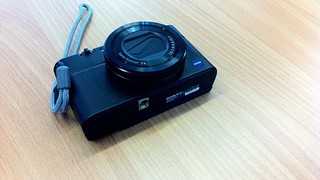
Jonathan Dowland: New camera

Sony RX100-III
Earlier in the year I treated myself to a new camera. It's been many years since I bought one, which was a perfectly serviceable Panasonic FS-15 compact, to replace my lost-or-stolen Panasonic TZ3, which I loved. The FS-15 didn't have a "wow" factor and with the advent of smartphones and fantastic smartphone cameras, it rarely left a drawer at home. Last year I upgraded my mobile from an iPhone to a Motorola Moto G, which is a great phone in many respects, but has a really poor camera. I was given a very generous gift voucher when I left my last job and so had the perfect excuse to buy a dedicated camera. I'd been very tempted by a Panasonic CSC camera ever since I read this review of the GF1 years ago, and the GM1 was high on my list, but there were a lot of compromises: no EVF... In the end I picked up a Sony RX 100 Mark 3 which had the right balance of compromises for me. I haven't posted a lot of photos to this site in the past but I hope to do so in future. I've got to make some alterations to the software first. Post-script: Craig Mod, who wrote that GF1 review, wrote another interesting essay a few years later: Cameras, Goodbye, where he discusses whether smartphone cameras are displacing even the top end of the Camera market.

14 July 2015

Matthew Palmer: Why DANE isn't going to win

In a comment to my previous post, Daniele asked the entirely reasonable question,
Would you like to comment on why you think that DNSSEC+DANE are not a possible and much better alternative?
Where DANE fails to be a feasible alternative to the current system is that it is not widely acknowledged to be superior in every possible way . A weak demonstration of this is that no browser has implemented DANE support, and very few other TLS-using applications have, either. The only thing I use which has DANE support that I m aware of is Postfix and SMTP is an application in which the limitations of DANE have far less impact. My understanding of the limitations of DANE, for large-scale deployment, are enumerated below.

DNS Is Awful Quoting Google security engineer Adam Langley:
But many (~4% in past tests) of users can t resolve a TXT record when they can resolve an A record for the same name. In practice, consumer DNS is hijacked by many devices that do a poor job of implementing DNS.
Consider that TXT records are far, far older than TLSA records. It seems likely that TLSA records would fail to be retrieved greater than 4% of the time. Extrapolate to the likely failure rate for lookup of TLSA records would be, and imagine what that would do to the reliability of DANE verification. It would either be completely unworkable, or else would cause a whole new round of just click through the security error training. Ugh. This also impacts DNSSEC itself. Lots of recursive resolvers don t validate DNSSEC, and some providers mangle DNS responses in some way, which breaks DNSSEC. Since OSes don t support DNSSEC validation by default (for example, by having the name resolution APIs indicate DNSSEC validation status), browsers would essentially have to ship their own validating resolver code. Some people have concerns around the single point of control for DNS records, too. While the weakest link nature of the CA model is terribad, there is a significant body of opinion that replacing it with a single, minimally-accountable organisation like ICANN isn t a great trade. Finally, performance is also a concern. Having to go out-of-band to retrieve TLSA records delays page generation, and nobody likes slow page loads.

DNSSEC Is Awful Lots of people don t like DNSSEC, for all sorts of reasons. While I don t think it is quite as bad as people make out (I ve deployed it for most zones I manage, there are some legitimate issues that mean browser vendors aren t willing to rely on DNSSEC. 1024 bit RSA keys are quite common throughout the DNSSEC system. Getting rid of 1024 bit keys in the PKI has been a long-running effort; doing the same for DNSSEC is likely to take quite a while. Yes, rapid rotation is possible, by splitting key-signing and zone-signing (a good design choice), but since it can t be enforced, it s entirely likely that long-lived 1024 bit keys for signing DNSSEC zones is the rule, rather than exception.

DNS Providers are Awful While we all poke fun at CAs who get compromised, consider how often someone s DNS control panel gets compromised. Now ponder the fact that, if DANE is supported, TLSA records can be manipulated in that DNS control panel. Those records would then automatically be DNSSEC signed by the DNS provider and served up to anyone who comes along. Ouch. In theory, of course, you should choose a suitably secure DNS provider, to prevent this problem. Given that there are regular hijackings of high-profile domains (which, presumably, the owners of those domains would also want to prevent), there is something in the DNS service provider market which prevents optimal consumer behaviour. Market for lemons, perchance?

Conclusion None of these problems are unsolvable, although none are trivial. I like DANE as a concept, and I d really, really like to see it succeed. However, the problems I ve listed above are all reasonable objections, made by people who have their hands in browser codebases, and so unless they re fixed, I don t see that anyone s going to be able to rely on DANE on the Internet for a long, long time to come.

12 July 2015

Lunar: Reproducible builds: week 11 in Stretch cycle

Debian is undertaking a huge effort to develop a reproducible builds system. I'd like to thank you for that. This could be Debian's most important project, with how badly computer security has been going.

PerniciousPunk in Reddit's Ask me anything! to Neil McGovern, DPL. What happened in the reproducible builds effort this week: Toolchain fixes More tools are getting patched to use the value of the SOURCE_DATE_EPOCH environment variable as the current time:

In the reproducible experimental toolchain which have been uploaded: Johannes Schauer followed up on making sbuild build path deterministic with several ideas. Packages fixed The following 311 packages became reproducible due to changes in their build dependencies : 4ti2, alot, angband, appstream-glib, argvalidate, armada-backlight, ascii, ask, astroquery, atheist, aubio, autorevision, awesome-extra, bibtool, boot-info-script, bpython, brian, btrfs-tools, bugs-everywhere, capnproto, cbm, ccfits, cddlib, cflow, cfourcc, cgit, chaussette, checkbox-ng, cinnamon-settings-daemon, clfswm, clipper, compton, cppcheck, crmsh, cupt, cutechess, d-itg, dahdi-tools, dapl, darnwdl, dbusada, debian-security-support, debomatic, dime, dipy, dnsruby, doctrine, drmips, dsc-statistics, dune-common, dune-istl, dune-localfunctions, easytag, ent, epr-api, esajpip, eyed3, fastjet, fatresize, fflas-ffpack, flann, flex, flint, fltk1.3, fonts-dustin, fonts-play, fonts-uralic, freecontact, freedoom, gap-guava, gap-scscp, genometools, geogebra, git-reintegrate, git-remote-bzr, git-remote-hg, gitmagic, givaro, gnash, gocr, gorm.app, gprbuild, grapefruit, greed, gtkspellmm, gummiboot, gyp, heat-cfntools, herold, htp, httpfs2, i3status, imagetooth, imapcopy, imaprowl, irker, jansson, jmapviewer, jsdoc-toolkit, jwm, katarakt, khronos-opencl-man, khronos-opengl-man4, lastpass-cli, lava-coordinator, lava-tool, lavapdu, letterize, lhapdf, libam7xxx, libburn, libccrtp, libclaw, libcommoncpp2, libdaemon, libdbusmenu-qt, libdc0, libevhtp, libexosip2, libfreenect, libgwenhywfar, libhmsbeagle, libitpp, libldm, libmodbus, libmtp, libmwaw, libnfo, libpam-abl, libphysfs, libplayer, libqb, libsecret, libserial, libsidplayfp, libtime-y2038-perl, libxr, lift, linbox, linthesia, livestreamer, lizardfs, lmdb, log4c, logbook, lrslib, lvtk, m-tx, mailman-api, matroxset, miniupnpd, mknbi, monkeysign, mpi4py, mpmath, mpqc, mpris-remote, musicbrainzngs, network-manager, nifticlib, obfsproxy, ogre-1.9, opal, openchange, opensc, packaging-tutorial, padevchooser, pajeng, paprefs, pavumeter, pcl, pdmenu, pepper, perroquet, pgrouting, pixz, pngcheck, po4a, powerline, probabel, profitbricks-client, prosody, pstreams, pyacidobasic, pyepr, pymilter, pytest, python-amqp, python-apt, python-carrot, python-django, python-ethtool, python-mock, python-odf, python-pathtools, python-pskc, python-psutil, python-pypump, python-repoze.tm2, python-repoze.what, qdjango, qpid-proton, qsapecng, radare2, reclass, repsnapper, resource-agents, rgain, rttool, ruby-aggregate, ruby-albino, ruby-archive-tar-minitar, ruby-bcat, ruby-blankslate, ruby-coffee-script, ruby-colored, ruby-dbd-mysql, ruby-dbd-odbc, ruby-dbd-pg, ruby-dbd-sqlite3, ruby-dbi, ruby-dirty-memoize, ruby-encryptor, ruby-erubis, ruby-fast-xs, ruby-fusefs, ruby-gd, ruby-git, ruby-globalhotkeys, ruby-god, ruby-hike, ruby-hmac, ruby-integration, ruby-jnunemaker-matchy, ruby-memoize, ruby-merb-core, ruby-merb-haml, ruby-merb-helpers, ruby-metaid, ruby-mina, ruby-net-irc, ruby-net-netrc, ruby-odbc, ruby-ole, ruby-packet, ruby-parseconfig, ruby-platform, ruby-plist, ruby-popen4, ruby-rchardet, ruby-romkan, ruby-ronn, ruby-rubyforge, ruby-rubytorrent, ruby-samuel, ruby-shoulda-matchers, ruby-sourcify, ruby-test-spec, ruby-validatable, ruby-wirble, ruby-xml-simple, ruby-zoom, rumor, rurple-ng, ryu, sam2p, scikit-learn, serd, shellex, shorewall-doc, shunit2, simbody, simplejson, smcroute, soqt, sord, spacezero, spamassassin-heatu, spamprobe, sphinxcontrib-youtube, splitpatch, sratom, stompserver, syncevolution, tgt, ticgit, tinyproxy, tor, tox, transmissionrpc, tweeper, udpcast, units-filter, viennacl, visp, vite, vmfs-tools, waffle, waitress, wavtool-pl, webkit2pdf, wfmath, wit, wreport, x11proto-input, xbae, xdg-utils, xdotool, xsystem35, yapsy, yaz. Please note that some packages in the above list are falsely reproducible. In the experimental toolchain, debhelper exported TZ=UTC and this made packages capturing the current date (without the time) reproducible in the current test environment. The following packages became reproducible after getting fixed: Ben Hutchings upstreamed several patches to fix Linux reproducibility issues which were quickly merged. Some uploads fixed some reproducibility issues but not all of them: Uploads that should fix packages not in main: Patches submitted which have not made their way to the archive yet: reproducible.debian.net A new package set has been added for lua maintainers. (h01ger) tracker.debian.org now only shows reproducibility issues for unstable. Holger and Mattia worked on several bugfixes and enhancements: finished initial test setup for NetBSD, rewriting more shell scripts in Python, saving UDD requests, and more debbindiff development Reiner Herrmann fixed text comparison of files with different encoding. Documentation update Juan Picca added to the commands needed for a local test chroot installation of the locales-all package. Package reviews 286 obsolete reviews have been removed, 278 added and 243 updated this week. 43 new bugs for packages failing to build from sources have been filled by Chris West (Faux), Mattia Rizzolo, and h01ger. The following new issues have been added: timestamps_in_manpages_generated_by_ronn, timestamps_in_documentation_generated_by_org_mode, and timestamps_in_pdf_generated_by_matplotlib. Misc. Reiner Herrmann has submitted patches for OpenWrt. Chris Lamb cleaned up some code and removed cruft in the misc.git repository. Mattia Rizzolo updated the prebuilder script to match what is currently done on reproducible.debian.net.

7 July 2015

Lunar: Reproducible builds: week 10 in Stretch cycle

What happened about the reproducible builds effort this week: Media coverage Daniel Stender published an English translation of the article which originally appeared in Linux Magazin in Admin Magazine. Toolchain fixes Fixes landed in the Debian archive: Lunar submitted to Debian the patch already sent upstream adding a --clamp-mtime option to tar. Patches have been submitted to add support for SOURCE_DATE_EPOCH to txt2man (Reiner Herrmann), epydoc (Reiner Herrmann), GCC (Dhole), and Doxygen (akira). Dhole uploaded a new experimental debhelper to the reproducible repository which exports SOURCE_DATE_EPOCH. As part of the experiment, the patch also sets TZ to UTC which should help with most timezone issues. It might still be problematic for some packages which would change their settings based on this. Mattia Rizzolo sent upstream a patch originally written by Lunar to make the generate-id() function be deterministic in libxslt. While that patch was quickly rejected by upstream, Andrew Ayer came up with a much better one which sadly could have some performance impact. Daniel Veillard replied with another patch that should be deterministic in most cases without needing extra data structures. It's impact is currently being investigated by retesting packages on reproducible.debian.net. akira added a new option to sbuild for configuring the path in which packages are built. This will be needed for the srebuild script. Niko Tyni asked Perl upstream about it using the __DATE__ and __TIME__ C processor macros. Packages fixed The following 143 packages became reproducible due to changes in their build dependencies: alot, argvalidate, astroquery, blender, bpython, brian, calibre, cfourcc, chaussette, checkbox-ng, cloc, configshell, daisy-player, dipy, dnsruby, dput-ng, dsc-statistics, eliom, emacspeak, freeipmi, geant321, gpick, grapefruit, heat-cfntools, imagetooth, jansson, jmapviewer, lava-tool, libhtml-lint-perl, libtime-y2038-perl, lift, lua-ldoc, luarocks, mailman-api, matroxset, maven-hpi-plugin, mknbi, mpi4py, mpmath, msnlib, munkres, musicbrainzngs, nova, pecomato, pgrouting, pngcheck, powerline, profitbricks-client, pyepr, pylibssh2, pylogsparser, pystemmer, pytest, python-amqp, python-apt, python-carrot, python-crypto, python-darts.lib.utils.lru, python-demgengeo, python-graph, python-mock, python-musicbrainz2, python-pathtools, python-pskc, python-psutil, python-pypump, python-repoze.sphinx.autointerface, python-repoze.tm2, python-repoze.what-plugins, python-repoze.what, python-repoze.who-plugins, python-xstatic-term.js, reclass, resource-agents, rgain, rttool, ruby-aggregate, ruby-archive-tar-minitar, ruby-bcat, ruby-blankslate, ruby-coffee-script, ruby-colored, ruby-dbd-mysql, ruby-dbd-odbc, ruby-dbd-pg, ruby-dbd-sqlite3, ruby-dbi, ruby-dirty-memoize, ruby-encryptor, ruby-erubis, ruby-fast-xs, ruby-fusefs, ruby-gd, ruby-git, ruby-globalhotkeys, ruby-god, ruby-hike, ruby-hmac, ruby-integration, ruby-ipaddress, ruby-jnunemaker-matchy, ruby-memoize, ruby-merb-core, ruby-merb-haml, ruby-merb-helpers, ruby-metaid, ruby-mina, ruby-net-irc, ruby-net-netrc, ruby-odbc, ruby-packet, ruby-parseconfig, ruby-platform, ruby-plist, ruby-popen4, ruby-rchardet, ruby-romkan, ruby-rubyforge, ruby-rubytorrent, ruby-samuel, ruby-shoulda-matchers, ruby-sourcify, ruby-test-spec, ruby-validatable, ruby-wirble, ruby-xml-simple, ruby-zoom, ryu, simplejson, spamassassin-heatu, speaklater, stompserver, syncevolution, syncmaildir, thin, ticgit, tox, transmissionrpc, vdr-plugin-xine, waitress, whereami, xlsx2csv, zathura. The following packages became reproducible after getting fixed: Some uploads fixed some reproducibility issues but not all of them: Patches submitted which have not made their way to the archive yet: reproducible.debian.net A new package set for the X Strike Force has been added. (h01ger) Bugs tagged with locale are now visible in the statistics. (h01ger) Some work has been done add tests for NetBSD. (h01ger) Many changes by Mattia Rizzolo have been merged on the whole infrastructure: debbindiff development Version 26 has been released on June 28th fixing the comparison of files of unknown format. (Lunar) A missing dependency identified in python-rpm affecting debbindiff installation without recommended packages was promptly fixed by Michal iha . Lunar also started a massive code rearchitecture to enhance code reuse and enable new features. Nothing visible yet, though. Documentation update josch and Mattia Rizzolo documented how to reschedule packages from Alioth. Package reviews 142 obsolete reviews have been removed, 344 added and 107 updated this week. Chris West (Faux) filled 13 new bugs for packages failing to build from sources. The following new issues have been added: snapshot_placeholder_replaced_with_timestamp_in_pom_properties, different_encoding, timestamps_in_documentation_generated_by_org_mode and timestamps_in_pdf_generated_by_matplotlib.

Next.

Previous.