If There is any sort of food for thought worth reading, this is it.
INDIGNEZ-VOUS! GET ANGRY! CRY OUT by
St phane Hessel
After 93 years, it is almost the final act. The end for me is not very far off any more. But it still leaves me a chance to be able to remind others of what acted as the basis of my political engagement. It was the years of resistance to the Nazi occupation -- and the program of social rights worked out 66 years ago by the National Council of the Resistance!
It is to Jean Moulin [murdered founder of the Council] that we owe, as part of this Council, the uniting of all elements of occupied France -- the movements, the parties, the labor unions -- to proclaim their membership in Fighting France, and we owe this to the only leader that it acknowledged, General de Gaulle. From London, where I had joined de Gaulle in March 1941, I learned that this Council had completed a program and adopted it on March 15th, 1944, that offered for liberated France a group of principles and values on which would rest the modern democracy of our country.
These principles and these values, we need today more than ever. It is up to us to see to it, all together, that our society becomes a society of which we are proud, not this society of immigrants without papers -- expulsions, suspicion regarding the immigrants. Not this society where they call into question social security and national retirement and health plans. Not this society where mass media are in the hands of the rich. These are things that we would have refused to give in to if we had been the true heirs of the National Council of the Resistance.
From 1945, after a dreadful drama [WWII], it was an ambitious
resurrection of society to which the remaining contingent of the Council
of the Resistance devoted itself. Let us remember them while creating
national health and pensions plans such as the Resistance wished, as its
program stipulated, "a full plan of French national health and social
security, aimed at assuring all citizens the means of existence whenever
they are unable to obtain them by a job; a retirement allowing the old
workers to finish their days with dignity."
The sources of energy, electricity, and gas, mines, the big banks, were
nationalized. Now this was as the program recommended: "... the return
to the nation of big monopolized means of production, fruits of common
labor, sources of energy, wealth from the mines, from insurance
companies and from big banks; the institution of a true economic and
social democracy involving the ousting of the big economic and financial
fiefdoms from the direction of the economy."
General interest must dominate over special interest. The just man
believes that wealth created in the realm of labor should dominate over
the power of money.
The Resistance proposed, "a rational organization of the economy
assuring the subordination of special interests to general interest, and
the emancipation of 'slaves' of the professional dictatorship that was
instituted just as in the fascist states," which had used the interim
[for two years after the war] government of the Republic as an agent.
A true democracy needs an independent press, and the Resistance
acknowledged it, demanded it, by defending "the freedom of the press,
its honor, and its independence from the State, the power of money and
foreign influence." This is what relieved restrictions on the press from
1944 on. And press freedom is definitely what is in danger today.
The Resistance called for a "real possibility for all French children to
benefit from the most advanced education," without discrimination.
Reforms offered in 2008 go contrary to this plan. Young teachers, whose
actions I support, went so far as refusing to apply them, and they saw
their salaries cut by way of punishment. They were indignant,
"disobeyed," judging these reforms too far from the ideal of the
democratic school, too much in the service of a society of commerce and
not developing the inventive and critical mind enough. 2
All the foundations of the social conquests of the Resistance are
threatened today.
The motive of the Resistance: indignation (Indignez-vous!)
Some dare to say to us that the State cannot afford the expenses of
these measures for citizens any more. But how can there be today a lack
of money to support and extend these conquests while the production of
wealth has been considerably augmented since the Liberation period when
Europe was in ruins? On the contrary, the problem is the power of money,
so much opposed by the Resistance, and of the big, boldfaced, selfish
man, with his own servants in the highest spheres of the State.
Banks, since privatized again, have proved to be concerned foremost for
their dividends and for the very high salaries of their leaders, not the
general interest. The disparity between the poorest and the richest has
never been so great, and amassing money, competition, so encouraged.
The basic motive of the Resistance was indignation!
We, the veterans of the resistance movements and combat forces of Free
France, we call on the young generation to live by, to transmit, the
legacy of the Resistance and its ideals. We say to them: Take our place,
"Indignez-vous!" [Get angry! or Cry out!].
The political, economic, intellectual leaders, and the whole society do
not have to give in, nor allow oppression by an actual international
dictatorship of the financial markets, which threatens peace and
democracy.
I wish for you all, each of you, to have your own motive for
indignation. It is precious. When something outrages you as I was
outraged by Nazism, then people become militant, strong, and engaged.
They join this current of history, and the great current of history must
continue thanks to each individual. And this current goes towards more
justice, more freedom, but not this unbridled freedom of the fox in the
henhouse. The rights contained in the UN Universal Declaration of Human
Rights of 1948 are just that, universal.
If you meet somebody who does not benefit from it, feel sorry for them
but help them to win their rights.
Two visions of history
When I try to understand what caused fascism, what made it so we were
overcome by Hitler and the Vichy [French government that collaborated
with Hitler], I tell myself that the propertied, with their selfishness,
were terrifically afraid of Bolshevik revolution. They were allowed to
lead with their fear.
But if, today as then, an active minority stands up, it will be enough;
we shall be the leavening that makes the bread rise. Certainly, the
experience of a very old person like me, born in 1917, is different from
the experience of the today's young persons. I often ask professors for
the opportunity to interact with their students, and I say to them: You
don't have the same obvious reasons to engage you. For us, to resist was
not to accept German occupation, defeat. It was comparatively simple.
Simple as what followed, decolonization. Then the war in Algeria.
It was necessary that Algeria become independent, it was obvious. As for
Stalin, we all applauded the victory of the Red Army against the Nazis
in 1943. But already we had known about the big Stalinist trials of
1935, and even if it was necessary to keep an ear open towards communism
to compensate against American capitalism, the necessity to oppose this
unbearable form of totalitarianism had established itself as an
obviousness. My long life presented a succession of reasons to outrage
me.
These reasons were born less from an emotion than a deliberate
commitment. As a young student at normal school [teachers college] I was
very influenced by Sartre, a fellow student. His "Nausea" [a novel],
"The Wall," [play], and "The Being and Nothingness" [essay] were very
important in the training of my thought. Sartre taught us, "You are
responsible as individuals." It was a libertarian message. The
responsibility of a person can not be assigned by a power or an
authority. On the contrary, it is necessary to get involved in the name
of one's responsibility as a human being.
When I entered the French Ecole Normale Superieure, Ulm Street, in Paris
in 1939, I entered it as a fervent adherent of the philosopher Hegel,
and I adhered to the thought of Maurice Merleau-Ponty. His teaching
explored concrete experience, that of the body and of its relations with
the senses, one big singular sense faced with a plurality of senses. But
my natural optimism, which wants all that is desirable to be possible,
carried me rather towards Hegel. Hegelism interprets the long history of
humanity as having a meaning: It is the freedom of man progressing step
by step. History is made of successive shocks, and the taking into
account of challenges. The history of societies thus advances; and in
the end, man having attained his full freedom, we have the democratic
state in its ideal form.
There is certainly another understanding of history. It says progress is
made by "freedom" of competition, striving for "always more"; it can be
as if living in a devastating hurricane. That's what it represented to a
friend of my father, the man who shared with him an effort to translate
into German "The Search for Time Lost" [novel] by Marcel Proust.
That was the German philosopher Walter Benjamin. He had drawn a
pessimistic view from a painting by the Swiss painter Paul Klee,
"Angelus Novus," where the face of the angel opens arms as if to contain
and push back a tempest, which he identifies with progress. For
Benjamin, who would commit suicide in September 1940 to escape Nazism,
the sense of history is the overpowering progression of disaster upon
disaster.
Indifference: the worst of attitudes
It is true the reasons to be indignant can seem today less clearly
related or the world too complex. Who's doing the ordering, who decides?
It is not always easy to differentiate between all the currents that
govern us. We are not any more dealing with a small elite whose joint
activities can be clearly seen. It is a vast world, of which we have a
feeling of interdependence.
We live in an interconnectivity as never before. But in this world there
still are intolerable things. To see them, it is well and necessary to
look, to search. I say to the young people, Search little, and that is
what you are going to find. The worst of attitudes is indifference, to
say "I can do nothing there, I'll just manage to get by." By including
yourself in that, you lose one of the essential elements that makes the
human being: the faculty of indignation and the commitment that is a
consequence of it.
They [young people] can already identify two big new challenges:
1. The huge gap which exists between the very poor and the very rich and
that does not cease increasing. It is an innovation of the 20th and 21st
centuries. The very poor in the today's world earn barely two dollars a
day. The new generation cannot let this gap become even greater. The
official reports alone should provoke a commitment.
2. Human rights and state of the planet: I had the chance after the
Liberation to join in the writing of the Universal Declaration of Human
Rights, adopted by the United Nations organization, on December 10th,
1948, in Paris at the palace of Chaillot. It was as principal private
secretary of Henry Laugier, the adjunct general-secretary of the UN, and
as and secretary of the Commission on Human Rights that I with others
was led to participate in the writing of this statement. I wouldn't know
how to forget the role in its elaboration of Ren Cassin, who was
national commissioner of justice and education in the government of Free
France in London in 1941 and won the Nobel peace prize in 1968, nor that
of Pierre Mend s-France in the Economic and Social Council, to whom the
text drafts we worked out were submitted before being considered by the
Third Committee (Social, Humanitarian and Cultural) of the General
Assembly. It was ratified by the 54 member states in session of the
United Nations, and I certified it as secretary.
It is to Ren Cassin that we owe the term "universal rights" instead of
"international rights" as offered by our American and British friends.
This [universal versus international] was key because, at the end of the
Second World War, what was at stake was to becomeereignty," which a
nation can emphasize while it devotes itself to crimes against humanity
on its own soil. Such was the case of Hitler, who felt himself supreme
and authorized to carry out a genocide. This universal statement owed
much to universal revulsion towards Nazism, fascism, and totalitarianism
-- and owes a lot, in our minds, to the spirit of the Resistance.
I had a feeling that it was necessary to move quickly so as not to be
dupes of the hypocrisy that there was in the UN membership, some whom
claimed these values already won but had no intention at all to promote
them faithfully -- claimed that we were trying to impose values on them.
I can not resist the desire to quote Article 15 of the Universal
Declaration of Human Rights (1948): "Everyone has the right to a
nationality." Article 22 says, "Everyone, as a member of society, has
the right to social security and is entitled to realization, through
national effort and international cooperation and in accordance with the
organization and resources of each State, of the economic, social and
cultural rights indispensable for his dignity and the free development
of his personality." And if this statement has a declarative scope, and
not statutory, the Declaration nevertheless has played a powerful role
since 1948. It saw colonized people take it up in their fight for
independence; it sowed minds in a battle for freedom.
I note with pleasure that in the course of last decades there has been
an increase in nongovernmental organizations (NGOs) and social movements
such as ATTAC (Association for the Taxation of Financial Transactions);
also FIDH (International Federation for Human Rights) and Amnesty
International, which are active and competitive. It is obvious that to
be effective today it is necessary to act in a network, to use all
modern means of communication.
To the young people, I say: Look around you, you will find topics that
justify your indignation facts about treatment of immigrants, of
"illegal" immigrants, of the Roma [aka Gypsies]. You will find concrete
situations that lead you to strong citizen action. Search and you shall
find!
My indignation regarding Palestine outrages by Israel [Indignez-vous!]
Today, my main indignation concerns Palestine, the Gaza Strip, and the
West Bank of Jordan. This conflict is outrageous. It is absolutely
essential to read the report by Richard Goldstone, of September 2009, on
Gaza, in which this South African, Jewish judge, who claims even to be a
Zionist, accuses the Israeli army of having committed "acts comparable
to war crimes and perhaps, in certain circumstances, crimes against
humanity" during its "Operation Cast Lead," which lasted three weeks.
I went back to Gaza in 2009 myself, when I was able to enter with my
wife thanks to our diplomatic passports, to study first-hand what this
report said. People who accompanied us were not authorized to enter the
Gaza Strip. There and in the West Bank of Jordan. We also visited the
Palestinian refugee camps set up from 1948 by the United Nations agency
UNRWA, where more than three million Palestinians expelled off their
lands by Israel wait even yet for a more and more problematical return.
As for Gaza, it is a roofless prison for one and a half million
Palestinians. A prison where people get organized just to survive.
Despite material destruction such as that of the Red Crescent hospital
by Operation Cast Lead, it is the behavior of the Gazans, their
patriotism, their love of the sea and beaches, their constant
preoccupation for the welfare of their children, who are innumerable and
cheerful, that haunt our memory. We were impressed by how ingeniously
they face up to all the scarcities that are imposed on them. We saw them
making bricks, for lack of cement, to rebuild the thousands of houses
destroyed by tanks. They confirmed to us that there had been 1400 deaths
including women, children, and oldsters in the Palestinian camp
during this Operation Cast Lead led by the Israeli army, compared to
only 50 injured men on the Israeli side. I share conclusions of the
South African judge. That Jews can, themselves, perpetrate war crimes is
unbearable. Alas, history does not give enough examples of people who
draw lessons from their own history. [The author, St phane Hessel, had
a Jewish father.]
Terrorism, or exasperation?
I know that Hamas [party of Palestine freedom fighters], which had won
the last legislative elections, could not help it that rockets were
launched on Israeli cities in response to the situation of isolation and
blockade in which Gazans exist. I think, naturally, that terrorism is
unacceptable; but it is necessary to acknowledge (from experience in
France) that when people are occupied by forces immensely superior to
their own, popular reaction cannot be altogether bloodless.
Does it serve Hamas to send rockets onto the town of Sd rot [Israeli
town across the border from Gaza]?
The answer is no. This does not serve their purpose, but they can
explain this gesture by the exasperation of Gazans. In the notion of
exasperation, it is necessary to understand violence as the regrettable
conclusion of situations not acceptable to those who are subjected them.
Thus, they can tell themselves, terrorism is a form of exasperation. And
that this "terrorism" is a misnomer. One should not have to resort to
this exasperation, but it is necessary to have hope. Exasperation is a
denial of hope. It is comprehensible, I would say almost natural, but it
still is not acceptable. Because it does not allow one to acquire
results that hope can possibly, eventually produce.
Nonviolence: the way we must learn to follow
I am persuaded that the future belongs to nonviolence, to reconciliation
of different cultures. It is by this way that humanity will have to
enter its next stage. But on this I agree with Sartre: We cannot excuse
the terrorists who throw bombs, but we can understand them. Sartre wrote
in 1947: "I recognize that violence in whatever form it may manifest
itself is a setback. But it is an inevitable setback because we are in a
world of violence. And if it is true that recourse to violence risks
perpetuating it, it is also true it is the sure means to make it stop."
To that I would add that nonviolence is a surer means of making violence
stop. One can not condone the terrorism, using Sartre or in the name of
this principle, during the war of Algeria, nor during the Munich Games
of 1972 the murder attempt made against Israeli athletes. Terrorism is
not productive, and Sartre himself would end up wondering at the end of
his life about the sense of violence and doubt its reason for being.
However, to proclaim "violence is not effective" is more important than
to know whether one must condemn or not those who devote themselves to
it. Terrorism is not effective. In the notion of effectiveness, a
bloodless hope is needed. If there is a violent hope, it is in the poem
of William Apollinaire "that hope is violent," and not in policy.
Sartre, in March 1980, within three weeks of his death, declared: "It is
necessary to try to explain why the world of today, which is horrible,
is only an instant in a long historical development, that hope always
has been one of the dominant forces in revolutions and insurrections,
and how I still feel hope as my conception of the future." [Note 5]
It is necessary to understand that violence turns its back on hope. It
is necessary to prefer to it hope, hope over violence. Nonviolence is
the way that we must learn to follow. So must the oppressors.
10
It is necessary to arrive at negotiations to remove oppression; it is
what will allow you to have no more terrorist violence. That's why you
should not let too much hate pile up.
The message of Mandela and Martin Luther King finds all its pertinence
in the world that overcame the confrontation of ideologies [e.g.,
Nazism] and conquered totalitarianism [e.g.,Hitler]. It is also a
message of hope in the capacity of modern societies to overcome
conflicts by a mutual understanding and a vigilant patience. To reach
that point is necessarily based on rights, against es, such as the
military intervention in Iraq.
We had this economic crisis, but we still did not initiate a new policy
of development. Also, the summit of Copenhagen against climatic warming
did not bring about a true policy for the preservation of the planet.
We are on a threshold between the terror of the first decade and the
possibilities of following decades. But it is necessary to hope, it is
always necessary to hope. The previous decade, that of 1990s, had been a
time of great progress. The United Nations had enough wisdom to call
conferences such as those of Rio on environment, in 1992, and that of
Beijing on women, in 1995. In September 2000, on the initiative of the
general secretary of United Nations, Kofi Annan, the 191 member
countries adopted a statement on the "eight objectives of the millennium
for development," by which they notably promised to reduce poverty in
the world by half before 2015.
My big regret is that neither Obama nor the European Union has yet
committed themselves to what should be the provision for a useful forum
bearing on the fundamental values.
Conclusion
How to conclude this call to be indignant? By saying still what, on the
occasion of the sixtieth anniversary of the program of the National
Council of the Resistance, we said on March 8th, 2004 -- we veterans of
the resistance movements and combat forces of Free France (1940-1945) --
that certainly "Nazism was conquered, thanks to the sacrifice of our
brothers and sisters of the Resistance and United Nations against
fascist barbarism. But this threat did not completely disappear, and our
anger against injustice is ever intact." [Note 6] Also, let us always be
called in "a truly peaceful insurrection against means of mass
communication that offer as a vista for our youth only the consumption
of mass trivia, contempt of the weakest and the culture, a generalized
amnesia, and the hard competition of all against all."
To those who will make the 21st century, we say with our affection:
TO CREATE IS TO RESIST; TO RESIST IS TO CREATE.


 Getting a birthday present is always nice, of course. This one made me itch to go outside and hunt for nice motifs, though ... Images are straight from the camera, just a bit cropped (look at the EXIF if you feel like it.) If you don't want to look at the EXIF: the beautiful new lens is the Canon Canon EF 70-200mm 1:2.8 L IS II USM (like all manufacturers, Canon likes to collect funny abbreviations at the end of their product names though I feel they're not as bad as some...), and I truly like what I'm seeing so far. That this lens has excellent sharpness goes without saying (especially on the 40D with modest 10MPixel on a crop sensor), see the comparison with the old EF 100-300mm f/4.5-5.6 USM (the piccolo picture.) Beyond sharpness, there's the 1:2.8 aperture, the IS really keeps what it promises (and is absolutely silent), and AF is quiet and ultra fast as well. I've only got it today, so I took only a few shots I'm confident that CA, flare resistance etc. will live up to reputation though. Now I'm really starting about a full frame camera with higher MP count to take full advantage of my lenses (you may remember that I quite like decent equipment; the wideangle is said to be usable for full frame down to ca. 14mm although it's really designed for crop sensor...)
The obvious question is if I really can take better pictures just because I'm now lugging around a 6kg bag of stuff ... but honestly, having a telephoto lens without image stabilisation was a pain, so getting the old tele replaced was the obvious next step.Oh yes, and: see you in Banja Luka! :-)


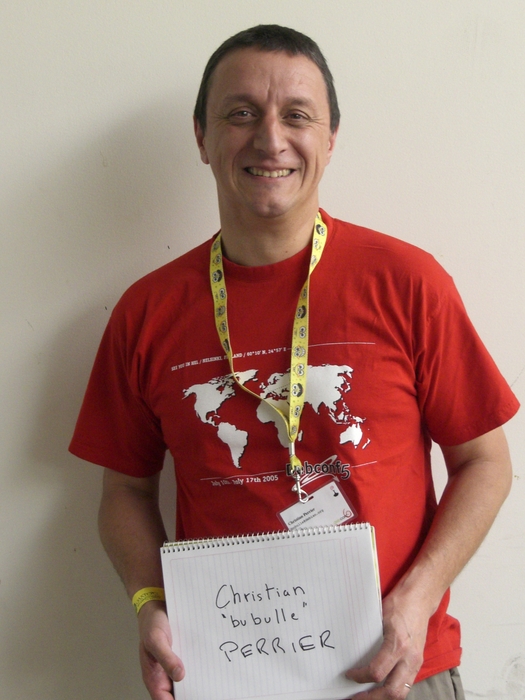
 but you ll be traveling the world while reading him.
My questions are in bold, the rest is by Christian.
Who are you?
I am a French citizen (which is easy to guess unless you correct my
usual mistakes in what follows). I m immensely proud of being married
for nearly 26 years with Elizabeth (who deserves a statue from Debian
for being so patient with my passion and my dedication to the
project).
I m also the proud father of 3 wonderful kids , aged 19 to
23.
I work as team manager in the Networks and Computers Division of Onera
the French Aerospace lab , a public research institute about
Aeronautics, Space and Defense. My team provides computer management
services for research divisions of Onera, with a specific focus put on
individual computing.
I entered the world of free software as one of the very first users of
Linux in France. Back in the early 1990 s, I happened (though the BBS
users communities) to be a friend of several early adopters of Linux
and/or BSD386/FreeBSD/NetBSD in France. More specifically, I
discovered Linux thanks with my friend Ren Cougnenc (all my free
software talks are dedicated to Ren , who passed away in 1996).
You re not a programmer, not even a packager. How did you come
to Debian?
I m definitely not a programmer and I never studied computing (I
graduated in Materials Science and worked in that area for a few years
after my PhD).
However, my daily work always involved computing (I redesigned the
creep testing laboratory and its acquisition system all by myself
during my thesis research work). An my hobbies often involved
playing with home computers, always trying to learn about something
new.
So, first learning about a new operating system then trying to
figure out how to become involved in its development was quite a
logical choice.
Debian is my distro of choice since it exists. I used Slackware on work
machines for a while, but my home server, kheops,
first ran Debian 1.1 when I stopped running a BBS on an MS-DOS machine
to host a news server. That was back in October 1996.
I then happened to be a user, and more specifically a user of
genealogy software, also participating very actively in Usenet from
this home computer and server, that was running this Debian thing.
So, progressively, I joined mailing lists and, being a passionate
person, I tried to figure out how I could bring my own little
contribution to all this.
This is why I became a packager (yes, I am one!) by taking over the
geneweb package, which I was using to publish my genealogy
research. I applied as DD in January 2001, then got my account in July
2001. My first upload to the Debian archive occurred on August 22nd
2001: that was of course geneweb, which I still maintain.
Quite quickly, I became involved in the work on French localization. I
have always been a strong supporter of localized software (I even
translated a few BBS software back in the early 90 s) as one of the
way to bring the power and richness of free software to more users.
Localization work lead me to work on the early version of Debian
Installer, during those 2003-2005 years where the development of D-I
was an incredibly motivating and challenging task, lead by Joey Hess
and his inspiring ideas.
From user to contributor to leader, I suddenly discovered, around
2004, that I became the coordinator of D-I i18n (internationalization)
without even noticing
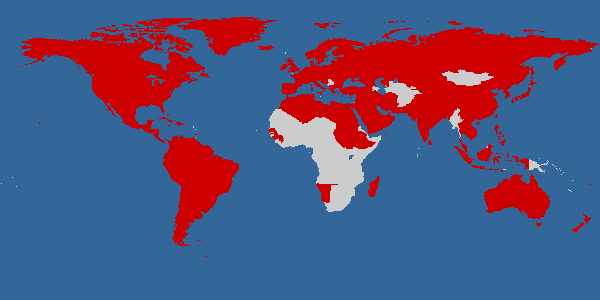

 Everybody hates Xperia
When I first got Sony Ericsson Xperia X10 it was running on Android Donut (1.6), my frustrations followed soon after mostly because it was greatly


 Google, please hurry up

 Time for a fifth Debian XSF News issue!
 Hrmh... I am listening to a local news radio station. Of course, what I am about to write lacks information and insight but it follows a conversation I have had with several groups of friends.
Our de-facto president has decreed that the tuition for private schools will be deducted from the Impuesto sobre la renta (revenue/profit tax) up to a given tuition level (IIRC up to MX$2000 a month per child per school). The interviewed subsecretary said they expect this deduction will reach MX$13,000 million, around US$1,000 million. This is, about a third of what is assigned to the National University (UNAM).
At a first sight, this sounds good. However, I just thought about a discussion I have had with many friends. This money the government will hand back to the taxpayers has to be cut from somewhere (after all, we are not in a country with huge superavit or anything like that).
Why does this sound unfair ot me? Because it benefits the few in perjudice of the many. I did a quick search, and found
 My first ever Linux installation was done in the late
nineties 1998 or thereabouts but was a RedHat 4.5
installation rather than a Debian one. The reason for that was fairly
simple: the Infomagick sixpack CD set that I'd bought contained RedHat,
Debian, and Slackware, but the RedHat installation was the only one that
could be installed directly from CD the other two required me to
write floppies and boot from those to start the installation, and I
wasn't very fond of that idea.
It was only a few years and a few broken RedHat upgrades later that I
saw the light and considered trying out this Debian thing that some of
my classmates were talking about. The fact that I'd just bought my own
computer (rather than having to compete for time with my siblings on my
parents' computer) was a good reason to do a fresh Linux installation.
I'd been planning to install Linux From Scratch, but as what was still
known as the LFS HOWTO told me you'd need a working Linux installation
to do that, I considered my options. Since I'd developed a strong
dislike of RedHat, I wasn't interested in doing another RedHat anymore.
So, I downloaded the most recent version of Debian at the time (Potato
Test Cycle III), wrote it to a CD, and installed. I've probably still got
the CD lying around somewhere.
A few months later, I found these "Linux Gazette" packages in the
archive, with the latest packaged issue being 47, but the latest
upstream version being much higher. Trying to figure out what was going
on, I mailed the maintainer, Adrian Bridgett, who encouraged me to take
over maintenance. Thus began my life of actively contributing to Open Source
software.
In November 2000, I applied to become a Debian Developer. In January
2001, Martin Michlmayr was assigned to be my AM. And in early February
2001, now just over ten years ago, I'd become a Debian Developer. Yes,
that was fast, and no, I probably wasn't really ready yet, at the
time.
Originally, I only cared much about these Linux Gazette packages.
But, as time went on, I started looking around, too. A friend passed me
an old Macintosh Centris 610. As I tried to install Debian on it, I
found that it didn't actually run very well. This turned out to be due
to it having a broken 68LC040 processor, so I bought me another
m68k-based mac, one with a full 68040 processor (a Centris 650). Thus I
became involved in the m68k port and buildd maintenance.
As these old machines came with 80MB or 250MB SCSI hard disks of
which I had none laying around, and a then-recent Debian installation
had minimum requirements of about 200MB, I was in need of network
storage to be able to do anything useful with the mac. NFS didn't work
as expected; the RTC implementation on m68k mac hardware was reverse
engineered and didn't work too well at the time, which meant that the
clock would run slower if the machine was under load, and that in turn
would mean that make would get confused about timestamps, since they
would suddenly appear to originate from the future (in NFS, it's the
server that assigns time stamps, not the client). There was a simple
solution, however; Pavel Macheck had written this neat 'Network Block
Device', which would let the client do its own filesystem on network
storage. Only it wasn't packaged; but then, that was
 Wow, that was a night. I'm still quite tired from the weekend. Someone
told me, that ~ 1 000 people subscribed to our live denting via

 Two weeks ago, Maria and I completed
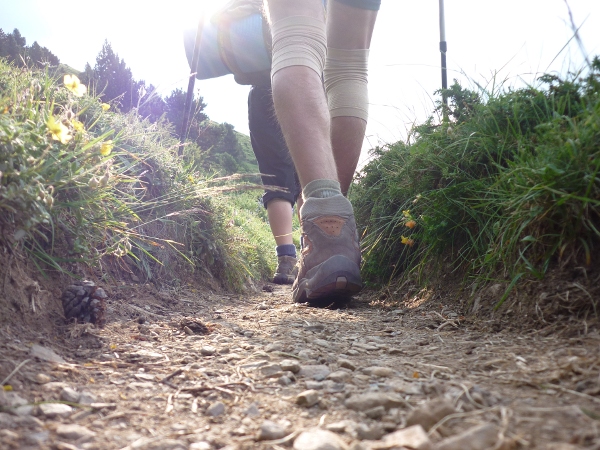 We managed to complete this challenge without facing major problems or
pains, and after the first five our six days, our legs seemed to have
gotten used to the daily effort and it started to be easier and easier.
Our morale kept growing as days passed and we advanced east. When I
started walking on a cold and rainy morning in Hondarribia, after barely
no rest in the night bus to Ir n, I thought for myself that it was
improbable that we'd manage to get anywhere near Catalunya, that one of
us would get injuried way before, or we'd just give up and go for the easy
beach vacation in the Basque Country.
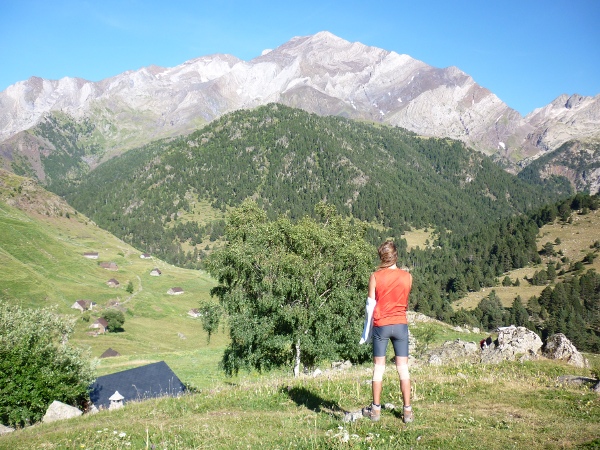
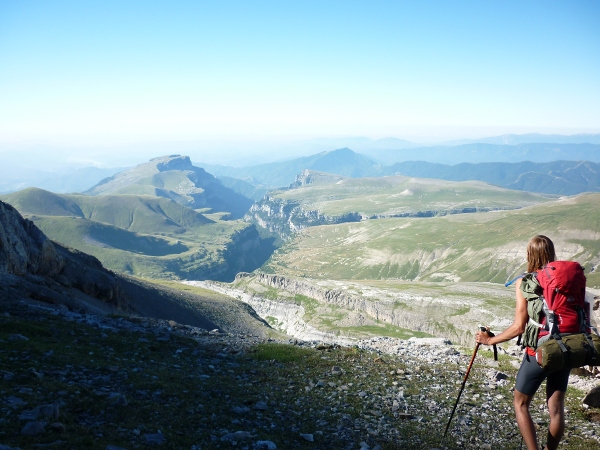
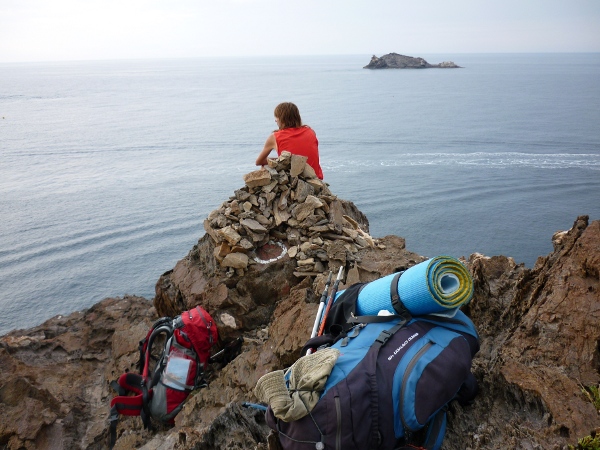
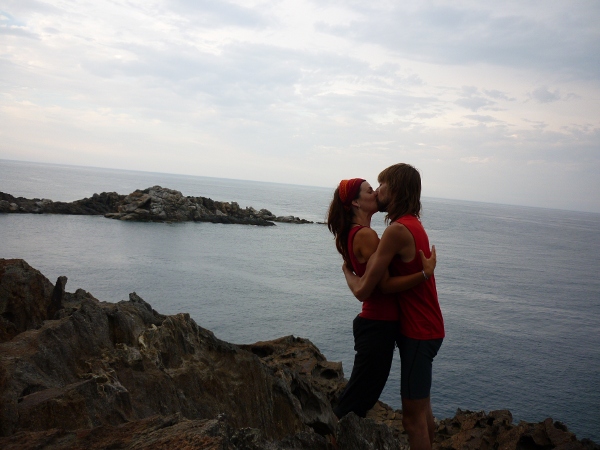 This adventure through GR 11 has been incredibly positive for us for
several reasons. We've learned a lot about ourselves and strengthened our
relation, and now I know how powerful drive can be; to get somewhere, no
matter how far, it's really easy if you just believe you can do it and
desire to get there.
Maria and I are proud of what we've done, and no wonder we're looking
for new challenges. An obvious one would be repeating this experience,
going through the French side of the Pyrenees, but for now, the Corsican
GR 20 seems the most appealing. We'll see, next summer!
 I have finally reached a decision regarding my involvement in the Debian Ruby packaging efforts. I have decided to stop. This has been a very hard decision to make. I have invested huge amounts of time in that work over the years. I still love the language, and will continue to use it on a daily basis for my own developments. I still hope that it will succeed. I know that some people will be disappointed by that decision (and that others will think your work was useless anyway, people should use RVM and rubygems ).
But I also know that I won t be able to push for all the required changes alone. I just don t have the time, nor the motivation. For the record, here are the changes I would have liked to see in the Ruby community.
The core Ruby development community should mature.
 (This is part of a series of posts on