Search Results: "bod"

12 May 2020

Daniel Silverstone: The Lars, Mark, and Daniel Club

Last night, Lars, Mark, and I discussed Jeremy Kun's The communicative value of using Git well post. While a lot of our discussion was spawned by the article, we did go off-piste a little, and I hope that my notes below will enlighten you all as to a bit of how we see revision control these days. It was remarkably pleasant to read an article where the comments section wasn't a cesspool of horror, so if this posting encourages you to go and read the article, don't stop when you reach the bottom -- the comments are good and useful too.
This was a fairly non-contentious article for us though each of us had points we wished to bring up and chat about it turned into a very convivial chat. We saw the main thrust of the article as being about using the metadata of revision control to communicate intent, process, and decision making. We agreed that it must be possible to do so effectively with Mercurial (thus deciding that the mention of it was simply a bit of clickbait / red herring) and indeed Mark figured that he was doing at least some of this kind of thing way back with CVS. We all discussed how knowing the fundamentals of Git's data model improved our ability to work wih the tool. Lars and I mentioned how jarring it has originally been to come to Git from revision control systems such as Bazaar (bzr) but how over time we came to appreciate Git for what it is. For Mark this was less painful because he came to Git early enough that there was little more than the fundamental data model, without much of the porcelain which now exists. One point which we all, though Mark in particular, felt was worth considering was that of distinguishing between published and unpublished changes. The article touches on it a little, but one of the benefits of the workflow which Jeremy espouses is that of using the revision control system as an integral part of the review pipeline. This is perhaps done very well with Git based workflows, but can be done with other VCSs. With respect to the points Jeremy makes regarding making commits which are good for reviewing, we had a general agreement that things were good and sensible, to a point, but that some things were missed out on. For example, I raised that commit messages often need to be more thorough than one-liners, but Jeremy's examples (perhaps through expedience for the article?) were all pretty trite one-liners which perhaps would have been entirely obvious from the commit content. Jeremy makes the point that large changes are hard to review, and Lars poined out that Greg Wilson did research in this area, and at least one article mentions 200 lines as a maximum size of a reviewable segment. I had a brief warble at this point about how reviewing needs to be able to consider the whole of the intended change (i.e. a diff from base to tip) not just individual commits, which is also missing from Jeremy's article, but that such a review does not need to necessarily be thorough and detailed since the commit-by-commit review remains necessary. I use that high level diff as a way to get a feel for the full shape of the intended change, a look at the end-game if you will, before I read the story of how someone got to it. As an aside at this point, I talked about how Jeremy included a 'style fixes' commit in his example, but I loathe seeing such things and would much rather it was either not in the series because it's unrelated to it; or else the style fixes were folded into the commits they were related to. We discussed how style rules, as well as commit-bisectability, and other rules which may exist for a codebase, the adherence to which would form part of the checks that a code reviewer may perform, are there to be held to when they help the project, and to be broken when they are in the way of good communication between humans. In this, Lars talked about how revision control histories provide high level valuable communication between developers. Communication between humans is fraught with error and the rules are not always clear on what will work and what won't, since this depends on the communicators, the context, etc. However whatever communication rules are in place should be followed. We often say that it takes two people to communicate information, but when you're writing commit messages or arranging your commit history, the second party is often nebulous "other" and so the code reviewer fulfils that role to concretise it for the purpose of communication. At this point, I wondered a little about what value there might be (if any) in maintaining the metachanges (pull request info, mailing list discussions, etc) for historical context of decision making. Mark suggested that this is useful for design decisions etc but not for the style/correctness discussions which often form a large section of review feedback. Maybe some of the metachange tracking is done automatically by the review causing the augmentation of the changes (e.g. by comments, or inclusion of design documentation changes) to explain why changes are made. We discussed how the "rebase always vs. rebase never" feeling flip-flopped in us for many years until, as an example, what finally won Lars over was that he wants the history of the project to tell the story, in the git commits, of how the software has changed and evolved in an intentional manner. Lars said that he doesn't care about the meanderings, but rather about a clear story which can be followed and understood. I described this as the switch from "the revision history is about what I did to achieve the goal" to being more "the revision history is how I would hope someone else would have done this". Mark further refined that to "The revision history of a project tells the story of how the project, as a whole, chose to perform its sequence of evolution." We discussed how project history must necessarily then contain issue tracking, mailing list discussions, wikis, etc. There are exist free software projects where part of their history is forever lost because, for example, the project moved from Sourceforge to Github, but made no effort (or was unable) to migrate issues or somesuch. Linkages between changes and the issues they relate to can easily be broken, though at least with mailing lists you can often rewrite URLs if you have something consistent like a Message-Id. We talked about how cover notes, pull request messages, etc. can thus also be lost to some extent. Is this an argument to always use merges whose message bodies contain those details, rather than always fast-forwarding? Or is it a reason to encapsulate all those discussions into git objects which can be forever associated with the changes in the DAG? We then diverted into discussion of CI, testing every commit, and the benefits and limitations of automated testing vs. manual testing; though I think that's a little too off-piste for even this summary. We also talked about how commit message audiences include software perhaps, with the recent movement toward conventional commits and how, with respect to commit messages for machine readability, it can become very complex/tricky to craft good commit messages once there are multiple disparate audiences. For projects the size of the Linux kernel this kind of thing would be nearly impossible, but for smaller projects, perhaps there's value. Finally, we all agreed that we liked the quote at the end of the article, and so I'd like to close out by repeating it for you all... Hal Abelson famously said:
Programs must be written for people to read, and only incidentally for machines to execute.
Jeremy agrees, as do we, and extends that to the metacommit information as well.

Jacob Adams: Roman Finger Counting

I recently wrote a final paper on the history of written numerals. In the process, I discovered this fascinating tidbit that didn t really fit in my paper, but I wanted to put it somewhere. So I m writing about it here. If I were to ask you to count as high as you could on your fingers you d probably get up to 10 before running out of fingers. You can t count any higher than the number of fingers you have, right? The Romans could! They used a place-value system, combined with various gestures to count all the way up to 9,999 on two hands.

The System Finger Counting (Note that in this diagram 60 is, in fact, wrong, and this picture swaps the hundreds and the thousands.) We ll start with the units. The last three fingers of the left hand, middle, ring, and pinkie, are used to form them. Zero is formed with an open hand, the opposite of the finger counting we re used to. One is formed by bending the middle joint of the pinkie, two by including the ring finger and three by including the middle finger, all at the middle joint. You ll want to keep all these bends fairly loose, as otherwise these numbers can get quite uncomfortable. For four, you extend your pinkie again, for five, also raise your ring finger, and for six, you raise your middle finger as well, but then lower your ring finger. For seven you bend your pinkie at the bottom joint, for eight adding your ring finger, and for nine, including your middle finger. This mirrors what you did for one, two and three, but bending the finger at the bottom joint now instead. This leaves your thumb and index finger for the tens. For ten, touch the nail of your index finger to the inside of your top thumb joint. For twenty, put your thumb between your index and middle fingers. For thirty, touch the nails of your thumb and index fingers. For forty, bend your index finger slightly towards your palm and place your thumb between the middle and top knuckle of your index finger. For fifty, place your thumb against your palm. For sixty, leave your thumb where it is and wrap your index finger around it (the diagram above is wrong). For seventy, move your thumb so that the nail touches between the middle and top knuckle of your index finger. For eighty, flip your thumb so that the bottom of it now touches the spot between the middle and top knuckle of your index finger. For ninety, touch the nail of your index finger to your bottom thumb joint. The hundreds and thousands use the same positions on the right hand, with the units being the thousands and the tens being the hundreds. One account, from which the picture above comes, swaps these two, but the first account we have uses this ordering. Combining all these symbols, you can count all the way to 9,999 yourself on just two hands. Try it!

History

The Venerable Bede The first written record of this system comes from the Venerable Bede, an English Benedictine monk who died in 735. He wrote De computo vel loquela digitorum, On Calculating and Speaking with the Fingers, as the introduction to a larger work on chronology, De temporum ratione. (The primary calculation done by monks at the time was calculating the date of Easter, the first Sunday after the first full moon of spring). He also includes numbers from 10,000 to 1,000,000, but its unknown if these were inventions of the author and were likely rarely used regardless. They require moving your hands to various positions on your body, as illustrated below, from Jacob Leupold s Theatrum Arilhmetico-Geometricum, published in 1727: Finger Counting with Large Numbers

The Romans If Bede was the first to write it, how do we know that it came from Roman times? It s referenced in many Roman writings, including this bit from the Roman satirist Juvenal who died in 130:
Felix nimirum qui tot per saecula mortem distulit atque suos iam dextera computat annos. Happy is he who so many times over the years has cheated death And now reckons his age on the right hand.
Because of course the right hand is where one counts hundreds! There s also this Roman riddle:
Nunc mihi iam credas fieri quod posse negatur: octo tenes manibus, si me monstrante magistro sublatis septem reliqui tibi sex remanebunt. Now you shall believe what you would deny could be done: In your hands you hold eight, as my teacher once taught; Take away seven, and six still remain.
If you form eight with this system and then remove the symbol for seven, you get the symbol for six!

Sources My source for this blog post is Paul Broneer s 1969 English translation of Karl Menninger s Zahlwort und Ziffer (Number Words and Number Symbols).

10 May 2020

NOKUBI Takatsugu: Virtual Background using webcam

I made a webpage to produce virtual background with webcam. https://knok.github.io/virtbg/ Sorcecode:
https://github.com/knok/knok.github.io/tree/master/virtbg Some online meeting software (Zoom, Microsoft Teams) supports virtual background, but I want to use other software like Jitsi (or google meet), so I made it. To make this, I referred the article Open Source Virtual Background .
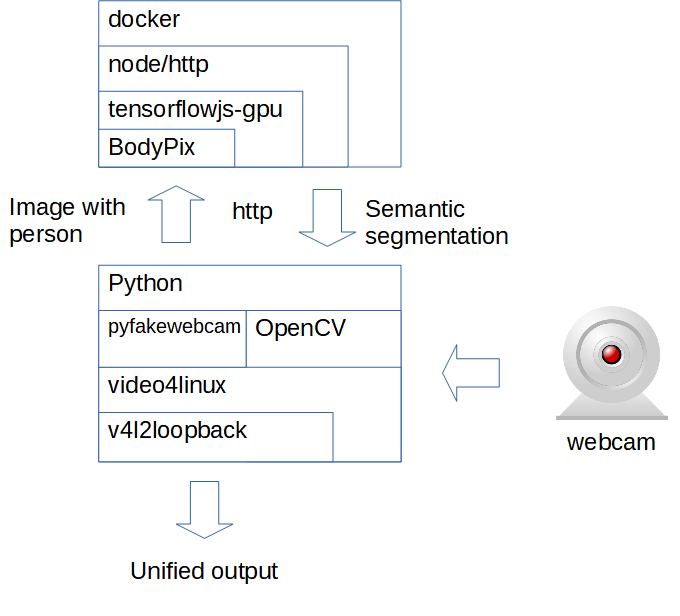
The following figure is the diagram.
It depends on docker, GPU, v4l2loopback (only works on Linux), so I want to make more generic solution. To make as a webpage, and using OBS
Studio with plugins (obs-v4l2sink, OBS-VirtualCam or OBS (macOS) Virtual Camera) you can use the solution on more platforms. To make as a single webpage, I can reduce overhead using inter-process commuication using http via docker. This is an example animation:
y4069-ju7wv.gif
Using jisti snapshot:
image.png
Unfortunately, BodyPix releases only pretraind models, no training data. I need more improvements:

Russ Allbery: Review: Golden Gates

Review: Golden Gates, by Conor Dougherty
Publisher: Penguin
Copyright: 2020
ISBN: 0-525-56022-X
Format: Kindle
Pages: 249
This review, for reasons that will hopefully become clear later, starts with a personal digression. I have been interested in political theory my entire life. That sounds like something admirable, or at least neutral. It's not. "Interested" means that I have opinions that are generally stronger than my depth of knowledge warrants. "Interested" means that I like thinking about and casting judgment on how politics should be done without doing the work of politics myself. And "political theory" is different than politics in important ways, not the least of which is that political actions have rarely been a direct danger to me or my family. I have the luxury of arguing about politics as a theory. In short, I'm at high risk of being one of those people who has an opinion about everything and shares it on Twitter. I'm still in the process (to be honest, near the beginning of the process) of making something useful out of that interest. I've had some success when I become enough a part of a community that I can do some of the political work, understand the arguments at a level deeper than theory, and have to deal with the consequences of my own opinions. But those communities have been on-line and relatively low stakes. For the big political problems, the ones that involve governments and taxes and laws, those that decide who gets medical treatment and income support and who doesn't, to ever improve, more people like me need to learn enough about the practical details that we can do the real work of fixing them, rather than only making our native (and generally privileged) communities better for ourselves. I haven't found my path helping with that work yet. But I do have a concrete, challenging, local political question that makes me coldly furious: housing policy. Hence this book. Golden Gates is about housing policy in the notoriously underbuilt and therefore incredibly expensive San Francisco Bay Area, where I live. I wanted to deepen that emotional reaction to the failures of housing policy with facts and analysis. Golden Gates does provide some of that. But this also turns out to be a book about the translation of political theory into practice, about the messiness and conflict that results, and about the difficult process of measuring success. It's also a book about how substantial agreement on the basics of necessary political change can still founder on the shoals of prioritization, tribalism, and people who are interested in political theory. In short, it's a book about the difficulty of changing the world instead of arguing about how to change it. This is not a direct analysis of housing policy, although Dougherty provides the basics as background. Rather, it's the story of the political fight over housing told primarily through two lenses: Sonja Trauss, founder of BARF (the Bay Area Renters' Federation); and a Redwood City apartment complex, the people who fought its rent increases, and the nun who eventually purchased it. Around that framework, Dougherty writes about the Howard Jarvis Taxpayers Association and the history of California's Proposition 13, a fight over a development in Lafayette, the logistics challenge of constructing sufficient housing even when approved, and the political career of Scott Wiener, the hated opponent of every city fighting for the continued ability to arbitrarily veto any new housing. One of the things Golden Gates helped clarify for me is that there are three core interest groups that have to be part of any discussion of Bay Area housing: homeowners who want to limit or eliminate local change, renters who are vulnerable to gentrification and redevelopment, and the people who want to live in that area and can't (which includes people who want to move there, but more sympathetically includes all the people who work there but can't afford to live locally, such as teachers, day care workers, food service workers, and, well, just about anyone who doesn't work in tech). (As with any political classification, statements about collectives may not apply to individuals; there are numerous people who appear to fall into one group but who vote in alignment with another.) Dougherty makes it clear that housing policy is intractable in part because the policies that most clearly help one of those three groups hurt the other two. As advertised by the subtitle, Dougherty's focus is on the fight for more housing. Those who already own homes whose values have been inflated by artificial scarcity, or who want to preserve such stratified living conditions as low-density, large-lot single-family dwellings within short mass-transit commute of one of the densest cities in the United States, don't get a lot of sympathy or focus here except as opponents. I understand this choice; I also don't have much sympathy. But I do wish that Dougherty had spent more time discussing the unsustainable promise that California has implicitly made to homeowners: housing may be impossibly expensive, but if you can manage to reach that pinnacle of financial success, the ongoing value of your home is guaranteed. He does mention this in passing, but I don't think he puts enough emphasis on the impact that a single huge, illiquid investment that is heavily encouraged by government policy has on people's attitude towards anything that jeopardizes that investment. The bulk of this book focuses on the two factions trying to make housing cheaper: Sonja Trauss and others who are pushing for construction of more housing, and tenant groups trying to manage the price of existing housing for those who have to rent. The tragedy of Bay Area housing is that even the faintest connection of housing to the economic principle of supply and demand implies that the long-term goals of those two groups align. Building more housing will decrease the cost of housing, at least if you build enough of it over a long enough period of time. But in the short term, particularly given the amount of Bay Area land pre-emptively excluded from housing by environmental protection and the actions of the existing homeowners, building more housing usually means tearing down cheap lower-density housing and replacing it with expensive higher-density housing. And that destroys people's lives. I'll admit my natural sympathy is with Trauss on pure economic grounds. There simply aren't enough places to live in the Bay Area, and the number of people in the area will not decrease. To the marginal extent that growth even slows, that's another tale of misery involving "super commutes" of over 90 minutes each way. But the most affecting part of this book was the detailed look at what redevelopment looks like for the people who thought they had housing, and how it disrupts and destroys existing communities. It's impossible to read those stories and not be moved. But it's equally impossible to not be moved by the stories of people who live in their cars during the week, going home only on weekends because they have to live too far away from their jobs to commute. This is exactly the kind of politics that I lose when I take a superficial interest in political theory. Even when I feel confident in a guiding principle, the hard part of real-world politics is bringing real people with you in the implementation and mitigating the damage that any choice of implementation will cause. There are a lot of details, and those details matter. Without the right balance between addressing a long-term deficit and providing short-term protection and relief, an attempt to alleviate unsustainable long-term misery creates more short-term misery for those least able to afford it. And while I personally may have less sympathy for the relatively well-off who have clawed their way into their own mortgage, being cavalier with their goals and their financial needs is both poor ethics and poor politics. Mobilizing political opponents who have resources and vote locally isn't a winning strategy. Dougherty is a reporter, not a housing or public policy expert, so Golden Gates poses problems and tells stories rather than describes solutions. This book didn't lead me to a brilliant plan for fixing the Bay Area housing crunch, or hand me a roadmap for how to get effectively involved in local politics. What it did do is tell stories about what political approaches have worked, how they've worked, what change they've created, and the limitations of that change. Solving political problems is work. That work requires understanding people and balancing concerns, which in turn requires a lot of empathy, a lot of communication, and sometimes finding a way to make unlikely allies. I'm not sure how broad the appeal of this book will be outside of those who live in the region. Some aspects of the fight for housing generalize, but the Bay Area (and I suspect every region) has properties specific to it or to the state of California. It has also reached an extreme of housing shortage that is rivaled in the United States only by New York City, which changes the nature of the solutions. But if you want to seriously engage with Bay Area housing policy, knowing the background explained here is nearly mandatory. There are some flaws I wish Dougherty would have talked more about traffic and transit policy, although I realize that could be another book but this is an important story told well. If this somewhat narrow topic is within your interests, highly recommended. Rating: 8 out of 10

4 May 2020

Dima Kogan: Redirection and /dev/stderr

I just hit some unexpected unix-ism (or maybe Linux-ism?) that I'd like to mention here. I found a workaround, but if anybody knows what's actually happening and can enlighten me, please send me an email, and I'll update the post. OK, so I have a program that does stuff, and outputs its progress to stderr. And I'm invoking this from a shell script that also outputs stuff to stderr. A minimized sample:
echo "Outer print 1111" > /dev/stderr
perl -E 'say STDERR ("1111 1111 1111 1111 1111 1111 1111 1111\n")'
echo "Outer print 2222" > /dev/stderr
perl -E 'say STDERR ("2222 2222 2222 2222 2222 2222 2222 2222\n")'
Let's call this dothing.sh. This works just fine. Now let's say I want to log the output to a file. Naturally I do this:
./dothing.sh 2> /tmp/log
Surprisingly, this does not work:
$ bash dothing.sh 2> /tmp/log && cat /tmp/log
Outer print 2222
2222 2222 2222 2222 2222 2222 2222 2222
$ bash dothing.sh 2> /tmp/log && xxd /tmp/log
0000000: 4f75 7465 7220 7072 696e 7420 3232 3232  Outer print 2222
0000010: 0a00 0000 0000 0000 0000 0000 0000 0000  ................
0000020: 0000 0000 0000 0000 0032 3232 3220 3232  .........2222 22
0000030: 3232 2032 3232 3220 3232 3232 2032 3232  22 2222 2222 222
0000040: 3220 3232 3232 2032 3232 3220 3232 3232  2 2222 2222 2222
0000050: 0a0a                                     ..
The 1111 prints are gone, and we now have a block of binary 0 bytes in there for some reason. I had been assuming that writes to stderr block until they're finished. So I can, without thinking about it, mix writing to fd 2 and opening, and then writing to /dev/stderr. Apparently the right way to do this is to write to fd 2 in the script directly, instead of opening /dev/stderr:
echo "Outer print 1111" >&2
perl -E 'say STDERR ("1111 1111 1111 1111 1111 1111 1111 1111\n")'
echo "Outer print 2222" >&2
perl -E 'say STDERR ("2222 2222 2222 2222 2222 2222 2222 2222\n")'
Why?

Update So I poked at it for a bit more, and it turns out that the obvious scapegoat (buffering) is actually not the issue. The problem is this:

$ ls -l /dev/stderr(:A)
-rw-r--r-- 1 dima dima 36 May  4 17:02 /tmp/log
:A is the zsh syntax for recursive link-following. /dev/stderr is thus ultimately a link to /tmp/log. So the file on disk /tmp/log is being opened for writing and written-to twice at the same time
  • once in the outer 2>/tmp/log redirection
  • again in the inner >/dev/stderr redirection
Now we know. Thanks to Larry Doolittle for pointers.

Russ Allbery: Review: Seraphina

Review: Seraphina, by Rachel Hartman
Series: Seraphina #1
Publisher: Ember
Copyright: 2012
ISBN: 0-375-89658-9
Format: Kindle
Pages: 360
Forty years ago, dragons and humans negotiated a fragile truce. The fighting stopped, the dragon-killing knights were outlawed, and dragons were allowed to visit the city in peace, albeit under stringent restrictions. Some on both sides were never happy with that truce and now, as the anniversary approaches, Prince Rufus has been murdered while hunting. His head was never found, and not a few members of the court are certain that it was eaten. Sixteen-year-old Seraphina had no intention of being part of that debate. She's desperately trying to keep a low profile as the assistant court music director and music tutor to a princess. Her father is furious that she's at court at all, since that they are hiding a family secret that cannot get out. But Seraphina has a bad habit of being competent in ways that are hard to ignore: improving the princess's willingness to learn music beyond all expectations, performing memorably at Prince Rufus's funeral, and then helping, with her dragon tutor, a newskin dragon (one new to shapeshifting) who was attacked by a mob. This brings her to the attention of Prince Lucian Kiggs: royal bastard, fiance of the princess, head of the royal guard, and observant investigator. For Seraphina and her secrets, that's a threat, but she has made more friends at court than she realizes. I probably should spoil Seraphina's secret, since it's hard to talk about this book without it and Hartman reveals it relatively early, but I try to avoid spoilers. I'll instead say that Seraphina is in danger from both the court and the dragons if her secret is uncovered, but she has an ability that will prove more useful than she ever expected in helping the kingdom avoid war. That ability is not something flashy; it lies in listening, understanding, and forming connections. As you have probably guessed from the age of the protagonist, this is a young adult fantasy. It has that YA shape; Seraphina is uncertain but brave, gets into trouble by being unable to keep her mouth shut or stand by when she can prevent bad things from happening, and is caught by surprise when others find those characteristics likable. The cast is small despite an epic fantasy setup, and the degree to which Seraphina ends up at the heart of the kingdom's affairs is perhaps a touch unrealistic. Like a lot of YA, Seraphina is very centered on its main character. Your enjoyment of this book will likely hinge on how much you like her mix of uncertainty, determination, and ethics. I liked her. I also appreciated the way that Hartman had her stumble into the plot through a series of accidents and entanglements with her past and her secret, despite her own best intentions. Seraphina is trying to avoid attention, not get into the middle of a novel, but she's naturally the sort of person who rushes towards danger to help others whenever events happen too fast for her to think. She has also attracted the attention (and unexpected friendship) of critical members of the royal family who like to meddle, which is bad for her attempts to hide. This could have felt artificial and too coincidental, but it didn't. The one thing that did bother me about this book, though, was the nature of dragons, although it's possible that I'm being unfair. Dragons in Hartman's world can shapeshift into human form, but they don't understand (and deeply distrust) human emotions, finding them overwhelming and impure. This bit of world-building is not original to this book, and perhaps I should attribute it to the ubiquitous influence of Spock and Vulcans. But I kept stumbling over the feeling like dragons were based partly on stereotypes of the autism spectrum, which hurt my ability to engross myself in the story. It would not surprise me if I had this all wrong, Hartman didn't intend anything of the sort, and no one else will read it that way. But it still seemed worth mentioning. Seraphina's dynamic with Kiggs becomes the core of the story, but it's slow and stumbling and occasionally frustrating when Seraphina is more cautious than the reader thinks she needs to be. The payoff is mostly worth the frustration, though. I wish Seraphina had been a bit more curious about her abilities, a bit more willing to notice the obvious (the bit with the dancers drug on far too long), and a bit more trusting of people who deserve her trust, and I wish Hartman had taken a different approach with the dragon attitude towards emotions. But this was fun. Recommended if you want a good-hearted story where doing the right thing is rewarded and people in positions of power notice when someone is a good person. Followed by Shadow Scale. Rating: 7 out of 10

3 May 2020

Enrico Zini: Tech links

The way developers somehow think DevOps is (or should be) an abbreviation of "Developers doing/replacing Operations" is terrifying to me.I'm also in the same boat as the author, in that I recommend and target Debian Stable + Backports (and some vendor/community repos when required).
However hard you work on documentation, it won't work for your software - unless you do it the right way.
I'm going to preach the wonders of Python dataclasses, but for reasons of interested to those who have already gone down the delightful rabbit-hole of typed Python. So let me start with a quick plug for mypy if you haven't heard about it.
Subscribe in a reader Subscribe by Email
Database of 15500 abandonware games free. One of the most complete video games museum. Take a trip down Memory Lane now! Warning: whole weekends can be lost.

Iain R. Learmonth: Hetzner Dedicated Server Reverse DNS + Ansible

Continuing on the path towards all my stuff being managed by Ansible, I ve figured out a method of managing the reverse DNS entries for subnets on the Hetzner Dedicated Server. There s a bunch of Ansible modules for handling Hetzner Cloud, but these servers are managed in Robot which the Cloud API doesn t cover. Instead, you need to use the Robot Webservice. Ansible does have a module for doing pretty arbitrary things with web APIs though, so using that I ve got the following playbook figured out to keep the reverse DNS entries in sync:
---
- hosts:
  - vmhost_vm1
  gather_facts: False
  tasks:
  - name: import hetzner webservice credentials
    include_vars:
      file: "hetzner_ws.yml"
  - name: set rdns for hetzner hosts
    block:
    - name: get current rdns entry
      uri:
        user: "  hetzner_ws_user  "
        password: "  hetzner_ws_password  "
        url: "https://robot-ws.your-server.de/rdns/  vmip4  "
        status_code: [200, 404]
      register: rdns_result
    - name: update incorrect rdns entry
      uri:
        user: "  hetzner_ws_user  "
        password: "  hetzner_ws_password  "
        url: "https://robot-ws.your-server.de/rdns/  vmip4  "
        method: "POST"
        body_format: form-urlencoded
        body:
          ptr: "  inventory_hostname  "
        status_code: [200, 201]
      when: '"rdns" not in rdns_result.json or inventory_hostname != rdns_result.json.rdns.ptr'
      changed_when: True
    delegate_to: localhost
The host groups this runs on are currently hardcoded as the VMs that live in the Hetzner Dedicated Server. A future iteration of this might use some inventory plugin to look up the subnets that are managed on Hetzner and create a group for all of those. Right now it won t be setting the reverse DNS for the router interface on that subnet, and won t automatically include new server s subnets. Gathering facts is disabled because all of these run locally. There is at least one VM running on this server that I can t log in to because I host it for someone else, so running locally is a necessity. The webservice credentials are stored in an Ansible Vault encrypted YAML file and loaded explicitly. An important note: the webservice username and password is not the same as your regular Robot username and password. You need to create a webservice user in Robot under Settings; Webservice and app settings . If you attempt to authenticate with an incorrect username and password 3 times in a row, your IP address will be blocked for 10 minutes. There are 6 hosts in this group, so I did this a few times before I realised there was a different user account I needed to create. I d suggest limiting to a single host while you re testing to get the authentication figured out. The actual calls to the webservice take place in a block just to avoid having to specify the delegate_to: localhost twice. The first step looks up the current PTR record, and accepts success if it gives either a 200 or 404 status code (it will be 404 if there is no existing pointer record). The result of this is used to conditionally create/update the PTR record in the next task. If nothing needs to be done, nothing will be changed and the second task will be skipped. If a change is needed, the second step is successful if either the PTR record is updated (status 200) or created (status 201). This was actually a lot easier than I thought it would be, and the uri module looks to be really flexible, so I bet there are other things that I could easily integrate into my Ansible playbooks.

Evgeni Golov: Remote management for OpenWRT devices without opening inbound connections

Everyone is working from home these days and needs a decent Internet connection. That's especially true if you need to do video calls and the room you want to do them has the worst WiFi coverage of the whole flat. Well, that's exactly what happened to my parents in law. When they moved in, we knew that at some point we'll have to fix the WiFi - the ISP provided DSL/router/WiFi combo would not cut it, especially not with the shape of the flat and the elevator shaft in the middle of it: the flat is essentially a big C around said shaft. But it was good enough for email, so we postponed that. Until now. The flat has wired Ethernet, but the users MacBook Air does not. That would have been too easy, right? So let's add another access point and hope the situation improves. Luckily I still had a TP-Link Archer C7 AC1750 in a drawer, which I could quickly flash with a fresh OpenWRT release, disable DHCPd and configure the same SSID and keys as the main/old WiFi. But I didn't know which channels would be best in the destination environment. Under normal circumstances, I'd just take the AP, drive to my parents in law and finish the configuration there. Nope, not gonna happen these days. So my plan was to finish configuration here, put the AP in a box and on the porch where someone can pick it up. But this would leave me without a way to further configure the device once it has been deployed - I was not particularly interested in trying to get port forwarding configured via phone and I was pretty sure UPnP was disabled in the ISP router. Installing a Tor hidden service for SSH was one possibility, setting up a VPN and making the AP a client another. Well, or just creating a reverse tunnel with SSH! sshtunnel Creating a tunnel with OpenSSH is easy: ssh -R127.0.0.1:2222:127.0.0.1:22 server.example.com will forward localhost:2222 on server.example.com to port 22 of the machine the SSH connection originated from. But what happens if the connection dies? Adding a while true; do ; done around it might help, but I would really like not to reinvent the wheel here! Thankfully, somebody already invented that particular wheel and OpenWRT comes with a sshtunnel package that takes care of setting up and keeping up such tunnels and documentation how to do so. Just install the sshtunnel package, edit /etc/config/sshtunnel to contain a server stanza with hostname, port and username and a tunnelR stanza referring said server plus the local and remote sides of the tunnel and you're good to go.
config server home
  option user     user
  option hostname server.example.com
  option port     22
config tunnelR local_ssh
  option server         home
  option remoteaddress  127.0.0.1
  option remoteport     2222
  option localaddress   127.0.0.1
  option localport      22
The only caveat is that sshtunnel needs the OpenSSH client binary (and the package correctly depends on it) and OpenWRT does not ship the ssh-keygen tool from OpenSSH but only the equivalent for Dropbear. As OpenSSH can't read Dropbear keys (and vice versa) you'll have to generate the key somewhere else and deploy it to the OpenWRT box and the target system. Oh, and OpenWRT defaults to enabling password login via SSH, so please disable that if you expose the box to the Internet in any way! Using the tunnel After configuring and starting the service, you'll see the OpenWRT system logging in to the configured remote and opening the tunnel. For some reason that connection would not show up in the output of w -- probably because there was no shell started or something, but logs show it clearly. Now it's just a matter of connecting to the newly open port and you're in. As the port is bound to 127.0.0.1, the connection is only possible from server.example.com or using it as a jump host via OpenSSH's ProxyJump option: ssh -J server.example.com -p 2222 root@localhost. Additionally, you can forward a local port over the tunneled connection to create a tunnel for the OpenWRT webinterface: ssh -J server.example.com -p 2222 -L8080:localhost:80 root@localhost. Yes, that's a tunnel inside a tunnel, and all the network engineers will go brrr, but it works and you can access LuCi on http://localhost:8080 just fine. If you don't want to type that every time, create an entry in your .ssh/config:
Host openwrt
  ProxyJump server.example.com
  HostName localhost
  Port 2222
  User root
  LocalForward 8080 localhost:80
And we're done. Enjoy easy access to the newly deployed box and carry on.

2 May 2020

Jonathan Carter: Free Software Activities for 2020-04

Debian project leader This month contained the first week and a half or so of my term as Debian Project Leader. So far my focus has been getting up to speed and keeping the gears turning with day to day DPL tasks. The updates listed here will also be available on the DPL blog, where I aim to make more frequent updates. During May, Debian Brazil will host Debian talks throughout the month which they will stream to their YouTube channel. You can find the schedule in this git repository, most of the talks will be in Portuguese, but on the 4th of May at 21:00 UTC, I ll be covering some Debian project topics for an hour or so and take some questions if there s time left. 2020-04-19: Handover session with Sam, our outgoing DPL. We covered a lot of questions I had and main areas that the DPL works in. Thanks to Sam for having taken the time to do this. 2020-04-21: First day of term! Thank you to everybody who showed support and have offered to help! 2020-04-21: Request feedback from the trademark team on an ongoing trademark dispute. 2020-04-21: Join the GNOME Advisory Board as a representative from Debian. 2020-04-21: Reply on an ongoing community conflict issue. 2020-04-21: Update Debian project summary for SPI annual report. 2020-04-21: Received a great e-mail introduction from Debian France and followed up on that. 2020-04-21: Posted Bits from the new DPL to debian-devel-announce. 2020-04-22: Became Debian s OSI Affilliate representative. 2020-04-22: Reply to a bunch of media inquiries for interviews, will do them later when initial priorities are on track. 2020-04-23: Resign as Debian FTP team trainee and mailing list moderator. In both these areas there are enough people taking care of it and I intend to maximise available time for DPL and technical areas in the project. 2020-04-25: Review outgoing mail for trademark team. 2020-04-25: Answer some questions in preparation for DAM/Front Desk delegation updates. 2020-04-26: Initiated wiki documentation for delegation updates process. 2020-04-27: Update delegation for the Debian Front Desk team. 2020-04-29: Schedule video call with Debian treasurer team. 2020-04-29: OSI affiliate call. Learned about some Open Source projects including OpenDev, OpenSourceMatters, FOSS Responders and Democracy Labs.

Debian Social Work on the Debian Social project is progressing, we plan to start a separate blog syndicated to Planet Debian that contains progress and status updates. I ve been terrible at tracking the work we ve been doing on this, so for now, here are some micro updates:

MiniDebConf Online In the DebConf video team, we ve been wondering whether we have all the tools required to successfully host a DebConf (or even a mini DebConf) entirely online. There s really just one way to know for sure, so we re going to host MiniDebConf Online from 28 May to 31 May. The first two days will be an online MiniDebCamp, where we can try to hold online spints, meetings and general chit-chat. The last two days will be for talks and lightnight talks, with BoFs likely to take place throughout the 4 days (this will probably be decided once we have a content team). Announcements should go out within the next week, in the meantime, save the dates.

Debian package uploads 2020-04-07: Upload package flask-autoindex (0.6.6-1) to Debian unstable. 2020-04-07: Upload package gamemode (1.5.1-1) to Debian unstable. 2020-04-08: Accept MR#2 for live-tasks (add usbutils to live-task-standard). 2020-04-08: Upload package live-tasks (11.0.2) to Debian unstable (Closes: #955526, #944578, #942837, #942834). 2020-04-08: Close live-config bug #655198 (Only affects squeeze which is no longer supported). 2020-04-08: Upload package live-config (11.0.1) to Debian unstable. 2020-04-08: Upload package calamares (3.2.22-1) to Debian unstable. 2020-04-15: Upload package xabacus (8.2.6-1) to Debian unstable. 2020-04-16: Merge MR#1 for gnome-shell-extension-dashtodock (new upstream release). 2020-04-16: Upload package gnome-shell-extension-dashtodock (67+git20200225-1) to Debian unstable. 2020-04-16: Merge MR#1 for gnome-shell-extension-hard-disk-led (fix some lintian issues). 2020-04-16: Merge MR#1 for gnome-shell-extension-system-monitor (fix some lintian issues). 2020-04-17: Upload package calamares (3.2.23-1) to Debian unstable. 2020-04-17: Upload package catimg (2.6.0-1) to Debian unstable (Closes: #956150). 2020-04-17: Upload package fabulous (0.3.0+dfsg1-7) to Debian unstable (Closes: #952242). 2020-04-17: Upload package gnome-shell-extension-system-monitor (38+git20200414-32cc79e-1) to Debian unstable (Closes: #956656, #956171). 2020-04-17: Upload package gnome-shell-extension-arc-menu (45-1) to Debian unstable (Closes: #956168). 2020-04-18: Upload package toot (0.26.0-1) to Debian unstable. 2020-04-23: Update packaging for gnome-shell-extension-tilix-shortcut, upstream section needs some additional work before release is possible. 2020-04-23: Upload package xabacus (8.2.7-1) to Debian unstable. 2020-04-27: Upload package gnome-shell-extension-dash-to-panel (37-1) to Debian unstable (Closes: #956162, #954978). 2020-04-27: Upload package gnome-shell-extension-dash-to-panel (37-2) to Debian unstable. 2020-04-27: Upload package gnome-shell-extension-dashtodock (68-1) to Debian unstable. 2020-04-30: Merge MR#8 for gamemode (add symbol files) (Closes: #952425). 2020-04-30: Merge MR#9 for gamemode (reduce number of -dev packages generated). 2020-04-30: Merge MR#10 for gamemode (deal better with upgrades on a buggy version). 2020-04-30: Manually merge changes from MR#11 for gamemode (packaging fixes). 2020-04-30: Upload package gamemode (1.5.1-2) to Debian unstable.

Sylvain Beucler: Debian LTS and ELTS - April 2020

Debian LTS Logo Here is my transparent report for my work on the Debian Long Term Support (LTS) and Debian Extended Long Term Support (ELTS), which extend the security support for past Debian releases, as a paid contributor. In April, the monthly sponsored hours were split evenly among contributors depending on their max availability - I was assigned 28.75h for LTS (out of 30 max; all done) and 7.75h for ELTS (out of 20 max; I did 2.75). Escalation procedures were (internally) documented with a focus on discussing issues with team coordinator(s) first. Debian LTS had its first team meeting through IRC and lots of workflow question were discussed. This should help discuss questions that are a bit hard to bring up, and ensure everybody participates. There were lots of topics and it was a bit rushed, but this is something we want to repeat monthly now, possibly with audio/video in a couple months. Remarks from last month's report were discussed, strengthening the Front-Desk role. 10% of the global funding is now reserved for infrastructure work. What kind of work, and who (LTS or external) will do the work, will be discussed further. A fellow DD suggested (in a private conversation) that LTS may be taking time from the Debian Security team, due to additional commits to review. Conversely, this is another opportunity to mention all the global, non-LTS-specific work that LTS provides, which I usually highlight in my reports, and maybe I should be even more ;) ELTS - Wheezy LTS - Jessie Documentation/Scripts

30 April 2020

Chris Lamb: Free software activities in April 2020

Here is my monthly update covering what I have been doing in the free software world during April 2020 (previous month's report). Looking it over prior to publishing, I am surprised how much I got done this month I felt that I was not only failing to do all the extra things I had planned, but I was doing far less than normal. But let us go easy on ourselves; nobody is nailing this. In addition, I did more hacking on the Lintian static analysis tool for Debian packages:
Reproducible builds One of the original promises of open source software is that distributed peer review and transparency of process results in enhanced end-user security. However, whilst anyone may inspect the source code of free and open source software for malicious flaws, almost all software today is distributed as pre-compiled binaries. This allows nefarious third-parties to compromise systems by injecting malicious code into ostensibly secure software during the various compilation and distribution processes. The motivation behind the Reproducible Builds effort is to ensure no flaws have been introduced during this compilation process by promising identical results are always generated from a given source, thus allowing multiple third-parties to come to a consensus on whether a build was compromised. The initiative is proud to be a member project of the Software Freedom Conservancy, a not-for-profit 501(c)(3) charity focused on ethical technology and user freedom. Conservancy acts as a corporate umbrella allowing projects to operate as non-profit initiatives without managing their own corporate structure. If you like the work of the Conservancy or the Reproducible Builds project, please consider becoming an official supporter. Elsewhere in our tooling, I made the following changes to diffoscope, our in-depth and content-aware diff utility that can locate and diagnose reproducibility issues, including preparing and uploading versions 139, 140, 141 and 142 to Debian: Lastly, I made a large number of changes to our website and documentation in the following categories:
Debian LTS This month I have contributed 18 hours to Debian Long Term Support (LTS) and 7 hours on its sister Extended LTS project. You can find out more about the project via the following video:
Debian I only filed three bugs in April, including one against snapshot.debian.org to report that a Content-Type HTTP header is missing when downloading .deb files (#956471) and to report build failures in the macs & ruby-enumerable-statistics packages:

28 April 2020

Steve Kemp: I'm a contractor, available for work

For the foreseeable future I'm working for myself, as a contractor, here in sunny Helsinki, Finland. My existing contract only requires me to work 1.5-2.0 days a week, meaning my week looks something like this: It does mean that I'm available for work Wednesday-Friday though, in the event I can find projects to work upon, or companies who would be willing to accept my invoices. I think of myself as a sysadmin, but I know all about pipelines, automation, system administration, and coding in C, C++, Perl, Ruby, Golang, Lua, etc. On the off-chance anybody reading this has a need for small projects, services, daemons, or APIs to be implemented then don't hesitate to get in touch. I did manage to fill a few days over the past few weeks completing an online course from Helsinki Open University, Devops with Docker, it is possible I'll find some more courses to complete in the future. (There is an upcoming course Devops with Kubernetes which I'll definitely complete.)

26 April 2020

Russ Allbery: Review: The Last Goodbye

Review: The Last Goodbye, by Matt Potter
Publisher: Silvertail
Copyright: 2014-2016
Printing: 2016
ISBN: 1-909269-42-5
Format: Kindle
Pages: 308
In the contested space between the interested amateur and the trained expert lies the enthusiast. A topic has, for often inexplicable reasons, caught fire in their thoughts and become a mild obsession. They may not have formal training or systematic conceptual grounding beneath their interest, but they partly make up for that lack with sustained fascination. They research widely and obscurely about their particular focus, develop novel theories, see distinctions and classifications that few others would bother to investigate, and present their discoveries to anyone who will stand still long enough. And occasionally, when that interest happens to coincide with writing skill, they produce some surprisingly excellent essays or books. Matt Potter's enthusiasm is resignation letters.
Every damaging resignation letter, every cornered truth attack, every out-of-control speech by a former friend, is more than just an inconvenience, to be countered with positive spin and internal memos: it's an open challenge to the official version of the story, the perfectly controlled brand. They are breaks in an otherwise perfectly planned, smoothly executed narrative of the powerful. Holes in the program code. A rare, irresistible chance to hack into history's shiny, unstoppable operation.
The Last Goodbye: A History of the World in Resignation Letters is not, in truth, a history of the world. It is, first and foremost, a taxonomy, because there are types of resignation letters. The opening chapter, the truth bomb, is the type that one would expect upon discovering that someone wrote a book on the topic (that wasn't advice on how to write a good one). But there are other types, less heavy on the fireworks but just as fascinating. The unquotable expert construction. The knife in the back. The incoherent scream of rage. But also the surprisingly gentle and graceful conclusion.
It is the question that the letters themselves try in vain to answer, over and over again even as they explain, analyse, protest and bear witness to a million other details. The question is: Why? All the forces in the universe stack up against unburdening ourselves in a resignation letter. Professionally, it can be suicide. In practical terms, it is often self-defeating. Self-help books coach against unleashing its force; colleagues and confidantes urge caution, self-restraint. And yet we do it, and damn the consequences. We have no choice but to speak in sorrow, love, grief, cold anger, thirst for revenge, wounded pride, the pain of injustice, loyalty, pangs of regret, throes of vengeful madness, deluded righteousness, panic, black distress, isolation, ecstasies of martyrdom, and a million other shades of human extremity we need to say our piece even as we leave the stage.
The risk of the enthusiast's book is that the lack of structural grounding can leave the conclusions unsupported. A fair critique of this book is that it contains a lot of amateur sociology. Potter has a journalist's eye for motive and narrative, but some of his conclusions may not be warranted. But he compensates for the lack of rigor with, well, enthusiasm. Potter is fascinated by resignation letters and the insight they offer, and that fascination is irresistibly contagious. It's probably obvious that the chapters on truth bombs, fuck yous, and knives in the back have visceral appeal. The resignation letter as a force of truth-telling, as the revenge of a disregarded peon, as a crack in the alliance between the powerful that may let some truth shine through, is what got me to buy this book. And Potter doesn't disappoint; he quotes from both famous and nearly unknown examples, dissects the writing and the intent, and gives us a ringside seat to a few effective acts of revenge. That's not the best part of this book, though. The chapter that I will remember the longest is Potter's dissection of the constructed resignation letter. The carefully drafted public relations statement, the bland formality, the attempt to make a news story disappear. The conversation-ender. It's a truism that any area of human endeavor involves more expertise than those who have only observed it from the outside will realize, but I had never thought to apply that principle to the ghost-written resignation letter. The careful non-apology, the declaration that one has "become a distraction," the tell-tale phrasing of "spending more time with my family" is offensive in its bland dishonesty. But Potter shows that the blandness is expertly constructed to destroy quotability. Those statements are nearly impossible to remember or report on because they have been built that way: nouns carefully separated from verbs, all force dissipated by circuities and modifiers, and subtle grammatical errors introduced to discourage written news from including direct quotes. Potter's journalism background shines here because he can describe the effect on news reporting. He walks the reader through the construction to reveal that the writing is not incompetent but instead is skillfully bad in a way that causes one's attention to skitter off of it. The letter vanishes into its own vagueness. The goal is to smother the story in such mediocrity that it becomes forgettable. And it works. I've written several resignation letters of my own. Somewhat unusually, I've even sent several of them, although (as Potter says is typical) fewer than I've written. I've even written (and sent) the sort of resignation letter that every career advisor will say to never send. Potter's discussion of the motives and thought process behind those letters rang true for me. It's a raw and very human moment, one is never in as much control of it as one wishes, the cracks and emotions break through in the writing, and often those letters are trying to do far too many things at the same time. But it's also a moment in which one can say something important and have others listen, which can be weirdly challenging to do in the normal course of a job. Potter ends this book beautifully by looking at resignation letters that break or transcend the mold of most of the others he's examined: letters where the author seems to have found some peace and internal understanding and expresses that simply and straightforwardly. I found this surprisingly touching after the emotional roller-coaster of the rest of the book, and a lovely note on which to end. This is a great book. Potter has a good eye for language and the emotion encoded in it, a bracing preference for the common worker or employee over the manager or politician, and the skill to produce some memorable turns of phrase. Most importantly, he has the enthusiast's love of the topic. Even if you don't care about resignation letters going in, it will be hard to avoid some fascination with them by the end of this book. Recommended. This book was originally published as F*ck You and Goodbye in the UK. Rating: 8 out of 10

24 April 2020

Fran ois Marier: Disabling mail sending from your domain

I noticed that I was receiving some bounced email notifications from a domain I own (cloud.geek.nz) to host my blog. These notifications were all for spam messages spoofing the From address since I do not use that domain for email. I decided to try setting a strict DMARC policy to see if DMARC-using mail servers (e.g. GMail) would then drop these spoofed emails without notifying me about it. I started by setting this initial DMARC policy in DNS in order to monitor the change:
@ TXT v=spf1 -all
_dmarc TXT v=DMARC1; p=none; ruf=mailto:dmarc@fmarier.org; sp=none; aspf=s; fo=0:1:d:s;
Then I waited three weeks without receiving anything before updating the relevant DNS records to this final DMARC policy:
@ TXT v=spf1 -all
_dmarc TXT v=DMARC1; p=reject; sp=reject; aspf=s;
This policy states that nobody is allowed to send emails for this domain and that any incoming email claiming to be from this domain should be silently rejected. I haven't noticed any bounce notifications for messages spoofing this domain in a while, so maybe it's working?

23 April 2020

Evgeni Golov: Controlling roller shutters using a Shelly 2.5, ESPHome and Home Assistant

Our house has roller shutters on all windows and most of them have an electric motor to open and close them. The motors are Schellenberg shaft motors (not sure this is the right English term), that you can configure end positions for and then by applying current to the right pair of pins they move the shutters up and down until the current is removed or one of the endstops is reached. As the motors were installed over a long period of time, the attached control units varied in functionality: different ways to program open/close times, with and without battery for the clock/settings etc, but they all had something in common: no central management and pretty ugly. We decided to replace those control units with regular 2 gang light switches that match the other switches in the house. And as we didn't want to lose the automatic open/close timer, we had to add some smarts to it. Shelly 2.5 and ESPHome Say hello to Shelly 2.5! The Shelly 2.5 is an ESP8266 with two relays attached to it in a super tiny package you can hide in the wall behind a regular switch. Pretty nifty. It originally comes with a Mongoose OS based firmware and an own app, but ain't nobody needs that, especially nobody who wants to implement some crude logic. That said, the original firmware isn't bad. It has a no-cloud mode, a REST API and does support MQTT for integration into Home Assistant and others. My ESP firmware of choice is ESPHome, which you can flash easily onto a Shelly (no matter 1, 2 or 2.5) using a USB TTL adapter that provides 3.3V. Home Assistant has native ESPHome support with auto-discovery, which is much nicer than manually attaching things to MQTT topics. To get ESPHome compiled for the Shelly 2.5, we'll need a basic configuration like this:
esphome:
  name: shelly25
  platform: ESP8266
  board: modwifi
  arduino_version: 2.4.2
We're using board: modwifi as the Shelly 2.5 (and all other Shellys) has 2MB flash and the usually recommended esp01_1m would only use 1MB of that - otherwise the configurations are identical (see the PlatformIO entries for modwifi and esp01_1m). And arduino_version: 2.4.2 is what the Internet suggests is the most stable SDK version, and who will argue with the Internet?! Now an ESP8266 without network connection is boring, so we add a WiFi configuration:
wifi:
  ssid: !secret wifi_ssid
  password: !secret wifi_password
  power_save_mode: none
The !secret commands load the named variables from secrets.yaml. While testing, I found the network connection of the Shelly very unreliable, especially when placed inside the wall and thus having rather bad bad reception (-75dBm according to ESPHome). However, setting power_save_mode: none explicitly seems to have fixed this, even if NONE is supposed to be the default on ESP8266. At this point the Shelly has a working firmware and WiFi, but does not expose any of its features: no switches, no relays, no power meters. To fix that we first need to find out the GPIO pins all these are connected to. Thankfully we can basically copy paste the definition from the Tasmota (another open-source firmware for ESPs) template:
pin_led1: GPIO0
pin_button1: GPIO2
pin_relay1: GPIO4
pin_switch2n: GPIO5
pin_sda: GPIO12
pin_switch1n: GPIO13
pin_scl: GPIO14
pin_relay2: GPIO15
pin_ade7953: GPIO16
pin_temp: A0
If we place that into the substitutions section of the ESPHome config, we can use the names everywhere and don't have to remember the pin numbers. The configuration for the ADE7953 power sensor and the NTC temperature sensor are taken verbatim from the ESPHome documentation, so there is no need to repeat them here. The configuration for the switches and relays are also rather straight forward:
binary_sensor:
  - platform: gpio
    pin: $ pin_switch1n 
    name: "Switch #1"
    internal: true
    id: switch1
  - platform: gpio
    pin: $ pin_switch2n 
    name: "Switch #2"
    internal: true
    id: switch2
switch:
  - platform: gpio
    pin: $ pin_relay1 
    name: "Relay #1"
    internal: true
    id: relay1
    interlock: &interlock_group [relay1, relay2]
  - platform: gpio
    pin: $ pin_relay2 
    name: "Relay #2"
    internal: true
    id: relay2
    interlock: *interlock_group
All marked as internal: true, as we don't need them visible in Home Assistant. ESPHome and Schellenberg roller shutters Now that we have a working Shelly 2.5 with ESPHome, how do we control Schellenberg (and other) roller shutters with it? Well, first of all we need to connect the Up and Down wires of the shutter motor to the two relays of the Shelly. And if they would not be marked as internal: true, they would show up in Home Assistant and we would be able to flip them on and off, moving the shutters. But this would also mean that we need to flip them off each time after use, as while the motor knows when to stop and will do so, applying current to both wires at the same time produces rather interesting results. So instead of fiddling around with the relays directly, we define a time-based cover in our configuration:
cover:
  - platform: time_based
    name: "$ location  Rolladen"
    id: rolladen
    open_action:
      - switch.turn_on: relay2
    open_duration: $ open_duration 
    close_action:
      - switch.turn_on: relay1
    close_duration: $ close_duration 
    stop_action:
      - switch.turn_off: relay1
      - switch.turn_off: relay2
We use a time-based cover because that's the easiest thing that will also turn the relays off for us after the shutters have been opened/closed, as the motor does not "report" any state back. We could use the integrated power meter of the Shelly to turn off when the load falls under a threshold, but I was too lazy and this works just fine as it is. Next, let's add the physical switches to it. We could just add on_press automations to the binary GPIO sensors we configured for the two switch inputs the Shelly has. But if you have kids at home, you'll know that they like to press ALL THE THINGS and what could be better than a small kill-switch against small fingers?
switch:
  [ previous definitions go here ]
  - platform: template
    id: block_control
    name: "$ location  Block Control"
    optimistic: true
  - platform: template
    name: "Move UP"
    internal: true
    lambda:  -
      if (id(switch1).state && !id(block_control).state)  
        return true;
        else  
        return false;
       
    on_turn_on:
      then:
        cover.open: rolladen
    on_turn_off:
      then:
        cover.stop: rolladen
  - platform: template
    name: "Move DOWN"
    internal: true
    lambda:  -
      if (id(switch2).state && !id(block_control).state)  
        return true;
        else  
        return false;
       
    on_turn_on:
      then:
        cover.close: rolladen
    on_turn_off:
      then:
        cover.stop: rolladen
This adds three more template switches. The first one, "Block Control", is exposed to Home Assistant, has no lambda definition and is set to optimistic: true, which makes is basically a dumb switch that can be flipped at will and the only thing it does is storing the binary on/off state. The two others are almost identical. The name differs, obviously, and so does the on_turn_on automation (one triggers the cover to open, the other to close). And the really interesting part is the lambda that monitors one of the physical switches and if that is turned on, plus "Block Control" is off, reports the switch as turned on, thus triggering the automation. With this we can now block the physical switches via Home Assistant, while still being able to control the shutters via the same. All this (and a bit more) can be found in my esphome-configs repository on GitHub, enjoy!

19 April 2020

Russ Allbery: Review: Beyond the Galaxy

Review: Beyond the Galaxy, by Ethan Siegel
Publisher: World Scientific
Copyright: 2016
ISBN: 981-4667-16-1
Format: Kindle
Pages: 370
In the preface of this book, Ethan Siegel recounts his experience as a new college professor in 2009, thrilled to learn that he would be teaching the college's introductory astronomy class. The only disappointment was that he could not find a textbook that described astronomy the way that he wanted to teach it. Siegel did not want to simply describe the current astronomical understanding. He wanted to start at the beginning and tell a story. What questions did we start with? How did we answer them? What new questions did those answers provoke? I enjoyed Sabine Hossenfelder's Lost in Math, but I'm even happier that she included in it a recommendation of Beyond the Galaxy as a good introduction to modern astronomy. I am completely in agreement with Siegel: Astronomy is interesting however it is described, but the best presentation for the interested lay person who does not intend to become a professional astronomy is chronological. (I feel the same way about physics and mathematics.) The narrative structure of scientific discovery draws me in every time. It's so satisfying to see our knowledge growing, breakthrough by breakthrough, only to meet the next puzzling inconsistency. It also is a natural fit for bringing someone up to speed on a field, since the history of the field starts with simpler questions and problems, and the complications of later discoveries build on the gaps left by earlier theories. Siegel tells that story well. Beyond the Galaxy starts with observations of seasonal changes in the path of the Sun through the sky and phases of the moon, quickly moves on to Eratosthenes's calculation of the circumference of the Earth, and continues at pace through early astronomy. The first chapter brings the reader up to the start of the 20th century, after which Siegel slows down and spends the remaining 10 chapters on the last 100 years: special and general relativity, the expansion of the universe, the Big Bang, dark matter, dark energy, the inflationary period, and more. For me, this was perfect. The story of early astronomy and the fight over the heliocentric model of the universe is worth telling, but it's been told many times before and features prominently in history books outside of science classes. The weight of material in this book matched my interest: What new developments have there been after general relativity and the Big Bang theory? What inconsistencies are dark matter and dark energy explaining? What is the inflationary period and how did it modify the Big Bang theory? (My half-formed impression of this part of astronomy from news articles turned out to be almost entirely wrong.) And how do we know all of this? The question of how we know as much as we do about the early origins of the universe turned out to be far more interesting than I had realized. It's one of those pieces of science where, when given only the conclusions, it's hard to imagine how our theories could be as complete as they are. Siegel is a bit repetitive in how he talks about theory development and occasionally skims over the details to avoid getting too deep into techniques and math, but he does a great job explaining the predictions of a theory, the design of experiments to prove or disprove those predictions, and the implications for the boundaries of what we know. This is the first time someone has explained the theorized origin of matter-antimatter asymmetry in sufficient detail that I was able to understand and internalize it. Dark matter and dark energy are the current topics of astronomy that get the most press, and the coverage of both is very good here. I was particularly fascinated by the link between dark matter and the superstructures of the universe that we've discovered. Astronomy does scale in a way that no other science can manage, and the scale of structure we've discovered and been able to map has gone up considerably since the last time I refreshed my astronomical knowledge. If you're looking for a math-light, comprehensive introduction to modern astronomy, I can wholeheartedly recommend this book. That goes double if you, like me, prefer a chronological view of scientific discovery so that you can understand what questions people were trying to answer and how our understanding changed over time. One note on format: Astronomy being what it is, this book is very heavy on pictures. It is not at all suitable for a dedicated ebook reader. The Kindle tries, but the combination of a small screen and black and white e-ink fail miserably. I switched to reading on a tablet, and that was a far better experience. The Kindle app still struggles to put the figures next to the text that discusses them, but that's a typesetting problem that I often have with physical books as well. If you don't have a tablet and you aren't willing to read on a computer screen, you probably want a physical copy of this one (which, sadly, means academic textbook pricing). Rating: 8 out of 10

17 April 2020

Julien Danjou: Being in Charge

Being in ChargeIf you never heard of the 10x engineer myth, it's a pretty great concept. It boils down to the idea where an engineer could be 10x more efficient than a random engineer. I find this fantastically twisted.Last week, I sat and chat with Alexis Monville in Le Podcast a podcast that equips you to make positive change in your organization. We talked about that 10x Engineer myth, and from there we digressed on how to grow your career and handle the different aspects of it.This was a very interesting exchange. Alexis is actually going to publish a new book next month (May 2020) entitled I am a Software Engineer and I am in charge.
Being in Charge
Lucky me, this week, I had the chance to be able to read the book before everybody else which means I actually read after our recording. I understood why Alexis said that a lot of what I was talking about during our podcast resonated with him. I send a detailed review of the book to Alexis and Michael if you're curious. I'm definitely recommending this book if you want to stop complaining about your job and start understanding how to pull the strings.I wish I had this book available 10 years ago!

14 April 2020

Markus Koschany: My Free Software Activities in March 2020

Welcome to gambaru.de. Here is my monthly report (+ the first week in April) that covers what I have been doing for Debian. If you re interested in Java, Games and LTS topics, this might be interesting for you. I am sure I am not the only one who will remember March 2020 in the future as a month nobody was really fond of. I was mostly occupied with non-Debian work and managed to get ill in the same week I wanted to celebrate my birthday but it didn t matter anyway because of ehm quarantine and social distancing. Maybe next year March will be great again.
Debian Games Debian Java Misc Debian LTS This was my 49. month as a paid contributor and I have been paid to work 10 hours on Debian LTS, a project started by Rapha l Hertzog. In that time I did the following: ELTS Extended Long Term Support (ELTS) is a project led by Freexian to further extend the lifetime of Debian releases. It is not an official Debian project but all Debian users benefit from it without cost. The current ELTS release is Debian 7 Wheezy . This was my 22. month and I have been paid to work 9 hours on ELTS. Thanks for reading and see you next time.

13 April 2020

Giovanni Mascellani: DKIM for Debian Developers

What is DKIM? DKIM (DomainKeys Identified Mail), as Wikipedia puts it, "is an email authentication method designed to detect forged sender addresses in emails (email spoofing), a technique often used in phishing and email spam". More prosaically, one of the reasons email spam is so abundant is that, given a certain email message, there is no simple way to know for certain who sent it and how reputable they are. So even if people having addresses @debian.org are very nice and well-behaving, any random spammer can easily send emails from whatever@debian.org, and even if you trust people from @debian.org you cannot easily configure your antispam filter to just accept all emails from @debian.org, because spammers would get in too. Since nearly ten years DKIM is there to help you. If you send an email from @debian.org with DKIM, it will have a header like this:
DKIM-Signature: v=1; a=rsa-sha256; c=simple/simple; d=debian.org;
    s=vps.gio.user; t=1586779391;
    bh=B6tckJy2cynGjNRdm3lhFDrp0tD7fF8hS4x0FCfLADo=;
    h=From:Subject:To:Date:From;
    b=H4EDlATxVm7XNqPy2x7IqCchBUz1SxFtUSstB23BAsdyTKJIohM0O4RRWhrQX+pqE
     prPVhzcfNALMwlfExNE69940Q6pMCuYsoxNQjU7Jl/UX1q6PGqdVSO+mKv/aEI+N49
     vvYNgPJNLaAFnYqbWCPI8mNskLHLe2VFYjSjE4GJFOxl9o2Gpe9f5035FYPJ/hnqBF
     XPnZq7Osd9UtBrBq8agEooTCZHbNFSyiXdS0qp1ts7HAo/rfrBfbQSk39fOOQ5GbjV
     6FehkN4GAXFNoFnjfmjrVDJC6hvA8m0tJHbmZrNQS0ljG/SyffW4OTlzFzu4jOmDNi
     UHLnEgT07eucw==
The field d=debian.org is the domain this email claims to be from and the fields bh= and b= are a cryptographic public key signature certifying this fact. How do I check that the email is actually from @debian.org? I use the selector s=vps.gio.user to fetch the public key via DNS, and then use the public key to verify the signature.
$ host -t TXT vps.gio.user._domainkey.debian.org
vps.gio.user._domainkey.debian.org descriptive text "v=DKIM1; k=rsa; s=email; h=sha256; p=" "MIIBIjANBgkqhkiG9w0BAQEFAAOCAQ8AMIIBCgKCAQEAsM/W/kxtKWT58Eak0cfm/ntvurfbkkvugrG2jfvSMnHHkFyfJ34Xvn/HhQPLwX1QsjhuLV+tW+BQtxY7jxSABCee6nHQRBrpDej1t86ubw3CSrxcg1mzJI5BbL8un0cwYoBtUvhCYAZKarv1W2otCGs43L0s" "GtEqqtmYN/hIVVm4FcqeYS1cYrZxDsjPzCEocpYBhqHh1MTeUEddVmPHKZswzvllaWF0mgIXrfDNAE0LiX39aFKWtgvflrYFKiL4hCDnBcP2Mr71TVblfDY0wEdAEbGEJqHR1SxvWyn0UU1ZL4vTcylB/KJuV2gMhznOjbnQ6cjAhr2JYpweTYzz3wIDAQAB"
There it is! Debian declares in its DNS record that that key is authorized to sign outbound email from @debian.org. The spammer hopefully does not have access to Debian's DKIM keys, and they cannot sign emails. Many large and small email services have already deployed DKIM since years, while most @debian.org emails still do not use it. Why not? Because people send @debian.org emails from many different servers. Basically, every DD used their @debian.org address sends email from their own mail server, and those mail servers (fortunately) do not have access to Debian's DNS record to install their DKIM keys. Well, that was true until yesterday! :-) A few weeks ago I poked DSA asking to allow any Debian Developer to install their DKIM keys, so that DDs could use DKIM to sign their emails and hopefully reduce the amount of spam sent from @debian.org. They have done it (thank you DSA very much, especially adsb), and now it is possible to use it! How do I configure it? I will not write here a full DKIM tutorial, there are many around. You have to use opendkim-genkey to generate a key and then configure your mail server to use opendkim to digitally sign outbound email. There are a few Debian-specific things you have to care about, though. First the have to choose a selector, which is a string used to distinguish many DKIM keys belonging to the same domain. Debian allows you to installa a key whose selector is <something>.<uid>.user, where <uid> is your Debian uid (this is done both for namespacing reasons and for exposing who might be abusing the system). So check carefully that your selector has this form. Then you cannot edit directly Debian's DNS record. But you can use the email-LDAP gateway on db.debian.org to install your key in a way similar to how entries in debian.net are handled (see the updated documentation). Specifically, suppose that opendkim-genkey generated the following thing for selector vps.gio.user and domain debian.org:
vps.gio.user._domainkey IN  TXT ( "v=DKIM1; h=sha256; k=rsa; "
      "p=MIIBIjANBgkqhkiG9w0BAQEFAAOCAQ8AMIIBCgKCAQEAsM/W/kxtKWT58Eak0cfm/ntvurfbkkvugrG2jfvSMnHHkFyfJ34Xvn/HhQPLwX1QsjhuLV+tW+BQtxY7jxSABCee6nHQRBrpDej1t86ubw3CSrxcg1mzJI5BbL8un0cwYoBtUvhCYAZKarv1W2otCGs43L0sGtEqqtmYN/hIVVm4FcqeYS1cYrZxDsjPzCEocpYBhqHh1MTeUE"
      "ddVmPHKZswzvllaWF0mgIXrfDNAE0LiX39aFKWtgvflrYFKiL4hCDnBcP2Mr71TVblfDY0wEdAEbGEJqHR1SxvWyn0UU1ZL4vTcylB/KJuV2gMhznOjbnQ6cjAhr2JYpweTYzz3wIDAQAB" )  ; ----- DKIM key vps.gio.user for debian.org
Then you have to carefully copy the content of the p= field (without being fooled by it being split between different strings) and construct a request of the form:
dkimPubKey: vps.gio.user MIIBIjANBgkqhkiG9w0BAQEFAAOCAQ8AMIIBCgKCAQEAsM/W/kxtKWT58Eak0cfm/ntvurfbkkvugrG2jfvSMnHHkFyfJ34Xvn/HhQPLwX1QsjhuLV+tW+BQtxY7jxSABCee6nHQRBrpDej1t86ubw3CSrxcg1mzJI5BbL8un0cwYoBtUvhCYAZKarv1W2otCGs43L0sGtEqqtmYN/hIVVm4FcqeYS1cYrZxDsjPzCEocpYBhqHh1MTeUEddVmPHKZswzvllaWF0mgIXrfDNAE0LiX39aFKWtgvflrYFKiL4hCDnBcP2Mr71TVblfDY0wEdAEbGEJqHR1SxvWyn0UU1ZL4vTcylB/KJuV2gMhznOjbnQ6cjAhr2JYpweTYzz3wIDAQAB
and then send it GPG-signed to changes@db.debian.org:
echo 'dkimPubKey: vps.gio.user blahblahblah'   gpg --clearsign   mail changes@db.debian.org
Then use host -t TXT vps.gio.user._domainkey.debian.org to chech the key gets published (it will probably take some minutes/hours, I don't know). Once it is published, you can enable DKIM in you mail server and your email will be signed. Congratulations, you will not look like a spammer any more! You can send an email to check-auth@verifier.port25.com to check that your setup is correct. They will reply with a report, including the success of DKIM test. Notice that currently Debian's setup only allows you to use RSA DKIM keys and doesn't allow you to set other DKIM fields (but you probably won't need to set them). EDIT DSA made an official announcement about DKIM support, which you might want to check out as well, together with its links. EDIT 2 Now ed25519 keys are supported, the syntax for specifying keys on LDAP is a little bit more flexible and you can also insert CNAME records. See the official documentation for the updated details. So we have solved our problems with spam? Ha, no! DKIM is only a small step. Useful, also because it enable other steps to be taken in the future, but small. In particular, DKIM enables you to say: "This particular email actually comes from @debian.org", but doesn't tell anybody what to do with emails that are not signed. A third-party mail server might wonder whether @debian.org emails are actually supposed to be signed or not. There is another standard for dealing with that, which is called DMARD, and I believe that Debian should eventually use it, but not now: the problem is that currently virtually no email from @debian.org is signed with DKIM, so if DMARC was enabled other mail servers would start to nuke all @debian.org emails, except those which are already signed, a minority. If people and services sending emails from @debian.org will start configuring DKIM on their servers, which is now possible, it will eventually come a time when DMARC can be enabled, and spammers will find themselves unable to send forged @debian.org emails. We are not there yet, but todays we are a little step closer than yesterday. Also, notice that having DKIM on @debian.org only counters spam pretending to be from @debian.org, but there is much more. The policy on what to accept is mostly independent on that on what you send. However, knowing that @debian.org emails have DKIM and DMARC would mean that we can set our spam filters to be more aggressive in general, but whitelist official Debian Developers and services. And the same can be done for other domains using DKIM and DMARC. Finally, notice that some incompatibilities between DKIM and mailing lists are known, and do not have a definitive answer yet. Basically, most mailing list engines modify either the body of the headers in forwarded emails, which means that DKIM does not validate any more. There are many proposed solutions, possibly none completely satisfying, but since spam is not very satisfying as well, something will have to be worked out. I wrote a lot already, though, so I wont't discuss this here.

Next.

Previous.