Search Results: "bab"

2 August 2021

Colin Watson: Launchpad now runs on Python 3!

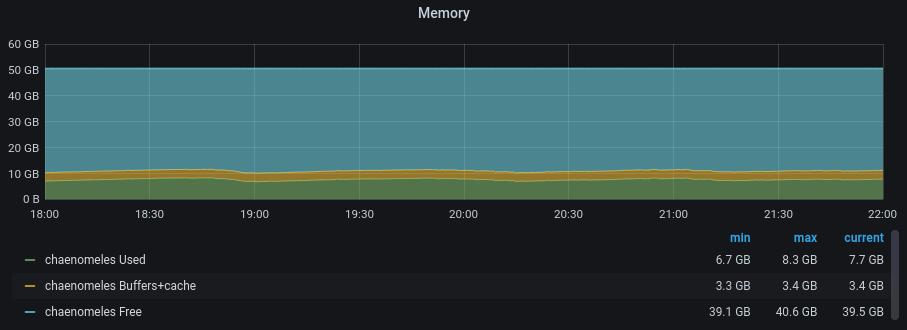
After a very long porting journey, Launchpad is finally running on Python 3 across all of our systems. I wanted to take a bit of time to reflect on why my emotional responses to this port differ so much from those of some others who ve done large ports, such as the Mercurial maintainers. It s hard to deny that we ve had to burn a lot of time on this, which I m sure has had an opportunity cost, and from one point of view it s essentially running to stand still: there is no single compelling feature that we get solely by porting to Python 3, although it s clearly a prerequisite for tidying up old compatibility code and being able to use modern language facilities in the future. And yet, on the whole, I found this a rewarding project and enjoyed doing it. Some of this may be because by inclination I m a maintenance programmer and actually enjoy this sort of thing. My default view tends to be that software version upgrades may be a pain but it s much better to get that pain over with as soon as you can rather than trying to hold back the tide; you can certainly get involved and try to shape where things end up, but rightly or wrongly I can t think of many cases when a righteously indignant user base managed to arrange for the old version to be maintained in perpetuity so that they never had to deal with the new thing (OK, maybe Perl 5 counts here). I think a more compelling difference between Launchpad and Mercurial, though, may be that very few other people really had a vested interest in what Python version Launchpad happened to be running, because it s all server-side code (aside from some client libraries such as launchpadlib, which were ported years ago). As such, we weren t trying to do this with the internet having Strong Opinions at us. We were doing this because it was obviously the only long-term-maintainable path forward, and in more recent times because some of our library dependencies were starting to drop support for Python 2 and so it was obviously going to become a practical problem for us sooner or later; but if we d just stayed on Python 2 forever then fundamentally hardly anyone else would really have cared directly, only maybe about some indirect consequences of that. I don t follow Mercurial development so I may be entirely off-base, but if other people were yelling at me about how late my project was to finish its port, that in itself would make me feel more negatively about the project even if I thought it was a good idea. Having most of the pressure come from ourselves rather than from outside meant that wasn t an issue for us. I m somewhat inclined to think of the process as an extreme version of paying down technical debt. Moving from Python 2.7 to 3.5, as we just did, means skipping over multiple language versions in one go, and if similar changes had been made more gradually it would probably have felt a lot more like the typical dependency update treadmill. I appreciate why not everyone might want to think of it this way: maybe this is just my own rationalization. Reflections on porting to Python 3 I m not going to defend the Python 3 migration process; it was pretty rough in a lot of ways. Nor am I going to spend much effort relitigating it here, as it s already been done to death elsewhere, and as I understand it the core Python developers have got the message loud and clear by now. At a bare minimum, a lot of valuable time was lost early in Python 3 s lifetime hanging on to flag-day-type porting strategies that were impractical for large projects, when it should have been providing for bilingual strategies (code that runs in both Python 2 and 3 for a transitional period) which is where most libraries and most large migrations ended up in practice. For instance, the early advice to library maintainers to maintain two parallel versions or perhaps translate dynamically with 2to3 was entirely impractical in most non-trivial cases and wasn t what most people ended up doing, and yet the idea that 2to3 is all you need still floats around Stack Overflow and the like as a result. (These days, I would probably point people towards something more like Eevee s porting FAQ as somewhere to start.) There are various fairly straightforward things that people often suggest could have been done to smooth the path, and I largely agree: not removing the u'' string prefix only to put it back in 3.3, fewer gratuitous compatibility breaks in the name of tidiness, and so on. But if I had a time machine, the number one thing I would ask to have been done differently would be introducing type annotations in Python 2 before Python 3 branched off. It s true that it s technically possible to do type annotations in Python 2, but the fact that it s a different syntax that would have to be fixed later is offputting, and in practice it wasn t widely used in Python 2 code. To make a significant difference to the ease of porting, annotations would need to have been introduced early enough that lots of Python 2 library code used them so that porting code didn t have to be quite so much of an exercise of manually figuring out the exact nature of string types from context. Launchpad is a complex piece of software that interacts with multiple domains: for example, it deals with a database, HTTP, web page rendering, Debian-format archive publishing, and multiple revision control systems, and there s often overlap between domains. Each of these tends to imply different kinds of string handling. Web page rendering is normally done mainly in Unicode, converting to bytes as late as possible; revision control systems normally want to spend most of their time working with bytes, although the exact details vary; HTTP is of course bytes on the wire, but Python s WSGI interface has some string type subtleties. In practice I found myself thinking about at least four string-like types (that is, things that in a language with a stricter type system I might well want to define as distinct types and restrict conversion between them): bytes, text, ordinary native strings (str in either language, encoded to UTF-8 in Python 2), and native strings with WSGI s encoding rules. Some of these are emergent properties of writing in the intersection of Python 2 and 3, which is effectively a specialized language of its own without coherent official documentation whose users must intuit its behaviour by comparing multiple sources of information, or by referring to unofficial porting guides: not a very satisfactory situation. Fortunately much of the complexity collapses once it becomes possible to write solely in Python 3. Some of the difficulties we ran into are not ones that are typically thought of as Python 2-to-3 porting issues, because they were changed later in Python 3 s development process. For instance, the email module was substantially improved in around the 3.2/3.3 timeframe to handle Python 3 s bytes/text model more correctly, and since Launchpad sends quite a few different kinds of email messages and has some quite picky tests for exactly what it emits, this entailed a lot of work in our email sending code and in our test suite to account for that. (It took me a while to work out whether we should be treating raw email messages as bytes or as text; bytes turned out to work best.) 3.4 made some tweaks to the implementation of quoted-printable encoding that broke a number of our tests in ways that took some effort to fix, because the tests needed to work on both 2.7 and 3.5. The list goes on. I got quite proficient at digging through Python s git history to figure out when and why some particular bit of behaviour had changed. One of the thorniest problems was parsing HTTP form data. We mainly rely on zope.publisher for this, which in turn relied on cgi.FieldStorage; but cgi.FieldStorage is badly broken in some situations on Python 3. Even if that bug were fixed in a more recent version of Python, we can t easily use anything newer than 3.5 for the first stage of our port due to the version of the base OS we re currently running, so it wouldn t help much. In the end I fixed some minor issues in the multipart module (and was kindly given co-maintenance of it) and converted zope.publisher to use it. Although this took a while to sort out, it seems to have gone very well. A couple of other interesting late-arriving issues were around pickle. For most things we normally prefer safer formats such as JSON, but there are a few cases where we use pickle, particularly for our session databases. One of my colleagues pointed out that I needed to remember to tell pickle to stick to protocol 2, so that we d be able to switch back and forward between Python 2 and 3 for a while; quite right, and we later ran into a similar problem with marshal too. A more surprising problem was that datetime.datetime objects pickled on Python 2 require special care when unpickling on Python 3; rather than the approach that ended up being implemented and documented for Python 3.6, though, I preferred a custom unpickler, both so that things would work on Python 3.5 and so that I wouldn t have to risk affecting the decoding of other pickled strings in the session database. General lessons Writing this over a year after Python 2 s end-of-life date, and certainly nowhere near the leading edge of Python 3 porting work, it s perhaps more useful to look at this in terms of the lessons it has for other large technical debt projects. I mentioned in my previous article that I used the approach of an enormous and frequently-rebased git branch as a working area for the port, committing often and sometimes combining and extracting commits for review once they seemed to be ready. A port of this scale would have been entirely intractable without a tool of similar power to git rebase, so I m very glad that we finished migrating to git in 2019. I relied on this right up to the end of the port, and it also allowed for quick assessments of how much more there was to land. git worktree was also helpful, in that I could easily maintain working trees built for each of Python 2 and 3 for comparison. As is usual for most multi-developer projects, all changes to Launchpad need to go through code review, although we sometimes make exceptions for very simple and obvious changes that can be self-reviewed. Since I knew from the outset that this was going to generate a lot of changes for review, I therefore structured my work from the outset to try to make it as easy as possible for my colleagues to review it. This generally involved keeping most changes to a somewhat manageable size of 800 lines or less (although this wasn t always possible), and arranging commits mainly according to the kind of change they made rather than their location. For example, when I needed to fix issues with / in Python 3 being true division rather than floor division, I did so in one commit across the various places where it mattered and took care not to mix it with other unrelated changes. This is good practice for nearly any kind of development, but it was especially important here since it allowed reviewers to consider a clear explanation of what I was doing in the commit message and then skim-read the rest of it much more quickly. It was vital to keep the codebase in a working state at all times, and deploy to production reasonably often: this way if something went wrong the amount of code we had to debug to figure out what had happened was always tractable. (Although I can t seem to find it now to link to it, I saw an account a while back of a company that had taken a flag-day approach instead with a large codebase. It seemed to work for them, but I m certain we couldn t have made it work for Launchpad.) I can t speak too highly of Launchpad s test suite, much of which originated before my time. Without a great deal of extensive coverage of all sorts of interesting edge cases at both the unit and functional level, and a corresponding culture of maintaining that test suite well when making new changes, it would have been impossible to be anything like as confident of the port as we were. As part of the porting work, we split out a couple of substantial chunks of the Launchpad codebase that could easily be decoupled from the core: its Mailman integration and its code import worker. Both of these had substantial dependencies with complex requirements for porting to Python 3, and arranging to be able to do these separately on their own schedule was absolutely worth it. Like disentangling balls of wool, any opportunity you can take to make things less tightly-coupled is probably going to make it easier to disentangle the rest. (I can see a tractable way forward to porting the code import worker, so we may well get that done soon. Our Mailman integration will need to be rewritten, though, since it currently depends on the Python-2-only Mailman 2, and Mailman 3 has a different architecture.) Python lessons Our database layer was already in pretty good shape for a port, since at least the modern bits of its table modelling interface were already strict about using Unicode for text columns. If you have any kind of pervasive low-level framework like this, then making it be pedantic at you in advance of a Python 3 port will probably incur much less swearing in the long run, as you won t be trying to deal with quite so many bytes/text issues at the same time as everything else. Early in our port, we established a standard set of __future__ imports and started incrementally converting files over to them, mainly because we weren t yet sure what else to do and it seemed likely to be helpful. absolute_import was definitely reasonable (and not often a problem in our code), and print_function was annoying but necessary. In hindsight I m not sure about unicode_literals, though. For files that only deal with bytes and text it was reasonable enough, but as I mentioned above there were also a number of cases where we needed literals of the language s native str type, i.e. bytes in Python 2 and text in Python 3: this was particularly noticeable in WSGI contexts, but also cropped up in some other surprising places. We generally either omitted unicode_literals or used six.ensure_str in such cases, but it was definitely a bit awkward and maybe I should have listened more to people telling me it might be a bad idea. A lot of Launchpad s early tests used doctest, mainly in the style where you have text files that interleave narrative commentary with examples. The development team later reached consensus that this was best avoided in most cases, but by then there were far too many doctests to conveniently rewrite in some other form. Porting doctests to Python 3 is really annoying. You run into all the little changes in how objects are represented as text (particularly u'...' versus '...', but plenty of other cases as well); you have next to no tools to do anything useful like skipping individual bits of a doctest that don t apply; using __future__ imports requires the rather obscure approach of adding the relevant names to the doctest s globals in the relevant DocFileSuite or DocTestSuite; dealing with many exception tracebacks requires something like zope.testing.renormalizing; and whatever code refactoring tools you re using probably don t work properly. Basically, don t have done that. It did all turn out to be tractable for us in the end, and I managed to avoid using much in the way of fragile doctest extensions aside from the aforementioned zope.testing.renormalizing, but it was not an enjoyable experience. Regressions I know of nine regressions that reached Launchpad s production systems as a result of this porting work; of course there were various other regressions caught by CI or in manual testing. (Considering the size of this project, I count it as a resounding success that there were only nine production issues, and that for the most part we were able to fix them quickly.) Equality testing of removed database objects One of the things we had to do while porting to Python 3 was to implement the __eq__, __ne__, and __hash__ special methods for all our database objects. This was quite conceptually fiddly, because doing this requires knowing each object s primary key, and that may not yet be available if we ve created an object in Python but not yet flushed the actual INSERT statement to the database (most of our primary keys are auto-incrementing sequences). We thus had to take care to flush pending SQL statements in such cases in order to ensure that we know the primary keys. However, it s possible to have a problem at the other end of the object lifecycle: that is, a Python object might still be reachable in memory even though the underlying row has been DELETEd from the database. In most cases we don t keep removed objects around for obvious reasons, but it can happen in caching code, and buildd-manager crashed as a result (in fact while it was still running on Python 2). We had to take extra care to avoid this problem. Debian imports crashed on non-UTF-8 filenames Python 2 has some unfortunate behaviour around passing bytes or Unicode strings (depending on the platform) to shutil.rmtree, and the combination of some porting work and a particular source package in Debian that contained a non-UTF-8 file name caused us to run into this. The fix was to ensure that the argument passed to shutil.rmtree is a str regardless of Python version. We d actually run into something similar before: it s a subtle porting gotcha, since it s quite easy to end up passing Unicode strings to shutil.rmtree if you re in the process of porting your code to Python 3, and you might easily not notice if the file names in your tests are all encoded using UTF-8. lazr.restful ETags We eventually got far enough along that we could switch one of our four appserver machines (we have quite a number of other machines too, but the appservers handle web and API requests) to Python 3 and see what happened. By this point our extensive test suite had shaken out the vast majority of the things that could go wrong, but there was always going to be room for some interesting edge cases. One of the Ubuntu kernel team reported that they were seeing an increase in 412 Precondition Failed errors in some of their scripts that use our webservice API. These can happen when you re trying to modify an existing resource: the underlying protocol involves sending an If-Match header with the ETag that the client thinks the resource has, and if this doesn t match the ETag that the server calculates for the resource then the client has to refresh its copy of the resource and try again. We initially thought that this might be legitimate since it can happen in normal operation if you collide with another client making changes to the same resource, but it soon became clear that something stranger was going on: we were getting inconsistent ETags for the same object even when it was unchanged. Since we d recently switched a quarter of our appservers to Python 3, that was a natural suspect. Our lazr.restful package provides the framework for our webservice API, and roughly speaking it generates ETags by serializing objects into some kind of canonical form and hashing the result. Unfortunately the serialization was dependent on the Python version in a few ways, and in particular it serialized lists of strings such as lists of bug tags differently: Python 2 used [u'foo', u'bar', u'baz'] where Python 3 used ['foo', 'bar', 'baz']. In lazr.restful 1.0.3 we switched to using JSON for this, removing the Python version dependency and ensuring consistent behaviour between appservers. Memory leaks This problem took the longest to solve. We noticed fairly quickly from our graphs that the appserver machine we d switched to Python 3 had a serious memory leak. Our appservers had always been a bit leaky, but now it wasn t so much a small hole that we can bail occasionally as the boat is sinking rapidly : A serious memory leak (Yes, this got in the way of working out what was going on with ETags for a while.) I spent ages messing around with various attempts to fix this. Since only a quarter of our appservers were affected, and we could get by on 75% capacity for a while, it wasn t urgent but it was definitely annoying. After spending some quality time with objgraph, for some time I thought traceback reference cycles might be at fault, and I sent a number of fixes to various upstream projects for those (e.g. zope.pagetemplate). Those didn t help the leaks much though, and after a while it became clear to me that this couldn t be the sole problem: Python has a cyclic garbage collector that will eventually collect reference cycles as long as there are no strong references to any objects in them, although it might not happen very quickly. Something else must be going on. Debugging reference leaks in any non-trivial and long-running Python program is extremely arduous, especially with ORMs that naturally tend to end up with lots of cycles and caches. After a while I formed a hypothesis that zope.server might be keeping a strong reference to something, although I never managed to nail it down more firmly than that. This was an attractive theory as we were already in the process of migrating to Gunicorn for other reasons anyway, and Gunicorn also has a convenient max_requests setting that s good at mitigating memory leaks. Getting this all in place took some time, but once we did we found that everything was much more stable: A rather flat memory graph This isn t completely satisfying as we never quite got to the bottom of the leak itself, and it s entirely possible that we ve only papered over it using max_requests: I expect we ll gradually back off on how frequently we restart workers over time to try to track this down. However, pragmatically, it s no longer an operational concern. Mirror prober HTTPS proxy handling After we switched our script servers to Python 3, we had several reports of mirror probing failures. (Launchpad keeps lists of Ubuntu archive and image mirrors, and probes them every so often to check that they re reasonably complete and up to date.) This only affected HTTPS mirrors when probed via a proxy server, support for which is a relatively recent feature in Launchpad and involved some code that we never managed to unit-test properly: of course this is exactly the code that went wrong. Sadly I wasn t able to sort out that gap, but at least the fix was simple. Non-MIME-encoded email headers As I mentioned above, there were substantial changes in the email package between Python 2 and 3, and indeed between minor versions of Python 3. Our test coverage here is pretty good, but it s an area where it s very easy to have gaps. We noticed that a script that processes incoming email was crashing on messages with headers that were non-ASCII but not MIME-encoded (and indeed then crashing again when it tried to send a notification of the crash!). The only examples of these I looked at were spam, but we still didn t want to crash on them. The fix involved being somewhat more careful about both the handling of headers returned by Python s email parser and the building of outgoing email notifications. This seems to be working well so far, although I wouldn t be surprised to find the odd other incorrect detail in this sort of area. Failure to handle non-ISO-8859-1 URL-encoded form input Remember how I said that parsing HTTP form data was thorny? After we finished upgrading all our appservers to Python 3, people started reporting that they couldn t post Unicode comments to bugs, which turned out to be only if the attempt was made using JavaScript, and was because I hadn t quite managed to get URL-encoded form data working properly with zope.publisher and multipart. The current standard describes the URL-encoded format for form data as in many ways an aberrant monstrosity , so this was no great surprise. Part of the problem was some very strange choices in zope.publisher dating back to 2004 or earlier, which I attempted to clean up and simplify. The rest was that Python 2 s urlparse.parse_qs unconditionally decodes percent-encoded sequences as ISO-8859-1 if they re passed in as part of a Unicode string, so multipart needs to work around this on Python 2. I m still not completely confident that this is correct in all situations, but at least now that we re on Python 3 everywhere the matrix of cases we need to care about is smaller. Inconsistent marshalling of Loggerhead s disk cache We use Loggerhead for providing web browsing of Bazaar branches. When we upgraded one of its two servers to Python 3, we immediately noticed that the one still on Python 2 was failing to read back its revision information cache, which it stores in a database on disk. (We noticed this because it caused a deployment to fail: when we tried to roll out new code to the instance still on Python 2, Nagios checks had already caused an incompatible cache to be written for one branch from the Python 3 instance.) This turned out to be a similar problem to the pickle issue mentioned above, except this one was with marshal, which I didn t think to look for because it s a relatively obscure module mostly used for internal purposes by Python itself; I m not sure that Loggerhead should really be using it in the first place. The fix was relatively straightforward, complicated mainly by now needing to cope with throwing away unreadable cache data. Ironically, if we d just gone ahead and taken the nominally riskier path of upgrading both servers at the same time, we might never have had a problem here. Intermittent bzr failures Finally, after we upgraded one of our two Bazaar codehosting servers to Python 3, we had a report of intermittent bzr branch hangs. After some digging I found this in our logs:
Traceback (most recent call last):
  ...
  File "/srv/bazaar.launchpad.net/production/codehosting1-rev-20124175fa98fcb4b43973265a1561174418f4bd/env/lib/python3.5/site-packages/twisted/conch/ssh/channel.py", line 136, in addWindowBytes
    self.startWriting()
  File "/srv/bazaar.launchpad.net/production/codehosting1-rev-20124175fa98fcb4b43973265a1561174418f4bd/env/lib/python3.5/site-packages/lazr/sshserver/session.py", line 88, in startWriting
    resumeProducing()
  File "/srv/bazaar.launchpad.net/production/codehosting1-rev-20124175fa98fcb4b43973265a1561174418f4bd/env/lib/python3.5/site-packages/twisted/internet/process.py", line 894, in resumeProducing
    for p in self.pipes.itervalues():
builtins.AttributeError: 'dict' object has no attribute 'itervalues'
I d seen this before in our git hosting service: it was a bug in Twisted s Python 3 port, fixed after 20.3.0 but unfortunately after the last release that supported Python 2, so we had to backport that patch. Using the same backport dealt with this. Onwards!

1 August 2021

Russ Allbery: Review: Fugitive Telemetry

Review: Fugitive Telemetry, by Martha Wells
Series: Murderbot Diaries #6
Publisher: Tordotcom
Copyright: April 2021
ISBN: 1-250-76538-2
Format: Kindle
Pages: 167
Fugitive Telemetry is the fifth Murderbot novella. It is not a sequel to the (as yet) lone novel, Network Effect. Instead, it takes place between Exit Strategy and Network Effect, filling in more of the backstory of the novel. You should not read it before Exit Strategy, but I believe it and Network Effect could be read in any order. A human has been murdered on Preservation Station. That is not a thing that happens on Preservation Station, which is normally a peaceful place whose crime is limited to intoxication-related stupidity. Murderbot's first worry, and the first worry of his humans, is that this may be one of their enemies getting into position to target them. That risk at least makes the murder worth investigating, rather than leaving it solely to Station Security. The problem from Murderbot's perspective is that there is an effective and efficient way of doing such an investigation, which starts with hacking into the security systems to get necessary investigative data and may end with the silent disposal of dead bodies of enemy agents. But this is Preservation Station, not the Corporation Rim, and Murderbot agreed to not do things like casually compromise all the station security systems or murder people who are security threats.
There was a big huge deal about it, and Security was all "but what if it takes over the station's systems and kills everybody" and Pin-Lee told them "if it wanted to do that it would have done it by now," which in hindsight was probably not the best response.
Worse, Murderbot's human wants it to work collaboratively with Station Security. That is a challenge, given that Security has a lot of reasons not to trust SecUnits, and Murderbot has a lot of reasons not to trust a security organization (not to mention considers them largely incompetent). Also, the surveillance systems are totally inadequate compared to the Corporation Rim for various financial and civil rights reasons that are doubtless wonderful except in situations where someone has been murdered. But hopefully the humans won't get in the way too much. This is one of those books (well, novellas) that I finished a while back but then stalled out on reviewing. I think that's because I don't have that much to say about it. Network Effect pushed the world-building and Murderbot's personal storyline forward significantly, but Fugitive Telemetry doesn't pick up those threads. Instead, this is another novella in much the same vein as the first four. If you, like me, are eager to see where Wells takes the story after the events of the novel, this is somewhat disappointing. But if you enjoyed the novellas, this is more of what you enjoyed: snarky comments about humanity, competence porn, Murderbot getting pulled into problems somewhat against its will and then trying to sort them out, and the occasional touching moment of emotional connection that Murderbot escapes from as quickly as possible. It's quite enjoyable, helped considerably by Wells's wise choice to not make the supporting human characters idiots. Collaboration is not Murderbot's strength; it is certain the investigation will be an endless series of frustrations and annoyances given the level of suspicion Station Security starts with. But some humans (and some SecUnits) are capable of re-evaluating their conclusions when given new evidence, and watching that happen is part of the fun of this novella. What this novella is missing is the overarching plot structure of the rest of the series, since where this story sits chronologically doesn't leave much room for advancing or even deepening the plot arc. It therefore feels incidental: delightful while I was reading it, probably missable if you have to, and not something I spent time thinking about after I finished it. If you liked the Murderbot novellas up until now, you will want to read this one. If you haven't started the series yet, this is not a place to start. If you want something more like the Network Effect novel, or a story where Murderbot makes significant decisions about its future, the wait continues. Rating: 8 out of 10

21 July 2021

Sean Whitton: Delivering Common Lisp executables using Consfigurator

I realised this week that my recent efforts to improve how Consfigurator makes the fork(2) system call have also created a way to install executables to remote systems which will execute arbitrary Common Lisp code. Distributing precompiled programs using free software implementations of the Common Lisp standard tends to be more of a hassle than with a lot of other high level programming languages. Executables will often be hundreds of megabytes in size even if your codebase is just a few megabytes, because the whole interactive Common Lisp environment gets bundled along with your program s code. Commercial Common Lisp implementations manage to do better, as I understand it, by knowing how to shake out unused code paths. Consfigurator s new mechanism uploads only changed source code, which might only be kilobytes in size, and updates the executable on the remote system. So it should be useful for deploying Common Lisp-powered web services, and the like. Here s how it works. When you use Consfigurator you define an ASDF system analagous to a Python package or Perl distribution called your consfig . This defines HOST objects to represent the machines that you ll use Consfigurator to manage, and any custom properties, functions those properties call, etc.. An ASDF system can depend upon other systems; for example, every consfig depends upon Consfigurator itself. When you execute Consfigurator deployments, Consfigurator uploads the source code of any ASDF systems that have changed since you last deployed this host, starts up Lisp on the remote machine, and loads up all the systems. Now the remote Lisp image is in a similarly clean state to when you ve just started up Lisp on your laptop and loaded up the libraries you re going to use. Only then are the actual deployment instructions are sent on stdin. What I ve done this week is insert an extra step for the remote Lisp image in between loading up all the ASDF systems and reading the deployment from stdin: the image calls fork(2) and establishes a pipe to communicate with the child process. The child process can be sent Lisp forms to evaluate, but for each Lisp form it receives it will actually fork again, and have its child process evaluate the form. Thus, going into the deployment, the original remote Lisp image has the capability to have arbitrary Lisp forms evaluated in a context in which all that has happened is that a statically defined set of ASDF systems has been loaded the child processes never see the full deployment instructions sent on stdin. Further, the child process responsible for actually evaluating the Lisp form received from the first process first forks off another child process and sets up its own control pipe, such that it too has the capacbility to have arbitrary Lisp forms evaluated in a cleanly loaded context, no matter what else it might put in its memory in the meantime. (Things are set up such that the child processes responsible for actually evaluating the Lisp forms never see the Lisp forms received for evaluation by other child processes, either.) So suppose now we have an ASDF system :com.silentflame.cool-web-service, and there is a function (start-server PORT) which we should call to start listening for connections. Then we can make our consfig depend upon that ASDF system, and do something like this:
CONSFIG> (deploy-these ((:ssh :user "root") :sbcl) server.example.org
           ;; Set up Apache to proxy requests to our service.
           (apache:https-vhost ...)
           ;; Now apply a property to dump the image.
           (image-dumped "/usr/local/bin/cool-web-service"
                         '(cool-web-service:start-server 1234)))
Consfigurator will: SSH to server.example.org; upload all the ASDF source for your consfig and its dependencies; compile and load that code into a remote SBCL process; call fork(2) and set up the control pipe; receive the applications of APACHE:HTTPS-VHOST and IMAGE-DUMPED shown above from your laptop, on stdin; apply the APACHE:HTTPS-VHOST property to ensure that Apache is proxying connections to port 1234; send a request into the control pipe to have the child process fork again and dump an executable which, when started, will evaluate the form (cool-web-service:start-server 1234). And that form will get evaluated in a pristine Lisp image, where the only meaningful things that have happened is that some ASDF systems have been loaded and a single fork(2) has taken place. You d probably need to add some other properties to add some mechanism for actually invoking /usr/local/bin/cool-web-service and restarting it when the executable is updated. (Background: The primary reason why Consfigurator s remote Lisp images need to call fork(2) is that they need to do things like setuid from root to other accounts and enter chroots without getting stuck in those contexts. Previously we forked right before entering such contexts, but that meant that Consfigurator deployments could never be multithreaded, because it might later be necessary to fork, and you can t usually do that once you ve got more than one thread running. So now we fork before doing anything else, so that the parent can then go multithreaded if desired, but can still execute subdeployments in contexts like chroots by sending Lisp forms to evaluate in those contexts into the control pipe.)

19 July 2021

Antonio Terceiro: Getting help with autopkgtest for your package

If you have been involved in Debian packaging at all in the last few years, you are probably aware that autopkgtest is now an important piece of the Debian release process. Back in 2018, the automated testing migration process started considering autopkgtest test results as part of its decision making. Since them, this process has received several improvements. For example, during the bullseye freeze, non-key packages with a non-trivial autopkgtest test suite could migrate automatically to testing without their maintainers needing to open unblock requests, provided there was no regression in theirs autopkgtest (or those from their reverse dependencies). Since 2014 when ci.debian.net was first introduced, we have seen an amazing increase in the number of packages in Debian that can be automatically tested. We went from around 100 to 15,000 today. This means not only happier maintainers because their packages get to testing faster, but also improved quality assurance for Debian as a whole. Chart showing the number of packages tested by ci.debian.net. Starts from close to 0 in 2014, up to 15,000 in 2021. The growth tendency seems to slow down in the last year However, the growth rate seems to be decreasing. Maybe the low hanging fruit have all been picked, or maybe we just need to help more people jump in the automated testing bandwagon. With that said, we would like to encourage and help more maintainers to add autopkgtest to their packages. To that effect, I just created the autopkgtest-help repository on salsa, where we will take help requests from maintainers working on autopkgtest for their packages. If you want help, please go ahead and create an issue in there. To quote the repository README:
Valid requests:
  • "I want to add autopkgtest to package X. X is a tool that [...] and it works by [...]. How should I approach testing it?" It's OK if you have no idea where to start. But at least try to describe your package, what it does and how it works so we can try to help you.
  • "I started writing autopkgtest for X, here is my current work in progress [link]. But I encountered problem Y. How to I move forward?" If you already have an autopkgtest but is having trouble making it work as you think it should, you can also ask here.
Invalid requests:
  • "Please write autopkgtest for my package X for me". As with anything else in free software, please show appreciation for other people's time, and do your own research first. If you pose your question with enough details (see above) and make it interesting, it may be that whoever answers will write at least a basic structure for you, but as the maintainer you are still the expert in the package and what tests are relevant.
If you ask your question soon, you might get your answer recorded in video: we are going to have a DebConf21 talk next month, where we I and Paul Gevers (elbrus) will answer a few autopkgtest questions in video for posterity. Now, if you have experience enabling autopkgtest for you own packages, please consider watching that repository there to help us help our fellow maintainers.

18 July 2021

Shirish Agarwal: BBI Kenyan Supreme Court, U.P. Population Bill, South Africa, Suli Deals , IT rules 2021, Sedition Law and Danish Siddiqui s death.

BBI Kenya and live Supreme Court streaming on YT The last few weeks have been unrelenting as all sorts of news have been coming in, mostly about the downturn in the Economy, Islamophobia in India on the rise, Covid, and electioneering. However, in the last few days, Kenya surpassed India in live-streaming proceeds in a Court of Appeals about BBI or Building Bridges Initiative. A background filler article on the topic can be found in BBC. The live-streaming was done via YT and if wants to they can start from

https://www.youtube.com/watch?v=JIQzpmVKvro One can also subscribe to K24TV which took the initiative of sharing the proceedings with people worldwide. If K24TV continues to share SC proceedings of Kenya, that would add to the soft power of Kenya. I will not go into the details of the case as Gautam Bhatia who has been following the goings-on in Kenya is a far better authority on the subject. In fact, just recently he shared about another Kenyan judgment from a trial which can be seen here. He has shared the proceedings and some hot takes on the Twitter thread started by him. Probably after a couple of weeks or more when he has processed what all has happened there, he may also share some nuances although many of his thoughts would probably go to his book on Comparative Constitutional Law which he hopes to publish maybe in 2021/2022 or whenever he can. Such televised proceedings are sure to alleviate the standing of Kenya internationally. There has been a proposal to do similar broadcasts by India but with surveillance built-in, so they know who is watching. The problems with the architecture and the surveillance built-in have been shared by Srinivas Kodali or DigitalDutta quite a few times, but that probably is a story for another day.

Uttar Pradesh Population Control Bill
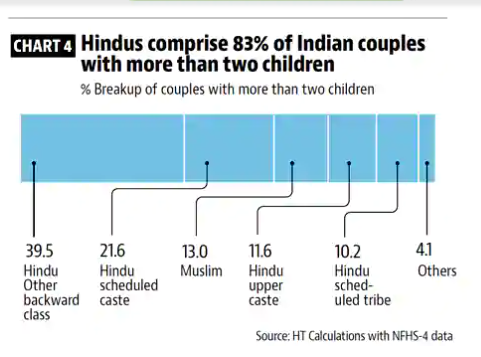
Hindus comprise 83% of Indian couples with more than two child children
The U.P. Population Bill came and it came with lot of prejudices. One of the prejudices is the idea that Muslims create or procreate to have the most children. Even with data is presented as shared above from NFHS National Family Health Survey which is supposed to carry our surveys every few years did the last one around 4 years back. The analysis from it has been instrumental not only in preparing graphs as above but also sharing about what sort of death toll must have been in rural India. And as somebody who have had the opportunity in the past, can vouch that you need to be extremely lucky if something happens to you when you are in a rural area. Even in places like Bodh Gaya (have been there) where millions of tourists come as it is one of the places not to be missed on the Buddhism tourist circuit, the medical facilities are pretty underwhelming. I am not citing it simply because there are too many such newspaper reports from even before the pandemic, and both the State and the Central Govt. response has been dismal. Just a few months back, they were recalled. There were reports of votes being bought at INR 1000/- (around $14) and a bottle or two of liquor. There used to be a time when election monitoring whether national or state used to be a thing, and you had LTO s (Long-time Observers) and STO s (Short-Term Observers) to make sure that the election has been neutral. This has been on the decline in this regime, but that probably is for another time altogether. Although, have to point out the article which I had shared a few months ago on the private healthcare model is flawed especially for rural areas. Instead of going for cheap, telemedicine centers that run some version of a Linux distro. And can provide a variety of services, I know Kerala and Tamil Nadu from South India have experimented in past but such engagements need to be scaled up. This probably will come to know when the next time I visit those places (sadly due to the virus, not anytime soonish.:( ) . Going back to the original topic, though, I had shared Hans Rosling s famous Ted talk on population growth which shows that even countries which we would not normally associate with family planning for e.g. the middle-east and Africa have also been falling quite rapidly. Of course, when people have deeply held prejudices, then it is difficult. Even when sharing China as to how they had to let go of their old policy in 2016 as they had the thing for leftover men . I also shared the powerful movie So Long my Son. I even shared how in Haryana women were and are trafficked and have been an issue for centuries but as neither suits the RW propaganda, they simply refuse to engage. They are more repulsed by people who publish this news rather than those who are actually practicing it, as that is culture . There is also teenage pregnancy, female infanticide, sex-selective abortion, etc., etc. It is just all too horrible to contemplate. Personal anecdote I know a couple, or they used to be a couple, where the gentleman wanted to have a male child. It was only after they got an autistic child, they got their DNA tested and came to know that the gentleman had a genetic problem. He again forced and had another child, and that too turned out to be autistic. Finally, he left the wife and the children, divorced them and lived with another woman. Almost a decade of the wife s life was ruined. The wife before marriage was a gifted programmer employed at IBM. This was an arranged marriage. After this, if you are thinking of marrying, apart from doing astrology charts, also look up DNA compatibility charts. Far better than ruining yours or the women s life. Both the children whom I loved are now in heaven, god bless them  If one wants to, one can read a bit more about the Uttar Pradesh Population bill here. The sad part is that the systems which need fixing, nobody wants to fix. The reason being simple. If you get good health service by public sector, who will go to the private sector. In Europe, AFAIK they have the best medical bang for the money. Even the U.S. looks at Europe and hopes it had the systems that Europe has but that again is probably for another day.
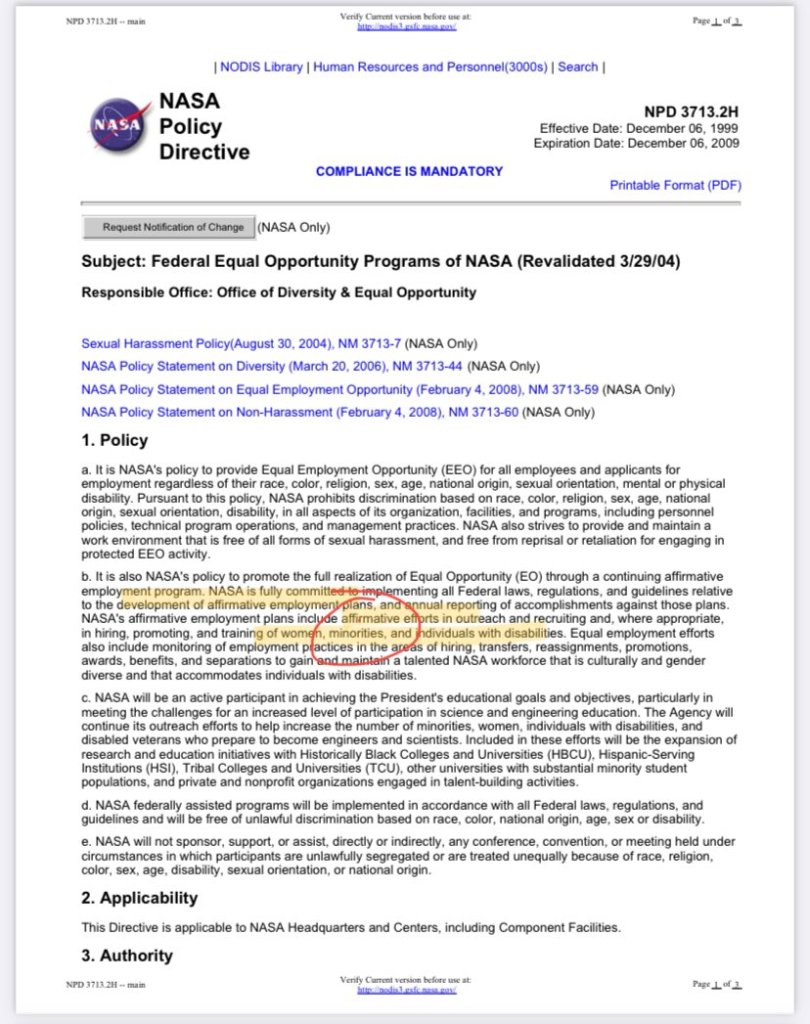
South Africa and India long-lost brothers. As had shared before, after the 2016 South African Debconf convention, I had been following South Africa. I was happy when FeesMustFall worked and in 2017 the then ANC president Zuma declared it in late 2017. I am sure that people who have been regular visitors to this blog know how my position is on student loans. They also must be knowing that even in U.S. till the 1970s it had free education all the way to be a lawyer and getting a lawyer license. It is only when people like Thurgood Marshall, Martin Luther King Jr., and others from the civil rights movement came out as a major force that the capitalists started imposing fees. They wanted people who could be sold to corporate slavery, and they won. Just last week, Biden took some steps and canceled student loans and is working on steps towards broad debt forgiveness. Interestingly, NASA has an affirmative diversity program for people from diverse backgrounds, where a couple of UC (Upper Caste) women got the job. While they got the job, the RW (Right-Wing) was overjoyed as they got jobs on merit . Later, it was found that both the women were the third or fourth generation of immigrants in U.S.
NASA Federal Equal Opportunity Policy Directive NPD 3713 2H
Going back to the original question and topic, while there has been a concerning spate of violence, some calling it the worst sort of violence not witnessed since 1994. The problem, as ascertained in that article, is the same as here in India or elsewhere. Those, again, who have been on my blog know that merit 90% of the time is a function of privilege and there is a vast amount of academic literature which supports that. If, for a moment, you look at the data that is shared in the graph above which shows that 83% of Hindus and 13% of Muslims have more than 2 children, what does it show, it shows that 83+13 = 96% of the population is living in insecurity. The 5% are the ones who have actually consolidated more power during this regime rule in India. Similarly, from what I understood living in Cape Town for about a month, it is the Dutch Afrikaans as they like to call themselves and the immigrants who come from abroad who have enjoyed the fruits of tourism and money and power while the rest of the country is dying due to poverty. It is the same there, it is the same here. Corruption is also rampant in both countries, and the judiciary is virtually absent from both communities in India and SA. Interestingly, South Africa and India have been at loggerheads, but I suspect that is more due to the money and lobbying power by the Dutch. Usually, those who have money power, do get laws and even press on their side, and it is usually the ruling party in power. I cannot help but share about the Gupta brothers and their corruption as I came to know about it in 2016. And as have shared that I m related to Gupta s on my mother s side, not those specific ones but Gupta as a clan. The history of the Gupta dynasty does go back to the 3rd-4th century. Equally interesting have been Sonali Ranade s series of articles which she wrote in National Herald, the latest on exports which is actually the key to taking India out of poverty rather than anything else. While in other countries Exporters are given all sort of subsidies, here it is being worked as how to give them less. This was in Economic times hardly a week back
Export incentive schemes being reduced
I can t imagine the incredible stupidity done by the Finance Minister. And then in an attempt to prove that, they will attempt to present a rosy picture with numbers that have nothing to do with reality. Interestingly enough, India at one time was a major exporter of apples, especially from Kashmir. Now instead of exporting, we are importing them from Afghanistan as well as Belgium and now even from the UK. Those who might not want to use the Twitter link could use this article. Of course, what India got out of this trade deal is not known. One can see that the UK got the better deal from this. Instead of investing in our own capacity expansion, we are investing in increasing the capacity of others. This is at the time when due to fuel price hike (Central taxes 66%) demand is completely flat. And this is when our own CEA (Chief Economic Adviser) tells us that growth will be at the most 6-7% and that too in 2023-2024 while currently, the inflation rate is around 12%. Is it then any wonder that almost 70% are living on Govt. ration and people in the streets of Kolkata, Assam, and other places have to sell kidneys to make sure they have some money for their kids for tomorrow. Now I have nothing against the UK but trade negotiation is an art. Sadly, this has been going on for the last few years. The politicians in India fool the public by always telling of future trade deals. Sadly, as any businessman knows, once you have compromised, you always have to compromise. And the more you compromise, the more you weaken the hand for any future trade deals.
IIT pupil tries to sell kidney to repay loan, but no takers for Dalit organ.
The above was from yesterday s Times of India. Just goes to show how much people are suffering. There have been reports in vernacular papers of quite a few people from across regions and communities are doing this so they can live without pain a bit. Almost all the time, the politicians are saved as only few understand international trade, the diplomacy and the surrounding geopolitics around it. And this sadly, is as much to do with basic education as much as it is to any other factor

Suli Deals About a month back on the holy day of Ramzan or Ramadan as it is known in the west, which is beloved by Muslims, a couple of Muslim women were targeted and virtually auctioned. Soon, there was a flood and a GitHub repository was created where hundreds of Muslim women, especially those who have a voice and fearlessly talk about their understanding about issues and things, were being virtually auctioned. One week after the FIR was put up, to date none of the people mentioned in the FIR have been arrested. In fact, just yesterday, there was an open letter which was published by livelaw. I have saved a copy on WordPress just in case something does go wrong. Other than the disgust we feel, can t say much as no action being taken by GOI and police.

IT Rules 2021 and Big Media After almost a year of sleeping when most activists were screaming hoarsely about how the new IT rules are dangerous for one and all, big media finally woke up a few weeks back and listed a writ petition in Madras High Court of the same. Although to be frank, the real writ petition was filed In February 2021, classical singer, performer T.M. Krishna in Madras High Court. Again, a copy of the writ petition, I have hosted on WordPress. On 23rd June 2021, a group of 13 media outlets and a journalist have challenged the IT Rules, 2021. The Contention came from Digital News Publishers Association which is made up of the following news companies: ABP Network Private Limited, Amar Ujala Limited, DB Corp Limited, Express Network Pvt Ltd, HT Digital Streams Limited, IE Online Media Services Pvt Ltd, Jagran Prakashan Limited, Lokmat Media Private Limited, NDTV Convergence Limited, TV Today Network Limited, The Malayala Manorama Co (P) Ltd, Times Internet Limited, and Ushodaya Enterprises Private Limited. All the above are heavyweights in the markets where they operate. The reason being simple, when these media organizations came into being, the idea was to have self-regulation, which by and large has worked. Now, the present Govt. wants each news item to be okayed by them before publication. This is nothing but blatant misuse of power and an attempt at censorship. In fact, the Tamil Nadu BJP president himself made a promise of the same. And of course, what is true and what is a lie, only GOI knows and will decide for the rest of the country. If somebody remembers Joseph Goebbels at this stage, it is merely a coincidence. Anyways, 3 days ago Supreme Court on 14th July the Honorable Supreme Court asked the Madras High Court to transfer all the petitions to SC. This, the Madras High Court denied as cited/shared by Meera Emmanuel, a reporter who works with barandbench. The Court says nothing doing, let this happen and then the SC can entertain the motion of doing it that level. At the same time, they would have the benefit of Madras High Court opinion as well. It gave the center two weeks to file a reply. So, either of end-week of July or latest by August first week, we might be able to read the Center s reply on the same. The SC could do a forceful intervention, but it would lead to similar outrage as has been witnessed in the past when a judge commented that if the SC has to do it all, then why do we need the High Courts, district courts etc. let all the solutions come from SC itself. This was, admittedly, frustration on the part of the judge, but due in part to the needless intervention of SC time and time again. But the concerns had been felt around all the different courts in the country.

Sedition Law A couple of days ago, the Supreme Court under the guidance of Honorable CJI NV Ramanna, entertained the PIL filed by Maj Gen S G Vombatkere (Retd.) which asked simply that the sedition law which was used in the colonial times by the British to quell dissent by Mahatma Gandhi and Bal Gangadhar Tilak during the Indian freedom struggle. A good background filler article can be found on MSN which tells about some recent cases but more importantly how historically the sedition law was used to quell dissent during India s Independence. Another article on MSN actually elaborates on the PIL filed by Maj Gen S. G. Vombatkere. Another article on MSN tells how sedition law has been challenged and changed in 10 odd countries. I find it equally sad and equally hilarious that the Indian media whose job is to share news and opinion on this topic is being instead of being shared more by MSN. Although, I would be bereft of my duty if I did not share the editorial on the same topic by the Hindu and Deccan Chronicle. Also, an interesting question to ask is, are there only 10 countries in the world that have sedition laws? AFAIK, there are roughly 200 odd countries as recognized by WTO. If 190 odd countries do not have sedition laws, it also tells a lot about them and a lot about the remaining 10. Also, it came to light that police are still filing laws under sec66A which was declared null and void a few years ago. It was replaced with section 124A if memory serves right and it has more checks and balances.

Danish Siddiqui, Pulitzer award-winning and death in Afghanistan Before I start with Danish Siddiqui, let me share an anecdote that I think I have shared on the blog years ago about how photojournalists are. Again, those who know me and those who follow me know how much I am mad both about trains and planes (civil aviation). A few months back, I had shared a blog post about some of the biggest railway systems in the world which shows that privatization of Railways doesn t necessarily lead to up-gradation of services but definitely leads to an increase in tariff/fares. Just had a conversation couple of days ago on Twitter and realized that need to also put a blog post about civil aviation in India and the problems it faces, but I digress. This was about a gentleman who wanted to take a photo of a particular train coming out of a valley at a certain tunnel at two different heights, one from below and one from above the train. This was several years ago, and while I did share that award-winning photograph then, it probably would take me quite a bit of time and effort to again look it up on my blog and share. The logistics though were far more interesting and intricate than I had first even thought of. We came around a couple of days before the train was supposed to pass that tunnel and the valley. More than half a dozen or maybe more shots were taken throughout the day by the cameras. The idea was to see how much light was being captured by the cameras and how much exposure was to be given so that the picture isn t whitened out or is too black. Weather is the strangest of foes for a photojournalist or even photographers, and the more you are in nature, the more unpredictable it is and can be. We were also at a certain height, so care had to be taken in case light rainfall happens or dew falls, both not good for digital cameras. And dew is something which will happen regardless of what you want. So while the two days our gentleman cameraman fiddled with the settings to figure out correct exposure settings, we had one other gentleman who was supposed to take the train from an earlier station and apprise us if the train was late or not. The most ideal time would be at 0600 hrs. When the train would enter the tunnel and come out and the mixture of early morning sun rays, dew, the flowers in the valley, and the train would give a beautiful effect. We could stretch it to maybe 0700 hrs. Anything after that would just be useless, as it wouldn t have the same effect. And of all this depended on nature. If the skies were to remain too dark, nothing we could do about it, if the dewdrops didn t fall it would all be over. On the day of the shoot, we were told by our compatriot that the train was late by half an hour. We sank a little on hearing that news. Although Photoshop and others can do touch-ups, most professionals like to take as authentic a snap as possible. Everything had been set up to perfection. The wide-angle lenses on both the cameras with protections were set up. The tension you could cut with a knife. While we had a light breakfast, I took a bit more and went in the woods to shit and basically not be there. This was too tensed up for me. Returned an hour to find everybody in a good mood. Apparently, the shoot went well. One of the two captured it for good enough. Now, this is and was in a benign environment where the only foe was the environment. A bad shot would have meant another week in the valley, something which I was not looking forward to. Those who have lived with photographers and photojournalists know how self-involved they can be in their craft, while how grumpy they can be if they had a bad shoot. For those, who don t know, it is challenging to be friends with such people for a long time. I wish they would scream more at nature and let out the frustrations they have after a bad shoot. But again, this is in a very safe environment. Now let s cut to Danish Siddiqui and the kind of photojournalism he followed. He followed a much more riskier sort of photojournalism than the one described above. Krittivas Mukherjee in his Twitter thread shared how reporters in most advanced countries are trained in multiple areas, from risk assessment to how to behave in case you are kidnapped, are in riots, hostage situations, etc. They are also trained in all sorts of medical training from treating gunshot wounds, CPR, and other survival methods. They are supposed to carry medical equipment along with their photography equipment. Sadly, these concepts are unknown in India. And even then they get killed. Sadly, he attributes his death to the thrill of taking an exclusive photograph. And the gentleman s bio reads that he is a diplomat. Talk about tone-deafness  On another completely different level was Karen Hao who was full of empathy as she shared the humility, grace, warmth and kinship she describes in her interaction with the photojournalist. His body of work can be seen via his ted talk in 2020 where he shared a brief collage of his works. Latest, though in a turnaround, the Taliban have claimed no involvement in the death of photojournalist Danish Siddiqui. This could be in part to show the Taliban in a more favorable light as they do and would want to be showcased as progressive, even though they are forcing that all women within a certain age become concubines or marry the fighters and killing the minority Hazaras or doing vile deeds with them. Meanwhile, statements made by Hillary Clinton almost a decade, 12 years ago have come back into circulation which stated how the U.S. itself created the Taliban to thwart the Soviet Union and once that job was finished, forgot all about it. And then in 2001, it landed back in Afghanistan while the real terrorists were Saudi. To date, not all documents of 9/11 are in the public domain. One can find more information of the same here. This is gonna take probably another few years before Saudi Arabia s whole role in the September 11 attacks will be known. Last but not the least, came to know about the Pegasus spyware and how many prominent people in some nations were targeted, including in mine India. Will not talk more as it s already a big blog post and Pegasus revelations need an article on its own.

17 July 2021

Raphaël Hertzog: Freexian s report about Debian Long Term Support, June 2021

A Debian LTS logo
Like each month, have a look at the work funded by Freexian s Debian LTS offering. Debian project funding In June, we put aside 5775 EUR to fund Debian projects for which we re looking forward to receive more projects from various
Debian teams! Learn more about the rationale behind this initiative in this article. Debian LTS contributors In June, 12 contributors have been paid to work on Debian LTS, their reports are available: Evolution of the situation In June we released 30 DLAs. As already written last month we are looking for a Debian LTS project manager and team coordinator.
Finally, we would like to remark once again that we are constantly looking for new contributors. Please contact Holger if you are interested! The security tracker currently lists 41 packages with a known CVE and the dla-needed.txt file has 23 packages needing an update. Thanks to our sponsors Sponsors that joined recently are in bold.

16 July 2021

Russell Coker: Thoughts about RAM and Storage Changes

My first Linux system in 1992 was a 386 with 4MB of RAM and a 120MB hard drive which (for some reason I forgot) only was supported by Linux for about 90MB. My first hard drive was 70MB and could do 500KB/s for contiguous IO, my first Linux hard drive was probably a bit faster, maybe 1MB/s. My current Linux workstation has 64G of RAM and 2*1TB NVMe devices that can sustain about 1.1GB/s. The laptop I m using right now has 8GB of RAM and a 180GB SSD that can do 380MB/s. My laptop has 2000* the RAM of my first Linux system and maybe 400* the contiguous IO speed. Currently I don t even run a VM with less than 4GB of RAM, NB I m not saying that smaller VMs aren t useful merely that I don t happen to be using them now. Modern AMD64 CPUs support 2MB huge pages . As a proportion of system RAM if I used 2MB pages everywhere they would be a smaller portion of system RAM than the 4KB pages on my first Linux system! I am not suggesting using 2MB pages for general systems. For my workstations the majority of processes are using less than 10MB of resident memory and given the different uses for memory mapped shared objects, memory mapped file IO, malloc(), stack, heap, etc there would be a lot of inefficiency having 2MB the limit for all allocation. But as systems worked with 4MB of RAM or less and 4K pages it would surely work to have only 2MB pages with 64GB or more of RAM. Back in the 90s it seemed ridiculous to me to have 256 byte pages on a 68030 CPU, but 4K pages on a modern AMD64 system is even more ridiculous. Apparently AMD64 supports 1GB pages on some CPUs, that seems ridiculously large but when run on a system with 1TB of RAM that s comparable to 4K pages on my first Linux system. Currently AWS offers 24TB EC2 instances and the Google Cloud Project offers 12TB virtual machines. It might even make sense to have the entire OS using 1GB pages for some usage scenarios on such systems, wasting tens of GB of RAM to save TLB thrashing might be a good trade-off. My personal laptop has 200* the RAM of my first Linux system and maybe 400* the contiguous IO speed. An employer recently assigned me a Thinkpad Carbon X1 Gen6 with an NVMe device that could sustain 5GB/s until the CPU overheated, that s 5000* the contiguous IO speed of my first Linux hard drive. My Linux hard drive had a 28ms average access time and my first Linux hard drive probably was a little better, let s call it 20ms for the sake of discussion. It s generally quoted that access times for NVMe are at best 10us, that s 2000* better than my first Linux hard drive. As seek times are the main factor for swap performance a laptop with 8GB of RAM and a fast NVMe device could be expected to give adequate performance with 2000* the swap of my first Linux system. For the work laptop in question I had 8G of swap and my personal laptop has 6G of swap which is somewhat comparable to the 4MB of swap on my first Linux system in that swap is about equal to RAM size, so I guess my personal laptop is performing better than it can be expected to. These are just some idle thoughts about hardware changes over the years. Don t take it as advice for purchasing hardware and don t take it too seriously in general. Also when writing comments don t restrict yourself to being overly serious, feel free to run the numbers on what systems with petabytes of Optane might be like, speculate on what NUMA systems in laptops might be like, etc. Go wild.

Junichi Uekawa: Bought BEHRINGER U-PHORIA 2-Channel UMC202HD.

Bought BEHRINGER U-PHORIA 2-Channel UMC202HD. My previous Q1002US mixer seemed to have unreliable right channel bus and was getting worried. MIDAS preamp, simple to use. Connect it to Linux box and it works as a USB audio device with two channel of input. It has two inputs and hence it will probably look like a stereo recording. If I connect my XM8500 it turns out to be on the left channel, for example. Looking at the waveforms, the noise floor is lower than Q1002US and I love it so far. Used my hack yesterday to confirm its behavior.

13 July 2021

Debian XMPP Team: XMPP Novelties in Debian 11 Bullseye

This is not only the Year of the Ox, but also the year of Debian 11, code-named bullseye. The release lies ahead, full freeze starts this week. A good opportunity to take a look at what is new in bullseye. In this post new programs and new software versions related to XMPP, also known as Jabber are presented. XMPP exists since 1999, and has a diverse and active developers community. It is a universal communication protocol, used for instant messaging, IoT, WebRTC, and social applications. You probably will encounter some oxen in this post. That's all for now. Enjoy Debian 11 bullseye and Happy Chatting!

1 July 2021

Paul Wise: FLOSS Activities June 2021

Focus This month I didn't have any particular focus. I just worked on issues in my info bubble.

Changes

Issues

Review
  • Spam: reported 3 Debian bug reports and 135 Debian mailing list posts
  • Debian wiki: RecentChanges for the month
  • Debian BTS usertags: changes for the month
  • Debian screenshots:
    • approved php-horde endless-sky claws-mail memtester
    • rejected python-gdal/weboob-qt (unrelated software)

Administration
  • Debian: restart bacula director
  • Debian wiki: approve accounts

Communication
  • This month I left freenode, an IRC network I had been on for at least 16 years, for reasons that you probably all read about. I think the biggest lesson I take from this situation and ones happening around the same time is that proper governance in peer production projects is absolutely critical.
  • Respond to queries from Debian users and contributors on the mailing lists and IRC

Sponsors The purple-discord/flower work was sponsored by my employers. All other work was done on a volunteer basis.

29 June 2021

Louis-Philippe V ronneau: New Winter Bicycle

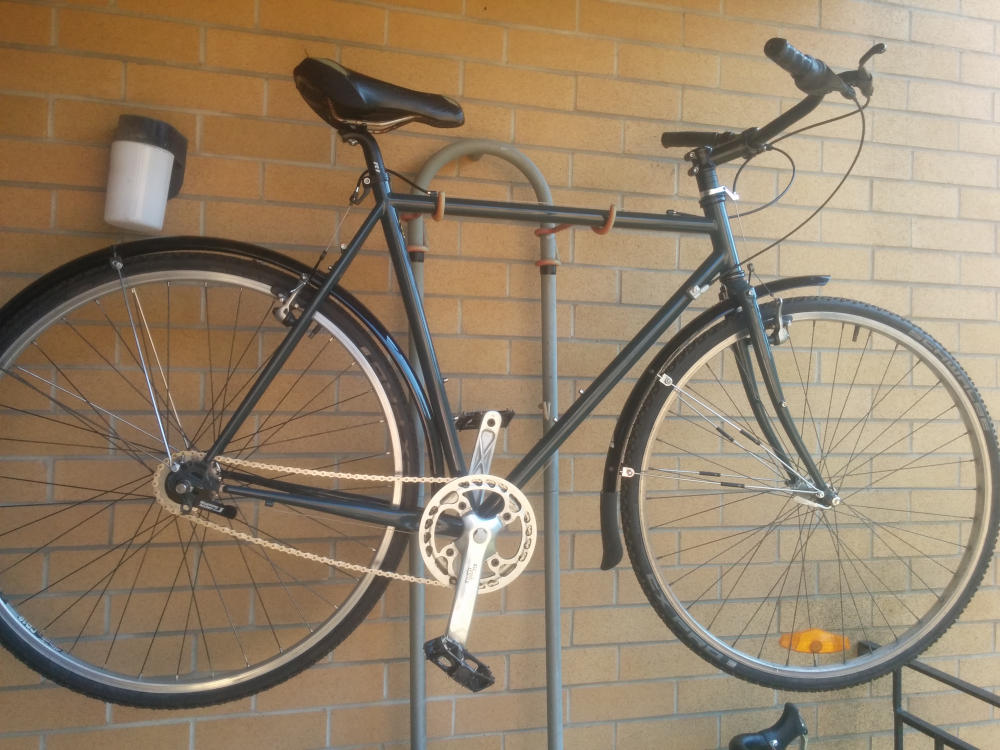
Although I'm about 5 months early and we're in the middle of a terrible heat wave where I live, I've just finished building my new winter bicycle! I've been riding all year round for about 8 years now and the winters in Montreal are harsh enough that a second winter-ready bicycle is required to have a fun and safe cold season. I'm saying "new bicycle" because a few months ago I totaled the frame of my previous winter bike. As you can see in the picture below (please disregard the salt crust), I broke the seat tube at the lug. I didn't notice it at first and while riding I kept hearing a "bang bang" sound coming from the frame when going over bumps. To my horror, I eventually realised the sound was coming from the seat tube hitting the bottom bracket shell! A large crack in my old bike frame I'm sad to see this Lejeune French frame go, but it was probably built in the 70's or the early 80's: it had a good life. Another great example of how a high quality steel frame can last a lifetime. Sparing no expense, I decided to replace it by a brand new Surly Cross-Check frameset. Surly is known for making great bike frames and the Cross-Check is a very versatile model. I'll finally be able to fit my Schwalbe Marathon Winter Plus tires at the front and the back with full length mud guards!!! Hard to ask for more. A picture of my new winter bike with CX Pro tires Summer has just started and I'm already looking forward to winter :)


28 June 2021

Shirish Agarwal: Indian Capital Markets, BSE, NSE

I had been meaning to write on the above topic for almost a couple of months now but just kept procrastinating about it. That push came to a shove when Sucheta Dalal and Debasis Basu shared their understanding, wisdom, and all in the new book called Absolute Power Inside story of the National Stock Exchange s amazing success, leading to hubris, regulatory capture and algo scam . Now while I will go into the details of the new book as currently, I have not bought it but even if I had bought it and shared some of the revelations from it, it wouldn t have done justice to either the book or what is sharing before knowing some of the background before it.

Before I jump ahead, I would suggest people to read my sort of introductory blog post on banking history so they know where I m coming from. I m going to deviate a bit from Banking as this is about trade and capital markets, although Banking would come in later on. And I will also be sharing some cultural insights along with history so people are aware of why things happened the way they did. Calicut, Calcutta, Kolkata, one-time major depot around the world Now, one cannot start any topic about trade without talking about Kolkata. While today, it seems like a bastion of communism, at one time it was one of the major trade depots around the world. Both William Dalrymple and the Chinese have many times mentioned Kolkata as being one of the major centers of trade. This was between the 13th and the late 19th century. A cursory look throws up this article which talks about Kolkata or Calicut as it was known as a major trade depot. There are of course many, many articles and even books which do tell about how Kolkata was a major trade depot. Now between the 13th and 19th century, a lot of changes happened which made Kolkata poorer and shifted trade to Mumbai/Bombay which in those times was nothing but just a port city like many others.

The Rise of the Zamindar Around the 15th century when Babur Invaded Hindustan, he realized that Hindustan is too big a country to be governed alone. And Hindustan was much broader than independent India today. So he created the title of Zamindars. Interestingly, if you look at the Mughal period, they were much more in tune with Hindustani practices than the British who came later. They used the caste divisions and hierarchy wisely making sure that the status quo was maintained as far as castes/creed were concerned. While in-fighting with various rulers continued, it was more or less about land and power other than anything else. When the Britishers came they co-opted the same arrangement with a minor adjustment. While in the before system, the zamindars didn t have powers to be landowners. The Britishers gave them land ownerships. A huge percentage of thess zamindars especially in Bengal were from my own caste Banias or Baniyas. The problem and the solution for the Britishers had been this was a large land to control and exploit and the number of British officers and nobles were very less. So they gave virtually a lot of powers to the Banias. The only thing the British insisted on were very high rents from the newly minted Zamindars. The Zamindar in turn used the powers of personal fiefdom to give loans at very high interest rates when the poor were unable to pay the interest rate, they would take the land while at the same time slavery was forced on both men and women, many a time rapes and affairs. While there have been many records shedding light on it, don t think it could be any more powerful as enacted and shared by Shabana Azmi in Ankur:the Seedling. Another prominent grouping was formed around the same time was the Bhadralok. Now as shared Bhadralok while having all the amenities of belonging to the community, turned a blind eye to the excesses being done by the Zamindars. How much they played a hand in the decimation of Bengal has been a matter of debate, but they did have a hand, that much is not contested.

The Rise of Stock Exchanges Sadly and interestingly, many people believe and continue to believe that stock exchanges is recent phenomena. The first stock exchange though was the Calcutta Stock Exchange rather than the Bombay Stock Exchange. How valuable was Calcutta to the Britishers in its early years can be gauged from the fact that at one time it was made the capital of India in 1772 . In fact, after the Grand Trunk Road (on which there had been even Train names in both countries) x number of books have been written of the trade between Calcutta and Peshawar (Now in Pakistan). And it was not just limited to trade but also cultural give-and-take between the two centers. Even today, if you look at YT (Youtube) and look up some interviews of old people, you find many interesting anecdotes of people sharing both culture and trade.

The problem of the 60 s and rise of BSE
After India became independent and the Constitutional debates happened, the new elites understood that there cannot be two power centers that could govern India. On one hand, were the politicians who had come to power on the back of the popular vote, the other was the Zamindars, who more often than not had abused their powers which resulted in widespread poverty. The Britishers are to blame, but so do the middlemen as they became willing enablers to the same system of oppression. Hence, you had the 1951 amendment to the Constitution and the 1956 Zamindari Abolition Act. In fact, you can find much more of an in-depth article both about Zamindars and their final abolition here. Now once Zamindari was gone, there was nothing to replace it with. The Zamindars ousted of their old roles turned and tried to become Industrialists. The problem was that the poor and the downtrodden had already had experiences with the Zamindars. Also, some Industrialists from North and West also came to Bengal but they had no understanding of either the language or the cultural understanding of what had happened in Bengal. And notice that I have not talked about both the famines and the floods that wrecked Bengal since time immemorial and some of the ones which got etched on soul of Bengal and has marks even today  The psyche of the Bengali and the Bhadralok has gone through enormous shifts. I have met quite a few and do see the guilt they feel. If one wonders as to how socialist parties are able to hold power in Bengal, look no further than Tarikh which tells and shares with you that even today how many Bengalis still feel somewhat lost.

The Rise of BSE Now, while Kolkata Stock Exchange had been going down, for multiple reasons other than listed above. From the 1950s onwards Jawaharlal Nehru had this idea of 5-year plans, borrowed from socialist countries such as Russia, China etc. His vision and ambition for the newly minted Indian state were huge, while at the same time he understood we were poor. The loot by East India Company and the Britishers and on top of that the division of wealth with Pakistan even though the majority of Muslims chose and remained with India. Travel on Indian Railways was a risky affair. My grandfather had shared numerous tales where he used to fill money in socks and put the socks on in boots when going between either Delhi Kolkata or Pune Kolkata. Also, as the Capital became Delhi, it unofficially was for many years, the transparency from Kolkata-based firms became less. So many Kolkata firms either mismanaged and shut down while Maharashtra, my own state, saw a huge boon in Industrialization as well as farming. From the 1960s to the 1990s there were many booms and busts in the stock exchanges but most were manageable.

While the 60s began on a good note as Goa was finally freed from the Portuguese army and influence, the 1962 war with the Chinese made many a soul question where we went wrong. Jawaharlal Nehru went all over the world to ask for help but had to return home empty-handed. Bollywood showed a world of bell-bottoms and cars and whatnot, while the majority were still trying to figure out how to put two square meals on the table. India suffered one of the worst famines in those times. People had to ration food. Families made do with either one meal or just roti (flatbread) rather than rice. In Bengal, things were much more severe. There were huge milk shortages, so Bengalis were told to cut down on sweets. This enraged the Bangalis as nothing else could. Note If one wants to read how bad Indians felt at that time, all one has to read is V.S. Naipaul s An Area of darkness . This was also the time when quite a few Indians took their first step out of India. While Air India had just started, the fares were prohibitive. Those who were not well off, either worked on ships or went via passenger or cargo ships to Dubai/Qatar middle-east. Some went to Russia and some even to States. While today s migr s want to settle in the west forever and have their children and grandchildren grow up in the West, in the 1960s and 70s the idea was far different. The main purpose for a vast majority was to get jobs and whatnot, save maximum money and send it back to India as a remittance. The idea was to make enough money in 3-5-10 years, come back to India, and then lead a comfortable life. Sadly, there has hardly been any academic work done in India, at least to my knowledge to document the sacrifices done by Indians in search of jobs, life, purpose, etc. in the 1960s and 1970s. The 1970s was also when alternative cinema started its journey with people like Smita Patil, Naseeruddin Shah who portrayed people s struggles on-screen. Most of them didn t have commercial success because the movies and the stories were bleak. While the acting was superb, most Indians loved to be captured by fights, car-chases, and whatnot rather than the deary existence which they had. And the alt cinema forced them to look into the mirror, which was frowned upon both by the masses and the classes. So cinema which could have been a wake-up call for a lot of Indians failed. One of the most notable works of that decade, at least to me, was Manthan. 1961 was also marked by the launch of Economic Times and Financial Express which tells that there was some appetite for financial news and understanding. The 1970s was also a very turbulent time in the corporate sector and stock exchanges. Again, the companies which were listed were run by the very well-off and many of them had been abroad. At the same time, you had fly-by-night operators. One of the happenings which started in this decade is you had corporate wars and hostile takeovers, quite a few of them of which could well have a Web series or two of their own. This was also a decade marked by huge labor unrest, which again changed the face of Bombay/Mumbai. From the 1950s till the 1970s, Bombay was known for its mills. So large migrant communities from all over India came to Bombay to become the next Bollywood star and if that didn t happen, they would get jobs in the mills. Bombay/Mumbai has/had this unique feature that somehow you will make money to make ends meet. Of course, with the pandemic, even that has gone for a toss. Labor unrest was a defining character of that decade. Three movies, Kaala Patthar, Kalyug, and Ankush give a broad outlook of what happened in that decade. One thing which is present and omnipresent then and now is how time and time again we lost our demographic dividend. Again there was an exodus of young people who ventured out to seek fortunes elsewhere. The 1970s and 80s were also famous for the license Raj which they bought in. Just like the Soviets, there were waiting periods for everything. A telephone line meant waiting for things anywhere from 4 to 8 years. In 1987, when we applied and got a phone within 2-3 months, most of my relatives both from my mother and father s side could not believe we paid 0 to get a telephone line. We did pay the telephone guy INR 10/- which was a somewhat princely sum when he was installing it, even then they could not believe it as in Northern India, you couldn t get a phone line even if your number had come. You had to pay anywhere from INR 500/1000 or more to get a line. This was BSNL and to reiterate there were no alternatives at that time.

The 1990s and the Harshad Mehta Scam The 90s was when I was a teenager. You do all the stupid things for love, lust, whatever. That is also the time you are introduced really to the world of money. During my time, there were only three choices, Sciences, Commerce, and Arts. If History were your favorite subject then you would take Arts and if it was not, and you were not studious, then you would up commerce. This is how careers were chosen. So I enrolled in Commerce. Due to my grandfather and family on my mother s side interested in stocks both as a saving and compounding tool, I was able to see Pune Stock Exchange in action one day. The only thing I remember that day is people shouting loudly with various chits. I had no idea that deals of maybe thousands or even lakhs. The Pune Stock Exchange had been newly minted. I also participated in a couple of mock stock exchanges and came to understand that one has to be aggressive in order to win. You had to be really loud to be heard over others, you could not afford to be shy. Also, spread your risks. Sadly, nothing about the stock markets was there in the syllabus. 1991 was also when we saw the Iraq war, the balance of payments crisis in India, and didn t know that the Harshad Mehta scam was around the corner. Most of the scams in India have been caught because the person who was doing it was flashy. And this was the reason that even he was caught as Ms. Sucheta Dalal, a young beat reporter from Indian Express who had been covering Indian stock market. Many of her articles were thought-provoking. Now, a brief understanding is required to know before we actually get to the scam. Because of the 1991 balance of payments crisis, IMF rescued India on the condition that India throws its market open. In the 1980s itself, Rajeev Gandhi had wanted to partially make India open but both politicians and Industrialists advised him not to do the same, we are/were not ready. On 21st May 1991, Rajeev Gandhi was assassinated by the LTTE. A month later, due to the sympathy vote, the Narsimha Rao Govt. took power. While for most new Governments there is usually a honeymoon period lasting 6 months or so till they get settled in their roles before people start asking tough questions. It was not to be for this Govt. Immediately, The problem had been building for a few years. Although, in many ways, our economy was better than it is today. The only thing India didn t do well at that time was managing foreign exchange. As only a few Indians had both the money and the opportunity to go abroad and need for electronics was limited. One of the biggest imports of the time then and still today is Energy, Oil. While today it is Oil/Gas and electronics, at that time it was only OIl. The Oil import bill was ballooning while exports were more or less stagnant and mostly comprised of raw materials rather than finished products. Even today, it is largely this, one of the biggest Industrialists in India Ambani exports gas/oil while Adani exports coal. Anyways, the deficit was large enough to trigger a payment crisis. And Narsimha Rao had to throw open the Indian market almost overnight. Some changes became quickly apparent, while others took a long time to come.

Satellite Television and Entry of Foreign Banks Almost overnight, from 1 channel we became multi-channel. Star TV (Rupert Murdoch) bought us Bold and Beautiful, while CNN broadcasted the Iraq War. It was unbelievable for us that we were getting reports of what had happened 24-48 hours earlier. Fortunately or unfortunately, I was still very much a teenager to understand the import of what was happening. Even in my college, except for one or two-person, it wasn t a topic for debate or talk or even the economy. We were basically somehow cocooned in our own little world. But this was not the case for the rest of India and especially banks. The entry of foreign banks was a rude shock to Indian banks. The foreign banks were bringing both technology and sophistication in their offerings, and Indian Banks needed and wanted fast money to show hefty profits. Demand for credit wasn t much, at least nowhere the level it today is. At the same time, default on credit was nowhere high as today is. But that will require its own space and article. To quench the thirst for hefty profits by banks, Enter Harshad Mehta. At that point in time, banks were not permitted at all to invest in the securities/share market. They could only buy Government securities or bonds which had a coupon rate of say 8-10% which was nowhere enough to satisfy the need for hefty profits as desired by Indian banks. On top of it, that cash was blocked for a long time. Most of these Government bonds had anywhere between 10-20 year maturity date and some even longer. Now, one loophole in that was that the banks themselves could not buy these securities. They had to approach a registered broker of the share market who will do these transactions on their behalf. Here is where Mr. Mehta played his game. He shared both legal and illegal ways in which both the bank and he would prosper. While banking at one time was thought to be conservative and somewhat cautious, either because they were too afraid that Western private banks will take that pie or whatever their reasons might be, they agreed to his antics. To play the game, Harshad Mehta needed lots of cash, which the banks provided him in the guise of buying securities that were never bought, but the amounts were transferred to his account. He actively traded stocks, at the same time made a group, and also made the rumor mill work to his benefit. The share market is largely a reactionary market. It operates on patience, news, and rumor-mill. The effect of his shenanigans was that the price of a stock that was trending at say INR 200 reached the stratospheric height of INR 9000/- without any change in the fundamentals or outlook of the stock. His thirst didn t remain restricted to stocks but also ventured into the unglamorous world of Govt. securities where he started trading even in them in large quantities. In order to attract new clients, he coveted a fancy lifestyle. The fancy lifestyle was what caught the eye of Sucheta Dalal, and she started investigating the deals he was doing. Being a reporter, she had the advantage of getting many doors to open and get information that otherwise would be under lock and key. On 23rd April 1992, Sucheta Dalal broke the scam.

The Impact The impact was almost like a shock to the markets. Even today, it can be counted as one of the biggest scams in the Indian market if you adjust it for inflation. I haven t revealed much of the scam and what happened, simply because Sucheta Dalal and Debasis Basu wrote The Scam for that purpose. How do I shorten a story and experience which has been roughly written in 300 odd pages in one or two paragraphs, it is simply impossible. The impact though was severe. The Indian stock market became a bear market for two years. Sucheta Dalal was kicked out/made to resign out of Indian Express. The thing is simple, all newspapers survive on readership and advertisements with advertisements. Companies who were having a golden run, whether justified or not, on the bourses/Stock Exchange. For many companies, having a good number on the stock exchange was better than the company fundamentals. There was supposed to be a speedy fast-track court setup for Financial crimes, but it worked only for the Harshad Mehta case and still took over 5 years. It led to the creation of NSE (National Stock Exchange). It also led to the creation of SEBI, perhaps one of the most powerful regulators, giving it a wide range of powers and remit but on the ground more often that proved to be no more than a glorified postman. And the few times it used, it used on the wrong people and people had to go to courts to get justice. But then this is not about SEBI nor is this blog post about NSE. I have anyways shared about Absolute power above, so will not repeat the link here. The Anecdotal impact was widespread. Our own family broker took the extreme step. For my grandfather on the mother s side, he was like the second son. The news of his suicide devastated my grandfather quite a bit, which we realized much later when he was diagnosed with Alzheimer s. Our family stockbroker had been punting, taking lots of cash from the market at very high rates, betting on stocks wildly as the stock market was reaching for the stars when the market crashed, he was insolvent. How the family survived is a tale in itself. They had just got married just a few years ago and had a cute boy and girl soon after. While today, both are grown-up, at that time what the wife faced only she knows. There were also quite a few shareholders who also took the extreme step. The stock markets in those days were largely based on trust and even today is unless you are into day-trading. So there was always some money left on the table for the share/stockbroker which would be squared off in the next deal/transaction where again you will leave something. My grandfather once thought of going over and meeting them, and we went to the lane where their house is, seeing the line of people who had come for recovery of loans, we turned back with a heavy heart. There was another taboo that kinda got broken that day. The taboo was that the stock market is open to scams. From 1992 to 2021 has been a cycle of scams. Even now, today, the stock market is at unnatural highs. We know for sure that a lot of hot money is rolling around, a lot of American pension funds etc. Till it will work, it will work, some news something and that money will be moved out. Who will be left handing the can, the Indian investors? A Few days back, Ambani writes about Adani. Now while the facts shared are correct, is Adani the only one, the only company to have a small free float in the market. There probably are more than 1/4th or 1/3rd of well-respected companies who may have a similar configuration, the only problem is it is difficult to know who the proxies are. Now if I were to reflect and compare this either with the 1960s or even the 1990s I don t find much difference apart from the fact that the proxy is sitting in Mauritius. At the same time, today you can speculate on almost anything. Whether it is stocks, commodities, derivatives, foreign exchange, cricket matches etc. the list is endless. Since 2014, the rise in speculation rather than investment has been dramatic, almost stratospheric. Sadly, there are no studies or even attempts made to document this. How much official and unofficial speculation is there in the market nobody knows. Money markets have become both fluid and non-transparent. In theory, you have all sorts of regulators, but it is still very much like the Wild West. One thing to note that even Income tax had to change and bring it provisions to account for speculative income.So, starting from being totally illegitimate, it has become kind of legal and is part of Income Tax. And if speculation is not wrong, why not make Indian cricket officially a speculative event, that will be honest and GOI will get part of the proceeds.

Conclusion I wish there was some positive conclusion I could drive, but sadly there is not. Just today read two articles about the ongoing environmental issues in Himachal Pradesh. As I had shared even earlier, the last time I visited those places in 2011, and even at that time I was devastated to see the kind of construction going on. Jogiwara Road which they showed used to be flat single ground/first floor dwellings, most of which were restaurants and whatnot. I had seen the water issues both in Himachal and UT (Uttarakhand) back then and this is when they made huge dams. In U.S. they are removing dams and here we want more dams

27 June 2021

Russ Allbery: New Big Eight signing key

For various reasons, I haven't had any time to work on Usenet (or most other personal hobbies other than a few book reviews) for the past few months, so it took me longer than expected to finish this work. But I have finally switched the official, preferred Big Eight signing key to a newly-generated OpenPGP key that isn't incredibly weak. I put up a basic web page with the new control information and links to the signing keys for the Big Eight hierarchy. Duplicate control messages will continue to be issued with the old signing key for the indefinite future, but be aware that the old key is quite weak and could probably be brute-forced if someone cared enough. You should switch to only honoring the new key if you are running a news server that honors Big Eight control messages. The PGP Moose key is almost as ancient as the old control message key and is probably nearly as weak, but we've not yet replaced it. When that happens, that will be noted here and on that web page.

26 June 2021

Bastian Venthur: The State of Python Packaging in 2021

Every year or so, I revisit the current best practices for Python packaging. I.e. the way you re supposed to distribute your Python packages. The main source is packaging.python.org where the official packaging guidelines are. It is worth noting that the way you re supposed to package your Python applications is not defined by Python or its maintainers, but rather delegated to a separate entity, the Python Packaging Authority (PyPA). PyPA PyPA does an excellent job providing us with information, best practices and tutorials regarding Python packaging. However, there s one thing that irritates me every single time I revisit the page and that is the misleading recommendation of their own tool pipenv. Quoting from the tool recommendations section of the packaging guidelines:
Use Pipenv to manage library dependencies when developing Python applications. See Managing Application Dependencies for more details on using pipenv.
PyPA recommends pipenv as the standard tool for dependency management, at least since 2018. A bold statement, given that pipenv only started in 2017, so the Python community cannot have had not enough time to standardize on the workflow around that tool. There have been no releases of pipenv between 2018-11 and 2020-04, that s 1.5 years for the standard tool. In the past, pipenv also hasn t been shy in pushing breaking changes in a fast-paced manner. PyPA still advertises pipenv all over the place and only mentions poetry a couple of times, although poetry seems to be the more mature product. I understand that pipenv lives under the umbrella of PyPA, but I still expect objectiveness when it comes to tool recommendation. Instead of making such claims, they should provide a list of competing tools and provide a fair feature comparison. Distributions You would expect exactly one distribution for Python packages, but here in Python land, we have several ones. The most popular ones being PyPI the official one and Anaconda. Anaconda is more geared towards data-scientists. The main selling point for Anaconda back then was that it provided pre-compiled binaries. This was especially useful for data-science related packages which depend on libatlas, -lapack, -openblas, etc. and need to be compiled for the target system. This problem has mostly been solved with the wide adoption of wheels, but you still encounter some source-only uploads to PyPI that require you to build stuff locally on pip install. Of course there s also the Python packages distributed by the Operating System, Debian in my case. While I was a firm believer in only using those packages provided by the OS in the very past, I moved to the opposite end of the spectrum throughout the years, and am only using the minimal packages provided by Debian to bootstrap my virtual environments (i.e. pip, setuptools and wheel). The main reason is outdated or missing libraries, which is expected Debian cannot hope to keep up with all the upstream changes in the ecosystem, and that is by design and fine. However, with the recent upgrade of manylinux, even the pip provided by Debian/unstable was too outdated, so you basically had to pip install --upgrade pip for a while otherwise you d end up compiling every package you d try to install via pip. So I m sticking to the official PyPI distribution wherever possible. However, compared to the Debian distribution it feels immature. In my opinion, there should be compiled wheels for all packages available that need it, built and provided by PyPI. Currently, the wheels provided are the ones uploaded by the upstream maintainers. This is not enough, as they usually build wheels only for one platform. Sometimes they don t upload wheels in the first place, relying on the users to compile during install. Then you have manylinux, an excellent idea to create some common ground for a portable Linux build distribution. However, sometimes when a new version of manylinux is released some upstream maintainers immediately start supporting only that version, breaking a lot of systems. A setup similar to Debian s where the authors only do a source-upload and the wheels are compiled on PyPI infrastructure for all available platforms, is probably the way to go. setup.py, setup.cfg, requirements.txt. Pipfile, pyproject.toml oh my! This is the part I m revisiting the documentation every year, to see what s the current way to go. The main point of packaging your Python application is to define the package s meta data and (build-) dependencies. setup.py + requirements.txt For the longest time, the setup.py and requirements.txt were (and, spoiler alert: still is) the backbone of your packaging efforts. In setup.py you define the meta data of your package, including its dependencies. If your project is a deployable application (vs. a library) you ll very often provide an additional requirements.txt with pinned dependencies. Usually the list of requirements is the same as defined in setup.py but with pinned versions. The reason why you avoid version pinning in setup.py is that it would interfere with other pinned dependencies from other dependencies you try to install. setup.cfg setup.cfg is a configuration file that is used by many standard tools in the Python ecosystem. Its format is ini-style and each tools configuration lives in its own stanza. Since 2016 setuptools supports configuring setup() using setup.cfg files. This was exciting news back then, however, it does not completely replace the setup.py file. While you can move most of the setup.py configuration into setup.cfg, you ll still have to provide that file with an empty setup() in order to allow for editable pip installs. In my opinion, that makes this feature useless and I rather stick to setup.py with a properly populated setup() until that file can be completely replaced with something else. Pipfile + Pipflie.lock Pipfile and Pipfile.lock are supposed to replace requirements.txt some day. So far they are not supported by pip or mentioned in any PEP. I think only pipenv supports them, so I d ignore them for now. pyproject.toml PEP 518 introduces the pyproject.toml file as a way to specify build requirements for your project. PEP 621 defines how to store project meta data in it. pip and setuptools support pyproject.toml to some extent, but not to a point where it completely replaces setup.py yet. Many of Python s standard tools allow already for configuration in pyproject.toml so it seems this file will slowly replace the setup.cfg and probably setup.py and requirements.txt as well. But we re not there yet. poetry has an interesting approach: it will allow you to write everything into pyproject.toml and generate a setup.py for you at build-time, so it can be uploaded to PyPI. Ironically, Python settled for the TOML file format here, although there is currently no support for reading TOML files in Python s standard library. Summary While some alternatives exist, in 2021 I still stick to setup.py and requirements.txt to define the meta data and dependencies of my projects. Regarding the tooling, pip and twine are sufficient and do their job just fine. Alternatives like pipenv and poetry exist. The scope of poetry seems to be better aligned with my expectations, and it seems the more mature project compared to pipenv but in any case I ll ignore both of them until I revisit this issue in 2022. Closing Thoughts While the packaging in Python has improved a lot in the last years, I m still somewhat put off how such a core aspect of a programming language is treated within Python. With some jealousy, I look over to the folks at Rust and how they seemed to get this aspect right from the start. What would in my opinion improve the situation?

21 June 2021

Shirish Agarwal: Accessibility, Freenode and American imperialism.

Accessibility This is perhaps one of the strangest ways and yet also perhaps the straightest way to start the blog post. For the past weeks/months, a strange experience has been there. I am using a Logitech wireless keyboard and mouse for almost a decade. Now, for the past few months and weeks we observed a somewhat rare phenomena . While in-between us we have a single desktop computer. So me and mum take turns to be on the Desktop. At times, however, the system would sit idle and after some time it goes to low-power mode/sleep mode after 30 minutes. Then, when you want to come back, you obviously have to give your login credentials. At times, the keyboard refuses to input any data in the login screen. Interestingly, the mouse still functions. Much more interesting is the fact that both the mouse and the keyboard use the same transceiver sensor to send data. And I had changed batteries to ensure it was not a power issue but still no input :(. While my mother uses and used the power switch (I did teach her how to hold it for few minutes and then let it go) but for self, tried another thing. Using the mouse I logged of the session thinking perhaps some race condition or something might be in the session which was not letting the keystrokes be inputted into the system and having a new session might resolve it. But this was not to be  Luckily, on the screen you do have the option to reboot or power off. I did a reboot and lo, behold the system was able to input characters again. And this has happened time and again. I tried to find GOK and failed to remember that GOK had been retired. I looked up the accessibility page on Debian wiki. Very interesting, very detailed but sadly it did not and does not provide the backup I needed. I tried out florence but found that the app. is buggy. Moreover, the instructions provided on the lightdm screen does not work. I do not get the on-screen keyboard while I followed the instructions. Just to be clear this is all on Debian testing which is gonna be Debian stable soonish  I even tried the same with xvkbd but no avail. I do use mate as my desktop-manager so maybe the instructions need some refinement ???? $ cat /etc/lightdm/lightdm-gtk-greeter.conf grep keyboard
# a11y-states = states of accessibility features: name save state on exit, -name
disabled at start (default value for unlisted), +name enabled at start. Allowed names: contrast, font, keyboard, reader.
keyboard=xvkbd no-gnome focus &
# keyboard-position = x y[;width height] ( 50%,center -0;50% 25% by default) Works only for onboard
#keyboard= Interestingly, Debian does provide two more on-screen keyboards, matchbox as well as onboard which comes from Ubuntu. While I have both of them installed. I find xvkbd to be enough for my work, the only issue seems to be I cannot get it from the drop-down box of accessibility at the login screen. Just to make sure that I have not gone to Gnome-display manager, I did run

$ sudo dpkg-reconfigure gdm3 Only to find out that I am indeed running lightdm. So I am a bit confused why it doesn t come up as an option when I have the login window/login manager running. FWIW I do run metacity as the window manager as it plays nice with all the various desktop environments I have, almost all of them. So this is where I m stuck. If I do get any help, I probably would also add those instructions to the wiki page, so it would be convenient to the next person who comes with the same issue. I also need to figure out some way to know whether there is some race-condition or something which is happening, have no clue how would I go about it without having whole lot of noise. I am sure there are others who may have more of an idea. FWIW, I did search unix.stackexchange as well as reddit/debian to see if I could see any meaningful posts but came up empty.

Freenode I had not been using IRC for quite some time now. The reasons have been multiple issues with Riot (now element) taking the whole space on my desktop. I did get alerted to the whole thing about a week after the whole thing went down. Somebody messaged me DM. I *think* I put up a thread or a mini-thread about IRC or something in response to somebody praising telegram/WhatsApp or one of those apps. That probably triggered the DM. It took me a couple of minutes to hit upon this. I was angry and depressed, seeing the behavior of the new overlords of freenode. I did see that lot of channels moved over to Libera. It was also interesting to see that some communities were thinking of moving to some other obscure platform, which again could be held hostage to the same thing. One could argue one way or the other, but that would be tiresome and fact is any network needs lot of help to be grown and nurtured, whether it is online or offline. I also saw that Libera was also using a software Solanum which is ircv3 compliant. Now having done this initial investigation, it was time to move to an IRC client. The Libera documentation is and was pretty helpful in telling which IRC clients would be good with their network. So I first tried hexchat. I installed it and tried to add Libera server credentials, it didn t work. Did see that they had fixed the bug in sid/unstable and now it s in testing. But at the time it was in sid, the bug-fixed and I wanted to have something which just ran the damn thing. I chanced upon quassel. I had played around with quassel quite a number of times before, so I knew I could play/use it. Hence, I installed it and was able to use it on the first try. I did use the encrypted server and just had to tweak some settings before I could use it with some help with their documentation. Although, have to say that even quassel upstream needs to get its documentation in order. It is just all over the place, and they haven t put any effort into streamlining the documentation, so that finding things becomes easier. But that can be said of many projects upstream. There is one thing though that all of these IRC clients lack. The lack of a password manager. Now till that isn t fixed it will suck because you need another secure place to put your password/s. You either put it on your desktop somewhere (insecure) or store it in the cloud somewhere (somewhat secure but again need to remember that password), whatever you do is extra work. I am sure there will be a day when authenticating with Nickserv will be an automated task and people can just get on talking on channels and figuring out how to be part of the various communities. As can be seen, even now there is a bit of a learning curve for both newbies and people who know a bit about systems to get it working. Now, I know there are a lot of things that need to be fixed in the anonymity, security place if I put that sort of hat. For e.g. wouldn t it be cool if either the IRC client or one of its add-on gave throwaway usernames and passwords. The passwords would be complex. This would make it easier who are paranoid about security and many do and would have. As an example we can see of Fuchs. Now if the gentleman or lady is working in a professional capacity and would come to know of their real identity and perceive rightly or wrongly the role of that person, it will affect their career. Now, should it? I am sure a lot of people would be divided on the issue. Personally, as far as I am concerned, I would say no because whether right or wrong, whatever they were doing they were doing on their own time. Not on company time. So it doesn t concern the company at all. If we were to let companies police the behavior outside the time, individuals would be in a lot of trouble. Although, have to say that is a trend that has been seen in companies that are firing people either on the left or right. A recent example that comes to mind is Emily Wilder who was fired by Associated Press. Interestingly, she was interviewed by Democracy now, and it did come out that she is a Jew. As can be seen and understood there is a lot of nuance to her story and not the way she was fired. It doesn t give a good taste in the mouth, but then getting fired nobody does. On few forums, people did share of people getting fired of their job because they were dancing (cops). Again, it all depends, for me again, hats off to anybody who feels like dancing or whatever because there are just so many depressing stories all around.

Banned and FOE On few forums I was banned because I was talking about Brexit and American imperialism, both of which are seem to ruffle a few feathers in quite a few places. For instance, many people for obvious reasons do not like this video

Now I m sorry I am not able to and have not been able to give invidious links for the past few months. The reason being invidious itself went through some changes and the changes are good and bad. For e.g. now you need to share your google id with a third-party which at least to my mind is not a good idea. But that probably is another story altogether and it probably will need its own place. Coming back to the video itself, this was shared by Anthony hazard and the Title is The Atlantic slave trade: What too few textbooks told you . I did see this video quite a few years ago and still find it hard to swallow that tens of millions of Africans were bought as slaves to the Americas, although to be fair it does start with the Spanish settlement in the land which would be called the U.S. but they bought slaves with themselves. They even got the American natives, i.e. people from different tribes which made up America at that point. One point to note is that U.S. got its independence on July 4, 1776 so all the people before that were called as European settlers for want of a better word. Some or many of these European settlers would be convicts who were sent from UK. But as shared in the article, that would only happen with U.S. itself is mature and open enough for that discussion. Going back to the original point though, these European or American settlers bought lot of slaves from Africa. The video does also shed some of the cruelty the Europeans or Americans did on the slaves, men and women in different ways. The most revelatory part though which I also forget many a times that because lot of people were taken from Africa and many of them men, it did lead to imbalances in the African societies not just in weddings but economics in general. It also developed a theory called Critical Race theory in which it tries to paint the Africans as an inferior race otherwise how would Christianity work where their own good book says All men are born equal . That does in part explain why the African countries are still so far behind their European or American counterparts. But Africa can still be proud as they are richer than us, yup India. Sadly, I don t think America is ready to have that conversation anytime soon or if ever. And if it were to do, it would have to out-do any truth and reconciliation Committee which the world has seen. A mere apology or two would not just cut it. The problems of America sadly are not limited to just Africans but the natives of the land, for e.g. the Lakota people. In 1868, they put a letter stating we will give the land back to the Lakota people forever, but then the gold rush happened. In 2007, when the Lakota stated their proposal for independence, the U.S. through its force denied. So much for the paper, it was written on. Now from what I came to know over the years, the American natives are called First nations . Time and time again the American Govt. has tried or been foul towards them. Some of the examples include The Yucca Mountain nuclear waste repository . The same is and was the case with The Keystone pipeline which is now dead. Now one could say that it is America s internal matter and I would fully agree but when they speak of internal matters of other countries, then we should have the same freedom. But this is not restricted to just internal matters, sadly. Since the 1950 s i.e. the advent of the cold war, America s foreign policy made Regime changes all around the world. Sharing some of the examples from the Cold War

Iran 1953
Guatemala 1954
Democratic Republic of the Congo 1960
Republic of Ghana 1966
Iraq 1968
Chile 1973
Argentina 1976
Afghanistan 1978-1980s
Grenada
Nicaragua 1981-1990
1. Destabilization through CIA assets
2. Arming the Contras
El Salvador 1980-92
Philippines 1986 Even after the Cold War ended the situation was anonymolus, meaning they still continued with their old behavior. After the end of Cold War

Guatemala 1993
Serbia 2000
Iraq 2003-
Afghanistan 2001 ongoing There is a helpful Wikipedia article titled History of CIA which basically lists most of the covert regime changes done by U.S. The abvoe is merely a sub-set of the actions done by U.S. Now are all the behaviors above of a civilized nation ? And if one cares to notice, one would notice that all the above countries in the list which had the regime change had either Oil or precious metals. So U.S. is and was being what it accuses China, a profiteer. But this isn t just the U.S. China story but more about the American abuse of its power. My own country, India paid IMF loans till 1991 and we paid through the nose. There were economic sanctions against India. But then, this is again not just about U.S. India. Even with Europe or more precisely Norway which didn t want to side with America because their intelligence showed that no WMD were present in Iraq, the relationship still has issues.

Pandemic and the World So I do find that this whole blaming of China by U.S. quite theatrical and full of double-triple standards. Very early during the debates, it came to light that the Spanish Flu actually originated in Kensas, U.S.

What was also interesting as I found in the Pentagon Papers much before The Watergate scandal came out that U.S. had realized that China would be more of a competitor than Russia. And this itself was in 1960 s itself. This shows the level of intelligence that the Americans had. From what I can recollect from whatever I have read of that era, China was still mostly an agri-based economy. So, how the U.S. was able to deduce that China will surpass other economies is beyond me even now. They surely must have known something that even we today do not. One of the other interesting observations and understanding that I got while researching that every year we transfer an average of 7500 diseases from animal to humans and that should be a scary figure. I think more than anything else, loss of habitat and use of animals from food to clothing to medicine is probably the reason we are getting such diseases. I am also sure that there probably are and have been similar number of transfer of diseases from humans to animals as well but for well-known biases and whatnot those studies are neither done or are under-funded. There are and have been reports of something like 850,000 undiscovered viruses which various mammals and birds have. Also I did find that most of such pandemics are hard to identify, for e.g. SARS 1 took about 15 years, Ebola we don t know till date from where it came. Even HIV has questions for us. Hell, even why does hearing go away is a mystery to us. In all of this, we want to say China is culpable. And while China may or may not be culpable, only time will tell, this is surely the opportunity for all countries to spend and make capacities in public health. Countries which will take lessons from it and improve their public healthcare models will hopefully will not suffer as those who will suffer and are continuing to suffer now  To those who feel that habitat loss of animals is untrue, I would suggest them to see Sherni which depicts the human/animal conflict in all its brutality. I am gonna warn in advance that the ending is not nice but what can you expect from a country in which forest area cover has constantly declined and the Govt. itself is only interested in headline management

The only positive story I can share from India is that finally the Modi Govt. has said we will do free vaccine immunization for everybody. Although the pace is nothing to write home about. One additional thing they relaxed was instead of going to Cowin or any other portal, people could simply walk in using their identity papers. Although, given the pace of vaccinations, it is going to take anywhere between 13-18 months or more depending on availability of vaccines.

Looking forward to all and any replies have a virtual keyboard, preferably xvkbd as that is good enough for my use-case.

20 June 2021

Julian Andres Klode: Migrating away from apt-key

This is an edited copy of an email I sent to provide guidance to users of apt-key as to how to handle things in a post apt-key world. The manual page already provides all you need to know for replacing apt-key add usage:
Note: Instead of using this command a keyring should be placed directly in the /etc/apt/trusted.gpg.d/ directory with a descriptive name and either gpg or asc as file extension
So it s kind of surprising people need step by step instructions for how to copy/download a file into a directory. I ll also discuss the alternative security snakeoil approach with signed-by that s become popular. Maybe we should not have added signed-by, people seem to forget that debs still run maintainer scripts as root. Aside from this email, Debian users should look into extrepo, which manages curated external repositories for you.

Direct translation Assume you currently have:
wget -qO- https://myrepo.example/myrepo.asc   sudo apt-key add  
To translate this directly for bionic and newer, you can use:
sudo wget -qO /etc/apt/trusted.gpg.d/myrepo.asc https://myrepo.example/myrepo.asc
or to avoid downloading as root:
wget -qO-  https://myrepo.example/myrepo.asc   sudo tee -a /etc/apt/trusted.gpg.d/myrepo.asc
Older (and all) releases only support unarmored files with an extension .gpg. If you care about them, provide one, and use
sudo wget -qO /etc/apt/trusted.gpg.d/myrepo.gpg https://myrepo.example/myrepo.gpg
Some people will tell you to download the .asc and pipe it to gpg --dearmor, but gpg might not be installed, so really, just offer a .gpg one instead that is supported on all systems. wget might not be available everywhere so you can use apt-helper:
sudo /usr/lib/apt/apt-helper download-file https://myrepo.example/myrepo.asc /etc/apt/trusted.gpg.d/myrepo.asc
or, to avoid downloading as root:
/usr/lib/apt/apt-helper download-file https://myrepo.example/myrepo.asc /tmp/myrepo.asc && sudo mv /tmp/myrepo.asc /etc/apt/trusted.gpg.d

Pretending to be safer by using signed-by People say it s good practice to not use trusted.gpg.d and install the file elsewhere and then refer to it from the sources.list entry by using signed-by=<path to the file>. So this looks a lot safer, because now your key can t sign other unrelated repositories. In practice, security increase is minimal, since package maintainer scripts run as root anyway. But I guess it s better for publicity :) As an example, here are the instructions to install signal-desktop from signal.org. As mentioned, gpg --dearmor use in there is not a good idea, and I d personally not tell people to modify /usr as it s supposed to be managed by the package manager, but we don t have an /etc/apt/keyrings or similar at the moment; it s fine though if the keyring is installed by the package. You can also just add the file there as a starting point, and then install a keyring package overriding it (pretend there is a signal-desktop-keyring package below that would override the .gpg we added).
# NOTE: These instructions only work for 64 bit Debian-based
# Linux distributions such as Ubuntu, Mint etc.
# 1. Install our official public software signing key
wget -O- https://updates.signal.org/desktop/apt/keys.asc   gpg --dearmor > signal-desktop-keyring.gpg
cat signal-desktop-keyring.gpg   sudo tee -a /usr/share/keyrings/signal-desktop-keyring.gpg > /dev/null
# 2. Add our repository to your list of repositories
echo 'deb [arch=amd64 signed-by=/usr/share/keyrings/signal-desktop-keyring.gpg] https://updates.signal.org/desktop/apt xenial main'  \
  sudo tee -a /etc/apt/sources.list.d/signal-xenial.list
# 3. Update your package database and install signal
sudo apt update && sudo apt install signal-desktop
I do wonder why they do wget gpg --dearmor, pipe that into the file and then cat sudo tee it, instead of having that all in one pipeline. Maybe they want nicer progress reporting.

Scenario-specific guidance We have three scenarios: For system image building, shipping the key in /etc/apt/trusted.gpg.d seems reasonable to me; you are the vendor sort of, so it can be globally trusted. Chrome-style debs and repository config debs: If you ship a deb, embedding the sources.list.d snippet (calling it $myrepo.list) and shipping a $myrepo.gpg in /usr/share/keyrings is the best approach. Whether you ship that in product debs aka vscode/chromium or provide a repository configuration deb (let s call it myrepo-repo.deb) and then tell people to run apt update followed by apt install <package inside the repo> depends on how many packages are in the repo, I guess. Manual instructions (signal style): The third case, where you tell people to run wget themselves, I find tricky. As we see in signal, just stuffing keyring files into /usr/share/keyrings is popular, despite /usr supposed to be managed by the package manager. We don t have another dir inside /etc (or /usr/local), so it s hard to suggest something else. There s no significant benefit from actually using signed-by, so it s kind of extra work for little gain, though.

Addendum: Future work This part is new, just for this blog post. Let s look at upcoming changes and how they make things easier.

Bundled .sources files Assuming I get my merge request merged, the next version of APT (2.4/2.3.something) will do away with all the complexity and allow you to embed the key directly into a deb822 .sources file (which have been available for some time now):
Types: deb
URIs: https://myrepo.example/ https://myotherrepo.example/
Suites: stable not-so-stable
Components: main
Signed-By:
 -----BEGIN PGP PUBLIC KEY BLOCK-----
 .
 mDMEYCQjIxYJKwYBBAHaRw8BAQdAD/P5Nvvnvk66SxBBHDbhRml9ORg1WV5CvzKY
 CuMfoIS0BmFiY2RlZoiQBBMWCgA4FiEErCIG1VhKWMWo2yfAREZd5NfO31cFAmAk
 IyMCGyMFCwkIBwMFFQoJCAsFFgIDAQACHgECF4AACgkQREZd5NfO31fbOwD6ArzS
 dM0Dkd5h2Ujy1b6KcAaVW9FOa5UNfJ9FFBtjLQEBAJ7UyWD3dZzhvlaAwunsk7DG
 3bHcln8DMpIJVXht78sL
 =IE0r
 -----END PGP PUBLIC KEY BLOCK-----
Then you can just provide a .sources files to users, they place it into sources.list.d, and everything magically works Probably adding a nice apt add-source command for it I guess. Well, python-apt s aptsources package still does not support deb822 sources, and never will, we ll need an aptsources2 for that for backwards-compatibility reasons, and then port software-properties and other users to it.

OpenPGP vs aptsign We do have a better, tighter replacement for gpg in the works which uses Ed25519 keys to sign Release files. It s temporarily named aptsign, but it s a generic signer for single-section deb822 files, similar to signify/minisign. We believe that this solves the security nightmare that our OpenPGP integration is while reducing complexity at the same time. Keys are much shorter, so the bundled sources file above will look much nicer.

Russ Allbery: Review: The Magician's Nephew

Review: The Magician's Nephew, by C.S. Lewis
Illustrator: Pauline Baynes
Series: Chronicles of Narnia #6
Publisher: Collier Books
Copyright: 1955
Printing: 1978
ISBN: 0-02-044230-0
Format: Mass market
Pages: 186
The Magician's Nephew is the sixth book of the Chronicles of Narnia in the original publication order, but it's a prequel, set fifty years before The Lion, the Witch and the Wardrobe. It's therefore put first in the new reading order. I have always loved world-building and continuities and, as a comics book reader (Marvel primarily), developed a deep enjoyment of filling in the pieces and reconstructing histories from later stories. It's no wonder that I love reading The Magician's Nephew after The Lion, the Witch and the Wardrobe. The experience of fleshing out backstory with detail and specifics makes me happy. If that's also you, I recommend the order in which I'm reading these books. Reading this one first is defensible, though. One of the strongest arguments for doing so is that it's a much stronger, tighter, and better-told story than The Lion, the Witch and the Wardrobe, and therefore might start the series off on a better foot for you. It stands alone well; you don't need to know any of the later events to enjoy this, although you will miss the significance of a few things like the lamp post and you don't get the full introduction to Aslan. The Magician's Nephew is the story of Polly Plummer, her new neighbor Digory Kirke, and his Uncle Andrew, who fancies himself a magician. At the start of the book, Digory's mother is bed-ridden and dying and Digory is miserable, which is the impetus for a friendship with Polly. The two decide to explore the crawl space of the row houses in which they live, seeing if they can get into the empty house past Digory's. They don't calculate the distances correctly and end up in Uncle Andrew's workroom, where Digory was forbidden to go. Uncle Andrew sees this as a golden opportunity to use them for an experiment in travel to other worlds. MAJOR SPOILERS BELOW. The Magician's Nephew, like the best of the Narnia books, does not drag its feet getting started. It takes a mere 30 pages to introduce all of the characters, establish a friendship, introduce us to a villain, and get both of the kids into another world. When Lewis is at his best, he has an economy of storytelling and a grasp of pacing that I wish was more common. It's also stuffed to the brim with ideas, one of the best of which is the Wood Between the Worlds. Uncle Andrew has crafted pairs of magic rings, yellow and green, and tricks Polly into touching one of the yellow ones, causing her to vanish from our world. He then uses her plight to coerce Digory into going after her, carrying two green rings that he thinks will bring people back into our world, and not incidentally also observing that world and returning to tell Uncle Andrew what it's like. But the world is more complicated than he thinks it is, and the place where the children find themselves is an eerie and incredibly peaceful wood, full of grass and trees but apparently no other living thing, and sprinkled with pools of water. This was my first encounter with the idea of a world that connects other worlds, and it remains the most memorable one for me. I love everything about the Wood: the simplicity of it, the calm that seems in part to be a defense against intrusion, the hidden danger that one might lose one's way and confuse the ponds for each other, and even the way that it tends to make one lose track of why one is there or what one is trying to accomplish. That quiet forest filled with pools is still an image I use for infinite creativity and potential. It's quiet and nonthreatening, but not entirely inviting either; it's magnificently neutral, letting each person bring what they wish to it. One of the minor plot points of this book is that Uncle Andrew is wrong about the rings because he's wrong about the worlds. There aren't just two worlds; there are an infinite number, with the Wood as a nexus, and our reality is neither the center nor one of an important pair. The rings are directional, but relative to the Wood, not our world. The kids, who are forced to experiment and who have open minds, figure this out quickly, but Uncle Andrew never shifts his perspective. This isn't important to the story, but I've always thought it was a nice touch of world-building. Where this story is heading, of course, is the creation of Narnia and the beginning of all of the stories told in the rest of the series. But before that, the kids's first trip out of the Wood is to one of the best worlds of children's fantasy: Charn. If the Wood is my mental image of a world nexus, Charn will forever be my image of a dying world: black sky, swollen red sun, and endless abandoned and crumbling buildings as far as the eye can see, full of tired silences and eerie noises. And, of course, the hall of statues, with one of the most memorable descriptions of history and empire I've ever read (if you ignore the racialized description):
All of the faces they could see were certainly nice. Both the men and women looked kind and wise, and they seemed to come of a handsome race. But after the children had gone a few steps down the room they came to faces that looked a little different. These were very solemn faces. You felt you would have to mind your P's and Q's, if you ever met living people who looked like that. When they had gone a little farther, they found themselves among faces they didn't like: this was about the middle of the room. The faces here looked very strong and proud and happy, but they looked cruel. A little further on, they looked crueller. Further on again, they were still cruel but they no longer looked happy. They were even despairing faces: as if the people they belonged to had done dreadful things and also suffered dreadful things.
The last statue is of a fierce, proud woman that Digory finds strikingly beautiful. (Lewis notes in an aside that Polly always said she never found anything specially beautiful about her. Here, as in The Silver Chair, the girl is the sensible one and things would have gone better if the boy had listened to her, a theme that I find immensely frustrating because Susan was the sensible one in the first two books of the series but then Lewis threw that away.) There is a bell in the middle of this hall, and the pillar that holds that bell has an inscription on it that I think every kid who grew up on Narnia knows by heart.
Make your choice, adventurous Stranger;
Strike the bell and bide the danger,
Or wonder, till it drives you mad,
What would have followed if you had.
Polly has no intention of striking the bell, but Digory fights her and does it anyway, waking Jadis from where she sat as the final statue in the hall and setting off one of the greatest reimaginings of a villain in children's literature. Jadis will, of course, become the White Witch who holds Narnia in endless winter some thousand Narnian years later. But the White Witch was a mediocre villain at best, the sort of obvious and cruel villain common in short fairy tales where the author isn't interested in doing much characterization. She exists to be evil, do bad things, and be defeated. She has a few good moments in conflict with Aslan, but that's about it. Jadis in this book is another matter entirely: proud, brilliant, dangerous, and creative. The death of everything on Charn was Jadis's doing: an intentional spell, used to claim a victory of sorts from the jaws of defeat by her sister in a civil war. (I find it fascinating that Lewis puts aside his normally sexist roles here.) Despite the best attempts of the kids to lose her both in Charn and in the Wood (which is inimical to her, in another nice bit of world-building), she manages to get back to England with them. The result is a remarkably good bit of villain characterization. Jadis is totally out of her element, used to a world-spanning empire run with magic and (from what hints we get) vaguely medieval technology. Her plan to take over their local country and eventually the world should be absurd and is played somewhat for laughs. Her magic, which is her great weapon, doesn't even work in England. But Jadis learns at a speed that the reader can watch. She's observant, she pays attention to things that don't fit her expectations, she changes plans, and she moves with predatory speed. Within a few hours in London she's stolen jewels and a horse and carriage, and the local police seem entirely overmatched. There's no way that one person without magic should be a real danger to England around the turn of the 20th century, but by the time the kids manage to pull her back into the Wood, you're not entirely sure England would have been safe. A chaotic confrontation, plus the ability of the rings to work their magic through transitive human contact, ends up with the kids, Uncle Andrew, Jadis, a taxicab driver and his horse all transported through the Wood to a new world. In this case, literally a new world: Narnia at the point of its creation. Here again, Lewis translates Christian myth, in this case the Genesis creation story, into a more vivid and in many ways more beautiful story than the original. Aslan singing the world into existence is an incredible image, as is the newly-created world so bursting with life that even things that normally could not grow will do so. (Which, of course, is why there is a lamp post burning in the middle of the western forest of Narnia for the Pevensie kids to find later.) I think my favorite part is the creation of the stars, but the whole sequence is great. There's also an insightful bit of human psychology. Uncle Andrew can't believe that a lion is singing, so he convinces himself that Aslan is not singing, and thus prevents himself from making any sense of the talking animals later.
Now the trouble about trying to make yourself stupider than you really are is that you very often succeed.
As with a lot in Lewis, he probably meant this as a statement about faith, but it generalizes well beyond the religious context. What disappointed me about the creation story, though, is the animals. I didn't notice this as a kid, but this re-read has sensitized me to how Lewis consistently treats the talking animals as less than humans even though he celebrates them. That happens here too: the newly-created, newly-awakened animals are curious and excited but kind of dim. Some of this is an attempt to show that they're young and are just starting to learn, but it also seems to be an excuse for Aslan to set up a human king and queen over them instead of teaching them directly how to deal with the threat of Jadis who the children inadvertently introduced into the world. The other thing I dislike about The Magician's Nephew is that the climax is unnecessarily cruel. Once Digory realizes the properties of the newly-created world, he hopes to find a way to use that to heal his mother. Aslan points out that he is responsible for Jadis entering the world and instead sends him on a mission to obtain a fruit that, when planted, will ward Narnia against her for many years. The same fruit would heal his mother, and he has to choose Narnia over her. (It's a fairly explicit parallel to the Garden of Eden, except in this case Digory passes.) Aslan, in the end, gives Digory the fruit of the tree that grows, which is still sufficient to heal his mother, but this sequence made me angry when re-reading it. Aslan knew all along that what Digory is doing will let him heal his mother as well, but hides this from him to make it more of a test. It's cruel and mean; Aslan could have promised to heal Digory's mother and then seen if he would help Narnia without getting anything in return other than atoning for his error, but I suppose that was too transactional for Lewis's theology or something. Meh. But, despite that, the only reason why this is not the best Narnia book is because The Voyage of the Dawn Treader is the only Narnia book that also nails the ending. The Magician's Nephew, up through Charn, Jadis's rampage through London, and the initial creation of Narnia, is fully as good, perhaps better. It sags a bit at the end, partly because it tries to hard to make the Narnian animals humorous and partly because of the unnecessary emotional torture of Digory. But this still holds up as the second-best Narnia book, and one I thoroughly enjoyed re-reading. If anything, Jadis and Charn are even better than I remembered. Followed by the last book of the series, the somewhat notorious The Last Battle. Rating: 9 out of 10

Sean Whitton: transient-caps-lock

If you re writing a lot of Common Lisp and you want to follow the convention of using all uppercase to refer to symbols in docstrings, comments etc., you really need something better than the shift key. Similarly if you re writing C and you have VARIOUS_LONG_ENUMS. The traditional way is a caps lock key. But that means giving up a whole keyboard key, all of the time, just for block capitalisation, which one hardly uses outside of programming. So a better alternative is to come up with some Emacs thing to get block capitalisation, as Emacs key binding is much more flexible than system keyboard layouts, and can let us get block capitalisation without giving up a whole key. The simplest thing would be to bind some sequence of keys to just toggle caps lock. But I came up with something a bit fancier. With the following, you can type M-C, and then you get block caps until the point at which you ve probably finished typing your symbol or enum name.
(defun spw/transient-caps-self-insert (&optional n)
  (interactive "p")
  (insert-char (upcase last-command-event) n))
(defun spw/activate-transient-caps ()
  "Activate caps lock while typing the current whitespace-delimited word(s).
This is useful for typing Lisp symbols and C enums which consist
of several all-uppercase words separated by hyphens and
underscores, such that M-- M-u after typing will not upcase the
whole thing."
  (interactive)
  (let* ((map (make-sparse-keymap))
     (deletion-commands &apos(delete-backward-char
                          paredit-backward-delete
                          backward-kill-word
                          paredit-backward-kill-word
                          spw/unix-word-rubout
                          spw/paredit-unix-word-rubout))
     (typing-commands (cons &aposspw/transient-caps-self-insert
                            deletion-commands)))
     (substitute-key-definition &aposself-insert-command
                                #&aposspw/transient-caps-self-insert
                                map
                                (current-global-map))
    (set-transient-map
     map
     (lambda ()
       ;; try to determine whether we are probably still about to try to type
       ;; something in all-uppercase
       (and (member this-command typing-commands)
            (not (and (eq this-command &aposspw/transient-caps-self-insert)
                      (= (char-syntax last-command-event) ?\ )))
            (not (and (or (bolp) (= (char-syntax (char-before)) ?\ ))
                      (member this-command deletion-commands))))))))
(global-set-key "\M-C" #&aposspw/activate-transient-caps)
A few notes:

18 June 2021

Gunnar Wolf: Fighting spam on roundcube with modsecurity

Every couple of months, one of my users falls prey to phishing attacks, and send their login/password data to an unknown somebody who poses as Well, as me, their always-friendly and always-helpful systems administrator. What follows is, of course, me spending a week trying to get our systems out of all of the RBLs/DNSBLs. But, no matter how fast I act, there s always distruption and lost mails (bounced or classified as spam) for my users. Most of my users use the Webmail I have configured on our institute s servers, Roundcube, for which I have the highest appreciation. Only that Of course, when a user yields their username and password to an attacker, it is very successful at Sending huge amounts of unrequested mail, leading to my server losing its reputation This week, I set two bits of mitigation strategies. The first one, most straightforward, was to ask Roundcube to disallow sending mails with over ten recipients. In a Debian install, this is as easy as setting up the following variable in /etc/roundcube/config.inc.php:
$config['max_recipients'] = 10
However, a dilligent spammer can still clog the server by sending many, many, many, many requests maybe each of them with ten recipients only; last weekend, I got a new mail every three seconds or so. Adding rate limit to a specific Roundcube action is not easy, however, or at least it took me quite a bit of headbanging to get it right . Roundcube is a very AJAX-y system where all (most, at least) actions are received by /index.php and there is quite a bit of parsing to do to understand the actions done. When sending a mail, of course, it is done using the POST HTTP verb, and the URI-specified variables include _task=mail&_unlock=loading<message_id> (of course, with changing message IDs). After some poking here and there, I faced to SpiderLabs ModSecurity Only that I am not yet well versed in writing rules for it. But after quite a bit of reading, poking, breaking I was able to come up with the following rules:
# How often does the limit counter expire   ratelimit_client=60,
# every 60 seconds
SecRule REQUEST_LINE "@rx POST.*_task=mail&_unlock" id:10,phase:2,nolog,pass,setuid:% tx.ua_hash ,setvar:user.ratelimit_client=+1,expirevar:user.ratelimit_client=60
# How many requests do we allow in the specified time period?  
# @gt 3, 3 requests
SecRule user:ratelimit_client "@gt 2" chain,id:100009,phase:2,deny,status:429,setenv:RATELIMITED,log,msg:RATE-LIMITED
SecRule REQUEST_LINE "@rx POST.*_task=mail&_unlock"
The first line specifies the rule will match request lines specifying the POST verb aind including the _task=mail&_unlock fragment in the URL. It increments tht ratelimit_client user variable, but expires it after 60 seconds. The first line verifies whether the above specified variable (do note that it s user: instead of user.) is greater than 2. If so, it sets the deny action, HTTP return status of 429 (Too Many Requests), and logs the reason why this request was denied (rate-limited). And Given the way Roundcube works, this even works transparently! If a user hits the limit, the mail sending component will just wait and, after a while, time out. Then, the user can click Send again. If legitimate users are too productive and try to send over three mails in a minute, they won t lose any of it; spammers will (hopefully!) find it unbearably slow and give up. Logging is quite informative; I will probably later restrict it to show fewer parts (even if just for privacy sake, as it logs the full request!) For a complex permissions framework such as mod_security, having information such as the following is most welcome in order to find a possibly misbehaving rule:
--76659f4b-H--
Message: Access denied with code 429 (phase 2). Pattern match "POST.*_task=mail&_unlock" at REQUEST_LINE. [file "/etc/modsecurity/rate_limit_sender.conf"] [line "20"] [id "100009"] [msg "RATELIMITED BOT"]
Apache-Error: [file "apache2_util.c"] [line 273] [level 3] [client 192.168.1.48] ModSecurity: Access denied with code 429 (phase 2). Pattern match "POST.*_task=mail&_unlock" at REQUEST_LINE. [file "/etc/modsecurity/rate_limit_sender.conf"] [line "20"] [id "100009"] [msg "RATELIMITED BOT"] [hostname "my.server.mx"] [uri "/roundcube/"] [unique_id "YMzJLR9jVDMGsG@18kB1qAAAAAY"]
Action: Intercepted (phase 2)
Stopwatch: 1624033581838813 1204 (- - -)
Stopwatch2: 1624033581838813 1204; combined=352, p1=29, p2=140, p3=0, p4=0, p5=94, sr=81, sw=89, l=0, gc=0
Response-Body-Transformed: Dechunked
Producer: ModSecurity for Apache/2.9.3 (http://www.modsecurity.org/).
Server: Apache
WebApp-Info: "default" "-" ""
Engine-Mode: "ENABLED"
I truly, truly hope this is the last time my server falls in the black pits of DNSBL/RBL lists

17 June 2021

Joey Hess: typed pipes in every shell

Powershell and nushell take unix piping beyond raw streams of text to structured or typed data. Is it possible to keep a traditional shell like bash and still get typed pipes? I think it is possible, and I'm now surprised noone seems to have done it yet. This is a fairly detailed design for how to do it. I've not implemented it yet. RFC. Let's start with a command called typed. You can use it in a pipeline like this:
typed foo   typed bar   typed baz
What typed does is discover the types of the commands to its left and its right, while communicating the type of the command it runs back to them. Then it checks if the types match, and runs the command, communicating the type information to it. Pipes are unidirectional, so it may seem hard to discover the type to the right, but I'll explain how it can be done in a minute. Now suppose that foo generates json, and bar filters structured data of a variety of types, and baz consumes csv and pretty-prints a table. Then bar will be informed that its input is supposed to be json, and that its output should be csv. If bar didn't support json, typed foo and typed bar would both fail with a type error. Writing "typed" in front of everything is annoying. But it can be made a shell alias like "t". It also possible to wrap programs using typed:
cat >~/bin/foo <<EOF
#/usr/bin/typed /usr/bin/foo
EOF
Or program could import a library that uses typed, so it natively supports being used in typed pipelines. I'll explain one way to make such a library later on, once some more details are clear. Which gets us back to a nice simple pipeline, now automatically typed.
foo   bar   baz
If one of the commands is not actually typed, the other ones in the pipe will treat it as having a raw stream of text as input or output. Which will sometimes result in a type error (yay, I love type errors!), but in other cases can do something useful.
find   bar   baz
# type error, bar expected json or csv
foo   bar   less
# less displays csv 
So how does typed discover the types of the commands to the left and right? That's the hard part. It has to start by finding the pids to its left and right. There is no really good way to do that, but on Linux, it can be done: Look at what /proc/self/fd/0 and /proc/self/fd/1 link to, which contains the unique identifiers of the pipes. Then look at other processes' fd/0 and fd/1 to find matching pipe identifiers. (It's also possible to do this on OSX, I believe. I don't know about BSDs.) Searching through all processes would be a bit expensive (around 15 ms with an average number of processes), but there's a nice optimisation: The shell will have started the processes close together in time, so the pids are probably nearby. So look at the previous pid, and the next pid, and fan outward. Also, check isatty to detect the beginning and end of the pipeline and avoid scanning all the processes in those cases. To indicate the type of the command it will run, typed simply opens a file with an extension of ".typed". The file can be located anywhere, and can be an already existing file, or can be created as needed (eg in /run). Once it discovers the pid at the other end of a pipe, typed first looks at /proc/$pid/cmdline to see if it's also running typed. If it is, it looks at its open file handles to find the first ".typed" file. It may need to wait for the file handle to get opened, which is why it needs to verify the pid is running typed. There also needs to be a way for typed to learn the type of the command it will run. Reading /usr/share/typed/$command.typed is one way. Or it can be specified at the command line, which is useful for wrapper scripts:
cat >~/bin/bar <<EOF
#/usr/bin/typed --type="JSON   CSV" --output-type="JSON   CSV" /usr/bin/bar
EOF
And typed communicates the type information to the command that it runs. This way a command like bar can know what format its input should be in, and what format to use as output. This might be done with environment variables, eg INPUT_TYPE=JSON and OUTPUT_TYPE=CSV I think that's everything typed needs, except for the syntax of types and how the type checking works. Which I should probably not try to think up off the cuff. I used Haskell ADT syntax in the example above, but don't think that's necessarily the right choice. Finally, here's how to make a library that lets a program natively support being used in a typed pipeline. It's a bit tricky, because it has to run typed, because typed checks /proc/$pid/cmdline as detailed above. So, check an environment variable. When not set yet, set it, and exec typed, passing it the path to the program, which it will re-exec. This should be done before program does anything else.
This work was sponsored by Mark Reidenbach on Patreon.

Next.

Previous.