Search Results: "az"

10 June 2020

Evgeni Golov: show your desk

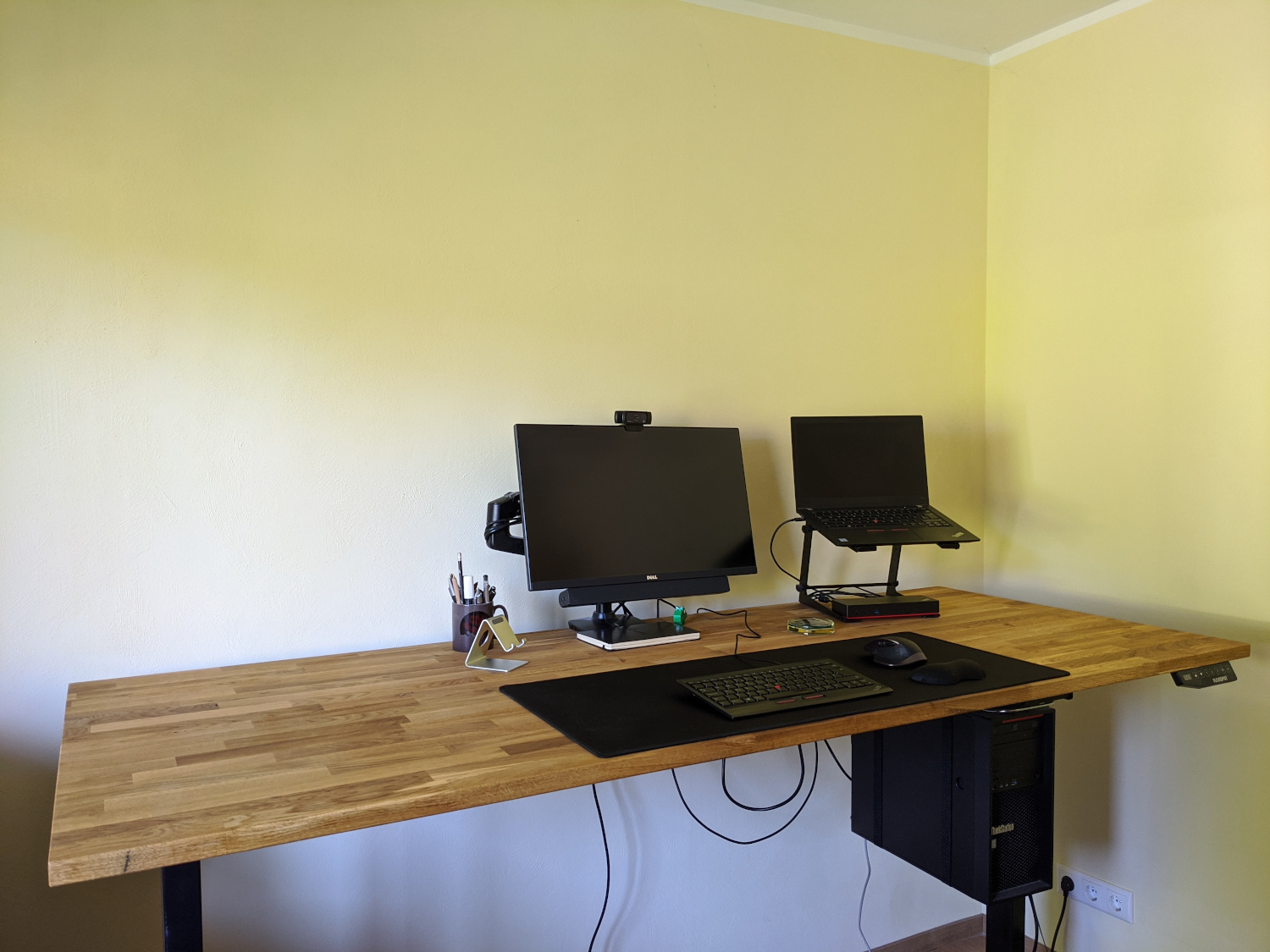
Some days ago I posted a picture of my desk on Mastodon and Twitter. standing desk with a monitor, laptop etc After that I got multiple questions about the setup, so I thought "Michael and Michael did posts about their setups, you could too!" And well, here we are ;-) desk The desk is a Flexispot E5B frame with a 200 80 2.6cm oak table top. The Flexispot E5 (the B stands for black) is a rather cheap (as in not expensive) standing desk frame. It has a retail price of 379 , but you can often get it as low as 299 on sale. Add a nice table top from a local store (mine was like 99 ), a bit of wood oil and work and you get a nice standing desk for less than 500 . The frame has three memory positions, but I only use two: one for sitting, one for standing, and a "change position" timer that I never used so far. The table top has a bit of a swing when in standing position (mine is at 104cm according to the electronics in the table), but not enough to disturb typing on the keyboard or thinking. I certainly wouldn't place a sewing machine up there, but that was not a requirement anyways ;) To compare: the IKEA Bekant table has a similar, maybe even slightly stronger swing. chair Speaking of IKEA The chair is an IKEA Volmar. They don't seem to sell it since mid 2019 anymore though, so no link here. hardware laptop A Lenovo ThinkPad T480s, i7-8650U, 24GB RAM, running Fedora 32 Workstation. Just enough power while not too big and heavy. Full of stickers, because I stickers! It's connected to a Lenovo ThinkPad Thunderbolt 3 Dock (Gen 1). After 2 years with that thing, I'm still not sure what to think about it, as I had various issues with it over the time:
  • the internal USB hub just vanishing from existence until a full power cycle of the dock was performed, but that might have been caused by my USB-switch which I recently removed.
  • the NIC negotiating at 100MBit/s instead of 1000MBit/s and then keeping on re-negotiating every few minutes, disconnecting me from the network, but I've not seen that since the Fedora 32 upgrade.
  • the USB-attached keyboard not working during boot as it needs some Thunderbolt magic.
The ThinkPad stands on a Adam Hall Stands SLT001E, a rather simple stand for laptops and other equipment (primarily made for DJs I think). The Dock fits exactly between the two feet of the stand, so that is nice and saves space on the table. Using the stand I can use the laptop screen as a second screen when I want it - but most often I do not and have the laptop lid closed while working. workstation A Lenovo ThinkStation P410, Xeon E5-2620 v4, 96GB RAM, running Fedora 32 Workstation. That's my VM playground. Having lots of RAM really helps if you need/want to run many VMs with Foreman/Katello or Red Hat Satellite as they tend to be a bit memory hungry and throwing hardware at problems tend to be an easy solution for many of them. The ThinkStation is also connected to the monitor, and I used to have an USB switch to flip my keyboard, mouse and Yubikey from the laptop to the workstation and back. But as noted above, this switch somehow made the USB hub in the laptop dock unhappy (maybe because I was switching too quickly after resume or so), so it's currently removed from the setup and I use the workstation via SSH only. It's mounted under the table using a ROLINE PC holder. You won't get any design awards with it, but it's easy to assemble and allows the computer to move with the table, minimizing the number of cables that need to have a flexible length. monitor The monitor is an older Dell UltraSharp U2515H - a 25" 2560 1440 model. It sits on an Amazon Basics Monitor Arm (which is identical to an Ergotron LX to the best of my knowledge) and is accompanied by a Dell AC511 soundbar. I don't use the adjustable arm much. It's from the time I had no real standing desk and would use the arm and a cardboard box to lift the monitor and keyboard to a standing level. If you don't want to invest in a standing desk, that's the best and cheapest solution! The soundbar is sufficient for listening to music while working and for chatting with colleagues. webcam A Logitech C920 Pro, what else? Works perfectly under Linux with the UVC driver and has rather good microphones. Actually, so good that I never use a headset during video calls and so far nobody complained about bad audio. keyboard A ThinkPad Compact USB Keyboard with TrackPoint. The keyboard matches the one in my T480s, so my brain doesn't have to switch. It was awful when I still had the "old" model and had to switch between the two. UK layout. Sue me. I like the big return key. mouse A Logitech MX Master 2. I got the MX Revolution as a gift a long time ago, and at first I was like: WTF, why would anyone pay hundred bucks for a mouse?! Well, after some time I knew, it's just that good. And when it was time to get a new one (the rubber coating gets all slippery after some time) the decision was rather easy. I'm pondering if I should try the MX Ergo or the MX Vertical at some point, but not enough to go and buy one of them yet. other notepad I'm terrible at remembering things, so I need to write them down. And I'm terrible at remembering to look at my notes, so they need to be in my view. So there is a regular A5 notepad on my desk, that gets filled with check boxes and stuff, page after page. coaster It's a wooden table, you don't want to have liquids on it, right? Thankfully a friend of mine once made coasters out of old Xeon CPUs and epoxy. He gave me one in exchange for a busted X41 ThinkPad. I still think I made the better deal ;) yubikey Keep your secrets safe! Mine is used as a GnuPG smart card for both encryption and SSH authentication, U2F on various pages and 2FA for VPN. headphones I own a pair of Bose QuietComfort 25 with an aftermarket Bluetooth adapter and Anker SoundBuds Slim+. Both are used rather seldomly while working, as my office is usually quiet and no one is disturbed when I listen to music without headphones. what's missing? light I want to add more light to the setup, noth to have a better picture during video calls but also to have better light when doing something else on the table - like soldering. The plan is to add an IKEA Tertial with some Tr dfri smart LED in it, but the Tertial is currently not available for delivery at IKEA and I'm not going to visit one in the current situation. bigger monitor Currently pondering getting a bigger (27+ inch) 4K monitor. Still can't really decide which one to get. There are so many, and they all differ in some way. But it seems no affordable one is offering an integrated USB switch and sufficient amount of USB ports, so I'll probably get whatever can get me a good picture without any extra features at a reasonable price. Changing the monitor will probably also mean rethinking the sound output, as I'm sure mounting the Dell soundbar to anything but the designated 5 year old monitor won't work too well.

9 June 2020

Julian Andres Klode: Review: Chromebook Duet

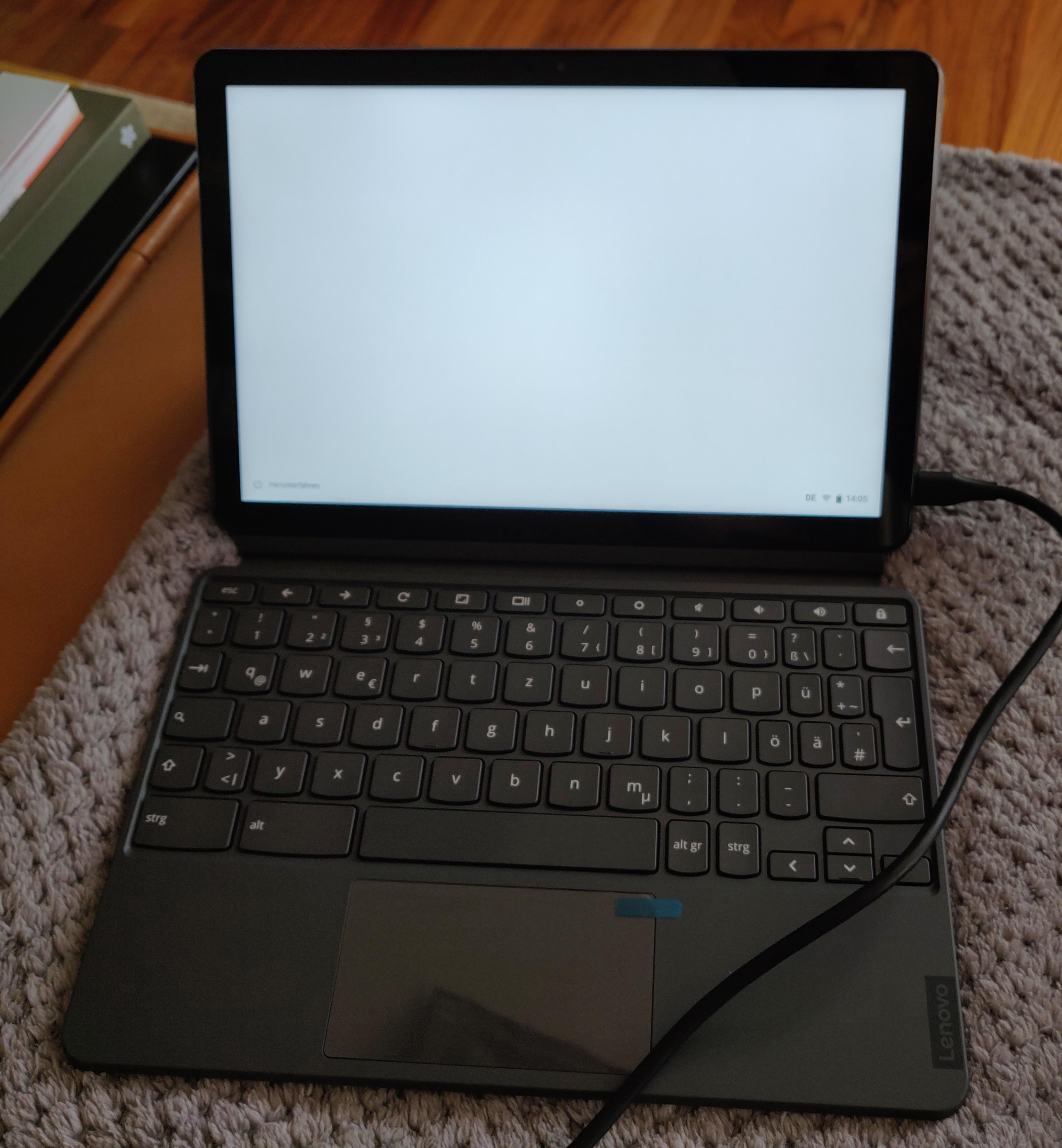
Sporting a beautiful 10.1 1920x1200 display, the Lenovo IdeaPad Duet Chromebook or Duet Chromebook, is one of the latest Chromebooks released, and one of the few slate-style tablets, and it s only about 300 EUR (300 USD). I ve had one for about 2 weeks now, and here are my thoughts.

Build & Accessories The tablet is a fairly Pixel-style affair, in that the back has two components, one softer blue one housing the camera and a metal feeling gray one. Build quality is fairly good. The volume and power buttons are located on the right side of the tablet, and this is one of the main issues: You end up accidentally pressing the power button when you want to turn your volume lower, despite the power button having a different texture. Alongside the tablet, you also find a kickstand with a textile back, and a keyboard, both of which attach via magnets (and pogo pins for the keyboard). The keyboard is crammed, with punctuation keys being halfed in size, and it feels mushed compared to my usual experiences of ThinkPads and Model Ms, but it s on par with other Chromebooks, which is surprising, given it s a tablet attachment.
fully assembled chromebook duet fully assembled chromebook duet
I mostly use the Duet as a tablet, and only attach the keyboard occasionally. Typing with the keyboard on your lap is suboptimal. My first Duet had a few bunches of dead pixels, so I returned it, as I had a second one I could not cancel ordered as well. Oh dear. That one was fine!

Hardware & Connectivity The Chromebook Duet is powered by a Mediatek Helio P60T SoC, 4GB of RAM, and a choice of 64 or 128 GB of main storage. The tablet provides one USB-C port for charging, audio output (a 3.5mm adapter is provided in the box), USB hub, and video output; though, sadly, the latter is restricted to a maximum of 1080p30, or 1440x900 at 60 Hz. It can be charged using the included 10W charger, or use up to I believe 18W from a higher powered USB-C PD charger. I ve successfully used the Chromebook with a USB-C monitor with attached keyboard, mouse, and DAC without any issues. On the wireless side, the tablet provides 2x2 Wifi AC and Bluetooth 4.2. WiFi reception seemed just fine, though I have not done any speed testing, missing a sensible connection at the moment. I used Bluetooth to connect to my smartphone for instant tethering, and my Sony WH1000XM2 headphones, both of which worked without any issues. The screen is a bright 400 nit display with excellent viewing angles, and the speakers do a decent job, meaning you can use easily use this for watching a movie when you re alone in a room and idling around. It has a resolution of 1920x1200. The device supports styluses following the USI standard. As of right now, the only such stylus I know about is an HP one, and it costs about 70 or so. Cameras are provided on the front and the rear, but produce terrible images.

Software: The tablet experience The Chromebook Duet runs Chrome OS, and comes with access to Android apps using the play store (and sideloading in dev mode) and access to full Linux environments powered by LXD inside VMs. The screen which has 1920x1200 is scaled to a ridiculous 1080x675 by default which is good for being able to tap buttons and stuff, but provides next to no content. Scaling it to 1350x844 makes things more balanced. The Linux integration is buggy. Touches register in different places than where they happened, and the screen is cut off in full screen extremetuxracer, making it hard to recommend for such uses. Android apps generally work fine. There are some issues with the back gesture not registering, but otherwise I have not found issues I can remember. One major drawback as a portable media consumption device is that Android apps only work in Widevine level 3, and hence do not have access to HD content, and the web apps of Netflix and co do not support downloading. Though one of the Duets actually said L1 in check apps at some point (reported in issue 1090330). It s also worth noting that Amazon Prime Video only renders in HD, unless you change your user agent to say you are Chrome on Windows - bad Amazon! The tablet experience also lags in some other ways, as the palm rejection is overly extreme, causing it to reject valid clicks close to the edge of the display (reported in issue 1090326). The on screen keyboard is terrible. It only does one language at a time, forcing me to switch between German and English all the time, and does not behave as you d expect it when editing existing words - it does not know about them and thinks you are starting a new one. It does provide a small keyboard that you can move around, as well as a draw your letters keyboard, which could come in handy for stylus users, I guess. In any case, it s miles away from gboard on Android. Stability is a mixed bag right now. As of Chrome OS 83, sites (well only Disney+ so far ) sometimes get killed with SIGILL or SIGTRAP, and the device rebooted on its own once or twice. Android apps that use the DRM sometimes do not start, and the Netflix Android app sometimes reports it cannot connect to the servers.

Performance Performance is decent to sluggish, with micro stuttering in a lot of places. The Mediatek CPU is comparable to Intel Atoms, and with only 4GB of RAM, and an entire Android container running, it s starting to show how weak it is. I found that Google Docs worked perfectly fine, as did websites such as Mastodon, Twitter, Facebook. Where the device really struggled was Reddit, where closing or opening a post, or getting a reply box could take 5 seconds or more. If you are looking for a Reddit browsing device, this is not for you. Performance in Netflix was fine, and Disney+ was fairly slow but still usable. All in all, it s acceptable, and given the price point and the build quality, probably the compromise you d expect.

Summary tl;dr:
  • good: Build quality, bright screen, low price, included accessories
  • bad: DRM issues, performance, limited USB-C video output, charging speed, on-screen keyboard, software bugs
The Chromebook Duet or IdeaPad Duet Chromebook is a decent tablet that is built well above its price point. It s lackluster performance and DRM woes make it hard to give a general recommendation, though. It s not a good laptop. I can see this as the perfect note taking device for students, and as a cheap tablet for couch surfing, or as your on-the-go laptop replacement, if you need it only occasionally. I cannot see anyone using this as their main laptop, although I guess some people only have phones these days, so: what do I know? I can see you getting this device if you want to tinker with Linux on ARM, as Chromebooks are quite nice to tinker with, and a tablet is super nice.

6 June 2020

Petter Reinholdtsen: Secure Socket API - a simple and powerful approach for TLS support in software

As a member of the Norwegian Unix User Group, I have the pleasure of receiving the USENIX magazine ;login: several times a year. I rarely have time to read all the articles, but try to at least skim through them all as there is a lot of nice knowledge passed on there. I even carry the latest issue with me most of the time to try to get through all the articles when I have a few spare minutes. The other day I came across a nice article titled "The Secure Socket API: TLS as an Operating System Service" with a marvellous idea I hope can make it all the way into the POSIX standard. The idea is as simple as it is powerful. By introducing a new socket() option IPPROTO_TLS to use TLS, and a system wide service to handle setting up TLS connections, one both make it trivial to add TLS support to any program currently using the POSIX socket API, and gain system wide control over certificates, TLS versions and encryption systems used. Instead of doing this:
int socket = socket(PF_INET, SOCK_STREAM, IPPROTO_TCP);
the program code would be doing this:
int socket = socket(PF_INET, SOCK_STREAM, IPPROTO_TLS);
According to the ;login: article, converting a C program to use TLS would normally modify only 5-10 lines in the code, which is amazing when compared to using for example the OpenSSL API. The project has set up the https://securesocketapi.org/ web site to spread the idea, and the code for a kernel module and the associated system daemon is available from two github repositories: ssa and ssa-daemon. Unfortunately there is no explicit license information with the code, so its copyright status is unclear. A request to solve this about it has been unsolved since 2018-08-17. I love the idea of extending socket() to gain TLS support, and understand why it is an advantage to implement this as a kernel module and system wide service daemon, but can not help to think that it would be a lot easier to get projects to move to this way of setting up TLS if it was done with a user space approach where programs wanting to use this API approach could just link with a wrapper library. I recommend you check out this simple and powerful approach to more secure network connections. :) As usual, if you use Bitcoin and want to show your support of my activities, please send Bitcoin donations to my address 15oWEoG9dUPovwmUL9KWAnYRtNJEkP1u1b.

Thorsten Alteholz: My Debian Activities in May 2020

FTP master This month I accepted 211 packages and rejected only 9. The overall number of packages that got accepted was 228. Debian LTS This was my seventy-first month that I did some work for the Debian LTS initiative, started by Raphael Hertzog at Freexian. This month my all in all workload has been 17.25h. During that time I did LTS uploads of: I started to work on php5 as well but did not upload a fixed version yet. Last but not least I did some days of frontdesk duties. Debian ELTS This month was the twenty third ELTS month. During my small allocated time I uploaded: I also did some days of frontdesk duties. Other stuff I improved packaging of I sponsored uploads of On my Go challenge I uploaded:
golang-github-apparentlymart-go-versions, golang-github-hashicorp-go-slug, golang-github-mozillazg-go-httpheader, golang-github-hashicorp-terraform-json, golang-github-hashicorp-terraform-plugin-test, golang-github-sean pager, golang-github-sean seed, golang-github-timberio-go-datemath,

3 June 2020

Debian Project Leader: DPL Activity logs for April/May 2020

First month as DPL I survived my first month as DPL! I agree with previous DPLs who have described it as starting a whole new job. Fortunately it wasn't very stressful, but it certainly was very time consuming. On the very first day my inbox exploded with requests. I dealt with this by deferring anything that wasn't important right away and just started working through it. Fortunately the initial swell subsided as the month progressed. The bulk of my remaining e-mail backlog are a few media outlets who wants to do interviews. I'll catch up with those during this month. Towards the end of the month, most of my focus was on helping to prepare for an online MiniDebConf that we hosted over the last weekend in May. We had lots of fun and we had some great speakers sharing their knowledge and expertise during the weekend. Activity log As I do on my own blog for free software activities, I'll attempt to keep a log of DPL activities on this blog. Here's the log for the period 2020-04-21 to 2020-05-21: 2020-04-19: Handover session with Sam, our outgoing DPL. We covered a lot of questions I had and main areas that the DPL works in. Thanks to Sam for having taken the time to do this. 2020-04-21: First day of term! Thank you to everybody who showed support and have offered to help! 2020-04-21: Request feedback from the trademark team on an ongoing trademark dispute. 2020-04-21: Join the GNOME Advisory Board as a representative from Debian. 2020-04-21: Reply on an ongoing community conflict issue. 2020-04-21: Update Debian project summary for SPI annual report. 2020-04-21: Received a great e-mail introduction from Debian France and followed up on that. 2020-04-21: Posted "Bits from the new DPL" to debian-devel-announce. 2020-04-22: Became Debian's OSI Affilliate representative. 2020-04-22: Reply to a bunch of media inquiries for interviews, will do them later when initial priorities are on track. 2020-04-23: Resign as Debian FTP team trainee and mailing list moderator. In both these areas there are enough people taking care of it and I intend to maximise available time for DPL and technical areas in the project. 2020-04-25: Review outgoing mail for trademark team. 2020-04-25: Answer some questions in preparation for DAM/Front Desk delegation updates. 2020-04-26: Initiated wiki documentation for delegation updates process. 2020-04-27: Update delegation for the Debian Front Desk team. 2020-04-29: Schedule video call with Debian treasurer team. 2020-04-29: OSI affiliate call. Learned about some Open Source projects including OpenDev, OpenSourceMatters, FOSS Responders and Democracy Labs. 2020-05-04: Delivered my first talk session as DPL titled "Mixed Bag of Debian" at "Fique Em Casa Use Debian" (Stay at home and use Debian!), organised by Debian Brazil, where they had a different talk every evening during the month of May. Great initiative I hope other local groups consider copying their ideas! 2020-05-05: Had a 2 hour long call with the treasurer team. Feeling optimistic for the future of Debian's financing although it will take some time and a lot of work to get where we want to be. 2020-05-17: Respond to cloud delegation update.

Keith Packard: picolibc-ryu

Float/String Conversion in Picolibc: Enter Ry I recently wrote about this topic having concluded that the best route for now was to use the malloc-free, but imprecise, conversion routines in the tinystdio alternative. A few days later, Sreepathi Pai pointed me at some very recent work in this area: This is amazing! Thirty years after the papers referenced in the previous post, Ulf Adams came up with some really cool ideas and managed to reduce the math required for 64-bit conversion to 128 bit integers. This is a huge leap forward; we were doing long multi-precision computations before, and now it's all short enough to fit in registers (ok, a lot of registers, but still). Getting the Ry Code The code is available on github: https://github.com/ulfjack/ryu. Reading through it, it's very clear that the author focuses on performance with lots of tuning for common cases. Still, it's quite readable, especially compared with the newlib multi-precision based code. Picolibc String/Float conversion interface Picolibc has some pretty basic needs for the float/string conversion code, it wants four functions:

  1. __dtoa_engine
    int
    __dtoa_engine(double x, struct dtoa *dtoa, uint8_t max_digits, uint8_t max_decimals);
    
    This converts the double x to a string of decimal digits and a decimal exponent stored inside the 'dtoa' struct. It limits the total number of digits to max_digits and, optionally (when max_decimals is non-zero), limits the number of fractional digits to max_decimals - 1. This latter supports 'f' formats. Returns the number of digits stored, which is <= max_digits. Less if the number can be accurately represented in fewer digits.
  2. __ftoa_engine
    int
    __ftoa_engine(float x, struct ftoa *ftoa, uint8_t max_digits, uint8_t max_decimals);
    
    The same as __dtoa_engine, except for floats.
  3. __atod_engine
    double
    __atod_engine(uint64_t m10, int e10);
    
    To avoid needing to handle stdio inside the conversion function, __atod_engine receives fully parsed values, the base-10 significand (m10) and exponent (e10). The value to convert is m10 * pow(10, e10).
  4. __atof_engine
    float
    __atof_engine(uint32_t m10, int e10);
    
    The same as __atod_engine, except for floats.
With these, it can do printf, scanf, ecvt, fcvt, gcvt, strtod, strtof and atof. Porting Ry to Picolibc The existing Ry float-to-string code always generates the number of digits necessary for accurate output. I had to hack it up to generate correctly rounded shorter output when max_digits or max_decimals were smaller. I'm not sure I managed to do that correctly, but at least it appears to be passing all of the test cases I have. In normal operation, Ry iteratively removes digits from the answer that aren't necessary to disambiguate with neighboring values. What I changed was to keep removing digits using that method until the answer had few enough digits to fit in the desired length. There's some tricky rounding code that adjusts the final result and I had to bypass that if I'd removed extra digits. That was about the only change necessary to the core algorithm. I also trimmed the code to only include the general case and not the performance improvements, then wrapped it with code to provide the _engine interface. On the string-to-float side, most of what I needed to do was remove the string parsing bits at the start of the function and switch from performance-optimized to space-optimized versions of a couple of internal routines. Correctness Results Because these new functions are now 'exact', I was able to adjust the picolibc tests to compare all of the bits for string/float conversion instead of having to permit a bit of slop in the answers. With those changes, the picolibc test suite passes, which offers some assurance that things aren't completely broken. Size Results Snek uses the 32-bit float versions of the conversion routines, and for that, the size difference is:
   text    data     bss     dec     hex filename
  59068      44   37968   97080   17b38 snek-qemu-riscv-orig.elf
  59430      44   37968   97442   17ca2 snek-qemu-riscv-ryu.elf
    362
362 bytes added to gain accurate printf/strtof results seems like a good trade-off in this case. Performance I haven't measured performance at all, but I suspect that it won't be nearly as problematic on most platforms as the source code makes it appear. And that's because Ry is entirely integer arithmetic with no floating point at all. This avoids using the soft fp code for platforms without hardware float support. Pointers to the Code I haven't merged this to picolibc master yet, it's on the ryu branch: Review, especially of the hack above to return short results, would be greatly appreciated! Thanks again to Ulf Adams for creating this code and to Sreepathi Pai for sending me a note about it!

1 June 2020

Jonathan Carter: Free Software Activities for 2020-05

I would say that this was a crazy month, but with everything ever escalating, does that even mean anything anymore? I lost track of tracking my activities in the second half of the month, and I m still not very good at logging the soft stuff , that is, things like non-technical work but that also takes up a lot of time, but will continue to work on it.
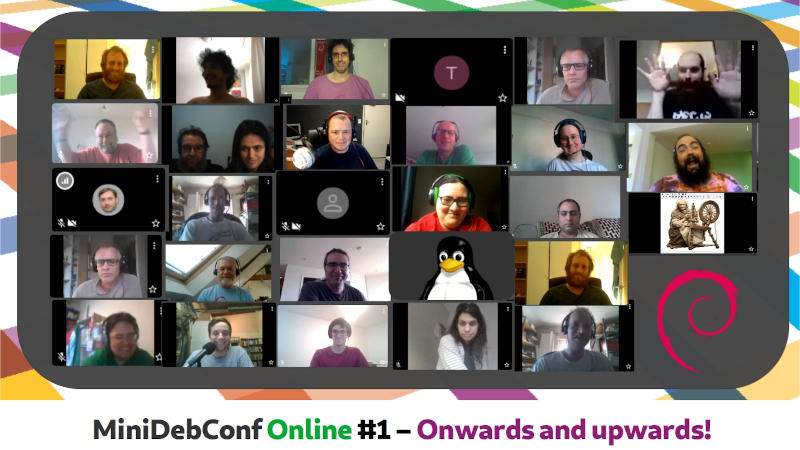
Towards the end of the month I spent a huge amount of time on MiniDebConf Online, I m glad it all worked out, and will write a seperate blog entry on that. Thank you again to everyone for making it a success! I m also moving DPL activities to the DPL blog, so even though it s been a busy month in the free software world my activity log here will look somewhat deceptively short this month MiniDebConf Online 2020-05-06: Help prepare initial CfP mail. 2020-05-06: Process some feedback regarding accessibility on Jitsi.

Debian Packaging 2020-05-02: Upload package gnome-shell-extension-workspaces-to-dock (53-1) to Debian unstable. 2020-05-02: Upload package tetzle (2.1.6-1) to Debian unstable. 2020-05-06: Upload package bundlewrap (3.9.0-1) to Debian unstable. 2020-05-06: Accept MR#1 for connectagram. 2020-05-06: Upload package connectagram (1.2.11-1) to Debian unstable. 2020-05-07: Upload package gnome-shell-extension-multi-monitors (20-1) to Debian unstable (Closes: #956169). 2020-05-07: Upload package tanglet (1.5.6-1) to Debian unstable. 2020-05-16: Upload package calamares (3.2.24-1) to Debian unstable. 2020-05-16: Accept MR#1 for tuxpaint-config. 2020-05-16: Accept MR#7 for debian-live. 2020-05-18: Upload package bundlewrap (3.10.0) to Debian unstable.

Debian Mentoring 2020-05-02: Sponsor package gamemode (1.5.1-3) (Games team request). 2020-05-16: Sponsor package gamemode (1.5.1-4) (Games team request).

31 May 2020

Enrico Zini: Controversial inventors

Paul-F lix Armand-Delille (3 July 1874 in Fourchambault, Ni vre 4 September 1963) was a physician, bacteriologist, professor, and member of the French Academy of Medicine who accidentally brought about the collapse of rabbit populations throughout much of Europe and beyond in the 1950s by infecting them with myxomatosis.
Charles Franklin Kettering (August 29, 1876 November 25, 1958) sometimes known as Charles "Boss" Kettering[1] was an American inventor, engineer, businessman, and the holder of 186 patents.[2] He was a founder of Delco, and was head of research at General Motors from 1920 to 1947. Among his most widely used automotive developments were the electrical starting motor[3] and leaded gasoline.[4][5] In association with the DuPont Chemical Company, he was also responsible for the invention of Freon refrigerant for refrigeration and air conditioning systems. At DuPont he also was responsible for the development of Duco lacquers and enamels, the first practical colored paints for mass-produced automobiles. While working with the Dayton-Wright Company he developed the "Bug" aerial torpedo, considered the world's first aerial missile.[6] He led the advancement of practical, lightweight two-stroke diesel engines, revolutionizing the locomotive and heavy equipment industries. In 1927, he founded the Kettering Foundation, a non-partisan research foundation. He was featured on the cover of Time magazine on January 9, 1933.
John Charles Cutler (June 29, 1915 February 8, 2003) was a senior surgeon, and the acting chief of the venereal disease program in the United States Public Health Service. After his death, his involvement in several controversial and unethical medical studies of syphilis was revealed, including the Guatemala and the Tuskegee syphilis experiments.
Ivy Ledbetter Lee (July 16, 1877 November 9, 1934) was an American publicity expert and a founder of modern public relations. Lee is best known for his public relations work with the Rockefeller family. His first major client was the Pennsylvania Railroad, followed by numerous major railroads such as the New York Central, the Baltimore and Ohio, and the Harriman lines such as the Union Pacific. He established the Association of Railroad Executives, which included providing public relations services to the industry. Lee advised major industrial corporations, including steel, automobile, tobacco, meat packing, and rubber, as well as public utilities, banks, and even foreign governments. Lee pioneered the use of internal magazines to maintain employee morale, as well as management newsletters, stockholder reports, and news releases to the media. He did a great deal of pro bono work, which he knew was important to his own public image, and during World War I, he became the publicity director for the American Red Cross.[1]

Chris Lamb: Free software activities in May 2020

Here is my monthly update covering what I have been doing in the free software world during May 2020 (previous month): In Lintian, the static analysis tool for Debian packages:
Reproducible builds One of the original promises of open source software is that distributed peer review and transparency of process results in enhanced end-user security. However, whilst anyone may inspect the source code of free and open source software for malicious flaws, almost all software today is distributed as pre-compiled binaries. This allows nefarious third-parties to compromise systems by injecting malicious code into ostensibly secure software during the various compilation and distribution processes. The motivation behind the Reproducible Builds effort is to ensure no flaws have been introduced during this compilation process by promising identical results are always generated from a given source, thus allowing multiple third-parties to come to a consensus on whether a build was compromised. The initiative is proud to be a member project of the Software Freedom Conservancy, a not-for-profit 501(c)(3) charity focused on ethical technology and user freedom. Conservancy acts as a corporate umbrella allowing projects to operate as non-profit initiatives without managing their own corporate structure. If you like the work of the Conservancy or the Reproducible Builds project, please consider becoming an official supporter.
Elsewhere in our tooling, I made the following changes to diffoscope, our in-depth and content-aware diff utility that can locate and diagnose reproducibility issues, including preparing and uploading versions 142, 143, 144, 145 and 146 to Debian: I also performed a huge overhaul of diffoscope's website:
Lastly, I made a large number of changes to the main Reproducible Builds website and documentation:
Debian LTS This month I contributed 17 hours to Debian Long Term Support (LTS) and 9 hours on its sister Extended LTS project. You can find out more about the two projects via the following video:
Debian I filed the following bug reports in Debian this month: I also filed a number of bugs against packages that are not compatible with Django 3.x, (organised around a single master bug) including django-taggit, sorl-thumbnail, django-simple-captcha, django-cas-server, django-cors-headers, python-django-csp, django-pipeline, python-django-jsonfield, python-django-contact-form, django-model-utils, django-fsm, django-modeltranslation, django-oauth-toolkit, libthumbor, python-django-extensions, python-django-imagekit, python-django-navtag, python-django-tagging, djangorestframework, django-haystack, django-taggit, django-simple-captcha, python-django-registration, python-django-pyscss, python-django-compressor, python-django-crispy-forms & python-django-mptt,
Lastly, I made the following uploads to Debian: I also sponsored an upload for adminer (4.7.7-1), also uploading it to buster-backports.

26 May 2020

Russell Coker: Cruises and Covid19

Problems With Cruises GQ has an insightful and detailed article about Covid19 and the Diamond Princess [1], I recommend reading it. FastCompany has a brief article about bookings for cruises in August [2]. There have been many negative comments about this online. The first thing to note is that the cancellation policies on those cruises are more lenient than usual and the prices are lower. So it s not unreasonable for someone to put down a deposit on a half price holiday in the hope that Covid19 goes away (as so many prominent people have been saying it will) in the knowledge that they will get it refunded if things don t work out. Of course if the cruise line goes bankrupt then no-one will get a refund, but I think people are expecting that won t happen. The GQ article highlights some serious problems with the way cruise ships operate. They have staff crammed in to small cabins and the working areas allow transmission of disease. These problems can be alleviated, they could allocate more space to staff quarters and have more capable air conditioning systems to put in more fresh air. During the life of a cruise ship significant changes are often made, replacing engines with newer more efficient models, changing the size of various rooms for entertainment, installing new waterslides, and many other changes are routinely made. Changing the staff only areas to have better ventilation and more separate space (maybe capsule-hotel style cabins with fresh air piped in) would not be a difficult change. It would take some money and some dry-dock time which would be a significant expense for cruise companies. Cruises Are Great People like social environments, they want to have situations where there are as many people as possible without it becoming impossible to move. Cruise ships are carefully designed for the flow of passengers. Both the layout of the ship and the schedule of events are carefully planned to avoid excessive crowds. In terms of meeting the requirement of having as many people as possible in a small area without being unable to move cruise ships are probably ideal. Because there is a large number of people in a restricted space there are economies of scale on a cruise ship that aren t available anywhere else. For example the main items on the menu are made in a production line process, this can only be done when you have hundreds of people sitting down to order at the same time. The same applies to all forms of entertainment on board, they plan the events based on statistical knowledge of what people want to attend. This makes it more economical to run than land based entertainment where people can decide to go elsewhere. On a ship a certain portion of the passengers will see whatever show is presented each night, regardless of whether it s singing, dancing, or magic. One major advantage of cruises is that they are all inclusive. If you are on a regular holiday would you pay to see a singing or dancing show? Probably not, but if it s included then you might as well do it and it will be pretty good. This benefit is really appreciated by people taking kids on holidays, if kids do things like refuse to attend a performance that you were going to see or reject food once it s served then it won t cost any extra. People Who Criticise Cruises For the people who sneer at cruises, do you like going to bars? Do you like going to restaurants? Live music shows? Visiting foreign beaches? A cruise gets you all that and more for a discount price. If Groupon had a deal that gave you a cheap hotel stay with all meals included, free non-alcoholic drinks at bars, day long entertainment for kids at the kids clubs, and two live performances every evening how many of the people who reject cruises would buy it? A typical cruise is just like a Groupon deal for non-stop entertainment from 8AM to 11PM. Will Cruises Restart? The entertainment options that cruises offer are greatly desired by many people. Most cruises are aimed at budget travellers, the price is cheaper than a hotel in a major city. Such cruises greatly depend on economies of scale, if they can t get the ships filled then they would need to raise prices (thus decreasing demand) to try to make a profit. I think that some older cruise ships will be scrapped in the near future and some of the newer ships will be sold to cruise lines that cater to cheap travel (IE P&O may scrap some ships and some of the older Princess ships may be transferred to them). Overall I predict a decrease in the number of middle-class cruise ships. For the expensive cruises (where the cheapest cabins cost over $1000US per person per night) I don t expect any real changes, maybe they will have fewer passengers and higher prices to allow more social distancing or something. I am certain that cruises will start again, but it s too early to predict when. Going on a cruise is about as safe as going to a concert or a major sporting event. No-one is predicting that sporting stadiums will be closed forever or live concerts will be cancelled forever, so really no-one should expect that cruises will be cancelled forever. Whether companies that own ships or stadiums go bankrupt in the mean time is yet to be determined. One thing that s been happening for years is themed cruises. A group can book out an entire ship or part of a ship for a themed cruise. I expect this to become much more popular when cruises start again as it will make it easier to fill ships. In the past it seems that cruise lines let companies book their ships for events but didn t take much of an active role in the process. I think that the management of cruise lines will look to aggressively market themed cruises to anyone who might help, for starters they could reach out to every 80s and 90s pop group those fans are all old enough to be interested in themed cruises and the musicians won t be asking for too much money. Conclusion Humans are social creatures. People want to attend events with many other people. Covid 19 won t be the last pandemic, and it may not even be eradicated in the near future. The possibility of having a society where no-one leaves home unless they are in a hazmat suit has been explored in science fiction, but I don t think that s a plausible scenario for the near future and I don t think that it s something that will be caused by Covid 19.

25 May 2020

Elana Hashman: Beef and broccoli

Beef and broccoli is one of my favourite easy weeknight meals. It's savoury, it's satisfying, it's mercifully quick, and so, so delicious. The recipe here is based on this one but with a few simplifications and modifications. The ingredients are basically the same, but the technique is a little different. Oh, and I include some fermented black beans because they're yummy :3 and Serves 3. Active time: 20-30m. Total time: 30m. Ingredients: For the marinade: For the sauce: For the rice: Recipe:
  1. Begin by preparing the rice: combine rice, water, and salt in a small saucepan and bring to a boil. Once it reaches a boil, cover and reduce to a simmer for 20 minutes. Then turn off the heat and let it rest.
  2. Mix the marinade in a bowl large enough to hold the meat.
  3. Thinly slice the beef. Place slices in the marinade bowl and toss to evenly coat.
  4. Start heating a wok or similar pan on medium-high to high heat. This will ensure you get a good sear.
  5. Prep the garlic, black beans, and broccoli. If you use frozen broccoli, you can save some time here :)
  6. Combine the ingredients for the sauce and mix well to ensure the corn starch doesn't form any lumps.
  7. By this point the beef should have been marinating for about 10-15m. Add a tablespoon of neutral cooking oil (like canola or soy) to the meat, give it one more toss to ensure it's thoroughly coated, then add a layer of meat to the dry pan. You may need to sear in batches. On high heat, cooking will take 1-2 minutes per side, ensuring each is nicely browned. Once the strips are cooked, remove from the pan and set aside.
  8. While the beef is cooking, steam the broccoli until it's almost (but not quite) cooked through. I typically do this by putting it in a large bowl, adding 2 tbsp water, covering it and microwaving: 3 minutes on high if frozen, 1 minutes on high if fresh, pausing halfway through to stir.
  9. Once all the beef is cooked and set aside, spray the pan or add oil to coat and add the garlic and black bean (if using). Stir and cook for 30-60 seconds until fragrant.
  10. When the garlic is ready, give the sauce a quick stir and add it to the pan, using it to deglaze. Once there are no more bits stuck to the bottom and the sauce is thick to your liking, add the broccoli and beef to the pan. Mix until thoroughly coated in sauce and heated through. Taste and adjust seasoning (salt, pepper, soy, etc.) if necessary.
  11. Fluff the rice and serve. Enjoy!
But I am a vegetarian??? Seitan can substitute for the beef relatively easily. Finding a substitute for oyster sauce is a little bit trickier, especially since it's the star ingredient. You can buy vegetarian or vegan oyster sauce (they're usually mushroom-based), but I have no idea how good they taste. You can also try making it at home! If you do, let me know how it turns out?

22 May 2020

Steve Kemp: Updated my linux-security-modules for the Linux kernel

Almost three years ago I wrote my first linux-security-module, inspired by a comment I read on LWN I did a little more learning/experimentation and actually produced a somewhat useful LSM, which allows you to restrict command-execution via the use of a user-space helper: Because the detection is done in userspace writing your own custom rules is both safe and easy. No need to touch the kernel any further! Yesterday I rebased all the modules so that they work against the latest stable kernel 5.4.22 in #7.
The last time I'd touched them they were built against 5.1, which was itself a big jump forwards from the 4.16.7 version I'd initially used.
Finally I updated the can-exec module to make it gated, which means you can turn it on, but not turn it off without a reboot. That was an obvious omission from the initial implementation #11. Anyway updated code is available here: I'd kinda like to write more similar things, but I lack inspiration.

17 May 2020

Enrico Zini: Art links

Guglielmo Achille Cavellini (11 September 1914 20 November 1990), also known as GAC, was an Italian artist and art collector. After an initial activity as a painter, in the 1940s and 1950s he became one of the major collectors of contemporary Italian abstract art, developing a deep relationship of patronage and friendship with the artists. This experience has its pinnacle in the exhibition Modern painters of the Cavellini collection at the National Gallery of Modern Art in Rome in 1957. In the 1960s Cavellini resumed his activity as an artist, with an ample production spanning from Neo-Dada to performance art to mail art, of which he became one of the prime exponents with the Exhibitions at Home and the Round Trip works. In 1971 he invented autostoricizzazione (self-historicization), upon which he acted to create a deliberate popular history surrounding his existence. He also authored the books Abstract Art (1959), Man painter (1960), Diary of Guglielmo Achille Cavellini (1975), Encounters/Clashes in the Jungle of Art (1977) and Life of a Genius (1989).
Paul Gustave Louis Christophe Dor (/d re /; French: [ ys.tav d . e]; 6 January 1832 23 January 1883[1]) was a French artist, printmaker, illustrator, comics artist, caricaturist, and sculptor who worked primarily with wood-engraving.
Enrico Baj era bravissimo a pij per culo er potere usanno a fantasia. Co quaa sempricit che solo dii granni, raccatta robbe tipo bottoni, pezzi de stoffa, cordoni, passamanerie varie, e l appiccica su a tela insieme aa pittura sua: che pare quasi che sta a gioc ma giocanno giocanno, zitto zitto, riesce a rovesci er monno. >>

Matthew Palmer: Private Key Redaction: UR DOIN IT RONG

Because posting private keys on the Internet is a bad idea, some people like to redact their private keys, so that it looks kinda-sorta like a private key, but it isn t actually giving away anything secret. Unfortunately, due to the way that private keys are represented, it is easy to redact a key in such a way that it doesn t actually redact anything at all. RSA private keys are particularly bad at this, but the problem can (potentially) apply to other keys as well. I ll show you a bit of Inside Baseball with key formats, and then demonstrate the practical implications. Finally, we ll go through a practical worked example from an actual not-really-redacted key I recently stumbled across in my travels.

The Private Lives of Private Keys Here is what a typical private key looks like, when you come across it:
-----BEGIN RSA PRIVATE KEY-----
MGICAQACEQCxjdTmecltJEz2PLMpS4BXAgMBAAECEDKtuwD17gpagnASq1zQTYEC
CQDVTYVsjjF7IQIJANUYZsIjRsR3AgkAkahDUXL0RSECCB78r2SnsJC9AghaOK3F
sKoELg==
-----END RSA PRIVATE KEY-----
Obviously, there s some hidden meaning in there computers don t encrypt things by shouting BEGIN RSA PRIVATE KEY! , after all. What is between the BEGIN/END lines above is, in fact, a base64-encoded DER format ASN.1 structure representing a PKCS#1 private key. In simple terms, it s a list of numbers very important numbers. The list of numbers is, in order:
  • A version number (0);
  • The public modulus , commonly referred to as n ;
  • The public exponent , or e (which is almost always 65,537, for various unimportant reasons);
  • The private exponent , or d ;
  • The two private primes , or p and q ;
  • Two exponents, which are known as dmp1 and dmq1 ; and
  • A coefficient, known as iqmp .

Why Is This a Problem? The thing is, only three of those numbers are actually required in a private key. The rest, whilst useful to allow the RSA encryption and decryption to be more efficient, aren t necessary. The three absolutely required values are e, p, and q. Of the other numbers, most of them are at least about the same size as each of p and q. So of the total data in an RSA key, less than a quarter of the data is required. Let me show you with the above toy key, by breaking it down piece by piece1:
  • MGI DER for this is a sequence
  • CAQ version (0)
  • CxjdTmecltJEz2PLMpS4BX n
  • AgMBAA e
  • ECEDKtuwD17gpagnASq1zQTY d
  • ECCQDVTYVsjjF7IQ p
  • IJANUYZsIjRsR3 q
  • AgkAkahDUXL0RS dmp1
  • ECCB78r2SnsJC9 dmq1
  • AghaOK3FsKoELg== iqmp
Remember that in order to reconstruct all of these values, all I need are e, p, and q and e is pretty much always 65,537. So I could redact almost all of this key, and still give all the important, private bits of this key. Let me show you:
-----BEGIN RSA PRIVATE KEY-----
..............................................................EC
CQDVTYVsjjF7IQIJANUYZsIjRsR3....................................
........
-----END RSA PRIVATE KEY-----
Now, I doubt that anyone is going to redact a key precisely like this but then again, this isn t a typical RSA key. They usually look a lot more like this:
-----BEGIN RSA PRIVATE KEY-----
MIIEogIBAAKCAQEAu6Inch7+mWtKn+leB9uCG3MaJIxRyvC/5KTz2fR+h+GOhqj4
SZJobiVB4FrE5FgC7AnlH6qeRi9MI0s6dt5UWZ5oNIeWSaOOeNO+EJDUkSVf67wj
SNGXlSjGAkPZ0nRJiDjhuPvQmdW53hOaBLk5udxPEQbenpXAzbLJ7wH5ouLQ3nQw
HwpwDNQhF6zRO8WoscpDVThOAM+s4PS7EiK8ZR4hu2toon8Ynadlm95V45wR0VlW
zywgbkZCKa1IMrDCscB6CglQ10M3Xzya3iTzDtQxYMVqhDrA7uBYRxA0y1sER+Rb
yhEh03xz3AWemJVLCQuU06r+FABXJuY/QuAVvQIDAQABAoIBAFqwWVhzWqNUlFEO
PoCVvCEAVRZtK+tmyZj9kU87ORz8DCNR8A+/T/JM17ZUqO2lDGSBs9jGYpGRsr8s
USm69BIM2ljpX95fyzDjRu5C0jsFUYNi/7rmctmJR4s4uENcKV5J/++k5oI0Jw4L
c1ntHNWUgjK8m0UTJIlHbQq0bbAoFEcfdZxd3W+SzRG3jND3gifqKxBG04YDwloy
tu+bPV2jEih6p8tykew5OJwtJ3XsSZnqJMwcvDciVbwYNiJ6pUvGq6Z9kumOavm9
XU26m4cWipuK0URWbHWQA7SjbktqEpxsFrn5bYhJ9qXgLUh/I1+WhB2GEf3hQF5A
pDTN4oECgYEA7Kp6lE7ugFBDC09sKAhoQWrVSiFpZG4Z1gsL9z5YmZU/vZf0Su0n
9J2/k5B1GghvSwkTqpDZLXgNz8eIX0WCsS1xpzOuORSNvS1DWuzyATIG2cExuRiB
jYWIJUeCpa5p2PdlZmBrnD/hJ4oNk4oAVpf+HisfDSN7HBpN+TJfcAUCgYEAyvY7
Y4hQfHIdcfF3A9eeCGazIYbwVyfoGu70S/BZb2NoNEPymqsz7NOfwZQkL4O7R3Wl
Rm0vrWT8T5ykEUgT+2ruZVXYSQCKUOl18acbAy0eZ81wGBljZc9VWBrP1rHviVWd
OVDRZNjz6nd6ZMrJvxRa24TvxZbJMmO1cgSW1FkCgYAoWBd1WM9HiGclcnCZknVT
UYbykCeLO0mkN1Xe2/32kH7BLzox26PIC2wxF5seyPlP7Ugw92hOW/zewsD4nLze
v0R0oFa+3EYdTa4BvgqzMXgBfvGfABJ1saG32SzoWYcpuWLLxPwTMsCLIPmXgRr1
qAtl0SwF7Vp7O/C23mNukQKBgB89DOEB7xloWv3Zo27U9f7nB7UmVsGjY8cZdkJl
6O4LB9PbjXCe3ywZWmJqEbO6e83A3sJbNdZjT65VNq9uP50X1T+FmfeKfL99X2jl
RnQTsrVZWmJrLfBSnBkmb0zlMDAcHEnhFYmHFuvEnfL7f1fIoz9cU6c+0RLPY/L7
n9dpAoGAXih17mcmtnV+Ce+lBWzGWw9P4kVDSIxzGxd8gprrGKLa3Q9VuOrLdt58
++UzNUaBN6VYAe4jgxGfZfh+IaSlMouwOjDgE/qzgY8QsjBubzmABR/KWCYiRqkj
qpWCgo1FC1Gn94gh/+dW2Q8+NjYtXWNqQcjRP4AKTBnPktEvdMA=
-----END RSA PRIVATE KEY-----
People typically redact keys by deleting whole lines, and usually replacing them with [...] and the like. But only about 345 of those 1588 characters (excluding the header and footer) are required to construct the entire key. You can redact about 4/5ths of that giant blob of stuff, and your private parts (or at least, those of your key) are still left uncomfortably exposed.

But Wait! There s More! Remember how I said that everything in the key other than e, p, and q could be derived from those three numbers? Let s talk about one of those numbers: n. This is known as the public modulus (because, along with e, it is also present in the public key). It is very easy to calculate: n = p * q. It is also very early in the key (the second number, in fact). Since n = p * q, it follows that q = n / p. Thus, as long as the key is intact up to p, you can derive q by simple division.

Real World Redaction At this point, I d like to introduce an acquaintance of mine: Mr. Johan Finn. He is the proud owner of the GitHub repo johanfinn/scripts. For a while, his repo contained a script that contained a poorly-redacted private key. He since deleted it, by making a new commit, but of course because git never really deletes anything, it s still available. Of course, Mr. Finn may delete the repo, or force-push a new history without that commit, so here is the redacted private key, with a bit of the surrounding shell script, for our illustrative pleasure:
#Add private key to .ssh folder
cd /home/johan/.ssh/
echo  "-----BEGIN RSA PRIVATE KEY-----
MMMMMMMMMMMMMMMMMMMMMMMMMMMMMMMMMMMMMMMMMMMMMMMMMMMMMMMMMMMMMMMM
NNNNNNNNNNNNNNNNNNNNNNNNNNNNNNNNNNNNNNNNNNNNNNNNNNNNNNNNNNNNNNNN
KKKKKKKKKKKKKKKKKKKKKKKKKKKKKKKKKKKKKKKKKKKKKKKKKKKKKKKKKKKKKKKK
 
MIIJKgIBAAKCAgEAxEVih1JGb8gu/Fm4AZh+ZwJw/pjzzliWrg4mICFt1g7SmIE2
TCQMKABdwd11wOFKCPc/UzRH/fHuQcvWrpbOSdqev/zKff9iedKw/YygkMeIRaXB
fYELqvUAOJ8PPfDm70st9GJRhjGgo5+L3cJB2gfgeiDNHzaFvapRSU0oMGQX+kI9
ezsjDAn+0Pp+r3h/u1QpLSH4moRFGF4omNydI+3iTGB98/EzuNhRBHRNq4oBV5SG
Pq/A1bem2ninnoEaQ+OPESxYzDz3Jy9jV0W/6LvtJ844m+XX69H5fqq5dy55z6DW
sGKn78ULPVZPsYH5Y7C+CM6GAn4nYCpau0t52sqsY5epXdeYx4Dc+Wm0CjXrUDEe
Egl4loPKDxJkQqQ/MQiz6Le/UK9vEmnWn1TRXK3ekzNV4NgDfJANBQobOpwt8WVB
rbsC0ON7n680RQnl7PltK9P1AQW5vHsahkoixk/BhcwhkrkZGyDIl9g8Q/Euyoq3
eivKPLz7/rhDE7C1BzFy7v8AjC3w7i9QeHcWOZFAXo5hiDasIAkljDOsdfD4tP5/
wSO6E6pjL3kJ+RH2FCHd7ciQb+IcuXbku64ln8gab4p8jLa/mcMI+V3eWYnZ82Yu
axsa85hAe4wb60cp/rCJo7ihhDTTvGooqtTisOv2nSvCYpcW9qbL6cGjAXECAwEA
AQKCAgEAjz6wnWDP5Y9ts2FrqUZ5ooamnzpUXlpLhrbu3m5ncl4ZF5LfH+QDN0Kl
KvONmHsUhJynC/vROybSJBU4Fu4bms1DJY3C39h/L7g00qhLG7901pgWMpn3QQtU
4P49qpBii20MGhuTsmQQALtV4kB/vTgYfinoawpo67cdYmk8lqzGzzB/HKxZdNTq
s+zOfxRr7PWMo9LyVRuKLjGyYXZJ/coFaobWBi8Y96Rw5NZZRYQQXLIalC/Dhndm
AHckpstEtx2i8f6yxEUOgPvV/gD7Akn92RpqOGW0g/kYpXjGqZQy9PVHGy61sInY
HSkcOspIkJiS6WyJY9JcvJPM6ns4b84GE9qoUlWVF3RWJk1dqYCw5hz4U8LFyxsF
R6WhYiImvjxBLpab55rSqbGkzjI2z+ucDZyl1gqIv9U6qceVsgRyuqdfVN4deU22
LzO5IEDhnGdFqg9KQY7u8zm686Ejs64T1sh0y4GOmGsSg+P6nsqkdlXH8C+Cf03F
lqPFg8WQC7ojl/S8dPmkT5tcJh3BPwIWuvbtVjFOGQc8x0lb+NwK8h2Nsn6LNazS
0H90adh/IyYX4sBMokrpxAi+gMAWiyJHIHLeH2itNKtAQd3qQowbrWNswJSgJzsT
JuJ7uqRKAFkE6nCeAkuj/6KHHMPsfCAffVdyGaWqhoxmPOrnVgECggEBAOrCCwiC
XxwUgjOfOKx68siFJLfHf4vPo42LZOkAQq5aUmcWHbJVXmoxLYSczyAROopY0wd6
Dx8rqnpO7OtZsdJMeBSHbMVKoBZ77hiCQlrljcj12moFaEAButLCdZFsZW4zF/sx
kWIAaPH9vc4MvHHyvyNoB3yQRdevu57X7xGf9UxWuPil/jvdbt9toaraUT6rUBWU
GYPNKaLFsQzKsFWAzp5RGpASkhuiBJ0Qx3cfLyirjrKqTipe3o3gh/5RSHQ6VAhz
gdUG7WszNWk8FDCL6RTWzPOrbUyJo/wz1kblsL3vhV7ldEKFHeEjsDGroW2VUFlS
asAHNvM4/uYcOSECggEBANYH0427qZtLVuL97htXW9kCAT75xbMwgRskAH4nJDlZ
IggDErmzBhtrHgR+9X09iL47jr7dUcrVNPHzK/WXALFSKzXhkG/yAgmt3r14WgJ6
5y7010LlPFrzaNEyO/S4ISuBLt4cinjJsrFpoo0WI8jXeM5ddG6ncxdurKXMymY7
:::::::::::::::::::::::::::::::::::::::::::::::::::::::::::::.::
:::::::::::::::::::::::::::.::::::::::::::::::::::::::::::::::::
LLLLLLLLLLLLLLLLLLLLLLLLLLLLLLLLLLLLLLLLLLLLLLLLLLLLLLLLLLLLLLlL


YYYYYYYYYYYYYYYYYYYYYyYYYYYYYYYYYYYYYYYYYYYYYYYYYYYYYYYYYYYYYY
gff0GJCOMZ65pMSy3A3cSAtjlKnb4fWzuHD5CFbusN4WhCT/tNxGNSpzvxd8GIDs
nY7exs9L230oCCpedVgcbayHCbkChEfoPzL1e1jXjgCwCTgt8GjeEFqc1gXNEaUn
O8AJ4VlR8fRszHm6yR0ZUBdY7UJddxQiYOzt0S1RLlECggEAbdcs4mZdqf3OjejJ
06oTPs9NRtAJVZlppSi7pmmAyaNpOuKWMoLPElDAQ3Q7VX26LlExLCZoPOVpdqDH
KbdmBEfTR4e11Pn9vYdu9/i6o10U4hpmf4TYKlqk10g1Sj21l8JATj/7Diey8scO
sAI1iftSg3aBSj8W7rxCxSezrENzuqw5D95a/he1cMUTB6XuravqZK5O4eR0vrxR
AvMzXk5OXrUEALUvt84u6m6XZZ0pq5XZxq74s8p/x1JvTwcpJ3jDKNEixlHfdHEZ
ZIu/xpcwD5gRfVGQamdcWvzGHZYLBFO1y5kAtL8kI9tW7WaouWVLmv99AyxdAaCB
Y5mBAQKCAQEAzU7AnorPzYndlOzkxRFtp6MGsvRBsvvqPLCyUFEXrHNV872O7tdO
GmsMZl+q+TJXw7O54FjJJvqSSS1sk68AGRirHop7VQce8U36BmI2ZX6j2SVAgIkI
9m3btCCt5rfiCatn2+Qg6HECmrCsHw6H0RbwaXS4RZUXD/k4X+sslBitOb7K+Y+N
Bacq6QxxjlIqQdKKPs4P2PNHEAey+kEJJGEQ7bTkNxCZ21kgi1Sc5L8U/IGy0BMC
PvJxssLdaWILyp3Ws8Q4RAoC5c0ZP0W2j+5NSbi3jsDFi0Y6/2GRdY1HAZX4twem
Q0NCedq1JNatP1gsb6bcnVHFDEGsj/35oQKCAQEAgmWMuSrojR/fjJzvke6Wvbox
FRnPk+6YRzuYhAP/YPxSRYyB5at++5Q1qr7QWn7NFozFIVFFT8CBU36ktWQ39MGm
cJ5SGyN9nAbbuWA6e+/u059R7QL+6f64xHRAGyLT3gOb1G0N6h7VqFT25q5Tq0rc
Lf/CvLKoudjv+sQ5GKBPT18+zxmwJ8YUWAsXUyrqoFWY/Tvo5yLxaC0W2gh3+Ppi
EDqe4RRJ3VKuKfZxHn5VLxgtBFN96Gy0+Htm5tiMKOZMYAkHiL+vrVZAX0hIEuRZ
JJJJJJJJJJJJJJJJJJJJJJJJJJJJJJJJJJJJJJJJJJJJJJJJJJJJJJJJJJJJJJJJ
MMMMMMMMMMMMMMMMMMMMMMMMMMMMMMMMMMMMMMMMMMMMMMMMMMMMMMMMMMMMMMMM
-----END RSA PRIVATE KEY-----" >> id_rsa
Now, if you try to reconstruct this key by removing the obvious garbage lines (the ones that are all repeated characters, some of which aren t even valid base64 characters), it still isn t a key at least, openssl pkey doesn t want anything to do with it. The key is very much still in there, though, as we shall soon see. Using a gem I wrote and a quick bit of Ruby, we can extract a complete private key. The irb session looks something like this:
>> require "derparse"
>> b64 = <<EOF
MIIJKgIBAAKCAgEAxEVih1JGb8gu/Fm4AZh+ZwJw/pjzzliWrg4mICFt1g7SmIE2
TCQMKABdwd11wOFKCPc/UzRH/fHuQcvWrpbOSdqev/zKff9iedKw/YygkMeIRaXB
fYELqvUAOJ8PPfDm70st9GJRhjGgo5+L3cJB2gfgeiDNHzaFvapRSU0oMGQX+kI9
ezsjDAn+0Pp+r3h/u1QpLSH4moRFGF4omNydI+3iTGB98/EzuNhRBHRNq4oBV5SG
Pq/A1bem2ninnoEaQ+OPESxYzDz3Jy9jV0W/6LvtJ844m+XX69H5fqq5dy55z6DW
sGKn78ULPVZPsYH5Y7C+CM6GAn4nYCpau0t52sqsY5epXdeYx4Dc+Wm0CjXrUDEe
Egl4loPKDxJkQqQ/MQiz6Le/UK9vEmnWn1TRXK3ekzNV4NgDfJANBQobOpwt8WVB
rbsC0ON7n680RQnl7PltK9P1AQW5vHsahkoixk/BhcwhkrkZGyDIl9g8Q/Euyoq3
eivKPLz7/rhDE7C1BzFy7v8AjC3w7i9QeHcWOZFAXo5hiDasIAkljDOsdfD4tP5/
wSO6E6pjL3kJ+RH2FCHd7ciQb+IcuXbku64ln8gab4p8jLa/mcMI+V3eWYnZ82Yu
axsa85hAe4wb60cp/rCJo7ihhDTTvGooqtTisOv2nSvCYpcW9qbL6cGjAXECAwEA
AQKCAgEAjz6wnWDP5Y9ts2FrqUZ5ooamnzpUXlpLhrbu3m5ncl4ZF5LfH+QDN0Kl
KvONmHsUhJynC/vROybSJBU4Fu4bms1DJY3C39h/L7g00qhLG7901pgWMpn3QQtU
4P49qpBii20MGhuTsmQQALtV4kB/vTgYfinoawpo67cdYmk8lqzGzzB/HKxZdNTq
s+zOfxRr7PWMo9LyVRuKLjGyYXZJ/coFaobWBi8Y96Rw5NZZRYQQXLIalC/Dhndm
AHckpstEtx2i8f6yxEUOgPvV/gD7Akn92RpqOGW0g/kYpXjGqZQy9PVHGy61sInY
HSkcOspIkJiS6WyJY9JcvJPM6ns4b84GE9qoUlWVF3RWJk1dqYCw5hz4U8LFyxsF
R6WhYiImvjxBLpab55rSqbGkzjI2z+ucDZyl1gqIv9U6qceVsgRyuqdfVN4deU22
LzO5IEDhnGdFqg9KQY7u8zm686Ejs64T1sh0y4GOmGsSg+P6nsqkdlXH8C+Cf03F
lqPFg8WQC7ojl/S8dPmkT5tcJh3BPwIWuvbtVjFOGQc8x0lb+NwK8h2Nsn6LNazS
0H90adh/IyYX4sBMokrpxAi+gMAWiyJHIHLeH2itNKtAQd3qQowbrWNswJSgJzsT
JuJ7uqRKAFkE6nCeAkuj/6KHHMPsfCAffVdyGaWqhoxmPOrnVgECggEBAOrCCwiC
XxwUgjOfOKx68siFJLfHf4vPo42LZOkAQq5aUmcWHbJVXmoxLYSczyAROopY0wd6
Dx8rqnpO7OtZsdJMeBSHbMVKoBZ77hiCQlrljcj12moFaEAButLCdZFsZW4zF/sx
kWIAaPH9vc4MvHHyvyNoB3yQRdevu57X7xGf9UxWuPil/jvdbt9toaraUT6rUBWU
GYPNKaLFsQzKsFWAzp5RGpASkhuiBJ0Qx3cfLyirjrKqTipe3o3gh/5RSHQ6VAhz
gdUG7WszNWk8FDCL6RTWzPOrbUyJo/wz1kblsL3vhV7ldEKFHeEjsDGroW2VUFlS
asAHNvM4/uYcOSECggEBANYH0427qZtLVuL97htXW9kCAT75xbMwgRskAH4nJDlZ
IggDErmzBhtrHgR+9X09iL47jr7dUcrVNPHzK/WXALFSKzXhkG/yAgmt3r14WgJ6
5y7010LlPFrzaNEyO/S4ISuBLt4cinjJsrFpoo0WI8jXeM5ddG6ncxdurKXMymY7
EOF
>> b64 += <<EOF
gff0GJCOMZ65pMSy3A3cSAtjlKnb4fWzuHD5CFbusN4WhCT/tNxGNSpzvxd8GIDs
nY7exs9L230oCCpedVgcbayHCbkChEfoPzL1e1jXjgCwCTgt8GjeEFqc1gXNEaUn
O8AJ4VlR8fRszHm6yR0ZUBdY7UJddxQiYOzt0S1RLlECggEAbdcs4mZdqf3OjejJ
06oTPs9NRtAJVZlppSi7pmmAyaNpOuKWMoLPElDAQ3Q7VX26LlExLCZoPOVpdqDH
KbdmBEfTR4e11Pn9vYdu9/i6o10U4hpmf4TYKlqk10g1Sj21l8JATj/7Diey8scO
sAI1iftSg3aBSj8W7rxCxSezrENzuqw5D95a/he1cMUTB6XuravqZK5O4eR0vrxR
AvMzXk5OXrUEALUvt84u6m6XZZ0pq5XZxq74s8p/x1JvTwcpJ3jDKNEixlHfdHEZ
ZIu/xpcwD5gRfVGQamdcWvzGHZYLBFO1y5kAtL8kI9tW7WaouWVLmv99AyxdAaCB
Y5mBAQKCAQEAzU7AnorPzYndlOzkxRFtp6MGsvRBsvvqPLCyUFEXrHNV872O7tdO
GmsMZl+q+TJXw7O54FjJJvqSSS1sk68AGRirHop7VQce8U36BmI2ZX6j2SVAgIkI
9m3btCCt5rfiCatn2+Qg6HECmrCsHw6H0RbwaXS4RZUXD/k4X+sslBitOb7K+Y+N
Bacq6QxxjlIqQdKKPs4P2PNHEAey+kEJJGEQ7bTkNxCZ21kgi1Sc5L8U/IGy0BMC
PvJxssLdaWILyp3Ws8Q4RAoC5c0ZP0W2j+5NSbi3jsDFi0Y6/2GRdY1HAZX4twem
Q0NCedq1JNatP1gsb6bcnVHFDEGsj/35oQKCAQEAgmWMuSrojR/fjJzvke6Wvbox
FRnPk+6YRzuYhAP/YPxSRYyB5at++5Q1qr7QWn7NFozFIVFFT8CBU36ktWQ39MGm
cJ5SGyN9nAbbuWA6e+/u059R7QL+6f64xHRAGyLT3gOb1G0N6h7VqFT25q5Tq0rc
Lf/CvLKoudjv+sQ5GKBPT18+zxmwJ8YUWAsXUyrqoFWY/Tvo5yLxaC0W2gh3+Ppi
EDqe4RRJ3VKuKfZxHn5VLxgtBFN96Gy0+Htm5tiMKOZMYAkHiL+vrVZAX0hIEuRZ
EOF
>> der = b64.unpack("m").first
>> c = DerParse.new(der).first_node.first_child
>> version = c.value
=> 0
>> c = c.next_node
>> n = c.value
=> 80071596234464993385068908004931... # (etc)
>> c = c.next_node
>> e = c.value
=> 65537
>> c = c.next_node
>> d = c.value
=> 58438813486895877116761996105770... # (etc)
>> c = c.next_node
>> p = c.value
=> 29635449580247160226960937109864... # (etc)
>> c = c.next_node
>> q = c.value
=> 27018856595256414771163410576410... # (etc)
What I ve done, in case you don t speak Ruby, is take the two chunks of plausible-looking base64 data, chuck them together into a variable named b64, unbase64 it into a variable named der, pass that into a new DerParse instance, and then walk the DER value tree until I got all the values I need. Interestingly, the q value actually traverses the split in the two chunks, which means that there s always the possibility that there are lines missing from the key. However, since p and q are supposed to be prime, we can sanity check them to see if corruption is likely to have occurred:
>> require "openssl"
>> OpenSSL::BN.new(p).prime?
=> true
>> OpenSSL::BN.new(q).prime?
=> true
Excellent! The chances of a corrupted file producing valid-but-incorrect prime numbers isn t huge, so we can be fairly confident that we ve got the real p and q. Now, with the help of another one of my creations we can use e, p, and q to create a fully-operational battle key:
>> require "openssl/pkey/rsa"
>> k = OpenSSL::PKey::RSA.from_factors(p, q, e)
=> #<OpenSSL::PKey::RSA:0x0000559d5903cd38>
>> k.valid?
=> true
>> k.verify(OpenSSL::Digest::SHA256.new, k.sign(OpenSSL::Digest::SHA256.new, "bob"), "bob")
=> true
and there you have it. One fairly redacted-looking private key brought back to life by maths and far too much free time. Sorry Mr. Finn, I hope you re not still using that key on anything Internet-facing.

What About Other Key Types? EC keys are very different beasts, but they have much the same problems as RSA keys. A typical EC key contains both private and public data, and the public portion is twice the size so only about 1/3 of the data in the key is private material. It is quite plausible that you can redact an EC key and leave all the actually private bits exposed.

What Do We Do About It? In short: don t ever try and redact real private keys. For documentation purposes, just put KEY GOES HERE in the appropriate spot, or something like that. Store your secrets somewhere that isn t a public (or even private!) git repo. Generating a dummy private key and sticking it in there isn t a great idea, for different reasons: people have this odd habit of reusing demo keys in real life. There s no need to encourage that sort of thing.
  1. Technically the pieces aren t 100% aligned with the underlying DER, because of how base64 works. I felt it was easier to understand if I stuck to chopping up the base64, rather than decoding into DER and then chopping up the DER.

16 May 2020

Michael Stapelberg: a new distri linux (fast package management) release

I just released a new version of distri. The focus of this release lies on: See the release notes for more details. The distri research linux distribution project was started in 2019 to research whether a few architectural changes could enable drastically faster package management. While the package managers in common Linux distributions (e.g. apt, dnf, ) top out at data rates of only a few MB/s, distri effortlessly saturates 1 Gbit, 10 Gbit and even 40 Gbit connections, resulting in fast installation and update speeds.

Lucas Kanashiro: Quarantine times

After quite some time without publishing anything here, I decided to share the latest events. It is a hard time for most of us but with all this time at home, one can also do great things. I would like to start with the wonderful idea the Debian Brasil community had! Why not create an online Debian related conference to keep people s minds busy and also share knowledge? After brainstorming, we came up with our online conference called #FiqueEmCasaUseDebian (in English it would be #StayHomeUseDebian). It started on May 3rd and will last until May 30th (yes, one month)! Every weekday, we have one online talk at night and on every Saturday, a Debian packaging workshop. The feedback so far has been awesome and the Brazilian Debian community is reaching out to more people than usual at our regular conferences (as you might have imagined, Brazil is huge and it is hard to bring people at the same place). At the end of the month, we will have the first MiniDebConf online and I hope it will be as successful as our experience here in Brazil. Another thing that deserves a highlight is the fact that I became an Ubuntu Core Developer this month; yay! After 9 months of working almost daily on the Ubuntu Server, I was able to get my upload rights to the Ubuntu archive. I was tired of asking for sponsorship, and probably my peers were tired of me too. I could spend more time here complaining about the Brazilian government but I think it isn t worth it. Let s try to do something useful instead!

15 May 2020

Junichi Uekawa: Bought Canon TS3300 Printer.

Bought Canon TS3300 Printer. I haven't bought a printer in 20 years. 5 years ago I think I would have used Google Cloud Print which took forever uploading and downloading huge print data to the cloud. 20 years ago I would have used LPR and LPD, admiring the postscript backtraces. Configuration was done using Android app, the printer could be connected via WiFi and then configuration through the app allowed printer to be connected to the home WiFi network, feels modern. It was recognized as a IPPS device by Chrome OS (using CUPS?). No print server necessary. Amazing.
14 May 2020

Iustin Pop: New internet provider

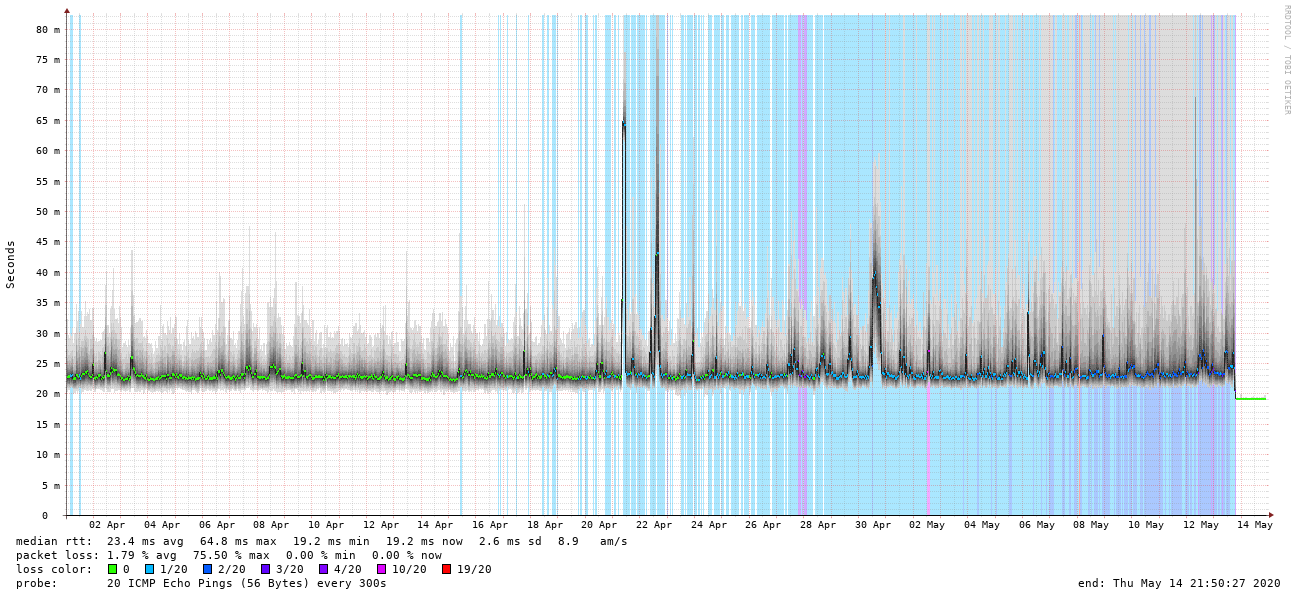
Note: all this is my personal experience, on my personal machines, and I don t claim it to be the absolute truth. Also, I don t directly call out names, although if you live in Switzerland it s pretty easy to guess who the old provider is from some hints. For a long time, I wanted to move away from my current (well, now past) provider, for a multitude of reasons. The main being that the company is very classic company, with classic support system, that doesn t work very well - I had troubles with their billing system that left me out cold without internet for 15 days, but for the recent few years, they were mostly OK, and changing to a different provider would have meant me routing a really long Ethernet cable around the apartment, so I kept postponing it. Yes, self-inflicted pain, I know. Until the entire work-from-home thing, when the usually stable connection start degrading in a very linear fashion day-by-day (this is a graph that basically reflects download bandwidth):
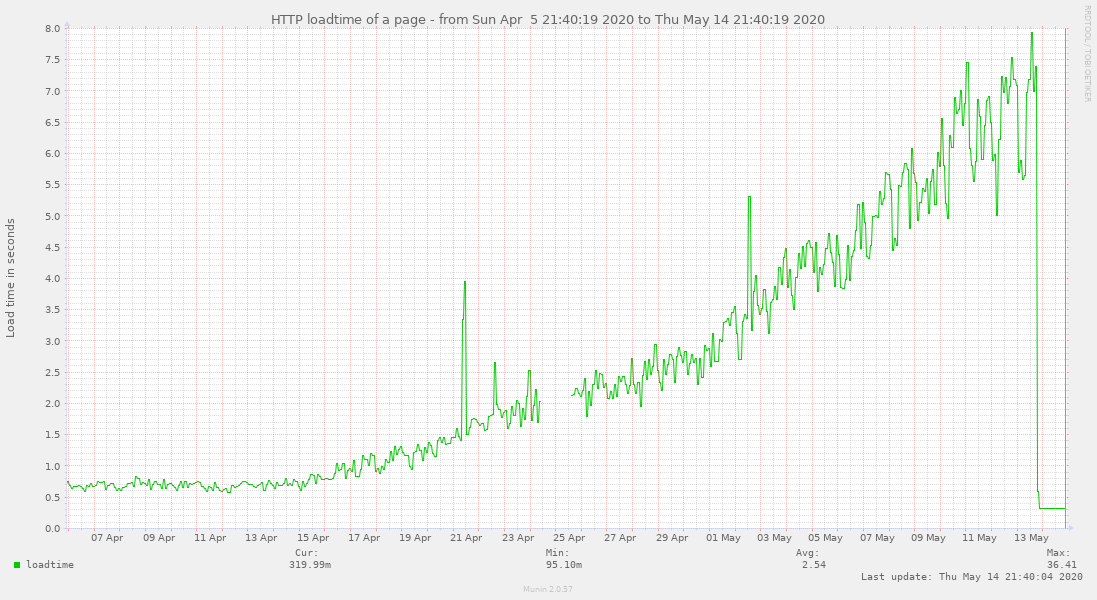
1+ month download bandwidth test 1+ month download bandwidth test
At first, I didn t realise this, as even 100Mbps is still fast enough. But once the connection went below (I believe) 50Mbps, it became visible in day to day work. And since I work daily from home yeah. Not fun. So I started doing speedtest.net - and oh my, ~20Mbps was a good result, usually 12-14Mbps. On a wired connection. On a connection that officially is supposed to be 600Mbps down. The upload speed was spot on, so I didn t think it was my router, but: Nothing helped. Once in a blue moon, speedtest would give me 100Mbps, but like once every two days, then it would be back and showing 8Mbps. Eight! It ended up as even apt update was tediously slow, and kernel downloads took ages The official instructions for dealing with bad internet are a joke: And the best part: If you are not satisfied with the results, read our internet optimisation guide. If you are still not happy, use our community forums or our social platforms. Given that it was a decline over 3-weeks, that I don t know of any computer component that would degrade this steadily but not throw any other errors, and that my upload speed was all good, I assumed it s the provider. Maybe I was wrong, but I wanted to do this anyway for a long while, so I went through the find how to route cable, check if other provider socket is good, order service, etc. dance, and less than a week later, I had the other connection. Now, of course, bandwidth works as expected:
1+ month updated bandwidth test 1+ month updated bandwidth test
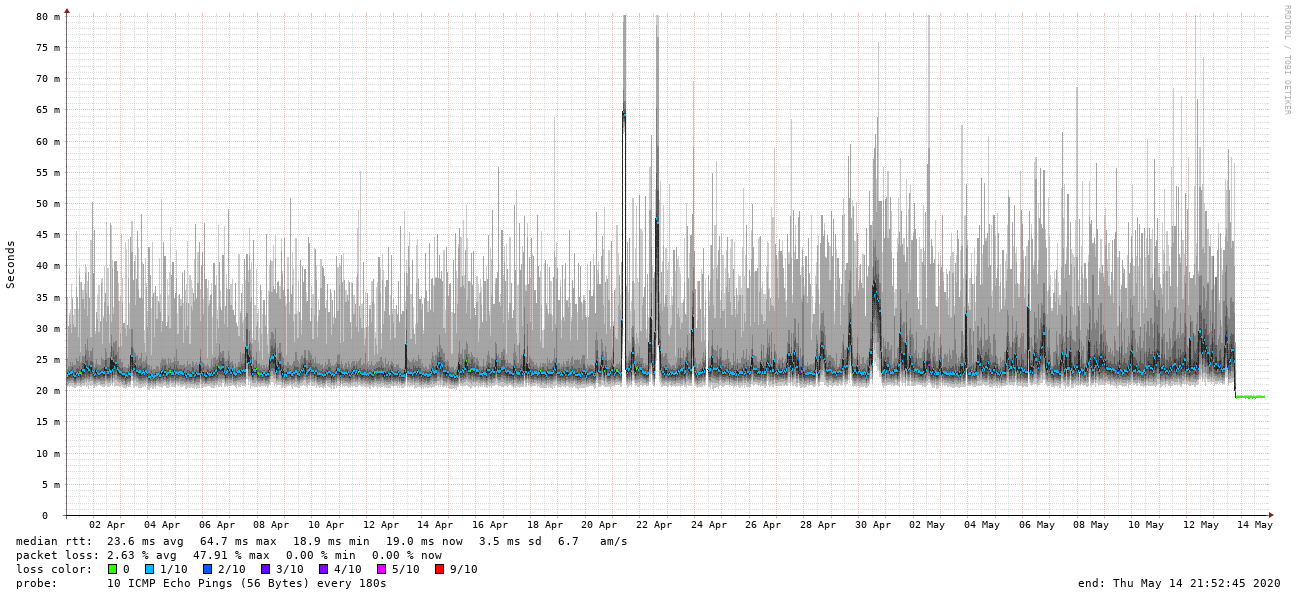
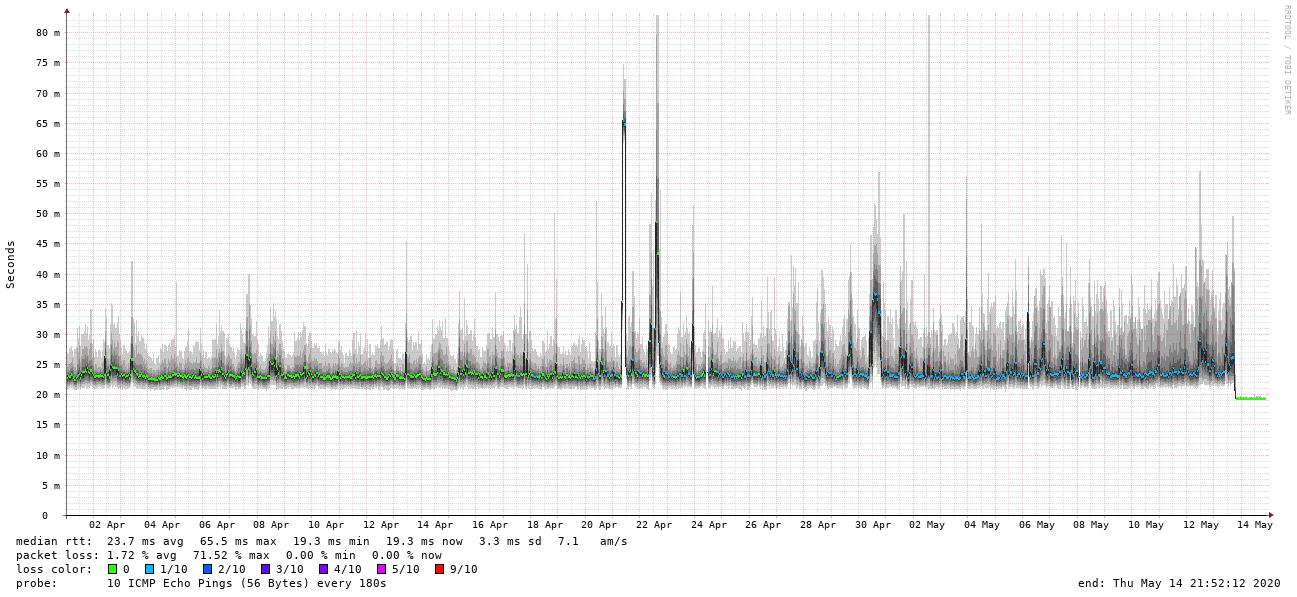
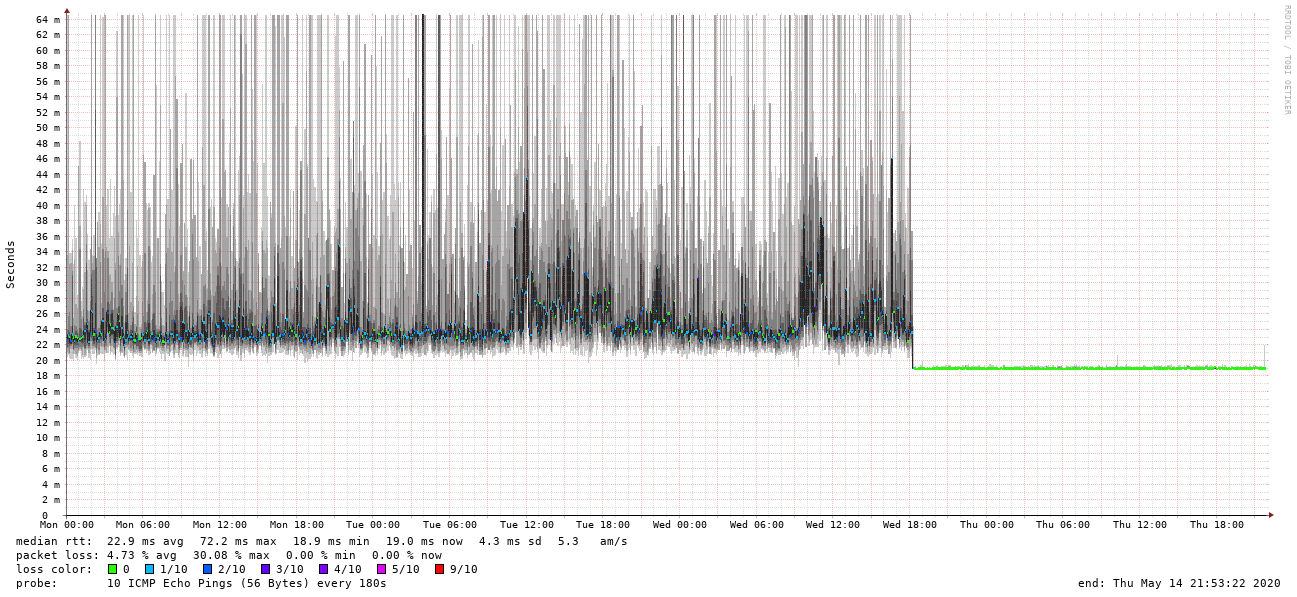
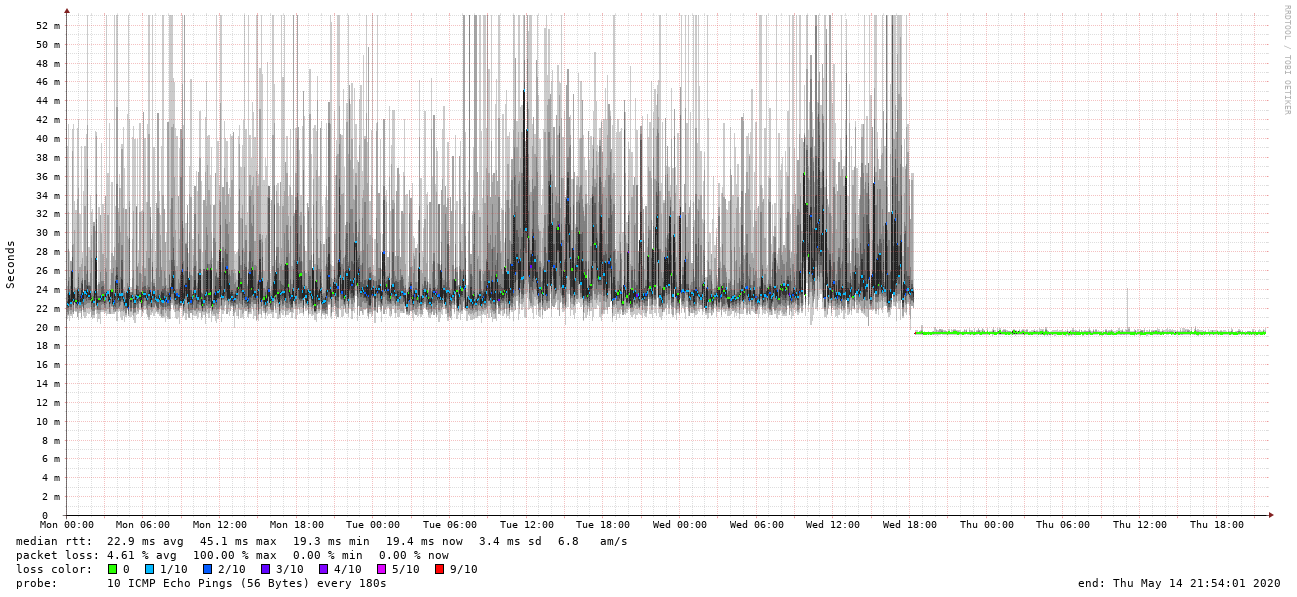
Both download and upload are fine (the graph above is just download). Latency is also much better, towards many parts of the internet that matter. But what is shocking is the difference in jitter to some external hosts I care about. On the previous provider, a funny thing was that both outgoing and incoming pings had both more jitter and packet loss when done directly (IPv4 to IPv4) than when done over a VPN. This doesn t make sense, since VPN is just overhead over IPv4, but the graphs show it, and what I think happens is that a VPN flow is cached in the provider s routers, whereas a simple ping packet not. But, the fact that there s enough jitter for a ping to a not-very-far host doesn t make me happy. Examples, outgoing:
Outgoing smokeping to public IPv4 Outgoing smokeping to public IPv4
Outgoing smokeping over VPN Outgoing smokeping over VPN
And incoming:
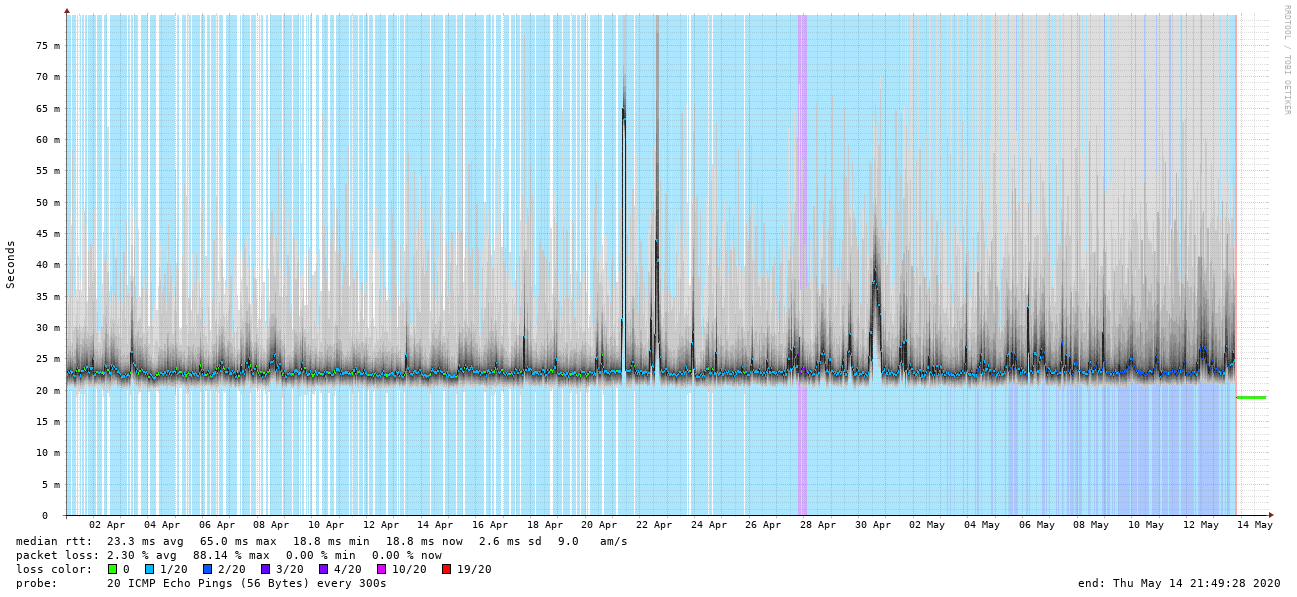
Incoming smokeping to public IPv4 Incoming smokeping to public IPv4
Incoming smokeping over VPN Incoming smokeping over VPN
Both incoming and outgoing show this weirdness - more packet loss and more jitter over VPN. Again, this is not a problem in practice, or not much, but makes me wonder what other shenanigans happen behind the scenes. You can also see clearly when the work from home traffic entered the picture and started significantly degrading my connection, even over the magically better VPN connection. Switching to this week s view shows the (in my opinion) dramatic improvement in consistency of the connection:
Outgoing current week smokeping to public IPv4 Outgoing current week smokeping to public IPv4
Outgoing current week smokeping over VPN Outgoing current week smokeping over VPN
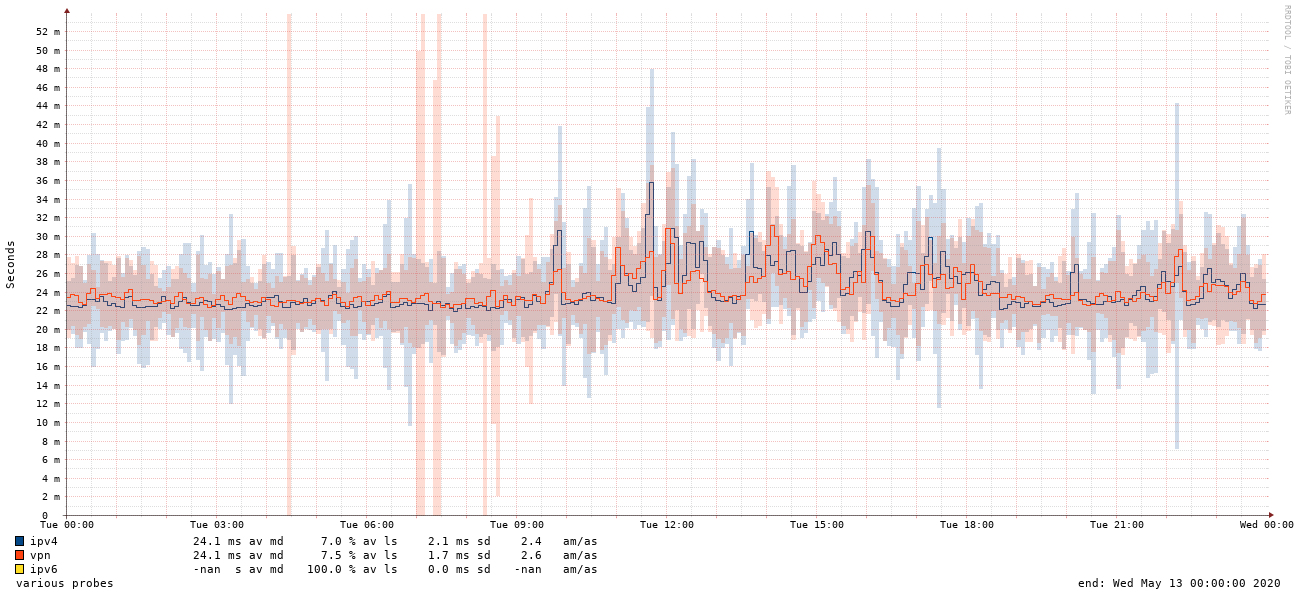
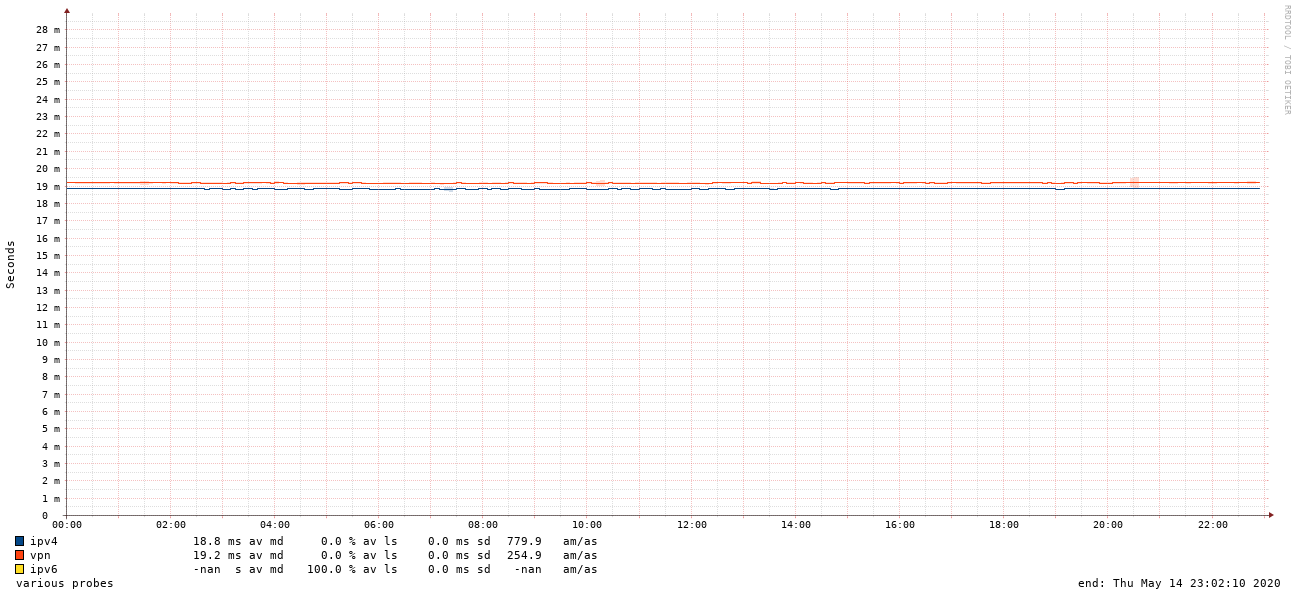
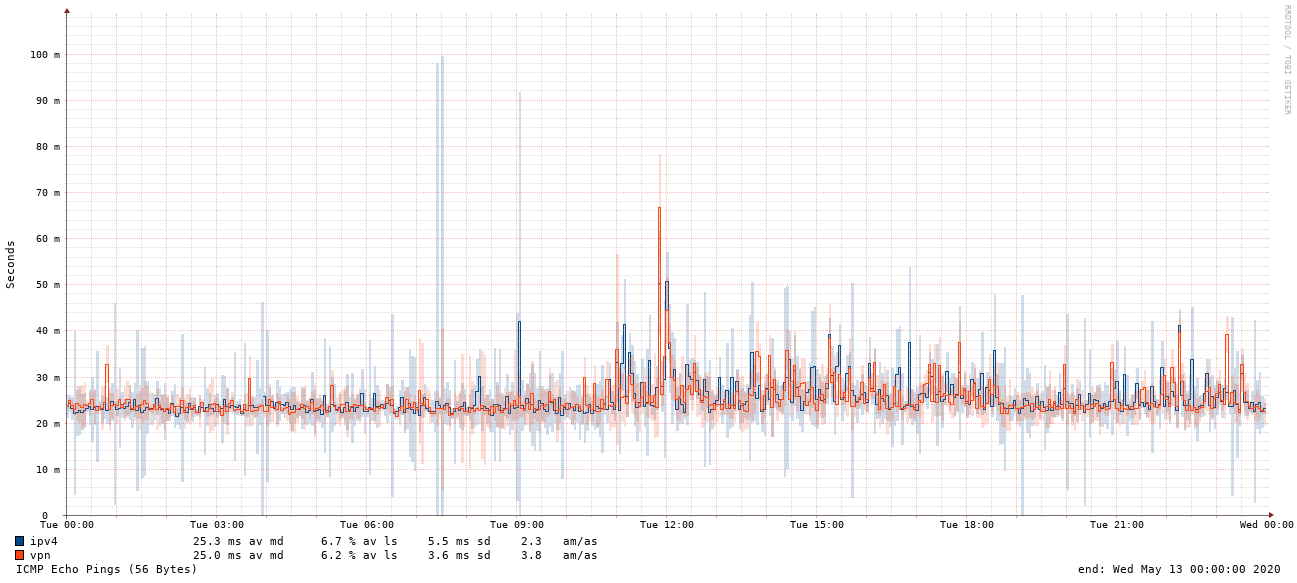
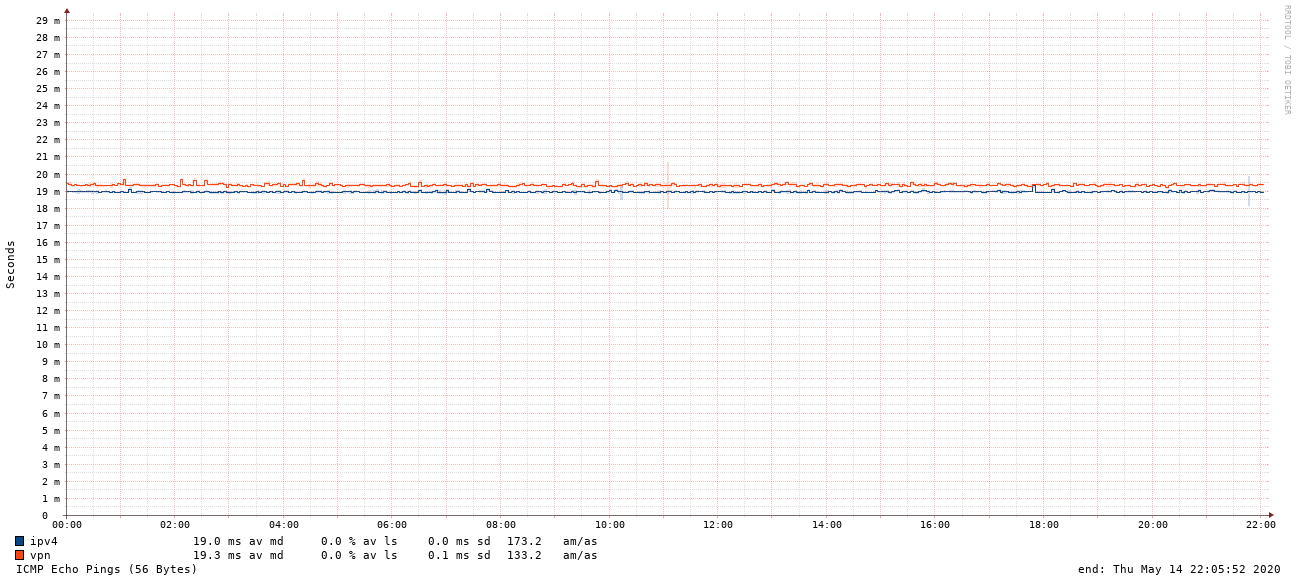
No more packet loss, no more jitter. You can also see my VPN being temporarily down during provider switchover because my firewall was not quite correct for a moment. And the last drill down, at high resolution, one day before and one day after switchover. Red is VPN, blue is plain IPv4, yellow is the missing IPv6 connection :) Incoming old:
Incoming 1-day smokeping, old provider Incoming 1-day smokeping, old provider
and new:
Incoming 1-day smokeping, new provider Incoming 1-day smokeping, new provider
Outgoing old:
Outgoing 1-day smokeping, old provider Outgoing 1-day smokeping, old provider
and new:
Outgoing 1-day smokeping, new provider Outgoing 1-day smokeping, new provider
This is what I expect, ping-over-VPN should of course be slower than plain ping. Note that incoming and outgoing have slightly different consistency, but that is fine for me :) The endpoints doing the two tests are different, so this is expected. Reading the legend on the graphs for the incoming connection (similar story for outgoing): So to my previous provider: it can be done better. Or at least, allow people easier ways to submit performance issue problems. For me, the moral of the story is that I should have switched a couple of years ago, instead of being lazy. And that I m curious to see how IPv6 traffic will differ, if at all :) Take care, everyone! And thanks for looking at these many graphs :)

13 May 2020

Russ Allbery: Review: Gideon the Ninth

Review: Gideon the Ninth, by Tamsyn Muir
Series: The Locked Tomb #1
Publisher: Tor
Copyright: September 2019
ISBN: 1-250-31317-1
Format: Kindle
Pages: 448
Despite being raised there, Gideon Nav is an outsider in the Ninth House. Her mother, already dead, fell from the sky with a one-day-old Gideon in tow, leaving her an indentured servant. She's a grumpy, caustic teenager in a world of moldering corpses, animated skeletons, and mostly-dead adults whose parts are falling off. Her world is sword fighting, dirty magazines, a feud with the house heir Harrowhark, and a determination to escape the terms of her indenture. Gideon does get off the planet, but not the way that she expects. She doesn't get accepted into the military. She ends up in the middle of a bizarre test, or possibly an ascension rite, mingling with and competing with the nobility of the empire alongside her worst enemy. I struggled to enjoy the beginning of Gideon the Ninth. Gideon tries to carry the story on pure snark, but it is very, very goth. If you like desiccated crypts, mostly-dead goons, betrayal, frustration, necromancers, black robes, disturbing family relationships, gloom, and bitter despair, the first six chapters certainly deliver, but I was sick of it by the time Gideon gets out. Thankfully, the opening is largely unlike the rest of the book. What starts as an over-the-top teenage goth rebellion turns into a cross between a manor house murder mystery and a competitive escape room. This book is a bit of a mess, but it's a glorious mess. It's also the sort of glorious mess that I don't think would have been written or published twenty years ago, and I have a pet theory that attributes this to the invigorating influence of fanfic and writers who grew up reading and writing it. I read a lot of classic science fiction and epic fantasy as a teenager. Those books have many merits, obviously, but emotional range is not one of them. There are a few exceptions, but on average the genre either focused on puzzles and problem solving (how do we fix the starship, how do we use the magic system to take down the dark god) or on the typical "heroic" (and male-coded) emotions of loyalty, bravery, responsibility, authority, and defiance of evil. Characters didn't have messy breakups, frenemies, anxiety, socially-awkward love affairs, impostor syndrome, self-hatred, or depression. And authors weren't allowed to fall in love with the messiness of their characters, at least on the page. I'm not enough of a scholar to make the argument well, but I suspect there's a case to be made that fanfic exists partially to fill this gap. So much of fanfic starts from taking the characters on the canonical page or screen and letting them feel more, live more, love more, screw up more, and otherwise experience a far wider range of human drama, particularly compared to what made it into television, which was even more censored than what made it into print. Some of those readers and writers are now writing for publication, and others have gone into publishing. The result, in my theory, is that the range of stories that are acceptable in the genre has broadened, and the emotional texture of those stories has deepened. Whether or not this theory is correct, there are now more novels like this in the world, novels full of grudges, deflective banter, squabbling, messy emotional processing, and moments of glorious emotional catharsis. This makes me very happy. To describe the emotional payoff of this book in any more detail would be a huge spoiler; suffice it to say that I unabashedly love fragile competence and unexpected emotional support, and adore this book for containing it. Gideon's voice, irreverent banter, stubborn defiance, and impulsive good-heartedness are the center of this book. At the start, it's not clear whether there will be another likable character in the book. There will be, several of them, but it takes a while for Gideon to find them or for them to become likable. You'll need to like Gideon well enough to stick with her for that journey. I read books primarily for the characters, not for the setting, and Gideon the Ninth struck some specific notes that I will happily read endlessly. If that doesn't match your preferences, I would not be too surprised to hear you bounced off the book. There's a lot here that won't be to everyone's taste. The setting felt very close to Warhammer 40K: an undead emperor that everyone worships, endless war, necromancy, and gothic grimdark. The stage for most of the book is at least more light-filled, complex, and interesting than the Ninth House section at the start, but everything is crumbling, drowning, broken, or decaying. There's quite a lot of body horror, grotesque monsters, and bloody fights. And the ending is not the best part of the book; roughly the last 15% of the novel is composed of two running fight scenes against a few practically unkillable and frankly not very interesting villains. I got exhausted by the fighting long before it was over, and the conclusion is essentially a series cliffhanger. There are also a few too many characters. The collection of characters and the interplay between the houses is one of the strengths of this book, but Muir sets up her story in a way that requires eighteen significant characters and makes the reader want to keep track of all of them. It took me about halfway through the book before I felt like I had my bearings and wasn't confusing one character for another or forgetting a whole group of characters. That said, most of the characters are great, and the story gains a lot from the interplay of their different approaches and mindsets. Palamedes Sextus's logical geekery, in particular, is a great counterpoint to the approaches of most of the other characters. The other interesting thing Muir does in this novel that I've not seen before, and that feels very modern, is to set the book in essentially an escape room. Locking a bunch of characters in a sprawling mansion until people start dying is an old fictional trope, but this one has puzzles, rewards, and a progressive physical structure that provides a lot of opportunities to motivate the characters and give them space to take wildly different problem-solving approaches. I liked this a lot, and I'm looking forward to seeing it in future books. This is not the best book I've read, but I thoroughly enjoyed it, despite some problems with the ending. I've already pre-ordered the sequel. Followed by Harrow the Ninth. Rating: 8 out of 10

12 May 2020

Evgeni Golov: Building a Shelly 2.5 USB to TTL adapter cable

When you want to flash your Shelly 2.5 with anything but the original firmware for the first time, you'll need to attach it to your computer. Later flashes can happen over the air (at least with ESPHome or Tasmota), but the first one cannot. In theory, this is not a problem as the Shelly has a quite exposed and well documented interface: Shelly 2.5 pinout However, on closer inspection you'll notice that your normal jumper wires don't fit as the Shelly has a connector with 1.27mm (0.05in) pitch and 1mm diameter holes. Now, there are various tutorials on the Internet how to build a compatible connector using Ethernet cables and hot glue or with female header socket legs, and you can even buy cables on Amazon for 18 ! But 18 sounded like a lot and the female header socket thing while working was pretty finicky to use, so I decided to build something different. We'll need 6 female-to-female jumper wires and a 1.27mm pitch male header. Jumper wires I had at home, the header I got is a SL 1X20G 1,27 from reichelt.de for 0.61 . It's a 20 pin one, so we can make 3 adapters out of it if needed. Oh and we'll need some isolation tape. SL 1X20G 1,27 The first step is to cut the header into 6 pin chunks. Make sure not to cut too close to the 6th pin as the whole thing is rather fragile and you might lose it. SL 1X20G 1,27 cut into pieces It now fits very well into the Shelly with the longer side of the pins. Shelly 2.5 with pin headers attached Second step is to strip the plastic part of one side of the jumper wires. Those are designed to fit 2.54mm pitch headers and won't work for our use case otherwise. jumper wire with removed plastic As the connectors are still too big, even after removing the plastic, the next step is to take some pliers and gently press the connectors until they fit the smaller pins of our header. Shelly 2.5 with pin headers and a jumper wire attached Now is the time to put everything together. To avoid short circuiting the pins/connectors, apply some isolation tape while assembling, but not too much as the space is really limited. Shelly 2.5 with pin headers and a jumper wire attached and taped And we're done, a wonderful (lol) and working (yay) Shelly 2.5 cable that can be attached to any USB-TTL adapter, like the pictured FTDI clone you get almost everywhere. Shelly 2.5 with full cable and FTDI attached Yes, in an ideal world we would have soldered the header to the cable, but I didn't feel like soldering on that limited space. And yes, shrink-wrap might be a good thing too, but again, limited space and with isolation tape you only need one layer between two pins, not two.
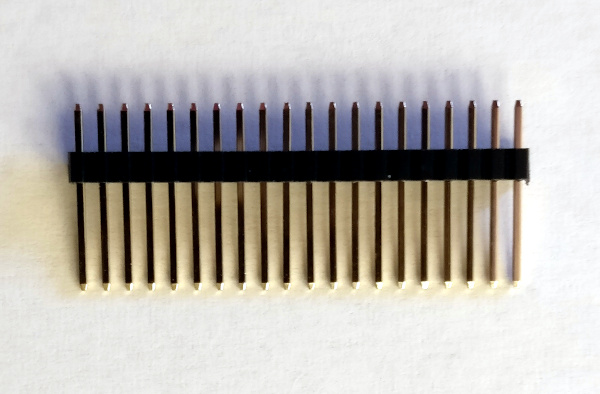
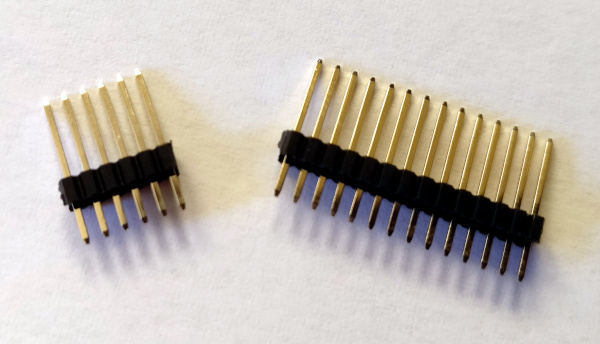
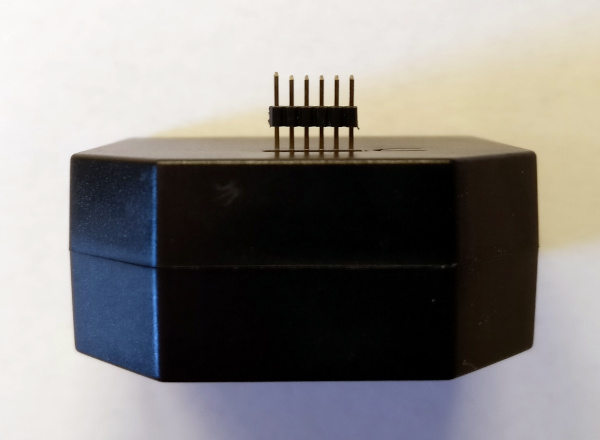
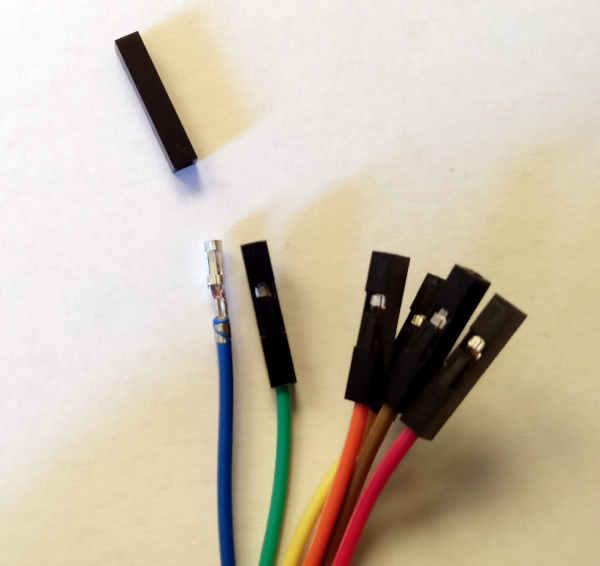
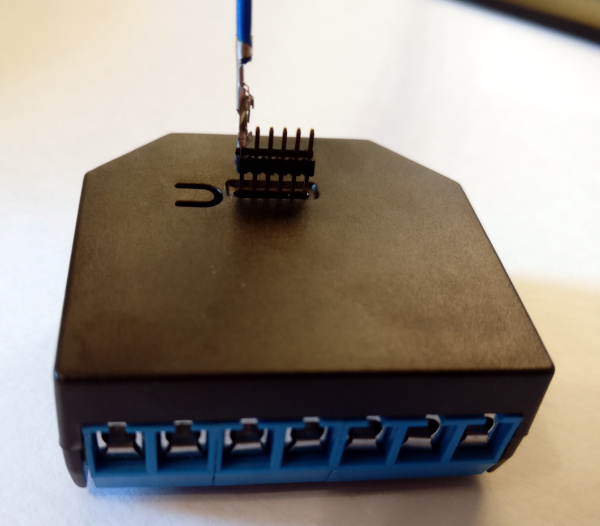
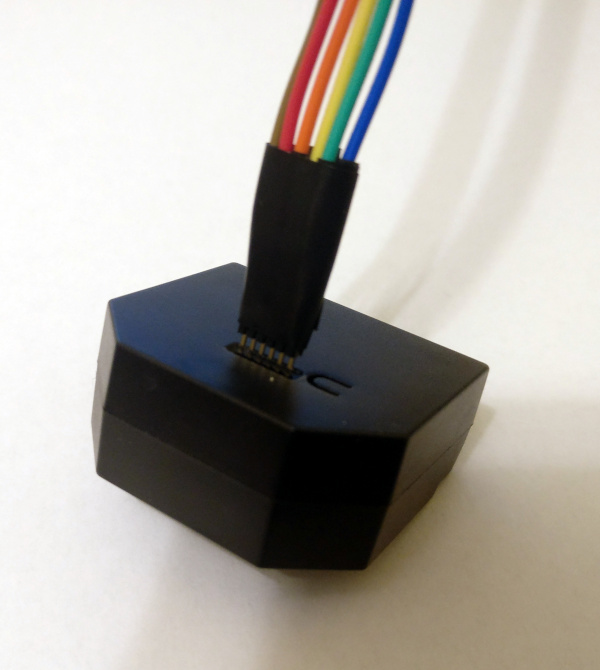
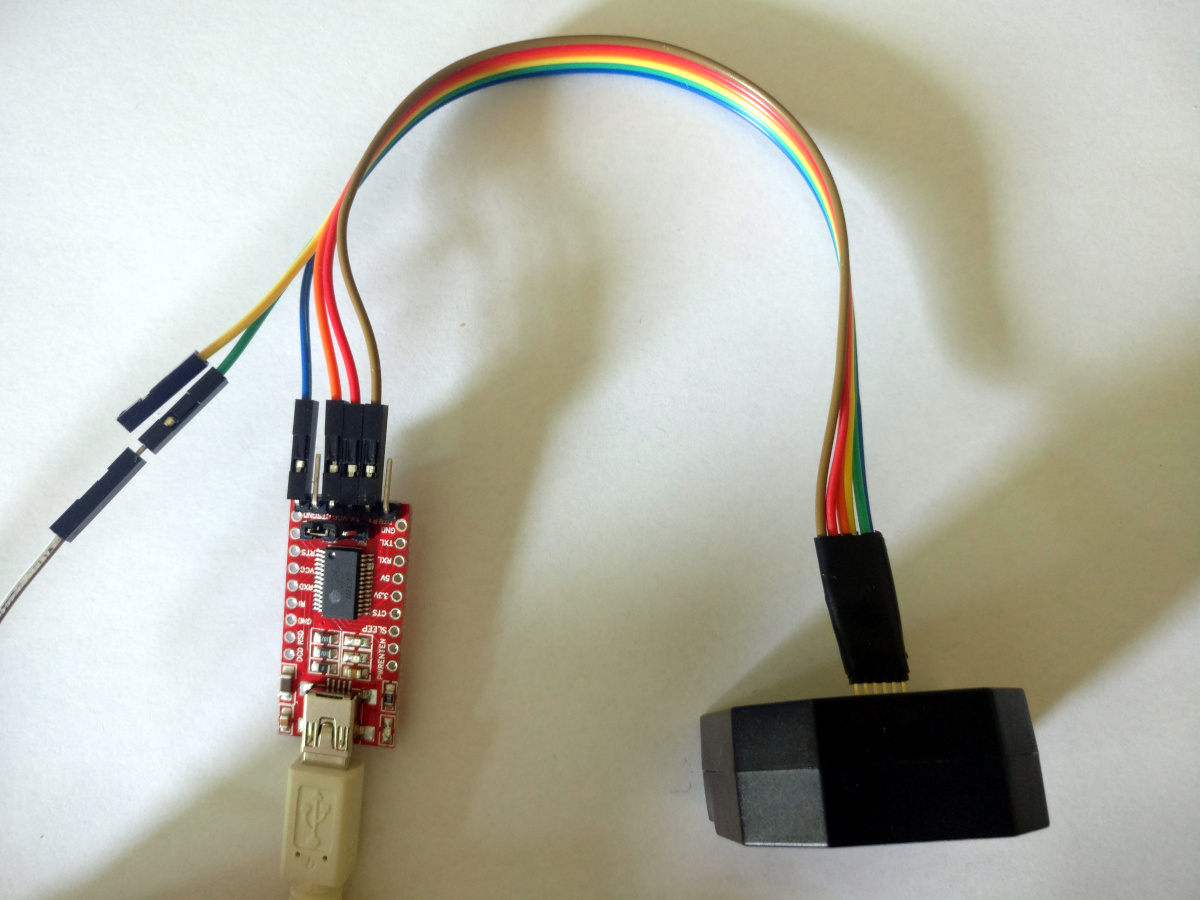
Next.

Previous.