Search Results: "Dirk Eddelbuettel"

20 August 2014

Dirk Eddelbuettel: RcppArmadillo 0.4.400.0

After two pre-releases in the last few days, Conrad finalised a new Armadillo version 4.400 today. I had kept up with the pre-releases, tested twice against all eighty (!!) CRAN dependents of RcppArmadillo and have hence uploaded RcppArmadillo 0.4.400.0 to CRAN and into Debian. This release brings a number of new upstream features which are detailed below. As included is s bugfix for sparse matrix creation at the RcppArmadillo end which was found by the ASAN tests at CRAN --- which are similar to the sanitizers tests I recently blogged. I was able to develop and test the fix in the very docker r-devel-san images I had written about which was nice. Special thanks also to Ryan Curtin for help with the fix.
Changes in RcppArmadillo version 0.4.400.0 (2014-08-19)
  • Upgraded to Armadillo release Version 4.400 (Winter Shark Alley)
    • added gmm_diag class for statistical modelling using Gaussian Mixture Models; includes multi-threaded implementation of k-means and Expectation-Maximisation for parameter estimation
    • added clamp() for clamping values to be between lower and upper limits
    • expanded batch insertion constructors for sparse matrices to add values at repeated locations
    • faster handling of subvectors by dot()
    • faster handling of aliasing by submatrix views
  • Corrected a bug (found by the g++ Address Sanitizer) in sparse matrix initialization where space for a sentinel was allocated, but the sentinel was not set; with extra thanks to Ryan Curtin for help
  • Added a few unit tests for sparse matrices
Courtesy of CRANberries, there is also a diffstat report for the most recent release. As always, more detailed information is on the RcppArmadillo page. Questions, comments etc should go to the rcpp-devel mailing list off the R-Forge page.

This post by Dirk Eddelbuettel originated on his Thinking inside the box blog. Please report excessive re-aggregation in third-party for-profit settings.

7 August 2014

Dirk Eddelbuettel: Rcpp now used by 250 CRAN packages

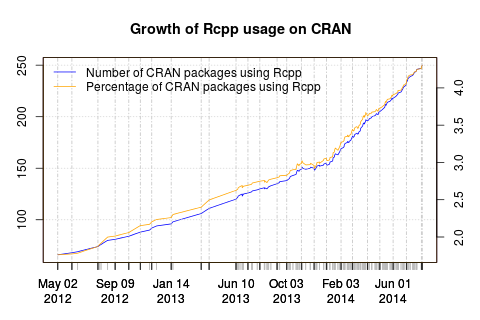
Rcpp growth
Rcpp reached a nice round milestone yesterday: 250 packages on CRAN now depend on it (as measured by Depends, Imports and LinkingTo declarations). The graph is on the left depicts the growth of Rcpp over time. Or at least since I started to write down some usage numbers: first informally, then via a script. Also displayed is the relative proportion of CRAN packages using it. Rcpp cleared the four per-cent hurdle just before useR! 2014 where I showed a similar graph (as two distinct graphs) in my invited talk. 250 is a pretty impressive, and rather humbling, number. From everybody behind Rcpp, I would like to say a heartfelt Thank You! to all the users and of course contributors.

This post by Dirk Eddelbuettel originated on his Thinking inside the box blog. Please report excessive re-aggregation in third-party for-profit settings.

5 August 2014

Dirk Eddelbuettel: BH release 1.54.0-3

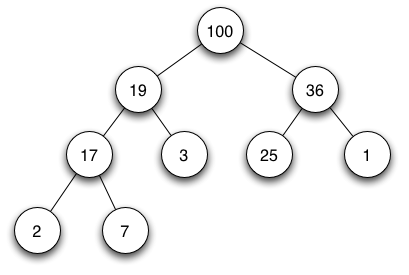
A new release of our BH package providing Boost headers for use by R is now on the CRAN mirrors. max-heap image This release is the third based on Boost 1.54.0. At the request of the maintainer of the recent added RcppMLPACK package, it adds the Boost.Heap library. Boost.Heap implements priority queues which extend beyond the corresponding (and somewhat simpler) class in the STL. Key features of the Boost.Heap priority queues are mutability, iterators, ability to merge, stable sort, and comparison. No other changes were made.
Changes in version 1.54.0-3 (2014-08-03)
  • Added Boost Heap library which will be needed by the next version of RcppMLPACK
Courtesy of CRANberries, there is also a diffstat report for the most recent release. Comments and suggestions are welcome via the mailing list or issue tracker at the GitHub repo.

This post by Dirk Eddelbuettel originated on his Thinking inside the box blog. Please report excessive re-aggregation in third-party for-profit settings.

3 August 2014

Dirk Eddelbuettel: Introducing sanitizers 0.1.0

A new package sanitizers is now on CRAN. It provides test cases for Address Sanitizers, and Undefined Behaviour Sanitizers. These are two recent features of both g++ and clang++, and described in the Checking Memory Access section of the Writing R Extension manual. I set up a new web page for the sanitizers package which illustrates their use case via pre-built Docker images, similar to what I presented at the end of my useR! 2014 keynote a few weeks ago. So instead of repeating this over here, I invite you to read the detailed discussion on the sanitizers page.

This post by Dirk Eddelbuettel originated on his Thinking inside the box blog. Please report excessive re-aggregation in third-party for-profit settings.

16 July 2014

Dirk Eddelbuettel: Introducing RcppParallel: Getting R and C++ to work (some more) in parallel

A common theme over the last few decades was that we could afford to simply sit back and let computer (hardware) engineers take care of increases in computing speed thanks to Moore's law. That same line of thought now frequently points out that we are getting closer and closer to the physical limits of what Moore's law can do for us. So the new best hope is (and has been) parallel processing. Even our smartphones have multiple cores, and most if not all retail PCs now possess two, four or more cores. Real computers, aka somewhat decent servers, can be had with 24, 32 or more cores as well, and all that is before we even consider GPU coprocessors or other upcoming changes. And sometimes our tasks are embarassingly simple as is the case with many data-parallel jobs: we can use higher-level operations such as those offered by the base R package parallel to spawn multiple processing tasks and gather the results. I covered all this in some detail in previous talks on High Performance Computing with R (and you can also consult the Task View on High Performance Computing with R which I edit). But sometimes we can't use data-parallel approaches. Hence we have to redo our algorithms. Which is really hard. R itself has been relying on the (fairly mature) OpenMP standard for some of its operations. Luke Tierney's (awesome) keynote in May at our (sixth) R/Finance conference mentioned some of the issues related to OpenMP. One which matters is that OpenMP works really well on Linux, and either not so well (Windows) or not at all (OS X, due the usual issue with the gcc/clang switch enforced by Applem but the good news is that the OpenMP toolchain is expected to make it to OS X is some more performant form "soon"). R is still expected to make wider use of OpenMP in future versions. Another tool which has been around for a few years, and which can be considered to be equally mature is the Intel Threaded Building Blocks library, or TBB. JJ recently started to wrap this up for use by R. The first approach resulted in a (now superseded, see below) package TBB. But hardware and OS issues bite once again, as the Intel TBB is not really building that well for the Windows toolchain used by R (and based on MinGW). (And yes, there are two more options. But Boost Threads requires linking which precludes easy use as e.g. via our BH package. And C++11 with its threads library (based on Boost Threads) is not yet as widely available as R and Rcpp which means that it is not a real deployment option yet.) Now, JJ, being as awesome as he is, went back to the drawing board and integrated a second threading toolkit: TinyThread++, a small header-only library without further dependencies. Not as feature-rich as Intel Threaded Building Blocks, but at least available everywhere. So a new package RcppParallel, so far only on GitHub, wraps around both TinyThread++ and Intel Threaded Building Blocks and offers a consistent interface available on all platforms used by R. Better still, JJ also authored several pieces demonstrating this new package for the Rcpp Gallery: All four are interesting and demonstrate different aspects of parallel computing via RcppParallel. But the last article is key. Based on a question by Jim Bullard, and then written with Jim, it shows how a particular matrix distance metric (which is missing from R) can be implemented in a serial manner in both R, and also via Rcpp. The key implementation, however, uses both Rcpp and RcppParallel and thereby achieves a truly impressive speed gain as the gains from using compiled code (via Rcpp) and from using a parallel algorithm (via RcppParallel) are multiplicative! Between JJ's and my four-core machines the gain was between 200 and 300 fold---which is rather considerable. For kicks, I also used a much bigger machine at work which came in at an even larger speed gain (but gains become clearly sublinear as the number of cores increases; there are however some tuning parameters). So these are exciting times. I am sure there will be lots more to come. For now, head over to the RcppParallel package and start playing. Further contributions to the Rcpp Gallery are not only welcome but strongly encouraged.
12 July 2014

Dirk Eddelbuettel: RcppArmadillo 0.4.320.0

While I was out at the (immensely impressive and equally enjoyable) useR! 2014 conference at UCLA, Conrad provided a bug-fix release 4.320 of Armadillo, the nifty templated C++ library for linear algebra. I quickly rolled that into RcppArmadillo release 0.4.320.0 which has been on CRAN and in Debian for a good week now. This release fixes some minor things with sparse and dense Eigen solvers (as well as one RNG issue probably of lesser interest to R users deploying the RNGs from R) as shown in the NEWS entry below.
Changes in RcppArmadillo version 0.4.320.0 (2014-07-03)
  • Upgraded to Armadillo release Version 4.320 (Daintree Tea Raider)
    • expanded eigs_sym() and eigs_gen() to use an optional tolerance parameter
    • expanded eig_sym() to automatically fall back to standard decomposition method if divide-and-conquer fails
    • automatic installer enables use of C++11 random number generator when using gcc 4.8.3+ in C++11 mode
Courtesy of CRANberries, there is also a diffstat report for the most recent release. As always, more detailed information is on the RcppArmadillo page. Questions, comments etc should go to the rcpp-devel mailing list off the R-Forge page.

This post by Dirk Eddelbuettel originated on his Thinking inside the box blog. Please report excessive re-aggregation in third-party for-profit settings.

13 June 2014

Dirk Eddelbuettel: Introducing pkgKitten: Creating R Packages that purr

A new package pkgKitten is now on CRAN in its infant version 0.1.0. It does only one thing: create R packages that do not suck. Or at least not as much as those created by the (R default) function package.skeleton() which creates files which the very standard, and very recommended, R CMD check then complains about. That is silly. Because each time R CMD check complains, something bad happens to a kitten somewhere. So pkgKitten offers a wrapper function kitten() which creates neat little packages which do not upset R CMD check. A complete little demo is on the pkgKitten webpage which also has pointers to the pkgKitten GitHub repo.

This post by Dirk Eddelbuettel originated on his Thinking inside the box blog. Please report excessive re-aggregation in third-party for-profit settings.

10 June 2014

Dirk Eddelbuettel: Introducing RcppRedis

RcppRedis, another new package of mine, appeared on CRAN a few weeks ago just in time for our annual R/Finance conference. And as of today, we also have Windows binaries thanks to generous help from John Buonagurio who help building the required 32- and 64-bit libraries for Windows, and Uwe Ligges who now installed them for the CRAN and win-builder machiness. Binaries for release 0.1.1 should be available within a day. To describe the package, I also just set up a page about RcppRedis so rather than repeating everything here I invite you to follow the link. The ever-so-brief NEWS entry for the two first uploads follows.
Changes in version 0.1.1 (2014-06-09)
  • Now with Windows support thanks to the installation of builds of the hiredis library (created by John Buonagurio) at CRAN / win-builder (thanks to Uwe Ligges)
  • Added support for new command zcount
Changes in version 0.1.0 (2014-05-10)
  • Initial CRAN upload

This post by Dirk Eddelbuettel originated on his Thinking inside the box blog. Please report excessive re-aggregation in third-party for-profit settings.

9 June 2014

Dirk Eddelbuettel: Rcpp 0.11.2

A new minor release 0.11.2 of Rcpp is now on the CRAN network for GNU R, and binaries for Debian have also been uploaded. The release smoothes a few edges on both the Rcpp side itself, as well as on the interaction between Rcpp and R which since release 3.1.0 offers a few new features related to C++11. Kevin added a couple of neat extensions related to vectors, a new ListOf templated list class, as well as a new option to warn on implicit casts. We decided not to make this option the default as it may be too common in some packages. JJ took care of a few buglets related to the wonderful Rcpp Attributes. See the NEWS file section below for details, or the ChangeLog file in the package and on the Rcpp Changelog page. Note that the diffstat reported by CRANberries is very large as Kevin also committed a whitespace cleanup which touched almost all files. As before, we tested this release by building against all CRAN packages which depend upon Rcpp. In fact we did three such runs leading up to the release. Only one package was blacklisted (as I currently don't have CUDA set-up), two had what may be internal errors or tests which were too restrictive, sixteen suffered from missing packages or RGL devices --- but the remaining 202 packages all built and tested cleanly. Detailed results of those tests (and the scripts for it) are in the rcpp-logs repo GitHub. There are a number of other fixes, upgrades and other extensions detailed in NEWS file extract below, in the ChangeLog file in the package and on the Rcpp Changelog page.
Changes in Rcpp version 0.11.2 (2014-06-06
  • Changes in Rcpp API:
    • Implicit conversions, e.g. between NumericVector and IntegerVector, will now give warnings if you use #define RCPP_WARN_ON_COERCE before including the Rcpp headers.
    • Templated List containers, ListOf<T>, have been introduced. When subsetting such containers, the return is assumed to be of type T, allowing code such as ListOf<NumericVector> x; NumericVector y = x[0] + x[1] + x[2].
    • In a number of instances, returned results are protected and/or cast more carefully.
  • Changes in Rcpp Attributes
    • Trailing line comments are now stripped by the attributes parser. This allows the parser to handle C++ source files containing comments inline with function arguments.
    • The USE_CXX1X environment variable is now defined by the cpp11 plugin when R >= 3.1. Two additional plugins have been added for use with C++0x (eg when using g++ 4.6.* as on Windows) as well as C++1y for compilers beginning to support the next revision of the standard; additional fallback is provided for Windows.
    • compileAttributes() now also considers Imports: which may suppress a warning when running Rcpp.package.skeleton().
Thanks to CRANberries, you can also look at a diff to the previous release. As always, even fuller details are on the Rcpp Changelog page and the Rcpp page which also leads to the downloads, the browseable doxygen docs and zip files of doxygen output for the standard formats. A local directory has source and documentation too. Questions, comments etc should go to the rcpp-devel mailing list off the R-Forge page

This post by Dirk Eddelbuettel originated on his Thinking inside the box blog. Please report excessive re-aggregation in third-party for-profit settings.

5 June 2014

Dirk Eddelbuettel: RcppArmadillo 0.4.300.8.0

A new minor / bug fix release 4.300.8 of Armadillo, the templated C++ library for linear algebra, was tagged by Conrad in his SVN repo a few days ago, following earlier snapshots in the 4.300.* series. We had prepared two earlier releases for GitHub but not CRAN in order to accomodate the CRAN maintainer's desire of "a release every one to two months" expressed in the CRAN Repo Policy. However, two actual bugs in the interaction between MinGW and C++11 were reported on the rcpp-devel mailing list, and this releases addresses these. Hence time for new release 0.4.300.8.0 of RcppArmadillo which is now on CRAN and in Debian. This release brings a few upstream changes detailed below such as nice new upstream changes such as more robust norm() (and related) functions, and fixes related to matrix and cube interactions. From our end, we added a better detection of Windows via both _WIN32 and WIN32 (as the former apparently gets undefined by MinGW in C++11 mode). We also added the ability to turn on C++11 support from R (possible since R 3.1.0) yet also turn it off for Armadillo. This is needed as the prescribed compiler on Windows is g++ 4.6.2 -- which offers a subset of C++11 which is good enough for a number of things from the C++11 standard, but not advanced enough for everything which Armadillo uses when C++11 support is turned on. As Armadillo continues to offer a choice of C++ standards, we can use the ability to deploy C++11 only outside of its internals. It is worth repeating that this issue should only affect Windows users wishing to use C++11; other platforms are fine as they generally have more modern compilers.
Changes in RcppArmadillo version 0.4.300.8.0 (2014-05-31)
  • Upgraded to Armadillo release Version 4.300.8 (Medieval Cornea Scraper)
    • More robust norm-related functions
    • Fixes between interactions between cube and vector types.
  • Adds a #define ARMA_DONT_USE_CXX11 to provide an option to turn C++11 off for Armadillo (but client packages may still use it)
  • More robust Windows detection by using _WIN32 as well as WIN32 as the latter gets diabled by MinGW with C++11
  • On Windows, C++11 can be turned off as the Armadillo code base uses more features of C++11 than g++ 4.6.2 version in Rtools implements
Changes in RcppArmadillo version 0.4.300.5.0 (2014-05-19)
  • Upgraded to Armadillo release Version 4.300.5 (Medieval Cornea Scraper)
    • Handle possible underflows and overflows in norm(), normalise(), norm_dot()
    • Fix for handling of null vectors by norm_dot()
Changes in RcppArmadillo version 0.4.300.2.0 (2014-05-13)
  • Upgraded to Armadillo release Version 4.300.2 (Medieval Cornea Scraper)
    • faster find()
Courtesy of CRANberries, there is also a diffstat report for the most recent release As always, more detailed information is on the RcppArmadillo page. Questions, comments etc should go to the rcpp-devel mailing list off the R-Forge page.

This post by Dirk Eddelbuettel originated on his Thinking inside the box blog. Please report excessive re-aggregation in third-party for-profit settings.

4 June 2014

Dirk Eddelbuettel: Introducing RPushbullet

A new package of mine appeared on CRAN today: RPushbullet. A few days ago, I had tweeted about a first version available via its GitHub repo. The package is now on CRAN which will make it easier to install for many. You still need an API key (free, after registration at Pushbullet) and one or more target devices to message to: an modern smartphone (Android, iPhone, ...) or a Chrome browser provided you also installed the corresponding app. I also set up a short web page on my server with some more information and an example. So pushbullet away...

This post by Dirk Eddelbuettel originated on his Thinking inside the box blog. Please report excessive re-aggregation in third-party for-profit settings.

31 May 2014

Dirk Eddelbuettel: RcppGSL 0.2.1 and 0.2.2

A few days ago, version 0.2.1 of RcppGSL---our interface package between R and the GNU GSL using our Rcpp package for seamless R and C++ integration---appeared on CRAN making it the first release in some time. And it turned that this version tickled an obscure and long-dormant bug under clang which was found on OS X Mavericks---which Kevin Ushey consequently squashed. So this is now reflected in version 0.2.2 which just arrived on CRAN. Besides the bugfix, a few things were modernized to reflect capabilities of Rcpp 0.11.0 and later. The releases also contain a few changes that had accumulated since the previous release in 2012 such as an additional example using B-splines, and use of updated vignette build options provided by R. The NEWS file entries follows below:
Changes in version 0.2.2 (2014-05-31)
  • A subtle bug (tickled only by clang on some OS versions) in vector and matrix view initialization was corrected by Kevin Ushey
Changes in version 0.2.1 (2014-05-26)
  • Added new example based on B-splines example in GSL manual illustrating simple GSL use via Rcpp attributes
  • Vignette compilation has been reverted to using highlight since version 0.4.2 or greater can be used as a vignette engine (with R 3.0.* or later).
  • Vignette compilation is now being done by R CMD build as R 3.0.0 supports different vignette engines, so the vignette build process has been simplified. A convenience helper script has also been added for command-line builds.
  • Unit tests now use sourceCpp() instead of cxxfunction() from the inline package
  • The DESCRIPTION file now uses Suggests: Rcpp (instead of Depends: Rcpp) to permit building of the vignette
  • The package now takes advantage of the simplified build process available with Rcpp (>= 0.11.0)
  • Similar updates to the build process were made for the example package included with RcppGSL
And courtesy of CRANberries, a summaries of changes to release 0.2.0 and this week's release 0.2.1 are available. More information is on the RcppGSL page. Questions, comments etc should go to the rcpp-devel mailing list off the R-Forge page.

This post by Dirk Eddelbuettel originated on his Thinking inside the box blog. Please report excessive re-aggregation in third-party for-profit settings.

13 May 2014

Dirk Eddelbuettel: Updated list of upcoming Rcpp talks and workshops

This is an updated version of an earlier post in March. A number of talks about Rcpp are scheduled over the next couple of months: So the month of June remains pretty open. If someone wants me to talk somewhere else, preferably on a Saturday, feel free to get in touch.

This post by Dirk Eddelbuettel originated on his Thinking inside the box blog. Please report excessive re-aggregation in third-party for-profit settings.

7 May 2014

Mario Lang: Planet bug: empty alt tags for hackergotchis

There is a strange bug in Planet Debian I am seeing since I joined. It is rather minor, but since it is an accessibility bug, I'd like to mention it here. I have written to the Planet Debian maintainers, and was told to figure it out myself. This is a pattern, accessibility is considered wishlist, apparently. And the affected people are supposed to fix it on their own. It is better if I don't say anything more about that attitude.
The Bug On Planet Debian, only some people have an alt tag for their hackergotchi, while all the configured entries look similar. There is no obvious difference in the configuration, but still, only some users here have a proper alt tag for their hackergotchi. Here is a list:
  • Dirk Eddelbuettel
  • Steve Kemp
  • Wouter Verhelst
  • Mehdi (noreply@blogger.com)
  • Andrew Pollock
  • DebConf Organizers
  • Francois Marier
  • The MirOS Project (tg@mirbsd.org)
  • Paul Tagliamonte
  • Lisandro Dami n Nicanor P rez Meyer (noreply@blogger.com)
  • Joey Hess
  • Chris Lamb
  • Mirco Bauer
  • Christine Spang
  • Guido G nther
These people/organisations currently displayed on Planet Debian have a proper alt tag for their hackergotchi. All the other members have none. In Lynx, it looks like the following:
hackergotchi for
And for those where it works, it looks like:
hackergotchi for Dirk Eddelbuettel
Strange, isn't it? If you have any idea why this might be happening, let me know, or even better, tell Planet Debian maintainers how to fix it. P.S.: Package planet-venus says it is a rewrite of Planet, and Planet can be found in Debian as well. I don't see it in unstable, maybe I am blind? Or has it been removed recently? If so, the package description of planet-venus is wrong.

Dirk Eddelbuettel: RcppEigen 0.3.2.1.2

A bug-fix release 0.3.2.1.2 is of RcppEigen is now on CRAN and in Debian. It contains a short upstream patch by Gaek Guennebaud for the UBSAN warnings that were flagged at CRAN (from a rather harmless cpu-id comparison). The NEWS entry follows.
Changes in RcppEigen version 0.3.2.1.2 (2014-05-05)
  • Applied upstream patch to not trigger g++ UBSAN warning on the cpu id comparison, with thanks to Gael Guennebaud for the patch
Courtesy of CRANberries, there are diffstat reports for the most recent release. Questions, comments etc about RcppEigen should go to the rcpp-devel mailing list off the R-Forge page.

This post by Dirk Eddelbuettel originated on his Thinking inside the box blog. Please report excessive re-aggregation in third-party for-profit settings.

5 May 2014

Dirk Eddelbuettel: RcppArmadillo 0.4.300.0

A new release 4.300 of Armadillo, the templated C++ library for linear algebra, was released by Conrad a few days ago. As usual, this was rolled up in a new RcppArmadillo release 0.4.300.0 which is now on CRAN and in Debian. This release brings nice new upstream changes such as faster find() as well as corresponding functions to find elements which are either finite or non-finite, based on a suggestion we made. This may need an RcppArmadillo specific extension as R extends the IEEE logic to supported NA, NaN and Inf on floating point variables whereas standard C++ (and hence Armadillo) only supports the latter two. We hope to work on this shortly. Kevin also put in some code to make sure unsigned int vectors and matrices are converted correctly, and I updated the short configure script checking for complete LAPACK support to account for the R 3.0.3 or later case.
Changes in RcppArmadillo version 0.4.300.0 (2014-05-04)
  • Upgraded to Armadillo release Version 4.300 (Medieval Cornea Scraper)
    • faster find()
    • added find_finite() and find_nonfinite() for finding indices of finite and non-finite elements
    • expressions X=inv(A)*B*C and X=A.i()*B*C are automatically converted to X=solve(A,B*C)
  • Corrected conversion to unsigned int vectors and matrices
  • Configure script now checks for R version 3.0.3 or newer to enable complex divide-and-conquer SVD in case of R-supplied LAPACK
Courtesy of CRANberries, there is also a diffstat report for the most recent release As always, more detailed information is on the RcppArmadillo page. Questions, comments etc should go to the rcpp-devel mailing list off the R-Forge page.

This post by Dirk Eddelbuettel originated on his Thinking inside the box blog. Please report excessive re-aggregation in third-party for-profit settings.

3 May 2014

Dirk Eddelbuettel: RcppSMC 0.1.3 and 0.1.4

The very useful Valgrind tool had flagged an actual error in the package which the CRAN maintainers asked us to address. This was followed by a minor brown-bad oversight of a missing delete, also tagged by Valgrind. Both are pretty ancient bugs which we probably should have found aeons ago. Releases 0.1.3 and 0.1.4 made it to CRAN yesterday in short succession. To recap, RcppSMC combines the SMCTC template classes for Sequential Monte Carlo and Particle Filters (Johansen, 2009, JSS) with the Rcpp package for R/C++ Integration (Eddelbuettel and Francois, 2011, JSS) and thereby allows for easier and more direct access from R to the computational core of the Sequential Monte Carlo algorithm. The two NEWS entries are below:
Changes in RcppSMC version 0.1.4 (2014-05-02)
  • Added missing delete operator to destructor in sampler
Changes in RcppSMC version 0.1.3 (2014-05-01)
  • Bugfix in Sampler.iterate() for memory overrun detected by valgrind
Courtesy of CRANberries, there are also diffstat reports for 0.1.3. and 0.1.4. As always, more detailed information is on the RcppSMC page,

This post by Dirk Eddelbuettel originated on his Thinking inside the box blog. Please report excessive re-aggregation in third-party for-profit settings.

15 April 2014

Dirk Eddelbuettel: BH release 1.54.0-2

Yesterday's release of RcppBDT 0.2.3 lead to an odd build error. If one used at the same time a 32-bit OS, a compiler as recent as g++ 4.7 and the Boost 1.54.0 headers (directly or via the BH package) then the file lexical_cast.hpp barked and failed to compile for lack of an 128-bit integer (which is not a surprise on a 32-bit OS). After looking at this for a bit, and looking at some related bug report, I came up with a simple fix (which I mentioned in an update to the RcppBDT 0.2.3 release post). Sleeping over it, and comparing to the Boost 1.55 file, showed that the hunch was right, and I have since made a new release 1.54.0-2 of the BH package which contains the fix.
Changes in version 1.54.0-2 (2014-04-14)
  • Bug fix to lexical_cast.hpp which now uses the test for INT128 which the rest of Boost uses, consistent with Boost 1.55 too.
Courtesy of CRANberries, there is also a diffstat report for the most recent release. Comments and suggestions are welcome via the mailing list or issue tracker at the GitHub repo.

This post by Dirk Eddelbuettel originated on his Thinking inside the box blog. Please report excessive re-aggregation in third-party for-profit settings.

14 April 2014

Dirk Eddelbuettel: RcppBDT 0.2.3

A new release of the RcppBDT package is now on CRAN. Several new modules were added; the package can now work on dates, date durations, "ptime" (aka posix time), and timezones. Most interesting may be the fact that ptime is configured to use 96 bits. This allows a precise representation of dates and times down to nanoseconds, and permits date and time calculations at this level. The complete NEWS entry is below:
Changes in version 0.2.3 (2014-04-13)
  • New module 'bdtDt' replacing the old 'bdtDate' module in a more transparent style using a local class which is wrapped, just like the three other new classes do
  • New module 'bdtTd' providing date durations which can be added to dates.
  • New module 'bdtTz' providing time zone information such as offset to UTC, amount of DST, abbreviated and full timezone names.
  • New module 'bdtDu' using 'posix_time::duration' for time durations types
  • New module 'bdtPt' using 'posix_time::ptime' for posix time, down to nanosecond granularity (where hardware and OS permit it)
  • Now selects C++11 compilation by setting CXX_STD = CXX11 in src/Makevars* and hence depend on R 3.1.0 or later this gives gives us long long needed for the nano-second high-resolution time calculations across all builds and platforms.
Courtesy of CRANberries, there is also a diffstat report for the lastest release. As always, feedback is welcome and the rcpp-devel mailing list off the R-Forge page for Rcpp is the best place to start a discussion. Update: I just learned the hard way that the combination of 32-bit OS, g++ at version 4.7 or newer and a Boost version of 1.53 or 1.54 does not work with this new upload. Some Googling suggests that this ought to be fixed in Boost 1.54; seemingly it isn't as our trusted BH package with Boost headers provides that very version 1.54. However, the Googling also suggested a quick two-line fix which I just committed in the Github repo. A new BH package with the fix may follow in a few days.

This post by Dirk Eddelbuettel originated on his Thinking inside the box blog. Please report excessive re-aggregation in third-party for-profit settings.

11 April 2014

Dirk Eddelbuettel: RcppCNPy 0.2.3

R 3.1.0 came out today. Among the (impressive and long as usual) list of changes is the added ability to specify CXX_STD = CXX11 in order to get C++11 (or the best available subset on older compilers). This brings a number of changes and opportunities which are frankly too numerous to be discussed in this short post. But it also permits us, at long last, to use long long integer types. For RcppCNPy, this means that we can finally cover NumPy integer data (along with the double precision we had from the start) on all platforms. Python encodes these as an int64, and that type was unavailable (at least in 32-bit OSs) until we got long long made available to us by R. So today I made the change to depend on R 3.1.0, and select C++11 which allowed us to free the code from a number if #ifdef tests. This all worked out swimmingly and the new package has already been rebuilt for Windows. I also updated the vignette, and refreshed its look and feel. Full changes are listed below.
Changes in version 0.2.3 (2014-04-10)
  • src/Makevars now sets CXX_STD = CXX11 which also provides the long long type on all platforms, so integer file support is no longer conditional.
  • Consequently, code conditional on RCPP_HAS_LONG_LONG_TYPES has been simplified and is no longer conditional.
  • The package now depends on R 3.1.0 or later to allow this.
  • The vignette has been updated and refreshed to reflect this.
CRANberries also provides a diffstat report for the latest release. As always, feedback is welcome and the rcpp-devel mailing list off the R-Forge page for Rcpp is the best place to start a discussion.

This post by Dirk Eddelbuettel originated on his Thinking inside the box blog. Please report excessive re-aggregation in third-party for-profit settings.

Next.

Previous.