Search Results: "ina"

22 January 2011

Matthew Palmer: Debugging Debian Installer

I've been doing a bit of work recently on the netcfg portion of Debian Installer, with the largest work so far being adding IPv6 support. Unlike most of the rest of d-i, netcfg is written in C, and as such suffers from some difficulties in the realm of debugging. Worse, the whole d-i environment is rather bereft of the usual debugging tools (strace, lsof, etc) -- but most importantly, in this case, gdb. Thanks to some hints from Julien Cristau, I was reminded of the existence of gdbserver, a small part of gdb that allows you to debug a program running on a remote machine, using a copy of gdb running on your local machine. It's designed for debugging embedded systems, I think, because all of the heavy lifting (symbol lookups, etc) happens on your local machine, not where gdbserver is running. Here are the steps I took to get a useful gdbserver session inside d-i:
  1. Get the gdb sources (apt-get source gdb) and drop into the gdbserver tree (cd gdb-x.y.z/gdb/gdbserver)
  2. Configure gdbserver to build a static binary (LDFLAGS=-static ./configure). This is necessary because you don't want to have to faff around with library dependencies inside the d-i environment. Then build gdbserver (make).
  3. Copy gdbserver over to your d-i machine/VM (I like using netcat; nc -l -p 31310 >/bin/gdbserver on the d-i machine, and nc IPADDR 31310 <gdbserver where you built gdbserver), then make it executable (chmod /bin/gdbserver)
  4. Fire up gdbserver in d-i, attaching it to the process you wish to debug: gdbserver host:31337 --attach PID
  5. Now things get a little trickier... on your local machine, you need to have an unstripped copy of the binary you're debugging. For me, this is easy, because I'm building netcfg myself (to keep the symbols, I just run DEB_BUILD_OPTIONS=noopt dpkg-buildpackage -b -rfakeroot) but I'm not sure what you'd do if you were just tracing around for fun.
  6. Once you've got your binary, just run gdb BINARY on your host machine to start gdb running.
  7. For the "even trickier" part of the show, your local machine also needs copies of all the libraries your binary is linked against. If you don't have this, when you try to debug you'll get all sorts of "wrong library or version mismatch?" errors, and your backtraces will likely break (amongst other things). Again, for me, this is easy, because I'm only running the d-i initrd, but if you're debugging something later in the installation process you might need to unpack some udebs somewhere. All I have to do is keep the initrd build tree around (which lives in the installer tree, under build/tmp/netboot/tree). Once you've got your tree of libraries, you can continue.
  8. You need to tell gdb about that tree of libraries, by running the following in gdb: set solib-absolute-prefix /path/to/library/tree
  9. Now, tell gdb to connect to your gdbserver: target remote IPADDR:31337 -- gdb should tell you "Remote debugging using IPADDR:31337", and the gdbserver should say "Remote debugging from host LOCALIP:31337".
  10. Now, you should be able to interact with the program being debugged just like any other. Enjoy!

Debian News: Join us in the countdown to Squeeze

The release team announced Squeeze will be released the weekend of the 5th-6th of February.

Join us in the final countdown! Squeeze Countdown

The banner was made by mvd based on Valessio s theme Spacefun.You are welcome to link it from your website.

While you are waiting, you can also update your Lenny systems to 5.0.8.

Ian Wienand: Adding a javascript tracker to your Docbook document

If you convert a docbook document in a chunked HTML form, it would presumably be very useful for you to place one of the various available javascript based trackers on each of your pages to see what is most popular, linked to etc. I'm assuming you've already got to the point where you have your DSSSL stylesheet going (see something like my prior entry). It doesn't appear you can get arbitrary output into the <head> tag -- the %html-header-tags% variable is really just designed for META tags and there doesn't appear to be anything else in the standard stylesheets to override. So the trick is to use $html-body-start$. But you have to be a little bit tricky to actually get your javascript to slip past the SGML parser. After several attempts and a bit of googling I finally ended up with the following for a Google Analytics tracker, using string-append to get the javascript comment filtering in:
(define ($html-body-start$)
  (make element gi: "script"
  attributes: '(("language" "javascript")
  	            ("type" "text/javascript"))
		    (make formatting-instruction 
		      data: (string-append "<" "!--
 var _gaq = _gaq   [];
  _gaq.push(['_setAccount', 'UA-XXXXXXXXXX-1']);
  _gaq.push(['_trackPageview']);
  (function()  
    var ga = document.createElement('script'); ga.type = 'text/javascript'; ga.async = true;
    ga.src = ('https:' == document.location.protocol ? 'https://ssl' : 'http://www') + '.google-analytics.com/ga.js';
    var s = document.getElementsByTagName('script')[0]; s.parentNode.insertBefore(ga, s);
   )();
// --" ">"))))

Russell Coker: Continuously Usable Testing of SE Linux

Joey has proposed a new concept of Continuously Usable Testing for Debian [1], basically testing should be usable at all times and packages that aren t usable should be dropped. But to properly achieve this goal we need continual testing of usability.The Plan For SE LinuxTo do this for SE Linux I m setting up a Xen server which will have a number of different DomUs for testing a variety of server applications. The system has 1.5G of RAM and 160G of mirrored storage. An image of a typical server will take about 4G of disk space, so we could have something like 40 images online and ready for testing. I have already setup Squid on another system on the same LAN to cache Debian packages, so running apt-get dist-upgrade on a number of DomUs won t take that long. With 256M for a typical server image I could have 5 images running at the same time. If the hardware isn t enough then I can expand it, I hope to get some donations of DDR-266 or DDR-333 RAM (or maybe DDR-400) to upgrade the system to 4G of RAM, I can add more hard drives, and I could even install more servers.I want to have testing be very usable for SE Linux throughout the development cycle so that I don t have to rush things before release.At this stage I m not sure whether to track Unstable or Testing for this. I guess it might be best to track Testing most of the time and only track Unstable for daemons that are changing rapidly. It might get boring testing every version that comes through Unstable, but if people want to do this then I won t stop them.Setting up the TestsWhat I need are interested people who want to install server configurations for testing. If you have some favorite combination of daemons that you want tested for SE Linux support (even if it s daemons that have no current policy) then I can give you root access to a DomU to develop test cases. Ideally there would be automated tests used for most things for example testing a mail server by using swaks to deliver mail and a POP or IMAP client script to retrieve it. But some things can t be tested properly without human intervention.For the automated tests I want to script the creation of DomUs, upgrading the packages in the DomU, testing it, and then shutting down the DomU if it all works. If at any time the tests fail (or the upgrade fails) then it would wait for human intervention. That would be me fixing SE Linux problems and other people fixing the application problems. I think that discovering SE Linux issues will only be a part of this project.For the manual tests I will grant access to create and destroy the DomUs in question to people who can run the tests.I m thinking of having a couple of DomUs running permanently for things which are test candidates but also useful for the project, such as a MediaWiki instance. It really depends on the interest of people who might use such things.Also I m thinking of setting up some Ubuntu DomUs too, I probably should join Ubuntu and get involved with SE Linux there.Sharing the ImagesI have a web server in Germany with almost unlimited bandwidth and storage. For every image that is created I want to upload a version to the server in Germany to allow anyone in the world to test it. There are lots of possible ways of using this for software development. For example if you had a patched version of Apache that you wanted to test then you could download every image that had Apache installed and test that they all work. That would be easier than configuring Apache in different ways and also possibly provide better coverage.Also if someone can t figure out how to configure a daemon correctly then downloading a Xen image of a working configuration could be helpful (if a little bandwidth intensive). Note that deploying such an image in production would be a really bad idea, among other things there are lots of places where passwords are stored and you wouldn t want to risk missing one.I also plan to share the scripts used in running the Dom0 and anything else that seems useful along the way.What We NeedThe main thing we need is volunteers to configure virtual machines with their favorite daemons. Note that I don t plan to have only one daemon per DomU, if we can get multiple daemons running that don t conflict (EG file server and mail server) or multiple daemons that can interact (EG database server and a mail server or anything else that can be a database client) running on the same system then that s a good thing. So there will be some degree of interaction with other people.I m happy to accept contributions from people who aren t interested in SE Linux. But SE Linux will run on all DomUs.Finally I also need more RAM for a HP D530S, DU875PA (that s a Celeron 2.4GHz). I ll accept donations of complete systems too once my HP system gets full, preferably relatively low power systems as they will be housed in a location that s not as well ventilated as I would like (cost and availability of IP addresses were the main criteria). A laptop with a broken screen would be great!The system won t go live until Monday, but I think that probably people won t be ready to do much work with less than two days notice anyway.

Jose Luis Rivas Contreras: WordPress: Paginating with query_posts()

I discovered, in not a very amusing way that if you use query_posts() then the variables for paginating with The Loop stop working. Fixing this is easy, just add to paged option on the array the variable $paged, in this way:
query_posts(
    'posts_per_page'    => 15,
    'paged'                 => $paged,
);
Or if you don t use it like this, then:
query_posts('posts_per_page=15&paged=' . $paged);
After this, using posts_nav_link() actually works.

Enrico Zini: Match package names across distributions

Match package names across distributions What would happen if we had a quick and reliable way to match package names across distributions? These ideas came up at the appinstaller2011 meeting: We thought they were good ideas, so we started hacking. To try it, you need to get the code and build the index first:
git clone git://git.debian.org/users/enrico/distromatch.git
cd distromatch
# Careful: 90Mb
wget http://people.debian.org/~enrico/dist-info.tar.gz
tar zxf dist-info.tar.gz
# Takes a long time to do the indexing
./distromatch --reindex --verbose
Then you can query it this way:
./distromatch $DISTRO $PKGNAME [$PKGNAME1 ...]
This would give you, for the package $PKGNAME in $DISTRO, the corresponding package names in all other distros for which we have data. If you do not provide package names, it automatically shows output for all packages in $DISTRO. For example:
$ time ./distromatch debian libdigest-sha1-perl
debian:libdigest-sha1-perl fedora:perl-Digest-SHA1
debian:libdigest-sha1-perl mandriva:perl-Digest-SHA1
debian:libdigest-sha1-perl suse:perl-Digest-SHA1
real    0m0.073s
user    0m0.056s
sys 0m0.016s
Yes it's quick. It builds a Xapian index with the information it needs, and then it reuses it. As soon as I find a moment, I intend to deploy an instance of it on DDE. It is using a range of different heuristics: This list may get obsolete soon as more heuristics get implemented. Euristics will never cover all corner cases we surely have, but the idea is that if we can match a sizable amout of packages, the rest can be somehow fixed by hand as needed. The data it requires for a distribution should be rather straightforward to generate:
  1. a file which maps binary package names to source package names
  2. a file with the list of files in all the packages
For example:
$ ls -l dist-debian/
total 39688
-rw-r--r--  1 enrico enrico  1688249 Jan 20 17:37 binsrc
drwxr-xr-x  2 enrico enrico     4096 Jan 21 19:12 db
-rw-r--r--  1 enrico enrico 29960406 Jan 21 10:02 files.gz
-rw-r--r--  1 enrico enrico  8914771 Jan 21 18:39 interesting-files
$ head dist-debian/binsrc 
openoffice.org-dev openoffice.org
ext4-modules-2.6.32-5-4kc-malta-di linux-kernel-di-mipsel-2.6
linux-headers-2.6.30-2-common linux-2.6
libnspr4 nspr
ipfm ipfm
libforks-perl libforks-perl
med-physics debian-med
libntfs-3g-dev ntfs-3g
libguppi16 guppi
selinux selinux
$ zcat dist-debian/files.gz   head
memstat etc/memstat.conf
memstat usr/bin/memstat
memstat usr/share/doc/memstat/changelog.gz
memstat usr/share/doc/memstat/copyright
memstat usr/share/doc/memstat/memstat-tutorial.txt.gz
memstat usr/share/man/man1/memstat.1.gz
libdirectfb-dev usr/bin/directfb-config
libdirectfb-dev usr/bin/directfb-csource
libdirectfb-dev usr/include/directfb-internal/core/clipboard.h
libdirectfb-dev usr/include/directfb-internal/core/colorhash.h
interesting-files and db are generated when indexing. To prove the usefulness of the idea (but does it need proving?), you can find in the same git repo a little example app (it took me 10 minutes to write it), that uses the distromatch engine to export Debtags tags to other distributions:
$ ./exportdebtags fedora   head
memstat: admin::benchmarking, interface::commandline, role::program, use::monitor
libdirectfb-dev: devel::lang:c, devel::library, implemented-in::c, interface::framebuffer, role::devel-lib
libkonqsidebarplugin4a: implemented-in::c++, role::shared-lib, suite::kde, uitoolkit::qt
libemail-simple-perl: devel::lang:perl, devel::library, implemented-in::perl, role::devel-lib, role::shared-lib, works-with::mail
libpoe-component-pluggable-perl: devel::lang:perl, devel::library, implemented-in::perl, role::shared-lib
manpages-ja: culture::japanese, made-of::man, role::documentation
libhippocanvas-dev: devel::library, qa::low-popcon, role::devel-lib
libexpat-ocaml-dev: devel::lang:ocaml, devel::library, implemented-in::c, implemented-in::ocaml, role::devel-lib, works-with-format::xml
libgnutls-dev: devel::library, role::devel-lib, suite::gnu
Just in case this made you itch to play with Debtags in a non-Debian distribution, I've generated the full datasets for Fedora, Mandriva and OpenSUSE. Others have been working on the same matching problem. After we started writing code we started to become aware of existing work: I'd like to make use of those efforts, maybe to cross-validate results, maybe even better as yet another heuristics.

21 January 2011

Adrian von Bidder: Wasted developer resources?

I had some hope when I read Girish Ramakrishnan's blog post that starts with To my knowledge, there are 3 Qt based JSON parsers out there . But I was really disappointed: instead of trying to get a consolidation going or at least highlighting the need for three different parsers, he announces yet another implementation. And, to make matters worse, it is intended to be statically linked whenever it is used. A friendly wave to all security conscious engineers who will now have to hunt down and kill security issues in various places wherever this json parser was used, in various different versions, possibly with local modifications. Girish, please do not take this as a personal attack, but what you're doing is just bad engineering practice. I don't claim qjsonparser is buggy. I haven't even looked at the code. But let's face it: bugs happen, and json is often passed over the net, so any parser is attack surface. So it should be as easy as possible to get fixed versions of the code out to the users. The means to do this is by allowing distribution builders to be aware of where the code in question was used, and to get fixed versions of it distributed easily. In other words: such code should always be in a shared library. Take, for example, the history of xpdf/poppler: many people spent countless hours chasing copies of xpdf code in many applications before they finally had enough, forked xpdf (if I have the history correctly) and created the poppler library which is now widely used. Now security issues with the PDF parser require one security fix, not 10.

Rapha&#235;l Hertzog: People behind Debian: Michael Vogt, synaptic and APT developer

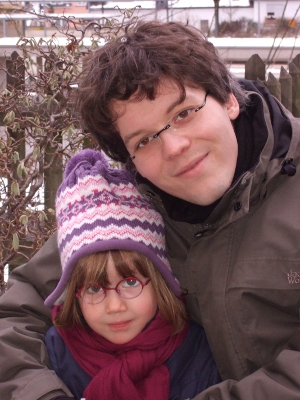
Michael and his daughter Marie

Michael has been around for more than 10 years and has always contributed to the APT software family. He s the author of the first real graphical interface to APT synaptic. Since then he created software-center as part of his work for Ubuntu. Being the most experienced APT developer, he s naturally the coordinator of the APT team. Check out what he has to say about APT s possible evolutions. My questions are in bold, the rest is by Michael. Who are you? My name is Michael Vogt, I m married and have two little daughters. We live in Germany (near to Trier) and I work for Canonical as a software developer. I joined Debian as a developer in early 2000 and started to contribute to Ubuntu in 2004. What s your biggest achievement within Debian or Ubuntu? I can not decide on a single one so I will just be a bit verbose. From the very beginning I was interested in improving the package manager experience and the UI on top for our users. I m proud of the work I did with synaptic. It was one of the earliest UIs on top of apt. Because of my work on synaptic I got into apt development as well and fixed bugs there and added new features. I still do most of the uploads here, but nowadays David Kalnischkies is the most active developer. I also wrote a bunch of tools like gdebi, update-notifier, update-manager, unattended-upgrade and software-properties to make the update/install situation for the user easier to deal with. Most of the tools are written in python so I added a lot of improvements to python-apt along the way, including the initial high level apt interface and a bunch of missing low-level apt_pkg features. Julian Andres Klode made a big push in this area recently and thanks to his effort the bindings are fully complete now and have good documentation. My most recent project is software-center. Its aim is to provide a UI strongly targeted for end-users. The goal of this project is to make finding and installing software easy and beautiful. We have a fantastic collection of software to offer and software-center tries to present it well (including screenshots, instant search results and soon ratings&reviews). This builds on great foundations like aptdaemon by Sebastian Heinlein, screenshots.debian.net by Christoph Haas, ddtp.debian.org by Michael Bramer, apt-xapian-index by Enrico Zini and many others (this is what I love about free software, it usually adds , rarely takes away ). What are your plans for Debian Wheezy? For apt I would love to see a more plugable architecture for the acquire system. It would be nice to be able to make apt-get update (and the frontends that use this from libapt) be able to download additional data (like debtags or additional index file that contains more end-user targeted information). I also want to add some scripts so that apt (optionally) creates btrfs snapshots on upgrade and provide some easy way to rollback in case of problems. There is also some interesting work going on around making the apt problem resolver a more plugable part. This way we should be able to do much faster development. software-center will get ratings&reviews in the upstream branch, I really hope we can get that into Wheezy. If you could spend all your time on Debian, what would you work on? In that case I would start with a refactor of apt to make it more robust about ABI breaks. It would be possible to move much faster once this problem is solved (its not even hard, it just need to be done). Then I would add a more complete testsuite. Another important problem to tackle is to make maintainer scripts more declarative. I triaged a lot of upgrade bug reports (mostly in ubuntu though) and a lot of them are caused by maintainer script failures. Worse is that depending on the error its really hard for the user to solve the problem. There is also a lot of code duplication. Having a central place that contains well tested code to do these jobs would be more robust. Triggers help us a lot here already, but I think there is still more room for improvement. What s the biggest problem of Debian? That s a hard question :) I mostly like Debian the way it is. What frustrated me in the past were flamewars that could have been avoided. To me being respectful to each other is important, I don t like flames and insults because I like solving problems and fighting like this rarely helps that. The other attitude I don t like is to blame people and complain instead of trying to help and be positive (the difference between it sucks because it does not support $foo instead of it would be so helpful if we had $foo because it enables me to let me do $bar ). For a long time, I had the feeling you were mostly alone working on APT and were just ensuring that it keeps working. Did you also had this feeling and are things better nowadays ? I felt a bit alone sometimes :) That being said, there were great people like Eugene V. Lyubimkin and Otavio Salvador during my time who did do a lot of good work (especially at release crunch times) and helped me with the maintenance (but got interested in other area than apt later). And now we have the unstoppable David Kalnischkies and Julian Andres Klode. Apt is too big for a single person, so I m very happy that especially David is doing superb work on the day-to-day tasks and fixes (plus big project like multiarch and the important but not very thankful testsuite work). We talk about apt stuff almost daily, doing code reviews and discuss bugs. This makes the development process much more fun and healthy. Julian Andres Klode is doing interesting work around making the resolver more plugable and Christian Perrier is as tireless as always when it comes to the translations merging. I did a quick grep over the bzr log output (including all branch merges) and count around ~4300 total commits (including all revisions of branches merged). Of that there ~950 commits from me plus an additional ~500 merges. It was more than just ensuring that it keeps working but I can see where this feeling comes from as I was never very verbose. Apt also was never my only project, I am involved in other upstream work like synaptic or update-manager or python-apt etc). This naturally reduced the time available to hack on apt and spend time doing the important day-to-day bug triage, response to mailing list messages etc. One the python-apt side Julian Andres Klode did great work to improve the code and the documentation. It s a really nice interface and if you need to do anything related to packages and love python I encourage you to try it. Its as simple as:
import apt
cache = apt.Cache()
cache["update-manager"].mark_install()
cache.commit()
Of course you can do much more with it (update-manager, software-center and lots of more tools use it). With pydoc apt you can get a good overview. The apt team always welcomes contributors. We have a mailing list and a irc channel and it s a great opportunity to solve real world problems. It does not matter if you want to help triage bugs or write documentation or write code, we welcome all contributors. You re also an Ubuntu developer employed by Canonical. Are you satisfied with the level of cooperation between both projects? What can we do to get Ubuntu to package new applications developed by Canonical directly in Debian? Again a tricky question :) When it comes to cooperation there is always room for improvement. I think (with my Canonical hat on) we do a lot better than we did in the past. And it s great to see the current DPL coming to Ubuntu events and talking about ways to improve the collaboration. One area that I feel that Debian would benefit is to be more positive about NMUs and shared source repositories (collab-maint and LowThresholdNmu are good steps here). The lower the cost is to push a patch/fix (e.g. via direct commit or upload) the more there will be. When it comes to getting packages into Debian I think the best solution is to have a person in Debian as a point of contact to help with that. Usually the amount of work is pretty small as the software will have a debian/* dir already with useful stuff in it. But it helps me a lot to have someone doing the Debian uploads, responding to the bugmail etc (even if the bugmail is just forwarded as upstream bugreports :) IMO it is a great opportunity especially for new packagers as they will not have to do a lot of packaging work to get those apps into Debian. This model works very well for me for e.g. gdebi (where Luca Falavigna is really helpful on the Debian side). Is there someone in Debian that you admire for his contributions? There are many people I admire. Probably too many to mention them all. I always find it hard to single out individual people because the project as a whole can be so proud of their achievements. The first name that comes to my mind is Jason Gunthorpe (the original apt author) who I ve never met. The next is Daniel Burrows who I met and was inspired by. David Kalnischkies is doing great work on apt. From contributing his first (small) patch to being able to virtually fix any problem and adding big features like multiarch support in about a year. Sebastian Heinlein for aptdaemon. Christian Perrier has always be one of my heroes because he cares so much about i18n. Christoph Haas for screenshots.debian.net, Michael Bramer for his work on debian translated package descriptions.
Thank you to Michael for the time spent answering my questions. I hope you enjoyed reading his answers as I did. Subscribe to my newsletter to get my monthly summary of the Debian/Ubuntu news and to not miss further interviews. You can also follow along on Identi.ca, Twitter and Facebook.

4 comments Liked this article? Click here. My blog is Flattr-enabled.

MJ Ray: The co-operative difference

I ve been a bit quiet on this blog and it s mainly been because our co-op is busy, with the annual reports and tax returns to do as well as an increasing amount of client work. It seems that we re not the only busy co-op:
Last year, whilst the UK economy as a whole contracted by 4.9%, the co-operative economy grew by 15.8% to 33.5 billion. This is partly down to the success of The Co-operative Group, but also stems from the success of over 4,990 other co-operatives in the UK which have continued to thrive. From Differences revealed in consumer views between PLCs and co-operatives Co-operatives UK
Meanwhile, I ve been testing out a couple of bits of software, including encrypted filesystems and new firmware for the FS-4400 Satellite PVR, which I could post about soon. We ve developed some Wordpress add-ons which I will package, release and announce. Finally, we re attending a couple of events next week. Busy times indeed!

20 January 2011

John Goerzen: Research on deduplicating disk-based and cloud backups

Yesterday, I wrote about backing up to the cloud. I specifically was looking at cloud backup services. I ve been looking into various options there, but also various options for disk-based backups. I d like to have both onsite and offsite backups, so both types of backup are needed. Also, it is useful to think about how the two types of backups can be combined with minimal overhead. For the onsite backups, I d want to see:
  1. Preservation of ownership, permissions, etc.
  2. Preservation of symlinks and hardlinks
  3. Space-efficient representation of changes ideally binary deltas or block-level deduplication
  4. Ease of restoring
  5. Support for backing up Linux and Windows machines
Deduplicating Filesystems for Local Storage Although I initially thought of block-level deduplicating file systems as something to use for offsite backups, they could also make an excellent choice for onsite disk-based backups. rsync-based dedup backups One way to use them would be to simply rsync data to them each night. Since copies are essentially free, we could do (or use some optimized version of) cp -r current snapshot/2011-01-20 or some such to save off historic backups. Moreover, we d get dedup both across and within machines. And, many of these can use filesystem-level compression. The real upshot of this is that the entire history of the backups can be browsed as a mounted filesystem. It would be fast and easy to find files, especially when users call about that file that they deleted at some point in the past but they don t remember when, exactly what it was called, or exactly where it was stored. We can do a lot more with find and grep to locate these things than we could do with tools in Bacula (or any other backup program) restore console. Since it is a real mounted filesystem, we could also do fun things like make tarballs of it at will, zip parts up, scp them back to the file server, whatever. We could potentially even give users direct access to their files to restore things they need for themselves. The downside of this approach is that rsync can t store all the permissions unless it s running as root on the system. Wrappers such as rdup around rsync could help with that. Another downside is that there isn t a central scheduling/statistics service. We wouldn t want the backup system to be hammered by 20 servers trying to send it data at once. So there d be an element of rolling our own scripts, though not too bad. I d have preferred not to authorize a backup server with root-level access to dozens of machines, but may be inescapable in this instance. Bacula and dedup The other alternative I thought of system such as Bacula with disk-based volumes . A Bacula volume is normally a tape, but Bacula can just write them to disk files. This lets us use the powerful Bacula scheduling engine, logging service, pre-backup and post-backup jobs, etc. Normally this would be an egregious waste of disk space. Bacula, like most tape-heritage programs, will write out an entire new copy of a file if even one byte changes. I had thought that I could let block-level dedupe reduce the storage size of Bacula volumes, but after looking at the Bacula block format spec, this won t be possible as each block will have timestamps and such in it. The good things about this setup revolve around using the central Bacula director. We need only install bacula-fd on each server to be backed up, and it has a fairly limited set of things it can do. Bacula already has built-in support for defining simple or complicated retention policies. Its director will email us if there is a problem with anything. And its logs and catalog are already extensive and enable us to easily find out things such as how long backups take, how much space they consume, etc. And it backs up Windows machines intelligently and comprehensively in addition to POSIX ones. The downsides are, of course, that we don t have all the features we d get from having the entire history on the filesystem all at once, and far less efficient use of space. Not only that, but recovering from a disaster would require a more extensive bootstrapping process. A hybrid option may be possible: automatically unpacking bacula backups after they ve run onto the local filesystem. Dedupe should ensure this doesn t take additional space if the Bacula blocksize aligns with the filesystem blocksize. This is certainly not a given however. It may also make sense to use Bacula for Windows and rsync/rdup for Linux systems. This seems, however, rather wasteful and useless. Evaluation of deduplicating filesystems I set up and tested three deduplicating filesystems available for Linux: S3QL, SDFS, and zfs-fuse. I did not examine lessfs. I ran a similar set of tests for each:
  1. Copy /usr/bin into the fs with tar -cpf - /usr/bin tar -xvpf - -C /mnt/testfs
  2. Run commands to sync/flush the disk cache. Evaluate time and disk used at this point.
  3. Rerun the tar command, putting the contents into a slightly different path in the test filesystem. This should consume very little additional space since the files will have already been there. This will validate that dedupe works as expected, and provide a hint about its efficiency.
  4. Make a tarball of both directories from the dedup filesystem, writing it to /dev/zero (to test read performance)
I did not attempt to flush read caches during this, but I did flush write caches. The test system has 8GB RAM, 5GB of which was free or in use by a cache. The CPU is a Core2 6420 at 2.13GHz. The filesystems which created files atop an existing filesystem had ext4 mounted noatime beneath them. ZFS was mounted on an LVM LV. I also benchmarked native performance on ext4 as a baseline. The data set consists of 3232 files and 516MB. It contains hardlinks and symlinks. Here are my results. Please note the comments below as SDFS could not accurately complete the test.
Test ext4 S3QL SDFS zfs-fuse
First copy 1.59s 6m20s 2m2s 0m25s
Sync/Flush 8.0s 1m1s 0s 0s
Second copy+sync N/A 0m48s 1m48s 0m24s
Disk usage after 1st copy 516MB 156MB 791MB 201MB
Disk usage after 2nd copy N/A 157MB 823MB 208MB
Make tarball 0.2s 1m1s 2m22s 0m54s
Max RAM usage N/A 150MB 350MB 153MB
Compression none lzma none gzip-2
It should be mentioned that these tests pretty much ruled out SDFS. SDFS doesn t appear to support local compression, and it severely bloated the data store, which was much larger than the original data. Moreover, it permitted any user to create and modify files, even if the permissions bits said that the user couldn t. tar gave many errors unpacking symlinks onto the SDFS filesystem, and du -s on the result threw up errors as well. Besides that, I noted that find found 10 fewer files than in my source data. Between the huge memory consumption, the data integrity concerns, and inefficient disk storage, SDFS is out of the running for this project. S3QL is optimized for storage to S3, though it can also store its files locally or on an sftp server a nice touch. I suspect part of its performance problem stems from being designed for network backends, and using slow compression algorithms. S3QL worked fine, however, and produced no problems. Creating a checkpoint using s3qlcp (faster than cp since it doesn t have to read the data from the store) took 16s. zfs-fuse appears to be the most-used ZFS implementation on Linux at the moment. I set up a 2GB ZFS pool for this test, and set dedupe=on and compress=gzip-2. When I evaluated compression in the past, I hadn t looked at lzjb. I found a blog post comparing lzjb to the gzip options supported by zfs and wound up using gzip-2 for this test. ZFS really shone here. Compared to S3QL, it took 25s instead of over 6 minutes to copy the data over and took only 28% more space. I suspect that if I selected gzip -9 compression it would have been closer both in time and space to S3QL. But creating a ZFS snapshot was nearly instantaneous. Although ZFS-fuse probably doesn t have as many users as ZFS on Solaris, still it is available in Debian, and has a good backing behind it. I feel safer using it than I do using S3QL. So I think ZFS wins this comparison. I spent quite some time testing ZFS snapshots, which are instantaneous. (Incidentally, ZFS-fuse can t mount them directly as documented, so you create a clone of the snapshot and mount that.) They worked out as well as could be hoped. Due to dedupe, even deleting and recreating the entire content of the original filesystem resulted in less than 1MB additional storage used. I also tested creating multiple filesystems in the zpool, and confirmed that dedupe even works between filesystems. Incidentally wow, ZFS has a ton of awesome features. I see why you OpenSolaris people kept looking at us Linux folks with a sneer now. Only our project hasn t been killed by a new corporate overlord, so guess that maybe didn t work out so well for you <grin>. The Cloud Tie-In This discussion leaves another discussion: what to do about offsite backups? Assuming for the moment that I want to back them up over the Internet to some sort of cloud storage facility, there are about 3 options:
  1. Get an Amazon EC2 instance with EBS storage and rsync files to it. Perhaps run ZFS on that thing.
  2. Use a filesystem that can efficiently store data in S3 or Cloud Files (S3QL is the only contender here)
  3. Use a third-party backup product (JungleDisk appears to be the leading option)
There is something to be said for using a different tool for offsite backups if there is some tool-level issue, that could be helpful. One of the nice things about JungleDisk is that bandwidth is free, and disk is the same $0.15/GB-mo that RackSpace normally charges. JungleDisk also does block-level dedup, and has a central management interface. This all spells nice for us. The only remaining question would be whether to just use JungleDisk to back up the backup server, or to put it on each individual machine as well. If it just backs up the backup server, then administrative burdens are lower; we can back everything there up by default and just not worry about it. On the other hand, if there is a problem with our main backups, we could be really stuck. So I d say I m leaning towards ZFS plus some sort of rsync solution and JungleDisk for offsite. I had two people suggest CrashPlan Pro on my blog. It looks interesting, but is a very closed product which makes me nervous. I like using standard tools and formats gives me more peace of mind, control, and recovery options. CrashPlan Pro supports multiple destinations and says that they do cloud hosting, but don t list pricing anywhere. So I ll probably not mess with it. I m still very interested in what comments people may have on all this. Let me know!

Simon Josefsson: Introducing the OATH Toolkit

I am happy to announce a project that I have been working quietly on for about a year: the OATH Toolkit. OATH stands for Open AuTHentication and is an organization that specify standards around authentication. That is a pretty broad focus, but practically it has translated into work on specifying standards around deploying and using electronic token based user authentication such as the YubiKey. YubiKey OATH s most visible specification has been the HOTP algorithm which is a way to generate event-based one-time passwords from a shared secret using HMAC-SHA1. HOTP has been published through the IETF as RFC 4226. Built on top of HOTP is the time-based variant called TOTP, which requires a clock in the token. OATH do some other work too, like specifying a data format for transferring the token configuration data (e.g., serial number and shared secret) called PSKC.

The aim of my project OATH Toolkit is to provide an implementation of various OATH related technologies. I m intentionally leaving it open ended because you never know what they may specify that I find interesting. However, the primary goal has been to focus on HOTP and TOTP. Throughout 2010, the project was called HOTP Toolkit but that name made it difficult to support TOTP in a non-confusing way. During the last month, after discussion with Daniel Pocock on Dynalogin which is a potential consumer of my package, I took the time to create a fork of the HOTP Toolkit and the OATH Toolkit was born. Now what does the OATH Toolkit actually do? Primarily it provides a library called liboath that implements HOTP and TOTP. Liboath is a relatively small library, and my goal is to keep it well documented and of high quality. There is GTK-DOC generated API documentation. Of course there is a command line tool to go with it, called oathtool which makes working with HOTP/TOTP from the command line easier. It can generate and validate one-time passwords. Let s say you want to generate the first four OTP based on the dummy key 1234.
jas@latte:~$ oathtool -w4 1234
376439
299783
041392
819202
158134
jas@latte:~$
By default the tool is using HOTP, but you can switch it into TOTP mode with the totp parameter. The output OTP will now depend on the current time on your machine, unless you specify the time manually using the now parameter.
jas@latte:~$ oathtool now= 2011-01-20 15:46 UTC totp 1234
527971
jas@latte:~$
The tool can do more, check the oathtool man page for all the details. The final component of the OATH Toolkit is a PAM module pam_oath. With it, you can login to your machine using an OTP and optionally a password. Right now the user and password management is simplistic, but that should improve over time. To setup single-factor authentication for su you would create a file containing the user information and HOTP key as /etc/users.oath like this:
HOTP root 1234
Then configure PAM to use the pam_oath module like this in /etc/pam.d/su:
auth requisite pam_oath.so debug usersfile=/etc/users.oath window=20
The user file will be rewritten every time you su to hold the current state. There is a README for the PAM-module with more documentation. That s it for an intro! From the OATH Toolkit webpage we link to binary packages for Debian and Ubuntu so please try the OATH Toolkit yourself and provide feedback to the oath-toolkit-help mailing list.

Julien Danjou: Code fontification with Gnus and Org-mode

I've added code fontification using Org src blocks inside Gnus. This interprets the block as an Org buffer and fontify it accordingly if org-src-fontify-natively it set to t. Thanks to S bastien Vauban for the original idea and implementation. Now it works out of the box without any customization. Flattr this

19 January 2011

Gunnar Wolf: Mandate for what?

I lived in Israel between 1994 and 1996 This was just after the signature of the Oslo agreements, the Rabin-Arafat signature. 1994-95 was a beautiful time to be in Israel; there was the excitement of a prospect of real peace with the Palestinians, something that had been just seen as unattainable for the past 50 years. But we also saw the buildup of a huge tension, of real hatred. And the dream of the end of the conflict, of two people living in peace side by side was heavily shattered on November 4 1995, when prime minister Rabin was assassinated. But for the sake of where I'm trying to get to (this post is meant to be about current Mexico, not of Israel 15 years ago), lets go a couple of months back. The Israeli society is a deeply democratic one (although I understand many people feel it is losing that trait). Lots of political propaganda of all sorts, many of it very creative, are posted on the streets And not by the government or by political parties, but by citizen movements. I tried to follow it... I remember a particular sticker that I started seeing very often: Rabin has no mandate over the Golan . At first, I understod that the Golan residents rejected Rabin's authority (but, why was it posted all over the country? And what specifically was it about?), until a friend explained to me that it meant that it rather meant that the right wing all over the country felt that Rabin had no right to push for negotiations involving in any way the Golan heights return to Syria because that was not his electoral platform. So, fast-forward in time, and 12500Km to the west. If you have followed my ramblings for the past ~five years, you are aware of what I think about Mexico's government It is an illegitimate government, which got the power thanks to a dirty and illegal (as per Mexico's legal system) campaign and to voting fraud. And, according to what I have read, around 30% of the population still believe firmly the elections were stolen. But even if they were legal, valid and legitimate What has happened since 2006 should not be seen as valid. In Mexico, we don't have such a democratic culture. The society is not used to demanding anything from the politicians. We often see, as an example, that when talking about political organs, there is a divide everybody understands although makes no sense: We talk about citizens as people unaffiliated to political parties (v.gr. the 1996 Federal Electoral Institute was very well regarded as it was "el IFE ciudadano", and has since then been overtaken by the parties). Why are the parties' members not seen as citizens? Well, maybe because of the same distortion field that makes us believe our de-facto president when he stated that, from the (then) over 28000 people killed in the war campaign against crime (he oficially declared he never used the term war... Of course, he was proved wrong), only ~10% were civilians. In my book, that would mean that ~25000 soldiers have been killed But no, he means mostly drug trafficants. So, as they are not innocent bystanders, they somehow stopped being civilians? But again, I'm straying off the topic. Let us assume for a minute that the 2006 elections were clean legal, and that the campaigns were not diffamatory, and all that. And tha we had a modern government, with the stated separation between the three powers and all that. By today, the Legislative power would have surely called for the government's disolution. Why? Again, we Mexicans are not used to what a democratic system means. We can see over and over examples of people who have been voted to power and forgot/betrayed everything they campaigned for. And we are used to that being... Normal. But, who did we vote for? Given the suposition of this last paragraphs (clean elections led to our current government), did the majority of the population vote for Felipe Calder n, the person? Or did it vote for Partido Acci n Nacional, the abstract entity organized as a party? No. The vote was (should have been) for the political campaign, for the things he promised he would work for, the priorities in the direction he would give the nation. Not too long ago, we took pride of living in a peaceful country. Yes, everybody feared the crime rate in the streets, everybody knew big cities such as the one I live in (and love living in) have deep problems. But the country had good relations and good respect from the international players, and it was mostly safe. And, I don't think any of the few readers that have read this far (regardless of where they live or how much they know me) has that opinion of Mexico anymore. What is now heard inside and outside is that we have a huge organized crime (mostly due to drug traffic), and that it's taking over the country. Why did this happen? The fact is, Calder n lacked legitimacy when he reached the presidency in December 2006. And although his campaign was centered on pushing work generation (his slogan was El presidente del empleo, The president of the jobs), lifting restrictions to entreprises, opening borders, getting more money in our economy... He knew he had to please the people that would protect him from any (then, probable) insurrection: Military and police. Our army has always been more a joke than an army... But they still have their guns. So, contrary to everything he promised, the first things he signed was a salary increase to all order-keeping forces in the country, and an all-out attack against drug traffic cartels. He had to make the order-keeping forces protagonist, useful and loyal. Now, fast-forward again to 2011. The country is living the worst violence since the end of the 1910-1920 revolution. Over 30,000 people have been killed. Economy has fallen as it had not for many years (this was the worst-performing country in America in 2009). Work generation was said to be high, but then corrected to indicate it was mediocre (just about the baseline of population growth). So, the balance so far of four years of... Government? Economic disaster. Social disaster. Promises unachieved. Starting actions he had no mandate to do. Felipe Calder n has no mandate to get us in this war. Even if he had been democratically elected, he would have to step down.

Robert Millan: Finally, amd32 is taking shape

When AMD launched its now widely used 64-bit architecture in year 2000, it started marketing it as a significant step forward because of it having longer word and pointer size. One just has to check the advertising material and notice those big 64 being touted as the main improvement. But it is commonly accepted that most applications don t need a 64-bit address space for anything. Building them in LP64 model is just a waste of memory due to increase of pointer size. Even though this made most applications lag behind, the new architecture still was an improvement in terms of speed because of the AMD revised ISA, featuring changes like: To summarize, most of the merit from AMD64 architecture was in fixing some of the insanity of Intel 386 ISA (instruction set architecture), rather than the increased pointer size which was a source of inefficiency most of the time. Perhaps AMD didn t evaluate this correctly, or perhaps its marketing side won over technical merit. However, although the new hardware is biased towards LP64 data model, it s not actually enforced. It was a matter of time until an independent project took over and attempted to fix this, combining the AMD64 ISA with ILP32 data model. I ve been reading with much interest in the binutils and gcc mailing lists that such project is beginning to take shape. A port of binutils, GCC, GDB and Linux is already available. Future plans include porting Glibc which will make it possible to build a standard GNU derivative out of this. Sadly, I don t have the time to devote to this project myself, but I ll continue following its progress. I m looking forward to bringing this speed boost to my machines.

Russell Coker: Free Amazon EC2 Servers

Amazon is providing free EC2 access for new customers (who have never been customers before) for one year [1]. It is 750 hours per month (enough to run non-stop for an entire month) of access to a Linux micro instance which has 613M of RAM and the ability to burst to two ECUs of compute power. The main EC2 web page [2] describes an ECU as the equivalent CPU capacity of a 1.0-1.2 GHz 2007 Opteron or 2007 Xeon processor and they also describe a single core of a modern CPU as having 3.5 ECUs. So a micro instance could burst to half the CPU power of a single core. The DomU that runs my blog (as well as some web sites for friends) has been averaging less than 1% use of a CPU core over the last few months, so the CPU capacity of a micro instance should be more than adequate for most things that run on the net.The free offering only provides 15G of free data transmission and 15G of free data reception per month. For my blog server that would be more than adequate as it has sent 24.5G and received 14G over the last 75 days.The Cost of Disk IOThe offer requires that you sign up with a credit card so if you use more than the free capacity then you have to start paying. It seems that the main issue in this regard is disk IO.The only storage that is available for a micro instance is the Elastic Block Store (EBS) [3]. The main way that EC2 operates is that when you create a new virtual machine it copies the data from an existing image so you can easily create dozens or hundreds of virtual machines with local disk performance and the data is removed when the instance is shut down. EBS is essentially SAN based storage, it s persistent and operates like a regular disk.The pricing for EBS is $0.10 per allocated GB per month plus $0.10 per million IOs. Unfortunately they don t define what an IO is apart from mentioning that you can use IOSTAT to measure them. According to iostat the server running my blog is doing 0.99 tps, so that means in a 30 day month I would expect 30*24*3600*0.99 = 2.56M transactions. Iostat also tells me that my blog server has read 62075330 blocks and written 91683344 blocks over the last 75 days 16 hours of uptime, that means it would do about (62075330+91683344)/75.66*30 = 61M block transfers in a 30 day month. So if I was to run my blog server on EC2 I could be spending either $0.15 or $6.00 per month on disk IO depending on how they count it (or maybe something in between, something larger than a 512 byte block but smaller than a transaction as reported by iostat could be used). Given that the last time I checked the prices one could rent a DomU for less than $6 per month [4] the difference in possible ways of measuring IOs is very significant!The MySQL server that is the backend to my blog (as well as a few other things) seems to be averaging about 3 writes per second (and no reads during operation because the databases are small). So it might be another 5 million IOs per month for the database.It s unfortunate that Amazon haven t clearly specified what they mean when measuring IO for billing purposes. Some aspects of measurement such as whether the bills for bandwidth include Ethernet headers can be ignored as a 26 byte Ethernet header won t make much difference to the bill when the average packet size is around 400 bytes or more (from ifconfig output it seems that my blog server sends packets of an average size of 459 bytes and receives packets of an average size of 1250 bytes). But the methods of measuring disk IO could give a factor of 20 difference in the bill.Optimising for EC2If I was going to put my blog on EC2 then I would start by configuring Apache to log to a fifo and then write a daemon that stores the log data and allows my home server to poll it and get the log data. As the filesystem is already mounted with noatime it seems that writing logs is the cause of all the disk writes so if they were stored in RAM (which shouldn t be a problem with 4M of logs per day) then all those writes could be avoided. Another possible solution to this would be to make /var/log be a tmpfs and then rsync the files periodically to my home server. I don t really need to have all the logs remain on the server I just need them to remain somewhere.Amazon also offers 100,000 messages on their Simple Queue Service (SQS) for free [5]. The messages can be up to 8K in size and are stored for up to 4 days. So it seems possible to put Apache logs into SQS messages in bundles of less than 8K and then get them out later for transfer to a server outside EC2.If I was able to get my disk writes to almost zero then there s a good chance that I could get into the free zone for one year.ConclusionWould I use this service? If I was looking for new hosting for my blog then I would seriously consider it. EC2 is quite fast and well connected and depending on how they work out the billing for disk IO I could probably keep the cost close to zero.EC2 is a different way of running things so you can t just have a virtual server running and expect it to automatically restart if it goes down for any reason (a standard feature of virtual hosting companies). Amazon does have a range of tools for managing EC2 instances and they all seem to be available in the free trial. So after spending the time to learn those tools the result should be good.I think that there are two groups of people who could benefit from using this. One is hobbyists, this is a great way to learn some skills related to high-end server stuff and EC2 experience should look good on a CV. The other is companies who want to use EC2 anyway and who will just save some money that they would otherwise pay. I ve seen someone recommend the free offering from EC2 for a company that needed a small server, I think that isn t a good option as a company that only wants a single small server will be better off paying something between $5 and $20 per month for a DomU from one of the virtual hosting providers.After a year you have to pay regular prices. A micro instance costs $0.02 per hour which is $14.40 per month, SQS costs $0.10 per month for sending up to 1G of data in and at $0.01 per 10,000 SQS requests would costs $0.03 (the 4M of log data I generate per day would be 1000 requests to write and read it which would be 30,000 requests per month), the EBS for MySQL would cost $0.10 for 1G of storage and maybe $0.50 for IOs. That means $15.13 before counting bandwidth.My blog server averages just under 10G of transmitted data per month, the first Gig is free so that would cost $0.15 for each subsequent Gig which is $1.35 per month. It receives just under 6G per month which at $0.10 per gig would be $0.60. So including data transfer it would be about $17.08 per month.This is a lot more expensive than some of the cheaper virtual server offerings but admittedly the cheaper virtual offerings don t have as much RAM. Also with a blog instance running on EC2 I could easily configure it so that I could create some big instances that use the same MySQL database if a lot of extra traffic suddenly started arriving. A micro instance running MySQL on it s own could cope with a heap of load a lot more easily than the PHP code for my blog. So using bigger servers to run the PHP code while running MySQL on the same server would be a good option particularly if the bigger servers use caching.Finally if you want to run an EC2 instance for a year then you can get a reserved instance, you pay $54 per annum and the cost drops to $0.007 per hour instead of $0.02 per hour. Using a reserved instance for my blog would give a cost of $54+365*24*0.007+12*(0.10+0.03+0.10+0.50) or about $124.08 per annum. $10 per month isn t too bad. So if I migrated my blog to EC2 then I would probably keep it there after the free period expired. The ability to expand rapidly when necessary is worth paying extra. Of course I am making some assumptions such as that the performance of a micro instance doesn t totally suck as Amazon don t specify what bursting to 2ECU really means it could have some performance problems.Note that all prices in this post are in US Dollars.

Nikita Youshchenko: Trinity project: KDE3 alive?

Trinity project in an attempt to keep KDE3 desktop compatible with ongoing changes elsewhere, and to some extent to fix bugs and add features into KDE3. It is for those us long-time KDE users who is upset by the way that KDE has chosen for KDE4. Unfortunately Trinity project looks small and underpowered, so it s future is unclear. Did not try it yet. There are debs, although some people think that it is hard to deal with those, because of KDE3 package namespace now used by KDE4, and also because of binary compatibility issues within Trinity. Why I don t like KDE4? Because I have no interest in eye candy, but due to heavy use of thin clients with apps running on remote server I do care about desktop resource consumption. A medium-class server (2 dual-core 2 GHz cpus, 16G ram) perfectly hosts 50 KDE3 sessions, served over vnc. Anything near to that with KDE4? I m not aware of any good-working kde4-over-vnc-over-network configuration, even for a single user over unloaded network. Looks like within KDE4, even with all effects turned off, every tiny operation results into near-fullscreen update. Spice is promising but requires per-session VMs which is a serious drawback when number of users is high.

Dirk Eddelbuettel: RcppBDT 0.1.0

The family of Rcpp packages just grew by one: the first 0.1.0 release of RcppBDT is now on CRAN. RcppBDT stands for Rcpp Boost Date_Time. It employs what we call Rcpp modules: a mechanism which provides easier ways to expose C++ functions and classes to R (and which bears some resemblance to Boost.Python---see this vignette about Rcpp modules for more details). And thus RcppBDT provides R users with access to (some) Boost Date.Time functionality. I used Boost Date.Time because it is widely known, useful and well tested. It can also be used in pure template mode not requiring linking (if one foregoes string parsing and formatting which is fine here as we get this from R already; it can be added via a #define in the header file). With that, the package is rather portable as it only needs to find the Boost headers. (And no, I have not yet added a configure option for that.) Basic usage follows Rcpp modules and provides the C++ class via a Reference Class in R. That means using a new constructor and assessing functions via the $ operator. Here is an example:
R> library(RcppBDT)
Creating a new generic function for "print" in "RcppBDT"
Creating a new generic function for "format" in "RcppBDT"
R> d <- new(bdtMod$date, 2011, 1, 18)
R> format(d)
[1] "2011-01-18"
R>
Not very exiting yet: we create a date, using explicit year, months and date arguments and then format it. Something more useful follows:
R> d$getDayOfWeek()
[1] 2
R> d$getModJulian()
[1] 55579
R> d$getFirstOfNextMonth()
[1] "2011-02-01"
R>
We can use accessors to extracts parts of the date, or use functions to convert the date to different representations such as a modified Julian date. Moreover, given a date, we can apply helper functions such as get me the date of the beginning of the next month. More interesting still are helper functions such as the ones below. Note that this also shows the alternate access method using wrapper functions I added for the package, this may be more familiar to most R users:
R> getNthDayOfWeek(third, Wed, Dec, 2010)
[1] "2010-12-15"
R> getLastDayOfWeekInMonth(Sat, Dec, 2010)
[1] "2010-12-25"
R> getFirstDayOfWeekInMonth(Sat, Dec, 2010)
[1] "2010-12-04"
R> getFirstDayOfWeekAfter(Wed, as.Date("2010-12-31"))
[1] "2011-01-05"
R>
This uses some of the constants Jan, Feb, ... , Dec; Sun, Mon, ..., Sat and first ... fifth defined in the package; normal integers can also be used. The third Wednesday in a month is also known as the IMM Date to Finance-heads; the example was borrowed from Whit's earlier rboostdatetime code on github. More examples are in the demo available with the package and accessible via demo(RcppBDT) once you install the package. As always, feedback would be welcome, both on the usefulness (or lack thereof) of the Boost Date.Time functionality as well as on the Rcpp modules wrapping. Additional Boost Date.Time functionality (durations, times, ...) may be added; contributions would be welcome. The rcpp-devel mailing list off the R-Forge page for Rcpp is the best place to start a discussion.

18 January 2011

Russell Coker: Conferences and People on the Autism Spectrum

There have been some recent discussions about issues related to the treatment of women at Free Software conferences, I ve written posts about Aspie Social Skills and Free Software [1] and Empathy, Autism, and Geeks [2] about this. But of course discussion continued on how Aspies supposedly cause problems that no-one seems to be noticing.Lisa of Chaotic Idealism wrote an interesting post about the NT social bias [3]. In summary NTs seem to think that Autism Spectrum Disorders are only about socialisation, not realising that for many people on the Spectrum it s sensory issues that are their main problem. Social problems are exacerbated by sensory issues and other causes of stress, so I think it s worth considering ways in which conferences can be planned to be less stressful for people on the Autism Spectrum, people who have SPD [4] that isn t associated with an ASD, and NTs who just get annoyed by loud noises etc.What Autism Conferences DoAutscape is one of only two conferences for people on the Autism Spectrum and the only one which clearly documents how they plan their conference [5]. The first noteworthy thing that they do is have badge colors to indicate what level of social interaction is desired by each delegate, I don t think that this is relevant to Free Software conferences as people who don t have sufficient social skills to suit at least a green badge probably won t be attending. But I think that when attending a conference about Free Software or any other equally geeky topic (if there is an equally geeky topic) it s worth keeping in mind the fact that there are probably a lot of people who would like to talk to you but lack the social skills to start a conversation.
No initiationRedPlease do not initiate any interaction with me.
Prior PermissionYellowPlease do not initiate unless I have already given you permission to approach me on a yellow badge.
Please initiateGreenI would like to socialise, but I have difficulty initiating. Please initiate with me.
NeutralWhite (or no badge)I am able to regulate my own interaction.
The next thing that they document is a black circle badge which indicates that the wearer shouldn t be photographed. Prior to reading that web site I wasn t aware of this being an Autistic issue, I was only aware of it being an issue for women who don t want zoomed-in pictures of themselves appearing on guys web sites (even pictures that aren t up-skirt or down-blouse can be unwelcome). A conference policy that prohibited photographs that zoom in on one person without that person s consent (or parental consent in the case of minors) would probably be a good idea.Another thing about badges is that it s a really good idea to have the delegate s name on both sides of the badge if the badge is attached in a way that permits it to turn. People on the Autism Spectrum tend to have some difficulty in recognising people and in remembering names. I find it inconvenient when someone expects me to recognise them but has their badge turned around so I can t see their name. Some people get really unhappy if they think that someone doesn t recognise them.Autscape has long breaks between activities and a leisure session each afternoon to allow delegates to recover from the stress of dealing with people. It seems to me that computer conferences in some cases could do with longer breaks between sessions. I find that a lot of the benefit of a conference is in what happens outside sessions and the standard practice of publishing videos of presentations makes personal meetings a more important part of the conference.Autscape has designated quiet spaces. I think that for computer conferences which have hack-labs (which seems to be most Free Software conferences nowadays even if they aren t labelled as such) it would be good to have some lab areas designated as quiet zones. I think that it is a really good thing to meet people you ve only known by email and then play some LAN based games against them and that this should be encouraged as part of a conference, but having that sort of thing separated from people who want to do some quiet coding is a really good idea. Whether people want to do quiet coding, read email, or just escape from the stress of a conference a quiet hack-lab would be a good place for it.An issue that s related to quiet spaces is the ability to escape from social situations. One of my pet hates is corporate meetings on boats, when the boat is in motion there is no escape. Corporate meetings that are only accessible by coach are also bad. Fortunately most conferences aren t like that.The Autscape web site states that they prohibit people from wearing perfume or aftershave to help people who are sensitive to smell. My observation of Free Software conferences is that encouraging everyone to have a shower every morning would be a good idea as there are stronger smells from unwashed people than from perfume.One thing that s interesting about the Autscape web site is that they have different color schemes available and have tested it in multiple web browsers including Safari and Konqueror (which apparently don t work so well). It s interesting to note that they test with such a variety of browsers including free software ones most corporations don t do that.Sensory Processing IssuesThe main SPD issues related to conferences seem to be noise and light related.For social events one difficulty that most people on the Spectrum seem to face is in listening to one person in a noisy crowded room. As well as that sudden noises and loud background noises can be very stressful. While it s sometimes impossible to avoid crowds (which can be another problem) it is often possible to select venues that have less noise problems. A venue with carpet on the floor and soft walls (anything other than brick or concrete) will be a lot quieter than one with hard surfaces that reflect noise. It seems that a quiet venue will benefit NTs as well, there seems to be a strong correlation between the price of food at restaurants and the amount of sound absorbing material on the floor and walls people who can afford a good dining experience seem to want it quiet.In terms of visual issues the relevant problems seem to be related to sudden transitions and lecture halls that are extremely dark. The only thing that can be done by conference organisers is to seek to have the lights in the lecture halls as bright as possible without preventing the viewing of the projector screen, this is usually done anyway.For social events the whole binge drinking at crowded bars thing doesn t work too well due to noise, poor lighting, crowds, and the smell of vomit. But there s no shortage of reasons to discourage binge drinking at conferences.FoodPsychology Today has a good article about preferences for food and picky eaters [6]. Lots of people on the Autism Spectrum have similar issues. The thing to do when arranging a conference meal is to have things neat and without needless combinations. Think about making food look more like what you would expect to see in a Japanese restaurant and less like Paella. Also having some very plain food on offer is a good thing, I think that bread-rolls for dinner and ice-cream for desert makes a viable meal. But any dish with a word like hash or mixed in it s name isn t a good option. Finally some combinations are really bad, I always find rare steak and potatoes on the same plate to be rather disgusting potato that s blood-stained doesn t appeal. The majority of conference meals satisfy these criteria.Autscape provides options of eating outside the main dining hall for people who can t tolerate the noise. For a Free Software conference it might be a better idea to provide seating outside the main area for people who are going to make noise. I don t mind people who want to get really drunk at the conference dinner, but I would prefer them to be in a separate room. Also when assisting a drunk friend to leave the venue before they cause more problems it would be convenient if there was a good place to take them to. The one occasion when I had to strongly encourage a friend to leave a conference dinner to reduce his embarrassment the next day (and reduce the annoyance for everyone else) there was no good place to take him so he just came back!ConclusionI don t expect that anyone will make any significant changes to conference plans after reading this post. I have tried to focus on things that would benefit NTs as well, but there are practical issues that get in the way such as the cost and availability of venues that are large enough. But there are some smaller ideas that can be implemented with relative ease.I hope that the people who are making claims about Autism and conference behavior will refer to this in future. If you think that there is a problem with the way people on the Spectrum act at conferences then the solution will more likely involve the suggestions I make here than anything else.

John Goerzen: Backing Up to the Cloud

I m recently taking some big-picture looks at how we do things, and one thing that I think could be useful would be for us to back up a limited set of data to an offsite location states away. Prices are cheap enough for this to make it useful. Services such as Amazon S3 and Rackspace Cloud Files (I ve heard particularly good things about that one) seem to be perfect for this. I m not quite finding software that does what I want, though. Here are my general criteria:
  1. Storage fees of $0.15 per gigabyte-month or less
  2. Free or cheap ($0.20 per gigabyte or less) bandwidth fees
  3. rsync-like protocol to avoid having to re-send those 20GB files that have 20MB of changes in their entirety every night
  4. Open Source and cross-platform (Linux, Windows, Mac, Solaris ideally; Linux and Windows at a minimum)
  5. Compression and encryption
  6. Easy way to restore the entire backup set or individual files
  7. Versatile include/exclude rules
  8. Must be runnable from scripts, cron, etc. without a GUI
  9. Nice to have: block or file-level de-duplication
  10. Nice to have: support for accurately backing up POSIX (user, group, permission bits, symlink, hard links, sparse files) and Windows filesystem attributes
  11. Nice to have: a point-and-click interface for the non-Unix folks to use to restore Windows files and routine restore requests
So far, here s what I ve found. I should note that not a single one of these solutions appears to handle hard links or sparse files correctly, meaning I can t rely on them for complete system-level backups. That doesn t mean they re useless I could still use them to back up critical user data just less useful. Of the Free Software solutions, Duplicity is a leading contender. It has built-in support for Amazon S3 and Rackspace Cloud Files storage. It uses rdiff, which is a standalone implementation of the rsync binary delta algorithm. So you send up a full backup, then binary deltas from that for incrementals. That makes it bandwidth-efficient for incremental backups, and storage-efficient. However, periodic full backups will have to be run, which will make it less bandwidth-efficient. (Perhaps not incredibly *often*, but they will still be needed.) Duplicity doesn t offer block-level de-deuplication or a GUI for the point-and-click folks. But it DOES offer the most Unixy approach and feels like a decent match for the task overall. The other service relying on Free Software is rsync.net, which supports rsync, sftp, scp, etc. protocols directly. That would be great, as it could preserve hard links and be compatible with any number of rsync-based backup systems. The downside is that it s expensive really expensive. Their cheapest rate is $0.32 per GB-month and that s only realized if you store more than 2TB with them. The base rate is $0.80 per GB-month. They promise premium support and such, but I just don t think I can justify that for what is, essentially, secondary backup. On the non-Open Source side, there s JungleDisk, which has a Server Edition that looks like a good fit. The files are stored on either S3 or Rackspace, and it seems to be a very slick and full-featured solution. The client, however, is proprietary though it does seem to offer a non-GUI command-line interface. They claim to offer block-level de-duplication which could be very nice. The other nice thing is that the server management is centralized, which presumably lets you easily automate things like not running more than one backup at a time in order to not monopolize an Internet link. This can, of course, be managed with something like duplicity with appropriate ssh jobs kicked off from appropriate places, but it would be easier if the agent just handled it automatically. What are people s thoughts about this sort of thing?

Matthew Garrett: LCA 2011 has moved

I haven't seen this widely publicised yet, so just to help make sure people know: Linux Conf AU 2011 is going ahead in Brisbane next week, but due to the flooding it's been moved to the QUT Kelvin Grove campus about 4KM north of the original venue. There are good bus links between it and the CBD. More details here.

Next.

Previous.