Search Results: "ema"

25 November 2006

Biella Coleman: Play Money by Julian Dibbel

A few months ago I finished Play Money by Julian Dibbel and like his My Tiny Life before it, the writing style is simple yet sumptuous, or I guess just simply sumptuous. Like the travel writings that pre-figured anthropological writing, Dibbel takes us to a far-away exotic land (but only a click or two away) that are populated by a motley crew of wizard (or is lizard)? slayers, gold-diggers, money-makers, and virtual-world-builders. For many, these MMOGsare no strange-lands but are becoming weaved firmly and intimately into the fabric of everyday life, whether as entertainment, sociality, and or for a cadre of folks, as a source of income generation. I think the book has gotten enough coverage that I don’t need to rehearse its content in any detail but the basic story is that Julian embarks on a real world quest in the virtual land of quests to try to make enough money (to be specific make a little more than his monthly salary as a freelance writer) from trading and selling a slew of virtual objects and gold. In taking us along, he gives a compelling entry into the imaginative and morally complex world of these games. And better is that whether you know nothing about them or are a seasoned player, the book has much to offer. One of the reasons I respect Julian Dibbel is because he takes his sweeeet time to churn out a book-length manuscript. In a day and age when there is so much pressure to release quick and often, especially when writing about anything in the so-called virtual plane of existence, he waited nearly 8 years from the publication of his last book on gaming, My Tiny Life before publishing on a considerably higher-tech phenomenon. Following him on his most recent adventure, you learn that he threw himself into a variety of gaming environments persistently and consistently and did at least 3 years of research and writing (at one point in the book he confesses how excruciating writing for him, which is hard to believe as the words slip so nicely off the paper but whatever the extent of his writing angst is, he clearly spends a lot of care in crafting his sentences). And I am starting to think that if more people followed this ethic of long-term immersion, coupled with slow-brewed productive sparsity, we would get higher quality products (Yes, kinda like the Debian release cyclce). Like any good ethnographer, he gives an intimate portrait of life in these worlds of copious play where various types of real world economies have mushroomed apace with new technological developments. That is, he gives us a taste of what it is like, as he cleverly puts it to own unreality. Couched within tales of gaming gone real world economic, are hearty reflections on the place of play in social and economic life, the close resemblance and conceptual affinity between computers and games (and not just computer games, and here he does a fantastic job at explaining the Turing Test), self-doubts about writing in general and in particular about this topic, commodity fetishism, and the changing nature of capitalism in a world of ever-greater abstractions. All of this makes for an enjoyable read that if used in the classroom (which like A Tiny Life, I am sure will become standard for courses on Virtual Worlds) allows you to bring in some good supplemental material whether Edward Castranova’s Synthetic Worlds, Greg Lastowka and Dan Hunter’s The Laws of Virtual Worlds and or older heavy-hitters like Max Weber and Karl Marx. The only topic I think I would have liked to seen included is that of capitalist finance, because there are, I think, some real affinities, phenomenologically and conceptually, between finance capitalism and gaming the virtual game. Otherwise some of my favorite sections were on hackers and the object of the computer, but of course, I am biased that way. So here I leave you with a tasty morsel of something that was sumptuous to ingest: It is this endlessly repeatable collusion of freedom and determinism-the warp and woof of fixed rules and free play, of running code and variable input that sets both games and computers apart, together from the larger universe of information technologies they inhabit…. But only games share the universal machine’s game’s thoroughgoing commitment to the principle of recursion: the chained repetition of simple operations, each building on both the input of the moment and the outcomes of preceding steps. And only games, therefore, come close to capturing that precise mi of unpredictability and inevitability that makes the computer such a powerful simulator of our lived experience of the world. p. 104
24 November 2006

Evan Prodromou: 3 Frimaire CCXV

I think there's a certain special sloth that Americans get to experience on the day after Thanksgiving that we don't get on other parts of the year. Something about the combination of gluttony and wholesomeness makes Black Friday a very mellow, enjoyable time. Maybe it's the fact that it's officially now The Holiday Season, but the stressful tasklist of December hasn't started yet. Or maybe just that it's a day off of work for no good reason except it just is. Maybe it's the fridge full of leftovers that still taste kind of good. I dunno. We had a good Thanksgiving dinner yesterday evening. Maj, Amita June and I had planned to go visit family in New Brunswick (New Jersey) for the holiday, which was really nice to do last year. But our visas are running out in December, and although we're (probably) not going to have a problem renewing them, our lawyer said it was a bad time to leave the country. So, we stayed in Montreal for Thanksgiving. Canadians have their own Thanksgiving, of course, on the 2nd Monday of October, but not having grown up with that day as Thanksgiving, and with most of our family celebrating in November, it's hard to get motivated around Canadian Thanksgiving. And it's just not that big a deal in Quebec, anyways. So we had a good dinner here; John Usher, Niko, Jeff Waye, Meg and Patti all came over and had a good time of it. I cooked my first Thanksgiving dinner -- a big salmon, potatoes and sweet potatoes, roasted broccoli and wax beans, a great big salad. Every family has a Thanksgiving dish tradition -- one of the Prodromous' is a big pot of macaroni and cheese. So I made that, too. We all ate pretty well, drank some wine, talked about the future of music and how fun it is to play hockey. Unfortunately, I managed to miss my Blinky Hockey practice last night -- I tried to put the (overtired) baby to bed at 10PM and ended up falling asleep myself. All in all a good TG, even though far from family. tags:

Speaking of home All of Canada is abuzz right now about a recently-proposed bill by the ruling Conservative Party in Parliament to declare the Quebecois to be a nation within Canada. Sovereignty of Quebec has been an extremely contentious issue in Canada over the last 50 years (two sovereignist parties are major players at the federal and provincial level), and this form of recognition is an interesting step. The whole thing began with Michael Ignatieff, a candidate for the leadership of the opposition Liberal Party. He has stated publicly that Quebec is indeed a nation, and his followers are pushing to have that be part of the Liberal Party platform. The sovereignist Bloc Quebecois tried to steal their thunder by introducing a bill in parliament to the same effect. Their thunder was in turn stolen by the Government with the latest bill, which now has the support of all the parties and will almost definitely pass. The wording of the bill is interesting. First, it calls the Quebecois a nation -- the people themselves, not Quebec qua territory or government. Although the government has stated that this includes all people in Quebec, it's still pretty obviously targeted towards recognition of an ethnic group, French-speaking Quebecois, more than everybody who's living inside the borders. Second, it recognizes this group as a nation within Canada -- deflating the suggestion that it may become an independent state. I have to admit that the ambiguous nature of Quebec's status is one of the things I find fascinating about living in Montreal. As far as I can tell, few sovereignists hope for anything like a total split with Canada, but instead are looking for some sort of autonomous status. On the other side, even the staunchest federalists have seemed comfortable with granting Quebec more of an international profile, such as giving Quebec a formal role in UNESCO. My guess is that the nature of Quebec's relationship with Canada will change gradually until it reaches some stable point where everyone's comfortable. I don't know where that stable point is, but I think it'll be interesting to find out. At the turn of the 20th century, if you had told people that the British, Austrian, Turkish and Russian Empires would be dissolved and almost forgotten within 100 years, they would have scoffed. But in that short span of time, the idea of empire, spheres of influence, and Great Powers has passed from the world stage. We simply don't think in terms of Empire any more, but in terms of nation-states. My guess is that the 21st century will see a similar change in the idea of nation-state. With pressure from supranational organizations like the UN, EU, GATT and the International Criminal Court, as well as pressure from unrecognized nations like Quebec and Catalunya and Wales, I think the firm borders of the nation-state are going to loosen up a lot. What it will mean is anyone's guess, but I think if we're lucky we'll have a richer tapestry of nations and people participating in global politics and culture. And I think Quebec will be an important part of those changes. tags:

Thanks, Biella! I'm glad to see that Biella is going to give us the goods on PR. Our Wikitravel 2007 Get-together is going to be on the island of Puerto Rico, and Biella's from there, so she's going to make up a list of good places to check out. Great news! tags:

Benjamin Mako Hill: Support Parallel Distribution Now!

My friend James Grimmelmann, currently a Resident Fellow of the Information Society Project at Yale Law School and an Adjunct Professor at New York Law School, contacted me recently because he was concerned that it doesn't seem likely that parallel distribution language is going to make it in latest draft of the Creative Commons 3.0 licenses. The issues and arguments around parallel distribution are complex but James and I both think that the status quo represents a mistake and a lost opportunity by CC. As a result, we have written a position statement that tries to explain the issues simply, make a case for parallel distribution, and answer some of the criticism that has been leveled against the idea. Prompted by conversations with hackers from Debian (myself included), CC lawyers recommend new "parallel distribution" language at the beginning of the CC 3.0 license revision process as a way to fix unanticipated effects of the current CC anti-DRM clause. Immediate negative reactions by a number of people demoted the language to an issue for debate. While the resulting debate has been both lengthy and heated, it has not involved more than a small handful of voices or led to any firm decisions. Time is running out for the drafts of CC's 3.0 licenses and unless something changes, the status quo -- no parallel distribution -- will remain. As a result, it's extremely important that users of CC licenses try to familiarize themselves with the issue and to make their voice heard. James and I feel the lack of a parallel distribution language in the CC licenses represents a failure by CC to live up to its own ideals and to do what is in the best interest of the users of CC licenses. Please read our position statement, pass the link and article around to others, and make yourself heard either on the cc-licenses list by emailing cc-licenses@lists.ibiblio.org or by posting a response on the comments page in my wiki. Finally, as a Debian developer, it's important for me to say that I do not think that the lack of parallel distribution makes the CC licenses non-free under the DFSG -- especially in light of the recent general resolution on the GFDL which deemed the GFDL, which contains language that is extremely similar to the current CC text, DFSG free. CC should use parallel distribution language because it is the right thing to do for the free culture movement and for the users of CC works and not because it will have any effect on the inclusion of CC BY and BY-SA works in Debian. You can find the position statement at: http://wiki.mako.cc/ParallelDistribution

Gunnar Wolf: Honest spammers

Wow...This time I'm truly amazed. A spam just hit my debian-devel mailbox. That's sadly not strange at all, I know. Only that I started reading it. It says:
Spammers don't seem to target us for their random alias generation
tools, or        maybe they haven't got to the letter 'o' yet. com
for subsequent posts, but that whole barn door thing comes to mind.
In so doing, values are overlooked often and mistakes are made. Maybe
Microsoft will let me        change my alias.
Maybe some of it would actually be useful to me. For whatever reason, my
Microsoft email address didn't ever get        spam.
Then it goes on talking nonsense splattered with all kinds of garbage talk, some news (or whatever) about stock options of a China Health thing, and goes on throwing nonsense blabber.
Sorry, I'm not linking to it (I'll probably later update this entry), it's still not available in the Web archive of debian-devel.">

23 November 2006

Edd Dumbill: Really really getting the testing religion

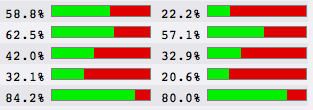
Writing tests is virtuous. It's the wholemeal bread of programming. Do it, and you'll be so much fitter. Except it tastes like cardboard and gets in the way of consuming the yummy treacle sponge of programming. But now I've got the testing religion. I view the lack of tests with the disapprobation of a reformed smoker tutting and huffing at the merest suggestion of a Marlboro Light. How did this happen and how can I be sure I won't backslide? The moment of transition was the first time that a test saved me from releasing software with a bad bug in it. The theoretical knowledge of virtue was translated into the palpitating relief of not disgracing myself in public. After that happened a few more times, I found myself desperately uncomfortable with the idea of releasing anything that didn't have decent test coverage. And so a virtuous habit is formed. It's not just driven by fear. With the right tools to hand, writing tests can be a lot of fun. You don't always need to be "in the zone". If you've got a spare half hour here and there, you can use it to increase the coverage of your tests. Getting better at testing is one of the ways I've become a much more proficient Rails developer over the last year of work on Expectnation. In case it helps anybody else, I thought I'd share some of the tools and techniques that are part of making Rails testing fun and effective. Continuous testing Whenever a checkin is made to our source repository, tests are run and the results emailed to everybody working on the project. As with the "you broke the build" disincentive, you need to be kept honest by frequent running of the tests. There are a variety of tools around to help you do continuous integration with Rails, most of which have some dependence on you using Subversion for source control. In the event, I just created my own script to do what we required. Coverage reports rcov coverage barsOne of the big mental hurdles with testing is knowing how many tests you should aim for.  You can't prove a negative: even if your tests are all passing it still doesn't tell you much about the tests you haven't written that might fail! We use rcov as part of the continuous integration process, and post the results to our project web site. The pretty red and green bars give you some idea of when you're starting to get adequate test coverage, and the line-by-line breakdown is invaluable. Tainting strings One of the easiest errors to make in Rails templates is to miss the call to h(), to escape any HTML in an output string. The only real way to catch these errors is through automation. The wonderful safe_erb plugin helps you do just that. By using Ruby's tainting mechanism for strings, it throws an exception if you render any external data unescaped. One of the beneficial side effects of safe_erb is that you then become very particular about ensuring your functional tests properly cover every action in your application.  Tests such as get 'index', which before seemed mundane and redundant, are now essential, as you want to test for tainted strings. In addition to the above techniques, there are a lot of fun shiny gadgets to help you write tests, such as ZenTest, but the three things above are the ones I've found to be of significant value. I ought to conclude with words of praise for Rails. It goes out of its way to make testing an important part of the development lifecycle, and the availability of the of unit, functional and integration test functionality makes it easy to get started. Every time I teach somebody about Rails' testing features, they end up finding it very enjoyable.
Don't forget, testing can be fun!

MJ Ray: Spam: Under Seige

At the start of this week, one of the mailservers I run came heavily under attack. As well as the continuing surge in the sheer volume of spam - which has been reported widely in articles like Spam up by 59 per cent [Spannerworks Search Marketing News] - there were dozens of clients opening connections and then just sitting there idle. Very strange. To bring things back under control, I added a mixture of new anti-spam methods, but some things will always be attractive enough for bad people to attack manually and defeat whatever anti-spam you put in place. The only anti-spam which can't be defeated is one that will defeat all real people - and that helps spammers to pollute the network, IMO, making everyone else waste yet more time as a result of their spamming. My main anti-spam at the moment is a mix of: I always argue against doing a hard reject for a dnsbl match. In general, dnsbls are way too trigger-happy and too prone to false positives, especially for things like new mailservers coming online. Just this month, one of my ISP mailservers ended up in sbl-xbl and I couldn't find out why. Once I had added the extra anti-spam, the spam volume dropped significantly. Total message volume reduced by about 20%. I can't tell reliably how many of the 20% (or the remaining 80%) are spam, of course. But then the network connection failed, which may have been the cause of the idle connections that turned this into a crisis in the first place.

John Goerzen: hpodder to be multithreaded... done right.

I'll be hacking on my hpodder program this weekend. hpodder is a full-featured podcast aggregator that runs on the command line, and has many features over other command-line podcatchers like bashpodder, and even over GUI tools like iPodder.

I originally envisioned hpodder to be something that I'd cron up and run in the background. But I have tended to run it in the foreground more than in the background. Some others have too, and the #1 requested hpodder feature is parallel downloads.

So I am working on that. I already have code working, in fact, that will parallelize both the hpodder update (downloading the feeds) and the hpodder download (downloading the actual episodes) commands.

Unlike ipodder, my code will make sure that no more than 1 thread will ever be downloading from a given server at a given time. ipodder had the terribly annoying habit of pointing all of its threads at a single server, thus pounding it while also providing little benefit for someone with a pipe fatter than the server's.

Before all this multithreaded stuff could be written, I needed to write my own status bar code instead of just letting curl display its own status bar. (That wouldn't work when there are 5 curls running at once)

I decided that I would write some generic status bar code, rather than something specific to hpodder. I took the apt-get status bar as an example, and whipped one up in Haskell and added it to my MissingH Haskell library.

But a status bar just begged for another feature: a generalized progress tracker. Something that could keep track of where a task (and its sub-tasks) are, calculate ETA, estimated time remaining, speed, etc. So I wrote that and made the status bar use it.

AND, a status bar begged for a generalized numeric formatter: something that could render 512 as 512, 2048 as 2K, 1048576 as 1M, etc. So I wrote that, and it's general enough that it can render into both SI and "binary" units by default (and others that users may want).

Finally, I wrote a function to take a number of seconds and render it in something friendly like 23m5s like apt uses, and shoved that in MissingH as well.

So now hpodder will have a status bar, and any other Haskell program can use the same status bar code in minutes because it's all generic. Or if someone just needs to render a number in megabytes, they can do that.

I really enjoy it when a program needs a solution that is generic enough to put in a larger library. I try to put as much of my Haskell code in MissingH as I can, so as to make it useful to others (and my other programs).

Biella Coleman: Hay Papito, que cold it is!

So it is hard to believe that in less than a month I will be somewhere, to be exact, Puerto Rico, that will be 80 degrees warmer than it is right now. And after weekend, it will be 100-105 degrees warmer. Yep, the cold (frikken) snap has arrived to Edmonton and it is preety intimidating. So long as there is no wind, it is tolerable but so long as there is some wind, it is unbearable. And I will park myself at home if that is the case. We were going to make a big trip to the mountains this weekend but with that type of weather, that may have been the end of me. And being that I think I am the only person in Edmonton from Puerto Rico…. that would be a shame. And speaking of the RICO… WikiTravel has chosen La Isla del Encanto as the spot for the Wiki Travel Get-Together. HAY Mamita y Papito, que HOT, as one would say… Evan Prodromou a.ka. MrBad, also a Debian developer, kick started the travelpedia and is going to be lucky enough to go. I am not sure if I can make it but I hearby promise to provide a detailed “map” of where the travelpedias should venture as I know the really good goods.. And they range from the Nuyorican cafe in El Viejo San Juan to hitting a couple of beaches on the amazing island of Culebra, going to Pinones Sunday night to listen to Rumba and anyway the list goes ON AND ON… I will be inspired while baking in 86 degrees (as opposed to freezing in-20 of Edmonton) and will provide le map.

22 November 2006

Simon Richter: The next step in packaging: functional units as system components?

I need to set up a spam filter, preferably with instantaneous rejection of emails. The way postfix does this is to immediately attempt to forward the mail to a filter, which is then responsible for feeding it back. This is probably the sanest way to do it, as it allows postfix to handle timeouts in the filter, and it allows the filter to modify the message (e.g. tag it) Now, all I need is a filter that actually works in this place. What would be nice would be a readymade spam filter installation that I could simply boot on a virtual machine and be set.

Erich Schubert: JSF XML syntax for c:url in attributes?

Dear Lazyweb, What is the JSF 1.2 XML-Syntax equivalent for
<img src="<c:url value='/static/foo.png' />" />
(this will make the URL relative to your application root, not to your web server; so if the app is installed in /foobar, the resulting URL will be /foobar/static/foo.png) My preferred solution would have a useful src= value so an XHTML browser can still display the page. Same for CSS stylesheets, links and similar. Please send me an email at erich@debian.org, I'll update the entry. (Comments are intentially not enabled.) Thanks. [Update: at least in apache myfaces, this should work (untested):
<c:url value="/static/foo.png" var="url" />
<img src="$ url " />
However, the template file won't render approximately in a regular browser. For easy-to-edit templates it would be nice to have an actual value in the src property. I have an idea how that could work with custom tags...]

21 November 2006

Eric Dorland: So I missed one...

Erich, give me a break man :) There are definitely still some branding issues left, I'm working on them.

The reason Ubuntu, Red Hat, etc can use the icon is that they've struck deals with Mozilla Corporation to include the trademark, where they submit there patches back upstream for quality assurance or what have you. Even if we came to a similar bargain, the logo has a non-free copyright license, so it isn't going into main.

Erich Schubert: Iceweasel is the latest firefox

Debian unstable now has iceweasel. Running iceweasel presented me with the pretty message
You've Updated To The Latest Version of Firefox
Great. Note: Ubuntu has more patches to firefox than Debian, so if Debian is (or: was) violating Mozillas trademark, so is Ubuntu. And probably Fedora. And Redhat. And Gentoo (well, maybe not; from what I know Gentoo is closed to unmodified upstream usually, and not as anal about LSB and desktop integration etc. as the others), ... you name it. Anyway, go, iceweasel, go.

Matt Brown: MyVFX first impressions

There has been a lot of interest recently in the VFX VoIP service launched by WorldXchange (WXC), no doubt partly driven by the fact that there is no monthly charge until April 2007. I had a spare Linksys PAP2T so I thought I would try the service out to see how it performed. The signup process didn’t go anywhere near as smoothly as it did when I signed up for my WXC DSL connection. The online signup form tried to force me to select a new WXC DSL Plan (I don’t want to do that, I want to keep my old plan with free National traffic). Despite trying several times and making sure that the only checkbox ticked was VFX each time, it refused to let me go any further. Giving up on the web form, I rang the WXC helpdesk who answered promptly. It is easy to see why WXC won the 2006 award for best call centre. Every time I deal with them over the phone it is a pleasant experience. This time was no exception. The CSR I was talking to explained that the webform was dying because I tried to use a VFX username that differed from my WXC DSL username. There was no mention of this restriction on the website! Anyway, 15 minutes later, with my MAC address taken down and my voice recording completed, I was told we were all done and that I would receive my welcome email and account details with 2 working days! 24 hours later I received the email with the details, followed promptly by a phone call from WXC CSR who was ready to talk me through the process of setting up my PAP2. Configuring the PAP2 was a simple procedure, I had to copy and paste a URL into the Provisioning Rule field of the web interface and reboot the device. It then downloads configuration information directly from WXC (based off the device MAC adddress) and configures itself. I was up and running with dial-tone about 2 minutes after receiving the email. Very smooth. I understand that the process is even easier if you purchase a pre-configured PAP2. The downside to the whole scheme is that in trying to make the process as simple as possible WXC has locked the entire system down very tightly and remove a lot of the flexibility that I would desire. In particular my PAP is now completely locked, I can’t access any of the web interfaces, and even the dial-in prompt on the PAP2 replies with a curt “cancelled” before hanging up. There is no way for me to configure the second line of the device to talk to a second SIP provider. Apparently WXC will create a custom configuration for me so that I can still use the second line, but I imagine this requires giving them all my account details for my second SIP provider, which I’m not sure I’m comfortable doing. It also appears that WXC has an arrangement with Linksys such that every PAP2 now sold in New Zealand comes pre-configured to be used with WXC. I haven’t had a chance to look at one of these PAP2s yet, but if it were to turn out that I had to contact WXC to remove the locking on my PAP2 before I was able to use it with another VoIP provider I would be fairly annoyed. The MyVFX portal is very underwhelming. It insists on opening itself in a new browser window, and isn’t integrated with the rest of the WXC/VFX website. From what I can make out it’s just a branded frontend on to the management system that WXC has purchased. The user interface is reminiscent of the design of the 1990s. I think there is a lot of potential for WXC to improve the experience in this area and I doubt that the average user would be comfortable updating settings via MyVFX in its present state. On the technical side of things the VFX service seems to be fairly well designed and secured. The devices are provisioned and configured using the Linksys/Sipura provisioning tools, which appear to encrypt all conversations with the device. The setup process downloaded two configuration files and a firmware file (v 3.1.10) to my PAP2. Both of the configuration files were binary and appear to be encrypted. Interestingly it appears that WXC downgraded the firmware from 5.1.1 to 3.1.1 during the provisioning process. The MyVFX portal and SIP server appear to be using some sort of BroadWorks device. The device fetches it’s configuration file from the WXC server every time it is powered on, so it will be easy for WXC to push out updates and configuration changes as they desire. The VoIP side of things is performed using SIP, which appears to be using standard HTTP Digest authentication. The username and passsword for this being hidden inside the encrypted configuration files which are downloaded to the device. The voice data uses the G.729 codec inside an RTP stream, and from a few short calls seems to be relatively good quality. Conclusion
Overall, VFX seems like a very easy to use and simple service. Simple being the keyword. By locking down the devices so securely and preventing people from using softphones and devices other than Linksys equipment I imagine many people like myself are excluded from the potential market. I can’t see myself keeping the service after I have to start paying money for it. But I would definitely recommend it to friends and family who are looking for a simple, easy to use VoIP system.

Biella Coleman: A spirited debate on the liberal frame of mind

This morning I came across Michael Berube’s response to Jodi Dean’s critique of Berube’s book What’s Liberal about the Liberal Arts?: Classroom Politics and Bias in Higher Education… It is a fascinating interchange worthy of a close read or two but without first-hand knowledge of the book, I hesitate to pledge my allegiance on either side. But I will hopefully to do so. The only thing that surprised me was that there was no mention of the grand master of the critique of liberalism, Stanely Fish… Not sure why but he seems like an obvious place to start. These ppst happened to really captured my attention this morening given I found them after reading the Chronicle of Higher Education piece Input or Intrusion? which examines the recent attacks against scholars deemed as “anti-Israel/pro-Palestine,” including against Nadia Abu El-Haj who happened to be on my dissertation committee… It will be very interesting to see how this all pans out and I am sure many of us are watching closely. And as an added bonus, here is a student’s thoughtful perspective on the Berube book.

Steve Langasek: midterm report

This is the first of my two formal reports to the Dunc-Tank board on the release management funding experiment. Although submitted to the board some time earlier, I've delayed publishing it to the wider community until a release update could be sent out with more concrete information on timeline adjustments as Debian developers are wont to demand.
I'm supposing that I don't need to give you any more specific details on what I've been working on than what's already been posted in my blog. There has certainly been plenty to keep me busy the past three weeks, including a lot of triage work on the state of bug reports in the BTS, managing the last of the major package transitions into testing for etch, removing packages and NMUing them, and it has indeed kept me busy. Busy enough that I've been lax when it comes to talking about it, either here or in my blog. :) Has the hard work paid off? Well, http://bugs.debian.org/release-critical/ shows a sharp decline in release critical bugs affecting testing over the same time period, following the peak resulting from Dunc Bank's successful campaign of identifying latent release-critical bugs in etch. Unfortunately, we have no statistics that track the number of RC bugs closed or opened over time, which makes it hard to judge how large of a dent my own work has made in the overall bug count. It's also totally guesswork to try to judge whether Dunc-Tank has encouraged others to help with the release overall, or discouraged them from doing so. What I can say is that, even though the past month coincides both with the tail-end of the Dunc Bank mass bug filings and multiple archive-wide rebuild efforts, the bug count is moving in the right direction, and I am seeing many maintainers being responsive to bugs in their packages and a number of active NMUers. If not for the buzz-kill of Lucas Nussbaum's latest round of build failure reports :), we would be down from over 300 RC bugs to less than 200 right now, which probably represents at least twice that many RC bugs closed. In terms of how the time I'm putting into this release compares with the sarge release, I'd say it's pretty comparable. That's actually quite a positive statement about Dunc Tank's role, IMHO; getting a Debian release out is uphill all the way, and whereas the sarge release came at a time when I was in a position to work more or less full time on it without compensation, my availability this time around would have been greatly reduced, and progress would have been much more heavily dependent on individual maintainers and semi-periodic bugsquashing parties, which I'm not sure is any longer enough to offset the rate at which new RC bugs are created in the distribution by uploaders. As it stands, I do find myself trying to consciously avoid a hero complex of needing to fix every bug personally, but there are after all only so many options for getting bugs fixed for release. A lot of maintainers respond positively to gentle nudging about their RC bugs, but there are still bugs that the maintainers can't or don't fix and that no NMUers take on, which does leave it more or less up to the release managers to address -- which is why one of my tasks for this week is to try get the count of RC bugs over 20 days old down from 90 to around 20-30, as these are the bugs that really do need more attention to get them resolved. So yes, Dunc-Tank is making a positive difference. Andi and I have reviewed the status, and while we don't think we'll be able to hit the Dec 4 deadline (even if we get the bug count down immediately we're waiting on the debian-installer to release, which needs at least one more release candidate with the 2.6.18 kernel), we do believe that a release before the end of the year is very possible and I'm looking forward to starting the full freeze in the next few weeks.

Biella Coleman: These two services I am prepared to acknoweldge, but I do not know of any others

So I am housed in University of Alberta Department of Philosophy as my supervisor is a philosopher and there is no seperate STS department. And this “academic housing” certainly has its advantages, like for example, learning about probably one of the most audacious (and frankly amusing) statments on religion ever… by Bertrand Russell:
My own view on religion is that of Lucretius. I regard it as a diseaese born of fear and and as a source of untold misery to the human race. I cannot, however, deny that it has made some contributions to civilizaion. It helped in early days to fix the calendar, and it caused Egyptian priests to chronicle eclipses with such care that in time they became able to predict them. These two services I am prepared to acknoweldge, but I do not know of any others. Bertand Russel. “Why I am not a Christian” p. 24
I am sure he turned over in his grave when his daughter said:
“He was the most fascinating man I have ever known, the only man I ever loved, the greatest man I shall ever meet, the wittiest, the gayest, the most charming. It was a privilege to know him, and I thank God he was my father.” Katharine Tait, My Father Bertrand Russell, NY: Harcourt Brace Jovanovich, 1975, p. 202.

20 November 2006

Biella Coleman: Modeling Politics on the Model of Free Software

My friend Jonah has written a provocative post that asks how the example of free software can be applied to the environmental politics as to create a free energy movement. His suggestion is a good one and it centers on the clear and accessible provision of information of labeling so as to create the conditions for meaningful choice and action. There is a line of critique launched against free software and the free culture movement accusing it of being myopic, privileged and limited. It is composed of a lot of well educated, white (many boys), honing in on liberating a set of artifacts software, music, movies etc, that are seen not to have all that much consequence in the world, compared to other more pressing matters, like famine, genocide, global warming, disease etc. I think this is somewhat of a negative critique that actually misses the point about why so many folks are attracted to the free culture movement in the first place and why it should be considered in a more positive light as a model for other forms of politics not because of its content but because of its form (and this is what Jonah basically says). In a world in which the mere thought about how to change the world is utterly paralyzing, seemingly futile, and just completely depressing, open source and free culture, by providing a set of tools along with a political message, has broken through the armour of apathy many of us are strangled by. It provided an opening to practically engage in politics, and thus allow many to taste the fruit of political action. And it is the taste, which keep people coming back to try to change the conditions of life. So the lesson to draw from free software is less whether its politics are radical or important enought, but that it provided an avenue and framework for alternative action. And it is this abililty to build the capacity for empowerment, which is one of its greatest virtues.

19 November 2006

Jeff Bailey: Google for your Domain

I've been playing with Google for your Domain over the past couple of weeks for Angie and my's email. A few observations so far:

1) Still a bit worried that Google now has a pile of my data. I don't know that there's a way to resolve this. I'm wondering if there's a way of doing GPG overlays onto gmail? For the most part I don't really care, but it would be nice to preserve the option of doing a local decryption.

2) It's nice to use my email address for my Jabber account finally. No more having to remember to check the gmail account from time to time to see if someone decided sending an email there would be a good idea. I should probably do the same with my hotmail account.

3) Google talk and Orkut don't play along with GfyD.

4) Google's incremental improvements are cool. In the past week they added customised start pages, which means that I can see my mail and calendar from a start page. The start page isn't as fully featured as the original start page (historical searches, various customer applets, etc. don't work), but looks alot like it did awhile ago.

5) gmail doesn't have a way of filtering on mailing lists. This annoyed me at first, but now is more of a reminder that I should unsubscribe from lists that I don't actually read anyway. The volume on the rest is low enough that I can continue to filter by hand.

Update: It seems that gmail *can* filter on mailing lists, it's just not documented. I've just setup a filter for listid:bug-gnulist.gnu.org and it seems to work. Use it in the "Has the words" section of the filter. Bug #83778177 filed with gmail for an update to http://mail.google.com/support/bin/answer.py?answer=7190

Biella Coleman: On Posting on Planet Debian

Since Debconf Mexico, parts of my blog have been published on planet debian. To be exact, only the categories, Debian, Academic and (I think) Tech are included while a plethora of other ones, such as Canada are not. At times I feel pangs of guilt or discomfort because a number of my academic posts have, on the surface at least, little to do with Debian, F/OSS, tech or law. But many do have either to do with law or science more generally, so I hope they are of some interest to a group of folks who seem pretty keen on these topics. Soon though, I am going to be in monk-mode, working like a hard working ox on my manuscript, full-time (now I am sharing my mindspace with an article on survivors and one that I have to present in January on the battles between hackers and scientologist, which I am pretty excited about too). I have just finished reading about 15 articles related to my book that have help to reignite the fire of interst, after burning out after years and years and can I add a few more years, on the same topic. So bear with me as soon there will either be many posts related to just F/OSS or at least none at all as I will be so overtaken by the work!

18 November 2006

Biella Coleman: Interestingness ranking of media objects

I now need to start looking for a flickr replacement. Yes, I am offended by the patent.

Next.

Previous.