Search Results: "ed"

23 November 2015

Lunar: Reproducible builds: week 30 in Stretch cycle

What happened in the reproducible builds effort this week: Toolchain fixes Mattia Rizzolo uploaded a version of perl to the reproducible repository including the patch written by Niko Tyni to add support for SOURCE_DATE_EPOCH in Pod::Man. Dhole sent an updated version of his patch adding support for SOURCE_DATE_EPOCH in GCC to the upstream mailing list. Several comments have been made in response which have been quickly addressed by Dhole. Dhole also forwarded his patch adding support for SOURCE_DATE_EPOCH in libxslt upstream. Packages fixed The following packages have become reproducible due to changes in their build dependencies: antlr3/3.5.2-3, clusterssh, cme, libdatetime-set-perl, libgraphviz-perl, liblingua-translit-perl, libparse-cpan-packages-perl, libsgmls-perl, license-reconcile, maven-bundle-plugin/2.4.0-2, siggen, stunnel4, systemd, x11proto-kb. The following packages became reproducible after getting fixed: Some uploads fixed some reproducibility issues, but not all of them: reproducible.debian.net Vagrant Cascadian has set up a new armhf node using a Raspberry Pi 2. It should soon be added to the Jenkins infrastructure. diffoscope development diffoscope version 42 was release on November 20th. It adds a missing dependency on python3-pkg-resources and to prevent similar regression another autopkgtest to ensure that the command line is functional when Recommends are not installed. Two more encoding related problems have been fixed (#804061, #805418). A missing Build-Depends has also been added on binutils-multiarch to make the test suite pass on architectures other than amd64. Package reviews 180 reviews have been removed, 268 added and 59 updated this week. 70 new fail to build from source bugs have been reported by Chris West, Chris Lamb and Niko Tyni. New issue this week: randomness_in_ocaml_preprocessed_files. Misc. Jim MacArthur started to work on a system to rebuild and compare packages built on reproducible.debian.net using .buildinfo and snapshot.debian.org. On December 1-3rd 2015, a meeting of about 40 participants from 18 different free software projects will be held in Athens, Greece with the intent of improving the collaboration between projects, helping new efforts to be started, and brainstorming on end-user aspects of reproducible builds.

Jonathan Dowland: CDs should come with download codes

boxes of CDs & the same data on MicroSD boxes of CDs & the same data on MicroSD
There's a Vinyl resurgence going on, with vinyl record sales growing year-on-year. Many of the people buying records don't have record players. Many records are sold including a download code, granting the owner an (often one-time) opportunity to download a digital copy of the album they just bought. Some may be tempted to look down upon those buying vinyl records, especially those who don't have a means to play them. The record itself is, now more than ever, a physical totem rather than a media for the music. But is this really that different to how we've treated audio CDs this century? For at least 15 years, I've ripped every CD I've bought and then stored it in a shoebox. (I'm up to 10 shoeboxes). The ripped copy is the only thing I listen to. The CD is little more than a totem, albeit one which I have to use in a relatively inconvenient ritual in order to get something I can conveniently listen to. The process of ripping CDs has improved a lot in this time, but it's still a pain. CD-ROM drives are also becoming a lot more scarce. Ripping is not necessary reliable, either. The best tool to verify a rip is AccurateRip, a privately-owned database of track checksums. The private status is a problem for the community (Remember what happened to CDDB?) and is only useful if other people using an AccurateRip-supported ripper have already successfully ripped the CD. Then there's things like CD pre-emphasis. It turns out that the Red Book standard defines a rarely-used flag that means the CD (or individual tracks) have had pre-emphasis applied to the treble-end of the frequency spectrum. The CD player is supposed to apply de-emphasis on playback. This doesn't happen if you fetch the audio data digitally, so it becomes the CD rippers responsibility to handle this. CD rippers have only relatively recently grown support for it. Awareness has been pretty low, so low that nobody has a good idea about how many CDs actually have pre-emphasis set: it's thought to be very rare, but (as far as I know) MusicBrainz doesn't (yet) track it. So some proportion of my already-ripped CDs may have actually been ripped incorrectly, and I can't easily determine which ones without re-ripping them all. I know that at least my Quake computer game CD has it set, and I have suspicions about some other releases. Going forward, this could be avoided entirely if CDs were treated more like totems, as vinyl records are, than the media delivering the music itself, and if record labels routinely included download cards with audio CDs. For just about anyone, no matter how the music was obtained, media-less digital is the canonical form for engaging with it. Attention should also be paid to make sure that digital releases are of a high quality: but that's a topic for another blog post.

Gergely Nagy: Keyboard updates

Last Friday, I compiled a list of keyboards I'm interested in, and received a lot of incredible feedback, thank you all! This allowed me to shorten the list considerably, two basically two pieces. I'm reasonably sure by now which one I want to buy (both), but will spend this week calming down to avoid impulse-buying. My attention was also brought to a few keyboards originally not on my list, and I'll take this opportunity to present my thoughts on those too.The FinalistsErgoDoxErgoDoxPros Cons SummaryThe keyboard looks interesting, primarily due to the thumb keys. From the ErgoDox EZ campaign, I'm looking at $270. That's friendly, and makes ErgoDox a viable option! (Thanks @miffe!)There's also another option, FalbaTech, which ships sooner, I can customize the keyboard to some extent, and Poland is much closer to Hungary than the US. With this option, I'm looking at $205 + shipping, a very low price for what the keyboard has to offer. (Thanks @pkkolos for the suggestion!)Keyboardio M01Keyboardio Model 01Pros Cons SummaryWith shipping cost and whatnot, I'm looking at something in the $370 ballpark, which is on the more expensive side. On the other hand, I get a whole lot of bang for my buck: LEDs, two center bars (tripod mounting sounds really awesome!), hardwood body, and a key layout that is very similar to what I came to love on the TypeMatrix.I also have a thing for wooden stuff. I like the look of it, the feel of it.The VerdictRight now, I'm seriously considering the Model 01, because even if it is about twice the price of the ErgoDox, it also offers a lot more: hardwood body (I love wood), LEDs, palm key. I also prefer the layout of the thumb keys on the Model 01.The Model 01 also comes pre-assembled, looks stunning, while the ErgoDox pales a little in comparsion. I know I could make it look stunning too, but I do not want to build things. I'm not good at it, I don't want to be good at it, I don't want to learn it. I hate putting things together. I'm the kind of guy who needs three tries to put together a set of IKEA shelves, and I'm not exaggerating. I also like the shape of the keys better on the Model 01.Nevertheless, the ErgoDox is still an option, due to the price. I'd love to buy both, if I could. Which means that once I'm ready to replace my keyboard at work, I will likely buy an ErgoDox. But for home, Model 01 it is, unless something even better comes along before my next pay.The Kinesis Advantage was also a strong contender, but I ended up removing it from my preferred options, because it doesn't come with blank keys, and is not a split keyboard. And similar to the ErgoDox, I prefer the Model 01's thumb-key layout. Despite all this, I'm very curious about the key wells, and want to try it someday.Suggested optionsYogitypeYogitypeSuggested by Andred Carter, a very interesting keyboard with a unique design.Pros Cons SummaryI like the idea of the keyboard, and if it wouldn't need a special inlay, but used a small screen or something to show the keys, I'd like it even more. Nevertheless, I'm looking for a mechanical keyboard right now, which I can also use for coding.But I will definitely keep the Yogitype in mind for later!Matias Ergo ProMatias Ergo ProPros Cons SummaryThis keyboard hardly meets any of my desired properties, and doesn't have anything standing out in comparison with the others. I had a quick look at this when compiling my original list, but was quickly discarded. Nevertheless, people asked me why, so I'm including my reasoning here:While it is a split keyboard, with a fairly simple design, it doesn't come in the layout I'd prefer, nor with blank keys. It lacks the thumb key area that ErgoDox and the Model 01 have, and which I developed an affection for.Microsoft Sculpt Ergonomic KeyboardMicrosoft SculptPros Cons SummaryThis keyboard does not buy me much over my current TypeMatrix 2030. If I'd be looking for the cheapest possible among ergonomic keyboards, this would be my choice. But only because of the price.Truly Ergonomic KeyboardTruly Ergonomic KeyboardPros Cons SummaryTwo important factors for me are physical layout and splittability. This keyboard fails both. While it is a portable device, that's not a priority for me at this time.

Thomas Goirand: OpenStack Liberty and Debian

Long over due post It s been a long time I haven t written here. And lots of things happened in the OpenStack planet. As a full time employee with the mission to package OpenStack in Debian, it feels like it is kind of my duty to tell everyone about what s going on. Liberty is out, uploaded to Debian Since my last post, OpenStack Liberty, the 12th release of OpenStack, was released. In late August, Debian was the first platform which included Liberty, as I proudly outran both RDO and Canonical. So I was the first to make the announcement that Liberty passed most of the Tempest tests with the beta 3 release of Liberty (the Beta 3 is always kind of the first pre-release, as this is when feature freeze happens). Though I never made the announcement that Liberty final was uploaded to Debian, it was done just a single day after the official release. Before the release, all of Liberty was living in Debian Experimental. Following the upload of the final packages in Experimental, I uploaded all of it to Sid. This represented 102 packages, so it took me about 3 days to do it all. Tokyo summit I had the pleasure to be in Tokyo for the Mitaka summit. I was very pleased with the cross-project sessions during the first day. Lots of these sessions were very interesting for me. In fact, I wish I could have attended them all, but of course, I can t split myself in 3 to follow all of the 3 tracks. Then there was the 2 sessions about Debian packaging on upstream OpenStack infra. The goal is to setup the OpenStack upstream infrastructure to allow packaging using Gerrit, and gating each git commit using the usual tools: building the package and checking there s no FTBFS, running checks like lintian, piuparts and such. I knew already the overview of what was needed to make it happen. What I didn t know was the implementation details, which I hoped we could figure out during the 1:30 slot. Unfortunately, this didn t happen as I expected, and we discussed more general things than I wished. I was told that just reading the docs from the infra team was enough, but in reality, it was not. What currently needs to happen is building a Debian based image, using disk-image-builder, which would include the usual tools to build packages: git-buildpackage, sbuild, and so on. I m still stuck at this stage, which would be trivial if I knew a bit more about how upstream infra works, since I already know how to setup all of that on a local machine. I ve been told by Monty Tailor that he would help. Though he s always a very busy man, and to date, he still didn t find enough time to give me a hand. Nobody replied to my request for help in the openstack-dev list either. Hopefully, with a bit of insistence, someone will help. Keystone migration to Testing (aka: Debian Stretch) blocked by python-repoze.who Absolutely all of OpenStack Liberty, as of today, has migrated to Stretch. All? No. Keystone is blocked by a chain of dependency. Keystone depends on python-pysaml2, itself blocked by python-repoze.who. The later, I upgraded it to version 2.2. Though python-repoze.what depends on version <= 1.9, which is blocking the migration. Since python-repoze.who-plugins, python-repoze.what and python-repoze.what-plugins aren t used by any package anymore, I asked for them to be removed from Debian (see #805407). Until this request is processed by the FTP masters, Keystone, which is the most important piece of OpenStack (it does the authentication) will be blocked for migration to Stretch. New OpenStack server packages available On my presentation at Debconf 15, I quickly introduced new services which were released upstream. I have since packaged them all: Congress, unfortunately, was not accepted to Sid yet, because of some licensing issues, especially with the doc of python-pulp. I will correct this (remove the non-free files) and reattempt an upload. I hope to make them all available in jessie-backports (see below). For the previous release of OpenStack (ie: Kilo), I skipped the uploads of services which I thought were not really critical (like Ironic, Designate and more). But from the feedback of users, they would really like to have them all available. So this time, I will upload them all to the official jessie-backports repository. Keystone v3 support For those who don t know about it, Keystone API v3 means that, on top of the users and tenant, there s a new entity called a domain . All of the Liberty is now coming with Keystone v3 support. This includes the automated Keystone catalog registration done using debconf for all *-api packages. As much as I could tell by running tempest on my CI, everything still works pretty well. In fact, Liberty is, to my experience, the first release of OpenStack to support Keystone API v3. Uploading Liberty to jessie-backports I have rebuilt all of Liberty for jessie-backports on my laptop using sbuild. This is more than 150 packages (166 packages currently). It took me about 3 days to rebuild them all, including unit tests run at build time. As soon as #805407 is closed by the FTP masters, all what s remaining will be available in Stretch (mostly Keystone), and the upload will be possible. As there will be a lot of NEW packages (from the point of view of backports), I do expect that the approval will take some time. Also, I have to warn the original maintainers of the packages that I don t maintain (for example, those maintained within the DPMT), that because of the big number of packages, I will not be able to process the usual communication to tell that I m uploading to backports. However, here s the list of package. If you see one that you maintain, and that you wish to upload the backport by yourself, please let me know. Here s the list of packages, hopefully, exhaustive, that I will upload to jessie-backports, and that I don t maintain myself: alabaster contextlib2 kazoo python-cachetools python-cffi python-cliff python-crank python-ddt python-docker python-eventlet python-git python-gitdb python-hypothesis python-ldap3 python-mock python-mysqldb python-pathlib python-repoze.who python-setuptools python-smmap python-unicodecsv python-urllib3 requests routes ryu sphinx sqlalchemy turbogears2 unittest2 zzzeeksphinx. More than ever, I wish I could just upload these to a PPA^W Bikeshed, to minimize the disruption for both the backports FTP masters, other maintainers, and our OpenStack users. Hopefully, Bikesheds will be available soon. I am sorry to give that much approval work to the backports FTP masters, however, using the latest stable system with the latest release, is what most OpenStack users really want to do. All other major distributions have specific repositories too (ie: RDO for CentOS / Red Hat, and cloud archive for Ubuntu), and stable-backports is currently the only place where I can upload support for the Stable release. Debian listed as supported distribution on openstack.org Good news! If you go at http://www.openstack.org/marketplace/distros/ you will see a list of supported distributions. I am proud to be able to tell that, after 6 months of lobbying from my side, Debian is also listed there. The process of having Debian there included talking with folks from the OpenStack foundation, and having Bdale to sign an agreement so that the Debian logo could be reproduced on openstack.org. Thanks to Bdale Garbee, Neil McGovern, Jonathan Brice, and Danny Carreno, without who this wouldn t have happen.

21 November 2015

B lint R czey: Wireshark 2.0 switched default UI to Qt in unstable

Wireshark With the latest release the Wireshark Project decided to make the Qt GUI the default interface. In line with Debian s Policy the packages shipped by Debian also switched the default GUI to minimize the difference from upstream. The GTK+ interface which was the previous default is still available from the wireshark-gtk package. You can read more about the new 2.0.0 release in the release notes or on the Wireshark Blog featuring some of the improvements. Happy sniffing! update: Wireshark 2.0.0 will be available from testing and jessie-backports in a week. Ubuntu users can already download binary packages from the Wireshark stable releases PPA maintained by the Wireshark Project (including me:-)).

Jonathan McDowell: Updating a Brother HL-3040CN firmware from Linux

I have a Brother HL-3040CN networked colour laser printer. I bought it 5 years ago and I kinda wish I hadn t. I d done the appropriate research to confirm it worked with Linux, but I didn t realise it only worked via a 32-bit binary driver. It s the only reason I have 32 bit enabled on my house server and I really wish I d either bought a GDI printer that had an open driver (Samsung were great for this in the past) or something that did PCL or Postscript (my parents have an Xerox Phaser that Just Works). However I don t print much (still just on my first set of toner) and once setup the driver hasn t needed much kicking. A more major problem comes with firmware updates. Brother only ship update software for Windows and OS X. I have a Windows VM but the updater wants the full printer driver setup installed and that seems like overkill. I did a bit of poking around and found reference in the service manual to the ability to do an update via USB and a firmware file. Further digging led me to a page on resurrecting a Brother HL-2250DN, which discusses recovering from a failed firmware flash. It provided a way of asking the Brother site for the firmware information. First I queried my printer details:
$ snmpwalk -v 2c -c public hl3040cn.local iso.3.6.1.4.1.2435.2.4.3.99.3.1.6.1.2
iso.3.6.1.4.1.2435.2.4.3.99.3.1.6.1.2.1 = STRING: "MODEL=\"HL-3040CN series\""
iso.3.6.1.4.1.2435.2.4.3.99.3.1.6.1.2.2 = STRING: "SERIAL=\"G0JXXXXXX\""
iso.3.6.1.4.1.2435.2.4.3.99.3.1.6.1.2.3 = STRING: "SPEC=\"0001\""
iso.3.6.1.4.1.2435.2.4.3.99.3.1.6.1.2.4 = STRING: "FIRMID=\"MAIN\""
iso.3.6.1.4.1.2435.2.4.3.99.3.1.6.1.2.5 = STRING: "FIRMVER=\"1.11\""
iso.3.6.1.4.1.2435.2.4.3.99.3.1.6.1.2.6 = STRING: "FIRMID=\"PCLPS\""
iso.3.6.1.4.1.2435.2.4.3.99.3.1.6.1.2.7 = STRING: "FIRMVER=\"1.02\""
iso.3.6.1.4.1.2435.2.4.3.99.3.1.6.1.2.8 = STRING: ""
iso.3.6.1.4.1.2435.2.4.3.99.3.1.6.1.2.9 = STRING: ""
iso.3.6.1.4.1.2435.2.4.3.99.3.1.6.1.2.10 = STRING: ""
iso.3.6.1.4.1.2435.2.4.3.99.3.1.6.1.2.11 = STRING: ""
iso.3.6.1.4.1.2435.2.4.3.99.3.1.6.1.2.12 = STRING: ""
iso.3.6.1.4.1.2435.2.4.3.99.3.1.6.1.2.13 = STRING: ""
iso.3.6.1.4.1.2435.2.4.3.99.3.1.6.1.2.14 = STRING: ""
iso.3.6.1.4.1.2435.2.4.3.99.3.1.6.1.2.15 = STRING: ""
iso.3.6.1.4.1.2435.2.4.3.99.3.1.6.1.2.16 = STRING: ""
I used that to craft an update file which I sent to Brother via curl:
curl -X POST -d @hl3040cn-update.xml https://firmverup.brother.co.jp/kne_bh7_update_nt_ssl/ifax2.asmx/fileUpdate -H "Content-Type:text/xml" --sslv3
This gave me back some XML with a URL for the latest main firmware, version 1.19, filename LZ2599_N.djif. I downloaded that and took a look at it, discovering it looked like a PJL file. I figured I d see what happened if I sent it to the printer:
cat LZ2599_N.djf   nc hl3040cn.local 9100
The LCD on the front of printer proceeded to display something like Updating Program and eventually the printer re-DHCPed and indicated the main firmware had gone from 1.11 to 1.19. Great! However the PCLPS firmware was still at 1.02 and I d got the impression that 1.04 was out. I didn t manage to figure out how to get the Brother update website to give me the 1.04 firmware, but I did manage to find a copy of LZ2600_D.djf which I was then able to send to the printer in the same way. This led to:
$ snmpwalk -v 2c -c public hl3040cn.local iso.3.6.1.4.1.2435.2.4.3.99.3.1.6.1.2
iso.3.6.1.4.1.2435.2.4.3.99.3.1.6.1.2.1 = STRING: "MODEL=\"HL-3040CN series\""
iso.3.6.1.4.1.2435.2.4.3.99.3.1.6.1.2.2 = STRING: "SERIAL=\"G0JXXXXXX\""
iso.3.6.1.4.1.2435.2.4.3.99.3.1.6.1.2.3 = STRING: "SPEC=\"0001\""
iso.3.6.1.4.1.2435.2.4.3.99.3.1.6.1.2.4 = STRING: "FIRMID=\"MAIN\""
iso.3.6.1.4.1.2435.2.4.3.99.3.1.6.1.2.5 = STRING: "FIRMVER=\"1.19\""
iso.3.6.1.4.1.2435.2.4.3.99.3.1.6.1.2.6 = STRING: "FIRMID=\"PCLPS\""
iso.3.6.1.4.1.2435.2.4.3.99.3.1.6.1.2.7 = STRING: "FIRMVER=\"1.04\""
iso.3.6.1.4.1.2435.2.4.3.99.3.1.6.1.2.8 = STRING: ""
iso.3.6.1.4.1.2435.2.4.3.99.3.1.6.1.2.9 = STRING: ""
iso.3.6.1.4.1.2435.2.4.3.99.3.1.6.1.2.10 = STRING: ""
iso.3.6.1.4.1.2435.2.4.3.99.3.1.6.1.2.11 = STRING: ""
iso.3.6.1.4.1.2435.2.4.3.99.3.1.6.1.2.12 = STRING: ""
iso.3.6.1.4.1.2435.2.4.3.99.3.1.6.1.2.13 = STRING: ""
iso.3.6.1.4.1.2435.2.4.3.99.3.1.6.1.2.14 = STRING: ""
iso.3.6.1.4.1.2435.2.4.3.99.3.1.6.1.2.15 = STRING: ""
iso.3.6.1.4.1.2435.2.4.3.99.3.1.6.1.2.16 = STRING: ""
Cool, eh? [Disclaimer: This worked for me. I ve no idea if it ll work for anyone else. Don t come running to me if you brick your printer.]

20 November 2015

Jonathan Dowland: smartmontools

It's been at least a year since I last did any work on Debian, but this week I finally uploaded a new version of squishyball, an audio sample comparison tool, incorporating a patch from Thibaut Girka which fixes the X/X/Y test method. Shamefully Thibaut's patch is nearly a year old too. Better late than never... I've also uploaded a new version of smartmontools which updates the package to the new upstream version. I'm not the regular maintainer for this package, but it is in the set of packages covered by the collab-maint team. To be polite I uploaded it to DELAYED-7, so it will take a week to hit unstable. I've temporarily put a copy of the package here in the meantime.

John Goerzen: I do not fear

I am so saddened by the news this week. The attacks in Paris, Beirut, and Mali. The reaction of fear, anger, and hate. Governors racing to claim they will keep out refugees, even though they lack the power to do so. Congress voting to keep out refugees. Emotions are a powerful thing. They can cause people to rise up and accomplish stunning things that move humanity forward. And they can move us back. Fear, and the manipulation of it, is one of those. What have I to fear? Even if the United States accepted half a million Syrian refugees tomorrow, I would be far more likely to die in a car accident than at the hands of a Syrian terrorist. I am a careful and cautious person, but I understand that life is not lived unless risk is balanced. I know there is a risk of being in a car crash every time I drive somewhere but if that kept me at home, I would never see my kids violin concert, the beautiful painted canyon of Texas, or the Flint Hills of Kansas. So I drive smart and carefully, but I still drive without fear. I accept this level of risk as necessary to have a life worth living in this area (where there are no public transit options and the nearest town is miles away). I have had pain in my life. I ve seen grandparents pass away, I ve seen others with health scares. These things are hard to think about, but they happen to us all at some point. What have I to fear? I do not fear giving food to the hungry, shelter to the homeless, comfort to those that have spent the last years being shot at. I do not fear helping someone that is different than me. If I fail to do these things for someone because of where they come from or what their holy book is, then I have become less human. I have become consumed by fear. I have let the terrorists have control over my life. And I refuse to do that. If governors really wanted to save lives, they would support meaningful mass transit alternatives that would prevent tens of thousands of road deaths a year. They would support guaranteed health care for all. They would support good education, science-based climate change action, clean water and air, mental health services for all, and above all, compassion for everyone. By supporting Muslim registries, we look like Hitler to them. By discriminating against refugees based on where they re from or their religion, we support the terrorists, making it easy for them to win hearts and minds. By ignoring the fact that entering the country as a refugee takes years, as opposed to entering as a tourist taking only minutes, we willfully ignore the truth about where dangers lie. So what do I have to fear? Only, as the saying goes, fear. Fear is making this country turn its backs on the needy. Fear is making not just the US but much of Europe turn its backs on civil liberties and due process. Fear gives the terrorists control, and that helps them win. I refuse. I simply refuse to play along. No terrorist, no politician, no bigot gets to steal MY humanity. Ultimately, however, I know that the long game is not one of fear. The arc of the universe bends towards justice, and ultimately, love wins. It takes agonizingly long sometimes, but in the end, love wins. So I do not fear.

Daniel Pocock: Databases of Muslims and homosexuals?

One US presidential candidate has said a lot recently, but the comments about making a database of Muslims may qualify as the most extreme. Of course, if he really wanted to, somebody with this mindset could find all the Muslims anyway. A quick and easy solution would involve tracing all the mobile phone signals around mosques on a Friday. Mr would-be President could compel Facebook and other social networks to disclose lists of users who identify as Muslim. Databases are a dangerous side-effect of gay marriage In 2014 there was significant discussion about Brendan Eich's donation to the campaign against gay marriage. One fact that never ranked very highly in the debate at the time is that not all gay people actually support gay marriage. Even where these marriages are permitted, not everybody who can marry now is choosing to do so. The reasons for this are varied, but one key point that has often been missed is that there are two routes to marriage equality: one involves permitting gay couples to visit the register office and fill in a form just as other couples do. The other route to equality is to remove all the legal artifacts around marriage altogether. When the government does issue a marriage certificate, it is not long before other organizations start asking for confirmation of the marriage. Everybody from banks to letting agents and Facebook wants to know about it. Many companies outsource that data into cloud CRM systems such as Salesforce. Before you know it, there are numerous databases that somebody could mine to make a list of confirmed homosexuals. Of course, if everybody in the world was going to live happily ever after none of this would be a problem. But the reality is different. While discrimination: either against Muslims or homosexuals - is prohibited and can even lead to criminal sanctions in some countries, this attitude is not shared globally. Once gay people have their marriage status documented in the frequent flyer or hotel loyalty program, or in the public part of their Facebook profile, there are various countries where they are going to be at much higher risk of prosecution/persecution. The equality to marry in the US or UK may mean they have less equality when choosing travel destinations. Those places are not as obscure as you might think: even in Australia, regarded as a civilized and laid-back western democracy, the state of Tasmania fought tooth-and-nail to retain the criminalization of virtually all homosexual conduct until 1997 when the combined actions of the federal government and high court compelled the state to reform. Despite the changes, people with some of the most offensive attitudes are able to achieve and retain a position of significant authority. The same Australian senator who infamously linked gay marriage with bestiality has successfully used his position to set up a Senate inquiry as a platform for conspiracy theories linking Halal certification with terrorism. There are many ways a database can fall into the wrong hands Ironically, one of the most valuable lessons about the risk of registering Muslims and homosexuals was an injustice against the very same tea-party supporters a certain presidential candidate is trying to woo. In 2013, it was revealed IRS employees had started applying a different process to discriminate against groups with Tea party in their name. It is not hard to imagine other types of rogue or misinformed behavior by people in positions of authority when they are presented with information that they don't actually need about somebody's religion or sexuality. Beyond this type of rogue behavior by individual officials and departments, there is also the more sinister proposition that somebody truly unpleasant is elected into power and can immediately use things like a Muslim database, surveillance data or the marriage database for a program of systematic discrimination. France had a close shave with this scenario in the 2002 presidential election when
Jean-Marie Le Pen, who has at least six convictions for racism or inciting racial hatred made it to the final round in a two-candidate run-off with Jacques Chirac. The best data security The best way to be safe- wherever you go, both now and in the future - is not to have data about yourself on any database. When filling out forms, think need-to-know. If some company doesn't really need your personal mobile number, your date of birth, your religion or your marriage status, don't give it to them.

Gergely Nagy: Looking for a keyboard

Even though I spend more time staring at the screen than typing, there are times when I - after lots and lots of prior brain work - sit down and start typing, a lot. A couple of years ago, I started to feel pain in my wrists, and there were multiple occasions when I had to completely stop writing for longer periods of time. These were situations I obviously did not want repeated, so I started to look for remedies. First, I bought a new keyboard, a TypeMatrix 2300, which while not ergonomic, was a huge relief for my hands and wrists. I also started to learn Dvorak, but that's still something that is kind-of in progress: my left hand can write Dvorak reasonably fast, but my right one seems to be Qwerty-wired, even after a month of typing Dvorak almost exclusively.This keyboard served me well for the past five year or so. But recently, I started to look for a replacement, partly triggered by a Clojure/conj talk I watched. I got as far as assembling a list of keyboards I'm interested in, but I have a hard time choosing. This blog post here serves two purposes then: first to make a clear pros/cons list for myself, second, to solicit feedback from others who may have more experience with any of the options below.Update: There is a [follow up post], with a few more keyboards explored, and a semi-final verdict. Thanks everyone for the feedback and help, much appreciated!Lets start with the current keyboard!TypeMatrix 2030TypeMatrix 2030Pros Cons SummaryAll in all, this is a keyboard I absolutely love, and am very happy with. Yet, I feel I'm ready to try something different. With my skins aging, and the aforementioned Clojure/conj talk, the desire to switch has been growing for a while now.Desired propertiesThere are a few desired properties of the keyboard I want next. The perfect keyboard need not have all of these, but the more the merrier. I plan to buy one keyboard for a start, but may end up buying another to bring to work (like I did with the TypeMatrix, except my employer at the time bought the second one for me). At work, I will continue using the TypeMatrix, most likely, but I'm not sure yet.Anyhow, there are a number of things I do with my computer that require a keyboard: I am looking for a keyboard that helps me do these things. A keyboard that will stay with me not for five years or a decade, but pretty much forever.The optionsUltimate Hacking KeyboardUltimate Hacking KeyboardPros Cons SummaryThe keyboard looks nice, has a lot of appealing features. It is programmable, so much so that by the looks of it, I could emulate the hardware dvorak switch my TypeMatrix has. However, I'm very unhappy with the addons, so there's that too.All in all, this would cost me about $304 (base keyboard, modules, palm rest and shipping). Not too bad, certainly a strong contender, despite the shortcomings.ErgoDoxErgoDoxPros Cons SummaryThe keyboard looks interesting, primarily due to the thumb keys. From the ErgoDox EZ campaign, I'm looking at $270. That's friendly, and makes ErgoDox a viable option! (Thanks @miffe!)Kinesis AdvantageKinesis AdvantagePros Cons SummaryThe key wells look interesting, but it's not a split keyboard, nor is it open source. The cost come out about $325 plus shipping and VAT and so on, so I'm probably looking at something closer to $400. Nah. I'm pretty sure I can rule this out.Kinesis FreeStyle2Kinesis FreeStyle2Pros Cons SummaryWhile a split keyboard, at a reasonably low cost ($149 + shipping + VAT), it lacks too many things to be considered a worthy contender.MaltronMaltronPros Cons SummaryWithout shipping, I'm looking at 450. That's a very steep price. I love the wells, and the thumb keys, but it's not split, and customisability is a big question here.AtreusAtreusPros Cons SummaryWhile not a split keyboard, it does look very interesting, and the price is much lower than the rest: $149 + shipping ($50 or so). It is similar - in spirit - to my existing TypeMatrix. It wouldn't take much to get used to, and is half the price of the alternatives. A strong option, for sure.Keyboardio M01Keyboardio Model 01Pros Cons SummaryWith shipping cost and whatnot, I'm looking at something in the $370 ballpark, which is on the more expensive side. On the other hand, I get a whole lot of bang for my buck: LEDs, two center bars (tripod mounting sounds really awesome!), hardwood body, and a key layout that is very similar to what I came to love on the TypeMatrix.I also have a thing for wooden stuff. I like the look of it, the feel of it.The Preference ListAfter writing this all up, I think I prefer the Model 01, but the UHK and ErgoDox come close too!The UHK is cheaper, but not by a large margin. It lacks the thumb keys and the palm key the M01 has. It also looks rather dull (sorry). They'd both ship about the same time, but, the M01 is already funded, while the UHK is not (mind you, there's a pretty darn high chance it will be).The ErgoDox has thumb keys, split keyboard, and is open source. Compared to the UHK, we have the thumb keys, and less distraction, for a better price. But the case is not so nice. Compared to the Model 01: no leds, or center bar, and an inferior case. But, much better price, which is an important factor too.Then, there's the Atreus. While it's a DIY kit, it is much more affordable than the rest, and I could have it far sooner. Yet... it doesn't feel like a big enough switch from my current keyboard. I might as well continue using the TypeMatrix then, right?The rest, I ruled out earlier, while I was reviewing them anyway.So, the big question is: should I invest close to $400 into a keyboard that looks stunning, and will likely grow old with me? Or should I give up some of the features, and settle for one of the $300 ones, that'll also grow old with me. Or is there an option I did not consider, that may match my needs and preferences better?If you, my dear reader, got this far, and have a suggestion, please either tweet at me, or write an email, or reach me over any other medium I am reachable at (including IRC, hanging out as algernon on FreeNode and OFTC).Thank you in advance, to all of you who contact me, and help me choose a keyboard!

Sylvain Beucler: Mini-sendmail... in bash

I recently faced an environment where there is no MTA. WTF? The reason is that people who work there get security audits on a regular basis, and the security people are usually mo...deratly skilled guys who blindly run a set of scripts, e.g. by ordering to disable Apache modules that "where seen enabled in /etc/apache2/mods-available/"... To avoid spending days arguing with them and nitpicking with non-technical managers, the system is trimmed to the minimum - and there is no MTA. No MTA, so no cron output, so difficulty to understand why last night's cron job failed miserably. Since it was not my role to reshape the whole business unit, I decided to hack a super-light, but functional way to get my cron output:
cat <<'EOF' > /usr/sbin/sendmail
#!/bin/bash
(
    echo "From me  $(LANG=C date)"
    cat
    echo
) >> /var/mail/all
EOF
chmod 755 /usr/sbin/sendmail
It works! :) There is a companion logrotate script, to avoid filling the file system:
cat <<'EOF' > /etc/logrotate.d/mail-all
/var/mail/all  
  daily
  rotate 10
  compress
  delaycompress
  notifempty
  create 622 root mail
 
EOF
Bootstrap with:
touch /var/mail/all
logrotate -f /var/mail/all
You now can check your sys-mails with:
mutt -f /var/mail/all
;)

Sylvain Beucler: Meritous: Free game ported on Android

Base attack Meritous is a nice, addictive action-adventure dungeon crawl game. Each new game is unique since the dungeon is built in a semi-random fashion. Last but not least, the engine, graphics and sound effects are GPL'd :) The game is based on SDL 1.2, which has an unofficial Android variant, so I decided to try and port it on my cell phone! The port was surprinsingly smooth and only non-SDL fixes (move big stack allocation to heap) were necessary. Who said it was difficult to program in C on Android? ;) It was also an opportunity to study the build system for F-Droid, an app market for free software apps, where APKs are rebuilt from source. The spec-like file is here. The game packaging is also being ressurected for Debian but is being distressfully held hostage in the NEW queue for 2 weeks! You can download the very first (aka beta) Android version: Comments welcome!

Sylvain Beucler: New free OpenGL ES documentation

Great news! The Learn OpenGL ES website recently switched its licensing to Creative Commons BY-SA 3.0 :) http://www.learnopengles.com/announcing-the-new-qa-and-forums-and-a-roundup/ It provides tutorials for OpenGL ES using Java/Android and WebGL, and is focusing on a more community-oriented creative process. Give them cheers!

Sylvain Beucler: No to ACTA - Paris

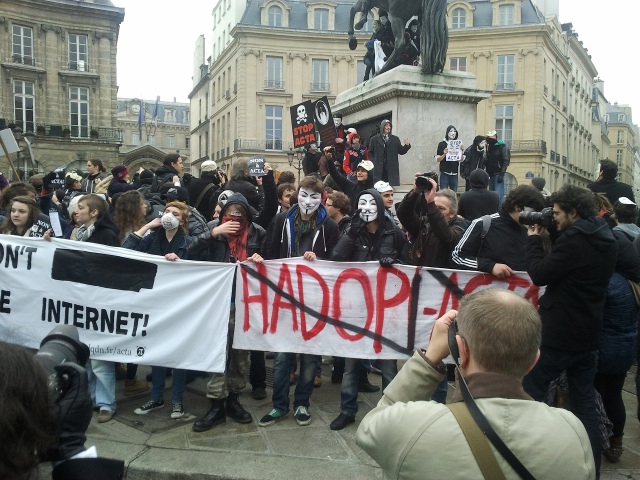
Today, there were events all around Europe to block ACTA. In Paris, the protest started at Place de la Bastille : APRIL was present, with in particular its president Lionel Allorge, and two members who wore the traditional anti-DRM suit : J r mie Zimmermann from La Quadrature du Net gave a speech and urged people to contact their legal representatives, in addition to protesting in the street : The protest was cheerful and free of violence : It got decent media coverage : Notable places it crossed include Place des Victoires : and Palais Royal, where it ended : Next protest is in 2 weeks, on March 10th. Update your agenda!

Sylvain Beucler: Rebuilding Android proprietary SDK binaries

Going back to Android recently, I saw that all tools binaries from the Android project are now click-wrapped by a quite ugly proprietary license, among others an anti-fork clause (details below). Apparently those T&C are years old, but the click-wrapping is newer. This applies to the SDK, the NDK, Android Studio, and all the essentials you download through the Android SDK Manager. Since I keep my hands clean of smelly EULAs, I'm working on rebuilding the Android tools I need.
We're talking about hours-long, quad-core + 8GB-RAM + 100GB-disk-eating builds here, so I'd like to publish them as part of a project who cares. As a proof-of-concept, the Replicant project ships a 4.2 SDK and I contributed build instructions for ADT and NDK (which I now use daily). (Replicant is currently stuck to a 2013 code base though.) I also have in-progress instructions on my hard-drive to rebuild various newer versions of the SDK/API levels, and for the NDK whose releases are quite hard to reproduce (no git tags, requires fixes committed after the release, updates are partial rebuilds, etc.) - not to mention that Google doesn't publish the source code until after the official release (closed development) :/ And in some cases like Android Support Repository [not Library] I didn't even find the proper source code, only an old prebuilt. Would you be interested in contributing, and would you recommend a structure that would promote Free, rebuilt Android *DK? The legalese Anti-fork clause:

3.4 You agree that you will not take any actions that may cause or result in the fragmentation of Android, including but not limited to distributing, participating in the creation of, or promoting in any way a software development kit derived from the SDK.
So basically the source is Apache 2 + GPL, but the binaries are non-free. By the way this is not a GPL violation because right after:
3.5 Use, reproduction and distribution of components of the SDK licensed under an open source software license are governed solely by the terms of that open source software license and not this License Agreement.
Still, AFAIU by clicking "Accept" to get the binary you still accept the non-free "Terms and Conditions". (Incidentally, if Google wanted SDK forks to spread and increase fragmentation, introducing an obnoxious EULA is probably the first thing I'd have recommended. What was its legal team thinking?) Indemnification clause:
12.1 To the maximum extent permitted by law, you agree to defend, indemnify and hold harmless Google, its affiliates and their respective directors, officers, employees and agents from and against any and all claims, actions, suits or proceedings, as well as any and all losses, liabilities, damages, costs and expenses (including reasonable attorneys fees) arising out of or accruing from (a) your use of the SDK, (b) any application you develop on the SDK that infringes any copyright, trademark, trade secret, trade dress, patent or other intellectual property right of any person or defames any person or violates their rights of publicity or privacy, and (c) any non-compliance by you with this License Agreement.
Usage restriction:
3.1 Subject to the terms of this License Agreement, Google grants you a limited, worldwide, royalty-free, non-assignable and non-exclusive license to use the SDK solely to develop applications to run on the Android platform. 3.3 You may not use the SDK for any purpose not expressly permitted by this License Agreement. Except to the extent required by applicable third party licenses, you may not: (a) copy (except for backup purposes), modify, adapt, redistribute, decompile, reverse engineer, disassemble, or create derivative works of the SDK or any part of the SDK; or (b) load any part of the SDK onto a mobile handset or any other hardware device except a personal computer, combine any part of the SDK with other software, or distribute any software or device incorporating a part of the SDK.
If you know the URLs, you can still direct-download some of the binaries which don't embed the license, but all this feels fishy. GNU licensing didn't answer me (yet). Maybe debian-legal has an opinion? In any case, the difficulty to reproduce the *DK builds is worrying enough to warrant an independent rebuild. Did you notice this?

Timo Jyrinki: Converting an existing installation to LUKS using luksipc

This is a burst of notes that I wrote in an e-mail in June when asked about it, and I'm not going to have any better steps since I don't remember even that amount as back then. I figured it's better to have it out than not.

So... if you want to use LUKS In-Place Conversion Tool, the notes below on converting a shipped-with-Ubuntu Dell XPS 13 Developer Edition (2015 Intel Broadwell model) may help you. There were a couple of small learnings to be had...

The page http://www.johannes-bauer.com/linux/luksipc/ itself is good and without errors, although funnily uses reiserfs as an example. It was only a bit unclear why I did save the initial_keyfile.bin since it was then removed in the next step (I guess it's for the case you want to have a recovery file hidden somewhere in case you forget the passphrase).

For using the tool I booted from a 14.04.2 LTS USB live image and operated there, including downloading and compiling luksipc in the live session. The exact reason of resizing before luksipc was a bit unclear to me at first so I simply indeed resized the main rootfs partition and left unallocated space in the partition table.


Then finally I ran ./luksipc -d /dev/sda4 etc.


I realized I want /boot to be on an unencrypted partition to be able to load the kernel + initrd from grub before entering into LUKS unlocking. I couldn't resize the luks partition anymore since it was encrypted... So I resized what I think was the empty small DIAGS partition (maybe used for some system diagnostic or something, I don't know), or possibly the next one that is the actual recovery partition one can reinstall the pre-installed Ubuntu from. And naturally I had some problems because it seems vfatresize tool didn't do what I wanted it to do and gparted simply crashed when I tried to use it first to do the same. Anyway, when done with getting some extra free space somewhere, I used the remaining 350MB for /boot where I copied the rootfs's /boot contents to.

After adding the passphrase in luks I had everything encrypted etc and decryptable, but obviously I could only access it from a live session by manual cryptsetup luksOpen + mount /dev/mapper/myroot commands. I needed to configure GRUB, and I needed to do it with the grub-efi-amd64 which was a bit unfamiliar to me. There's also grub-efi-amd64-signed I have installed now but I'm not sure if it was required for the configuration. Secure boot is not enabled by default in BIOS so maybe it isn't needed.


I did GRUB installation I think inside rootfs chroot where I also mounted /dev/sda6 as /boot (inside the rootfs chroot), ie mounted dev, sys with -o bind to under the chroot (from outside chroot) and mount -t proc proc proc too. I did a lot of trial and effort so I surely also tried from outside the chroot, in the live session, using some parameters to point to the mounted rootfs's directories...


I needed to definitely install cryptsetup etc inside the encrypted rootfs with apt, and I remember debugging for some time if they went to the initrd correctly after I executed mkinitramfs/update-initramfs inside the chroot.


At the end I had grub asking for the password correctly at bootup. Obviously I had edited the rootfs's /etc/fstab to include the new /boot partition, I changed / to be "UUID=/dev/mapper/myroot / ext4 errors=remount-ro 0 ", kept /boot/efi as coming from the /dev/sda1 and so on. I had also added "myroot /dev/sda4 none luks" to /etc/crypttab. I seem to also have GRUB_CMDLINE_LINUX="cryptdevice=/dev/sda4:myroot root=/dev/mapper/myroot" in /etc/default/grub.

The only thing I did save from the live session was the original partition table if I want to revert.


So the original was:

Found valid GPT with protective MBR; using GPT.
Disk /dev/sda: 500118192 sectors, 238.5 GiB
Logical sector size: 512 bytes
...
First usable sector is 34, last usable sector is 500118158
Partitions will be aligned on 2048-sector boundaries
Total free space is 6765 sectors (3.3 MiB)

Number Start (sector) End (sector) Size Code Name
1 2048 1026047 500.0 MiB EF00 EFI system partition
2 1026048 1107967 40.0 MiB FFFF Basic data partition
3 1107968 7399423 3.0 GiB 0700 Basic data partition
4 7399424 467013631 219.2 GiB 8300
5 467017728 500117503 15.8 GiB 8200

And I now have:


Number Start (sector) End (sector) Size Code Name

1 2048 1026047 500.0 MiB EF00 EFI system partition
2 1026048 1107967 40.0 MiB FFFF Basic data partition
3 1832960 7399423 2.7 GiB 0700 Basic data partition
4 7399424 467013631 219.2 GiB 8300
5 467017728 500117503 15.8 GiB 8200
6 1107968 1832959 354.0 MiB 8300

So it seems I did not edit DIAGS (and it was also originally just 40MB) but did something with the recovery partition while preserving its contents. It's a FAT partition so maybe I was able to somehow resize it after all.


The 16GB partition is the default swap partition. I did not encrypt it at least yet, I tend to not run into swap anyway ever in my normal use with the 8GB RAM.


If you go this route, good luck! :D

Pau Garcia i Quiles: Desktops DevRoom @ FOSDEM 2016: Have you submitted your talk yet?

FOSDEM 2016 is going to be great (again!) and you still have the chance to be one of the stars. Have you submitted your talk to the Desktops DevRoom yet? No? Remember: we will only accept proposals until December 6th. After that, the Organization Team will get busy and vote and choose the talks. Here is the full Call for Participation, in case you need to check the details on how to submit: FOSDEM Desktops DevRoom 2016 Call for Participation Topics include anything related to the Desktop: desktop environments, software development for desktop/cross-platform, applications, UI, etc

19 November 2015

Matthew Garrett: If it's not practical to redistribute free software, it's not free software in practice

I've previously written about Canonical's obnoxious IP policy and how Mark Shuttleworth admits it's deliberately vague. After spending some time discussing specific examples with Canonical, I've been explicitly told that while Canonical will gladly give me a cost-free trademark license permitting me to redistribute unmodified Ubuntu binaries, they will not tell me what Any redistribution of modified versions of Ubuntu must be approved, certified or provided by Canonical if you are going to associate it with the Trademarks. Otherwise you must remove and replace the Trademarks and will need to recompile the source code to create your own binaries actually means.

Why does this matter? The free software definition requires that you be able to redistribute software to other people in either unmodified or modified form without needing to ask for permission first. This makes it clear that Ubuntu itself isn't free software - distributing the individual binary packages without permission is forbidden, even if they wouldn't contain any infringing trademarks[1]. This is obnoxious, but not inherently toxic. The source packages for Ubuntu could still be free software, making it fairly straightforward to build a free software equivalent.

Unfortunately, while true in theory, this isn't true in practice. The issue here is the apparently simple phrase you must remove and replace the Trademarks and will need to recompile the source code. "Trademarks" is defined later as being the words "Ubuntu", "Kubuntu", "Juju", "Landscape", "Edubuntu" and "Xubuntu" in either textual or logo form. The naive interpretation of this is that you have to remove trademarks where they'd be infringing - for instance, shipping the Ubuntu bootsplash as part of a modified product would almost certainly be clear trademark infringement, so you shouldn't do that. But that's not what the policy actually says. It insists that all trademarks be removed, whether they would embody an infringement or not. If a README says "To build this software under Ubuntu, install the following packages", a literal reading of Canonical's policy would require you to remove or replace the word "Ubuntu" even though failing to do so wouldn't be a trademark infringement. If an @ubuntu.com email address is present in a changelog, you'd have to change it. You wouldn't be able to ship the juju-core package without renaming it and the application within. If this is what the policy means, it's so impractical to be able to rebuild Ubuntu that it's not free software in any meaningful way.

This seems like a pretty ludicrous interpretation, but it's one that Canonical refuse to explicitly rule out. Compare this to Red Hat's requirements around Fedora - if you replace the fedora-logos, fedora-release and fedora-release-notes packages with your own content, you're good. A policy like this satisfies the concerns that Dustin raised over people misrepresenting their products, but still makes it easy for users to distribute modified code to other users. There's nothing whatsoever stopping Canonical from adopting a similarly unambiguous policy.

Mark has repeatedly asserted that attempts to raise this issue are mere FUD, but he won't answer you if you ask him direct questions about this policy and will insist that it's necessary to protect Ubuntu's brand. The reality is that if Debian had had an identical policy in 2004, Ubuntu wouldn't exist. The effort required to strip all Debian trademarks from the source packages would have been immense[2], and this would have had to be repeated for every release. While this policy is in place, nobody's going to be able to take Ubuntu and build something better. It's grotesquely hypocritical, especially when the Ubuntu website still talks about their belief that people should be able to distribute modifications without licensing fees.

All that's required for Canonical to deal with this problem is to follow Fedora's lead and isolate their trademarks in a small set of packages, then tell users that those packages must be replaced if distributing a modified version of Ubuntu. If they're serious about this being a branding issue, they'll do it. And if I'm right that the policy is deliberately obfuscated so Canonical can encourage people to buy licenses, they won't. It's easy for them to prove me wrong, and I'll be delighted if they do. Let's see what happens.

[1] The policy is quite clear on this. If you want to distribute something other than an unmodified Ubuntu image, you have two choices:
  1. Gain approval or certification from Canonical
  2. Remove all trademarks and recompile the source code
Note that option 2 requires you to rebuild even if there are no trademarks to remove.

[2] Especially when every source package contains a directory called "debian"

comment count unavailable comments

Vincent Fourmond: Purely shell way to extract a numbered line from a file

I feel almost shameful to write it down, but as it took me a long time to realize this, I'll write it down anyway. Here's the simplest portable shell one-liner I've found to extract only the, say, 5th line from file:
~ cat file   tail -n +5   head -n1
Hope it helps...Update: following the comments to this post, here are a couple of other solutions. Thanks to all who contributed !
~ cat file   sed -ne 5p
~ cat file   sed -ne '5 p;q ' 
The second solution has the advantage of closing the input after line 5, so if you have an expensive command, you'll kill it with a SIGPIPE soon after it produces line 5. Other ones:
~ cat file   awk 'NR==5  print; exit '
~ cat file   head -n5   tail -n1 
The last one, while simpler, is slightly more expensive because all the lines before the one you're interested in are copied twice (first from cat to head and then from head to tail). This happens less with the first solution because, even if tail passes on all the lines after the one you're interested in, it is killed by a SIGPIPE when head closes.

Miriam Ruiz: Projects, Conflicts and Emotions

The Debian Project includes many people, groups and teams with different goals, priorities and ways of doing things. Diversity is a good thing, and the results of the continuous interaction, cooperation and competition among different points of view and components make up a successful developing framework both in Debian and in other Free / Libre / Open Source Software communities. The cost of this evolutionary paradigm is that sometimes there are subprojects that might have been extremely successful and useful that are surpassed by newer approaches, or that have to compete with alternative approaches that were not there before, and which might pursue different goals or have a different way of doing things that their developers find preferable in terms of modularity, scalability, stability, maintenance, aesthetics or any other reason. Whenever this happens, the emotional impact on the person or group of people that are behind the established component (or process, or organizational structure), that is being questioned and put under test by the newer approach can be important, particularly when they have invested a lot of time and effort and a considerable amount of emotional energy doing a great job for many years. Something they should be thanked for. This might be particularly hard when -for whatever reason- the communication between both teams is not too fluent or constant, and sometimes the author or authors of the solution that was considered mainstream until then might feel left out and their territory stolen. As generally development teams and technical people in the Free / Libre / Open Source world are more focused on results than on relationships, projects are generally not too good at managing this (emotional, relational) situations, even though they (we) are gradually learning and improving. What has happened with the Debian Live Project is indeed a hurtful situation, even though it s probably an unavoidable one. The Debian Live Project has done a great job for many years and it is sad to see it dying abruptly. A new competing approach is on its way with a different set of priorities and different way of doing things, and all that can be done at the moment is to thank Daniel for all his work, as well as everyone who has made the Debian Live Project successful for so many years, also thank the people who are investing their time and effort in developing something that might be even better. Lets wait and see. Source of the image: Conflict Modes and Managerial Styles by Ed Batista

Next.

Previous.