Search Results: "tim"

9 November 2012

Richard Hartmann: Release Critical Bug report for Week 45

Erratum Last week's posting had the wrong week. Turns out the script always outputs week 42. As the weeks were so close to each other, I didn't realize this at first. I fixed this by hand for this posting and will have it fixed upstream by next week. Timing I have put a lot of thought into when to publish this. Friday so it's before the weekend? Sat/Sun so it's during the weekend? Monday so it's at the actual start of the week (sorry, people from the U.S.)? Feedback welcome, assuming anyone cares. The actual gist The UDD bugs interface currently knows about the following release critical bugs: How do we compare to the squeeze cycle ?
Week Squeeze Wheezy Diff
43 284 (213+71) 468 (332+136) +184 (+119 ; +65)
44 261 (201+60)
45 261 (205+56)
46 271 (200+71)
47 283 (209+74)
48 256 (177+79)
49 256 (180+76)
50 204 (148+56)
51 124 (124+54)
52 115 (78+37)
1 93 (60+33)
2 82 (46+36)
3 25 (15+10)
4 14 (8+6)
5 2 (0+2)
6 release!

Matthew Garrett: Last day at Red Hat

After four and a half years at Red Hat, I'm about to take the three weeks of holiday I've built up and am then heading off to Nebula at the beginning of December. I'm still planning on being active in UEFI and Secure Boot development, and don't expect anything to change in terms of my Fedora involvement. It's been a fun time here, so just imagine that I'm writing something about exciting future challenges while I go back to saying goodbye to people.

comment count unavailable comments

Olivier Berger: Using a DreamPlug with Debian as an IPv4/IPv6 router for a home LAN behind a FreeBox

The goal of this article is to describe the setup I've made for my home LAN behind a FreeBox (French ISP Free.fr).

1 Principles
The FreeBox is configured :
  • in router mode (with a local IPv4 network on 192.168.0.x/24)
  • with IPv6 support activated (by convention, we'll use the 2a01:e35:1234:5678::/64 prefix below, to represent the IPv6 prefix provided by the FreeBox)
Behind the FreeBox, I have connected a DreamPlug computer (running Debian wheezy with a dual-boot setup as sold by NewIT) on its eth0 etherlink port. Behind the DreamPlug, I have connected a switch (to its eth1 ethernet port), on which the LAN's machines will be connected, on a dual IPv4/IPv6 network. The IPv4 will be on 192.168.4.0/24 (addresses for machines connected to the switch will be static) while the IPv6 will use the addresses auto-generated on the FreeBox's prefix. The DreamPlug will also provide a wifi network (in master mode, through its uap0 interface), only IPv4 on 192.168.3.0/24. On the DreamPlug, the outgoing IPv4 traffic will be masqueraded, while the IPv6 traffic will be bridged so that machines on the LAN can be reached from the Internet directly, passing through the eth0 eth1 bridge. The DreamPlug will also act as a filter/firewall to only allow selected traffic to reach the LAN machines (in particular for the IPv6, since the machines may be reached directly from the Internet otherwise).

1.1 Alternatives
There are a lot of howtos describing the setup of FreeBox + IPv6, but I couldn't find one that was exactly reflecting the kind of setup I have. Some dealt with a FreeBox setup in bridge mode (i.e. not the router mode), but in case the DreamPlug isn't so much reliable, or I've messed with the config, I'm tempted to keep the possibility to connect directly to the FreeBox. Others didn't use the same setup with a router distributing both wired and wifi networks. And note described exactly the setup for a DreamPlug running Debian wheezy and using ferm as a firewall. No, there's no NIH syndrom here ;)

2 DreamPlug router configuration

2.1 Interfaces configuration
The /etc/network/interfaces on the DreamPlug looks like the following (kudos to Dag Bertelsen's Setting up Dreamplug as a router with Shorewall firewall for the wifi configuration bits):
# Note: Order of the interfaces declarations matters

auto lo
iface lo inet loopback

auto uap0
iface uap0 inet static
post-up /usr/bin/uaputl sys_cfg_ssid dream-uAP-XXXX
# Modus WPA2
post-up /usr/bin/uaputl sys_cfg_protocol 32
# WLAN password
post-up /usr/bin/uaputl sys_cfg_wpa_passphrase "WHATEVER PASSWORD"
# Set the Cipher
post-up /usr/bin/uaputl sys_cfg_cipher 8 8
# automatic channel
post-up /usr/bin/uaputl sys_cfg_channel 0 1
post-up /usr/bin/uaputl bss_start
# we deliver addresses for the Wifi with DHCP
post-up /usr/sbin/service udhcpd start
address 192.168.3.1
netmask 255.255.255.0

# Only IP6 traffic passes through the router between the Freebox on eth0 and the LAN on eth1
auto br0
iface br0 inet manual
bridge_ports eth0 eth1
bridge_maxwait 0
pre-up ebtables -t broute -A BROUTING -p ! ipv6 -j DROP
down ebtables -t broute -F

# Connected to the FreeBox, with DHCP in IPv4, masquerading outgoing IPv4 traffic
auto eth0
iface eth0 inet dhcp
up iptables -t nat -A POSTROUTING -o eth0 -j MASQUERADE
down iptables -t nat -F
post-up sysctl -q -w net.ipv4.ip_forward=1
iface eth0 inet6 auto

# Connected to the LAN with a static IPv4 address
auto eth1
iface eth1 inet static
address 192.168.4.1
netmask 255.255.255.0

2.2 DHCP server configuration
The DHCP config for udhcpd is as such (in /etc/udhcpd.conf):
start 192.168.3.100
end 192.168.3.200
interface uap0
opt lease 86400
opt router 192.168.3.1
opt subnet 255.255.255.0
opt dns 192.168.3.1
opt domain localdomain
max_leases 101
lease_file /var/lib/udhcpd.leases
auto_time 5

2.3 Firewall configuration
The firewall I use is ferm. Here's the /etc/ferm/ferm.conf configuration (YMMV). Thanks to Ren Garcia's R gles de firewall pour un pont IPv6 for inspiration :
## Interfaces of the router

# Our LAN on a switch
@def $DEV_PRIVATE = eth1;

# The ISP router
@def $DEV_WORLD = eth0;

# Our Wifi LAN
@def $DEV_WIFI = uap0;


## IP networks of our LAN

# IPv4 (includes ethernet switch and wifi)
@def $NET_PRIVATE = 192.168.0.0/16;

# IPv6 (the prefix granted by the ISP)
@def $NET6_PRIVATE = 2a01:e35:1234:5678::/64;

# IPv6 Local link
@def $LINK6 = fe80::/10;

# Specific machines on the LAN
@def $MACHINE_MYDESKTOP = 2a01:0e35:1234:5678:1234:5678:9abc:def0;

# Special function to log dropped packets
@def &DROP() =
mod limit limit 1/second limit-burst 10 LOG log-prefix "$DOMAIN-$CHAIN: ";
DROP;


# IPv4 iptables rules
table filter
chain INPUT
policy DROP;

# connection tracking
mod state state INVALID DROP;
mod state state (ESTABLISHED RELATED) ACCEPT;

# allow local packet
interface lo ACCEPT;

# respond to ping
#proto icmp ACCEPT;
proto icmp icmp-type echo-request ACCEPT;

# allow IPsec
proto udp dport 500 ACCEPT;
proto (esp ah) ACCEPT;

# allow SSH connections from the private network and from some
# well-known internet hosts
#saddr ($NET_PRIVATE 123.45.67.89) proto tcp dport ssh ACCEPT;
saddr $NET_PRIVATE proto tcp dport ssh ACCEPT;

# we provide DNS and SMTP services for the internal net
interface $DEV_PRIVATE saddr $NET_PRIVATE
proto (udp tcp) dport domain ACCEPT;
proto tcp dport smtp ACCEPT;


interface $DEV_WIFI
# DHCP
proto udp dport 67:68 ACCEPT;
proto (udp tcp) dport domain ACCEPT;

proto udp dport netbios-dgm DROP;


# LOG all dropped packets
proto (udp tcp) &DROP();


# outgoing connections are not limited
chain OUTPUT policy ACCEPT;

chain FORWARD
policy DROP;

# connection tracking
mod state state INVALID DROP;
mod state state (ESTABLISHED RELATED) ACCEPT;

# connections from the internal net to the internet or to other
# internal nets are allowed
interface $DEV_PRIVATE ACCEPT;
interface $DEV_WIFI ACCEPT;

# LOG all dropped packets
proto (udp tcp) &DROP();


# IPv4 masquerade / NAT support

table nat
chain POSTROUTING
# masquerade private IP addresses
saddr $NET_PRIVATE outerface $DEV_WORLD MASQUERADE;


## IPv6:

domain ip6
table filter

chain INPUT
policy DROP;

# Internal traffic authorized
saddr $NET6_PRIVATE ACCEPT;
saddr $LINK6 ACCEPT;

# accept multicast
daddr ff00::/8 ACCEPT;

interface lo ACCEPT;

# For public traffic
# Only DNS resolution + NTP acceped for UDP
interface br0
proto udp

sport domain ACCEPT;

dport ntp ACCEPT;

&DROP();


# TCP on ports < 1024 forbidden except for SSH
proto tcp

dport ssh ACCEPT;

dport 0:1023 DROP;


# Accepted established traffic
mod state state INVALID DROP;
mod state state (ESTABLISHED RELATED) ACCEPT;

# incoming connections forbidden
proto tcp syn DROP;

# Accept ping
proto icmpv6 ACCEPT;


proto (udp tcp) &DROP();

chain FORWARD
policy DROP;

# All local traffic accepted
saddr $LINK6 ACCEPT;

# All ping accepted unless coming from internet
saddr ! $NET6_PRIVATE proto icmpv6 icmp-type echo-request DROP;
proto icmpv6 ACCEPT;

# Allow SSH to specific machines
proto tcp daddr $MACHINE_MYDESKTOP dport ssh ACCEPT;

# Accept established traffic
mod state state INVALID DROP;
mod state state (ESTABLISHED RELATED) ACCEPT;

# Accept outgoing traffic
saddr $NET6_PRIVATE ACCEPT;

# Accept local outgoing traffic
saddr ::1 ACCEPT;

proto (udp tcp) &DROP();


# ebtables
domain eb chain FORWARD
policy DROP;

# Only accept bridged traffic for IPv6
logical-in br0 logical-out br0
#ebtables -t broute -A BROUTING -p ! ipv6 -j DROP
proto IPv6 ACCEPT;


2.4 DNS config

The DreamPlug will run bind9 to cache the DNS for the wifi network (default config is OK out of the box).

3 Configuration for the LAN machines

3.1 Connection with Wifi
Machines connected with the WPA wifi network should get an IPv4 only address via DHCP on the 192.168.3.0/24 network. There's nothing to be configured specifically.

3.2 Ethernet connection on the switch
Machines connected via ethernet cables to the switch can run either with IPv4 config, in which case they should be configured statically for the 192.168.4.0/24 network, using the router on 192.168.4.1 as a gateway, or with IPv6 auto config. On wheezy, the /etc/network/interfaces will look like :
auto eth1
iface eth1 inet static
address 192.168.4.42
netmask 255.255.255.0
gateway 192.168.4.1
dns-nameservers 212.27.40.241 212.27.40.240

iface eth1 inet6 auto

4 To do list

The setup works fine, but there are a few things I'd like to improve :
  • running a regular Debian distro on the DreamPlug (the kernel used at the moment is patched for the wifi driver in master mode support), possibly using only Free Software.
  • using subnets for the IPv6 machines (but that seems not exactly obvious, requiring NDP proxying and stuff), so that the privacy is improved (the IPv6 auto generated global addresses depend on the MAC addresses hmmm probably not optimal).
  • adding more stuff to the DreamPlug router so that it becomes a full fledged FreedomBox.

5 References

Date: 2012-11-09 16:30:34 CET

Michal &#268;iha&#345;: New documentation for phpMyAdmin

I was quite unhappy with shape of our documentation for some time, but this week I finally found some time to dig deeper into conversion into something more usable. Nowadays I'm mostly using Sphinx for writing documentation, which allows to easily write using RST and provides output to various formats. Together with Read the Docs service, it makes great combo for providing user documentation, which I use for example for Weblate. So with a little bit of magic in Python and Beautiful Soup I was able to convert most of the HTML documentation into RST without tons of manual work. The resulting source (and ugly conversion script) temporarily lives on my github and generated documentation is available on Read the Docs. There are of course still many things to improve, but I think even right now it is easier to navigate than previous monolithic HTML file. Now we need to decide if and how to integrate this into official repositories and I can then continue on improving the documentation content.

Filed under: English Phpmyadmin 0 comments Flattr this!

8 November 2012

Jo Shields: Evil, or why Douglas Crockford is harmful to Free Software

Yesterday I received a new serious bug report against Mono in Debian. For those not in the know, serious severity is release critical, and can trigger removal of a package from the distribution in order to make a shipping release (e.g. if Debian is in deep freeze, as is the case right now). Bug 692614 relates to a single source file, ./mcs/class/System.Web.Extensions/System.Web.Script.Serialization/JsonDeserializer.cs, which is part of the System.Web.Extensions assembly. This file was written in 2008 by an upstream Mono developer, and is based on some code from json.org specifically JSON_parser.c and JSON_checker.c json.org code carries a non-standard license. Specifically, it s MIT/X11 with an added clause: The Software shall be used for Good, not Evil. I ve had some discussions with Mono upstream, and they believe that they have resolved the matter to their satisfaction their solution will make its way into Debian soon. But in the meantime, let s talk about the clause. The Free Software Foundation s Freedom 0 reads:
A program is free software if the program s users have the four essential freedoms:
  • The freedom to run the program, for any purpose (freedom 0).
The Debian Free Software Guidelines and Open Source Initiative s Open Source Definition clause 6 reads:
No Discrimination Against Fields of Endeavor The license must not restrict anyone from making use of the program in a specific field of endeavor. For example, it may not restrict the program from being used in a business, or from being used for genetic research.
It s fairly clear that the JSON.org license clause goes against both of these, making any piece of software using that license neither Open Source nor Free Software. It is not distributable by any organization which mandates Freedom for its users not in Debian, not in Fedora, not on Google Code. Anybody who cares about their users will reject a clause like this, because it has awful chilling effects. Think it s funny? It really isn t. Who can use the code without being at risk of a lawyer knocking on their doors? Can the Catholic Church? The ACLU? Republicans? Democrats? Military contractors? Genetic engineers? Big pharma? Petrochemicals firms? Communists? Fascists? Mono developers? WikiLeaks? Without a clear definition of good and evil , people need to seriously consider whether they are safe to use the code because if the developer and users interpretations of the terms differ, there could be hell to pay. Would you want to ship a hardware device let s say you re making a smart TV and have some developer of a library send his lawyers around to tell you sorry, TV rots kids brains, it s clearly evil to get your entire distribution channel shut down by injunction? It s not an oversight, kids. Upstream are well aware of the pain this childishness causes anyone who takes software licenses seriously. They giggle about it at conferences, like tweenagers who think they ve one-upped the adults in the room. This non-Free license is intended to mock people who take licensing seriously. In fact, one could easily categorise efforts to pollute the Free Software ecosystem with fake, non-Free software as evil, which would mean all JSON.org code fails to comply with its own license, due to shipping with its license (Inception, anyone?). Before the jokers in the room claim that this kind of problem is deserved by Mono, let s take a look at all the software in Debian which Douglas Crockford endangers with his childishness. PHP? OwnCloud? jQuery? You think Debian serves its users well by pulling jQuery from the next release in order to serve the ego of a man behaving like an eleven year old? It is also interesting to note that the author of this do no evil clause works at PayPal. Read that twice, go and repair your irony meters, then come back. In conclusion: thank you so VERY much Doug Crockford for making the world of Free Software measurably worse.

7 November 2012

Russell Coker: Rape Apology and LCA 2011

After a lecture at LCA 2011 included some inappropriate slides there was a long discussion on several mailing lists about the issues related to this. In February 2011 I wrote a blog post debunking some of the bogus arguments in question [1]. Of course the matter didn t end there, at LCA 2012 I was drawn into a few debates IRL about the issues, as long as there are more than a few men who want such porny pictures used in LCA talks the issue can t be properly resolved. The most serious aspect of the discussion in question is that of rape apology, the bad ideas that were presented have a real impact on the way people behave, merely making public statements saying that something is OK is going to increase the incidence of it happening. The Geek Feminism Wiki has a good page summarising the issue [2]. The Finally Feminism 101 post about Rape Culture is also worth reading in this context [3]. Recently Valeria Aurora wrote a post for the Ada Initiaive blog about the rape apology issue and how the community needs to act to prevent such behavior [4]. This inspired Matthew Garrett to write about the issue and state the position that In the absence of an apology and explanation from Ted, I ll be interacting with him to the bare minimum that I m compelled to as a result of my job [5]. I agree with Matthew s article, everything he writes is logical and I believe that it is all for the benefit of the FOSS community as a whole. I think that most guys have quietly defriended guys who are rape-positive in the past (for example when I was 12 I refused to play D&D with boys who were raping NPCs). But blogging about it, explaining the problem, and giving the offender the possibility to reform is a good idea and it s something that should be done more often. Sam Varghese has written about the issue for ITWire [6]. He has taken the wrong approach to this, he specifically claims that Matthew Garrett has kicked off what could be a damaging episode . I think that Matthew s approach is necessary and the situation demands it. If Matthew had been on holidays and I had read the TAI post earlier then I would probably have written a blog post which Sam could have described in a similar manner. So I don t think that Matthew kicked anything off (I think that someone had to do it). I also don t think that this has to be damaging it depends on how everyone reacts. On her personal blog Valerie says When I first read Ts o s comments, I couldn t sleep for two nights. I wanted to throw up every time I thought about it. I was furious and frightened at the same time. Every time I think about this, even now, I literally have nightmares. I can t bear the thought of working with him even over email, much less attending the same conferences [7]. I don t think that any of us who are seriously involved in the FOSS community have a way of avoiding this issue, allowing Valerie and other women who have the same understanding of the situation to go through that without any support is not a neutral action. I think we need to consider whether someone who gives other delegates and speakers nightmares should be welcome to attend a conference. Valerie s post makes sense to me and I can understand why she doesn t want to associated with Ted, my understanding of the issue isn t important or even required, I merely note this because I m sure that there are lots of readers who will ignore anything that a woman might say. ITWire has a follow-up article with Ted s response, Ted fails to address all the issues and seems to think that the people who disagree with him merely don t appreciate his nuance [8]. The thing is that the issue of the incidence of rape was raised in discussion to consider the probability that rape survivors would have been in the audience for the Mark Pesce talk in question. None of Ted s claims indicate that rape could be rare enough that a crowd of 500+ random people could be expected not to have multiple rape survivors so his comments weren t even relevant to the discussion. Ted seems unwilling to try to understand the position of all the people who disagree with him.

MJ Ray: Adrift @coopsutd in @coopParty workshop

image

Welney washes

Sometimes I felt at home at Cooperatives United, like at the wonderful fringe dinner at Eighth Day last Thursday night. Sometimes I felt overwhelmed by the flood, like at the cooperative party workshop on Friday morning. The workshop addressed the key questions: why do we want cooperative politicians, what could they do and what are the needs and challenges facing them? Personally, I felt the first is obvious and the answer is all the second. It s both frustrating (few ask why other movements want to influence politicians) and reassuring (no taboo topics) that the first question is asked. There were many fascinating answers to the other two questions from around the world. As so often with workshops, few hard conclusions were reached, but I think some interesting conversations were started there, which we might hear again in the future. What would I call the top challenge? Persuading open and transparent co-op members to join the party. I ve written about my difficulty with joining political parties in the past, as some forms of collective responsibility are against my beliefs and I m not sure that joining a small party will help anyone much, but I think I ll take another look at the cooperative party, all the same. The picture above is of the Welney washes, some miles south-west of Lynn. It s a stunning wetland environment, and it surprises me every time the train crosses the floods, as it did on the way to Manchester. And yes, I ve shoehorned a picture I liked into this article!

6 November 2012

Jon Dowland: Debian Day #12

A few bits and pieces:

Jon Dowland: Microsoft Windows Surface RT

Some quick first impressions of the Windows Surface RT I just can't figure out what Microsoft are aiming to achieve with this. They've overpriced it and sold it short at the same time by promising a much better amd64/x86_64 one in the future. The end-to-end secure code execution means they're stuck waiting for the app store goldrush but there's no market for people to bother porting software to it. Even the most basic apps (google link on home screen/whatever it's called) don't work/can't be installed. It's telling that Redhat, a multi-billion dollar company, don't feel it's worth investing the $99 required to get an ARM Fedora boot path signed so that you could run Fedora on the hardware. No doubt that is a convenient side effect for MS: As much as it would be nice to imagine they consider Linux enough of a threat to have purposefully locked it out, I suspect the resilient to viruses is the key reason. And indeed, in tablet land, poor Android is the most pest-ridden platform. Who would have seen that coming? The USP, if there is one, is "full office", but the text lag makes it a fairly unpleasant experience to write anything serious on it. The basic keyboard is utterly unusable, and the posh keyboard pushes the price deep into proper laptop territory. Heck, my beloved x121e, the machine I live on for work and play, cost less than the tablet with even the basic keyboard.

Jon Dowland: Chronic

I've been ill for around 18 months. I started off ill, and more recently became more ill, so that I'd mentally divided my illness into two distinct periods. The truth, it turns out, is not quite so clear-cut. My more recent period of malaise spurred me on to seek a different treatment, which has restored me to a state of well-being which I had honestly forgot existed. It's quite possibly a combination of the desired outcome of treatment and also a side-effect of the drugs I'm on at the moment but I feel both mentally and physically the best I have in a long time. My mind is burning with ideas once again. Responsibilities and chores that used to sap me now seem less daunting. Having acclimatised to a steady-seeming state of being, which turns out to not be "well", I'd started to wonder if, in some respects, I'd reached the limits of my abilities. The knock-on effect of that was, to me, to consider what the future held, in many regards, including in terms of career. There were some benefits to my prior state of being. I'd begun to learn how to relax, how to wind down, how to not bite off more than I could chew. In particular I'd stopped worshipping at the alter of multitasking and started to give proper attention to one significant task at a time, with corresponding improvements in my productivity. These useful chunks of self-discipline have fallen to the wayside a little bit now. I'm enjoying a holiday in the body-and-mind landscape of my past. I don't feel too guilty about it. I think I deserve it. But I mustn't linger here too long, lest I forget those hard-won lessons. I've not managed to follow through on a lot of things I've tried to pick up over the last year and a half: software half-finished; Debian committments uncompleted; and I've felt a lingering sense of guilt about that, but at least I now have an explanation. Currently reading: Chronic City, by Jonathan Lethem.

Stefano Zacchiroli: bits from the DPL for October 2012

Freshly baked, bits from the DPL for October 2012.
Dear Project Members,
another month, another periodic report of DPL-ish activities, this time for October 2012. Highlights Debian on public clouds I've spent quite some time to improve Debian presence on the so called "public clouds". Following up to an inquiry of a fellow developer, I've reached out to Microsoft to investigate the possibility of having Debian as an option on Windows Azure. Around the same time, I've been approached by Amazon to have Debian as an option on the AWS marketplace. In both cases, we will need to overcome challenges of various kinds, at the technical (e.g. image preparation), bureaucratic (e.g. terms of the agreements we'll need to accept to be present), and political (e.g. chain of trust, platform freedom) levels. Up to now, discussions have been going on mostly in private, simply because they started as 1-to-1 inquiries and continued from there, but there is no good reason they should remain so. Hence, thanks to the listmasters and in particular Alexander Wirt, we have setup the new debian-cloud mailing list. If you are interested in these topics please join the list. For both Azure and AWS there is good progress on the technical part already; summaries will soon be posted on the list so that we are all on the same page. Similarly, I'll post there status reports about the bureaucratic requirements. And of course there is no reason to focus on specific clouds, if you'd like to support others and are willing to put some work to that end, please join the list and let us know. DPL helpers meeting I've already bothered you at least in my last platform and DebConf13 talk with observations about how non-scalable the DPL job is. After having collected applications of DPL helpers for a while, I've finally sat down and tried to put those applications into good use. The idea is simple: to the extend of possible, we should shift from a one-man-band job to a more "board-like" job, with people sharing an agenda, a list of outstanding tasks, and public communication. We have started slowly, setting up the #debian-dpl IRC channel and running periodic bi-weekly meetings there. You can find the meeting minutes and full logs at the usual place. We are still ramping up, so we don't have yet "fancy" stuff like a mailing list or an issue tracker entry, but they're in the working. Some of the outcome are starting to show, too (e.g. as part of recent discussions on 3rd party orphaning, or on our inbound trademark policy, or even in the forthcoming DMCA policy to make mentors.d.n an official project service). It's an experiment and a big challenge. I'm, for one thing, not yet convinced there are enough people interested in sharing the load of DPL duties (that look boring, for many tech geeks) in the long run. But I'm also convinced that the sustainability of the Debian organization model depends on this, so it's worth trying. If you're interested in the challenge and willing to volunteer some of your time, please join us on #debian-dpl . I'll take care of keeping the project informed of further evolution, in particular about the communication channels we will pick for day to day activities and accountability. Events / public communication I've spent most of my remaining Debian time in October attending events on behalf of the Project, in particular: On the topic of public communication, I've also coordinated with the press team an answer to a press inquiry about Secure Boot (which has become part of this article), and happily vouched for the Ubuntu charity marathon, adding some Debian challenges to it. Delegations As largely overdue matters, I've finalized the delegations mentioned last month, namely: FTP masters, New Members Front Desk, and Policy editors. Assets and legal stuff Miscellanea Now let's all go back to RC Bug squashing to make Wheezy a reality. SPAM-my link of the month is http://udd.debian.org/bugs.cgi and its various "views" at the bottom of the page. Cheers.
PS the day-to-day activity log for October 2012 is available at the usual place master:/srv/leader/news/bits-from-the-DPL.txt.201210

Andrew Pollock: [life] On leasing a Leaf

Circumstances have required us to become a two-car family, and I've been very keen on the Nissan Leaf for some time. It's an excellent little car. A friend had leased one, and had positive things to say about the whole leasing process, so on Saturday we leased one ourselves. Now that we've been through the process, I'm not sure why you'd ever buy a car instead of lease. We paid $4,628 as a "down payment" (of which we'll get a $2,500 rebate) and it's going to cost I think $257 a month. Maintenance for the 3 years is included in those monthly payments as is any damage to the vehicle at the end of the lease. After the 3 years you hand the car back or pay out the residual. We plan on handing the car back. We get 12,000 miles a year, after which it's 15 cents a mile. There's no way in the world we'll do 12,000 miles a year in it. The last three cars I've owned I've just paid for in cash, because I generally don't like debt and like to minimise my monthly outlays, but in the case of cars, I also don't like forking out a large wad of cash for something that instantly loses value the moment it drives off the lot. I also think that given the pace of innovation in the electric vehicle space, the new hotness in three years time will be even more awesome than the Leaf is today. It gets delivered tomorrow.

MJ Ray: Why co-ops and social enterprises should avoid publishing Word files

I sometimes ask other co-ops and social enterprises to publish things as web pages, PDFs, ODFs or basically any standard format instead of Microsoft Word Doc files. Doc files have the practical problem that they look different even in different versions of Microsoft Word, but also, Microsoft is not a co-operative (a private-sector firm oft accused of bring a monopolist, in fact!), whereas PDF, ODF and so on are more co-operatively developed, so I feel that we should support the better alternatives. The usual first move is to PDFs. I don t like them as much as web pages (it s a file to download and open in an app or plugin, rather than something I can just read without interrupting my flow), but the process is basically the same. Just upload a PDF where you would have uploaded a Doc. Occasionally, I get a reply saying that PDF is no better than Word because Adobe are also a private-sector supplier and therefore not much different from Microsoft (not as big, though?), while doc files are an ISO standard too. I m careful to suggest using ISO PDFs rather than Adobe PDFs. Although PDF started with Adobe, it was given to an independent ISO process (currently co-chaired by someone from Microsoft, which amuses me) and so software to read it has been developed by a wide range of people, including our co-op in a small part. You can find some non-Adobe software for reading PDFs at http://pdfreaders.org there is also alternative PDF creation software, such as that built-in to libreoffice, but I don t know of a good similar listing for them. Microsoft have only given part of Doc (called Docx) to the ISO process and there is a limited range of other readers for it, which suffer the same different on every version problem as Word as far as I ve seen. There s also the added complication that Microsoft Office reportedly won t comply with the Strict standard before Office 2013 More widely, Microsoft are so un-cooperative that they don t seem to want to share a marketplace with anyone else and have been hauled in front of regulators numerous times for monopoly offences. They seem to be on their way there again. So Adobe is not great (does its best to continue marketing and extending PDF as if it had sole control), but Microsoft is much worse. ISO ODF and web pages are other possibilities. The ODF standards are mainly developed by the democratic non-profit Organization for the Advancement of Structured Information Standards, while web standards are mainly developed by an unincorporated trade consortium, the W3C. While they are not themselves co-operatives, co-operatives can be members of both of those. So, whatever the problem, please prefer to publish web pages, PDF or ODF files, rather than Microsoft Word Doc files.

Michal &#268;iha&#345;: Playing with HTML microdata

Since Google introduced support for "Rich snippets", I wanted to play with that technology a bit. I've already used microformats in the past, but today's preferred solution seems to be microdata, which plays nicely with HTML 5. To have some real data to show, I've chosen spolecneaktivity.cz, a community site for free time activities (sorry it is Czech only). It provides me XML export of some data to play with. After a little bit of hacking, I wrote a Python script to parse that and output HTML with all microdata details I've found in original XML. The output now lives at http://cihar.com/aktivity/ and Google's Structured Data Testing Tool seems to parse this just fine. The only question is whether it will show up in the results sometimes as it warns "urls are pointing to a different domain than the base url".

Filed under: English Website 0 comments Flattr this!

Russ Allbery: Review: Cerebus

Review: Cerebus, by Dave Sim
Series: Cerebus #1
Publisher: Aardvark-Vanaheim
Copyright: August 1987
Printing: July 2003
ISBN: 0-919359-08-6
Format: Graphic novel
Pages: 546
Cerebus is something of a legend in comics. Begun in December of 1977 by Dave Sim, it was one of the first entirely independent, self-published comics in a field dominated by the large work-for-hire companies like Marvel and DC. It ran for 300 issues and nearly 27 years and became one of the most influential independent comic books of all time, in part due to Sim's outspoken views in favor of creator rights and his regular use of the editorial pages in Cerebus issues to air those views. This collection (the first "phonebook") collects issues 1 through 25, with one of the amazing wrap-around covers that makes all of the phonebooks so beautiful (possibly partly by later Cerebus collaborator Gerhard, although if so it's uncredited so far as I can tell). Cerebus reliably has some of the best black-and-white art you will ever see in comics. There is some debate over where to start with Cerebus, and a faction that, for good reasons, argues for starting with the second phonebook (High Society). While these first twenty-five issues do introduce the reader to a bunch of important characters (Elrod, Lord Julius, Jaka, Artemis Roach, and Suenteus Po, for example), all those characters are later reintroduced and nothing that happens here is hugely vital for the overall story. It's also quite rough, starting as Conan parody with almost no depth. The first half or so of this collection features lots of short stories with little or no broader significance, and the early ones are about little other than Cerebus's skills and fighting abilities. That said, when reading the series, I like to start at the beginning. It is nice to follow the characters from their moment of first introduction, and it's delightful to watch Sim's ability grow (surprisingly quickly) through the first few issues. Cerebus #1 is bad: crude, simplistic artwork, almost nothing in the way of a story, and lots of purple narration. But flipping forward even to Cerebus #6 (the first appearance of Jaka), one sees a remarkable difference. By Cerebus #7, Cerebus looks like himself, the plot is getting more complex, and Sim is clearly hitting his stride. And, by the end of this collection, the art has moved from crude past competent and into truly beautiful in places. It's one of the few black-and-white comics where I never miss color. The detailed line work is more enjoyable than I think any coloring could be. The strength of Cerebus as an ongoing character slowly emerges from behind the parody. What I like the most about Cerebus is that he's neither a predestined victor (apart from the early issues that follow the Conan model most closely) nor a pure loner who stands apart from the world. He gets embroiled in political affairs, but almost always for his own reasons (primarily wealth). He has his own moral code, but it's fluid and situational; it's the realistic muddle of impulse and vague principle that most of us fall back on in our everyday life, which is remarkably unlike the typical moral code in comics (or even fiction in general). And while he is in one sense better and more powerful than anyone else in the story, that doesn't mean Cerebus gets what he wants. Most stories here end up going rather poorly for him, forcing daring escapes or frustrating cutting of losses. Sim quickly finds a voice for Cerebus that's irascible, wise, practical, and a bit world-weary, as well as remarkably unflappable. He's one of the best protagonists in comics, and that's already clear by the end of this collection. Parody is the focus of these first issues, which is a mixed bag. The early issues are fairly weak sword-and-sorcery parody (particularly Red Sonja, primarily a vehicle for some tired sexist jokes) and worth reading only for the development in Sim's art style and the growth of Cerebus as a unique voice. Sim gets away from straight parody for the middle of the collection, but then makes an unfortunate return for the final few issues, featuring parodies of Man-Thing and X-Men that I thought were more forced than funny. You have to have some tolerance for this, and (similar to early Pratchett) a lot of it isn't as funny as the author seems to think it is. That said, three of Sim's most brilliant ongoing characters are parodies, just ones that are mixed and inserted into the "wrong" genres in ways that bring them alive. Elrod of Melvinbone, a parody of Moorcock's Elric of Melnibone who speaks exactly like Foghorn Leghorn, should not work and yet does. He's the source of the funniest moments in this collection. His persistant treatment of Cerebus as a kid in a bunny suit shouldn't be as funny as it is, but it reliably makes me laugh each time I re-read this collection. Lord Julius is a straight insertion of Groucho Marx who really comes into his own in the next collection, High Society, but some of the hilarious High Society moments are foreshadowed here. And Artemis Roach, who starts as a parody of Batman and will later parody a huge variety of comic book characters, provides several delightful moments with Cerebus as straight man. I'm not much of a fan of parody, but I still think Cerebus is genuinely funny. High Society is definitely better, but I think one would miss some great bits by skipping over the first collection. Much of what makes it work is the character of Cerebus, who is in turn a wonderful straight man for Sim's wilder characters and an endless source of sharp one-liners. It's easy to really care about and root for Cerebus, even when he's being manipulative and amoral, because he's so straightforward and forthright about it. The world Sim puts him into is full of chaos, ridiculousness, and unfairness, and Cerebus is the sort of character to put his head down, make a few sarcastic comments, and then get on with it. It's fun to watch. One final note: I've always thought the "phonebook" collections were one of Sim's best ideas. Unlike nearly all comic book collections, a Cerebus phonebook provides enough material to be satisfying and has always felt like a good value for the money. I wish more comic book publishers would learn from Sim's example and produce larger collections that aren't hardcover deluxe editions (although Sim has an admitted advantage from not having to reproduce color). Followed by High Society. Rating: 7 out of 10

5 November 2012

Dirk Eddelbuettel: RInside 0.2.9

A new version 0.2.9 of RInside arrived on CRAN earlier today; Windows binaries have already been built too. RInside provides a set of convenience classes which facilitate embedding of R inside of C++ applications and programs, using the classes and functions provided by the Rcpp R and C++ integration package. This release adds a few new features as detailed in the extract from the NEWS below. A key new feature is the added support for resilience to bad user input based on discussions and an initial (but altered) patch by Theodore Lytras. There are a few ways that this can be deployedon so we also added two more example programs detailing it. The featured Qt example and the Wt example have been updated to use this too. Another feature that may be quite useful for some is the additonal attempt to find a value for R_HOME if none has been set. The value is typically found at compile time of the RInside package which poses a problem for those using the Windows build -- which is shipped as a binary reflecting the value of the build system. One alternative has always been to build the package locally too to get the local value, or to set it explicitly. But because the error behaviour a cryptic message of Cannot open base package is confusing to many, we now try to call the R function which gets this value from the registry. This may need more tweaking and testing, and if you use RInside on the Windows platform I would appreciate feedback. The complete list of changes since the last release are summarized below in the corresponding NEWS file entry:
Changes in RInside version 0.2.9 (2012-11-04)
  • Applied (modified) patch by Theodore Lytras which lets RInside recover from some parsing errors and makes RInside applications more tolerant of errors
  • Added non-throwing variants of parseEval() and parseEvalQ()
  • Modified Qt and Wt examples of density estimation applications to be much more resilient to bad user input
  • On Windows, have RInside use R's get_R_HOME() function to get R_HOME value from registry if not set by user
  • Added note to examples/standard/Makefile.win that R_HOME may need to be set to run the executables so either export your local value, or re-install RInside from source to have it reflected in the library build of libRinside
  • Updated CMake build support for standard, armadillo and eigen
  • Improved CMake builds of examples/standard, examples/eigen and examples/armadillo by detecting architecture
CRANberries also provides a short report with changes from the previous release. More information is on the RInside page. Questions, comments etc should go to the rcpp-devel mailing list off the Rcpp R-Forge page.

Alberto Garc a: Igalia at LinuxCon Europe

I came to Barcelona with a few other Igalians this week for LinuxCon, the Embedded
Linux Conference
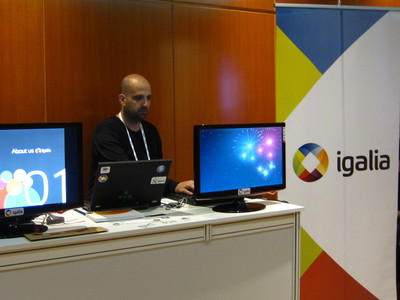
and the KVM Forum. We are sponsoring the event and we have a couple of presentations this year, one about QEMU, device drivers and industrial hardware (which I gave today, slides here) and the other about the Grilo multimedia framework (by Juan Su rez). We ll be around the whole week so you can come and talk to us anytime. You can find us at our booth on the ground floor, where you ll also be able to see a few demos of our latest work and get some merchandising.
Igalia booth

MJ Ray: Seize the Media! @theBoyler @coopsutd

image

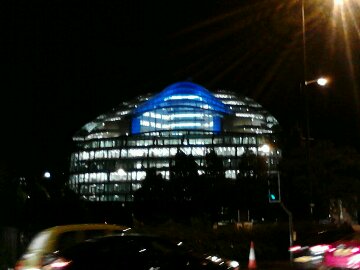
1 Angel Square

So when I arrived on Thursday (ten minutes early despite a cancelled train, thanks to help from the cooperative fellow traveller mentioned last post), I was in time to go to a workshop on media cooperatives led by @theBoyler. It wasn t what I expected. It seemed to concentrate on the opportunity presented by the current awful state of news media companies in many countries and the technology-driven changes to their businesses. For example, WordPress is a viable way to start online first, then move into print later. There are already news co-ops in places where there would be no local news media. The challenge well be how to overcome what I d call spoiling or scorched earth tactics from departing media companies. Some local news media owners are looking for a way out. One obvious one is to turn a local title into a minor variation on a regional-or-worse service or publication, maybe by selling it to a bigger media business. That loses some audience but many will put up with it, so it avoids creating an obvious gap in the market for more truly local reporting. Much else was covered and the audience suggested tons of examples. I m not sure we reached many firm conclusions, but there seem quite a few examples to learn from (Morning Star, taz, ) and Dave Boyle s work is continuing

4 November 2012

Wouter Verhelst: Windows usability: followup.

Yesterday, I posted a blog post containing a list of issues with Windows, in response to a similar list for Linux, which has received quite some response; I've seen people +1 it on google+, and I've received a number of replies on the blog post itself. One of these replies was by the author of the original list; and as expected, he totally and utterly failed to see the point. He also has the audacity to claim I haven't installed Linux yet what?!? The last time I used anything other than Linux on my personal machine for any real work was on Windows 98. And no, that was not because I was too cheap to buy the latest and greatest. I have used Windows in some cases since then, but never on my own hardware. First of all, I should note that the list which I posted was only semi-serious (with tongue in cheek); the fact that it refers to Windows as the operating system which "attempts to replace Linux as the major operating system" should have been a pretty big clue to that effect. Like the original list that it was a reply to, my list contains things that are only true in a particular context (e.g., the one about requiring recent hardware), it contains things that don't matter for the large majority of Windows users (e.g., the point about focus-follows-mouse) but that are major arguments for why I don't use Windows, it contains things that are so alien to what most of us are used to that even most Linux users don't use it, while on the other hand some swear by it (like the SELinux argument), and it contains some things that a seasoned Windows user will call bullshit on but that are real actual problems for the non-seasoned Windows user that I am (such as the mouse argument). It also contains some actual facts, like the statement about most crashes being a direct result of faulty drivers that's pulled directly from a scientific study on the subject conducted by Microsoft, together with some independent researchers. Like the original list, I don't expect this list to change anything for the better, precisely because it is flawed in exactly the same way. But whether the items on that list were right or wrong isn't the point. This is: Nobody (except nutcases) ever said Linux is perfect, or that it's useful for everyone; and while the issues Artem lists may be bugs or may be design flaws or any of a number of other things that could be real problems, the fact is that creating a long "list of issues" isn't going to solve anything. If you find that there are problems with Linux, you basically have three options: fix the problem, get someone to fix it for you, or stop using Linux. Really. Rather than better or worse, Linux is different. It will have its own set of problems, and it will have its own set of advantages. Some of the design decisions cause problems, but also have serious advantages, and focussing on only these problems (the existence of which I'm not denying) isn't very helpful. A good example is the library model: under Linux, libraries are typically installed in a system-wide location, and use a SONAME which is (part of) the filename of that library and which defines the binary interface exported by that library. In contrary to the situation under Windows, Linux libraries also must use position-independent code. The result is a more robust library model. The downside to that model, however, is that when you install older applications that require older SONAME versions of a particular library, getting those older versions may be a challenge. While in theory, installing an older version of a library is not going to cause any problem if the SONAME is different, in practice you'll often find that you'll need to go to (unsupported) older packages from older versions of the distribution, which may not install due to missing or conflicting dependencies, or which may expect data files in a different format in the same location that newer versions of the same library do, or which may have any number of other issues. When that happens, the solution is to either use an older version of the distribution in a chroot or some such, or to patch and/or compile the needed libraries yourself, and install them alongside the newer version of the same library. That's perfectly possible, after all, precisely because of the SONAME. Another good example is the development model: where Windows has a central authority (Microsoft) which defines what it is to be "Windows" and what is and isn't part of that, the same simply isn't true about Linux. Yes, Linus defines what the official Linux kernel has, but he doesn't have any say about the user interface, the boot process, or any number of other things; other people make decisions there. As a result, in effect, who decides what it means to be a "Linux system" is, really, you, the user. If you believe that the Linux user space is completely wrong, you can just change it to something else entirely; and that's precisely what Google did when they created Android. Since there's no central authority making decisions about what will and won't go into the system, this means that inevitably, at any given time, there will be many competing options for many subsystems. Usually this will be an advantage; e.g., the competition between KDE and Gnome benefits both. Sometimes, however, the competing options are so confusingly interwoven that even those who should know the system inside out can't make heads or tails of it, and debugging issues then becomes quite a challenge. Unfortunately, the Linux sound subsystem is currently an example of the latter. I'm not saying that all the items in Artem's list are invalid; a minority are, in fact, actual problems for a majority of Linux users. Most however, are personal opinions, issues affecting only a small minority of Linux users, or, as above, things where he only talks about the downsides of a design decision that also has major advantages. As an example of something in the second category: it's easy, for example, to list hundreds if not thousands of issues relating to particular pieces of hardware that don't work under Linux, simply because the manufacturer doesn't provide any information, and the people developing drivers for Linux have to reverse engineer how everything works. If you're a bit careful in what you buy, however much like MacOS users need to be careful, too then using Linux isn't an issue. My Lenovo Thinkpad X220, for instance, has no parts that don't work; and this includes things like a docking station, and the fact that my (9-cell) battery life is over fourteen hours, which (I believe) is more than on the same laptop with the same battery under Windows. So how is making a list of issues useful? The answer to that is simply, not at all. If you want to help, don't look for other people's problems; we can all do that. Instead, try to look for solutions to these problems. That's not always easy, and in many cases requires that you first understand why something is done in a particular way. If you don't want to spend time doing that, that's perfectly fine; but then don't expect that open source developers (who are already strapped for time, usually) will suddenly jump up and fix the problems you think are most important, as opposed to what they think should be worked on most urgently. After all, most Open Source developers have their own sets of priorities what they think requires most work, and that's what they'll work on not what's shown in a particular list by someone they don't know and have no reason to respect, somewhere on the Internet. Finally, I'd like to note that any statement which claims that Linux isn't "ready" to be used on the desktop, when hundreds of thousands (if not millions) of people are using it in exactly that way for their day-to-day work, is insulting these people's intelligence. Since that includes me, it's also insulting my intelligence. And I don't like to have my intelligence insulted...

MJ Ray: The @coopsutd Journey

image I m on my way back from Cooperatives United. I haven t quite posted as much as I planned (just a few microblogs/tweets) because the event was so much bigger and busier than I expected! So I m writing this on my (6 hour) journey home. We ve attended Congress before and it was nothing like that. I was expecting something maybe 50% larger than last time and this seemed more like 300%. I wonder if Cooperatives UK have some numbers Maybe it reflects the growing strength of the cooperative economy that they reported in the summer just gone. Anyway, I was pleasantly surprised on the journey from Norfolk. I made a brief informal travellers co-op with an actor from Micawber Theatre company (tickets on sale now for shows in Ipswich and London) to overcome the challenge of East Midlands Trains. Unprompted by me, he blamed the shocking service on the big train businesses being unaccountable to passengers. Maybe that s it. Cooperatives are accountable and people are ready for more responsible post-capitalist businesses. That s why coops are doing well now and Cooperatives United was such a lively event. I ll write more tomorrow. Now if you ll excuse me, we ve got to get off and change carriages because East Midlands Trains couldn t be bothered to tell us the train divides at Nottingham until long after we boarded!

Next.

Previous.