Search Results: "ina"

6 February 2011

Nikita Youshchenko: Keeping KDE3 when upgrading to squeeze

This post is for those who want to upgrade their debian to the shiny new release, but still wants to continue using KDE3 packages from lenny. This could be done by keeping lenny as a low-priority apt source, and proper package pinning. To keep system more consistent, I use the following rule: pin to lenny all packages from sources that build something depended on KDE libraries. This rule catches all of KDE3, and also everything that uses KDE3 libraries, but was not included into KDE3. Also, this keeps good practice of avoiding installation binary packages built from different versions of the same source package. One exception is OpenOffice.org. Due to it s KDE plugin, it is caught by the rule. But lenny has too old version of it. Better to take version from lenny-backports. Below is my script that generates needed configuration. It parses /var/lib/apt/lists/*_lenny_*_Packages files; to have these, lenny should be mentioned by name (not by oldstable alias) in /etc/apt/sources.list. Packages found are pinned with priority of 900 (this value may need to be adjusted). Output of the script could be put directly into a file in /etc/apt/preferences.d/ directory before upgrading system to squeeze.
#!/bin/bash
# Find out sources that build packages depending on kdelibs4c2a, and pin
# to lenny any package that comes from any of those sources.
# Exception is openoffice.org - pin it to lenny-backports instead
cat /var/lib/apt/lists/*_lenny_*_Packages   awk '
        BEGIN  
                found["kdelibs"] = 1
         
        /^Package: /  p=$2; s=$2 
        /^Source: /   s=$2 
        /^Depends:.*\<kdelibs4c2a\>/  found[s]=1 
        /^$/  allp[p]=1; p2s[p]=s 
        END  
                delete found["openoffice.org"]
                for (p in allp)  
                        if (p2s[p] in found)  
                                print("Package: " p)
                                print("Pin: release n=lenny")
                                print("Pin-Priority: 900")
                                print("")


'
cat /var/lib/apt/lists/*_lenny-backports_*Packages   awk '
        /^Package: /  p=$2; s=$2 
        /^Source: /   s=$2 
        /^$/ && s=="openoffice.org"  
                print("Package: " p)
                print("Pin: release n=lenny-backports")
                print("Pin-Priority: 900")
                print("")
         
'

Vincent Fourmond: Doxygen and Ruby...

I've been using Doxygen for a while now, and, no surprises, I find it fantastic ! The only thing that is really missing there is a decent support for Ruby... Allright, Ruby already has a documentation system, rdoc, but using only one for everything has its charms, and Doxygen is doubtlessly much more evolved than rdoc. Maybe when I have time, I'll have a look at writing it. (but that won't be before a long time...). Update: I finally had some time to write and publish this patch. It is available on github

Martin Michlmayr: Upgrading to Debian 6.0 (squeeze) on ARM

Debian 6.0 (squeeze) has been released. Here are some notes if you're running Debian on an ARM-based NAS device or plug computer and are planning to upgrade. First of all, make sure to read the release notes for Debian 6.0 on ARM. This document contains a lot of information on performing a successful upgrade. Second, during the kernel upgrade, you'll get the following message about the boot loader configuration:
The boot loader configuration for this system was not recognized. These
settings in the configuration may need to be updated:
 * The root device ID passed as a kernel parameter;
 * The boot device ID used to install and update the boot loader.
On ARM-based NAS devices and plug computers, you can simply ignore this warning. We put the root device into the ramdisk so it will be updated automatically. Finally, after doing the upgrade and before rebooting your system, make sure to run flash-kernel to activate the new kernel.

Benjamin Mako Hill: Editor-to-Reader Ratios on Wikipedia

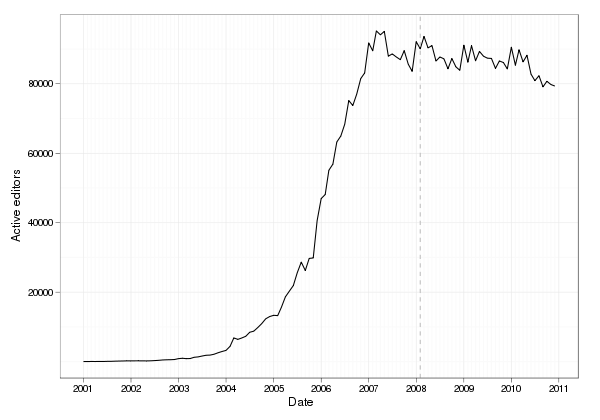
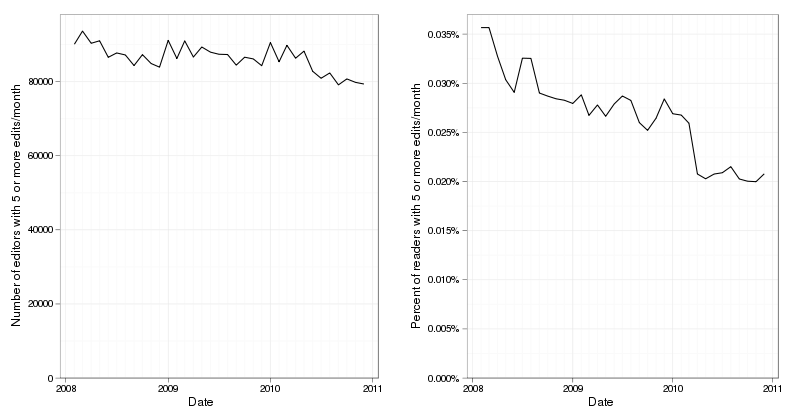
It's been reported for some time now that the number of active editors on Wikipedia (usually defined as people who have edited at least 5 times in a given month) peaked in 2007 and has been mostly stable since then. A graph of the total number of active editors in every month since Wikipedia's founding is shown below. The graph shows the aggregate numbers for all language Wikipedias. English Wikipedia is the largest component of this and is generally more variable. That said, very similar patterns exist for most larger languages. /copyrighteous/images/active_editors_all_wikpiedia.png Felipe Ortega, who has provided many of these statistics, has warned against fatalist claims. Although there seems to be a decrease in the total number of active editors over the last two years, the situation seems to have somewhat stabilized in most languages. New editors in Wikipedia are replacing folks at almost the rate that they are leaving. It is also widely known that the number of readers of Wikipedia has been increasing during this period. According to the report cards released by the foundation using comScore data, the number of unique visitors to Wikipedia each month has increased by 61 million people in the last year -- over 17%. This discrepancy between rising readership and stable or sinking editorship should raise major concern. After all, the Wikimedia Foundation's mission is two part: (1) to empower and engage people around the world to collect and develop educational content and (2) to disseminate it effectively and globally. Although the Foundation report cards include measures of raw levels of editorship, a better metric of engagement and empowerment might be the proportion of readers who engage in editing. I could not find reliable data on the number of unique readers reached each month for more than a few months in the last year. What is available, however, is wonderful data on page views each month going back to 2008. Analysis of the data from available report cards show that, at least during the last year, there is a very stable ratio of 35 page views per unique visitor, as estimated by comScore. Using that measure, we can do a back of the envelope estimation on the proportion of users that are editors for the period where page view data is available, dating back from February 2008 ( marked with the grey dashed lined above). The graphs below show the very different results you get when you consider the change in the number of Wikipedia editors and the change in the editor-to-reader ratio. Once again, these data are combined data for all language Wikipedias although graphs look very similar for most larger languages. The results are striking. Although there has been a 12% decrease between February 2008 and December 2010 in the number of active editors, there is a 42% decrease in the proportion of readers who edit at least five times a month. We can see that fulfilling the first half of the Wikimedia mission remains a struggle. /copyrighteous/images/wikipedia_editors_combined_graph.png Although the graphs above do not say anything directly about the most active core contributors to Wikipedia, the fact that Wikipedia is being maintained by a tiny -- and shrinking -- proportion of its readership does mean that the idea behind Wikipedia is under threat. Although none are as big as Wikipedia, there are lots of good encyclopedias out there. The reason Wikipedia is different, interesting, and important is because -- unlike all those others -- Wikipedia is the encyclopedia that anyone can edit. Wikipedia is powerful because it allow its users to transcend their role as consumers of the information they use to understand the world. Wikipedia allows users to define the reference works that define their understanding of the their environment and each other. But 99.98% of the time, readers do not transcend that role. I think that's a problem. Worse, that the number is growing. The Wikimedia Foundation recently ran a major successful effort to attract donations in its annual fundraiser. Jimmy Wales' smiling mug is apparently enough in the way of motivation to get something like 1% of its readers to donate money to support the project. I think that's very good news. If the Wikimedia community can entice even half of those people to contribute through an increased involvement in the projects themselves, they might do more than ensure Wikipedia's continued growth. They would help take a step toward the empowerment and engagement of those users in sharing their own knowledge, and the continued fulfillment of a critically important mission.

Erich Schubert: Debian Squeeze released!

Debian GNU/Linux 6.0 "squeeze" has been released today.
Congratulations to everyone involved in ironing the last few bugs out.
(My own involvement had been a bit limited recently, but I at least kept my few remaining packages in a ready-to-release state and helped with the occasional bug report and patch.)
Some people think that Ubuntu is the better Debian - I do NOT. Debian is a fun place, has great people working on it and is true to its aims at creating a truly free and high-quality distribution. The long release cycles of Debian are a feature, not a bug. Stable is for production systems, not toy projects.
The proper way of attributing Debian stable is conservative and sustainable, but not outdated. It actually can do everything you need - and will do so in 10 years.
If you have been using Open Source for as long as me (say 15+ years) you will probably have seen software hypes come and go. The one thing that has been always the same was Debian: dead reliable. There was a time when everyone was crazy about enlightement for it's shiny pretty UI. Almost like Compiz-Beryl just two years ago. It came, as a matter of fact Debian also had it, but it also went.
I also remember how people complained that Debian didn't ship Xgl back in 2006 when this was the latest hype (there was no Debian release in 2006). Well, Xgl died in 2008. The features remained, but done in a much nicer way, and also found their way into Debian. In fact, I also ran Xgl at least once, on Debian, but just not on "stable". One could say that Xgl never was quite "stable", was it?
Debian stable is good the way it is: an administrators choice. Of course, developers might have different needs, but there also is testing, unstable and experimental. Just make sure to align your choice with your needs. And sometimes, also rethink your needs: there is no "latest beta versions" and "stable platform" at the same time.

Nico Golde: Debian 6.0 squeeze

Wooohoo, we finally released squeeze! Many thanks to everyone who worked on this the past 2 years and also it's nice to see the new "corporate" design going live!

Meike Reichle: Squeeze Release Live Dent Finished

That's it! Squeeze is released and the website's new design is in place. What a great day! In addition to the usual announcements on the website and mailing lists we decided to also do a live coverage of the whole process using identi.ca this time! Alex and me have been doing a live coverage of Debian's release process for almost 19 hours straight and, although we're dead beat now, I think it was well worth it! People seemed to enjoy being included in the process and many expressed their admiration for Debian's well-coordinated and purposeful proceedings. Congratulations to all involved: the FTP team, the release team, the CD team, the www team and the publicity team! Great work everyone!

5 February 2011

Joerg Jaspert: Squeeze Release

So after quite a while I again had the opportunity to do the ftpmaster works of a Debian release. Not quite my first and hopefully not my last one, lets see. And, like last time, Mark joined to help with the work. Again, a few moments and not a detailed log (times in UTC): Right now (that is, 21:38 UTC) I am mosty waiting for the rest of the people working on the release (CD builders, press, website, ) to finish their task (building hundreds of images just takes ages). When that is done we can then do a coordinated push to the world. Last plans for that would mean in about an hour . Lets see, Mr. Murphy sure can be around. Thanks go out to everyone involved in preparing this release, be it in the past by fixing bugs, uploading packages, doing whatever was needed, as well as doing the work today. Update: If you miss us setting the new testing AKA wheezy to something inside there - there is no need to. It is simply the continutation of testing with just another name, which did not get changed contents, so nothing done for that. :)

Vincent Fourmond: ctioga superseded by ctioga2

First, some historical details: some 6 years ago, I discovered Ruby together with Tioga, a great library for producing plots. That immediately resulted in my first Ruby program, ctioga. But as years passed and more features were forced into ctioga, I was compelled to see my initial design mistakes, and think about a complete rewrite. This is where ctioga2 was born, some time at the beginning of 2009. I completely stopped using the old ctioga a few month after starting to work on ctioga2, but it took ages before I finally came up with a decent enough documentation to release and announce publicly. But now, it's done, and the first public release of ctioga2 is out, still fresh ! Here are a few highlights of the differences: In any case, you can make yourself an opinion of ctioga2 by looking at the galleries. Enjoy !

Ian Wienand: Comcast self-setup with Netgear routers

I just got a Zoom 5341 modem to replace a very sketchy old Motorola model and so far it seems to work fine. However, the Comcast self-install switch process was not seamless. After you plug your new modem in the process starts fine, capturing your session and prompting you for your account. However at the next step it prompts you to download the Windows or Mac only client, directing you to an address http://cdn/.... It is at this point you can get stuck if you're behind a Netgear router (I have a WNDR3700) and probably others. The simple problem is that, for whatever reason, the factory firmware in this router does not pass on the domain search suffix through its inbuilt DHCP client. Without that, cdn doesn't resolve to anything, so you can't download the self-help tool and you're effectively stuck at a "can not find this page" screen. If you google at this point you can find many people who have hit this problem, and various information from erroneous suggestions that you've been hacked (?) to most people just giving up and moving into Comcast phone support hell. Assuming you now don't have internet access, you can complete the process with a quick swizzle. Somebody might be able to correct me on this, but I don't think you want to run the self-install tool from an actual computer plugged directly into the modem if you have a router in the picture, because the wrong MAC address will get registered. So, your best solution is to turn everything off, plug your computer directly into the modem, turn it on, get an address, download the tool, turn everything off, plug the router back-in to the modem and then run the self install tool. At this point, everything just worked fine for me. Netgear should probably fix this by correctly passing through the domain search suffixes in their routers. Comcast should probably fix this by doing some sort of geo-ip lookup to give clients a fully-qualified address in that webpage to download the tool even if their router is broken (or really, does downloading that file really require a content-delivery network?). You can probably fix this by running Openwrt on your router before you start. Otherwise, the Zoom modem and the Netgear WNDR3700 seem to make a very nice combination which I would reccommend.

Craig Small: A few minor updates

No real terribly exciting updates lately but all important in their own way. ncurses A new version of ncurses got uploaded into sid. It should hopefully fix the backspace versus delete problem some of the FreeBSD people have been having with some of the terminal emulators. Oh, and if you are pining for the good old days when 8 colours and 64kB of memory was good enough for everyone, checkout ncurses-examples which have a bunch of interesting things you can do with curses, including some games. Anyone remeber the tower of Hanoi? dh-make dh-make, the tool to take a raw tar (or zip) archive and make a Debian package has been updated too. One of the interesting side-effects of maintaining dh-make is you find out (usually through bug reports) the little changes that happen to the Debian package build process. Most people, including myself, though the main big thing between versions 1 and 2 and version 3 of the source formats was the inclusion of quilt patches right inside the source files. And probably for the sake of "main things" this is true. What I didn't realise is that dpkg-source has changed in other ways too. Bug 580804 tripped this one up. For most people, you run dh_make, fix some things up and use debuild. If you didn't have the original tar file (perhaps you got the source from git or svn) you just use --creatorig and it copies the current directory into ../whatever-1.2.3.orig Source format 3 doesn't like this. Previously it would find that there was no orig.tar.gz archive but there was a orig directory and make the archive from that. Now you have to do it yourself and dh_make does it like that too. pidgin-musictracker Now this should of been a pretty simple stock-standard upstream upgrade. Download the file, uupdate, debuild and release. The problem is that upstream didn't fix their po files. These are the translation files that convert the raw english texts in a program into whatever language. This means the first time you run the build process, you have no diff file. However when you run it the second time, part of the install target rebuilds the po files (mainly the line references), you have differences and then a big diff file of these po updates. The real fix is to make sure your po files are up to date before you release! The trick is that they don't automatically and I have been caught myself; though it happens in the release testing phase (because my release testing involves usually building the debian archive so I see my own problem). irc came to the rescue again. Someone there suggested getting dpkg-source to ignore the changes. The way you do that is put parameters into debian/source/options. I wanted to ignore the changes to the po and pot files so my file has:
extend-diff-ignore=po/.*\.pot?
I put that in and it works!

4 February 2011

Robert Millan: Diskless Debian GNU/kFreeBSD HOWTO

It was completely non-obvious; In some cases I had to figure it out by reading kFreeBSD source code; I write it down here so it s not forgotten ;-) This is a short guide on how to boot Debian GNU/kFreeBSD via network on a diskless machine, using GRUB as the bootloader.
  • Step 1: Configure your DHCP/TFTP environment to load GRUB from network. See the PXE GRUB documentation for details.
  • Step 2: Rebuild kfreebsd-8 package with BOOTP and BOOTP_NFSROOT options, as described in upstream handbook. They need to be added to the debian/arch/*/*.config file for your architecture. This kernel can still be used for normal, disk-based boot, but it will issue DHCP requests to attempt network boot every time you start it.
  • Step 3: Put your kFreeBSD in TFTP directory and configure GRUB to load it. This requires only one command in grub.cfg. My setup:
    set timeout=1
    set default=0 menuentry Debian GNU/kFreeBSD
    echo Loading kFreeBSD
    kfreebsd /beastie/boot/kfreebsd-8.1-1-amd64.gz
    echo Booting
    boot
  • Step 4: Build a directory tree with your GNU/kFreeBSD userland, and export it via NFS. I copied it from an existing Debian GNU/kFreeBSD install, but I suppose debootstrap could do the job as well.
  • Step 5: kFreeBSD mounts root NFS in readonly mode initially, and Debian userland turns out to be very unhappy with that. If you want things to work you ll need to either setup tmpfs in a few places (e.g. /tmp) or adjust fstab so that / is remounted as writable by the INIT scripts. Example fstab line:
    192.168.1.3:/srv/netboot/beastie / nfs rw 0 0
    This, however, will only work if mount_nfs(8) is in your system. And (well, too bad) it hasn t been packaged yet. So you can copy it from a FreeBSD base tarball, along with its dependencies (/lib/libc.so.7, /libexec and /etc/netconfig).
  • Step 6: Finally the system boots, but you ll soon notice that file locks don t work. This breaks some daemons (rsyslog), dpkg, apt and possibly a lot other things. Actual (i.e. non-local) file locking on NFS requires a running lock daemon, both on client and on server. However, since FreeBSD lockd isn t packaged either, and you probably don t need global locks anyway, I suggest you disable it with nolockd mount option.
    The tricky part is that as explained in mount_nfs manpage, nolockd will only be honored when performing the initial mount, and it will be silently ignored if used while updating the mount options. So fstab is not an option.
    The only way I could find of telling the kernel to use arbitrary options when mounting / is by sending them via DHCP. Use the following options in your dhcpd.conf:
    option option-130 code 130 = text;
    option option-130 nolockd ;
  • Et voil . A Debian GNU/kFreeBSD system running completely in diskless mode. Enjoy!

    3 February 2011

    Rapha&#235;l Hertzog: People behind Debian: Mike Hommey, Firefox/Iceweasel maintainer

    Mike Hommey, our Iceweasel maintainer

    For as long as I have known Mike, he s been maintaining one of the largest (and most widely used) package: Iceweasel, Debian s default web browser. It s effectively Mozilla s Firefox although it has been renamed to avoid some rules enforced by Mozilla s trademark policy. But we might see Firefox back in Debian read on to know Mike s plans. His story is also very interesting in that he went from simple user to Iceweasel maintainer, and now he s working for Mozilla Corporation. But you already knew that contributing to free software is a good way to grow skills and gain experience that are valuable on the job market, right? ;-) My questions are in bold, the rest is by Mike. Who are you? I am Mike Hommey. I am French, even if my name doesn t sound so. I have been a GNU/Linux user since 1995, using Debian since 1999, and started packaging in 2003. After a long time in the NM queue, I became a DD in 2005. The main reason I started being actively involved is quite selfish: I wanted some things done, and I just did them. My first packages were extensions for the Mozilla Suite, the old one that directly inherited from Netscape Communicator. Later on, I wanted some of these extensions to work with the new kid on the block: Phoenix; or maybe it was already Firebird. By then, integrating extensions was a hassle, and the mozilla-browser maintainer had come up with a script that would make it easier for extension packages. So I ported that script for use with Phoenix/Firebird and sent it to the BTS. Then Phoenix/Firebird became Firefox, and it grew a real extension manager. Except that is was entirely not suited for extensions installed by the packaging system. So I made it work better. And made a few more changes to make Firefox work better. All through patches or NMUs. Then I became co-maintainer, then Firefox couldn t keep its name and became Iceweasel, and, fast-forward until today, I m now taking care of Iceweasel/Xulrunner and Iceape in stable, unstable, experimental and an external repository. This 8 years-long story (wow, I hadn t even realized it had been that long until I wrote it) tells you something: newcomers shouldn t be afraid to stick their hands anywhere, even in big packages. I was only a Mozilla and Phoenix end-user when I started. Apart from Mozilla-related packaging, I also happen to (co-)maintain some other packages in Debian, most notably webkit, though I haven t been very active in the pkg-webkit team recently. There are several reasons for that, the main one being that there are other team members getting the job done. And I can t say that much about the pkg-mozilla team, since there are effectively no other team members. What s your biggest achievement within Debian? I am quite proud that Squeeze will be the first Debian release where Iceweasel works on all supported architectures. Previously, we only knew the package compiled on all these architectures. Starting with Squeeze, we know it passes several of the test suites coming with the source code. This ensures most of the browser is functional. It was actually far from being the case before, as it appeared when the test suites were first enabled. I think it is very important to have properly working packages on all our supported architectures. The current evolution of hardware shows how important it still is. Who would have thought a few years back that we would see ARM or MIPS based netbooks today ? What are your plans for Debian Wheezy? For Debian Wheezy, I would like to improve Iceweasel/Icedove/Iceape integration with the packaging system. Something that would allow to use the apt database to find extensions or plugins, on top of the current behaviour. I also want to improve desktop integration, most notably for KDE. Another thing I d like to see happen is to package google breakpad independently (its source code is currently embedded in chromium and iceweasel, though not built, as far as I know), and have our Mozilla products builds be able to send their crash reports upstream. It is very important that upstream gets direct visibility over what crashes on GNU/Linux systems. It helps making them aware of issues that would otherwise probably remain unnoticed, as there are much more users using distributions packages than upstream tarballs. And not all Debian users report crashes to the BTS. I know at least Fedora and SuSE are already doing it. More importantly, I want to avoid the sad situation we got with Squeeze, where we re going to release a 18 months old Iceweasel. We got there for a combination of reasons, one being that I was preparing for a freeze in December 2009 and focusing on getting 3.5 in shape instead of the then upcoming 3.6. The result was that we didn t get 3.6 packages before upstream released 3.6.3 in April 2010. By then it was too late, considering the uncertainty of the release schedule, to update reverse dependencies and get 3.6 ready for Squeeze. Things are different for 4.0. I m already getting ahead of things, and while reverse dependencies haven t been taken care of, all beta releases have been made available through http://mozilla.debian.net/, usually within hours after upstream release (sometimes even a few hours before official announcement, but always after availability on ftp.mozilla.org). A great share of our patches were also pushed upstream. Several things made that possible: There will be a couple major upstream releases until Wheezy comes along, and I want to make them available early in unstable, even if that means breaking reverse dependencies until they are fixed. Finally, I would like to get other people involved, starting with the Icedove maintainer. Volunteers are very much welcome, for any kind of involvement: bug triaging, documentation (which we are deeply lacking), testing, code People interested can contact the pkg-mozilla team list. As the Debian packaging gets less time consuming, I should be able to spend more time mentoring, which should help. If you could spend all your time on Debian, what would you work on? I actually have been working almost full time on Debian for a few months during a more-or-less purposeful unemployment period. That s when I attempted to add an alert popup when Iceweasel or extensions are upgraded (which was eventually removed because not working very effectively). That s when I worked on Iceweasel 3.6 and the first 4.0 betas. That s when I pushed more than 70 patches upstream, and got upstream commit access. I know for a fact that keeping up with upstream and answering bug reports is already time consuming, and time comes in finite quantity. Working full time on Debian allows to do more than that, as I ve been able to experience first hand. Unfortunately, that doesn t help pay the bills, so it would be best if time could be shared with other persons. Like, actual members in the pkg-mozilla team. ;) Anyways, if I were to work full time on Debian again, I d like to do more than packaging, and help improve some of our infrastructure, most notably the buildd network, to grow some automated way to get packages built on all or some of our architectures. Call that PPA if you want, though I don t think we need something exactly like PPA. We sure do have porter boxes, but there is a huge overhead to get packages built there: you need to first try, then see you lack build dependencies, then wait for admins to install them, then come back and launch your build, and finally come back again much later to see how it went. And that s when it goes smoothly. Repeat for each architecture. It s already cumbersome when it s a small package, so imagine when it s Iceweasel. I d like to be able to push a (signed) .dsc somewhere, say I want it built on that and that architecture, and get binary packages and logs back. It could then be up to developers to distribute them, or not. Sometimes, you re just interested in test suite results. Another related wish would be a way to access build trees of failed builds, possibly on the buildd where it failed. What s the biggest problem of Debian? Lack of contributors, lack of contributors, and lack of contributors. It can sound weird to say that in a community of 1000+ people. But the sad reality is that we ve seen, repeatedly, calls for help in various places from various understaffed teams (most often of effectively one member) for years. So there is obviously a problem getting people to invest time in these teams either on the long term, or at all. I know this is not a very significant metric, but it already should say a lot: I wouldn t be surprised if more than 2/3 of the number of source lines of code in Debian come from less than 5% of the number of packages in the archive, and see less than 5% of the DD/DM population involved. If someone feels like doing the actual math, I m curious to know how far I m from reality, and in what direction. We also lack manpower to be able to make our release development smoother. In a perfect world where manpower is not a scarce resource, we should work on $release+1 when $release is being frozen. Said otherwise, we should have been able to start working on Wheezy in August 2010, or even earlier. You ve been working for Mozilla Corporation for a few months. How does the work look like and what are you working on? I am actually not working full time for MoCo; I am only contracting for 4 days a week. That was a request I made to keep having enough spare time for Debian or other activities. I am working from home, and am pretty much free about when I work, as long as I work long enough. I take advantage of this freedom and the saved commuting time to live a healthier life by doing some sports in the daytime (which also happens to be cheaper). I mostly work with Taras Glek and other people on various aspects of Firefox startup performance. This involves pretty interesting low-level stuff, in which I actually got involved before being contracted. This work has nothing to do with packaging Iceweasel, though I can have a few opportunities to do things somehow related. You told in your blog that you were discussing with Mozilla how Debian could use the Firefox trademark. Can you tell us a bit about the progress you made? I have got an informal approval of the patches we are applying to the Iceweasel 4.0 beta packages. There are a few concerns about using the system cairo library, and the embedded copy of libpng needs to be used to have support for the animated PNGs that are used in the user interface and that are required in Firefox feature-set. Other than that, there are pretty much no objection on the technical side. We managed to get to some common ground as to how to manage stable updates and more generally, changes to our packages, but I m still waiting for an actual agreement draft. While I, as the maintainer, am fine with the way it should look according to my discussions with the people involved at Mozilla, I ll seek review from my fellow Debian Developers when I ll have something to show. I haven t decided yet how this will reflect on the Debian packages, though. For example, would Iceweasel stay? But I do hope Wheezy will get Firefox back. Is there someone in Debian that you admire for their contributions? Not someone, but all past, present and future release team members. This is a team that receives a lot of critics (and I indirectly gave one a few paragraphs ago), yet manages to keep doing an amazing job and its members are very committed to their task. I admire their dedication.
    Thank you to Mike for the time spent answering my questions. I hope you enjoyed reading his answers as I did. Subscribe to my newsletter to get my monthly summary of the Debian/Ubuntu news and to not miss further interviews. You can also follow along on Identi.ca, Twitter and Facebook.

    8 comments Liked this article? Click here. My blog is Flattr-enabled.

    2 February 2011

    Enrico Zini: Gzip streaming in Python (or lack thereof)

    Gzip streaming in Python (or lack thereof) Consider this simple Python snippet:
    #!/usr/bin/python
    import gzip
    from urllib import urlopen
    zfd = urlopen("http://ftp.debian.org/debian/dists/sid/Contents-udeb.gz")
    fd = gzip.GzipFile(fileobj=zfd, mode="r")
    for line in fd:
        foobar(line)
    
    It does not work: it turns out GzipFile wants to seek() and tell() on its file object:
    $ /tmp/z.py 
    Traceback (most recent call last):
      File "/tmp/z.py", line 8, in <module>
        for line in fd:
      File "/usr/lib/python2.6/gzip.py", line 438, in next
        line = self.readline()
      File "/usr/lib/python2.6/gzip.py", line 393, in readline
        c = self.read(readsize)
      File "/usr/lib/python2.6/gzip.py", line 219, in read
        self._read(readsize)
      File "/usr/lib/python2.6/gzip.py", line 247, in _read
        pos = self.fileobj.tell()   # Save current position
    AttributeError: addinfourl instance has no attribute 'tell'
    
    Oh dear... this really shouldn't be. Let's look around the internet for details:
    Since opener.open returns a file-like object, and you know from the headers that when you read it, you're going to get gzip-compressed data, why not simply pass that file-like object directly to GzipFile? As you read from the GzipFile instance, it will read compressed data from the remote HTTP server and decompress it on the fly. It's a good idea, but unfortunately it doesn't work. Because of the way gzip compression works, GzipFile needs to save its position and move forwards and backwards through the compressed file. This doesn't work when the file is a stream of bytes coming from a remote server; all you can do with it is retrieve bytes one at a time, not move back and forth through the data stream. So the inelegant hack of using StringIO is the best solution: download the compressed data, create a file-like object out of it with StringIO, and then decompress the data from that.
    Oh really, so it's a limitation of "the way gzip compression works", and the only way to work around this fundamental design flaw of gzip is to buffer the lot in memory or to a temporary file? [facepalm]
    # Apparently, this is not how gzip compression works:
    curl http://ftp.debian.org/debian/dists/sid/Contents-udeb.gz   zcat
    
    This is not the first time that, after finding a frustrating spot in core Python things, looking around the internet for extra information has the effect of amplifying my frustration by destroying my expectations of common sense. What is the gzip module doing anyway?
        if self._new_member:
            # If the _new_member flag is set, we have to
            # jump to the next member, if there is one.
            #
            # First, check if we're at the end of the file;
            # if so, it's time to stop; no more members to read.
            pos = self.fileobj.tell()   # Save current position
            self.fileobj.seek(0, 2)     # Seek to end of file
            if pos == self.fileobj.tell():
                raise EOFError, "Reached EOF"
            else:
                self.fileobj.seek( pos ) # Return to original position
            self._init_read()
            self._read_gzip_header()
            self.decompress = zlib.decompressobj(-zlib.MAX_WBITS)
            self._new_member = False
    
    Right, tell() and seek() in order to check if it's reached end of file. Oh dear... So, there's a flaw in the Python standard library, and: I wish core Python documentation started properly documenting Python flaws so that one can code with language limitations in mind, insted of having to rediscover them and their work arounds every time.

    1 February 2011

    Ana Beatriz Guerrero Lopez: Debian at the Google Code-in 2010-11

    As you might know, Debian was one of the 20 organizations selected to participate in the first Google Code-in. We got a moderate success since we started preparing the contest very late (I joined as mentor/admin the very first day of the contest!). Because of this, unlike other organizations, we did not manage to engage interested students from the very beginning of the Code-in. Since we did not have too many Debian tasks the first days, we did not attract many students, and thus did not have very many throughout the contest. Given Debian tasks were mostly about improving and contributing to Debian, it was quite hard having tasks that did not require having a Debian installation and that made it difficult for many students to get involved. Also, until the last two weeks we did not have any translation task that could have attracted earlier students without too much confidence in their technical and English skills. Nonetheless, Debian got 39 tasks done: With about 30 students participating and at least one of the students has keep contributing to Debian after the contest! The contest was sometimes stressful with several students wanting their tasks to be reviewed at the same time, and the date was problematic due to the winter (or summer!) holidays but still I am quite happy with the final result :D Debian will be also participating again this year in the Google Summer of Code 2011. Join the soc-coordination mailing list and stay tunned if you want to participate as mentor or student.

    Cyril Brulebois: Debian XSF News #3

    Time for a third Debian XSF News issue! Debian XSF News #3 It s been a year On a personal note, it s been a year to the day since I first looked into X. After having hacked on the Debian Installer to make it use X.Org instead of DirectFB, I did some heavy bug triaging, resulting in a drop in the xorg-server bug count in March. The same happened past week as written above, resulting in a second drop. In the meanwhile, the bug count remained more or less stable, since we try to reply quickly to new bugs, and since Julien Viard de Galbert does bug triaging on a weekly basis: BTS graph for xorg-server One might ask: what does maintaining X mean?

    31 January 2011

    Tiago Bortoletto Vaz: TXT2TAGS SAMPLE - Aurelio Jargas

    Before you start reading: this post is only intended to test a plugin that I've just written to give PyBlosxom a txt2tags formatting support. The original txt2tag sample used here is available at txt2tag website. Mine with few changes is here.IntroductionWelcome to the txt2tags sample file.Here you have examples and a brief explanation of allmarks.The first 3 lines of the this file are used as headers,on the following format:
      line1: document title  line2: author name, email  line3: date, version
    Lines with balanced equal signs = around are titles.Fonts and BeautifiersWe have two sets of fonts:The NORMAL type that can be improved with beautifiers.The TYPEWRITER type that uses monospaced font forpre-formatted text.We will now enter on a subtitle...BeautifiersThe text marks for beautifiers are simple, just as youtype on a plain text email message.We use double *, /, - and _ to represent bold,italic, strike and underline.The bold italic style is also supported as acombination.Pre-Formatted TextWe can put a code sample or other pre-formatted text:
        here    is     pre-formatted  //marks// are  **not**   interpreted 
    And also, it's easy to put a one line pre-formattedtext:
      prompt$ ls /etc
    Or use pre-formatted inside sentences.More CosmeticsSpecial entities like email (duh@somewhere.com) and URL (http://www.duh.com)are detected automagically, as long as the horizontal line:
    ^ thin or large v
    You can also specify an explicit link with label.And remember,
    A TAB in front of the line does a quotation.
    More TABs, more depth (if allowed).
    Nice.ListsA list of items is natural, just putting a dash ora plus at the beginning of the line.Plain ListThe dash is the default list identifier. For sublists,just add spaces at the beginning of the line. Morespaces, more sublists.The list ends with two consecutive blank lines.Numbered ListThe same rules as the plain list, just a differentidentifier (plus).
    1. one
    2. two
    3. three
      • mixed lists!
      • what a mess
        1. counting again
        2. ...
    4. four
    Definition ListThe definition list identifier is a colon, followed bythe term. The term contents is placed on the next line.
    orange
    a yellow fruit
    apple
    a green or red fruit
    other fruits
    • wee!
    • mixing lists
      1. again!
      2. and again!
    TablesUse pipes to compose table rows and cells.Double pipe at the line beginning starts a heading row.Natural spaces specify each cell alignment.
    heading 1heading 2heading 3
    cell 1.1cell 1.2cell 1.3
    cell 2.1cell 2.2cell 2.3
    Without the last pipe, no border:
    heading 1heading 2heading 3
    cell 1.1cell 1.2cell 1.3
    cell 2.1cell 2.2cell 2.3
    Special EntitiesBecause things were too simple.ImagesThe image mark is as simple as it can be: [filename]. OtherThe handy %%date macro expands to the current date.So today is 20110206 on the ISO YYYYMMDD format.You can also specify the date format with the %? flags,as %%date(%m-%d-%Y) which gives: 02-06-2011.That's all for now.

    Stefano Zacchiroli: who the bloody hell cares about Debian

    A down-under talk on the role of Debian, A.D. 2011 I'm back from LCA 2011, which I've attended to share some thoughts about the role that Debian plays in the Free Software ecosystem, 18 years after its inception (yes, we are that old^Welder). The talk title---Who the bloody hell cares about Debian? [1]---was meant to be rather provocative. The idea was indeed to challenge the meme that, in the era of distributions that release every 6 months, a distribution with a release cycle of circa 2 years (like Debian, considering the past 5 years) is not a project that deserves your attention anymore. Is it really the case? In the talk I (obviously) claim it is not, using two main arguments. The first argument is based on the observation that Debian offers a set of pretty rare, if not unique, features among mainstream FOSS distributions. Those features consist of a mix of technical and "political" aspects: (1) a focus on package quality, with no distinction among first and second class packages; (2) a strong culture of software freedom, which refuses to offer non-free software (or firmware) by default to users and distribution developers (as parts of the infrastructure used to make Debian); (3) independence from commercial interests, with no single company or entity that could claim to babysit Debian; and (4) a decision making model based on a weighted sum of do-ocracy and democracy, which implies that by doing (rather than talking) everyone has a chance to have an impact on Debian. Considering all that and looking at the most popular FOSS distributions, one can easily identify Debian as one of the few remaining players who both care about Free Software and can be trusted in making choices not driven by profit. Mind you, I've nothing against companies in general and I'm very well aware that many FOSS companies carry a good deal of the burden of developing and promoting Free Software. Nonetheless, in days in which it is striking how quickly FOSS-friendly companies can become very much FOSS-unfriendly, I can't help putting my trust and efforts into community-driven projects, better if with no attached company label whatsoever. Furthermore, having distributions like Debian around can encourage other company-backed distributions to demand more and more independence and clarifications about the relationships between the community and the backing company. The second argument about the relevance of Debian is more pragmatic and rather straightforward: Debian is the root of a huge tree of derived-distribution (AKA "derivatives"), more than 120 according to popular distribution indexing sites. Each Debian derivative focuses its attention on, and directs its people power to, customizing Debian for a specific target and build entierly upon Debian work for all parts that do not need customization. That possibility is one key advantage of Free Software, after all. A well-known derivative example is Ubuntu, which is probably the most popular Debian derivative, enjoying a user base way larger than that of Debian itself. Ubuntu is heavily customized with respect to Debian and still had only about (at the time of Natty) 25% of packages which either differed from their Debian counterparts or that did not exist in Debian at all. Other Debian derivatives tend to be way less customized than that. Either way, if you are running a Debian derivative, chances are that you heavily depend on Debian and on its well-being. (Yes, it is so also if you didn't know about that, sorry.) Let's now fast-forward to the end of the talk, skipping my usual comments on how to keep the whole tree of Debian derivatives sustainable and beneficial for Free Software as a whole (i.e. by reducing as much as possible the viscosity of patch flow along the derivatives tree). Feedback People's reaction to such a provocative talk has been positive and we have enjoyed a fairly long Q&A session discussing the topics mentioned above as well as other Debian-related topics. A (commented) summary of the obtained feedback is reported below. Judging from the recurrent questions and suggestions I've received doing Debian talks in the past 8 months, I dare to say that LCA feedback is fairly representative of the feelings of many Debian users. Slides of the talk are available, while a video will eventually be posted at http://linuxconfau.blip.tv.
    [1] Kudos to Francois Marier for suggesting the title. If the title doesn't ring a bell for you (it didn't for me in the beginning), you might want to check out the story of this ad. Update: minor rephrasing in the 4th paragraph

    Michael Banck: 31 Jan 2011

    Debian Med Bioinformatics Sprint Last weekend, I was at the Debian Med Meeting in Travem nde near L beck, thanks to an invitation by Steffen M ller and Andreas Tille. It was a great opportunity to finally meet Steffen and some of the other bioinformatics people in Debian like Manuel Prinz face-to-face for the first time. Also, lots of upstream and related bioinformatics packagers from e.g. Biolinux were present as well, many of them from the UK. I discussed with and helped some people about Debian packaging. There is a big push to get Debian packages done and integrated in Debian and Ubuntu, but often enough people are not exactly sure what the requirements are and what needs to be done. Hopefully, the sprint was successful to clear things up and move forward. I also managed to finalize the initial Jmol packaging and uploaded it to Debian towards the end of the sprint. I plan to update the other bioinformatics related packages in debichem like pymol and openbabel as soon as squeeze is released. Overall, it was a great weekend, many thanks to NERC and Debian for making it possible, and to Steffen M ller for organizing it!

    Francois Marier: Keeping a log of branch updates on a git server

    Using a combination of bad luck and some of the more advanced git options, it is possible to mess up a centralised repository by accidentally pushing a branch and overwriting the existing branch pointer (or "head") on the server.

    If you know where the head was pointing prior to that push, recovering it is a simple matter of running this on the server:
    git update-ref /refs/heads/branchname commit_id
    However, if you don't know the previous commit ID, then you pretty much have to dig through the history using git log.

    Enabling a server-side reflogOne option to prevent this from happening is to simply enable the reflog, which is disabled by default in bare repositories, on the server.

    Simply add this to your git config file on the server:
    [core]
    logallrefupdates = true
    and then whenever a head is updated, an entry will be added to the reflog.

    Next.

    Previous.