Search Results: "ed"

28 November 2015

Andreas Metzler: Dual boot Debian (stretch) and Windows 10 (UEFI)

I have just assembled and upgraded to a new computer (ct 11 Watt PC with Skylake i5-6500) and chose to go from BIOS/MBR to UEFI/GPT. The computer needs to also run Windows (in this case 10) and so I had googled in vain before for a matching dual-boot howto. It turned out to be unnecessary, it is straightforward.
  1. Install Windows and leave some space for Linux. (I used rufus to build a UEFI USB install image).
  2. Install Debian. Stretch-Alpha4 di just worked and adds a entry for Windows to the grub menu
  3. Reboot and enter UEFI setup, and select the Debian installation as boot option.

Daniel Pocock: Disabling Dynamic Currency Conversion (DCC) in Airbnb

In many travel-related web sites for airlines and hotels, there is some attempt to sting the customer with an extra fee by performing a currency conversion at an inflated exchange rate. Sometimes it is only about five percent and this may not appear to be a lot but in one case a hotel was trying to use a rate that increased the cost of my booking by 30%. This scheme/scam is referred to as Dynamic Currency Conversion (DCC). Sometimes the website says that they are making it "easy" for you by giving you a "guaranteed" exchange rate that "might" be better than the rate from your bank. Sometimes a hotel or restaurant in a tourist location insists that you have to pay in a currency that is not the same as the currency on your booking receipt or their menu card, this is also a DCC situation. Reality check: these DCC rates are universally bad. Last time I checked, my own credit card only has a 0.9% fee for currency conversion. Credit card companies have become a lot more competitive but the travel industry hasn't. Airbnb often claims that they want to help the little guy and empower people, at least that is the spin they were using when New York city authorities were scrutinizing their business model. Their PR blog tries to boast about the wonderful economic impact of Airbnb. But when it comes to DCC, the economic impact is universally bad for the customer and good for Airbnb's bosses. Most sites just turn on DCC by default and add some little opt-out link or checkbox that you have to click every time you book. Airbnb, however, is flouting regulations and deceiving people by trying to insist that you can't manually choose the currency you'll use for payment. Fortunately, Visa and Mastercard have insisted that customers do have the right to know the DCC exchange rate and choose not to use DCC. What are the rules? Looking at the Visa system, the Visa Product and Service Rules, page 371, s5.9.7.4 include the statement that the merchant (Airbnb) must "Inform the Cardholder that Dynamic Currency Conversion is optional". The same section also says that Airbnb must "Not use any language or procedures that may cause the Cardholder to choose Dynamic Currency Conversion by default". When you read the Airbnb help text about currencies, do you think the language and procedures there comply with Visa's regulations? What does Airbnb have to say about it? I wrote to Airbnb to ask about this. A woman called Eryn H replied "As it turns out we cannot provide our users with the option to disable currency conversion." She went on to explain "When it comes to currency converting, we have to make sure that the payments and payouts equal to be the same amount, this is why we convert it as well as offer to convert it for you. We took it upon ourselves to do this for our users as a courtesy, not so that we can inconvenience any users.". That, and the rest of Eryn's email, reads like a patronizing copy-and-paste response that we've all come to dread from some poorly trained customer service staff these days. Miss H's response also includes this little gem: "Additionally, if you pay in a currency that s different from the denominated currency of your payment method, your payment company (for example, your credit or bank card issuer) or third-party payment processor may apply a currency conversion rate or fees to your payment. Please contact your provider for information on what rates and fees may apply as these are not controlled by or known to Airbnb." and what this really means is that if Airbnb forces you to use a particular currency, with their inflated exchange rate and that is not the currency used by your credit card then you will have another currency conversion fee added by your bank, so you suffer the pain of two currency conversions. This disastrous scenario comes about because some clever person at Airbnb wanted to show users a little "courtesy", as Miss H describes it. What can users do? As DCC is optional and as it is not clear on the booking page, there are other things a user can do. At the bottom of the Airbnb page you can usually find an option to view prices in a different currency. You can also change your country of residence in the settings to ensure you view prices in the host currency. This allows you to see the real price, without the DCC steal. People have been able to email or call Airbnb and have DCC disabled for their account. Not all their telephone staff seem to understand these requests and apparently it is necessary to persist and call more than once. In the long term, the cost savings outweigh the time it may take even if you spend 20 minutes on the phone getting it fixed. Whatever you do, with any travel site, print a copy of the information page showing the price in host currency. After doing that for an Airbnb booking and before making any payment, send a message to the host quoting the total price in their currency and stating DCC is not authorized. If Airbnb does wrongly convert the currency, send a letter to the credit card company asking for a full refund/chargeback on the basis that the transaction in the wrong currency was not an authorized transaction. It is important to ensure that you do not agree to the payment using Verified-by-Visa or Mastercard Securecode and do not pay with a debit card as these things can undermine your chances of a successful chargeback. The chargeback rules are very clear about this. On the Visa website, the Guide for the Lodging Industry describes all the chargeback reason codes. On page 46, reason code 76 is described for cases such as these:
  • Cardholder was not advised that Dynamic Currency Conversion (DCC) would occur
  • Cardholder was refused the choice of paying in the merchant s local currency
If you feel that Airbnb's web site was not operating in compliance with these rules, while many other web sites have made the effort to do so, why shouldn't you demand a correction by your bank? Once enough people do this, don't be surprised if Airbnb fixes their site.

27 November 2015

Russ Allbery: remctl 3.10

remctl is a simple and secure remote command execution protocol using GSS-API. Essentially, it's the thinnest and simplest possible way to deploy remote network APIs for commands using Kerberos authentication and encryption. Most of the work in this release is around supporting anonymous authentication for an upcoming project of mine. This included cleaning up ACL handling so that clients that authenticated with anonymous PKINIT didn't count as ANYUSER (it's not likely this would have been a security problem for existing users, since you would have had to enable anonymous service tickets in your KDC), and adding new anyuser:auth and anyuser:anonymous ACLs that are explicit about whether anonymous users are included. With this change, it's possible, using a KDC with anonymous service tickets enabled, to use anonymous PKINIT to make entirely unauthenticated remctl calls. I plan on using this with wallet to support initial system key bootstrapping using external validation of whether a system is currently allowed to bootstrap keys. Note that you need to be very careful when enabling anonymous service tickets, since many other Kerberos applications (including remctl prior to this release) assume that any client that can get a service ticket is in some way authenticated. Also new in this release, the server now sets the REMOTE_EXPIRES environment variable to the time when the authenticated remote session will expire. This is usually th expiration time of the user's credentials. I'm planning on using this as part of a better kx509 replacement to issue temporary X.509 certificates from Kerberos tickets, limited in lifetime to the lifetime of the Kerberos ticket. This release also includes some portability fixes, a bug fix for the localgroup ACL for users who are members of lots of local groups, and some (mildly backwards-incompatible) fixes for the Python RemctlError exception class. You can get the latest release from the remctl distribution page.

Simon Josefsson: Automatic Replicant Backup over USB using rsync

I have been using Replicant on the Samsung SIII I9300 for over two years. I have written before on taking a backup of the phone using rsync but recently I automated my setup as described below. This work was prompted by a screen accident with my phone that caused it to die, and I noticed that I hadn t taken regular backups. I did not lose any data this time, since typically all content I create on the device is immediately synchronized to my clouds. Photos are uploaded by the ownCloud app, SMS Backup+ saves SMS and call logs to my IMAP server, and I use DAVDroid for synchronizing contacts, calendar and task lists with my instance of ownCloud. Still, I strongly believe in regular backups of everything, so it was time to automate this. For my use-case, taking backups of the phone whenever I connect it to one of my laptops is sufficient. I typically connect it to my laptops for charging at least every other day. My laptops are all running Debian, but this should be applicable to most modern GNU/Linux system. This is not Replicant-specific, although you need a rooted phone. I thought that automating this would be simple, but I got to learn the ins and outs of systemd and udev in the process and this ended up taking the better part of an evening. I started out adding an udev rule and a small script, thinking I could invoke the backup process from the udev rule. However rsync would magically die after running a few seconds. After an embarrassing long debugging session, finally I found someone with a similar problem which led me to a nice writeup on the topic of running long-running services on udev events. I created a file /etc/udev/rules.d/99-android-backup.rules with the following content:
ACTION=="add", SUBSYSTEMS=="usb", ENV ID_SERIAL_SHORT =="323048a5ae82918b", TAG+="systemd", ENV SYSTEMD_WANTS +="android-backup@$env ID_SERIAL_SHORT .service"
ACTION=="add", SUBSYSTEMS=="usb", ENV ID_SERIAL_SHORT =="4df9e09c25e75f63", TAG+="systemd", ENV SYSTEMD_WANTS +="android-backup@$env ID_SERIAL_SHORT .service"
The serial numbers correspond to the device serial numbers of the two devices I wish to backup. The adb devices command will print them for you, and you need to replace my values with the values from your phones. Next I created a systemd service to describe a oneshot service. The file /etc/systemd/system/android-backup@.service have the following content:
[Service]
Type=oneshot
ExecStart=/usr/local/sbin/android-backup %I
The at-sign ( @ ) in the service filename signal that this is a service that takes a parameter. I m not enough of an udev/systemd person to explain these two files using the proper terminology, but at least you can pattern-match and follow the basic idea of them: the udev rule matches the devices that I m interested in (I don t want this to happen to all random Android devices I attach, hence matching against known serial numbers), and it causes a systemd service with a parameter to be started. The systemd service file describe the script to run, and passes on the parameter. Now for the juicy part, the script. I have /usr/local/sbin/android-backup with the following content.
#!/bin/bash
DIRBASE=/var/backups/android
export ANDROID_SERIAL="$1"
exec 2>&1   logger
if ! test -d "$DIRBASE-$ANDROID_SERIAL"; then
    echo "could not find directory: $DIRBASE-$ANDROID_SERIAL"
    exit 1
fi
set -x
adb wait-for-device
adb root
adb wait-for-device
adb shell printf "address 127.0.0.1\nuid = root\ngid = root\n[root]\n\tpath = /\n" \> /mnt/secure/rsyncd.conf
adb shell rsync --daemon --no-detach --config=/mnt/secure/rsyncd.conf &
adb forward tcp:6010 tcp:873
sleep 2
rsync -av --delete --exclude /dev --exclude /acct --exclude /sys --exclude /proc rsync://localhost:6010/root/ $DIRBASE-$ANDROID_SERIAL/
: rc $?
adb forward --remove tcp:6010
adb shell rm -f /mnt/secure/rsyncd.conf
This script warrant more detailed explanation. Backups are placed under, e.g., /var/backups/android-323048a5ae82918b/ for later off-site backup (you do backup your laptop, right?). You have to manually create this directory, as a safety catch to not wildly rsync data into non-existing directories. The script logs everything using syslog, so run a tail -F /var/log/syslog& when setting this up. You may want to reduce verbosity of rsync if you prefer (replace rsync -av with rsync -a). The script runs adb wait-for-device which you rightly guessed will wait for the device to settle. Next adb root is invoked to get root on the device (reading all files from the system naturally requires root). It takes some time to switch, so another wait-for-device call is needed. Next a small rsyncd configuration file is created in /mnt/secure/rsyncd.conf on the phone. The file tells rsync do listen on localhost, run as root, and use / as the path. By default, rsyncd is read-only so the host will not be able to upload any data over rsync, just read data out. Next rsync is started on the phone. The adb forward command forwards port 6010 on the laptop to port 873 on the phone (873 is the default rsyncd port). Unfortunately, setting up the TCP forward appears to take some time, and adb wait-for-device will not wait for that to complete, hence an ugly sleep 2 at this point. Next is the rsync invocation itself, which just pulls in everything from the phone to the laptop, excluding some usual suspects. The somewhat cryptic : rc $? merely logs the exit code of the rsync process into syslog. Finally we clean up the TCP forward and remove the rsyncd.conf file that was temporarily created. This setup appears stable to me. I can plug in a phone and a backup will be taken. I can even plug in both my devices at the same time, and they will run at the same time. If I unplug a device, the script or rsync will error out and systemd cleans up. If anyone has ideas on how to avoid the ugly temporary rsyncd.conf file or the ugly sleep 2, I m interested. It would also be nice to not have to do the adb root dance, and instead have the phone start the rsync daemon when connecting to my laptop somehow. TCP forwarding might be troublesome on a multi-user system, but my laptops aren t. Killing rsync on the phone is probably a good idea too. If you have ideas on how to fix any of this, other feedback, or questions, please let me know!


Russ Allbery: rra-c-util 5.9

A minor release of my C utility library, including some changes required for the previous release of pam-afs-session and the upcoming release of remctl. The Kerberos portability layer now correctly defines the strings for dealing with anonymous principals when built with Heimdal, and adds KRB5_ANON_REALM (required for doing the authentication). The PAM testing framework has some improvements for handling pam_modutil_getpwnam and supports testing against PAM_SESSION_ERR. You can get the latest version from the rra-c-util distribution page.

Erich Schubert: ELKI 0.7.0 on Maven and GitHub

Version 0.7.0 of our data mining toolkit ELKI is now available on the project homepage, GitHub and Maven.
You can also clone this example project to get started easily.
What is new in ELKI 0.7.0? Too much, see the release notes, please!
What is ELKI exactly?
ELKI is a Java based data mining toolkit. We focus on cluster analysis and outlier detection, because there are plenty of tools available for classification already. But there is a kNN classifier, and a number of frequent itemset mining algorithms in ELKI, too.
ELKI is highly modular. You can combine almost everything with almost everything else. In particular, you can combine algorithms such as DBSCAN, with arbitrary distance functions, and you can choose from many index structures to accelerate the algorithm. But because we separate them well, you can add a new index, or a new distance function, or a new data type, and still benefit from the other parts. In other tools such as R, you cannot easily add a new distance function into an arbitrary algorithm and get good performance - all the fast code in R is written in C and Fortran; and cannot be easily extended this way. In ELKI, you can define a new data type, new distance function, new index, and still use most algorithms. (Some algorithms may have prerequisites that e.g. your new data type does not fulfill, of course).
ELKI is also very fast. Of course a good C code can be faster - but then it usually is not as modular and easy to extend anymore.
ELKI is documented. We have JavaDoc, and we annotate classes with their scientific references (see a list of all references we have). So you know which algorithm a class is supposed to implement, and can look up details there. This makes it very useful for science.
ELKI is not: a turnkey solution. It aims at researchers, developers and data scientists. If you have a SQL database, and want to do a point-and-click analysis of your data, please get a business solution instead with commercial support.

Gergely Nagy: Feeding Emacs

For the past fifteen years, I have been tweaking my ~/.emacs continously, most recently by switching to Spacemacs. With that switch done, I started to migrate a few more things to Emacs, an Atom/RSS reader being one that's been in the queue for years - ever since Google Reader shut down. Since March 2013, I have been a Feedly user, but I wanted to migrate to something better for a long time. I wanted to use Free Software, for one.I saw a mention of Elfeed somewhere a little while ago, and in the past few days, I decided to give it a go. The results are pretty amazing.blah

Norbert Preining: Slick Google Map 0.3 released

I just have pushed a new version of the Slick Google Map plugin for WordPress to the servers. There are not many changes, but a crucial fix for parsing coordinates in DMS (degree-minute-second) format. slick-google-map-logo The documentation described that all kind of DMS formats can be used to specify a location, but these DMS encoded locations were sent to Google for geocoding. Unfortunately it seems Google is incapable of handling DMS formats, and returns slightly of coordinates. By using a library for DMS conversion, which I adapted slightly, it is now possible to use a wide variety of location formats. Practically everything that can reasonably interpreted as a location will be properly converted to decimal coordinates. Plans for the next release are: Please see the dedicated page or the WordPress page for more details and downloads. Enjoy.

Paul Wise: The GPL is not magic pixie dust

Become a Software Freedom Conservancy Supporter!
The GPL is not magic pixie dust. It does not work by itself.
The first step is to choose a copyleft license for your code.
The next step is, when someone fails to follow that copyleft license, it must be enforced
and its a simple fact of our modern society that such type of work
is incredibly expensive to do and incredibly difficult to do.
-- Bradley Kuhn, in FaiF episode 0x57 As the Debian Website used to imply, public domain and permissively licensed software can lead to the production of more proprietary software as people discover useful software, extend it and or incorporate it into their hardware or software products. Copyleft licenses such as the GNU GPL were created to close off this avenue to the production of proprietary software but such licenses are not enough. With the ongoing adoption of Free Software by individuals and groups, inevitably the community's expectations of license compliance are violated, usually out of ignorance of the way Free Software works, but not always. As Karen and Bradley explained in FaiF episode 0x57, copyleft is nothing if no-one is willing and able to stand up in court to protect it. The reality of today's world is that legal representation is expensive, difficult and time consuming. With gpl-violations.org in hiatus until some time in 2016, the Software Freedom Conservancy (a tax-exempt charity) is the major defender of the Linux project, Debian and other groups against GPL violations. In March the SFC supported a lawsuit by Christoph Hellwig against VMware for refusing to comply with the GPL in relation to their use of parts of the Linux kernel. Since then two of their sponsors pulled corporate funding and conferences blocked or cancelled their talks. As a result they have decided to rely less on corporate funding and more on the broad community of individuals who support Free Software and copyleft. So the SFC has launched a campaign to create a community of folks who stand up for copyleft and the GPL by supporting their work on promoting and supporting copyleft and Free Software. If you support Free Software, like what the SFC do, agree with their compliance principles, are happy about their successes in 2015, work on a project that is an SFC member and or just want to stand up for copyleft, please join Christopher Allan Webber, Carol Smith, Jono Bacon, myself and others in becoming a supporter. For the next week your donation will be matched by an anonymous donor. Please also consider asking your employer to match your donation or become a sponsor of SFC. Don't forget to spread the word about your support for SFC via email, your blog and or social media accounts.

26 November 2015

Olivier Berger: Handling video files produced for a MOOC on Windows with git and git-annex

This post is intended to document some elements of workflow that I ve setup to manage videos produced for a MOOC, where different colleagues work collaboratively on a set of video sequences, in a remote way. We are a team of several schools working on the same course, and we have an incremental process, so we need some collaboration over a quite long period of many remote authors, over a set of video sequences. We re probably going to review some of the videos and make changes, so we need to monitor changes, and submit versions to colleagues on remote sites so they can criticize and get later edits. We may have more that one site doing video production. Thus we need to share videos along the flow of production, editing and revision of the course contents, in a way that is manageable by power users (we re all computer scientists, used to SVN or Git). I ve decided to start an experiment with Git and Git-Annex to try and manage the videos like we use to do for slides sources in LaTeX. Obviously the main issue is that videos are big files, demanding in storage space and bandwidth for transfers. We want to keep a track of everything which is done during the production of the videos, so that we can later re-do some of the video editing, for instance if we change the graphic design elements (logos, subtitles, frame dimensions, additional effects, etc.), for instance in the case where we would improve the classes over the seasons. On the other hand, not all colleagues want to have to download a full copy of all rushes on their laptop if they just want to review on particular sequence of the course. They will only need to download the final edit MP4. Even if they re interested in being able to fetch all the rushes, should they want to try and improve the videos. Git-Annex brings us the ability to decouple the presence of files in directories, managed by regular Git commands, from the presence of the file contents (the big stuff), which is managed by Git-Annex. Here s a quick description of our setup : Why didn t we use git-annex on windows directly, on the Windows host which is the source of the files ? We tried, but that didn t make it. Git-Annex assistant somehow crashed on us, thus causing the Git history to be strange, so that became unmanageable, and more important, we need robust backups, so we can t allow to handle something we don t fully trust: shooting again a video is really costly (setting up again a shooting set, with lighting, cameras, and a professor who has to repeat again the speech!). The rsync (with delete on destination) from windows to Linux is robust. Git-Annex on Linux seems robust so far. That s enough for now :-) The drawback is that we need manual intervention for starting the rsync, and also that we must make sure that the rsync target is ready to get a backup. The target of the rsync on Linux is a git-annex clone using the default indirect mode, which handles the files as symlinks to the actual copies managed by git-annex inside the .git/ directory. But that ain t suitable to be compared to the origin of the rsync mirror which are plain files on the Windows computer. We must then do a git-annex edit on the whole target of the rsync mirror before the rsync, so that the files are there as regular video files. This is costly, in terms of storage, and also copying time (our repo contains around 50 Gb, and the Linux host is a rather tiny laptop). After the rsync, all the files need to be compared to the SHA256 known to git-annex so that only modified files are taken into account in the commit. We perform a git-annex add on the whole files (for new files having appeared at rsync time), and then a git-annex sync . That takes a lot of time, since all SHA256 computations are quite long for such a set of big files (the video rushes and edited videos are in HD). So the process needs to be the following, on the target Linux host:
  1. git annex add .
  2. git annex sync
  3. git annex copy . to server1
  4. git annex copy . to server2
  5. git annex edit .
  6. only then : rsync
Iterate ad lib  I would have preferred to have a working git-annex on windows, but that is a much more manageable process for me for now, and until we have more videos to handle in our repo that our Linux laptop can hold, we re quite safe. Next steps will probably involve gardening the contents of the repo on the Linux host so we re only keeping copies of current files, and older copies are only kept on the 2 servers, in case of later need. I hope this can be useful to others, and I d welcome suggestions on how to improve our process.

25 November 2015

Steve Kemp: A transient home-directory?

For the past few years all my important work has been stored in git repositories. Thanks to the mr tool I have a single configuration file that allows me to pull/maintain a bunch of repositories with ease. Having recently wiped & reinstalled a pair of desktop systems I'm now wondering if I can switch to using a totally transient home-directory. The basic intention is that: I see only three problems with this: My dotfiles contain my my bookmarks, passwords, etc. But they don't contain setup for GNOME, etc. So there might be some configuration that will become annoying - For example I like "Ctrl-Alt-t" to open a new gnome-terminal command. That's configured on each new system I login to the first time. My images/videos/books are all stored beneath /srv and not in my home directory - so the only thing I'll be losing is program configuration, caches, and similar. Ideally I'd be using a smartcard for my SSH keys - but I don't have one - so for the moment I might just have to rsync them into place, but that's grossly bad. I'll be interesting to see how well this works out, but I see a potential gain in portability and discipline at the very least.

Daniel Pocock: Introducing elfpatch, for safely patching ELF binaries

I recently had a problem with a program behaving badly. As a developer familiar with open source, my normal strategy in this case would be to find the source and debug or patch it. Although I was familiar with the source code, I didn't have it on hand and would have faced significant inconvenience having it patched, recompiled and introduced to the runtime environment. Conveniently, the program has not been stripped of symbol names, and it was running on Solaris. This made it possible for me to whip up a quick dtrace script to print a log message as each function was entered and exited, along with the return values. This gives a precise record of the runtime code path. Within a few minutes, I could see that just changing the return value of a couple of function calls would resolve the problem. On the x86 platform, functions set their return value by putting the value in the EAX register. This is a trivial thing to express in assembly language and there are many web-based x86 assemblers that will allow you to enter the instructions in a web-form and get back hexadecimal code instantly. I used the bvi utility to cut and paste the hex code into a copy of the binary and verify the solution. All I needed was a convenient way to apply these changes to all the related binary files, with a low risk of error. Furthermore, it needed to be clear for a third-party to inspect the way the code was being changed and verify that it was done correctly and that no other unintended changes were introduced at the same time. Finding or writing a script to apply the changes seemed like the obvious solution. A quick search found many libraries and scripts for reading ELF binary files, but none offered a patching capability. Tools like objdump on Linux and elfedit on Solaris show the raw ELF data, such as virtual addresses, which must be converted manually into file offsets, which can be quite tedious if many binaries need to be patched. My initial thought was to develop a concise C/C++ program using libelf to parse the ELF headers and then calculating locations for the patches. While searching for an example, I came across pyelftools and it occurred to me that a Python solution may be quicker to write and more concise to review. elfpatch (on github) was born. As input, it takes a text file with a list of symbols and hexadecimal representations of the patch for each symbol. It then reads one or more binary files and either checks for the presence of the symbols (read-only mode) or writes out the patches. It can optionally backup each binary before changing it.

Daniel Pocock: Drone strikes coming to Molenbeek?

The St Denis siege last week and the Brussels lockdown this week provides all of us in Europe with an opportunity to reflect on why over ten thousand refugees per day have been coming here from the middle east, especially Syria. At this moment, French warplanes and American drones are striking cities and villages in Syria, killing whole families in their effort to shortcut the justice system and execute a small number of very bad people without putting them on trial. Some observers estimate air strikes and drones kill twenty innocent people for every one bad guy. Women, children, the sick, elderly and even pets are most vulnerable. The leak of the collateral murder video simultaneously brought Wikileaks into the public eye and demonstrated how the crew of a US attack helicopter had butchered unarmed civilians and journalists like they were playing a video game. Just imagine that the French president had sent the fighter jets to St Denis and Molenbeek instead of using law enforcement. After all, how are the terrorists there any better or worse than those in Syria, don't they deserve the same fate? Or what if Obama had offered to help out with a few drone strikes on suburban Brussels? After all, if the drones are such a credible solution for Syria's future, why won't they solve Brussels' (perceived) problems too? If the aerial bombing "solution" had been attempted in a western country, it would have lead to chaos. Half the population of Paris and Brussels would find themselves camping at the migrant camps in Calais, hoping to sneak into the UK in the back of a truck. Over a hundred years ago, Russian leaders proposed a treaty agreeing never to drop bombs from balloons and the US and UK happily signed it. Sadly, the treaty wasn't updated after the invention of fighter jets, attack helicopters, rockets, inter-continental ballistic missiles, satellites and drones. The reality is that asymmetric warfare hasn't worked and never will work in the middle east and as long as it is continued, experts warn that Europe may continue to face the consequences of refugees, terrorists and those who sympathize with their methods. By definition, these people can easily move from place to place and it is ordinary citizens and small businesses who will suffer a lot more under lockdowns and other security measures. In our modern world, people often look to technology for shortcuts. The use of drones in the middle east is a shortcut from a country that spent enormous money on ground invasions of Iraq and Afghanistan and doesn't want to do it again. Unfortunately, technological shortcuts can't always replace the role played by real human beings, whether it is bringing law and order to the streets or in any other domain. Aerial bombardment - by warplane or by drone - carries an implicitly racist message, that the people abused by these drone attacks are not equivalent to the rest of us, they can't benefit from the normal procedures of justice, they don't have rights, they are not innocent until proven guilty and they are expendable. The French police deserve significant credit for the relatively low loss of life in the St Denis siege. If their methods and results were replicated in Syria and other middle eastern hotspots, would it be more likely to improve the situation in the long term than drone strikes?

Ben Armstrong: Debian Live After Debian Live

Get involved After this happened, my next step was to get re-involved in Debian Live to help it carry on after the loss of Daniel. Here s a quick update on some team progress, notes that could help people building Stretch images right now, and what to expect next. Team progress Test build notes Test boot notes Coming soon See the TODO in the wiki. We re knocking these off steadily. It will be faster with more people helping (hint, hint). facebooktwittergoogle_plusredditpinterestlinkedinmail

24 November 2015

Bernd Zeimetz: bzed.de online again

Finally, bzed.de is back online and I m planning to start blogging again! Part of the reason why I became inactive was the usage of ikiwiki, which is great, but at end unnecessarily complicated. So I ve migrated by page to gohugo.io - a static website generator, written in go. Hugo has an active community and it is easy to create themes for it or to enhance it. Also it is using plain Markdown syntax instead of special ikiwiki syntax mixed into it - should make it easy to migrate away again if necessary. In case somebody else would like to convert from ikiwiki to Hugo, here is the script I ve hacked together to migrate my old blog posts.

#!/bin/bash
find . -type f -name '*.mdwn'   while read i; do
    tmp= mktemp 
     
        echo '+++'
        slug="$(echo $i   sed 's,.*/,,;s,\.mdwn$,,')"
        echo "slug = \"$ slug \""
        echo "title = \"$(echo $i   sed 's,.*/,,;s,\.mdwn$,,;s,_, ,g;s/\b\(.\)/\u\1/;s,debian,Debian,g')\""
        if grep -q 'meta updated' $i; then
            echo -n 'date = '
            sed '/meta updated/!d;/.*meta updated.*/s,.*=",,;s,".*,,;s,^,",;s,$,",' $i
        else
            echo -n 'date = '
            git log --diff-filter=A --follow --format='"%aI"' -1 -- $i
        fi
        if grep -q '\[\[!tag' $i; then
            echo -n 'tags ='
            sed '/\[\[!tag/!d;s,[^ ]*tag ,,;s,\]\],,;s,\([^ ]*\),"\1",g;s/ /,/g;s,^,[,;s,$,],' $i
        fi
        echo 'categories = ["linux"]'
        echo 'draft = false'
        echo '+++'
        echo ''
        sed -e '/\[\[!tag/d' \
            -e '/meta updated/d' \
            -e '/\[\[!plusone *\]\]/d' \
            -e 's,\[\[!img files[0-9/]*/\([^ ]*\) alt="\([^"]*\).*,![\2](../\1),g' \
            -e 's,\[\([^]]*\)\](\([^)]*\)),[\1](\2),g' \
            -e 's,\[\[\([^ ]*\) \([^]]*\)\]\],[\1](\2),g' \
            $i
      > $tmp
    #cat $tmp; rm $tmp 
    mv $tmp  echo $i   sed 's,\.mdwn,.md,g' 
done

For the planet Debian readers - only linux related posts will show up on the planet. If you are interested in my mountain activities and other things I post, please follow my blog on bzed.de directly.

Carl Chenet: db2twitter: Twitter out of the browser

You have a database, a tweet pattern and wants to automatically tweet on a regular basis? No need for RSS, fancy tricks, 3rd party website to translate RSS to Twitter or whatever. Just use db2twitter. db2twitter is pretty easy to use! First define your Twitter credentials:
screen_name_of_the_user_to_retweet=journalduhacker
consumer_key=ml9jaiBnf3pmU9uIrKNIxAr3v
consumer_secret=8Cmljklzerkhfer4hlj3ljl2hfvc123rezrfsdctpokaelzerp
access_token=213416590-jgJnrJG5gz132nzerl5zerwi0ahmnwkfJFN9nr3j
access_token_secret=3janlPMqDKlunJ4Hnr90k2bnfk3jfnwkFjeriFZERj32Z
Then your database information:
dbconnector=mysql+mysqlconnector
dbhost=localhost
database=jobboard
dbuser=jobboard
dbpass=V3rYS3cr3t
dbtables=jobs,
jobs_rows=companyname,jobtitle,id
Then the pattern of your tweet, a Python-style formatted string:
tweet=  hires a   https://www.linuxjobs.fr/jobs/ 
Add db2twitter in your crontab:
*/10 * * * * db2witter db2twitter db2twitter.ini
And you re all set! db2twitter will generate and tweet the following tweets:
MyGreatCompany hires a web developer https://www.linuxjobs.fr/jobs/51
CoolStartup hires a devops skilled in Docker https://www.linuxjobs.fr/jobs/52
db2twitter is developed by and run for LinuxJobs.fr, the job board of th french-speaking Free Software and Opensource community. banner-linuxjobs-small db2twitter also has cool options like; db2twitter is coded in Python 3.4, uses SQlAlchemy (see supported database types) and Tweepy. The official documentation is available on readthedocs.

Rhonda D'Vine: Salut Salon

I don't really remember where or how I stumbled upon this four women so I'm sorry that I can't give credit where credit is due, and I even do believe that I started writing a blog entry about them already somewhere. Anyway, I want to present you today Salut Salon. They might play classic instruments, but not in a classic way. But see and hear yourself: So like always, enjoy!

/music permanent link Comments: 1 Flattr this

Michal Čihař: Wammu 0.40

Yesterday, Wammu 0.40 has been released. The list of changes is not really huge: I will not make any promises for future releases (if there will be any) as the tool is not really in active development.

Filed under: English Gammu Wammu 0 comments

23 November 2015

Riku Voipio: Using ser2net for serial access.

Is your table a mess of wires? Do you have multiple devices connected via serial and can't remember which is /dev/ttyUSBX is connected to what board? Unless you are a embedded developer, you are unlikely to deal with serial much anymore - In that case you can just jump to the next post in your news feed. Introducting ser2netUsually people start with minicom for serial access. There are better tools - picocom, screen, etc. But to easily map multiple serial ports, use ser2net. Ser2net makes serial ports available over telnet. Persistent usb device names and ser2netTo remember which usb-serial adapter is connected to what, we use the /dev/serial tree created by udev, in /etc/ser2net.conf:
# arndale
7004:telnet:0:'/dev/serial/by-path/pci-0000:00:1d.0-usb-0:1.8.1:1.0-port0':115200 8DATABITS NONE 1STOPBIT
# cubox
7005:telnet:0:/dev/serial/by-id/usb-Prolific_Technology_Inc._USB-Serial_Controller_D-if00-port0:115200 8DATABITS NONE 1STOPBIT
# sonic-screwdriver
7006:telnet:0:/dev/serial/by-id/usb-FTDI_FT230X_96Boards_Console_DAZ0KA02-if00-port0:115200 8DATABITS NONE 1STOPBIT
The by-path syntax is needed, if you have many identical usb-to-serial adapters. In that case a Patch from BTS is needed to support quoting in serial path. Ser2net doesn't seems very actively maintained upstream - a sure sign that project is stagnant is a homepage still at sourceforge.net... This patch among other interesting features can be also be found in various ser2net forks in github. Setting easy to remember names Finally, unless you want to memorize the port numbers, set TCP port to name mappings in /etc/services:

# Local services
arndale 7004/tcp
cubox 7005/tcp
sonic-screwdriver 7006/tcp
Now finally:
telnet localhost sonic-screwdriver
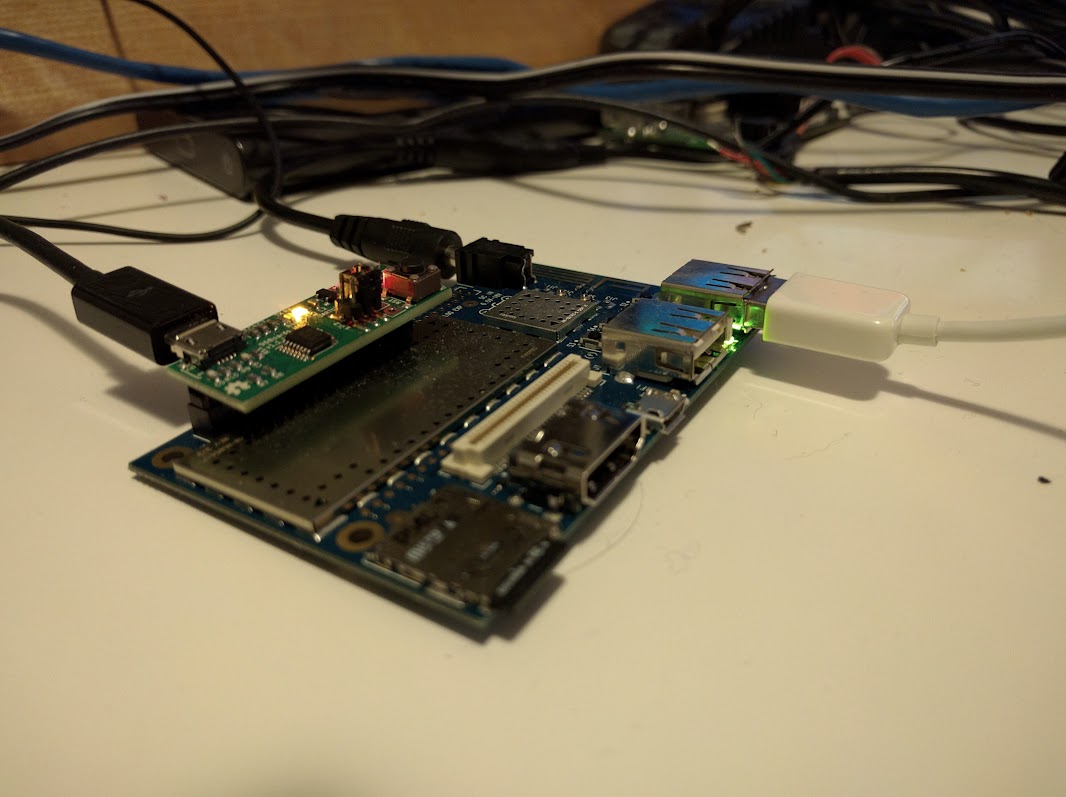
^Mandatory picture of serial port connection in action

C.J. Adams-Collier: Regarding fdupes

Dear readers, There is a very useful tool for finding and merging shared permanent storage, and its name is fdupes. There was a terrible occurrence in the software after version 1.51, however. They removed the -L argument because too many people were complaining about lost data. It sounds like user error to me, and so I continue to use this one. I have to build from source, since the newer versions do not have the -L option. https://github.com/tobiasschulz/fdupes And so there you are. I recommend using it, even though this most useful feature has been deprecated and removed from the software. Perhaps there should be a fdupes-danger package in Debian?

Next.

Previous.