Search Results: "ana"

3 July 2007

MJ Ray: Comments on coverage of the Tour de France

I asked for any other free-to-air satellite coverage of the Tour de France and Bernie S commented:
"RAI 3 on Hotbird"
and there's an online schedule on the RAI 3 site. Neville Emerson wrote:
"Can't wait. Cycling is the best and coverage is getting better and better every year."
Yes, at long last. There's now a full itv coverage listing on the CTC site but I still don't understand why itv are so late at launching their tdf site! Speckled Hen asks:
"Anyone know if there's any live coverage online? Can't see anything on either Eurosport or ITV web sites. I know the Beeb usually do it with rugby internationals."
I heard of some recorded items from ASO (Amury Sport Organisation, the tour's managers) on YouTube, but nothing about live video feeds yet. I've had audio in the past from both Radio France and Eurosport but I've not even found those details for this year yet (I'm slow at reading French and the new Yahoo Eurosport site is terribly hard to navigate). Keep watching Cycling Fans and TdFBlog (who kindly linked this item in their coverage summary ) for news of video coverage. Unless anyone would like to leave me details of live online coverage in a comment on my site, please?

Paul van Tilburg: Ruby D-Bus 0.2.0

Arnaud and I finally managed to release Ruby D-Bus “Almost live from DebConf 7” 0.2.0. The release was planned for DebConf 7. However, I didn’t manage to get it ready in between all the talks, meetings, and other social stuff. Ruby D-Bus is an implementation of the D-Bus protocol in pure Ruby. After starting the development in February, it soon became apparent that several other projects were out there with about the same goal, such as Pure Ruby DBUS and R-Bus. Our approach is to have an API that is close to the old Ruby D-Bus bindings. While the other, similar projects seem to have a slightly different goal, we still invite them to come to some sort of merging so that no duplicate effort is put into three or four separate projects with almost the same result. The 0.2.0 release is our first real public release. We have a large subset of the features working and documented. The main focus of this release was to improve the API documentation and the tutorial. The 0.2.0 release is a release for exploratory purposes. We invite everyone interested to have a look at the API and inner works and provide us with feedback and/or patches. This means that the API can still change a bit over time based on feedback and tweaks performed by ourselves. So don’t built a big application on it just yet if you’re not willing to make some changes later on. For more information, see our project (Trac) page.

2 July 2007

Christoph Berg: Looking for a Window Manager

I had been using fvwm2 for some 10 years when around the beginning of this year, I thought it might be time for a change. My config was originally copied from some SuSE templates and then heavily tweaked over the years, but recently broke more and more in subtle way with new fvwm upstream versions, e.g. moving windows suddenly required a different mouse button. Probably the config was just slightly out of spec and fvwm got "fixed", but it was annoying. The "tiled" window managers I had seen on others' desktops made me curious, so I gave ion3 a try some months ago. The overall appearance was all cool, but it tried a bit too hard to squeeze all windows into tiled windows - of course there's the floating workspace, but creating one was weird, and moving windows even weirder. And if only the (default) key bindings were more vi-like... I admit I never really bothered to read the documentation - probably everything would have been much nicer otherwise. Then there was the big license "wtf" with ion, at which point I started looking around further. dwm looks clearly too l33t to be serious, so wmii was the next choice, 3.1 to be exact. vi key bindings, a nicely configurable status bar, easy workspace switching and window moving. wmii doesn't have horizontally split windows (windows are always in columns), and no "tabbed" windows, though. It didn't warp the pointer to the currently active window (something I got used to with fvwm), but some config tweaks mostly fixed that. This time, I read the documentation, but there's only a 10 page pdf beginners document, but there's not much to configure anyway. Then came lenny. Testing and unstable currently feature version 3.6 which is a big disappointment. It is broken (the default config is unusable), and even after fixing that, it looks like they removed all the little details that I liked. The status bar is still there (though with a new location in the virtual filesystem), the color cannot be changed anymore (unless changing some other color as well). The windows used to have slim 1-pixel (configurable) borders. Now they still have, but the border will be expanded if the window chooses a different size - xterm always rounds down to the next character size, so all my terminals have fat surroundings now. The last-active window in a inactive column still had some markup so I knew which window Alt-Left/Right wound return to, now I have to guess. I wouldn't mind fixing my 3.1 config for 3.6, but I don't think I will, given these issues look unfixable. The 3.1 wmiirc file looked like a sh script, the 3.6 uses eval and a bunch of functions that frighten me. On a positive note, it is now possible to create new workspaces by just selecting them, which is much handier than start-program, wait, move-window-over, move-workspace. I guess I will give ion (2, 3?) another try...

Evan Prodromou: 13 Messidor CCXV

More weekend stories: on Friday, we had a Geek Lunch at La ka to welcome Tara Hunt to Montreal. She's in town for a few days for Montreal Jazz Fest, and she asked to meet some people in the local Web/BarCamp/hacker scene. Lunch was good and interesting people came. Austin Hill made it, as well as Patrick Tanguay, Fred Ngo and Ben Yoskovitz, and Niko. I was especially glad to see Seb Paquet, who I don't get enough time with. All in all a good time was had. tags:

Rest of the weekend Friday night John Usher came over for our weekly Pizza Night and we had beers until very late indeed. Saturday I got a nice glass desk for my office, and we got a big square wooden coffee table off of Montreal Craigslist. We went down to the Pont Jacques Cartier to see the fireworks on Saturday night, part of the International Fireworks Competition. Except there weren't any fireworks on Saturday night. Doh! Long walk home. Yesterday, Canada Day, we had our new neighbours Jake and Magda over for a get-to-know-you brunch. Jake is a structural engineer, and Magda is a professor of history at UQ M. They're expecting a baby any day now, so we figured it was a good idea to hang out with them before the madness begins. I made a couple of quiches, a big green salad, and some banana bread. It was a good meal. tags:

Russell Coker: New Storage Developments

Eweek has an article on a new 1TB Seagate drive. Most home users don’t have a need for 1TB of storage (the only way I’ve ever filled a 300G drive is by using it for multiple backups) and enterprise customers generally want small fast drives (with 100G drives still being sold for servers). One interesting thing to note about this is the fact that the new drive is described as being able to sustain 105MB/s (although I suspect that is only for the first few zones of the disk - see my ZCAV results page for graphs of the performance of some typical disks). The previous disks that I have seen have topped out at about 90MB/s. However even if the drive could deliver 105MB/s over it’s entire capacity it would take almost 3 hours to perform a backup - increases in IO speeds have not been keeping up with capacity increases. Another interesting thing is the potential for using the same technology in low power 2.5 inch disks. While a 1TB disk isn’t going to be much use to me a 300G 2.5inch disk that uses less power will be very useful - and it might be possible to perform a backup of such a disk in a reasonable amount of time! The latest trend in PCs seems to be small form factor (SFF) and low power machines that don’t have space for two drives. If you want RAID-1 on your home machines for reliability then that isn’t very convenient. But two 2.5 inch disks can fit in less space than a single 3.5 inch disk and therefore all the SATA based SFF machines that are currently being shipped with a single 3.5 inch disk can be upgraded to a pair of 2.5 inch disks - this will be convenient for me when those machines start going cheap at auction next year! Even for servers the trend seems to be towards 2.5 inch disks. I recently bought a 2U HP server that supports up to 8 hot-swap SFF disks, I wonder how the performance of 8*SFF disks would compare to 4 of the bigger and faster disks. The next thing we need is a method of backing up large volumes of data. The 650M data CD came out when a 150M disk was considered big. The 4.7G data DVD started to become popular when 45G disks were considered big. Now almost everyone has 300G disks and 1TB disks are becoming available yet the best commonly available backup method is a double-layer DVD at 9.4G - it seems that the vast majority of home users that make backups are using cheap IDE disks to do so. Fortunately there are some new technology developments that may improve the situation. Call/Recall has developed technology that may permit multiple terabytes of storage on an optical disk. It’s yet to be seen whether their technology lives up to the claims made about it, but we have to hope. The current storage situation is getting unmanagable.

Edd Dumbill: Nokia N800, the second time around

Nokia's N800 internet tablet is an intriguing device. When I originally got one a few months back I tried to treat it purely as a consumer object, just using the installed apps and things available through the obvious point-and-click channels.As a consequence it served mainly as a portable (and expensive) internet radio, streaming me the cricket commentary from the BBC. And when I upgraded my wireless network I somehow managed to make it WPA2 only, knocking the N800 offline. An offline N800 is an almost thoroughly useless device, so it went into the drawer and I forgot about it.Ultimately you can't leave something that expensive unused, so I dragged it out again, fiddled the wi-fi router into compliance, and decided not to deny my hacker nature this time. The N800 is Linux underneath, so who could resist?
The result is two-edged, really: I'm a lot happier with the device, but on the other hand must conclude that the N800 is still a bit far from being consumer-ready.Must-have softwareSo, what things did I install this time around that made the device happier?Claws Mail is a nice email client that works well with my IMAP accounts, which all use SSL and TLS, have lots of messages and a deep folder hierarchy. I don't really want to write much mail on the N800, but an easy reading interface is a bonus.The FM radio is something I can't believe I missed before. I had no idea this was in there, but plug some headphones into the N800 and they act as the antenna for an FM receiver. Desperately cute and old-world, a bit like when laptops still used to have parallel printer ports.I had previously ignored Maemo Mapper, thinking it was useless without a GPS, but it turns out to work very nicely as a dedicated client for Google Maps, as well as several other mapping sources. Must-do geeky bitsTry as I might to like the touch screen, the first thing I had to do with the device was find a way of not using the stylus to do sysadmin type tasks on it.So, first stop is to get a terminal up, figure out how to use the root account, install a SSH client and server, and get my pubkey onto the N800. Now I could shell into it and use a decent keyboard.On my local network I hate maintaining DNS if I don't have to, so the next thing I wanted was Zeroconf support in the shape of avahi. One of the quickest ways to get this going is to install the Canola media application, which uses Zeroconf to find shared music.With these basics in place, the N800 supports APT package repositories familiar to Debian and Ubuntu users, so the device becomes a lot less weird and much more manageable. I felt the same pleasant familiarity as I did with the NSLU2. Things to look forward toThe N800's video camera is neat, but nobody I know uses Google Talk for conferencing. Fortunately it seems that Skype for the N800 is just around the corner. Initially, video support is unlikely, but I imagine that if Skype on the N800 proves popular, it won't be far off.The N800 is something I don't mind having kicking around the kitchen or nursery, so staying in touch with my family while I'm travelling will become a lot more fun.
Also, I'd like to get NFS running on the N800, but that requires the installation of a new kernel, which I've not quite yet had the time to do. Once that's done, all my media, photos and storage will be handily available. 

Evan Prodromou: 12 Messidor CCXV

Long fun weekend here. Last Thursday, Maj's brother Brian appeared on our doorstep unexpectedly. He'd been driving across the country from Santa Barbara for a few weeks, stopping to see friends and go camping and rock climbing along the way. Every few days he'd call our home number to tell us when he'd be coming in... but our home phone has had mixed-up wiring since our move on June 1. So his arrival was a really pleasant surprise. That night we went out to dinner at Ouzeri, the upscale Greek restaurant around the corner. We had been trying to connect with Matt Biddulph and Alexandra Deschamps-Sonsino, who are visiting Montreal for a month. Matt and I were introduced at South by Southwest by connector Ben Cerveny, and Maj and Alex met separately and serendipitously at Montreal Pecha Kucha. So we did a big dinner at Ouzeri to talk and have fun. Boris Anthony came along, which made for a really great time. We had a lot of good wines at Ouzeri -- they have the best-known Greek wine cellar in town. We started off with an Ayiotiriki white (in a cool bottle), then a Naoussa, then a Rapsani. All very tasty. Dinner was a mix of appetizers, moussaka, and a big grilled shrimp platter. Boris got a nice-looking slice of lamb, too. Oh, and we got Ouzeri's trademark saganaki: a big raw cheese, doused with ouzo and cooked flamb at the table. Amita June doesn't like sitting at the table too much, so we took a walk outside so she could burn off some energy. A little bored, I twittered about where we were. Within 20 minutes, both Hugh and Niko cruised in to join us. Power of the Internet, dot dot dot. We finished dinner and decided to take the talk on the road. Everyone came over to our house at 4690 rue Pontiac and we... uh... opened another bottle of wine and hung out and talked for a couple of hours. By the time the bars were open and active on Mont-Royal, everyone streamed out and Maj and I put Amita to sleep. Good time! tags:

1 July 2007

Clint Adams: El justiciero, cha, cha, cha

On February 14, 2004, Gage & Tollner, ostensibly New York's oldest restaurant, closed down and, if that weren't traumatic enough, became a TGI Friday's. Finally, Friday's is gone, and the fa ade sports a banner advertising a fully-equipped restaurant for rent. What will it become next?

Russell Coker: Committing Data to Disk

I’ve just watched the video of Stewart Smith’s LCA talk Eat My Data about writing applications to store data reliably and not lose it. The reason I watched it was not to learn about how to correctly write such programs, but so that I could recommend it to other people. Recently I have had problems with a system (that I won’t name) which used fwrite() to write data to disk and then used fflush() to commit it! Below is a section from the fflush(3) man page:
NOTES
Note that fflush() only flushes the user space buffers provided by the
C library. To ensure that the data is physically stored on disk the
kernel buffers must be flushed too, e.g. with sync(2) or fsync(2).
Does no-one read the man pages for library calls that they use? Then recently I discovered (after losing some data) that both dpkg and rpm do not call fsync() after writing package files to disk. The vast majority of Linux systems use either dpkg or rpm to manage their packages. All those systems are vulnerable to data loss if the power fails, a cluster STONITH event occurs, or any other unexpected reboot happens shortly after a package is installed. This means that you can use the distribution defined interface for installing a package, be told that the package was successfully installed, have a crash or power failure, and then find that only some parts of the package were installed. So far I have agreement from Jeff Johnson that RPM 5 will use fsync(), no agreement from Debian people that this would be a good idea, and I have not yet reported it as a bug in SUSE and Red Hat (I’d rather get it fixed upstream first). During his talk Stewart says sarcastically “everyone uses the same filesystem because it’s the one true way“. Unfortunately I’m getting this reaction from many people when reporting data consistency issues that arise on XFS. The fact that Ext3 by default will delay writes by up to 5 seconds for performance (which can be changed by a mount option) and that XFS will default to delaying up to 30 seconds means that some race conditions will be more likely to occur on XFS than in the default configuration of Ext3. This doesn’t mean that they won’t occur on Ext3, and certainly doesn’t mean that you can rely on such programs working on Ext3. Ext3 does however have the data=ordered mount option (which seems to be the default configuration on Debian and on Red Hat systems), this means that meta-data is committed to disk after the data blocks that it referrs to. This means that an operation of writing to a temporary file and then renaming it should give the desired result. Of course it’s bad luck for dpkg and rpm users who use Ext3 but decided to use data=writeback as they get better performance but significantly less reliability. Also we have to consider the range of filesystems that may be used. Debian supports Linux and HURD kernels as main projects and there are less supported sub-projects for the NetBSD, FreeBSD, and OpenBSD kernels as well as Solaris. Each of these kernels has different implementations of the filesystems that are in common and some have native filesystems that are not supported on Linux at all. It is not reasonable to assume that all of these filesystems have the same caching algorithms as Ext3 or that they are unlike XFS. The RPM tool is mainly known for being used on Red Hat distributions (Fedora and RHEL) and on SuSE - these distributions include support for Ext2/3, ReiserFS, and XFS as root filesystems. RPM is also used on BSD Unix and on other platforms that have different filesystems and different caching algorithms. One objection that was made to using fsync() was the fact that cheap and nasty hard drives have write-back caches that are volatile (their contents dissappear on power loss). As with such drives reliable operation will be impossible so why not just give up! Pity about the people with good hard drives that don’t do such foolishness, maybe they are expected to lose data as an expression of solidarity with people who buy the cheap and nasty hardware. Package installation would be expected to be slower if all files are sync’d. One method of mitigating this is to write a large number of files (EG up to a maximum of 900) and then call fsync() on each of them in a loop. After the last file has been written the first file may have been entirely committed to disk, and calling fsync() on one file may result in other files being synchronised too. Another issue is that the only time package installation speed really matters is during an initial OS install. It should not be difficult to provide an option to not call fsync() for use during the OS install (where any error would result in aborting the install anyway).

30 June 2007

Holger Levsen: Happy Camper

ikiwiki rules my world! Today I switched debian-community.org and my personal todo list to ikiwiki, and I must say, I'm impressed and happy. Just being able to use svn+vim to edit and organize a wiki or more generally, information, really rocks. Joey, thanks a swarm of fish for ikiwiki!!

On a somewhat, very loosly related note, I've decided to give up on gnome and beryl, and go back to ion2 or maybe 3. Beryl and Gnome are nice and fancy, and it's good to show others that Debian can be beautiful, but a.) it's way slower than using ion as window manager. And b.) I'm now running 2.6.21 and have been using powertop... ;) Maybe I'll come back to a typical desktop UI with Lenny.. :)

And, now you might ask, how is this related? I formerly used Riot as Information Organisation Tool, which is written by the same author as ion. That said, I totally want to run a free fork of ion3 with a proper licence. I *heart* debian stable with custom repositories! :)

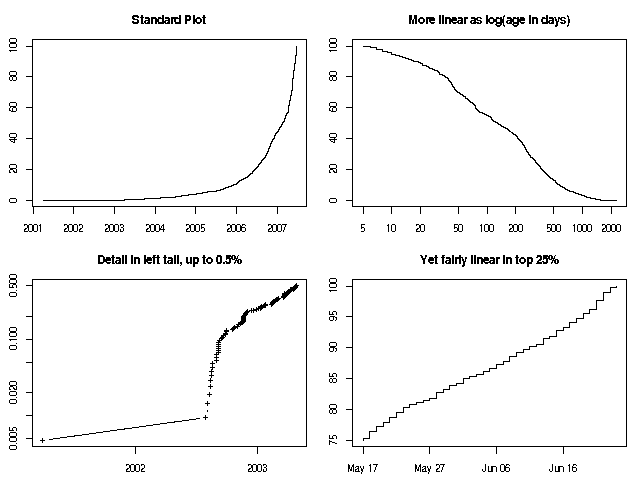
Dirk Eddelbuettel: Improving simple charts

Earlier today and via Planet Debian, Lucas blogged about the 'age distribution' of Debian packages, defined as the time since the last (re-)compilation. He illustrated his findings with an, umm, rather ugly chart. Having climbed onto the soap box once before, I would like to point out how easy it can be to create simple, informative, and, at to least to me, prettier charts using R. Lucas included a URL to the data. The first nice thing to note that we can read the data directly from the URL -- no need to copy the file:
pkgAge <- read.table(file="http://people.debian.org/~lucas/arch-age/arch-age.log", col.names=c("pkg","yyyymmdd"))
read the data into a data.frame which we have given two column names.
pkgAge[,"date"] <- as.Date(as.character(pkgAge[,"yyyymmdd"]), "%Y%m%d")
pkgAge[,"age"] <- as.numeric(difftime(Sys.Date(), pkgAge[,"date"], units="day"))
pkgAge[,"prop"] <- (1:nrow(pkgAge)) / nrow(pkgAge) * 100
We then create three new columns. First is a date, by parsing the (integer) dates (after first casting them into characters) by supplying the format in standard C notation: "%Y%m%d" for year, date and month without any separators or formatters. Now, having the date as an actual date object inside a real data analysis language we can do things as e.g. computing date differences. The difftime function does just that, using the current date as other point. We ask for the return to be in days, and cast this down to a purely numeric vector (instead of datediff object). Lastly, we quickly compute the date proportion in percentages. We can then view the date. Before we plot,
png("packageAges.png", quality=100, width=640, height=480, pointsize=10)
oldpar <- par(mfrow=c(2,2), mar=c(2.5,2.5,3,1))
we direct the charts to a png file of given dimensions, and ask for all plots in one figure (using mfrow with two rows by two) with somewhat smaller figure margins using the mar argument to par. The first chart shows again proportion over date:
with(pkgAge, plot(date, prop, type='l', main="Standard Plot"))
(The with() function simply allows us to refer to the columns by their names without explicit subsetting. plot(pkgAge[,"date",], pkgAge[,"prop"]) is equivalent, but more cumbersome.) As it clear that the data has a fairly long tail in the older dates, we can also try to plot the plot over logarithmic time differences. This doesn't work for dates, but it works for our (positive-valued) age variable:
with(pkgAge, plot(age, prop, type='l', log="x", main="More linear as log(age in days)"))
The very far left tail below 0.5 percent is interesting as the one very old package is clearly an outlier within an outlier region. We use the subset function to take just one portion of the data, use logs, and explicit plotting symbols '+' in a points-and-lines plot:
with(subset(pkgAge, prop0.5), plot(date, prop, type='b', log="y", pch="+", main="Detail in left tail, up to 0.5%"))
Lastly, the upper quartile is fairly linear.
with(subset(pkgAge, prop>75), plot(date, prop, type='l', pch=".", main="Yet fairly linear in top 25%"))
At the end
oldpar <- par(mfrow=c(2,3))
dev.off()
we restore the graphics paramters and close the device (here the file). All this then yields the following chart: Debian Package Age-since-recompile Distributions Updated to correctly display the assignment operator <-

29 June 2007

Martin F. Krafft: DebConf7

I am sitting at Frankfurt airport in between flights home from Edinburgh (not anymore, but that's where this post was born). It's been an intense 2.5 weeks of DebConf7, which has been unlike other DebConfs for me in two respects: this was the first time I actually went to DebCamp, the week leading up to the conference, which is designated to teams and individuals with development goals to achieve during the week. And I was also actively involved in the organisation of the conference, which was unexpected, but a very good experience I am not going to miss next year. Well, it wasn't unexpected. When I booked my flights in January, I had decided to arrive a day early and leave a day late to be able to lend a hand. In between then and the conference, my life turned somewhat upside-down and I had forgotten everything about these noble goals of mine. So when I arrived at the conference venue on Saturday morning with thoughts of netconf circling my head, I was surprised to find everyone buzzing about (how na ve of me) and somewhat clueless as to how I should merge in: my wrists didn't really hold up to heavy lifting, and my knee certainly didn't enjoy stairs, of which there were plenty on the way up to the top floor, where DebCamp was taking place. After trying and being mostly ridiculed by the other organisers ("friends"... ha!), I set out to accomplish some other tasks more suited to my bodily condition, such as wiring the hack lab to accomodate 40 geeks for the first week. That took me most of the day, but at least the space was ready for Sunday morning and the official start of the camp. My goal for the week was netconf and I made good progress until I ran into a wall on Tuesday and had to back off and rethink my design. Reinhart Tartler and Enrico Zini dedicated their time to listen to my design and the problems and helped me clear the mess up and helped me reduce complexity and converge on a straight-forward, event-based design. As the newly appointed DebConf press officer and one of the organisation volunteers, I did not get any further for a few days, as I was manning the front desk or preparing and releasing my first press release (with the help of several others), which lead to a lovely story on The Register and doubled the number of attendees that preregistered for DebianDay (which marks the end of DebCamp and the start of DebConf). I blame the geeks in skirts, actually. Silly bunch, but not quite as silly as those attendants who could get a laugh out of the underwear question for two weeks in a row. Up to this point, I had managed to keep a perfect balance between netconf, orga-team, and sleep. So good, apparently, that when the orga-team t-shirts arrived, Uncle Steve made it quite clear that I should be getting one, even though I had spent considerable time on netconf, am sure some of the others must have worked twice the amount, and I was still quite well rested then. But they gave me a shirt and thus I became part of the orga-team. And even though it was rough at times, running around during the day, filling spare minutes with netconf brain-work, and enjoying nights that got longer with every day of the conference, I am glad and proud to be a member of this team now. It took me until after the official start of the conference to return to the netconf code, but with the new design, I got most of the framework to a point where it could obtain static and dynamic addresses from configuration files as well as DHCP servers in time for my presentation on Tuesday (the recording of which shall be linked from the netconf homepage as soon as it's available). Of course, nothing worked on screen in front of the audience, but noone really expected that anyway. and then I took it all apart for further simplification, so by the time night fell, the slides from the talk had already become outdated as I moved to yet another design, which is even simpler and which allowed me to sketch complex scenarios, such as DHCP after WPA. For two days, I made good progress, but the time available for hacking decreased noticeably, as I kept volunteering for more tasks that needed doing, and more and more people turned up. Somewhere in between, Keith Packard took hostage of (and fixed parts of) my broken X40 laptop, but that's the meat of another story. And on some other night, our leader Sam, in his official capacity as DPL, presented me with the instantiation of my innermost desires as consolation for my hosital stay: a pony. Just look at that smile! With 400 attendants, this year's DebConf continued the trend of immense growth of the event, and while it's great to witness this increase in popularity among attendees and sponsors, who make it possible each year to fly more people to the destination, I am also rather sceptical. The problem is less the additional load on the organising team the next 100 people are going to be easier to accomodate than the previous 100 were. It is more that the conference is losing focus. More people make you spend less time with the same folks, and as the number of non-contributors increases, the social element starts to outweigh the technical element. I am not condemning the social element, but to paraphrase the words of my favourite Debian developer, it's painful to come to DebConf or even IRC with a project and questions just to find that the people are generally more interested in being social, even to the point of preventing technical discussions. I realise that this is a sensitive subject as the issue of various cabals keeps coming up frequently and it does not seem right to start limiting the audience to this conference, but unless we consider the matter, DebConf might deteriorate similarly to other conferences, which have enjoyed enormous growth as well before it was too late. I think we must make sure that people understand that we are, after all, a technical project and must not lose touch with out roots. Of course, I may also be overreacting, after a week of intense coding and many other stress factors I continued working hard on netconf and helping with the organisation throughout Friday, briefly taking time off to prepare a presentation on my Ph.D. research, which was very well received, as well as a workshop on Debian packaging with modern (distributed) version control systems, which yielded around a dozen new subscribers to the vcs-pkg mailing list. But now, back to netconf. All things considered, I was making good progress, but not getting netconf into a releasable state just yet. I can parse /etc/network/interfaces files and get data from DHCP servers, even configure interfaces with those, but it's all still work in progress as I have not yet bothered to implement such basics as default gateways or DNS servers. But the framework is in place, and I am very happy with it as everything I keep adding falls into place beautifully. To mark the end of my netconf development sprint at DebConf7, I scheduled a code introduction session on Friday, where around 15 people turned out to get a walkthrough of the code and explanation of some of my design decisions. The session was recorded and will be available on video shortly. I think it turned out to be a very good idea; I found myself intrigued by someone else's code before until that someone took the time to explain what was going on. I sincerely hope that this introduction helps bootstrap a few people's experiences with the code and yields more contributors! Even though we ended almost every single evening of the two weeks in one of the surrounding pubs, the last few nights were definitely the most enjoyable. On Thursday, the local team had organised a Ceilidh with a band teaching us geeks how to dance the Scottish way, and the venue stayed open for two hours longer than before, causing most people to come out for beer or bouncing about. On Friday and Saturday, the folks of InfoSeed let us use their comfy couches (in the basement of the conference night venue) and we chilled to music and massages, while on Sunday, after a very tiresome day of cleaning up, the noticably lesser number of survivors hung out at the Forest Cafe for some so-so live music, few beers, and an early journey to bed, where a Dutch Muppet kept us entertained for at least another hour. The best about Monday, my day of return, must have been that the airline lost my backpack, which saved me from having to lug it around in Zurich, and made for a great moment on the phone with the baggage tracing service, who announced that my bags would be delivered in about 6 hours between 20:00 and 22:00 just as the door bell rang and the courier dropped off my bag. I'll be back in Argentina, unless something goes seriously wrong. And I'll be on the orga-team again. If you guys stop holding your meetings on Monday night. Thanks to everyone who made DebConf7 possible. I am proud to have been able to contribute, but the real work was done by a few others. You know who you are. NP: Solar Project: Five
David Nusinow: Post Debconf Spewage

I've been back from Edinburgh for a few days, but this is the first real chance I've had to sit down and write a little bit about it. I'll preface this blog post by saying that my first Debconf was probably the best single week of my entire life. Yeah, it was that awesome.

I won't talk about all the stuff that happened, because that would just take too long. The most important thing was that I got to see a number of old friends again and spend more time with them in one run than ever before. That alone was really enormous for me. On top of that was the pleasure of finally meeting so many people in person. I met a few XSF members finally, including Julien Cristau, my partner in crime. There's no way I could possibly list everyone that I'm so thankful to have finally met. There was one very memorable evening in the night venue where it was largely the same crowd who's usually in #debian-devel when I'm on, and we all just couldn't stop cracking jokes and laughing (not to mention ITP'ing absurd programs). There was another night when Old World Cambridge collided with New World Cambridge, and much Pimm's was had by (almost) all. There was staying up until 5 in the morning and stumbling back to the hostel in the dawn to try and get some sleep before running back to the conference. The most delightful thing about all this was that so many people I already knew and loved were there, and everyone who I hadn't met in person before turned out to be even better in real life. It was like a week of the purest joy.

I also got the privilege of giving my talk and BoF to fairly full audiences, particularly the former. The BoF was on maintaining packages with git. I didn't expect more than 10 people to show, but more than 5 times that did express interest, so many that they moved it to the main lecture hall instead of the small discussion room that it was going to be in originally. I hadn't really planned out how to handle an audience like that, and while I managed to get other people in the audience talking (thanks in particular to Madduck, MadCoder, and keithp for adding so much to the discussion) I felt like I had to fumble through a lot of it. That's the nature of a BoF I guess. I also gave a talk on my plans for the XSF for the Lenny release. I'll talk about that stuff in future blog posts (some of which are overdue) but I will say that it was surprisingly well attended given that it was scheduled for 9:45 am after one of the usual nights of drinking and hacking until dawn.

I have to echo others and give a big thank you to the organizers. You guys did a great job, and persevered in the face of adversity (read: cowgate) and really made a great conference out of it. I learned a lot, laughed even more, and drank even more than that and I can't wait to do it again.

28 June 2007

Jacobo Tarr&#237;o Barreiro: A little bit of everything

July 5th, 2007 will be the 10th anniversary of the Debian Social Contract. Also, on July 5th, 2007, I will be flying to Dublin to start a new job at Google Ireland the following Monday. Today (well, technically yesterday now) was my last day at Allenta. It’s been several good years, with nice and funny coworkers (and friends), learning and doing lots of very varied stuff. However, after several years I felt a need to do something a bit different. It appears that working at Google is all the rage now, so I decided to jump on the bandwagon ;) Oh, yeah, I’m excited about living in Dublin, and about working at Google. I already have so many plans, I’ll be happy if I manage to undertake 1/10 of them ;-) If you live in or near Dublin and want to meet, feel free to call or email me. My Spanish phone number is in the Debian developer database or in all of my domains’ WHOIS records. My email addresses are all easy to find. As I don’t know what kind of Internet access I’ll have outside of work (assuming I will not be out exploring the city when not working), it’ll probably be a bit hard for me to keep up with mail and with the Galician debconf template translation stuff. Today I’m in the 12th position in the ranking, with only 12 strings left to catch the Brazilian Portuguese team. I know that the Catalan team wants revenge from when I overtook them. It’s your opportunity, nois! :-)

Antti-Juhani Kaijanaho: The Dying Philosophers Problem

Reading a masters thesis draft that mentions the dining philosophers problem – a parable about the difficulties of process synchronization very well known in computer science – it occurred to me that it must not be a very good idea to eat just spaghetti (or just rice). I asked a nutritionist about it, and here is her answer. Even if they manage to avoid deadlock or livelock, dying of malnutrition is not going to be their first problem, go read the full story! [Typos and thinkos corrected after initial publication]

Fabio M. Di Nitto: Linux running on SUN's LDOM!

Guys.. meet Super Davem We did it again. After another *really* long session of super-tag-team play with Davem coding as hell and me testing like crazy we finally managed to do a full install of Linux (based on Debian/Ubuntu installer) on SUN's LDOM as guest host (similar to domU concept of Xen). There is still a lot of work to do and major problems to solve before we will able to call this "stable" for the generic user. David's blog has detailed instructions on how to install and a complete list of the issues. If you plan to try it, make sure to read David's blog! A net-boot gutsy installer image is available here and net-boot kernel here. The code published by David will hit the gutsy kernel as soon as we are satisfied with the overall situation. Most of the userland bits required to install are already in the archive and others will land soon after Tribe-2 release. STAY TUNED!

MJ Ray: Tour de France on ITV and others

Despite their TV trailers and it being only 10 days away, there's still nothing on the itv sport site about the Tour de France coverage, but I can see the early stage details on tvtv now. The bulk of the coverage is on itv4 with some highlights repeated around midnight on itv1 and itv4. Unusually, the first stage is also on itv1, so terrestial analogue viewers can see what the fuss is really about, instead of the ceremonial final stage. Eurosport International is being good and covering everything live and in highlights, as ever. (Eurosport Analogue is free-to-air in English and German; Eurosport Digital is FTA in German.) The British Eurosport schedule seems something between the International and itv schedules described below. Strangely, it seems that the weekend afternoon live coverage is also on itv4, which doesn't usually start transmission until 18:00. I guess itv play or citv may be closing down early to make space. In detail: Presentation of the teams - Friday 6 July, live on itv4 from 18:30 (preceded by Liege-Bastogne-Liege highlights at 18:00), repeated on itv1 00:00, on itv4 00:30. Eurosport show it recorded 10:45-11:15 Saturday morning. Prologue - Saturday 7 July, live on itv4 14:45-19:00, live on Eurosport 15:00-18:30, highlights on itv4 00:30 Stage 1 - Sunday 8 July, live on itv4 from 10:30-16:10, live on itv1 10:50-11:50 and 15:15-16:00, live on Eurosport 10:00-16:00, highlights on itv4 19:00, repeated on itv4 00:30 As far as I can see so far, weekday stages look likely to be live on Eurosport from 13:00-16:30 (covering the start live at whatever time and maybe with highlights between that and the main live coverage) with highlights on itv4 19:00, repeated on itv4 after 23:30, highlights on Eurosport after 21:00. I expect most weekends to be a similar coverage pattern to the Prologue and the final stage to be covered like Stage 1, similar to last year's final stage. Also, France 2/3, ARD/ZDF (listings) and maybe RTBFSat will cover the race live too. Any other free-to-air satellite coverage?

MJ Ray: Last Chance for the Working Draft of the Web Content Accessibility Guidelines 2.0

As a result of commenting on some problems in CUBA's Jam Busting June site I was made aware of the Working Draft of WCAG 2.0 or the Not-Working Draft, as I think it could be called. If you want to comment on it yourself, you had until the end of 27 June 2007 (US EDT, I assume). Put simply, it's too confusing for both web developers and site managers. Even the Quick Reference is rather long for practical use. It's very indirect - it's not even clear whether xhtml over HTTP is preferred. I submitted a comment about that - also rather disappointing to find that W3C appear to fail to use stripslashes() when needed. I submitted another comment about the backwards step of allowing Javascript-required sites to be called accessible. Javascript is dangerous for accessibility and bad for power consumption. What the blue blazes is an AJAX-only webmail doing as one of the accessibility examples? I see that notable sites have already criticised WCAG 2.0. While I don't necessarily agree with everything they say, this is a very disappointing situation. Will WCAG 2 be rescued? Are accessible-friendly webmasters screwed if WCAG 1.0 is replaced by 2.0 in our national standards? It lets all the Flash-only cowboys claim WCAG-conformance as long as they note their site relies upon Flash. (Question: is a site still WCAG-2.0-accessible if it requires Flash to view the note that says it requires Flash?) Should we start looking towards MACCAWS, WHATWG, expanding IETF to cover the web, or starting another democratic/meritocratic standards body?

27 June 2007

Mike O'Connor: A sign that I really don't know what I'm doing

I decided it was finally time to go digging in our boxes of books to find my old Xlib manual. We haven't unpacked any of our books since we moved in August, they are all sitting in boxes in our basement. I went through every box I could find, and, of course, the book I was looking for was really in the very last box in the stack. This was a blessing and curse. A curse for the obvious reason that I had to look through every box, a blessing in that I got to pull out a couple of other books that I've been meaning to get my hands on, such as a couple of key birding books, and my NCJOHB. Anyway, I return to the couch with my Xlib Programming Manual (which is from R5, but I'm sure is going to answer some questions I have). I of course turn right to the section on window manager, only to find in the first paragraph:
This chapter is not primarily for window manager writers, as those are a rare breed. There are several good customizable window managers available, and there is very little reason for users or application writers to want to write their own. Only a few people in the X community are going to be actively involved in writing window managers, and chances are good they already know all of what is described here"
Heh, what have I gotten myself into?

Evan Prodromou: 7 Messidor CCXV

Someone in the #mediawiki channel the other day asked, "Would it be possible to have easy-to-parse error messages?" and I thought, "Wow, that sounds like a microformat in the making." Probably one of the most common HTML patterns in Web applications is error messages. We see them all the time on the Web: login errors, form validation errors, backend errors and user input errors. But what if this common pattern was standardized? If HTML error messages all followed a similar format, we could have browser plugins that recorded and analyzed the errors that come up. They could either feed back this structured error data when we needed it -- say, when filing a bug report -- or use the error data to help us find workarounds or documentation online. I brought the idea up in the #microformats channel on Freenode, and it got a good response, so I took the next step and created a list of error message examples and some error message brainstorming on the microformats wiki. Hopefully this can be the start of some interesting feedback loops in software errors. tags:

Next.

Previous.