Search Results: "sto"

15 December 2009

Tollef Fog Heen: N900 first impressions

Collabora was kind enough to buy N900s for all its employees. Yay! I got mine on Friday and has been playing around with it quite a bit. It's very shiny and the user experience is a lot better than the N810. There are a few graphical glitches, it seems it's XDamage damaging a bit of a window and it's just not quick enough to repaint. Not a problem, and it has far fewer instances of just hanging for half a second which my iPhone has. That is, it hasn't had any of those yet. The screen is good, but resistive. Takes a short while to get used to when you're used to capacative, but it's not a problem at all. The keyboard is good, but I need to map something as the compose key. Having US/UK key caps and using the Norwegian layout is a bit confusing. Not really the fault of the device though. The web browser is generally quite good. The gestures take a bit of time to get used to, but they're not hard as such. Some of the default "applications" are implemented as just links to the web pages of services like Twitter, which is a bit silly as you don't even get a version that's optimised for the N900. They're not useless, but they are absolutely nowhere near a real application. Also, the "Store" (Ovi Store) application/web page says "coming soon", which is quite odd. I'm not sure if I can change the selection of applications on the default application list, but modifying the desktop is easy. There seems to be few themes and background images available so far, at least in anything resembling official repositories. Hopefully this will improve over time. So far, I haven't actually written any code for the N900. I have some applications I want to write, mostly widget-style apps like "when does the next bus home leave from a bus stop close to me and where is the bus stop", but also some other ones. Battery life is not great. It almost did 48 hours today with a bit of use underway, and I did charge it before it ran completely out, but when I'm used to closer to a week, it's not that good. Camera seems good and is quite fast, I think it took less than five seconds from opening the camera shutter until I had taken a picture. Shutter delay is quite bad at about a third or half a second, but this is a mobile phone (or mobile computer, as Nokia likes to call it) and not a DSLR, so I'm quite happy with it. As a phone, it seems fine so far. I can make calls and accept calls and there's no noticeable problems with it. It also functions as a modem/DUN over bluetooth, which is quite useful. Build quality seems good, there's a good feeling when sliding the keyboard in and out, but only time will tell how good it actually is. So far, I'm happy with it, it's a big step up from my previous UK phone (which is a Nokia E70; my iPhone is a 2G phone so I can't use it here with the provider I'm using). Hopefully I'll post more happy stories about it in the days to come.

14 December 2009

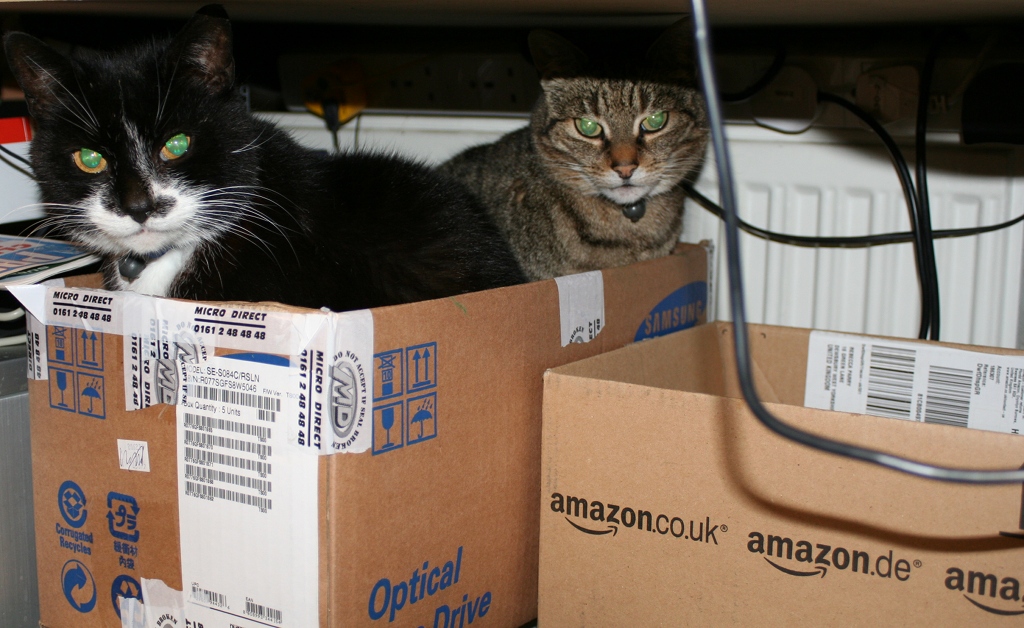
Vincent Sanders: Two pussies, one box

Our household contains two felis catus. These evil creatures (sorry I repeat myself, I already mentioned they were cats) are not sweet kittens, they are grumpy old animals who spend the majority of their lives sleeping indoors and rarely venturing out.

Historically they have had free reign of the house and slept wherever it suited them but with the arrival of the children they were confined to the lower half of the house and provided simple cardboard boxes in which they can reside completely undisturbed.

All well and good you might say and indeed this has produced happy cats for the last eight years. however I recently caused a great deal of discord in the household by providing new boxes never imagining this could possibly cause as much trouble as it has. Currently the two of them are attempting to occupy a single box and win some form of passive aggressive fight for occupancy.

This has been going on for a month now and shows no sign of easing. I do wonder what I need to do to aleviate this situation before it results in a full blown outbreak of evil. Any ideas?

Ondřej Čertík: ESCO 2010 conference

An interesting conference 2nd European Seminar on Coupled Problems (ESCO) will be held on June 28 July 2, 2010 in Pilsen, Czech Republic.
Among the topics are solving PDEs and applications and using Python for scientific computing. In particular, Ga l Varoquaux is the keynote speaker.

Unfortunately, it was later announced that the SciPy 2010 conference is going to be at the same time, which is really unfortunate. But here are some reasons why you should consider going to ESCO 2010 instead:


If you have time, I can fully recommend to go to ESCO 2010.

Joey Hess: two films

I've been watching some good films recently. Two I especially liked. baby camel in sidecar man in taxi Goodbye Solo starts in Winston-Salem and ends up at Blowing Rock. Both settings, as well as the taxi in between, are very familiar. The characters could easily be people I've met. Tulpan is set in a steppe in Kazakhstan. The desert and dust devils mostly reminded me of Mars. Particularly of this amazing shot taken by the Spirit rover. dust devils on Mars! Still, I felt so much more at home in Tulpan. Kept pausing it to check out how the family had their yurt set up and furnished, and watched their very real-seeming life unfold, right down to the lambing scene. While Solo took the very familiar, and confounded expectations and biases at every step. They're both fine films, from directors I want to see more of. I've seen Ramin Bahrani's work before Solo, and especially liked Man Push Cart. Don't know if I will ever find any of Sergei Dvortsevoy's earlier films.

13 December 2009

Russell Coker: Links December 2009

Dan Gilbert gave an insightful TED talk about our mistaken expectations of happiness [1]. Don Marti has an insightful post about net neutrality and public property [2]. When net access requires access to public property then it should be sold in a neutral manner. Rachel Pike gave an interesting TED talk about the scientific research behind a climate headline [3]. The people who claim to be skeptical of the science should watch this. Mark Peters wrote an interesting article A Happy Writer Is a Lousy Writer about the correlation between emotional state and work quality [4]. Apparently watching a film about cancer will make people more careful and focussed on details. CERIAS has an interesting short article about Firefox security as well as some philosophy on why web browser security generally sucks [5]. Cory Doctorow writes in the Guardian about Peter Mandelson s new stupidity in trying to legislate against file sharing [6]. This is going to seriously damage the economy of every country that implements it. Charles Stross has been blogging a series of non-fiction essays about space colonisation, in The Myth of the Starship he describes how most ideas of space travel are bad and how the word ship is always going to be unsuitable [7]. Brent T. White is an associate professor of law at the University of Arizona who has written an interesting paper about mortgages [8]. He says that anyone who is underwater (IE owing more than the value of their house) should walk away. The credit damage from abandoning a bad mortgage apparently isn t that bad, and there is the possibility of negotiating with the bank to reduce the value of the loan to match the value of the house. Mako is working on a project to allow prisoners to blog [9]. It s basically a snail-mail to web gateway as the prisonsers are not allowed Internet access. PracticalEthicsnews.com has an article about the special status that homeopathy is given [10]. It also notes that homeopathic medicines include arsenic and mercury. Such quackery should be outlawed, a life sentence for homeopathy would be appropriate IMHO. Cory Doctorow wrote an interesting essay about why he is not selling one of his books in audio form (he s giving it away) [11]. He concludes by noting that he wants no license agreement except don t violate copyright law . The fact that he can t get anyone to sell an audio book under such terms is a good demonstration of how broken the marketplace is. Thulasiraj Ravilla gave an inspiring TED talk about the Aravind Eye Care System a program to bring the efficiency of McDonalds to eye surgery [12]. Hopefully that program can spawn similar programs for other branches of medicine and spread to more countries. In many ways they are providing better service (both in quality and speed) than people in first-world countries who pay a lot of money can expect to receive. Scott Kim gave an interesting TED talk about his work designing puzzles [13]. He is also a big fan of social networking, unfortunately (for people like me who don t like social networking) his web site ShuffleBrain.com relies on Facebook. Gordon Brown (UK Prime Minister) gave an inspiring TED talk about global ethic vs the national interest [14], with a particular focus on the global effort required to tackle the climate change problem. Now if only we could get Kevin Rudd to listen to that. Brough has written an interesting analysis of the AT&T network problems that are blamed on the iPhone [15]. His essential claim is that the problem is due to overly large buffers which don t cause TCP implementations to throttle the throughput. This seems similar to my observations of the Three network in Australia where ping times of 8 seconds or more will periodically occur. One particularly nasty corner case with this is when using a local DNS server I can have a DNS packet storm where basic requests time out while BIND uses a significant portion of available bandwidth (including ICMP messages from receiving ports that BIND has closed). To alleviate this I am now using the Google public DNS service [16] (the Three DNS servers never worked properly).

Benjamin Mako Hill: Upcoming Travel

As is becoming my custom, I'm planning to spend much of December and January on the road. This time I'll be in Seattle, Japan and Wellington, New Zealand. Here's the rough schedule: Mika will also be around for everything but the NZ leg and SJ seems likely to make an appearance in Japan during the first week of January. Feel free to get in contact if you'd like to meet up in any of the places above for a coffee or beer. I'm also open to hanging out with giving talks at LUGs, GLUGs, Wikipedia groups, free culture groups, colleges or Universities along the way. Most of my time in Japan is still basically unstructured so I'm quite open to suggestions during the first couple weeks of January.

Julian Andres Klode: APT2 progress report for the 1st half of December


This week was successful. I have pushed some changes from November to the repository which change the license to LGPL-2.1+ (which makes bi-directional sharing of code with other projects easier, since most Vala code is under the same license) and implement HTTP using libsoup2.4 directly, instead of using GIO and GVFS for this. I also added a parser for the sources.list format which uses regular expressions to parse the file and is relatively fast. The code needs a current checkout of Vala s git master to work correctly; as released versions had a bug which I noticed today and J rg Billeter fixed in Vala 25 minutes later; thank you J rg. While nothing else happened in the public repository, the internal branch has seen a lot of new code; including SQLite 3 caches; Acquire text progress handling; and capt; the command-line advanced package tool. Most of the code will need to be reworked before it will be published, but I hope to have this completed until Christmas. It will also depend on Vala 0.7.9 or newer, which is yet to be released. The decision to use SQLite 3 as a backend means that we won t see the size limitations APT has and that development can be simplified by using SQL queries for filtering requests. It also means that APT2 will be very fast in most actions, like searching; which currently happens in 0.140 seconds (unstable,experimental and more repositories enabled), whereas aptitude takes 1.101 seconds, cupt (which has no on-disk cache) 1.292 seconds, and apt-cache 0.475 seconds. Searching is performed by one SQL query. I also want to thank Jens Georg <mail@jensge.org>, who wrote Rygel s Database class which is also used with minor modifications (like defaulting to in-memory journals) in APT2 as well. Rygel.Database is a small wrapper around sqlite3 which makes it easier to program for Vala programmers. The command-line application capt provides a shell based on readline with history (and later on command completion) as well as direct usage like capt config dump or capt search python-apt . Just as with Eugene s cupt, capt will be the only program in the core APT2 distribution and provide the same functionality currently provided by apt-get, apt-config and friends. The name is not perfect and can be easily confused with cupt , but it was the closest option for now; considering that the name apt is already used by Java (for its Annotation Processing Tool ). That s all for now, I ll tell you once all those features have passed my QA, and there is really something usable in the repository. In the meanwhile, you can discuss external dependency solvers, database layouts and other stuff in their threads on deity@lists.debian.org. And a screenshot from capt:
jak@hp:~/Desktop/APT2:temp$ capt
apt$ help
APT2 0.0.20091213 command-line frontend
Commands:
  config dump               Dump the configuration
  config get OPTION         Get the given option
  config set OPTION VALUE   Set the given option
  search EXPRESSION         Search for the given expression
  show PACKAGE              Show all versions of the given package
  sources list              Print a list of all sources
  version                   Print the version of APT2
apt$ search python-apt
build-depends-python-apt - Dummy package to fulfill package dependencies
python-apt - Python interface to libapt-pkg
python-apt-dbg - Python interface to libapt-pkg (debug extension)
python-apt-dev - Python interface to libapt-pkg (development files)
python-aptdaemon - Python module for the server and client of aptdaemon
python-aptdaemon-gtk - Python GTK+ widgets to run an aptdaemon client
apt$
Posted in APT2

Julian Andres Klode: MySQL


If Oracle owned MySQL, it would not make a big difference with regards to competition on the database market. Oracle would then own 2 relational databases. But there is also the BSD-licensed PostgreSQL, the world s most advanced open source database with several enhanced products from companies. If Oracle closed MySQL, the community would step in. I truly believe that the free software community is strong enough to support MySQL. There already is MariaDB and I believe that this project could serve as the base in case Oracle closes MySQL or stops MySQL completely. The community was strong enough to build complete operating systems and maintain them, so it should not be that hard to support one database. All in all, I don t see how Oracle buying Sun (and thus MySQL) could negatively influence competition in the database market, and I would therefore recommend the EC to approve the Oracle-Sun deal as it, without imposing any conditions on Oracle. Posted in General

Clint Adams: Sanjana Kumar goes to the movies

I have an imaginary automobile. It is the finest hybrid of German and Japanese engineering. It has a peppy little engine and a turning radius so small it would make a baby camel cry, and a six-speed manual transmission, and it is powered by the urine of vegan bears. My imaginary father asked me why I would possibly want to buy an imaginary car with a manual transmission. Obviously, whichever marketing campaign brainwashed him in the first place wasn't strong enough on the memetics, because after borrowing my imaginary car, he shut the hell up. You see, it's considerably more fun to drive than an automatic. There are other benefits as well, of course. The primary one is that the transmission does what I want. An automatic transmission is configured for maximum comfort , so it wastes a lot of power when shifting. With a manual, you can slip from gear to gear with minimal clutch time, or in some cases, if you're feeling sassy, without using the clutch at all. You can control your engine speed so that your shift will be just as smooth as an automatic without the egregiously long clutch disengagement or shift overlap. You also can see the road in front of you, so you're always going to be smarter than an automatic transmission, unless you don't understand how slopes work or what collisions with other cars mean to your well-being. Now some NRA member is going to point out that you can get a shift kit and tweak your automatic to be less awful. While spending money on this type of thing sounds like a great idea, a shift kit is not going to bring an automatic into the same league as my car. I can still start the car when the battery's dead. I can get higher fuel efficiency (vegan bears don't exactly urinate for free). I can shift into fifth gear, and coming from a full stop, drive up a hill without stalling (this is particularly useful when a squirrel has gnawed the teeth off of all your other gears). Furthermore, shift kit or not, an automatic is absolutely no fun. Someday, when transmissions have advanced into the realm of liquid hyperspace buckminsterfullerene cones that commune with the unicorns, and they'll have cameras and radar feeding the car's computer with useful information about its surroundings so it can make intelligent shift decisions faster than a human. Then I'll have to choose between saner and more fun. That era has not yet arrived. This is a lousy metaphor for debhelper.

12 December 2009

Russell Coker: US Border Security

Making Light has a post about the Canadian sci-fi author Peter Watts who was beaten and jailed overnight without access to a lawyer by US border guards because he asked what they were doing [1]. Apparently one is supposed to cringe in fear whenever questioned by authority in the US, so much for land of the free . In 12 hours time I will hopefully have got past the security police and be boarding a flight out of the US and it will be a great relief. On a practical note, if al Quaeda was a serious threat, if anyone really cared to stop the importation of drugs, of if any of the other reasons for having security on borders were taken seriously then this sort of thing really wouldn t help to achieve such goals. One of the purposes of a justice system is to encourage cooperation from the population. If a suspect will be treated fairly and considered to be innocent until proven guilty then there is no reason not to report suspicious people to the police. If however a suspect will be summarily beaten and denied access to a lawyer then no decent person can make a police report unless they are certain of the suspect s guilt beyond all reasonable doubt. When Barack Obama was elected the majority of the world s population was greatly relieved, we expected some significant changes in the way things are run. It doesn t seem that he is living up to our expectations.

Russ Allbery: Peter Watts attacked by US border guards

Signal boost. While returning from a trip to the US (in other words, going to Canada) on December 8th, Canadian SF author Peter Watts was attacked, beaten, pepper-sprayed, and imprisoned without access to legal counsel by the US Border Patrol. See also his post on the subject. The government's case has obviously not yet been presented. However, given the past behavior of the US Department of Homeland Security, I find Watts's description of the event entirely credible. This is an outrage. This is the kind of thing that happens in third-world dictatorships. See also Making Light and Boing Boing. John Scalzi's post has information on how to donate money to Watts to get through this legal fight. I will be giving him money. I also plan on calling my US Representative and Senators when I'm no longer at work, as this sort of treatment of a Canadian citizen warrants a Congressional investigation and heads rolling, not only at the agent level but at the Homeland Security management level. Even apart from basic questions of human rights, Homeland Security is going to systematically destroy the tourist industry in the United States if this sort of behavior is not stomped on immediately and severely. There are border patrol guards who are probably still on duty today who are common criminals and belong in prison for assault. ETA: The government's side of the story. This is pretty much what I expected, and with the data available so far, I feel confirmed in my initial reaction. This level of force is completely disproportional and flatly unacceptable short of Watts pulling a weapon on the agents, which they are not claiming that he did and which therefore he clearly didn't do. I'm highly skeptical of this supposed "choking" of a police officer after they pepper-sprayed him. This reads like the standard cover-your-ass charges filed by the police after they beat someone up. Once they've provoked the struggle by grabbing you and have done something as painful and disorienting as pepper-spraying you, chances are you're going to physically react in ways that they can conveniently misinterpret and use as the basis for charges. People elsewhere have pointed out that contacting Congressional representatives is probably better done Monday morning since nothing will happen during the weekend.

11 December 2009

Gustavo Noronha Silva: Regressions, ah, regressions

There are few things I really hate. One of them is regressions. Regressions are bad because they usually take away things we are used to rely on, and leave us with the idea that perhaps the technical improvements didn t really improve our lifes as a user, despite putting less burden on the developers. Software is made for users, after all. As part of my work on WebKitGTK+, I always keep an eye on regressions, both from previous WebKitGTK+ releases, and those imposed on embedding applications on their migration away from Gecko, and try to focus some of my efforts into lowering their numbers, whenever I can. In recent times I have worked on removing a few very user-visible regressions in Epiphany, which I see as the most demanding WebKitGTK+ user in GNOME, such as save page not working, missing
favicon support, failing to
perform server-pushed downloads (such as GMail attachments), and not being able to view source. An example of a regression from a previous version of WebKit also exists: in 1.1.17 we started advertising more than we should as supported by the HTML5 media player, causing download to be almost completely broken. All of these are working if you are using WebKit and Epiphany from trunk/master, so should be on the next development versions of WebKitGTK+ and Epiphany. Other people have also fixed many other regressions; a few examples: Xan has reimplemented the Epiphany customization of the context menu, Frederic Peters provided a work-around for mailto: links while we don t have SoupURILoader yet, and Joanmarie Diggs keeps rocking on the accessibility front! If you find regressions, keep them coming! If you have a patch, even better! =) Next week WebKitGTK+ team gets together to work furiously on improving WebKitGTK+ in a hackfest sponsored by Collabora, and Igalia, and hosted/organized by Igalia. While there I should also get my hands on one of these. Can t wait! =)

John Goerzen: Graduating and what now?

I guess I ve never been one to do things a certain way just because that s how they re normally done. I took my first college class pretty young, back in 1995, just after my freshman year in high school. By the time of my junior year in high school, I was well on my way through the computer science curriculum at Wichita State, and would probably have graduated from WSU at about age 20 had I not moved to Dallas, and then Indianapolis, for jobs. I did so because I (correctly) thought that in my line of work, experience was more important than a degree. However, playing into that was the incorrect notion that an education was useful primarily as a means to a career a notion that colleges and universities unfortunately have been promoting themselves. After moving back to Kansas, I started work to finish my degree I had effectively one year left had I been a full-time student. But it was difficult doing so, living almost an hour from Wichita, having a full-time job, and then when Jacob was on the way, I stopped classes entirely. Having online classes available to help me finish out the degree has been great. A year ago, I re-thought the value of education to me, concluding that there is a lot of value in education for its own sake. Looking at education as little more than a means to a career is the wrong way to approach it. Since I have had that re-evaluation, I ve adjusted my path even at this late point, and have enjoyed my classes more than I ever had before because of it. Graduating! So anyhow, here I am, graduating in a few days, 14 years after I started. I ve had some good news this semester, too: I ll pass the requirements to be a graduate of the WSU honors program, and also to graduate magna cum laude. So it may have taken me 14 years to do finish college, but at least I ve done it well . It feels weird to be about to be done with college, after so many years of being almost done, except for And a question I ve been thinking about a lot is: What next? Obviously I ll start by taking a break from college stuff. I want to be able to spend more time with Terah, Oliver, and Jacob, and there are things around the house that need attention. But after that? I figure I have a few options: No more college, but some reading. I do enjoy reading, and especially reading older works that are nicely out of copyright and thus free. I ve read few of the classics, but I enjoy reading them, and want to be better informed about them too. That could be fun. But sometimes it s hard to know how to place things in context. For instance, I don t think I could have gotten as much out of reading some famous philosophers as I did by doing so in a class that put them all in context and discussed criticisms of different positions. I also wouldn t necessarily have the ability to discuss and debate ideas with my classmates. Take the occasional undergraduate class in a topic that interests me. I m especially interested in history and literature, and haven t had much exposure at the college level in either. Various online courses are available from universities in Kansas on those topics. I could take a course or two each year and become a better-informed, more well-rounded person, and study an interesting topic at the same time. Maybe this would eventually lead to a degree, and maybe not. It would be fine either way. Graduate studies. It s a lot of work, and I m not sure it would be all that interesting to me. I ve looked some at curricula. I don t think that I m interested in computer science as a graduate program; I enjoy coding more than theorizing and analysis. But I also don t think that a graduate MIS or some such degree is for me; most of them appear to either focus on Windows or cover things that I ve already known how to do for years, and thus I wonder just what the point of them is (in addition to questioning how rigorous the curriculum is). I could also, down the road, pursue a graduate degree in something like English, philosophy, or history, but it seems a natural path to that would be to take more undergraduate classes in those topics first. So for now, I ll sit tight. I ll see how I feel by summer, how pressed for time I feel at home, and if I still feel the desire to take more classes. If so, I suspect I ll try to take some undergraduate classes in whatever sounds interesting to me at the time. In a way, that is quite freeing take a class on whatever topic I like, without a defined degree in mind. I ve never been free to do that before, and I like the idea of it.

Tim Retout: Moving

I'm now a Debian Developer. :) My thanks go to Ben Hutchings, gregor herrmann, Chris Lamb, Christoph Berg, Steve McIntyre, Brad Smith, Jonny Lamb, Chris Boyle, everyone at credativ, and everyone else who helped me with Debian over the last... almost six years? Actually, I've been a DD since the weekend, but have been too absorbed to write about it. In other news, I'm moving house today... I'm more or less packed now. My internet access may be intermittent at home for the next few weeks. (Home is now Southampton, UK.)

10 December 2009

Matthew Garrett: Nook update

My nook arrived today, along with an email asking for my shipping address in order to be sent a CD with the source on. So that's progress. The nook itself is an interesting device - it comes in impressively well produced packaging, which looks easily as attractive as any Apple product I've laid hands on lately. Except that it then includes a double-sided sheet of instructions in the outer packaging to tell you how to get the damn thing out.

And so far, that seems like a pretty good summary of the device. There's a huge quantity of form here, but the function is lacking. The initial registration was made infuriating by the lag between hitting a key on the keyboard[1] and anything happening. I'm not talking about the understandable lag due to the latency of updates on e-ink screens - I'm talking about the seemingly non-deterministic time between tapping the screen and it indicating that I've pressed a key. The coverflow feature for books is better than selecting from a menu of items (e-ink lends itself badly to interactive displays), but slow and jerky. Worse, it's limited to B&N content. Anything you obtain elsewhere and then copy onto the device (which presents as USB mass storage) ends up in a separate menu without any coverflow. And, even more infuriatingly, you can't catagorise the files you copy on there. It's just one big list, sorted alphabetically by author (surname) and then title.

Once you're in a book, things aren't bad. It reformats the text every time you enter a book (no caching), but that takes much less time than my Sony did. The default font is very readable, even at small sizes. But there's clearly something horribly wrong - various epub files I have take up to 4 seconds to perform a page turn, which is way longer than the second or so my Sony took. There's no way to skip to a given page number, which seems like an insane oversight. And, though it's a minor point, the next/previous page buttons are the opposite way around to the Kindle or Sonys, and it's taking a while to get used to that.

It's a promising device. The hardware's clearly capable and the software is mostly there, with the features I'm really missing being ones that shouldn't be hard to implement[2]. But those features are pretty glaring, and right now they make this less functional than the Sony, let alone the Kindle. I'm also kind of surprised that it doesn't ship with any kind of cover at all. There's ample opportunity for physical trauma to turn one of these into a paperweight.

Side note: My nook managed to include the QA checklist slip, presumably by accident. The nook's internal manufacturing designation appears to be "X2", and mine was built on 2009/11/25. Which would seem optimistic for an intended shipping date in the US of 2009/11/30, which does support the idea that the shipping delay was due to some kind of delay in the hardware production.

[1] Presented on the LCD panel
[2] Of course, this being closed-source, I can't do so myself. Sigh.

John Goerzen: Being a Dad at Thanksgiving

Over Thanksgiving this year, we took a train trip to visit Terah s family in Indiana. Here s the story of the trip. The Train to Indiana Our last train trip (to Chicago) was in May, before Oliver was born. Jacob always has enjoyed the train, but this time wow. We told Jacob about the trip the day before we were to leave. Several times in the day, he d get a sly smile, and ask, What are we going to do? Terah or I would spell out the day s activities, and when we d get close to the part where I d wake him up at night and we d go to the train station, he d have a big smile. The big hour (2AM) arrived and Jacob woke up while Terah was putting his shoes on. I was there a moment later. Normally Jacob is terribly grumpy after waking up, even more so if somebody else woke him up. That day, I saw a very groggy-looking boy. I asked him, Jacob, are you ready to go to the train station? He answered, YEAH! while rubbing his eyes. Dad, let s go! We had Amtrak s family bedroom for the first time this trip, and it worked out great. Jacob actually slept, despite his extreme excitement. He d been talking about eating in the diner car for quite some time, and was really excited when breakfast time rolled around. We sat down, and he pressed his nose up against the window right away. He counted the freight trains the he saw, pointed out train tracks and crossing guard lights , noticed barns and trucks, and gave us frequent updates on how fast we were going. His voice was high-pitched from excitement, and sometimes we d have a running commentary we could barely interrupt, and other times he d sit there silently just soaking it all in. But he didn t eat. He didn t want to turn his head away from the window for a second to take a bite. I kept reminding him to take a bite, and finally, fearing he d be really hungry as soon as we went back to our room, fed him a few bites for the first time in ages. I don t believe he realized that happened. He just opened his mouth by reflex and once I had to tell him to close his mouth around the fork that was in it. It was much the same story for lunch, and for dinner on the train though less so for dinner since it was dark outside. At dinner, a man sitting across the aisle from us said, If you weren t getting your meal free [since we're in the sleeper], I d buy it for you. Your boys are amazingly well-behaved! I thanked him politely Jacob and Oliver both were doing well but didn t really think it was that unusual. Oliver and Jacob were both big hits on the train. They got smiles from so many people on board and in the stations. Several of the dining car staff seemed to linger at our table longer than elsewhere, looking at them (and especially Oliver). Oliver slept well on the train: img_2240.jpg And here are a couple of typical Jacob photos: img_2244.jpg img_2241.jpg In Indiana I ve got to start this out with one of the family gatherings at Terah s aunt s house. They have a large kids area in their basement, and a swingset with a slide outside. Jacob loved all of this, and spent hours playing with me. Sometimes if I d go upstairs with the adults, I d hear Jacob s voice from the basement a few minutes later: DAAAAAD!!!! Shall you come back downstairs? DAAAD! And, of course, it s hard to resist a 3-year-old that wants to play with me, so I inevitably would. We played air hockey Jacob shrieked with delight whenever anybody scored a goal in any way. At one point, he stood up, looked around, and said, Hmmm. Where are all the trains? Apparently he expected every home to be stocked with toy trains, and this one wasn t. A few seconds later, he was all excited. He ran over to a toy semi, and said, I will use the semi train! Outside the short slide had a ladder going up to it. I held Jacob s hands while he climbed up the first few times, but I knew he could do it himself. I started helping him less and less, and eventually refused to help him at all. He was rather frustrated with that for a moment, but a couple times later, climbed up and said, Dad, I got up here all by myself! A few times later, it looked like he was having trouble, so I tried to help, and got shooed away with, No, dad! I can do it. The best moment of the weekend came during the drive back to Terah s mom s house where we were staying. Terah was driving, and I heard Jacob say, Shall you come closer? Not sure how to do that from the front seat of the car, I reached my hand back there and he held it. He held one or the other of my hands for 20 minutes until he fell asleep in the car. It s funny what feeling needed by a 3-year-old makes a person feel, but that was surely a happy day. Jacob got to see all of his Indiana grandparents on this trip, and loved playing with them. He especially liked using a perfect red train (his words!) he drug home from the nursery at church on Sunday, and a child-sized tent in the basement. I m not sure how many times I heard Gampa Mike! Shall we go to the basement? that weekend. One point he wanted me to come down to see it and play with him, so I did. Then he decided we all needed to be down there, and told me I ll go pick up mom. I ll be right back. Stay downstairs, dad. Fearing that Terah wouldn t know what to do when Jacob attempted to pick her up , I tried to discreetly follow at a distance. That was no match for a 3-year-old. He looked back at me from the top of the stairs, pointed an accusing finger at me, lowered his voice, and said, Dad. Stay. Terah and I spent a day in South Bend and stayed at the Oliver Inn while Jacob and Oliver got some time to themselves with their grandparents. We had dinner at the beautiful Tippecanoe Place, just next door. The Trip Home We had a few hours in downtown Chicago on our way home. We went and ate at a small Indian restaurant. Jacob kept alternating between three things: This food is very spicy! I like spicy food. I need another drink! A little while later, Terah decided we should have some dessert. So she and Oliver stayed in the waiting area while Jacob and I went asporing (exploring) to find something. We walked a block or two to the nearest Dunkin Donuts, then to a Starbucks, and then back. Jacob carried the sack of donuts, guarding them so carefully that I was afraid he might smash them. (They were cream-filled so that wouldn t have been good.) He had a lot of fun exploring Chicago Union Station, and also enjoyed walking in Chicago (though not quite as much; it was all a little too loud for him.) In the train station, he loved the escalators. Up and down we went, whenever we wouldn t get in people s way. I had to eventually drag him away from them as I was getting a little self-conscious at all the people standing around watching us repeatedly go up and down the escalators. Jacob has found a 3-year-old way to express his feelings: he ll pretend to be a kitty, and say the kitty is sad or something like it. All day he had been saying the kitty is hungry. He hadn t had a big breakfast, but he had plenty of opportunity to eat at lunch, and a snack. We were a bit confused, but I think we finally figured it out on the train back to Kansas. We didn t have time to eat breakfast in the diner on the train from South Bend to Chicago, so Jacob missed out on the dining car then, and I think he was disappointed or confused about that. Once we had dinner in the dining car, he was happier. Since we ve been back home, he s been talking about our next train trip. He says which suitcases we ll take, that we ll eat in the diner, that it will be a night train we take, and generally is still very excited about it. It was a fun trip.

Biella Coleman: Postdoc Hall of Shame (please spread the shame)

Postdoc Hall of Shame So a few years ago I got stuck with no health insurance as I had a fellowship that had for its history accepted professors (with health insurance) not fresh off the boat PhDs as was the case with me. Since I was at a Large State school it was nearly impossible for me to get insurance and finally I ended up paying 400 a month and getting a whole lot of headache. In many ways my ordeal was a fluke following a change of policy and this fellowship now provides insurance to its postdocs. Increasingly, however, it seems like a number of postdoctoral fellowships shirk from their duties and don t provide a drop of health insurance. Given the academic job market, many academics don t have any choice but to accept these positions and if they don t come with insurance, well then these folks are shelling out thousands upon thousands of dollars for basic, really lousy, coverage. Given that universities for the most part have decent, even in some cases kick ass insurance, with a large pool of people, shutting postdocs out of their pool is.. gross and just plain wrong. One of my fellow friends, currently on the market and currently screwed by her last postdoc wrote up a short document (aka Academic Labor Hall of Shame) and I thought I would post it here as it gets to the heart of the issues and starts shaming some of these shameful universities. If you know of other postdoctoral positions that don t offer insurance, please please leave a comment. We will include it in the hall of shame. Academic Labor Hall of Shame Universities like to promote themselves as bastions of enlightenment, but their treatment of temporary and hidden employees is often anything but enlightened. Or progressive. Or fair. 1. Postdoctoral fellows and researchers: There is a growing trend towards classing postdocs as not employees . I learned this recently when I was laid off from postdoctoral position at the University of Pennsylvania. I planned to extend my health insurance through COBRA, which is currently federally subsidized for workers who lost their jobs during the financial crisis. I was shocked when Penn initially claimed that I was not eligible for the subsidy (made available through the American Recovery and Reinvestment Act of 2009, the so-called stimulus act ). Their reason was that postdocs were not classed by Penn as employees. I appealed this with the Office of General Counsel and after a few weeks was told that I was indeed eligible, as Penn had found an inconsistency in [their] policy for certain categories of post docs between tax treatment and the availability of COBRA/ARRA . This means that while I am in fact eligible for this subsidy, postdocs paid through many other classes of grants are still not. If you want to see an example of this process of sorting some postdocs into not employee status, here is another one:
Postdocs on training grants or on individual fellowships (roughly 25% of VUMC postdocs) receive a stipend and are specifically excluded from the employee classification. They do not pay FICA and do not receive employee benefits. Their health insurance is provided and purchased separately. [by whom?] Even if Vanderbilt does in this case make provisions for these postdocs to receive health insurance, there is abundant evidence that some postdocs are outright excluded, as in this example at Stanford:
Stanford makes no provision for fellows to purchase health insurance, and the Institute will not provide medical insurance or other benefits. External fellows must bring their own medical coverage with them or purchase an individual plan during their stay in California. This is also quite apparent when you look into the outfits that profit from selling health insurance to postdocs (because their universities don t provide them any):
http://www.garnett-powers.com/npa/ Also, take a look at the policy they and you ll note that it stinks: it excludes such luxuries as preventive care, birth control, and chemotherapy. I m not making this up:
http://www.garnett-powers.com/npa/summary.pdf

Joey Hess: happy on a cloudy day

Today is a nice milestone. For the first time my server is "in the cloud", and yet I have full control over the kernel it is running. While it should be possible to do this with Xen, I never found a host who would. So for the three years since I got rid of colocated physical hardware, I was constantly nagging my Xen hosters to update their kernels, often to fix security issues. And I sometimes struggled with things like udev that needed a newer kernel. Most importantly it just didn't feel right for "my" server to not run my kernel. Even though in this modern day, "my" server is just a fever dream of bigger computer. I'm infected with the Sovereign Computing meme. KVM probably makes this easier than does Xen. What Steve has set up at kvm-hosting.org is a great example and template for providing a small group with great hosting at a very fair price, with full control, and an excellent interface. It's the little things, like being able to view the my neighboring guests' virtial machines in top, that I really like.
  PID USER      PR  NI  VIRT  RES  SHR S %CPU %MEM    TIME+  COMMAND            
 2841 joey      20   0 1637m 1.0g 3152 S    7 13.2  48:27.20 kvm                
 6606 steve     20   0 1365m 1.0g 3540 S    2 13.2   9:29.52 kvm                
 2888 cernio    20   0 1269m 284m 3152 R    1  3.6   4:08.57 kvm   
 2800 ore2      20   0  754m 521m 3152 S    0  6.6   4:35.68 kvm     
This all feels sorta science fictional when I step back and look at it.
notes for kernel setup on kvm-hosting.org I want to be able to install regular Debian kernel packages. In these packages, the virtio drivers are modules, and need to be manually added to an initrd. So first edit /etc/initramfs-tools/modules and add the below to it, then run update-initramfs -k all -u to rebuild the initrd. BTW, some of these modules may not really be necessary.
virtio_blk
virtio_console
virtio_pci
virtio_net
virtio_balloon
virtio-rng
Then edit /etc/kernel-img.conf to configure the kernels to add a symlink to the latest version in /boot. This way, kvm-shell can be configured to boot the latest kernel automatically.
do_symlinks = yes
link_in_boot = yes
And here is a hook that rsyncs /boot, sending kernels and initrds to kvm-hosting, so its interface will let me boot them. This was put in /etc/initramfs-tools/hooks/kvm-hosting-rsync and made executable.
#!/bin/sh
# Use --copy-links so the symlinks to the current
# kernel and initrd are selectable in kvm-shell.
# 
# Use --delete because I like living dangerously. :)
rsync --copy-links --delete -vazr /boot/ kernels.kvm-hosting.net::joey-kernels/

9 December 2009

Asheesh Laroia: A big machine that nothing can stop

A couple of weeks ago, Lucas Nussbaum wrote about his experience at the Ubuntu Developer Summit. Two things stuck out at me: In the summer of 2004, my laptop (an iBook G4) ran Debian GNU/Linux on PowerPC. I tried out Ubuntu that autumn, and was very impressed. It's been five years since then. My desktop still runs Debian, and I'm proud to be a "two-distro" community member. At the same time, this juggernaut nature raises concern. When Ubuntu releases ship with significant flaws, I quietly sigh and wonder, Are we doing good service to the people coming to GNU/Linux for the first time and seeing Ubuntu? This bugginess has bit me a few times (even for upgrades between one release and the next), and it pushed a friend of mine to switch a lot of his computing to DragonflyBSD. Lucas points out that Ubuntu's done a fantastic job of becoming visible. A look at Google Trends shows that people search for "Ubuntu" about as much as they search for "Linux" at all. Richard Stallman complains when people refer to GNU/Linux as just "Linux." But today, the most popular name for an operating system based on GNU is probably "Ubuntu." For Stallman, having his hard work associated with someone else's "Linux" project must be frustrating. As a Debian contributor, it would be easy to succumb to the same feeling with regard to Ubuntu. Lucas is well aware of that. He asks, Debian does have users! I was feeling a bit disheartened about my maintenance work on alpine lately, when out of the blue I received an email from a fellow at MIT asking me if I would accept some help with maintenance from him. Just seeing the note was a relief; it's very nice to be reminded that I have users to take care of. Debian is not as popular as Ubuntu on the desktop (or laptop), it's true. But technically sharp people do frequently still choose it. For example, the FreeNAS project recently announced a switch from FreeBSD to Debian (and a new name as coreNAS). But we could end up a "package supermarket". To stave this off, we must do good releases and make sure people know about them. Doing all that work takes us all time. We must recruit new contributors, help them find things to work on, and make sure they feel welcome. And sometimes-sloppy maintainers like me ought to fix our packages, and get help from others where necessary. I promise to work toward that.
Next.

Previous.

