Search Results: "pa"

1 August 2015

Steve McIntyre: Justifying 32-bit UEFI on 64-bit Intel hardware, and tracking broken UEFI implementations

You might have seen some of the posts I've written in the last few months about adding support in Debian for so-called Mixed-EFI systems like the Intel Bay Trail: a 64-bit processor shipped with a 32-bit EFI implementation. I've finally seen a public justification from Intel evangelist Brian Richardson as to why these systems are crippled^Wconfigured this way, and it's nice to see our guesses confirmed. The reason is simply cost - like most consumer PCs shipped today, they come with Windows. In terms of system design, it's cheaper to just include the limited memory and storage needed for 32-bit Windows. 64-bit Windows takes a lot more storage in particular. And on modern systems 32-bit Windows can only boot using 32-bit UEFI. Fair enough... However, Brian goes on to state some more things that are simply out of date, saying that "Linux support for UEFI IA32 is still an unanswered question". Ummm, Brian: we've got working 32-bit x86 UEFI support in our standard Jessie (and newer) installation images already, and they work just fine on CD/DVD or USB stick. We've even gone one stage further than anybody else (thus far!) in adding easy support for running a full 64-bit Linux system on top of those 32-bit UEFI implementations. I say "thus far" here because all the work here here is Free Software. Other folks added the support in Linux for making a 64-bit kernel work with a 32-bit UEFI; I added code in Linux to expose some of the details to userspace, and code in Grub to work with it. My changes have gone upstream already, so I'd expect to see other distros like Fedora or Ubuntu also using them soon.

Steve McIntyre: Tracking broken UEFI implementations

There can be issues with shipping installer images including UEFI. But they're mainly due to crappy UEFI implementations that vendors have shipped. It's fairly well-known that Apple have shipped some really shoddy firmware over the years, and to allow people to install Debian on older Apple x86 machines we've now added the workaround of a non-UEFI 32-bit installer image too. But Apple aren't the only folks shipping systems with horrendously buggy UEFI, and a lot of Linux folks have had to deal with this over the last few years. I've been talking to a number of other UEFI developers lately, and we've agreed to start a cross-distro resource to help here - a list of known-broken UEFI implementations so that we can share our experiences. The place for this in in the OSDev wiki at http://wiki.osdev.org/Broken_UEFI_implementations. We're going to be adding new information here as we find it. If you've got a particular UEFI horror story on your own broken system, then please either add details there or let me know and I'll try to do it for you.

Steve McIntyre: New UEFI team in Debian

We've just started a new team in Debian for maintaining our UEFI packages together, with git repositories in a shared project on alioth etc. We're just working out the exact details of how we're going to manage things, but for now we've moved the following packages under the team's umbrella: and in the future we'll clearly end up adding more. We've also started a new IRC channel (#debian-efi) on irc.debian.org aka irc.oftc.net. New members always welcome to help with the work here!

Lars Wirzenius: Obnam 1.13 released (backup software)

I have just released version 1.13 of Obnam, my backup program. See the website at http://obnam.org for details on what it does. The new version is available from git (see http://git.liw.fi) and as Debian packages from http://code.liw.fi/debian, and uploaded to Debian, and soon in unstable. The NEWS file extract below gives the highlights of what's new in this version. Version 1.13, released 2015-08-01 Bug fixes: Improvements:

Russ Allbery: Review: The Pyramid Waltz

Review: The Pyramid Waltz, by Barbara Ann Wright
Series: Katya and Starbride #1
Publisher: Bold Strokes
Copyright: September 2012
ISBN: 1-60282-792-3
Format: Kindle
Pages: 264
Princess Katya Nar Umbriel is publicly a bored, womanizing, and difficult daughter to the rulers of Farraday. It's all an act, though, with the full knowledge of her parents. As the second child, she's the leader of the Order of Vestra: the equivalent of the Secret Service, devoted to protecting the royal family and, by extension, the kingdom, particularly against magical attacks. Starbride is new to court and entirely out of place. From a northern neighboring country, and far more comfortable in practical clothing than the frilled court dresses that her mother wants her to wear, she has been sent to court to make contacts. Her people are getting the bad side of various trade contracts and desperately need some political maneuvering space of their own. Starbride's best hope for this is to study law in the palace library when she can manage to avoid the other courtiers. But then she and Katya stumble across each other, outside of the roles they're playing, and might have an opportunity for a deeper connection. One that neither of them want to entangle in their personal worries. This is the last of a set of books I picked up while looking for lesbian romance with fantasy or science fiction elements. On the romance front, it's one of the better entries in that set. Both Katya and Starbride are likeable, in large part due to their mutual exasperation with the trappings of the court. (Making the protagonists more serious, thoughtful, and intelligent than the surrounding characters is an old trick, but it works.) Wright has a good ear for banter, particularly the kind when two people of good will are carefully feeling each other out. And despite Katya's need to keep a deep secret from Starbride for some of the book, The Pyramid Waltz mostly avoids irritating communication failures as a plot driver. The fantasy portion and the plot drivers, alas, are weaker. The world building is not exactly bad, but it's just not that interesting. There are a couple of moderately good ideas, in the form of pyramid magic and secret (and dangerous) magical powers that run in the royal family, but they're not well-developed. Pyramid magic turns out to look much like any other generic fantasy magic system, with training scenes that could have come from a Valdemar or Wheel of Time novel (and without as much dramatic tension). And the royal family's secret, while better-developed and integral to the plot, still felt rather generic and one-sided. Maybe that's something Wright develops better in future novels in this series, but that was another problem: the ending of The Pyramid Waltz was rather weak. Partly, I think, this is because the cast is too large and not well-developed. I cared about Katya and Starbird, and to a lesser extent their servants and one of the Order members. (Wright has a moderately interesting bit of worldbuilding about how servants work in Starbride's culture, which I wish we'd seen more of.) But there are a bunch of other Order of Vesta members, Katya's family, and various other bits of history and hinted world views, none of which seemed to get much depth. The ending climax involved a lot of revelations and twists that primarily concerned characters I didn't care about. It lost something in the process. This book is clearly set up for a sequel. There is an ending, but it's not entirely satisfying. Unfortunately, despite liking Katya and Starbird a lot, the rest of the story wasn't compelling enough to make me want to buy it, particularly since the series apparently goes through another three books before reaching a real ending. I enjoyed parts of this book, particularly Katya and Starbird feeling each other out and discovering similarities in their outlook. Katya teasing Starbird, and Starbird teasing herself, over her mother's choice of her clothing was probably the best part. It's not bad for what it's trying to do, but I think it's a bit too generic and not satisfying enough to really recommend. Followed by For Want of a Fiend. Rating: 6 out of 10

31 July 2015

Scott Kitterman: Plasma 5 (KDE) In Testing

A few days ago, fellow Qt/KDE team member Lisandro gave an update on the situation with migration to Plasma 5 in Debian Testing (AKA Stretch). It s changed again. All of Plasma 5 is now in Testing. The upgrade probably won t be entirely smooth, which we ll work on that after the gcc5 transition is done, but it will be much better than the half KDE4 SC half Kf5/Plasma 5 situation we ve had for the last several days. The issues with starting kwin should be resolved once users upgrade to Plasma 5. To use the current kwin with KDE SC 4, you will need to add a symlink from /usr/bin/kwin to /usr/bin/kwin_x11. That will be included in the next upload after gcc5. Systemsettings and plasma-nm now work. In my initial testing, I didn t see anything major that was broken. One user reported an issue with sddm starting automatically, but it worked fine for me. During the upgrade you should get a debconf prompt asking if you want to use kdm or sddm. Pick sddm. When I tried to dist-upgrade, apt wanted to remove task-kde-desktop. I let it remove it and some other packages and then in a second step did apt-get install task-kde-desktop. That pulled it back in successfully along with adding and removing a reasonably large stack of packages. Obviously we need to make that work better before Stretch is released, but as long as you don t restart KDE in between those two steps it should be fine. Lastely, I used apt-get autoremove to clear out a lot of no longer needed KDE4 things (when it asks if you want to stop the running kdm, say no). Here are a few notes on terminology and what I understand of the future plans: What used to be called KDE is now three different things (in part because KDE is now the community of people, not the software): KDE Frameworks 5 (Kf5): This is a group of several dozen small libraries that as a group, roughly equate to what used to be kdelibs. Plasma (Workspaces) 5: This is the desktop that we ve just transitioned to. Applications: These are a mix of kdelibs and Kf5 based applications. Currently in Testing there are some of both and this will evolve over time based on upstream development. As an example, the Kf5 based version of konsole is in Unstable and should transition to Testing shortly. Finally, thanks to Maximiliano Curia (maxy on IRC) for doing virtually all of the packaging of Kf5, Plasma 5, and applications. He did the heavy lifting, the rest of us just nibbled around the edges to keep it moving towards testing.

Steve McIntyre: Linaro VLANd v0.3

VLANd is a python program intended to make it easy to manage port-based VLAN setups across multiple switches in a network. It is designed to be vendor-agnostic, with a clean pluggable driver API to allow for a wide range of different switches to be controlled together. There's more information in the README file. I've just released v0.3, with a lot of changes included since the last release: VLANd is Free Software, released under the GPL version 2 (or any later version). For now, grab it from git; tarballs will be coming shortly.

Raphaël Hertzog: My Free Software Activities in July 2015

My monthly report covers a large part of what I have been doing in the free software world. I write it for my donators (thanks to them!) but also for the wider Debian community because it can give ideas to newcomers and it s one of the best ways to find volunteers to work with me on projects that matter to me. Debian LTS This month I have been paid to work 15 hours on Debian LTS. In that time I did the following: Kali Linux / Debian Stretch work kaliKali Linux wants to experiment something close to Debian Constantly Usable Testing: we have a kali-rolling release that is based on Debian Testing and we want to take a new snapshot every 4 months (in order to have 3 releases per year). More specifically we have a kali-dev repository which is exactly Debian Stretch + our own Kali packages (the kali package take precedence) updated 4 times a day, just like testing is. And we have a britney2 setup that generates kali-rolling out of kali-dev (without any requirement in terms of delay/RC bugs, it just ensures that dependencies are not broken), also 4 times a day. We have jenkins job that ensures that our metapackages are installable in kali-dev (and kali-rolling) and that we can build our ISO images. When things break, I have to fix them and I try to fix them on the Debian side first. So here are some examples of stuff I did in response to various failures: If you analyze this list, you will see that a large part of the issues we had come down to package getting removed from testing due to RC bugs. We should be able to anticipate those issues and monitor the packages that have an impact on Kali. We will probably add new jenkins job that installs all the metapackages and then run how-can-i-help -s testing-autorm --old I just submitted #794238 as a wishlist against how-can-i-help. At the same time, there are bugs that make it into testing and that I fix / work around on the Kali side. But those fixes / work around might be more useful if they were pushed to testing via testing-proposed-updates. I tried to see whether other derivatives had similar needs to see if derivatives could join their efforts at this level but it does not look like so for now. Last but not least, bugs reported on the Kali side also resulted in Debian improvements: Other Debian work Sponsorship. I sponsored multiple packages for Daniel Stender who is packaging prospector, a software that I requested earlier (through RFP bug). So I reviewed and uploaded python-requirements-detector, python-setoptconf, pylint-celery and pylint-common. During a review I also discovered a nice bug in dh-python (#793609a comment in the middle of a Build-Depends could break a package). I also sponsored an upload of notmuch-addrlookup (new package requested by a Freexian customer). Packaging. I uploaded python-django 1.7.9 in unstable and 1.8.3 in experimental to fix security issues. I uploaded a new upstream release of ditaa through a non-maintainer uploaded (again at the request of a Freexian customer). Distro Tracker. Beside the work to integrate detailed security status, I fixed the code to be compatible with Django 1.8 and modified the tox configuration to ensure that the test suite is regularly run against Django 1.8. I also merged multiple patches of Christophe Siraut (cf #784151 and #754413). Thanks See you next month for a new summary of my activities.

2 comments Liked this article? Click here. My blog is Flattr-enabled.

Simon Kainz: DUCK challenge: week 4

The DUCK challenge is making a quite stable progress: in the last 4 weeks there were approximately 12.25 packages fixed and uploaded per week. In the current week the following packages were fixed and uploaded into unstable: So we had 14 packages fixed and uploaded by 10 different uploaders. A big "Thank You" to you!! Since the start of this challenge, a total of 49 packages, uploaded by 31 different persons were fixed. Here is a quick overview:
Week 1 Week 2 Week 3 Week 4 Week 5 Week 6 Week 7
# Packages 10 15 10 14 - - -
Total 10 25 35 49 - - -
The list of the fixed and updated packages is availabe here. I will try to update this ~daily. If I missed one of your uploads, please drop me a line. DebConf15 is approaching quite fast, so please get involved: The DUCK Challenge is running until end of DebConf15! Pevious articles are here: Week 1, Week 2, Week 3.

30 July 2015

Daniel Pocock: Free Real-time Communications (RTC) at DebConf15, Heidelberg

The DebConf team have just published the first list of events scheduled for DebConf15 in Heidelberg, Germany, from 15 - 22 August 2015. There are two specific events related to free real-time communications and a wide range of other events related to more general topics of encryption and privacy. 15 August, 17:00, Free Communications with Free Software (as part of the DebConf open weekend) The first weekend of DebConf15 is an open weekend, it is aimed at a wider audience than the traditional DebConf agenda. The open weekend includes some keynote speakers, a job fair and various other events on the first Saturday and Sunday. The RTC talk will look at what solutions exist for free and autonomous voice and video communications using free software and open standards such as SIP, XMPP and WebRTC as well as some of the alternative peer-to-peer communications technologies that are emerging. The talk will also look at the pervasive nature of communications software and why success in free RTC is so vital to the health of the free software ecosystem at large. 17 August, 17:00, Challenges and Opportunities for free real-time communications This will be a more interactive session people are invited to come and talk about their experiences and the problems they have faced deploying RTC solutions for professional or personal use. We will try to look at some RTC/VoIP troubleshooting techniques as well as more high-level strategies for improving the situation. Try the Debian and Fedora RTC portals Have you registered for rtc.debian.org? It can successfully make federated SIP calls with users of other domains, including Fedora community members trying FedRTC.org. You can use rtc.debian.org for regular SIP (with clients like Empathy, Jitsi or Lumicall) or WebRTC. Can't get to DebConf15? If you can't get to Heidelberg, you can watch the events on the live streaming service and ask questions over IRC. To find out more about deploying RTC, please see the RTC Quick Start Guide. Did you know? Don't confuse Heidelberg, Germany with Heidelberg in Melbourne, Australia. Heidelberg down under was the site of the athlete's village for the 1956 Olympic Games.

Steve Kemp: The differences in Finland start at home.

So we're in Finland, and the differences start out immediately. We're renting a flat, in building ten, on a street. You'd think "10 Streetname" was a single building, but no. It is a pair of buildings: 10A, and 10B. Both of the buildings have 12 flats in them, with 10A having 1-12, and 10B having 13-24. There's a keypad at the main entrance, which I assumed was to let you press a button and talk to the people inside "Hello I'm the postmaster", but no. There is no intercom system, instead you type in a magic number and the door opens. The magic number? Sounds like you want to keep that secret, since it lets people into the common-area? No. Everybody has it. The postman, the cleaners, the DHL delivery man, and all the ex-tenants. We invited somebody over recently and gave it out in advance so that they could knock on our flat-door. Talking of cleaners: In the UK I lived in a flat and once a fortnight somebody would come and sweep the stair-well, since we didn't ever agree to do it ourselves. Here somebody turns up every day, be it to cut the grass, polish the hand-rail, clean the glass on the front-door, or mop the floors of the common area. Sounds awesome. But they cut the grass, right outside our window, at 7:30AM. On the dot. (Or use a leaf-blower, or something equally noisy.) All this communal-care is paid for by the building-association, of which all flat-owners own shares. Sounds like something we see in England, or even like Americas idea of a Home-Owners-Association. (In Scotland you own your own flat, you don't own shares of an entity which owns the complete building. I guess there are pros and cons to both approaches.) Moving onwards other things are often the same, but the differences when you spot them are odd. I'm struggling to think of them right now, somebody woke me up by cutting our grass for the second time this week (!) Anyway I'm registered now with the Finnish government, and have a citizen-number, which will be useful, I've got an appointment booked to register with the police - which is something I had to do as a foreigner within the first three months - and today I've got an appointment with a local bank so that I can have a euro-bank-account. Happily I did find a gym to join, the owner came over one Sunday to give me a tiny-tour, and then gave me a list of other gyms to try if his wasn't good enough - which was a nice touch - I joined a couple of days later, his gym is awesome. (I'm getting paid in UK-pounds, to a UK-bank, so right now I'm getting local money by transferring to my wifes account here, but I want to do that to my own, and open a shared account for paying for rent, electricity, internet, water, & etc). My flat back home is still not rented, because the nice property management company lost my keys. Yeah you can't make that up can you? With a bit of luck the second set of keys I mailed them will arrive soon and the damn thing can be occupied, while I'm not relying on that income I do wish to have it.

28 July 2015

Jonathan Dowland: Sound effect pitch-shifting in Doom

My previous blog posts about deterministic Doom proved very popular. The reason I was messing around with Doom's RNG was I was studying how early versions of Doom performed random pitch-shifting of sound effects, a feature that was removed early on in Doom's history. By fixing the random number table and replacing the game's sound effects with a sine wave, one second long and tuned to middle-c, I was able to determine the upper and lower bounds of the pitch shift. Once I knew that, I was able to write some patches to re-implement pitch shifting in Chocolate Doom, which I'm pleased to say have been accepted. The patches have also made their way into the related projects Crispy Doom and Doom Retro. I'm pleased with the final result. It's the most significant bit of C code I've ever released publically, as well as my biggest Doom hack and the first time I've ever done any audio manipulation in code. There was a load of other notes and bits of code that I produced in the process. I've put them together on a page here: More than you ever wanted to know about pitch-shifting.

Lisandro Damián Nicanor Pérez Meyer: Plasma/KF5 : Testing situation

Dear Debian/KDE users,

We are aware that the current situation in testing is very unfortunate, with two main issues:

  1. systemsettings transitioned to testing before the corresponding KDE Control Modules. The result is that systemsettings displays an empty screen. This is tracked in the following bug https://bugs.debian.org/cgi-bin/bugreport.cgi?bug=790703.
  2. plasmoids such as plasma-nm transitioned to testing before plasma-desktop 5. The result is that the plasmoid are no longer displayed in the system tray.

We are working on getting plasma-desktop to transition to testing as soon as possible (hopefully in 2 days time), which will resolve both those issues. We appreciate that the transition to KF5 is much rougher than we would have liked, and apologize to all those impacted.

On behalf of the Qt/KDE team,
Lisandro.

Norbert Preining: ePub editor Sigil landed in Debian

Long long time ago I wanted to have Sigil, an epub editor, to appear in Debian. There was a packaging wishlist bug from back in 2010 with intermittent activities. But thanks to concerted effort, especially by Mattia Rizzolo and Don Armstrong, packaging progressed to a state that I could sponsor the upload to experimental about 4 months ago. And yesterday, after long waiting, finally Sigil passed the watchful eyes of the Debian ftp-masters and has entered Debian/experimental. sigil-debian I have already updated the packaging for the latest version 0.8.7, which will be included in Debian/sid rather soon. Thanks again especially Mattia for his great work.
Email this to someonePrint this pageShare on FacebookShare on Google+Tweet about this on TwitterShare on LinkedInFlattr the author

27 July 2015

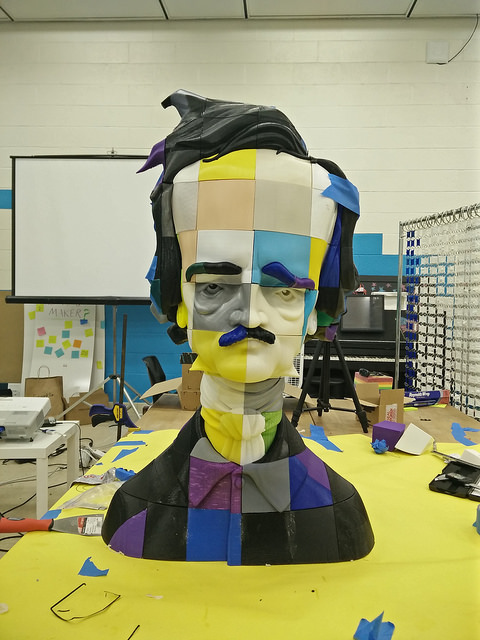
Kees Cook: 3D printing Poe

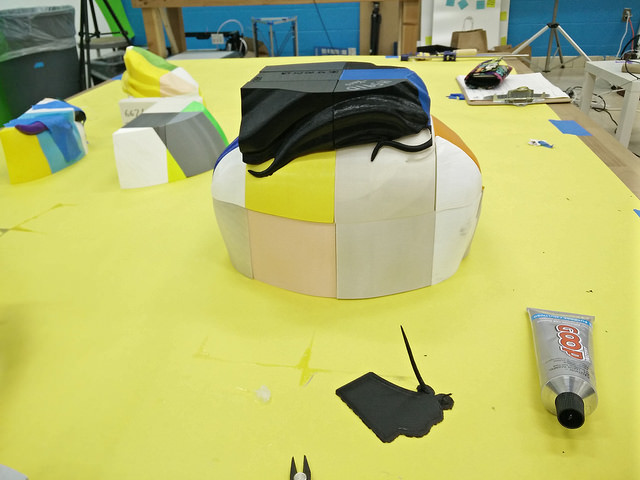
I helped print this statue of Edgar Allan Poe, through We the Builders , who coordinate large-scale crowd-sourced 3D print jobs: Poe's Face You can see one of my parts here on top, with -Kees on the piece with the funky hair strand: Poe's Hair The MakerWare I run on Ubuntu works well. I wish they were correctly signing their repositories. Even if I use non-SSL to fetch their key, as their Ubuntu/Debian instructions recommend, it still doesn t match the packages:
W: GPG error: http://downloads.makerbot.com trusty Release: The following signatures were invalid: BADSIG 3D019B838FB1487F MakerBot Industries dev team <dev@makerbot.com>
And it s not just my APT configuration:
$ wget http://downloads.makerbot.com/makerware/ubuntu/dists/trusty/Release.gpg
$ wget http://downloads.makerbot.com/makerware/ubuntu/dists/trusty/Release
$ gpg --verify Release.gpg Release
gpg: Signature made Wed 11 Mar 2015 12:43:07 PM PDT using RSA key ID 8FB1487F
gpg: requesting key 8FB1487F from hkp server pgp.mit.edu
gpg: key 8FB1487F: public key "MakerBot Industries LLC (Software development team) <dev@makerbot.com>" imported
gpg: Total number processed: 1
gpg:               imported: 1  (RSA: 1)
gpg: BAD signature from "MakerBot Industries LLC (Software development team) <dev@makerbot.com>"
$ grep ^Date Release
Date: Tue, 09 Jun 2015 19:41:02 UTC
Looks like they re updating their Release file without updating the signature file. (The signature is from March, but the Release file is from June. Oops!)

2015, Kees Cook. This work is licensed under a Creative Commons Attribution-ShareAlike 3.0 License.
Creative Commons License

Andrew Cater: Bye SPARC - for now

So it looks as if it's the end for the Debian SPARC port that is primarily 32 bit, for now at least. Too little available modern hardware, too few porters and an upstream hardware provider emotionally tied to significant licensing and support agreements.

If 64 bit SPARC hardware were more available, I'd be interested again. SPARC has given me two of my favourite moments in Debian. I helped a colleague to duplicate existing software and move architecture from Intel to SPARC mainly by copying across the list of packages.

It also allowed me in ?? 1999 / 2000 ?? to take a SPARC 20 to London Olympia to a Linux Expo where one of the principal sponsors was Sun. They laughed on their stand when I set up older hardware with minimal memory but were not so amused when I demonstrated Debian, full X Window environment and KDE successfully.

Michael Stapelberg: dh-make-golang: creating Debian packages from Go packages

Recently, the pkg-go team has been quite busy, uploading dozens of Go library packages in order to be able to package gcsfuse (a user-space file system for interacting with Google Cloud Storage) and InfluxDB (an open-source distributed time series database). Packaging Go library packages (!) is a fairly repetitive process, so before starting my work on the dependencies for gcsfuse, I started writing a tool called dh-make-golang. Just like dh-make itself, the goal is to automatically create (almost) an entire Debian package. As I worked my way through the dependencies of gcsfuse, I refined how the tool works, and now I believe it s good enough for a first release. To demonstrate how the tool works, let s assume we want to package the Go library github.com/jacobsa/ratelimit:
midna /tmp $ dh-make-golang github.com/jacobsa/ratelimit
2015/07/25 18:25:39 Downloading "github.com/jacobsa/ratelimit/..."
2015/07/25 18:25:53 Determining upstream version number
2015/07/25 18:25:53 Package version is "0.0~git20150723.0.2ca5e0c"
2015/07/25 18:25:53 Determining dependencies
2015/07/25 18:25:55 
2015/07/25 18:25:55 Packaging successfully created in /tmp/golang-github-jacobsa-ratelimit
2015/07/25 18:25:55 
2015/07/25 18:25:55 Resolve all TODOs in itp-golang-github-jacobsa-ratelimit.txt, then email it out:
2015/07/25 18:25:55     sendmail -t -f < itp-golang-github-jacobsa-ratelimit.txt
2015/07/25 18:25:55 
2015/07/25 18:25:55 Resolve all the TODOs in debian/, find them using:
2015/07/25 18:25:55     grep -r TODO debian
2015/07/25 18:25:55 
2015/07/25 18:25:55 To build the package, commit the packaging and use gbp buildpackage:
2015/07/25 18:25:55     git add debian && git commit -a -m 'Initial packaging'
2015/07/25 18:25:55     gbp buildpackage --git-pbuilder
2015/07/25 18:25:55 
2015/07/25 18:25:55 To create the packaging git repository on alioth, use:
2015/07/25 18:25:55     ssh git.debian.org "/git/pkg-go/setup-repository golang-github-jacobsa-ratelimit 'Packaging for golang-github-jacobsa-ratelimit'"
2015/07/25 18:25:55 
2015/07/25 18:25:55 Once you are happy with your packaging, push it to alioth using:
2015/07/25 18:25:55     git push git+ssh://git.debian.org/git/pkg-go/packages/golang-github-jacobsa-ratelimit.git --tags master pristine-tar upstream
The ITP is often the most labor-intensive part of the packaging process, because any number of auto-detected values might be wrong: the repository owner might not be the Upstream Author , the repository might not have a short description, the long description might need some adjustments or the license might not be auto-detected.
midna /tmp $ cat itp-golang-github-jacobsa-ratelimit.txt
From: "Michael Stapelberg" <stapelberg AT debian.org>
To: submit@bugs.debian.org
Subject: ITP: golang-github-jacobsa-ratelimit -- Go package for rate limiting
Content-Type: text/plain; charset=utf-8
Content-Transfer-Encoding: 8bit
Package: wnpp
Severity: wishlist
Owner: Michael Stapelberg <stapelberg AT debian.org>
* Package name    : golang-github-jacobsa-ratelimit
  Version         : 0.0~git20150723.0.2ca5e0c-1
  Upstream Author : Aaron Jacobs
* URL             : https://github.com/jacobsa/ratelimit
* License         : Apache-2.0
  Programming Lang: Go
  Description     : Go package for rate limiting
 GoDoc (https://godoc.org/github.com/jacobsa/ratelimit)
 .
 This package contains code for dealing with rate limiting. See the
 reference (http://godoc.org/github.com/jacobsa/ratelimit) for more info.
TODO: perhaps reasoning
midna /tmp $
After filling in all the TODOs in the file, let s mail it out and get a sense of what else still needs to be done:
midna /tmp $ sendmail -t -f < itp-golang-github-jacobsa-ratelimit.txt
midna /tmp $ cd golang-github-jacobsa-ratelimit
midna /tmp/golang-github-jacobsa-ratelimit master $ grep -r TODO debian
debian/changelog:  * Initial release (Closes: TODO) 
midna /tmp/golang-github-jacobsa-ratelimit master $
After filling in these TODOs as well, let s have a final look at what we re about to build:
midna /tmp/golang-github-jacobsa-ratelimit master $ head -100 debian/**/*
==> debian/changelog <==                            
golang-github-jacobsa-ratelimit (0.0~git20150723.0.2ca5e0c-1) unstable; urgency=medium
  * Initial release (Closes: #793646)
 -- Michael Stapelberg <stapelberg@debian.org>  Sat, 25 Jul 2015 23:26:34 +0200
==> debian/compat <==
9
==> debian/control <==
Source: golang-github-jacobsa-ratelimit
Section: devel
Priority: extra
Maintainer: pkg-go <pkg-go-maintainers@lists.alioth.debian.org>
Uploaders: Michael Stapelberg <stapelberg@debian.org>
Build-Depends: debhelper (>= 9),
               dh-golang,
               golang-go,
               golang-github-jacobsa-gcloud-dev,
               golang-github-jacobsa-oglematchers-dev,
               golang-github-jacobsa-ogletest-dev,
               golang-github-jacobsa-syncutil-dev,
               golang-golang-x-net-dev
Standards-Version: 3.9.6
Homepage: https://github.com/jacobsa/ratelimit
Vcs-Browser: http://anonscm.debian.org/gitweb/?p=pkg-go/packages/golang-github-jacobsa-ratelimit.git;a=summary
Vcs-Git: git://anonscm.debian.org/pkg-go/packages/golang-github-jacobsa-ratelimit.git
Package: golang-github-jacobsa-ratelimit-dev
Architecture: all
Depends: $ shlibs:Depends ,
         $ misc:Depends ,
         golang-go,
         golang-github-jacobsa-gcloud-dev,
         golang-github-jacobsa-oglematchers-dev,
         golang-github-jacobsa-ogletest-dev,
         golang-github-jacobsa-syncutil-dev,
         golang-golang-x-net-dev
Built-Using: $ misc:Built-Using 
Description: Go package for rate limiting
 This package contains code for dealing with rate limiting. See the
 reference (http://godoc.org/github.com/jacobsa/ratelimit) for more info.
==> debian/copyright <==
Format: http://www.debian.org/doc/packaging-manuals/copyright-format/1.0/
Upstream-Name: ratelimit
Source: https://github.com/jacobsa/ratelimit
Files: *
Copyright: 2015 Aaron Jacobs
License: Apache-2.0
Files: debian/*
Copyright: 2015 Michael Stapelberg <stapelberg@debian.org>
License: Apache-2.0
Comment: Debian packaging is licensed under the same terms as upstream
License: Apache-2.0
 Licensed under the Apache License, Version 2.0 (the "License");
 you may not use this file except in compliance with the License.
 You may obtain a copy of the License at
 .
 http://www.apache.org/licenses/LICENSE-2.0
 .
 Unless required by applicable law or agreed to in writing, software
 distributed under the License is distributed on an "AS IS" BASIS,
 WITHOUT WARRANTIES OR CONDITIONS OF ANY KIND, either express or implied.
 See the License for the specific language governing permissions and
 limitations under the License.
 .
 On Debian systems, the complete text of the Apache version 2.0 license
 can be found in "/usr/share/common-licenses/Apache-2.0".
==> debian/gbp.conf <==
[DEFAULT]
pristine-tar = True
==> debian/rules <==
#!/usr/bin/make -f
export DH_GOPKG := github.com/jacobsa/ratelimit
%:
	dh $@ --buildsystem=golang --with=golang
==> debian/source <==
head: error reading  debian/source : Is a directory
==> debian/source/format <==
3.0 (quilt)
midna /tmp/golang-github-jacobsa-ratelimit master $
Okay, then. Let s give it a shot and see if it builds:
midna /tmp/golang-github-jacobsa-ratelimit master $ git add debian && git commit -a -m 'Initial packaging'
[master 48f4c25] Initial packaging                                                      
 7 files changed, 75 insertions(+)
 create mode 100644 debian/changelog
 create mode 100644 debian/compat
 create mode 100644 debian/control
 create mode 100644 debian/copyright
 create mode 100644 debian/gbp.conf
 create mode 100755 debian/rules
 create mode 100644 debian/source/format
midna /tmp/golang-github-jacobsa-ratelimit master $ gbp buildpackage --git-pbuilder
[ ]
midna /tmp/golang-github-jacobsa-ratelimit master $ lintian ../golang-github-jacobsa-ratelimit_0.0\~git20150723.0.2ca5e0c-1_amd64.changes
I: golang-github-jacobsa-ratelimit source: debian-watch-file-is-missing
P: golang-github-jacobsa-ratelimit-dev: no-upstream-changelog
I: golang-github-jacobsa-ratelimit-dev: extended-description-is-probably-too-short
midna /tmp/golang-github-jacobsa-ratelimit master $
This package just built (as it should!), but occasionally one might need to disable a test and file an upstream bug about it. So, let s push this package to pkg-go and upload it:
midna /tmp/golang-github-jacobsa-ratelimit master $ ssh git.debian.org "/git/pkg-go/setup-repository golang-github-jacobsa-ratelimit 'Packaging for golang-github-jacobsa-ratelimit'"
Initialized empty shared Git repository in /srv/git.debian.org/git/pkg-go/packages/golang-github-jacobsa-ratelimit.git/
HEAD is now at ea6b1c5 add mrconfig for dh-make-golang
[master c5be5a1] add mrconfig for golang-github-jacobsa-ratelimit
 1 file changed, 3 insertions(+)
To /git/pkg-go/meta.git
   ea6b1c5..c5be5a1  master -> master
midna /tmp/golang-github-jacobsa-ratelimit master $ git push git+ssh://git.debian.org/git/pkg-go/packages/golang-github-jacobsa-ratelimit.git --tags master pristine-tar upstream
Counting objects: 31, done.
Delta compression using up to 8 threads.
Compressing objects: 100% (25/25), done.
Writing objects: 100% (31/31), 18.38 KiB   0 bytes/s, done.
Total 31 (delta 2), reused 0 (delta 0)
To git+ssh://git.debian.org/git/pkg-go/packages/golang-github-jacobsa-ratelimit.git
 * [new branch]      master -> master
 * [new branch]      pristine-tar -> pristine-tar
 * [new branch]      upstream -> upstream
 * [new tag]         upstream/0.0_git20150723.0.2ca5e0c -> upstream/0.0_git20150723.0.2ca5e0c
midna /tmp/golang-github-jacobsa-ratelimit master $ cd ..
midna /tmp $ debsign golang-github-jacobsa-ratelimit_0.0\~git20150723.0.2ca5e0c-1_amd64.changes
[ ]
midna /tmp $ dput golang-github-jacobsa-ratelimit_0.0\~git20150723.0.2ca5e0c-1_amd64.changes   
Uploading golang-github-jacobsa-ratelimit using ftp to ftp-master (host: ftp.upload.debian.org; directory: /pub/UploadQueue/)
[ ]
Uploading golang-github-jacobsa-ratelimit_0.0~git20150723.0.2ca5e0c-1.dsc
Uploading golang-github-jacobsa-ratelimit_0.0~git20150723.0.2ca5e0c.orig.tar.bz2
Uploading golang-github-jacobsa-ratelimit_0.0~git20150723.0.2ca5e0c-1.debian.tar.xz
Uploading golang-github-jacobsa-ratelimit-dev_0.0~git20150723.0.2ca5e0c-1_all.deb
Uploading golang-github-jacobsa-ratelimit_0.0~git20150723.0.2ca5e0c-1_amd64.changes
midna /tmp $ cd golang-github-jacobsa-ratelimit 
midna /tmp/golang-github-jacobsa-ratelimit master $ git tag debian/0.0_git20150723.0.2ca5e0c-1
midna /tmp/golang-github-jacobsa-ratelimit master $ git push git+ssh://git.debian.org/git/pkg-go/packages/golang-github-jacobsa-ratelimit.git --tags master pristine-tar upstream
Total 0 (delta 0), reused 0 (delta 0)
To git+ssh://git.debian.org/git/pkg-go/packages/golang-github-jacobsa-ratelimit.git
 * [new tag]         debian/0.0_git20150723.0.2ca5e0c-1 -> debian/0.0_git20150723.0.2ca5e0c-1
midna /tmp/golang-github-jacobsa-ratelimit master $
Thanks for reading this far, and I hope dh-make-golang makes your life a tiny bit easier. As dh-make-golang just entered Debian unstable, you can install it using apt-get install dh-make-golang. If you have any feedback, I m eager to hear it.

Dirk Eddelbuettel: Evading the "Hadley tax": Faster Travis tests for R

Hadley is a popular figure, and rightly so as he successfully introduced many newcomers to the wonders offered by R. His approach strikes some of us old greybeards as wrong---I particularly take exception with some of his writing which frequently portrays a particular approach as both the best and only one. Real programming, I think, is often a little more nuanced and aware of tradeoffs which need to be balanced. As a book on another language once popularized: "There is more than one way to do things." But let us leave this discussion for another time. As the reach of the Hadleyverse keeps spreading, we sometimes find ourselves at the receiving end of a cost/benefit tradeoff. That is what this post is about, and it uses a very concrete case I encountered yesterday. As blogged earlier, the RcppZiggurat package was updated. I had not touched it in a year, but Brian Ripley had sent a brief and detailed note concerning something flagged by the Solaris compiler (correctly suggesting I replace fabs() with abs() on integer types). (Allow me to stray from the main story line here for a second to stress just how insane a work load he is carrying, essentially for all of us. R and the R community are so just so indebted to him for all his work---which makes the usual social media banter about him so unfortunate. But that too shall be left for another time.) Upon making the simple fix, and submitting to GitHub the usual Travis CI was triggered. And here is what I saw: first travis build in a year
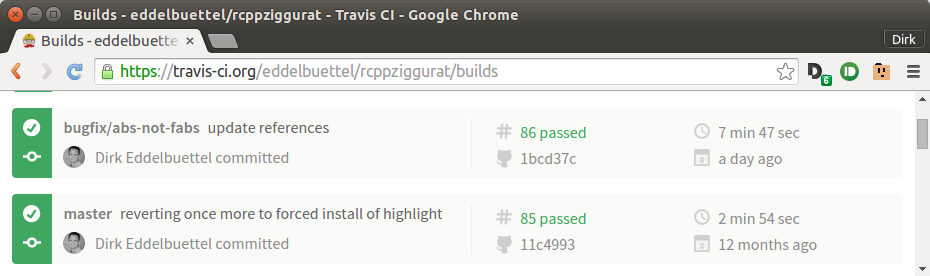
All happy, all green. Previous build a year ago, most recent build yesterday, both passed. But hold on: test time went from 2:54 minutes to 7:47 minutes for an increase of almost five minutes! And I knew that I had not added any new dependencies, or altered any build options. What did happen was that among the dependencies of my package, one had decided to now also depend on ggplot2. Which leads to a chain of sixteen additional packages being loaded besides the four I depend upon---when it used to be just one. And that took five minutes as all those packages are installed from source, and some are big and take a long time to compile. There is however and easy alternative, and for that we have to praise Michael Rutter who looks after a number of things for R on Ubuntu. Among these are the R builds for Ubuntu but also the rrutter PPA as well as the c2d4u PPA. If you have not heard this alphabet soup before, a PPA is a package repository for Ubuntu where anyone (who wants to sign up) can upload (properly setup) source files which are then turned into Ubuntu binaries. With full dependency resolution and all other goodies we have come to expect from the Debian / Ubuntu universe. And Michael uses this facility with great skill and calm to provide us all with Ubuntu binaries for R itself (rebuilding what yours truly uploads into Debian), as well as a number of key packages available via the CRAN mirrors. Less know however is this "c2d4u" which stands for CRAN to Debian for Ubuntu. And this builds on something Charles Blundell once built under my mentorship in a Google Summer of Code. And Michael does a tremdous job covering well over a thousand CRAN source packages---and providing binaries for all. Which we can use for Travis! What all that means is that I could now replace the line
 - ./travis-tool.sh install_r RcppGSL rbenchmark microbenchmark highlight
which implies source builds of the four listed packages and all their dependencies with the following line implying binary installations of already built packages:
 - ./travis-tool.sh install_aptget libgsl0-dev r-cran-rcppgsl r-cran-rbenchmark r-cran-microbenchmark r-cran-highlight
In this particular case I also needed to build a binary package of my RcppGSL package as this one is not (yet) handled by Michael. I happen to have (re-)discovered the beauty of PPAs for Travis earlier this year and revitalized an older and largely dormant launchpad account I had for this PPA of mine. How to build a simple .deb package will also have to left for a future post to keep this more concise. This can be used with the existing r-travis setup---but one needs to use the older, initial variant in order to have the ability to install .deb packages. So in the .travis.yml of RcppZiggurat I just use
before_install:
## PPA for Rcpp and some other packages
- sudo add-apt-repository -y ppa:edd/misc
## r-travis by Craig Citro et al
- curl -OL http://raw.github.com/craigcitro/r-travis/master/scripts/travis-tool.sh
- chmod 755 ./travis-tool.sh
- ./travis-tool.sh bootstrap
to add my own PPA and all is good. If you do not have a PPA, or do not want to create your own packages you can still benefit from the PPAs by Michael and "mix and match" by installing from binary what is available, and from source what is not. Here we were able to use an all-binary approach, so let's see the resulting performance: latest travis build
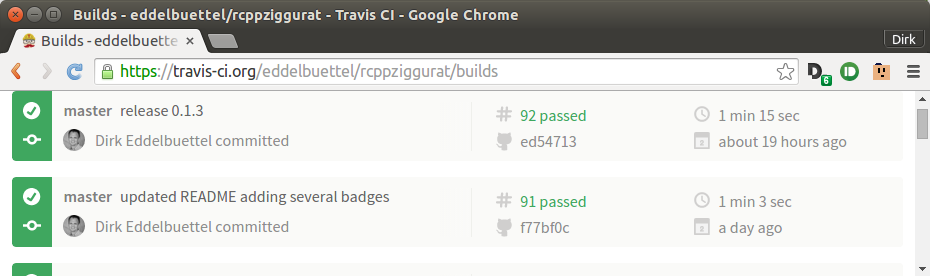
Now we are at 1:03 to 1:15 minutes---much better. So to conclude, while the every expanding universe of R packages is fantastic for us as users, it can be seen to be placing a burden on us as developers when installing and testing. Fortunately, the packaging infrastructure built on top of Debian / Ubuntu packages can help and dramatically reduce build (and hence test) times. Learning about PPAs can be a helpful complement to learning about Travis and continued integration. So maybe now I need a new reason to blame Hadley? Well, there is always snake case ...

Follow-up: The post got some pretty immediate feedback shortly after I posted it. Craig Citro pointed out (quite correctly) that I could use r_binary_install which would also install the Ubuntu binaries based on their R packages names. Having built R/CRAN packages for Debian for so long, I am simply more used to the r-cran-* notations, and I think I was also the one contributing install_aptget to r-travis ... Yihui Xie spoke up for the "new" Travis approach deploying containers, caching of packages and explicit whitelists. It was in that very (GH-based) discussion that I started to really lose faith in the new Travis approach as they want use to whitelist each and every package. With 6900 and counting at CRAN I fear this simply does not scale. But different approaches are certainly welcome. I posted my 1:03 to 1:15 minutes result. If the "New School" can do it faster, I'd be all ears.

This post by Dirk Eddelbuettel originated on his Thinking inside the box blog. Please report excessive re-aggregation in third-party for-profit settings.

26 July 2015

Gregor Herrmann: RC bugs 2015/30

this week, besides other activities, I again managed to NMU a few packages as part of the GCC 5 transition. & again I could build on patches submitted by various HP engineers & other helpful souls.

Lunar: Reproducible builds: week 13 in Stretch cycle

What happened in the reproducible builds effort this week: Toolchain fixes akira uploaded a new version of doxygen in the experimental reproducible repository incorporating upstream patch for SOURCE_DATE_EPOCH, and now producing timezone independent timestamps. Dhole updated Peter De Wachter's patch on ghostscript to use SOURCE_DATE_EPOCH and use UTC as a timezone. A modified package is now being experimented. Packages fixed The following 14 packages became reproducible due to changes in their build dependencies: bino, cfengine2, fwknop, gnome-software, jnr-constants, libextractor, libgtop2, maven-compiler-plugin, mk-configure, nanoc, octave-splines, octave-symbolic, riece, vdr-plugin-infosatepg. The following packages became reproducible after getting fixed: Some uploads fixed some reproducibility issues but not all of them: Patches submitted which have not made their way to the archive yet: reproducible.debian.net Packages identified as failing to build from source with no bugs filed and older than 10 days are scheduled more often now (except in experimental). (h01ger) Package reviews 178 obsolete reviews have been removed, 59 added and 122 updated this week. New issue identified this week: random_order_in_ruby_rdoc_indices. 18 new bugs for packages failing to build from sources have been reported by Chris West (Faux), and h01ger.

Next.

Previous.