Search Results: "mak"

15 November 2010

Raphaël Hertzog: Save disk space by excluding useless files with dpkg

Most packages contain files that you don t need: for example translations in languages that you don t understand, or documentation that you don t read. Wouldn t it be nice if you could get rid of them and save a few megabytes? Good news: since dpkg 1.15.8 you can! dpkg has two options --path-include=glob-pattern and --path-exclude=glob-pattern that control what files are installed or not. The pattern work the same than what you re used to on the shell (see the glob(7) manual page). Passing those options on the command-line would be impractical, so the best way to use them is to put them in a file in /etc/dpkg/dpkg.cfg.d/. Beware, the order of the options does matter: when a file matches several options, the last one makes the decision. A typical usage is to first exclude a directory and then to re-include parts of that directory that you want to keep. For example if you want to drop gettext translations and translated manual pages except French, you could put this in /etc/dpkg/dpkg.cfg.d/excludes:
# Drop locales except French
path-exclude=/usr/share/locale/*
path-include=/usr/share/locale/fr/*
path-include=/usr/share/locale/locale.alias
# Drop translated manual pages except French
path-exclude=/usr/share/man/*
path-include=/usr/share/man/man[1-9]/*
path-include=/usr/share/man/fr*/*
Note that the files will vanish progressively every time that a package is upgraded. If you want to save space immediately, you have to reinstall the packages present in your system. aptitude reinstall or apt-get --reinstall install might help. In theory with aptitude you can even do aptitude reinstall ~i but it tends to not work because one package is not available (either because it was installed manually or because the installed version has been superseded by a newer version on the mirror).
Found it useful? Click here to see how you can encourage me to provide more articles like this one.

8 comments Liked this article? Click here. My blog is Flattr-enabled.

Tim Retout: Gnash and librtmp

Having studied librtmp over the weekend, it doesn't drop into gnash as neatly as I'd hoped. Gnash already has classes to implement NetConnection and NetStream, which it makes sense to use - but librtmp is designed to replace the need for such classes to exist. So it implements certain higher-level responses to various calls from the server, that are necessary when downloading a stream. Gnash probably needs to hook in instead, and let the flash application decide what to do in these cases. So more work required, and possibly changes to librtmp in future - but I've started fixing up Gnash's RTMP code instead, for now, and have sent a couple of initial patches to Savannah. I don't think YouTube exercises these code paths, so they're a little rusty - I hope to make more progress through the week.

Alessio Treglia: Bits from the Debian Multimedia Maintainers

This brief announcement was published in the debian-devel-announce mailing list and I repeat it here for your information.
Hi! Since there has been a lot happening in the Debian Multimedia world during the Squeeze release, so we figured we should give you an update on that. Who are we? In the dark old ages, there were two teams involved in multimedia: the Debian Multimedia and Debian Multimedia Packages teams. Please note that neither of them is related to debian-multimedia.org (which is maintained by Christian Marillat, and is known to break current ffmpeg-based applications like mplayer and vlc in Debian Squeeze.). During late 2008, both teams were merged into one, the Debian Multimedia Maintainers team, to avoid effort fragmentation. Since then, there has been a lot of work done: Consumer Multimedia in Debian Consumer Multimedia is about playing and, well, consuming multimedia. Squeeze will feature: Squeeze will not feature: Producer Multimedia in Debian Producer multimedia is software for producing multimedia. Squeeze will
feature: End user applications: Platforms and technologies: Squeeze will not feature: Debian Multimedia Blend There is also an effort to start a Debian Multimedia Blend to give a better overview about what multimedia applications are available in Debian. There is a short list for a quick overview as well as a long package list separated in sections to give a more detailed overview (including translations, screenshots, popularity of package etc). You are invited to help improving the tasks either directly in SVN or by sending patches to Andreas Tille <tille@debian.org> or debian-multimedia@lists.debian.org (see below). Note that not all of the packages listed in the tasks pages are maintained by the Debian Multimedia team, since they are aimed at producing useful package sets instead of showing only our own packages. For those who want to squash some bugs in multimedia packages there is also the bugs page generated by the Blends tools, or our team bug page. Other activity The team has seen a lot of growth since the merger. Of the current 52 members of the Alioth team, 20 were added during 2009 and 18 in 2010, many of whom are involved in upstream development as well as the debian packaging. The number of packages has also grown, with 112 of the current 205 git repositories in our team area having its first commit during 2010. Where to reach us The Debian Multimedia Maintainers can be reached at pkg-multimedia-maintainers@lists.alioth.debian.org, should you have any questions. We have also decided to repurpose the old debian-multimedia@lists.debian.org address for user and more general discussion. We would like to invite everyone interested in multimedia to join us there. Interested developers/packagers can also join us at the first address. Some of the team members are also in the #debian-multimedia channel on OFTC.

Regards,

Alessio Treglia on behalf of the Debian Multimedia Maintainers

Manoj Srivastava: Manoj: Dear Lazyweb: How do you refresh or recreate your kvm virt periodically?

Dear Lazyweb, how do all y all using virts recreate the build machine setup periodically? I have tried and failed to get qemu-make-debian-root script work for me. Going through and redoing it from netinst ISO is an option but then I need debconf preseeding files, and I was wondering if there are some out there. And then there is the whole Oh, by the way, upgrade from Squeeze to Sid, please step. The less sexy alternative is going to the master copy and running a cron job to safe-upgrade each week, and re-creating any copy-on-write children. Would probably work, but I am betting there are less hackish solutions out there. First, some background. It has been an year since I interviewed for the job I currently hold. And nearly 10 months since I have been really active in Debian (apart from Debconf 10). Partly it was trying to perform well at the new job, partly it was getting permissions to work on Debian from my employer. Now that I think I have an handle on the job, and the process for getting permissions is coming to a positive end, I am looking towards getting my Debian processes and infrastructure back up to snuff. Before the interregnum, I used to have a UML machine setup to do builds. It was generated from scratch weekly using cron, and ran SELinux strict mode, and I used to have an automated ssh based script to build packages, and dump them on my box to test them. I had local git porcelain to do all this and tag releases, in a nice, effortless work flow. Now, the glory days of UML are long gone, and all the cool kids are using KVM. I have set up a kvm box, using a netinst ISO (like the majority of the HOWTO s say). I used madduck s old /etc/networking/interfaces set up to do networking using a public bridge (mostly because how cool his solution was, virsh can talk natively to a bridge for us now) and I have NFS, SELinux, ssh, and my remote build infrastructure all done, so I am ready to hop back into the fray once the lawyers actually ink the agreements. All I have to do is decide on how to refresh my build machines periodically. And I guess I should set up virsh, instead of having a shell alias around kvm. Just haven t gotten around to that.

Benjamin Mako Hill: Between the Bars

Almost a year ago, I blogged about Between the Bars -- a project that offers a blogging platform to the 1% of the United States population that is currently incarcerated. The way it works is pretty simple: prisoners send letters through the postal mail. We scan them and put them up on the web. Visitors can transcribe letters or leave comments which are mailed back to the authors. About a month ago, my collaborator Charlie DeTar and I finally finished planning and paperwork and opened the site to bloggers. Over the last few weeks, we've had a bunch of authors sign up. We now have a daily stream of blog posts going up on the site. Please visit the site. Leave comments. Transcribe posts. If you know of prisoners who might like to use the site, let them know. If you want postcard fliers to send to prisoners, let us know.

14 November 2010

Marco d'Itri: Other people's ethics and tastes

In the last years I noticed a growing trend of people pushing for "new" rules about what is appropriate or not for single developers or for the project as a whole. In too many cases even just considering these ideas to be an obvious fact... I prefer to not give specific examples because these would divert the attention from the main topic and would be affected by my own biases. At this point I believe it is useful to remember that all ethical issues which are not explicitly covered by the Social Contract are just the developers' own opinions. It may even be a good idea, but other developers are not and should not be compelled to agree with it no matter how good or important you believe it is. You are entitled to having your own ethics and even ranting about it on Planet Debian, but I am entitled to not caring at all without this making me a worse Debian Developer. Let's try to be grown ups and not be excessively annoyed by other people's choices. This is why I want to convey this simple message to the people who keep preaching about what is proper for me or for Debian: please fuck you. If I want to receive lectures about what is right or wrong then I surely know where I can find a priest. For some reason, now I see fit to mention that I have an Amazon wishlist...

13 November 2010

Julien Blache: pommed v1.35: October 2010 MacBook Air

I ve just release pommed v1.35, adding support for the October 2010 MacBook Air machines. Kernel support for these machines has been submitted during the 2.6.37-rc cycle, so it will appear in 2.6.37 or 2.6.38 depending on maintainers, merge window and patch readiness. The machines have new keyboard assemblies (WellSpring IV and IVa) requiring new quirks in the HID layer, new trackpads, need sound & applesmc configurations of their own and the backlight module needs to know about them. So, make sure your kernel has all of that, otherwise your machine will be hard to use and pommed will not work at all. Update: #603395 filed against linux-2.6 with all the needed patches attached. It looks like we ll have all of this in Squeeze, thanks to our kernel team.

12 November 2010

Steve McIntyre: Using pulseaudio in a chroot

(Mainly for my own information, so I can find this again later!) I'm running Debian Squeeze on my Lenovo Thinkpad X200 laptop, using the amd64 version so that I can make the most of the 64-bit CPU. However, I also need a range of 32-bit apps too for now, typically proprietary rubbish like the Flash plug-in for Firefox^WIceweasel. So I set up a 32-bit chroot with a small Debian installation in there too. (Roll on multi-arch!) That's been working ok for a while, except that I couldn't get working audio in my browser. I didn't really pay much attention to that until recently: I wanted to watch some videos on YouTube and the sound mattered! After some digging, it became clear that Iceweasel inside the chroot just wasn't talking to the currently-running pulseaudio server outside the chroot. I had installed all the required libs in the chroot too, but still no joy. After some searching (thanks to the folks on the Archlinux wiki for this!) I've now been able to configure my chroot correctly. 2 bits needed: 1. Configure alsa in the chroot to use pulse by default by creating/editing /etc/asound.conf:
pcm.pulse  
    type pulse
 
ctl.pulse  
    type pulse
 
pcm.!default  
    type pulse
 
ctl.!default  
    type pulse
 
2. The dbus machine ID in the chroot needs to be the same as that of the main host, which it wasn't for me. That caused audio apps to report "connection refused" when I tested them. The machine ID is stored in /var/lib/dbus/machine-id. Either copy that file from the host system into the chroot, or add /var/lib/dbus as a bind-mount along with the usual suspects like /home and /tmp. Job done, I can watch movie trailers etc. with sound in my browser. Yay! :-)

Pietro Abate: dose3 distcheck

A while ago I wrote about the new distcheck tool upcoming in dose3. I've recently updated the proposal on the debian wiki to reflect recent changes in the yaml data structure. The idea was to remove redundant information, to make it easier to read and at the same time include enough details to make it easy to use from a script. I'll write down a small example to explain the format. A package can be broken because of a missing package or because of a conflict. For a missing package we'll have a stanza like this :
package: libgnuradio-dev
version: 3.2.2.dfsg-1
architecture: all
source: gnuradio (= 3.2.2.dfsg-1)
status: broken
reasons:
-
missing:
pkg:
package: libgruel0
version: 3.2.2.dfsg-1+b1
architecture: amd64
missingdep: libboost-thread1.40.0 (>= 1.40.0-1)
paths:
-
depchain:
-
package: libgnuradio-dev
version: 3.2.2.dfsg-1
architecture: all
depends: libgnuradio (= 3.2.2.dfsg-1)
-
package: libgnuradio
version: 3.2.2.dfsg-1
architecture: all
depends: libgnuradio-core0
-
package: libgnuradio-core0
version: 3.2.2.dfsg-1+b1
architecture: amd64
depends: libgruel0 (= 3.2.2.dfsg-1+b1)
The first part gives details about the package libgnuradio-dev, specifying its status, source and architecture. The second part is the reason of the problem. In this case it is a missing package that is essential to install libgnuradio-dev. missindep is the dependency that cannot be satisfied is the package libgruel0 , in this case: libboost-thread1.40.0 (>= 1.40.0-1). The paths component gives all possible depchains from the root package libgnuradio-dev to libgruel0 . Notice that we do not include the last node in the dependency chain to avoid a useless repetition. Of course there might be more then on path to reach libgruel0. Distcheck will unroll all of them. Because of the structure of debian dependencies usually there are not so many paths. The other possible cause of a problem is a conflict. Consider the following :
package: a
version: 1
status: broken
reasons:
-
conflict:
pkg1:
package: e
version: 1
pkg2:
package: f
version: 1
depchain1:
-
depchain:
-
package: a
version: 1
depends: b
-
package: b
version: 1
depends: e
depchain2:
-
depchain:
-
package: a
version: 1
depends: d
-
package: d
version: 1
depends: f
This is the general case of a deep conflict. I use an artificial example here instead of a concrete one since this case is not very common and I was not able to find one. To put everything in context, this is the example I've used (it's in cudf format, but I think you get the gist of it):
package: a
version: 1
depends: b, d

package: b
version: 1
depends: e

package: d
version: 1
depends: f

package: f
version: 1
conflicts: e

package: e
version: 1
conflicts: f
The first part of the distcheck report is as before with details about the broken package. Since this is a conflict, and all conflicts are binary, we give the two packages involved in the conflict first. Packages f and e are in conflict, but they are not direct dependency of package a . For this reason, we output the two paths that from a lead to f or e. All dependency chains for each conflict are together. Again, since there might be more than one way from a to reach the conflicting packages, we can have more then one depchain. Another important upcoming change is distcheck (to be implemented soon) it the ability to check if a package is in conflict with an Essential package. In the past edos-debcheck always check the installability of a package in the empty universe. This assumption is actually not true for debian as all essential packages should always be installed. For this reason, now distcheck will check the installability problem not in an empty universe, but in a universe with all essential packages installed. This check is not going to be fool proof though. Because of the semantic of essential packages, despite is not possible to remove a package toutcourt, an essential package can be replaced by a non essential package via the replace mechanism. For example, poking with this feature I noticed that the package upstart in sid replace sysinit and it is in conflict with it. This is perfectly fine as it gives a mechanism to upgrade and replace essential components of the system. At the same time this does not fit in the edos-debcheck philosophy of checking packages for installation problems in the empty universe (or in a universe with all essential packages installed). At the moment we are still thinking how to address this problem (the solution will be in the long term to add the replace semantic in distcheck), but for the moment we will just provide an option to check packages w.r.t essential packages conscious the this can lead to false positives. This work is of course done in collaboration with the mancoosi team in paris. Dose3 is still not ready for prime time. We are preparing debian packages and we plan to upload them in experimental in the near feature.


Dirk Eddelbuettel: RcppArmadillo 0.2.9

The new version 0.2.9 of RcppArmadillo has been uploaded to CRAN. The only change is an update of the included Armadillo template library to version 0.9.92 which Conrad released this week. RcppArmadillo makes it easy to write highly efficient and highly readable C++ code for linear algebra (based on Armadillo) in R extensions (using Rcpp for the interface). The short NEWS file extract follows, also containing Conrad's entry for 0.9.92::
0.2.9   2010-11-11
    o   Upgraded to Armadillo 0.9.92 "Wall Street Gangster":
         * Fixes for compilation issues under the Intel C++ compiler
         * Added matrix norms
More information is on the RcppArmadillo page. Questions, comments etc should go to the rcpp-devel mailing list off the R-Forge page.

11 November 2010

Neil Williams: Counterpoint


There must be other organisations across the world which do a similar job but this is the local one for me and in lieu of actually getting to a Remembrance Day event this year (I'll be at a bug squashing event for Debian Squeeze), I'm using my blog, just this once, to express my own thanks to those who gave their lives that I may be free to do what I enjoy, writing code to make things just work.

Matt Zimmerman: Back to the future

In my professional role as Ubuntu CTO, I take on a number of different perspectives, which sometimes compete for my attention, including: My recent work, as Canonical has gone through a period of organizational growth and change, has prioritized the inward perspective. I took on a six-month project which was inwardly focused, temporarily handing off many of my day-to-day responsibilities (well done, Robbie!). I ve grappled with an assortment of growing pains as many new people joined Canonical over the past year. With that work behind me, it s time to rebalance myself and focus more outside of Canonical again. It s good to be back! In my outward facing capacity, I ll shortly be attending Web 2.0 Summit in San Francisco. I attend several free software conferences each year, but this is a different crowd. I hope to renew some old ties, form some new ones, and generally derive inspiration from the people and organizations represented there. Being in the San Francisco Bay area will also give me an opportunity to meet with some of Canonical s partners there, as well as friends and acquaintances from the free software community. With my head down, working hard to make things happen, it s easy to lose perspective on how that work fits into the outside world. Spending more time with people outside of Canonical and Ubuntu is an important way of balancing that effect. Looking forward, I ll be thinking about the longer term direction for the Ubuntu platform. The platform is the layer of Ubuntu which makes everything else possible: it s how we weave together products like Desktop Edition and Server Edition, and it s what developers target when they write applications. Behind the user interfaces and applications, there is a rich platform of tools and services which link it all together. It s in this aspect of Ubuntu that I ll be investing my time in research, experimentation and imagination. This includes considering how we package and distribute software, how we adapt to technological shifts, and highlighting opportunities to cooperate with other open source projects. My primary outside-in role is as chair of the Ubuntu Technical Board. In this capacity, I m accountable to the Ubuntu project, the interests of its members, and the people who use the software we provide. Originally, the TB was closely involved with a range of front-line technical decisions in Ubuntu, but today, there are strong, autonomous teams in place for the most active parts of the project, so we only get involved when there is a problem, or if a technical question comes up which doesn t fit the charter of an established team. It s something of a catch-all. I d like to re-establish the TB in a more central role in Ubuntu, looking after concerns which affect the project as a whole, such as transparency and development processes. I m also re-joining Debian as a non-uploading contributor, to work on stimulating and coordinating cooperation between Debian and Ubuntu. I m looking forward to working more with Zack on joint projects in this area. This change will help me to support Canonical and Ubuntu more effectively as they continue to grow and change. I look forward to exercising some mental muscles I haven t used very much lately, and facing some new challenges as well.

Steve Kemp: The pain of a new IP address

Tonight I was having some connectivity issues, so after much diagnostic time and pain I decided to reboot my router. At the moment my home router came back my (external) IP address changed, and suddenly I found I could no longer login to my main site. Happily however I have serial console access, and I updated things such that my new IP address was included in the hosts.allow file. [*] The next step was to push that change round my other boxes, and happily I have my own tool slaughter which allows me to make such global changes in a client-pulled fashion. 60 minutes later cron did its magic and I was back. This reminds me that I let the slaughter tool stagnate. Mostly because I only use it to cover my three remote boxes and my desktop, and although I received one bug report (+fix!) I never heard of anybody else using it. I continue to use and like CFEngine at work. Puppet & Chef have been well argued against elsewhere, and I'm still to investigate BFG2 + FAI. Mostly I'm happy with slaughter. My policies are simple, readable, and intuitive. Learn perl? Learn the "CopyFile" and you're done. For example. By contrast the notion of state machines, functional operations, and similar seem over-engineered in other tools. Perhaps thats my bug, perhaps that's just the way things are - but the rants linked to above makes sense to me and I find myself agreeing 100%. Anyway; slaughter? What I want to do is rework it such that all policies are served via rsync and not via HTTP. Other changes, such as the addition of new primitives, don't actually seem necessary. But serving content via rsync just seems like the right way to go. (The main benefit is recursive copies of files become trivial.) I'd also add the ability to mandate GPG-signatures on policies, but that's possible even now. The only step backwards I see is that currently I can serve content over SSL, but that should be fixable even if via stunnel.
*
My /etc/hosts.allow file contains this:
ALL: 127.0.0.1
ALL: /etc/hosts.allow.trusted
ALL: /etc/hosts.allow.trusted.apache
Then hosts.allow.trusted contains:
# www.steve.org.uk
80.68.85.46
# www.debian-administration.org
80.68.80.176
# my home.
82.41.x.x
I've never seen anybody describe something similar, though to be fair it is documented. To me it just seems clean to limit the IPs in a single place. To conclude hosts.allow.trusted.apache is owned by root.www-data, and can be updated via a simple CGI script - which allows me to add a single IP address on the fly for the next 60 minutes. Neat.
ObQuote: Tony is a little boy that lives in my mouth. - The Shining

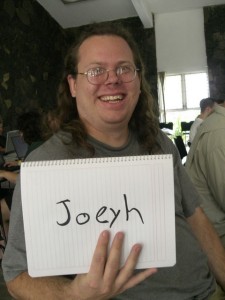
Rapha&#235;l Hertzog: People behind Debian: Joey Hess of debhelper fame


I decided recently to publish interviews from Debian contributors and I picked Joey Hess as my first target. He s one of the few who have heavily influenced Debian by creating software that have become building blocks of the project, like the debian-installer (Joey uses the shorthand d-i to refer to it). My questions are in bold, the rest is by Joey (except for the additional information that I inserted in italics). Who are you? Hello, I m Joey Hess. I m one of the oldtimers in Debian. Actually, I just checked, and there are still up to nineteen active Debian Developers who joined the project before I did, in 1996. I got started fairly young, and am just 34 years old. I spend part of my time working with Lars Wirzenius, another Debian oldtimer, on Branchable. It makes it dead-easy for anyone to make a website that is built from Git, using my Ikiwiki engine to do wiki and blog style things. These days I spend the rest of my time working on free software, when I should really be looking for work to pay the bills. What s your biggest achievement within Debian or Ubuntu? I guess I m mostly known by Debian developers for writing debhelper and perhaps debconf. Probably founding the Debian Installer project has been a bigger impact for users. I m fairly equally proud of all three projects. But while it might sound corny, I am more proud of the accumulation of all the smaller things done in the context of Debian. It s more of a deep connection to the project. All the bugs fixed, and filed, and packages uploaded, and late night discussions, and just being a part of the larger project. What are your plans for Debian Wheezy? Hmm, I stopped thinking of Debian releases by code names back around Slink. :) So, few specific plans for Wheezy. The main thing I would like to help make happen in Debian next is Constantly Usable Testing, and it transcends releases anyway. The only specific plans I have for Wheezy are that there will probably be a new debhelper compat level, and I hope d-i will finally switch to using git. RH: You can learn more about Constantly Usable Testing in my article Can Debian offer a Constantly Usable Testing distribution?. If you could spend all your time on Debian, what would you work on? Getting Debian on all these computers that we carry around in our pockets and can t easily run apt-get on and hack on. Phones that is. It s a bigger problem than just Debian, but I think Debian needs to find a way to be part of the eventual solution. The FreedomBox concept at least hints at a way around the current situation with embedded computers in general. What s the biggest problem of Debian? I believe that the biggest problem is institutional, social and technological inertia. Every specific case of something that frustrates me about Debian today can be traced back to that. You contribute regularly to Debian mailing lists, yet I don t remember any aggressive/frustrated mail of you. How do you manage that? Are you avoiding heated discussions? Rats, sounds like all my wonderful flames of years past have been forgotten! Seriously though, after I noticed thread patterns, I started trying to avoid participating in the bad patterns myself. Now I limit myself to one expression of an opinion, and I don t care who gets the last word. If people can t be convinced, it s time to find another approach to the problem. Also, code talks. Most of the programs you wrote for Debian are in Perl. Do you regret this choice? I love that question! No, no regrets. My only concern is whether the language limits contributors or users. I have not seen Perl significantly limiting the use of anything except for debconf (we had to rewrite it in C for d-i). And I do not notice fewer contributions to my Perl-based code than to other code. I do sometimes regret when someone tells me they had to learn or re-learn Perl to work on something I wrote. But while I m enjoying writing new things in Haskell now, and while I hope it will mean less maintenance burden later, I don t think using Haskell will make it easier for others to contribute to my programs. Anyway, for me the interesting thing about writing a program is the problem it solves and the decisions made doing it. Choice of language is one of the less interesting decisions. Is there someone in Debian that you admire for his contributions? Well, lots. You re tempting me to throw a dart at a map. So arbitrarily, I ll say Anthony Towns. We could all learn something from how he s approached making big, fundamental changes, like introducing Testing, and making Debian Maintainers happen.
Thank you to Joey for the time spent answering my questions. I hope you enjoyed reading his answers as I did. Subscribe to my newsletter and don t miss further interviews. You can also follow along on Identi.ca, Twitter and Facebook. PS: If you want to suggest me someone to interview, leave a comment or mail me.

3 comments Liked this article? Click here. My blog is Flattr-enabled.

Michael Casadevall: On Achieving Goals ...

*blows the dust off his blog*

It's been quite awhile since I last wrote anything in this thing, so I guess its a good time as any, off the tails of UDS-N, to finally sit down and write something down. Since my last blog posting in May, I've been travelling around the world, attending conferences, and trying to represent both Ubuntu and Debian itself, and Canonical in all my travels. I was recently posted to China for a full month where I lived and worked out of an office, made friends with fellow Ubuntu users, and tech enthusiasts, had a wonderful time meeting with people with the Beijing Linux User's Group, and worked hard within my team at Canonical, and the legions of Ubuntu Developers to help make one of the best releases we've ever had.

As I was writing specs and drafting work items, I came to the point that I was reflecting on my own personal goals and growth in life. Two years and change ago, I was a struggling junior at Rochester Institute of Technology, a little less than two years ago, I started working full time with Canonical, and this year, I've gone and traveled to many places I've only dreamed about; Anchorage & Barrow, Alaska; Tampere, Finland; Prague, Czech Republic; and Brussels, Belgium, just to name a few. I packed up and lived in China for a month (an amazing experience, and I look forward to going back and visiting again sometime in the near future). Had you told the me of two years ago what I would be doing now, I'd probably think you were smoking something good.

One thing I've discovered in my life is that if you want to do something, you need to get out there and just ****ing do it. This may seem simple, but I think of the dreams a lot of people have that never seem to come to fruition. When I have an opportunity, I take it; going to Alaska was a dream I harbored for many years, especially entering the arctic circle, and heading to Barrow. That entire trip was booked on roughly four days notice, and the side trip to Barrow was planned the day before it actually happen. I don't regret any of it; it was one of the best things I ever done.

It brings me to what I consider the flux of this blog posting. For those who know me, I've had a goal of visiting every state within the United States. At this time last year, this map looked like this

As of two weeks ago today, this map looked like this:


Now, by the end of the day today, it will look like this:


The point I'm trying to make is if you want to do something, do it the first chance you get, or just don't do it; I say this because you never know when you will be able to do it again.

As for completing a life goal, well, it feels pretty amazing :-). I may write about that in a future blog posting ...

Steve Kemp: I miss the old Debian

I miss the days when Debian was about making software work well together. These days the user mailing lists are full of posts from users asking for help on Ubuntu [*1*], people suggesting that we copy what Ubuntu has done, and people asking for "howtos" because documentation is too scary or too absent for them to read. Yesterday the whole commercial spam on Planet debate started. Its yet another example of how in-fighting[*2*] seems to be the most fun part of Debian for too many. Me? I started and folded a company. I got Debian help and users. Some threw money at me. Joey Hess? Started making the nice-looking ikiwiki-powered branchable.com. Commercial? Yes. Spam? No. I guess there is little I can do. I could quit - as over time I've become less patient dealing with the project as a whole, but simultaneously more interested in dealing with a few specific people. But I suspect the net result would be no change. Either people would say "Ok , bye" or worse still offer my flttry: "Don't go - we lurve you". Meh. I shouldn't write when I'm annoyed, but living in a hotel will do that to you. Footy-Mc-Foot-notes. Cos HTML is hard. Lets go shopping Eat Cake.
1
The Ubuntu forums are largely full of the blind leading the blind. Or equally often the blind being ignored. I do believe that an Ubuntu stackoverflow site would be more useful than forums. But that's perhaps naive. People will still most often say "My computer doesn't work" missing all useful the details. The only obvious gain is you can avoid "me too!!!" comments, and "fix this now or I'm gonna go .. use gentoo?".
2
Back a few years when people were less civil some mailing lists and irc channesl were unpleasant places to be. These days we've solved half the problem: People mostly don't swear at each other. The distractions, the threads that don't die, even if you ignore them and don't join in the "hilarity" they still have a devisively negative effect.

10 November 2010

Tim Retout: Splitting librtmp from Gnash

So I studied the SWF 8 iPlayer a little - there are some simple rendering issues with Gnash that I'd like to come back to, but the biggest problem is obviously the media not playing. Looking at the network requests, wireshark says something about malformed packets - Gnash is getting as far as making RTMP requests, but the connection dies pretty quickly. My working theory is that there is a bug in the Gnash RTMP client code. This code was forked from rtmpdump, and has since been converted from C to C++, and a whole bunch of other stuff. It's quite possible that there is some change deep in the code which hasn't been copied back into Gnash - therefore, it makes sense to get Gnash building against librtmp properly, which is now a separate library. This, of course, means actually writing code. Eurgh. I try to avoid that when I can, but sometimes it is inevitable. :) When writing larger changes, I find it takes me longer to get acquainted with the existing code base - in this case, two code bases, since I have to understand librtmp at some level, as well. I'm not expecting to produce anything before the weekend, which is frustrating. It is also risky to write about stuff before you have completed it, because it can be a very public failure if you don't manage it!

David Welton: The Future of Programming Languages: Economics

Someone on Hacker News asks about the future of programming languages, and I realized that it's a pretty interesting topic. Here's my take on it: Programming languages are about people, and the compromises they may or may not make in order to communicate their intentions to computers. The technology in question may change, but there will likely always be people involved, and as long as that's true, looking at the problem through the lense of economics provides useful results. Therefore, looking at programming languages pretty much requires that you look at the economics of them:
I wrote this in a hurry. Have I missed anything? How do these factors apply to languages you see emerging?

Martin-&#201;ric Racine: Ubuntu kernel at 1000Hz with PREEMPT enabled?

Back when Linux kernel 2.6 was released, one of the immediate benefits that I noticed was how beautifully responsive my desktop had suddenly become. As it turned out, Linus figured out that he would create a buzz to accompany kernel 2.6's release by having a default clock rate of 1000Hz. However, the excitement was short-lived and kernel defaults were soon brought back down to a more conservative rate of 250Hz, allegedly because some peripheral chips could not handle such a high frequency bump without producing an increased amount of processing errors. Adding insult to injury, Ubuntu defaults eventually dropped another responsiveness enhancement, kernel preemption, allegedly because the goal was to have a one-size-fits-all kernel shipping with Ubuntu and preemption was detrimental to the kernel performance when the host is used as a server, which was a problem because Ubuntu had somehow decided to shift its focus from the desktop market towards the more lucrative server market. While there is nothing wrong with universally-safe kernel defaults or with a corporate decision to shift a distribution's focus towards more lucrative markets, it nonetheless left me pondering what would be the best way to get a 1000Hz kernel with preemption on my desktops, without constantly having to crank out my own kernel packages. As such, I was wondering if there would be enough traction from desktop users to justify producing such a kernel and to make it available as a post-install option from the Ubuntu repository? PS: I'm already aware that a specialized Ubuntu kernel is available to cater for the needs of audio production, but my understanding is that it has power management disabled, because it can interfere with the real-time operation of MIDI devices, while normal desktop users would definitely want to have power management enabled.


Erich Schubert: Calendar

If you want to see a really big Google Calendar, check out this calendar. Essentially, it is all the events from over 100 other calendars (all containing swing dancing events) merged into one, resulting in often more than 50 events every day, occasionally over 20 at the same time). The data is approximately the same that can be seen on this map; in fact I'm trying to move the data keeping from a custom database (which has superior filtering capabilities such as synonyms in text search) to just having Google keep the data for me (meaning it will eventually not require me to have an own web server for this). I'm doing some filtering such as removing events that don't have parseable geo information (I'm adding GeoRSS:where elements, in fact), some text to html conversion of the entry contents and filtering out inappropriate events via some regular expressions (e.g. only including "Swing" not "Ballroom" events from a calendar) There are still a couple of things to resolve. I'm not sure that recurrence exceptions are propagated properly to the combined calendar; the updates could work more incrementally, and I have to resolve some timezone issues due to the global nature of the calendar: I need to make sure the timezone information is preserved, since usually it makes more sense to give the events in local (to the event) time. P.S. sorry, the code is too specialized and needs cleanup, I won't share it yet.

Next.

Previous.

