Search Results: "ina"

12 February 2011

David Welton: Book Review: Start Small, Stay Small, A Developer's Guide to Launching a Startup

<iframe frameborder="0" marginheight="0" marginwidth="0" scrolling="no" src="http://rcm.amazon.com/e/cm?lt1=_blank&amp;bc1=000000&amp;IS2=1&amp;bg1=FFFFFF&amp;fc1=000000&amp;lc1=0000FF&amp;t=dedasys-20&amp;o=1&amp;p=8&amp;l=as4&amp;m=amazon&amp;f=ifr&amp;asins=B003YH9MMI" style="width: 120px; height: 240px; float: left; margin-right: 10px;"></iframe> I tend to be a sucker for business books, to the point where I created (and later sold) a site to discuss them. Part of the motivation for creating that site was that a lot of them tend to contain one good idea, and an inordinate amount of fluff. This book does not - it's good material that could not easily be summarized because it's full of information. I think it's actually one of the more relevant books I've ever read in that, for my situation, the idea behind it really speaks to me. I work as a consultant during the days, and I like it a lot. Rather than working on the same old thing year after year, I get to meet new people, new clients, new situations, and help them out, which is motivating. However, consulting has its downsides too, in that it doesn't create a great deal of long-term value. Once you've finished up a project, it's on to the next one, or no money comes in. I'm also a bit older and more set in my ways: I did my time in the California Bay Area, and I don't relish going back and working like mad on a "Real Startup" with VC backing, crazy hours, and having the thing consume my life. The idea behind "Start Small, Stay Small" is to find and create really niche products: stuff that will earn you some extra money as a developer, but also niches that are small enough to not really be interesting to larger companies that need a lot of income to justify a forray into a particular market segment. This, then, becomes your 'competitive advantage': Microsoft, or even 37 Signals, simply isn't going to chase after a market that is worth 20,000 dollars a year. And yet for someone working on their own, if you manage to set up something that brings in that money, and mostly automate it so that it's not a second job, it's a tidy extra bit of money. Several projects like that might even be enough to live on, depending on your lifestyle. With that in mind, the authors, Rob Walling and Mike Taper, delve into the details of how to go about doing so. The whole thing is done under the assumption that you don't have a lot of time or money to throw at things that don't bring in concrete results in relatively short order. Various subjects discussed in detail include how to find a niche, how to create a sales web site, how to measure market demand, conversion rates, how to productively outsource less critical portions of your business, and much more. They also discuss what sorts of numbers to look at for various aspects of the business, and anchor the discussion with real numbers for many things, rather than just giving you a hand-wavy phrase that's not that useful in the real world. It's not a 'timeless' book as all the concrete numbers and techniques reference technologies, sites, and the market dynamics of 2011, but after all, that's part of what makes it good. Other things I didn't like so much were being sold on their for-pay "micropreneur community", and the relatively high price of the book but I think it's worth it given the real advice you get. If you don't like marketing, and think that products succeed or fail on their merits alone, of course the book will leave you cold, but of course you're wrong about that anyway!

Wouter Verhelst: Ten years of Debian

My first ever Linux installation was done in the late nineties 1998 or thereabouts but was a RedHat 4.5 installation rather than a Debian one. The reason for that was fairly simple: the Infomagick sixpack CD set that I'd bought contained RedHat, Debian, and Slackware, but the RedHat installation was the only one that could be installed directly from CD the other two required me to write floppies and boot from those to start the installation, and I wasn't very fond of that idea. It was only a few years and a few broken RedHat upgrades later that I saw the light and considered trying out this Debian thing that some of my classmates were talking about. The fact that I'd just bought my own computer (rather than having to compete for time with my siblings on my parents' computer) was a good reason to do a fresh Linux installation. I'd been planning to install Linux From Scratch, but as what was still known as the LFS HOWTO told me you'd need a working Linux installation to do that, I considered my options. Since I'd developed a strong dislike of RedHat, I wasn't interested in doing another RedHat anymore. So, I downloaded the most recent version of Debian at the time (Potato Test Cycle III), wrote it to a CD, and installed. I've probably still got the CD lying around somewhere. A few months later, I found these "Linux Gazette" packages in the archive, with the latest packaged issue being 47, but the latest upstream version being much higher. Trying to figure out what was going on, I mailed the maintainer, Adrian Bridgett, who encouraged me to take over maintenance. Thus began my life of actively contributing to Open Source software. In November 2000, I applied to become a Debian Developer. In January 2001, Martin Michlmayr was assigned to be my AM. And in early February 2001, now just over ten years ago, I'd become a Debian Developer. Yes, that was fast, and no, I probably wasn't really ready yet, at the time. Originally, I only cared much about these Linux Gazette packages. But, as time went on, I started looking around, too. A friend passed me an old Macintosh Centris 610. As I tried to install Debian on it, I found that it didn't actually run very well. This turned out to be due to it having a broken 68LC040 processor, so I bought me another m68k-based mac, one with a full 68040 processor (a Centris 650). Thus I became involved in the m68k port and buildd maintenance. As these old machines came with 80MB or 250MB SCSI hard disks of which I had none laying around, and a then-recent Debian installation had minimum requirements of about 200MB, I was in need of network storage to be able to do anything useful with the mac. NFS didn't work as expected; the RTC implementation on m68k mac hardware was reverse engineered and didn't work too well at the time, which meant that the clock would run slower if the machine was under load, and that in turn would mean that make would get confused about timestamps, since they would suddenly appear to originate from the future (in NFS, it's the server that assigns time stamps, not the client). There was a simple solution, however; Pavel Macheck had written this neat 'Network Block Device', which would let the client do its own filesystem on network storage. Only it wasn't packaged; but then, that was easy to fix. Thus I started maintaining the single piece of software that I've worked the most on, to date. A few years later, Pavel lost interest in maintaining NBD, and handed over upstream maintenance to me and maintenance of the kernel side to Paul Clements. Thus began my life in upstream work. And while I originally joined Debian with the intent of using it as a learning experience and stepping stone on my way to more "important" free software, I found that it wasn't as satisfying as was my work for Debian. Over the years, there's been this duality where I've felt like I was doing too much and not enough at the same time. Too much, because the things I was doing would eat up much of my spare time, leaving little time left for other hobbies. Not enough, because I witnessed other people doing much more for Debian than I did, and I wanted to make a difference. As the years passed by, many things have changed. Not only in Debian, but also besides it. I became an independent contractor, focusing mostly on supporting people in using Debian (although I support them with other distributions, too). The importance of a port went from 'something which these weird porter people are doing, and that we should probably help them with if it doesn't work, but is their problem really' to 'something that I really really really have to make sure works for my packages', and back for the port that I cared about most. After several years of trying, I finally managed to explain to my parents what this Debian thing is, why it matters, and what my role in the whole thing is. We did a few releases, some taking longer than I would've liked. People joined the project, and left again. Some of my friends died. My fame in the project rose, even though I wasn't aware of it initially; and thus I was rather surprised when someone asked me whether I was "the Wouter Verhelst" at a key signing party. Recently, I've started looking back, and considered the things which Debian has meant to me. Ten years ago, I was 22, still in college, and had way too much spare time on my hands. I'd recently gotten my first Internet installation, and all these online communities were very new to me. Yes, that was all probably rather late. Debian has changed my life in many ways; it has allowed me to meet various kinds of people, both online and in meatspace. I've been to Helsinki, Edinburgh, Mar del Plata, C ceres, and New York City, places that I might otherwise not have visited. Each of these trips was an incredible experience that I have fond memories of; and while the most fond ones originate from Helsinki, I cherish the memories of each of these trips as some of the best trips I've ever done. Working on Debian has forced me to learn about the inner workings of a Linux-based system, which is knowledge that has helped me tremendously professionally, too. And finally, working on Debian has given me a unique perspective on this whole FOSS community, which has helped shape my ethics and my view of the world. While I believe that I would've subscribed to most of that ideology at any rate, I'm not sure that the details of my beliefs and understanding would've been exactly the same. And while I don't agree on every position that the project subscribes to as a whole, I do believe that the philosophies that lie at the core of this project contain just the right mix of pragmatism and ideology that makes it possible for our project to thrive in a changing world of not only a growing group of people who subscribe unconditionally to the free software ideals, but also business people who care mostly about money. Over the years, somehow I moved from "one of the recent batch of new Debian Developers" to "someone who's been with the project longer than most". It still feels weird to see people shut up because you've built up a reputation in some area, and you give your gut opinion on some subject without researching it too much. I try not to let that happen too often. Today, ten years and just over a week ago, my life as a Debian Developer started, and it would change the way I looked at the world, the things I would do in my spare time, and the people I would meet. I wouldn't have it any other way. Thanks, Debian, for what's been a blast; may the next ten years be as inspiring to me and everyone as the past ten!

11 February 2011

Patrick Winnertz: A bunch of new versions

Today I started to package from nearly all packages which I maintain within debian the new upstream versions, as squeeze is finally released :) Have fun with powertop 2.0beta (1.97) and the new lmms versions, to name only a few! ;)

10 February 2011

Marco Silva: Using Horizontal Sharding in SQLAlchemy to display multiple DBs

My problem was: I had a number of databases generated in different machines and I wanted to query them as if they were one, using the database the data came from as a field while querying and while showing results. The databases are SQLite3 files, generated using SQLAlchemy in a Python program. I solved this by using SQLAlchemy, which was good because I could use the same ORM mapping that the program used. I noticed that the Horizontal Sharding SQLAlchemy extension would fit well the problem, although not perfectly. I had to make some changes in some classes of this extension, and now it works fine. It was possible to filter the data using database as a criteria, but I couldn't get the database information from each line of a query result. I made a simple patch to SQLAlchemy, which wasn't likely to be introduced in the distribution, but worked for me, and sent it to its bug tracker. The change was included in SQLAlchemy in a very different fashion, as expected, but since I'm using the released version from SQLAlchemy, I kept on using my version of the patch. I don't want to do direct changes in SQLAlchemy source code, so I made the change in my program:
class ShardedSessionShardId(ShardedSession):
    def __init__(self, *args, **kwargs):
        super(ShardedSessionShardId, self).__init__(*args, **kwargs)
        self._query_cls = ShardedQueryShardId
class ShardedQueryShardId(ShardedQuery):
    def _execute_and_instances(self, context):
        if self._shard_id is not None:
            result = self.session.connection(
                            mapper=self._mapper_zero(),
                            shard_id=self._shard_id).execute(context.statement, self._params)
            news = list(self.instances(result, context))
            for new in news:
                new.shard_id = self._shard_id
            return iter(news)
        else:
            partial = []
            for shard_id in self.query_chooser(self):
                result = self.session.connection(
                            mapper=self._mapper_zero(),
                            shard_id=shard_id).execute(context.statement, self._params)
                news = list(self.instances(result, context))
                for new in news:
                    new.shard_id = shard_id
                partial = partial + news
            # if some kind of in memory 'sorting'
            # were done, this is where it would happen
            return iter(partial)
create_session = sessionmaker(class_=ShardedSessionShardId)
Another problem is that I had to make each result be included in the query, even if two results from different DBs have the same primary key. I achieved this by changing two classes: WeakInstanceDict, and Mapper. For using the new WeakInstanceDict, I had again to change the ShardedSession variation:
class WeakInstanceDictNoIdentity(WeakInstanceDict):
    def add(self, state):
        # if state.key in self:
        #     if dict.__getitem__(self, state.key) is not state:
        #         raise AssertionError("A conflicting state is already "
        #                             "present in the identity map for key %r"
        #                             % (state.key, ))
        # else:
            dict.__setitem__(self, state.key, state)
            self._manage_incoming_state(state)
class ShardedSessionShardId(ShardedSession):
    def __init__(self, *args, **kwargs):
        super(ShardedSessionShardId, self).__init__(*args, **kwargs)
        self._query_cls = ShardedQueryShardId
        self._identity_cls = WeakInstanceDictNoIdentity
        self.identity_map = self._identity_cls()
To start using the new Mapper, I simply replaced each call to mapper with MapperNoIdentity:
class MapperNoIdentity(Mapper):
    def _instance_processor(self, context, path, adapter,
                                polymorphic_from=None, extension=None,
                                only_load_props=None, refresh_state=None,
                                polymorphic_discriminator=None):
        """Produce a mapper level row processor callable
           which processes rows into mapped instances."""
        pk_cols = self.primary_key
        if polymorphic_from or refresh_state:
            polymorphic_on = None
        else:
            if polymorphic_discriminator is not None:
                polymorphic_on = polymorphic_discriminator
            else:
                polymorphic_on = self.polymorphic_on
            polymorphic_instances = util.PopulateDict(
                                        self._configure_subclass_mapper(
                                                context, path, adapter)
                                        )
        version_id_col = self.version_id_col
        if adapter:
            pk_cols = [adapter.columns[c] for c in pk_cols]
            if polymorphic_on is not None:
                polymorphic_on = adapter.columns[polymorphic_on]
            if version_id_col is not None:
                version_id_col = adapter.columns[version_id_col]
        identity_class = self._identity_class
        def identity_key(row):
            return identity_class, tuple([row[column] for column in pk_cols])
        new_populators = []
        existing_populators = []
        load_path = context.query._current_path + path
        def populate_state(state, dict_, row, isnew, only_load_props):
            if isnew:
                if context.propagate_options:
                    state.load_options = context.propagate_options
                if state.load_options:
                    state.load_path = load_path
            if not new_populators:
                new_populators[:], existing_populators[:] = \
                                    self._populators(context, path, row,
                                                        adapter)
            if isnew:
                populators = new_populators
            else:
                populators = existing_populators
            if only_load_props:
                populators = [p for p in populators
                                if p[0] in only_load_props]
            for key, populator in populators:
                populator(state, dict_, row)
        session_identity_map = context.session.identity_map
        if not extension:
            extension = self.extension
        translate_row = extension.get('translate_row', None)
        create_instance = extension.get('create_instance', None)
        populate_instance = extension.get('populate_instance', None)
        append_result = extension.get('append_result', None)
        populate_existing = context.populate_existing or self.always_refresh
        if self.allow_partial_pks:
            is_not_primary_key = _none_set.issuperset
        else:
            is_not_primary_key = _none_set.issubset
        def _instance(row, result):
            if translate_row:
                ret = translate_row(self, context, row)
                if ret is not EXT_CONTINUE:
                    row = ret
            if polymorphic_on is not None:
                discriminator = row[polymorphic_on]
                if discriminator is not None:
                    _instance = polymorphic_instances[discriminator]
                    if _instance:
                        return _instance(row, result)
            # determine identity key
            if refresh_state:
                identitykey = refresh_state.key
                if identitykey is None:
                    # super-rare condition; a refresh is being called
                    # on a non-instance-key instance; this is meant to only
                    # occur within a flush()
                    identitykey = self._identity_key_from_state(refresh_state)
            else:
                identitykey = identity_key(row)
            # instance = session_identity_map.get(identitykey)
            # if instance is not None:
            #     state = attributes.instance_state(instance)
            #     dict_ = attributes.instance_dict(instance)
            #     isnew = state.runid != context.runid
            #     currentload = not isnew
            #     loaded_instance = False
            #     if not currentload and \
            #             version_id_col is not None and \
            #             context.version_check and \
            #             self._get_state_attr_by_column(
            #                     state,
            #                     dict_,
            #                     self.version_id_col) != \
            #                             row[version_id_col]:
            #         raise orm_exc.ConcurrentModificationError(
            #                 "Instance '%s' version of %s does not match %s"
            #                 % (state_str(state),
            #                     self._get_state_attr_by_column(
            #                                 state, dict_,
            #                                 self.version_id_col),
            #                         row[version_id_col]))
            # elif refresh_state:
            if refresh_state:
                # out of band refresh_state detected (i.e. its not in the
                # session.identity_map) honor it anyway.  this can happen
                # if a _get() occurs within save_obj(), such as
                # when eager_defaults is True.
                state = refresh_state
                instance = state.obj()
                dict_ = attributes.instance_dict(instance)
                isnew = state.runid != context.runid
                currentload = True
                loaded_instance = False
            else:
                # check for non-NULL values in the primary key columns,
                # else no entity is returned for the row
                if is_not_primary_key(identitykey[1]):
                    return None
                isnew = True
                currentload = True
                loaded_instance = True
                if create_instance:
                    instance = create_instance(self,
                                                context,
                                                row, self.class_)
                    if instance is EXT_CONTINUE:
                        instance = self.class_manager.new_instance()
                    else:
                        manager = attributes.manager_of_class(
                                                instance.__class__)
                        # TODO: if manager is None, raise a friendly error
                        # about returning instances of unmapped types
                        manager.setup_instance(instance)
                else:
                    instance = self.class_manager.new_instance()
                dict_ = attributes.instance_dict(instance)
                state = attributes.instance_state(instance)
                state.key = identitykey
                # manually adding instance to session.  for a complete add,
                # session._finalize_loaded() must be called.
                state.session_id = context.session.hash_key
                session_identity_map.add(state)
            if currentload or populate_existing:
                if isnew:
                    state.runid = context.runid
                    context.progress[state] = dict_
                if not populate_instance or \
                        populate_instance(self, context, row, instance,
                            only_load_props=only_load_props,
                            instancekey=identitykey, isnew=isnew) is \
                            EXT_CONTINUE:
                    populate_state(state, dict_, row, isnew, only_load_props)
            else:
                # populate attributes on non-loading instances which have
                # been expired
                # TODO: apply eager loads to un-lazy loaded collections ?
                if state in context.partials or state.unloaded:
                    if state in context.partials:
                        isnew = False
                        (d_, attrs) = context.partials[state]
                    else:
                        isnew = True
                        attrs = state.unloaded
                        # allow query.instances to commit the subset of attrs
                        context.partials[state] = (dict_, attrs)
                    if not populate_instance or \
                            populate_instance(self, context, row, instance,
                                only_load_props=attrs,
                                instancekey=identitykey, isnew=isnew) is \
                                EXT_CONTINUE:
                        populate_state(state, dict_, row, isnew, attrs)
            if loaded_instance:
                state._run_on_load(instance)
            if result is not None and \
                        (not append_result or
                            append_result(self, context, row, instance,
                                    result, instancekey=identitykey,
                                    isnew=isnew)
                                    is EXT_CONTINUE):
                result.append(instance)
            return instance
        return _instance
I had to include some auxiliary definitions to make the rewrites work:
_none_set = frozenset([None])
_runid = 1L
_id_lock = util.threading.Lock()
def _new_runid():
    global _runid
    _id_lock.acquire()
    try:
        _runid += 1
        return _runid
    finally:
        _id_lock.release()
It would be good to be able to set these identity requirements as a parameter. My last problem was selecting more than one database to search. setshard only worked for one, so I created a new field in query, called shards, and checked for it on querychooser:
def query_chooser(query):
    try:
        return query.shards
    except AttributeError:
        pass
    return tcs.keys()
So, when I want to look only in a list of shards, I set this field. I'm aware that this is not a recommended python idiom, but, well, it works fine.

Rapha&#235;l Hertzog: Best practices when sponsoring Debian packages

Sponsoring a package means uploading a package for someone else (usually a new contributor starting out as package maintainer). This is an activity reserved to Debian Developer who are supposed to be knowledgeable about packaging. This article tries to document the process to ensure the sponsor is doing a reasonably good job according to Debian s standards. Sponsoring a package in the Debian archive is not a trivial matter. It means that you verified the packaging and that it is of the level of quality that Debian strives to have. Let s have a look to what you can and should do when you re sponsoring a package. Sponsoring the initial upload Sponsoring a brand new package into Debian requires a thorough review of the Debian packaging. Building the package and testing the software is definitely not enough! You should open every file in the debian directory and look out for potential problems. Here s a checklist that you can use to perform the audit: If the audit did not reveal any problem, you can upload the package. But remember that even if you re not the maintainer, the sponsor is still responsible of what he uploaded to Debian. That s why you re encouraged to keep up with the package through the Package Tracking System. Sponsoring an update of an existing package You will usually assume that the package has already gone through a full review. So instead of doing it again, you will carefully analyze the difference between the current version and the new version prepared by the maintainer. If you have not done the initial review yourself, you might still want to have a more deeper look just in case the initial reviewer was sloppy. To be able to analyze the difference you need both versions. Download the current version of the source package (with apt-get source) and rebuild it (or download the current binary packages with aptitude download). Download the source package to sponsor (usually with dget). Read the new changelog entry, it should tell you what to expect during the review. The main tool you will use is debdiff, you can run it with two source packages (.dsc files), or two binary packages, or two .changes files (it will then compare all the binary packages listed in the .changes). If you compare the source packages (excluding upstream files in the case of a new upstream version, for example by filtering the output of debdiff with filterdiff -i '*/debian/*'), you must understand all the changes you see and they should be properly documented in the Debian changelog. If everything is fine, build the package and compare the binary packages to verify that the changes on the source package have no unexpected consequences (like some files dropped by mistake, missing dependencies, etc.). You might want to check out the Package Tracking System to verify if the maintainer has not missed something important. Maybe there are translations updates sitting in the BTS that could have been integrated. Maybe the package has been NMUed and the maintainer forgot to integrate the changes from the NMU in his package. Maybe there s a release critical bug that he has left unhandled and that s blocking migration to testing. Whatever. If you find something that she could have done (better), it s time to tell her so that she can improve for next time. And so that she has a better understanding of her responsibilities. If you have found no problem, upload the new version. Otherwise ask the maintainer to provide you a fixed version.
This article will be repurposed to enhance the Debian Developers Reference, hopefully leading to a fix for the wishlist bug #453313. Click here and help me fix more of those. You re also welcome to suggest improvements in the comments. Are there other checks that you re always doing? Do you have some handy tip to make it easier to review a package?

7 comments Liked this article? Click here. My blog is Flattr-enabled.

Russell Coker: LCA2011, Harassment, etc

The conference LCA 2011 had an anti-harassment policy [1] which was violated by a keynote speech. The speaker and the conference organisers apologised, but of course the matter didn t end there.Discussion continued on the lca-chat list (for conference delegates) [2], on the Linux-aus list (for members of Linux Australia the parent body of the LCA conference) [3], and in some blog posts.There is also some discussion on an LWN article that is linked from an ITWire article [4].I think that the policy was reasonable and from all the descriptions it seems to have worked reasonably well. With such things there are always possibilities to tweak things, so probably there will be future policies which are better in some ways, but it seemed to do the job. The way that the LCA organisers handled the situation was appropriate. In the discussion there were some comments with logical failures that I think need further analysis, I ll summarise them one per paragraph with the heading being a para-phrase of the claim.Is it Offensive?A particularly relevant blog post is Skud s post about avoiding the use of the word offense [5]. In the various discussions about the speech in question most of the people who disapprove of the erotic images don t use the word offense , this is presumably due in part to the influence of Skud s post. This hasn t stopped people claiming that the debate is about whether the images are offensive, I m not sure if this is a deliberate straw-man attack or just cluelessness.The anti-harassment policy does use the word offensive in two places, I think that this was a mistake but it doesn t detract from the overall meaning of the document.Is it Harassment?There was some discussion about whether the actions in question were harassment. Wordnet s definition of harassment includes the act of tormenting by continued persistent attacks and criticism . It seems unlikely that any of the people in the audience who objected to the erotic content in the lecture slides had never seen unwanted erotic material before. So I think that it s worth considering this incident as just another entry in a list of similar incidents that some of the delegates have experienced, and thus as a continuation of persistent attacks IE harassment. Melissa McEwan s post about the variety of harassment that she has received from men is worth reading in this regard [6].I think that a reasonable analogy here is the school bullying campaigns that were experienced by many members of the Linux community when they were younger. School bullying in most cases is not about a small number of extreme incidents, but about a large number of small incidents each of which when considered independently can be rationalised as something that isn t significant (excusing such incidents independently is what allows bullying to be rife in most schools). In many cases of high school bullying the victim is blamed for supposedly over-reacting after a reaction is compared to some small incident at the end of a long harassment campaign, some of the criticism of the Geek Feminists seems to echo this pattern.It seems to me that some of the more dismissive comments which demonstrated a lack of regard for the experiences of other people can reasonably be considered as harassment too (which is also something that Melissa McEwan mentions). Note that I am specifically not advocating that the discussion be shut down, merely that the people who claim that it s only the (supposed) opinion of the majority that matters are part of the problem. However the fact that the apology for the talk received applause from the majority of the audience seems to indicate that the majority is in fact in favor of the anti-harassment policy.Derald Wing Sue, Ph.D. and David P. Rivera (a doctoral candidate in counseling psychology) have written a couple of interesting short articles about this for Psychology Today. Bullying and Microaggressions describes bullying as more than physical violence and also discusses adult bullies [7]. The Power to Define Reality describes the way that the experiences of people who lack power can have the reality of their experiences denied [8] this one really relates to some of the discussions about harassment.But it s Legal!It has been claimed that the legal system works well in Australia and that Australian law should be the only necessary guide to content. A trivial counter-case that was noted in the discussion is the fact that pure sales presentations are not accepted at LCA and such presentations are certainly legal! There is a good precedent for prohibiting things that are legal as part of the conference speaker agreement.More generally the legal system changes slowly and still infringes on what many people in our community regard as basic human rights. There is no reason why an Australian conference should have as it s standards the bare minimum that is required by Australian law.It was pointed out that workplace social norms translate well between cultures, they are usually more stringent than Australian law requires and Australian workplace law is a lot more stringent than the laws relating to conferences and other public events. It seems to me that a presentation which would result in a visit from HR if given at the office shouldn t be regarded as suitable for a conference such as LCA.But there is a Balance of Men and Women in Erotic Pictures!The complaints are not about a lack of balance in the erotic material, but it s presence there at all. Defending the slides on the basis that there was a supposed balance of male and female misses the point that most people just want no erotic material in presentations at conferences.Also it seems to me that if there are pictures which aren t offensive then the way to demonstrate this would be to publish them and say look, they aren t offensive . If it takes 600 words in a blog post to justify the use of some images then that alone seems to be evidence that the images were poorly chosen.But the talk was EffectiveSome of the people who have commented on this issue mentioned that they couldn t remember what was said when the images in question were displayed. When images from the talk are remembered and the main content of the talk isn t that seems to be a failure of the talk.When a major sponsor of the conference complains and requests that the talk video never be published that also seems like a major failure of the talk.I think that the effective talks are ones that educate people and inspire them to do something positive and useful. A talk that inspires a discussion about whether the speaker deserves censure doesn t seem effective.There are claims that there is no way the talk could have made the point as well if it wasn t for the images in question. But I can t believe that someone who is capable enough to get awarded a keynote speaking position at a conference such as LCA is incapable of finding other images to make the same point.But Similar Images are on MTVWhen people want MTV content they can watch MTV.Why Can t we just try Educating Men?It was claimed that education works in dealing with such issues in corporate environments and sporting clubs. My observation of the corporate environment is that such training must be extremely rare in Australia, the Netherlands, and probably the UK due to the fact that none of my employers have done it. I have heard first-hand reports of diversity training from people who work in the US. I expect that the fact that people who fail diversity training in a corporate environment get a meeting with HR is a major factor in it s effectiveness.The long email discussions and blog comment threads when these incidents happen could theoretically be used as training. But when you have some men using multiple mailing lists and dozens of posts arguing without appearing to learn it seems clear that they are not about to learn anything no matter what education is offered. It seems to me that you could broadly divide the free software community into two groups, those who want to learn how to do things better (but who are unlikely to make gross errors anyway), and those who won t learn.Besides, having a keynote speaker at a major conference apologise should be educational.But Clueless Nerds Hit on GirlsI don t know why every discussion about the treatment of women ends up getting a mention of this supposed issue.But Women Could make False AccusationsIn any classification system you have to make some sort of balance between false-positives and false-negatives. If the aim is to get zero false-positives then the incidence of false-negatives will increase. So if the aim was to never ever have a false accusation brought against a man for sexual harassment then the vast majority of real harassment cases would result in no action at all.I don t think it s reasonable to expect that most women who are mistreated should suffer in silence just to reduce the possibility that men might be falsely accused.The Rape Statistics cited in the discussion may be InaccurateThere is no possible way of interpreting rape statistics to make it not be a serious problem, now matter how you analyse the available information it happens far too often and has a significant impact on the victim. Also the suggested reinterpretation of the statistics didn t contradict the claim that it is likely that there are multiple rape victims attending LCA. So interpreting the statistics in a different way to get different numbers doesn t change anything. Trying to diminish the significance of rape generally doesn t support any other arguments that you might make.There are things that you can just discuss for the heck of it and things which should be discussed with care (if at all) to avoid needlessly hurting people. In these sorts of discussions the right thing to do is to avoid debating the numbers as much as possible.I think that the numbers produced by RAINN [9] are as good as we can get.But I am very supportive of women in our communityIf you spend all your time arguing with women and don t listen to what they have to say then you really aren t supporting them.ConclusionAfter publishing this post I ll email the URL to a few of the men who helped inspire it, I will explain how disappointed I am and how I expect better from them. I encourage others to do the same.Also when such discussions happen I encourage men to vote in favor of the positions advocated by women. Writing a message that addresses points in the debate can be difficult and if the debate is rapid then you may find that every point that you might make has been made by someone else. But in that case just posting to agree with the women can really mean a lot.

9 February 2011

Jonathan Wiltshire: Point Release Security Co-ordinator

In Bits from the Security Team a few weeks ago, Thijs Kinkhorst wrote:
Since a couple of years we ve been handing off security issues of minor or
theoretical impact but for which a fix would be desirable at some point, like
certain classes of denial-of-service attacks, off to stable point updates.
We re looking for a person that wants to coordinate this: monitor the Security
Tracker for issues classified as such by the Security Team, converse with
maintainers to get such updates done and coordinate with the stable release
managers on this.
I m happy to confirm, now that it s been announced, that I am that person: point release security co-ordinator. Affected packages If your package fulfils these criteria: it is a candidate for updating in stable or oldstable, and you ll probably receive a mail from me at some point asking you to do so. You can pre-empt this mail of course, by backporting your fix to the affected versions and contacting the release team to get your fix into stable, without waiting for me. In such a case, please drop me a note with the details so I can tick your off on my hit^W candidate list. Making a stable/oldstable upload This is documented in the Developer s Reference, but to summarise:
  1. Prepare your fix, targetting stable or oldstable, and build it in an up-to-date chroot for that release
  2. Send a diff of the new package to the release team, asking for permission to upload
  3. Upload as normal, and wait for it to be included in the next point release. Meanwhile, notify the security team of your upload, if it fixes a CVE.
Tracking candidate packages I m going to start off tracking filed bugs for SPU candidates and OSPU candidates with usertags in the BTS, under my own address. In time that might be merged into an address used by the security team, but for now I m still finding a good workflow so it s much easier this way.
Comments
Point Release Security Co-ordinator is a post from: jwiltshire.org.uk Flattr

Matthew Garrett: LCA 2011

I'm both back from LCA 2011 and also over the associated brutal jetlag, so if you sent me mail and I still haven't replied then it's fallen down some sort of cliff and you should probably shout at me until I do something about it. LCA was, as usual, excellent. Especially given that the original venue was the same distance above the river as the now somewhat misleadingly described dry dock on the opposite bank.

I did a bunch of talks this year, and they're now all online, so without further ado:

Enterprise power management - a discussion of power management with a focus on enterprise users, given at the plumbers miniconf. LWN did a writeup here, and every time I say "Tera" you should pretend that I'm saying "Giga". I have no good excuse.

Linux license compliance - about the poor observance of the GPL's conditions by vendors, given at the business miniconf. A useful example presented itself in the form of a GPL-violating Android tablet that I bought in literally the first store I went into in Australia this year. Probably also the last appearance of my Knuth t-shirt, because it appears to have several holes in places where it shouldn't.

Making laptops work in Linux - talking about identifying how laptop-specific functionality is wired up, with an emphasis on reverse-engineering ACPI methods to figure out how to make things work. This one was my presentation at the main conference.

The organisers and volunteers deserve incredible gratitude for the way the conference was managed, especially considering that the CBD was underwater a week and a half earlier.

Alexander Wirt: squeeze-backports and lenny-backports-sloppy started

The backports team is proud to announce the next generation of backports:
squeeze-backports. From now on all contributors will be able to upload
backports of packages available in wheezy (testing) to squeeze-backports.
Additionally the previously announced lenny-backports-sloppy is now officially
open for uploads.

To ensure the basic principle that a system consisting of lenny plus
lenny-backports can be upgraded to squeeze proper, the handling of the
lenny-backports branch has changed. From now on uploads to lenny-backports
need manual approval from a backports team member similar to the handling of
the proposed-updates queue within the regular archive. Feel free to upload
packages here, especially security updates to previously backported versions,
but please ensure the versions are lower than those in stable /
stable-security.

If you feel the need of newer versions for lenny than which are available in
squeeze, please do upload them to lenny-backports-sloppy. The rules for this
suite are practically the same as for squeeze-backports: Do base your uploads
on packages available in testing (wheezy) and build them in the appropriate
environment.

Please remember when using lenny-backports-sloppy you can't easily upgrade to a
plain squeeze. This suite is specificly meant to contain newer versions than
squeeze. While the aim is to only carry packages that will also be provided in
squeeze-backports for upgrade possibilities, we can't guarantee that, so be
careful.

User visible change to squeeze-backports

As the apt maintainers had been so kind to introduce a new archive wide option
in squeeze, the usage of backports.debian.org is easier than ever before: In
the past you had to explicitly configure pinning for the backports repository
to enjoy the full feature set including upgrades to new versions of packages
you had installed from there. As this is cumbersome, errorprone and a nuisance
this new setting got introduced. With this feature backports get handled in a
way that updates for packages installed from squeeze-backports will happen out
of the box.

And last but definitely not least, let us send a big "thank you" to all
contributors that backports.debian.org enjoys to have - you made it possible to
serve more than 1400 binary packages through 837 source backports since
lenny-backports got kicked into life. Keep up the good work.

Thank you very much!

8 February 2011

Cyril Brulebois: Debian XSF News #4

Here comes the forth Debian XSF News issue! I usually try to keep the items sorted chronologically (but grouped by topic when possible), so if you re wondering about the current status of X in unstable, make sure you read the last entry.

Christoph G hre: Squeeze finally landed

Half a year after I found three Squeezes in my luggage, some more of these cute green guys landed at FOSDEM.

Thanks to Gavin for the fun and all involved Debian people for Squeeze!
landed squeezes

Mike Hommey: Knowing how much disk seeks hurt

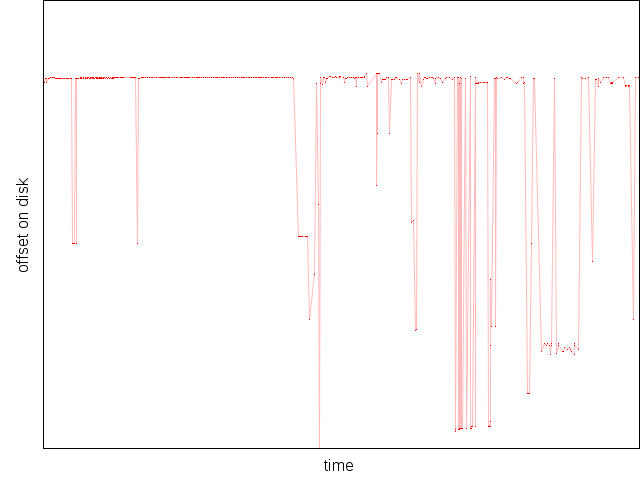
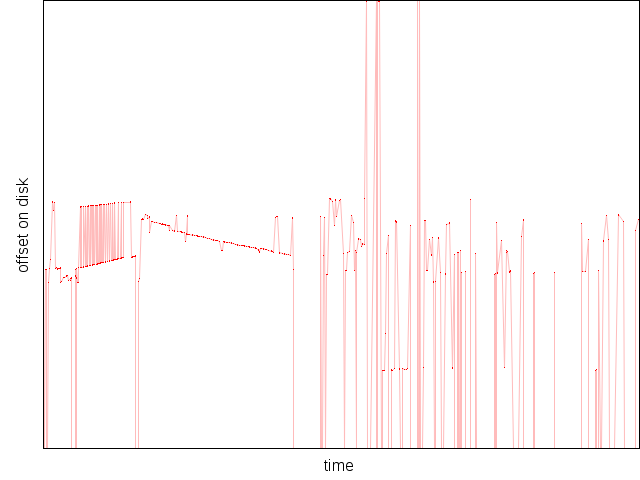
We all know disk seeks hurt. But we usually don t have a precise idea how much. How about getting that idea? Here is a little experiment I ran a few days ago. I took the output from the systemtap script tracking I/O I wrote, on a Firefox startup after boot. Each line of that output, which gives a timestamp (which we don t care about here), a file name, and an offset, represents a 4096 bytes read (one page). The first set of data points I got is how much time it takes to reproduce this read pattern after a reboot, and how that compares to Firefox startup time. For what it s worth, I did group following reads, to avoid doing too many system calls, and also avoided kernel readahead by using direct I/O, meaning I would only read exactly what the kernel reads when Firefox normally starts. All the following tests were done under the usual conditions (see previous posts), but I limited the tests to the x86-64 architecture, because all that really matters is the disk. I ll mention, however, that the amount of data read in these tests is 34,729,984 bytes, and that the original I/O pattern looks like this: Zooming around the main location where most I/O happen, we can see the pattern is still bumpy: This somehow looks familiar, doesn t it? We already know for a fact that even these patterns that, on the whole disk, look like pretty much insignificant, have an important impact on startup time. Try to imagine what kind of difference could be observed if we were reordering all these reads. Anyways, back to that I/O simulation, we first need to see how far it is from the actual Firefox startup. We would rather that simulated I/O + warm startup/hot cache end up close to the real thing. However, we need to keep in mind, as we saw in a previous post, that CPU scaling, when mixed with I/O, has an influence on startup time. Warm startup not involving I/O, the CPU can run at maximum speed the whole time. As such, for a fair comparison, we need to compare to cold startup time with the CPU forced at maximum speed, which we saw is faster than startup time with CPU scaling.
Average time (ms)
Simulated cold startup 2,764.26 0.42%
Warm startup 250.74 0.18%
Simulated cold + warm 3015
Real cold startup 3087.47 0.31%
Difference 72.47 (2.35%)
Close enough, I d say. The difference is most probably caused by metadata reads and a few other things, that isn t in the systemtap script scope. Now we know our simulated I/O is close to reality, what happens if we reorder all these reads according to the position on disk?
Average time (ms) Corresponding transfer rate
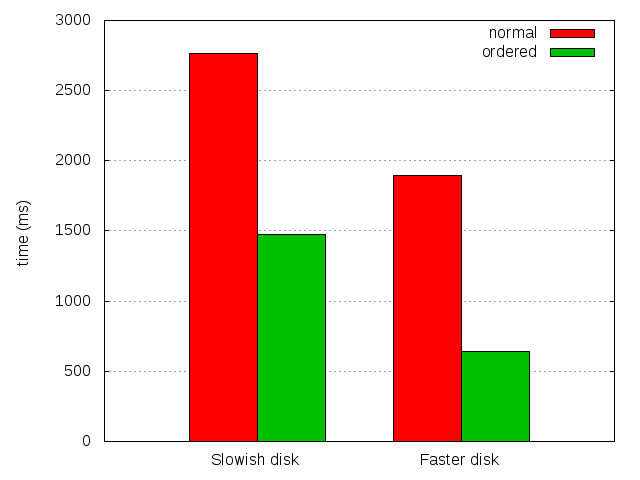
Simulated I/O 2,764.26 0.42% 12.56 MB/s
Reordered I/O 1,473.34 0.43% 23.57 MB/s
Difference 1,290.92 (46.7%) n/a
That s almost twice as fast ! And the disk doesn t even have a big throughput (around 30MB/s). Let s see what it does with a disk with a bigger throughput (85MB/s).
Average time (ms) Corresponding transfer rate
Simulated I/O 1,898.66 0.16% 18.29 MB/s
Reordered I/O 644.0 0.15% 53.93 MB/s
Difference 1,254.66 (66.08%) n/a
That s almost three times as fast ! The faster the disk, the bigger the improvement we can get by reordering and grouping I/O, which is not unexpected, but here we can see how much having to go back and forth on the disk hurt badly. Obviously, the numbers from the faster disk can t be directly compared to the ones from the slower disk, because the data was not arranged the same way on the disk, and file system fragmentation, as well as how the file system is filled also have their own share to add to the problem. And because it s more impressive to see on a graph than in a result table: Disks seeks hurt. Badly.

Michal &#268;iha&#345;: phpMyAdmin translation status

As we're slowly heading towards phpMyAdmin 3.4, it is good time to look at current translations state. There are few which are already at 100%, so they are in best possible shape: Some languages really miss just few messages, so they will hopefully get to 100% soon: And there is huge progress in Russian, which will at this pace get to 100% this week. Was your language not listed? You can help it being better!

Filed under: English Phpmyadmin 0 comments Flattr this!

Paul Wise: Looking towards Debian wheezy

So Debian squeeze has finally been released and it is time to look toward to what we might work on or want to happen for the next release, codenamed Debian wheezy. An informal discussion on IRC mentioned libburnia libraries and apps, finishing DEP5, objnam, wayland, multiarch, Matthew Palmer plans to work on netcfg, ifupdown and the KDE team plan to remove Qt3/KDE3. I personally plan to work on catching up with my packages, the removal of defoma, boosting the Debian games team, improving collaboration with derivatives, changes to the Debian wiki, reviewing more packages mentioned on debian-mentors and more. I am really excited to see the cross-distro collaboration of Enrico Zini and others in bringing application management to Linux distributions, the multiarch work by Steve Langasek and others and hopefully optimistic about the recent discussions of automated post-install testing. I probably will not work on almost all of these but I would like to see multiarch, cross compiliation, widespread systemd integration, netconf revival, porting to phones/tablets, OEM mode and media for d-i, partitioning improvments for d-i, widespread automated post-install testing, expansion of daca, deployment of debexpo, widespread adoption of PET, automated removal of bad packages, better pro-active security measures, building all packages on buildds, migration away from Debian-specific stuff in favour of cross-distro solutions, addition of new UI experiences (like MeeGo, Android, Unity, QtMoko), addition of new APIs for portability (like Android, Khronos, MacOS/iOS stuff), more interesting/weird ports, merging derivatives into Debian, better integration of Debian Pure Blends, removing non-free packages where free alternatives exist, ex-developers and MIA folks returning to Debian, expansion of the backports repository, fixes for lots of bugs and probably other things I forgot. What are you going to work on? What do you wish you could work on? What work are you hoping others will do? What work are you excited about that others are doing?

Stefano Zacchiroli: ZOMG a Debian release

mythbustering a Debian release This is no news anymore, but in case you don't know yet: Debian 6.0 "Squeeze" has been released the past week-end. If you haven't yet downloaded Squeeze, stop reading this blog post right here and jump to: to choose your ISO; or check the release notes for upgrade instructions from Debian 5.0 "Lenny". Done?
Cool!
I hope you are now enjoying Squeeze as much as I've enjoyed being part of its development cycle which: I'm still shaked by the events, given the release happened in a sort of split context: the teams working on the final phases of the release (release team, ftp-masters, webmasters, cd, DSA, etc.) were "at home" hacking frantically on it, while many EU-based Debian people (including yours truly) were at FOSDEM representing Debian to the community with booth, talks, and answering the recurrent question so, have you released yet? . At FOSDEM, I've been personally submerged by congratulation messages that are not really for me, but rather for the Debian community at large. So: congratulations folks! People out there be them Debian users, users of some derivative, or Free Software enthusiasts in general seem to really love what we have achieved with Squeeze! The people that need to be thanked for this result are way too many, so I won't try to name names. Nonetheless, I've a few personal kudos to deliver to: I'm overwhelmed by happiness about all that and I'll cherish it forever as a souvenir of what a community of volunteers, driven by common ideals, can achieve. Now let's party and then roll up our sleeves for Wheezy, which is already open for development.
PS I've talked again at FOSDEM about the relevance of Debian in the Free Software ecosystem. I've the impression the message is getting through: check out the very nice article Why Debian matters more than ever by Zonker.

Lars Wirzenius: Growing the Debian development community

In an article about gender issues among American atheists, Sharon Moss and Lyz Liddell give a list of things to consider to be better community, not just for women:
  • Be a leader. Take responsibility for the tone of your group. If potential new members are being made to feel uncomfortable and aren t coming back, you re doing it wrong. As a leader, it is your job to prioritize the comfort of your attendees in programs, group dynamics, and communications. Try to put yourself in other members shoes and also ask for feedback.
  • Promote a sense of community. Take the time to socialize and get to know each other. If you re group isn t primarily a social group, thinking about adding some social time. Go to breakfast before the protest, compose your letters to the editor over coffee, or grab a pizza and beer after that lecture. When you know each other, you have each others backs. Being a jerk isn t tolerated.
  • Moderate discussions. Make sure everyone has the opportunity to participate- new people, quiet people, etc. Don t let conversation be dominated by one or two people who must win.
  • Embrace and accept different ways of communicating. Whether someone is an aggressive debater or not, make sure they re still welcome. The other atheist in the room isn t your enemy.
  • Encourage subgroups. Every event your group hosts doesn t need to appeal to your entire membership. Many women appreciate women-only space to express their nonbelief and to connect with other atheist women. Here at the Humanist Community of Central Ohio, we started a subgroup book club called Reasonable Women. When it grew to have about 25 regular members and was beginning to be a little too large and unwieldy to function as a book club, we created a second group, Heathen Chicks, which is just a social group that meets at a local cafe. It isn t just about creating women only space, for us, this has been a way to draw more women into other events our group hosts.
  • Foster women in leadership. Groups with women in leadership positions tend to have more women. Encourage women in your group to be visible in leadership.
These should work pretty well for Debian as well. I mean for the project in general, for getting all kinds of new people in, and getting them to stay, not just women, even if the gender imbalance is perhaps the biggest glaring problem we have. As a concrete suggestion, maybe it would be a good idea to continue the Debian party line that Joey set up for the squeeze release. We already have IRC, but having an audio chat with your Debian peers might be a nice addition. Specifically a social one, instead of something intended to boost productivity.

7 February 2011

Vincent Sanders: It is a bit breezy

The weather has been a bit odd round here for a while now. The snow storms in December and early January were a mild inconvenience for me but as I work from home the advice not to travel was not too much of a problem.

It seems however that now February is here and the snow is gone we are in for some pretty strong storms. This actually affected me today when my neighbours garden wall was blown over!

As you can see my nice new IP camera captured the event, well OK the frame before and after but you get the idea. Unfortunately for my neighbour the wall collapsed onto his pickup causing extensive damage.

A short time later when my weather station was recording gusts well over 50mph nearby drains started flowing the wrong way and it became a case of water, water everywhere!

It seems that when the new buildings were erected a few years ago that the architect while maximising used space on the building plot may have inadvertently created something of a wind tunnel.

The Gap between our properties is on a parallel (north to south) to the valley below. The wind seems to travel along the crest of the valley and be funnelled through any spaces between the houses. Fortunately the rest of the properties on green lane are pretty old and the spacing between is very generous and the funnelling effect is minimal.

I wonder if we could fit a wind turbine in there? Alas it was too much for my secondary anemometer which is now smashed in three parts.

Also gaining access to the gable end wall of my property has become somewhat perilous (Hence the wonky APT antenna I cannot get fixed). Yes that really is a guy balancing on a ladder 10m high in a strong wind. And indeed the platform the ladder is resting on is built from scaffolding board wedged between the houses.

I guess the hospital emergency room being 300m away means medical assistance is on hand, even so he is braver than I am. So my weather satellite imagery will just have to come from the internet like everyone else's for a while.

Matthew Garrett: Hardware vexation

My laptop (an HP 2530p) gets quite a lot of abuse. It's been with me enough to have done the equivalent of going round the world 4 or 5 times, and it's typically just thrown in a bag without any particular care or attention being given to its care or wellbeing. It's been dropped a couple of times with the only damage being some corners that aren't really as even as they should be. All in all, it's survived amazingly well. But it recently started refusing to boot, merely flashing its LEDs. After finally finding a list of what these mean, I narrowed it down to the memory. Taking it apart and putting it back together again got things working for a while, but then it happened again. And again. So, since I have one memory module and two slots, I decided to just move the RAM in the hope that there's something physically wrong with the slot. It worked! Until I got to the BIOS splash and it informed me that Intel AMT requires that there be memory in slot 0. And didn't give me an opportunity to continue without AMT.

My hardware is conspiring against me.

Jonathan McDowell: Why Linux? (Part 6: Freedom)

(This is part of a series of posts on Why Linux?) I think of myself as reasonably pragmatic in my approach to Free/Open Source software. I don't get worked up over which set of language people want to use. I use devices that require binary firmware to be downloaded to them (because just because I can't see it doesn't mean it doesn't exist). I have non-free in my sources.list. And yet, talking to other Linux users these days, I realize I'm much more of a Freedom nut job than average. I want the source, be it for a driver, a minor widget, or a full app. I don't buy nVidia. I will sacrifice a degree of functionality in order to get Free. And while I think WINE is an excellent piece of software, I think the best end result is that it's no longer necessary, not that it's a perfect implementation of the ABI. How does any of this help justify my use of Linux in the work place? As previously mentioned, I'm a developer. Most developers don't operate in a vacuum; they have to inter-operate with other ecosystems. And usually somewhere along the line there's a failure to document exactly how something is handled, or an ambiguity about what exact choice might be taken. If I have access to the source then I can check that out for myself. If I don't, I have to guess. As an example, a long time ago I was involved in writing a serial console driver for QNX. There came a point where the behaviour wasn't quite as we'd expect. Although the organisation had a license for the source, I wasn't allowed to look at it. Instead I had to come up with a series of suitable questions that someone who could look at the source could answer without violating any NDAs. If I'd been able to look at the source directly we'd have all saved a lot of time. And that's an example where someone could look at the source, rather than having to make a bunch of guesses and instrument tests to see which was right. Access to the Linux source has helped me in other commercial contexts too. At Black Cat we were able to take advantage of patches like grsecurity in order to tighten up shell account boxes. I wrote the IPv6 support for l2tpns, because we had access to the source and could. I've been able to look at the source to understand exactly what SCSI responses are sent in certain circumstances too (or understand exactly what the error that a user land test program was getting back meant). Also I'm a big believe in Linus' Law. I do think that good Free software is much better than proprietary software (there's some really bad Free software out there though, I'm not disputing that). The fact that smart people can look at it and scratch whatever their itch is means that we get a gradual process of improvement that can't be ignored. Equally as long as someone has an interest in the software, end users can't be left high and dry by organisations abandoning still users applications. I think that should be a powerful driver to business to look towards Free software. (Before my more astute readers point it out; yes, I am employed writing non-free software. See the first sentence. One day I'll find a job working on Free software that ticks enough of the other boxes to be viable.)

6 February 2011

David Watson: Project 52 - Week 5

Today the Chinese New Year celebrations were held in Liverpool City Centre, I went with my family. I wanted to get some shots of the dragon parade, but this year it seemed to be a lot more crowded than previous years. The shots I did get of the dragon were mostly obstructed, so I chose one of my other shots from the day of one of the many lanterns decorating china town. Week 5 - Lantern

Next.

Previous.