Search Results: "tim"

19 November 2012

Vasudev Kamath: Weekly Log - 17/23 - 112012

The last week was quite productive as I was on vacation and at home town but sadly I couldn't complete this post so again merging the work with this week but this week ain't much productive as I was tired from journey back and didn't get enough time to recover. So here it goes. Debian Related Upstream Related I raised a pull request #8 on Gubbi fixing the Makefile to more organized and introducing xz compression in it. Additionally I removed distribution specific stuffs from Makefile and made it generic. That's all for the two weeks. This week there will be foss.in and we will be having some Debian specific mini conference, including some Debian basics to newbies and some bug squashing if any :-). So more to report next week, till then Cya.

18 November 2012

Sven Mueller: Ingress

As some may have noticed, Google launched something that is unusual for the company: A game. A mobile alternate reality game, to be precise. See allthingsd article for a bit more information. In my opinion this game is most interesting to people who are mildly interested in geo-caching. You spend most of the gaming time either looking for the right portals (geo-location that is an interesting place for one reason or another, many located at sculptures, murals or (more scarcely) interesting local businesses), or trying to solve the puzzles that appear in the game itself or on http://www.nianticproject.com/. I was one of the beta testers and really enjoy the game, especially in areas with more players. As the game is most fun when people coordinate a bit, I started a google group for the munich area for one of the two teams (the enlightenment), but I will only let people enter that group who can be verified to be on that team. On a side note: I still have a few invites to the game left, so if you are interested, please leave a comment and enter your gmail.com email address (you need a Google account to play anyway) while doing so. I will send out invites in the order I received the requests (which I admit might not always be the same in which they were submitted. First come first serve and no guarantee to get an invitation though. Your email address you enter when commenting isn t shown to anyone and I don t share them with anyone but the game (and thus Google). EDIT: So short time went past, but I already ran out of invites (note that I didn t approve comments that really only were like please send me an invite , but still did sent one out). Feel free to still ask me for an invite, I will send some out as I get new ones, but this might take anything between a few days and some weeks. PS: For the lucky ones who got invites: You don t strictly need to do the training offered when you start the game for the first time, but I strongly encourage you to do so.
PPS: I m opening my group to any enlightened players in Germany. I will share some useful information about some game details there in the near future (nothing company confidential of course, just information anyone can gather in the game or from the published information). EDIT: As noted before, I don t have any more invites to give away. As I still get like 4 requests for invites per day, and now have more than 30 unfulfilled requests pending (with no new invites to give in sight), I m now disabling comments. Disclaimer: I work for Google since a few months ago, but this post solely represents my own opinions and hasn t been endorsed by Google in any way.

Russ Allbery: Powell's anniversary haul

Powell's was holding an anniversary sale and giving out free gift cards with a qualifying order, so it seemed like a good idea to pick up a few books. Ben Aaronovitch Midnight Riot (sff)
Patricia Briggs Alpha & Omega (sff)
Patricia Briggs Moon Called (sff)
Mark Forster Get Everything Done (non-fiction)
Lynn Galli Wasted Heart (romance)
Sam Harris Lying (non-fiction)
K.E. Lane And Playing the Role of Herself (romance)
Jack McDevitt Firebird (sff)
Marshall Rosenberg Nonviolent Communication (non-fiction)
Deborah Tannen The Argument Culture (non-fiction)
Bill Willingham, et al. Fables: Animal Farm (graphic novel) I'm not sure if the Forster will be worth the cost, but I've really liked his other writing about time management, so I thought I'd take a chance on it. I think the Tannen and the Rosenberg are on roughly the same topic, but I arrived at them through different recommendation paths. I've been feeling like reading about how to communicate lately. The McDevitt novel is the latest in the Alex Benedict series. I'm only a couple of books away from being caught up. I've gotten lots of positive recommendations for Aaronovitch's series, so thought I'd get the first one. There's also a variety of random stuff, mostly on the Kindle, that I'd not added to one of these posts, noted here mostly for my own records. Alpha & Omega is a novella rather than a novel, which I grabbed because I picked up and read Cry Wolf during vacation.

Neil Williams: Long term maintenance of perl cross-build support in Debian

After prompts from Wookey and Steve McIntyre, I decided to look at #285559 and #633884 for perl cross-build support and then port that support forward to the current perl in Wheezy and on to the version of perl currently in experimental. The first patch is for perl 5.8, the second for perl 5.12, neither of which is available currently in Debian. snapshot.debian.org provided the 5.12 source but then that no longer cross-builds with the patch.

The problem, as with any cross build, is that the build must avoid trying to execute binaries compiled within the build to achieve the test results required by ./configure (or in the case of perl, Configure). dpkg-cross has one collection of cache values but the intention was always to migrate the package-specific support data into the packages themselves and keep the architecture-specific data in dpkg-cross or dpkg-dev. Therefore, the approach taken in #633884 would be correct, if only there was a way of ensuring that the cached values remain in sync with the relevant Debian package.

I'll note here that I am aware of other ways of cross-building perl, this is particularly concerned with cross-building the Debian configuration of perl as a Debian package and using Debian or Emdebian cross-compilers. After all, the objective is to support bootstrapping Debian onto new architectures. However, I fully expect this to be just as usable with Ubuntu packages of perl compiled with, e.g. Linaro cross-compilers but I haven't yet looked at the differences between perl in Debian vs Ubuntu in any detail.

I've just got perl 5.14.2 cross-building for armel using the Emdebian gcc-4.4 cross-compiler (4.4.5-8) on a Debian sid amd64 machine without errors (it needs testing, which I'll look at later), so now is the time to document how it is done and what needs to be fixed. I've already discussed part of this with the current perl maintainers in Debian and, subject to just how the update mechanism works, have outline approval for pushing these changes into the Debian package and working with upstream where appropriate. The cache data itself might live in a separate source package which will use a strict dependency on perl to ensure that it remains in sync with the version which it can cross-build. Alternatively, if I can correctly partition the cache data between architecture-specific (and therefore generated from the existing files) and package_$version specific, then it may be possible to push a much smaller patch into the Debian perl package. This would start with some common data, calculate the arch-specific data and then look for some version-specific data, gleaned from Debian porter boxes whilst the version is in Debian experimental.

The key point is that I've offered to provide this support for the long term, ensuring that we don't end up with future stable releases of Debian having a perl package which cannot be cross-built. (To achieve that, we will also end up with versions of perl in Debian testing which also cross-build.)

This cross-build is still using dpkg-cross paths, not MultiArch paths, and this will need to be changed eventually. (e.g. by the source package providing two binaries, one which uses MultiArch and one which expects dpkg-cross paths.) The changes include patches for the upstream Makefile.SH, debian/rules and the cache data itself. Depending on where the cache data finally lives, the new support might or might not use the upstream Cross/ directory as the current contents date from the Zaurus support and don't appear to be that useful for current versions of perl.

The cache data itself has several problems:

  1. It is tightly tied to the version of perl which generated it.

  2. It is, as expected, architecture-dependent

  3. It is, unfortunately, very sensitive to the specific configuration used by the distribution itself


That last point is important because it means that the cache data is not useful upstream as a block. It also means that generating the cache data for a specific Debian package means running the generation code on the native architecture with all of the Debian build-dependencies installed for the full perl build. This is going to complicate the use of this method for new architectures like arm64.

My objective for the long term maintenance of this code is to create sufficient data that a new architecture can be bootstrapped by judicious use of some form of template. Quite how that works out, only time will tell. I expect that this will involve isolating the data which is truly architecture-specific which doesn't change between perl versions from the data which is related to the tests for build-dependencies which does change between perl versions and then work out how to deal with any remainder. A new architecture for a specific perl version should then just be a case of populating the arch-specific data such as the size of a pointer/char and the format specifiers for long long etc. alongside the existing (and correct) data for the current version of perl.

Generating the cache data natively

The perl build repeats twice (three builds in total) and each build provides and requires slightly different cache data - static, debug and shared. Therefore, the maintenance code will need to provide a script which can run the correct configuration step for each mode, copy out the cache data for each one and clean up. The script will need to run inside a buildd chroot on a porter box (I'm looking at using abel.debian.org and harris.debian.org for this work so far) so that the derived data matches what the corresponding Debian native build would use. The data then needs slight modification - typically to replace the absolute paths with PERL_BUILD_DIR. It may also be necessary to change the value of cc, ranlib and other compiler-related values to the relevant cross-compiler executables. That should be possible to arrange within the build of the cache data support package itself, allowing new cache files to be dropped in directly from the porter box.

The configuration step may need to be optimised within debian/rules of perl itself as it currently proceeds on from the bare configuration to do some actual building but I need to compare the data to see if a bare config is modified later. The test step can be omitted already. Each step is performed as:

DEB_BUILD_OPTIONS="nocheck" fakeroot debian/rules perl.static


That is repeated for perl.debug and libperl.so.$(VERSION) where $VERSION comes from :

/bin/bash debian/config.debian --full-version


The files to be copied out are:


There is a lot of scope for templating of some form here, e.g. config.h.debug is 4,686 lines long but only 41 of those lines differ between amd64 and armhf for the same version of perl (and some of those can be identified from existing architecture-specific constants) which should make for a much smaller patch.

Architecture-specific cache data for perl

So far, the existing patches only deal with armel and armhf. If I compare the differences between armel & armhf, it comes down to:

  1. compiler names (config.h.*)

  2. architecture names (config.sh.*)

  3. architecture-based paths (config.sh.*)


However, comparing armel and armhf doesn't provide sufficient info for deriving arm64 or mips etc. Comparing the same versions for armhf and amd64 shows the range of differences more clearly. Typical architecture differences exist like the size of a long, flags to denote if the compiler can cast negative floats to 32bit ints and the sprintf format specifier strings for handling floats and doubles. The data also includes some less expected ones like:

armhf: #define Netdb_host_t const void * /**/
amd64: #define Netdb_host_t char * /**/


I'm not at all sure why that is arch-specific - if anyone knows, email codehelp @ d.o - same address if anyone fancies helping out ....

Cross-builds and debclean

When playing with the cross-build, remember to use the cross-build clean support, not just debclean:


dpkg-architecture -aarmel -c fakeroot debian/rules clean


That wasted quite a bit of my time initially with having to blow away the entire tree, unpack it from original apt sources and repatch it. (Once Wheezy is out, may actually investigate getting debclean to support the -a switch).

OK, that's an introduction, I'm planning on pushing the cross-build support code onto github soon-ish and doing some testing of the cross-built perl binaries in a chroot on an armel box. I'll detail that in another blog post when it's available.

Next step is to look at perl 5.16 and then current perl upstream git to see how to get Makefile.SH fixed for the long term.

Jamie McClelland: New Privacy Arguments are Needed

Another decent article on online privacy was published by the NYT this morning. The article documents the collection and centralized aggregation of consumer data online. It ends with a strong message about consumers becoming the "product" - which echoes what Noam Chomsky and Ben Bagdikian have been saying for decades. The problem with this critique is that it doesn't go far enough. Chomsky and Bagdikian didn't say readers are the product of modern journalism and that's bad because nobody wants to be a product. They critiqued the model because it produces terrible journalism and democracy suffers as a result. Similarly, the online trading of audiences and the invasion of our privacy that results has more important implications than "don't be a sucker" which seems to be the gist of the privacy argument these days. Honestly, I don't stay awake at night worrying that Nike knows I'm looking for a pair of sneakers, or even that they know my income. I do stay awake at night worrying that people are tagging my photo on Facebook, which could allow the New York Police Dept to submit a photo of protesters to Facebook and get a list of names and addresses of the people in the photo. Or it could allow the police to track my movements via existing networks of surveillance cameras by matching my image to my name. Would that require a search warrant? How would that impact my trust in my government to know that my movements are being tracked? Or worse, to know they might be tracked but I'll never know if they are or aren't? Many governments (including the US) have sordid histories of infiltrating political organizations and intentionally sowing dissent. Having access to activists' purchasing habits provides a treasure trove of material for this purpose that previously was labor intensive for cops to collect. It also provides leverage during interrogation, a time of heightened emotional vulnerability where the mere mention of a private detail of one's life can have a powerful impact. How can we prevent law enforcement from having access to these details of our lives? And then there's the dragnet. A central database of consumer habits provides a tantalizing collection of information that could be searched for people who fit a profile of a crime. Is solving the crime at hand worth the invasion of privacy that results from people being investigating only based on their consumer habits? How would we measure the impact an investigation like this would have on our confidence in democracy and government? The corporate advertisers promoting this kind of data collection argue that these problems are the price of progress. However, the ideology behind these technology developments is capitalism, not some intrinsic aspect of the Internet or network communications. Historically, the Internet has developed based on a drive toward de-centralization. Email and web sites, the bedrock of Internet activity, are based on these principles: anyone can add their own email server or web server and everyone can seamlessly access it. In contrast, the logic of capitalism as it relates to the Internet, is one of centralization and aggregating data. Facebook and Google want you to use their platforms for all your online activities so they have as complete a picture as possible of what you like and do. As the New York Times article describes, companies like Rubicon want to track all your movements and aggregate that data for profit. We have a choice. We can carefully evaluate our use of corporate services and consider the implications it has not only on our lives but on society as a whole. And, we can choose to use and support services that promote open standards and interoperability that will respect our personal privacy values. Want a practical example? Friendica is software designed to allow you to post status alerts, photos, videos and other information about yourself in a way similar to Facebook. However, it has one big difference: you can host your account on any server running the software anywhere in the world. You can still "friend" people on different servers, but we don't have to all trust the same organization to host it. Furthermore, Friendica allows you to post once and automatically cross-post to your Twitter, Facebook or other similar services. Sound good? You are welcome to try out an account on the May First/People Link install: https://friends.mayfirst.org/.

Michal Čihař: Roadmap for Weblate 1.4

As Weblate 1.3 is out, it's time to think about features for next release. My current plan is to go more into two areas. First is improving support for machine translations. I have some ideas how to integrate these in interesting ways, I just hope my (poor) Javascript knowledge will not prevent me doing it that way. The second area is improving testsuite. Right now it really does not cover much and I'd like to cover at least basic functionality with different file formats. I'll see how much I will be able to cover, but at least I will try to cover as much as possible :-).

Filed under: English Weblate 0 comments Flattr this!

Mike Hommey: Debian EFI mode boot on a Macbook Pro, without rEFIt

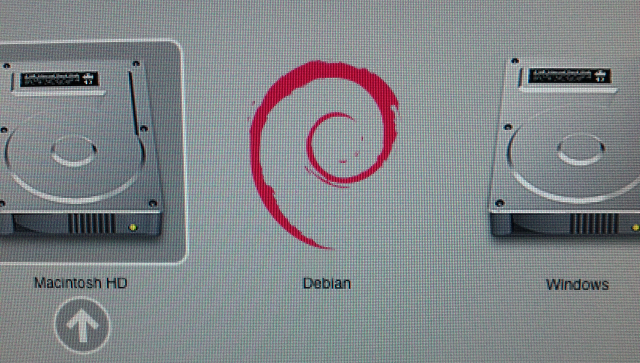
Diego s post got me to switch from grub-pc to grub-efi to boot Debian on my Macbook Pro. But I wanted to go further: getting rid of rEFIt. rEFIt is a pretty useful piece of software, but it s essentially dead. There is the rEFInd fork, which keeps it up-to-date, but it doesn t really help with FileVault. Moreover, the boot sequence for a Linux distro with rEFIt/rEFInd looks like: Apple EFI firmware rEFIt/rEFInd GRUB Linux kernel. Each intermediate step adding its own timeout, so rEFIt/rEFInd can be seen as not-so-useful intermediate step. Thankfully, Matthew Garrett did all the research to allow to directly boot GRUB from the Apple EFI firmware. Unfortunately, his blog post didn t have much actual detail on how to do it. So here it is, for a Debian system: Now, the Apple Boot Manager, shown when holding down the option key when booting the Macbook Pro, looks like this:
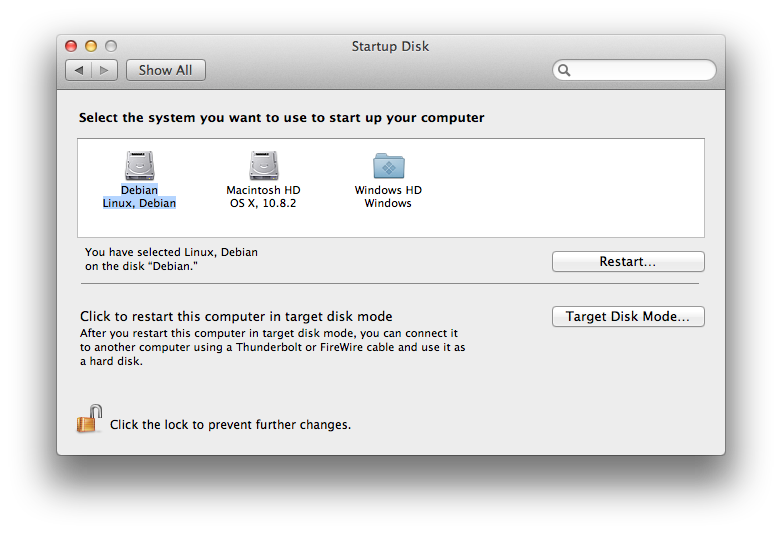
And the Startup disk preferences dialog under OSX, like this:
Andreas Metzler: avconv - constant rate-factor is incompatible with 2pass

My receiver (Topfield SRP 2410) has the nasty habit of rescaling to fill the display, ignoring the aspect ratio. So I am reencoding, adding padding (black bars) and top and bottom. In this context avconv has offered some less cryptic errors. The one that cost me most time was this one:
[libx264 @ 0x8f29ca0] constant rate-factor is incompatible with
2pass.
[...]
Error while opening encoder for output stream #0:0 - maybe incorrect
parameters such as bit_rate, rate, width or height
libx264 interprets a missing bit-rate specification as a request for constant rate-factor encoding. Which does not work with multi pass. Setting a bitrate (avconv syntax -b:v 1200k) fixes the problem.

Russ Allbery: Review: A Hero's Tale

Review: A Hero's Tale, by Catherine M. Wilson
Series: Women Were Warriors #3
Publisher: Shield Maiden
Copyright: 2008
ISBN: 0-9815636-3-5
Format: Kindle
Pages: 301

This is an ebook, so metadata may be inaccurate or missing. See notes on ebooks for more information. A Hero's Tale is the third book in the When Women Were Warriors trilogy, which is best thought of as a single long novel. Reading it independently will miss most of the significance of the plot, since one wouldn't know many of the important characters. A Hero's Tale follows the pattern of the second book: even less quiet contemplation, and even more in the way of events and plot. Tamras completes her training, in a somewhat unexpected way (and in a rather interesting reworking of gender roles), but then both Maara's past and the problems of A Journey of the Heart catch up with them. There is, accordingly, quite a bit more action, or at least war councils and political maneuvering, than the previous books, and somewhat less time for thoughtful wisdom. That also means that A Hero's Tale shifts a bit more towards the traditional fantasy coming-of-age story, where the heroine is able to shift armies and win conflicts with an understated and self-deprecating skill that comes inevitably but indirectly out of all of her previous experiences. I think Wilson is still fairly original in how she presents those tropes, with an interesting focus on empathy and compassion that is all too rare in this sort of story, but this book does feel a lot more like a story that one has read before. If you're particularly allergic to that story shape, you may find this entry somewhat disappointing. One of the things I loved about it, though, was Wilson's avoidance of traditional villains. There is one, so it's not a complete avoidance, but nearly everyone in this story has their own viewpoint and perspective and is on the side of right in their own way. Wilson uses Tamras's empathy and willingness to listen and understand to let the reader see various different perspectives without moving away from the first-person perspective. It's very nicely done. I thought the handling of the emotional arc of the story was more mixed. Tamras is seriously tested in some moments that aimed for heartbreaking, but I thought they fell short of the emotional punch they were supposed to carry since the story shape had already made it obvious that everything would turn out okay in the end. The story is so gentle that Wilson hadn't established any willingness to end something badly, which robs a lot of the punch from emotional turmoil. I also had quite a bit of trouble with the principle of love above all else, particularly for someone in Tamras's position. Maybe that's because I'm still too entrenched in the attitude towards politics that this series argues against, but I had a hard time not seeing her as personally indulgent. Both of those factors blunted the emotional climax for me, leaving it moving but not as heartbreaking as I think Wilson was aiming for. (This is the point where a friend will tell me that I think too much about books while I'm reading them.) That said, Wilson continues to write one of the best mentoring relationships that I've seen in fiction. The dynamic between Tamras and Maara is just beautiful, and remains so through the end of the book. So many traditional issues with rivalry, growth, replacement of the mentor, and relative social position that are ignored or dealt with ham-handedly in other stories are handled adeptly and quietly. Maara is by far my favorite character of this series, largely because of how she handles that relationship. I could identify with her more easily than with Tamras at various points in the story, and I thought the understated ending was quietly beautiful. If you enjoyed the rest of the series, definitely read A Hero's Tale for the conclusion. If you've been hungry for more typical action, you'll get some of it here. I wish a few deep emotions other than love had been in play, but, despite that, When Women Were Warriors is still quietly and delightfully different than most things I've read, and worth the price. Rating: 8 out of 10

17 November 2012

Craig Sanders: done

OK, I m finished my experiment. It s over now and I can break character . First, I have to offer special thanks to tshirtman for being the first to unambiguously exemplify one of my main points. well done! In case it s not blindingly obvious (as it should be), the reason for my post was that I was outraged by the spectacle of one fairly high-profile member of the linux community trying to rally support to shun and exclude another fairly high-profile member because a nightmare had upset her. WTF? Is that really all it s going to take to destroy someone s reputation and perhaps their career? even with the shunning target s own words available and archived to disprove the ridiculous straw-man mis-characterisations of what he actually said? Not one of the arguments against him actually addressed anything he said, they ALL attacked him for things he didn t say, for things that other people claimed he said. I was further outraged by seeing everyone who even suggested that questioning of stats (or, indeed, ANY claim of fact or evidence) may be, in some small way, a valid and reasonable thing to do get instantly put in their place and dismissed as Yet Another Rape Apologist. Are we supposed to be anti-science, anti-scientific method now? or are rape stats a special case like religion where we are just supposed to switch off our analytical brains and accept what we are told on faith, without question? Surely we are capable of better than that? i know we are capable of better than that. Or, at least, i used to know that. Now i m not so sure. In 2011, all it took was Ted Tso ( TT ) making some fairly reasonable statements about the need for any claimed evidence or statistics to be viewed skeptically and that dissenting research should also be considered and he was instantly vilified as a rape apologist . Sorry, but questioning extremely dodgy stats (that even in feminist circles are viewed more as ideological propaganda than as serious research) is NOWHERE NEAR SUFFICIENT to earn the label of rape-apologist. That is not how debate works you can t just refuse to engage with someone s point and simply accuse them of being the enemy for not agreeing 100% with whatever you say at least, not if you have any intellectual honesty or self-respect. (sure, some people are complete jerks and deserve to be told to FOAD in no uncertain terms but a) jerks like that are self-evident and obvious, and b) TT s participation in that thread was at all times civil and reasonable) But that thread is ancient history it was over and done with nearly two years ago.
In October this year, for reasons which are not at all clear, Valerie Aurora ( VA ) decided to revive the issue (which had been resolved back in 2011 with a resounding fuck no, we don t want misogynist shit or porn in our conferences from pretty much the entire linux community including near-universal support for improved anti-harassment policies both for linux.conf.au and for geek conferences in general) and use it to attack TT. And she did so by twisting his words and claiming in a post on The Ada Initiative blog that he said something which he didn t, that rape was impossible if both people were drunk enough . If he chose, he could quite easily win a libel case against her and TAI on that. It s not what he said, it s not even close to what he said, and VA is clearly too smart to honestly believe that it is what he said. In another post on her personal, blog she talks about how what he said was so terrible that it even now gives her nightmares, and that she can t bear the thought of working with him. Again, WTF? VA can say I had nightmares and was upset and furious and THAT is enough to justify a call to shun TT?? He didn t attack her, or threaten her (explicitly or implicitly), he was polite and civil. What he did was disagree with VA by referring to other research that disputed VA s preferred studies. I agree with and support many (perhaps most) of VA s and The Ada Initiative s aims, I certainly believe that linux and open source etc should be very welcoming and supportive of human diversity (including gender and sexuality, identity, religion, politics and so on), believe that it s a good thing that The Ada Initiative exists as part of that diversity welcome to be particularly supportive of women in geekdom. And i wholeheartedly agree that Linux leaders should not make public statements belittling and condoning rape BUT: a) I haven t seen one instance of that happening, ever and b) I find VA s choice of tactics here to be despicable. as i do when anyone else uses similar tactics, because they ARE despicable tactics. They are exactly the same as accusing someone of being a child pornographer for being against net censorship: You dared to disagree with me so I m going to accuse you of being a monster. (and, i must admit, the enthusiasm level of my support for The Ada Initiative is somewhat .diminished by this tactical blunder by the spokesperson and co-founder) There are far more deserving targets of VA s ire than TT. And there are far better ways for the Ada Initiative to achieve their aims.
Why? So why did I decide to comment when I knew that I was inevitably going to be accused of hating women and being a rape apologist? Mostly because I thought it would be gutless of me not to. Hardly anyone else had, and they quickly backed down under the accusations of misogyny and since I consider myself to be psychologically fairly strong, I felt that I am capable of wearing a little shit (or even a lot) for a while. In my egocentric fashion, I thought if I can t do then it s no wonder that no one else dares . And also because anyone who cared to make even the slightest effort to find out what my actual views on sexual harassment, rape, women s rights and numerous inter-related issues are can fairly easily see a very consistent record of the kinds of things I argue for and against, and my scathing responses to actual misogynists when they appear on lists that I participate in. they are not my kind of people. and even then, i hesitated. it s scary and intimidating to be putting yourself forward to be accused of being one of the things you hate. this is, of course, an instance of the chilling effect. So, I found the prospect scary, almost terrifying .and I can t think of a single person who has met me online or in real life who would even remotely describe me as being any kind of delicate or sensitive wall-flower. again, if i can t do it, it s no wonder no one else dares . so i clicked the Publish button. an ego is useful for some things. Also, I took VA s words but don t be silent as inspiration. In the process, i discovered why it is that some people just simply refuse to engage in rational discourse. I ve seen it many times from the other side, but i ve never experienced the seductive pleasure of indulging in it myself before there s a liberating freedom in just ignoring any and every point that someone makes and simply accuse them of being the enemy. You don t have to try to understand what they wrote, hell you don t even have to really read it you just need to quickly scan it for overall tone and if they don t seem like they re 100% supportive, you just accuse them of being the enemy or an apologist for the enemy. it s that fucking simple and easy. well, sort of easy. easy for some, perhaps. i personally found it extremely difficult a struggle to refrain from engaging, to remain in character (i m not much of an actor). especially when i kind of agreed with whoever was arguing against my experimental character or if i thought they made a good point. and even more so when i thought that some comments skirted a bit too close to being the kind of misogynist crap that i didn t want to tolerate having on MY blog. (i resolved that issue by just approving any reply that didn t squick me or that i could squint at and think hmmm borderline, give benefit of doubt ) but even though i don t like it, i can recognise the attraction it holds for some people.
Other thoughts: I m particularly disgusted by the men who intervene way too early without an explicit invitation or request for help or a clear need such as an immediate threat of violence in womens issues. Many or maybe even most may not realise it, but they are just taking over and asserting male strength and control by protecting women rather than giving them the support and space to discover and practice their own strength and their own voices. These uninvited interventions do not help women, they weaken and undermine them, they perpetuate dependence, they steal strength from the movement. It is patronising and enfeebling. But mostly, they just re-assert male dominance and are an attempt to make women s spaces more comfortable, more palatable, for men.(*) (it s also quite often very transparent self-serving and ingratiating behaviour from blokes who want to lay the groundwork for perhaps getting laid one day) IMO this goes far beyond a problem with men over-involving themselves in feminist causes i feel the same way for any relatively less-privileged group with a need to find their own voice and their own power they ll never find it if members of the privileged class (i.e. white males like me) just ride roughshod over the movement and speak FOR them rather then just silently lending their strength in support. For the most part, they (we) should just shut up and listen we already have more than enough opportunities to have our say. (*) yes, i m well aware of the difficulty in writing something like that paragraph as a member of a privileged class, without coming across as either self-hating or patronising or both. if i ve failed here, it s not for want of trying. done is a post from: Errata

Antoine Beaupr : First stable release of the Drupal OpenID Provider

A short announcement to mark the release of the first stable OpenID provider for Drupal. Started by James Walker around 4 years ago, I have since then got commit access and taken care of the module for the last 2 years. And while it was not an easy task, with the help of the community, this module was able to mature to a fully featured, flexible and standard implementation during that time. One has to wonder however, is it too late for OpenID?

A bit of history Drupal was one of the pioneers in OpenID support. Back in 2006 when the protocol was still in its infancy (less than a year old!), Drupal was adding OpenID support to its 4.7 release through a contrib module and two years later, the Drupal 6.0 release was sporting OpenID in core, although not without significant interoperability issues. Still, we could say that rapid adoption by such a popular CMS as Drupal really boosted OpenID's adoption. At about the same time, Yahoo, Sourceforge, Myspace, Microsoft and Google would all join the OpenID bandwagon. On the OpenID "provider" side of things, things were not so great however. Back when I started experimenting with this, it wasn't actually that easy to host your own OpenID provider, to allow your users to login to other OpenID-enabled sites. While there are a lot of different libraries to provide OpenID support in your application there was not (and still isn't) any software that gives you an OpenID provider and is dedicated to that. No official reference implementation either, other than the code from the one of the founding companies of OpenID, JanRain. There was an OpenID provider module in Drupal, but there was no official release done until a two beta releases in 2010.

Koumbit's community involvement It is about that time I started getting involved in the project. Koumbit needed an easy way for our workers to log into multiple sites without too much trouble, so I started looking at OpenID provider implementations. The lack of dedicated software somehow made the Drupal implementation a natural fit, and I started experimenting with the module, filing bugs and reviewing patches, as there were a lot of interoperability and design issues with the provider. After a while, walkah was kind enough to give me full access to the project and I started doing regular releases (every few months), culminating in today's official 1.0 release for both Drupal 6 and Drupal 7, which I am very proud and happy about. While I am here, I want to send many thanks to the people behind the Drupal 7 port: paranojik, mikecar, xamanu and testing from neizod. A lot of issues were also patched, reviewed and tested by numerous contributors that are unfortunately difficult to track down other than reading the commit log. So we at Koumbit have been running our own OpenID provider for a good while now, and it has the key advantage of being connected to our LDAP directory (with the D6 LDAP integration module so it is, in a sense, a central point for authentication at Koumbit. Very often people don't clearly understand what their LDAP password does, and I can easily remind them "it's the OpenID thing", or "try your password in the OpenID site" if they think they have forgotten it. So much goes on in the web browser these days that it makes everything much easier.

The problem with Drupal's OpenID provider However, it is kind of embarrassing that it took so long. More than 6 years after the OpenID protocol was written, we have a stable OpenID provider. Now, this may be because I am overly conservative about stable releases, but I don't think so: the OpenID provider module had, for a long time, serious interoperability issues with OpenID sites. There was also a clear lack of features on the OpenID provider, a gap that various third party modules, now documented on the OpenID provider homepage are now trying to fill. There is also serious security issues with the protocol itself. The complexity and lack of clarity of the OpenID specification have rendered my work quite difficult at time, as the protocol has significant ambiguities and no clear reference implementation. OpenID is unfortunately renowned to be vulnerable to phishing and while Koumbit's use of the HTTPS protocol alleviates some of those issues (especially the redirect session hijack), tools like sslstrip can bypass those protections easily. The privacy aspect is also problematic, as the user is usually not free to choose which information from his or her profile is divulged to the site they are logging into. Of course those issues may be overlooked if the security trade off is not worth it. In the case of Koumbit, we use OpenID on a lot of client sites, but usually nothing critical, and we train our users to pay attention to the HTTPS icon when login in their OpenID account.

Are there alternatives? But unfortuantely, the reality is that there are not really any alternatives to OpenID out there. Mozilla's new BrowserID initiative (now rebranded Persona, boy those guys sure love rebranding..) is interesting, but actually has even more flaws than OpenID itself. Not only is it not resolving the phishing problem, it actually creates new problems, including my personal favorite, trusting server-side Javascript code, which OpenID is not using that much. I should also mention the Shibboleth module which has a surprising number of installs recorded on Drupal.org, but that depends on the much more complicated Shibboleth federation, for which there is no server implementation for Drupal, from what I understand. Oauth, on the other end, is even more widely used, and has server-side components like Oauth Login Provider and Services 3.x. We could also simply give up and use our souls stored at Facebook, Google and Twitter for authentication everywhere. Maybe OpenID opened the door for those corporations to see that there is a real opportunity in leveraging user's profile to track their online activity. It is not something that OpenID was necessarily designed for but it's an idea that certainly permeates Facebook connect and "like" buttons or Twitter and Google online business strategies, where you are the product sold to advertisers. I personally believe we should keep the struggle for distributed and standard identity mechanisms for the web that respect users' privacy. With Drupal's OpenID Provider, it is possible to create a secure, privacy-aware identity provider, although I still have to perform that damn security audit. Experiments with those third party modules should also be encouraged and I welcome any feedback on those modules. While I do not plan to attend OpenID conferences or do significant development on the OpenID provider right now, I will certainly make sure Koumbit keeps its commitment to maintaining stewardship on the OpenID provider module in Drupal. I encourage people to try it out, submit issues and patches to make it even better. Long life to OpenID! PS: if people are interested in funding that security audit, I would be happy to perform this through my regular work at Koumbit.org, just file a request at services@koumbit.org.

Raphael Geissert: Better routing, less bad apples

Another month, another update to http.debian.net. This time around most of the work was done outside the redirector's code base, as strange as it may sound.

The redirector heavily relies on the mirrors doing at least a couple of things right, for the rest it can and does compensate. When it needs to compensate, certain requests are redirected to automatically-detected good mirrors, thus avoiding mirrors that might work fine for some parts of the day but cause headaches during the rest.

So, part of the work done since the last update was to prod more mirror administrators to upgrade to the latest version of ftpsync. This reduces the number of mirrors for which compensation is needed in order to avoid errors during installations and upgrades. Hopefully, no additional work is needed for the redirector to notice the upgrades. This results in immediate improvements.

However, not all mirrors comply with the bare minimum requirements. As stated in my previous blog post, running rsync once is not enough. When mirrors break these assumptions they lead to the "bad apple" effect. The effects in this case are temporary errors, as experienced by some people. The interesting part of those issues is that the affected population may quickly change given the redirector's use of geo location and the way it creates mirror subsets.

As interesting as the distribution of the effects may be, they are not really welcome. So I put together some code to attempt to detect the bad apples. This resulted in a list of mirrors that have now been disabled in the redirector and whose administrators are going to be contacted so that they comply with the minimum requirements. Given that detection is time-sensitive, there's no 100% guarantee that all of them have been identified so far. The code to detect them will have to be adapted and integrated into the redirector's code base to be proactive on avoiding this kind of issues.

Last but not least, the redirector is now using a database of AS peers for better (re-)routing. This is the next move towards a decision making based more on network location/topology than in geographic location. This first use of a peers database is limited to IPv4 and is based on a recent routing table dump and on feedback provided by interested people. If you are a mirror or network administrator, or you are familiar with the topology of your network please drop me an email so that the redirector can make a better use of your peering agreements.

N.b. in the case of the database, the term peer may also include transit providers. It is used to refer to and establish a relationship between two AS(N)s.


Feedback is, as always, welcome. I read each and every email but it may take me some time to get to it, or reply.

Lior Kaplan: LibreOffice conference and motivation

Last week, just before the branching of 3.6.4 was the peak of my recent work in LibreOffice. The motivation from attending the conference and working with others lasted long for me with the help of a few collaborations done since (thanks Caolan and Eike). My own patches were approved just in time to make it to the 3-6 branch, which, along other fixes, pretty much makes 3.6.4 a better release to the RTL users in general, and Hebrew users specifically. Things aren t perfect, but they re improving nicely (on going status is at RTL bugs wiki page). I m also very happy that most RTL related fixes since the conference have been cherry-picked from master to 3-6 branch, so the users won t have to wait till February for the 4.0 release. Last year I had to wait till the 3.5 release to see some of my work fruits, now I can see them in much shorter intervals. The motivation and involvement go hand in hand, each enhances the other for me. I ve started reviewing patches sent for RTL bugs to verify the suggested fixes with private builds and marking bugs as verified when the patches do get accepted. Compering to a month ago, I m now busy with helping the developers do their part instead of just reporting problems. Seeing things go forward (and helping them do so) is much more motivating than waiting for someone to pick the bug report and try solve it. I hope having fast response to their code changes is also motivating for the developers, in that case everyone enjoys the collaboration.
Filed under: LibreOffice

Russell Coker: Geeky Jeans

It s likely that most people make things like comfort, style, and price the main criteria when purchasing clothes. But there are other things that can be more important such as the ability to fit a phone in the pocket. My last pair of jeans was from Rivers (one of the more affordable Australian clothing stores which also has online sales) [1]. They were the long leg version and have front pockets that are 28cm deep (measured from the bottom of the pocket to the lowest part of the lip) and 15cm wide (a 15cm ruler will barely fit sideways in the pocket). I ve just got some new jeans from Rivers which are the regular leg length, they have front pockets which are 21cm deep and slightly more than 16cm wide. The old pair could fit a Nexus 7 tablet in the front pocket. The new pair should more easily fit such a tablet in the pocket but it might be less comfortable to walk with the tablet in the pocket. I don t plan to try using my front pocket for a tablet (I d be more likely to use a backpack or my Scott e vest [2]), but a Galaxy Note 2 (which is about the largest device that most people would want in their pocket) would fit nicely. I find the Rivers jeans to be quite comfortable and I like the way they look. They also only cost $25 online or $30 in the store. When I bought my first pair before I even had a 4 phone they were good value and they will be even better value early next year when I get a bigger phone. Even though Rivers jeans may wear out faster than more expensive brands, for $30 it s easy to just buy a few pairs at a time. During an email discussion of geeky clothing the issue of women s clothes having fewer and smaller pockets was raised. Unfortunately I didn t think to measure the pockets in women s jeans when I was at the Rivers to discover whether they have big pockets too. I ll do that next time I m in the area.

16 November 2012

Diego Escalante Urrelo: EFI mode boot on Macbook3,1 with Debian

After my last post I got curious about booting the Macbook in EFI mode. Because, well, why not? So I googled for a while and found this blog post which served as a great reference and comment on two other. I understand EFI is somewhat buggy and what works for me might not work for you. So be careful, have a rescue disk at hand. On that topic, I should say that I could not get this to work with Debian sid s 3.2 kernel, but 3.5 from experimental worked fine for me.

Hopefully, you after booting EFI succesfully. My main question before doing this was What works? , I had heard some weird rumours and mentions that you had to run X in framebuffer mode and weird stuff like that. This is bullshit. Everything works fine, with the same standard software and setup. Features:

So, here we go. I am posting my notes in shell-like since I find little benefit in turning them into an essay or something more textual. Good luck! # Install grub-efi-$arch.
# Usually $arch depends on your processor.
# Best bet: you can use OSX to check for this:
#
# $ ioreg -l -p IODeviceTree grep firmware-abi
# It will print EFI32, or EFI64. You know what to do.
$ sudo apt-get install grub-efi-amd64 # Now we need to mount the system EFI partition for GRUB2 to install
# itself on it.
# NOTE: you have to do this, installing the package is NOT enough.
$ sudo mkdir /boot/efi
$ sudo mount /dev/sda1 /boot/efi
# Did you get the right partition?
# It should have an EFI directory with an APPLE directory inside.
# DO NOT DELETE THE APPLE DIRECTORY, PRICK.
$ ls /boot/efi
EFI/
$ ls /boot/efi/EFI/
APPLE/
# Create a new directory, debian will do.
# Run grub-install so GRUB2 drops its EFI code in the new directory.
$ sudo mkdir /boot/efi/EFI/debian
$ sudo grub-install
$ ls /boot/efi/EFI/
$ ls /boot/efi/EFI/debian/
# Help rEFIt know this is a GNU/Linux boot.
# rEFIt assigns icons depending on the name of the EFI file, grub64x is not in its list
$ sudo mv /boot/efi/EFI/debian/grub64x.efi /boot/efi/EFI/debian/e.efi # IMPORTANT: Add the proper modeset.
# For EFI-only systems: efi_uga
# For UEFI systems: efi_gop
# Without this you won t have any graphics.
$ sudo vim /etc/default/grub
...
GRUB_VIDEO_BACKEND="efi_uga"
...
# Update grub, reboot. Hope that everything worked.
$ sudo update-grub Extra credit
You can clean your MBR from the old GRUB2-pc installation (if you installed it to the hybryd-MBR, like a sane person) from OSX:
$ sudo fdisk -u /dev/disk(tab-to-complete, verify it is the right disk) (Read the man page for your fdisk to be sure -u still means fix MBR while keeping partitions )

Julien Danjou: Logitech Unifying devices support in UPower

A few months ago, I wrote about my reverse engineering attempt to Logitech Unifying devices. Back then, I concluded my post with big hopes on the future after receiving a document with some part of the specification of the HID++ 2.0 from Logitech. A couple of weeks ago, some of my summer work has been merged to UPower, adding battery support for some Logitech devices. HID++ UPower As I discovered late in my first reverse engineering attempt, Logitech developed a custom HID protocol named HID++. This protocol exists in two versions, 1.0 and 2.0. Some devices talk with version 1 of the protocol (like my M705 mouse) and some others talk with version 2 of the protocol (like my K750 keyboard). Recently, I've been able to be in touch with a Logitech engineer who worked on the Linux support for the Unifying receiver, and he has been really helpful and exposed me some details about this protocol. Logitech made the decision to publish their HID++ specification publicly about a year ago, but still didn't do it. The internal review needed to publish such documents hasn't be done yet. The only published draft is just an extract of the specification, with even some typo in it as I discovered. Some other documents have been recently published, but I didn't have the time to review them. They contains HID++ 1.0 specifications and some details I asked for about the K750 keyboard. UPower support UPower It took me sometime to get a full understanding of the protocol, its different version etc. After reverse engineering my K750 keyboard, I've also reverse engineered the data stream used to get my M705 mouse battery status. I've also received some information about the HID++ 1.0 protocol, so I've been able to discover a bit more on what the packets mean. Most of my discoveries are now used to do proper #define in up-lg-unifying.c so the code makes more sense. My first patch implements a new property for UPower devices, named luminosity, that use with K750 keyboard to report the light level received. The second patch add support for Logitech Unifying devices (over USB only) and should work with at least Logitech M705 and K750 devices. This should be available with the next version of UPower, which should be 0.9.19. gnome-power-statistics for K750 So far, Logitech has been kind enough to help me understanding part of the protocol and even sent me a few devices so I can play and test my work with them. Unfortunately, this will probably requires some work and time, and so far Logitech was not able to help with that. There should be enough information out there to at least add support for battery to HID++ 2.0 devices, and probably a few other things too. I hope I'd get the time do this at some point, but feel free to beat me in this race!

Paul Tagliamonte: pathfinding debian's social connections

As a followup to my toy over at debtree, I ve taken some suggestions from my buddy Arno and found some time in the hotel during a visit for work up to Canada with the Open North folks hacking on open13. The hack is called debfriends (I need to purge personal details from the source tree before I can push it to VCS, since it uses the nm.d.o dump. Sorry, I should have been better about that.) I ve posted a cute front-end on my staging machine to play with over at graph.lucifer.pault.ag There s also an API, but it has all the data in the NM dump exposed. If you re a DD who will treat this data right, I can add a key (it s not secure, like, at all). I m going to publish the source ASAP so that others can stand up an instance if they d like. It s a cute toy, though! In the tradition of using nhandler for my examples, here s an example path from pabs to Nathan: pabs > nhandler Also, we re a shockingly well connected bunch. Well done :) Feel free to play with it!

Axel Beckert: Useful but Unknown Unix Tools: dwdiff better than wdiff + colordiff

A year ago I wrote in Useful but Unknown Unix Tools: How wdiff and colordiff help to choose the right Swiss Army Knife about using wdiff and colordiff together. Colordiff ed wdiff output looks like this:
$ wdiff foobar.txt barfoo.txt   colordiff
[-foo-]bar fnord
gnarz hurz quux
bla  +foo+  fasel
But if you have colour, why still having these hard to read wdiff markers still in the text? There exists a tool named dwdiff which can do word diffs in colour without textual markers and with even less to type (and without being git diff --color-words ;-). Actually it looks like git diff --color-words, just without the git:
$ dwdiff -c foobar.txt barfoo.txt
foo bar fnord
gnarz hurz quux
bla foo fasel
Another cool thing about dwdiff (and its name giving feature) is that you can defined what you consider whitespace, i.e. which character(s) delimit the words. So lets do the example above again, but this time declare that f is considered the only whitespace character:
$ dwdiff -W f -c foobar.txt barfoo.txt
foo bar bar fnord
gnarz hurz quux
bla foo fasel
dwdiff can also show line numbers:
$ dwdiff -c -L foobar.txt barfoo.txt
   1:1    foo bar fnord
   2:2    gnarz hurz quux
   3:3    bla foo fasel
$ dwdiff -c -L foobar.txt quux.txt
   1:1    foo bar fnord
   1:2    foobar floedeldoe
   2:3    gnarz hurz quux
   3:4    bla foo fasel
(coloured shell screenshots by aha)

15 November 2012

Craig Sanders: I had a dream

I had a dream that many prominent members of the Linux community were dressed in Nazi SS uniforms on the Arctic ice, clubbing baby seals to death. I can t bear the thought that so many Linux people may secretly be Nazi seal murderers, so I demand that they be excluded from any future Linux-related events or conferences that I might wish to attend. My nightmare and the strength of my personal reaction to it are conclusive proof that they are guilty. I can t remember all those who were identified in my dream right now, so I need to be able to point the finger at any time in the future and have any individual shunned excluded and banned from events, conferences, mailing lists, and open source projects in general with any who communicate with them (or, worse, support the evil-doers by pretending to a moderate, reasonable, rational, and/or evidence-based stance) being likewise exiled. After all, remember that even in these enlightened times there is still a seething culture of penguin-supremacism in the Linux community overtly pushing the agenda of the pure penguin race over the pernicious and corrosive evil of seals .this culture of seal-murder must be stamped out by whatever means necessary. Zero tolerance for seal-murder apologists! Thank you for understanding and supporting me in my very real fears. You make the world a safer place for everyone. I had a dream is a post from: Errata

MJ Ray: Please vote for police commissioners

Contrary to http://blog.einval.com/2012/11/13, I ve just been and voted (four times, or 2 2 one for me, one as a proxy) for a police and crime commissioner. I agree with much of what Steve writes and more besides. It s a very bad election. But I voted for three main reasons: Firstly, parties I don t like will get their core vote out anyway. If we don t turn put, the election becomes more about party structures, less the popular wish. Secondly, democracy is imperfect, but it s the best we ve got. I ve interacted with two appointed police authorities and they re rubbish and they re untouchable/unaccountable. Thirdly, I expect policing to be a hot topic here if the government do actually try to build the incinerator that 65,000 people/90+% voted against. Best try to get a non-gov commissioner now, I think. So that s why I ve voted and encouraged other members of our co-op to vote.

Next.

Previous.