Search Results: "sto"

20 December 2009

Dirk Eddelbuettel: Rcpp and inline example

Following up on yesterday's Rcpp 0.7.0 release, here is a quick example of why the new feastures can be so useful. The following R code defines a character variable gslrng. This variable contains a short C++ code segment, which is then transformed by the function cfunction into a function of two arguments assigned to funx: <body style="background-color:#ffffff">
    ## now use Rcpp to pass down a parameter for the seed, and a vector size
    gslrng <- '
       int seed = RcppSexp(s).asInt();
       int len = RcppSexp(n).asInt();
       gsl_rng *r;
       gsl_rng_env_setup();
       std::vector<double> v(len);
       r = gsl_rng_alloc (gsl_rng_default);
       gsl_rng_set (r, (unsigned long) seed);
       for (int i=0; i<len; i++)  
           v[i] = gsl_rng_get (r);
        
       gsl_rng_free(r);
       return RcppSexp(v).asSexp();
    '
    ## turn into a function that R can call
    ## compileargs redundant on Debian/Ubuntu as gsl headers are found anyway
    funx <- cfunction(signature(s="numeric", n="numeric"),
                      gslrng,
                      includes="#include <gsl/gsl_rng.h>",
                      Rcpp=TRUE,
                      cppargs="-I/usr/include",
                      libargs="-lgsl -lgslcblas")
    print(funx(0, 5))
</body> The signature argument to cfunction defines two variables s and n -- which the C++ function then reads in from R and converts to two integers seed and len. seed is used to initialize the random-number generator, and len draws are then taken and stored in the STL vector v which returned at the end. As the R level, we now have a function of two arguments returning a vector of RNG draws of the given lenth and using the given seed. Also note how we tell cfunction to add the GSL include line, specify that we want to compile and link against Rcpp and provide -I and -L arguments to compile and link with the GSL. (The include statement is not needed as the compiler would have found them in /usr/include anyway, but it shows how to set this if needed.) Finally, we simply call our freshly compiled, linked and loaded C++ function with arguments zero for the seed and five for the length, and print the results vector returned to R from C++.

Torsten Landschoff: Restoring a package selection on new system

I am moving from my old Debian development system to a new one, changing architectures from i386 to amd64. So I need to do a fresh install, but basically I want to keep my package selection. Conventional wisdom is to use dpkg --get-selections and dpkg --set-selections to preserve the package selection. However, this does not keep the information about automatically installed packages. Instead, I used
aptitude search '?installed?not(?automatic)' -F %p > packages.txt
to dump the packages I installed manually. Installing these was a matter of running:
aptitude install  cat packages.txt 
In fact this was taking so long that I loaded the packages in batches using
cat packages.txt xargs -n 100 aptitude install --schedule-only; aptitude
While I was at it, it ran
aptitude remove '?obsolete'
on the original system, killing of a few hundred packages that accumulated since 2003.

Stefano Zacchiroli: RC bugs of the week - week 15

RCBW - week #15 Here are last weektoday squashes, by yours truly: Some highlights:

Wouter Verhelst: Good, not evil

There is a bit of a fluff online currently about the following clause in the "jsmin" code (whatever that is):
The software shall be used for good, not evil
This seems to have started when Google rejected a project based on that code due to its license being not free or open source according to their standards, and therefore not welcome anymore. The arguments then quickly degenerated into things like 'when did google stop being against evil'. But those are all besides the point. One of the most important properties of free and open source software is that anyone can use it for any purpose; there are no restrictions to using them. The DFSG (and hence, the OSD which was derived from the DFSG) encode this as follows:
No Discrimination Against Fields of Endeavor
The license must not restrict anyone from making use of the program in a specific field of endeavor. For example, it may not restrict the program from being used in a business, or from being used for genetic research.
You may think "how is 'evil' a field of endeavor", but that is the wrong question. To "use software for evil" can mean any of a number of things, including "nuclear research", "weapons development", "abortion", or, heck "the cash register in a butchery shop", depending on the ethical and moral framework through which the person writing the license sees the world. The ability to give someone a CD or DVD with a bunch of software on there, being able to tell them that they can just use this in any which way they see fit, is a very strong and important feature of the free and open source community. Every time someone comes up with a clause like the above, however, this ability is diluted somewhat; and if it is readily accepted within the greater free and open source movement, then eventually everyone interested in using a piece of software must first check whether they're not trying to use software that forbids someone's pet evil, and we lose one of the greatest strenghts that does exist for free software, but not for proprietary software. The sad thing is, the jsmin author seems to agree. From a video/transcript on which he talks about his absurd license clause is the following quote:
Also about once a year, I get a letter from a lawyer, every year a different lawyer, at a company I don't want to embarrass the company by saying their name, so I'll just say their initials IBM
[laughter]
saying that they want to use something I wrote. Because I put this on everything I write, now. They want to use something that I wrote in something that they wrote, and they were pretty sure they weren't going to use it for evil, but they couldn't say for sure about their customers. So could I give them a special license for that? Of course. So I wrote back this happened literally two weeks ago "I give permission for IBM, its customers, partners, and minions, to use JSLint for evil."
Or, in other words, all you have to do if you want to use this software for evil is set up a second company, tell Douglas that this second company wants to sell software that uses his software to people who might use it for "evil", even though the first company won't, and you're in business. Because Douglas doesn't really oppose evildoers. So the question is, why is that clause in there in the first place? There are only two possibilities; either Douglas didn't really think about those issues, in which case I hope he will one day see the light and remove the clause; or he did, and decided to go ahead and put that clause there anyway. And that would be evil.

Wouter Verhelst: QNAP NAS device

A customer called me a while back. They have a pretty high-end NAS (2U server with external disk enclosure) that they use for most of their needs: both document and other storage for management types, as well as storage for their EDA cluster. People familiar with EDA tools will know that they are pretty disk intensive. They tend to require shitloads of diskspace, preferably at high performance. The problem was that extending the storage space of this high-end NAS device is rather expensive. Supported disks only come at 300G units with prices that are higher than the cheap TB disks available today for the desktop market; and while the price and performance of those disks is worth it for the EDA requirements, the number of people storing documents and similar on the same device is not so high that performance would be an issue. Thus, what they wanted was a cheap solution to augment, rather than replace, their current storage solution, with the focus being on low cost at the possible expense of performance and, since bacula runs well there, reliability. They were quite surprised when I offered them a solution based around a QNAP device; they had expected a price, without hard disks, of about three to four times the price of the QNAP, and therefore were very happy with this suggestion. Unfortunately, the devices produced by this manufacturer that are supported by Lenny, the current Debian stable release, were EOL'd just before we placed the order; however, their replacements will be supported by Squeeze, the next release, and with a bit of help from Martin Michlmayr, we were able to install Lenny with a somewhat more recent kernel. This drove the price up somewhat, both because the newer devices are a few tens of euros more expensive, and because we agreed to pay Martin to prioritize work on the specific device that we'd need, so that we wouldn't have to wait for him to get around to it. As of this Thursday, the device, which had finally arrived after some initial delays, has been installed. Unfortunately, one of the disks that they'd bought was DOA; but they had the foresight to buy five, rather than four, disks, so that was not a major problem. In fact, the only real issues that I ran into were this one arm-specific bug, and the fact that the high-end NAS device is still running etch, which means that rsync --acl won't work. That means I'll have to go back there soon to do an upgrade of the high-end device (which had been planned for a while already); for the arm-specific bug, a workaround is already in place. All in all, a pretty good experience.

Daniel Stone: don't be evil

'I give permission for IBM, its customers, partners, and minions, to use JSLint for evil.'

Russell Coker: I Bought the Bose QC-15

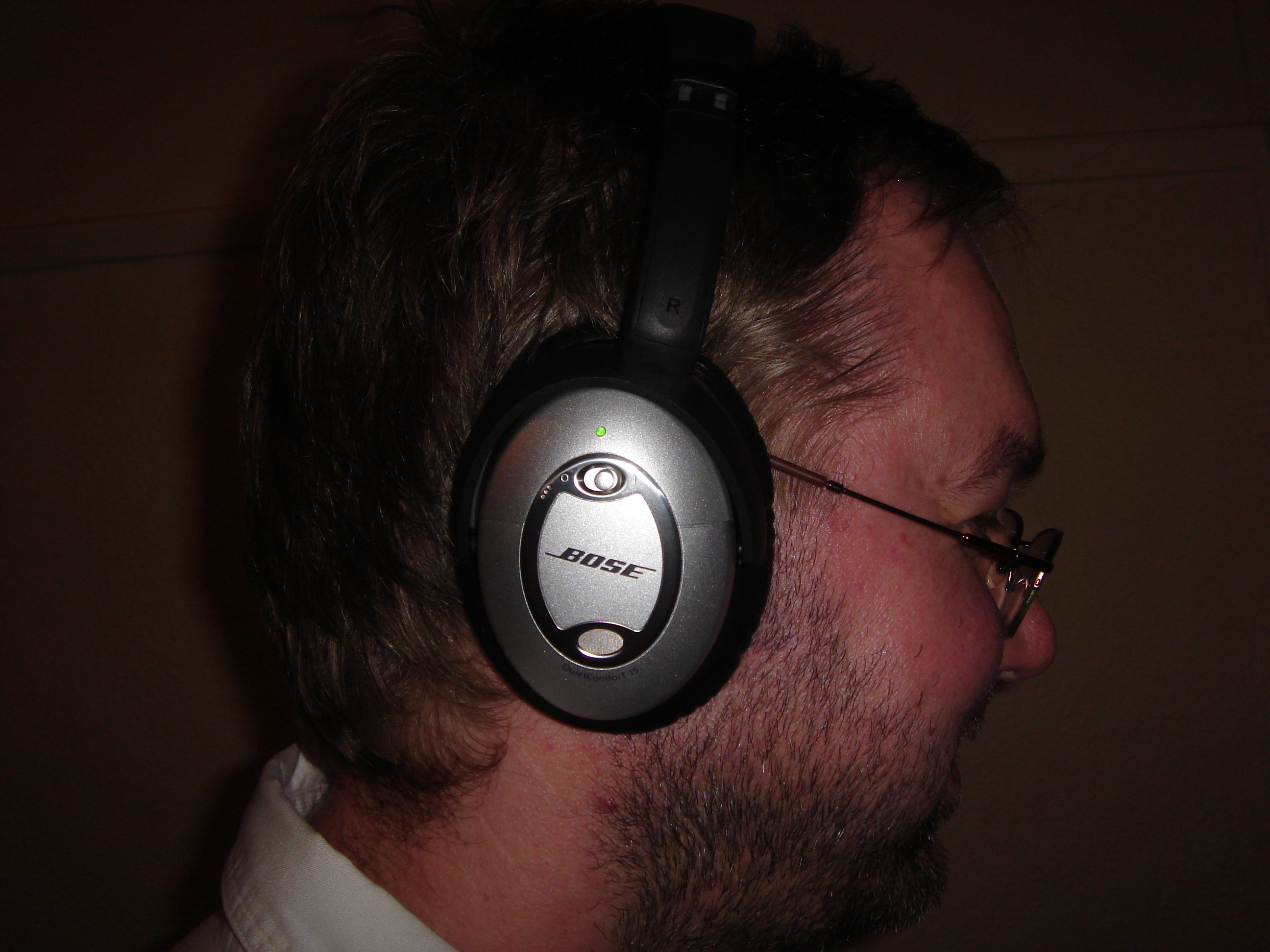
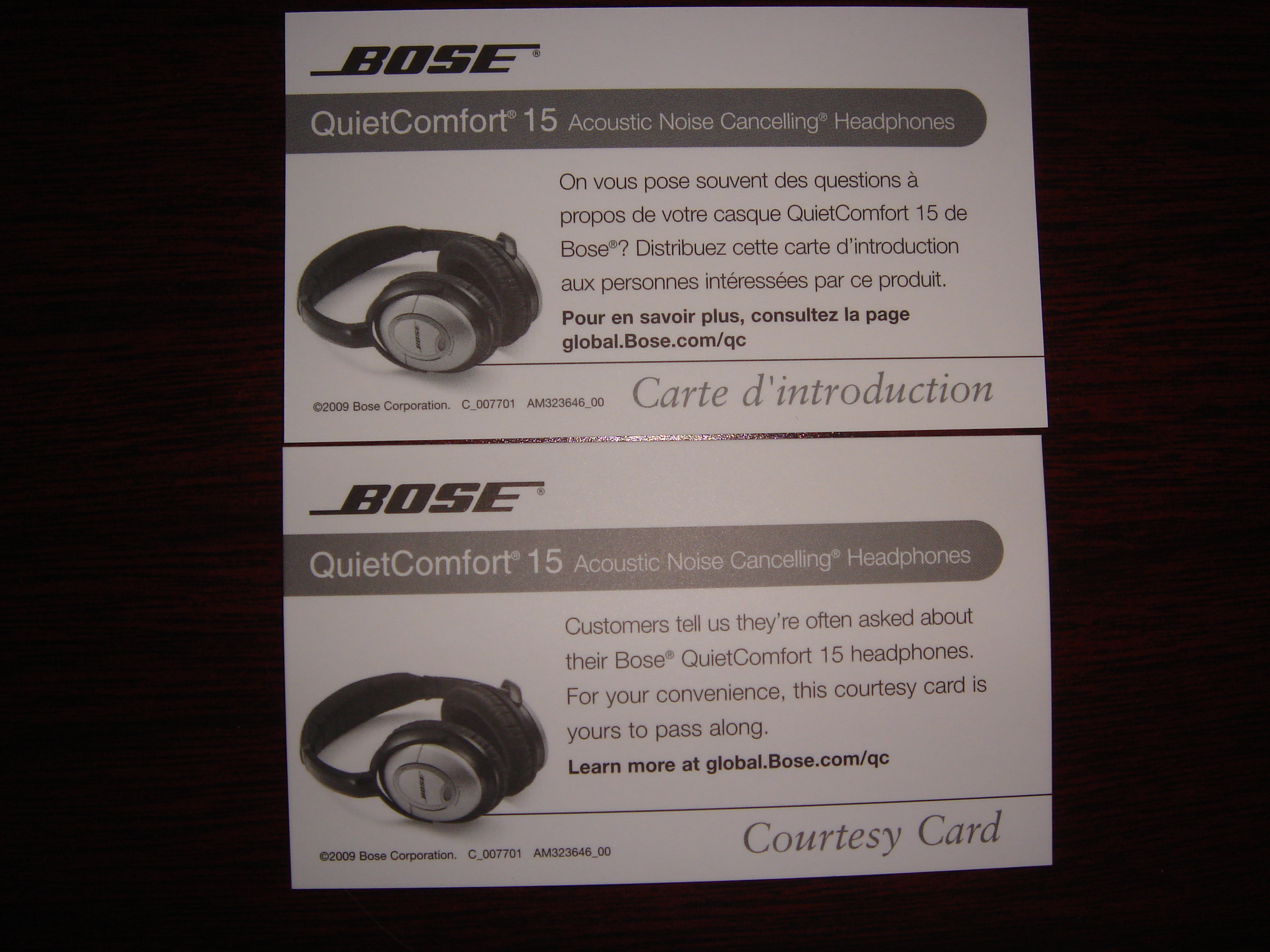
I bought the Bose QC15 noise canceling headphones for my trip back from the US. See my previous posts about Noise Canceling Headphones [1] and Testing Noise Canceling Headphones [2] for the details of my search. I first tried my new headphones in my hotel room and they worked really well at blocking the noise from the nearby road (El Camino Real in Menlo Park) as well as the noise from the heater in my room. At the airport they entirely blocked the sound of the airport air conditioning system (which was surprisingly loud I didn t realise how loud until I tried the headphones). On the flight the headphones worked really well. I used them for hours when they weren t plugged in to any source, just stopping the noise was a huge benefit. I was also able to listen to music (both MP3s on my laptop and the plane sound system) at a relatively low volume with an apparent high quality. The Bose store I visited in Stanford mall has a sound system set up to emulate the noise you experience inside a jet to demonstrate what the headset can do. It really lives up to this demonstration! I recommend them to anyone who wants over-ear noise canceling headphones and can afford $US300 + tax. But one thing to note is that not everyone likes such things my wife didn t like the sound that they generate (the least bad way to describe it is as a soft hiss). This is definitely not something you would want to buy based on reviews alone, it must be tested in-store. The main technical suggestion I can make for improvement to the QC-15 is for it to have slightly softer and thicker padding where it contacts the sides of the wearer s head. I find that my glasses prevent it from making as good contact as I would like, and that when wearing it while eating the contact is significantly broken with every jaw movement which is really annoying. A minor suggestion is that every pair of headphones should have the left and right ear pieces clearly marked, I really shouldn t have to read an instruction manual to discover which way to wear it. One thing that surprised me was the inclusion of business cards for the headset! Here is a picture:

The picture links to a larger picture that also shows the French version of the same text on the other side. I was astonished by this, encouraging happy customers to help sell your products is a reasonable and effective form of product promotion (really this is what I m doing for Bose with this blog post). But giving customers business cards is going too far anyone who wants me to hand out their business cards can offer to pay me to do so (and I probably won t accept). But if such things are considered to be a good idea then here are a few suggestions for other things that they could do:
  1. Create a Bose dating site where one can meet people who like music and traveling (this does sound appealing). In about 10 years the children of people who meet that way would start buying audio gear
  2. Start a Bose fan club.
  3. Create a template that be used by a tattoo parlor to make a Bose tattoo.
  4. Sell Bose fan t-shirts to people who aren t dedicated enough to get a tattoo.
  5. Register Bose as a religion, that gets tax free status among other benefits.
It s a pity that Bose doesn t make any water-proof noise canceling headphones. It would be something for their marketing people to wear while jumping over a shark on water skis [3]. But seriously the best thing that Bose could do to have their products promoted would be to start by printing the web site for each product on the item, my headset has two patent numbers listed which seem unlikely to provide any benefit for anyone, in that space they could have printed the global.bose.com/qc URL that is on the business card. Of course providing the URL really doesn t do any good when the URL actually is useless. It starts by giving me a page asking which country I am in the correct thing to do is to use geoip to determine the country and then give the user the option of selecting another country if that one is not ideal. Then after I select a country it doesn t take me to a specific page for the product! I could have typed in www.bose.com and got the same result (in terms of US shopping at least) while typing six fewer characters! Next like most corporate web sites the Bose site doesn t appear to be configured for longevity of URLs URLs which are clearly designed for the computer rather than humans are expected to change without warning. This discourages linking to any page that one might discover through web searches or navigating the site, and causes them to lose a lot of potential links. Having specific URLs for all the products (including the obsolete ones) that are designed firstly for humans to read and write would be a good idea. It would be really useful to be able to compare the features of new products with the ones that are going cheap on eBay. For someone who is considering buying a new product now the purchase decision would be easier if they knew that the company would provide resources to help them get a better price on eBay in a few years if they want to upgrade to a newer model. One thing to keep in mind is the fact that the reputation of a company (which makes a dramatic impact on the prices customers are prepared to pay) depends largely on a long history of making quality products. Telling customers about those historic products is one of the most sensible things that most corporations fail to do on the Internet.

Julien Danjou: Teething troubles

It's not that often that I start something from scratch. It's an amazing feeling to start a new project, to start writing something new. I like that. It's creation, it's an artistic part of our computing stuff. I feel like a code artist. And what I like even more is that little feeling that you are going in an unknown land. Some area in this tech world where nobody ever came before you, or only a few pioneers. That the sensation I got starting to using Cython, Python 3 and various other tools. I just spent half of my time trying to fix problems, rather than working on *my* code. Problems in autoconf macro not knowing Python 2.6 or Python 3.1. Problems and limitations in Cython. And problem in Python. That last one was a hard one. I'm still a beginner in the Python world: I barely know anything. And I was trying to use something nobody never did: building an embedded Python with a set of built-in modules. I spent hours trying to find why one type of module importing was badly failing. I finally found the answer thanks to a guy. who has the same problem A guy ? No. A pioneer. What do I say? A hero. He's been my week-hero! Thank you Miguel Lobo because you found the bug I chased for hours and because you even reported it as issue 1644818, including a patch! How not damn wonderful is that? I will not bore you with the technical details of that bug, since nobody cares. Nobody cares, even the Python guys, since that bug has been opened for 3 years, and nobody even reviewed in that time. I found an old thread about that bug where some guys were wanking about how they should do the review, because Miguel pushed for several weeks to have a review, back in 2007. But that bug was in my way. I had to do something. So I prepared my mail reader, mounted my web browser and here I was for a uniq quest: getting a Python bug fixed. At that point, if you did not stop reading earlier, you might get very excited. Don't be, spoiler, it's still not fixed. You'll have to wait the end of the season and see all the episodes I'll have to write to get the end of the story! Let's continue. I had to create an account on the Python bug tracking system. That was a trivial task for a man like me (you bet). Then, I launched a verbal attack, something you rarely see in a bug tracking system. Something I knew would awake any developer caring about their software.
Julien Danjou: Is there any chance to see this *bug* fixed someday?
I had the deep feeling that my quest was starting here. How many days would I have to wait until I get an answer? Time was passing. Minutes were ticking while I was waiting, sat in a comfortable sofa in a softly lighted room. It seemed like all my life was shorter than the delay I had to wait to get an answer. After waiting for hours, suddenly, and only 15 minutes later, I got an answer:
Martin v. L wis: Please ask on python-dev. I may be willing to revive my five-for-one offer.
Martin? Don't know that guy. Who is he? Who is he like? Will he fix that bug? What is this offer? So many question without an answer. But he asked to ask on python-dev, and I said: challenged accepted! I will write a mail to python-dev to get that bug fixed. Which I did. I sent a short (but well written you know, I made efforts) "WTF?" to pyhon-dev. And then the guy asked me to review 5 bugs so he will review and fix this one. And this is how I said that he was pissing me off for blackmailing me to fix a bug that was its "duty". Therefore, this is the end of the story so far. Will that bug be fixed some day? There's a hope, because another guy jumped in and took the bug assignment. To be continued. My conclusion about all that story: that is a little rude to start something new, with new tools, and get quickly into teething troubles. It's even more harsh to enter a community because you just found bugs, and be not very well received when you ask to apply a 10 lines long fix somebody wrote 3 years ago to fix it. I'll probably still use Python :-), but I get a darker image of its community now.

Debian News: Updates on LXDE

Several LXDE components have been updated recently in sid. They bring some new features and improve flexibility of customization. Below you have a summary of the most important changes:

Andrew Lee

Francois Marier: Debugging logcheck rule files

logcheck is a neat little log file monitoring tool I use on all of my machines.

I recently noticed however that I hadn't received any logcheck messages in a while from one of my servers. Either that was a sign that things were going really well or, more likely, that logcheck wasn't producing any output anymore.

Manually logging an error to syslogHere's what I did to force a message to be printed to the logs:
logger -p kern.error This is a test
Which I would expect to produce this logcheck notice:
Dec 20 15:34:08 hostname username: This is a test
Unfortunately, that didn't happen on the next scheduled run.

Forcing a logcheck runTo rule out the following:
I ran logcheck manually:
sudo -u logcheck /usr/sbin/logcheck -o -d >& logcheck.out
Looking at the output file however, my test message still wasn't there. Either logcheck was broken or one of my rule files was swallowing everything.

Finding the broken rule fileTo find the broken rule, I started by ignoring rules defined in /etc/logcheck/ignore.d.server/ and /etc/logcheck/ignore.d.workstation/ by running logcheck in paranoid mode:
logger -p kern.error This is a test
sudo -u logcheck /usr/sbin/logcheck -o -d -p >& logcheck.out
This worked, so I then ran logcheck in server mode:
logger -p kern.error This is a test
sudo -u logcheck /usr/sbin/logcheck -o -d -s >& logcheck.out
Given that this also worked, it meant that the offending rule file was in /etc/logcheck/ignore.d.workstation/. So I moved all of my custom local-* rule files out of the way and ran logcheck in workstation mode:
logger -p kern.error This is a test
sudo -u logcheck /usr/sbin/logcheck -o -d -w >& logcheck.out
Once I verified that this worked, I started to put my local files back one by one until it broke again. Then slowly removed lines from the offending file until it worked.

Solution to my problemIt turns out that one of my rule files had a line like this:
path != NULL   column != NULL
Escaping the pipe symbols with backslashes solved the problem:
path != NULL \ \  column != NULL

Maybe I should periodically print a message to syslog to make sure that logcheck is still working...

19 December 2009

Stephan Peijnik: Rest in peace Flo: 13.11.1986 16.12.2009

Today is a sad day. Everything feels like I am having a bad nightmare. That's because today I learnt from the too early death of my friend Florian Hufksy.

I am sitting here and do not really know what to write. I keep on thinking about the great times we spent together. The time we started programming when we were twelve. The time we spent learning BASIC. All the times you knew more than me and could teach me a thing or two. I remember our geek talks. How we would discuss latest games. How we lost contact and how we met again. I am thinking about how sorry I am for not having met you often enough. I keep on trying to understand what drove you that far. How you could just end it all. More and more memories come to my mind, like the moment when you showed me one of your projects, Super Mario War. The moments we had playing video games together. All those moments, all that time, I miss you my friend. You were a genius, always a step ahead, not only of me, but seemingly the whole world. I can't stop thinking about your brilliant ideas and how you always finished your projects. You were a real hacker, a real genius, a person trying to make the world a better place, a person who will be missed, not only by me.

You were a genius and I always respected you, not only as a hacker, but as a beloved friend. Why did we not spend more time together? Why did you have to go? Why do I have to write this now, sitting here in my chair with tears in my eyes? And all those memories come up again and again. There is so much more that comes to my mind, but I can't keep on writing, it just hurts too much.

The world is a sad place today. I am sad. I am mourning the too early death of my beloved friend, Florian. You will always have a special place in my heart.

Lior Kaplan: Use signed packages from a trusted source


Use signed packages from a trusted source or suffer the consequences. Malware Hidden Inside Screensaver, Theme on GNOME-Look.
As it turns out, two malicious software packages had been uploaded to GNOME-Look.org, masquerading as valid .deb packages (a GNOME screensaver and theme, respectively).
Posted in Debian GNU/Linux

MJ Ray: Similarities between the co-op and Google

This is a bit of a silly note for a Saturday while I m currently working on translating the co-op s web pages into Esperanto. The old site was translated, but the new site launched as English-only. I d like to have other languages too, but I ll start with the one that s easiest for me as a test case to get the internationalisation working again. That means that I m currently lost in django-blocks language settings. Apparently both our co-op and Google speak Esperanto. Facebook is mostly translated. Most Plone-based sites have some translation, but often it s only the standard Plone parts and any customisations remain in English, which looks a bit odd. Have you seen Esperanto on other major websites where you weren t expecting it?

18 December 2009

Asheesh Laroia: Diversity in Free Software: South Asians as an example

As someone born in India, I sometimes look around and wonder, Where are the Indians (and other South Asians) in Free Software? (I don't mean to exclude South Asians from other countries, so I will lump us together. I believe that we are more similar than we are different, although I know more about India than about the rest of South Asia.) There is no shortage of Indians performing information technology jobs in the United States. The same is true in academia; the Computing Research Association uses National Science Foundation data to show about 15% of computer science bacholor's degrees are awarded to "Asians or Pacific Islanders." These are not precise numbers targeted at South Asians in particular, but they confirm a general feeling that plenty of technologists in the United States are from that part of the world. South Asia is quite a populous region, coming in at over one billion people. It, too, has plenty of technology workers. So much FLOSS conversation happens in English, and India is well-suited to handle this; English is an "official language". Indian academia reports that there are 350 million English users and about 90 million English speakers. So let's visually compare the Debian developers map for South Asia (over one billion people) and that of New Zealand, a country of four million. India: New Zealand: These two countries have about the same number of Debian developers (at least, who have marked their location in the Debian LDAP database). About four. South Asians comprise about one sixth of the world's population. There are about one thousand Debian developers; we represent at best 1% of that. These numbers are comparable to the under-representation of women in Free Software, especially when you compare the figure to South Asians' over-representation in the rest of information technology. That makes me sad. Take a look at the Debian developer map again. You'll see that Debian is certainly not an Americans-only project, or even an English-speakers-only project. South America has a respectable dotting of developers, and Western- to Central-Europe are packed. I have strong feelings about Free Software. It emerges from an ethos of personal empowerment, and with open source it has become a dominant force in computing. Yet there are plenty of sharp people -- at least women and South Asians -- who, somehow, become culturally excluded from participating.

Why care about diversity? Consider the diversity of contributors we already have. Some contribute to Free Software because of particular business needs, such as what caused Avi Kivity to write KVM, the new leader in Linux-based virtualization. Everaldo's art background gave us the "Crystal" icon set that set the standard for sharp-looking icons on the Free Desktop for years. Josh Coalson knew about compressing sound, and his Free Lossless Audio Codec is now the standard in high quality audio. We already have a great deal of diversity. We should be celebrating! Back in 2001, FLAC's users were celebrating. In that year, I decided to ditch proprietary operating systems because I felt I could achieve all my computing needs in the Free world. A happy user of FLAC myself, I lurked on the mailing list as I watched grateful people thank Josh for the great software he wrote. Different contributions will excite different sorts of users. The more different people we have improving FLOSS, the more happy users we can make. Happy users of FLOSS are Free users. Happy users can become contributors, putting forth code, documentation, translations, and word-of-mouth marketing. The first reason to improve diversity in FLOSS is to better suit our users' needs. The more diversity we have in our contributors, the more chance we have of tickling our users in the ways that please them the most. I wish to see an end to software that restricts users' freedom, so I want to see us build the tools that users want. One thing that pleases me is when I see other people contributing who seem similar to me. When I went to Debconf, I was thrilled to be surrounded by people who cared about software freedom and technical excellence. I had even more fun being social, chatting about rainforests, mutual friends, websites, and music. I might have had the most fun playing the card game Mao. A second reason, then, to improve diversity in FLOSS is to increase contributor retention by increasing joy. Mao was an example of a cultural bond I happened to share with a handful of Debianites. The more diversity we have, the more frequent these sorts of coincidences will be. The final, most obvious, reason to reach out to groups of people who do not typically contribute is that we can increase our numbers. That by itself is so valuable. Ubuntu sees 100 new bugs per week, even after the bug squad's efforts. If we can do a better job of recruiting new contributors, the raw numbers give us more strength in creating and maintaining world-class software as well as letting the world know about it.

Changing the balance I believe that there are plenty of South Asians quite capable of contributing to FLOSS. I believe the same of women. I believe the same of men. Back to the topic at hand. Why do the South Asians vanish when we look at Free Software, not tech in general? There are plenty of reasons I can dream up, based on my experience with Indians.
  • Plenty of South Asian parents urge their children to make low-risk career choices.
  • My mother reports that schools in India focus on memorization instead of creativity. This can leave little room for extracurricular pursuits.
It's tough for FLOSS advocates to work directly on these distant issues. But I think we can focus some problems we can help solve. Crucially, awareness of Free Software spreads best by social circles. I learned about Linux from a friend at a summer camp. I'll repeat that:
  • Awareness of Free Software spreads best by social networks.
So if you want to spread that awareness, try to be a bridge. If you meet someone from an unusual background for open source who needs support or mentorship, try to help. That is an investment in the diversity and growth of Free Software. Those people can now unlock more "open source minorities."

What success looks like Google Summer of Code helps some new contributors get started and provides that mentorship. Rachel McCreary was invited to the SciPy conference after a successful summer. Her father left a comment explaining how her sisters participated in FLOSS via Google's Highly Open Participation (GHOP) Contest:
Rachel was inspired and motivated by BOTH of her little sisters, each completing six GHOP tasks (if memory serves).
GHOP and GSOC has been a game-changer for these girls. Rachel's younger sister is applying to schools such as MIT with an interest in a science major. The youngest daughter now has a Caltech poster on her wall with the intent to eventually attend.
Their proud Dad
Soon, these stories will be commonplace. Until then, we have work to do. (I'm still researching these topics. If you can help me find any sort of data to help me learn more about diversity in FLOSS, even if it seems like I wouldn't like it, leave a comment.)

Sandro Tosi: Remote Apache logging with syslog: is there anything better?

We're doing a pilot to do remote logging for some Apache logs (possibly other services in the future). We've heard of remote syslog capability (and since syslog is on all Linux system) we're giving it a try.

The configuration is quite simple:
  1. [srv] prepare a machine to do the log server
  2. [srv] open it's rsyslogd to receive messages on UDP (or TCP) port
  3. [srv] log the selected facility.level to a log file
  4. [cli] forward the above facility.level to @srv<srv address="" ip=""></srv>
Ok, easy and it works. Unfortunately we face pretty fast the limitation of syslog:
  1. only 8 facilities for users custom log (local0-local7)
  2. only 8 levels for logs severity
this is a big block (only 64 combinations, if you agree to do some "dirty" stuff) if you want to log remotely several services on several different platform on the syslog server.

rsyslog is quite flexible and it allows you to filter messages based on the tag in them, and log in different files, but it's still something very "home-made" and not that professional.

I don't we're the only one needing a remote logging tool, and while syslog is the classic solution, is very bind to the system logs and not to the applications logs: any suggestions for this task? I'd like to hear how you solved this task, possibly without a custom tool, but using something standard.

17 December 2009

Eugene V. Lyubimkin: a small script to satisfy build-dependencies from .dsc

Here it is: http://paste.debian.net/54275/. It needs /usr/bin/cupt from testing or unstable to work. Please report bugs or suggestions in comments to this post or anywhere where you can reach me.

Typical usage:

1) './script package.dsc -s' - preview
2) 'sudo ./script package.dsc' - do the work

Type './script' to see usage.

I will move it to more permanent storage soon.
UPD: Moved. http://people.debian.org/~jackyf/satisfy-dsc-deps.

Vincent Sanders: What is it with embedded computing?

Last week I was given a development board for a system on chip (SoC) we were looking at using. All i had to do was ensure I could get a reasonable, supportable, bootloader and Linux kernel running on it.

Now I am a fairly competent engineer, I have worked with the ARM processors and SoC for many years. It should not therefor take me four days of almost continuous frustration to get a bootloader and kernel onto a system, but it has.

Firstly the system arrives and we look it over, the hardware design is not exactly elegant but seems like it will get the job done. That is at least a step up from several previous offerings which have been just plain broken. So I power it up and it boots into Fedora core 8, possibly not my first OS choice for a diskless system, but it does work.

Perhaps its worth mentioning that my experience with doing any Open Source development has caused me to have a severe aversion to software which is not upstream, especially kernels. The effort required to run your own patch series and keep it up to date is nothing short of Herculean.

Let us be honest, how many developers do you know who are talented enough to generate good code and patient enough to separately maintain it over a long period of time? I shall not belabor this point as others have repeatedly made it for me in much more eloquent ways. Lets us just say from my point of view. Upstream - good. Long term forks - bad.

With this in mind, the solutions Simtec develop are always with a view to our customers being able to simply download and use the standard upstream software wherever possible. Here is where the story stops being smooth and becomes a rant.

The system was running 2.6.22, one that was patched all which ways. "maybe they just shipped an old kernel" I thought. I opened the CD they provided and...oh, OK its just zips and tarballs of the binaries and source they used (actually that in itself is a minor miracle with a lot of vendors right now - see the almost continuous stream of copyright infringement litigation from the FSF) but sill stuck back in July 2007.

So i did teh normal thing, entered the URL printed on the outside of the box and went looking for the updates. No dice, just the same old stuff. So I contacted the company and recived the news that no there were no updates, that was what was published for the device, thats what I could have.

My initial reaction was of tired resignation...this would not be my first SoC port (probably around the fifth or sixth!) So I responded with cd linux-2.6;git checkout master;git pull and went to see what I could see. and lo and behold, there in the kernel, was full support for not only the SoC but for the other version of the very board I had.

Fortunately after mentioning this on IRC my giraffe loving friend. pointed me at the correct community git tree to find the tiny patch required to support my board.

So the vendor was not only shipping old code but actively dissuading customers from even looking for new stuff, which it turns out was mainline anyway! To add to this somewhere along the lines the company name on the box and contact information has changed and...well confusion reigned.

Right Plain sailing from here on? not quite...that would have been too easy. So you can build a mainline kernel...but you cannot boot it. you guessed it the bootloader they ship on the board is ancient, specifically a u-boot fork from December 2005. Having finally figured out how this was going to go, I went to the uboot repo, pulled the latest and built it for my target. And then I needed to upgrade the u-boot and joy of joys bricked the system.

Fortunately the system has a integrated FDTI serial/JTAG port so re-writing the flash should be as simple as running openOCD configured correctly. Of course this did not work...in the end I resorted to running their binary built versions from the CD (tarfile inside a zip inside a tarfile...whatever) and wrote their original image back to the board...which worked.

Long story short, next day I discover that i need a magic different uboot target (make u-boot.kwb for those that care) write this with the binary openocd build and...success
From then on its all been a bit anticlimactic and straightforward and I now have a system capable of starting a kernel over the network and a root fs on network, disc or flash.

My main complaint from all of this is what the hell are vendors doing shipping crap like this? Why do they all insist on taking a dreadful code drop from the SoC manufacturer when they first brought the part up and shipping that prototype junk until the part reaches the end of its life?!?

All the usual excuses about support etc. will come out, but seriously, you recive *no* support from vendors unless you pay for it and even then they will simply tell you whats on the CD is "it". Btw the diff for u-boot to support this board is larger than the original sources and the 2.6.22 is attacked with a 65MB diff which cannot be good.

The Open Source option is continuously innovating and improving, producing ever better software...but the embedded world seems to be forever stuck shipping crap. Is this just me? Does anyone have any solutions? Or am I stuck with this until I change profession?

Kees Cook: headache empathy

Run gstreamer-properties , click the Video tab, change Default Input Plugin to Custom , and add this Pipeline:
v4l2src ! ffmpegcolorspace ! vertigotv ! ffmpegcolorspace
Now when Empathy video-chatting with a friend, you can give them a headache! Or give yourself a headache by trying it directly from the command line:
gst-launch v4l2src ! ffmpegcolorspace ! vertigotv ! ffmpegcolorspace ! xvimagesink
Feel free to replace vertigotv with any other or more of the video effects listed in gst-inspect effectv . Here s me with edgetv ! vertigotv: Edge Vertigo

16 December 2009

Gintautas Miliauskas: Android apps

I've recently gotten myself an Android phone. The Android app market is not as mature as iPhone's App Store, but there is a lot of applications, and plenty of chaff to separate the wheat from. I found most of the apps I use by browsing "top Android apps" lists on the web, so I am putting up a similar list here in case someone finds it useful.

15 December 2009

John Goerzen: Review: A Christmas Carol

I guess you can say that A Christmas Carol by Charles Dickens has been a success. It was published in 1843 and has never been out of print since then. It s spawned all manner of plays, films, adaptations, and spoofs. It s been adapted at least twice by Disney, once featuring Mickey Mouse and another time featuring Jim Carey. We re almost inundated with the story I m not sure how many ways I ve seen it. Yet I had never read the original story by Dickens until just now. And I must say, what a treat it was. Despite knowing the plot in advance, it was a very good read. The 19th century London setting was done well. It wasn t some idealized London as is often portrayed in film adaptations. It had depth, as did the characters. Dickens Scrooge had a troubled childhood, the son of poor and apparently abusive parents. He turned to business, with which he was successful. Along the way, he lost sight of family, and really of his humanity in general, striving to be a richer and more successful businessman at the cost of all else. How apropos this story is for us in the 21st century. Our large banks define success in terms of profits made for their shareholders, while adding more gotchas to the terms of the credit cards held by their customers. Our governments play geopolitical games over weapons, oil, and gas, while unwilling to sacrifice anything to prevent a climate disaster. Our politicians, even in the season of Christmas, turn a blind eye and a cold heart to the suffering of those that can t afford health care for naught but political reasons, rather than trying their hardest to make a plan that will help them reality as soon as possible. And what of us, the citizens of the 21st century? We consume ever flashier cars, houses, computers, and cellphones with data plans, while poverty intensifies across the globe in this economic downturn. Well, count me among those many inspired and reminded by Dickens to be a more empathetic person, to remember how good even many of the poor in the West have it compared to other parts of the world, and to try to do more for others. And that, perhaps, is part of the genius of Dickens. He inspired a complete change of how people looked at Christmas in his time. And his work is no less relevant today; perhaps it hits even closer to home these days. He invites us to carefully consider the question: what does it mean to achieve success in life? And he deftly illustrates that wealth is wrong answer. Here s hoping that many others will also learn a small bit about life from Dickens. How to find it: A Christmas Carol is available for free from Project Gutenberg for reading online, printing, or reading on an ebook reader such as the Kindle. Be careful when buying printed editions. Many have been abridged or improved for a modern audience , and thus lose a lot of the quality of the original. I found at least one edition that looks true to the original; I m sure there are others. [This review also posted to Goodreads]

Next.

Previous.