Search Results: "ag"

11 June 2015

Vincent Fourmond: Release 0.13 of ctioga2

Today is ctioga2's release. Unlike most other release, this one does not bring many visible features, but quite a few changes nevertheless, including:
As usual, the new version is available as a gem
~ gem update ctioga
Enjoy !

Holger Levsen: 20150610-debian-22k

>22000 source packages in Debian main today Just now Debian main for the first time had more than 22000 source packages in unstable, 22001 at this moment to be exact. Very few weeks ago for the first time there were more than 45000 binary packages for unstable/amd64(+all) in main - and today this number is up to 45542! Thanks and kudos to everyone involved to make it happen. You make countless people smile each day! Keep up the good work! (And, that said, cleaning the archive from cruft and making sure only "good" packages enter is also a very important part of this work. Thanks to those who care about that too.)

John Goerzen: Roundup of remote encrypted deduplicated backups in Linux

Since I wrote last about Linux backup tools, back in a 2008 article about BackupPC and similar toools and a 2011 article about dedpulicating filesystems, I ve revisited my personal backup strategy a bit. I still use ZFS, with my tool simplesnap that I wrote about in 2014 to perform local backups to USB drives, which get rotated offsite periodically. This has the advantage of being very fast and very secure, but I also wanted offsite backups over the Internet. I began compiling criteria, which ran like this: So, how did things stack up? Didn t meet criteria A lot of popular tools didn t meet the criteria. Here are some that I considered: Obnam and Attic/Borg Backup Obnam and Attic (and its fork Borg Backup) are both programs that have a similar concept at their heart, which is roughly this: the backup repository stores small chunks of data, indexed by a checksum. Directory trees are composed of files that are assembled out of lists of chunks, so if any given file matches another file already in the repository somewhere, the added cost is just a small amount of metadata. Obnam was eventually my tool of choice. It has built-in support for sftp, but its reliance on local filesystem semantics is very conservative and it works fine atop davfs2 (and, I d imagine, other S3-backed FUSE filesystems). Obnam s repository format is carefully documented and it is very conservatively designed through and through clearly optimized for integrity above all else, including speed. Just what a backup program should be. It has a lot of configurable options, including chunk size, caching information (dedup tables can be RAM-hungry), etc. These default to fairly conservative values, and the performance of Obnam can be significantly improved with a few simple config tweaks. Attic was also a leading contender. It has a few advantages over Obnam, actually. One is that it uses an rsync-like rolling checksum method. This means that if you add 1 byte at the beginning of a 100MB file, Attic will upload a 1-byte chunk and then reference the other chunks after that, while Obnam will have to re-upload the entire file, since its chunks start at the beginning of the file in fixed sizes. (The only time Obnam has chunks smaller than its configured chunk size is with very small files or the last chunk in a file.) Another nice feature of Attic is its use of packs , where it groups chunks together into larger pack files. This can have significant performance advantages when backing up small files, especially over high-latency protocols and links. On the downside, Attic has a hardcoded fairly small chunksize that gives it a heavy metadata load. It is not at all as configurable as Obnam, and unlike Obnam, there is nothing you can do about this. The biggest reason I avoided it though was that it uses a single monolithic index file that would have to be uploaded from scratch after each backup. I calculated that this would be many GB in size, if not even tens of GB, for my intended use, and this is just not practical over the Internet. Attic assumes that if you are going remote, you run Attic on the remote so that the rewrite of this file doesn t have to send all the data across the network. Although it does work atop davfs2, this support seemed like an afterthought and is clearly not very practical. Attic did perform much better than Obnam in some ways, largely thanks to its pack support, but the monolothic index file was going to make it simply impractical to use. There is a new fork of Attic called Borg that may, in the future, address some of these issues. Brief honorable mentions: bup, zbackup, syncany There are a few other backup tools that people are talking about which do dedup. bup is frequently mentioned, but one big problem with it is that it has no way to delete old data! In other words, it is more of an archive than a backup tool. zbackup is a really neat idea it dedups anything you feed at it, such as a tar stream or zfs send stream, and can encrypt, too. But it doesn t (yet) support removing old data either. syncany is fundamentally a syncing tool, but can also be used from the command line to do periodic syncs to a remote. It supports encryption, sftp, webdave, etc. natively, and runs on quite a number of platforms easily. However, it doesn t store a number of POSIX attributes, such as hard links, uid/gid owner, ACL, xattr, etc. This makes it impractical for use for even backing up my home directory; I make fairly frequent use of ln, both with and without -s. If there were some tool to create/restore archives of metadata, that might work out better.

Holger Levsen: 20150610-lts-may

My LTS May With regrets I have had to realize that I'm currently to overloaded to work on Debian LTS, so we planned that I'll do 7h in May and then I would take a three months break from doing LTS work. And then I didn't even manage that, I've only managed to finally fix #783800 ("security-tracker: squeeze-lts/non-free not handled correctly") and file #788362 and that was that. I do hope to come back to do sensible and serious LTS work in autumn, but for now it's better to move this off my plate. I'm really sorry for not being able to support Debian LTS at the moment. I still think it's very much needed, worth of and in need of support - just not by me at this point. Of course I'll also continue to use it myself - because it's great to be able to choose when to upgrade ones systems! :-)

Daniel Silverstone: In defence of curl sudo bash -

Long ago, in days of yore, we assumed that any software worth having would be packaged by the operating system we used. Debian with its enormous pile of software (over 20,000 sources last time I looked) looked to basically contain every piece of free software ever. However as more and more people have come to Linux-based and BSD-based systems, and the proliferation of *NIX-based systems has become even more diverse, it has become harder and harder to ensure that everyone has access to all of the software they might choose to use. Couple that with the rapid development of new projects, who clearly want to get users involved well before the next release cycle of a Linux-based distribution such as Debian, and you end up with this recommendation to bypass the operating system's packaging system and simply curl sudo bash -. We, the OS-development literati, have come out in droves to say "eww, nasty, don't do that please" and yet we have brought this upon ourselves. Our tendency to invent, and reinvent, at the very basic levels of distributions has resulted in so many operating systems and so many ways to package software (if not in underlying package format then in policy and process) that third party application authors simply cannot keep up. Couple that with the desire of the consumers to not have their chosen platform discounted, and if you provide Debian packages, you end up needing to provide for Fedora, RHEL, SuSE, SLES, CentOS, Mint, Gentoo, Arch, etc.etc; let alone supporting all the various BSDs. This leads to the simple expedience of curl sudo bash -. Nobody, not even those who are most vehemently against this mechanism of installing software, can claim that it is not quick, simple for users, easy to copy/paste out of a web-page, and leaves all the icky complexity of sorting things out up to a script which the computer can run, rather than the nascent user of the software in question. As a result, many varieties of software have ended up using this as a simple installation mechanism, from games to orchestration frameworks - everyone can acknowledge how easy it is to use. Now, some providers are wising up a little and ensuring that the url you are curling is at least an https:// one. Some even omit the sudo from the copy/paste space and have it in the script, allowing them to display some basic information and prompting the user that this will occur as root before going ahead and elevating. All of these myriad little tweaks to the fundamental idea improve matters but are ultimately just putting lipstick on a fairly sad looking pig. So, what can be done? Well we (again the OS-development literati) got ourselves into this horrendous mess, so it's up to us to get ourselves back out. We're all too entrenched in our chosen packaging methodologies, processes, and policies, to back out of those; yet we're clearly not properly servicing a non-trivial segment of our userbase. We need to do better. Not everyone who currently honours a curl sudo bash - is capable of understanding why it's such a bad idea to do so. Some education may reduce that number but it will never eliminate it. For a long time I advocated a switch to wget && review && sudo ./script approach instead, but the above comment, about people who don't understand why it might be a bad idea, really applies to show how few of those users would even be capable of starting to review a script they downloaded, let alone able to usefully judge for themselves if it is really safe to run. Instead we need something better, something collaborative, something capable of solving the accessibility issues which led to the curl sudo bash - revolt in the first place.
I don't pretend to know what that solution might be, and I don't pretend to think I might be the one to come up with it, but I can hilight a few things I think we'll need to solve to get there:
  1. Any solution to this problem must be as easy as curl sudo bash - or easier. This might mean a particular URI format which can have os-specific ways to handle standardised inputs, or it might mean a pervasive tool which does something like that.
  2. Any solution must do its best to securely acquire the content the user actually wanted. This means things like validating SSL certificates, presenting information to the user which a layman stands a chance of evaluating to decide if the content is likely to be what they wanted, and then acting smoothly and cleanly to get that content onto the user's system.
  3. Any solution should not introduce complex file formats or reliance on any particular implementation of a tool. Ideally it would be as easy to implement the solution on FreeBSD in shell, or on Ubuntu as whizzy 3D GUIs written in Haskell. (modulo the pain of working in shell of course)
  4. The solution must be arrived at in a multi-partisan way. For such a mechanism to be as usefully pervasive as curl sudo bash - as many platforms as possible need to get involved. This means not only Debian, Ubuntu, Fedora and SuSE; but also Arch, FreeBSD, NetBSD, CentOS etc. Maybe even the OpenSolaris/Illumos people need to get involved.
Given the above, no solution can be "just get all the apps developers to learn how to package software for all the OS distributions they want their app to run on" since that way madness lies. I'm sure there are other minor, and major, requirements on any useful solution but the simple fact of the matter is that until and unless we have something which at least meets the above, we will never be rid of curl sudo bash - :- just like we can never seem to be rid of that one odd person at the party, noone knows who invited them, and noone wants to tell them to leave because they do fill a needed role, but noone really seems to like. Until then, let's suck it up and while we might not like it, let's just let people keep on curl sudo bash -ing until someone gets hurt.
P.S. I hate curl sudo bash - for the record.

Petter Reinholdtsen: Measuring and adjusting the loudness of a TV channel using bs1770gain

Television loudness is the source of frustration for viewers everywhere. Some channels are very load, others are less loud, and ads tend to shout very high to get the attention of the viewers, and the viewers do not like this. This fact is well known to the TV channels. See for example the BBC white paper "Terminology for loudness and level dBTP, LU, and all that" from 2011 for a summary of the problem domain. To better address the need for even loadness, the TV channels got together several years ago to agree on a new way to measure loudness in digital files as one step in standardizing loudness. From this came the ITU-R standard BS.1770, "Algorithms to measure audio programme loudness and true-peak audio level". The ITU-R BS.1770 specification describe an algorithm to measure loadness in LUFS (Loudness Units, referenced to Full Scale). But having a way to measure is not enough. To get the same loudness across TV channels, one also need to decide which value to standardize on. For European TV channels, this was done in the EBU Recommondaton R128, "Loudness normalisation and permitted maximum level of audio signals", which specifies a recommended level of -23 LUFS. In Norway, I have been told that NRK, TV2, MTG and SBS have decided among themselves to follow the R128 recommondation for playout from 2016-03-01. There are free software available to measure and adjust the loudness level using the LUFS. In Debian, I am aware of a library named libebur128 able to measure the loudness and since yesterday morning a new binary named bs1770gain capable of both measuring and adjusting was uploaded and is waiting for NEW processing. I plan to maintain the latter in Debian under the Debian multimedia umbrella. The free software based TV channel I am involved in, Frikanalen, plan to follow the R128 recommondation ourself as soon as we can adjust the software to do so, and the bs1770gain tool seem like a good fit for that part of the puzzle to measure loudness on new video uploaded to Frikanalen. Personally, I plan to use bs1770gain to adjust the loudness of videos I upload to Frikanalen on behalf of the NUUG member organisation. The program seem to be able to measure the LUFS value of any media file handled by ffmpeg, but I've only successfully adjusted the LUFS value of WAV files. I suspect it should be able to adjust it for all the formats handled by ffmpeg.

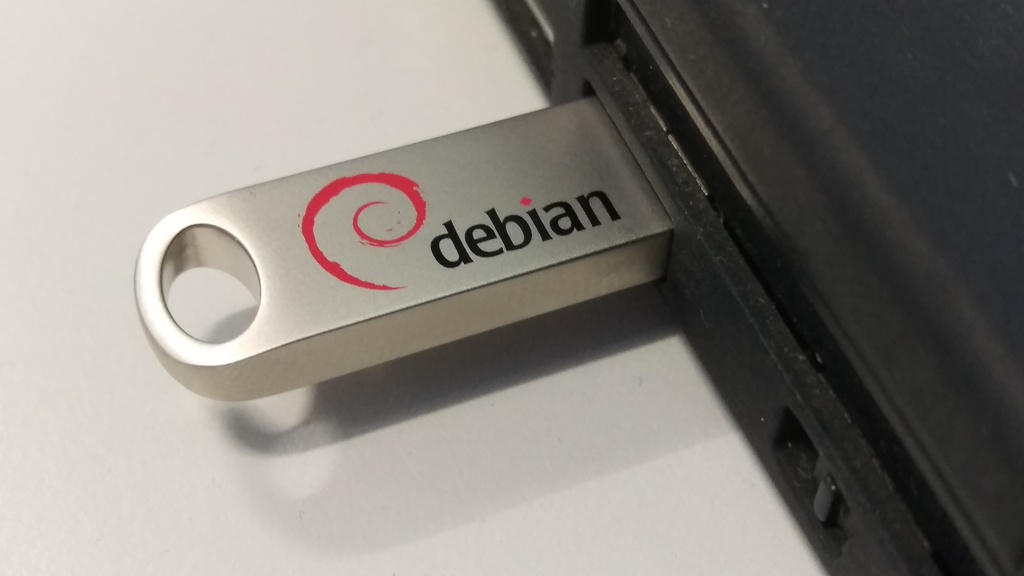
Steve McIntyre: Debian-branded USB keys

I've had some 8GB USB keys made, with the Debian swirl and text. By buying a reasonable number, I've got what I think is a good price for nice high-quality keys (metal body with a solid loop for attaching to a keyring). I'm now selling these for 7 pounds each, and I'm planning on bringing some to DebConf 15 too, where they'll be 10 EUR. USB key They're selling faster than I expected - if you're interested in buying one (or several!), please let me know. If there's enough demand, I may order more.
10 June 2015

DebConf team: DebConf15 Invited speakers (Posted by DebConf Team)

This year, on top of the many excellent contributed talks, BoFs, and other events always part of DebConf (some of which have already been announced) we are excited to have confirmed the following keynote speakers. During the Open Weekend (Saturday, August 15th and Sunday, August 16th), we will have keynotes delivered by: On the last day of DebConf, we look forward to the closing keynote by: For more information about our invited speakers, please see http://debconf15.debconf.org/invited_speakers.xhtml Citizenfour Screening Additionally, there will be a screening of the Citizenfour movie, winner of the Best Documentary Feature Academy Award on the evening of Friday, August 21st. You still have time to submit your talk There are only a few days left before the end of the Call for Proposals on June 15th. Events submitted after that date might not be part of the official DebConf schedule. So, please, hurry, check out the proposal submission guide and submit your event. Regards from the DebConf Team

Norbert Preining: Tribute to Hermann Zapf

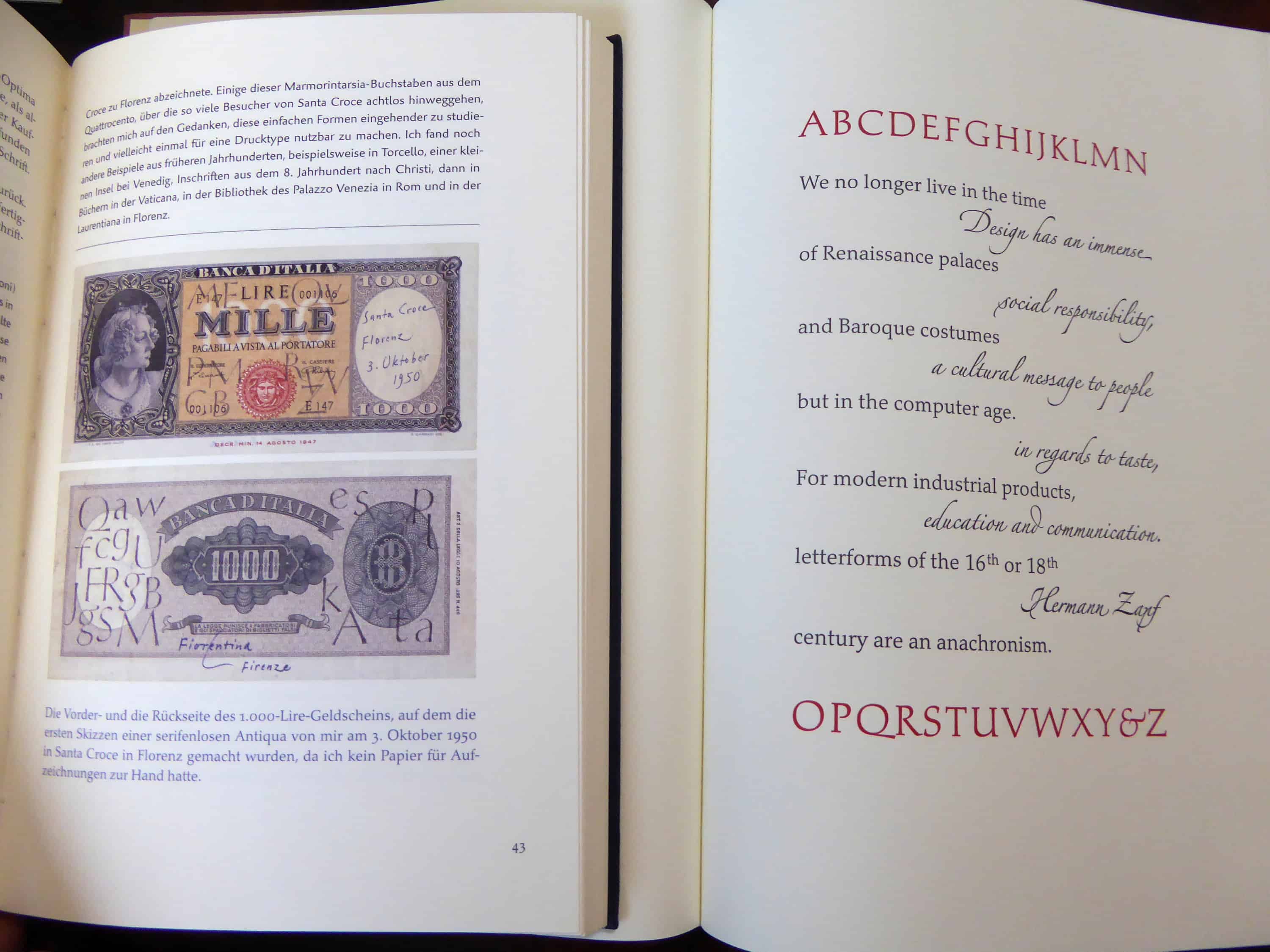
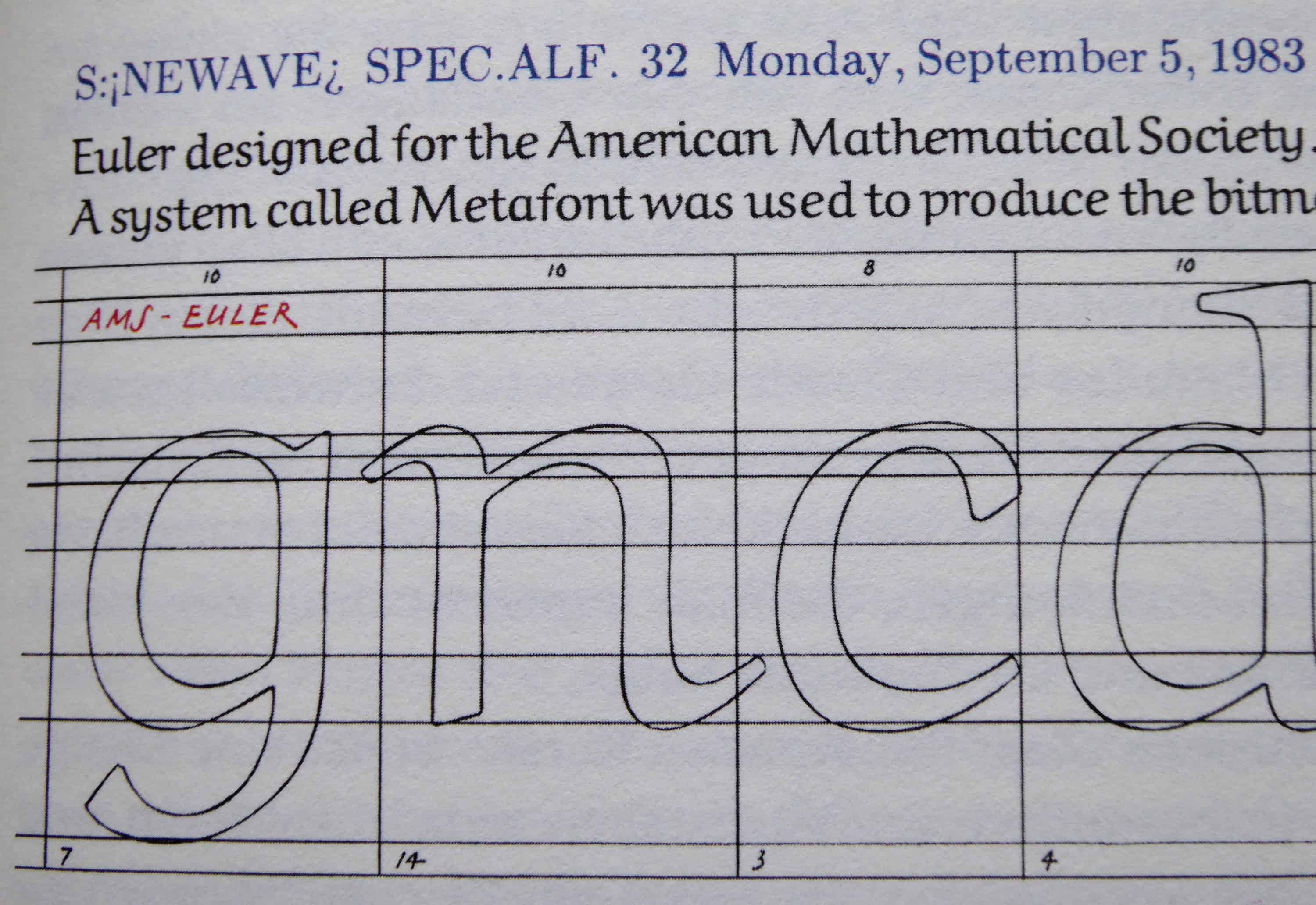
Last weekend Hermann Zapf, one of the greatest font designers and typographers of our times, has passed away at the age of 96. Much has been written about his life, his immense sphere of influence, his excellent typefaces, and some of the links to other obituaries can be found here at the end. There is nothing of value I can contribute, but let Hermann Zapf speak for himself with a few images from two books by or dedicated to him. zapf-heart-blood-ink The books I have taken these photos from are: zapf-books In his long life, Hermann Zapf has created a wide range of typefaces, some if which have become the main staple in the printing business, most notably Palatino, Janson, Optima, and Zapf Dingbats. But there are many more: zapf-alphabets While probably not as popular anymore as some years (decades?) ago, Palatino still is one of my favorite typefaces. I often wished to have the freedom to choose my own fonts for publications, but normally that doesn t happen. Palatino has found many offspring (or imitations?), and there are excellent renderings for use with (La)TeX, too. zapf-palatino Hermann Zapf also had connections with Don Knuth and the AMS (American Mathematical Society), and he designed for the AMS the Euler typeface, using Knuth s MetaFont program. zapf-euler Last weekend, when I heard of Hermann Zapf s death, I was at a conference at Tsukuba University. What a coincidence that all the signs in the building (floor numbers, indications, etc) were set optimain another of his great typefaces, the Optima. I had a strange feeling, and reset my presentation in Optima/Euler in honor of Hermann Zapf s great life. Although I never met Hermann Zapf personally I missed the TeX conferences where he participated it was to a great extent his influence that years ago I got started in typography. Living a life like he did, dedicating himself to the beauty and expressiveness of letters, design, calligraphy, seems like a dream for me. But beauty can be found even in the strangest equation in mathematics, the queerest theorem in logic. While not all of us are as gifted as Hermann Zapf in creating beauty, we should strive to increase our ability to appreciate the beauty. The beauty of letters is subtle, evasive, and needs training, that is practice, to be appreciated. Hermann Zapf taught us how even self-training can lead to excellence. His letters, which I meet every day, are a permanent reminder to strive for beauty and clarity, and never relent in our exercise. Thanks Hermann Zapf. zapf-letters Links to tributes around the world English Linotype (Type foundry where Zapf started working)
Bigelow and Holmes (Type designers)
New York Times (Newspaper)
Type Drawers
Quarz (News magazine)
Kaveh Bazargan (next president of TUG)
TeX Overflow (Q&A website concerning TeX) German FontShop (Type foundry and internet shop)
Deutschland Funk (News station)
S ddeutsche (Newspaper)
Echo (Newspaper)
Heise (Techology News page)

9 June 2015

Tiago Bortoletto Vaz: Zyne is now in Debian

Zyne is a modular synthetizer written in Python. Anyone can create and extend its modules using the Pyo library. Zyne's GUI is coded using WXPython and will look nicely in GNU/Linux, Mac and Windows systems. It's written by the same author of Pyo, and together with Cecilia and Soundgrain is part of an amazing set of libre tools for sound synthesis and electronic music composition.
/images/zyne-screenshot.png

Zyne loading 6 of its 14 default modules

Zyne package is result of a successful one-day event called MicroDebconf Brasilia 2015, being created during a track about packaging and QA leaded by Eriberto Mota and Antonio Terceiro.

Norbert Preining: Debian/TeX Live 2015 the new layout

While updating the TeX Live package for Debian for the upcoming 2015 release, one of my aims was to convert as much as possible of the TeX configuration infrastructure to use dpkg triggers. We used the trigger mechanism already for the update of the font map configuration file (calls to updmap-sys), but till now neither for files installed into texmf trees, nor for format generation. In this blog I will describe the new management of all TeX related configuration files, while in the following one I will describe how things have been implemented with dpkg triggers. In due time this information will also be codified in the Debian TeX sub-policy. Debian - TeX Live 2015 Let us start with recalling the different actions that have to be taken when TeX packages are installed, removed, or updated. Required actions for TeX packages Filename database The simplest case are packages that only include files ment to be loaded while running TeX or Metafont or similar programs. In this case the file name database of TeX (and the one of ConTeXt) needs to be updated. Usually this is done by calling mktexlsr on the changed trees, plus, if ConTeXt is installed, running mtxrun --generate. Font map activation More complicated are font packages that provide PostScript fonts. These packages need to ship a so called map file which maps TeX font names to PostScript fonts names. Examples are lm.map which defines this mapping for the Latin Modern fonts. All these map files have to be collected in one or more updmap.cfg files, and then a call to updmap(-sys) is necessary to generate configuration files for dvips, pdftex, and some other programs. Format and hyphenation definitions Even more complicated is the case of additional hyphenation patterns and additional format definitions. At the moment, hyphenation patterns are only shipped from the TeX Live packages itself, but additional format definitions are already provided by other packages than the TeX Live ones. Again, in both cases all the different format and hyphenation pattern definitions must be combined, into configuration files fmtutil.cnf and several language.* files, respectively. After this some incantation of fmtutil(-sys) is necessary to update the format dumps of TeX. Status up to Debian/TeX Live 2014 Up to now most of these actions are done in the postinstall script of the providing packages, generated by dh_installtex. The tex-common package shipped besides the program dh_installtex also postinstall and postrm snippets that took care of all the necessary steps, and ensuring that configuration succeeds even if some of the programs were missing. While this worked quite nicely for many years, I saw several disadvantages: Furthermore, /etc/texmf/ was filled with snippet-configuration directories, e.g., /etc/texmf/hyphen.d/ and /etc/texmf/fmt.d/ where the standard configuration of TeX was saved, and system administrators could change the necessary settings. While this is a good thing, i.e., to give system administrators the chance to change their configuration, it carries a big risk: most system administrators, most users, have not the blankest idea how to write a proper format definition for TeX, nor a proper entry for a hyphenation pattern. And the TeX engines are not forgiving in this respect and will bail out immediately. Finally, having so many configuration files hanging around in /etc/texmf/ makes it complicated to update between releases, where these files might have changed completely, files might have been added or removed. New layout for Debian/TeX Live 2015 and onward Thanks to a rewrite of fmtutil in Perl (also one of my endeavors), and adding the capability to read multiple fmtutil.cnf files in the same way updmap can read multiple updmap.cfg files, starting with Debian/TeX Live 2015 we can finally do the following: So let us dive into the details, following the above order: Filename database Update of the filename databases is now done automatically via a trigger on the two directories that are searched by kpathsea and used by Debian packages: /usr/share/texlive/texmf-dist/ (for TeX Live packages) and /usr/share/texmf/ (for all other packages). Thus, if a Debian package installs files into one of these directories, automatically mktexlsr (and, if ConTeXt is installed also mtxrun) is run from the tex-common trigger action. As a consequence for package maintainers of TeX related packages, if you are not adding font maps, formats, or hyphens, there is no need anymore to call dh_installtex or do anything TeX specific besides installing the files into the proper locations. Font map activation Here nothing has changed from the previous status, I just repeat that map snippets should be installed into /var/lib/tex-common/fontmap-cfg/texlive/ (for TeX Live packages) and /var/lib/tex-common/fontmap-cfg/texmf/ (for all other packages). One snippet can contain arbitrary many Map or MixedMap lines. Example: /var/lib/tex-common/fontmap-cfg/texmf/tex-gyre.cfg:
Map qag.map
Map qbk.map
Map qcr.map
Map qcs.map
Map qhv.map
Map qpl.map
Map qtm.map
Map qzc.map
There is a necessary action to be taken in postinst and postrm, which is calling update-texmf-conf map (but take care when writing your own code in postrm, as update-texmf-conf might not be available!). Format and hyphenation definitions Format definitions and hyphenations are now treated in the very same way as font maps. That is: Package maintainers are advised to use dh_installtex as it also caters for the removal of format dumps under /var/lib/texmf/web2c. Format of the configuration files Files under /var/lib/tex-common/fmtutil-cnf/ must consist of syntactically correct lines for fmtutil.cnf, that is white-space separated entries where the first word is the name of the format, the second the name of the engine, the third the respective hyphenation configuration file or a literal if none, and the rest of the line are additional arguments to the respective initex program, where the last entry is the ini-file. A typical example would be /var/lib/tex-common/fmtutil-cnf/texlive/texlive-omega.cnf:
aleph aleph - *aleph.ini
lamed aleph language.dat *lambda.ini
Files under /var/lib/tex-common/hyphen-cnf have a slightly changed syntax from the ones we used to have back in /etc/texmf/hyphen.d. The new syntax is taken directly from the TeX Live database, execute statement AddHyphen. That is one line of key=value pairs, where the following keys are allowed: name, synonyms, lefthyphenmin, righthyphenmin, file, file_patterns, file_exceptions, and luaspecial. A typical example would be /var/lib/tex-common/hyphen-cnf/texlive/texlive-lang-polish.cnf:
name=polish lefthyphenmin=2 righthyphenmin=2 file=loadhyph-pl.tex file_patterns=hyph-pl.pat.txt file_exceptions=hyph-pl.hyp.txt
In addition, package maintainers that have shipped files in /etc/texmf/fmt.d or /etc/texmf/hyphen.d are advised to remove them on package upgrade, using PACKAGE.maintscript and the proper rm_conffile directive (see the musixtex package for an example. Overriding system settings In case an administrator wants to override any of the default setting, it has become much easier in case of font maps and formats, due to the multi-feature of the respective programs. For hyphenations a separate configuration file needs to be provided. Overriding font maps and formats This can be handled by dropping a updmap.cfg or fmtutil.cnf file, respectively, into either /etc/texmf/web2c/ or /usr/local/share/texmf/web2c/ (both will work). The new files will be evaluated by the respective programs (updmap(-sys) and fmtutil(-sys), respectively), and allow by default to override entries in other files. Please see the manual page of the two programs for details, or this entry for updmap and this entry for fmtutil. Overriding hyphenation patterns When generating the various language.* files, update-language evaluates last the file /etc/texmf/web2c/local-hyphen.cnf, which should contain hyphenation patterns in the very same format as described above. Using this entry one can add additional patterns, or override given ones. Current status of uploads Several packages have already been uploaded to experimental: tex-common, musixtex, context, texinfo. What remains are the TeX Live packages itself, but here we are facing two problems: So, in case you cannot wait for the next century to happen (or, that all the packages are accepted), and still want to give it a shot, here are the apt-get lines:
deb http://people.debian.org/~preining/TeX/ exp/
deb-src http://people.debian.org/~preining/TeX/ exp/
but be warned, there might be more changes coming in. Warnings: First, in case you have already texlive-binaries 2015.20150524.37493-2 installed, please downgrade to the new version -1 which is now on the server. They are the same packages, only the version number has changed. Yes, and if you test it, don t be surprised if suddenly you are left with a not-working TeX system. Don t tell me I didn t warn you  Anyway, I hope to hear some feedback and installation reports. Conclusion While packaging has become easier for maintainers, and there is less clutter in /etc/texmf/, we now are depending on dpkg to call the tex-common triggers. Thus, if this happens rather often, then especially fmtutil-sys --all will be called several times. This is a slight regression from the previous setup, but paid off (IMNSHO) by the arguments given in the beginning. That said, there will be of course a certain time of transition until the new setup has proven its merits, and bugs are ironed out. But having bugs that need to be mostly fixed only in one package, namely tex-common, seems like an easier task to me. Enjoy.

8 June 2015

Lunar: Reproducible builds: week 6 in Stretch cycle

What happened about the reproducible builds effort for this week: Presentations On May 26th,Holger Levsen presented reproducible builds in Debian at CCC Berlin for the Datengarten 52. The presentation was in German and the slides in English. Audio and video recordings are available. Toolchain fixes Niels Thykier fixed the experimental support for the automatic creation of debug packages in debhelper that being tested as part of the reproducible toolchain. Lunar added to the reproducible build version of dpkg the normalization of permissions for files in control.tar. The patch has also been submitted based on the main branch. Daniel Kahn Gillmor proposed a patch to add support for externally-supplying build date to help2man. This sparkled a discussion about agreeing on a common name for an environment variable to hold the date that should be used. It seems opinions are converging on using SOURCE_DATE_UTC which would hold a ISO-8601 formatted date in UTC) (e.g. 2015-06-05T01:08:20Z). Kudos to Daniel, Brendan O'Dea, Ximin Luo for pushing this forward. Lunar proposed a patch to Tar upstream adding a --clamp-mtime option as a generic solution for timestamp variations in tarballs which might also be useful for dpkg. The option changes the behavior of --mtime to only use the time specified if the file mtime is newer than the given time. So far, upstream is not convinced that it would make a worthwhile addition to Tar, though. Daniel Kahn Gillmor reached out to the libburnia project to ask for help on how to make ISO created with xorriso reproducible. We should reward Thomas Schmitt with a model upstream trophy as he went through a thorough analysis of possible sources of variations and ways to improve the situation. Most of what is missing with the current version in Debian is available in the latest upstream version, but libisoburn in Debian needs help. Daniel backported the missing option for version 1.3.2-1.1. akira submitted a new issue to Doxygen upstream regarding the timestamps added to the generated manpages. Packages fixed The following 49 packages became reproducible due to changes in their build dependencies: activemq-protobuf, bnfc, bridge-method-injector, commons-exec, console-data, djinn, github-backup, haskell-authenticate-oauth, haskell-authenticate, haskell-blaze-builder, haskell-blaze-textual, haskell-bloomfilter, haskell-brainfuck, haskell-hspec-discover, haskell-pretty-show, haskell-unlambda, haskell-x509-util, haskelldb-hdbc-odbc, haskelldb-hdbc-postgresql, haskelldb-hdbc-sqlite3, hasktags, hedgewars, hscolour, https-everywhere, java-comment-preprocessor, jffi, jgit, jnr-ffi, jnr-netdb, jsoup, lhs2tex, libcolor-calc-perl, libfile-changenotify-perl, libpdl-io-hdf5-perl, libsvn-notify-mirror-perl, localizer, maven-enforcer, pyotherside, python-xlrd, python-xstatic-angular-bootstrap, rt-extension-calendar, ruby-builder, ruby-em-hiredis, ruby-redcloth, shellcheck, sisu-plexus, tomcat-maven-plugin, v4l2loopback, vim-latexsuite. The following packages became reproducible after getting fixed: Some uploads fixed some reproducibility issues but not all of them: Patches submitted which did not make their way to the archive yet: Daniel Kahn Gilmor also started discussions for emacs24 and the unsorted lists in generated .el files, the recording of a PID number in lush, and the reproducibility of ISO images in grub2. reproducible.debian.net Notifications are now sent when the build environment for a package has changed between two builds. This is a first step before automatically building the package once more. (Holger Levsen) jenkins.debian.net was upgraded to Debian Jessie. (Holger Levsen) A new variation is now being tested: $PATH. The second build will be done with a /i/capture/the/path added. (Holger Levsen) Holger Levsen with the help of Alexander Couzens wrote extra job to test the reproducibility of coreboot. Thanks James McCoy for helping with certificate issues. Mattia Rizollo made some more internal improvements. strip-nondeterminism development Andrew Ayer released strip-nondeterminism/0.008-1. This new version fixes the gzip handler so that it now skip adding a predetermined timestamp when there was none. Holger Levsen sponsored the upload. Documentation update The pages about timestamps in manpages generated by Doxygen, GHC .hi files, and Jar files have been updated to reflect their status in upstream. Markus Koschany documented an easy way to prevent Doxygen to write timestamps in HTML output. Package reviews 83 obsolete reviews have been removed, 71 added and 48 updated this week. Meetings A meeting was held on 2015-06-03. Minutes and full logs are available. It was agreed to hold such a meeting every two weeks for the time being. The time of the next meeting should be announced soon.

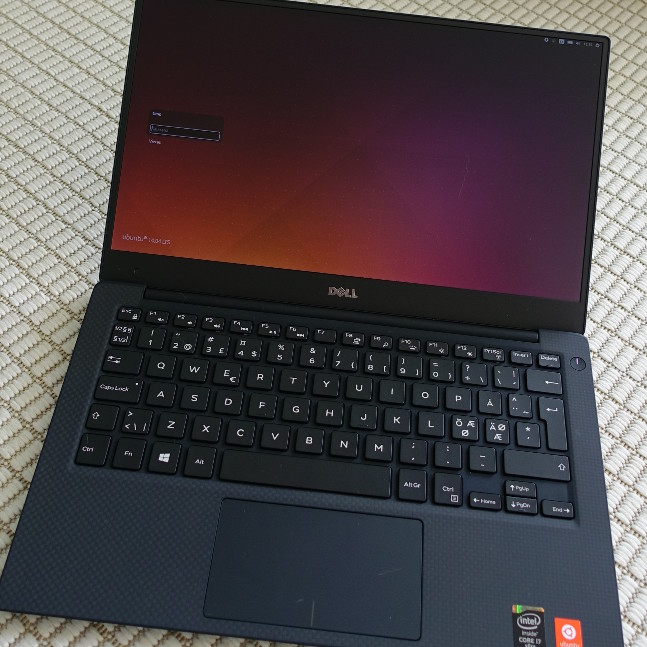
Timo Jyrinki: Quick Look: Dell XPS 13 Developer Edition (2015) with Ubuntu 14.04 LTS

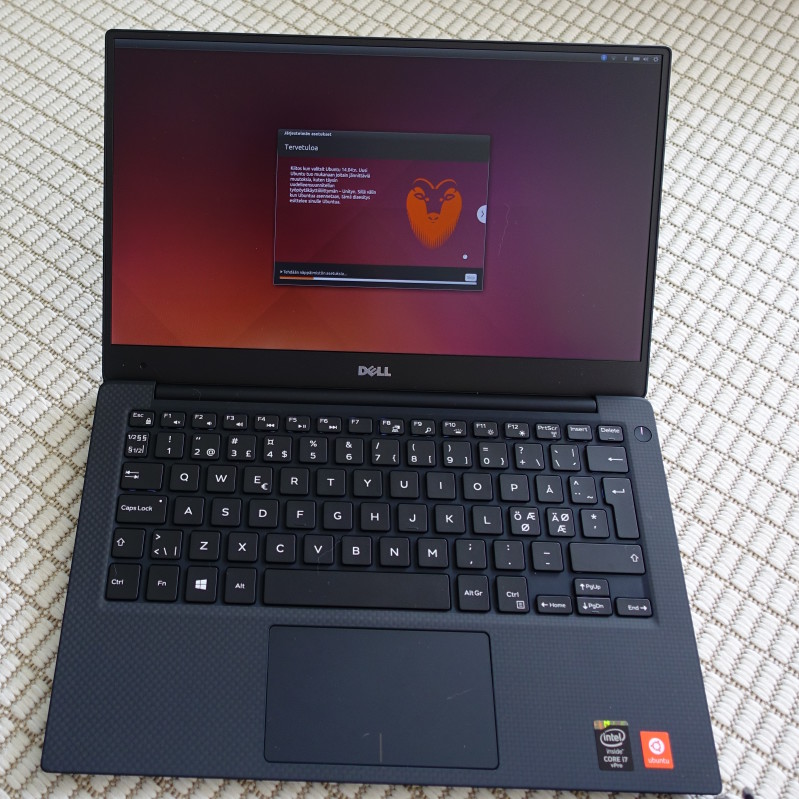
I recently obtained the newest Dell's Ubuntu developer offering, XPS 13 (2015, model 9343). I opted in for FullHD non-touch display, mostly because of better battery life, the actual no need for higher resolution, and matte screen which is great outside. Touch would have been "nice-to-have", but in my work I don't really need it.

The other specifications include i7-5600U CPU, 8GB RAM, 256GB SSD [edit: lshw], and of course Ubuntu 14.04 LTS pre-installed as OEM specific installation. It was not possible to directly order it from Dell site, as Finland is reportedly not online market for Dell... The wholesale company however managed to get two models on their lists and so it's now possible to order via retailers. [edit: here are some country specific direct web order links however US, DE, FR, SE, NL]

In this blog post I give a quick look on how I started up using it, and do a few observations on the pre-installed Ubuntu included. I personally was interested in using the pre-installed Ubuntu like a non-Debian/Ubuntu developer would use it, but Dell has also provided instructions for Ubuntu 15.04, Debian 7.0 and Debian 8.0 advanced users among else. Even if not using the pre-installed Ubuntu, the benefit from buying an Ubuntu laptop is obviously smaller cost and on the other hand contributing to free software (by paying for the hardware enablement engineering done by or purchased by Dell).
Unboxing
The Black Box. (and white cat)

Opened box.


First time lid opened, no dust here yet!
First time boot up, transitioning from the boot logo to a first time Ubuntu video.
A small clip from the end of the welcoming video.
First time setup. Language, Dell EULA, connecting to WiFi, location, keyboard, user+password.
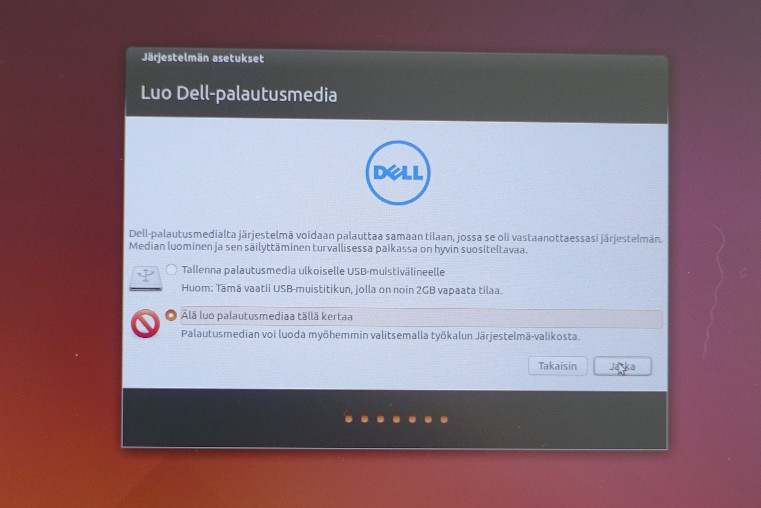
Creating recovery media. I opted not to do this as I had happened to read that it's highly recommended to install upgrades first, including to this tool.
Finalizing setup.
Ready to log in!
It's alive!
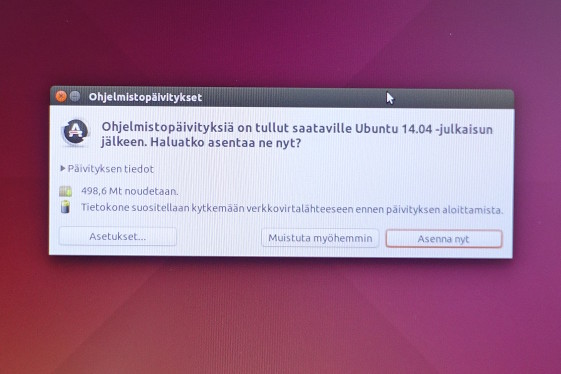
Not so recent 14.04 LTS image... lots of updates.
Problems in the First BatchUnfortunately the first batch of XPS 13:s with Ubuntu are going to ship with some problems. They're easy to fix if you know how to, but it's sad that they're there to begin with in the factory image. There is no knowledge when a fixed batch will start shipping - July maybe?

First of all, installing software upgrades stops. You need to run the following command via Dash Terminal once: sudo apt-get install -f (it suggests upgrading libc-dev-bin, libc6-dbg, libc6-dev and udev). After that you can continue running Software Updater as usual, maybe rebooting in between.

Secondly, the fixed touchpad driver is included but not enabled by default. You need to enable the only non-enabled Additional Driver as seen in the picture below or instructed in Youtube.

Dialog enabling the touchpad driver.

Clarification: you can safely ignore the two paragraphs below, they're just for advanced users like me who want to play with upgraded driver stacks.

Optionally, since I'm interested in the latest graphics drivers especially in case of a brand new hardware like Intel Broadwell, I upgraded my Ubuntu to use the 14.04.2 Hardware Enablement stack (matches 14.10 hardware support): sudo apt install --install-recommends libgles2-mesa-lts-utopic libglapi-mesa-lts-utopic linux-generic-lts-utopic xserver-xorg-lts-utopic libgl1-mesa-dri-lts-utopic libegl1-mesa-drivers-lts-utopic libgl1-mesa-glx-lts-utopic:i386

Even though it's much better than a normal Ubuntu 14.10 would be since many of the Dell fixes continue to be in use, some functionality might become worse compared to the pre-installed stack. The only thing I have noticed though is the internal microphone not working anymore out-of-the-box, requiring a kernel patch as mentioned in Dell's notes. This is not a surprise since the real eventual upstream support involves switching from HDA to I2S and during 14.10 kernel work that was not nearly done. If you're excited about new drivers, I'd recommend waiting until August when the 15.04 based 14.04.3 stack is available (same package names, but 'vivid' instead of 'utopic'). [edit: I couldn't resist myself when I saw linux-generic-lts-vivid (3.19 kernel) is already in the archives. 14.04.2 + that gives me working microphone again!]
ConclusionDell XPS 13 Developer Edition with Ubuntu 14.04 LTS is an extremely capable laptop + OS combination nearing perfection, but not quite there because of the software problems in the launch pre-install image. The laptop looks great, feels like a quality product should and is very compact for the screen size.

I've moved over all my work onto it and everything so far is working smoothly in my day-to-day tasks. I'm staying at Ubuntu 14.04 LTS and using my previous LXC configuration to run the latest Ubuntu and Debian development versions. I've also done some interesting changes already like LUKS In-Place Conversion, converting the pre-installed Ubuntu into whole disk encrypted one (not recommended for the faint hearted, GRUB reconfiguration is a bit of a pain).

I look happily forward to working a few productive years with this one!

Craig Small: Checking Cloudflare SSL

My website for a while has used CloudFlare as its front-end. It s a rather nice setup and means my real server gets less of a hammering, which is a good thing. A few months ago they enabled a feature called Universal SSL which I have also added to my site. Around the same time, my SSL check scripts started failing for the website, the certificate had expired apparently many many days ago. Something wasn t right. The Problem The problem was simply at first I d get emails saying The SSL certificate for enc.com.au (CN: ) has expired! . I use a program called ssl-cert-check that would check all (web, smtp, imap) of my certificates. It s very easy to forget to renew and this program runs daily and does a simple check. Running the program on the command line gave some more information, but nothing (for me) that really helped:
$ /usr/bin/ssl-cert-check -s enc.com.au -p 443
Host Status Expires Days
----------------------------------------------- ------------ ------------ ----
unable to load certificate
140364897941136:error:0906D06C:PEM routines:PEM_read_bio:no start line:pem_lib.c:701:Expecting: TRUSTED CERTIFICATE
unable to load certificate
139905089558160:error:0906D06C:PEM routines:PEM_read_bio:no start line:pem_lib.c:701:Expecting: TRUSTED CERTIFICATE
unable to load certificate
140017829234320:error:0906D06C:PEM routines:PEM_read_bio:no start line:pem_lib.c:701:Expecting: TRUSTED CERTIFICATE
unable to load certificate
140567473276560:error:0906D06C:PEM routines:PEM_read_bio:no start line:pem_lib.c:701:Expecting: TRUSTED CERTIFICATE
enc.com.au:443 Expired -2457182
So, apparently, there was something wrong with the certificate. The problem was this was CloudFlare who seem to have a good idea on how to handle certificates and all my browsers were happy. ssl-cert-check is a shell script that uses openssl to make the connection, so the next stop was to see what openssl had to say.
$ echo ""   /usr/bin/openssl s_client -connect enc.com.au:443 CONNECTED(00000003)
140115756086928:error:14077438:SSL routines:SSL23_GET_SERVER_HELLO:tlsv1 alert internal error:s23_clnt.c:769:
---
no peer certificate available
---
No client certificate CA names sent
---
SSL handshake has read 7 bytes and written 345 bytes
---
New, (NONE), Cipher is (NONE)
Secure Renegotiation IS NOT supported
Compression: NONE
Expansion: NONE
No ALPN negotiated
---
No peer certificate available. That was the clue I was looking for. Where s my Certificate? CloudFlare Universal SSL uses certificates that have multiple domains in the one certificate. The do this by having one canonical name which is something like sni(numbers).cloudflaressl.com and then multiple Subject Alternative Names (a bit like ServerAlias in apache configurations). This way a single server with a single certificate can serve multiple domains. The way that the client tells the server which website it is looking for is Server Name Indication (SNI). As part of the TLS handshaking the client tells the server I want website www.enc.com.au . The thing is, by default, both openssl s_client and the check script do not use this feature. That was fail the SSL certificate checks were failing. The server was waiting for the client to ask what website it wanted. Modern browsers do this automatically so it just works for them. The Fix For openssl on the command line, there is a flag -servername which does the trick nicely:
$ echo ""   /usr/bin/openssl s_client -connect enc.com.au:443 -servername enc.com.au 
CONNECTED(00000003)
depth=2 C = GB, ST = Greater Manchester, L = Salford, O = COMODO CA Limited, CN = COMODO ECC Certification Authority
verify error:num=20:unable to get local issuer certificate
---
(lots of good SSL type messages)
That was openssl happy now. We asked the server what website we were interested in with the -servername and got the certificate. The fix for ssl-cert-check is even simpler. Like a lot of things once you know the problem, the solution is not only easy to work out but someone has done it for you already. There is a Debian bug report on this problem with a simple fix from Francois Marier. Just edit the check script and change the line that has:
 TLSSERVERNAME="FALSE"
and change it to true. Then the script is happy too:
$ ssl-cert-check -s enc.com.au -p https
Host Status Expires Days
----------------------------------------------- ------------ ------------ ----
enc.com.au:https Valid Sep 30 2015 114
All working and as expected! This isn t really a CloudFlare problem as such, it is just that s the first place I had seen these sort of SNI certificates being used in something I administer (or more correctly something behind the something).

Russ Allbery: Review: Late Eclipses

Review: Late Eclipses, by Seanan McGuire
Series: October Daye #4
Publisher: DAW
Copyright: March 2011
ISBN: 1-101-50253-3
Format: Kindle
Pages: 372
Late Eclipses is the fourth book the October Daye series, and relies heavily on characters introduced in the previous books. I recommend reading this series from the start; jumping into the middle would miss a lot of nuance. Thankfully, though, enough is explained that you don't have to have read the previous books recently. (I wish more series would do that.) Unsurprisingly, the book opens with Toby's life getting more complicated. Also unsurprisingly, that means getting more entangled in the affairs of the fae court, as Toby gets pushed farther out of her comfort zone. But that quickly takes a back seat to much worse news: Toby's close friend Lily is deathly ill. That isn't supposed to be possible for an undine. And Lily isn't the last person to get deathly ill in this book. I should note up-front that this book contains one of my least favorite tropes in fiction of this sort: a protagonist who falls under the influence of something mind-altering and has to keep second-guessing her own perceptions. I have this problem with most books about drugs or some equivalent. There was enough of that here to irritate me, but this is just a personal quirk and I'm used to other people liking those books better, so you may need to adjust my rating accordingly. That said, I liked Late Eclipses better than An Artificial Night, even with that drawback. It's less dark, less bleak, and returns to some of the mystery feel of the first two books of the series. A lot of urban fantasy mixes in a bit of a detective element, usually from the noir tradition, and I think that provides a useful plot driver. There's a lot at stake in this story, but Toby also gets a lot of agency. She's out doing things, making guesses and following up on them, rather than trying to endure vast horror. And she has more trust in her instincts and abilities, and is gathering more allies and respect. There was a bit too much of "abuse the protagonist" for my tastes, but some of the court maneuvering is quite satisfying. There's always a risk with power curves taking away the risk in stories like this, or of having to constantly invent a bigger bad than the previous one, but McGuire is doing a good job keeping control of that. Toby is getting stronger, and it's obvious that she's more than she appears or realizes. Coming to terms with the edges of that is part of this story. But the dangers in these stories have been very different in kind rather than escalating degree. The complex political machinations of the fae court help here considerably, creating problems that Toby has to navigate through with allies and careful thought. One of my favorite parts of this series continues to be the supporting cast. We don't get as much of the Luidaeg here, but we get lots of May (who is becoming one of my favorite characters of the series) and several other excellent supporting characters. It's rare that I like the supporting cast of an urban fantasy series this well without feeling like they're overshadowing the protagonist. Some parts of this story bugged me for idiosyncratic reasons, but I still thought it was a step up from the previous installment. McGuire's world doesn't seem to be running out of steam. I'll definitely keep reading. Followed by One Salt Sea. Rating: 7 out of 10

7 June 2015

Thomas Goirand

There s a lot of things I d like to blog about. The last version of OpenStack, the OpenStack Liberty design summit, Kilo in the official jessie-backports repositories, etc. Maybe the most interesting part of this blog post is the last bit at the end, about a major change in the packaging workflow for OpenStack in Debian. Please read on OpenStack release names reminder
Just a reminder to make it easier for the average Debian reader who may know Debian well, but not OpenStack. OpenStack 2014.1, is Icehouse, and is the version in Jessie. 2014.2 is Juno and was released right before the freeze of Jessie. 2015.1.0 is what has been released just right after jessie, on the 30th of April. Liberty, which probably will be called 12 (as this will be the 12th release of OpenStack), and not 2015.2 (this has been discussed in Vancouver), will be released in about 5 months form now. The last summit, in Vancouver, BC, Canada, was the Liberty summit, as the OpenStack conventions are always named after the next release (since we are discussing what we will be doing during the next development cycle). OpenStack 2015.1.0, aka Kilo, release in Debian
5 days after the release of Jessie, OpenStack 2015.1.0, aka Kilo, was released. Since I couldn t upload to unstable during the freeze, I was holding a lot of packages, and when I did upload them, there was about 20 packages of mine in the FTP master s NEW queue. Though, since the DSA want to use OpenStack for the Debian infrastructure, the 20 packages were fast track into Sid, thanks to the work of Paultag (thanks man!). OpenStack Kilo in the official Jessie backports
Previously, I was only uploading OpenStack packages to Debian unstable, and maintaining a non-official Debian repositories for backports to Debian stable. However, for multiple reasons, this wasn t satisfying. Then, after packages migrated to Stretch, I started to upload to Debian backports. And right before the summit, almost everything went in. Only python-pysaml2 was missing (as I discovered too late that version 2.0.0 breaks Keystone which needs version 2.4.0). In fact, the last bits of the Kilo release reached jessie-backports in the middle of the OpenStack Liberty summit. Removal of the Debian install-guide from the official site
As there was not enough efforts working on the documentation, unfortunately, the link to the Debian install-guide has been removed from docs.openstack.org. IMO, this is mostly due to a bad communication between myself and the doc team, and also because one person who promised to work on the Debian side of the install-guide failed to warn everyone that he finally couldn t (as his managers assigned him to something else). I hope this will soon be reverted. During the Vancouver summit, I had the opportunity to discuss with the doc team about re-inclusion of the Debian install-guide. Unfortunately, as they are moving away from the XML source format to a more standard RST-based system, the current documentation is frozen, so it seems more realistic to hold on until all of the install-guide is switched to RST. OpenStack Debian image listed on apps.openstack.org
There s a new area on the openstack.org where images and apps for OpenStack are listed. Under the glance image tab, you will see that both the Jessie and the weekly testing image are listed. There s also a nice, easily identifiable Debian logo to link to these images. Also, as there are trademark problems with the Ubuntu images which makes them harder to redistribute, the Murano project (which is shipping a system to automatically install apps that to installed within a few clicks on an OpenStack cloud) decided to switch to Debian for their base image. Debian listed in the OpenStack market place
On the openstack.org site, there s a section called Marketplace. In there, vendors supporting OpenStack are listed. To get there, a vendor needs to 1/ have a defined set of OpenStack project supported by the distribution (Debian already has a way more than the required set), 2/ sign some kind of agreement with the OpenStack foundation, and 3/ pay some sponsoring money. During the summit, I discussed this with Jonathan Bryce, from the OpenStack foundation, and he agreed that Debian would not have to pay for this (since we aren t a big company with big money). I have put Jonathan and Neil (our Debian Project Leader) in touch so that signing the document may happen, though since we were all busy with the summit, I do not expect Jonathan to send the documents right away. Hopefully, this will be fixed before the end of this month of May 2015. Debian (and Ubuntu) packages collaboratively maintained upstream
Since about forever (forever is 5 years in the OpenStack world ), I pushed for more collaboration on OpenStack packaging between Debian package maintainers and Canonical. However, for some reasons which I do not wish to expand on in this blog post, it has been socially hard to do so. Also, Canonical always used BZR, which wasn t to the tastes of everyone. But during the Liberty summit, some very good things happened. First of all, Launchpad is now able to support Git (it s been a few weeks it does in fact). Even though it will take a bit of time before the Canonical server team switches to it, we can consider that this problem is already out of the way. Then it looks like Canonical are now more open than before for collaboration with Debian on the OpenStack packaging. Note that we actually did some work together already, but now we both would like a full alignment of *all* of our packages. I have discussed this with James Page, who is the head of Canonical s server team. We will first start to do so on the dependencies: this includes all of the python-*client libraries, but also all of python-oslo.* (the Oslo libs are use by all of the projects and are kind of unifying the project), plus all the third party dependencies the project relies on. James already pushed new versions of some Oslo libraries to Experimental (in order to not overwrite Kilo), which are adding transition packages needed for Ubuntu. We wont need those in Debian, but we want to welcome them to keep the same source packages. We will then later try to merge the core projects if we can. Unfortunately, since the packaging of the core projects (ie: Nova, Neutron, Cinder, Glance, etc.) was forked, merging probably will be a bit painful. We will have to make some decisions on how this happen. I am however confident that it will be done during the Liberty release cycle. Move of the packaging to upstream Gerrit
A few weeks after the summit, I wrote a proposal to upstream OpenStack dev list, with as subject: Adding packaging as an OpenStack project . What it means is that I have proposed to have Debian/Ubuntu packaging to happen in upstream infrastructure, using Gerrit, and building packages using upstream cloud. We will add all the tests we can, like building with unit tests, lintian, piuparts, adequate, but also maybe a full installation of the packages with functional tests. My proposal is here: http://lists.openstack.org/pipermail/openstack-dev/2015-May/064848.html As everything, this translates into a Gerrit review process: https://review.openstack.org/#/c/185187/ As you can read in the above thread, Fedora/RDO people, which have used a Gerrit work-flow for a long time already, also would like to join. But it looks like we ll be doing 2 teams: one for RPMs and one for debs. The proposal is currently under review by the OpenStack technical committee, which will accept (or not) if the packaging project can be fully considered as an OpenStack project. I expect a final answer next Tuesday. Note that if they deny, we can still use the stackforge namespace instead, their decision is just about the TC blessing the project as being OpenStack or not. What s very nice about this, is that not only we will have a better collaboration between Debian & Ubuntu, better automated testing and Q/A, this also opens contributions to potentially anyone. Especially, we welcome operation people, those who are doing actual big deployments. Sure, it was possible before, but I often had the feedback that many were scared to break anything when trying to contribute. Thanks to the CI/CD form upstream infra, and the Gerrit peer review process, it wont be a problem anymore. So we do expect operation people to contribute more. I will also push more upstream packaging within Mirantis, so that MOS (Mirantis OpenStack) aligns fully with Debian & Ubuntu as well. Another good thing, is that it will be easier for the puppet team to support Debian (they historically were more Ubuntu oriented), and it s going to be super easy for them to request for packaging fixes. I hope we will be able to work hand-to-hand with them, adding puppet deployment checks in the packaging repo, and packaged deployments within the puppet Gerrit review process.

6 June 2015

Dirk Eddelbuettel: RcppArmadillo 0.5.200.1.0

Conrad put out a new minor release 5.200.1 of Armadillo yesterday. Armadillo is a powerful and expressive C++ template library for linear algebra aiming towards a good balance between speed and ease of use with a syntax deliberately close to a Matlab. Our corresponding RcppArmadillo release 0.5.200.1.0 is now on CRAN and on its way into Debian. See below for the brief list of changes.
Changes in RcppArmadillo version 0.5.200.1.0 (2015-06-04)
  • Upgraded to Armadillo release 5.200.1 ("Boston Tea Smuggler")
    • added orth() for finding the orthonormal basis of the range space of a matrix
    • expanded element initialisation to handle nested initialiser lists (C++11)
    • workarounds for bugs in GCC, Intel and MSVC C++ compilers
  • Added another example to inst/examples/fastLm.r
Courtesy of CRANberries, there is also a diffstat report for the most recent CRAN release. As always, more detailed information is on the RcppArmadillo page. Questions, comments etc should go to the rcpp-devel mailing list off the R-Forge page.

This post by Dirk Eddelbuettel originated on his Thinking inside the box blog. Please report excessive re-aggregation in third-party for-profit settings.

5 June 2015

Laura Arjona: Games

Nota: Este art culo, en espa ol, aqu . I m not a gamer, although probably I ve played with machines/computers more than most of the girls of my age. My path has been: handheld machine, Pong and tenis in my uncle s console, MSX (with that one, in addition to playing, I learnt what was an algorithm and a program, and I started to write small programs in Basic, and I copied and ran the source code of small games and programs to make graphics, which I found in MSX magazines). My parents considered that arcade machines in bars were like slot machines so they were banned for us (even pinball, only table soccer was saved from them, and only if my father was playing with us). In the MSX I played Magical Tree, Galaxians, Arkanoid, Konami s Sports Games, Spanish games from Dinamic, and some arcades like Golden Axe, Xenon, and maybe some more. The next computers (PC AT, later a 286) were not so for gaming; let s say that we played more with the printer (Harvard Graphics, Bannermania ). Later, I was interested in other things more than in computer games, and later there were highschool homework, dBase III, and later the University and programming again and more, and it was the end of gaming, computer was for office and Uni homework.
Later, it came the internet and since then, reading and writing and communicating was more interesting for me than playing. I was not good at playing, and if you are not good, you play less, and you don t get better, so you begin to find other ways to loose your time, or to win it :) The new generation My son is 6 years old now, and I m living with him a second adventure about games. Games have changed a lot, and the family computing try to stay in the libre software side whenever I am the one that can decide, so sometimes some challenges arise. Android (phone and tablet) The kid has played games in the phone and tablet with Android since he was a baby. We tried some of the last years popular games. I am not so keen of banning things, but I don t feel comfortable with the popular games for Android (advertisements, nonfree software, addictive elements, massive data recollection and possible surveillance ), so I try to control without being Cruella de Vil . Some techniques I use: On the other side, in my phone there is no Google Play, so we have been able to discover the section Games of F-Droid. We have tried (all of them available in F-Droid, emphasis in the ones that he liked best): 2048, AndroFish, Bomber, Coloring for Kids, Core, Dodge, Falling Blocks, Free Fall, Frozen Bubble, HeriSwap (this one in the tablet), Hex, HyperRogue, Meerkat Challenge, Memory, Pixel Dungeon, Robotfindskitten, Slow it!, Tux Memory, Tux Rider, Vector Pinball. Playing in my phone with CyanogenMod and having downloaded the games from F-Droid provides a relief similar to the one when playing a non-computer game. At least with the games that I have listed above. Maybe it is because they are simpler games, or they make me remember the ones that I played time ago. But it s also because of the peace of mind of knowing that they are libre software, that have been audited by the F-Droid community, that they don t abuse the user. The same happens with Debian, what takes me to the next part of this blogpost. Computer games: Debian The kid has learnt to play with the tablet and the phone before than with the computer, because our computers have no joysticks nor touchscreens. He learnt to use the touchpad before than the mouse, because it s easier and we have no mouse at home. He learnt to use the mouse at school, where they work with educative games via CD or via web, using Flash :( So Flash player appears and dissapears from my Debian setup depending on his willness to play with the school games . Until few time ago, in the computer we played with GCompris, ChildsPlay, and TuxPaint.
When he learnt to use the arrow keys, I installed Hannah and he liked a lot, specially when we learnt to do hannah -l 900 :) Later, in ClanTV there were advertisements about some online computer games about their favorite series, resulting in that they need Flash or a framework called Unity3D (no, it s not Ubuntu s Unity), and after digging a bit I decided that I was not going to install that #@%! in my Debian, so when he insisted in play those games, I booted the Windows 7 partition in his father s laptop and I installed it there. Windows is slow and sad in the computer, and those web games with that framework are not very light, so luckily they have not become very interesting. We have not played in the computer much more, maybe some incursion in Minetest, what takes me to the next section. (Not without stating my eternal thanks to the Games Team in Debian. I think they do a very important work and I think that next year I ll try to get involved in some way, because I know that the future of our family computer games is tied to libre games in Debian). PlayStation 3 and Minecraft Some time ago my husband bought a PlayStation 3 for home. The shop had discounts prices and so. He would play together with the kid an so.
The machine came home with some games for free (included in the price), but most of them were classified for +13 or so, so the only two left were Pro Evolution Soccer, and Minecraft.
I decided not to connect the machine to the network. Maybe we are loosing cool things, but I feel safer like that. So, no ethernet cable plugged, no registration in the Sony shop (or whatever its name is). The controllers are quite complex for the three of us. They are DualShock don t-know-what, and I think there is something (software) that makes the game adaptative to the person playing, because my husband is worse player after the son plays, if they play in turns and use the same controller. The kid liked Minecraft. I didn t know anything about that game (well, I knew that there was a libre clone called Minetest), so, for learning the basics I had a look at the wiki and searched videos about how to and we began learning. Now, the kid can read a bit so he needs less help, and he has watched a lot of videos about Minecraft, so he is interested in exploring and building. I had a look at Minetest, and I installed it in Debian. Having to use the keyboard is a disadvantage, and we didn t know how to dig, so it was not much attractive at first sight. I have looked a bit about how to use the PS3 controller in the computer, via USB, and it seems to work, but I suppose I need to write something to match each controller button with the corresponding key and subsequent action in Minetest. This is work, and I am lazy, and the boy seems not very interested in playing with the computer. Watching the videos we have infered that it s possible to download saved games and worlds to upload them in the videogame console. We have done some tests. I wanted to upload a saved game about an amusement park, but the file was in a folder of name NPEB01899* and even when the PS3 saw it to copy it from USB to the console, later it didn t appear in the list of saved games (our sved games were in folders named BLES01976). And renaming the folder didn t work, of course. I understood that we had met Sony s restrictions, so I searched for more info. The games are saved using an encryption key and you are not able to use saved games from consoles in other world zone or using a media different than ours (the game can be played using a disc or purchasing it in the digital shop, it seems). Very ugly all of this! I read somewhere that there is certain software (libre software, BTW) that allows to break the encryption and re-encrypt the saved game with the zone and type of media of your console, but it seems the program only works for Windows, and it needs a console ID that we have not, because we didn t register the console in the PlayStation network. All these things look shaky grounds for me, unpleasant stuff, I don t want to spend time on this, maybe I should learn a bit more about Minetest and make it work and interesting and tell Sony go fly a kite. Finally, I found a saved game in the same format as ours (BLES01976), it s not an amusement park but it is a world with interesting places to explore and many things already built, so I ve tried to import it and it worked, so my son will be happy for some time, I suppose. We have tried Minetest in the tablet too, but the touchscreen is not comfortable for this kind of games. I feel quite frustrated and angry about this issue of Sony s restrictions on saved games. So I suppose that in the next months I ll try to learn more about Minetest in Debian, game controllers in Debian, and games in Debian in general. So I hope to be able to offer cool stuff to my son, and he becomes more interested in playing in a safe environment which does not abuse the user. And with this, I finish Libre games in GNU/Linux, Debian, and info about games in internet When we have searched info about games in internet, I found that many times you need to go out from the secure environment: webpages with links to downloads that who knows if they contain what they say they contain, advertisements, videoblogs with a language not adequate for kids (or any person that loves their mother language) That s why I believe the path is to go into detail about libre games provided by the distro you use (Debian in my case). Here I bookmark a list of website with info that surely will be useful for me, to read in depth: We ll see how it goes. Comments? You can comment in this Pump.io thread.
Filed under: My experiences and opinion Tagged: Debian, English, F-Droid, Free culture, Free Software, Games, libre software, Moving into free software

Simon McVittie: Why polkit (or, how to mount a disk on modern Linux)

I've recently found myself explaining polkit (formerly PolicyKit) to one of Collabora's clients, and thought that blogging about the same topic might be useful for other people who are confused by it; so, here is why udisks2 and polkit are the way they are. As always, opinions in this blog are my own, not Collabora's. Privileged actions Broadly, there are two ways a process can do something: it can do it directly (i.e. ask the kernel directly), or it can use inter-process communication to ask a service to do that operation on its behalf. If it does it directly, the components that say whether it can succeed are the Linux kernel's normal permissions checks (DAC), and if configured, AppArmor, SELinux or a similar MAC layer. All very simple so far. Unfortunately, the kernel's relatively coarse-grained checks are not sufficient to express the sorts of policies that exist on a desktop/laptop/mobile system. My favourite example for this sort of thing is mounting filesystems. If I plug in a USB stick with a FAT filesystem, it's reasonable to expect my chosen user interface to either mount it automatically, or let me press a button to mount it. Similarly, to avoid data loss, I should be able to unmount it when I'm finished with it. However, mounting and unmounting a USB stick is fundamentally the same system call as mounting and unmounting any other filesystem - and if ordinary users can do arbitrary mount system calls, they can cause all sorts of chaos, for instance by mounting a filesystem that contains setuid executables (privilege escalation), or umounting a critical OS filesystem like /usr (denial of service). Something needs to arbitrate: you can mount filesystems, but only under certain conditions . The kernel developer motto for this sort of thing is mechanism, not policy : they are very keen to avoid encoding particular environments' policies (the sort of thing you could think of as business rules ) in the kernel, because that makes it non-generic and hard to maintain. As a result, direct mount/unmount actions are only allowed by privileged processes, and it's up to user-space processes to arrange for a privileged process to make the desired mount syscall. Here are some other privileged actions which laptop/desktop users can reasonably expect to just work , with or without requiring a sysadmin-like (root-equivalent) user: In environments that use a MAC framework like AppArmor, actions that would normally be allowed can become privileged: for instance, in a framework for sandboxed applications, most apps shouldn't be allowed to record audio. This prevents carrying out these actions directly, again resulting in the only way to achieve them being to ask a service to carry out the action. Ask a system service to do it On to the next design, then: I can submit a request to a privileged process, which does some checks to make sure I'm not trying to break the system (or alternatively, that I have enough sysadmin rights that I'm allowed to break the system if I want to), and then does the privileged action for me. You might think I'm about to start discussing D-Bus and daemons, but actually, a prominent earlier implementation of this was mount(8), which is normally setuid root:
% ls -l /bin/mount
-rwsr-xr-x 1 root root 40000 May 22 11:37 /bin/mount
If you look at it from an odd angle, this is inter-process communication across a privilege boundary: I run the setuid executable, creating a process. Because the executable has the setuid bit set, the kernel makes the process highly privileged: its effective uid is root, and it has all the necessary capabilities to mount filesystems. I submit the request by passing it in the command-line arguments. mount does some checks - specifically, it looks in /etc/fstab to see whether the filesystem I'm trying to mount has the user or users flag - then carries out the mount system call. There are a few obvious problems with this: Ask a system service to do it, via D-Bus or other IPC To avoid the issues of setuid, we could use inter-process communication in the traditional sense: run a privileged daemon (on boot or on-demand), make it listen for requests, and use the IPC channel as our privilege boundary. udisks2 is one such privileged daemon, which uses D-Bus as its IPC channel. D-Bus is a commonly-used inter-process system; one of its intended/designed uses is to let user processes and system services communicate, especially this sort of communication between a privileged daemon and its less-privileged clients. People sometimes criticize D-Bus as not doing anything you couldn't do yourself with some AF_UNIX sockets. Well, no, of course it doesn't - the important bit of the reference implementation and the various interoperable reimplementations consists of a daemon and some AF_UNIX sockets, and the rest is a simple matter of programming. However, it's sufficient for most uses in its problem space, and is usually better than inventing your own. The advantage of D-Bus over doing your own thing is precisely that you are not doing your own thing: good IPC design is hard, and D-Bus makes some structural decisions so that fewer application authors have to think about them. For instance, it has a central hub daemon (the dbus-daemon, or message bus ) so that n communicating applications don't need O(n ) sockets; it uses the dbus-daemon to provide a total message ordering so you don't have to think about message reordering; it has a distributed naming model (which can also be used as a distributed mutex) so you don't have to design that; it has a serialization format and a type system so you don't have to design one of those; it has a framework for activating" run-on-demand daemons so they don't have to use resources initially, implemented using a setuid helper and/or systemd; and so on. If you have religious objections to D-Bus, you can mentally replace D-Bus with AF_UNIX or something and most of this article will still be true. Is this OK? In either case - exec'ing a privileged helper, or submitting a request to a privileged daemon via IPC - the privileged process has two questions that it needs to answer before it does its work: It needs to make some sort of decision on the latter based on the information available to it. However, before we even get there, there is another layer: In the setuid model, there is a simple security check that you can apply: you can make /bin/mount only executable by a particular group, or only executable by certain AppArmor profiles, or similar. That works up to a point, but cannot distinguish between physically-present and not-physically-present users, or other facts that might be interesting to your local security policy. Similarly, in the IPC model, you can make certain communication channels impossible, for instance by using dbus-daemon's ability to decide which messages to deliver, or AF_UNIX sockets' filesystem permissions, or a MAC framework like AppArmor. Both of these are quite coarse-grained checks which don't really understand the finer details of what is going on. If the answer to "is this safe? is something of the form maybe, it depends on... , then they can't do the right thing: they must either let it through and let the domain-specific privileged process do the check, or deny it and lose potentially useful functionality. For instance, in an AppArmor environment, some applications have absolutely no legitimate reason to talk to udisks2, so the AppArmor policy can just block it altogether. However, once again, this is a coarse-grained check: the kernel has mechanism, not policy, and it doesn't know what the service does or why. If the application does need to be able to talk to the service at all, then finer-grained access control (obeying some, but not all, requests) has to be the service's job. dbus-daemon does have the ability to match messages in a relatively fine-grained way, based on the object path, interface and member in the message, as well as the routing information that it uses itself (i.e. the source and destination). However, it is not clear that this makes a great deal of sense conceptually: these are facts about the mechanics of the IPC, not facts about the domain-specific request (because the mechanics of the IPC are all that dbus-daemon understands). For instance, taking the udisks2 example again, dbus-daemon can't distinguish between an attempt to adjust mount options for a USB stick (probably fine) and an attempt to adjust mount options for /usr (not good). To have a domain-specific security policy, we need a domain-specific component, for instance udisks2, to get involved. Unlike dbus-daemon, udisks2 knows that not all disks are equal, knows which categories make sense to distinguish, and can identify which categories a particular disk is in. So udisks2 can make a more informed decision. So, a naive approach might be to write a function in udisks2 that looks something like this pseudocode:
may_i_mount_this_disk (user, disk, mount options)   boolean
 
    if (user is root   user is root-equivalent)
        return true;
    if (disk is not removable)
       return false;
    if (mount options are scary)
       return false;
    if (user is in  manipulate non-local disks  group)
        return true;
    if (user is not logged-in locally)
       return false;
    # https://en.wikipedia.org/wiki/Multiseat_configuration
    if (user is not logged-in on the same seat where the disk is
            plugged in)
       return false;
    return true;
 
Delegating the security policy to something central The pseudocode security policy outlined above is reasonably complicated already, and doesn't necessarily cover everything that you might want to consider. Meanwhile, not every system is the same. A general-purpose Linux distribution like Debian might run on server/mainframe systems with only remote users, personal laptops/desktops with one root-equivalent user, locked-down corporate laptops/desktops, mobile devices and so on; these systems should not necessarily all have the same security policy. Another interesting factor is that for some privileged operations, you might want to carry out interactive authorization: ask the requesting user to confirm that the action (which might have come from a background process) should take place (like Windows' UAC), or to prove that the person currently at the keyboard is the same as the person who logged in by giving their password (like sudo). We could in principle write code for all of this in udisks2, and in NetworkManager, and in systemd, ... - but that clearly doesn't scale, particularly if you want the security policy to be configurable. Enter polkit (formerly PolicyKit), a system service for applying security policies to actions. The way polkit works is that the application does its domain-specific analysis of the request - in the case of udisks2, whether the device to be mounted is removable, whether the mount options are reasonable, etc. - and converts it into an action. The action gives polkit a way to distinguish between things that are conceptually different, without needing to know the specifics. For instance, udisks2 currently divides up filesystem-mounting into org.freedesktop.udisks2.filesystem-mount, org.freedesktop.udisks2.filesystem-mount-fstab, org.freedesktop.udisks2.filesystem-mount-system and org.freedesktop.udisks2.filesystem-mount-other-seat. The application also finds the identity of the user making the request. Next, the application sends the action, the identity of the requesting user, and any other interesting facts to polkit. As currently implemented, polkit is a D-Bus service, so this is an IPC request via D-Bus. polkit consults its database of policies in order to choose one of several results: So how does polkit decide this? The first thing is that it reads the machine-readable description of the actions, in /usr/share/polkit-1/actions, which specifies a default policy. Next, it evaluates a local security policy to see what that says. In the current version of polkit, the local security policy is configured by writing JavaScript in /etc/polkit-1/rules.d (local policy) and /usr/share/polkit-1/rules.d (OS-vendor defaults). In older versions such as the one currently shipped in Debian unstable, there was a plugin architecture; but in practice nobody wrote plugins for it, and instead everyone used the example local authority shipped with polkit, which was configured via files in /etc/polkit-1/localauthority and /etc/polkit-1/localauthority.d. These policies can take into account useful facts like: For instance, gnome-control-center on Debian installs this snippet:
polkit.addRule(function(action, subject)  
        if ((action.id == "org.freedesktop.locale1.set-locale"  
             action.id == "org.freedesktop.locale1.set-keyboard"  
             action.id == "org.freedesktop.hostname1.set-static-hostname"  
             action.id == "org.freedesktop.hostname1.set-hostname"  
             action.id == "org.gnome.controlcenter.datetime.configure") &&
            subject.local &&
            subject.active &&
            subject.isInGroup ("sudo"))  
                    return polkit.Result.YES;
             
 );
which is reasonably close to being pseudocode for active local users in the sudo group may set the system locale, keyboard layout, hostname and time, without needing to authenticate . A system administrator could of course override that by dropping a higher-priority policy for some or all of these actions into /etc/polkit-1/rules.d. Summary

Patrick Schoenfeld: Testing puppet modules: an overview

When it comes to testing puppet modules, there are lot of options, but for someone entering the world of puppet module testing, the pure variety may seem overwhelming. This is a try to provide some overview. So you ve written a puppet module and would like to add some tests. Now what?As of today, puppet tests basically can be done in two ways, complementing each other: Catalog tests
In most cases you should at least write some catalog tests.
As of writing this (June 2015) the tool of choice is rspec-puppet. There used to be at least one other and you might have heard about it, but it s deprecated. For an introduction to this tool, you are best served by reading its brief but sufficient docs. Function acceptance tests
If catalog testing is not enough for you (e.g. you want to test that your website profile is actually installing and serving your site on port 80 and port 443) the next logical step is to write beaker tests for tests in a real system (as real as a virtual machine can be). This is also what you need, if you are writing custom types. Today s tool of choice for this job is beaker with beaker-rspec. After you ve written some rspec tests, this might feel similar. Since the documentation, might not seem very newbie friendly at first glance, the page Howto Beaker lists the relevant pages in the documentation to get started in a sensible order. Basically it s: Update your modules build depencies (Gemfile), decide for a hypervisor, create (or describe) your test environment, write spec tests and execute them :)
Skeleton of a module If testing puppet modules falls into your lap and you ve already written your puppet code, it s to late too start with a module anatomy as generated by puppet module generate But: It s certainly a good bet to know which technologies are todays common best practice. Further reading A very good guide to setting things up and writing tests of both types is the threepart blog post by Micka l Can vet written for camptocamp. It is a basic guide into test-driven development (writing tests before writing actual code) on a practical example.

Next.

Previous.