Search Results: "will"

10 July 2011

NeuroDebian: NeuroDebian@HBM2011.ca

NeuroDebian@HBM2011.ca On June 26-30 the annual meeting of the Organization for Human Brain Mapping (HBM2011) took place in Quebec City, Canada. Encouraged by our positive experience at last year s SfN in San Diego and enthusiasm of our scientific adviser, James V. Haxby, we hosted another NeuroDebian booth. The setup was pretty much the same as last year: Some chairs and tables, lots of people, our tri-fold flyers, a Debian mirror and some virtual machine images to show Debian in action. This time we also had an LCD display attracting visitors with the package swarm, some demos, and our recent paper. We had many curious people have their first exposure to Debian, long-time users expressing their gratitude to Debian, and our upstream developers getting together to discuss various topics. Having registered the booth as NeuroDebian , we had the additional pleasure of explaining visitors the concept of a project inside Debian, in contrast to a derived distribution. But that is nothing new really, so let s talk about the differences from last year s booth. First of all, we had more people at the booth. Dominique Belhachemi volunteered to help us out and that was very much appreciated. Although HBM has only about a tenth of the attendees that SfN has, we had significantly more traffic. While last year people were primarily interested in knowing about the project, this time many of them wanted to give it a try immediately. People came with their laptops, got the VM images and started playing with Debian. After a day or so, some came back and asked for recommendations on particular software after having been exposed to the wealth of the Debian archive. What also had increased was the number of developers, or rather research labs developing neuroimaging software that came to the booth to discuss how to get their software into Debian and how to arrange ongoing maintenance of these future Debian packages. As we have our plates already quite full, we have been spending some time on mentoring interested developers to learn the art of Debian packaging and making them familiar with Debian s procedures and standards (e.g. working on #609820 with Yannick Schwartz, upstream, at the booth). ../../_images/BusyBooth216.jpg Two promising new developments need to be mentioned. First, we were approached by companies that develop hardware for brain-imaging and psychophysics research. They were curious to learn about Debian as an integrated platform that offers free software solutions that an increasing amount of their customers demands (e.g. PsychoPy). Apparently, the movement towards open research software has finally made it into the business plans of companies, as they seem to start perceiving compatibility with free software systems as a competitive advantage. We explained how software gets into Debian, and how its release cycle is managed. To foster their motivation we also pointed them to the existing open-source software that is already available or even present in Debian. Let s see whether we see more Debian-certified research products in the future. Lastly, we started talking with folks from the INCF to explore possibilities of collaborating on INCF projects using Debian as the integration and development platform. The INCF is an OECD-funded organization that develops collaborative neuroinformatics infrastructure and promotes the sharing of data and computing resources to the international research community. At least one INCF project is already relying on the efforts of the NeuroDebian project. We are going to continue this discussion during a workshop in September. A report will follow...
../../_images/DDs13.jpg

Debian people at the booth (f.l.t.r): Michael Hanke, Yaroslav Halchenko, Stephan Gerhard, Dominique Belhachemi. Not shown: Swaroop Guntupalli.

Acknowledgments This booth has been made possible by the generous support of Prof. James V. Haxby (Dartmouth College, New Hampshire, USA).

Christian Perrier: Cheese and Wine party for DebConf 11, aka C&W7

Do I need to explain what is the Cheese and Wine (C&W) party? Still, if some of you need more information, please feel free to ask. The C&W7 wiki page now exists on DebConf wiki. Information will come there until the day of the C&W, which is scheduled for Tuesday July 26th, so the day before the planned daytrip, if I'm correct. C&W orga details are currently very vague, but the most important point is: start planning what YOU will be bringing for the event. Remember that the event is only successful when many of us manage to bring good stuff to share (preferrably cheese, wine...or other ethanol-improved beverages). If you think about something *else* than cheese, please feel free to bring it: just try to have it representative of your part of the world...or a part of the world you love. Any further questions can be asked in the debconf-discuss mailing list or in #debconf channel on irc.debian.org

James Morrison: Code reviews

I'm reading through http://scientopia.org/blogs/goodmath/2011/07/06/things-everyone-should-do-code-review/. So, I'll make my comments here since I expect they will be long. As a caveat, I still work at Google and have done a lot of code reviews. I've made a lot of mistakes while code reviewing, I've had difficult code reviews, but my biggest problems were non-code reviews. The caveat is for most of the code reviews, I know the code being changed better than the person changing the code.

I'll reply to sections as I come across them: "Given a problem, there are usually a dozen different ways to solve it. Andgiven a solution, there's a million ways to render it as code. As a reviewer, your job isn't to make sure that the code is what you would have written - because it won't be.". I disagree with this. There are many times where code is first written in a (1) Ignorant way (2) Sloppy way (to try to save trivial amounts of work). I agree that the code probably won't be the way the reviewer wrote it, but it is good to comment on how it could have been written. Many times the reviewee isn't familiar (or ignores) with the idiomatic style of a larger bit of code.

"The second major pitfall of review is that people feel obligated to say something.". It's fine to say something, but if that's what you say most of the time then you are wasting the reviewee's time. If you do a first pass and don't find anything, you should go back and read the code and be sure that you understand it. Most times I've seen people say nothing is that they don't want to know what the new (or changed) code does.

The last section is about speed. For speed there are two types of code reviews, one which is quick, small and fixes something important. Those should only take one round and typically only need the reviewer to ask for tests. Then there is everything else, which includes small and unimportant. For those, it's ok to take more time to start the review, but each iteration should get smaller and faster.

For anyone that's gotten this far, I guess I can say my comments about Mark's blog post are purely bike shedding, but that's something with code reviews, it's ok to say you think the bike shed should be neon pink as long as you don't force the reviewee to paint the bike shed neon pink.

9 July 2011

Stefano Zacchiroli: debconf11 video hardware

And Now For Something Completely Different There are those weird coincidences that flock together and have the power of subverting initial expectations. Something like that has happened to me this week, when I've ended up spending a considerable amount of my IRILL work time (you know, something like 1000% of it) as a Debian Video Team volunteer. Mean as I am, I'm not going to explain the concatenation of coincidences. Suffices to say that most of the video hardware meant to be used at DebConf11 ended up being in my IRILL office. Of course all of it for about 200 kg and 2000 liters was in need of some inventory, packing, and shipment love. Together with Holger, Mehdi, and Etci we have tamed all of it. The following box miscellanea will therefore soon be on its way to Banja Luka:
DebConf11 video hardware
As an undesirable side effect, I had to join Bdale's knows more about ATA than he'd like to -club.
Holger opted not to join the club and I really can't blame him.

Wouter Verhelst: Freedom, continued

Okay, so the story continues: Joe Brockmeier has posted a rebuttal to Nina Paley's post that I commented on earlier today. Basically, Joe says that Culture is not the same things as Software, and gives a lot of arguments as to why this would be true. But I can't agree with him. Let's see why. His first argument is "One of these things is not like the other". As in,
But it's far more reasonable and sensible to discuss Perl scripts and software written in assembler embedded on a chip together, and the rights that they come with, than to try to talk about rights to modify sculpture and essays.
I don't see how one could combine a perl script with an embedded assembler program, except perhaps over a network, or by using exec() two cases in which the FSF would consider that they are not even derivatives anymore, they are "at arm's length", and it would be legal to do something like this if one bit was released under the GPL while the other was not. At the same time, it's possible to engrave (part of) an essay into a statue, for example. Or make a technical apparatus which looks like a statue but which will play music if you come near it. Both would be valid cases of some artist combining two separate and (at first sight) distinct things into one work.
Sure, you could crowdsource sculpture, but I doubt it will have much practical application. (And certainly difficult over the Internet, but I digress...)
It's called RepRap, and it's very much possible over the Internet. Joe moves on, with 'Unintended consequences of forkable prose'.
Take the GNU Manifesto, for example. If you could "fork" the manifesto, I could easily see variant versions modified to justify open source instead of free software.
This argument had been brought forward during the discussions which Debian had on the GFDL vote, and has been seriously debunked there. In short: the ability and right to fork someone's prose does not, in any way, give you the right to misrepresent them. While I believe it should be okay for someone to base a theoretical Open Source Manifesto on the GNU Manifesto, I do not believe it should be okay for them to still keep calling it the GNU Manifesto. It's not the same thing anymore, so that should be clear. This is true within Free Software as well: if you fork, you give it a new name, so it becomes clear that you're not the original anymore. Moreover, I doubt the kind of prose found in the GNU Manifesto is the same kind of prose that Nina would like to see in a free culture movement. Not because the GNU Manifesto is a bad piece of writing it isn't but because Free Culture likely focuses on other things than manifestos. Next, we get "Solving a problem that doesn't exist"
The spark that fired off the GNU revolution was a legitimate problem because of non-free code, a user was unable to make use of hardware they (or their university) legitimately owned.
(...)
While Paley and others may want the same freedoms to go with cultural works, it is not a real problem in the same sense.
Pardon ye me? I am a musician. Not a very brilliant one, mind you, but I play the flute with much enthusiasm, and have done so in a number of places. If you've been to any debconf since 2007, surely you must've heard me play. Also, I've been singing in choirs since I was sixteen which, I just realized, means I've now been singing for more than half my lifetime. Time flies, it must be said. One of the orchestra that I've been playing in was an extended flute choir with a rather unusual instrumentarium: apart from 30-something flautists, the orchestra also had a piano and drummer, a number of guitar players, and a bass guitar. Such an unusual set of music means you have three options: you play original music, written specifically for your group; you play something written for a different set of instruments, without changing anything, and hope nobody notices that it doesn't actually sound very well; or you make modifications. You make a derivative work of the music, so you can actually play it. There, I've said the word. This isn't just true for music; I've yet to see the first theatre performance that is true, word-for-word, to the original script. Also, movies use music all the time. When they do, there are usually two options: either they have original pieces of music written specifically for their movie (as is the case for most Hollywood blockbusters), or they take a piece of existing music, and adapt it so it fits the events in the movie better. By, say, shortening it, so it doesn't run into the next scene. Or by repeating the refrain an extra time, so the words line up nicely with the action. Or by having a group of musicians record a version of that piece specifically for your movie, which is the same thing in everything except the speed so that the feet of the actor walking on the big screen hit the ground in sync with the music. Or... well. You get the idea. By claiming that artists have no need to modify and derive from others, the only thing Joe accomplishes is to show that he really, really, really doesn't know what the fuck he's talking about. Artists have a need to modify other artists' works all the time. The only difference with free software is that they either need to invoke the fair use clause, or need to pay big bucks to the original rightsholder. Sound familiar? Joe finishes up with stating that despite all of that, Free Culture is still possible. And:
That doesn't mean that free culture is impossible. It simply means that different standards apply.
Exactly: different standards apply. And why? There is no good reason for that. Because people make money from cultural works? Well, money is made from software, too, that has never been a good enough reason. Because Culture is not functional? How many in the Free Software movement would even be willing to only be doing software all the time, and not ever do anything remotely related to Culture? None, I would say. Culture is just as functional as Software, it just serves different functions. In the comments, Joe clarifies that he isn't against people preferring not to use the ND clause in the CC licenses they select, he's just against demanding that others do the same. That argument would make sense if not for the fact that the FSF demands, mostly, that Software Should Be Free!!1!. By not complaining about the GNU Manifesto, but complaining about Paley's "Rantifesto", which basically complains about the lack of such an environment in the free culture movement, Joe just makes a fool of himself. Anyway, 'nuff said.

Wouter Verhelst: On Software (and Cultural) Freedom

Nina Paley, author/actor/director/animatrist of the excellent sita sings the blues, blogs about the FSF's double standards when it comes to freedom. To the FSF, Software Should Be Free!!1!, and it is willing to go to great lengths to accomplish that. For example, the FSF will create dracionian requirements on their Hardware endorsement criteria, that will most likely render it unusable, just for the remote possibility that they might convert a single soul to their religion. They will add propaganda to their documentation, and slap on a license that makes it illegal for anyone to modify or remove that propaganda. They will claim to make an update to that license, just to make their friends happy, but then do not make any effort to finish the job. Most of all, the FSF is led by a person who deserves our respect for jumpstarting a movement that has made all this free software even possible, but whose atypical behaviour might be interfering with his message these days. I have stated before that I'm not a member of the FSF, and that 'I have my reasons'. In case you were wondering: the above are my reasons. I can't be a member of, or be supporting of, any organization that uses such double standards in anything. In the case of Debian, it took us a long time to come to the conclusion that the GNU FDL is a non-free license. And though we came to that conclusion through other arguments than "Culture should be free, too" (specifically, the arguments boiled down to "if it's digital, it's software, and software should be free"), I have since come to the conclusion that there is nothing special about 'digital stuff' that should mean it should be more free than 'non-digital stuff'. If I hand you a piece of music on a sheet of paper, why should you not have the right to redistribute and/or modify that, while you should have the exact same right if I were to hand you the exact same paper on a digital medium? That makes no sense. So, in short, I agree with you, Nina: there is no Free Culture movement, and that's a shame; and while it would be nice if the FSF were to take a lead role in guiding such a movement, I find it highly unlikely that they will. The FSF may claim they care about Freedom, that doesn't mean they do; they care about Software Freedom. And while that certainly was an issue thirty years ago, when the FSF was formed, it isn't so much anymore today. There can only be one conclusion: the FSF is obsolete.

Wouter Verhelst: CUPS: ghaaah!

So I have a postscript color printer. This is nice, because I can just throw postscript at it, and it will provide me with a hardcopy of whatever that postscript describes. Since postscript is what Unix-like systems like most, that's great. Today, I needed to print something. It had been a while, and apparently some things in sid that are related to printing had changed, because it did not work anymore. I don't print every day (I absolutely don't print every day), so it had been, well, "a fair while" since I last used it. Of course it didn't work. Of course, it is not the first time this happens. Every so often, my printer loses track with the cups installation on my server, and then I have to prod it a bit usually by restarting the printer or the CUPS server, or both and then it works again. The usual CUPS failure mode is that the printer was not available when I tried to print something, which causes CUPS to mark the printer as 'offline' or something, resulting in it being 'disabled'. The 'cupsenable' command is supposed to fix this, except that once in a blue moon it doesn't. I've learned to live with it. But today was different. Rather than the printer being disabled, something in the printer stack would just discard print jobs. That is, they would show up in the cups queue for a moment, and then disappear. I wouldn't get a piece of paper with something useful on it. I would just get nothing at all. This featureful printer supports syslog, and so I told it to send syslog messages to a useful system somewhere on the network. But that didn't produce anything interesting. It would tell me when the system had been powercycled, sure, but not why something would fail. After trying many things for about an hour, sick of it all, I purged CUPS off my system and reinstalled it, then had it search for a printer again. It did find the printer through zeroconf messages, and I allowed the autoconfiguration stuff do things as it saw fit. When I asked it to print the exact same postscript file again, something came out of the printer. Finally, I thought, "success"! Except it wasn't. Instead, the printer just produced gibberish. It turned out that cups had decided that my HP 2550n network-enabled postscript laserprinter was instead a HP 9xx-something USB-only PCL printer. Going back to the configuration interface and telling it to use the 2550n ppd file instead got me back to square one: the print job would appear in the print queue for a few seconds, then magically disappear. At this point I was using 'tail -F' to monitor any logfile that might remotely be related. /var/log/cups/*, /var/log/syslog, /var/log/daemon.log, you name it. But nothing gave me any remote clue what was happening with the postscript that I'd been throwing at cups. So I used netcat. This printer supports LPR, but will also accept postscript on port 9100 (I forgot what HP calls it), so a simple 'nc printer 9100 < foo.ps' should in theory just produce a printed page. And since someone told me that a "modern" (yeah, right) Linux printing system uses pdf throughout rather than postscript (for what, I don't know), I thought it might've been possible that something somewhere was just mangling the postscript in a way that things would not work anymore. I was right, ut I never expected to e right in this manner.

Did you think this would be listed in the cups logs somewhere? Of
course not! That would be too easy!
But then of course fixing this was fairly easy: just throw the
original file from which this postscript was generated through a
different postscript-generating program, and try again. Magic: suddenly
the printer prints what I want! And it only took me 90 minutes.
Sometimes I wonder what the "userfriendly" police is smoking. Oh
well. 
 

8 July 2011

Joey Hess: thoughts on the last shuttle launch

I watched the final shuttle launch this morning; for several years I've tried to catch shuttle events, knowing it would soon be over, but before that the shuttle had faded into the background for me as it did for so many of us. It was an impractical rocket to nowhere that we mostly only paid attention to when it blew up. Fourteen years ago today, Debian was flying in space aboard Columbia. According to the press release, it ran on an SSD on an embedded 486 in the lab module, and controlled plant watering, telemetry, and video. At the time, I had just become a Debian developer, and was very impressed to be part of a project that was involved in that. It was early days for Debian, and near the midpoint of the shuttle's thirty years. Now it seems likely that Debian, or its derivatives (or at least Free Software) will easily outlast that thirty year run, but I do wonder to what extent our work will fade into the background (and what interesting ways it will find to explode) over that time span and beyond. We'd say we have better methods than the centralized, committee-driven, top-down, PR-conscious NASA... impressive though it can be at its best. We have dreams just as noble as the ones behind the space program, but also goals that are more adaptable, equally at home flying in space, or emebdded in some pocket-lint laden artifact of a perhaps more contemporary inward turn.

DebConf team: DebConf11 preliminary schedule available (Posted by Talks team)

We are happy to announce that the preliminary schedule for the upcoming DebConf11 is available! As usual, it is still possible that more changes will occur, though we don t expect anything major. DebConf11 talks will mostly happen in two rooms simultaneously, except for a few plenaries which will be presented in the main room with no parallel event. We ve tried to cluster related talks/BoFs in sequence, even though it was not always possible. Besides that there will be tracks covering specific topics, which are: As in previous years, we provide many ways to access the schedule: the DebConf team

Julien Blache: Farewell, Space Shuttle Program

Well, today was the day and I ve just watched the last ever Space Shuttle launch. Let s just say there s something very, very wrong with this world and leave it at that. Hats off to all the men and women who dedicated their lives or part thereof to these magnificent birds over the past 30+ years, from the original design studies back in the days to the transition & retirement operations that will last for a year still. We ll most probably never get to see any other machine pushing boundaries like the Shuttle has done, and this is a gigantic loss for us all. One day people will realize If you aren t familiar with the challenges faced by the Shuttle, with the advances in science and countless engineering disciplines brought by Shuttle and more generally with Shuttle and facts about the Shuttle, go read Wings in Orbit; a book by the people who built and operated the Space Shuttle, available freely in PDF format from NASA. Did you know that the Space Shuttle Main Engines (SSME, RS-25) are the most powerful, most efficient engines ever built? They were designed 40 years ago. I won t make a list, but this is true of a number of other components. What the hell have we been doing all these years?

Russell Coker: Multiple Filesystems for Security

There is always been an ongoing debate about how to assign disk space into multiple partitions. I think that nowadays the best thing to do is to assign about 10G for the root filesystem for every desktop and server system because 10G is a small fraction of the disk space available (even the smallest laptops seem to all have disks larger than 100G nowadays). Even if 10G turns out not to be enough using separate filesystems for /var or /usr provides little benefit now that it s easy to resize the root filesystem with LVM and a separate /usr is known to be broken [1]. In a discussion on a private mailing list there was a suggestion that multiple filesystems should be used for security. DoS Attacks There are some minor security benefits in having multiple filesystems. If a critical program will fail when there is no free disk space then allowing an unprivileged process to use up all the space on that filesystem is a minor security issue, so having unprivileged processes not being permitted to write to important filesystems is a benefit. But most failures of this type are merely DoS attacks which usually aren t a big deal if you can control a local process there are usually lots of other ways of DoSing a system. Links Links have been the cause of many security issues in Unix over the years. Using different filesystems for different tasks can prevent the use of hard links in attacks aimed at exploiting race conditions. But even if you prevent hard links there are similar issues with symbolic links. SE Linux is one of many security improvements for Linux which allow restrictions on the creation of hard links. SE Linux also allows restricting the ability of processes to follow symbolic links, so a privileged process can be denied access to follow a sym-link that was created by an unprivileged process. NFS The subtree_check option in /etc/exports causes the NFS server to verify that file access is in the correct subtree. So if you export only one subdirectory of a filesystem to a given server then hostile code on that server (or on a network device which impersonates that server) can t access other subdirectories. This option is documented as having performance implications and working best for filesystems that are mostly read-only, for this reason it s turned off by default in recent versions of the NFS utilities. So if you want to NFS export /home then it s probably a good idea to have /home be on a separate filesystem to prevent attacks on the root filesystem. But of the systems with significant use of /home (IE anything other than accounts used solely for su - ) most of them have a separate filesystem for /home anyway so this shouldn t be an issue. SE Linux When mounting filesystems with SE Linux there is a context= mount option that allows specifying the context for all files on the filesystem. This can save a small amount of storage space for XATTRs and theoretically improve performance (although the difference is unlikely to show up on benchmarks for anything other than fsck). Generally the context mount option is only used for a filesystem that has a huge number of files with the same context, such as a mail spool that uses Maildir, Cyrus, or any of the other formats that involve one file per message. But again such data is generally stored on a separate filesystem for other reasons anyway. I found one interesting corner case in regard to SE Linux systems mounting files from an NFS server. When an NFS server exports multiple subdirectories of a filesystem mounted on /foo then if one NFS client running SE Linux is to mount two subdirectories of /foo with different contexts then the second mount attempt will give the error an incorrect mount option was specified . This is because as of kernel 2.6.18 by default it s not permitted to mount parts of the same filesystem with different mount options. The option nosharecache allows you to use different mount options, but does apparently permit some undesirable behavior in the case of hard links that cross between the subtrees. Thanks to Eric Paris for the tip about nosharecache. The best example I can think of for which you might want context mount options that differ among files that are used for the same purpose on an NFS mount is a web server which has data files and CGI-BIN scripts. So it seems that a SE Linux web server that mounts it s data over NFS and is at risk of having hard links between the CGI-BIN directory and the data directory is a corner case in which multiple filesystems is required for security. This seems to be a very unlikely case. Conclusion Servers that are deployed in the real world are complex enough that there are always systems with some unusual corner cases demanding configuration choices that aren t expected. There are some real corner cases for SE Linux where multiple filesystems are compelled for security or for a combination of security and best performance. But I wouldn t make a generic recommendation of using lots of filesystems for security. I think that the people who encounter the strange corner cases can usually work out that they need to do something different. So a small number of filesystems seems like a good general aim that doesn t conflict with security.

7 July 2011

Mike Hommey: Prepare yourself for the upcoming changes on the mozilla.debian.net repository

With the upcoming changes in the beta and aurora channels (6.0 is going to reach beta, and 7.0 to reach aurora), the mozilla.debian.net repository is going to adapt, and drop versioned archives in favor of channel archives. The channel archives for beta and aurora already existed, however what is new is the release channel. Currently, that channel contains Iceweasel 5.0, but as soon as 6.0 is released, that s what the release channel will contain. To summarize, if you added lines containing iceweasel-x.0 where x is 4, 5, or 6 in your /etc/apt/sources.list, you need to update it to the corresponding channel (don t forget 4.0 is dead, you should use release instead). The iceweasel-5.0 and iceweasel-6.0 archives still exist at the moment but will be dropped as soon as the new aurora and beta releases are ready, which should be real soon now (only waiting for actual upstream releases). As a somehow related note, it should be noted that Iceweasel 5.0 should (finally) enter Debian unstable on the 15th of July, at which point the latest 6.0 beta will also be uploaded to Debian experimental. It is still unclear how long it will take for Iceweasel 5.0 to reach Debian testing/wheezy, because of all the reverse dependencies, but when that happens, we ll also be able to push it to backports.debian.org.

Matthew Palmer: Honest Achmed is my CA of Choice

It s not often that you get clarity and transparency from a Certificate Authority, so it s good to see that Honest Achmed has requested his CA root certificate be included in Firefox. Really, how can you not trust a guy whose name is Honest Achmed , and who has such a strong and clear-cut verification statement:
Honest Achmed promises to studiously verify that payment from anyone requesting a certificate clears before issuing it (except for his uncles, who are good for credit). Achmed guarantees that no certificate will be issued without payment having been received, as per the old latin proverb nil certificati sine lucre .
His response to Mozilla s CA Recommended Practices is forthright and trustworthy, too:
Honest Achmed promises to abide by these practices. If he s found not to abide by them, he ll claim it was a one-off slip-up in procedures and that policies have been changed to ensure that it doesn t happen again. If it does happen again, he ll blame it on one of his uncles or maybe his cousin, who still owes him some money for getting the car fixed.
I m getting all my SSL certificates from Honest Achmed. He can t be any worse than Comodo

6 July 2011

John Goerzen: Geeks, Hobbies, and Free/Open Source: Feedback Wanted

I ve been thinking lately about ways to improve ways in which I interact with Free Software projects, and ways in which they interact with me. Before I proceed to take steps or make suggestions, I d like to see if others share my traits and observations. Here are some questions I have been thinking of. If you d like to help give me anecdotal evidence, please post a comment below this post. Identify the question numbers you are answering. It helps me if you can give specific examples, but if you don t have the time or memory for that, no problem. I will post my own answers in a day or two, but the point of this post is listening, not talking, so I ll not post them immediately. Hobbies (General any geeks) Examples: video games might be a challenging hobby (depending on the person) but in most cases aren t educational. A hobby might be video game playing or being a Debian developer. A sub-hobby might be playing GTA IV , playing RPGs , or maintaining mutt . Free/Open Source Hobbies Examples on F9: If, say, you are a long-time Perl user and have gone to Perl conferences, but now you are interested in Ruby, would your involvement with the Perl community cause you to avoid taking up the Ruby programming hobby? Or would it cause you to cut your ties with Perl less quickly than your changing interest might dictate? (This is a completely arbitrary example and isn t meant to start a $LANGUAGE thread.) Changes over time

Dirk Eddelbuettel: Even faster linear model fits with R using RcppEigen

Linear regression models are a major component of every applied researcher's toolbox. Obtaining results more quickly is therefore of central importance, particularly when many such models have to be fit. Common examples in this context are Monte Carlo simulation or bootstrapping. My talks introducing High Performance Computing with R (see e.g. these slides from a five-hour workshop at the ISM in Tokyo) frequently feature an example of how to extend R with dedicated compiled code for linear regressions. Romain and I also frequently use this a motivating examples with our Rcpp package for seamless R and C++ integration. In fact, the examples directory for Rcpp still contains an earlier version of a benchmark for fastLm(), a faster alternative for R's lm() and lm.fit() functions. We have also extended this with the RcppArmadillo package which brings Conrad Sanderson's excellent Armadillo library with templated C++ code for linear algebra to R, as well as a simple integration to the GNU GSL via our RcppGSL package. The Rcpp section on my blog contains several posts about fastLm benchmarks. Doug Bates has been a key Rcpp contributor, helping particularly with the initial Armadillo integration. His research, however, also requires highly performing sparse matrix operations which Armadillo does not yet offer. So Doug has started to explore the Eigen project---a free C++ template math library mainly focused on vectors, matrices, and linear algebra (note that we will refer to the Eigen, Eigen2 and Eigen3 APIs as just 'Eigen' here, focusing on the latest version, Eigen3). Better still, Doug went to work and pretty much single-handedly wrote a new package RcppEigen which integrates the templated C++ library Eigen with R using Rcpp. RcppEigen also provides a fastLm implementation and benchmark script. In fact, it contains a full six different implementations as Doug is keenly interested in rank-revealing decompositions which can guard against ill-conditioned model matrices. Some more background information on this is also available in Doug's article on Least Squares Calculations in R in R News 4(1). Doug's implementation also uses an elegant design. It comprises a base class with common functionality, and six subclasses which specialize accordingly for these six different decompositions approaches: On my server, the result of running the included benchmark script lmBenchmark is as follows:
lm benchmark for n = 100000 and p = 40: nrep = 20
     test   relative elapsed user.self sys.self
7     LLt   1.000000   0.918      0.91     0.00
3    LDLt   1.002179   0.920      0.92     0.00
5 SymmEig   3.021786   2.774      2.19     0.57
6      QR   5.136166   4.715      4.24     0.48
2   PivQR   5.303922   4.869      4.27     0.58
8    arma   6.592593   6.052      6.03     0.02
1  lm.fit   9.386710   8.617      7.14     1.45
4     SVD  33.858388  31.082     30.19     0.84
9     GSL 114.972767 105.545    104.79     0.63
From this first set of results, the preferred method may be 'PivQR', the pivoted QR. Strictly-speaking, it is the only one we can compare to lm.fit() which also uses a pivoting scheme. In the case of a degenerated model matrix, all the other methods, including the four fastest approaches, are susceptible to producing incorrect estimates. Doug plans to make SVD and SymmEig rank-revealing too. As for pure speed, the LL and LDL decomposition have almost identical performance, and are clearly faster than the other approaches. Compared to lm.fit(), which is the best one could do with just R, we see an improvement by a factor of eight which is quite impressive (albeit not robust to rank-deficient model matrices). Apart from the SVD, all approaches using Eigen are faster than the one using Armadillo, which itself is still faster than R's lm.fit(). Doug and I were very surprised by the poor performance of the GNU GSL (which also uses SVD) via RcppGSL. Now, Eigen uses its own code for all linear algebra operations, bypassing BLAS and LAPACK libraries. The results above were achieved with the current Atlas package in Ubuntu. If we take advantage of the BLAS / LAPACK plug-in architecture offered on Debian / Ubuntu systems (see the vignette in my gcbd package for more) and use Goto BLAS which provide tuning as well as parallelism on multi-core machines, the results are as follow:
lm benchmark for n = 100000 and p = 40: nrep = 20
     test   relative elapsed user.self sys.self
3    LDLt   1.000000   0.907      0.90     0.00
7     LLt   1.000000   0.907      0.91     0.00
5 SymmEig   2.981257   2.704      2.14     0.56
6      QR   5.004410   4.539      4.03     0.50
8    arma   5.072767   4.601     15.30     3.05
2   PivQR   5.307607   4.814      4.27     0.55
1  lm.fit   8.302095   7.530      9.55    12.25
4     SVD  33.015436  29.945     29.06     0.85
9     GSL 195.413451 177.240    244.64   319.89
We see that the BLAS-using Armadillo approach improves a little and moves just slightly ahead of the pivoted QR. On the other hand, lm.fit(), which also uses a pivoting scheme and hence only level 1 BLAS operations, changes less. GSL performs even worse (and it is unclear why). Doug's post announcing RcppEigen on the Eigen list has a few more sets of results. This post has illustrated some of the performance gains that can be obtained from using Eigen via RcppEigen. When not using rank-revealing methods, computing time can be reduced by up to eight times relative to lm.fit(). Rank-revealing method can still improve by almost a factor of two. The main disadvantage of Eigen may be one of the reasons behind its impressive performance: its heavily templated code does not use BLAS, and the resulting object code (as e.g. in RcppEigen) becomes enormous (when compiling with debugging symbols). As one illustration, the shared library for RcppEigen on my Ubuntu 64-bit system has a size of 24.6 mb whereas RcppArmadillo comes in at a mere 0.78 mb; without debugging symbols it is a more reasonable 0.52 mb. The performance of Eigen is certainly intriguiging, and its API is rather complete. It seems safe to say that we may see more R projects going to make use of Eigen thanks to the RcppEigen wrapper.

Update: Clarified statement about large object size which was entirely due to building with debugging support.

5 July 2011

Rudy Godoy: Compute Clusters Integration for Debian Development and Testing Report 3

Hello this is the third report regarding my project. As usual, quick
summary first. From my last report I have progressed much little than I
would like but, as stated previously also, I m finishing semester
and between exams and projects it takes almost all my time. However, I m
free of academic duties next week and I ll double the speed on the project. What was done so far

- Started working on the modifications to the Eucalyptus code, as
expected.
I ve almost complete the code for the Libvirt s XML Domain
definition. I ve abstracted the wrapper in order to support a broader
number of arches. Previously it was tailored for supporting x86/amd64
based machines. The idea is to have a list of supported arches and
generate the XML file according that. For ARM some parameters and
elements are different than for the others. This would allow for
people to support another architectures, given they are well supported
by KVM-Qemu.
Started working on changes to util/data.c to make sure the correct
parameters are being passed to the XML generator and to libvirt kvm
calls.
- Define and start to setup the testing / demo environment. Basically
involves having one machine to run KVM as hypervisor so the Eucalyptus
handler uses it to run ARM kvm-qemu images.
- Over this weekend I ll be publising the code changes on my
website. Steffen suggested to create some docs regarding the progress
too. I ll do that once I feel I m on track again for my current
pending work, that s coding. What I ll be working over the next two weeks

- My primary goal is to catch up on the work pace and finish the neccesary
code for Eucalyptus to support ARM images. This means to finish
modifications to:
node/handlers_kvm.c handling nc creation. Little changes are need
here from what I ve indentified already.
util/data. c,h handling instance creation. This is the part where
most of the work shall be done. I ve started to work here already.
- Test the code I ve complete already and send the patches to the teams
involved. To date I m still working on a local environment, because no
usable patches have been generated already, just little pieces here
and there.
- Since this is a sort of gluing project, that is code here and there
and make it work together. I m in the process of finding a machine to
be able to test parts of it once they are complete. I m still
contacting people to get such machine, in anycase I gues I can manage
to get one myself. I can t use my current machine since it involves
reinstalling and working at the OS level.
- For the project s demo I ll use both machines, one as the front-end
and the kvm one for NCs (nodes). That s the goal. What is required after that

- I d like to release a package that includes my changes, so it can be
installed either from official packages or my own packages, this
involves:
Updating the packaging bits to the pkg-Eucalyptus repo.
Talking to upstream about it.
- Write the reference Steffen suggested. I believe that I can finish the first part in one week, because of the
work I ve done in the past weeks to understand the Eucalyptus code. I m
also will be talking more to the Eucalyptus team and also to the
maintainers about such changes. I guess that s all for now.

John Goerzen: The Lives of Others

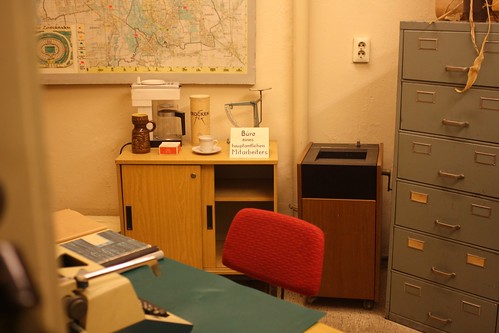
It s not very often that I watch a movie anymore. It s been a few years since I ve actually purchased one (normally I see them from Netflix). But yesterday I saw one that may change that. The Lives of Others is an incredible film set in the former East Germany (GDR/DDR) mostly in 1984. The authenticity of it is incredible and so is the story. It s subtitled, but if you re an American wary of subtitled European films, don t be wary of this one. It is easy to watch and worth every minute. The story revolves around the Stasi, the GDR Ministry for State Security ( secret police ). It is an incredible picture of what living in a police state was like, and how many of the informants were victims of the regime too. My breath caught near the beginning of the film, showing the inside of a Stasi building. A prisoner was being interrogated for helping someone attempt to escape to the west. But the reason my breath caught was this incredible feeling of I was there . Last year, Terah and I were in Leipzig and visited the Stasi museum there, Museum in der Runden Ecke . I always have an incredible sense of history when being in a preserved place, and this building was literally the Stasi headquarters for Leipzig. Much of it was preserved intact, and seeing it in the film brought home even more vividly the terrible things that happened in that building, and others like it, not so very long ago. IMG_2717 We watched the special features on the Blu-Ray disc, and one of them was an interview with director Florian Henckel von Donnersmarck. He described how he spent a lot of time interviewing both victims of the Stasi, as well as ex-Stasi officers. One of the most disturbing things to me was his almost offhand comment that most of the former Stasi officers still had some pride in performing their jobs well. Even now, freed of the state s ideology, they were proud of the work they did which could be put most charitably as ruining people s lives. What leads a person to view life that way? How can we try to make sure it doesn t happen again elsewhere? I am happy to say that most of us have never experienced anything like the Stasi. And yet, small reflections of that mindset can be seen almost everywhere. Societies at wartime or feeling under threat, even Western democracies, can drum up those feelings. In the USA, for instance, the McCarthyism era saw people s careers ruined for alleged anti-state behavior. Contemporary examples include the indefinite detention (I hate that word; shouldn t we say imprisonment ?) of terrorism suspects at Guantanamo Bay, and the terrible treatment of Bradley Manning, who revealed some true but embarrassing things about the US military which really needed to be revealed. Even tobacco farmers and companies are selling a product they know ruins lives, but somehow keep doing it. And there are still members of the public that try to make life difficult for people that don t think like they do. From organizing campaigns of telephone harassment of colleges that don t perform the American national anthem before sporting events, to tossing about the term un-American (a loaded McCarthyist one, which many may not even be aware) at an inflated rate, we are not immune from attempts at forcing conformity or silence in others, and blind loyalty to state. I am never in a particularly celebratory mood on July 4, the biggest day for American boasting, faux patriotism, militarism, and general flag-waving. We do have a lot to be proud of and thankful for, but it seems that we celebrate all the wrong things on July 4, and see it as an occasion to proclaim American exceptionalism rather than as one to see how far we ve come and bolster hope for how far we can, and should, yet go. No, I don t think that the land of the free ought to have operated secret prisons in Europe (nor the Europeans to have been complicit in it), or that the American military was defending our freedom 100% of the time they were deployed, or that it is right for governments to mandate daily recitation of an untrue document (the pledge of allegiance) in schools. And yet, I am mindful that I have a lot to be thankful for stability, lack of much internal violent conflict, etc. And this particular day I am happy that a post like this is not something that gets the attention of some government agency and mostly that I will have a handful of angry emails to delete.

4 July 2011

Joerg Jaspert: DebConf11 - Looks like we will be there

So it finally looks like I will be at DebConf11 too. Including my (then) wife (ohwow, feels weird to write this). At least we just booked the flight tickets. There is a small chance that we still won t make it, but for now it looks good. Lucky beings we seem to be - we found flights going directly to Banja Luka, no need to take train from somewhere like Zagreb or so. (Well, for some values of directly, we have one stop included). We will arrive on Friday the 22nd, afternoon and leave on Sunday the 31st, again afternoon. Since DC6 this is the shortest time I had attending DebConf (DC5 I only did DebConf, not Camp, DC10 I skipped entirely). Somehow feels weird. Update: Well, due to some <censored> we now do have to go via Zagreb and an annoying bus trip. Meh. Should make us arrive on Thursday late night, but still annyoing.

Nathan Handler: Google Summer of Code Report #3

Since my last report, a lot of visible changes have been made. First, if you edit the value of any of the text inputs on the dashboard table, your changes will be saved when you hit the submit button. This feature still needs a bit of work though. For example, I noticed during testing that if you submit the form multiple times, you will sometimes end up with approximately duplicate entries in the changes file (the file that stores user-submitted changes to the table). I also need to implement some checks to ensure that the values submitted are actually valid (i.e. we probably only want to allow a few possible values for the status column). Another big improvement is the addition of a graph at the bottom of each project s page. This graph tracks the number of open tasks versus time. The graph is re-generated once each day based on a progress file. This file simply lists a date and the number of open tasks on each line. While the graph does correctly show a line tracking the progress, it still has some issues to sort out. For example, the x-axis does not properly display a time increment. Work on the graph was blocked for a while due to not having a fully-functioning dashboard. Now that the dashboard is functioning, I should be able to start working on fixing these graph issues. Several people approached me to request the ability to link directly to a particular project. That way, users do not need to mess around with the select boxes. Above each table is a title. If you click on the title, the URL should update to link directly to the project. This is done with the distro and project query parameters. For example, a link to dex.html?distro=ubuntu&project=ancient-patches will take you directly to Ubuntu s ancient-patches project. Attempting to specify an invalid distro or project will cause the query parameters to be ignored. While looking at the table title, you will also notice a new (Graph) link. This link will take you directly to the bottom of the page so you can view the graph. Currently, it is not possible to link directly to the graph anchor tag of a specific project. Attempting to do so will cause the #graph portion of the URL to be ignored. However, if you click on the actual graph, it will load a full-size graph.png that you can link to. One rather significant issue that has shown up is that the table is very wide. On most monitors, you will have to scroll horizontally to view all of the columns. This is due to the fact that most of the cells are made up of text inputs (they don t have a background or border, but if you click on some text in the table, you should see the box) rather than plain text. The size parameter for a text input was meant to specify how many characters should be visible. However, while I have the size parameter set correctly for each input, it is showing up much wider than the text. I will continue to play around with this, since excluding the size parameter results in some values getting cut-off. As mentioned in my last report, I have continued to work with Allison Randal to make the dashboard more useful. I have received feedback directly from her and indirectly from other people working on the python2.7 project. During my last phone call with my mentor, Stefano Zacchiroli, we agreed that it would be very helpful to spend some time documenting how to go about adding a new project to the dashboard and how to utilize all of the dashboard s features. The goal of this is to not require people to go through me or any other individual to be able to use the dashboard. So while the Summer of Code is meant to focus on programming, I will probably spend some time adding some documentation, as a program is rather useless if nobody knows how to use it. Another bug that I will be working on has to do with sorting the table. I had this feature working early on in the project. However, the sorting broke when I starting using text inputs instead of plain text. I have done some research, and I hope to get the sorting re-implemented in the near future. One other feature that has been requested by several people is the ability to hide completed tasks. This has been on my todo list for a while. Matt Zimmerman wanted to take this a step farther. He felt that the status of the task should be separate from the bug. This means that you can have an open task with a closed bug or a closed task with an open bug. The user could then have some more control over what data they are seeing. I will probably attempt to add some check boxes to control whether certain information is displayed. The user will also be able to specify this directly in the URL. This means that a team could link directly to all open tasks in a project. It is also worth noting that thanks to some help from the fantastic Alioth admins, I now have a live instance of the dashboard running on Alioth. While the URL might change in the future, I hope to keep it running on Alioth. If you are interested in helping out with DEX or dextools, my code is available in a git repository on alioth. You can also join the debian-derivatives mailing list, join #debian-derivatives on OFTC, or contact me directly via email or on IRC (nhandler).

Ross Burton: System Defaults in GSettings

Note: Florian in the comments points me at the documentation (albeit rather concise) for this in the API documentation under Vendor Overrides. GSettings, like GConf before it, allows the administrator of a system to override the default settings or lock down keys to particular settings. This is well documented in the GNOME wiki. However GConf didn't really have the concept of vendor patches. Traditionally if a Vendor wanted to change a default (say, the wallpaper) they'd have to patch the GConf schemas directly. Luckily for people who maintain distributions, GSettings provides a way of installing vendor overrides directly. It's not documented as far as I can tell so consider this a first draft at the manual... First, find the setting you want to override, dconf-editor is useful for this. Say you're making a work-orientated custom distribution so you want the shell's popup calendar to show the week number by default. Some digging in dconf-editor leads us to the org.gnome.shell.calendar folder (the "schema") with a boolean key show-weekdate that defaults to false. By changing the default of this to true, all users will have work week shown unless they explicitly set it to false. Now we've found the information we need we can write the override file. Create a new file with the extension .gschema.override, such as mydistro-tweaks.gschema.override. This file is a .ini-style keyfile, logically mapping schemas to groups and key/value pairs to (predicable) key/value pairs. The value needs to be in the GVariant serialisation format, but for things like booleans, numbers and strings these are fairly obvious. So we'd have a file that looks a little something like this:
[org.gnome.shell.calendar]
  show-weekdate=true
Note that you can set multiple keys in multiple schemas in the same override file, so if we also wanted to show the date in the panel we'd have this:
[org.gnome.shell.calendar]
show-weekdate=true
[org.gnome.shell.clock]
show-date=true
Now the file is ready to be installed. Put it in a package, install to $prefix/share/glib-2.0/schemas and finally run glib-compile-schemas $prefix/share/glib-2.0/schemas in the post-install/post-remove hooks. Done! (many thanks to Ryan Lortie for telling me how vendor patches work)

Next.

Previous.