Bernhard R. Link: Alpha testers wanted
If you ever tried to determine what patches other distributions apply to
some package you are interested in,
you might have come to the same conclusion as I:
It is quite an impudence how those are presented.
If you don't give up, you end up with programs or scripts to extract many
propietary source package formats, more VCS systems installed than you think there should exist.
Thats when you start to love the concept that every Debian mirror has next
to each binary package the source in a format that you can extract the changes
easily with only tools you find on every unixoid.
And that's why I love the new (though in my eyes quite misnamed) "3.0 (quilt)"
format, because that makes it even clearer and easier.
Sadly one problem remained: How to generate and store those patches?
While you can just use patches manually or use quilt to handle those
patches and store the result in a vcs of your choice, the newfangled
VCSes (especially git) became quite good at managing,
moving and merging changes around,
so it seems quite a waste to not be able to use this also to handle
those patches easily.
While one can either use git to handle a patchset, by storing it
as a chain of commits and using the interactive rebase, or using git
to store the history of your package, doing both at the same time
is tricky and not resonably doable with git provided porcelain.
Thus I wrote my own tool to faciliate git for both tasks at the same
time. The idea is to have three branches: a branch storing the history
of the your package, a branch storing your patches in a way suitable
to submit them upstream or to create a debian/patches/ directory
from, and an branch with the upstream contents.
I've an implemenation which seems to already work, though I am sure
there is still much to improve and many errors and pitfalls still to find.
Thus if you also like to experiment with handling patches of a debian
package in git, take a look at the manpage or the program at
git://git.debian.org/~brlink/git-dpm.git
(WARNING: as stated above: alpha quality; also places are temporary and are likely to change in the future).
(WARNING: as stated above: alpha quality; also places are temporary and are likely to change in the future).
 With the help of a couple of friends, we ve put a 4.5T RAID-5 machine on our network and I m trying to figure out how to share the storage with the rest of the hosts. In the past, I have used NFS and CIFS/Samba to provide access to remote hosts. This has generally worked okay so long as the server stays online.
I don t know if the results are going to be much different, but I am now trying a different approach. I plan to run an iSCSI server, and I ve already configured AoE (ATA over Ethernet). I ve exported a block device on the network segment and mounted it on a remote host. This was pretty easy to configure. There is a bit of documentation on the internet already, but I ll give another quick overview.
I gave the storage server the unoriginal name san0 . This host is running debian lenny. I am testing the configuration from my debian sid development host, which has the similarly unoriginal name dev0 . So, think server when you see san0 and client when you see dev0 .
I assume that you ve already got an LVM volume group set up. Mine is called vg0 . Correct the following examples to account for any differences. You can use disk partitions instead of LVM logical volumes.

 I ve spent the last week packaging VMware Workstation 7.0.0 at work. Looking around on the net, I ve been unable to find anything helpful about packaging this new version, so it seems nobody s got around to packaging it yet.
I ve asked our customer for its approval for releasing our packaging scripts to the community and got it, so

 I happily release
 Forgetting that the product named Internet Explorer is from a certain Redmond company, and thus has to promote other products and services of the same company, I typed in a search term straight into the address bar in an IE6 window.

 On the train to my parents' house for Christmas I finished up a wild run
through the book
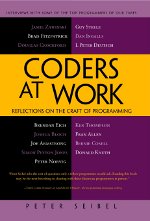 The book is a collection of interviews with 15 great programmers of our time,
starting with Jamie Zawinsky and ending with Donald Knuth. It's written in an
interview style each interview starts with a brief introduction to the
person being interviewed, summarizing what the person is known for and what he
or she has accomplished and a few of the highlights of the interview, and then
a transcript of the interview follows, with the author/editor, Peter Siebel,
will saying something or asking a question, and the interviewee responding. I
was skeptical about this format at first because I feel like it can be an easy
way out of good editing and make the reader have to do the work of the editor,
but on finishing I think that Siebel uses the format to his advantage in this
case.
For one, the speech format allows the reader to really form a picture of how
the person being interviewed speaks and would act in a conversation. Jamie is
somewhat bitter and pretty informal. Brad Fitzpatrick is flippant and
energetic, his speech littered with profanity and colloquialisms. Others seem
more stately and verbose Joe Armstrong's responses can go on for a page or
more. In this way, not only do readers learn something about what these greats
have learned about programming, but we also feel a bit more like we've met or
know them, and can connect to them more as people.
I always have this problem where I want to read computer books, but often
computer books seem inextricably tied to the computer, so there's this dynamic
of reading a bit and then wanting to get on a machine and try something out,
write some code, play around especially with books focused on a specific
language. Coders at Work retains some of this computer-book dynamic in that I
constantly encountered things that I want to investigate or play around with
more: Erlang, OCaml, various papers and essays, Knuth's literate programs, and
books such as Higher Order Perl and others. Siebel makes a point to ask each
person what her short-list of books and papers programmers should read are, so
this book is a great source of pointers to other reading material. Unlike a
more specific book, however, keeping a list in a notebook was enough to settle
the mind to read away-from-a-computer for chapters at a time.
It's obvious that despite the interview format, Siebel has done some serious
editing. None of the prose is boring to read, and I can't imagine that the text
is a straight transcript of how the interviews went. He also has arranged the
interviews in an order such that different interviews play off each other. In
Branden Eich's interview, for example, he disparages the book
Design Patterns:
 Christian
 It seems strange to me. I don't think I know people as aware of internationalization issues as
 Sometimes, the main task at any one time is simply going to take time and cannot be shortened. With my poor network connection, this tends to occur any time I need to do network tasks like multistrap and debootstrap tests, archive updates and the rest. The problem is that my network connection is so bad, most apt type tasks completely saturate all available bandwidth, especially when downloading a single large package like those built from gcc or OOo.

 Today, standing in the middle of a creek with snow still on its banks,
meltwater lapping above my knees, barefoot, in my underwear, and using
a tree trunk for support as I hauled across a big backpack and a sack
full of Mediteranean food (and pants); I wondered for a minute if I
knew what I was doing here.
But I think Anna
