Search Results: "will"

23 July 2011

Mike Hommey: debian-rules-missing-recommended-target, dh, and dumb make

Lintian now has a warning for debian/rules missing build-arch and build-indep targets. As a dh user, I was surprised that some of my dh-using packages had this problem. And when looking at the source, I remembered how I came to this: GNU make is stupid. Considering the following excerpt of the GNU make manual:
.PHONY
The prerequisites of the special target .PHONY are considered to be phony targets. When it is time to consider such a target, make will run its recipe unconditionally, regardless of whether a file with that name exists or what its last-modification time is.
And considering the following debian/rules:
.PHONY: build
%:
        dh $@
What do you think happens when you run debian/rules build in a directory containing a build file or directory?
make: Nothing to be done for build .
However, an explicit rule, like the following, works:
.PHONY: build
build:
        dh $@
It happens that many of the packages I maintain contain a build subdirectory in their source. As such, to work around the aforementioned issue, I just declared the dh rules explicitely, as in:
.PHONY: build binary binary-arch binary-indep (...)
build binary binary-arch binary-indep (...):
        dh $@
And this obviously doesn t scale for new rules such as build-arch and build-indep. To be future-proof, I ll use the following instead:
.PHONY: build
build %:
        dh $@
I don t know why I didn t do that the first time

Wouter Verhelst: IT BUILDS!

Finally. Since the release of squeeze, I've been fighting to get nbd to actually build on "most" architectures. There had been several issues, not the least of which was the fact that it had categorically refused to build on the kFreeBSD ports. I'd tried to debug that several times, but could not understand the issues. So then I set up a VirtualBox image with kFreeBSD to test, and when I finally got it to build there, I did an upload with the changes that I'd applied. Only to find it didn't build on the autobuilders. I briefly considered building it myself and uploading that, but then we have two kFreeBSD ports, so that wouldn't help. And, I guess, it would be severely frowned upon. Eventually I found the final issue: the test suite has recently acquired a set of "integrity" tests, that replay a recorded session and verify that the responses from the server are correct. This implementation in nbd-tester-client, however, has non-blocking writes to the server, and the server also does non-blocking writes. The "integrityhuge" test tries to write rather large blocks in one go; so basically, what happened not only on kfreebsd-* but also on some Linux architectures, like s390 and ia64, was that the buffers of both the server and the tester client were full, and they would deadlock when both wait for the other to read before they could continue writing. This is a bug, yes, but one that has existed for a very long time, and one which is unlikely to hit in actual usage the integrityhuge test fires off a multitude of very large reads and writes, without waiting; a situation that is highly unlikely to occur in real usage. So for now, I will disable the integrityhuge test, until such a time when I can implement async writes a feature that has been on my TODO list for a significant amount of time.

22 July 2011

Stefano Zacchiroli: 16 months of debian sprints

average sprint speed: 1 sprint/month I've proposed a DebConf11 BoF on Debian sprints and, more generally, on how we have been using Debian money in the past 1.3 years. As part of the BoF preparation, I've taken the time to review the last 16 months of sprints and check how the Debian Sprint Program which we've recently streamlined and "marketed" quite a bit is going. In particular, I've finally done the homework of preparing the big table of sprints and their costs, in order to evaluate how sustainable the sprint program is. Without further ado, here is the table:
Debian sprints held from April 2010 to June 2011
No Sprint When (month) Where Attendees Debian cost (EUR)
1 groupware (report) 04/2010 de 4 240
2 FAI (report) 06/2010 de 7 570
(DebConf10) 08/2010 us
3 ftpmaster (report) 09/2010 de 3 350
4 DSA (report) 09/2010 de 3 400
5 release team (report) 10/2010 fr 6 0
6 kernel team (report) 10/2010 fr 3 120
7 www team 12/2010 at 5 1430
8 debian med 01/2011 de 25 460
9 security team 01/2011 de 7 1000
10 emdebian 02/2011 uk 17 0
11 ftpmaster 03/2011 de 5 2000
12 groupware 04/2011 de 6 300
13 alioth 05/2011 uk 4 500
14 debian edu 06/2011 de 9 760
15 release team 06/2011 be 5 1640
(DebConf11) 07/2010 ba
Total 15 sprints 16 months 9770
To better understand the table, several comments are in order: Please note that the purpose of the table is not to be precise and transparent about Debian finances and how we use them. That is a (very!) worthwhile goal and I do think Debian should do much better in informing its community about how donated money are used to further Debian goals. But that is a broader topic on which the auditors are working; it is not up to me to discuss it here. If you are interested in that topic though, you might want to follow tbm's BoF at DebConf11. The purpose of the table is rather to find out some general figures about Debian sprints held in the recent past: I'm personally quite happy about those figures. Enabling volunteer developers to meet and hack together in person is possibly the most valuable way of using donated money. Having 1 sprint/month is not bad, but in a project the size of Debian is quite possibly a minimum. Doing more than that is highly desirable. It is also financially sustainable, especially if we will be able to show by actually having more sprints and being transparent about them that we can put into good use donated money. Another, more subtle, aspect of sustainability is that related to sprint management. Processing sprint requests and ensuring that transparency guidelines are actually followed by the organizers is still quite some work. I've been mostly doing that myself up to now, which is all fine and well, but does not necessarily scale. Other organizations (such as KDE e.V.) have realized that to the point of having hired people specifically to manage sprints in an otherwise volunteer community. In Debian we are quite keen of maintaining the project running on a volunteer basis. At the same time I feel we should have more room for scalability in the number of sprints we could run. So if you are looking for a management task to help Debian with, think about becoming, err, "sprint master", and contact me. If otherwise you want to focus on Debian hacking, what are you waiting for? Check the guidelines and propose your sprint! To know more about sprints, Debian money, and how you could help with all that, be sure not to miss the Sprint and money BoF.

Cosimo Alfarano: D-Bus eavesdroppers and unicast signals

There was an interesting issue in D-Bus, related to unicast vs broadcast signals, which led [edit: typo] to a small change in specs and which might be of some interest for D-Bus developers.

Unicast signals are not widely known and probably even less used, but they are possible.
They are useful, for instance, when you need to trigger an action from a single client, among your listeners.

Until some days ago, when a unicast signal was emitted, it was actually received by everyone listening to the signal's interface (unless a strict rule was added, unusual), waking up a number of processes which actually weren't interested in the signal.
Collateral effect, waking up cost apart: those processes might actually consider the signal as they were the actual recipient and take some action upon it. Bad.

Typical rule having this problem is "sender="org.foo,interface=org.bar".
Imagine several clients using this rule to listen to org.foo, but org.foo wanting to send a signal to :1.23 only.
Specifying destination=:1.23 for the signal object didn't really work since no dest=val was specified in the rule, allowing any destination actually matching it and all the listeners to be woken up anyway.

The problem with this situation was fixing the bad behaviour without filter out eavesdroppers, which actually wanted to receive the message even if not for them.

The solution is a sort of "eavesdrop opt-in", as Thiago proposed to add a keyword to DBusMatchRule, "eavesdrop=true false" which defaults to false and with which the listener declares that it really wants to eavesdrop, enabling it to receive messages (including signals) not meant for it (AKA eavesdropping).
Otherwise any message (again, including signals) with a specified destination won't match a filter with no or different destination. Also a rule with a specific destination won't match broadcast messages.


In other words, by default a match rule filter will match only broadcast messages or the ones specifically for you, unless you declare your very nature of eavesdropper by adding "eavesdrop=true" to your filter rule.

This is a behavioural change and consequently means a small amend to the D-Bus spec for 1.5.x.

It also means that if you maintain some code which acts as an eavesdropper, you should fix the code adding "eavesdrop=true" to your filter.
Note that it's only for 1.5.x branch; adding the "eavesdrop" keyword to a filter sent to a 1.4.x bus will fail as the keyword is not recognized.
An example on how to deal with this change keeping compatibility toward 1.4.x (stable branch) and 1.5.x (devel branch) at the same time is shown by this bustle fix. It checks for the feature presence and prepends the keyword if supported.

Russell Coker: /run and SE Linux Policy

Currently Debian/Unstable is going through a transition to using /run instead of /var/run. Naturally any significant change to the filesystem layout requires matching changes to SE Linux policy. We currently have Debian bug #626720 open about this. Currently the initscripts package breaks selinux-policy-default in Debian/Unstable so that you can t have initscripts using /run if the SE Linux policy doesn t support it. A patch has been suggested to the policy which uses a subst file, basically that causes the SE Linux labeling programs to treat one directory tree the same way as another. The problem with this is that it depends on a libselinux patch that is not in any yet released version of libselinux (and certainly won t be in a Squeeze update). The upside of such a fix is that it would work for policy that I package as well as custom policy, so if someone wrote custom policy referring to /var/run it would automatically work with /run without any extra effort. I think that the only way to do this is to just have regular expressions that deal with this in the file contexts. It s a bit ugly and slows the relabel process down a little (probably no more than about 10%) but it will work and work on Squeeze as well. One thing I really like to do is to have the SE Linux policy for version X of Debian work with version X+1. This makes upgrades a lot easier for the users. Ideally upgrading a server could be a process that involves separate upgrades of the kernel, the SE Linux policy, and user-space in any particular order because upgrading everything at once almost guarantees that something will break and it may be difficult to determine the cause. At this time I m not sure whether I ll add a new policy using the subs file before the release of Wheezy (the next stable release of Debian) or just keep using regular expressions. I can have the Wheezy policy depend on a new enough libselinux so it won t be a problem in that regard (a new upstream version of libselinux with the subst feature should be released soon). In any case I need a back-port to Squeeze to use regular expressions to make an upgrade to Wheezy easier. for n in $(find . -name "*.fc" xargs grep var/run cut -f1 -d: uniq) ; do
sed -e "s/\/var\/run/\/(var\/)?run/" < $n > $n.new
mv $n.new $n
done
for n in $(find . -name "*.fc" xargs grep var/lock cut -f1 -d: uniq) ; do
sed -e "s/\/var\/lock/\/((var\/run) (run) (var))\/lock/" < $n > $n.new
mv $n.new $n
done
for n in $(find . -name "*.fc" xargs grep dev/shm cut -f1 -d: uniq) ; do
sed -e "s/\/dev\/shm/\/((var\/run) (run) (dev))\/shm/" < $n > $n.new
mv $n.new $n
done I used the above fragment of shell code to change /var/run to /(var/)?run , /var/lock to /((var/run) (run) (var))/lock , and change /dev/shm to /(var/run) (run) (dev))/shm . It involves a reasonable number of changes to policy (mostly for /var/run), but hopefully this will be acceptable to the release team for inclusion in the next Squeeze update as the changes are relatively simple and obvious and the size of the patch is due to it being generated code. There is one final complication, Squeeze currently has selinux-policy-default version 2:0.2.20100524-7+squeeze1, but initscripts in Unstable breaks versions <= 2:0.2.20100524-9. So I guess I could submit a proposed version 2:0.2.20100524-9+squeeze1 to the release team to fix this. I would really like to have the Squeeze policy work with initscripts from Unstable or Wheezy. Any suggestions for how to deal with this? Update: I wrote the above before testing the code, and it turned out to not work. I ve written another post describing a better solution that I have now uploaded to Unstable. I still have to sort something out with an update for Squeeze.

21 July 2011

Stefano Zacchiroli: Test Driven Development in Debian

... or TDDD and DEP8 context As a nice byproduct of the huge "rolling" discussion we had back in April/May, various people have brainstormed about applying Test-Driven Development (TDD) techniques to Debian development. Here is a brief summary of some opinions on the matter: ... and hey, they've also coined the cool TDDD acronym, which I hereby took the freedom to re-target to Test-Driven Development in Debian. Having a cool acronym, we are already half-way to actually having the process up and running *g*. more testing I believe Debian needs more testing and I've been advocating for that since quite a while e.g. at DebConf10, as one of the main goals we should pursue in the near future. Of course advocating alone is not enough in Debian to make things happen and that is probably why this goal has been (thus far) less successful that others we have put forward, such as welcoming non-packaging contributors as Debian Project members. There are important reasons for increasing testing in Debian. quality assurance Quality Assurance has always been, and still is, one of the distinctive traits of Debian. I often say that Debian has a widespread culture of technical excellence and that is visible in several places: the Debian Policy process, lintian, piuparts, periodic full archive rebuilds, the EDOS/Mancoosi QA tools, the cultural fact that maintainers tend to know a lot about the software they're packaging rather than only about packaging, the we release when it's ready mantra, etc. But caring about quality is not a boolean, it's rather something that should be continuously cherished, refining quality requirements over time. By simply maintaining the status quo in its QA tools and processes, Debian won't remain for long a distribution who could claim to care about package quality. Others will catch up and are in fact already doing that. In particular, we surely have room for improvements in our quality tools and processes for: reducing inertia Inertia is a recurring topic among Debian lovers (and haters). It is often argued how difficult it is to make changes in Debian, both small and large, due to several (alleged) hindrances such as the size of the archive, the number of ports, the number of maintainers that should agree before proceeding with a cross-package change, etc. It's undeniable that the more code/ports/diversity you have, the more difficult is to apply "global" changes. But at least for what concerns the archive size, I believe that for the most part it's just FUD: simply debunking the self-inflicted culture about how "dangerous" doing NMUs is might go and has already gone, imho a long way to fight inertia. Adding per-package and integration tests will make us go another long way in reducing inertia when it comes to performing archive-wide changes. Indeed if a package you are not entirely familiar with has extensive test suites, and if they still pass after your changes, you can be more confident in your changes. The barrier to contribution, possibly via NMU, gets reduced as a result. And if your change will turn out to be bad but still not spot by the test suites, then you can NMU (or otherwise contribute) again to extend the test suite and make the life easier for future contributors to that package. It smells a lot like an useful virtuous cycle to me. autopkgtest / DEP8 how you can help Of all the above, the topic that intrigues me the most is as-installed package testing. Work on that front has been started a few years ago by Ian Jackson when he was working for Canonical. The status quo is embodied by the autopkgtest package. At present, the package contains of various tools and the following two specs:
  1. README.package-tests provides a standard format to declare per-package tests using the new debian/tests/control file. Tests come as executable files which will be run by the adt-run tool in a testbed where the package(s) to be tested is already installed. This part of the specs has been reified as DEP8 which I'm (supposedly) co-driving with Iustin Pop and Ian (for well-deserved credits).
  2. README.virtualisation-sever describes the interface among the test runner and the testbed. A nice separation is provided among the runner and the testbed, enabling different testbed environments with a varying degree of isolation: you can have a "null" testbed which runs tests on your real machines (needless to say, this is highly discouraged, but is provided by the adt-virt-null tool), a chroot testbed (adt-chroot), or a XEN/LVM based testbed (adt-virt-xenlvm).
The specs allow for several runtime testing scenarios and look quite flexible. The tools on the other hand suffer a bit of bitrot, which is unsurprisingly given they haven't been used much for several years. At the very minimum the following Python development tasks are in need of some love: If you are both interested in TDDD and grok Python, the above and many others tasks might whet your appetite. If this is the case don't hesitate to contact me, I'll be happy to provide some guidance.
Note: this post is the basis for the TDDD BoF that I will co-host with Tom Marble at DebConf11. If you plan to come, we will appreciate your thoughts on this matter as well as your help in getting the autopkgtest toolchain up and running again.

Joachim Breitner: Copying HTML from gnome-terminal

One of the first things that I worked on here at DebConf11 is supporting the HTML target in gnome-terminal. This means that if you copy a part of the screen and paste it into some application that handles HTML (such as evolution or my blog s edit field), attributes such as color and boldness are preserved. Here are some examples: A man page
MAN(1)                           Manual pager utils                           MAN(1)
NAME
       man - an interface to the on-line reference manuals
SYNOPSIS
       man [-C file] [-d] [-D] [--warnings[=warnings]] [-R encoding] [-L locale] [-m
       system[,...]] [-M path] [-S list] [-e extension] [-i -I] [--regex --wildcard]
       [--names-only]  [-a]  [-u]  [--no-subpages]  [-P  pager] [-r prompt] [-7] [-E
       encoding]   [--no-hyphenation]   [--no-justification]   [-p   string]    [-t]
       [-T[device]] [-H[browser]] [-X[dpi]] [-Z] [[section] page ...] ...
       man -k [apropos options] regexp ...
       man -K [-w -W] [-S list] [-i -I] [--regex] [section] term ...
       man -f [whatis options] page ...
       man  -l [-C file] [-d] [-D] [--warnings[=warnings]] [-R encoding] [-L locale]
       [-P pager] [-r prompt] [-7]  [-E  encoding]  [-p  string]  [-t]  [-T[device]]
       [-H[browser]] [-X[dpi]] [-Z] file ...
       man -w -W [-C file] [-d] [-D] page ...
       man -c [-C file] [-d] [-D] page ...
       man [-hV]
DESCRIPTION
       man is the system's manual pager. Each page argument given to man is normally
       the name of a program, utility or function.  The manual page associated  with
       each  of these arguments is then found and displayed. A section, if provided,
 Manual page man(1) line 1 (press h for help or q to quit)
A coloured diff from git
commit 55c514ae6a714abcfa818c33f00a2c051412c3d9
Author: Joachim Breitner <mail@joachim-breitner.de>
Date:   Thu Jul 21 12:08:56 2011 +0200
    Refactor vte_terminal_determine_colors_internal
    
    to work on VteCellAttr instead of VteCell, and use it in
    vte_terminal_cellattr_to_html.
diff --git a/src/vte.c b/src/vte.c
index 8bcc95d..7d4a6f1 100644
--- a/src/vte.c
+++ b/src/vte.c
@@ -6532,19 +6532,18 @@ swap (guint *a, guint *b)
 
 static void
 vte_terminal_determine_colors_internal(VteTerminal *terminal,
-                                      const VteCell *cell,
+                                      const VteCellAttr *attr,
                                       gboolean selected,
                                       gboolean cursor,
                                       guint *pfore, guint *pback)
  
        guint fore, back;
Midnight commander
  Links     Datei     Befehl     Optionen     Rechts
 <  ~/build/gnome-terminal/vte  .[^]> <  ~/build/gnome-terminal/vte  .[^]> 
 'n        Name            Gr e  Modifikations 'n         Name            Gr e  Modifikations 
 /..                      BERVZ. 20. Jul 18:23 /..                       BERVZ. 20. Jul 18:23 
 /.git                       4096 22. Jul 12:42 /.git                        4096 22. Jul 12:42 
 /autom4te.cache             4096 22. Jul 11:20 /autom4te.cache              4096 22. Jul 11:20 
 /doc                        4096 22. Jul 11:20 /doc                         4096 22. Jul 11:20 
 /glade                      4096 22. Jul 11:20 /glade                       4096 22. Jul 11:20 
 /gnome-pty-helper           4096 22. Jul 09:47 /gnome-pty-helper            4096 22. Jul 09:47 
 /perf                       4096 22. Jul 11:20 /perf                        4096 22. Jul 11:20 
 /po                         4096 22. Jul 11:20 /po                          4096 22. Jul 11:20 
 /src                       12288 22. Jul 12:41 /src                        12288 22. Jul 12:41 
 /termcaps                   4096 22. Jul 11:20 /termcaps                    4096 22. Jul 11:20 
  .gitignore                  935 22. Jul 11:20  .gitignore                   935 22. Jul 11:20 
  AUTHORS                      41 20. Jul 18:25  AUTHORS                       41 20. Jul 18:25 
  COPYING                   35068 22. Jul 11:11  COPYING                    35068 22. Jul 11:11 
  ChangeLog.pre-git        433051 20. Jul 18:25  ChangeLog.pre-git         433051 20. Jul 18:25 
  HACKING                     905 20. Jul 18:25  HACKING                      905 20. Jul 18:25 
  MAINTAINERS                 118 20. Jul 18:25  MAINTAINERS                  118 20. Jul 18:25 
  Makefile                  30512 22. Jul 11:20  Makefile                   30512 22. Jul 11:20 
  Makefile.am                1247 22. Jul 11:11  Makefile.am                 1247 22. Jul 11:11 
  Makefile.in               28812 22. Jul 11:20  Makefile.in                28812 22. Jul 11:20 
  NEWS                      43910 20. Jul 18:25  NEWS                       43910 20. Jul 18:25 
  README                      496 20. Jul 18:25  README                       496 20. Jul 18:25 
  aclocal.m4               377874 22. Jul 11:20  aclocal.m4                377874 22. Jul 11:20 
 *autogen.sh                  610 20. Jul 18:25 *autogen.sh                   610 20. Jul 18:25 
 
 BERVZ.                                        BERVZ.                                         
  10G/104G (9%)   10G/104G (9%)  
Hint: To look at the output of a command in the viewer, use M-!
~/build/gnome-terminal/vte $
 1Hilfe   2Men     3Ansicht  4Bear~ten 5Kopieren 6Ver~ben 7Mkdir    8L schen  9Men s   10Beenden
These changes are discussed in GNOME Bugzilla bug #365121 and can be downloaded in my git repository. Unfortunately, I later found out that I was not basing my work on the current development version, which has changed considerably, so we will see how and when my changes will actually make it into GNOME. Also note that my blog s HTML editor actually modifies the HTML code, so looking at the source of this page does not give you the code that I generate. Update: I ported my changes onto the vte-next branch, so they could be merged now. Please follow the bug report if you want to know more.

Flattr this post

Julien Blache: Now, say

just how many Space Shuttle Programs can you fund with the insane amounts of money Europe is about to spend to pull Greece out of the hole they ve dug for themselves? Same for the countries that will undoubtedly follow the same path in the coming weeks. Yeah, fuck that. Point is: there are so many better ways to spend that money (that we don t have anyway).

Rapha&#235;l Hertzog: People behind Debian: Martin Michlmayr, former Debian Project Leader

Martin Michlmayr is a Debian developer since 2000 and I share quite a few things with him, starting with his age and involvement in the quality assurance team. He managed to be elected Debian Project Leader in 2003 and 2004. He s no longer as active as he used to be but his input is always very valuable and he continues to do very interesting things in particular concerning the support of NAS devices. Read on for the details. Raphael: Who are you? Martin: I m Martin Michlmayr. I m 32, originally from Austria, and currently living in the UK. I ve contributed to various free software projects over the years but Debian is without doubt the one I m most passionate about. I joined Debian in 2000 when I was a student. I worked on Debian more or less full time for a few years while I was pretending to study. Later I started a PhD to do research about quality and management aspects of volunteer free software projects. I investigated the release process in several free software projects, in particular looking at time-based releases. After finishing my PhD in 2007, I joined Hewlett-Packard. I m part of HP s Open Source Program Office and work on various free software and open source activities, both internally and within the community. Raphael: How did you start contributing to Debian? Martin: I first used Debian in the days of 0.93R6, some time around the end of 1995. The 0.93R6 release was still based on a.out but I needed an ELF-based system for some application, so I moved to Slackware. I then quickly moved to Red Hat Linux where I stayed for several years. I rediscovered Debian in 2000 and quickly decided to join the project. I cannot recall how I rediscovered Debian but when I did, it was clear to me that Debian was the ideal project for me: I could identify with its philosophy, I liked the volunteer nature of the project, and I found the size and diversity of Debian interesting since a large project offers a lot of different challenges and opportunities. I remember how many new things there were to learn and back then the documentation and other resources for new contributors were nowhere as good as they are today. My application manager, Julian Gilbey, was a great help he was incredibly friendly and passionate about Debian. I also remember meeting up with Peter Palfrader (weasel) for key signing when we were both in the New Maintainer queue. I was incredibly lucky with my New Maintainer process and soon became an official Debian Developer. Because there was a shortage of application managers, my first major contribution in Debian was to become an application manager myself and help other people join the project. Debian is a large project with a long history and a rich culture, so new contributors should expect that it will take some time to become familiar with everything. Fortunately, there are many resources, such as documentation and the debian-mentors list, for new contributors. Another great way to become familiar with the way things are done in Debian is to subscribe to various Debian mailing lists and ideally to read some mailing list archives. It s also a great idea to attend the Debian Conference or other conferences since meeting people in real life is a great way to integrate. I remember attending Debian Conference 1 in Bordeaux where I gave my first public talk. Finally, new contributors should find an area where they can make a unique contribution. Most people in Debian maintain packages but there are so many other ways to contribute. For example, most of my contributions were not technical but were about coordination and other organizational activities. Raphael: What s your biggest achievement within Debian? Martin: I m particularly proud of a number of achievements: Raphael: Speaking about NAS devices: what exactly are you doing on this topic and how can people help? Martin: There are plenty of instructions on the Internet to install Linux distributions on NAS or various embedded devices by connecting a serial console and then typing in hundreds of commands. What I found is that such instructions significantly limit the user base because they are way too complicated for most users. There are just too many steps that can go wrong. So instead, in Debian, we provide a solution that just works: usually, you download a firmware image for your NAS device from Debian and when you upgrade you get the Debian installer. You connect to the installer via SSH and perform a normal installation. The installer knows about the device and will prepare everything for you automatically for example, it knows if the device has requirements for the partition layout and it will install the kernel where the device expects to find it; unfortunately, NAS devices are not like PCs, so the requirements are different for almost every device and therefore you need special code to support a new device. Finally, there are detailed installation guides and we provide help on our mailing lists. There are a number of technical areas for improvement. The installation could be made even easier, and it would be nice to support new platforms and devices. A bigger problem is that while we ve implemented a great solution for NAS devices, we haven t really extended this work to support other classes of devices. For example, tablets and mobile phones are getting incredibly popular and we don t have a compelling solution for such devices, mostly because of the lack of an appropriate GUI. Raphael: What are your plans for Debian Wheezy? Martin: I ve recently been asked by Stefano Zacchiroli, our current Debian Project Leader, to coordinate the care-taking of Debian finances. Debian, as a volunteer project, relies on donations and in-kind gifts (e.g. hardware) to maintain its infrastructure and to support various development efforts, such as funding sprints and other developer gatherings. Debian s money and other assets are held by affiliate organizations around the world. My responsibility will be to keep track of money and other assets (e.g. hardware and trademarks), work with the DPL to establish procedures related to the use of Debian s assets, and make sure that the procedures are followed. Finally, we want to publish public statements so our donors know how we use their donations to further improve Debian. I just started working on this and this will be my main activity in Debian in the coming months. Raphael: Speaking of money, I plan to run a fundraising to get the Debian book I wrote with Roland Mas translated (cf. http://debian-handbook.info). Is this something Debian should support? Martin: First of all, I should make it clear that I don t decide how Debian spends its money. This is up to the DPL to decide together with the project at a whole. I ll just make sure that procedures are followed and expenses tracked and reported properly. Having said that, in my opinion, it s unlikely that Debian as a project will fund this effort. It would be inconsistent with the position of the project not to fund work directly (only some related expenses, such as travel costs to allow Debian teams to organize face-to-face meetings). Whether Debian should support the fundraising effort by helping to promote it is another question and that s probably not as clear cut. It looks like a worthwhile effort, but on the other hand it would be unfair for authors of other Debian books for Debian to put its weight behind one and there are many other efforts that are worth promoting if you promote one, where do you stop? So while it sounds worthwhile, it s probably better for Debian to stay out of it. But somehow related to this, I sometimes worry about the fact that there are so few paid opportunities around Debian. If you contribute to the Linux kernel for a while, you have an excellent chance to get hired by someone and to work on the kernel full time. The kernel may be an extreme example but there are a lot of projects that have more paid opportunities than Debian, e.g. Mono, GNOME, OpenOffice/LibreOffice and KDE. Obviously, there are some Debian Developers who can spend some time on Debian as part of their job. I know that some Canonical employees contribute to Debian, that support companies like credativ improve Debian as part of their work, and that system administrators fix bugs or package new software as they deploy Debian. But I think this is a minority of contributors and even they don t work full time on Debian. Instead what I see is that a lot of people leave university, get a job and then no longer have time for Debian or people start a family and no longer have time. I can take myself as an example since I don t have nearly as much time as I did in the past when I was a student. I guess there are different ways to deal with this problem one would be to create more paid opportunities around Debian outside the project, another one might be to make it easier for new volunteers to join the project. I don t have the answers to these questions but it s something I wonder about, and I also wonder whether pure volunteer projects can still keep up with projects with a lot of full time contributors. Raphael: What motivates you to continue to contribute year after year? Martin: Debian is a great project with a great mission, goals and people. I contribute to make Debian a better solution and to promote the free software philosophy. Finally, the community around Debian provides a lot of motivation. It s amazing how much I ve learned about other cultures because of my involvement in Debian and how many friends I ve made over the years all around the world. Raphael: Do you have wishes for Debian Wheezy? Martin: Not really. I m pretty happy with the way things are going at the moment. We have made a lot of organizational changes in the last few years from which the project has greatly benefited. I m particularly pleased about the plans to adopt a time-based freeze. Raphael: Is there someone in Debian that you admire for their contributions? Martin: There are many people I admire greatly. I d like to mention Joey Hess because he s a great example to follow. He doesn t get involved in politics, is easy to work with and does great technical work. In fact, he has made not one but several contributions that have completely changed Debian (debconf, debhelper, and debian-installer). Furthermore, Debian has a lot of contributors who have done great work over the years but who are not very vocal about it. People like Colin Watson or Peter Palfrader. Debian has many unique contributors and the list of people I admire is much longer than the few people I just mentioned.
Thank you to Martin for the time spent answering my questions. I hope you enjoyed reading his answers as I did. He raised some interesting questions. Subscribe to my newsletter to get my monthly summary of the Debian/Ubuntu news and to not miss further interviews. You can also follow along on Identi.ca, Twitter and Facebook.

No comment Liked this article? Click here. My blog is Flattr-enabled.

20 July 2011

Andrew Pollock: [life/americania] 4th of July in the Grand Canyon

Our adventurous friends Eric and Katie had invited us to join them on a hike in the Grand Canyon over the 4th of July weekend. As this struck us as something we'd never have considered doing otherwise, we thought we'd accept their kind offer. We're so glad we did. It was quite a bit of traveling just to get there. We flew out of San Jose on Thursday night, got into Las Vegas, rented a car, and then drove to Peach Springs, Arizona, where we stayed the night. We didn't get in at the Grand Canyon Caverns Inn until around midnight, and we had to get up again for a 5:00am departure (I think we actually got away by more like 5:30am), to drive to the Hualapai Hilltop, where the trail head was. Zoe handled all of this very well. She didn't end up falling asleep in the car until about 10:30pm I think, and dealt with the transfer out of the car at midnight very well and went back to sleep. The drive to the Hualapai Hilltop, along Indian Road 18, took about an hour. We had to dodge a bit of livestock on the road. The road itself was sealed and of good quality. We remarked on the way back out that as soon as you left the Havasupai Reservation and entered the Hualapai Reservation that there was a distinct degradation in the quality of the road. We parked at the Hilltop, and got ourselves organised, and commenced our descent by about 7:10am. The first 1.5 miles was very steep. There were a bunch of switchbacks and there was a fair few people coming up the other way already. There were also a few mule trains coming in the opposite direction that we had to dodge. The mule trains have right of way, so we had to stop and get out of the way to let them pass. Zoe thought they were pretty cool because they invariably had a few dogs with them as well, and she thinks dogs are awesome. The remaining 6.5 miles (it was an 8 mile/13 kilometre hike in total) were fairly easy. There was a lot of variety in terrain. Rocks, sand, dirt. It wasn't all in the sun, which was made it more comfortable. Heat wise, I think it was in the high 30's Celsius, with pretty much no humidity, so it didn't feel too uncomfortable. Towards the end, as we got near the water, there was a distinct change in the canyon. There was more greenery, and we started hearing insects and seeing bird life. When we first saw the water, it was hard not to just jump in, it looked so inviting. The total hiking time was about 4 hours 45 minutes, which included a reasonable stop to give Zoe some breakfast. We arrived in the village at around midday. Unfortunately the lodge wasn't ready for check ins until 1pm, so we had to twiddle our thumbs for a little bit. Zoe handled the hike incredibly well. We used a Macpac Possum child carrier that Nigel had passed down to us, and she didn't complain the whole time. She even took a nap in it. We were very relieved that it wasn't a problem for her. Sarah carried her, and I carried everything else. (I'm so glad I didn't see the photo of how I looked until well afterwards). In hindsight we probably brought too much stuff, but we didn't really know what to expect down there, so we'd rather have too much than too little. The village completely exceeded my expectations. I had this (silly) mental picture of it being just the lodge and not much else, but somewhere between 450 and 700 people live in the village. It had two general-type stores, a cafe that was pretty much like a fast food/takeaway place, an elementary school, and some sort of basic medical clinic. There was also a small general purpose community centre of some sort. The main store had pretty much everything you'd need in the food department. The cafe frequently ran out of various different things, but you weren't going to go hungry. For the remainder of Friday, we just stayed put in the village and let Zoe stretch her legs. Eric and Katie and their kids explored the first set of falls down from the village, unofficially named Rock Falls. On Saturday, we all hiked down to Havasu Falls. We met a couple of other families (amusingly both from the Bay Area) along the way, so we had some interesting conversations. I have no idea how long the hike was. Havasu Falls was impressive. Quite tall and narrow at the top, and quite loud. Zoe was impressed. We took her for a bit of a swim in the pools in the bottom. We had lunch there, and then Zoe and Sarah stayed there (Zoe took a nap in the KinderKot (also courtesy of Nigel) in the shade by the falls, and I took the Macpac with a water bladder in it to refill it at the spring in the campground, which was further down stream, and to check out Mooney Falls with Eric and Katie (and their kids), which was further downstream again from the campground. Mooney Falls was pretty insane. A lot taller than Havasu Falls, and a lot more treacherous to get to the bottom of. Parts of it were vertical. Chains and rickety ladders were involved. Caves were involved. I'm so glad I didn't have Zoe in the Macpac, because on multiple occasions, the top of it got bashed into rocks, so without having Sarah with me also to act as a guide, there's no way I could have safely descended with Zoe in the backpack. My favourite photo illustrating how crazy this was is this one that I took of Eric and Katie. This photo highlights some of the craziness involved to get down. I pretty much got to the bottom, had a quick look around and left Eric and Katie to it, because I figured Zoe would have woken up by now, and was probably bored. Turned out I had all of the sunscreen with me as well. So I climbed back up, and trekked back to the campground, refilled at the spring, and headed back up to Havasu Falls. After we reunited, we then hiked back up to the village, which to be honest, was the hardest bit of hiking we did. I was carrying Zoe in the Macpac, and it was hot, and it was mostly loose sand all the way. We were very glad to get back to the village. Zoe started showing signs of coming down with a cold and a cough, so we decided to cut short our stay in the village and leave on Sunday instead of Monday. We'd been tossing up between getting a helicopter or horses out. We ended up opting for the helicopter after learning that the horses still took about 3.5 hours, and you basically had no control over the animal. We were dubious as to how Zoe would go being bounced around on the back of a horse for that long. The helicopter ride also took all of about 5 minutes. The tribal members get first dibs on the helicopter, and there had been a death in the village, and I think a lot of people had come to the village for the viewing (the casket itself was flown out earlier on Sunday morning for a burial out of the village), so I suspect there was a higher number of tribal passengers than usual. We didn't get out until 2pm. Again, Zoe was incredibly good. She just hung out with us while we waiting for a flight out. There were plenty of dogs for her to be entertained by, and some other kids. She also took a pretty decent nap. So we finally got out, and got back to our car, and then the heavens opened. It absolutely poured down with rain. Sarah was keen to check out Hoover Dam, so we decided to stay near Boulder City in Nevada, and got a suite in the Hacienda Hotel and Casino for cheap. The next day was the Monday public holiday for Independence Day, and we were tossing up whether or not to take Zoe to a doctor to get her checked to see if she had bronchitis (we've been a bit gun-shy about bronchitis since the time she came down with it when we were in Australia). She ended up falling asleep in the car while we were hunting around for an Urgent Care facility that was open, so we decided to let her sleep and drove to Las Vegas. After she woke up, we took her to see the flamingos at Flamingo and the lions at MGM Grand. Zoe absolutely loved all the lights, sights and sounds of Las Vegas. In the afternoon, we took her to a doctor, and got the "first child, huh?" from the doctor (she didn't have bronchitis). After that, we went and briefly checked out Hoover Dam (just walked half way across the bridge in front of it and walked across the dam itself). The following day, we packed up and spent the morning on the Las Vegas strip again. This time we went to the Venetian (Zoe thought the gondolas were pretty cool) and then we flew out in the afternoon. So it was a lovely little family vacation. We ended up spending about as much time in Las Vegas as we did in the Grand Canyon, but that was okay. I'd really like to go back to Supai again, but I'm not sure if the stars will align themselves appropriately. If we did, knowing what I know now, I'd take a lot less food and put all of the luggage on a horse, and just hike in with the minimum of stuff. I'd probably be game to hike out as well if the bulk of the luggage was on a horse. Photos from the trip are here.

Aigars Mahinovs: Debconf11 the arrival and Debcamp

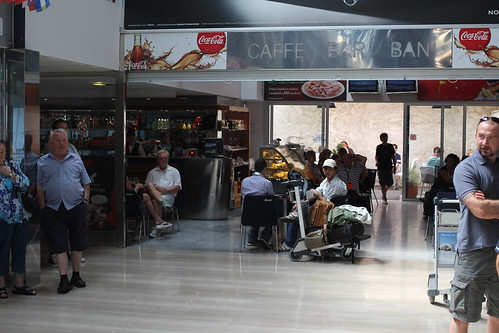
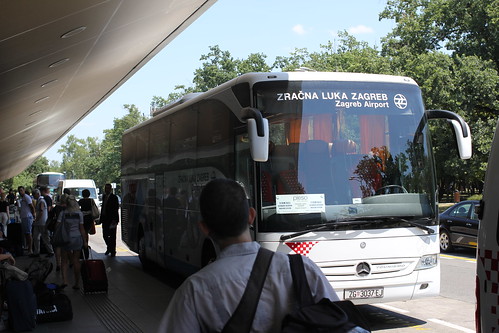
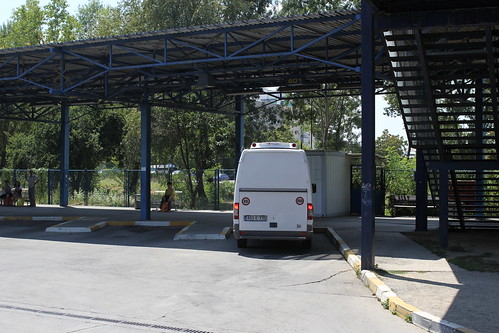
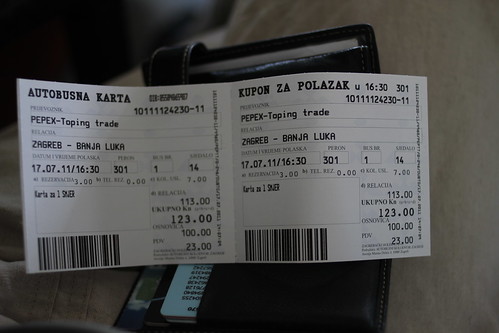
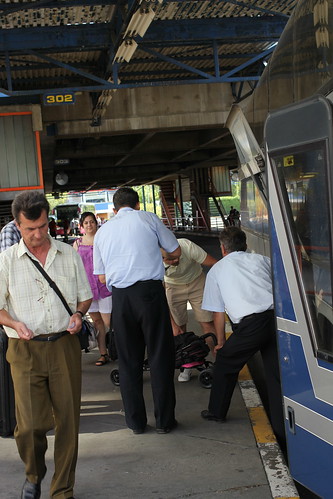
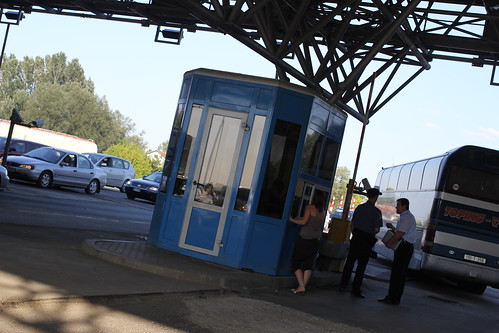
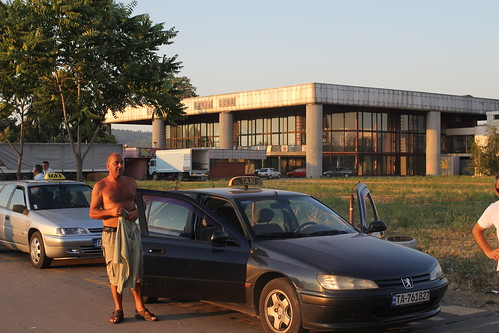
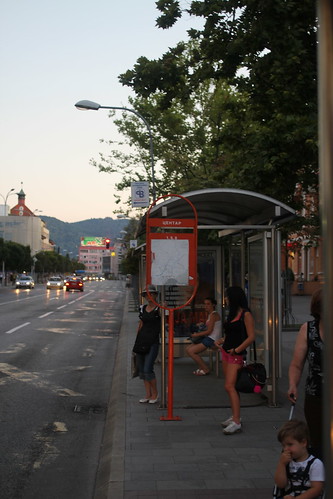
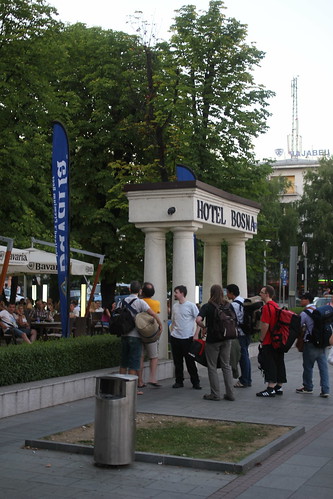
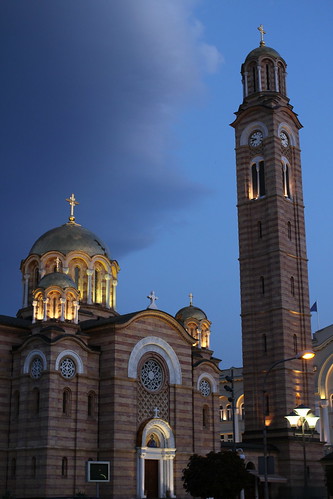
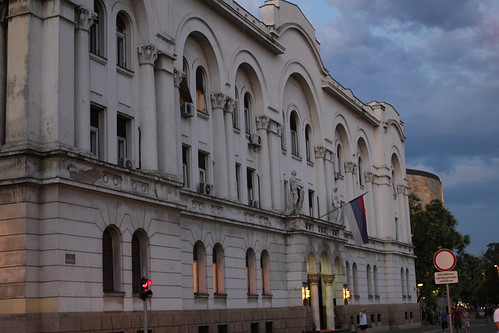
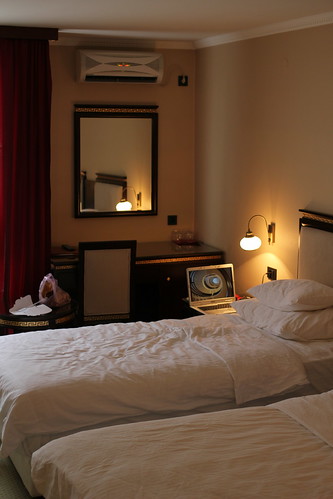
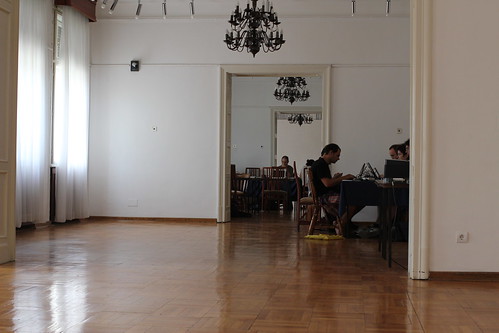
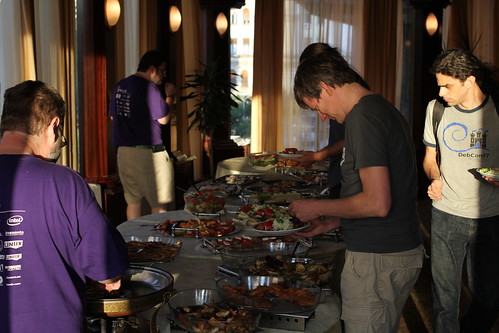
Short version arrival was quite easy, the arrival wiki page is now up-to-date and my photos are uploaded every day to this Flickr set. I had a small problem departing from CDG to Zagreb after scanning my suit twice and complaining that it had too many electronic devices, they had me remove my Nexus S, Nokia N950 and Kindle 3 from the suit pockets and then scanned that all lot again. After that another security guy asked me to open my suitcase and started squishing my Ligo cheese and declaring in a grave voice that it was too soft to be legal . As I kept calm and explained the DebConf cheese party to him, he looked around, put the cheese back in the bag and said ok, ok, off you go . So I still have that softness for the party. I heard an even better anecdote from our next years hosts when they were travelling trough Germany, a border official asked a typical so, what are you here for? question. They answered that they were in transit for an IT conference and gave him the invitation letter. He read the letter, nodded and then said: DebConf, huh? So, who was the author of the Linux kernel? and when after the initial shock they gave the right answer, they were immediately waved trough. Now that s what I call good border security. :) Meeting point - cafe at the Zagreb airport I met up with the guys in the Zagreb airport caf , which was immediately after exiting the secure zone. We waited for dkg to arrive and get his baggage. The passport check too a couple of minutes, but the baggage claim looked to be taking almost a half an hour. The airport bus After that was sorted out, we took out some local money in one of the 5 ATMs around and went to the bus. We were waived to just put our bags into the bus luggage space and get on, the driver went around to sell us tickets just before we drove off. It was one of the most comfortable and well air-conditioned buses I have been on in a long time. We were in the Zagreb bus station in less than half an hour. Non-official bus that tried to lure us Then a funny part started an old man came up to dkg and immediately asked Are you going to Banja Luka? , and when he said yes, the man started dragging us along to the bus station saying that there is a bus to there that will leave in a couple minutes, but we were in luck, so we should follow him right to the bus. Driven by curiosity, we went on. The man dragged us to the far side of the bus terminal bus stops where there was a minibus with Bosnian number plates, but no official designation as a passenger transit bus and no other passengers. They asked a reasonable 120 kuna for the trip, but they looked very shady to me, so we refused. I think that if we agreed and we were lucky enough that they actually did get us to Banja Luka, the price would have risen along the way, for example using the highway tolls as an excuse. Bus ticket to Banja Luka After getting cursed at by the old man and being demanded to buy him a beer for his efforts, we went upstairs to the real bus station where we were told that there were two buses to Banja Luka: one at 15:00 and another at 16:30, but that those two buses arrive in Banja Luka almost at the same time, so we got us tickets for the latter bus and went to a local bar to get some food and drinks. I somehow managed to get sausages in deepfried bread that for some reason cost almost triple of a hamburger and fries that others got, but it sure helped to pass the time and after all those 9 was not a bad price for a good meal. Bus to Banja Luka at Zagreb bus station We were a bit surprised by the bus drivers asking us to pay 1 (or 8 kuna) for bags to be put into bus bag storage, especially as we for several minutes could not quite understand what they want of us as neither of them spoke either English, Russian or German. Border crossing I don t remember when was the last time I crossed a real (i.e. non-Shengen) border in a bus, so getting out of the bus and walking one-by-one to the border official was a new experience. On the other border of two bus drivers collected the passports an then brought them back later, so that was less painful. And by then we were in Bosnia! And of the things that greeted us was a billboard for the casino in Banja Luka Hotel Bosna. :) By the time we got to Banja Luka, dkg had already made friends with an official from Croatian ministry of regional development that sat behind us on the bus and knew English very well (after living in Canada for some time). The bus station in Banja Luka looked almost abandoned like the bus stopped in the field with only a few taxi drivers and a bunch of buildings some distance away showing that this was indeed part of civilization. Banja Luka taxis The taxi drivers would take you to the venue for 8-10 KM 5 or 50-100 kuna (if their meter is broken and you look to be really ignorant of the exchange rates). If you walk on a bit, there is a bus station with an ATM taking Visa cards and a bit further on a bus stop that will take you to the centre of the city for 1.5 KM. The train station looked fully abandoned when we went there, only a news kiosk was working there. The bus driver reacted well to the name Hotel Bosna and wave toward it when we passed by it. Central bus stop - get off here Meeting first Debian peoples at the hotel It is hard to miss, especially the blinking Casino sign or the white pillars with black letters Hotel Bosna on top. You just get off at the bus station Central and walk back a couple hundred meters. Then see all you Debian friends drinking in the cool bar and walk around the corner to the main entrance of the hotel to check in. Church at sunset Main event location Hotel room The rooms are looking really great this is the best DebConf location that I have been to (I was not in Argentina). Soft beds with linens changed daily, nice air conditioning, towels (changed daily, if used), good shower, It is lacking in the speed and power of its free WiFi and in some place there is a clear impression that the hotel was built as a top of the line hotel a couple decades ago, but somehow has fallen into a disrepair since. Or it is simply used much more than expected. IMG_4973 So far I would say that the DebCamp is running full steam two hacklabs have desks, chairs, power and network connection, one of them even has sufficient air conditioning. The network works great for me so far, at least in the venue. The hotel wireless is barely usable to read a blog post, preferably without photos. Dinner buffet The food is being served well and on time. So far for lunch and dinner you walk up to the reception and get a food ticket based on your room number and go to the M level for the food (the M level is between the ground floor, labelled as PR , and first floor) where for breakfast and dinner there is a buffet, but for lunch you sit at a table and they bring you food. Vegetarians should clearly say vegetarian while pointing at themselves to get the special vegetarian option. So far food has been very good, except that that they often run out of popular items, such as fries, in the buffet. You can also ask for beer and other extra drinks with your food, but know that they cost extra up to 2.5KM for a beer, for example.

19 July 2011

Olivier Berger: Migrating mail from Evolution local storage to Evolution + local Imap (dovecot with Maildir) 2/X

See previous post for the rationale. I ve then started migrating my mail using evolution. First I ve installed dovecot and set it up so as to store my mail inside my $HOME/Maildir/ dir. Evolution will run dovecot on demand through a pipe, instead of through network access like with regular remote IMAP servers. So dovecot won t be started as a daemon. I ve been inspired by Roland s setup for this (even though I not using offlineimap). Inside Evolution, I ve configured a second mail profile, for this local IMAP server, using the custom command to connect to server :
"MAIL=maildir:$HOME/Maildir /usr/lib/dovecot/imap" I ve migrated my existing mail folders using copy to function on all top-level mail folders from the local evolution storage, to copy them to the IMAP folders. Note that some folders that include a dot ( . ) need to be renamed, as the dot is a path separator for IMAP. I ve adapted Evolution s vfolders definitions so as to take into account the active remote folders instead of the local ones, and that s it, the mail is migrated. I m using fetchmail + procmail to fetch mail from remote servers and to deliver it to the Maildirs, using dovecot s deliver program, with something like : DELIVER="/usr/lib/dovecot/deliver" :0: w
$DELIVER
I ve migrated the filters of evolution to server-side Sieve rules so that dovecot s deliver sorts incoming mail in the right Maildirs. The dovecot config needs to be adapted to activate the sieve plugin (dovecot-sieve Debian package), in /etc/dovecot/conf.d/15-lda.conf : protocol lda
# Space separated list of plugins to load (default is global mail_plugins).
mail_plugins = $mail_plugins sieve
log_path = /tmp/dovecot-deliver-errors.log
info_log_path = /tmp/dovecot-deliver.log

The original Evolution filters rules were stored in $HOME/.config/evolution/mail/filters.xml, so I wrote a quick python DOM parsing tool to extract the (long) list of definitions and generate Sieve rules for the $HOME/.dovecot.sieve config file (in which folder hierarchy uses a . path separator instead of a / ). The sieve-test program can be used to check is sieve rules function as you want. Now this is all setup, I only need to configure notmuch to index all the Maildirs. But this is left to another post.

John Goerzen: Trains and Birthdays

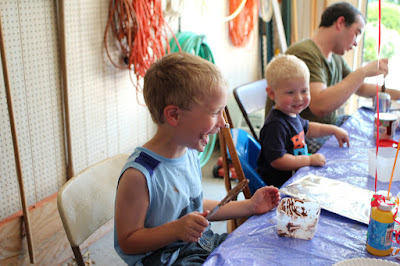
This weekend, the boys got what they ve been waiting for: another trip on Amtrak. For the last week or so, Jacob has had a morning ritual. He ll look at the calendar, figure out what today is, figure out when we ll get on the train, and then figure out how many days it will be. As the number gets lower, the excitement gets higher, of course. Friday morning, we woke the boys at 2:30AM to get to the train station. The only Amtrak trains through our area are middle of the night departures. Jacob is normally hard to wake up, but when I tell him that I m waking him up to go to the train station, he wakes up faster than I ve ever seen him before. It takes about 3 seconds for him to process that in his groggy state, and then he sits up straight, throws off the covers, and is instantly ready to go. Both boys were excited even in the station waiting room. Oliver has been on an Amtrak train before, but it s been awhile and he probably doesn t remember it. He constantly talked about it, jabbering as much as his vocabulary lets him. Once we were on the train, Terah and I would have liked to get some more sleep. The boys, on the other hand, were now wide awake, and didn t fall back asleep until about 5:30. That means Terah and I didn t, either. Here s what it usually looks like: When it came time for breakfast, we went to the dining car as usual. Jacob had already been telling us for days what he would eat for breakfast on the train: I always have French toast on the train, dad. And so he did. A few minutes later, I heard the waitress telling other people they were out of French toast, so I was glad I didn t have to disappoint Jacob over that! But it was Oliver that really came alive on this trip. I don t think I ve ever seen him so excited. It was almost constant. He happily talked about anything he could see or touch. But he also listened to other conversations, and would frequently pick out one word from a sentence and try to say it. He does that at home too, but not nearly so often as on the train. Both boys wanted to go exploring a lot my word for taking them for a walk in the train and seeing what they might find. We walked up and down the train several times, Jacob excited over opening the doors between the cars, and Oliver excited just to be there. Oliver s excitement kept him from sleeping well. He did eventually get a short nap, but that wasn t quite enough to avert a couple of tantrums later in the day. The reason for the trip was the 80th birthday party for Terah s grandpa. And it so happened that Oliver s 2nd birthday would be over the same time. So, Saturday morning, we all went for breakfast at Das Dutchman Essenhaus, one of the favorite local restaurants in northern Indiana. After that, it was over to a relative s place for some birthday festivities. The children got mini cakes to decorate as rail cars. There was frosting and all sorts of toppings. Great fun was had by all, and it was wise that this activity took place in a garage rather than indoors. Yes, that is a marshmallow stuck to Jacob s nose. Then in the evening, it was off to another relative s place for some more family time. Jacob had a great time all day, and was in high spirits. He asked me to sit by him at dinner, and started one of the longest conversations I ve had with him in some time. We just talked about the things that happened in the day, but it was nice when I told him, I like sitting by you, Jacob, and he said, Dad, me too! The big highlight for the day happened in the evening. We were gathered around a fire with a guitar to do some singing. Jacob was happily perched in his lawn chair, but got very excited when he saw some lightweight airplanes flying overhead. These kept flying at some distance, and he kept pointing them out to us. But that wasn t even the most exciting part. That came when the fireflies came out. Jacob ran around, catching them in his hands, and excitedly showing them to whatever person happened to be closest. He was laughing with joy for such a long time. At one point, someone asked him if the bugs were tickling his hands. He said, evidentally just realizing it, Oh yes, they ARE tickling my hands! He was one very happy boy. Sunday I had to leave to get back home, while Terah and the boys will return a couple of days later. Although I do sort of look forward to a train trip that I can relax without having to manage two young boys, I do miss them already and will be happy to have everyone back home in a few days. (This post written during the trip and posted a week later after arriving home)

18 July 2011

John Goerzen: Pooh, Books, and Dads

If I think back to fond memories of being with my dad during my childhood, there s one thing that always comes back first. It s those late summer evenings outside. Dad often had outdoor projects going on of some sort. I d go out there hanging around, maybe chatting, maybe playing with cats, or maybe doing something of my own. Dad often had an old AM radio sitting around and would be listening to a baseball game while working. As it got darker, lights would come on, and the bugs would start flying near them. Sometimes dad would be working just inside the barn, and the bugs would start flying in there, while some light poured out the big front door. There s something about that scratchy AM signal, the evening slowly getting darker, the slow pace of the baseball game, and just being around dad and a peripheral part of whatever he was doing that stirs a wonderfully fond recollection in me. I don t remember the specifics of any one of those times, nor do I really remember how often it happened, but it does stick with me. We ve had a routine in our house, starting early enough that neither of our boys know anything different, where right before bed, I read a book and sing a song to each of them individually. Last November, I was looking for some books to challenge Jacob a little more than what we had been reading. I found The Complete Winnie the Pooh used for $4 on Amazon. This contains the original A. A. Milne stories, not the Disney series. It had a few line drawings, but there were many pages without any. It s 352 pages and written in a rather dated form of British English. So for all these reasons, I wasn t sure if Jacob would like it. But it was $4 so I bought it. And Jacob was hooked. Each evening, we start bedtime with looking at the map of the 100-acre forest, just inside the cover. He gets to pick out 4 things for me to describe, and then we turn to our story. We usually read somewhere between 2 and 5 pages at bedtime, depending on how well he got ready without wasting time. And then we sing. A. A. Milne has his Pooh character make up songs throughout the book. They are printed with words only, no tune, so I make up a tune for them as we go. Jacob has taken to requesting these songs for his bedtime song as well. Jacob always gets to choose his bedtime story, and sometimes he chooses a different one but about 75% of the time, it s been Pooh. A few weeks ago, he started noticing that we were almost to the end. He got very concerned, asking what we d do next. I suggested a different book, which he didn t like. Then I pointed out that we could restart the Pooh stories from the beginning, which was exciting for him. Last night, we finished the book. The very last story was an interesting one, suggesting Christopher Robin growing up and no longer having imaginary adventures with the animals, but making Pooh promise to always be there for him. I don t think Jacob caught onto that meaning, though. When we finished it, we had this conversation: Jacob: Dad, is that the end? Me: Yes. Jacob, getting a big smile: Yay! So can we start back at the beginning tomorrow? Me: Sure! Jacob then gave a clap, shouted Yay! again, and was a very happy boy. Sometimes I wonder what our boys will remember in 25 years of their fun times with me. I don t know if Jacob will remember all the days reading about the animals in the 100-acre wood when he was 4, or maybe he ll remember watching train and combine videos, or playing radio hide-and-seek, or maybe something entirely different. But I have no doubt that I will remember sitting on the couch in his room, holding him on my lap, and reading a 350-page book to a loving 4-year-old. As Pooh aptly put it, Sometimes, the smallest things take up the most room in your heart.

Wouter Verhelst: About the beard...

I'm someone who sometimes has a beard, and sometimes doesn't. Today, I'm someone with a fairly long beard, although it's not (yet?) one of the likes of andrew or maddog. I don't think it looks very well on me, but you can blame the government (or lack thereof) in Belgium. How?! What?! Yes, the government. A while back, a movie critic working for the RTL (a Francophone Belgian TV station) decided to keep his beard until the Belgian government took the oath of office. He was quickly joined by an actor, and then by a Flemish radio presenter (dutch, with pictures). And then by a whole bunch of people. I didn't join them, initially. But after a while, when my beard was starting to get long again, people started asking me, 'is that for the government?' And initially I said no. But people kept asking. Since it seemed like a good excuse for not having shaven that long, after a while I just decided to say 'yes' for the heck of it. And now, after having said so for quite a while, I've kindof grown to the idea. Which, I guess, means that if the impossible happens, and someone back home manages to form a government that will take the oath while I'm still in Bosnia and Herzegovina, I'll have to go out and buy some razor equipment. But I don't expect that to happen. Today, exactly 400 days after the previous election (yes, it's really been that long), it still doesn't look as if there's going to be an agreement on anything. I wish there was something positive or funny that I could report on in this whole thing, but it doesn't look like it. Sigh.

Stefano Zacchiroli: arrived at debconf11

debconf riding is again After ~1650 km of motorbike riding from Paris, yesterday evening I've arrived at DebConf11, after having shared the part of the trip from Geneva to Banja Luka with my good friend gismo. DebConf11 motorbike trip DebConf11 motorbike trip DebConf11 motorbike trip DebConf11 motorbike trip DebConf11 motorbike trip The venue looks great. It's full of nice spots for impromptu chats, beers, and the like, which I love. I had a good lengthy recovery sleep and I'm ready for the usual DebConf fun to begin. Plan for today is simple: dismantle DPL backlog accumulated during the trip and in the frantic 10-15 days before it. If you are at the conference and willing to discuss, chat, or simply share a beer: do not hesitate! For something less informal, Neil is also organizing an in person "ask the leader" session here; feel free to propose questions to him and make me have a hard time answering them. See you around.

Rapha&#235;l Hertzog: Deciphering one of dpkg s weirdest errors: unable to open /path/to/foo.dpkg-new

We already studied one weird error of dpkg, let s do another one:
Unpacking replacement libexo-common ...
dpkg: error processing /var/cache/apt/archives/libexo-common_0.6.1-1_all.deb (--unpack):
 unable to open '/usr/share/doc/exo/html/C/images/exo-preferred-applications-internet.png.dpkg-new': No such file or directory
Rather difficult to understand on the first look right? Let s see in detail what s usually happening when you get this error. The first hint comes from the file extension .dpkg-new . This extension is used by dpkg to unpack the updated files near the old files. When everything has been unpacked, they are renamed over the old files. The failure happens precisely when dpkg tries to rename the file (in fact when it tries to fsync() it before the rename) but why does it fail? Usually because there are unexpected symlinks (or bind mounts) involved that resulted in two different files being installed in the same directory. For example consider package that provides /dir1/a-file and /dir2/a-file. Now imagine that on the target system, /dir1 is a real directory but /dir2 is a symbolic link that points to /dir1. When dpkg processes /dir1/a-file.dpkg-new everything is fine, but when it tries to process /dir2/a-file.dpkg-new it will fail because that file is the same than /dir1/a-file.dpkg-new which has already been renamed. Diagnosing further the problem requires to understand why there s a symlink instead of a real directory. It might be two packages that were badly coordinated, or a problem in the package itself because it lacks some code that drops the symlink in the preinst (so that dpkg installs the real directory instead of keeping the symlink). There might be variations in the way two files end up sharing the same directory, but this simple example should have clarified the nature of the underlying problem.
Subscribe to this blog by RSS, by email or on Facebook.

No comment Liked this article? Click here. My blog is Flattr-enabled.

17 July 2011

Cyril Brulebois: Thoughts on multiple webcams

Keeping an eye on something with a webcam is really easy: just a matter of setting up for example (c)vlc to multicast from /dev/videoX to the network, and done. Example:
# Streaming:
cvlc v4l2:///dev/video0 --no-audio --sout "#transcode vcodec=mp2v,vb=3072 :std access=udp,mux=ts,dst=224.0.0.1 "
# Playing, possibly on a remote machine:
vlc udp://@224.0.0.1:1234
Notes: Possible problems: Where to go from here:

Wouter Verhelst: Mechlin to Banja Luka in statistics

I decided to go to DebConf11 by car. Not willing to do this alone, I asked for volunteers to join me in my car trip. One such volunteer showed up, and the car trip happened. Now, since I remembered to push the correct buttons on my dashboard after I completely fueled up the car and checked the tire tension and other things, I am now proud to be able to present you with the following statistics on this trip:
  1. Total distance travelled: 1466.8 km
  2. Average driving speed: 95.9 km/h [0]
  3. Total number of kilometers wasted on 'oh, crap, we forgot something': 10 (approx) [1][2]
  4. Total amount of fuel used: 81.3l
  5. Average fuel consumption rate: 5.5l/100km [3]
  6. Total amount of kilometers spent behind the wheel by Jeremy: 50 (approx)
  7. Total amount of kilometers spent behind the wheel by Wouter: the rest.[4]
  8. Time of departure: 2011-07-16 21:00
  9. Time of departure after point three and making sure we had everything: 2011-07-16 22:00
  10. Time of arrival: 2011-07-17 15:15 (approx) [5]
  11. Outside temperature at departure: 12 celcius
  12. Outside temperature at arrival: 35 celcius
  13. Longest (voluntary) break: 1 hour (approx; breakfast, tanking, bathroom visit, watching the sun rise)
  14. Longest (involuntary) break: 45 minutes (approx; customs check) [6]
  15. Last fueling stop: 4 AM.
  16. Amount of kilometers left to go before the car said bleep, you need to tank soon: less than one.
  17. Most tense moment: on crossing the slovenia->croatia border, confusing the border police officer ("no, I'm Wouter, that is Jeremy" yes, we both had photo-ID), who then promptly holds on to our documents, asks the car's papers, and tells us to please park over there and wait a moment while he gets us to be handled by guy in a somewhat more military-looking uniform.[7]
  18. Biggest "uh-oh" moment: after crossing the croatia->bosnia and herzegovina border, watching the very, very, very, very, very[8] long line of trucks queueing to cross the border. In the other direction. And then realizing that you probably need to go through that very same queue on the way back
  19. Largest single toll fee: 15 [9]
  20. Last bit of time spent asleep before this trip: the minutes surrounding 2011-07-16 05:00:00 [10]
  21. Time wasted writing this blog post when I really should've gone to bed instead: 45 minutes
  22. Time now: 21:02:54
But it was fun. And that's all that matters. Those who've shown up at debconf already, or who will arrive soon: see you tomorrow. Those who will arrive later: see you soon. And those who won't arrive: better luck next time, I hope. [0] this includes times when the car isn't moving with the engine running, but not times when the car is turned off, locked, alone and forgotten, in the rain, while those idiots who were supposed to be its drivers were inside having a drink.
[1] Which is surprisingly little. Usually I manage to need more.
[2] Jeremy forgot his^Wa Debian banner. I forgot something, I can't recall what. I decided to bring some CD's to enjoy during the trip, and a 3.5mm audio connection cable which we end up not using
[3] According to the dash. I'm too tired right now to check it. Also see the next two points. [4] This could incorrectly be interpreted as a criticism on Jeremy. It's not his fault that I only told him a day before we left that I have a manual transmission. And in fact, if anything, I'm unhappy with the fact that I even had to hand him the wheel for those 50 km. I would've loved to be able to say "I went all the way from Mechlin to Banja Luka, all by myself".
[5] I forgot to check the clock, to be honest.
[6] What, you think I have a chronometer?
[7] The last four points could really have been written as two. Figuring out which goes with which is left as an exercise to the reader.
[8] very, very, very
[9] 7-day Slovenian road tax vignet
[10] Once I wake up, I hardly ever manage to fall asleep again. Esecially if it's light outside.

Daniel Baumann: Debian Live Autobuilds

Right now I am sitting in the train to the airport for going to DebCamp/DebConf 11 in Banja Luka, Bosnia and Herzegovina. During DebCamp amongst other things I am going to work on finishing up the last bits on getting daily/weekly Debian Live autobuilds back for wheezy. This spring Jimmy Kaplowitz offered to help with the task of overseeing the debian-live autobuilder and to coordinate necessary bits with cdimage.debian.org. Having them on cdimage.d.o became recently possible as Steve McIntyre offered to make a VM available for us (live-build requires root privileges, and naturally, you would not want to let that run on the host system itself, that is why in the past it was not possible to build them on cdimage.d.o). The remaining issues are, and this is why the autobuilds are not yet back since spring, that live-build still needs two things: a couple of tweeks for wheezy, and the autobuild stuff need to be properly integrated into live-build itself. That will happen as an additional binary package live-build-cron with a bunch of debconf questions, so that everyone and his dog can setup a debian-live autobuild server on his own machine. The initial upload (which will not yet work, do not bother to try) was uploaded to experimental this week and cleared the new queue, now looking forward to get this all finished up and resulting in a live-build uploaded to unstable by the end of the week. In the second week, Jimmy arrives, I will be introducing him to live-build and the various little things to watch for and hopefully manage to persuade him to take over the autobuilds maintenance. Having all images that are based on packages solely from the stable/testing/unstable archives moved to cdimage.d.o is freeing up ressources on live.debian.net which did the job in the past since etch. Ben Armstrong volunteered to help with overseeing the live.d.n instance of live-build-cron that will build more then once per day images for si, with the only difference that they will not use live-* from the archive but the latest snapshots from our git snapshots repository. This will be a big help for the development as eventually we will be autotesting these images for various things. Last but not least, thanks to both Jimmy and Ben for all your kindness, patience and help with this during the last couple of months. We have interesting times ahead.

Next.

Previous.