Search Results: "ron"

18 April 2008

Axel Beckert: Harddisk prices gone mad

Cut and paste from Brack’s SATA harddisk pricelist:
Samsung SpinPoint S166,  HDD,  80GB, 7200rpm, 8.9ms,  8MB Cache, SATA II NCQ, OEM, 3.5'', SAH-HD082GJ   CHF  53.00
Samsung SpinPoint S250,  HDD, 250GB, 7200rpm, 8.9ms,  8MB Cache, SATA-II NCQ, OEM, 3.5'', SAH-HD250HJ   CHF  64.00
[...]
Samsung SpinPoint T166s, HDD, 400GB, 7200rpm, 8.9ms, 16MB Cache, SATA-II NCQ, OEM, 3.5'', SAH-HD403LJ   CHF 109.00
Samsung SpinPoint T166s, HDD, 500GB, 7200rpm, 8.9ms, 16MB Cache, SATA-II NCQ, OEM, 3.5'', SAH-HD501LJ   CHF 101.00
So from 80 GB to 250 GB the price difference is less than CHF 10 and 500 GB harddisks are cheaper than 400 GB harddisks of the same type? We live in a strange world. And no, none of this harddisks is marked as special price or promotion. Oh and for all those not having CHF as your daily currency:
CHFEURUSD
1.00€0.626417$0.997506
1.59638€1.00$1.5924
1.0025€0.627983$1.00
(Rates from x-rates.com.)

Steve Kemp: That wasn't true. Made it up. Shouldn't have done that. Sorry.

Chronicle
My blog compiler received a bit of love recently, primarily because MJ Ray wanted to use it. As mentioned before I've added a simple spooling system, and the mercurial repository now contains a simple RSS importer.
Debian Work
In other news I've been working on various Debian packages, here is a brief summery:
bash-completion
After seeing a RFH bug I closed a few bash-completion bugs, and submitted patches for a couple more. I was intending to do more, but I'm still waiting for the package code to be uploaded to the the alioth project.
javascript work
I've updated the jquery package I uploaded to follow the new "Javascript standard" - in quotes only because it is both minimal and new. Once the alioth project has been configured I'll upload my sources.
Apache2
I've agreed to work on a couple of SSL-related bugs in the Apache 2.x package(s) - time disappeared but I hope to get that done this weekend. Initially that was because I was hoping I could trade a little love for getting a minor patch applied to mod_vhost_alias - instead I've now copied that module into libapache2-mod-vhost-bytemark and we'll maintain our own external module.
Hardware
I've been loaned a Nokia 770 which is very nice. Having used it with vim, ssh & etc I think that I'd rather have a device with a real keyboard. The Nokia 810 looks pretty ideal for me. I'm going to be asking around to see if I can get a donated/loaned device to play with for a while before I take the plunge and pay for one of my own.
I've got a couple more things on the go at the moment, but mostly being outdoors is more interesting to me than the alternative. Hence the downturn in writing and releasing security advisories. I'll pick things up more fully over the coming weeks I'm sure. ObQuote: Shaun of the Dead

MJ Ray: Explaining web site improvements: what's important to you?

[Photo of Some Traffic]
Is this traffic or congestion? This is one of those Friday Afternoon Projects - it's been put off all through a busy week because it's unpaid, I'm not completely sure how to approach it and now my arms hurt like hell from travel jabs which are making it hard to concentrate! So I'm going to float it on here... I've been asked to brief a meeting next week about that group's current web site and its problems. I'm not linking it yet to avoid insulting/embarrassing them. The site looks OK, but doesn't rank well on search engines and doesn't allow much member participation. I need to explain why that's a bad thing and how the site's technical choices have led to that. I'm not directly pitching for TTLLP to get any work (because I'm a member of that group, it might be a conflict of interest and we're pretty busy anyway - even our own site needs work on some of the points I'm going to mention), but I don't want to be unhappy if we're asked to implement my recommendations. I've got a usual outline that I follow, but my presentation's time is limited, so I'd like to ask you: what about this is important and what isn't? If you give me useful feedback, I'll put you in the Acknowledgements with a backlink and I hope the briefing will be shared pretty widely over the next few months. The current plan is to start with a basic explanation of how search engines rank pages, as far as we can tell, referring to PageRank Explained Correctly with Examples, by Ian Rogers as well as the shorter official summaries from the dominant search sites at Yahoo, Microsoft and Google. Then I go through a quick evaluation of the site against the basics of validation, accessibility and robot-friendliness, followed by a couple of SEO-style checks of its current rankings and inbound links. Next is a bit different because I have access to some of their web access stats: I summarise what we know and suggest some other stats they've probably not considered and why they're useful, along the lines of Dave Briggs's measures of blog success. Finally, I suggest ways to improve the site. The top tip will be to take control of the site hosting and stop using the cheap and cheerful donated server that makes all links except the front page point to another domain. I'll probably suggest a mix of free and open source software tools to power it. If they don't want to move it all yet, I'll suggest running a second site for member participation, using tools like Wordpress, NoseRub and so on. What do you think? Plan for success, am I missing some tricks, or am I setting myself up for a lynching? Let me know with a comment or email, please.

David Welton: "Open Source" Akismet or Defensio?

I have a bad habit of getting caught up in side projects - I love to build stuff, and open see opportunities to engage in this hobby. A site I've run for a while is the Linux Incompatibility List, which also led me to create my own Rails based wiki for it, DedaWiki, which is of course open source (and could use some more attention). However, things are getting badly on the spam front, and it's time to find a better solution than hacking at my own anti-spam code. Two systems that look good are Akismet, which I use successfully for this journal, and Defensio. However, being the impractical guy that I am, I am also curious if there are what we might call 'open source' efforts in this area. I'm not sure what that would look like, since there's probably strength in numbers, and a hosted solution is certainly easier. Also, it seems the incentives in an arms race like anti-spam are in favor of the quick turnaround that a small, smart, dedicated team can provide. Also... a bit of security through obscurity in an arms race type situation probably doesn't hurt, since there's often going to be a way around anything that's not locked down (and part of the value of a journal like this is in the comments), and letting people see exactly what numbers and ratios and metrics are being used is going to help the bad guys. Anyone able to point me to something that proves me wrong?

Robert McQueen: Lazyweb request: gadgets I would like to have

Last night I thought of a few gadgets which I’d like to have, and although I’m pretty sure you should be able to get hold of them, I had trouble finding anything that looked quite right: So, answers on a postcard…

Axel Beckert: Dilbert.com changed - to the better

nion argues about the new Dilbert.com website now using flash instead of GIFs. Well, he hasn’t looked right: Dilbert.com offers now flash and static images. And the last ones are now much easier than ever to view or fetch, because Dilbert.com now has RSS feeds. Ok, at the moment, the feed seems broken respectively empty, but I have the last week of Dilbert comics in my feed reader. In colour! Additionally Dilbert.com is opening its archive. (The link to the blog post currently broken, too.) Back to 2001 is said to be available now, the reminder is in the works The new Dilbert.com site worked fine yesterday but seems to have some problems today. But I expect that they will fix that soon. :-) Noticed it btw. because the inofficial Dilbert feed from tapestry included a broken image yesterday. (Works fine now, but no new comic in that feed today…)

Julien Danjou: Updating my .plan

I've been on holidays for one week now, breaking my usual workflow. Well, that allowed me to rest and to think about what I'd like to do and things I need to handle during next weeks. The urgent things this next days will be my primary server replacement. It is currently dying, and I already had to change its power supply twice in a month. Unfortunately, I'm now at a point where I do not have any spare piece so if things go wrong again, I'm screwed. I need to collect some money and buy a new server, or maybe get a server if someone have an old or spare one to give me, I do not know yet. On the awesome front, I'm about to release awesome 2.3, which will be the final minor release of the major branch 2. This will lead me to work on awesome 3 at a slower rate and a cooler pace. Then, the thing I do not have to hurry for is awesome 3. There's no big problems in awesome 2, and the xcb-util stuff are not stabilized yet. After my gentle yelling on XCB mailing list, it seems that things will move but will slowly. So I do have time to make things right and do what I want on that branch, making bugfix release on awesome 2 if needed. You can read more about futur on my last post about awesome. All this should give me some more spare time to work on the upcoming Debian release, lenny, which I'd like to work on. Two years ago (my god, time flies), we've done good work with the french cabal squashing critical bugs and I'd like to go back on this and squash asses again.

17 April 2008

Russell Coker: Solar Powered PC

I’ve just read an interesting post on TomsHardware.com about a solar powered PC [1]. It describes all the steps involved in creating a modern high-performance low-power computer. They have a lot of interesting information. One surprising fact (from page 3) is that the PSUs tested (both for AC and DC input) were more efficient when idle (I expected the greatest efficiency to be when under load). An AMD processor was chosen due in large part to the fact that chipsets in suitable motherboards used less power. For the CPU itself Intel had a competitive offering but no matching motherboard was power efficient enough (from page 7). Page 8 documents how using a cooling fan (instead of passive cooling) reduced the power requirements of the CPU to such a degree that it always saved power use overall. Why do CPUs take less power when they are cooler? Page 9 mentions that a small passively cooled video card can draw 88.5W when idle! That sucks pretty badly, it seems that having a video controller integrated with the motherboard is the way to go if you want to save power. It’s interesting to note how much energy can be used by RAM. Page 13 shows that the difference between 2*1G and 2*512M can be as much as 3.4W and that the difference between different brands of RAM for the 2*1G can make as much as 1.2W difference. Their final system drew 61W when idle, my latest 64bit system takes 52W when idle [2] (which compares to the 38W of their system without a monitor), so we are talking about 9% of system power being saved by using less RAM or 3% being saved by using a different brand of RAM. The summary of hard drive power use on page 14 is interesting, the fact that 2.5 inch laptop disks use less power than 3.5 inch desktop disks is hardly surprising, but the difference when idle is very surprising (apparently one of the 3.5 inch disks spends 8W on turbulence and friction in the bearings). It’s unfortunate that they didn’t compare any of the server-class 2.5 inch disks, it was about 6 months before the article was written that HP announced that in future they would cease shipping 3.5 inch disks and only use 2.5 inch disks (I wonder if this is related to all HP’s recent work on server cooling). Rumor has it that many server class 3.5 inch disks have platters that would fit into a 2.5 inch case because at high rotational speeds a larger diameter platter would not be strong enough. The information on DVD power use on page 15 is quite shocking. From now on when I install machines as servers which don’t have a need for for a CD-ROM drive I’ll remove the drive prior to deployment. Even if it saves only 0.47W then it’s still worth doing on a machine which uses less than 40W! An additional benefit of this is that it might speed up the boot process as the system won’t need to check for a bootable CD. It’s unfortunate that most computer parts don’t have published documentation on how much power they draw. Even if you don’t want to run on solar power there are still significant benefits to saving electricity (including reducing the noise from cooling fans and heat problems in summer). If technical data was published then people could make informed decisions about which parts to buy. Update: Changed the percentage savings for different types of RAM to be based on the system power use without the monitor. I’m most interested in saving power for servers and for idle desktops (running a desktop machine 24*7 is pretty common) so most of the time the monitor will be turned off. It’s interesting to note that they power their system uses is about the same as a P3 system and could be less if they used a different hard drive.

Neil Williams: Data Centric programming - a new start at Alioth.

It's time for me to stop complaining about the commercialisation of SourceForge and vote with my code. I'm leaving for brighter, bluer pastures at Alioth.

Query Object Framework is first (libqof1). The others will follow. I'm leaving because of unusable mailing list archives, impossibly slow web pages and wiki and the general amount of work involved in the SF interface. I'm gaining sane mailing lists, a friendly and usable ikiwiki and a simpler (although very similar) interface.

I'm also migrating most of those packages to subversion. With so many other changes, it's not exactly a problem to add cvs2svn into the mix.

Now, of course, this does not mean that these upstream packages suddenly become Debian-only or Debian-native. It does mean that I have a chance of encouraging new developers to join the team by providing the kinds of services and support that people need when starting off with a new project. (I suppose the one thing I don't yet have is an IRC channel. Not sure if it is worthwhile but I'll see what happens.)

QOF will form the basis of the support available for each of the other projects - all will share the same low-volume QOF-devel mailing list and QOF Wiki as provided by Alioth. I'll also migrate QuickList because I'm looking at restarting development on a stalled project allied to QOF and which could provide missing functionality in QuickList. I did look at Gaby in this mix but a botched Gtk1->Gtk2 transition that ended up with two incompatible forks running different parts of the original codebase put me off completely (and neither of the forks actually worked). (Some packages deserve to be dead upstream.)

I'm looking for new blood, fresh faces and a new desire to take these projects forwards. The driving force is data freedom - creating data-driven applications that are completely agnostic to where and how the data happens to be stored. It is user data, it should be as free as the source code that wrote it. Who cares what format it is in? Let's get it into a format that some other program can use and make use of the existing data instead of duplicating it all the time. (The observant will note that my old haunt of GnuCash is stubbornly ignorant of the merits of a decent import/export implementation that actually covers more than 50% of the data in the application. No wonder I took the chance to sponsor homebank.)

DWI Data With Interaction (aka DUI -- Data Under the Interface) is what can provide the missing interfaces. It'll take a while to get it back up to date and available in Debian but it can provide the link between data and interfaces. GNU/Linux users should be able to design an interface purely on the basis of the data that it needs to handle and not care one jot about how that data comes from one free software app and goes on to the next free software app. QOF is gaining a connection to libgda which means that data can go to and fro between a whole range of databases and file formats. Homebank and pilot-qof can gain new data inputs (and possibly outputs) by utilising the existing import/export support in new ways via DWI/QOF (as libqof2). That can give a complete interface for all PIM and financial data for a typical SOHO user and all based on SQL-type queries so that every stage of the process can be tweaked and optimised according to user requirements at runtime.

(Where does Emdebian come into this? Well, many people like me need to record and process PIM/financial data on the move so Emdebian means that those users can have the same data processing on their handhelds as on the desktop. Smaller apps to capture the data quickly and efficiently whilst on the move; larger apps to refine, optimise and filter the data on the desktop entirely under user control but with a simple, scriptable, interface based on runtime queries so that the user can do exactly the same conversions tomorrow with new data but none of the configuration. Easy!)

Is this groupware ? No - it is personal, ultimately flexible and entirely customised for particular users by the users themselves. It's about small niche markets, about independent business people with bespoke and highly specialised requirements. No one is going to spend time writing their reports in Scheme or Haskell, because they are the only people who need that particular report. Instead, that individual user needs to be empowered through a simple and intuitive interface to take a piece of data from one source, correlate it with a static piece of data from individual configuration sources, calculate a result according to a third piece of data from a completely separate source and combine them all into a new set of objects that can be used in other queries. It's about preparing invoices from Palm data, it's about handling customer accounts for a one-man company or handling a stocks and shares portfolio for a partnership. Ultimately customised, ultimately flexible and completely format-agnostic.

These are the kind of applications that hold people back from GNU/Linux migrations - bespoke applications that are developed for just a few small companies or just a few situations. Free software finds it hard to provide those apps because free software depends (currently) on someone else being motivated to write a bespoke program and that person rarely understands the niche. This is a chance to put the development into the hands of those with the motivation to do the work, by making the development process more WYSIWYG.

The question is: Can we come up with a better name for DWI, dear lazyweb?

"DWI is a fairly simple environment for quickly creating data-driven applications, that is, graphical applications that manipulate and show info from a database. This environment differs from others in that it is focused on native GTK/Gnome support through the Glade GUI designer, and thus allows you to build user interfaces as elegant as you can make them in Glade."
http://dwi.sourceforge.net/

The big appeal is that DWI is database-agnostic - it only cares about the data structure, not the file format. Ally that with QOF which provides data-centric SQL-based queries and conversions between objects (including combining elements from one object into one or more other objects without having to hardcode the connection between the objects at compile time) and we have an interesting and powerful combination of engines, frontends and backends that are all data-centric.

Please, if this sparks your interest, join the QOF-devel mailing list, have a play with the ikiwiki at http://qof.alioth.debian.org/ and have a go with the code. This whole area is begging for development but it is just so far from being usable by the target audience at this stage. There is a lot of programming to be done by current developers before the principles can be let loose on the masses.
:-)

This is about working between existing projects and between distributions - no longer dedicated to a single application, platform or file format, no more tunnel vision. Work on the edges of existing applications (and indeed projects), remove the sharp edges of applications that should work together but can't. The majority of the code in these libraries and applications is already stable and mature. Like so many parts of free software, it is time, IMHO, to put aside our egotistical devotion to the one-true-executable and come up with an actual solution.

Bah! I'm beginning to sound like a PR exec instead of a dedicated geek. What does it take to motivate people and get things done around here?

:-)

Joerg Jaspert: debadmin delegation - should I accept or deny it?

As you might have read on debian-devel-announce lately, Sam delegated the ftpmaster rights to me. Steve, our new DPL, did state his full support in an IRC query minutes later. Now I got a query from someone who is, pretty strongly, argumenting that I should decline this delegation. Mostly on the grounds that it is not nice to force new team members into an existing team, and that it is not a good environment to work in, if a DPL can do that if he feels like proving a point. Leaving alone the fact that delegations are one (central) part of the DPL job, and that the constitution leaves a way if you do not like those delegations (GR), I’m now unsure what to do. (Just for the record - i once was bitten by a DPL using his powers in a way I absolutely did hate (and still do). Some of you might remember the fun around the DebConf7 venue decision). I could do
  1. decline the delegation, stay ftp assistant only. Which I am for a long time now. Possibly see some flame on the lists when I do this.
  2. do nothing, ie. accept the delegation. That will get at least one of the long time ftpmasters upset, possibly more of them. Maybe with a resign from that job. Or Debian. But it would enable me to do the work only ftpmasters can do, like changes to the code, changes to the archive directly, etc. Without delays while waiting for a master to comment on something I prepared. Good example here is the current situation with the release teams transitions: They are 90% done and merged, just one little more merge is waiting to happen before they are ready to use… And whenever I tried to get a master (mostly Aj, as he was working with me on this) to do the final steps I got nothing but silence back, even when he was otherwise active…
Bah. I hate this. The thing is - I really do want to have debadmin rights, and am working in that direction for a long time now. Not publically, but by talking with James in the past months, … As Sams mail showed - that did go nowhere, unfortunately. Now, could readers of my blog (and I know there are people reading this, my traffic stats tell me so :) ) please comment on this and give me advice? I just want some opinions about this. (Yes, my blog does understand comments since some time :) ) UPDATE: Thanks to everyone who commented on this, either by using the comment form here, by mail or via IRC. I really appreciate your input. I’ve decided to not decline the delegation and one DSA member already added my account to the debadmin group. (Thanks).

16 April 2008

Jeff Bailey: Physio, T-shirts, and the end of the contest!

Updates of the moment:

* I can put a t-shirt on now! About 3 days ago, I got brave and decided to give it a try. So, yay, no more zip up sweaters!

* Had my 6-week checkup yesterday, and everything is looking good. The incision is still a bit red and since my skin is so sensitive, the surgeon doesn't want me in the hottub for another 2 weeks. *pout*

* I started physiotherapy today. I can only give it a mixed review. The therapist was absolutely wonderful, it turns out that I got the clinic director. However, she doesn't actually have time to see me 3 days a week. Her schedule is so booked up that I'd be lucky to see her once a week. On top of that, the receptionists and assistants were not terribly professional (tending not to articulate, getting flustered, sort of tossing sheets of paper at me expecting me to know what to do with them), and the place was not clean. It was also in one big room, so the therapy is done in front of everyone else. Blech. So I have an appointment with a different clinic on Friday. Hopefully this one will go better.

* I don't think I've mentioned Leif recently. He's walking, can open the doors in the house now, and can clearly say "All Done". He also climbed onto my lap the other day and cuddled with me. So cute!

* Lastly, this is the end of the contest of "Guess the cost!" And the final total for the bill was.... $199,849.24. Our running total is of all things combined at UCSF is now somewhere around $280k, so I'm guessing the final total for everything will be around $300k when we're all said and done. Crazy. The closest guess was by [info]runasand at $192,000, whoever you are. Linked-in says the winner is in Norway. So finding that vegan restaurant might be interesting. I still remember Debconf 3 in Norway when the caterer told me "In Norway, we have a special way of preparing vegetables... We feed them to the animals." And the meat-eaters begging the vegetarians who were going elsewhere for food for their meals so that they had something other than slabs of meat to eat.

I think because of this, I'm going to have to award the prize to [info]mmmmtino in the meantime, who came in second place at $185k. That way I can pay it out hopefully within the next year. I'll still keep the other as a raincheque in case I happen to wind up in Norway sometime again. =)

Further on the OMG-This-medical-system-is-barbaric, It looks like the insurance company negotiates the hospital down in price, because they're in network. I've only seen the payout information for that one day overnight stay, but the insurance company will only be paying 10% of the cost. So if I didn't have insurance, I'd have to pay $67k. But the insurance company gets to pay around $7k. Do they charge so much because they don't make enough money when someone is insured? How does that all work?

Wouter Verhelst: Actually, you can

Uwe Hermann and Russell Coker talked about resizing ext3 volumes in several scenarios. While they point out interesting things (i.e., the fact that you can resize stuff without losing data), they both get the important bits wrong. Uwe, you can do online resizing. Just use
resize2fs <device-node>
. The kernel will notice that the device is mounted, and perform an online resize. This takes slightly longer than an offline resize, but (a) you don't need to do the fsck, and (b) you can still write and otherwise use the file system while the resize is in progress, so the net result is that you win time, especially if the file system in question is huge (I've done things like resize a 700+G LVM volume by 50-100G, which takes half a minute or so; an fsck will take seriously longer). Russell, resizing the LVM volume on which the root filesystem lives used to deadlock the kernel in the old days, but that bug has been fixed since around Linux 2.6.13. I've done online resizes of the LVM volume (and ext3 filesystem) of my root filesystem many times since then, both on some of my home systems and on huge customer boxes, and never encountered any problems. I really love LVM, especially on servers. /home is full? lvresize -L +5G /dev/<hostname>/home && resize2fs /dev/<hostname>/home, and we can work again.

Simon McVittie: Implementing D-Bus services with telepathy-glib

16:46 < epmf> tp-glib is made of magic

—#telepathy, 2008-04-15

Rob pointed out today that I'd been promising to blog about telepathy-glib for several months and still haven't done so. I think there's too much to cover in one blog post, so I'll start with the oldest part - implementing a service (typically a Telepathy connection manager).

While telepathy-glib is (obviously) intended for Telepathy implementors, I think the ideas we've been implementing are likely to be useful for any D-Bus API, particularly flexible/complex APIs where an object implements many interfaces.

Introduction to telepathy-glib telepathy-glib started out as a collection of code extracted from our XMPP connection manager, telepathy-gabble, but at some point it grew beyond that into a wrapper around/partial replacement for dbus-glib. We've been quite pleased with it, really :-) My first major round of work on telepathy-glib, during the first half of 2007, was to split it out from telepathy-gabble (versions up to 0.5.9 were released as part of Gabble 0.5.x tarballs, in fact), leading to the release of the 0.6.x stable branch in late September. This was very helpful for implementing connection managers - Salut, Idle and telepathy-sofiasip (our connection managers for link-local XMPP, IRC and SIP) all started off by forking/cargo-culting from Gabble, and achieved huge code reductions by porting to telepathy-glib. Also, Will Thompson used it in his Summer of Code project, telepathy-haze, to go from nothing to a working and useful Telepathy implementation based on libpurple in a matter of a few months. The second major round of work, which I'll discuss in a later article, added client code to telepathy-glib, obsoleting the older/worse libtelepathy and allowing client programs like Empathy and telepathy-stream-engine to be written using telepathy-glib. In the process, I accidentally reinvented DBusGProxy :-) More details to come later!
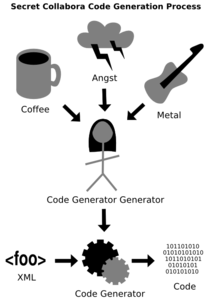
Some background: service-side code generation
The secret Collabora code-generation process

(credit: daf)

Supporting D-Bus in the GObject world has always involved quite a lot of code generation. The core API of dbus-glib is heavily reliant on varargs functions, which aren't type-safe and are easy to get wrong. dbus-glib contains a program called dbus-binding-tool, which is meant to generate reasonably sane GObject APIs for D-Bus objects. Unfortunately, it seems to be intended to generate a whole GObject at a time. Early versions of telepathy-gabble used dbus-binding-tool plus a script called gengobject.py to generate API stubs for the exported objects; developers then filled in the blanks, and hey presto, we had a GObject on D-Bus. This was fine up to a point, but had a couple of major drawbacks. Whenever we changed the D-Bus API (quite common during the early development of Telepathy), there was a very laborious and error-prone merging process. We ended up with the following process:
  • copy the D-Bus introspection XML from the telepathy-spec repository into a directory xml/pristine (actually, the canonical form for the spec was Python for a while, and we had a script that exported a contrived object onto D-Bus and introspected itself to get the XML - but that's another story!)
  • preprocess the introspection XML to add the dbus-glib CFunctionName annotation, resulting in a directory xml/modified
  • run dbus-binding-tool and a Python script gengobject.py to generate C source in xml/src
  • three-way-diff the old version of xml/src, the new version of xml/src, and the real C code in src to create a new version of src
  • pray that the diff process hadn't randomly exchanged functions' implementations
  • update the resulting code in src so it worked
  • check the whole mess back into darcs
  • hope that nobody else had made changes that would result in darcs conflicts
If you haven't yet gathered, this was a bit of a nightmare. Also, it was very easy to return the wrong thing from a method without noticing - because all the APIs were varargs, the compiler didn't notice, and the first we'd know about it was a mysterious segfault under certain circumstances.
How telepathy-glib fixes code generation telepathy-glib improves on this by taking advantage of this innocuous-looking feature in dbus-glib:
commit 355ef78d98d6fc65715845d56232199162cab12a
Author: Steve Frécinaux <steve istique net>
Date:   Thu Aug 17 11:48:20 2006 +0200
    Interface support for bindings.
Instead of running dbus-binding-tool or creating GObjects with D-Bus interfaces, we put the entire Telepathy spec through glib-ginterface-gen.py, a distant descendant of Gabble's gengobject.py. For each interface in the spec, we generate a GInterface that mirrors the D-Bus interface. Any GObject that implements the GInterface automatically gets the D-Bus interface if it's exported onto D-Bus. There are a few non-obvious refinements, though:
  • The signature of the method implementation is always in the mode that dbus-glib calls "asynchronous", where the method implementation can either send a reply message before or after it returns. For "slow" methods, this is the only thing you can do. For instance, many Telepathy D-Bus methods can't return anything until some TCP round-trips to the server have happened. This is also the only thing you can do if you want to extract extra information, like the sender's unique name, from the method-call message (dbus-glib's "synchronous" API doesn't allow this to be done). For "fast" methods, sending a reply message before returning is just as easy as using the "synchronous" API (it's just a difference of syntax), and has an API consistent with that of the "slow" methods, making it easier for service authors.

  • The layout of the GInterface vtable is private, and (auto-generated) accessor functions are used to fill in implementations. This means our ABI doesn't change just because we re-ordered functions in the spec.

  • If no implementation is provided for a method, we just raise an appropriate error (org.freedesktop.Telepathy.Errors.NotImplemented), rather than suffering an assertion failure. This means we can safely add methods to an interface.

  • While we're generating code anyway, we generate some static inline wrapper functions which wrap dbus_g_method_return(), to have type-safe method returns. You can easily check that a method replies with correct types, by checking that the implementation of Foo() replies by calling tp_svc_some_interface_return_from_foo().

  • Similarly, we generate wrapper functions to emit signals, to get type-safe signal emission.

Not all interfaces are stable enough to be included in telepathy-glib's stable API and ABI, so some of our other projects include a copy of the telepathy-glib code-generation tools, and generate their own "mini-telepathy-glib" (traditionally in a /extensions/ directory) for their implementation-specific (drafts of) interfaces. This isn't yet as polished as it ought to be (mainly because we don't want to freeze the augmented-introspection-XML format that we write the Telepathy spec in, because it's rather ad-hoc and hackish in places) but it works quite well in practice. To see what this looks like in practice, have a look at the examples in telepathy-glib, or at a Telepathy connection manager like telepathy-gabble.
Mixins and base classes Another feature of telepathy-glib which makes life easier for connection manager authors is that it provides "mixins" and base classes which implement some of the GInterfaces. There's absolutely nothing magic about the base classes - they don't have any access to private implementation details of the GInterfaces, they just implement them like everyone else does. The "mixins" are only slightly more magical - they store some extra state inside the structures representing GObjects and their classes, and use it to provide default implementations of some or all of the methods on a particular interface (or two interfaces, in the case of the new TpMessageMixin). I'll leave it up to Rob to explain those in greater detail, since I seem to remember that he invented them :-P The examples and regression tests in telepathy-glib are quite good examples of how these work in practice.

Steve McIntyre: Final Sarge CDs done and released

Forgot to mention, but some people seem to have spotted anyway. The last (ever!) official set of Sarge CDs and DVDs is available. I'd strongly advise against most people using them, as Etch is a much better bet and Lenny isn't too far away. But for those people that might want them, you can find them in the "archive" area: http://cdimage.debian.org/cdimage/archive/3.1_r8/

Holger Levsen: 4 months and eleven days

I'm still ill with quite heavy fever, I feel like doing nothing, I'm even to weak to walk the dog properly... but he copes well and is great as usual :-)

Thinking about Debian doesn't make me feel better at all, reading through the comments of lucas post didnt help at all. Since 2000???! Gosh.

Unfortunatly the NM statistics miss two important data points: 1. people who made it thru NM and 2. people waiting for account creation. The second is only "good" to attribute blame, the first would be nice to have, so one could easily see, whether nowadays less people apply for NM or whether there are just less people in NM because the process is faster now.

I don't remember when exactly, but sometime in the past I resolved for myself to only blog positive things here, I'm seriously considering to drop this policy and poste a mean rant every day or so, either til Debian is really dead or those things are fixed or I am kicked.

Ironically it needs people to fix stuff, but yet most people in Debian are overworked. Maybe we should try to get more people in...

Besides fixing stuff and keeping up, there was also this thing called inno- what?

Also ironically I'm also and still very annoyed by whiners.

Guess I will look for a book or a movie now.

MJ Ray: Better Free Software Organisations?

Another zero-day announcement of a Software in the Public Interest online meeting has been posted. The announcement mentions "one motion has been raised" but the agenda doesn't include any motions, so I'm not sure what. Also, the agenda lists "Debian logo licence" as up for discussion but I thought last month's meeting resolved that. I watch SPI fairly closely and I'm confused. How about the rest of you? SPI isn't alone in this: many software organisations seem to suffer from similar problems. For example, I ranted in passing about Free Software Manchester yesterday, who just posted the notes from their own zero-day meeting and I've suggested possible ways of reforming debian's currently-stalled New Maintainer process more than once. Are free software users particularly bad at the basics of running an interest society (like welcoming and expiring members, calling meetings, publishing routine communications, and so on), have I been spoiled by cooperatives with their friendly Member Services departments or secretariats, or what? Is this why so many free software orgs seem to include self-perpetuating leadership groups? Is this a serious problem if, as reported, Software Development is a Team Sport [etbe]? Are there fully-working free software mass participation groups out there? I feel a lot of these problems are caused by attempting to order our inherently entropy-filled world completely and insisting everything follows petty rules, such as refusing to answer a question because the "wrong" member asked it. The world will not become less random just because hackers try to impose arbitrary rules. Sometimes it's good to put down minimum standards (because calling zero-day meetings is a mostly-avoidable way of excluding some members) but it will always be a poor alternative to trying to do the best you can for others. How do we get past this? My pro-cooperation-and-better-business platform for SPI board went pretty badly and I've had some anti-cooperative flames back from someone starting another free software group this month, so I don't think I can fix these existing organisations any time soon. About 1 in 6 people in the UK are members of a cooperative, so even if that is reflected among hackers (and I think it's lower), all of them would not be enough to reform much. One of the most common memes in free software is "show us the code" and the few other free software cooperatives I've seen have mostly failed, with a few surviving but hitting a size limit. As a result, I'm currently negotiating the start of a new free software cooperative. So far, I'm really happy with how that's going. Many cooperators learn at the feet of large consumer cooperatives like the Cooperative Group who run training courses for new members about putting cooperative values and principles into practice, which we smaller groups couldn't run ourselves. As a result, most cooperators already know how to work well together. Should large software societies like SPI try commissioning similar courses?

15 April 2008

Russell Coker: Software Development is a Team Sport

Albert writes about software development and how much teamwork is used [1]. He makes an interesting clash of analogies by suggesting that it’s not a “team sport” because “its not like commercial fishing where many hands are used to pull in the net at the same time“. I think that software development for any non-trivial project is a team sport. You don’t have the same level of direct coordination as required for pulling in a net (or the rugby scrum [2] to use a sporting analogy), but that doesn’t stop it being a team effort. Some parts of team development projects are like a relay event, in corporate environments the work is done in parallel simply because everyone is working the same hours but in free software development projects the work is often serialised. I think that it’s often more effective to serialise some work, if someone is actively working on one sections of code it may save time to avoid working in that area until they are finished. There is little benefit in writing code to old interfaces. Some parts of team projects have specialised skill areas (EG debugging, skills in particular programming languages, and graphical design). Soccer is one sport where different rules apply to different players (the goal keeper can use their hands). In ice-hockey the protective clothing used by the goal keeper is considerably different from that used by other players. In most team sports where the aim is to put a ball through a goal at one end (EG basketball and all versions of football) there seems to be some degree of specialisation, some players are dedicated to scoring goals while others are dedicated to defense. The fielding team in cricket has every player assigned to a different part of the field - with slight differences in the skills required. Then there is the issue of large projects such as Linux distributions. It seems to me that a Linux distribution will always comprise multiple teams as well as some individual projects. Maybe we could consider Linux distributions (and distributions of the other free OSs) to be similar to countries that compete in the Olympics. The culture of the Free Software (or Open Source if that’s your idea) community can be compared to the Olympic Spirit. Of course the Olympic idea that people should come together in peace for the Olympic Games and that it’s about honor not money is pretty much dead. Maybe the Free Software development processes should be compared to an ideal of what sporting contests would be if there weren’t unreasonable amounts of money (and therefore corruption) involved. Of course no analogy is perfect and there are many ways in which this one breaks down. One of which is the cooperation between distributions. There is a lot of private discussion between developers of various distributions and upstream developers about how to plan new features. It’s not uncommon for developers to announce certain development decisions as soon as they are made to help other distributions make decisions - for a developer in a distribution project if there is an issue which doesn’t matter much to you or your users then it’s often good to strive for compatibility with other distributions. When users advocate new features or changes they sometimes try multiple distributions. It’s not uncommon for a feature request to be rejected by one distribution and then accepted by another. Once a feature is included in a major distribution the upstream developer is more likely to accept it due to it’s wide testing. Then when the feature is in upstream it’s almost certain to be included in all other distributions. I often recommend that when someone disagrees with one of their bugs being closed as “not a bug” that they try reproducing it in another distribution and reporting it there. As a side note, the criteria for reporting a bug in any free software distribution is that you can describe it in a way that allows other people to reproduce it - whether it’s a bug that afflicts you every day or whether you installed the distribution for the sole purpose of reporting the bug in a new forum is not relevant. As a general rule I recommend that you not have the same bug report open in more than one distribution at any time (if you notice a bug reported in multiple distributions then please add a note to each bug report so that work can be coordinated). As a general rule the only situation where I will open the same bug in multiple forums is if I have been told that the responsible person or people in one forum are unwilling or unable to fix it. Finally, the people who consider that they don’t need to be a team player because they do their coding alone might want to consider Qmail. Dan Bernstein is a great coder and Qmail is by most metrics a fine piece of software, in terms of security Qmail is as good as it gets! If Dan was more of a team player then I believe that his mail server would have been much more successful (in terms of the number of sites using it). However I do understand his desire to have a great deal of control over his software.

Neil Williams: PS - on keeping interested during the wait

Something I want to add to a post by Slyvian LeGall - motivation does not have to disappear during the wait.
I was lucky, my advocate is project-lead for a Debian sub-project (Emdebian in this case) and I was able to contribute to Emdebian before my DD status was completed. This included uploads to Emdebian that Debian people could use. It included policy decisions, infrastructure development and programming of bespoke utilities.
i.e. my interest was maintained because I had an outlet and an encouraging, supportive, advocate.
When a DD advocates a particular person in NM, there should be some common ground, some experience of working with that person and it should be possible to find a way to maintain a working relationship within that environment.
My experience of the end of NM was one of increasing responsibility, increasing activity, increasing motivation and constant affirmation and assistance from my advocate and others in the sub-project.
So a big thank you to Wookey and debian-embedded in general. It bodes well for the other prospective DD's currently being mentored and encouraged through NM within Emdebian itself.
(Mind you, my NM timescale shows that I didn't wait anywhere near as long as the current delays.)
I fully appreciate that the horrendous delays currently being inflicted on people in NM and upon Debian in general are abominable. If there are ways that existing teams in Debian can adopt and encourage these prospective developers, it can only help in keeping these people interested. It may be a more productive way of helping with the NM problems than just carping on a blog.

Amaya Rodrigo: The absurd farce

It happens that when I get burnt out by Debian (I might blog about that later, but then I just might not) I am forced to face the real world just to learn that Debian was not so bad to begin with. Oh, the irony! I need to smoke more so that I spend less time involved in this crap nobody can change. It is hard enough to change Debian, I don't even want to think about the rest.

If you want to understand the world crisis you are living in...

Lucas Nussbaum: 4 months and 10 days without any new Debian developer. Is Debian dying?

It has now been more than 4 months since the last Debian developer account was created. 18 contributors have been through all steps, and are simply waiting for this simple administrative task to be done. We are sending a terrible message to potential contributors. We have strong requirements on the technical level of our developers. During the new maintainer process, we ask them to answer about 80 questions about Debian. We ask them to do grunt work. We review their reports twice (New Maintainers’ Front Desk, then Debian Account Manager). But even after we are totally satisfied about what they did, even after they became more qualified than many of our current DDs, we ask them to wait for months, so that the only person allowed to create accounts can finally do his “job”. It discourages the contributors currently in the NM process. I’ve seen several signs of frustration, or even depression. Some of them reduce their involvement in Debian, so we lose them before they even became Debian developers. Some of them consider resigning from the NM process. We should all feel guilty about that. But it also discourages people from joining Debian. Instead, they go to other more welcoming projects, which is totally understandable. Debian isn’t the only distribution with developers from the community those days. There’s Gentoo, Ubuntu, Fedora, openSUSE. Some of those have nice programs for new contributors, like “school” sessions. Sure, Debian is the “biggest” distribution without a company behind it. But is independance worth all the trouble? Of course, we have Debian Maintainers. DM is great for people who want to work on their packages. But, when we are trying to release lenny, we need more: people who are going to go through RC bugs, submitting patches. Who are going to do QA work. In short: people who care more about the whole distribution. Can we afford not recruiting anybody? Can we run Debian with the current manpower? I don’t think so. There are more than 550 RC bugs in lenny, many packages are currently blocked from migrating to lenny because they are RC-buggy, and many packages are orphaned or neglected. There are also a lot of bugs which haven’t been filed yet (I asked for help with running piuparts, which would probably result in 100-200 new RC bugs, but nobody had time to help). Most of the work that needs to be done is not rocket science. We could use a lot more manpower. Currently, the same small set of developers is doing most of the grunt work. They will get tired too. So, what can we do, as simple developers? There’s no magic solution, but we can try a few things.
  1. It seems that some people disagree that there’s a problem. Let’s prove them wrong: we could start a blog meme with “I, too, agree that the Debian accounts and keyring situation is severely hurting Debian, and that a solution needs to be found RSN.” It’s not going to solve the problem by itself, but it will at least show that we consider it very important. Pressure could help.
  2. We could start discussing solutions together. Our newly elected DPL said that he would talk with the problematic teams to determine how the situation could be improved. Unfortunately, this has been tried in the past (and failed). It might work this time, of course, but we could prepare a backup plan. So let’s find one or two good plans, and vote on them. (I liked the idea of giving accounts creation/management to DSA. After all, it’s only an sysadmin task once the report has been approved by FD and DAM.)
  3. We could push forward Josip Rodin’s proposal about infrastructure teams. It might not solve the DAM problem immediately, but would probably help avoid similar problems in the future.
Notes:
1. Maybe the 18 waiting accounts will be created today or tomorrow. Even if that happens, it won’t solve anything. Waiting 4 months for a simple administrative task is not acceptable, and we need to fix that problem anyway.
2. Account creation is not the only problem. Some people have been unable to upload packages or to vote for the DPL election, because their PGP key expired, and nobody updated it even if they have been asking for more than 4 months.

Next.

Previous.