Search Results: "ina"

20 March 2011

Steve Kemp: My node-reverse-proxy is both stable and public

I posted a brief snippet of code on Friday which was my initial stab at a reverse HTTP proxy in Javascript (using node.js). Over the past couple of days I've tidied it up, added a command line parser, and made it flexible enough that it works for me. My node reverse HTTP proxy is now both documented ( a little ) and available for further eyeballs. Usage is pretty much:
$ node ./node-reverse-proxy.js --config ./path/to/config.file.js
The configuration file defines lists of virtual hosts along with the destination back-ends to proxy to - which is usually going to be a server running upon a high port on the loopback adapter, but might not be. In addition to that we can perform rewrites such as:
/**
  * Handler for wildcard host: *.repository.steve.org.uk
  *
  */
'([^.]*).repository.steve.org.uk':
     
        /**
         * Rewrites for static files - these will be handled via a
         * separate virtual host.
         */
        'rules':  
            '^/robots.txt':  'http://repository.steve.org.uk/robots.txt',
            '^/favicon.ico': 'http://repository.steve.org.uk/favicon.ico',
         ,
      ,
That says requests for http://chronicle.repository.steve.org.uk/robots.txt will be redirected to http://repository.steve.org.uk/robots.txt. Alternatively we can invoke javascript for each request matching a pattern:</p.>
    /**
     * static.steve.org.uk will mostly proxy to 127.0.0.1:1008
     * but files beneath /private/ have an IP-based ACL.
     */
    'static.steve.org.uk':
     
        host: 'localhost',
        port: '1008',
        'functions':  
            '/private': (function(orig_host, vhost,req,res)  
                var remote = req.connection.remoteAddress;;
                if ( ( remote != "80.68.85.46" ) &&
                     ( remote != "82.41.51.252" ) &&
                     ( remote != "89.16.161.34") &&
                     ( remote != "89.16.161.98" ) )
                 
                    res.writeHead(403);
                    res.write( "Denied access to " + req.url  + " from " + remote );
                    res.end();
                 
            ),
         
     ,
Fun stuff. It was live for my server, replacing apache, for a few hours today. I need to add some trivial HTTP Basic-Auth handling then it will go back. Otherwise I hope it is vaguely useful to others, and that the provided examples explain things neatly. ObQuote: "Only one thing alive with less than four legs can hear this frequency" - Superman.

19 March 2011

Gunnar Wolf: Starting work on KindleClip

Starting work on KindleClip
Quite probably, the best thing got for myself during the last year was my Kindle. I just love it! It has changed the way I interact with knowledge, and saved me from hours of boredom. But it has also taught me the value of scribbling along the book pages and of underlining passages. Yes, I hold a deep regard for my regular (paper) books, and I never scribble on them, not even on text books. In any case, I can scribble on a post-it or something like that. Still, when you underline or comment on a passage in the Kindle, what can you do with your annotation? Well, not much. Annotations (called clippings in Kindlespeak) are stored on an easily accessible My Clippings.txt text file, very easy to parse and work with. So, I devoted yesterday evening to coming up with a first prototype of an app that I think can be very useful if you use clippings extensively: It displays each clipping with its base information separately, allows you to filter on the specific book to which each clipping is related as well as on the clipping type. So, if it interests you, clone it away from github!
git://github.com/gwolf/kindleclip.git
Written in Ruby, Gtk (Glade). No further libraries are (currently?) needed. The code is far from beautiful, but is a first stab towards functionality. Any comments welcome!

18 March 2011

Kai Wasserb ch: KVIrc updates (ahead)

For the users of Debian Squeeze we, the KVIrc maintainers, plan to upload the soon-to-be-released upstream bug fix release 4.0.4, packages of RC2 are available. RC2 is most likely going to be identical to the final 4.0.4 release. The update will be, if the SRMs agree (still need to ask them, but I wanted to wait for the final version before I do that), uploaded to stable-proposed-updates, maybe squeeze-updates and fix a few nasty bugs, which some users might experience, including graphical glitches when used under Gnome (upstream bug #1010), some crashes (e.g. upstream bugs #878, #879, #1093, #1098 and some without bug numbers like r4796), a regression in the Perl scripting support and a lot of translation updates (btw: if you use KVIrc and the translation for your mothertounge is lacking, consider to help! Coordinate your efforts on IRC.) Apart from that I just uploaded a new SVN snapshot of 4.1 into Sid, the next will follow in about ten days unless you report bugs, which make an earlier upload necessary. ;-)

Adnan Hodzic: Debian CUT, a new rolling release?

This post is also available on/was written for OMG! Ubuntu

It looks like 2011 started well for Debian. The project won awards in two out of seven categories at the Linux New Media Awards 2011 ( Best Open Source Server Distribution and Outstanding Contribution to Open Source/Linux/Free Software ). Just recently Internet.com declared Debian the most influential distribution ever, stating that ~63% of all distributions now being developed come ultimately from Debian. However, my intention for this article is not solely to praise Debian for its recent awards, but rather to focus on a new project, Debian CUT. Don t be surprised if you haven t heard about CUT; it seems most Debian community hasn t either. Then again, maybe it s because it is only labelled as unofficial/development so far.
A bit of history One of the greatest criticisms of Debian is that its release cycles are too long. Debian stable release is seen as often as Ubuntu s LTS release. As a server solution this doesn t present a problem at all, it can even seen as a pro. However, for desktop use and for your average Joe who needs to have the latest software and is unable to get it, this may well present a problem. Of course he can always turn to backports to get what he needs but by the time you have finished reading this very sentence, Joe has already moved to Ubuntu. For those who are completely unaware how things work within Debian, let me try to shed some light. Debian has 3 main branches: Unstable , is a branch used mainly by developers, where the latest changes to the software they are working on are made. Usually, after approximately 10 days this software is pushed to testing , branch which is going to become next Debian stable release. For comparison, in the process of a new Ubuntu release at one point in this process, changes from testing/unstable are frozen where Ubuntu fixes bugs until they are ready to release new Ubuntu release. Debian s testing branch is said by some to be more stable then most of the stable distributions out there. Last but not least is stable branch, which follows the (in)famous mantra it s released when it s ready , although last two releases have been released in a more timely manner. Okay, so what is Debian CUT? The idea stretches back more then 2 years, to Joey Hess proposing the idea of Constantly Usable Testing . For users/developers who can t wait ~2 years to see new Debian release, they usually turn to Debian testing branch. To clarify, testing images are released weekly, but most of us in Debian don t recommend you jump to testing by installing it from weekly image, but rather by upgrading from stable. To make the situation even worse, these builds frequently don t work due to all the changes that have been pushed from unstable. But this is where Constantly Usable Testing idea comes in, where the installer is always installable and you re already using what s going to be next stable release. You wouldn t have to worry about whether the next update is going to break your system, but would get regular security updates, while the big updates would come in shape of new testing snapshot versions. Frequency of release of these snapshots is ought to be on monthly basis, so you can plan on seeing the next release on April 6th (exactly one month after the current release, provided of course if there are no showstopper bugs). To sum it all up, you wouldn t have to wait ~2 years before new Stable release shows up, nor (in case you have already switched to testing) would you have to worry whether your next update will break your system. You would get your updates in form of timely (ie: monthly) snapshots until it s time for major milestone which would turn out to be new Debian release. Even though this might be long term goal, in these early stages no one can guarantees this. Rolling release? The simplest way to explain this concept is that there are two types of Linux distributions: one with milestone version numbers and other where new updates keep coming through their rolling release cycles. Some of the rolling distributions are Gentoo and Arch Linux, while on the other side you have RedHat and Suse. Novell announced that OpenSuse is moving to rolling release with project codename Tumbleweed. It s also worth mentioning that Debian already has its rolling counters and perfect examples are: LMDE and aptosid. It is a way to continuously develop software, a way that best fits Debian as a platform where software is continuously developed. Especially because most of its greatest values could get lost with the release of that big stable version . Perfect case of that could be the almost drop of Chromium in Squeeze. Another great example could be Android, which is criticised most for its versioning. Companies are refusing to release new Android versions to their current phones, because they want you to buy new phone with latest Android version, even though your current one is perfectly capable of running latest Android. Personally, I m sure the future will reveal that rolling releases are the future, towards which all Linux platforms should be heading. Perhaps the definition of rolling releases I gave earlier is why I believe this project has such bright future ahead of it. Debian would be somewhat of a hybrid of this definition, it would be rolling release until it s time to mark a big milestone with a version number, and before you know it, we re rolling again. Unofficial Debian Monthly Testing Snapshot Release (version 2011.03 final) Michael Gilbert took on a big responsibility, trying experimentally to prove the feasibility of such a project. He has released a first wheezy snapshot installer (versioned 2011.03) as a test for the development community to try out and evaluate. Please read official announcement along with download links. While you can use this snapshot to have constantly working installer, after it is installed you could move to testing altogether if you wish. Conclusion As I have already mentioned, this project is still in the development/experimental stage, which makes all of this its very conception. Also, apart from rumors of Ubuntu becoming rolling release, if Ubuntu is to get its rolling release this how it s going to get it Smile If you d like to find out more about Debian CUT, I suggest you read Raphael Hertzog s article A constantly usable testing distribution for Debian , and watch the video of Joey Hess CUT BoF on DebConf10 in NYC. Of course, if you d like to get involved into this project, please use the project s mailing list. If you have any comments, please do share, as I d be happy to answer any of your questions.

DebConf team: DebConf11: Short insiders summary of recent developments in DC11 organization (Posted by Vedran Omeragic)

Recently there has been some major developments in DebConf11 organization. In short, I will list some of the most important.

Website

Official DC11 website has finally been completed and now contains a great deal of information for those interested in attending this years conference. Some of the most notable changes include:

Navigation

Frontpage now contains a small menu with links to most important parts of website, like About, Registration, Contact Sidebar menu is now divided in 3 categories:

  • The Conference Links to pages which are directly connected with the Conference like About DC, Debian Day, Registration, Call for Papers, Talk Schedules, Payments Most of these links are hidden at the moment, and will be until the registration is open, to avoid any unnecessary confusion.
  • More Information Basic information for attendees like Important Dates, Accommodations, Venue, Visa Everything you need to know about your stay in Banja Luka.
  • Practical While these pages have almost nothing to do with the Conference itself, they do provide a vast information about city, getting to Bosnia, some practical information, as well as the Map of the whole city made my me :)

New Pages added
  • How Can I Help This page contains some basic information for anyone who wants to help out. Weather by volunteering, sponsoring, or just by adding a banner on their website
    DC11: How Can I Help?
  • Contact Instead of just sending visitors to mailto, we replaced it by a page which contains ALL contact information, emails AND phone numbers (which will be added just before DebCamp starts).
    DC11: Contact
  • Sponsorship Just like with the contact page, we made a page to be more user friendly to any interested parties or individuals, and contains most important info, such as sponsorship levels and contact address.
    DC11: Sponsorship
  • About DebConf11 Actually it s just a page with a content copied from frontpage (which is now used for something else).
    DC11: About DebConf11

New features:
  • Documentation Is now used to store all important documents and records for public use and sharing, like brochures, official government documents, important public mails, as well as the recordings of all IRC meeting logs. Can be found at:
    DC11: Documentation
  • Frontpage: Navigation To ensure the main goal of website, information availability, frontpage has been redesigned to provide maximum accessibility as well as easy access to any part of the website. DC11: Frontpage
  • Frontpage: Latest News To keep the public and attendees well informed of any important events and developments, we decided to add latest news section. Note however, that if you want to stay completely informed of any changes and updates, we still recommend subscribing to our mailing list, which can be found under contact page.
    DC11: Frontpage
  • Map of Banja Luka Because of lack of data on Google Maps and Open Street Map, as well as some other minor local maps, we made a small map of almost whole city and added around 60 or 70 locations which we consider to be of importance for our attendees. Such locations include hotels, parking spots, restaurants, bars, clubs, petrol stations, taxi stations, etc. This page uses simple JavaScript and is not dragable . Therefore we added Index Location to auto-locate the needed locations, as well as the legend to clarify the category of locations. Pointing your mouse over a certain location will open a small bubble with some info on that location/object. We should also point out that some of this data may not be 100% correct (ie working hours may be off ). Map is available at:
    DC11: Banja Luka City Map
Bosnian language

Site is now available on Bosnian language for native speaking attendees, should they have problems with English version. Every page is available on both languages, which can be changed by clicking on ba/en flag in upper left corner, or DC11: Bosnian Version.

Design

As you may have noticed, the official page received a small face lift. New header with the Government building, a small token of appreciation for all the help the Government is providing; as well as some minor changes in CSS and color scheme. While talking about design, we d like to thank Leandro G mez for his help with the header.

Sponsorship Sponsorship Levels

As agreed on the meeting, which took place on 22. of February, [Meeting logs], following sponsorship levels will be used for this years conference:

  • Steel < 1.000
  • Bronze > 1.000
  • Silver > 5.000
  • Gold > 10.000
  • Platinum > 20.000

Main reason for lowering amounts is due to last years results of high increase in the same. As for the benefits of these levels, the only thing changed is t-shirts / bags places; we believe t-shirts are much more noticeable than bags, and have therefore been promoted to Silver, while bags have been downgraded to Bronze. For a full list of requirements and benefits, please visit: DC11: Sponsorship Sponsorship Brochure

Sponsorship brochures have finally been completed and are available for a public distribution. The brochures are available in 3 qualities: low, high and original. Low and high quality brochures, ~6Mb and ~8Mb respectively, are for normal distribution to our sponsors, while original quality, at around 240Mb, is intended for maximum quality printing. Just as with the website, each quality is available in both Bosnian and English. Current version of the brochure is 1.1 and is most likely the final one. These brochures are available at Documentation page: DC11: Documentation >> Documents made by Local Team Or download them directly:

Also, I d like to thank Mirosal Remetic for making a great template and Pablo Duboue for some very valuable suggestions regarding the structure of the brochure.

Visas and Customs Rules

Many questions have been raised regarding Bosnian visa regime. We got in contact with the embassy and they clarified who can enter our country with(out) Visa. The list can be found on DC11 Wiki: Visa regime. It also states, which countries have a privilidge of ID-only entrance. If your country is not listed, that means you will need visa. If you want to know what exactly you need to get one, please visit the this official Government page and chose your country from a drop-down menu. As for the visa itself, as well as the list of Customs Rules, please read DC11: Visa.

Also, thanks to Darjan Prtic for getting the list from the Government officials.

So, what s next?

If you think, that is it for now, you are dead wrong. At this very moment following is being organized and developed:

  • Registration Registration Team is currently hacking penta and modifying it for this years needs and conditions. We expect to have registrations open by the end of March / beginning of April.
  • Travel and getting to Banja Luka Being one of the greatest obstacle, Travel Team is working hard on finding best routes for attendees and mapping the city
  • Sponsorship With final decision and agreement for sponsorship levels and brochures ready for public distribution, Sponsorship Team is now actively looking for new sponsors, global and local, preparing various promotional material, as well as planning our advertising strategy.

Final word

Well, these are pretty much the highlights of some recent and some future developments of DebConf11 organizational team. Mind you, there s a lot more going on, but I tried to give a small summary from the inside. Should you be interested in attending, helping out, sponsoring or just have some questions, feel free to ask them on our mailing list at: debconf11-localteam@lists.debconf.org. I should inform you that this is a public mailing list and its archives are available for a broader public. If you do not wish for your mail to be made public, please direct any enquiry directly to me trough the Contact Form or any other member of Core Local Team, Adnan Hodzic or Velimir Iveljic.

Russell Coker: Some Postfix Scripts for dealing with Outbound Spamming

I ve just written some small scripts to help me manage spam emergencies on a mail server. I ve been doing this thing with a bit of manual effort for a while, but after having done it once from a phone I want to optimise it a bit to reduce painful typing.My observation is that when a system I run is used as an outbound mail relay for spamming I will notice this reasonably quickly by the queues getting big. Some portion of mail that is queued is delayed due to general network issues and anti-spam measures that neither accept nor reject mail cause a typical spam message to be more likely to be queued than a typical non-spam message. So I look for accounts that send large amounts of mail.The biggest mail server I run (and the only one to have an outbound spam problem) is configured to not allow users to fake their sender address (IE use an address from gmail.com or another server) unless they pay extra. So the spam I deal with tends to have a valid origin email address that I can use.Queue CountingThe following command provides a sorted list of the accounts that have the most mail in the queue. This usually means a maximum of 2 or 3 spammers at the end of the list:mailq grep ^[A-F0-9] cut -c 42-80 sort uniq -c sort -n tailThe following function declaration makes the command get-top-sender find the sender with the largest number of queue entries (which has been a spammer every time I ve checked such things) and assign their email address to the environment variable $TOP_SENDER. It has to be a shell function so that the environment variable will be set in the context of the shell and available to child processes.function get-top-sender() TOP_SENDER_LINE=$(mailq grep ^[A-F0-9] cut -c 42-80 sort uniq -c sort -n tail -1) ; export TOP_SENDER=$(echo $TOP_SENDER_LINE cut -f2 -d\ ) ; TOP_COUNT=$(echo $TOP_SENDER_LINE cut -f1 -d\ ); echo "Top Sender is $TOP_SENDER with $TOP_COUNT messages" ; Viewing the QueueThe following script uses the first parameter or the environment variable $TOP_SENDER to specify the user who s mail should be read. In the normal course of events user email won t be read by the sysadmin, but if we are to determine whether a slew of email is spam or not there s no other way. So far I haven t seen a large number of queued messages not be spam, but I expect it ll happen eventually and the user will be happy that I checked it instead of locking their account and deleting all the queued mail. For readers who don t do sysadmin work, this is why we always have entries in the Terms of Service about the possibility of your email being read to fix technical problems or to investigate possible breaches of the ToS from your end.#!/bin/bash
set -e
mkdir -p ~/tmp/$$
cd ~/tmp/$$
if [ "$1" != "" ]; then
TOP_SENDER="$1"
fi
if [ "$TOP_SENDER" = "" ]; then
echo "Specify the sender on the command-line or in \$TOP_SENDER"
exit 1
fi
for n in $(mailq grep ^[A-F0-9].*$TOP_SENDER cut -c 1-10) ; do
FILE=$(echo $n sed -e "s/^\(.\)/\/var\/spool\/postfix\/deferred\/\1\/\1/" -e "s/ .*$//")
if [ -f "$FILE" ]; then
postcat "$FILE" > $n
else
echo "File $FILE missing, probably active"
fi
done
less *
rm -rf ~/tmp/$$Note that this needs to be done with a single less command so that I can terminate it by pressing q and easily go to the next file with :n . It does waste some server resources by running postcat on all queue files relating to the user in question, but that doesn t matter, servers are supposed to be powerful enough to cope with some inefficiency in processing uncommon operations.The Final CommandAfter that I have a script that connects by ssh to all outbound mail relays and deletes bad messages from the queues and then connects to the database server to lock the account that was used for sending the mail. I m not publishing it because it s specific to the servers I run.So when NAGIOS reports that the queue is too large I have one script to find the most likely culprit, one script to view the queued email from that account, and a final script to lock the account and purge the spam.I ve also added a reminder of the command names to /etc/motd as I don t want to be running ls and set on a phone to discover command names that I ve forgotten.Any suggestions for improvements to this will be welcome.

16 March 2011

Lars Wirzenius: QR codes for backup?

This is probably an idea obvious to everyone, and probably someone's already implemented this, but just in case they haven't, I'll throw this idea out there for someone to hack on. QR codes are two-dimensional bar codes. You can take arbitrary data and encode it into a barcode, which you can then print out. Later, you can scan it in and decode the barcode, and get the original data back. barcode-1.png Given that printed paper is fairly durable and unlikely to go suddenly bad, like hard disks do, this can be used for backups. I did a quick experiment. I put 2000 bytes per barcode and printed it out in various sizes: 10, 20, 30, and 70 mm squares. Then I scanned them in. The 70 mm one was the only one that could be decoded, the others were too small and smudged. It should be possible to fit 12 squares of just under 70 mm on an A4 sized page. That's 24000 bytes of raw data. What could you fit in that space? Or several pages of that? It's not dense enough for storing large amounts of data (images, audio, video), but there's a number of important things that are not so large. Perhaps secret keys, or your Revelation keyring file? For ease of use, it would be good to have a tool to take arbitrary binary data, compress it if possible, divide it into chunks of suitable size, number each chunk, and output a PDF with all the QR codes laid out optimally, ready for printing.

Gerfried Fuchs: Games Team IRC Meeting

As Paul Wise already blogged, there is going to be a IRC meeting of the Debian/Ubuntu Games Team on the upcoming friday night. It will be held at 18th of March at 21:00 UTC in #debian-games on irc.oftc.net, so if you are interested in bringing the Games Team up to pace again, want to join and wonder how you could help, please attend. The agenda isn't final yet, the doodle poll about it is still open, if you want to put your preferences in.

/debian permanent link Comments: 0 Flattr this

Daniel Kahn Gillmor: CryptLib and the OpenSSL License

I spent part of today looking at packaging Peter Gutmann's CryptLib for debian. My conclusion: it may not be worth my time. One of the main reasons i wanted to package it for debian is because i would like to see more OpenPGP-compliant free software available to debian users and developers, particularly if the code is GPL-compatible. Cryptlib makes it quite clear that it intends to be GPL-compatible:
cryptlib is distributed under a dual license that allows free, open-source use under a GPL-compatible license and closed-source use under a standard commercial license.
However, a significant portion of the cryptlib codebase (particularly within the bn/ and crypt/ directories) appears to derive directly from OpenSSL, and it retains Eric Young's copyright and licensing. This licensing retains the so-called "advertising clause" that is generally acknowledged to be deliberately incompatible with the GPL. (A common counterargument for this incompatibility is that OpenSSL should be considered a "System Library" for GPL'ed tools that link against it; whether or not you believe this for tools linked against OpenSSL, this counterargument clearly does not hold for a project that embeds and ships OpenSSL code directly, as CryptLib does) This does not mean that CryptLib is not free software (it is!), nor does it mean that you cannot link it against GPL'ed code (you can!). However, you probably can't distribute the results of linking CryptLib against any GPL'ed code, because the GPL is incompatible with the OpenSSL license. The un-distributability of derived GPL-covered works makes the CryptLib package much less appealing to me, since i want to be able to write distributable code that links against useful libraries, and many of the libaries i care about happen to be under the GPL. I also note that Peter Gutmann and CryptLib Security Software (apparently some sort of company set up to distribute CryptLib) may be in violation of Eric Young's License, which states:
 * 3. All advertising materials mentioning features or use of this software
 *    must display the following acknowledgement:
 *    "This product includes cryptographic software written by
 *     Eric Young (eay@cryptsoft.com)"
 *    The word 'cryptographic' can be left out if the rouines from the library
 *    being used are not cryptographic related :-).
A Google search for Eric Young's name on cryptlib.com yields no hits. I do find his name on page 340 of the Cryptlib manual, but that hardly seems like it covers "All advertising materials mentioning features or use of this software". I suppose it's also possible that CryptLib has negotiated an alternate license with Eric Young that I simply don't know about. In summary: i think CryptLib could go into debian, but its incorporation of OpenSSL-licensed code makes it less useful than i was hoping it would be. I have a few other concerns about the package after looking it over in more detail. I suspect these are fixable one way or another, but i haven't sorted them out yet. I'm not sure i'll spend the time to do so based on the licensing issues i sorted out above. But in case anyone feels inspired, the other concerns i see are:
embedded code copies
In addition to embedded (and slightly-modified) copies of bn/ and crypt/ from OpenSSL, CryptLib contains an embedded copy of zlib. Debian has good reasons for wanting to avoid embedded code copies. I've got it CryptLib building against the system copy of zlib, but the bits copied from OpenSSL seem to be more heavily patched, which might complicate relying on the system version.
executable stack
lintian reports shlib-with-executable-stack for the library after it is built. I don't fully understand what this means or how to fix it, but i suspect it derives from the following set of object files that also have an executable stack:
0 dkg@pip:~/src/cryptlib/cryptlib$ for foo in $(find . -iname '*.o'); do
>  if ! readelf -S "$foo"   grep -q .note.GNU-stack ; then
>   echo "$foo"
>  fi
> done
./shared-obj/desenc.o
./shared-obj/rc5enc.o
./shared-obj/md5asm.o
./shared-obj/castenc.o
./shared-obj/bfenc.o
./shared-obj/rmdasm.o
./shared-obj/sha1asm.o
./shared-obj/bn_asm.o
./shared-obj/rc4enc.o
0 dkg@pip:~/src/cryptlib/cryptlib$ 
They probably all need to be fixed, unless there's a good reason for them to be that way (in which case they need to be documented).
non-PIC code
lintian reports shlib-with-non-pic-code on the library after it is built. I don't fully understand what this means, or how to resolve it cleanly, but i imagine this is just a question of sorting out the details.
Anyone interested in using my packaging attempts as a jumping off point can start with:
git clone git://lair.fifthhorseman.net/~dkg/cryptlib
Oh, and please correct me about anything in this post; I'd be especially happy to hear that my analysis of the licensing issues above is wrong :) Tags: cryptlib, gpl, licensing, openssl

Paul Wise: Debian/Ubuntu games team meeting

The Debian/Ubuntu games team has been less active over the past few years, so we are having an IRC meeting at the end of the week as part of an attempt to revive the team a bit. Some of you might have seen the announcement in the Debian Misc Developer News issue 26. So if you have an interest in gaming and Debian/Ubuntu, please join us on the IRC channel. Gamers and lurkers welcome, come one come all! The agenda for the meeting is not yet finalised so if you would like to influence it please take a look at the poll. The primary focus of the meeting looks like it will be reviving the team and looking forward to our goals for Debian wheezy.

15 March 2011

Josselin Mouette: Copyright assignment is killing the free in free software

A few weeks ago, at work, we were looking for a solution to a tricky printing problem: how to manage, in a centralized infrastructure, a large number of locations, worstations and printers? One of the consultants working for us came up with a great idea. With only a 20-line patch to CUPS, workstations would be able to find which printers are on the same location. 20 lines of code, instead of a complex virtualisation solution? This is exactly the kind of reasons why we use free software: when there s something wrong, you can fix it. When you need something more, you can code it. Now, many others could benefit of such an improvement, and we don t want to maintain a forked version of CUPS, so we forwarded it upstream, who looked interested. But upstream now being Apple, they requested a stupid copyright assignment agreement. I will leave to the reader s imagination the complexity of getting such a document signed in a Fortune 500 company with no business with Apple. This will, of course, not happen - and if the decision was mine, the answer would have been a clear No. No, because I want to improve free software, not to contribute to Apple s proprietary version. No, because copyleft is about giving as much as you take. How many contributions are being left out of CUPS because of this stupid copyright assignment? It looks to me that such software is doomed to remain crippled as long as companies like Apple are in charge of their maintenance. There is free software. And there is free software by Apple. And Oracle. And Canonical.

Michal &#268;iha&#345;: phpMyAdmin translation status

Last weekend we've released phpMyAdmin 3.4.0-beta4, hopefully last beta and there are still lot of translations missing. The only new complete translation compared to last week is German, so we now have 13 translations at 100%: There are still lot of translations which would need some love, for example: I'm happy that not only translation status is improving, but some translators also reviewed older translations, so that it is more consistent. The great work in this area was done in Russian. And of course there is still great ongoing effort on Urdu translation. You can help make translation to your language better! If your language is missing just let me know (either in comments or by email).

Filed under: English Phpmyadmin 0 comments Flattr this!

14 March 2011

Axel Beckert: Planet Commandline officially online

Around the first bunch of postings in my Useful but Unknown Unix Tools, Tobias Klauser of inotail and Symlink fame came up with the idea of making a Planet (i.e. a blog aggregator) of all the comandline blogs and blog categories out there. A first Planet Venus running prototype based on the template and style sheets of Planet Symlink was quickly up and running. I just couldn t decide if I should use an amber or phosphor green style for this new planet. Marius Rieder finally had the right idea to solve this dilemma: Offer both, an amber and a phosphor green style. Christian Herzog pointed me to the right piece of code at A List Apart. So here is it, available in you favourite screen colors:

Planet Commandline For a beginning, the following feeds are included:

Which leads us to the discussion what kind of feeds should be included in Planet Commandline. Of course, all blogs or blog categories which (nearly) solely post neat tips and tricks about the command line in English are welcome. Microblogging feeds containing (only) small but useful command line tips are welcome, too, if they neither permanently contain dozens of posts per day nor have a low signal-to-noise ratio. Unfortunately most identi.ca groups do, so they re not suitable for such a planet. What I m though unsure about are non-English feeds. Yes, there s one in already, but I noticed this only after including Beat s Chr tertee and his FreeBSD command line tips are really good. So if it doesn t go overboard, I think it s ok. If there are too many non-English feeds, I ll probably split Planet Commandline off into at least three Planets: One with all feeds, one with English only and one with all non-English feeds or maybe even one feed per language. But for now that s still a long way off. Another thing I m unsure about are more propgram specific blogs like the impressive Mastering Emacs blog about mastering the world s best text editor . *g* (Yeah, I didn t include that one yet. But as soon someone shows me the vi-equivalent of that blog, I ll include both. Anyone thinks, spf13 s vim category is up to that?) Oh, and sure, any shell-specific (zsh, tcsh, bash, mksh, busybox) tips & tricks blogs don t count as program-specific blogs like some $EDITOR, $BROWSER, or $VCS specific blogs do. :-) Of course I m happy about further suggestions for feeds to include in Planet Commandline. Just remember that the feed should provide (at least nearly) exclusively command line tips, tricks or howtos. Suggestions for links to other commandline related planets are welcome, too.

Mike Hommey: Avoiding dependencies upon recent libstdc++

Mozilla has been distributing Firefox builds for GNU/Linux systems for a while, and 4.0 should even bring official builds for x86-64 (finally, some would say). The buildbots configuration for these builds uses gcc 4.3.3 to compile the Firefox source code. With the C++ part of gcc, it can sometimes mean side effects when using the C++ STL. Historically, the Mozilla code base hasn t made a great use of the STL, most probably because 10+ years back, portability and/or compiler support wasn t very good. More recently, with the borrowing of code from the Chromium project, this changed. While the borrowed code for out-of-process plugins support didn t have an impact on libstdc++ usage, the recent addition of ANGLE had. This manifests itself in symbols version usage These are the symbol versions required from libstdc++.so.6 on 3.6 (as given by objdump -p): And on 4.0: This means Firefox 4.0 builds from Mozilla need the GLIBCXX_3.4.9 symbol version, which was introduced with gcc 4.2. This means Firefox 4.0 builds don t work on systems with a libstdc++ older than that, while 3.6 builds would. It so happens that the system libstdc++ on the buildbots themselves is that old, which is why we set LD_LIBRARY_PATH to the appropriate location during tests. This shouldn t however be a big problem for users. Newer gcc, new problems As part of making Firefox faster, we re planning to switch to gcc 4.5, to benefit from better (as in working) profile guided optimization, and other compiler improvements. We actually attempted to switch to gcc 4.5 twice during the 4.0 development cycle. But various problems made us go back to gcc 4.3.3, the main contender being the use of even newer libstdc++ symbols: GLIBCXX_3.4.14 was added in gcc 4.5, making the build require a very recent libstdc++ installed on users systems. As this wouldn t work for Mozilla builds, we attempted to build with -static-libstdc++. This options makes the resulting binary effectively contain libstdc++ itself, which means not requiring a system one. This is the usual solution used for builds such as Mozilla s, that require to work properly on very different systems. The downside of -static-libstdc++ is that it makes the libxul.so binary larger (about 1MB larger). It looks like the linker doesn t try to eliminate the code from libstdc++ that isn t actually used. Taras has been fighting to try to get libstdc++ in a shape that would allow the linker to remove that code that is effectively dead weight for Firefox. Why do we need these symbols? The actual number of symbols required with the GLIBCXX_3.4.14 version is actually very low: With the addition of the following on debug builds only: The number of symbols required with the GLIBCXX_3.4.9 version is even lower: It however varies depending on the compiler version. I have seen other builds also require std::ostream& std::ostream::_M_insert(double). All these are actually internal implementation details of the libstdc++. We re never calling these functions directly. I m going to show two small examples triggering some of these requirements (that actually generalize to all of them). The case of templates
#include <iostream>
int main()  
    unsigned int i;
    std::cin >> i;
    return i;
 
This example, when built, requires std::istream& std::istream::_M_extract<double>(double&), but we are effectively calling std::istream& operator>>(unsigned int&). It is defined in /usr/include/c++/4.5/istream as:
template<typename _CharT, typename _Traits>
class basic_istream : virtual public basic_ios<_CharT, _Traits>  
    basic_istream<_CharT, _Traits>& operator>>(unsigned int& __n)  
        return _M_extract(__n);
     
 
And _M_extract is defined in /usr/include/c++/4.5/bits/istream.tcc as:
template<typename _CharT, typename _Traits> template<typename _ValueT>
        basic_istream<_CharT, _Traits>&
        basic_istream<_CharT, _Traits>::_M_extract(_ValueT& __v)  
            (...)
         
And later on in the same file:
extern template istream& istream::_M_extract(unsigned int&);
What this all means is that libstdc++ actually provides an implementation of an instance of the template for the istream (a.k.a. basic_istream<char>) class, with an unsigned int & parameter (and some more implementations). So, when building the example program, gcc decides, instead of instantiating the template, to use the libstdc++ function. This extern definition, however, is guarded by a #if _GLIBCXX_EXTERN_TEMPLATE, so if we build with -D_GLIBCXX_EXTERN_TEMPLATE=0, we actually get gcc to instantiate the template, thus getting rid of the GLIBCXX_3.4.9 dependency. The downside is that this doesn t work so well with bigger code, because other things are hidden behind #if _GLIBCXX_EXTERN_TEMPLATE. There is however another (obvious) way to for the template instantiation: instantiating it. So adding template std::istream& std::istream::_M_extract(unsigned int&); to our code is just enough to get rid of the GLIBCXX_3.4.9 dependency. Other template cases obviously can be worked around the same way. The case of renamed implementations
#include <list>
int main()  
    std::list<int> l;
    l.push_back(42);
    return 0;
 
Here, we get a dependency on std::_List_node_base::_M_hook(std::_List_node_base*) but we are effectively calling std::list<int>::push_back(int &). It is defined in /usr/include/c++/bits/stl_list.h as:
template<typename _Tp, typename _Alloc = std::allocator<_Tp> >
class list : protected _List_base<_Tp, _Alloc>  
    void push_back(const value_type& __x)  
        this->_M_insert(end(), __x);
     
 
_M_insert is defined in the same file:
template<typename ... _Args>
void _M_insert(iterator __position, _Args&&... __args)  
    _List_node<_Tp>* __tmp = _M_create_node(std::forward<_args>(__args)...);
    __tmp->_M_hook(__position._M_node);
 
Finally, _M_hook is defined as follows:
struct _List_node_base  
    void _M_hook(_List_node_base * const __position) throw ();
 
In gcc 4.4, however, push_back has the same definition, and while _M_insert is defined similarly, it calls __tmp->hook instead of __tmp->_M_hook. Interestingly, gcc 4.5 s libstdc++ exports symbols for both std::_List_node_base::_M_hook and std::_List_node_base::hook, and the code for both methods is the same. Considering the above, a work-around for this kind of dependency is to define the newer function in our code, and make it call the old function. In our case here, this would look like:
namespace std  
    struct _List_node_base  
        void hook(_List_node_base * const __position) throw ();
        void _M_hook(_List_node_base * const __position) throw ();
     ;
    void _List_node_base::_M_hook(_List_node_base * const __position) throw ()  
        hook(__position);
     
 
which you need to put in a separate source file, not including <list>. All in all, with a small hack, we are able to build Firefox with gcc 4.5 without requiring libstdc++ 4.5. Now, another reason to switch to gcc 4.5 was to use better optimization flags, but it turns out it makes the binaries 6MB bigger. But that s another story.

Rapha&#235;l Hertzog: Missing firmware in Debian? Learn how to deal with the problem

You know it already, since Debian 6.0 non-free firmware are no longer provided by a standard Debian installation. This will cause some troubles to users who need them. I m thus going to do a small overview on the topic and teach you what you need to know to deal with the problem. What are firmware and how are they used? From the user s point of view, a firmware is just some data that is needed by some piece of hardware in order to function properly. The driver for that hardware typically loads the firmware on the device as part of its initialization. In the Linux kernel, the drivers are all using a standardized interface (request_firmware) to retrieve the firmware before sending it to the device. Thanks to this standardization, it s possible to either embed the firmware in the kernel or to have it request the firmware from user-space when needed. Debian (like most distributions) has selected the latter option. Thus when the kernel needs a firmware, it sends out a request to user-space. udev is getting the request with the name of the firmware, and in its default configuration (see /lib/udev/rules.d/80-drivers.rules) it executes /lib/udev/firmware.agent in response. Where are firmware stored? firmware.agent is a simple shell script that tries to locate a firmware before sending it back to the kernel through a sysfs entry. It looks into the following directories: Firmware provided by packages are thus usually in /lib/firmware and you can use /usr/local/lib/firmware for manually installed firmware. How do I know whether I need a firmware? First of, you can notice messages from the kernel telling you that it tried to load a firmware but it failed. They look like this:

e100: eth0: e100_request_firmware: Failed to load firmware "e100/d101m_ucode.bin": -2
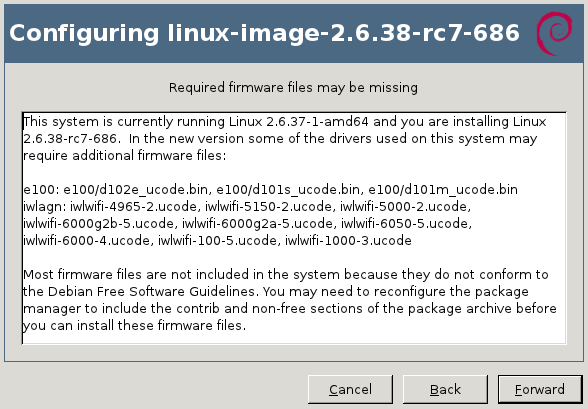
But you might be informed sooner. When you install a new version of the Linux kernel with the official Debian packages, the post-installation script will go through all loaded modules (those listed by lsmod) and it will verify whether this module as provided by the newly installed kernel might require firmware files. This information can be retrieved with modinfo:
$ modinfo -F firmware /lib/modules/2.6.32-5-amd64/kernel/drivers/net/e100.ko
e100/d102e_ucode.bin
e100/d101s_ucode.bin
e100/d101m_ucode.bin
If one (or more) of those firmware is (are) not yet available on the system, you will get a warning message similar to this one:
update-initramfs will also generate a similar warning on the terminal:
update-initramfs: Generating /boot/initrd.img-2.6.32-5-amd64
W: Possible missing firmware /lib/firmware/e100/d102e_ucode.bin for module e100
W: Possible missing firmware /lib/firmware/e100/d101s_ucode.bin for module e100
W: Possible missing firmware /lib/firmware/e100/d101m_ucode.bin for module e100
The Debian installer also detects when you have hardware that might require a missing firmware file. You have the option to supply the missing files on a USB stick (either directly or through the corresponding package). How do I find and install the missing firmware? Now that you have the name of the firmware file that you want, it s relatively easy to identify the package that provides the required file. You can use apt-cache search <filename> because the firmware packages embed the list of firmware files in their description. You can also use apt-file (provided by the package of the same name) or the web interface at packages.debian.org.
$ apt-cache search d101m_ucode.bin
firmware-linux-nonfree - Binary firmware for various drivers in the Linux kernel
$ apt-file search d101m_ucode.bin
firmware-linux-nonfree: /lib/firmware/e100/d101m_ucode.bin
If the above commands return nothing, you probably need to enable the non-free repository in your /etc/apt/sources.list (you can also enable it within synaptic). And you also want to run sudo apt-file update to have the latest information. Now you can install the right package, in the example above it was firmware-linux-nonfree. How do I install all firmware just to be sure I don t miss any? There s no meta-package depending on all firmware packages so there s no easy answer to this question. Furthermore not all firmware packages respect the naming convention firmware-* (there s for example zd1211-firmware). So your best bet is to look up all the packages with a generic search like this one:
$ apt-file --package-only search /lib/firmware/
atmel-firmware
[...]
And then install them all. Are there DVD or CD images with non-free firmware? Yes. Debian provides an unofficial netinst image for i386/amd64/powerpc with the non-free firmware, you can find it here: http://cdimage.debian.org/cdimage/unofficial/non-free/cd-including-firmware/. I provide complete DVD sets with firmware, and Multi-Arch CD/DVD with firmware, it s over there in my DVD shop: http://raphaelhertzog.com/go/debian-cd/ (i386/amd64 only) When using those installation discs, the Debian-installer will be able to find the required firmware immediately. There s no need for you to provide them on a USB stick. Other questions? I think I covered the most important things you have to know about firmware on Debian. But should you still have a question, feel free to share it in the comments so that I can improve this article.
Click here to subscribe to my free newsletter and get my monthly analysis on what s going on in Debian and Ubuntu. Or just follow along via the RSS feed, Identi.ca, Twitter or Facebook.

6 comments Liked this article? Click here. My blog is Flattr-enabled.

13 March 2011

Steve Kemp: A few forks.

Although I promised in my previous entry that I'd made my last mention of the redisfs - replication friendly redis-based filesystem I have to disappoint. Ben Sykes informed me that he'd made a fork of redisfs, called shredisfs. I like forks. Forks are good, and this particular one was very welcome - from the README:
Steve's original managed around 250k per second for writes on my test machine, this version does about 15MB a second writes. ... Read speed on the test machine here now is around 180MB/sec..
Needless to say I "stole" the improvements and rolled them into my original release. Thanks all round to those of you that submitted bug reports, suggestions, and codez. I also had a release out briefly which used zLib to compress the values of keys stored in memory. Unfortunately that lead to a net-slowdown for files which were bigger than a single block - due to the overhead of file-system appends which translated to: "fetch", "compress", "append", and "decompress". Finally on the subject of qpsmtpd, my favourite SMTP-server - the exceptionally talented Matt Sergeant released a proof of concept rewrite in Javascript. Using nodejs this new SMTP server is heavily asynchronous and you can find it online under the name Haraka. Although my javascript-fu is weak I'm very impressed by the codebase out there so far, and I'd expect good things of it in the future. Even if it does use Javascript and not my beloved Perl. Finally I'm a year older. But birthdays aren't important. ObQuote: "Do you wanna know what makes all my candy taste so special? " - Epic Movie.

David Bremner: Debugging Duplicity Duplication

It seems kind of unfair, given the name, but duplicity really doesn't like to be run in parallel. This means that some naive admin (not me of course, but uh, this guy I know ;) ) who writes a crontab
 @daily  duplicity incr $ARGS $SRC $DEST
 @weekly duplicity full $ARGS $SRC $DEST 
is in for a nasty surprise when both fire at the same time. In particular one of them will terminate with the not very helpful.
 AttributeError: BackupChain instance has no attribute 'archive_dir'
After some preliminary reading of mailing list archives, I decided to delete ~/.cache/duplicity on the client and try again. This was not a good move.
  1. It didn't fix the problem
  2. Resyncing from the server required decrypting some information, which required access to the gpg private key.
Now for me, one of the main motivations for using duplicity was that I could encrypt to a key without having the private key accessible. Luckily the following crazy hack works.
  1. A host where the gpg private key is accessible, delete the ~/.cache/duplicity, and perform some arbitrary duplicity operation. I did duplicity clean $DEST
  2. Now rsync the ./duplicity/cache directory to the backup client.
Now at first you will be depressed, because the problem isn't fixed yet. What you need to do is go onto the backup server (in my case Amazon s3) and delete one of the backups (in my case, the incremental one). Of course, if you are the kind of reader who skips to the end, probably just doing this will fix the problem and you can avoid the hijinks. And, uh, some kind of locking would probably be a good plan... For now I just stagger the cron jobs.

Francois Marier: Setting up RAID on an existing Debian/Ubuntu installation

I run RAID1 on all of the machines I support. While such hard disk mirroring is not a replacement for having good working backups, it means that a single drive failure is not going to force me to have to spend lots of time rebuilding a machine.

The best possible time to set this up is of course when you first install the operating system. The Debian installer will set everything up for you if you choose that option and Ubuntu has alternate installation CDs which allow you to do the same.

This post documents the steps I followed to retrofit RAID1 into an existing Debian squeeze installation. Getting a mirrored setup after the fact.

OverviewBefore you start, make sure the following packages are installed:
apt-get install mdadm rsync initramfs-tools
Then go through these steps:
  1. Partition the new drive.
  2. Create new degraded RAID arrays.
  3. Install GRUB2 on both drives.
  4. Copy existing data onto the new drive.
  5. Reboot using the RAIDed drive and test system.
  6. Wipe the original drive by adding it to the RAID array.
  7. Test booting off of the original drive.
  8. Resync drives.
  9. Test booting off of the new drive.
  10. Reboot with the two drives and resync the array.
(My instructions are mostly based on this old tutorial but also on this more recent one.)

1- Partition the new driveOnce you have connected the new drive (/dev/sdb), boot into your system and use one of cfdisk or fdisk to display the partition information for the existing drive (/dev/sda on my system).

The idea is to create partitions of the same size on the new drive. (If the new drive is bigger, leave the rest of the drive unpartitioned.)

Partition types should all be: fd (or "linux raid autodetect").

2- Create new degraded RAID arraysThe newly partioned drive, consisting of a root and a swap partition, can be added to new RAID1 arrays using mdadm:
mdadm --create /dev/md0 --level=1 --raid-devices=2 missing /dev/sdb1
mdadm --create /dev/md1 --level=1 --raid-devices=2 missing /dev/sdb2
and formatted like this:
mkswap /dev/md1
mkfs.ext4 /dev/md0
Specify these devices explicitly in /etc/mdadm/mdadm.conf:
DEVICE /dev/sda* /dev/sdb*
and append the RAID arrays to the end of that file:
mdadm --detail --scan >> /etc/mdadm/mdadm.conf
dpkg-reconfigure mdadm
You can check the status of your RAID arrays at any time by running this command:
cat /proc/mdstat

3- Install GRUB2 on both drivesThe best way to ensure that GRUB2, the default bootloader in Debian and Ubuntu, is installed on both drives is to reconfigure its package:
dpkg-reconfigure grub-pc
and select both /dev/sda and /dev/sdb (but not /dev/md0) as installation targets.

This should cause the init ramdisk (/boot/initrd.img-2.6.32-5-amd64) and the grub menu (/boot/grub/grub.cfg) to be rebuilt with RAID support.

4- Copy existing data onto the new driveCopy everything that's on the existing drive onto the new one using rsync:
mkdir /tmp/mntroot
mount /dev/md0 /tmp/mntroot
rsync -auHxv --exclude=/proc/* --exclude=/sys/* --exclude=/tmp/* /* /tmp/mntroot/

5- Reboot using the RAIDed drive and test systemBefore rebooting, open /tmp/mntroot/etc/fstab, and change /dev/sda1 and /dev/sda2 to /dev/md0 and /dev/md1 respectively.

Then reboot and from within the GRUB menu, hit "e" to enter edit mode and make sure that you will be booting off of the new disk:
set root='(md/0)'
linux /boot/vmlinuz-2.6.32-5-amd64 root=/dev/md0 ro quiet
Once the system is up, you can check that the root partition is indeed using the RAID array by running mount and looking for something like:
/dev/md0 on / type ext4 (rw,noatime,errors=remount-ro)

6- Wipe the original drive by adding it to the RAID arrayOnce you have verified that everything is working on /dev/sdb, it's time to change the partition types on /dev/sda to fd and to add the original drive to the degraded RAID array:
mdadm /dev/md0 -a /dev/sda1
mdadm /dev/md1 -a /dev/sda2
You'll have to wait until the two partitions are fully synchronized but you can check the sync status using:
watch -n1 cat /proc/mdstat

7- Test booting off of the original driveOnce the sync is finished, update the boot loader menu:
update-grub
and shut the system down:
shutdown -h now
before physically disconnecting /dev/sdb and turning the machine back on to test booting with only /dev/sda present.

After a successful boot, shut the machine down and plug the second drive back in before powering it up again.

8- Resync drivesIf everything works, you should see the following after running cat /proc/mdstat:
md0 : active raid1 sda1[1]
280567040 blocks [2/1] [_U]
indicating that the RAID array is incomplete and that the second drive is not part of it.

To add the second drive back in and start the sync again:
mdadm /dev/md0 -a /dev/sdb1

9- Test booting off of the new driveTo complete the testing, shut the machine down, pull /dev/sda out and try booting with /dev/sdb only.

10- Reboot with the two drives and resync the arrayOnce you are satisfied that it works, reboot with both drives plugged in and re-add the first drive to the array:
mdadm /dev/md0 -a /dev/sda1
Your setup is now complete and fully tested.

Ongoing maintenanceI recommend making sure the two RAIDed drives stay in sync by enabling periodic RAID checks. The easiest way is to enable the checks that are built into the Debian package:
dpkg-reconfigure mdadm
but you can also create a weekly or monthly cronjob which does the following:
echo "check" > /sys/block/md0/md/sync_action
Something else you should seriously consider is to install the smartmontools package and run weekly SMART checks by putting something like this in your /etc/smartd.conf:
/dev/sda -a -d ata -o on -S on -s (S/../.././02 L/../../6/03)
/dev/sdb -a -d ata -o on -S on -s (S/../.././02 L/../../6/03)
These checks, performed by the hard disk controllers directly, could warn you of imminent failures ahead of time. Personally, when I start seeing errors in the SMART log (smartctl -a /dev/sda), I order a new drive straight away.

11 March 2011

Dirk Eddelbuettel: RcppArmadillo 0.2.16

Conrad Sanderson continues an active release schedule for his wonderful Armadillo templated C++ library for linear algebra; release 1.1.8 just came out yesterday. So I made a new release 0.2.16 of RcppArmadillo, our Rcpp-based integration into R. No changes on our side. This new version should now be on most CRAN mirrors. The short NEWS file extract follows below containing just Conrad's entry for 1.1.8.
0.2.16  2011-03-10
    o   Upgraded to Armadillo Version 1.1.8   "Kangaroo Steak"
         * Added floor() and ceil()
         * Added "not a number": math::nan()
         * Added infinity: math::inf()
         * Added standalone is_finite()
         * Faster min(), max(), mean()
         * Bugfix for a corner case with NaNs in min() and max()
And courtesy of CRANberries, here are the diffs to.2.15.
 ChangeLog                                                    6 
 DESCRIPTION                                                 10 
 inst/NEWS                                                   11 
 inst/doc/RcppArmadillo-unitTests.pdf                     binary
 inst/doc/unitTests-results/RcppArmadillo-unitTests.html      6 
 inst/doc/unitTests-results/RcppArmadillo-unitTests.txt      38 -
 inst/include/armadillo                                       2 
 inst/include/armadillo_bits/Cube_meat.hpp                   10 
 inst/include/armadillo_bits/Mat_meat.hpp                    30 -
 inst/include/armadillo_bits/arma_ostream_meat.hpp          119 ++---
 inst/include/armadillo_bits/arma_ostream_proto.hpp           8 
 inst/include/armadillo_bits/arma_version.hpp                 6 
 inst/include/armadillo_bits/arrayops_meat.hpp               39 +
 inst/include/armadillo_bits/arrayops_proto.hpp               5 
 inst/include/armadillo_bits/auxlib_meat.hpp                 10 
 inst/include/armadillo_bits/constants.hpp                  322 +++++++++++---
 inst/include/armadillo_bits/diskio_meat.hpp                 46 +-
 inst/include/armadillo_bits/eglue_core_meat.hpp            345 +++-------------
 inst/include/armadillo_bits/eop_aux.hpp                     16 
 inst/include/armadillo_bits/eop_core_meat.hpp              105 +---
 inst/include/armadillo_bits/eop_core_proto.hpp               6 
 inst/include/armadillo_bits/fn_elem.hpp                     58 ++
 inst/include/armadillo_bits/fn_misc.hpp                     53 ++
 inst/include/armadillo_bits/fn_norm.hpp                     14 
 inst/include/armadillo_bits/format_wrap.hpp                 12 
 inst/include/armadillo_bits/op_max_meat.hpp                 43 -
 inst/include/armadillo_bits/op_mean_meat.hpp                38 -
 inst/include/armadillo_bits/op_min_meat.hpp                 46 +-
 inst/include/armadillo_bits/op_var_meat.hpp                 27 -
 inst/include/armadillo_bits/restrictors.hpp                  9 
 inst/include/armadillo_bits/traits.hpp                      20 
 31 files changed, 782 insertions(+), 678 deletions(-)
More information is on the RcppArmadillo page. Questions, comments etc should go to the rcpp-devel mailing list off the R-Forge page.

9 March 2011

Wouter Verhelst: NBD in d-i

Success! It only took, erm,
wouter@celtic:~/debian/debian-installer-wouter/partman-nbd/debian$ cat changelog 
partman-nbd (0.1) UNRELEASED; urgency=low
  * Initial release.
 -- Wouter Verhelst <wouter>  Fri, 28 Dec 2007 11:45:43 +0100
just over three years, but I've finally gotten it to work. More or less. That is to say, I have a VM currently running which is finishing up an installation. It hasn't completed yet, but it's gotten past the critical point now and I'm hopeful that a reboot test will be successful. If it is, I'll need to make sure that the updates that I've done on the live installer to massage it into running are committed to packages too, and then I'm all set. Looks like you'll be able to install wheezy on a system without hard disk. How's that for 'Universal operating system'?

Next.

Previous.