About a year and a half after I started writing the openstack-debian-images package, I m very happy to announce to everyone that, thanks to Steve McIntyre s help, the official OpenStack Debian image is now generated at the same time as the official Debian CD ISO images. If you are a cloud user, if you use OpenStack on a private cloud, or if you are a public cloud operator, then you may want to download the weekly build of the OpenStack image from here:

http://cdimage.debian.org/cdimage/openstack/testing/
Note that for the moment, there s only the amd64 arch available, but I don t think this is a problem: so far, I haven t found any public cloud provider offering anything else than Intel 64 bits arch. Maybe this will change over the course of this year, and we will need arm64, but this can be added later on.
Now, for later plans: I still have 2 bugs to fix on the openstack-debian-images package (the default 1GB size is now just a bit too small for Jessie, and the script exits with zero in case of error), but nothing that prevents its use right now. I don t think it will be a problem for the release team to accept these small changes before Jessie is out.
When generating the image, Steve also wants to generate a sources.tar.gz containing all the source packages that we include on the image. He already has the script (which is used as a hook script when running the build-openstack-debian-image script), and I am planning to add it as a documentation in /usr/share/doc/openstack-debian-images.
Last, probably it would be a good idea to install grub-xen, just as Ian Campbell suggested to make it possible for this image to run in AWS or other Xen based clouds. I would need to be able to test this though. If you can contribute with this kind of test, please get in touch.
Feel free to play with all of this, and customize your Jessie images if you need to. The script is (on purpose) very small (around 400 lines of shell script) and easy to understand (no function, it s mostly linear from top to bottom of the file), so it is also very easy to hack, plus it has a convenient hook script facility where you can do all sorts of things (copying files, apt-get install stuff, running things in the chroot, etc.).
Again, thanks so much to Steve for working on using the script during the CD builds. This feels me with joy that Debian finally has official images for OpenStack.
I go to the gym every couple of days. I lift things up, then put them down, and sometimes I repeat this process another 30 times. When I'm done I write down what I've done, how many times I did the lifty-droppy thing, and so on.
I want to see pretty graphs. I want to have records of different things. I guess I just need some simple text-boxes:
deadlift 3 x 7 @ 210lbs.
etc. Sometimes I use machines so I'd say instead:
converging seated-row 3 x 8 @ 150lbs
Anyway that's it. I want a simple GUI, a bit like a spreadsheet where I can easily add rows of each session. (A session might have 10-15 exercises in it, so not many.) I imagine some kind of SQLite database for the back-end. Or CSV. Either works.
Writing GUI software is hard. I guess I should look at GtK or Qt over the next few days and see if it is going to be easier to do it online via a jQuery + CGI system instead. To be honest I expect doing it "online" is liable to be more popular, but I think a desktop toy-application is just as useful.
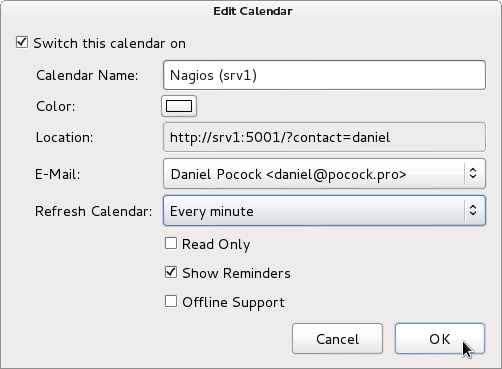
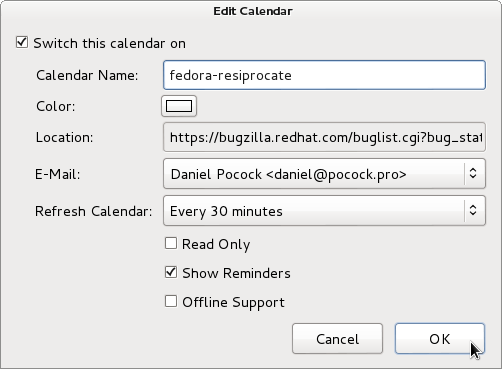
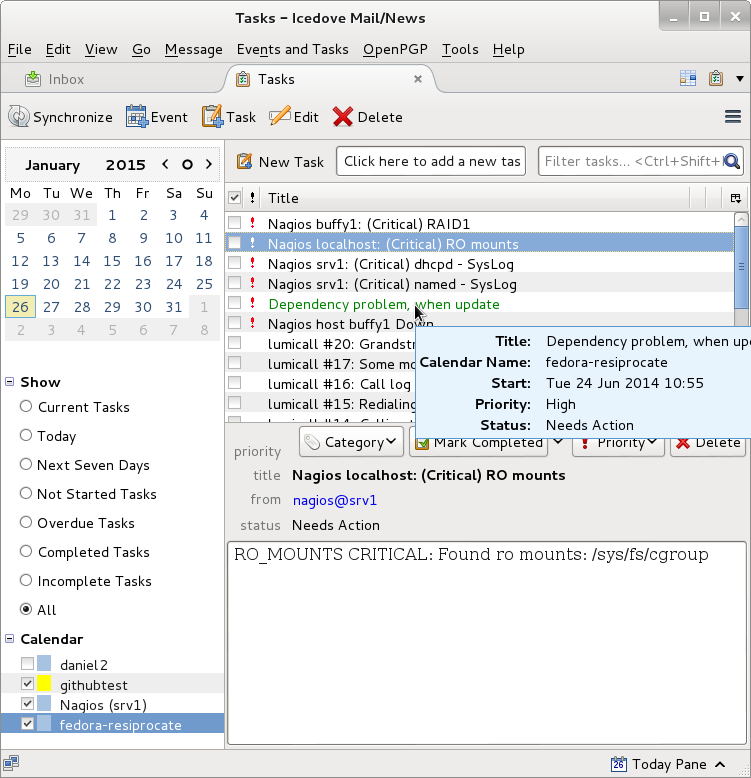
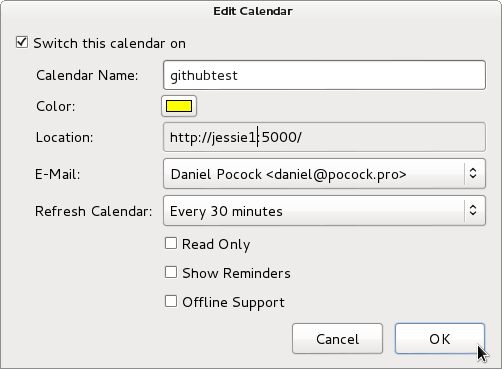
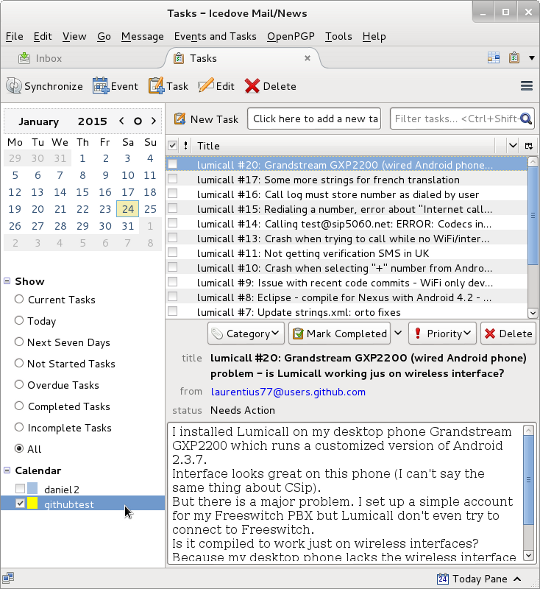
http://nagios-server.example.org:5001?contact=danielScreenshots Here I demonstrate using Mozilla Lightning / Iceowl-extension to aggregate issues from Nagios, the Fedora instance of Bugzilla and Lumicall's Github issues into a single to-do list.
-CONFIG_X86_SYSFB=y +# CONFIG_X86_SYSFB is not set -CONFIG_FB_SIMPLE=y +# CONFIG_FB_SIMPLE is not setWithout these modifications, the screen would be garbled some 5-6 seconds after boot (but SSH would still work, as far as I remember).
Dear manufacturers of kitchen scales, could you please stop
considering your clients as idiots, and start developing useful
features?Liquid measurement: this is one feature that is
available on almost every electronic scale available. Except it is
completely useless to people that use the metric system, as all it does
is replace the usual display in grammes by centilitres
and divide the number on display by ten. Thank you, but no person that
has been to school in a country that uses the metric system needs
electronic assistance to determine the volume corresponding to a given
weight of water, and for people that have not, a simple note written on
the scale, stating that for water or milk, divide the weight in grammes
by ten to get the volume in centilitres should be enough.
Now, there is still one thing that an electronic scale could be
useful for, which is determining the volume of liquids other than water
(density 1 g/ml) or milk (density approx. equal to 1 g/ml), most
importantly: oil (density approx. equal to .92 g/ml for edible oils like
sunflower, peanut, olive and canola).
I install the

unattended-upgrades
package on almost all of my Debian and Ubuntu servers in order to ensure
that security updates are automatically applied. It works quite well except
that I still need to login manually to upgrade my
Rackspace servers whenever a new
rackspace-monitoring-agent is released because it comes from a separate
repository
that's not covered by unattended-upgrades.
It turns out that unattended-upgrades can be configured to automatically
upgrade packages outside of the standard security repositories but it's not
very well documented and the few relevant
answers
you can find online are still using the old whitelist syntax.
apt-get install unattended-upgrades
and to answer yes to the automatic stable update question.
If you don't see the question (because your debconf threshold is too low --
change it with dpkg-reconfigure debconf), you can always trigger the
question manually:
dpkg-reconfigure -plow unattended-upgrades
Once you've got that installed, the configuration file you need to look at is
/etc/apt/apt.conf.d/50unattended-upgrades.
origin (shortcut: o)label (shortcut: l)archive (shortcut: a)suite (which is the same as archive)component (shortcut: c)site (no shortcut)_Release file under /var/lib/apt/lists/.
Note that the value of site is the hostname of the package repository,
also present in the first part these *_Release filenames
(stable.packages.cloudmonitoring.rackspace.com in the example below).
In my case, I was looking at the following inside
/var/lib/apt/lists/stable.packages.cloudmonitoring.rackspace.com_debian-wheezy-x86%5f64_dists_cloudmonitoring_Release:
Origin: Rackspace
Codename: cloudmonitoring
Date: Fri, 23 Jan 2015 18:58:49 UTC
Architectures: i386 amd64
Components: main
...
which means that, in addition to site, the only things I could match on
were origin and component since there are no Suite or Label fields
in the Release file.
This is the line I ended up adding to my
/etc/apt/apt.conf.d/50unattended-upgrades:
Unattended-Upgrade::Origins-Pattern
// Archive or Suite based matching:
// Note that this will silently match a different release after
// migration to the specified archive (e.g. testing becomes the
// new stable).
// "o=Debian,a=stable";
// "o=Debian,a=stable-updates";
// "o=Debian,a=proposed-updates";
"origin=Debian,archive=stable,label=Debian-Security";
"origin=Debian,archive=oldstable,label=Debian-Security";
+ "origin=Rackspace,component=main";
;
unattended-upgrades will pick
up rackspace-monitoring-agent the next time it runs, I used:
unattended-upgrade --dry-run --debug
which should output something like this:
Initial blacklisted packages:
Starting unattended upgrades script
Allowed origins are: ['origin=Debian,archive=stable,label=Debian-Security', 'origin=Debian,archive=oldstable,label=Debian-Security', 'origin=Rackspace,component=main']
Checking: rackspace-monitoring-agent (["<Origin component:'main' archive:'' origin:'Rackspace' label:'' site:'stable.packages.cloudmonitoring.rackspace.com' isTrusted:True>"])
pkgs that look like they should be upgraded: rackspace-monitoring-agent
...
Option --dry-run given, *not* performing real actions
Packages that are upgraded: rackspace-monitoring-agent
/var/run/reboot-required file whenever a kernel update has been installed,
all you need to do is create a cronjob like this in
/etc/cron.daily/reboot-required:
#!/bin/sh
cat /var/run/reboot-required 2> /dev/null true
assuming of course that you are already receiving emails sent to the root
user (if not, add the appropriate alias in /etc/aliases and run
newaliases).
acpi -V as
well as via the KDE widget. Hibernation via systemctl
hibernate works as well.
What does not work is the warning when my battery is low, or
automagic hibernation when shutting the lid or when the battery
level is critical.
From what I gather, something in the communication between
upower and KDE broke down, but I can't find what it is. I have also
been told that Cinnamon is affected as well, so this seems to be a
more general problem
Sadly, me and anyone else who's affected has been unable to fix
this.
So, dear lazyweb, please help.
In loosely related news, this old status is still
valid. UMTS is stable-ish now but even though I saved the SIM's
PIN, KDE always displays a "SIM PIN unlock request" prompt after
booting or hibernating. Once I enter that PIN, systemd tells me
that a system policy prevents the change and wants my user
password. If anyone knows how to get rid of that, I would
also appreciate any pointers.
I've done a bunch of hacking on the Redis key/value database server recently:
Lua-based maxmemory eviction scripts. (#2319) (This changeset was sponsored by an anonymous client.) Redis typically stores the entire data set in memory, using the operating system's virtual memory facilities if required. However, one can use Redis more like a cache or ring buffer by enabling a "maxmemory policy" where a RAM limit is set and then data is evicted when required based on a predefined algorithm. This change enables entirely custom control over exactly what data to remove from RAM when this maxmemory limit is reached. This is an advantage over the existing policies of, say, removing entire keys based on the existing TTL, Least Recently Used (LRU) or random eviction strategies as it permits bespoke behaviours based on application-specific requirements, crucially without maintaining a private fork of Redis. As an example behaviour of what is possible with this change, to remove the lowest ranked member of an arbitrary sorted set, you could load the following eviction policy script:
local bestkey = nil local bestval = 0 for s = 1, 5 do local key = redis.call("RANDOMKEY") local type_ = redis.call("TYPE", key) if type_.ok == "zset" then local tail = redis.call("ZRANGE", key, "0", "0", "WITHSCORES") local val = tonumber(tail[2]) if not bestkey or val < bestval then bestkey = key bestval = val end end end if not bestkey then -- We couldn't find anything to remove, so return an error return false end redis.call("ZREMRANGEBYRANK", bestkey, "0", "0") return true
TCP_FASTOPEN support. (#2307) The aim of TCP_FASTOPEN is to eliminate one roundtrip from a TCP conversation by allowing data to be included as part of the SYN segment that initiates the connection. (More info.)
Support infinitely repeating commands in redis-cli. (#2297)
Add --failfast option to testsuite runner. (#2290)
Add a -q (quiet) argument to redis-cli. (#2305)
Making some Redis Sentinel defaults a little saner. (#2292)
Add run-parts(8) directories to be executed at various points in the daemon's lifecycle. (e427f8) This is especially useful for loading Lua scripts as they are not persisted across restarts.
Split out Redis Sentinel into its own package. (#775414, 39f642) This makes it possible to run Sentinel sanely on Debian systems without bespoke scripts, etc.
Ensure /etc/init.d/redis-server start idempotency with --oknodo (60b7dd) Idempotency in initscripts is especially important given the rise of configuration managment systems.
Uploaded 3.0.0 RC2 to Debian experimental. (37ac55)
Re-enabled the testsuite. (7b9ed1)
Conrad put up a maintenance release 4.600.4 of Armadillo a few days ago. As in the past, we tested this with number of pre-releases and test builds against the now over one hundred CRAN dependents of our RcppArmadillo package. The tests passed fine as usual, and results are as always in the rcpp-logs repository.
Changes are summarized below based on the NEWS.Rd file.
Changes in RcppArmadillo version 0.4.600.4.0 (2015-01-23)Courtesy of CRANberries, there is also a diffstat report for the most recent release. As always, more detailed information is on the RcppArmadillo page. Questions, comments etc should go to the rcpp-devel mailing list off the R-Forge page.
- Upgraded to Armadillo release Version 4.600.4 (still "Off The Reservation")
- Speedups in the transpose operation
- Small bug fixes
This post by Dirk Eddelbuettel originated on his Thinking inside the box blog. Please report excessive re-aggregation in third-party for-profit settings.
Four years ago, whilst looking for something unrelated, I stumbled across
Tom Morton's port of "Frontier: Elite
II" for the Atari to i386/OpenGL.
This took me right back to playing Frontier on my Amiga in the mid-nineties. I
spent a bit of time replaying Frontier and its sequel, First Encounters, for
which there exists an interesting family of community-written game engines
based on a reverse-engineering of the original DOS release.
I made some scrappy notes about engines, patches etc. at the time, which are on
my frontier page.
With the recent release of Elite: Dangerous, I thought I'd pick up where I
left in 2010 and see if I could get the Thargoid ship. I'm nowhere near yet,
but I've spent some time trying to maximize income during the game's initial
Soholian Fever period. My record in a JJFFE-derived engine (and winning the
Wiccan Ware race during the same period) is currently 727,800. Can you do
better?
Since July, I have been aware of an ugly problem with
propellor. Certain
propellor configurations could have a bug. I've tried to solve the problem at
least a half-dozen times without success; it's eaten several weekends.
Today I finally managed to fix propellor so it's impossible to write code that
has the bug, bending the Haskell type checker to my will with the power of
GADTs and type-level functions.
the bug
Code with the bug looked innocuous enough. Something like this:
foo :: Property
foo = property "foo" $
unlessM (liftIO $ doesFileExist "/etc/foo") $ do
bar <- liftIO $ readFile "/etc/foo.template"
ensureProperty $ setupFoo bar
ensureProperty
line, and the setupFoo Property is run only sometimes, and is
passed data that is read from the filesystem.
This makes it very hard, indeed probably impossible for Propellor to
look inside the monad, realize that setupFoo is being used, and add
its Info to the host.
Probably, setupFoo doesn't have Info associated with it -- most
properties do not. But, it's hard to tell, when writing such a Property
if it's safe to use ensureProperty. And worse, setupFoo could later
be changed to have Info.
Now, in most languages, once this problem was noticed, the solution would
probably be to make ensureProperty notice when it's called on a Property
that has Info, and print a warning message. That's Good Enough in a sense.
But it also really stinks as a solution. It means that building propellor
isn't good enough to know you have a working system; you have to let it
run on each host, and watch out for warnings. Ugh, no!
the solution
This screams for GADTs. (Well, it did once I learned how what GADTs are
and what they can do.)
With GADTs, Property NoInfo and Property HasInfo can be separate data
types. Most functions will work on either type (Property i) but
ensureProperty can be limited to only accept a Property NoInfo.
data Property i where
IProperty :: Desc -> ... -> Info -> Property HasInfo
SProperty :: Desc -> ... -> Property NoInfo
data HasInfo
data NoInfo
ensureProperty :: Property NoInfo -> Propellor Result
requires,
which only runs the first Property after the second one has successfully
been met.
So, what's it's type when used with GADT Property?
requires :: Property i1 -> Property i2 -> Property ???
class Combine x y r where
requires :: x -> y -> r
Combines, for each combination
of 2 Properties with HasInfo or NoInfo.
It type checked. But, type inference was busted. A simple expression
like
foo requires bar
blew up:
No instance for (Requires (Property HasInfo) (Property HasInfo) r0)
arising from a use of requires'
The type variable r0' is ambiguous
Possible fix: add a type signature that fixes these type variable(s)
Note: there is a potential instance available:
instance Requires
(Property HasInfo) (Property HasInfo) (Property HasInfo)
-- Defined at Propellor/Types.hs:167:10
To avoid that, it needed ":: Property HasInfo" appended --
I didn't want the user to need to write that.
I got stuck here for an long time, well over a month.
type level programming
Finally today I realized that I could fix this with a little type-level
programming.
class Combine x y where
requires :: x -> y -> CombinedType x y
CombinedType is a type-level function, that calculates the type that
should be used for a combination of types x and y. This turns out to be really
easy to do, once you get your head around type level functions.
type family CInfo x y
type instance CInfo HasInfo HasInfo = HasInfo
type instance CInfo HasInfo NoInfo = HasInfo
type instance CInfo NoInfo HasInfo = HasInfo
type instance CInfo NoInfo NoInfo = NoInfo
type family CombinedType x y
type instance CombinedType (Property x) (Property y) = Property (CInfo x y)
before :: (IsProp x, Combines y x, IsProp (CombinedType y x)) => x -> y -> CombinedType y x
before x y = (y requires x) describe (propertyDesc x)
onChange
:: (Combines (Property x) (Property y))
=> Property x
=> Property y
=> CombinedType (Property x) (Property y)
onChange = -- 6 lines of code omitted
fallback :: (Combines (Property p1) (Property p2)) => Property p1 -> Property p2 -> Property (CInfo p1 p2)
fallback = -- 4 lines of code omitted
[Property], and since a haskell list can only contain a
single type, while Property Info and Property NoInfo are two different
types, that needed to be dealt with. Happily, I was able to extend
propellor's existing (&) and (!) operators to work in this situation,
so a list can be constructed of properties of several different types:
propertyList "foos" $ props
& foo
& foobar
! oldfoo
$ sudo apt-get install python-yaml python-icalendar python-flask python-pygithubJust create an API token in Github and put it into a configuration file like this:
api_token: 6b36b3d7579d06c9f8e88bc6fb33864e4765e5fac4a3c2fd1bc33aad bind_address: ::0 bind_port: 5000 filter: allRun it from the shell:
$ ./github_icalendar/main.py github-ics.cfgand connect to it with your favourite iCalendar client. Consolidating issue lists from Bugzilla, Github, Debian BTS and other sources A single iCalendar client can usually support multiple sources and thereby consolidate lists of issues from multiple bug trackers. This can be much more powerful than combining RSS bug feeds because iCalendar has built-in support for concepts such as priority and deadline. The client can use these to help you identify the most critical issues across all your projects, no matter which bug tracker they use. Bugzilla bugtrackers already expose iCalendar feeds directly, just look for the iCalendar link at the bottom of any search results page. Here is an example URL from the Mozilla instance of Bugzilla. The Ultimate Debian Database consolidates information from the Debian and Ubuntu universe and can already export it as an RSS feed, there is discussion about extrapolating that to an iCalendar feed too. Further possibilities
A new release 0.11.4 of Rcpp is now on the CRAN network for GNU R, and an updated Debian package will be uploaded in due course.
Rcpp has become the most popular way of enhancing GNU R with C++ code. As of today, 323 packages on CRAN depend on Rcpp for making analyses go faster and further; BioConductor adds another 41 packages, and casual searches on GitHub suggests dozens mores.
This release once again adds a large number of small bug fixes, polishes and enhancements. And like the last time, these changes were made by a group of seven different contributors (counting code commits) plus three more providing concrete suggestions. This shows that the Rcpp development and maintenance rests a large number of (broad) shoulders.
See below for a detailed list of changes extracted from the NEWS file.
Changes in Rcpp version 0.11.4 (2015-01-20)Thanks to CRANberries, you can also look at a diff to the previous release As always, even fuller details are on the Rcpp Changelog page and the Rcpp page which also leads to the downloads page, the browseable doxygen docs and zip files of doxygen output for the standard formats. A local directory has source and documentation too. Questions, comments etc should go to the rcpp-devel mailing list off the R-Forge page.
- Changes in Rcpp API:
- The
ListOf<T>class gains the.attrand.namesmethods common to other Rcpp vectors.- The
[dpq]nbinom_mu()scalar functions are now available via theR::namespace when R 3.1.2 or newer is used.- Add an additional test for AIX before attempting to include
execinfo.h.Rcpp::stopnow supports improvedprintf-like syntax using the small tinyformat header-only library (following a similar implementation in Rcpp11)- Pairlist objects are now protected via an additional
Shield<>as suggested by Martin Morgan on the rcpp-devel list.- Sorting is now prohibited at compile time for objects of type
List,RawVectorandExpressionVector.- Vectors now have a
Vector::const_iteratorthat is 'const correct' thanks to fix by Romain following a bug report in rcpp-devel by Martyn Plummer.- The
mean()sugar function now uses a more robust two-pass method, and new unit tests formean()were added at the same time.- The
mean()andvar()functions now support all core vector types.- The
setequal()sugar function has been corrected via suggestion by Qiang Kou following a bug report by S ren H jsgaard.- The macros
major,minor, andmakedevno longer leak in from the (Linux) system headersys/sysmacros.h.- The
push_front()string function was corrected.- Changes in Rcpp Attributes:
- Only look for plugins in the package's namespace (rather than entire search path).
- Also scan header files for definitions of functions to be considerd by Attributes.
- Correct the regular expression for source files which are scanned.
- Changes in Rcpp unit tests
- Added a new binary test which will load a pre-built package to ensure that the Application Binary Interface (ABI) did not change; this test will (mostly or) only run at Travis where we have reasonable control over the platform running the test and can provide a binary.
- New unit tests for sugar functions
mean,setequalandvarwere added as noted above.- Changes in Rcpp Examples:
- For the (old) examples
ConvolveBenchmarksandOpenMP, the respectiveMakefilewas renamed toGNUmakefileto pleaseR CMD checkas well as the CRAN Maintainers.
This post by Dirk Eddelbuettel originated on his Thinking inside the box blog. Please report excessive re-aggregation in third-party for-profit settings.
A new version of RcppGSL is now on CRAN. This package provides an interface from R to the GNU GSL using our Rcpp package.
This follows on the heels on the recent RcppGSL 0.2.3 release and extends the excellent point made by Qiang Kou in a contributed section of the vignette: We now not only allow to turn the GSL error handler off (to not abort() on error) but do so on package initialisation.
No other user-facing changes were made.
The NEWS file entries follows below:
Changes in version 0.2.4 (2015-01-24)Courtesy of CRANberries, a summary of changes to the most recent release is available. More information is on the RcppGSL page. Questions, comments etc should go to the rcpp-devel mailing list off the R-Forge page.
- Two new helper function to turn the default GSL error handler off (and to restore it) were added. The default handler is now turned off when the package is attached so that GSL will no longer abort an R session on error. Users will have to check the error code.
- The
RcppGSL-intro.Rnwvignette was expanded with a short section on the GSL error handler (thanks to Qiang Kou).
This post by Dirk Eddelbuettel originated on his Thinking inside the box blog. Please report excessive re-aggregation in third-party for-profit settings.
A new version of RcppAnnoy is now on CRAN. RcppAnnoy wraps the small, fast, and lightweight C++ template header library Annoy written by Erik Bernhardsson for use at Spotify. RcppAnnoy uses Rcpp Modules to offer the exact same functionality as the Python module wrapped around Annoy.
This version contains a trivial one-character change requested by CRAN to cleanse the Makevars file of possible GNU Make-isms. Oh well. This release also overcomes an undefined behaviour sanitizer bug noticed by CRAN that took somewhat more effort to deal with. As mentioned recently in another blog post, it took some work to create a proper Docker container with the required compiler and subsequent R setup, but we have one now, and the aforementioned blog post has details on how we replicated the CRAN finding of an UBSAN issue. It also took Erik some extra efforts to set something up for his C++/Python side, but eventually an EC2 instance with Ubuntu 14.10 did the task as my Docker sales skills are seemingly not convincing enough. In any event, he very quickly added the right fix, and I synced RcppAnnoy with his Annoy code.
Courtesy of CRANberries, there is also a diffstat report for this release. More detailed information is on the RcppAnnoy page page.
This post by Dirk Eddelbuettel originated on his Thinking inside the box blog. Please report excessive re-aggregation in third-party for-profit settings.
Lever Rukhin Photographs Los Angeles From His CarPhoblographer: It looks like many of these images have artificial lighting in them. What s your gear setup, and how do you introduce so much light into the scene from your car? Lever: About 9 months ago, I affixed a Mola beauty dish onto the roof rack of my 75 Volvo and juice it with a profoto bi-tube. This takes a bit of practice, as making a turn changes the light completely, which I always try to keep balanced. The Canon 5D3 with a 24mm f1.4 is set up on a tripod. The strobe has allowed me to capture more detail as well as creating a somewhat surreal feel to the sets.
Lev Rukhin http://www.levrukhin.com/Pitchfork: The world has a difficult time with the female auteur. B: I have nothing against Kanye West. Help me with this I m not dissing him this is about how people talk about him. With the last album he did, he got all the best beatmakers on the planet at the time to make beats for him. A lot of the time, he wasn t even there. Yet no one would question his authorship for a second. If whatever I m saying to you now helps women, I m up for saying it. For example, I did 80% of the beats on Vespertine and it took me three years to work on that album, because it was all microbeats it was like doing a huge embroidery piece. Matmos came in the last two weeks and added percussion on top of the songs, but they didn t do any of the main parts, and they are credited everywhere as having done the whole album. [Matmos ] Drew [Daniel] is a close friend of mine, and in every single interview he did, he corrected it. And they don t even listen to him. It really is strange.In Defense of the Selfie Stick
When you ask someone to take a picture of you, technically, they are the photographer, and they own the copyright of your picture. ( ) All of a sudden, your backpacking adventure in Europe requires you to pack a stack of legal contracts. Now your exchange goes from Can you take a picture of us? to Can you take a picture of us, making sure that the church is on the top right corner, and also, I am going to need you to sign this paper .I don t know what s with the selfie stick hate. Let people have fun, it doesn t hurt. If anything, it prevents them from asking you to take their photo, and if we already established you are the kind of people not a big fan of strangers, all the better, right? Why Top Tech CEOs Want Employees With Liberal Arts Degrees
Both Yi and Sheer recognize that the scientific method is valuable, with its emphasis on logic and reason, especially when dealing with data or engineering problems. But they believe this approach can sometimes be limiting. When I collaborate with people who have a strictly technical background, says Yi, the perspective I find most lacking is an understanding of what motivates people and how to balance multiple factors that are at work outside the realm of technology.Interesting food for thought, specially if you know an engineer that ditches the arts as of little value for personal growth in their careers/life.
I recently started using the Slack group chat tool in a few teams. Wishing to add some vanity notifications such as sales and user growth milestones from some Django-based projects, I put together an easy-to-use integration between the two called django-slack.
Whilst you can use any generic Python-based method of sending messages to Slack, using a Django-specific integration has some advantages:
from django_slack import slack_message @login_required def view(request, item_id): item = get_object_or_404(Item, pk=item_id) slack_message('items/viewed.slack', 'item': item, 'user': request.user, ) return render(request, 'items/view.html', 'item': item, )
% extends django_slack % % block text % user.get_full_name just viewed item.title ( item.content urlize ). % endblock %.slack files are regular Django templates text is automatically escaped as appropriate and that you can use the regular template filters and tags such as urlize, loops, etc. By default, django-slack posts to the #general channel, but it can be overridden on a per-message basis by specifying a channel block:
% block channel % #mychannel % endblock %You can also set the icon, URL and emoji in a similar fashion. You can set global defaults for all of these attributes to avoid DRY violations within .slack templates as well. For more information please see the project homepage or read the documentation. Patches and other contributions are welcome via the django-slack GitHub project.
| Week | Squeeze | Wheezy | Jessie |
|---|---|---|---|
| 43 | 284 (213+71) | 468 (332+136) | 319 (240+79) |
| 44 | 261 (201+60) | 408 (265+143) | 274 (224+50) |
| 45 | 261 (205+56) | 425 (291+134) | 295 (229+66) |
| 46 | 271 (200+71) | 401 (258+143) | 427 (313+114) |
| 47 | 283 (209+74) | 366 (221+145) | 342 (260+82) |
| 48 | 256 (177+79) | 378 (230+148) | 274 (189+85) |
| 49 | 256 (180+76) | 360 (216+155) | 226 (147+79) |
| 50 | 204 (148+56) | 339 (195+144) | ??? |
| 51 | 178 (124+54) | 323 (190+133) | 189 (134+55) |
| 52 | 115 (78+37) | 289 (190+99) | 147 (112+35) |
| 1 | 93 (60+33) | 287 (171+116) | 140 (104+36) |
| 1 | 93 (60+33) | 287 (171+116) | 140 (104+36) |
| 2 | 82 (46+36) | 271 (162+109) | 157 (124+33) |
| 3 | 25 (15+10) | 249 (165+84) | 172 (128+44) |
| 4 | 14 (8+6) | 244 (176+68) | 187 (132+55) |
| 5 | 2 (0+2) | 224 (132+92) | |
| 6 | release! | 212 (129+83) | |
| 7 | release+1 | 194 (128+66) | |
| 8 | release+2 | 206 (144+62) | |
| 9 | release+3 | 174 (105+69) | |
| 10 | release+4 | 120 (72+48) | |
| 11 | release+5 | 115 (74+41) | |
| 12 | release+6 | 93 (47+46) | |
| 13 | release+7 | 50 (24+26) | |
| 14 | release+8 | 51 (32+19) | |
| 15 | release+9 | 39 (32+7) | |
| 16 | release+10 | 20 (12+8) | |
| 17 | release+11 | 24 (19+5) | |
| 18 | release+12 | 2 (2+0) |
Next.