Search Results: "he"

4 February 2016

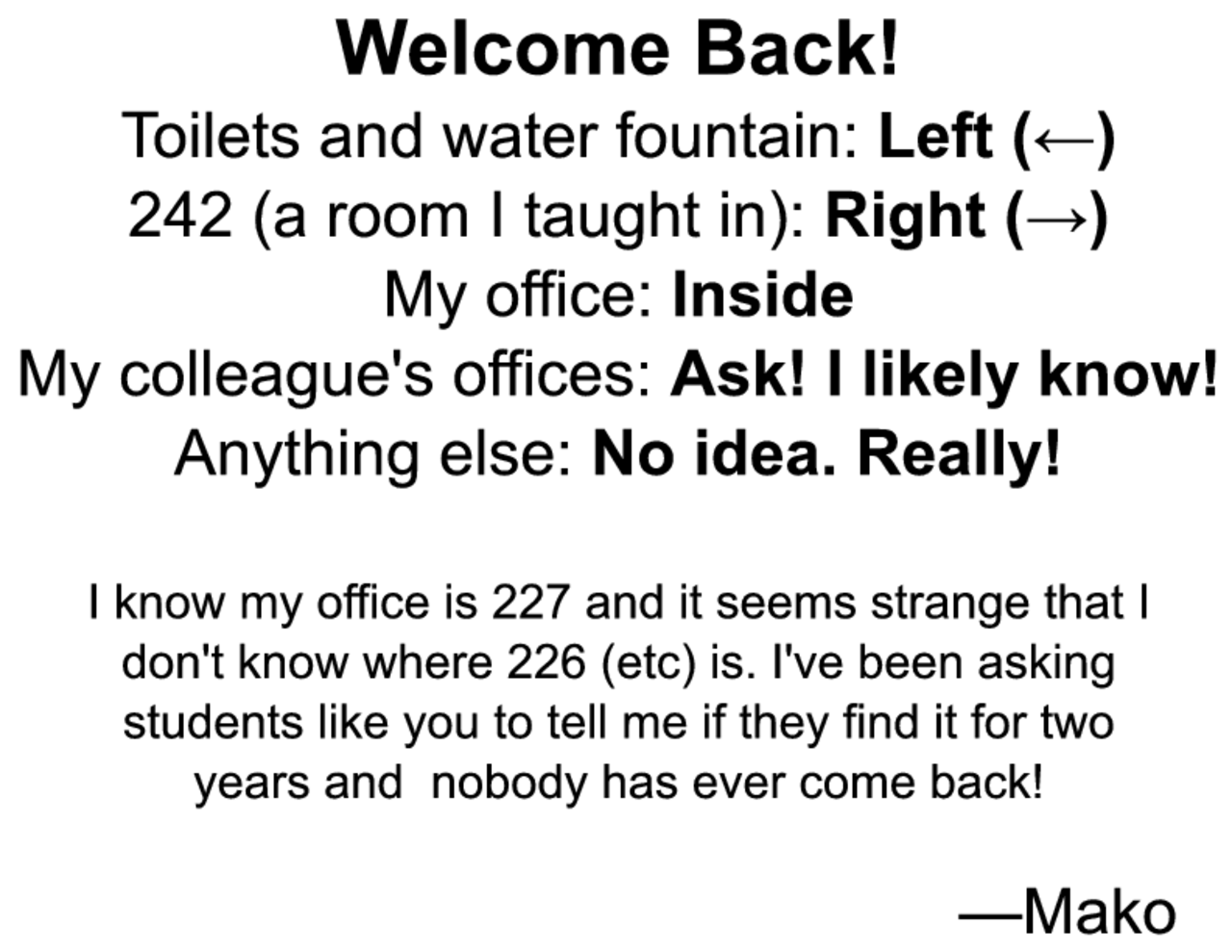
Benjamin Mako Hill: Welcome Back Poster

My office door is on the second floor in front the major staircase in my building. I work with my door open so that my colleagues and my students know when I m in. The only time I consider deviating from this policy is the first week of the quarter when I m faced with a stream of students, usually lost on their way to class and that, embarrassingly, I am usually unable to help. I made this poster so that these conversations can, in a way, continue even when I am not in the office. early_quarter_doors_sign

3 February 2016

Michal Čihař: Gammu 1.37.0

Today, Gammu 1.37.0 has been released. As usual it collects bug fixes. This time there is another important change as well - improver error reporting from SMSD. This means that when SMSD fails to connect to the database, you should get a bit more detailed error than "Unknown error". Full list of changes: Would you like to see more features in Gammu? You an support further Gammu development at Bountysource salt or by direct donation.

Filed under: English Gammu 0 comments

Sven Hoexter: Moby

Maybe my favourite song of Moby - "That's when I reach for my revolver" - is one of the more unsual ones, slightly more rooted in his Punk years and a cover version. Great artist anyway.

Jonathan Dowland: Comparing Docker images

I haven't written much yet about what I've been up to at work. Right now, I'm making changes to the sources of a set of Docker images. The changes I'm making should not result in any changes to the actual images: it's just a re-organisation of the way in which they are built. I've been using the btrfs storage driver for Docker which makes comparing image filesystems very easy from the host machine, as all the image filesystems are subvolumes. I use a bash script like the following to make sure I haven't broken anything:
oldid="$1"; newid="$2";
id_in_canonical_form()  
    echo "$1"   grep -qE '^[a-f0-9] 64 $'
 
canonicalize_id()  
    docker inspect --format '  .Id  ' "$1"
 
id_in_canonical_form "$oldid"   oldid="$(canonicalize_id "$oldid")"
id_in_canonical_form "$newid"   newid="$(canonicalize_id "$newid")"
cd "/var/lib/docker/btrfs/subvolumes"
sumpath()  
    cd "$1" && find . -printf "%M %4U %4G %16s %h/%f\n"   sort
 
diff -ruN "$oldid" "newid"
diff -u <(sumpath "$oldid") <(sumpath "$newid")
Using -printf means I can ignore changes in the timestamps on files which is something I am not interested in. If it is available in your environment, Lars Wirzenius' tool Summain generates manifests that include a file checksum and could be very useful for this use-case.

Wouter Verhelst: OMFG, ls

alias ls='ls --color=auto -N'
Unfortunately it doesn't actually revert to the previous behaviour, but it's close enough.

Thomas Goirand: Moby

Just a quick reply to Rhonda about Moby. You can t introduce him without telling about Go, which is the title who made him famous, very early in the age of electronic music (November 1990, according to wikipedia). Many attempted to remix this song (and Moby himself), but nothing s as good as the original version.

Michal &#268;iha&#345;: New projects on Hosted Weblate

I had some pile of hosting requests in queue since half of January and my recent talk on FOSDEM had some impact on requests for hosting translations as well, so it's about time to process them. New kids on the block are: Second round includes: Unfortunately I had to reject some projects as well mostly due to lack of file format support. This is still the same topic - when translating project, please stick with some standard format. Preferably what is usual on your platform. If you like this service, you can support it on Bountysource salt or Gratipay. There is also option for hosting translations of commercial products.

Filed under: English Weblate 0 comments

2 February 2016

Rhonda D'Vine: Moby

Today is one of these moods. And sometimes one needs certain artists/music to foster it. Music is powerful. There are certain bands I know that I have to stay away from when feeling down to not get too deep into it. Knowing that already helps a lot. The following is an artist that is not completely in that area, but he got powerful songs and powerful messages nevertheless; and there was this situation today that one of his songs came to my mind. That's the reason why I present you today Moby. These are the songs: Hope you like the selection; and like always: enjoy!

/music permanent link Comments: 2 Flattr this

Sune Vuorela: Compilers and error messages

So. I typo ed up some template code the other day. And once again I learned the importance of using several c++ compilers. Here is a very reduced version of my code:
#include <utility>
template <typename T> auto foo(const T& t) -> decltype(x.first)

return t.first;

int main()

foo(std::make_pair(1,2));
return 0;
And let s start with the compiler I was testing with first. MSVC (2013 and 2015)
main.cpp(8): error C2672: foo : no matching overloaded function found
main.cpp(8): error C2893: Failed to specialize function template unknown-type foo(const T &)
It is not completely clear from that error message what s going on, so let s try some other compilers: GCC (4.9-5.3)
2 : error: x was not declared in this scope
template <typename T> auto foo(const T& t) -> decltype(x.first)
That s pretty clear. More compilers: Clang (3.3-3.7)
2 : error: use of undeclared identifier x
template <typename T> auto foo(const T& t) -> decltype(x.first)
ICC (13)
example.cpp(2): error: identifier x is undefined
template <typename T> auto foo(const T& t) -> decltype(x.first)
(Yes. I mistyped the variable name used for decltype. Replacing the x with t makes it build). Thanks to http://gcc.godbolt.org/ and http://webcompiler.cloudapp.net/ for testing with various compilers.

Steve Kemp: Best practice - Don't serve writeable PHP files

I deal with compromises often enough of PHP-based websites that I wish to improve hardening. One obvious way to improve things is to not serve PHP files which are writeable by the webserver-user. This would ensure that things like wp-content/uploads didn't get served as PHP if a compromise wrote valid PHP there. In the past using php5-suhosin would have allowd this via the suhosin.executor.include.allow_writable_files flag. Since suhosin is no longer supported under Debian Jessie I wonder if there is a simple way to achieve this? I've written a toy-module which allows me to call stat on every request, and return a 403 on access to writeable files/directories. But it seems like I shouldn't need to write my own code for this functionality. Any pointers welcome; happy to post my code if that is useful but suspect not - it just shouldn't exist.

Dirk Eddelbuettel: Like peanut butter and jelly: x13binary and seasonal

This post was written by Dirk Eddelbuettel and Christoph Sax and will be posted on both author's respective blogs. The seasonal package by Christoph Sax brings a very featureful and expressive interface for working with seasonal data to the R environment. It uses the standard tool of the trade: X-13ARIMA-SEATS. This powerful program is provided by the statisticians of the US Census Bureau based on their earlier work (named X-11 and X-12-ARIMA) as well as the TRAMO/SEATS program by the Bank of Spain. X-13ARIMA-SEATS is probably the best known tool for de-seasonalization of timeseries, and used by statistical offices around the world. Sadly, it also has a steep learning curve. One interacts with a basic command-line tool which users have to download, install and properly reference (by environment variables or related means). Each model specification has to be prepared in a special 'spec' file that uses its own, cumbersome syntax. As seasonal provides all the required functionality to use X-13ARIMA-SEATS from R --- see the very nice seasonal demo site --- it still required the user to manually deal with the X-13ARIMA-SEATS installation. So we decided to do something about this. A pair of GitHub repositories provide both the underlying binary in a per-operating system form (see x13prebuilt) as well as a ready-to- use R package (see x13binary) which uses the former to provide binaries for R. And the latter is now on CRAN as package x13binary ready to be used on Windows, OS-X or Linux. And the seasonal package (in version 1.2.0 -- now on CRAN -- or later) automatically makes use of it. Installing seasaonal and x13binary in R is now as easy as:

install.packages("seasonal")
which opens the door for effortless deployment of powerful deasonalization. By default, the principal function of the package employs a number of automated techniques that work well in most circumstances. For example, the following code produces a seasonal adjustment of the latest data of US retail sales (by the Census Bureau) downloaded from Quandl:
library(seasonal) 
library(Quandl)   ## not needed for seasonal but has some niceties for Quandl data
rs <- Quandl(code="USCENSUS/BI_MARTS_44000_SM", type="ts")/1e3
m1 <- seas(rs)
plot(m1, main = "Retail Trade: U.S. Total Sales", ylab = "USD (in Billions)")
This tests for log-transformation, performs an automated ARIMA model search, applies outlier detection, tests and adjusts for trading day and easter effects, and invokes the SEATS method to perform seasonal adjustment. And this is how the adjusted series looks like:
Of course, you can access all available options of X-13ARIMA-SEATS as well. Here is an example where we adjust the latest data for Chinese exports (as tallied by the US FED), taking into account the different effects of Chinese New Year before, during and after the holiday:
xp <- Quandl(code="FRED/VALEXPCNM052N", type="ts")/1e9
m2 <- seas(window(xp, start = 2000),
          xreg = cbind(genhol(cny, start = -7, end = -1, center = "calendar"), 
                       genhol(cny, start = 0, end = 7, center = "calendar"), 
                       genhol(cny, start = 8, end = 21, center = "calendar")
          ),
          regression.aictest = c("td", "user"),
          regression.usertype = "holiday")
plot(m2, main = "Goods, Value of Exports for China", ylab = "USD (in Billions)")
which generates the following chart demonstrating a recent flattening in export activity measured in USD.
We hope this simple examples illustrates both how powerful a tool X-13ARIMA-SEATS is, but also just how easy it is to use X-13ARIMA-SEATS from R now that we provide the x13binary package automating its installation.

This post by Dirk Eddelbuettel originated on his Thinking inside the box blog. Please report excessive re-aggregation in third-party for-profit settings.

Norbert Preining: Gaming: The Talos Principle Road to Gehenna

After finishing the Talos Principle I immediately started to play the extension Road to Gehenna, but was derailed near completion by the incredible Portal Stories: Mel. Now that I finally managed to escape from the test chambers my attention returned to the Road to Gehenna. As with the pair Portal 2 and Portal Stories: Mel, the challenges are going up considerably from the original Talos Principle to the Road to Gehenna. Checking the hours of game play it took me about 24h through all the riddles in Road to Gehenna, but I have to admit, I had some riddles where I needed to cheat. road-to-gehenna.jpg The Road to Gehenna does not bring much new game play elements, but loads of new riddles. And the best of all, playable on Linux! And as with the original game, the graphics are really well done, while still be playable on my Vaio Pro laptop with Intel integrated graphic card a plus that is rare in the world of computer games where everyone is expected to have a high-end nVidia or Radeon card. Ok, there is not much action going on where quick graphic computations are necessary, still the impression of the game is great.

gehenna1 The riddles contain the well known elements (connectors, boxes, jammer, etc), but the settings are often spectacular, sometimes very small and narrow, just a few moves if done in the right order, sometimes like wide open fields with lots of space to explore. Transportation between various islands suspended in the air is with vents, giving you a lot of nice flight time!

gehenna2 If one searches a lot, or uses a bit of cheating, one can find good old friends from the Portal series, burried in the sand in one of the world. This is not the only easter egg hidden in the game, there are actually a lot, some of which I have not seen but only read about afterwards. Guess I need to replay the whole game.

gehenna3 Coming back to the riddles, I really believe that the makers have been ingenious in using the few items at hand to create challenging and surprising riddles. As it is so often, many of the riddles look completely impossible at first glance, and often even after staring at them for tens and tens of minutes. Until (and if) one has the the a-ha effect and understands the trick. This often still needs a lot of handwork and trial-error rounds, but all in all the game is well balanced. What is a bit a pain similar to the original game are collecting the stars to reach the hidden world and free the admin. There the developers overdid it in my opinion, with some rather absurd and complicated stars.

gehenna4 The end of the game, ascension of the messengers, is rather unspectacular. A short discussion on who remains and then a big closing scene with the messenger being beamed up a la Starship Enterprise, and a closing black screen. But well, the fun was with the riddles.
gehenna5 All in all an extension that is well worth the investment if one enjoyed the original Talos, and is looking for rather challenging riddles. Now that I have finished all the Portal and Talos titles, I am hard thinking of what is next looking into Braid Enjoy!

Michal &#268;iha&#345;: Weekly phpMyAdmin contributions 2016-W04

As I've already mentioned in separate blog post we mostly had some security issues fun in past weeks, but besides that some other work has been done as well. I've still focused on code cleanups and identified several pieces of code which are no longer needed (given our required PHP version). Another issue related to security updates was to set testing of 4.0 branch using PHP 5.2 as this is what we've messed up in the security release (what is quite bad as this is only branch supporting PHP 5.2). In addition to this, I've updated phpMyAdmin packages in both Debian and Ubuntu PPA. All handled issues:

Filed under: Debian English phpMyAdmin 0 comments

Russell Coker: Compatibility and a Linux Community Server

Compatibility/interoperability is a good thing. It s generally good for systems on the Internet to be capable of communicating with as many systems as possible. Unfortunately it s not always possible as new features sometimes break compatibility with older systems. Sometimes you have systems that are simply broken, for example all the systems with firewalls that block ICMP so that connections hang when the packet size gets too big. Sometimes to take advantage of new features you have to potentially trigger issues with broken systems. I recently added support for IPv6 to the Linux Users of Victoria server. I think that adding IPv6 support is a good thing due to the lack of IPv4 addresses even though there are hardly any systems that are unable to access IPv4. One of the benefits of this for club members is that it s a platform they can use for testing IPv6 connectivity with a friendly sysadmin to help them diagnose problems. I recently notified a member by email that the callback that their mail server used as an anti-spam measure didn t work with IPv6 and was causing mail to be incorrectly rejected. It s obviously a benefit for that user to have the problem with a small local server than with something like Gmail. In spite of the fact that at least one user had problems and others potentially had problems I think it s clear that adding IPv6 support was the correct thing to do. SSL Issues Ben wrote a good post about SSL security [1] which links to a test suite for SSL servers [2]. I tested the LUV web site and got A-. This blog post describes how to setup PFS (Perfect Forward Secrecy) [3], after following it s advice I got a score of B! From the comments on this blog post about RC4 etc [4] it seems that the only way to have PFS and not be vulnerable to other issues is to require TLS 1.2. So the issue is what systems can t use TLS 1.2. TLS 1.2 Support in Browsers This Wikipedia page has information on SSL support in various web browsers [5]. If we require TLS 1.2 we break support of the following browsers: The default Android browser before Android 5.0. Admittedly that browser always sucked badly and probably has lots of other security issues and there are alternate browsers. One problem is that many people who install better browsers on Android devices (such as Chrome) will still have their OS configured to use the default browser for URLs opened by other programs (EG email and IM). Chrome versions before 30 didn t support it. But version 30 was released in 2013 and Google does a good job of forcing upgrades. A Debian/Wheezy system I run is now displaying warnings from the google-chrome package saying that Wheezy is too old and won t be supported for long! Firefox before version 27 didn t support it (the Wikipedia page is unclear about versions 27-31). 27 was released in 2014. Debian/Wheezy has version 38, Debian/Squeeze has Iceweasel 3.5.16 which doesn t support it. I think it is reasonable to assume that anyone who s still using Squeeze is using it for a server given it s age and the fact that LTS is based on packages related to being a server. IE version 11 supports it and runs on Windows 7+ (all supported versions of Windows). IE 10 doesn t support it and runs on Windows 7 and Windows 8. Are the free upgrades from Windows 7 to Windows 10 going to solve this problem? Do we want to support Windows 7 systems that haven t been upgraded to the latest IE? Do we want to support versions of Windows that MS doesn t support? Windows mobile doesn t have enough users to care about. Opera supports it from version 17. This is noteworthy because Opera used to be good for devices running older versions of Android that aren t supported by Chrome. Safari supported it from iOS version 5, I think that s a solved problem given the way Apple makes it easy for users to upgrade and strongly encourages them to do so. Log Analysis For many servers the correct thing to do before even discussing the issue is to look at the logs and see how many people use the various browsers. One problem with that approach on a Linux community site is that the people who visit the site most often will be more likely to use recent Linux browsers but older Windows systems will be more common among people visiting the site for the first time. Another issue is that there isn t an easy way of determining who is a serious user, unlike for example a shopping site where one could search for log entries about sales. I did a quick search of the Apache logs and found many entries about browsers that purport to be IE6 and other versions of IE before 11. But most of those log entries were from other countries, while some people from other countries visit the club web site it s not very common. Most access from outside Australia would be from bots, and the bots probably fake their user agent. Should We Do It? Is breaking support for Debian/Squeeze, the built in Android browser on Android <5.0, and Windows 7 and 8 systems that haven t upgraded IE as a web browsing platform a reasonable trade-off for implementing the best SSL security features? For the LUV server as a stand-alone issue the answer would be no as the only really secret data there is accessed via ssh. For a general web infrastructure issue it seems that the answer might be yes. I think that it benefits the community to allow members to test against server configurations that will become more popular in the future. After implementing changes in the server I can advise club members (and general community members) about how to configure their servers for similar results. Does this outweigh the problems caused by some potential users of ancient systems? I m blogging about this because I think that the issues of configuration of community servers have a greater scope than my local LUG. I welcome comments about these issues, as well as about the SSL compatibility issues.

1 February 2016

Lunar: Reproducible builds: week 40 in Stretch cycle

What happened in the reproducible builds effort between January 24th and January 30th:

Media coverage Holger Levsen was interviewed by the FOSDEM team to introduce his talk on Sunday 31st.

Toolchain fixes Jonas Smedegaard uploaded d-shlibs/0.63 which makes the order of dependencies generated by d-devlibdeps stable accross locales. Original patch by Reiner Herrmann.

Packages fixed The following 53 packages have become reproducible due to changes in their build dependencies: appstream-glib, aptitude, arbtt, btrfs-tools, cinnamon-settings-daemon, cppcheck, debian-security-support, easytag, gitit, gnash, gnome-control-center, gnome-keyring, gnome-shell, gnome-software, graphite2, gtk+2.0, gupnp, gvfs, gyp, hgview, htmlcxx, i3status, imms, irker, jmapviewer, katarakt, kmod, lastpass-cli, libaccounts-glib, libam7xxx, libldm, libopenobex, libsecret, linthesia, mate-session-manager, mpris-remote, network-manager, paprefs, php-opencloud, pisa, pyacidobasic, python-pymzml, python-pyscss, qtquick1-opensource-src, rdkit, ruby-rails-html-sanitizer, shellex, slony1-2, spacezero, spamprobe, sugar-toolkit-gtk3, tachyon, tgt. The following packages became reproducible after getting fixed: Some uploads fixed some reproducibility issues, but not all of them:
  • gnubg/1.05.000-4 by Russ Allbery.
  • grcompiler/4.2-6 by Hideki Yamane.
  • sdlgfx/2.0.25-5 fix by Felix Geyer, uploaded by Gianfranco Costamagna.
Patches submitted which have not made their way to the archive yet:
  • #812876 on glib2.0 by Lunar: ensure that functions are sorted using the C locale when giotypefuncs.c is generated.

diffoscope development diffoscope 48 was released on January 26th. It fixes several issues introduced by the retrieval of extra symbols from Debian debug packages. It also restores compatibility with older versions of binutils which does not support readelf --decompress.

strip-nondeterminism development strip-nondeterminism 0.015-1 was uploaded on January 27th. It fixes handling of signed JAR files which are now going to be ignored to keep the signatures intact.

Package reviews 54 reviews have been removed, 36 added and 17 updated in the previous week. 30 new FTBFS bugs have been submitted by Chris Lamb, Michael Tautschnig, Mattia Rizzolo, Tobias Frost.

Misc. Alexander Couzens and Bryan Newbold have been busy fixing more issues in OpenWrt. Version 1.6.3 of FreeBSD's package manager pkg(8) now supports SOURCE_DATE_EPOCH. Ross Karchner did a lightning talk about reproducible builds at his work place and shared the slides.

Rapha&#235;l Hertzog: My Free Software Activities in January 2016

My monthly report covers a large part of what I have been doing in the free software world. I write it for my donators (thanks to them!) but also for the wider Debian community because it can give ideas to newcomers and it s one of the best ways to find volunteers to work with me on projects that matter to me. Debian LTS I did not ask for any paid hours this month and won t be requesting paid hours for the next 5 months as I have a big project to handle with a deadline in June. That said I still did a few LTS related tasks: Distro Tracker Due to many nights spent on playing Splatoon (I m at level 33, rank B+, anyone else playing it?), I did not do much work on Distro Tracker. After having received the bug report #809211, I investigated the reasons why SQLite was no longer working satisfactorily in Django 1.9 and I opened the upstream ticket 26063 and I had a long discussion with two upstream developers to find out the best fix. The next point release (1.9.2) will fix that annoying regression. I also merged a couple of contributions (two patches from Christophe Siraut, one adding descriptions to keywords, cf #754413, one making it more obvious that chevrons in action items are actionable to show more data, a patch from Balasankar C in #810226 fixing a bad URL in an action item). I fixed a small bug in the unsubscribe command of the mail bot, it was not properly recognizing source packages. I updated the task notifying of new upstream versions to use the data generated by UDD (instead of the data generated by Christoph Berg s mole-based implementation which was suffering from a few bugs). Debian Packaging Testing experimental sbuild. While following the work of Johannes Schauer on sbuild, I installed the version from experimental to support his work and give him some feedback. In the process I uncovered #810248. Python sponsorship. I reviewed and uploaded many packages for Daniel Stender who keeps doing great work maintaining prospector and all its recursive dependencies: pylint-common, python-requirements-detector, sphinx-argparse, pylint-django, prospector. He also prepared an upload of python-bcrypt which I requested last month for Django. Django packaging. I uploaded Django 1.8.8 to jessie-backports.

My stable updates for Django 1.7.11 was not handled before the release of Debian 8.3 even though it was filed more than 1.5 months before. Misc stuff. My stable update for debian-handbook has been accepted fairly shortly after my last monthly report (thank you Adam!) so I uploaded the package once acked by a release manager. I also sponsor a backports upload of zim prepared by Joerg Desch. Kali related work Kernel work. The switch to Linux 4.3 in Kali resulted in a few bug reports that I investigated with the help of #debian-kernel and where I reported my findings back so that the Debian kernel could also benefit from the fixes I uploaded to Kali: first we included a patch for a regression in the vmwgfx video driver used by VMWare virtual machines (which broke the gdm login screen), then we fixed the input-modules udeb to fix support of some Logitech keyboards in debian-installer (see #796096). Misc work. I made a non-maintainer upload of python-maxminddb to fix #805689 which had been removed from stretch and that we needed in Kali. I also had to NMU libmaxminddb since it was no longer available on armel and we actually support armel in Kali. During that NMU, it occurred to me that dh-exec could offer a feature of optional install , that is installing a file that exists but not failing if it doesn t exist. I filed this as #811064 and it stirred up quite some debate. Thanks See you next month for a new summary of my activities.

No comment Liked this article? Click here. My blog is Flattr-enabled.

Ritesh Raj Sarraf: State of Email Clients on Linux Based Platforms

I've been trying to catch up on my reading list (Thanks to rss2email, now I can hold the list longer, than just marking all as read). And one item from last year's end worth spending time was Thunderbird. Thunderbird has been the email client of choice for many users. The main reason for it being popular has been, in my opinion, it being cross platform. Because that allows users an easy migration path across platforms. It also bring persistence, in terms of features and workflows, to the end users. Perhaps that must have been an important reason for many distributions (Ubuntu) and service providers to promote it as the default email client. A Windows/Mac user migrating to Ubuntu will have a lot better experience if they see familiar tools, and their data and workflows being intact. Mozilla must have executed its plan pretty well, to have been able to get it rolling so far. Because other attempts elsewhere (KDE4 Windows) weren't so easy. Part of the reason maybe that any time a new disruptive update is rolled on (KDE4, GNOME3), a lot many frustrated users are born. It is not that people don't want change. Its just that no one likes to see things break. But unfortunately, in Free Software / Open Source world, that is taken lightly. That's one reason why it takes Mozilla so so so long to implement Maildir in TB, when others (Evolution) have had it for so long. So, recently, Mozilla announced its plans to drop Thunderbird development. It is not something new. Anyone using TB knows how long it has been in Maintenance/ESR mode. What was interesting on LWN was the comments. People talked a lot about DE Native Email clients - Kmail, Sylpheed. TUI Clients and these days Browser based clients. Surprisingly, not much was talked about Evolution. My recent move to GNOME has made me look into letting go of old tools/workflows, and try to embrace newer ones. Of them has been GNOME itself. Changing workflows for email was difficult and frustrating. But knowing that TB doesn't have a bright future, it was important to look for alternatives. Just having waited for Maildir and GTK3 port of TB for so long, was enough. On GNOME, Evolution, may give an initial impression of being in Maintenance mode. Especially given that most GNOME apps are now moving to the new UI, which is more touch friendly. And also, because there were other efforts to have another email client on GNOME, I think it is Yorba. But even in its current form, Evolution is a pretty impressive email client Personal Information Management tool. It already is ported to GTK3. Which implies it is capable of responding to Touch events. It sure could have a revised Touch UI, like what is happening with other GNOME Apps. But I'm happy that it has been defered for now. Revising Evolution won't be an easy task, and knowing that GNOME too is understaffed, breaking a perfectly working tool won't be a good idea. My intent with this blog post is to give credit to my favorite GNOME application, i.e. Evolution. So next time you are looking for an email client alternative, give Evolution a try. Today, it already does:
  • Touch UI
  • Maildir
  • Microsoft Exchange
  • GTK3
  • Addressbook, Notes, Tasks, Calendar - Most Standards Based and Google Services compatible
  • RSS Feed Manager
  • And many more that I may not have been using
The only missing piece is being cross-platform. But given the trend, and available resources, I think that path is not worthy of trying. Keep It Simple. Support one platform and support it well.

Categories:

Keywords:

Like:

Mike Gabriel: My FLOSS activities in January 2016

In January 2016 I was finally able to work on various FLOSS topics again (after two months of heavily focussed local customer work): Upload of MATE 1.12 to Debian testing/unstable At the beginning of the new year, I finalized the bundle upload of MATE 1.12 to Debian unstable [1]. All uploaded packages are available in Debian testing (stretch) and Ubuntu xenial by now. MATE 1.12 will also be the version shipped in Ubuntu MATE 16.04 LTS. Additionally, I finally uploaded caja-dropbox to Debian unstable (non-free), thanks to Vangelis Mouhtsis and Martin Wimpress for doing first steps preparations. The package has already left Debian's NEW queue, but unfortunately has been removed from Debian testing (stretch) again due to build failures in one of its dependencies. Debian LTS work In January 2016 I did my first round of Debian LTS front desk work [2]. Before actually starting with my front desk duty, I worked myself through the documentation and found it difficult to understand the output of the lts-cve-triage.py script. So, I proposed various improvments to the output of that script (all committed by now). During the second week of January then, I triaged the following packages regarding known/open CVE issues: read more

Michal &#268;iha&#345;: Canon MF8540Cdn on Debian Linux

I've recently bought this beast and of course want to run it on Linux. Vendor does provide Linux drivers which even come with source, so that looked quite okay in the beginning. However it turned out not to be that easy. First attempt was to install the 64-bit drivers and all I got from the printer is almost blank page with:
**** Unable to open the initial device, quitting.
Okay, that's not much helpful. Meanwhile I did install i386 system where it worked just fine. I started to smell some problems and looked at the source. It turned out to be almost complete, there was just single i386 binary, which is obviously needed by the driver. Once realizing this, it was quite easy to make it work on 64 bit system as well:
dpkg --add-architecture i386
apt install libxml2:i386 libstdc++6:i386
Not that I'd be happy to run binary blob on my system, but at least printing now works. Scanning from the device is easy - all you need to configure access to email and Samba and it works pretty without problems.

Filed under: Debian English 0 comments

Michal &#268;iha&#345;: Canon MF8640Cdn on Debian Linux

I've recently bought this beast and of course want to run it on Linux. Vendor does provide Linux drivers which even come with source, so that looked quite okay in the beginning. However it turned out not to be that easy. First attempt was to install the 64-bit drivers and all I got from the printer is almost blank page with:
**** Unable to open the initial device, quitting.
Okay, that's not much helpful. Meanwhile I did install i386 system where it worked just fine. I started to smell some problems and looked at the source. It turned out to be almost complete, there was just single i386 binary, which is obviously needed by the driver. Once realizing this, it was quite easy to make it work on 64 bit system as well:
dpkg --add-architecture i386
apt install libxml2:i386 libstdc++6:i386
Not that I'd be happy to run binary blob on my system, but at least printing now works. Scanning from the device is easy - all you need to configure access to email and Samba and it works pretty without problems.

Filed under: Debian English 0 comments

Next.

Previous.