Search Results: "ed"

26 December 2015

Norbert Preining: Debian/TeX Live 2015.20151226-1

Before I disappear into the Japanese winter holidays, here the Christmas update of all TeX Live packages. Nothing spectacular here, just the usual bunch of updates of loads of packages. There is a bug with respect to a file move from one package to another, will be fixed in an upload soon. Debian - TeX Live 2015 Updated packages apnum, appendix, archaeologie, babel, babel-french, babel-greek, babel-hungarian, bangorcsthesis, beamer-verona, bhcexam, bibarts, bidi, bxjscls, chemfig, commado, comprehensive, context, cslatex, csplain, ctanify, doclicense, dvips, ejpecp, exsheets, fbb, fibeamer, fithesis, fontools, francais-bst, gitinfo2, glossaries, gnuplottex, greek-fontenc, hyph-utf8, indextools, ksp-thesis, l3build, l3experimental, l3kernel, l3packages, latexcourse-rug, lollipop, lstbayes, lualibs, luaotfload, luatexja, luatexko, luatodonotes, make4ht, mcf2graph, media9, mex, mfirstuc, mhchem, mptopdf, nameauth, nevelok, newtx, nicetext, nucleardata, ocgx2, pageslts, petri-nets, phonrule, pkuthss, powerdot, proofread, proposal, pst-labo, pst-solides3d, reledmac, sapthesis, serbian-lig, showlabels, t2, tcolorbox, tempora, testhyphens, tetex, tex4ebook, tex4ht, texlive-scripts, texsis, thuthesis, toptesi, tudscr, ucharcat, versonotes, xcharter, xepersian, xifthen, xindy, xint. New packages beamertheme-detlevcm, beamertheme-metropolis, beamertheme-phnompenh, beamer-verona, bitpattern, carbohydrates, delimseasy, drawmatrix, einfuehrung2, ellipse, ffslides, gitlog, greektonoi, ksp-thesis, longfbox, options, simpler-wick, unicode-data. Enjoy.

Julian Andres Klode: Much faster incremental apt updates

APT s performance in applying the Pdiffs files, which are the diff format used for Packages, Sources, and other files in the archive has been slow. Improving performance for uncompressed files The reason for this is that our I/O is unbuffered, and we were reading one byte at a time in order to read lines. This changed on December 24, by adding read buffering for reading lines, vastly improving the performance of rred. But it was still slow, so today I profiled using gperftools the rred method running on a 430MB uncompressed Contents file with a 75 KB large patch. I noticed that our ReadLine() method was calling some method which took a long time (google-pprof told me it was some _nss method, but that was wrong [thank you, addr2line]). After some further look into the code, I noticed that we set the length of the buffer using the length of the line. And whenever we moved some data out of the buffer, we called memmove() to move the remaining data to the front of the buffer. So, I tried to use a fixed buffer size of 4096 (commit). Now memmove() would spend less time moving memory around inside the buffer. This helped a lot, bringing the run time on my example file down from 46 seconds to about 2 seconds. Later on, I rewrote the code to not use memmove() at all opting for start and end variables instead; and increasing the start variable when reading from the buffer (commit). This in turn further improved things, bringing it down to about 1.6 seconds. We could now increase the buffer size again, without any negative effect. Effects on apt-get update I measured the run-time of apt-get update, excluding appstream and apt-file files, for the update from todays 07:52 to the 13:52 dinstall run. Configured sources are unstable and experimental with amd64 and i386 architectures. appstream and apt-file indexes are disabled for testing, so only Packages and Sources indexes are fetched. The results are impressive: That s a tenfold increase in performance. By the way, running without PDiffs took 20 seconds, so there s no reason not to use them. Future work Writes are still unbuffered, and account for about 75% to 80% of our runtime. That s an obvious area for improvements. rred-profile Performance for patching compressed files Contents files are usually compressed with gzip, and kept compressed locally because they are about 500 MB uncompressed and only 30MB compressed. I profiled this, and it turns out there is not much we can do about it: The majority of the time is spent inside zlib, mostly combining CRC checksums: rred-gz-profile Going forward, I think a reasonable option might be to recompress Contents files using lzo they will be a bit bigger (50MB instead of 30MB), but lzo is about 6 times as fast (compressing a 430MB Contents file took 1 second instead of 6).
Filed under: Debian, Uncategorized

Lucas Nussbaum: Debian packages with /outdated/ packaging style

(This is just a copy of this debian-devel@ email) Following my blog post yesterday with graphs about Debian packaging evolution, I prepared lists of packages for each kind of outdatedness. Of course not all practices highlighted below are deprecated, and there are good reasons to continue to do some of them. But still, given that they all represent a clear minority of packages, I thought that it would be useful to list the related packages. (I honestly didn t know if some of my packages would show up in the lists!) The lists are available at https://people.debian.org/~lucas/qa-20151226/ I also pushed them to alioth, so you can either do:
ssh people.debian.org 'grep -A 10 YOURNAME ~lucas/public_html/qa-20151226/*ddlist'
or:
ssh alioth.debian.org 'grep -A 10 YOURNAME ~lucas/qa-20151226/*ddlist' the meaning of the lists is: If you don t understand why your package is listed, you can have a look at allpackages-20151226.yaml that provides more details. If you still don t understand, just ask me. Excluding duplicates, a total of 5469 packages are listed. The dd-list output for the merged list is also available (which isn t very useful, except to know if you are listed).

Russ Allbery: Review: The Steerswoman

Review: The Steerswoman, by Rosemary Kirstein
Series: Steerswomen #1
Publisher: Del Rey
Copyright: 1989, 2003
Printing: 2003
ISBN: 0-345-46105-3
Format: Trade paperback
Pages: 264
I read this novel as part of The Steerswoman's Road omnibus, which is the edition reflected in the metadata (except for the page count, which is just this novel). Rowan is a steerswoman, a member of an order of traveling scholars in a world of generally medieval customs. This is a world of small villages and town blacksmiths, of swords, sailing ships, and lots of walking. Steerswomen (the order does include some men, but only rarely; the gender balance is left delightfully unexplained and unremarked) mostly travel routes through the Inner Lands until they decide to retire and do research and study. Sometimes, though, they get on the trail of something unexplained, and are driven to explain it. That's the case for Rowan at the start of this book: she's run across several peculiar flat jewels. No one seems to know what they are, their pattern of distribution is odd, and they're discovered in some decidedly strange places, such as embedded deep in a tree. It's a puzzle, and Rowan is determined to understand it. The Steerswoman opens with Rowan investigating a jewel owned by an innkeeper, and a chance meeting in his inn with an Outskirter who wears a whole belt of the same jewels. The Outskirters are nomadic tribes from the far west known for their prickly attitude, their ability in warfare, and their occasional raids. Those who live in the Inner Lands consider them barbarians. But Bel is curious, thoughtful, and happy to tell Rowan of the origin of her belt: her father found a huge number of the jewels embedded in the side of a cliff, far into the Outskirts. Rowan is immediately tempted to go there, but she has to report to the Archives first. Much to her surprise, Bel asks to accompany her. And then wizards start trying to kill them. The steerswomen are Kirstein's best bit of world-building and the anchor around which the rest of the story is told. Steerswomen have to answer all questions they're asked, truthfully. In return, they can ask a question of anyone and have to be answered truthfully. If anyone refuses to answer, or tells a deliberate lie, they're placed under the steerswomen's ban, and no steerswoman will answer their questions. This is woven deep into the culture of the Inner Lands... except for the wizards, who refuse to explain what they're doing or how to anyone, are under the ban, and don't care. They protect cities from dragons, build magical lighting, and occasionally start wars with other wizards in which numerous people die. They're effectively the rulers of this world insofar as it has rulers, and they're apparently quite interested in Rowan's search for these unexplained jewels. Rowan is a wonderful character. At the start of the book, she's the only steerswoman that the reader knows, so much of her early behavior is also world-building, showing us steerswomen. But as the story develops, we meet other steerswomen and Rowan develops into her own character: innocent in a way, but determined, ethical, and with a very deep store of self-knowledge and inner contemplation. I found the middle part of the book somewhat frustrating for the same reasons Rowan did. The ending lets her shine, in her own way, and it's deeply satisfying. The Steerswoman does pick up a third character along the way, a young boy named Will who hopes to become a wizard's apprentice, and to whom I never warmed. Part of the problem was structural: he's very suspicious of characters that the reader knows are entirely honorable. This is a difficult tone to pull off without irritating me, and Kirstein doesn't quite manage. She also shifts the story to the Will's perspective from time to time, and I never found his viewpoint very interesting. I warmed to him a bit by the climax, but I still don't think he added much to the story. Bel, though... Bel competes with Rowan as best character of this book. The other characters all have roles to play: Rowan is the steerswoman, integral to the world-building, and Will exemplifies another corner of the analytical process so central to this book and represents the appeal of the wizards. But Bel is just herself: irreverent, curious, loyal, dangerous, decisive, and adventurous. Rowan is the heart of the book and the primary protagonist, but I think Bel is its soul. I haven't said too much about the themes of this book, intentionally. Kirstein is doing something very interesting and subtle with the reader's expectations of a medieval world with wizards, and I think it's better experienced without spoilers. But it's also a character-driven story, a story of unlikely friendship between two very different women, and a story about the value of being true to yourself even when it's exceptionally dangerous. Rowan delighted me immediately, Bel grew on me over the course of the story, and the rough patches in the middle of the book faded in comparison to an excellent ending. Unfortunately, this is only part of a story. There is a climax, and we do know what the jewels are by the end of the book. But the journey has raised many more questions, most of which are not solved. The world has become far more complicated. Rowan has a lot left to learn and investigate. I recommend the omnibus, or getting the ebooks from Amazon where you can quickly get more, because you'll probably want to immediately start the second book. Followed by The Outskirter's Secret. Rating: 8 out of 10

Russ Allbery: kstart 4.2

kstart is a collection of two utilities for managing Kerberos tickets, particularly focused on the needs of long-running commands or daemons. This release has taken embarassingly long to release, given that the last release was in January of 2012. Sorry about that, particularly those who were stuck on various bugs! This code base, particularly the test suite, is in dire need of significant refactoring, which reduces my desire to work on it, and then I ran very, very short on free software time. This release is important because I think I've finally worked through all the various tricky complexity of startup when running a command under k5start. The core problem: the original k5start exited when authentication failed. However, it's very nice to start daemons that need a Kerberos ticket by running them via k5start. But if this is done during system startup, the network may not be up yet, and one may not be able to contact the KDC. It's very difficult to get the timing right just by adjusting init scripts. The core fix in this release is that k5start run as a daemon or with a command, and krenew run with the -i option, now keeps retrying the authentication or renewal until it succeeds. It's retried immediately and then with exponential backoff, starting with a delay of a second, until intervals of one minute, and then retried at a delay of one minute until it succeeds. Any command isn't run until the authentication works, so (unlike previous versions) k5start won't start the command without a Kerberos ticket. That should fix various problems people are having. There are also some new options to tweak the renewal behavior. -H can now be used in combination with -K to specify how long of a minimum ticket lifetime k5start or krenew should try to maintain. Alternately, there's now a -a flag that tells both to attempt an authentication or renewal every time they wake up (at the interval specified with -K). This probably should have been the default for -K originally, but I didn't change the original behavior for backwards compatibility. There are also a couple of bug fixes: the temporary ticket cache created by k5start is cleaned up properly, and the programs no longer incorrectly reject the combination of -b and -K or a command. You can get the latest version from the kstart distribution page.

25 December 2015

Lucas Nussbaum: Debian is still changing

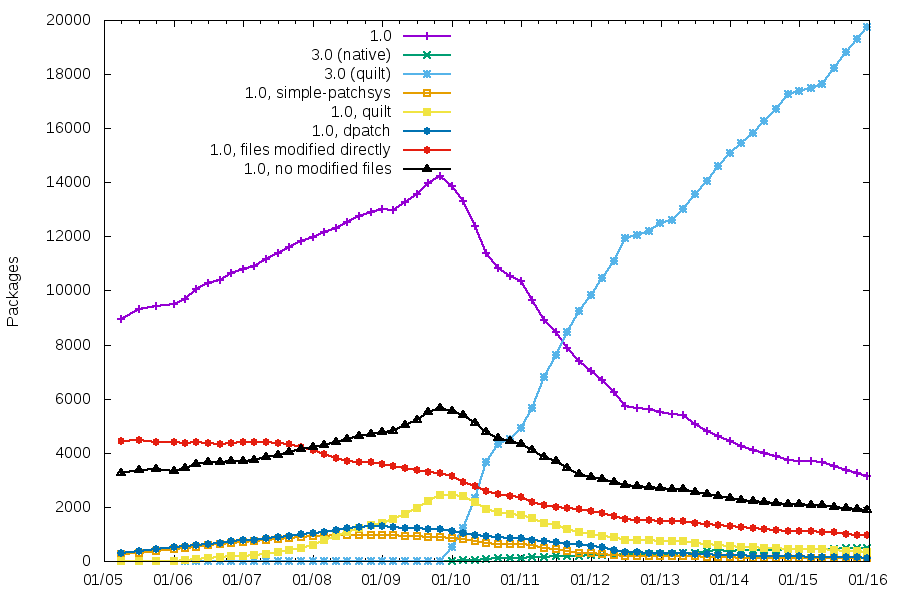
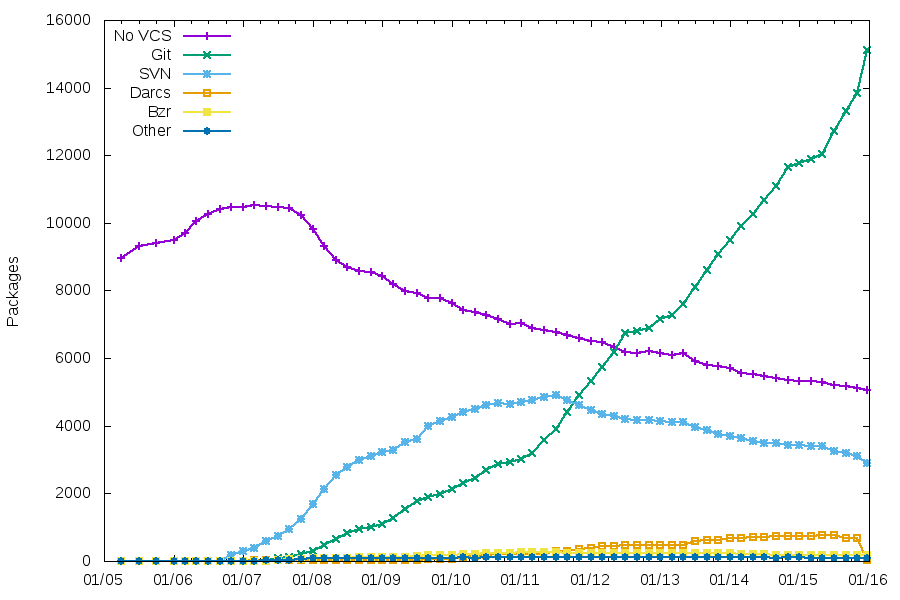
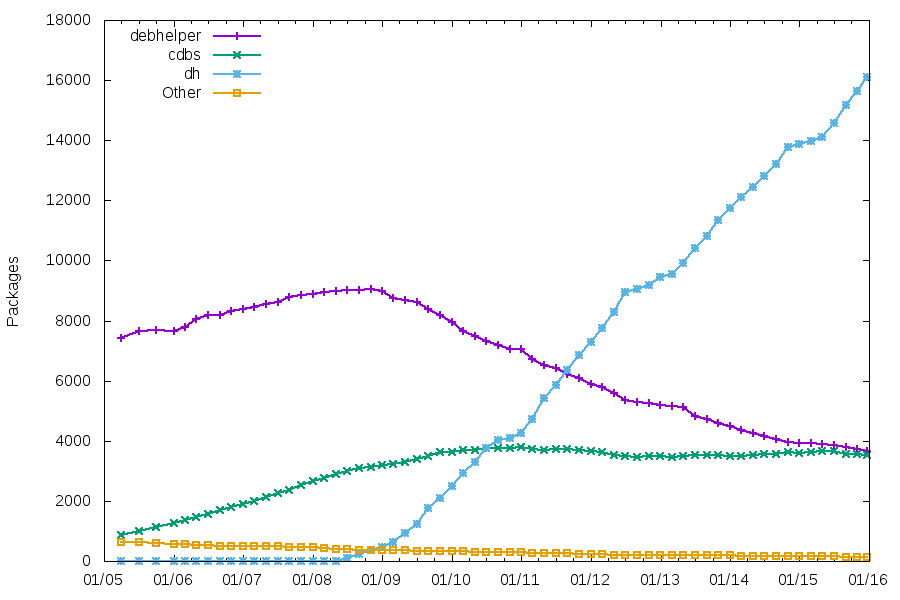
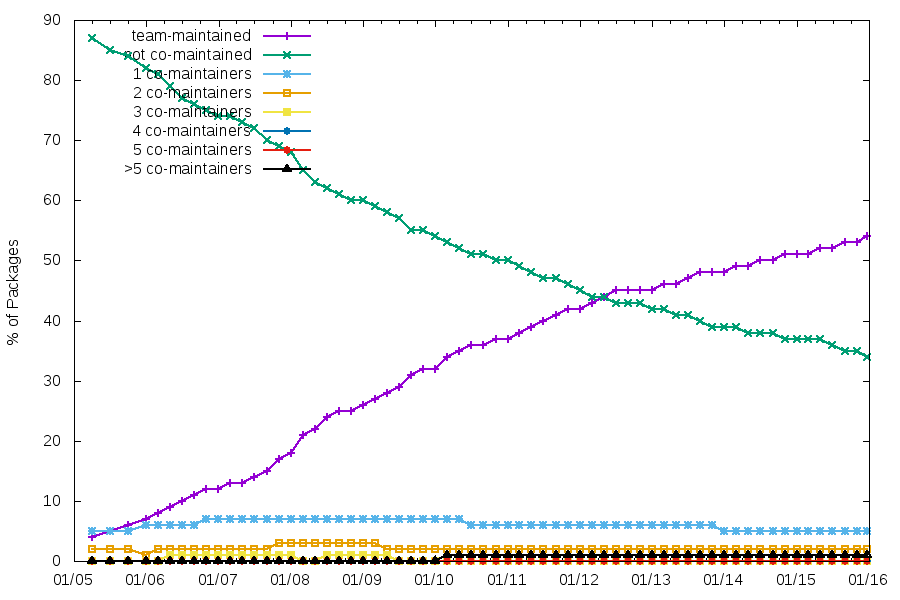
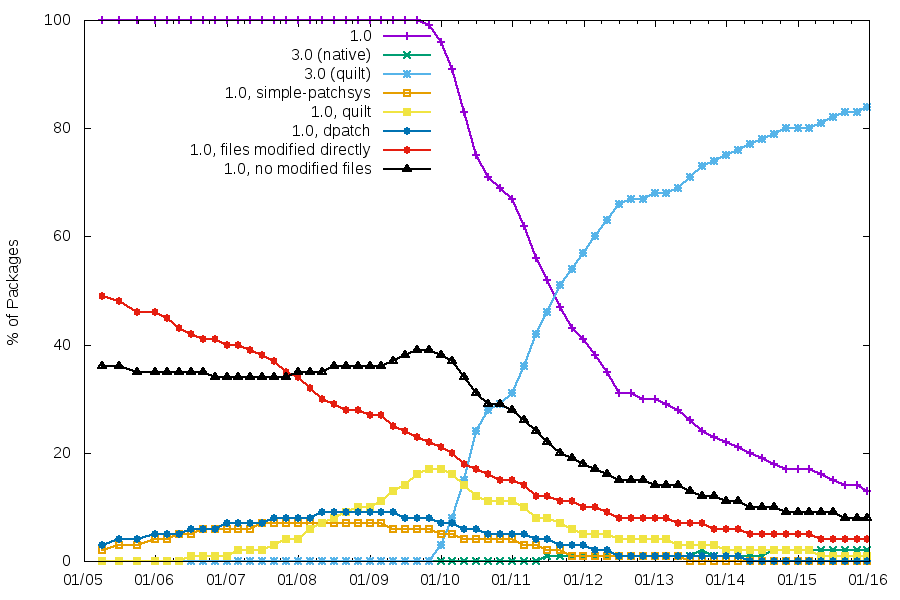
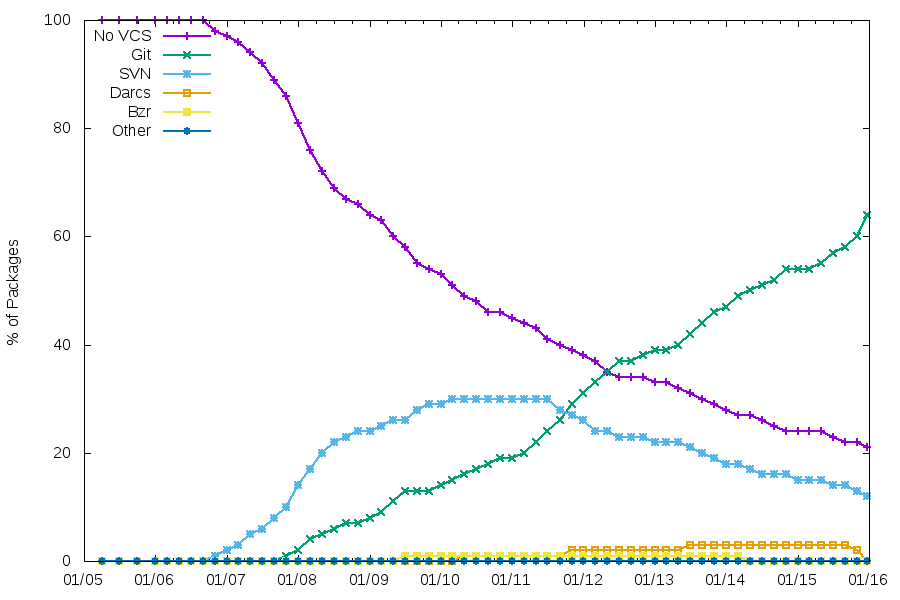
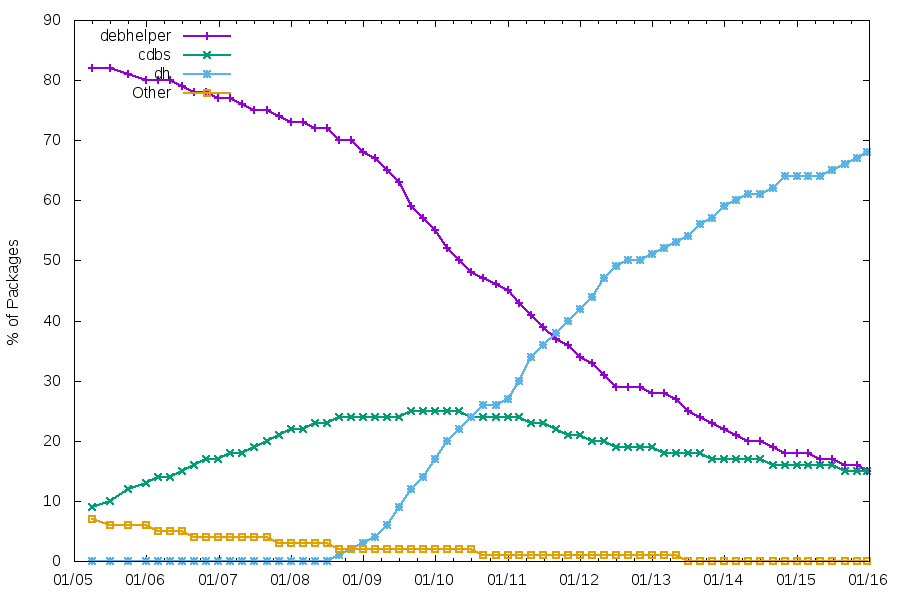
Here is an update to the usual graphs generated from snapshot.d.o. See my previous blog post for the background info. In all graphs, it s easy to see the effect of the Jessie freeze (and the previous freezes since 2005, too). Team maintenance comaint-2015 It s interesting to see that, while the number of team-maintained packages increases, the number of packages that aren t co-maintained is very stable. Maintenance using a VCS vcs-2015 Git is the clear winner now, with the migration rate increasing recently. Packaging helpers helpers-2015 As usual, the number of packages using CDBS is quite stable. The number of packages using traditional debhelper might soon be lower than those using CDBS. Patch systems and packaging formats formats-patches-2015 3.0 is the clear winner, even if we still have 3000+ packages using 1.0, and ~1000 of those modifying files directly. The other patch systems have basically disappeared.
So, all those graphs are kind-of boring now. Any good ideas of additional things to track, that be can identified reliably by looking at source packages? For those interested, below are links to the graphs with percentages of packages. comaint-percent-2015 formats-patches-percent-2015 vcs-percent-2015 helpers-percent-2015

Thorsten Alteholz: Debian Med Bug Squashing in Advent 2015

The Debian Med Bug Squashing just ended and the Debian Med Advent Calendar is full to bursting. Like the years before, the Debian Med team performed a bug squashing event from December 1st to 24th. All bugs that have been closed during that period got an entry in the calendar. This year I am really impressed with the achievement of all participants. After the rather small quantity last year, the incredible number of 150 bugs have been closed this year! Thanks alot!
year number of bugs closed
2011 63
2012 28
2013 73
2014 5
2015 150

Norbert Preining: Plex Home Theater becomes OpenPHT release 1.5.0 for Debian sid and jessie

The nice guys from RasPlex have forked the abandoned Plex Home Theater into OpenPHT (github, Plex forum) and updated it with several improvements. Plex itself is now developing a new player called Plex Media Player, which unfortunately uses closed source components. I tried to build also the Plex Media Player for Debian, but a hitherto unreleased Qt versions is necessary, so I gave up for now. So here is a new built of OpenPHT for Debian/sid and jessie, amd64 and i386. This new package conflicts with the old plexhometheater. plex-debian-new Note also that the lines for sources.list have changed again. I will also remove the builds of plexhometheater from my server soon. sid and testing For sid use the following lines:
deb http://www.preining.info/debian/ openpht-sid main
deb-src http://www.preining.info/debian/ openpht-sid main
You can also grab the binary for amd64 directly here for amd64 and i386, you can get the source package with
dget http://www.preining.info/debian/pool/main/o/openpht/openpht_1.5.0.502-1.dsc
jessie For the stable release jessie, use the following lines:
deb http://www.preining.info/debian/ openpht-jessie main
deb-src http://www.preining.info/debian/ openpht-jessie main
You can also grab the binary for amd64 directly here for amd64 and i386, you can get the source package with
dget http://www.preining.info/debian/pool/main/o/openpht/openpht_1.5.0.502-1~bpo8+1.dsc
The release file and changes file are signed with my official Debian key 0x860CDC13. Now be ready for enjoying the next movie!

24 December 2015

Clint Adams: Before the Tet Offensive

Kurt has trouble keeping his mouth shut. This became widely apparent when he was expelled from Catholic school for telling a visiting dignitary to go fuck himself. WB used to preach angrily against casual sex. Kurt enlisted in the Army, and due to his high IQ he ended up in the Army Security Agency. After training, he was stationed in Germany where he performed signals intelligence functions like direction finding and passing on information to the CIA and NSA. One day WB shagged a boy with a leather hat. Contrary to what one might assume, Kurt had awareness of consequences. He refused officer training because that would have extended his commitment from 4 to 6 years. He purposefully flunked his French language proficiency exam. He wanted there to be no chance of him getting transferred to Vietnam. The following day, WB found herself confronted and asked to explain why she had had a change of heart about casual sex. Oh, it wasn't casual sex, she explained. He came over and said, I've been dying to make love with you for the past three hours, so it was special, she clarified. Thus the nature of the past communication failure became clear to everyone but WB. Despite all his efforts to avoid Vietnam, Kurt, of course, had trouble keeping his mouth shut. So in 1967 he pissed off the wrong person and found himself having to choose between Leavenworth and Saigon. He chose life of alcoholism over prison.

Zlatan Todori : Deepin switches to Debian Sid

Distribution that I feel fond of their work on UX for Linux ecosystem has switched from Ubuntu to Debian. So now pabs will probably invite them to our Derivate Census and they start packaging their stack into Debian directly. More about their latest RC release and the mention of switch is on their blog

Michal Čihař: Going to FOSDEM

It has become almost tradition for me, so yes, I'm attending FOSDEM 2016. It's probably the best conference in Europe to meet other free software guys and that was always motivation for me to come - to see people I meet on mailing lists for rest of the year. This time it will be slightly different for me - I will be giving talk there for first time. Originally I wanted to do lightning talk only, but in the end I got persuaded and it's full length talk now. It will be in the Coding for Language Communities devroom and you might guess from the devroom topic that it will be about Weblate.

Filed under: English phpMyAdmin SUSE Weblate 0 comments

23 December 2015

David Bremner: Offline key signing with caff

After a mildly ridiculous amount of effort I made a bootable-usb key. I then layered a bash script on top of a perl script on top of gpg. What could possibly go wrong?
 #!/bin/bash
 infile=$1
 keys=$(gpg --with-colons  $infile   sed -n 's/^pub//p'   cut -f5 -d: )
 gpg --homedir $HOME/.caff/gnupghome --import $infile
 caff -R -m no "$ keys[*] "
 today=$(date +"%Y-%m-%d")
 output="$(pwd)/keys-$today.tar"
 for key in $ keys[*] ; do
     (cd $HOME/.caff/keys/;   tar rvf "$output" $today/$key.mail*)
 done
The idea is that keys are exported to files on a networked host, the files are processed on an offline host, and the resulting tarball of mail messages sneakernetted back to the connected host.

Alexander Wirt: New mailinglists

Today I spend some time to go through the lists.debian.org bugreports. In consequence I created three new lists:

Petter Reinholdtsen: OpenALPR, find car license plates in video streams - nice free software

When I was a kid, we used to collect "car numbers", as we used to call the car license plate numbers in those days. I would write the numbers down in my little book and compare notes with the other kids to see how many region codes we had seen and if we had seen some exotic or special region codes and numbers. It was a fun game to pass time, as we kids have plenty of it. A few days I came across the OpenALPR project, a free software project to automatically discover and report license plates in images and video streams, and provide the "car numbers" in a machine readable format. I've been looking for such system for a while now, because I believe it is a bad idea that the automatic number plate recognition tool only is available in the hands of the powerful, and want it to be available also for the powerless to even the score when it comes to surveillance and sousveillance. I discovered the developer wanted to get the tool into Debian, and as I too wanted it to be in Debian, I volunteered to help him get it into shape to get the package uploaded into the Debian archive. Today we finally managed to get the package into shape and uploaded it into Debian, where it currently waits in the NEW queue for review by the Debian ftpmasters. I guess you are wondering why on earth such tool would be useful for the common folks, ie those not running a large government surveillance system? Well, I plan to put it in a computer on my bike and in my car, tracking the cars nearby and allowing me to be notified when number plates on my watch list are discovered. Another use case was suggested by a friend of mine, who wanted to set it up at his home to open the car port automatically when it discovered the plate on his car. When I mentioned it perhaps was a bit foolhardy to allow anyone capable of placing his license plate number of a piece of cardboard to open his car port, men replied that it was always unlocked anyway. I guess for such use case it make sense. I am sure there are other use cases too, for those with imagination and a vision. If you want to build your own version of the Debian package, check out the upstream git source and symlink ./distros/debian to ./debian/ before running "debuild" to build the source. Or wait a bit until the package show up in unstable.

22 December 2015

John Goerzen: Amtrak Airlines

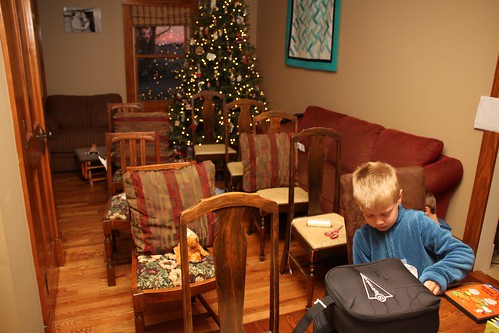
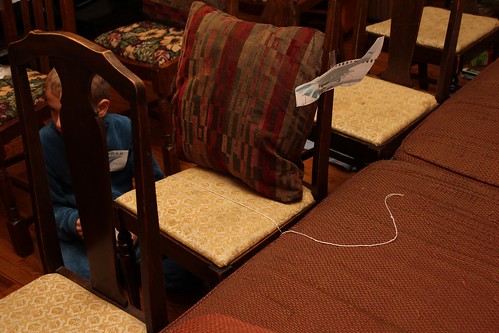
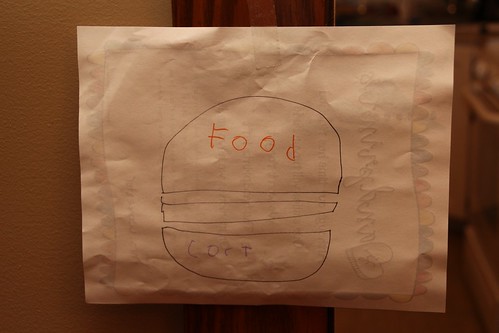
I came downstairs this morning and found a surprise waiting for me. Chairs from all over had been gathered up and arranged in rows, airline style. Taped to the wall was a food court sign. At the front was a picture of an airplane, decked out with the Amtrak logo of all things, and a timetable taped to our dining room table. IMG_6123 Jacob soon got out string to be seatbelts, too. And, using his copy machine, printed out a picture of a wing to tape to the side of the airplane . IMG_6128 And here is the food court sign Oliver made: IMG_6126 This plane was, according to the boys, scheduled to leave at 9:30. It left a fashionable 2 hours late or so. They told me I would be the pilot, and had me find headphones to be my headset . (I didn t wear my real headset on the grounds that then I wouldn t be able to hear them.) Jacob decided he would be a flight attendant, his grandma would be the co-pilot, and Oliver would be the food court worker. The food court somehow seemed to travel with the plane. Oliver made up a menu for the food court. It consisted of, and I quote: trail mix, banana, trail mix, half banana, trail mix, trail mix, trail mix . He s already got the limited selection of airport food down pat, I can see. Jacob said the flight would be from Chicago to Los Angeles, and so it was. Since it was Amtrak Airlines, we were supposed to pretend to fly over the train tracks the whole way. If it s not Christmas yet, we just invent some fun, eh? Pretty clever.

Ian Wienand: Platform bootstrap for OpenStack Infrastructure

This is a terse guide on bootstrapping virtual-machine images for OpenStack infrastructure, with the goal of adding continuous-integration support for new platforms. It might also be handy if you are trying to replicate the upstream CI environment. It covers deployment to Rackspace for testing; Rackspace is one of the major providers of capacity for the OpenStack Infrastructure project, so it makes a good place to start when building up your support story. Firstly, get an Ubuntu Trusty environment to build the image in (other environments, like CentOS or Fedora, probably work -- but take this step to minimise differences to what the automated machinery of what upstream does). You want a fair bit of memory, and plenty of disk-space. The tool used for building virtual-machine images is diskimage-builder. In short, it takes a series of elements, which are really just scripts run in different phases of the build process. I'll describe building a Fedora image, since that's been my focus lately. We will use a fedora-minimal element -- this means the system is bootstrapped from nothing inside a chroot environment, before eventually being turned into a virtual-machine image (contrast this to the fedora element, which bases itself off the qcow2 images provided by the official Fedora cloud project). Thus you'll need a few things installed on the Ubuntu host to deal with bootstrapping a Fedora chroot
apt-get install yum yum-utils python-lzma
You will hit stuff like that python-lzma dependency on this road-less-travelled -- technically it is a bug that yum packages on Ubuntu don't depend on it; without it you will get strange yum errors about unsupported compression. At this point, you can bootstrap your diskimage-builder environment. You probably want diskimage-builder from git, and then build up a virtualenv for your support bits and pieces.
git clone git://git.openstack.org/openstack/diskimage-builder
virtualenv dib_env
. dib_env/bin/activate
pip install dib-utils
dib-utils is a small part of diskimage-builder that is split-out; don't think too much about it. While diskimage-builder is responsible for the creation of the basic image, there are a number of elements provided by the OpenStack project-config repository that bootstrap the OpenStack environment. This does a lot of stuff, including caching all git trees (so CI jobs aren't cloning everything constantly) and running puppet setup.
git clone git://git.openstack.org/openstack-infra/project-config
There's one more trick required for building the VHD images that Rackspace requires; make sure you install the patched vhd-util as described in the script help. At this point, you can probably build an image. Here's something approximating what you will want to do
break=after-error \
TMP_DIR=~/tmp \
ELEMENTS_PATH=~/project-config/nodepool/elements \
DIB_DEV_USER_PASSWORD="password"  DIB_DEV_USER_PWDLESS_SUDO=1 \
DISTRO=23 \
./bin/disk-image-create -x --no-tmpfs -t vhd \
   fedora-minimal vm devuser simple-init \
   openstack-repos puppet nodepool-base node-devstack
To break some of this down This goes and does its thing; it will take about 20 minutes. Depending on how far your platform diverges from the existing support, it will require a lot of work to get everything working so you can get an image out the other side. To see a rough example of what should be happening, see the logs of the official image builds that happen for a variety of platforms. At some point, you should get a file image.vhd which is now ready to be deployed. The only reasonable way to do this is with shade. You can quickly grab this into the virtualenv we created before
pip install shade
Now you'll need to setup a clouds.yaml file to give yourself the permissions to upload the image. It should look something like
clouds:
  rax:
    profile: rackspace
    auth:
       username: your_rax_username
       password: your_rax_password
       project_id: your_rax_accountnum
    regions:
    - IAD
You should know your user-name and password (whatever you log into the website with), and when you login to Rackspace your project_id value is listed in the drop-down box labeled with your username as Account #. shade has no UI as such, so a simple script will do the upload.
import shade
shade.simple_logging(debug=True)
cloud = shade.openstack_cloud(cloud='rax')
image = cloud.create_image('image-name', filename='image.vhd', wait=True)
Now wait -- this will also take a while. Even after upload it takes a fair while to process (you will see the shade debug output looping around some glance calls seeing if it is ready). If everything works, the script should return and you should be able to see the new image in the output of nova list-images. At this point, you're ready to try booting! One caveat is that the Rackspace web interface does not seem to give you the option to boot with a configuration drive available to the host, essential for simple-init to bring up the network. So boot via the API with something like
nova boot --flavor=2 --image=image-uuid --config-drive 1 test-image
This should build and boot your image! This will allow you to open a whole new door of debugging to get your image booting correctly. You can now iterate by rebuilding/uploading/booting as required. Note these are pretty big images, and uploaded in broken-up swift files, so I find swift delete --all helpful to reset between builds (obviously, I have nothing else in swift that I want to keep). The Rackspace java-based console UI is rather annoying; it cuts itself off every time the host reboots. This makes it quite difficult to catch the early bootup, or modify grub options via the boot-loader, etc. You might need to fiddle timeout options, etc in the image build. If you've managed to get your image booting and listening on the network, you're a good-deal of the way towards having your platform supported in upstream OpenStack CI. At this point, you likely want to peruse the nodepool configuration and get an official build happening here. Once that is up, you can start the process of adding jobs that use your platform to test! Don't worry, there's plenty more that can go wrong from here -- but you're on the way! OpenStack infra is a very dynamic environment, which many changes in progress; so in general, #openstack-infra on freenode is going to be a great place to start looking for help.

Jonas Smedegaard: Hamara Linux

Siri and I are on a journey through India and Nepal, with the aim of learning about needs of Debian derivatives, to improve Debian and encourage closer integration.

Distribution Hamara Linux is a distribution based on Trisquel, hence descending from Debian via Ubuntu. Next release will be a direct derivative of Debian. We recommended to package missing parts for Debian itself, even if Hamara needs them faster than deemed "stable" in Debian. ITP bugreports is since filed for theme and install routine.

Visual design Hamara Linux ships with a coherent visual style, covering widget theme, install routine, boot and login, and a range of wallpapers. Siri has begun comparing widget theme against Debian. We might try distill diffs for each Debian Ubuntu Trisquel Hamara derivation.

System contents and setup Hamara Linux comes in two flavors: Hamara Namaste with a GNOME desktop, and Hamara Sugam with an Lxde desktop. I have begun decomposing the package sets into classes for Boxer, at the same time extending Boxer.

Steve Kemp: Finding and reporting trivial security issues

This week I'll be mostly doing drive-by bug-reporting. As with last year we start by using the Debian Code Search, to look for obviously broken patterns such as "system.>./tmp/.*" Once we find a fun match we examine the code and then report the bugs we find. Today that was stalin which runs some fantastic things on startup:
(system "uname -m >/tmp/QobiScheme.tmp")
(system "rm -f /tmp/QobiScheme.tmp"))
We can exploit this like so:
$ ln -s /home/steve/HACK /tmp/QobiScheme.tmp
$ ls -l /home/steve/HACK
ls: cannot access /home/steve/HACK: No such file or directory
Now we run the script:
$ cd /tmp/stalin-0.11/benchmarks
$ ./make-hello
And we see this:
$ ls -l /home/steve/HACK
-rw-r--r-- 1 steve steve 6 Dec 22 08:30 /home/steve/HACK
For future reference the lsat looks horrifically bad - it writes multiple times to /tmp/lsat1.lsat and although it tries to detect races I'm not convinced. Something to look at in the future.

Michal Čihař: Weekly phpMyAdmin contributions

Again one week has passed and there has been some progress on phpMyAdmin. This week the focus was on code cleanup and issue fixing. I've identified several pieces of dead code and removed that from our code base (the biggest removal being no longer used PMA_String class). The codebase is quite old and sometimes it's not easy to identify code which is not really being used, as it still might be referenced from some locations, but without actually invoking it. On the issue fixing side, I'm really happy from improving user experience with fields marked as binary - so far phpMyAdmin has displayed them as hexadecimal dump in all cases. Now it will display them as text as long as the content is valid utf-8. Bugs fixed: PS: I will most likely skip report next week due to Christmas.

Filed under: English phpMyAdmin 0 comments

Dmitry Shachnev: ReText 5.3 released

On Sunday I have released ReText 5.3, and here finally comes the official announcement. Highlights in this release are: Also, a week before ReText 5.3 a new version of PyMarkups was released, bringing enhanced support for the Textile markup. You can now edit Textile files in ReText too, provided that python-textile module for Python 3 is installed. As usual, you can get the latest release from PyPI or from the Debian/Ubuntu repositories. Please report any bugs you find to our issue tracker.

Next.

Previous.