Search Results: "tg"

18 December 2012

Raphael Geissert: Nicer, but stricter

Lately I've been working on making the redirector nicer to the mirrors and to some potential users. More specifically, those behind a caching proxy.

The redirector is now nicer to traditional web proxies by redirecting to objects that are known not to change with a "moved permanently" code (HTTP status code 301.) This applies to files in the pool/ directory and ".pdiff" files, among others.
Previously, a traditional caching web proxy would sometimes end up with multiple copies of the same object, fetched from different mirrors; and the redirection would not be cached at all. With this change, this is no longer the case.

Using a caching proxy that is aware of the Debian repository design is still more likely to yield better results, however: If my memory serves correctly, apt-cacher has the ability of updating the Packages, Sources, and similar files with the ".pdiff"s on the server side. Apt-Cacher-NG apparently can use debdelta, and so on.
Check my blog post about one APT caching proxy not being efficient for some comments related to those tools.

Another recent change is that mirrors that can't be used by the redirector will no longer be monitored as often as the other mirrors. For instance, if a mirror doesn't generate a trace file (used for monitoring) then the redirector will gradually limit the rate at which the mirror is checked.
This rate-limiting mechanism applies to different kinds of errors, and should reduce the amount of wasted time and bandwidth while still allowing automatic-detection of mirrors that recover.


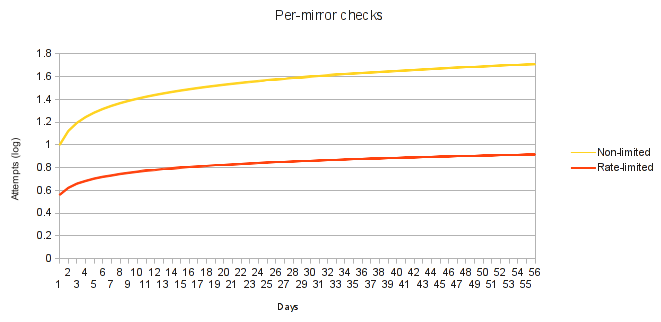
Projection of a rate-limited mirror over six weeks. The mirror would have to fail in every attempt for that to happen.
N.b. there's a bump in the scale.

The rate limiter applies an initial exception to allow temporary errors to not affect the use of the mirror by the redirector. After that exception, it is pretty much linear. However, that chart doesn't really reflect the effect of the rate limiter, so put in comparison with the normal checking behaviour:


Comparison of the two behaviours over an 8 weeks period using a logarithmic scale.
Nice chart colours by Libreoffice.

The code to detect mirrors that don't perform a two-stages sync that I talked about in a previous post has not yet been integrated as the current implementation would be too expensive on the mirrors to just add it as-is.

While tracking down problems exposed to users, I decided to take a stricter approach as to what mirrors are used by the redirector. Suffice to say that the remaining mirrors using the obsolete anonftpsync are going to be ignored entirely. ftpsync has been around for a few years now and it is the standard tool.
Whether you are mirroring Debian, Raspbian, Ubuntu, or any other Debian-like packages repository, ftpsync is the right tool to use.

Most of the issues I've been discovering, and sometimes working around, affect direct users of the mirrors and are not related to the http.debian.net redirector. When not detected beforehand they happen to be exposed by the redirector, but like I said, I plan to be stricter in order to increase the redirector's reliability. Once a strict and reliable foundation is built, more workarounds might see their way in to better use the available resources.

That's it for now. The road is long, the challenge is great, and being an observer in an uncontrolled environment makes it even more interesting.

17 December 2012

Lars Wirzenius: Obnam 1.3 (backup software) and other releases

I've just pushed out the release files for Obnam version 1.3, my backup application, as well as Larch, my B-tree library, and cliapp, my Python framework for command line applications. They are available via my home page (http://liw.fi/). Since Debian is frozen, I am not uploading packages to Debian, but .deb files are available from my personal apt repository for the intrepid. (I will be uploading to Debian again after the freeze. I am afraid I'm too lazy to upload to experimental, or do backports. Help is welcome!) From the Obnam NEWS file: Bug fixes for Obnam: NEWS for Larch: NEWS for cliapp:

15 December 2012

Martin Pitt: Running a script with unshared mount namespace

When writing system integration tests it often happens that I want to mount some tmpfses over directories like /etc/postgresql/ or /home, and run the whole script with an unshared mount namespace so that (1) it does not interfere with the real system, and (2) is guaranteed to clean up after itself (unmounting etc.) after it ends in any possible way (including SIGKILL, which breaks usual cleanup methods like trap , finally , def tearDown() , atexit() and so on). In gvfs and postgresql-common s tests, which both have been around for a while, I prepare a set of shell commands in a variable and pipe that into unshare -m sh, but that has some major problems: It doesn t scale well to large programs, looks rather ugly, breaks syntax highlighting in editors, and it destroys the real stdin, so you cannot e. g. call a bash -i in your test for interactively debugging a failed test. I just changed postgresql-common s test runner to use unshare/tmpfses as well, and needed a better approach. What I eventually figured out preserves stdin, $0, and $@, and still looks like a normal script (i. e. not just a single big string). It still looks a bit hackish, but I can live with that:
#!/bin/sh
set -e
# call ourselves through unshare in a way that keeps normal stdin, $0, and CLI args
unshare -uim sh -- -c " tail -n +7 $0 " "$0" "$@"
exit $?
# unshared program starts here
set -e
echo "args: $@"
echo "mounting tmpfs"
mount -n -t tmpfs tmpfs /etc
grep /etc /proc/mounts
echo "done"
As Unix/Linux shebang parsing is rather limited, I didn t find a way to do something like
#!/usr/bin/env unshare -m sh
If anyone knows a trick which avoids the tail -n +7 hack and having to pay attention to passing around $@ , I d appreciate a comment how to simplify this.

Thorsten Glaser: Der heilige Frieden?

(Apologies for putting this on Planet Debian, but it says the one or other non-English post is okay as long as it s an exception. I feel I need to reach more people with this, but don t feel like translating this into English right now.)
Update: Tanguy asked for a short English summary: it s me ranting against the rioting against muslims and the call for more CCTV surveillance after a possible bomb was found at the train station. In Bonn herrscht immer noch Bombenstimmung , wenn man z.B. auf die Webseite der Lokalzeitung schaut von dem Amoklauf in Connecticut, ber den sich im IRC gewunder wird, ist immer noch nichts zu sehen, daf r wird flei ig wider Islamisten gehetzt. Ich finde das besorgniserregend, mu doch jetzt jeder Angeh rige des Islams f rchten, verfolgt oder benachteiligt zu werden. Das reizt doch erst recht zum Gegenschlag, bei dem dann auch Menschen, die absolut nicht mit der hier vorherrschenden Meinung und Politik bereinstimmen, getroffen werden k nnen. Ich pers nlich habe kein Problem mit Menschen anderen Glaubens oder anderer Weltanschauung, solange wir friedlich miteinander leben k nnen. Ich teile eure Unzufriedenheit mit dem herrschenden Staat, der immer weitergehenden berwachung, Unterdr ckung von Leuten, die nicht dem vorherrschenden Menschenbild entsprechen (egal an welchen Kategori n), und bitte die, die dies lesen, nochmal nachzudenken, bevor sie etwas tun, was hinterher Unschuldige trifft oder gar in friendly fire ausartet. Hat eigentlich wer die in Bad Godesberg ausgegebenen Koran-B cher sich mal angeschaut? Als ich davon las, war ich ja zugegebenerma en neugierig, weil ich vom Koran leider eher wenig kenne, wei aber nicht, wie neutral oder eben nicht die bersetzung gehalten ist. Anhand dessen, was ich bereits mitbekam, sollte das eher friedlicher sein als was durch sp tere Theologen festgelegt wurde wie ja auch zum Beispiel im Christentum, aber ber die Horrorepisoden der christlichen Kirche will ich jetzt auch nicht mich auslassen, in der Hoffnung, da auch diese sich mit den Jahren gebessert hat. (Ist nur halt das Problem mit den Leuten, die die alten Hetzparolen jetzt noch verbreiten. Ist wie im Netz mit den Groupies von Theo de Raadt, die noch asiger zu Leuten sind als er selber.) (Au erdem mu man ja bef rchten, durch Besitz eines Korans schon vorverurteilt zu werden heutzutage *seufz* ich finde das nicht gut!) Update (ich verga ): auch der Ruf nach mehr Video berwachung ist nur Panikmache. Das geht nur zu Lasten des Normalb rgers. Vielleicht lassen sich noch Kleinstdelikte wie Taschendiebstahl damit abschrecken, aber gerade diese Bomben und dergleichen sind doch oft von Leuten, die vor Konsequenzen keine Angst haben, organisiert. Die werden dann maximal M rtyrer. Ich wiederhole nochmal f r die Politiker und die ganz langsamen unter den Lesern: berwachung verhindert keine Straftat.

7 December 2012

Thorsten Glaser: Collision resolution in open addressing hashtables

Before we begin, everyone should read up on hashtables and what open addressing / closed hashing is. The context is lines 111 190 of Python s Objects/dictobject.c as of today (so we get the line numbers straight). (I ve reworded this wlog entry a bit; I originally wrote it too late at night for it to read coherent.) Basically, I ve got an application where I d like to use a hashtable for a number of things not as generic as Python, and with focus on small footprint. I d like to offer associative arrays in a scripting language, where the keys are always arbitrary byte strings excluding NUL. Also, I d like to use the hashtable as backend for indexed arrays, where the keys are uint32_t and the usual use case is sequential. Finally, I m using it for several internal tables, such as a list of keywords, one of builtins, one of special variables, etc. which is a reason for me to not use a self-balancing binary tree as data structure (reading further below might suggest that, but getting a sorted list of hashtable keys is not the focus, though not unimportant).
My questions on this are:

Why is the shift on perturb done after its first use? In my experiments (using 32-bit width everywhere), for the pathological case of an 8-element (i = 3) table with three entries 0, 0x40000000 and 0x800000000, the second round yields 1 for all three, so it cannot have to do with the upper bits. My lookup looks like:

	mask = 2  - 1;
	j = perturb = hash(key);
	goto find_first_slot;
	 find_next_slot:
	j = (j << 2) + j + perturb + 1;
	perturb >>= PERTURB_SHIFT;
	/* FALLTHROUGH */
	 find_first_slot:
	entry = table[j & mask];
	if (!match(entry)) goto find_next_empty_slot;
 

This means that my first check is always the bare hash (so only do it if needed is no reason) and, since I m using gotos, I could just move the perturb >>= PERTURB_SHIFT; line before the line recalculating the next j to use. This seems to make more sense, even in the face of Python. (I actually looked at the Python file s comments again today because I thought to use a different resolution, but they have a good rationale for using the multiplication by 5.) Why can t we just use i as the PERTURB_SHIFT? Sure, this changes a shift-right by a constant, which can possibly be encoded as immediate value in assembly (unless you re on a pre-80186, which can only do SHR AX,1 and SHR AX,CL but not SHR AX,4, but that s outside of mksh s scope) into a right-shift by a variable, but i is already known, and I think the behaviour is better (it wouldn t eat any bits; assume the same 8-entry hashtable and pathologic keys 0, 8 and 16). Again: who do I think I am to go against the wisdom of the Python people, who seem to have shed more thought on this than everyone else I saw, asked, read about (including Spammipedia). That s why I m asking here. On that reference: I don t support spammers or people nagging for donations or premium accounts, like Xing and Groundspeak/Geocaching.COM, at all. In fact, I urge others to do the same, so it really hurts them; it may be their business model, but not if they spam me. Besides, OpenCaching.DE exists. Another thing is: to avoid CVE-2011-4815, I m randomising the hash used, with one seed value per hashtable, changed before a resize operation. I originally thought to seed it with nonzero, but then I have to rehash on hashtable resize, so I ll be XORing the final hash value instead (thanks ciruZ for the idea). I m thinking of omitting that for indexed arrays, as an attacker almost certainly cannot determine the keys there. (To directly use the indexed array keys, which are already uint32_t, as hashes makes using i from even more important.) The hash I m using is a modified Jenkins one-at-a-time called NZAAT: it s my new generic standard n n-cryptographic hash, and the changes are thus: while adding a byte, another increment of the hash is done (so NUL counts), and the finaliser got prefixed with the shift-left-add+shift-right-xor sequence of the adder (but not adding any value or the +1), to get best avalanche for all bytes. I actually compiled several versions of Hash.cs on a Windows VM at work to analyse the original one-at-a-time and all of my modifications; these turned out to be the simplest ones (I originally had added 0x100 instead of 1, but the effect was the same, and +1 is usually cheaper on most CPUs). Also, to avoid people being able to get to the seed, a user will always get only a sorted list of hashtable keys (numeric for indexed arrays, ASCIIbetically otherwise; see also my thoughts on JSON from the previous wlog entry). What algorithm do I use? For strings, comparisons are much more expensive, so I d like to keep them low. Memory use is also a factor; allocating one large(r) block is better than many small ones due to the pool allocator overhead and due to portability to ancient Unic s (which is another reason for me to use a hashtable which is a small struct plus an array of pointers, and then pass the list of keys as array of string pointers, instead of a tree). For both reasons, I m thinking a relatively simple MergeSort: I need to allocate the result array anyway, so I can just get two and free the one that isn t the end result, and it s AFAICT the cheapest on comparisons other than Tree Sort (which nobody really seems to use, and which would effect to using a balanced binary tree again). Since keys are unique, stability and duplicate handling is never an issue. I d like to use only one algorithm and one data structure, not a combination, as compactness is a design goal. Please drop your thoughts on Freenode, e.g. by /msg MemoServ send mirabilos your text here or per eMail to the domains debian, freewrt or mirbsd, which are organisations, with the localpart tg. Or just contact me as usual, if you re already acquainted. Or lookup 0xE99007E0. Thanks in advance! (Especially, Python Developers thoughts are welcome.)

Christoph Berg: apt.postgresql.org

So we finally made it, and sent out an official announcement for apt.postgresql.org. This new repository hosts packages for all PostgreSQL server versions (at the moment 8.3, 8.4, 9.0, 9.1, 9.2) for several Debian/Ubuntu distributions (squeeze, wheezy, sid, precise) on two architectures (amd64, i386). Now add packages for extension modules on top of all these, and you get a really large amount of binaries from a small number of sources. Right now there's 1670 .deb files and 148 .dsc files, but the .dsc count includes variants that only differ in the version number per distribution (we attach .pgdg60+1 for squeeze packages, .pgdg70+1 for wheezy and so on), so the real number of different sources is rather something like 81, with 38 distinct source package names. Dimitri Fontaine, Magnus Hagander, and I have been working on this since I first presented the idea at PGconf.EU 2011 in Amsterdam. We now have a Jenkins server building all the packages, an archive server with the master repository, and a feed that syncs the repository to the postgresql.org FTP (well, mostly http) server. If you were previously using pgapt.debian.net, that's the same archive as on apt.postgresql.org (one rsync away). Please update your sources.list to point to apt.postgresql.org, I'll shut down the archive at that location at the end of January. Here's the Quickstart instructions from the Wiki page: Import the repository key from http://apt.postgresql.org/pub/repos/apt/ACCC4CF8.asc:
wget -O - http://apt.postgresql.org/pub/repos/apt/ACCC4CF8.asc   sudo apt-key add -
Edit /etc/apt/sources.list.d/pgdg.list. The distributions are called codename-pgdg. In the example, replace squeeze with the actual distribution you are using:
deb http://apt.postgresql.org/pub/repos/apt/ squeeze-pgdg main
Configure apt's package pinning to prefer the PGDG packages over the Debian ones in /etc/apt/preferences.d/pgdg.pref:
Package: *
Pin: release o=apt.postgresql.org
Pin-Priority: 500
Note: this will replace all your Debian/Ubuntu packages with available packages from the PGDG repository. If you do not want this, skip this step. Update the package lists, and install the pgdg-keyring package to automatically get repository key updates:
apt-get update
apt-get install pgdg-keyring

4 December 2012

Daniel Kahn Gillmor: Error messages are your friend (postgres is good)

Here is a bit of simple (yet subtly-flawed) sql, which produces different answers on different database engines:
0 dkg@pip:~$ cat test.sql
drop table if exists foo;
create table foo (x int, y int);
insert into foo VALUES (1,3);
insert into foo VALUES (1,5);
select y from foo group by x;
0 dkg@pip:~$ sqlite3 < test.sql
5
0 dkg@pip:~$ mysql -N dkg < test.sql
3
0 dkg@pip:~$ psql -qtA dkg < test.sql
ERROR:  column "foo.y" must appear in the GROUP BY clause or be used in an aggregate function
LINE 1: select y from foo group by x;
               ^
0 dkg@pip:~$ 
are two of the many reasons postgresql is my database engine of choice.Tags: errors, postgresql, sql

1 December 2012

Thorsten Glaser: Proposed extensions to the JSON specification

The following proposal extends the JSON specification, with the idea of using JSON as an information interchange format, rather than just a way of writing certain ECMAscript values. They do not add anything but only restrict valid JSON content and encoders with some rationale. First of, I d like to remind everyone, including JSON s author, that JSON is case-sensitive, except in the four hexdigits after a backslash-u sequence in a String. Second, I d like to remind everyone that JSON is not binary-safe. No way around that, it implements Unicode (actually, 16-bit UCS-2, and it doesn t guarantee that UTF-16 surrogates are correctly paired) text. I also consider only UTF- 8, 16,32 B,L E valid encodings for JSON. (No PDP endian, either. Sorry, guys.) For my first proposal, I d like to point out CVE-2011-4815 which was about overflowing hashtables. The obvious fix is to randomise the hash per hashtable; to ensure this doesn t leak, we sort ASCIIbetically the keys of an Object in the encoder. (Using Unicode is good here we can just sort the keys as UTF-8 strings by their uint8_t value or as Unicode (UCS-2 or even UCS-4 or UTF-16) strings by the codepoints.) JSON was never preserving the order of elements in an Object anyway so we make it standardised (we still accept any order, and, when parsing, in collision cases, the later value wins). This also helps diffs. For my second proposal, I d like to forbid \u0000, \uFFFE, \uFFFF in strings. The first because many implementations use C strings, and for an information interchange format this is better; it also has security implications to allow NUL in a string. The other two, but not unpaired UTF-16 surrogates (as ECMAscript uses UCS-2 and got UTF-16 only later) because they re not valid Unicode; JSON was not binary-safe already so why bother. Among other benefits, this also helps implementations. For my third proposal, I d like to agree that implementations should impose a nesting depth limit that may be user-defined, and in the face of which, cyclic checking may be ignored by an encoder. I emit nesting depth overflows as literalnull; might also throw an error. Since I was asked, the common standard value is to restrict nesting depth is 32, unless the user specified one. (I also saw 8, but 32 WFM pretty well.) Most seem to use it even if it may seem low at first. Only specialised applications probably need more, and they can always pass a value. For my forth proposal, backslash-escape U+007F U+009F always. It may upset humans, editors, databases, etc. (This paragraph is newly added, after some IRC discussion.) All these do not permit anything that wasn t accepted to be accepted afterwards. I ve got a fifth proposal which changes acceptance rules but only for a subset of parsers: formally JSON is defined in ECMA-262 as industry standard that, in contrast to RFC 4627, always allowed any Value as top-level element of a JSON text. I d like to make it so, and ignore the RFC s requirement for it to be an Object or Array. Even so, the first two characters (after the BOM, if any) of a JSON text always are in the non-NUL 7-bit ASCII range, allowing for encoding detection. (This is done by the NUL octet pattern in the first four octets.) JSON has only taken off because it s a tightly defined simple format that can be used everywhere and isn t too awful for humans (escaping not needed for U+0020 U+D7FF and U+E000 U+FFFD after all, although I d also take the C1 control characters out, see my forth proposal above). I ve started to use a trailing comma in indexed and associative arrays in code I write at work, when the array values are one a line, to help version control systems to do their diffs, but refrain from asking for a JSON extension to permit that in order to not endanger compatibility any (no comment needed, it s just not worth it), but I d like my above proposals to be followed by implementators (and I m one of them). Some more discussion with Jonathan pointed out that JSON5 allows for trailing commata in Object and Array; IMHO the only feature of it that is not bad or outright harmful. I ll probably keep from accepting them because, on their own, they re not that useful, and I usually would run JSON texts, even configs, through a parser/encoder roundtrip to pretty-print them which would lose them anyway. As for binary-safeness: probably best to just use base64 and let the outer layers worry about compression. The data is usually unrelated to the JSON-encoded structure, and even if it s related to other data the base64 representation is usually similar (unless misaligned). Update 02.12.2012 Wrong I was about the first two characters: " " is a valid JSON text. Still possible to peek at four octets and determine the encoding by ordering the tests; updated my notes.

30 November 2012

Christoph Berg: pgbouncer running on the same hardware

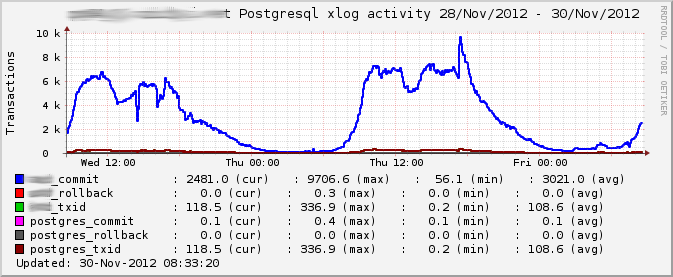
We have a PostgreSQL server with 16 cores that was apparently running well below its capacity: load something between 3.0 and 4.0, around 200 active database connections, almost all always being <IDLE>. However, when the tps count reached 7k transactions per second, things started to throttle, and pgbouncer (running on the database server) started listing up to half of the client connections to be in cl_waiting state. Load was still low, but application performance was bad. The culprit turned out to be the kernel scheduler, fairly distributing CPU time among all running processes. There's one single pgbouncer process, but hundreds of postgres processes. A simple renice of the pgbouncer process did the trick and gave us another extra 2k tps.
26 November 2012

Christoph Berg: Shared Memory and Swapping

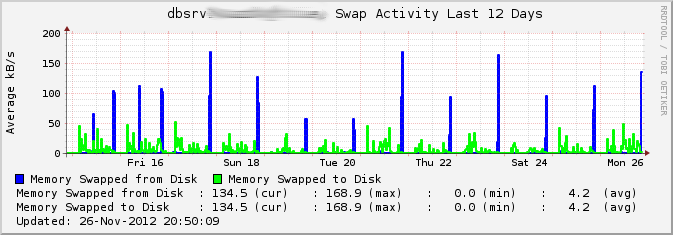
We have this PostgreSQL server with plenty of RAM that is still using some of its swap over the day (up to 600MB). Then suddenly everything is swapped in again. It turned out the reason is there are two clusters running, and the second one isn't used as heavily as the first one. Disk I/O activity of the first cluster slowly evicts pages from the second shared buffers cache to swap, and then the daily pg_dump run reads them back every evening. I was not aware of an easy way to get numbers for "amount of SysV shared memory swapped to disk", but some googling led to shmctl(2):
#define _GNU_SOURCE 1
#include <sys/ipc.h>
#include <sys/shm.h>
#include <stdio.h>
#include <unistd.h>
int main ()
 
        struct shm_info info;
        int max;
        long PAGE_SIZE = sysconf(_SC_PAGESIZE);
        max = shmctl(0, SHM_INFO, (struct shmid_ds *) &info);
        printf ("max: %d\nshm_tot: %ld\nshm_rss: %ld\nshm_swp: %ld\n",
                        max,
                        info.shm_tot * PAGE_SIZE,
                        info.shm_rss * PAGE_SIZE,
                        info.shm_swp * PAGE_SIZE);
        return 0;
 
The output looks like this:
max: 13
shm_tot: 13232308224
shm_rss: 12626661376
shm_swp: 601616384
Update: Mark points out that ipcs -mu shows the same information. Thanks for the hint!
# ipcs -mu
------ Shared Memory Status --------
segments allocated 2
pages allocated 3230544
pages resident  3177975
pages swapped   51585
Swap performance: 0 attempts     0 successes

Steve Langasek: Upstart in Debian

Good news, everyone! So as of last Sunday, this works on all Linux archs in Debian unstable and gives you a modern version of upstart:
echo 'Yes, do as I say!'   apt-get -o DPkg::options=--force-remove-essential -y --force-yes install upstart
Thanks to the ifupdown, sysvinit, and udev maintainers for their cooperation in getting upstart support in place; to the Debian release team for accomodating the late changes needed for upstart to be supported in wheezy; and to Scott for his past maintenance of upstart in Debian. Benchmarking One of the consequences is that it's now possible to do meaningful head-to-head comparisons of boot speed between sysvinit (with startpar), upstart, and systemd. At one time or another people have tested systemd vs. sysvinit when using bash as /bin/sh, and upstart vs. sysvinit, and systemd vs. sysvinit+startpar, and there are plenty of bootcharts floating around showing results of one init system or another on one distro or another, but I'm not aware of anyone having done a real, fair comparison of the three solutions, changing nothing but the init system. I've done some initial comparisons in a barebones sid VM, and the results are definitely interesting. Sysvinit with startpar (the default in Debian) can boot a stock sid install, with no added services, in somewhere between 3.37 and 3.42 seconds (three runs). That's not a whole lot, but on the other hand this is a system with a single filesystem and no interesting services yet. Is this really as fast as we can boot? No, even this minimal system can boot faster. Testing with upstart shows that upstart can do the same job in between 3.03 and 3.19 seconds (n=3, mean=3.09). This confirms what we'd already seen in Ubuntu, that it makes a difference to boot speed to have filesystem mounting handled by an integrated process that understands the whole system instead of as a group of serialized shell scripts. What about systemd? The same test gives a boot time between 2.32 and 2.85 seconds (n=4, mean=2.48). Interesting; what would make systemd faster than upstart in sid? Well, a quick look at the system shows one possible contributing factor: the rsyslog package in Debian has a systemd unit file, but not an upstart job file. Dropping in the /etc/init/rsyslog.conf from Ubuntu has a noticeable impact, and brings the upstart boot time down nearer to that of systemd (2.78-3.03s, n=5, mean=2.92). Besides telling me that it's time to start spamming Debian maintainers with wishlist bugs asking them to include upstart jobs in their packages, this suggests that the remaining difference in boot time may be due to the outstanding init scripts in rcS.d that are made built-in no-ops by systemd but not (yet) by upstart in Debian (e.g., hwclock, hostname, udev-mtab). (In Ubuntu, /etc/rcS.d has long since been emptied out in favor of upstart jobs in the common case, since the time it takes to get to runlevel=2 is definitely a major issue for boot speed and boot parallelization.) It also gives the lie to the claim that's been made in various places that spawning shells is a major bottleneck for upstart vs. systemd. More study is certainly needed to confirm this, but at least this naive first test suggests that in spite of the purported benefits of hard-coding boot-time policies in C code, upstart with its default degree of runtime configurability is at least in the ballpark of systemd. Indeed, when OpenSuSE switched from upstart to systemd, it seems that something else in the stack managed to nullify any benefit from improving the boot-time performance of apparmor. Contrary to what some would have you believe, systemd is not some kind of silver bullet for boot speed. Upstart, with its boot-time flexibility and its long history of real-world testing in Ubuntu, is a formidable competitor to systemd in the boot speed department - and a solid solution to the many longstanding boot-time ordering bugs in Debian, which still affect users of sysvinit. I've published the bootcharts for the above tests here. Between the fact that Debian's bootchart package logs by default to /var/log/bootchart.tgz (thus overwriting on every boot) and the fact that these tests are in a VM, I haven't bothered to include the raw data, just the bootcharts themselves. The interested reader can probably generate more interesting boot charts of their own anyway - in particular, it will be interesting to see how the different init systems perform with more complicated filesystem layouts, or when booting a less trivial set of services. Other musings The boot charts have been created with the bootchart package rather than with bootchart2. For one thing, it turns out that bootchart2 includes systemd units, not init scripts; so when replacing bootchart with bootchart2, the non-matching init script is left behind and systemd in particular gets terribly confused. This is now reported as Bug #694403. In an amusing twist, while I was experimenting with bootchart2, I also noticed that having systemd installed would slow down booting with other init systems, because systemd installs udev rules which take a noticeable amount of time to run a helper command at boot even though the helper should be a no-op. So if you're doing boot speed testing of other init systems, be sure you don't have systemd on the system at the time!

16 November 2012

Michal &#268;iha&#345;: Weblate 1.3

Quite on updated schedule (ie. one month later than originally planned), Weblate 1.3 has been released today. It comes with lot of improvements, especially in support of non gettext files, new quality checks and improved performance. Full list of changes for 1.3: You can find more information about Weblate on it's website, the code is hosted on Github. If you are curious how it looks, you can try it out on demo server. You can login there with demo account using demo password or register your own user. Ready to run appliances will be soon available in SUSE Studio Gallery. Weblate is also being used https://l10n.cihar.com/ as official translating service for phpMyAdmin, Gammu, Weblate itself and others. If you are free software project which would like to use Weblate, I'm happy to help you with set up or even host Weblate for you (this will be decided case by case as my hosting space is limited).

Filed under: English Phpmyadmin Weblate 0 comments Flattr this!

15 November 2012

Axel Beckert: Tools to handle archives conveniently

TL;DR: There s a summary at the end of the article. Today I wanted to see why a dependency in a .deb-package from an external APT repository changed so that it became uninstallable. While dpkg-deb --info foobar.deb easily shows the control information, the changelog is in the filesystem part of the package. I could extract that one dpkg-deb, too, but I d have to extract either to some temporary directory or pipe it into tar which then can extract a single file from the archive and sent it to STDOUT:
dpkg-deb --fsys-tarfile foobar.deb   tar xOf - ./usr/share/doc/foobar/changelog.Debian.gz   zless
But that s tedious to type. The following command is clearly less to type and way easier to remember:
acat foobar.deb ./usr/share/doc/foobar/changelog.Debian.gz   zless
acat stands for archive cat is part of the atool suite of commands:
als
lists files in an archive.
$ als foobar.tgz
drwxr-xr-x abe/abe           0 2012-11-15 00:19 foobar/
-rw-r--r-- abe/abe          13 2012-11-15 00:20 foobar/bar
-rw-r--r-- abe/abe          13 2012-11-15 00:20 foobar/foo
acat
extracts files in an archive to standard out.
$ acat foobar.tgz foobar/foo foobar/bar
foobar/bar
bar contents
foobar/foo
foo contents
adiff
generates a diff between two archives using diff(1).
$ als quux.zip
Archive:  quux.zip
  Length      Date    Time    Name
---------  ---------- -----   ----
        0  2012-11-15 00:23   quux/
       16  2012-11-15 00:22   quux/foo
       13  2012-11-15 00:20   quux/bar
---------                     -------
       29                     3 files
$ adiff foobar.tgz quux.zip
diff -ru Unpack-3594/foobar/foo Unpack-7862/quux/foo
--- Unpack-3594/foobar/foo      2012-11-15 00:20:46.000000000 +0100
+++ Unpack-7862/quux/foo        2012-11-15 00:22:56.000000000 +0100
@@ -1 +1 @@
-foo contents
+foobar contents
arepack
repacks archives to a different format. It does this by first extracting all files of the old archive into a temporary directory, then packing all files extracted to that directory to the new archive. Use the --each (-e) option in combination with --format (-F) to repack multiple archives using a single invocation of atool. Note that arepack will not remove the old archive.
$ arepack foobar.tgz foobar.txz
foobar.tgz: extracted to  Unpack-7121/foobar'
foobar.txz: grew 36 bytes
apack
creates archives (or compresses files). If no file arguments are specified, filenames to add are read from standard in.
aunpack
extracts files from an archive. Often one wants to extract all files in an archive to a single subdirectory. However, some archives contain multiple files in their root directories. The aunpack program overcomes this problem by first extracting files to a unique (temporary) directory, and then moving its contents back if possible. This also prevents local files from being overwritten by mistake.
(atool subcommand descriptions from the atool man page which is licensed under GPLv3+. Examples by me.) I though miss the existence of an agrep subcommand. Guess why? atool supports a wealth of archive types: tar (gzip-, bzip-, bzip2-, compress-/Z-, lzip-, lzop-, xz-, and 7zip-compressed), zip, jar/war, rar, lha/lzh, 7zip, alzip/alz, ace, ar, arj, arc, rpm, deb, cab, gzip, bzip, bzip2, compress/Z, lzip, lzop, xz, rzip, lrzip and cpio. (Not all subcommands support all archive types.) Similar Utilities There are some utilities which cover parts of what atool does, too: Tools from the mtools package Yes, they come from the handle MS-DOS floppy disks tool package, don t ask me why. :-)
uz
gunzips and extracts a gzip d tar d archives
Advantage over aunpack: Less to type. :-)
Disadvantage compared to aunpack: Supports only one archive format.
lz
gunzips and shows a listing of a gzip d tar d archive
Advantage over als: One character less to type. :-)
Disadvantage compared to als: Supports only one archive format.
unp unp extracts one or more files given as arguments on the command line.
$ unp -s
Known archive formats and tools:
7z:           p7zip or p7zip-full
ace:          unace
ar,deb:       binutils
arj:          arj
bz2:          bzip2
cab:          cabextract
chm:          libchm-bin or archmage
cpio,afio:    cpio or afio
dat:          tnef
dms:          xdms
exe:          maybe orange or unzip or unrar or unarj or lha 
gz:           gzip
hqx:          macutils
lha,lzh:      lha
lz:           lzip
lzma:         xz-utils or lzma
lzo:          lzop
lzx:          unlzx
mbox:         formail and mpack
pmd:          ppmd
rar:          rar or unrar or unrar-free
rpm:          rpm2cpio and cpio
sea,sea.bin:  macutils
shar:         sharutils
tar:          tar
tar.bz2,tbz2: tar with bzip2
tar.lzip:     tar with lzip
tar.lzop,tzo: tar with lzop
tar.xz,txz:   tar with xz-utils
tar.z:        tar with compress
tgz,tar.gz:   tar with gzip
uu:           sharutils
xz:           xz-utils
zip,cbz,cbr,jar,war,ear,xpi,adf: unzip
zoo:          zoo
So it s very similar to aunpack, just a shorter command and it supports some more exotic archive formats which atool doesn t support. Also part of the unp package is ucat which does more or less the same as acat, just with unp as backend. dtrx From the man page of dtrx:
In addition to providing one command to extract many different archive types, dtrx also aids the user by extracting contents consistently. By default, everything will be written to a dedicated directory that s named after the archive. dtrx will also change the permissions to ensure that the owner can read and write all those files. Supported archive formats: tar, zip (including self-extracting .exe files), cpio, rpm, deb, gem, 7z, cab, rar, and InstallShield. It can also decompress files compressed with gzip, bzip2, lzma, or compress.
dtrx -l lists the contents of an archive, i.e. works like als or lz. dtrx has two features not present in the other tools mentioned so far: Unfortunately you can t mix those two features. But you can use the following tool for that purpose: deepfind deepfind is a command from the package strigi-utils and recursively lists files in archives, including archives in archives. I ve already written a detailed blog-posting about deepfind and its friend deepgrep. tardiff tardiff was written to check what changed in source code tarballs from one release to another. By default it just lists the differences in the file lists, not in the files contents and hence works different than adiff. Summary atool and friends are probably the first choice when it comes to DWIM archive handling, also because they have an easy to remember subcommand scheme. uz and lz and the shortest way to extract or list the contents of a .tar.gz file. But nothing more. And you have to install mtools even if you don t have a floppy drive. unp comes in handy for exotic archive formats atool doesn t support. And it s way easier to remember and type than aunpack. dtrx is neat if you want to extract archives in archives or if you want to extract metadata from some package files with just a few keystrokes. For listing all files in recursive archives, use deepfind.

9 November 2012

Olivier Berger: Using a DreamPlug with Debian as an IPv4/IPv6 router for a home LAN behind a FreeBox

The goal of this article is to describe the setup I've made for my home LAN behind a FreeBox (French ISP Free.fr).

1 Principles
The FreeBox is configured :
  • in router mode (with a local IPv4 network on 192.168.0.x/24)
  • with IPv6 support activated (by convention, we'll use the 2a01:e35:1234:5678::/64 prefix below, to represent the IPv6 prefix provided by the FreeBox)
Behind the FreeBox, I have connected a DreamPlug computer (running Debian wheezy with a dual-boot setup as sold by NewIT) on its eth0 etherlink port. Behind the DreamPlug, I have connected a switch (to its eth1 ethernet port), on which the LAN's machines will be connected, on a dual IPv4/IPv6 network. The IPv4 will be on 192.168.4.0/24 (addresses for machines connected to the switch will be static) while the IPv6 will use the addresses auto-generated on the FreeBox's prefix. The DreamPlug will also provide a wifi network (in master mode, through its uap0 interface), only IPv4 on 192.168.3.0/24. On the DreamPlug, the outgoing IPv4 traffic will be masqueraded, while the IPv6 traffic will be bridged so that machines on the LAN can be reached from the Internet directly, passing through the eth0 eth1 bridge. The DreamPlug will also act as a filter/firewall to only allow selected traffic to reach the LAN machines (in particular for the IPv6, since the machines may be reached directly from the Internet otherwise).

1.1 Alternatives
There are a lot of howtos describing the setup of FreeBox + IPv6, but I couldn't find one that was exactly reflecting the kind of setup I have. Some dealt with a FreeBox setup in bridge mode (i.e. not the router mode), but in case the DreamPlug isn't so much reliable, or I've messed with the config, I'm tempted to keep the possibility to connect directly to the FreeBox. Others didn't use the same setup with a router distributing both wired and wifi networks. And note described exactly the setup for a DreamPlug running Debian wheezy and using ferm as a firewall. No, there's no NIH syndrom here ;)

2 DreamPlug router configuration

2.1 Interfaces configuration
The /etc/network/interfaces on the DreamPlug looks like the following (kudos to Dag Bertelsen's Setting up Dreamplug as a router with Shorewall firewall for the wifi configuration bits):
# Note: Order of the interfaces declarations matters

auto lo
iface lo inet loopback

auto uap0
iface uap0 inet static
post-up /usr/bin/uaputl sys_cfg_ssid dream-uAP-XXXX
# Modus WPA2
post-up /usr/bin/uaputl sys_cfg_protocol 32
# WLAN password
post-up /usr/bin/uaputl sys_cfg_wpa_passphrase "WHATEVER PASSWORD"
# Set the Cipher
post-up /usr/bin/uaputl sys_cfg_cipher 8 8
# automatic channel
post-up /usr/bin/uaputl sys_cfg_channel 0 1
post-up /usr/bin/uaputl bss_start
# we deliver addresses for the Wifi with DHCP
post-up /usr/sbin/service udhcpd start
address 192.168.3.1
netmask 255.255.255.0

# Only IP6 traffic passes through the router between the Freebox on eth0 and the LAN on eth1
auto br0
iface br0 inet manual
bridge_ports eth0 eth1
bridge_maxwait 0
pre-up ebtables -t broute -A BROUTING -p ! ipv6 -j DROP
down ebtables -t broute -F

# Connected to the FreeBox, with DHCP in IPv4, masquerading outgoing IPv4 traffic
auto eth0
iface eth0 inet dhcp
up iptables -t nat -A POSTROUTING -o eth0 -j MASQUERADE
down iptables -t nat -F
post-up sysctl -q -w net.ipv4.ip_forward=1
iface eth0 inet6 auto

# Connected to the LAN with a static IPv4 address
auto eth1
iface eth1 inet static
address 192.168.4.1
netmask 255.255.255.0

2.2 DHCP server configuration
The DHCP config for udhcpd is as such (in /etc/udhcpd.conf):
start 192.168.3.100
end 192.168.3.200
interface uap0
opt lease 86400
opt router 192.168.3.1
opt subnet 255.255.255.0
opt dns 192.168.3.1
opt domain localdomain
max_leases 101
lease_file /var/lib/udhcpd.leases
auto_time 5

2.3 Firewall configuration
The firewall I use is ferm. Here's the /etc/ferm/ferm.conf configuration (YMMV). Thanks to Ren Garcia's R gles de firewall pour un pont IPv6 for inspiration :
## Interfaces of the router

# Our LAN on a switch
@def $DEV_PRIVATE = eth1;

# The ISP router
@def $DEV_WORLD = eth0;

# Our Wifi LAN
@def $DEV_WIFI = uap0;


## IP networks of our LAN

# IPv4 (includes ethernet switch and wifi)
@def $NET_PRIVATE = 192.168.0.0/16;

# IPv6 (the prefix granted by the ISP)
@def $NET6_PRIVATE = 2a01:e35:1234:5678::/64;

# IPv6 Local link
@def $LINK6 = fe80::/10;

# Specific machines on the LAN
@def $MACHINE_MYDESKTOP = 2a01:0e35:1234:5678:1234:5678:9abc:def0;

# Special function to log dropped packets
@def &DROP() =
mod limit limit 1/second limit-burst 10 LOG log-prefix "$DOMAIN-$CHAIN: ";
DROP;


# IPv4 iptables rules
table filter
chain INPUT
policy DROP;

# connection tracking
mod state state INVALID DROP;
mod state state (ESTABLISHED RELATED) ACCEPT;

# allow local packet
interface lo ACCEPT;

# respond to ping
#proto icmp ACCEPT;
proto icmp icmp-type echo-request ACCEPT;

# allow IPsec
proto udp dport 500 ACCEPT;
proto (esp ah) ACCEPT;

# allow SSH connections from the private network and from some
# well-known internet hosts
#saddr ($NET_PRIVATE 123.45.67.89) proto tcp dport ssh ACCEPT;
saddr $NET_PRIVATE proto tcp dport ssh ACCEPT;

# we provide DNS and SMTP services for the internal net
interface $DEV_PRIVATE saddr $NET_PRIVATE
proto (udp tcp) dport domain ACCEPT;
proto tcp dport smtp ACCEPT;


interface $DEV_WIFI
# DHCP
proto udp dport 67:68 ACCEPT;
proto (udp tcp) dport domain ACCEPT;

proto udp dport netbios-dgm DROP;


# LOG all dropped packets
proto (udp tcp) &DROP();


# outgoing connections are not limited
chain OUTPUT policy ACCEPT;

chain FORWARD
policy DROP;

# connection tracking
mod state state INVALID DROP;
mod state state (ESTABLISHED RELATED) ACCEPT;

# connections from the internal net to the internet or to other
# internal nets are allowed
interface $DEV_PRIVATE ACCEPT;
interface $DEV_WIFI ACCEPT;

# LOG all dropped packets
proto (udp tcp) &DROP();


# IPv4 masquerade / NAT support

table nat
chain POSTROUTING
# masquerade private IP addresses
saddr $NET_PRIVATE outerface $DEV_WORLD MASQUERADE;


## IPv6:

domain ip6
table filter

chain INPUT
policy DROP;

# Internal traffic authorized
saddr $NET6_PRIVATE ACCEPT;
saddr $LINK6 ACCEPT;

# accept multicast
daddr ff00::/8 ACCEPT;

interface lo ACCEPT;

# For public traffic
# Only DNS resolution + NTP acceped for UDP
interface br0
proto udp

sport domain ACCEPT;

dport ntp ACCEPT;

&DROP();


# TCP on ports < 1024 forbidden except for SSH
proto tcp

dport ssh ACCEPT;

dport 0:1023 DROP;


# Accepted established traffic
mod state state INVALID DROP;
mod state state (ESTABLISHED RELATED) ACCEPT;

# incoming connections forbidden
proto tcp syn DROP;

# Accept ping
proto icmpv6 ACCEPT;


proto (udp tcp) &DROP();

chain FORWARD
policy DROP;

# All local traffic accepted
saddr $LINK6 ACCEPT;

# All ping accepted unless coming from internet
saddr ! $NET6_PRIVATE proto icmpv6 icmp-type echo-request DROP;
proto icmpv6 ACCEPT;

# Allow SSH to specific machines
proto tcp daddr $MACHINE_MYDESKTOP dport ssh ACCEPT;

# Accept established traffic
mod state state INVALID DROP;
mod state state (ESTABLISHED RELATED) ACCEPT;

# Accept outgoing traffic
saddr $NET6_PRIVATE ACCEPT;

# Accept local outgoing traffic
saddr ::1 ACCEPT;

proto (udp tcp) &DROP();


# ebtables
domain eb chain FORWARD
policy DROP;

# Only accept bridged traffic for IPv6
logical-in br0 logical-out br0
#ebtables -t broute -A BROUTING -p ! ipv6 -j DROP
proto IPv6 ACCEPT;


2.4 DNS config

The DreamPlug will run bind9 to cache the DNS for the wifi network (default config is OK out of the box).

3 Configuration for the LAN machines

3.1 Connection with Wifi
Machines connected with the WPA wifi network should get an IPv4 only address via DHCP on the 192.168.3.0/24 network. There's nothing to be configured specifically.

3.2 Ethernet connection on the switch
Machines connected via ethernet cables to the switch can run either with IPv4 config, in which case they should be configured statically for the 192.168.4.0/24 network, using the router on 192.168.4.1 as a gateway, or with IPv6 auto config. On wheezy, the /etc/network/interfaces will look like :
auto eth1
iface eth1 inet static
address 192.168.4.42
netmask 255.255.255.0
gateway 192.168.4.1
dns-nameservers 212.27.40.241 212.27.40.240

iface eth1 inet6 auto

4 To do list

The setup works fine, but there are a few things I'd like to improve :
  • running a regular Debian distro on the DreamPlug (the kernel used at the moment is patched for the wifi driver in master mode support), possibly using only Free Software.
  • using subnets for the IPv6 machines (but that seems not exactly obvious, requiring NDP proxying and stuff), so that the privacy is improved (the IPv6 auto generated global addresses depend on the MAC addresses hmmm probably not optimal).
  • adding more stuff to the DreamPlug router so that it becomes a full fledged FreedomBox.

5 References

Date: 2012-11-09 16:30:34 CET

2 November 2012

Neil Williams: Introducing pyBit - Buildd Integration Toolkit

pyBit - cross-platform package building using AMQP


Message queues provide a simple way to create a distributed, cross-platform buildd toolkit to build packages using a collection of buildds, direct from various VCS clients. pyBit is intended to support rapidly evolving software collections and can support multiple VCS frontends and multiple build backends. Cross building is expected to be supported for some backends. The initial backend uses dpkg for Debian with subversion providing the source and sbuild doing the actual build.

pyBit includes support for cancelling selected builds and using multiple buildd clients per architecture, per platform and per suite.

Hooks are available or in development for subversion and git, other VCS hooks can be added. A RESTful web API provides live build reports and can generate build jobs for specific packages using particular VCS branches on selected architectures to support re-building packages at any point in the development process. Build history is stored using postgresql.

Other buildd systems can rebuild long lists of packages or build lots of binary packages from relatively slow moving source packages. PyBit exists to handle much more rapid software development across a wide range of platforms, VCS inputs and architectures. Buildd clients which are under-used can be tasked with building multiple suites or adding cross-build support. Buildd clients which are over-utilised are easily identified and adding new machines to an existing architecture / platform / suite pool should be easy. Hook activation automatically cancels any ongoing build for the same architecture, platform and suite to avoid wasting time on an interim version.

The emphasis in pyBit is to have fast builds with redundant clients, reliable reporting using a flexible and intuitive frontend. To this end, there is no need for a source package to be uploaded. Depending on the VCS hook in use, builds can happen every time a particular file is changed (e.g. debian/changelog for a native Debian package) or at every push (for a distributed VCS) or whatever is appropriate for a particular software collection. Builds are checked for available build-dependencies and packages re-queued if the build-dependencies are not yet met.

In the longer term, it may well be possible to use more than one server / database combination to support more builds and more platforms.

So far, we've got to a working model and tagged 0.1.0 as the first downloadable release. There is a lot more to do, especially adding more documentation, more VCS hooks, support for more VCS methods on the buildd clients and more buildd client scripts for platforms other than Debian. (The git hook and git source client are expected to let pyBit be self-buildable but a certain amount of configuration will be required for the server and each client which makes it not-quite self-hosting.)

pyBit concentrates on preparing collections of binary packages which can be used to build others, rather than trying to rebuild everything every time - this allows more rapid upstream software development and encourages modular, re-usable software. pyBit will also support rebuilding specific versions, architectures, suites or platforms via the RESTful web API. Access to this frontend can be controlled through any of the standard methods.

Components are loosely coupled via JSON encoded messages sent using rabbitMQ and curl. A new client can be added at any time and it will simply pick up buildd jobs from the relevant queue.

Development has now moved to Github and if anyone wants to look at new clients and new hooks, just contact the team by email or via IRC (#pybit on irc.oftc.net). Current development is based on Debian Squeeze 6.0.6 with backports and also on Debian Wheezy - more testing is welcome. Patches are also very welcome, pyBit is licensed under GPL2+.

There is no intrinsic reason why pyBit could not support any buildd platform capable of taking source from a known location and building a set of binaries. Packages are added to the queues whenever the hook is activated, so adding new packages to the collection is simply a case of triggering the existing hook.

Another interesting challenge for pyBit would be to trigger a hook on a new source code repository and just let it work through every package until everything is built. That probably won't work with the current 0.1.0 code but if that is what you'd like to work on, join the team.

Vincent Bernat: Network virtualization with VXLAN

Virtual eXtensible Local Area Network (VXLAN) is a protocol to overlay a virtualized L2 network over an existing IP network with little setup. It is currently described in an Internet-Draft. It adds the following perks to VLANs while still providing isolation:
  1. It uses a 24-bit VXLAN Network Identifier (VNI) which should be enough to address any scale-based concerns of multitenancy.
  2. It wraps L2 frames into UDP datagrams. This allows one to rely on some interesting properties of IP networks like availability and scalability. A VXLAN segment can be extended far beyond the typical reach of today VLANs.
The VXLAN Tunnel End Point (VTEP) originates and terminates VXLAN tunnels. Thanks to a serie of patches from Stephen Hemminger, Linux can now act as a VTEP. Let s see how this works.

About IPv6 When possible, I try to use IPv6 for my labs. This is not the case here for several reasons:
  1. IP multicast is required and PIM-SM implementations for IPv6 are not widespread yet. However, they exist. This explains why I use XORP for this lab: it supports PIM-SM for both IPv4 and IPv6.
  2. VXLAN Internet-Draft specifically addresses only IPv4. This seems a bit odd for a protocol running on top of UDP and I hope this will be fixed soon. This is not a major stopper since some VXLAN implementations support IPv6.
  3. However, the current implementation for Linux does not support IPv6. IPv6 support will be added later.
Once IPv6 support is available, the lab should be easy to adapt.

Lab So, here is the lab used. R1, R2 and R3 will act as VTEPs. They do not make use of PIM-SM. Instead, they have a generic multicast route on eth0. E1, E2 and E3 are edge routers while C1, C2 and C3 are core routers. The proposed lab is not resilient but convenient to explain how things work. It is built on top of KVM hosts. Have a look at my previous article for more details on this. VXLAN lab The lab is hosted on GitHub. I have made the lab easier to try by including the kernel I have used for my tests. XORP comes preconfigured, you just have to configure the VXLAN part. For this, you need a recent version of ip.
$ sudo apt-get install screen vde2 kvm iproute xorp git
$ git clone git://git.kernel.org/pub/scm/linux/kernel/git/shemminger/iproute2.git
$ cd iproute2
$ ./configure && make
You get  ip' as  ip/ip' and  bridge' as  bridge/bridge'.
$ cd ..
$ git clone git://github.com/vincentbernat/network-lab.git
$ cd network-lab/lab-vxlan
$ ./setup

Unicast routing The first step is to setup unicast routing. OSPF is used for this purpose. The chosen routing daemon is XORP. With xorpsh, we can check if OSPF is working as expected:
root@c1# xorpsh
root@c1$ show ospf4 neighbor   
  Address         Interface             State      ID              Pri  Dead
192.168.11.11    eth0/eth0              Full      3.0.0.1          128    36
192.168.12.22    eth1/eth1              Full      3.0.0.2          128    33
192.168.101.133  eth2/eth2              Full      2.0.0.3          128    36
192.168.102.122  eth3/eth3              Full      2.0.0.2          128    38
root@c1$ show route table ipv4 unicast ospf   
192.168.1.0/24  [ospf(110)/2]
                > to 192.168.11.11 via eth0/eth0
192.168.2.0/24  [ospf(110)/2]
                > to 192.168.12.22 via eth1/eth1
192.168.3.0/24  [ospf(110)/3]
                > to 192.168.102.122 via eth3/eth3
192.168.13.0/24 [ospf(110)/2]
                > to 192.168.102.122 via eth3/eth3
192.168.21.0/24 [ospf(110)/2]
                > to 192.168.101.133 via eth2/eth2
192.168.22.0/24 [ospf(110)/2]
                > to 192.168.12.22 via eth1/eth1
192.168.23.0/24 [ospf(110)/2]
                > to 192.168.101.133 via eth2/eth2
192.168.103.0/24        [ospf(110)/2]
                > to 192.168.102.122 via eth3/eth3

Multicast routing Once unicast routing is up and running, we need to setup multicast routing. There are two protocols for this: IGMP and PIM-SM. The former one allows routers to forward multicast datagrams while the first one allows hosts to subscribe to a multicast group.

IGMP IGMP is used by hosts and adjacent routers to establish multicast group membership. In our case, it will be used by R2 to let E2 know it subscribed to 239.0.0.11 (a multicast group). Configuring XORP to support IGMP is simple. Let s test with iperf to have a multicast listener on R2:
root@r2# iperf -u -s -l 1000 -i 1 -B 239.0.0.11
------------------------------------------------------------
Server listening on UDP port 5001
Binding to local address 239.0.0.11
Joining multicast group  239.0.0.11
Receiving 1000 byte datagrams
UDP buffer size:  208 KByte (default)
------------------------------------------------------------
On E2, we can now check that R2 is properly registered for 239.0.0.11:
root@e2$ show igmp group
Interface    Group           Source          LastReported Timeout V State
eth0         239.0.0.11      0.0.0.0         192.168.2.2      248 2     E
XORP documentation contains a good overview of IGMP.

PIM-SM PIM-SM is far more complex. It does not have its own topology discovery protocol and relies on routing information from other protocols, OSPF in our case. I will describe here a simplified view on how PIM-SM works. XORP documentation contains more details about PIM-SM. The first step for all PIM-SM routers is to elect a rendez-vous point (RP). In our lab, only C1, C2 and C3 have been configured to be elected as a RP. Moreover, we give better priority to C3 to ensure it wins. RP election
root@e1$ show pim rps   
RP              Type      Pri Holdtime Timeout ActiveGroups GroupPrefix       
192.168.101.133 bootstrap 100      150     135            0 239.0.0.0/8
Let s suppose we start iperf on both R2 and R3. Using IGMP, they subscribe to multicast group 239.0.0.11 with E2 and E3 respectively. Then, E2 and E3 send a join message (also known as a (*,G) join) to the RP (C3) for that multicast group. Using the unicast path from E2 and E3 to the RP, the routers along the paths build the RP tree (RPT), rooted at C3. Each router in the tree knows how to send multicast packets to 239.0.0.11: it will send them to the leaves. RP tree
root@e3$ show pim join   
Group           Source          RP              Flags
239.0.0.11      0.0.0.0         192.168.101.133 WC   
    Upstream interface (RP):   eth2
    Upstream MRIB next hop (RP): 192.168.23.133
    Upstream RPF'(*,G):        192.168.23.133
    Upstream state:            Joined 
    Join timer:                5
    Local receiver include WC: O...
    Joins RP:                  ....
    Joins WC:                  ....
    Join state:                ....
    Prune state:               ....
    Prune pending state:       ....
    I am assert winner state:  ....
    I am assert loser state:   ....
    Assert winner WC:          ....
    Assert lost WC:            ....
    Assert tracking WC:        O.O.
    Could assert WC:           O...
    I am DR:                   O..O
    Immediate olist RP:        ....
    Immediate olist WC:        O...
    Inherited olist SG:        O...
    Inherited olist SG_RPT:    O...
    PIM include WC:            O...
Let s suppose that R1 wants to send multicast packets to 239.0.0.11. It sends them to R1 which does not have any information on how to contact all the members of the multicast group because it is not the RP. Therefore, it encapsulates the multicast packets into PIM Register packets and sends them to the RP. The RP decapsulates them and sends them natively. The multicast packets are routed from the RP to R2 and R3 using the reverse path formed by the join messages. Multicast routing via the RP
root@r1# iperf -c 239.0.0.11 -u -b 10k -t 30 -T 10
------------------------------------------------------------
Client connecting to 239.0.0.11, UDP port 5001
Sending 1470 byte datagrams
Setting multicast TTL to 10
UDP buffer size:  208 KByte (default)
------------------------------------------------------------
root@e1# tcpdump -pni eth0
10:58:23.424860 IP 192.168.1.1.35277 > 239.0.0.11.5001: UDP, length 1470
root@c3# tcpdump -pni eth0
10:58:23.552903 IP 192.168.11.11 > 192.168.101.133: PIMv2, Register, length 1480
root@e2# tcpdump -pni eth0
10:58:23.896171 IP 192.168.1.1.35277 > 239.0.0.11.5001: UDP, length 1470
root@e3# tcpdump -pni eth0
10:58:23.824647 IP 192.168.1.1.35277 > 239.0.0.11.5001: UDP, length 1470
As presented here, the routing is not optimal: packets from R1 to R2 could avoid the RP. Moreover, encapsulating multicast packets into unicast packets is not efficient either. At some point, the RP will decide to switch to native multicast1. Rooted at R1, the shortest-path tree (SPT) for the multicast group will be built using source-specific join messages (also known as a (S,G) join). Multicast routing without RP From here, each router in the tree knows how to handle multicast packets from R1 to the group without involving the RP. For example, E1 knows it must duplicate the packet and sends one through the interface to C3 and the other one through the interface to C1:
root@e1$ show pim join   
Group           Source          RP              Flags
239.0.0.11      192.168.1.1     192.168.101.133 SG SPT DirectlyConnectedS 
    Upstream interface (S):    eth0
    Upstream interface (RP):   eth1
    Upstream MRIB next hop (RP): 192.168.11.111
    Upstream MRIB next hop (S):  UNKNOWN
    Upstream RPF'(S,G):        UNKNOWN
    Upstream state:            Joined 
    Register state:            RegisterPrune RegisterCouldRegister 
    Join timer:                7
    KAT(S,G) running:          true
    Local receiver include WC: ....
    Local receiver include SG: ....
    Local receiver exclude SG: ....
    Joins RP:                  ....
    Joins WC:                  ....
    Joins SG:                  .OO.
    Join state:                .OO.
    Prune state:               ....
    Prune pending state:       ....
    I am assert winner state:  ....
    I am assert loser state:   ....
    Assert winner WC:          ....
    Assert winner SG:          ....
    Assert lost WC:            ....
    Assert lost SG:            ....
    Assert lost SG_RPT:        ....
    Assert tracking SG:        OOO.
    Could assert WC:           ....
    Could assert SG:           .OO.
    I am DR:                   O..O
    Immediate olist RP:        ....
    Immediate olist WC:        ....
    Immediate olist SG:        .OO.
    Inherited olist SG:        .OO.
    Inherited olist SG_RPT:    ....
    PIM include WC:            ....
    PIM include SG:            ....
    PIM exclude SG:            ....
root@e1$ show pim mfc  
Group           Source          RP             
239.0.0.11      192.168.1.1     192.168.101.133
    Incoming interface :      eth0
    Outgoing interfaces:      .OO.
root@e1$ exit
[Connection to XORP closed]
root@e1# ip mroute
(192.168.1.1, 239.0.0.11)        Iif: eth0       Oifs: eth1 eth2

Setting up VXLAN Once IP multicast is running, setting up VXLAN is quite easy. Here are the software requirements:
  • A recent kernel. Pick at least 3.7-rc3. You need to enable CONFIG_VXLAN option. You also currently need a patch on top of it to be able to specify a TTL greater than 1 for multicast packets.
  • A recent version of ip. Currently, you need the version from git.
On R1, R2 and R3, we create a vxlan42 interface with the following commands:
root@rX# ./ip link add vxlan42 type vxlan id 42 \
>                               group 239.0.0.42 \
>                               ttl 10 dev eth0
root@rX# ip link set up dev vxlan42
root@rX# ./ip -d link show vxlan42
10: vxlan42: <BROADCAST,MULTICAST,UP,LOWER_UP> mtu 1460 qdisc noqueue state UNKNOWN mode DEFAULT 
link/ether 3e:09:1c:e1:09:2e brd ff:ff:ff:ff:ff:ff
vxlan id 42 group 239.0.0.42 dev eth0 port 32768 61000 ttl 10 ageing 300
Let s assign an IP in 192.168.99.0/24 for each router and check they can ping each other:
root@r1# ip addr add 192.168.99.1/24 dev vxlan42
root@r2# ip addr add 192.168.99.2/24 dev vxlan42
root@r3# ip addr add 192.168.99.3/24 dev vxlan42
root@r1# ping 192.168.99.2                    
PING 192.168.99.2 (192.168.99.2) 56(84) bytes of data.
64 bytes from 192.168.99.2: icmp_req=1 ttl=64 time=3.90 ms
64 bytes from 192.168.99.2: icmp_req=2 ttl=64 time=1.38 ms
64 bytes from 192.168.99.2: icmp_req=3 ttl=64 time=1.82 ms
--- 192.168.99.2 ping statistics ---
3 packets transmitted, 3 received, 0% packet loss, time 2003ms
rtt min/avg/max/mdev = 1.389/2.375/3.907/1.098 ms
We can check the packets are encapsulated:
root@r1# tcpdump -pni eth0
tcpdump: verbose output suppressed, use -v or -vv for full protocol decode
listening on eth0, link-type EN10MB (Ethernet), capture size 65535 bytes
11:30:36.561185 IP 192.168.1.1.43349 > 192.168.2.2.8472: UDP, length 106
11:30:36.563179 IP 192.168.2.2.33894 > 192.168.1.1.8472: UDP, length 106
11:30:37.562677 IP 192.168.1.1.43349 > 192.168.2.2.8472: UDP, length 106
11:30:37.564316 IP 192.168.2.2.33894 > 192.168.1.1.8472: UDP, length 106
Moreover, if we send broadcast packets (with ping -b or ARP requests), they are encapsulated into multicast packets:
root@r1# tcpdump -pni eth0
11:31:27.464198 IP 192.168.1.1.41958 > 239.0.0.42.8472: UDP, length 106
11:31:28.463584 IP 192.168.1.1.41958 > 239.0.0.42.8472: UDP, length 106
Recent versions of iproute also comes with bridge, an utility allowing one to inspect the FDB of bridge-like interfaces:
root@r1# ../bridge/bridge fdb show vxlan42
3e:09:1c:e1:09:2e dev vxlan42 dst 192.168.2.2 self 
0e:98:40:c6:58:10 dev vxlan42 dst 192.168.3.3 self

Demo For a demo, have a look at the following video (it is also available as an Ogg Theora video).
<iframe frameborder="0" height="270" src="http://www.dailymotion.com/embed/video/xusell" width="480"></iframe>

  1. The decision is usually done when the bandwidth used by the follow reachs some threshold. With XORP, this can be controlled with switch-to-spt-threshold. However, I was unable to make this works as expected. XORP never sends the appropriate PIM packets to make the switch. Therefore, for this lab, it has been configured to switch to native multicast at the first received packet.

29 October 2012

Wouter Verhelst: Dear lazyweb,

I am looking for a replacement for IlohaMail, since I just noticed it stopped working reliably:
[Mon Oct 29 18:57:18 2012] [error] [client 195.144.91.202] PHP Warning:  strcasecmp() expects parameter 1 to be string, array given in /usr/share/IlohaMail/include/mime.inc on line 87, referer: [...]
This happens when trying to view an email. When that happens, the headers are parsed correctly, but the body isn't shown, and one has to instead click on the "view source" link to see anything at all. There's actually a patch for this bug gathering dust in the BTS; that, plus the fact that it has not seen any upstream activity since 2005, and that the last maintainer upload into Debian was in 2008, makes me conclude that IlohaMail is probably dead. Therefore, I'm looking for a replacement. Specifically, I'm looking for: Does something like that exist? If so, pointers would be greatly appreciated.

17 October 2012

Gunnar Wolf: Cycling: Atzcapozalco's cycle path; @p00k4 sends me rail-riding!

Yesterday I went to FES Iztacala, the faculty where I worked between 1999 and 2003. It's nice to go visit some good friends (even if to talk for work issues). It is somewhat far from my usual roaming area (~25Km straight to the North), so I cannot do it as often as I'd like. But anyway - I had to be at work early in the morning, but leaving from here a bit early for lunchtime, and leaving home at ~14:30, I managed to arrive to Iztacala in ~75 minutes. Sustained cycling for 20 Km/h, even counting stops at traffic lights on the way, yay! Anyway, had a productive and fun evening there, but around 18:00 I decided to head back before night got me Specially for the first part of the way, as I'm not familiar with Atzcapozalco. Alejandro suggested me to go by the recently (some months ago) opened cycle path that covers 4Km and almost exactly crosses the delegation (each of the 16 constitutive parts of Distrito Federal, where an important part of Mexico City is located). The cycle path is a good initiative... But I must say, I'm very very glad I took it still with good daylight. As well as the Recreative cyclepath that goes to the South, until the border of Morelos state, this one was built over abandoned rail tracks. Good use for a vacant and useless public space Rail tracks which lay unclaimed in the city are uncomfortable to walk, and useless for anything else, so they basically mean a useless 2m-wide strip of common grounds. So, I welcome any initiatives that make it into a useful space again! And two meters are just enough for a comfortable cycling path - Yes, which will surely be shared with pedestrians, and sometimes becomes uncomfortable. But lets try it! However... When rail tracks are decomissioned and cycle paths built over them... the metal should be dismounted! Not only because of economic concerns (good metal used for rail tracks is much more expensive and useful than asphalt), but because if it stays there, it just becomes a danger. Specially, as is the case, if the asphalt is just deep enough to sometimes cover the tracks And sometimes not. Had I known, I would have taken several photographs of important mistakes in the rail layout. I know I was very close to having an accident at least once (this means, I lost balance and miraclously managed to slow down from ~15Km/h by running with the bike between my legs!), and got in uncomfortable situations several more times. For a good portion of the track, there is a train track running at about of its width, so I had to constantly ring the bell or shout whenever I saw pedestrians As changing from side to side to route around them would put both them and me in danger. Towards the Southern part of the cycle path, as it is a much more active industrial area, there are many places where multiple tracks cross each other under the thin asphalt, sometimes completely unpaved. In one of those points I even decided to step down of the bike and make ~20m walking. This cycle path seems like it was done in a great hurry to present a successful project to the Politicians in Charge, without much thought on what it requires to be really a good project. It provides, yes, a very useful and good mobility solution for cyclists in the North-West. But it is too dangerous... And I am not sure whether I'd take it again. Probably not. So, all in all... Oh, and lastly: Some might be surprised I'm using bits of Twitterspeak here. But well, I now have presence a bot repeating my posts over there, so I'd better get Alejandro to read this using the proper channels ;-)

Martin Pitt: Running a Samba server as normal user for testing

For writing tests for GVFS (current tests, proposed improvements) I want to run Samba as normal user, so that we can test gvfs smb backend without root privileges and thus can run them safely and conveniently in a make check environment for developers and in JHBuild for continuous integration testing. Before these tests could only run under gvfs-testbed, which needs root. Unlike other servers such as ssh or ftp, this turned out surprisingly non-obvious and hard, so I want to document it in this blog post for posterity s benefit. Running the server Running smbd itself is mainly an exercise of figuring out all the options that you need to set; Alex Larsson and I had some fun figuring out all the quirks and hiccups that happen between Ubuntu s and Fedora s packaging and 3.6 vs. 4.0, but finally arrived at something working. First, you need to create an empty directory where smbd can put all its databases and state files in. For tests you would use mkdtemp(), but for easier reading I just assume mkdir /tmp/samba here. The main knowledge is in the Samba configuration file, let s call it /tmp/smb.conf:
[global]
workgroup = TESTGROUP
interfaces = lo 127.0.0.0/8
smb ports = 1445
log level = 2
map to guest = Bad User
passdb backend = smbpasswd
smb passwd file = /tmp/smbpasswd
lock directory = /tmp/samba
state directory = /tmp/samba
cache directory = /tmp/samba
pid directory = /tmp/samba
private dir = /tmp/samba
ncalrpc dir = /tmp/samba
[public]
path = /tmp/public
guest ok = yes
[private]
path = /tmp/private
read only = no
For running this as a normal user you need to set a port > 1024, so this uses 1445 to resemble the original (privileged) port 445. The map to guest line makes anonymous logins work on Fedora/Samba 4.0 (I m not sure whether it s a distribution or a version issue). Don t ask about dir vs. directory , that s an inconsistency in Samba; with above names it works on both 3.6 and 4.0. We use the old smbpasswd backend as shipping large tdb files is usually too inconvenient and brittle for test suites. I created an smbpasswd file by running smbpasswd on a real Samba installation, and then using pdbedit to convert it to a smbpasswd file:
sudo smbpasswd -a martin
sudo pdbedit -i tdbsam:/var/lib/samba/passdb.tdb -e smbpasswd:/tmp/smbpasswd
The result for password foo is
myuser:0:XXXXXXXXXXXXXXXXXXXXXXXXXXXXXXXX:AC8E657F83DF82BEEA5D43BDAF7800CC:[U          ]:LCT-507C14C7:
which you are welcome to copy&paste (you can replace myuser with any valid user name, of course). This also defines two shares, one public, one authenticated. You need to create the directories and populate them a bit:
mkdir /tmp/public /tmp/private
echo hello > /tmp/public/hello.txt
echo secret > /tmp/private/myfile.txt
Now you can run the server with
smbd -iFS -s /tmp/smb.conf
The main problem with this approach is that smbd exits ( Server exit (failed to receive smb request) ) after a client terminates, so you need to write your tests in a way to only run one connection/request per test, or to start smbd in a loop. Running the client If you merely use the smbclient command line tool, this is rather simple: It has a -p option for specifying the port:
$ smbclient -p 1445 //localhost/private
Enter martin's password: [enter "foo" here]
Domain=[TESTGROUP] OS=[Unix] Server=[Samba 3.6.6]
smb: \> dir
  .                                   D        0  Wed Oct 17 08:28:23 2012
  ..                                  D        0  Wed Oct 17 08:31:24 2012
  myfile.txt                                   7  Wed Oct 17 08:28:23 2012
In the case of gvfs it wasn t so simple, however. Surprisingly, libsmbclient does not have an API to set the port, it always assumes 445. smbclient itself uses some internal libcli API which does have a way to change the port, but it s not exposed through libsmbclient. However, Alex and I found some mailing list posts ([1], [2]) that mention $LIBSMB_PROG, and it s also mentioned in smbclient s manpage. It doesn t quite work as advertised in the second ML post (you can t set it to smbd, smbd apparently doesn t speak the socket protocol over stdin/stdout), and it s not being used anywhere in the current Samba sources, but what does work is to use good old netcat:
export LIBSMB_PROG="nc localhost 1445"
with that, you can use smbclient or any program using libsmbclient to talk to our test smb server running as user.

MJ Ray: I ve got anti-spam, so why am I still seeing some spam?

So you ve got lots of shiny spam-detection software (not eyetests or similar rubbish) installed but are still getting some spam on your email and your website? Why aren t your spam detectors and preventative measures effective at dealing with it? Basically, the spam detectors are pretty effective, but it s a problem of scale. The underlying problem is that there s so much spam now something like 73% of email is spam just now (I suspect the web is worse). I expect much of the rest is legitimate robots too, like newsletters, automated billing, or notifications about social network activity. So, we want to trap the spam, while letting humans and good robots through. We can t use physical ability tests because there are both human spammers who are paid to spam trickier sites manually, and people like me who fail things like Google s human test because we use technology to overcome our physical limitations: there are now robots that are better than me at voice recognition or passing eyetests! We try to design websites so that the return on investment for spammers is too low (don t give untrusted users outgoing links automatically, basically). Even so, when we re using some popular software like WordPress, our site settings don t give them a return, but most stupid automatic spammers don t bother to check and still have a go. After that, the main things we re trying are rules of thumb to trap spammers (which is usually enough to filter out 90% or so) and to group sites together in informal co-operative spam-fighting networks like blogspam.net, so that once a spammer is spotted, they should get blocked on lots of sites (which blocks a bit over half of the remaining 10%). Sadly, the rest gets shown to humans for decision. Real comments are so few and far between now that we really don t want to risk turning real people away and killing discussions. We used to go after spammers who got shown to humans, but there are now too many spammers and too many service providers who won t kick spammers off their services: the spammers pay them and we don t: all we could do was waste their money in support, so they stopped offering any support to non-customers. Is that a flaw in the co-operative nature of the Internet? Can we overcome it? Wish I knew

Next.

Previous.