Search Results: "sten"

5 July 2020

Thorsten Alteholz: My Debian Activities in June 2020

FTP master This month I accepted 377 packages and rejected 30. The overall number of packages that got accepted was 411. Debian LTS This was my seventy-second month that I did some work for the Debian LTS initiative, started by Raphael Hertzog at Freexian. This month my all in all workload has been 30h. During that time I did LTS uploads of: I started to work on curl as well but did not upload a fixed version, so this has to go to ELTS now. Last but not least I did some days of frontdesk duties. Debian ELTS This month was the twenty fourth ELTS month. Unfortunately in the last month of Wheezy ELTS even I did not find any package to fix a CVE, so during my small allocated time I didn t uploaded anything. But at least I did some days of frontdesk duties und updated my working environment for the new ELTS Jessie. Other stuff I uploaded a new upstream version of

4 July 2020

Russ Allbery: Review: The Light Brigade

Review: The Light Brigade, by Kameron Hurley
Publisher: Saga
Copyright: 2019
ISBN: 1-4814-4798-X
Format: Kindle
Pages: 355
In the wake of the Blink, which left a giant crater where S o Paulo was, Dietz signed up for the military. To be a hero. To satisfy an oath of vengeance. To kill aliens. Corporations have consumed the governments that used to run Earth and have divided the world between them. Dietz's family, before the Blink, were ghouls in Tene-Silva territory, non-citizens who scavenged a precarious life on the margins. Citizenship is a reward for loyalty and a mechanism of control. The only people who don't fit into the corporate framework are the Martians, former colonists who went dark for ten years and re-emerged as a splinter group offering to use their superior technology to repair environmental damage to the northern hemisphere caused by corporate wars. When the Blink happens, apparently done with technology far beyond what the corporations have, corporate war with the Martians is the unsurprising result. Long-time SF readers will immediately recognize The Light Brigade as a response to Starship Troopers with far more cynical world-building. For the first few chapters, the parallelism is very strong, down to the destruction of a large South American city (S o Paulo instead of Buenos Aires), a naive military volunteer, and horrific basic training. But, rather than dropships, the soldiers in Dietz's world are sent into battle via, essentially, Star Trek transporters. These still very experimental transporters send Dietz to a different mission than the one in the briefing. Advance warning that I'm going to talk about what's happening with Dietz's drops below. It's a spoiler, but you would find out not far into the book and I don't think it ruins anything important. (On the contrary, it may give you an incentive to stick through the slow and unappealing first few chapters.) I had so many suspension of disbelief problems with this book. So many. This starts with the technology. The core piece of world-building is Star Trek transporters, so fine, we're not talking about hard physics. Every SF story gets one or two free bits of impossible technology, and Hurley does a good job showing the transporters through a jaundiced military eye. But, late in the book, this technology devolves into one of my least-favorite bits of SF hand-waving that, for me, destroyed that gritty edge. Technology problems go beyond the transporters. One of the bits of horror in basic training is, essentially, torture simulators, whose goal is apparently to teach soldiers to dissociate (not that the book calls it that). One problem is that I never understood why a military would want to teach dissociation to so many people, but a deeper problem is that the mechanics of this simulation made no sense. Dietz's training in this simulator is a significant ongoing plot point, and it kept feeling like it was cribbed from The Matrix rather than something translatable into how computers work. Technology was the more minor suspension of disbelief problem, though. The larger problem was the political and social world-building. Hurley constructs a grim, totalitarian future, which is a fine world-building choice although I think it robs some nuance from the story she is telling about how militaries lie to soldiers. But the totalitarian model she uses is one of near-total information control. People believe what the corporations tell them to believe, or at least are indifferent to it. Huge world events (with major plot significance) are distorted or outright lies, and those lies are apparently believed by everyone. The skepticism that exists is limited to grumbling about leadership competence and cynicism about motives, not disagreement with the provided history. This is critical to the story; it's a driver behind Dietz's character growth and is required to set up the story's conclusion. This is a model of totalitarianism that's familiar from Orwell's Nineteen Eighty-Four. The problem: The Internet broke this model. You now need North Korean levels of isolation to pull off total message control, which is incompatible with the social structure or technology level that Hurley shows. You may be objecting that the modern world is full of people who believe outrageous propaganda against all evidence. But the world-building problem is not that some people believe the corporate propaganda. It's that everyone does. Modern totalitarians have stopped trying to achieve uniformity (because it stopped working) and instead make the disagreement part of the appeal. You no longer get half a country to believe a lie by ensuring they never hear the truth. Instead, you equate belief in the lie with loyalty to a social or political group, and belief in the truth with affiliation with some enemy. This goes hand in hand with "flooding the zone" with disinformation and fakes and wild stories until people's belief in the accessibility of objective truth is worn down and all facts become ideological statements. This does work, all too well, but it relies on more information, not less. (See Zeynep Tufekci's excellent Twitter and Tear Gas if you're unfamiliar with this analysis.) In that world, Dietz would have heard the official history, the true history, and all sorts of wild alternative histories, making correct belief a matter of political loyalty. There is no sign of that. Hurley does gesture towards some technology to try to explain this surprising corporate effectiveness. All the soldiers have implants, and military censors can supposedly listen in at any time. But, in the story, this censorship is primarily aimed at grumbling and local disloyalty. There is no sign that it's being used to keep knowledge of significant facts from spreading, nor is there any sign of the same control among the general population. It's stated in the story that the censors can't even keep up with soldiers; one would have to get unlucky to be caught. And yet the corporation maintains preternatural information control. The place this bugged me the most is around knowledge of the current date. For reasons that will be obvious in a moment, Dietz has reasons to badly want to know what month and year it is and is unable to find this information anywhere. This appears to be intentional; Tene-Silva has a good (albeit not that urgent) reason to keep soldiers from knowing the date. But I don't think Hurley realizes just how hard that is. Take a look around the computer you're using to read this and think about how many places the date shows up. Apart from the ubiquitous clock and calendar app, there are dates on every file, dates on every news story, dates on search results, dates in instant messages, dates on email messages and voice mail... they're everywhere. And it's not just the computer. The soldiers can easily smuggle prohibited outside goods into the base; knowledge of the date would be much easier. And even if Dietz doesn't want to ask anyone, there are opportunities to go off base during missions. Somehow every newspaper and every news bulletin has its dates suppressed? It's not credible, and it threw me straight out of the story. These world-building problems are unfortunate, since at the heart of The Light Brigade is a (spoiler alert) well-constructed time travel story that I would have otherwise enjoyed. Dietz is being tossed around in time with each jump. And, unlike some of these stories, Hurley does not take the escape hatch of alternate worlds or possible futures. There is a single coherent timeline that Dietz and the reader experience in one order and the rest of the world experiences in a different order. The construction of this timeline is incredibly well-done. Time can only disconnect at jump and return points, and Hurley maintains tight control over the number of unresolved connections. At every point in the story, I could list all of the unresolved discontinuities and enjoy their complexity and implications without feeling overwhelmed by them. Dietz gains some foreknowledge, but in a way that's wildly erratic and hard to piece together fast enough for a single soldier to do anything about the plot. The world spins out of control with foreshadowing of grimmer and grimmer events, and then Hurley pulls it back together in a thoroughly satisfying interweaving of long-anticipated scenes and major surprises. I'm not usually a fan of time travel stories, but this is one of the best I've read. It also has a satisfying emotional conclusion (albeit marred for me by some unbelievable mystical technobabble), which is impressive given how awful and nasty Hurley makes this world. Dietz is a great first-person narrator, believably naive and cynical by turns, and piecing together the story structure alongside the protagonist built my emotional attachment to Dietz's character arc. Hurley writes the emotional dynamics of soldiers thoughtfully and well: shit-talking, fights, sudden moments of connection, shared cynicism over degenerating conditions, and the underlying growth of squad loyalty that takes over other motivations and becomes the reason to keep on fighting. Hurley also pulled off a neat homage to (and improvement on) Starship Troopers that caught me entirely by surprise and that I've hopefully not spoiled. This is a solid science fiction novel if you can handle the world-building. I couldn't, but I understand why it was nominated for the Hugo and Clarke awards. Recommended if you're less picky about technological and social believability than I am, although content warning for a lot of bloody violence and death (including against children) and a horrifically depressing world. Rating: 6 out of 10

2 July 2020

Russell Coker: Isolating PHP Web Sites

If you have multiple PHP web sites on a server in a default configuration they will all be able to read each other s files in a default configuration. If you have multiple PHP web sites that have stored data or passwords for databases in configuration files then there are significant problems if they aren t all trusted. Even if the sites are all trusted (IE the same person configures them all) if there is a security problem in one site it s ideal to prevent that being used to immediately attack all sites. mpm_itk The first thing I tried was mpm_itk [1]. This is a version of the traditional prefork module for Apache that has one process for each HTTP connection. When it s installed you just put the directive AssignUserID USER GROUP in your VirtualHost section and that virtual host runs as the user:group in question. It will work with any Apache module that works with mpm_prefork. In my experiment with mpm_itk I first tried running with a different UID for each site, but that conflicted with the pagespeed module [2]. The pagespeed module optimises HTML and CSS files to improve performance and it has a directory tree where it stores cached versions of some of the files. It doesn t like working with copies of itself under different UIDs writing to that tree. This isn t a real problem, setting up the different PHP files with database passwords to be read by the desired group is easy enough. So I just ran each site with a different GID but used the same UID for all of them. The first problem with mpm_itk is that the mpm_prefork code that it s based on is the slowest mpm that is available and which is also incompatible with HTTP/2. A minor issue of mpm_itk is that it makes Apache take ages to stop or restart, I don t know why and can t be certain it s not a configuration error on my part. As an aside here is a site for testing your server s support for HTTP/2 [3]. To enable HTTP/2 you have to be running mpm_event and enable the http2 module. Then for every virtual host that is to support it (generally all https virtual hosts) put the line Protocols h2 h2c http/1.1 in the virtual host configuration. A good feature of mpm_itk is that it has everything for the site running under the same UID, all Apache modules and Apache itself. So there s no issue of one thing getting access to a file and another not getting access. After a trial I decided not to keep using mpm_itk because I want HTTP/2 support. php-fpm Pools The Apache PHP module depends on mpm_prefork so it also has the issues of not working with HTTP/2 and of causing the web server to be slow. The solution is php-fpm, a separate server for running PHP code that uses the fastcgi protocol to talk to Apache. Here s a link to the upstream documentation for php-fpm [4]. In Debian this is in the php7.3-fpm package. In Debian the directory /etc/php/7.3/fpm/pool.d has the configuration for pools . Below is an example of a configuration file for a pool:
# cat /etc/php/7.3/fpm/pool.d/example.com.conf
[example.com]
user = example.com
group = example.com
listen = /run/php/php7.3-example.com.sock
listen.owner = www-data
listen.group = www-data
pm = dynamic
pm.max_children = 5
pm.start_servers = 2
pm.min_spare_servers = 1
pm.max_spare_servers = 3
Here is the upstream documentation for fpm configuration [5]. Then for the Apache configuration for the site in question you could have something like the following:
ProxyPassMatch "^/(.*\.php(/.*)?)$" "unix:/run/php/php7.3-example.com.sock fcgi://localhost/usr/share/wordpress/"
The fcgi://localhost part is just part of the way of specifying a Unix domain socket. From the Apache Wiki it appears that the method for configuring the TCP connections is more obvious [6]. I chose Unix domain sockets because it allows putting the domain name in the socket address. Matching domains for the web server to port numbers is something that s likely to be error prone while matching based on domain names is easier to check and also easier to put in Apache configuration macros. There was some additional hassle with getting Apache to read the files created by PHP processes (the options include running PHP scripts with the www-data group, having SETGID directories for storing files, and having world-readable files). But this got things basically working. Nginx My Google searches for running multiple PHP sites under different UIDs didn t turn up any good hits. It was only after I found the DigitalOcean page on doing this with Nginx [7] that I knew what to search for to find the way of doing it in Apache.

30 June 2020

Chris Lamb: Free software activities in June 2020

Here is my monthly update covering what I have been doing in the free software world during June 2020 (previous month): For Lintian, the static analysis tool for Debian packages:

Reproducible Builds One of the original promises of open source software is that distributed peer review and transparency of process results in enhanced end-user security. However, whilst anyone may inspect the source code of free and open source software for malicious flaws, almost all software today is distributed as pre-compiled binaries. This allows nefarious third-parties to compromise systems by injecting malicious code into ostensibly secure software during the various compilation and distribution processes. The motivation behind the Reproducible Builds effort is to ensure no flaws have been introduced during this compilation process by promising identical results are always generated from a given source, thus allowing multiple third-parties to come to a consensus on whether a build was compromised. The project is proud to be a member project of the Software Freedom Conservancy. Conservancy acts as a corporate umbrella allowing projects to operate as non-profit initiatives without managing their own corporate structure. If you like the work of the Conservancy or the Reproducible Builds project, please consider becoming an official supporter. This month, I:

Elsewhere in our tooling, I made the following changes to diffoscope including preparing and uploading versions 147, 148 and 149 to Debian: trydiffoscope is the web-based version of diffoscope. This month, I specified a location for the celerybeat scheduler to ensure that the clean/tidy tasks are actually called which had caused an accidental resource exhaustion. (#12)

Debian I filed three bugs against: Debian LTS This month I have worked 18 hours on Debian Long Term Support (LTS) and 5 hours on its sister Extended LTS project. You can find out more about the project via the following video:
Uploads

Russ Allbery: Review: The Fifth Risk

Review: The Fifth Risk, by Michael Lewis
Publisher: W.W. Norton
Copyright: 2018
Printing: 2019
ISBN: 0-393-35745-7
Format: Kindle
Pages: 254
The Fifth Risk starts with the presidential transition. Max Stier, the first person profiled by Lewis in this book, is the founder of the Partnership for Public Service. That foundation helped push through laws to provide more resources and structure for the transition of the United States executive branch from one president to the next. The goal was to fight wasted effort, unnecessary churn, and pointless disruption in the face of each administration's skepticism about everyone who worked for the previous administration.
"It's Groundhog Day," said Max. "The new people come in and think that the previous administration and the civil service are lazy or stupid. Then they actually get to know the place they are managing. And when they leave, they say, 'This was a really hard job, and those are the best people I've ever worked with.' This happens over and over and over."
By 2016, Stier saw vast improvements, despite his frustration with other actions of the Obama administration. He believed their transition briefings were one of the best courses ever produced on how the federal government works. Then that transition process ran into Donald Trump. Or, to be more accurate, that transition did not run into Donald Trump, because neither he nor anyone who worked for him were there. We'll never know how good the transition information was because no one ever listened to or read it. Meetings were never scheduled. No one showed up. This book is not truly about the presidential transition, though, despite its presence as a continuing theme. The Fifth Risk is, at its heart, an examination of government work, the people who do it, why it matters, and why you should care about it. It's a study of the surprising and misunderstood responsibilities of the departments of the United States federal government. And it's a series of profiles of the people who choose this work as a career, not in the upper offices of political appointees, but deep in the civil service, attempting to keep that system running. I will warn now that I am far too happy that this book exists to be entirely objective about it. The United States desperately needs basic education about the government at all levels, but particularly the federal civil service. The public impression of government employees is skewed heavily towards the small number of public-facing positions and towards paperwork frustrations, over which the agency usually has no control because they have been sabotaged by Congress (mostly by Republicans, although the Democrats get involved occasionally). Mental images of who works for the government are weirdly selective. The Coast Guard could say "I'm from the government and I'm here to help" every day, to the immense gratitude of the people they rescue, but Reagan was still able to use that as a cheap applause line in his attack on government programs. Other countries have more functional and realistic social attitudes towards their government workers. The United States is trapped in a politically-fueled cycle of contempt and ignorance. It has to stop. And one way to help stop it is someone with Michael Lewis's story-telling skills writing a different narrative. The Fifth Risk is divided into a prologue about presidential transitions, three main parts, and an afterword (added in current editions) about a remarkable government worker whom you likely otherwise would never hear about. Each of the main parts talks about a different federal department: the Department of Energy, the Department of Agriculture, and the Department of Commerce. In keeping with the theme of the book, the people Lewis profiles do not do what you might expect from the names of those departments. Lewis's title comes from his discussion with John MacWilliams, a former Goldman Sachs banker who quit the industry in search of more personally meaningful work and became the chief risk officer for the Department of Energy. Lewis asks him for the top five risks he sees, and if you know that the DOE is responsible for safeguarding nuclear weapons, you will be able to guess several of them: nuclear weapons accidents, North Korea, and Iran. If you work in computer security, you may share his worry about the safety of the electrical grid. But his fifth risk was project management. Can the government follow through on long-term hazardous waste safety and cleanup projects, despite constant political turnover? Can it attract new scientists to the work of nuclear non-proliferation before everyone with the needed skills retires? Can it continue to lay the groundwork with basic science for innovation that we'll need in twenty or fifty years? This is what the Department of Energy is trying to do. Lewis's profiles of other departments are similarly illuminating. The Department of Agriculture is responsible for food stamps, the most effective anti-poverty program in the United States with the possible exception of Social Security. The section on the Department of Commerce is about weather forecasting, specifically about NOAA (the National Oceanic and Atmospheric Administration). If you didn't know that all of the raw data and many of the forecasts you get from weather apps and web sites are the work of government employees, and that AccuWeather has lobbied Congress persistently for years to prohibit the NOAA from making their weather forecasts public so that AccuWeather can charge you more for data your taxes already paid for, you should read this book. The story of American contempt for government work is partly about ignorance, but it's also partly about corporations who claim all of the credit while selling taxpayer-funded resources back to you at absurd markups. The afterword I'll leave for you to read for yourself, but it's the story of Art Allen, a government employee you likely have never heard of but whose work for the Coast Guard has saved more lives than we are able to measure. I found it deeply moving. If you, like I, are a regular reader of long-form journalism and watch for new Michael Lewis essays in particular, you've probably already read long sections of this book. By the time I sat down with it, I think I'd read about a third in other forms on-line. But the profiles that I had already read were so good that I was happy to read them again, and the additional stories and elaboration around previously published material was more than worth the cost and time investment in the full book.
It was never obvious to me that anyone would want to read what had interested me about the United States government. Doug Stumpf, my magazine editor for the past decade, persuaded me that, at this strange moment in American history, others might share my enthusiasm.
I'll join Michael Lewis in thanking Doug Stumpf. The Fifth Risk is not a proposal for how to fix government, or politics, or polarization. It's not even truly a book about the Trump presidency or about the transition. Lewis's goal is more basic: The United States government is full of hard-working people who are doing good and important work. They have effectively no public relations department. Achievements that would result in internal and external press releases in corporations, not to mention bonuses and promotions, go unnoticed and uncelebrated. If you are a United States citizen, this is your government and it does important work that you should care about. It deserves the respect of understanding and thoughtful engagement, both from the citizenry and from the politicians we elect. Rating: 10 out of 10

26 June 2020

Dirk Eddelbuettel: littler 0.3.11: docopt updates

max-heap image The twelveth release of littler as a CRAN package is now available, following in the fourteen-ish year history as a package started by Jeff in 2006, and joined by me a few weeks later. littler is the first command-line interface for R as it predates Rscript. It allows for piping as well for shebang scripting via #!, uses command-line arguments more consistently and still starts faster. It also always loaded the methods package which Rscript only started to do in recent years. littler lives on Linux and Unix, has its difficulties on macOS due to yet-another-braindeadedness there (who ever thought case-insensitive filesystems as a default where a good idea?) and simply does not exist on Windows (yet the build system could be extended see RInside for an existence proof, and volunteers are welcome!). See the FAQ vignette on how to add it to your PATH. A few examples are highlighted at the Github repo, as well as in the examples vignette. This release mostly responds to the recent docopt release 0.7.0 which brought a breaking change for quoted arguments. In short, it is for the better because an option --as-cran is now available parsed as opt$as_cran which is easier than the earlier form where we needed to back-tick protect as-cran containing an underscore. We also added a new portmanteau-ish option to roxy.r. The NEWS file entry is below.

Changes in littler version 0.3.11 (2020-06-26)
  • Changes in examples
    • Scripts check.r and rcc.r updated to reflect updated docopt 0.7.0 behaviour of quoted arguments
    • The roxy.r script has a new ease-of-use option -f --full regrouping two other options.

CRANberries provides a comparison to the previous release. Full details for the littler release are provided as usual at the ChangeLog page. The code is available via the GitHub repo, from tarballs and now of course also from its CRAN page and via install.packages("littler"). Binary packages are available directly in Debian as well as soon via Ubuntu binaries at CRAN thanks to the tireless Michael Rutter. Comments and suggestions are welcome at the GitHub repo. If you like this or other open-source work I do, you can now sponsor me at GitHub. For the first year, GitHub will match your contributions.

This post by Dirk Eddelbuettel originated on his Thinking inside the box blog. Please report excessive re-aggregation in third-party for-profit settings.

Jonathan Dowland: Our Study

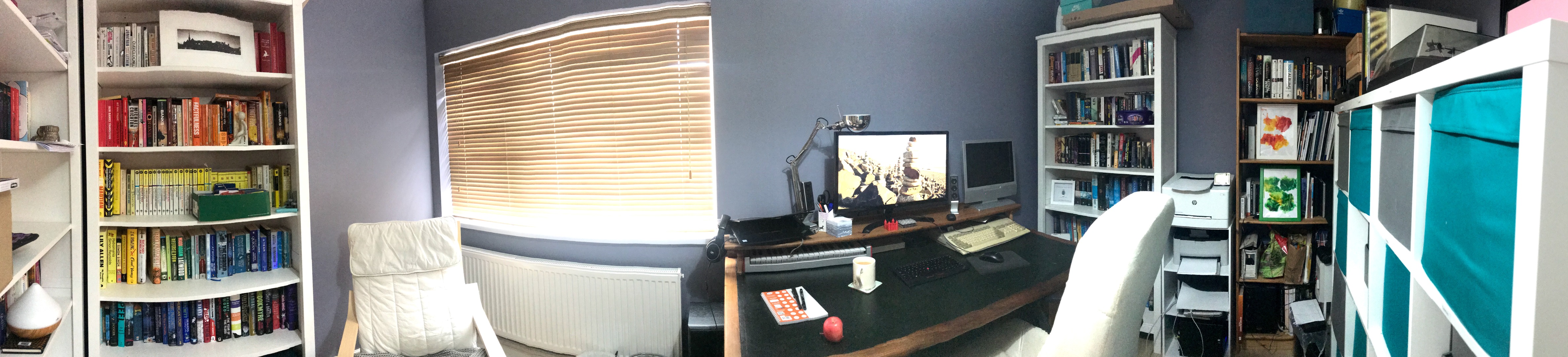
This is a fairly self-indulgent post, sorry! Encouraged by Evgeni, Michael and others, given I'm spending a lot more time at my desk in my home office, here's a picture of it:
Fisheye shot of my home office Fisheye shot of my home office
Near enough everything in the study is a work in progress. The KALLAX behind my desk is a recent addition (under duress) because we have nowhere else to put it. Sadly I can't see it going away any time soon. On the up-side, since Christmas I've had my record player and collection in and on top of it, so I can listen to records whilst working. The arm chair is a recent move from another room. It's a nice place to take some work calls, serving as a change of scene, and I hope to add a reading light sometime. The desk chair is some Ikea model I can't recall, which is sufficient, and just fits into the desk cavity. (I'm fairly sure my Aeron, inaccessible elsewhere, would not fit.) I've had this old mahogany, leather-topped desk since I was a teenager and it's a blessing and a curse. Mostly a blessing: It's a lovely big desk. The main drawback is it's very much not height adjustable. At the back is a custom made, full-width monitor stand/shelf, a recent gift produced to specification by my Dad, a retired carpenter. On the top: my work Thinkpad T470s laptop, geared more towards portable than powerful (my normal preference), although for the forseeable future it's going to remain in the exact same place; an Ikea desk lamp (I can't recall the model); a 27" 4K LG monitor, the cheapest such I could find when I bought it; an old LCD Analog TV, fantastic for vintage consoles and the like. Underneath: An Alesis Micron 2 octave analog-modelling synthesizer; various hubs and similar things; My Amiga 500. Like Evgeni, my normal keyboard is a ThinkPad Compact USB Keyboard with TrackPoint. I've been using different generations of these styles of keyboards for a long time now, initially because I loved the trackpoint pointer. I'm very curious about trying out mechanical keyboards, as I have very fond memories of my first IBM Model M buckled-spring keyboard, but I haven't dipped my toes into that money-trap just yet. The Thinkpad keyboard is rubber-dome, but it's a good one. Wedged between the right-hand bookcases are a stack of IT-related things: new printer; deprecated printer; old/spare/play laptops, docks and chargers; managed network switch; NAS.

25 June 2020

Russell Coker: How Will the Pandemic Change Things?

The Bulwark has an interesting article on why they can t Reopen America [1]. I wonder how many changes will be long term. According to the Wikipedia List of Epidemics [2] Covid-19 so far hasn t had a high death toll when compared to other pandemics of the last 100 years. People s reactions to this vary from doing nothing to significant isolation, the question is what changes in attitudes will be significant enough to change society. Transport One thing that has been happening recently is a transition in transport. It s obvious that we need to reduce CO2 and while electric cars will address the transport part of the problem in the long term changing to electric public transport is the cheaper and faster way to do it in the short term. Before Covid-19 the peak hour public transport in my city was ridiculously overcrowded, having people unable to board trams due to overcrowding was really common. If the economy returns to it s previous state then I predict less people on public transport, more traffic jams, and many more cars idling and polluting the atmosphere. Can we have mass public transport that doesn t give a significant disease risk? Maybe if we had significantly more trains and trams and better ventilation with more airflow designed to suck contaminated air out. But that would require significant engineering work to design new trams, trains, and buses as well as expense in refitting or replacing old ones. Uber and similar companies have been taking over from taxi companies, one major feature of those companies is that the vehicles are not dedicated as taxis. Dedicated taxis could easily be designed to reduce the spread of disease, the famed Black Cab AKA Hackney Carriage [3] design in the UK has a separate compartment for passengers with little air flow to/from the driver compartment. It would be easy to design such taxis to have entirely separate airflow and if setup to only take EFTPOS and credit card payment could avoid all contact between the driver and passengers. I would prefer to have a Hackney Carriage design of vehicle instead of a regular taxi or Uber. Autonomous cars have been shown to basically work. There are some concerns about safety issues as there are currently corner cases that car computers don t handle as well as people, but of course there are also things computers do better than people. Having an autonomous taxi would be a benefit for anyone who wants to avoid other people. Maybe approval could be rushed through for autonomous cars that are limited to 40Km/h (the maximum collision speed at which a pedestrian is unlikely to die), in central city areas and inner suburbs you aren t likely to drive much faster than that anyway. Car share services have been becoming popular, for many people they are significantly cheaper than owning a car due to the costs of regular maintenance, insurance, and depreciation. As the full costs of car ownership aren t obvious people may focus on the disease risk and keep buying cars. Passenger jets are ridiculously cheap. But this relies on the airline companies being able to consistently fill the planes. If they were to add measures to reduce cross contamination between passengers which slightly reduces the capacity of planes then they need to increase ticket prices accordingly which then reduces demand. If passengers are just scared of flying in close proximity and they can t fill planes then they will have to increase prices which again reduces demand and could lead to a death spiral. If in the long term there aren t enough passengers to sustain the current number of planes in service then airline companies will have significant financial problems, planes are expensive assets that are expected to last for a long time, if they can t use them all and can t sell them then airline companies will go bankrupt. It s not reasonable to expect that the same number of people will be travelling internationally for years (if ever). Due to relying on economies of scale to provide low prices I don t think it s possible to keep prices the same no matter what they do. A new economic balance of flights costing 2-3 times more than we are used to while having significantly less passengers seems likely. Governments need to spend significant amounts of money to improve trains to take over from flights that are cancelled or too expensive. Entertainment The article on The Bulwark mentions Las Vegas as a city that will be hurt a lot by reductions in travel and crowds, the same thing will happen to tourist regions all around the world. Australia has a significant tourist industry that will be hurt a lot. But the mention of Las Vegas makes me wonder what will happen to the gambling in general. Will people avoid casinos and play poker with friends and relatives at home? It seems that small stakes poker games among friends will be much less socially damaging than casinos, will this be good for society? The article also mentions cinemas which have been on the way out since the video rental stores all closed down. There s lots of prime real estate used for cinemas and little potential for them to make enough money to cover the rent. Should we just assume that most uses of cinemas will be replaced by Netflix and other streaming services? What about teenage dates, will kissing in the back rows of cinemas be replaced by Netflix and chill ? What will happen to all the prime real estate used by cinemas? Professional sporting matches have been played for a TV-only audience during the pandemic. There s no reason that they couldn t make a return to live stadium audiences when there is a vaccine for the disease or the disease has been extinguished by social distancing. But I wonder if some fans will start to appreciate the merits of small groups watching large TVs and not want to go back to stadiums, can this change the typical behaviour of groups? Restaurants and cafes are going to do really badly. I previously wrote about my experience running an Internet Cafe and why reopening businesses soon is a bad idea [4]. The question is how long this will go for and whether social norms about personal space will change things. If in the long term people expect 25% more space in a cafe or restaurant that s enough to make a significant impact on profitability for many small businesses. When I was young the standard thing was for people to have dinner at friends homes. Meeting friends for dinner at a restaurant was uncommon. Recently it seemed to be the most common practice for people to meet friends at a restaurant. There are real benefits to meeting at a restaurant in terms of effort and location. Maybe meeting friends at their home for a delivered dinner will become a common compromise, avoiding the effort of cooking while avoiding the extra expense and disease risk of eating out. Food delivery services will do well in the long term, it s one of the few industry segments which might do better after the pandemic than before. Work Many companies are discovering the benefits of teleworking, getting it going effectively has required investing in faster Internet connections and hardware for employees. When we have a vaccine the equipment needed for teleworking will still be there and we will have a discussion about whether it should be used on a more routine basis. When employees spend more than 2 hours per day travelling to and from work (which is very common for people who work in major cities) that will obviously limit the amount of time per day that they can spend working. For the more enthusiastic permanent employees there seems to be a benefit to the employer to allow working from home. It s obvious that some portion of the companies that were forced to try teleworking will find it effective enough to continue in some degree. One company that I work for has quit their coworking space in part because they were concerned that the coworking company might go bankrupt due to the pandemic. They seem to have become a 100% work from home company for the office part of the work (only on site installation and stock management is done at corporate locations). Companies running coworking spaces and other shared offices will suffer first as their clients have short term leases. But all companies renting out office space in major cities will suffer due to teleworking. I wonder how this will affect the companies providing services to the office workers, the cafes and restaurants etc. Will there end up being so much unused space in central city areas that it s not worth converting the city cinemas into useful space? There s been a lot of news about Zoom and similar technologies. Lots of other companies are trying to get into that business. One thing that isn t getting much notice is remote access technologies for desktop support. If the IT people can t visit your desk because you are working from home then they need to be able to remotely access it to fix things. When people make working from home a large part of their work time the issue of who owns peripherals and how they are tracked will get interesting. In a previous blog post I suggested that keyboards and mice not be treated as assets [5]. But what about monitors, 4G/Wifi access points, etc? Some people have suggested that there will be business sectors benefiting from the pandemic, such as telecoms and e-commerce. If you have a bunch of people forced to stay home who aren t broke (IE a large portion of the middle class in Australia) they will probably order delivery of stuff for entertainment. But in the long term e-commerce seems unlikely to change much, people will spend less due to economic uncertainty so while they may shift some purchasing to e-commerce apart from home delivery of groceries e-commerce probably won t go up overall. Generally telecoms won t gain anything from teleworking, the Internet access you need for good Netflix viewing is generally greater than that needed for good video-conferencing. Money I previously wrote about a Basic Income for Australia [6]. One of the most cited reasons for a Basic Income is to deal with robots replacing people. Now we are at the start of what could be a long term economic contraction caused by the pandemic which could reduce the scale of the economy by a similar degree while also improving the economic case for a robotic workforce. We should implement a Universal Basic Income now. I previously wrote about the make-work jobs and how we could optimise society to achieve the worthwhile things with less work [7]. My ideas about optimising public transport and using more car share services may not work so well after the pandemic, but the rest should work well. Business There are a number of big companies that are not aiming for profitability in the short term. WeWork and Uber are well documented examples. Some of those companies will hopefully go bankrupt and make room for more responsible companies. The co-working thing was always a precarious business. The companies renting out office space usually did so on a monthly basis as flexibility was one of their selling points, but they presumably rented buildings on an annual basis. As the profit margins weren t particularly high having to pay rent on mostly empty buildings for a few months will hurt them badly. The long term trend in co-working spaces might be some sort of collaborative arrangement between the people who run them and the landlords similar to the way some of the hotel chains have profit sharing agreements with land owners to avoid both the capital outlay for buying land and the risk involved in renting. Also city hotels are very well equipped to run office space, they have the staff and the procedures for running such a business, most hotels also make significant profits from conventions and conferences. The way the economy has been working in first world countries has been about being as competitive as possible. Just in time delivery to avoid using storage space and machines to package things in exactly the way that customers need and no more machines than needed for regular capacity. This means that there s no spare capacity when things go wrong. A few years ago a company making bolts for the car industry went bankrupt because the car companies forced the prices down, then car manufacture stopped due to lack of bolts this could have been a wake up call but was ignored. Now we have had problems with toilet paper shortages due to it being packaged in wholesale quantities for offices and schools not retail quantities for home use. Food was destroyed because it was created for restaurant packaging and couldn t be packaged for home use in a reasonable amount of time. Farmer s markets alleviate some of the problems with packaging food etc. But they aren t a good option when there s a pandemic as disease risk makes them less appealing to customers and therefore less profitable for vendors. Religion Many religious groups have supported social distancing. Could this be the start of more decentralised religion? Maybe have people read the holy book of their religion and pray at home instead of being programmed at church? We can always hope.

24 June 2020

Fran ois Marier: Automated MythTV-related maintenance tasks

Here is the daily/weekly cronjob I put together over the years to perform MythTV-related maintenance tasks on my backend server. The first part performs a database backup:
5 1 * * *  mythtv  /usr/share/mythtv/mythconverg_backup.pl
which I previously configured by putting the following in /home/mythtv/.mythtv/backuprc:
DBBackupDirectory=/var/backups/mythtv
and creating a new directory for it:
mkdir /var/backups/mythtv
chown mythtv:mythtv /var/backups/mythtv
The second part of /etc/cron.d/mythtv-maintenance runs a contrib script to optimize the database tables:
10 1 * * *  mythtv  /usr/bin/chronic /usr/share/doc/mythtv-backend/contrib/maintenance/optimize_mythdb.pl
once a day. It requires the libmythtv-perl and libxml-simple-perl packages to be installed on Debian-based systems. It is quickly followed by a check of the recordings and automatic repair of the seektable (when possible):
20 1 * * *  mythtv  /usr/bin/chronic /usr/bin/mythutil --checkrecordings --fixseektable
Next, I force a scan of the music and video databases to pick up anything new that may have been added externally via NFS mounts:
30 1 * * *  mythtv  /usr/bin/mythutil --quiet --scanvideos
31 1 * * *  mythtv  /usr/bin/mythutil --quiet --scanmusic
Finally, I defragment the XFS partition for two hours every day except Friday:
45 1 * * 1-4,6-7  root  /usr/sbin/xfs_fsr
and resync the RAID-1 arrays once a week to ensure that they stay consistent and error-free:
15 3 * * 2  root  /usr/local/sbin/raid_parity_check md0
15 3 * * 4  root  /usr/local/sbin/raid_parity_check md2
using a trivial script. In addition to that cronjob, I also have smartmontools run daily short and weekly long SMART tests via this blurb in /etc/smartd.conf:
/dev/sda -a -d ata -o on -S on -s (S/../.././04 L/../../6/05)
/dev/sdb -a -d ata -o on -S on -s (S/../.././04 L/../../6/05)
If there are any other automated maintenance tasks you do on your MythTV server, please leave a comment!

Raphaël Hertzog: Freexian s report about Debian Long Term Support, May 2020

A Debian LTS logo Like each month, here comes a report about the work of paid contributors to Debian LTS. Individual reports In May, 198 work hours have been dispatched among 14 paid contributors. Their reports are available: Evolution of the situation In May 2020 we had our second (virtual) contributors meeting on IRC, Logs and minutes are available online. Then we also moved our ToDo from the Debian wiki to the issue tracker on salsa.debian.org.
Sadly three contributors went inactive in May: Adrian Bunk, Anton Gladky and Dylan A ssi. And while there are currently still enough active contributors to shoulder the existing work, we like to use this opportunity that we are always looking for new contributors. Please mail Holger if you are interested.
Finally, we like to remind you for a last time, that the end of Jessie LTS is coming in less than a month!
In case you missed it (or missed to act), please read this post about keeping Debian 8 Jessie alive for longer than 5 years. If you expect to have Debian 8 servers/devices running after June 30th 2020, and would like to have security updates for them, please get in touch with Freexian. The security tracker currently lists 6 packages with a known CVE and the dla-needed.txt file has 30 packages needing an update. Thanks to our sponsors New sponsors are in bold. With the upcoming start of Jessie ELTS, we are welcoming a few new sponsors and others should join soon.

No comment Liked this article? Click here. My blog is Flattr-enabled.

21 June 2020

Molly de Blanc: Fire

The world is on fire. I know many of you are either my parents friends or here for the free software thoughts, but rather than listen to me, I want you to listed to Black voices in these fields. If you re not Black, it s your job to educate yourself on issues that affect Black people all over the world and the way systems are designed to benefit White Supremacy. It is our job to acknowledge that racism is a problem whether it appears as White Supremacy, Colonialism, or something as seemingly banal as pay gaps. We must make space for Black voices. We must make space for Black Women. We must make space for Black trans lives. We must do this in technology. We must build equity. We must listen. I know I have a platform. It s one I value highly because I ve worked so hard for the past twelve years to build it against sexist attitudes in my field (and the world). However, it is time for me to use that platform for the voices of others. Please pay attention to Black voices in tech and FOSS. Do not just expect them to explain diversity and inclusion, but go to them for their expertise. Pay them respectful salaries. Mentor Black youth and Black people who want to be involved. Volunteer or donate to groups like Black Girls Code, The Last Mile, and Resilient Coders. If you re looking for mentorship, especially around things like writing, speaking, community organizing, or getting your career going in open source, don t hesitate to reach out to me. Mentorship can be a lasting relationship, or a brief exchange around a specific issue of event. If I can t help you, I ll try to connect you to someone who can. We cannot build the techno-utopia unless everyone is involved.

19 June 2020

Ingo Juergensmann: Jitsi Meet and ejabberd

Since the more or less global lockdown caused by Covid-19 there was a lot talk about video conferencing solutions that can be used for e.g. those people that try to coordinate with coworkers while in home office. One of the solutions is Jitsi Meet, which is NOT packaged in Debian. But there are Debian packages provided by Jitsi itself. Jitsi relies on an XMPP server. You can see the network overview in the docs. While Jitsi itself uses Prosody as XMPP and their docs only covers that one. But it's basically irrelevant which XMPP you want to use. Only thing is that you can't follow the official Jitsi documentation when you are not using Prosody but instead e.g. ejabberd. As always, it's sometimes difficult to find the correct/best non-official documentation or how-to, so I try to describe what helped me in configuring Jitsi Meet with ejabberd as XMPP server and my own coturn STUN/TURN server... This is not a step-by-step description, but anyway... here we go with some links: One of the first issues I stumpled across was that my Java was too old, but this can be quickly solved by update-alternatives:
There are 3 choices for the alternative java (providing /usr/bin/java). Selection Path Priority Status
------------------------------------------------------------
* 0 /usr/lib/jvm/java-11-openjdk-amd64/bin/java 1111 auto mode
1 /usr/lib/jvm/java-11-openjdk-amd64/bin/java 1111 manual mode
2 /usr/lib/jvm/java-8-openjdk-amd64/jre/bin/java 1081 manual mode
3 /usr/lib/jvm/jre-7-oracle-x64/bin/java 316 manual mode
It was set to jre-7, but I guess this was from years ago when I ran OpenFire as XMPP server. If something is not working with Jitsi Meet, it helps to not watch the log files only, but also to open the Debug Console in your web browser. That way I catched some XMPP Failures and saw that it tries to connect to some components where the DNS records were missing:
meet IN A yourIP
chat.meet IN A yourIP
focus.meet IN A yourIP
pubsub.meet IN A yourIP
Of course you also need to add some config to your ejabberd.yml:
host_config:
domain.net:
auth_password_format: scram
meet.domain.net:
## Disable s2s to prevent spam
s2s_access: none
auth_method: anonymous
allow_multiple_connections: true
anonymous_protocol: both
modules:
mod_bosh:
mod_caps:
mod_carboncopy:
#mod_disco:
mod_stun_disco:
secret: "YOURSECRETTURNCREDENTIALS"
services:
-
host: yourIP # Your coturn's public address.
type: stun
transport: udp
-
host: yourIP # Your coturn's public address.
type: stun
transport: tcp
-
host: yourIP # Your coturn's public address.
type: turn
transport: udp
mod_muc:
access: all
access_create: local
access_persistent: local
access_admin: admin
host: "chat.@"
mod_muc_admin:
mod_ping:
mod_pubsub:
access_createnode: local
db_type: sql
host: "pubsub.@"
ignore_pep_from_offline: false
last_item_cache: true
max_items_node: 5000 # For Jappix this must be set to 1000000
plugins:
- "flat"
- "pep" # requires mod_caps
force_node_config:
"eu.siacs.conversations.axolotl.*":
access_model: open
## Avoid buggy clients to make their bookmarks public
"storage:bookmarks":
access_model: whitelist
There is more config that needs to be done, but one of the XMPP Failures I spotted from debug console in Firefox was that it tried to connect to conference.domain.net while I prefer to use chat.domain.net for its brevity. If you prefer conference instead of chat, then you shouldn't be affected by this. Just make just that your config is consistent with what Jitsi Meet wants to connect to. Maybe not all of the above lines are necessary, but this works for me. Jitsi config is like this for me with short domains (/etc/jitsi/meet/meet.domain.net-config.js):
var config = hosts:
domain: 'domain.net',
anonymousdomain: 'meet.domain.net',
authdomain: 'meet.domain.net',
focus: 'focus.meet.domain.net',
muc: 'chat.hookipa.net'
, bosh: '//meet.domain.net:5280/http-bind',
//websocket: 'wss://meet.domain.net/ws',
clientNode: 'http://jitsi.org/jitsimeet',
focusUserJid: 'focus@domain.net', useStunTurn: true, p2p:
// Enables peer to peer mode. When enabled the system will try to
// establish a direct connection when there are exactly 2 participants
// in the room. If that succeeds the conference will stop sending data
// through the JVB and use the peer to peer connection instead. When a
// 3rd participant joins the conference will be moved back to the JVB
// connection.
enabled: true, // Use XEP-0215 to fetch STUN and TURN servers.
useStunTurn: true, // The STUN servers that will be used in the peer to peer connections
stunServers: [
// urls: 'stun:meet-jit-si-turnrelay.jitsi.net:443' ,
// urls: 'stun:stun.l.google.com:19302' ,
// urls: 'stun:stun1.l.google.com:19302' ,
// urls: 'stun:stun2.l.google.com:19302' ,
urls: 'stun:turn.domain.net:5349' ,
urls: 'stun:turn.domain.net:3478'
], ....
In the above config snippet one of the issues solved was to add the port to the bosh setting. Of course you can also take care that your bosh requests get forwarded by your webserver as reverse proxy. Using the port in the config might be a quick way to test whether or not your config is working. It's easier to solve one issue after the other and make one config change at a time instead of needing to make changes in several places. /etc/jitsi/jicofo/sip-communicator.properties:
org.jitsi.jicofo.auth.URL=XMPP:meet.domain.net
org.jitsi.jicofo.BRIDGE_MUC=jvbbrewery@chat.meet.domain.net
/etc/jitsi/videobridge/sip-communicator.properties:
org.jitsi.videobridge.ENABLE_STATISTICS=true
org.jitsi.videobridge.STATISTICS_TRANSPORT=muc
org.jitsi.videobridge.STATISTICS_INTERVAL=5000 org.jitsi.videobridge.xmpp.user.shard.HOSTNAME=localhost
org.jitsi.videobridge.xmpp.user.shard.DOMAIN=domain.net
org.jitsi.videobridge.xmpp.user.shard.USERNAME=jvb
org.jitsi.videobridge.xmpp.user.shard.PASSWORD=SECRET
org.jitsi.videobridge.xmpp.user.shard.MUC_JIDS=JvbBrewery@chat.meet.domain.net
org.jitsi.videobridge.xmpp.user.shard.MUC_NICKNAME=videobridge1 org.jitsi.videobridge.DISABLE_TCP_HARVESTER=true
org.jitsi.videobridge.TCP_HARVESTER_PORT=4443
org.ice4j.ice.harvest.NAT_HARVESTER_LOCAL_ADDRESS=yourIP
org.ice4j.ice.harvest.NAT_HARVESTER_PUBLIC_ADDRESS=yourIP
org.ice4j.ice.harvest.DISABLE_AWS_HARVESTER=true
org.ice4j.ice.harvest.STUN_MAPPING_HARVESTER_ADDRESSES=turn.domain.net:3478
org.ice4j.ice.harvest.ALLOWED_INTERFACES=eth0
Sometimes there might be stupid errors like (in my case) wrong hostnames like "chat.meet..domain.net" (a double dot in the domain), but you can spot those easily in the debug console of your browser. There tons of config options where you can easily make mistakes, but watching your logs and your debug console should really help you in sorting out these kind of errors. The other URLs above are helpful as well and more elaborate then my few lines here. Especially Mike Kuketz has some advanced configuration tips like disabling third party requests with "disableThirdPartyRequests: true" or limiting the number of video streams and such. Hope this helps...
Kategorie:

18 June 2020

Gunnar Wolf: On masters and slaves, whitelists and blacklists...

LWN published today yet another great piece of writing, Loaded terms in free software. I am sorry, the content will not be immediately available to anybody following at home, as LWN is based on a subscription model But a week from now, the article will be open for anybody to read. Or you can ask me (you most likely can find my contact addresses, as they are basically everywhere) for a subscriber link, I will happily provide it. In consonance with the current mood that started with the killing of George Floyd and sparked worldwide revolts against police brutality, racism (mostly related to police and law enforcement forces, but social as well) and the like, the debate that already started some months ago in technical communities has re-sparked: We have many terms that come with long histories attached to them, and we are usually oblivious to their obvious meaning. We? Yes, we, the main users and creators of technology. I never felt using master and slave to refer to different points of a protocol, bus, clock or whatever (do refer to the Wikipedia article for a fuller explanation) had any negative connotations but then again, those terms have never tainted my personal family. That is, I understand I speak from a position of privilege. A similar although less heated issue goes around the blacklist and whitelist terms, or other uses that use white to refer to good, law-abiding citizens, and black to refer to somewhat antisocial uses (i.e. the white hat and black hat hackers). For several years, this debate has been sparking and dying off. Some important changes have been made Particularly, in 2017 the Internet Software Consortium started recommending Primary and Secondary, Python dropped master/slave pairs after a quite thorough and deep review throughout 2018, GitHub changed the default branch from master to main earlier this week. The Internet Engineering Task Force has a draft (that lapsed and thus sadly didn t become an RFC, but still, is archived), Terminology, Power and Oppressive Language that lists suggested alternatives:
There are also many other relationships that can be used as metaphors, Eglash s research calls into question the accuracy of the master-slave metaphor. Fortunately, there are ample alternatives for the master-slave relationship. Several options are suggested here and should be chosen based on the pairing that is most clear in context:
  • Primary-secondary
  • Leader-follower
  • Active-standby
  • Primary-replica
  • Writer-reader
  • Coordinator-worker
  • Parent-helper
I ll add that I think we Spanish-speakers are not fully aware of the issue s importance, because the most common translation I have seen for master/slave is maestro/esclavo: Maestro is the word for teacher (although we do keep our slaves in place). But think whether it sounds any worse if you refer to device pairs, or members of a database high-availability cluster, or whatever as Amo and Esclavo. It does sound much worse I cannot add much of value to this debate. I am just happy issues like this are being recognized and dealt with. If the topic interests you, do refer to the LWN article! Some excrepts: I consider the following to be the core of Jonathan Corbet s writeup:
Recent events, though, have made it clear even to those of us who were happy to not question this view that the story of slavery and the wider racist systems around it is not yet finished. There are many people who are still living in the middle of it, and it is not a nice place to be. We are not so enlightened as we like to think we are. If there is no other lesson from the events of the last few weeks, we should certainly take to heart the point that we need to be listening to the people who have been saying, for many years, that they are still suffering. If there are people who are telling us that terms like slave or blacklist are a hurtful reminder of the inequities that persist in our society, we need to accept that as the truth and act upon it. Etymological discussions on what, say, master really means may be interesting, but they miss the point and are irrelevant to this discussion.
Part of a comment by user yokem_55:
Often, it seems to me that the replacement words are much more descriptive and precise than the old language. Allowlist is far more obviously a list of explicitly authorized entities than whitelist . Mainline has a more obvious meaning of a core stream of development than master . The benefit of moving past this language is more than just changing cultural norms, it s better, more precise communication across the board.
Another spot-on comment, by user alan:
From my perspective as a Black American male, I think that it s nice to see people willing to see and address racism in various spheres. I am concerned that some of these steps will be more performative than substantial. Terminology changes in software so as to be more welcoming is a nice thing. Ensuring that oppressed minorities have access to the tools and resources to help reduce inequity and ensuring equal protection under the laws is better. We ll get there one day I m sure. The current ask is much simpler, its just to stop randomly killing and terrorizing us. Please and thank you.
So Maybe the protests of this year caught special notoriety because the society is reacting after (or during, for many of us) the lockdown. In any case, I hope for their success in changing the planet s culture of oppression.

Comments Tomas Janousek 2020-06-19 10:04:32 +0200 In the blog post On masters and slaves, whitelists and blacklists you claim that GitHub changed the default branch from master to main earlier this week but I don t think that change is in effect yet. When you create a repo, the default branch is still named master . Gunnar Wolf 2020-06-19 11:52:30 -0500 Umh, seems you are right. Well, what can I say? I m reporting only what I have been able to find / read Now, given that said master branch does not carry any Git-specific meaning and is just a commonly used configuration I hope people start picking it up. No, I have not renamed master branches in any of my repos but intend to do so soonish. Tomas Janousek 2020-06-19 20:01:52 +0200 Yeah, don t worry. I just find it sad that so much inaccurate news is spreading from a single CEO tweet, and I wanted to help stop that. I m sure some change will happen eventually, but until it does, we shouldn t speak about it in the past tense. :-)

15 June 2020

Mark Brown: Book Club: Zettlekasten

Recently I was part of a call with Daniel and Lars to discuss Zettelkasten, a system for building up a cross-referenced archive of notes to help with research and study that has been getting a lot of discussion recently, the key thing being the building of links between ideas. Tomas Vik provided an overview of the process that we all found very helpful, and the information vs knowledge picture in Eugene Yan s blog on the topic (by @gapingvoid) really helped us crystalize the goals. It s not at all new and as Lars noted has a lot of similarities with a wikis in terms of what it produces but it couples this with an emphasis on the process and constant generation of new entries which Daniel found similar to some of the Getting Things Done recommendations. We all liked the emphasis on constant practice and how that can help build skills around effective note taking, clear writing and building links between ideas. Both Daniel and Lars already have note taking practicies that they find useful, combinations of journalling and building up collections of notes of learnings over time, and felt that there could be value in integrating aspects of Zettelkasten into these practices so we talked quite a bit about how that could be done. There was a consensus that journalling is useful so the main idea we had was to keep maintaining the journal, using that as an inbox and setting aside time to write entries into a Zettelkasten. This is also a useful way to approach recording things when away from a computer, taking notes and then writing them up later. Daniel suggested that one way to migrate existing notes might be to simply start anew, moving things over from old notes as required and then after a suitably long period (for example a year) review anything that was left and migrate anything that was left. We were all concerned about the idea of using any of the non-free solutions for something that is intended to be used long term, especially where the database isn t in an easily understood format. Fortunately there are free software tools like Zettlr which seem to address these concerns well. This was a really useful discussion, it really helps to bounce ideas off each other and this was certainly an interesting topic to learn about with some good ideas which will hopefully be helpful to us.

Arturo Borrero Gonz lez: A better Toolforge: a technical deep dive

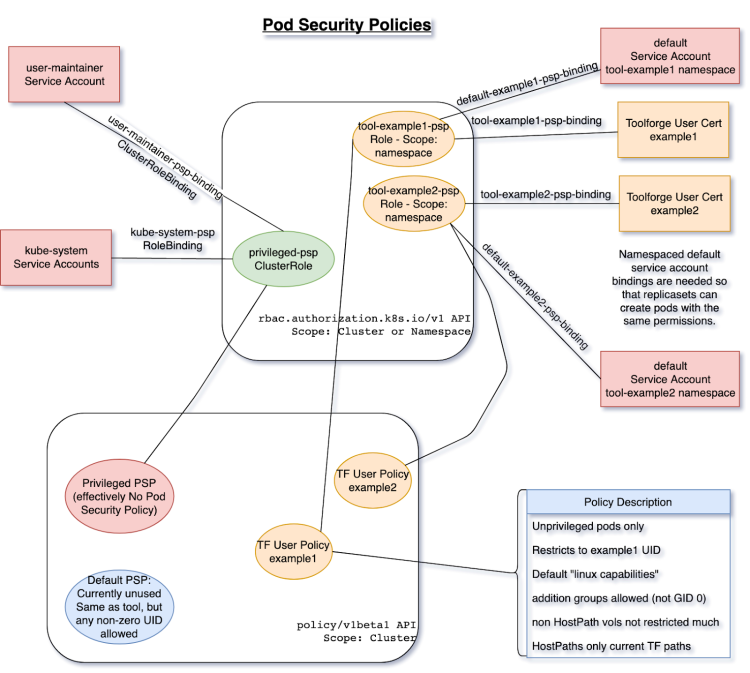
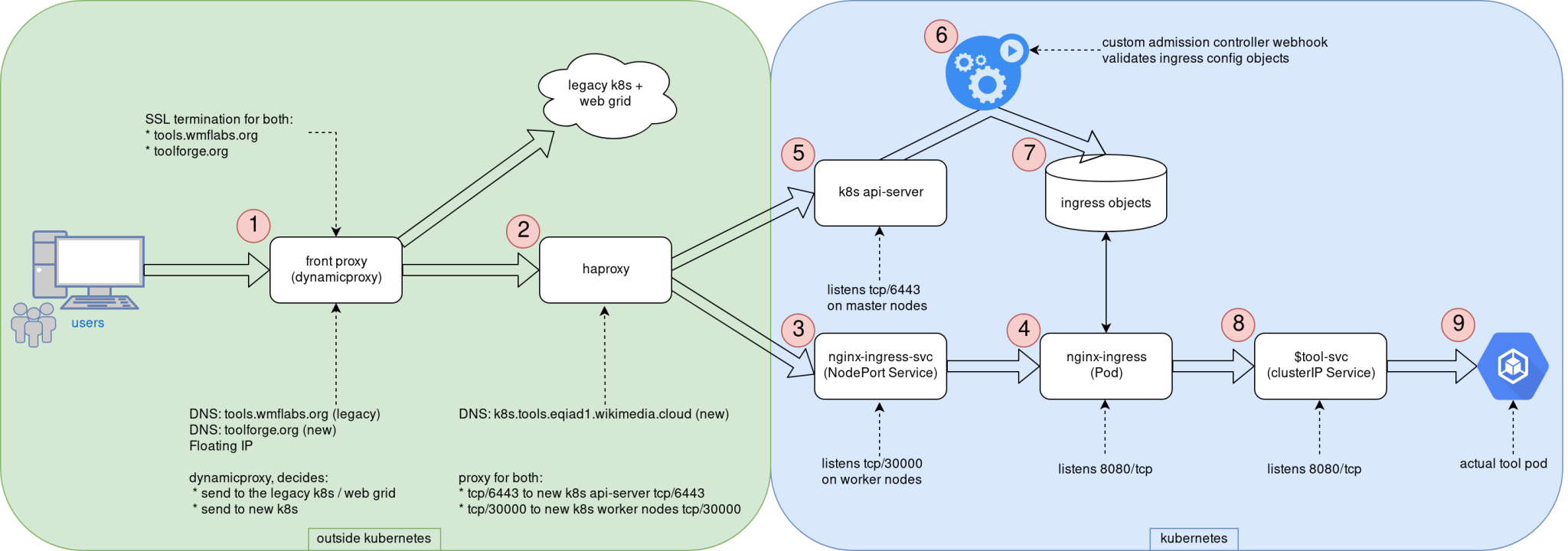
Logos This post was originally published in the Wikimedia Tech blog, and is authored by Arturo Borrero Gonzalez and Brooke Storm. In the previous post, we shared the context on the recent Kubernetes upgrade that we introduced in the Toolforge service. Today we would like to dive a bit more in the technical details. Custom admission controllers One of the key components of the Toolforge Kubernetes are our custom admission controllers. We use them to validate and enforce that the usage of the service is what we intended for. Basically, we have 2 of them: The source code is written in Golang, which is pretty convenient for natively working in a Kubernetes environment. Both code repositories include extensive documentation: how to develop, test, use, and deploy them. We decided to go with custom admission controllers because we couldn t find any native (or built-in) Kubernetes mechanism to accomplish the same sort of checks on user activity. With the Ingress controller, we want to ensure that Ingress objects only handle traffic to our internal domains, which by the time of this writing, are toolforge.org (our new domain) and tools.wmflabs.org (legacy). We safe-list the kube-system namespace and the tool-fourohfour namespace because both need special consideration. More on the Ingress setup later. The registry controller is pretty simple as well. It ensures that only our internal docker registry is used for user-scheduled containers running in Kubernetes. Again, we exclude from the checks containers running in the kube-system namespace (those used by Kubernetes itself). Other than that, the validation itself is pretty easy. For some extra containers we run (like those related to Prometheus metrics) what we do is simply upload those docker images to our internal registry. The controls provided by this admission controller helps us validate that only FLOSS software is run in our environment, which is one of the core rules of Toolforge. RBAC and Pod Security Policy setup I would like to comment next on our RBAC and Pod Security Policy setup. Using the Pod Security Policies (or PSP) we establish a set of constraints on what containers can and can t do in our cluster. We have many PSP configured in our setup: Each user can interact with their own namespace (this is how we achieve multi-tenancy in the cluster). Kubernetes knows about each user by means of TLS certs, and for that we have RBAC. Each user has a rolebinding to a shared cluster-role that defines how Toolforge tools can use the Kubernetes API. The following diagram shows the design of our RBAC and PSP in our cluster: RBAC and PSP for Toolforge diagram RBAC and PSP for Toolforge, original image in wikitech I mentioned that we know about each user by means of TLS certificates. This is true, and in fact, there is a key component in our setup called maintain-kubeusers. This custom piece of Python software is run as a pod inside the cluster and is responsible for reading our external user database (LDAP) and generating the required credentials, namespaces, and other configuration bits for them. With the TLS cert, we basically create a kubeconfig file that is then written into the homes NFS share, so each Toolforge user has it in their shell home directory. Networking and Ingress setup With the basic security controls in place, we can move on to explaining our networking and Ingress setup. Yes, the Ingress word might be a bit overloaded already, but we refer here to Ingress as the path that end-users follow from their web browser in their local machine to a webservice running in the Toolforge cluster. Some additional context here. Toolforge is not only Kubernetes, but we also have a Son of GridEngine deployment, a job scheduler that covers some features not available in Kubernetes. The grid can also run webservices, although we are encouraging users to migrate them to Kubernetes. For compatibility reasons, we needed to adapt our Ingress setup to accommodate the old web grid. Deciding the layout of the network and Ingress was definitely something that took us some time to figure out because there is not a single way to do it right. The following diagram can be used to explain the different steps involved in serving a web service running in the new Toolforge Kubernetes. Toolforge k8s network topology diagram Toolforge k8s network topology, original image in Wikitech The end-user HTTP/HTTPs request first hits our front proxy in (1). Running here is NGINX with a custom piece of LUA code that is able to decide whether to contact the web grid or the new Kubernetes cluster. TLS termination happens here as well, for both domains (toolforge.org and tools.wmflabs.org). Note this proxy is reachable from the internet, as it uses a public IPv4 address, a floating IP from CloudVPS, the infrastructure service we provide based on Openstack. Remember that our Kubernetes is directly built in virtual machines a bare-metal type deployment. If the request is directed to a webservice running in Kubernetes, the request now reaches haproxy in (2), which knows the cluster nodes that are available for Ingress. The original 80/TCP packet is now translated to 30000/TCP; this is the TCP port we use internally for the Ingress traffic. This haproxy instance provides load-balancing also for the Kubernetes API as well, using 6443/TCP. It s worth mentioning that unlike the Ingress, the API is only reachable from within the cluster and not from the internet. We have a NGINX-Ingress NodePort service listening in 30000/TCP in every Kubernetes worker node in (3); this helps the request to eventually reach the actual NGINX-Ingress pod in (4), which is listening in 8080/TCP. You can see in the diagram how in the API server (5) we hook the Ingress admission controller (6) to validate Kubernetes Ingress configuration objects before allowing them in for processing by NGINX-Ingress (7). The NGINX-Ingress process knows which tools webservices are online and how to contact them by means of an intermediate Service object in (8). This last Service object means the request finally reaches the actual tool pod in (9). At this point, it is worth noting that our Kubernetes cluster uses internally kube-proxy and Calico, both using Netfilter components to handle traffic. tools-webservice Most user-facing operations are simplified by means of another custom piece of Python code: tools-webservice. This package provides users with the webservice command line utility in our shell bastion hosts. Typical usage is to just run webservice start stop status. This utility creates all the required Kubernetes objects on-demand like Deployment, ReplicaSet, Ingress and Service to ease deploying web apps in Toolforge. Of course, advanced users can interact directly with Kubernetes API and create their custom configuration objects. This utility is just a wrapper, a shortcut. tool-fourohfour and tool-k8s-status The last couple of custom components we would like to mention are the tool-fourohfour and tool-k8s-status web services. These two utilities run inside the cluster as if they were any other user-created tool. The fourohfour tool allows for a controlled handling of HTTP 404 errors, and it works as the default NGINX-Ingress backend. The k8s-status tool shows plenty of information about the cluster itself and each tool running in the cluster, including links to the Server Admin Log, an auto-generated grafana dashboard for metrics, and more. For metrics, we use an external Prometheus server that contacts the Kubernetes cluster to scrape metrics. We created a custom metrics namespace in which we deploy all the different components we use to observe the behavior of the system: All the Prometheus data we collect is used in several different Grafana dashboards, some of them directed for user information like the ones linked by the k8s-status tool and some others for internal use by us the engineers. These are for internal use but are still public, like the Ingress specific dashboard, or the cluster state dashboard. Working publicly, in a transparent way, is key for the success of CloudVPS in general and Toolforge in particular. Like we commented in the previous post, all the engineering work that was done here was shared by community members. By the community, for the community We think this post sheds some light on how the Toolforge Kubernetes service works, and we hope it could inspire others when trying to build similar services or, even better, help us improve Toolforge itself. Since this was first put into production some months ago we detected already some margin for improvement in a couple of the components. As in many other engineering products, we will follow an iterative approach for evolving the service. Mind that Toolforge is maintained by the Wikimedia Foundation, but you can think of it as a service by the community for the community. We will keep an eye on it and have a list of feature requests and things to improve in the future. We are looking forward to it! This post was originally published in the Wikimedia Tech blog, and is authored by Arturo Borrero Gonzalez and Brooke Storm.

14 June 2020

Evgeni Golov: naked pings 2020

ajax' post about "ping" etiquette is over 10 years old, but holds true until this day. So true, that my IRC client at work has a script, that will reply with a link to it each time I get a naked ping. But IRC is not the only means of communication. There is also mail, (video) conferencing, and GitHub/GitLab. Well, at least in the software engineering context. Oh and yes, it's 2020 and I still (proudly) have no Slack account. Thankfully, (naked) pings are not really a thing for mail or conferencing, but I see an increasing amount of them on GitHub and it bothers me, a lot. As there is no direct messaging on GitHub, you might rightfully ask why, as there is always context in form of the issue or PR the ping happened in, so lean back an listen ;-) notifications become useless While there might be context in the issue/PR, there is none (besides the title) in the notification mail, and not even the title in the notification from the Android app (which I have installed as I use it lot for smaller reviews). So the ping will always force a full context switch to open the web view of the issue in question, removing the possibility to just swipe away the notification/mail as "not important right now". even some context is not enough context Even after visiting the issue/PR, the ping quite often remains non-actionable. Do you want me to debug/fix the issue? Review the PR? Merge it? Close it? I don't know! The only actionable ping is when the previous message is directed at me and has an actionable request in it and the ping is just a reminder that I have to do it. And even then, why not write "hey @evgeni, did you have time to process my last question?" or something similar? BTW, this is also what I dislike about ajax' minimal example "ping re bz 534027" - what am I supposed to do with that BZ?! why me anyways?! Unless I am the only maintainer of a repo or the author of the issue/PR, there is usually no reason to ping me directly. I might be sick, or on holiday, or currently not working on that particular repo/topic or whatever. Any of that will result in you thinking that your request will be prioritized, while in reality it won't. Even worse, somebody might come across it, see me mentioned and think "ok, that's Evgeni's playground, I'll look elsewhere". Most organizations have groups of people working on specific topics. If you know the group name and have enough permissions (I am not exactly sure which, just that GitHub have limits to avoid spam, sorry) you can ping @organization/group and everyone in that group will get a notification. That's far from perfect, but at least this will get the attention of the right people. Sometimes there is also a bot that will either automatically ping a group of people or you can trigger to do so. Oh, and I'm getting paid for work on open source. So if you end up pinging me in a work-related repository, there is a high chance I will only process that during work hours, while another co-worker might have been available to help you out almost immediately. be patient Unless we talked on another medium before and I am waiting for it, please don't ping directly after creation of the issue/PR. Maintainers get notifications about new stuff and will triage and process it at some point. conclusion If you feel called out, please don't take it personally. Instead, please try to provide as much actionable information as possible and be patient, that's the best way to get a high quality result. I will ignore pings where I don't immediately know what to do, and so should you. one more thing Oh, and if you ping me on IRC, with context, and then disconnect before I can respond In the past you would sometimes get a reply by mail. These days the request will be most probably ignored. I don't like talking to the void. Sorry.

12 June 2020

Ulrike Uhlig: The right to demand change

Two women sit in an office, one asks: "What's the difference between being assertive and being aggressive?" The other replies: "Your gender." (Cartoon by Judy Horacek, 1999.) When a person of a marginalized group (read: a person with less privilege, a person with lower rank) is being framed and blamed as being aggressive, she is being told that her behavior is unacceptable. Marginalized people have learnt that they need to comply to fit, and are likely to suppress their feelings. By being framed as aggressive, the marginalized person is also being told that what they are saying cannot be listened to because the way they are saying it does not comply with expectations. There is a word for this: tone policing. This great comic by Robot Hugs has all the important details. Tone policing is a silencing tactic in which privileged participants of a discussion one-sidedly define the terms of the conversation. This tactic has the interesting side effect of shifting the responsibility to prove that one is not aggressive, hostile, explosive, a minefield, etc. to the person being framed and blamed - proving that one is worthy to be listened to. (Some of those words are actual quotes taken from real life.) Years ago, I worked in a company in which my female developer colleague would put herself in a state of overly expressed sorriness, all the while pretending to be stupid and helpless whenever she needed to ask anything from the sysadmins. When I confronted her with that, she replied: "I do it because it works." In the same company, another woman who generally asked assertively for what she needed ended up being insulted by one of the project managers using the word "dominatrix". While the example comes from my own experience, this kind of thing happens across any oppression/privilege boundaries. In some conversations, be they verbal or written, frustration and anger of one person are sometimes being mistaken by the communication partner for aggressiveness. Why is this happening? Asking a person with privilege to see, question, or change their behavior, questions their privilege. I'm thinking that it might be that most people think of themselves as "being good" and when they are being asked to question themselves or their behavior, their self-image is being challenged. "Me? But I did not do anything wrong! It's certainly not my fault if you are being oppressed! I sacrificed myself to reach my current position in life!" This comic by Toby Morris, "On a Plate", explains it quite nicely. So are we stuck with seeing conversations derail? I'd argue instead that while anger and frustration are unpleasant feelings, they're important: they show us that our boundaries have been crossed, that we want something to change, to stop, or that we need something different right now. We have the right to be angry and to demand change.

10 June 2020

Joey Hess: bracketing and async exceptions in haskell

I've been digging into async exceptions in haskell, and getting more and more concerned. In particular, bracket seems to be often used in ways that are not async exception safe. I've found multiple libraries with problems. Here's an example:

withTempFile a = bracket setup cleanup a
  where
    setup = openTempFile "/tmp" "tmpfile"
    cleanup (name, h) = do
        hClose h
        removeFile name
This looks reasonably good, it makes sure to clean up after itself even when the action throws an exception. But, in fact that code can leave stale temp files lying around. If the thread receives an async exception when hClose is running, it will be interrupted before the file is removed. We normally think of bracket as masking exceptions, but it doesn't prevent async exceptions in all cases. See Control.Exception on "interruptible operations", which can receive async exceptions even when other exceptions are masked. It's a bit surprising, but hClose is such an interruptable operation, because it flushes the write buffer. The only way to know is to read the code. It can be quite hard to determine if an operation is interruptable, since it can come down to whether it retries a STM transaction, or uses a MVar that is not always full. I've been auditing libraries and I often have to look at code several dependencies away, and even then may not be sure if a library has this problem. So far, around half of the libraries I've looked at, that use bracket or onException or the like probably have this problem. What can libraries do? My impression of the state of things now is that you should be very cautious using race or cancel or withAsync or the like, unless the thread is small and easy to audit for these problems. Kind of a shame, since I had wanted to be able to cancel a thread that is big and sprawling and uses all the libraries mentioned above.
This work was sponsored by Jake Vosloo and Graham Spencer on Patreon.

Jonathan Dowland: Template Haskell and Stream-processing programs

I've written about what Template Haskell is, and given an example of what it can be used for, it's time to explain why I was looking at it in the context of my PhD work. Encoding stream-processing programs StrIoT is an experimental distributed stream-processing system that myself and others are building in order to explore our research questions. A user of StrIoT writes a stream-processing program, using a set of 8 functional operators provided for the purpose. A simple example is
streamFn :: Stream Int -> Stream Int
streamFn = streamFilter (<15)
         . streamFilter (>5)
         . streamMap (*2)
Our system is distributed: we take a stream-processing program and partition it into sub-programs, which are distributed to and run on separate nodes (perhaps cloud instances, or embedded devices like Raspberry Pis etc.). In order to do that, we need to be able to manipulate the stream-processing program as data. We've initially opted for a graph data-structure, with the vertices in the graph defined as
data StreamVertex = StreamVertex
      vertexId   :: Int
    , operator   :: StreamOperator
    , parameters :: [String]
    , intype     :: String
    , outtype    :: String
      deriving (Eq,Show)
A stream-processing program encoded this way, equivalent to the first example
path [ StreamVertex 0 Map    ["(*2)"]  "Int" "Int"
     , StreamVertex 1 Filter ["(>5)"]  "Int" "Int"
     , StreamVertex 2 Filter ["(<15)"] "Int" "Int"
     ]
We can easily manipulate instances of such types, rewrite them, partition them and generate code from them. Unfortunately, this is quite a departure from the first simple code example from the perspective of a user writing their program. Template Haskell gives us the ability to manipulate code as a data structure, and also to inspect names to gather information about them (their type, etc.). I started looking at TH to see if we could build something where the user-supplied program was as close to that first case as possible. TH limitations There are two reasons that we can't easily manipulate a stream-processing definition written as in the first example. The following expressions are equivalent, in some sense, but are not equal, and so yield completely different expression trees when quasi-quoted:
[  streamFilter (<15) . streamFilter (>5) . streamMap (*2)  ]
  \s -> streamFilter (<15) (streamFilter (>5) (streamMap (*2) s))  ]
[  streamMap (*2) >>> streamFilter (>5) >>> streamFilter (<15)  ]
[  \s -> s & streamMap (*2) & streamFilter (>5) & streamFilter (<15)  ]
[  streamFn  ] -- a named expression, defined outside the quasi-quotes
In theory, reify can give you the definition of a function from its name, but in practice it doesn't, because this was never implemented. So at the very least we would need to insist that a user included the entirety of a stream-processing program within quasi-quotes, and not split it up into separate bits, with some bits defined outside the quotes and references within (as in the last case above). We would probably have to insist on a consistent approach for composing operators together, such as always use (.) and never >>>, &, etc. which is limiting. Incremental approach After a while ruminating on this, and before moving onto something else, I thought I'd try approaching it from the other side. Could I introduce some TH into the existing approach, and improve it? The first thing I've tried is to change the parameters field to TH's ExpQ, meaning the map instance example above would be
StreamVertex 0 Map [ [  (*2)  ] ] "Int" "Int"
I worked this through. It's an incremental improvement ease and clarity for the user writing a stream-processing program. It catches a class of programming bugs that would otherwise slip through: the expressions in the brackets have to be syntactically valid (although they aren't type checked). Some of the StrIoT internals are also much improved, particularly the logical operator. Here's an excerpt from a rewrite rule that involves composing code embedded in strings, dealing with all the escaping rules and hoping we've accounted for all possible incoming expression encodings:
let f' = "(let f = ("++f++"); p = ("++p++"); g = ("++g++") in\
         \ \\ (a,b) v -> (f a v, if p v a then g b v else b))"
    a' = "("++a++","++b++")"
    q' = "(let p = ("++p++"); q = ("++q++") in \\v (y,z) -> p v y && q v z)"
And the same section after, manipulating ExpQ types:
let f' = [  \ (a,b) v -> ($(f) a v, if $(p) v a then $(g) b v else b)  ]
    a' = [  ($(a), $(b))  ]
    q' = [  \v (y,z) -> $(p) v y && $(q) v z  ]
I think the code-generation part of StrIoT could be radically refactored to take advantage of this change but I have not made huge inroads into that. Next steps This is, probably, where I am going to stop. This work is very interesting to me but not the main thrust of my research. But incrementally improving the representation gave me some ideas of what I could try next: The type would have collapsed down to
data StreamVertex = StreamVertex
      vertexId   :: Int
    , opAndParams :: ExpQ
      deriving (Eq,Show)
Example instances might be
StreamVertex 0 [  streamMap (*2)  ]
StreamVertex 1 [  streamExpand  ]
StreamVertex 2 [  streamScan (\c _ -> c+1) 0  ]
The vertexId field is a bit of wart, but we require that due to the graph data structure that we are using. A change there could eliminate it, too. By this point we are not that far away from where we started, and certainly much closer to the "pure" function application in the very first example.

Evgeni Golov: show your desk

Some days ago I posted a picture of my desk on Mastodon and Twitter. standing desk with a monitor, laptop etc After that I got multiple questions about the setup, so I thought "Michael and Michael did posts about their setups, you could too!" And well, here we are ;-) desk The desk is a Flexispot E5B frame with a 200 80 2.6cm oak table top. The Flexispot E5 (the B stands for black) is a rather cheap (as in not expensive) standing desk frame. It has a retail price of 379 , but you can often get it as low as 299 on sale. Add a nice table top from a local store (mine was like 99 ), a bit of wood oil and work and you get a nice standing desk for less than 500 . The frame has three memory positions, but I only use two: one for sitting, one for standing, and a "change position" timer that I never used so far. The table top has a bit of a swing when in standing position (mine is at 104cm according to the electronics in the table), but not enough to disturb typing on the keyboard or thinking. I certainly wouldn't place a sewing machine up there, but that was not a requirement anyways ;) To compare: the IKEA Bekant table has a similar, maybe even slightly stronger swing. chair Speaking of IKEA The chair is an IKEA Volmar. They don't seem to sell it since mid 2019 anymore though, so no link here. hardware laptop A Lenovo ThinkPad T480s, i7-8650U, 24GB RAM, running Fedora 32 Workstation. Just enough power while not too big and heavy. Full of stickers, because I stickers! It's connected to a Lenovo ThinkPad Thunderbolt 3 Dock (Gen 1). After 2 years with that thing, I'm still not sure what to think about it, as I had various issues with it over the time:
  • the internal USB hub just vanishing from existence until a full power cycle of the dock was performed, but that might have been caused by my USB-switch which I recently removed.
  • the NIC negotiating at 100MBit/s instead of 1000MBit/s and then keeping on re-negotiating every few minutes, disconnecting me from the network, but I've not seen that since the Fedora 32 upgrade.
  • the USB-attached keyboard not working during boot as it needs some Thunderbolt magic.
The ThinkPad stands on a Adam Hall Stands SLT001E, a rather simple stand for laptops and other equipment (primarily made for DJs I think). The Dock fits exactly between the two feet of the stand, so that is nice and saves space on the table. Using the stand I can use the laptop screen as a second screen when I want it - but most often I do not and have the laptop lid closed while working. workstation A Lenovo ThinkStation P410, Xeon E5-2620 v4, 96GB RAM, running Fedora 32 Workstation. That's my VM playground. Having lots of RAM really helps if you need/want to run many VMs with Foreman/Katello or Red Hat Satellite as they tend to be a bit memory hungry and throwing hardware at problems tend to be an easy solution for many of them. The ThinkStation is also connected to the monitor, and I used to have an USB switch to flip my keyboard, mouse and Yubikey from the laptop to the workstation and back. But as noted above, this switch somehow made the USB hub in the laptop dock unhappy (maybe because I was switching too quickly after resume or so), so it's currently removed from the setup and I use the workstation via SSH only. It's mounted under the table using a ROLINE PC holder. You won't get any design awards with it, but it's easy to assemble and allows the computer to move with the table, minimizing the number of cables that need to have a flexible length. monitor The monitor is an older Dell UltraSharp U2515H - a 25" 2560 1440 model. It sits on an Amazon Basics Monitor Arm (which is identical to an Ergotron LX to the best of my knowledge) and is accompanied by a Dell AC511 soundbar. I don't use the adjustable arm much. It's from the time I had no real standing desk and would use the arm and a cardboard box to lift the monitor and keyboard to a standing level. If you don't want to invest in a standing desk, that's the best and cheapest solution! The soundbar is sufficient for listening to music while working and for chatting with colleagues. webcam A Logitech C920 Pro, what else? Works perfectly under Linux with the UVC driver and has rather good microphones. Actually, so good that I never use a headset during video calls and so far nobody complained about bad audio. keyboard A ThinkPad Compact USB Keyboard with TrackPoint. The keyboard matches the one in my T480s, so my brain doesn't have to switch. It was awful when I still had the "old" model and had to switch between the two. UK layout. Sue me. I like the big return key. mouse A Logitech MX Master 2. I got the MX Revolution as a gift a long time ago, and at first I was like: WTF, why would anyone pay hundred bucks for a mouse?! Well, after some time I knew, it's just that good. And when it was time to get a new one (the rubber coating gets all slippery after some time) the decision was rather easy. I'm pondering if I should try the MX Ergo or the MX Vertical at some point, but not enough to go and buy one of them yet. other notepad I'm terrible at remembering things, so I need to write them down. And I'm terrible at remembering to look at my notes, so they need to be in my view. So there is a regular A5 notepad on my desk, that gets filled with check boxes and stuff, page after page. coaster It's a wooden table, you don't want to have liquids on it, right? Thankfully a friend of mine once made coasters out of old Xeon CPUs and epoxy. He gave me one in exchange for a busted X41 ThinkPad. I still think I made the better deal ;) yubikey Keep your secrets safe! Mine is used as a GnuPG smart card for both encryption and SSH authentication, U2F on various pages and 2FA for VPN. headphones I own a pair of Bose QuietComfort 25 with an aftermarket Bluetooth adapter and Anker SoundBuds Slim+. Both are used rather seldomly while working, as my office is usually quiet and no one is disturbed when I listen to music without headphones. what's missing? light I want to add more light to the setup, noth to have a better picture during video calls but also to have better light when doing something else on the table - like soldering. The plan is to add an IKEA Tertial with some Tr dfri smart LED in it, but the Tertial is currently not available for delivery at IKEA and I'm not going to visit one in the current situation. bigger monitor Currently pondering getting a bigger (27+ inch) 4K monitor. Still can't really decide which one to get. There are so many, and they all differ in some way. But it seems no affordable one is offering an integrated USB switch and sufficient amount of USB ports, so I'll probably get whatever can get me a good picture without any extra features at a reasonable price. Changing the monitor will probably also mean rethinking the sound output, as I'm sure mounting the Dell soundbar to anything but the designated 5 year old monitor won't work too well.

Next.

Previous.