Zinnia Gray lives in rural Ohio and is obsessed with Sleeping Beauty, even
though the fairy tale objectively sucks. That has a lot to do with having
Generalized Roseville Malady, an always-fatal progressive amyloidosis
caused by teratogenic industrial waste. No one with GRM has ever lived to
turn twenty-two. A Spindle Splintered opens on Zinnia's
twenty-first birthday.
For her birthday, her best (and only) friend Charm (Charmaine Baldwin)
throws her a party at the tower. There aren't a lot of towers in Ohio;
this one is a guard tower at an abandoned state penitentiary occasionally
used by the local teenagers, which is not quite the image one would get
from fairy tales. But Charm fills it with roses, guests wearing cheap
fairy wings, beer, and even an honest-to-god spinning wheel. At the end
of the night, Zinnia decides to prick her finger on the spindle on a whim.
Much to both of their surprise, that's enough to trigger some form of
magic in Zinnia's otherwise entirely mundane world. She doesn't fall
asleep for a thousand years, but she does get dumped into an actual
fairy-tale tower near an actual princess, just in time to prevent her from
pricking her finger.
This is, as advertised on the tin, a fractured fairy tale, but it's one
that barely introduces the Sleeping Beauty story before driving it
entirely off the rails. It's also a fractured fairy tale in which the
protagonist knows exactly what sort of story she's in, given that she
graduated early from high school and has a college degree in folk studies.
(Dying girl rule #1: move fast.) And it's one in which the fairy
tale universe still has cell reception, if not chargers, which means you
can text your best friend sarcastic commentary on your multiversal
travels. Also, cell phone pictures of the impossibly beautiful princess.
I should mention up-front that I have not watched Spider-Man: Into
the Spider-Verse (yes, I know, I'm sure it's wonderful, I just don't
watch things, basically ever), which is a quite explicit inspiration for
this story. I'm therefore not sure how obvious the story would be to
people familiar with that movie. Even with my familiarity with the
general genre of fractured fairy tales, nothing plot-wise here was all
that surprising. What carries this story is the characters and the
emotional core, particularly Zinnia's complex and sardonic feelings about
dying and the note-perfect friendship between Zinnia and Charm.
"You know it wasn't originally a spinning wheel in the story?" I
offer, because alcohol transforms me into a chatty Wikipedia page.
A Spindle Splintered is told from Zinnia's first-person
perspective, and Zinnia is great. My favorite thing about Harrow's
writing is the fierce and complex emotions of her characters. The overall
tone is lighter than The Once and Future
Witches or The Ten Thousand Doors of
January, but Harrow doesn't shy away from showing the reader Zinnia's
internal thought process about her illness (and her eye-rolling bemusement
at some of the earlier emotional stages she went through).
Dying girl rule #3 is no romance, because my entire life is one
long trolley problem and I don't want to put any more bodies on the
tracks. (I've spent enough time in therapy to know that this isn't "a
healthy attitude towards attachment," but I personally feel that
accepting my own imminent mortality is enough work without also having
a healthy attitude about it.)
There's a content warning for parents here, since Harrow spends some time
on the reaction of Zinnia's parents and the complicated dance between
hope, despair, smothering, and freedom that she and they had to go
through. There were no easy answers and all balances were fragile, but
Zinnia always finds her feet. For me, Harrow's character writing is like
emotional martial arts: rolling with punches, taking falls, clear-eyed
about the setbacks, but always finding a new point of stability to punch
back at the world. Zinnia adds just enough teenage irreverence and
impatience to blunt the hardest emotional hits. I really enjoy reading
it.
The one caution I will make about that part of the story is that the focus
is on Zinnia's projected lifespan and not on her illness specifically.
Harrow uses it as setup to dig into how she and her parents would react to
that knowledge (and I thought those parts were done well), but it's told
from the perspective of "what would you do if you knew your date of
death," not from the perspective of someone living with a disability. It
is to some extent disability as plot device, and like the fairy tale that
it's based on, it's deeply invested in the "find a cure" approach to the
problem. I'm not disabled and am not the person to ask about how well a
story handles disability, but I suspect this one may leave something to be
desired.
I thought the opening of this story is great. Zinnia is a great
first-person protagonist and the opening few chapters are overflowing with
snark and acerbic commentary. Dumping Zinnia into another world but
having text messaging still work is genius, and I kind of wish Harrow had
made that even more central to the book. The rest of the story was good
but not as good, and the ending was somewhat predictable and a bit of a
deus ex machina. But the characters carried it throughout, and I
will happily read more of this. Recommended, with the caveat about
disability and the content warning for parents.
Followed by A Mirror Mended, which I have already pre-ordered.
Rating: 8 out of 10
The long awaited James WebbSpace
Telescope has
finally been successfully launched today. It is a Xmas gift for many
people who have been waiting for it for many years.
On a more personal side, I am happy and proud to have contributed to a tiny
part of a tiny piece of software of this huge project over the last 15 years:
the Instrument Performance Simulator
of the NIRSpec instrument.
Shattered Pillars is the second book in the Eternal Sky series,
which begins with Range of Ghosts. You
should read them in order, and ideally close together, since they (along
with the next book) form a single continuous story.
I made the horrible mistake of reading the first book of an Elizabeth Bear
series and then letting four years go by before reading the second one.
Bear's trademark style is to underexplain things to the point that it can
be hard to follow the plot when you remember it, let alone after more than
sufficient time to forget even the general shape of the plot. I therefore
spent most of this book (and a bit of Internet searching) trying to dig up
pieces of my memory and reconstruct the story. Learn from my error and
read the trilogy as one novel if you're going to read it.
Please, authors and publishers, put a short plot synopsis at the start of
series books. No, your hints about what happened previously that you
weave into the first two chapters are not as good as a one-page plot
synopsis. No, I don't want to have to re-read the first book; do you have
any idea how many books I own but haven't read? No, the Internet doesn't
provide plot synopses for every book. Give me a couple of paragraphs and
help me enjoy your fiction! Argh.
Possible spoiler warnings for the first book are in order because I don't
remember the first book well enough to remember what plot details might be
a spoiler.
As Shattered Pillars opens, Temur, Samarkar, and their companions
have reached the western city of Asitaneh, seeking help from Temur's
grandfather to rescue Edene from the Nameless. This will require
breaching the Nameless fortress of Ala-Din. That, in turn, will entangle
Temur and Samarkar in the politics of the western caliphate, where
al-Sepehr of the Nameless is also meddling. Far to the east, from where
Samarkar came, a deadly plague breaks out in the city of Tsarepheth, one
that follows an eerily reliable progression and is even more sinister than
it may first appear. Al-Sepehr's plans to sow chaos and war using ancient
evil magic and bend the results to his favor continue apace. But one of
the chess pieces he thought he controlled has partly escaped his grasp.
Behind all of this lurks the powers of Erem and its scorching, blinding,
multi-sunned sky. Al-Sepehr believes he understands those powers well
enough to use them. He may be wrong.
This is entirely the middle book of a trilogy, in that essentially
nothing is resolved here. All the pieces in motion at the start of this
book are still in motion at the end of this book. We learn a lot more
about the characters, get some tantalizing and obscure glances at Erem,
and end the book with a firmer idea of the potential sides and powers in
play, but there is barely any plot resolution and no proper intermediate
climax. This is a book to read as part of a series, not on its own.
That said, I enjoyed this book considerably more than I would have
expected given how little is resolved. Bear's writing is vivid and
engrossing and made me feel like I was present in this world even when
nothing apparently significant was happening. And, as usual, her
world-building is excellent if you like puzzles, stray hints, and
complicated, multi-faceted mythology. This is a world in which the sky
literally changes depending on which magical or mythological system reigns
supreme in a given area, which in the Erem sections give it a science
fiction flavor. If someone told me Bear could merge Silk Road historical
fantasy with some of the feel of planetary romance (but far more
sophisticated writing), I would have been dubious, but it works.
Perhaps the best thing about this book is that all of the characters feel
like adults. They make complex, nuanced decisions in pursuit of their
goals, thoughtfully adjust to events, rarely make obviously stupid
decisions, and generally act like the intelligent and experienced people
that they are. This is refreshing in epic fantasy, where the plot tends
to steamroll the characters and where often there's a young chosen one at
the center of the plot whose courage and raw power overcomes repeated
emotional stupidity. Shattered Pillars is careful, precise, and
understated where epic fantasy is often brash, reckless, and
over-explained. That plus the subtle and deep world-building makes this
world feel older and more complex than most series of this sort.
There's also a magical horse, who is delightfully uninterested in
revealing anything about where it came from or why it's magical, and who
was probably my favorite character of the book. Hrahima, the giant
tiger-woman, is a close second. I was intrigued to learn more about her
complicated relationship with her entirely separate mythology, and hope
there's more about that the third book.
The villain is still hissable, but a bit less blatantly so on camera. It
helps that the scenes from the villains' perspective primarily focus on
his more interesting servants. One of the problems with this book, and I
think one of the reasons why it feels so transitional and intermediate, is
that there are a lot of viewpoint characters and a lot of
scene-switching. We're kept up-to-date with four separate threads of
events, generally with more than one viewpoint character in each of those
threads, and at times (particularly with the wizards of Tsarepheth) I had
trouble keeping all the supporting characters straight. Hopefully the
third book will quickly merge plot lines and bring some of this complexity
together.
I wish I'd read this more closely to Range of Ghosts. Either that
or a plot synopsis would have helped me enjoy it more. But this is solid
epic fantasy by one of SFF's better writers, and now I'm invested in the
series again. Some unfortunate logistics are currently between me and the
third book, but it won't be four years before I finish the series.
Followed by Steles of the Sky.
Rating: 7 out of 10
Tarisai was raised alone in Bhekina House by an array of servants and
tutors who were not allowed to touch her. Glimpses of the world were
fleeting and sometimes ended by nailed-shut windows. Her life revolved
around her rarely-seen mother, The Lady, who treats her with deep
affection but rarely offers a word of praise, instead only pushing her to
study harder. The servants whispered behind her back (but still in her
hearing) that she was not human.
At the age of seven, in a child's attempt to locate her absent mother by
sneaking out of the house, she finds her father and is told a piece of the
truth: she is the daughter of the Lady and a captive ehru, a djinn. At
the age of eleven she's sent with two guardians to Oluwan City, the
capital of Aritsar, to enter a competition she knows nothing about, for
reasons no one has ever explained.
Raybearer is a young adult fantasy novel, the first of a duology.
Like a lot of young adult novels, it is a coming of age story that follows
Tarisai from the end of her highly manipulated childhood through her
introduction to a world she was carefully never taught about. Like a lot
of young adult fantasy novels, Tarisai has some unusual abilities. What
those are, and why she has them, is perhaps less obvious than it may
appear at first.
Unlike a lot of young adult fantasy novels, Raybearer is not set in
a facsimile of Western Europe, the structure of gods and religion is not
obviously derived from Christianity or Greek or Norse mythology, and
neither Tarisai nor most of the characters of this story are white. Some
of the characters are; Ifueko draws from a grab bag of cultures that does
include European as well as African, Middle Eastern, and Asian. But the
food, the physical descriptions, the landscape, and the hair and hair
styles feel primarily African not in the sense of specific identifiable
regions, but in the same way that most fantasy feels European even if the
map isn't recognizable.
That gives this story a freshness that I found delightful. The mythology
of this world shares some similarities to standard fantasy tropes,
including a bargain with the underworld that plays a similar role to fae
bargains in some European fantasy, but it also goes in different
directions and finds atypical balances, which gave the story room to catch
me by surprise.
The magical center of this book (and series), which Tarisai is carefully
not told about until the story starts, is a system for anointing and
protecting the emperor: selection of people who swear loyalty to him and
each other and become his innermost circle, and thereby grant him magical
protection. The emperor himself is the Raybearer, possessing an artifact
that makes him invulnerable to one form of death for each member of his
council he anoints. At eleven council members, he becomes invulnerable to
anything but old age, or an attack from one of the council themselves.
As the reader learns early in the book, that last part is important.
Tarisai is an assassin; her mother's goal is for her to be selected as a
member of the council for the prince, who will become the next emperor.
But there is rather more to this system of magic than it may first appear,
in a way that adds good depth to the mythology. And there is quite a bit
more to Tarisai herself than anyone expects.
Tarisai as a protagonist follows a more typical young adult pattern, but
it's a formula that works for me. Her upbringing isolated from any other
children has left her craving connection, but it also made her
self-reliant, stubborn, and good at keeping her own counsel. One of the
things that I loved about this book is that she's not thrown into a nest
of vipers and cynical politics. Some of that is happening in the
background, but the first step of her mother's plan is for her to earn the
trust of the prince in a competition with other potential council members,
all of whom are, well, kids. They fight (some), but they also make
friends, helped along by the goal and requirement that they join a
cooperative council or be sent home. That gives the plot a more
collaborative and social feel than one would otherwise expect from the
setup. Ifueko does a great job juggling a challenging cast size by
focusing on a few kids with whom Tarisai strikes up a friendship but
giving the others distinct-enough personalities that their presence is
still felt in the story.
There are two character dynamics that stand out: Tarisai's relationship
with Prince Ekundayo, and her friendship with Sanjeet. The first carries
much of the weight of the plot, of course; Tarisai is supposed to gain his
trust and then kill him, and the reader will be unsurprised that this
takes twists and turns no one expected. But Ifueko, refreshingly, does
not reach for the stock plot development of a romance to complicate
matters, even though many of the characters expect that. To the contrary,
this is a rare story that at least hints at an acknowledgment that some
people are not interested in romance at all, and there are other forms
that mutual respect can take.
Tarisai's relationship with Sanjeet is a different type of depth: two kids
with very different histories finding a common understanding in the ways
that they were both abused, and create space for each other. It's a great
friendship that includes some deeply touching moments.
It took me a bit to get into this book, but once Tarisai starts finding
her feet and navigating her new relationships, I was engrossed. The story
takes a sharp and nasty turn that was hard to read, but Ifueko chooses to
turn it into a story of resiliency rather than survival, which makes it
much easier to read than it could have been. She also pulls off the kind
of plot that complicates and deepens the motives of the obvious villains
in a way that gives the story much greater heft, but without disregarding
the damage that they have done. I think the plot did fall apart a bit at
the end of the book, with too much quick travel and world-building
revelations at the cost of development of the relationships that were
otherwise at the center of the book, but I'm hoping the sequel will pull
those threads back together.
And it's so refreshing to read a fantasy novel of this type with a
different setting. It's not perfect: Ifueko falls back on
Planet of
the Hats regional characterization in a few places, and Songland is so
obviously Korea that it felt jarring and out of place. Christianity also
snuck its nose into the world-building tent near the end in ways that
bugged me a bit, although it was subtle enough that I think most readers
won't notice. But compared to most fantasy settings, it feels original
and fresh. More of this!
Ifueko starts this book with a wonderfully memorable dedication:
For the kid scanning fairy tales for a hero with a face like theirs.
And for the girls whose stories we compressed into pities and wonders,
triumphs and cautions, without asking, even once, for their names.
I think she was successful on both parts of that promise, and it makes for
some great reading. Recommended.
Followed by Redemptor.
Rating: 8 out of 10
Debian comes with tons of fonts for all kinds of purposes,
you can easily list them (almost) all with: apt-cache search ^fonts-.
However, sometimes they are not in their latest version, or as a user you would like
to get access to new fonts that are not present in Debian stable yet.
With the tool fnt you can easily preview, and install
fonts from Debian sid and Google Web Fonts (that's about 2,000 fonts that are DSFG compliant).
Any user can use the tool to install fonts only for the user itself, or the
system administrator can run it as root to install the fonts system wide.
The package fnt is already in Bookworm,
so if you run Debian testing you can use it to get, test and use many fonts that are in their way
of being packaged in Debian:
ITP #973779fnt install scheherazadenew RFP #944140fnt install arsenal RFP #757249fnt install ekmukta RFP #724629fnt install firasans RFP #766211fnt install orbitron RFP #803690fnt install pompiere RFP #754784fnt install raleway RFP #827735fnt install reemkufi RFP #986999fnt install redhat display,mono,text
If you want to learn more you can have a look at the wiki page about fonts
(https://wiki.debian.org/Fonts),
and if you want to contribute or maintain fonts in Debian,
don't hesitate to join the Fonts Team!
How to disable internal keyboard/touchpad when a cat arrives I m using an external keyboard (1) and mouse (2), but the laptop lid is usually still open for better cooling. That means the internal keyboard (3) and touchpad (4) made of comfortable materials are open to be used by a cat searching for warmth (7), in the obvious every time case that a normal non-heated nest (6) is not enough.
The problem is, everything goes chaotic at that point in the default configuration. The solution is to have quick shortcuts in my Dash to Dock (8) to both disable (10) and enable (9) keyboard and touchpad at a very rapid pace.It is to be noted that I m not disabling the touch screen (5) by default, because most of the time the cat is not leaning on it there is also the added benefit that if one forgets about the internal keyboard and touchpad disabling and detaches the laptop from the USB-C monitor (11), there s the possibility of using the touch screen and on-screen keyboard to type in the password and tap on the keyboard/touchpad enabling shortcut button again. If also touch screen was disabled, the only way would be to go back to an external keyboard or reboot.So here are the scripts. First, the disabling script (pardon my copy-paste use of certain string manipulation tools):
dconf write /org/gnome/desktop/peripherals/touchpad/send-events "'disabled'" sudo killall evtest sudo evtest --grab $(sudo libinput list-devices grep -A 1"AT Translated Set 2 keyboard" tail -n 1 sed 's/.*\/dev/\/dev/')& sudo evtest --grab $(sudo libinput list-devices grep -A 1"Dell WMI" tail -n 1 sed 's/.*\/dev/\/dev/')& sudo evtest --grab $(sudo libinput list-devices grep -A 1"Power" grep Kernel tail -n 1 sed 's/.*\/dev/\/dev/')& sudo evtest --grab $(sudo libinput list-devices grep -A 1"Power" grep Kernel head -n 1 sed 's/.*\/dev/\/dev/')& sudo evtest --grab $(sudo libinput list-devices grep -A 1"Sleep" grep Kernel tail -n 1 sed 's/.*\/dev/\/dev/')& sudo evtest --grab $(sudo libinput list-devices grep -A 1"HID" grep Kernel head -n 1 sed 's/.*\/dev/\/dev/')& sudo evtest --grab $(sudo libinput list-devices grep -A 1"HID" tail -n 1 sed 's/.*\/dev/\/dev/')& #sudo evtest --grab $(sudo libinput list-devices grep -A 1 "ELAN" tail -n 1 sed 's/.*\/dev/\/dev/') # Touch screen
And the associated ~/.local/share/applications/disable-internal-input.desktop:
With these, if I sense a cat or am just proactive enough, I press Super+9. If I m about to detach my laptop from the monitor, I press Super+8. If I forget the latter (usually this is the case) and haven t yet locked the screen, I just tap the enabling icon on the touch screen.
Two weeks ago I decided to make myself a combined birthday and Christmas present and upgrade my coffee gear.
I ve got my first espresso machine back in 2013, it was a cheap Saeco Philips Poemia, which made reasonably
drinkable coffee, but not being able to make good coffee made me increasingly unhappy about it. However,
since it worked, I wasn t motivated enough to change anything until it stopped working. One day the nut holding
the shower screen broke, and I couldn t replace it.
Having no coffee machine is arguably worse than having a mediocre one, so I started looking for a new one in the budget
range. Having spent about two months reading reviews for all sorts of manual espresso machines, I realised the best
thing I can probably do for the money I was willing to spend at the time was to buy a second-hand Gaggia Classic.
Which is what I did: I paid 260 to a person who apparently decided they prefer to press a button to get their espresso
rather than have to prepare it themselves.
My first attempts at making espresso weren t very much successful, as my hand grinder couldn t produce the right grind for
espresso (without using pressurised baskets), so I quickly upgraded it to the 50 De Longhi electric grinder, which was much
better for espresso.
Gaggia Classic 2015 and De Longhi grinder
This setup has worked for me for nearly 4 years, but over the time the Gaggia started malfunctioning.
See, this particular Gaggia Classic is the 2015 model, which resulted in the overhaul of the design after Gaggia was acquired by
Philips. They replaced the boiler, changed the exterior design a bit, and importantly for me replaced the fully metal group
head with the metal and plastic version typically found in cheap espresso machines like my old Poemia.
The Gaggia Classic 2015 group head
The trouble with this one is that the plastic bit (barely seen on the picture, but it s inserted into the notches on the sides
of the group head) is that it gets damaged over the time, especially when the portafilter is inserted very tightly. The more
damaged it gets, the tigher it is necessary to insert the portafilter to avoid leakage, the more damaged it gets and so on.
At one point, the Gaggia was leaking water every time I was making coffee, affecting the quality of the brew and making a mess
in the kitchen. I made a mistake and removed the plastic bit only to realise it cannot be purchased separately and nobody knows
how to put it back once it s been removed; I ended up paying more than a hundred euro to replace the group head as a whole.
Once I ve got the Gaggia back, I became too conscious of the potential damage I can make by overengaging the portafilter, I decided
it s probably the time to get a new coffee machine.
Gaggia Classic 2015 vs 2019
The makers of Gaggia listened to the critics and undid the 2015 changes to the Gaggia Classic design, reverting to the previous one
and fixing it they basically merged the fixes many of the owners of the old Gaggia did themselves. The group head is now without
any plastic, so I don t have to worry that much about damaging it accidentally.
A friend pointed out that my grinder is probably not good enough and recommended a couple of models to me; I checked
Kev s Coffee Blog and found a grinder, Sage Dose Control Pro,
which was available on sale in my local shop for a reasonable price.
I ve also got a portafilter holder to make tamping more comfortable I used to tamp against an edge of the sink:
The final setup:
Gaggia Classic 2019 and Sage BCG600 Dose Control Pro
What I learnt from this is that the grinder does indeed make a huge difference. I am now able to consistently produce brews I would only occasionally
get with the old De Longhi grinder. There is one downside to the new grinder.
Happy with my new purchase, I went to read this review and thought to myself: lucky me, my grinder is absolutely quiet! And then I realised that
the noise in my kitchen is not, in fact, produced by the fridge, but the grinder. Well, a cheap switched plug solved the issue completely (I wish
sockets here each had a switch like they usually to in the UK!)
The first time I applied for grad school it was a bit of a lark. I was serious about it, I wanted to go, I had goals, and I am happy to be here now. However, it was a little fun. I took a white paper and crisped it up with the help of some friends who read it and provided comments. I wrote a personal statement, got some letters of recommendation, and generally felt pretty good about the process. It wasn t stressful.
The second time I applied to grad school it was a slog. For several weeks I gave up most of my free time to application writing and when I wasn t working on applications I thought about how I ought to be doing something about it. Applications are due while you re coming up on the end of your semester or end of the year push at work or both! There just isn t enough time for everything. I think even applying for grad school qualifies you to attend.
Here are some things I learned in the application process. Note, I haven t gotten in anywhere (yet), so we ll see how it pans out.
You have to do a lot of research.
This changes by field, school, and even individual faculty preference. Some possible mentors / advisors like to talk with prospective students ahead of time. On two of my applications I was explicitly asked who I spoke with in the department. On others I was asked to list faculty (in order of preference even!) that I would be interested in working with. Some schools requested in essays to list faculty. In general, it s considered important to explain why a particular school: what about that school attracts you? What resources do they have that you want to take advantage of? What research that they are doing interests you?
Faculty profiles and department websites are useful for this, but far from complete. A co-worker suggested I contact someone who, based on their profile, I shared no research interests with. However, we talked and it turns out we had things in common! In general, colleagues, peers, other academics, and friends were the best resource I had for investigating schools and potential faculty.
I also went to some Q&A sessions / office hours run by schools / departments / labs. Some really cool people wrote blog posts and / or Tweets soliciting grad students. These are great.
Sometimes the people you want to work with aren t taking grad students.
Most schools I looked at did not maintain lists of who is taking on grad students starting in the fall, but I think two did. Sometimes I contacted people and got back Sorry, not taking on anyone this year. Try $OtherProfessor. This was actually really helpful! But, it s a downer to learn you re not going to get to work with one of your academic heroes because the timing is wrong.
It s expensive and waivers might not help.
Most applications in the US cost about $100 (USD). In some fields it s recommended you apply to 8-10 schools. That s a lot of money. I think everywhere I applied had a waiver you could apply for, but I generally didn t qualify. Some waivers require you to submit days to weeks ahead of the deadline. Others require that you participate in certain professional organizations, student organizations, or live locally to the school. These might be less useful than you were hoping.
Everyone says your writing sample matters, but only five people will read it.
This is what I was told anyway. I was told that my writing sample (which was 20 pages!) will probably only be read by faculty who are thinking of taking me on as an advisee. Someone else might pick it up and read it out of curiosity. I was told stories about how the right writing sample turned eh, maybe candidates into enthusiastic yeses.
Everyone says letters of recommendation matter and it s extremely frustrating.
My recommenders are all amazing people I have so much respect and admiration for it s wild. They re people I want to be like in my academic career. They also all got their letters in the day they were due. I had a moment where I genuinely thought I was just not going to go to grad school because of how close the deadline was.
I ve been told that a great letter matters a lot, but meh letters don t hold you back as much as it sounds like they will. I ve been told that where a recommender is affiliated matters a lot.
My personal statement radically changed based on school / program.
Two of the schools I applied to had very specific requirements for their personal statements. Other schools wanted me to mostly talk about my research interests. One school had a 350 word personal statement, but a 1,000 word research statement. I wrote a research statement and a personal statement and then used them as the basis for what I submitted to different schools. Each application ended up with something pretty different, and not just because I talked about why each program was exciting to me in different ways.
I also applied to different kinds of programs, and presented myself a differently depending on the program s focus and the faculty. For the more social science heavy programs I emphasized the empirical research I did, while for others I leaned more heavily on my philosophical background and theoretical interests.
Oh, also, I was told to not use contractions. Getting rid of them in all my materials was super tedious.
Diversity Statements are becoming more common.
A few of my schools had diversity statements either required or optional. The purpose of these, I was told, is not to play some sort of marginalization Olympics, but to show that you can talk about diversity (and equity and inclusion, etc) without being offensive. It s just as valid to write about your own disability as the disability of a parent (though, ask their permission first).
Triple check what s required.
I made spreadsheets about what each school required. For example, some people wanted official transcripts, some unofficial. Some places required essays rather than generic personal statements, and I needed to build in enough time to manage that.
Ask your friends to help.
I hate asking for help, but applying for grad school made me shameless. I asked anyone I could to read over materials, proofread, or just talk with me about what I was writing. People picked up on things like you used the word technology five times in this one sentence and it looks real weird.
Some schools have projects where current grad students will even look over materials!
Advent of Code 2021Advent of Code, for those not in the know,
is a yearly Advent calendar (since 2015) of coding puzzles many people
participate in for a plenary of reasons ranging from speed coding to code
golf with stops at learning a new language or practicing already known
ones.
I usually write boring C++, but any language and then some can be used.
There are reports of people implementing it in hardware, solving them by
hand on paper or using Microsoft Excel
so, after solving a puzzle the easy way yesterday, this time
I thought: CHALLENGE ACCEPTED! as I somehow remembered an old 2008
article about solving Sudoku with aptitude
(Daniel Burrows via archive.org as the blog is long gone)
and the good same old a package management system that can solve [puzzles] based on package dependency rules is not something that I think would be useful or worth having (Russell Coker).
Day 8 has a rather lengthy
problem description and can reasonably be approached in a bunch of
different way. One unreasonable approach might be to massage the
problem description into Debian packages and let apt help me solve the
problem (specifically Part 2, which you unlock by solving Part 1. You
can do that now, I will wait here.)
Be warned: I am spoiling Part 2 in the following, so solve it yourself
first if you are interested.
I will try to be reasonable consistent in naming things in the following
and so have chosen: The input we get are lines like acedgfb cdfbe gcdfa fbcad dab cefabd cdfgeb eafb cagedb ab cdfeb fcadb cdfeb cdbaf.
The letters are wires mixed up and connected to the segments of the
displays: A group of these letters is hence a digit (the first 10)
which represent one of the digits 0 to 9 and (after the pipe) the four
displays which match (after sorting) one of the digits which means
this display shows this digit. We are interested in which digits are
displayed to solve the puzzle. To help us we also know which segments
form which digit, we just don't know the wiring in the back.
So we should identify which wire maps to which segment!
We are introducing the packages wire-X-connects-to-Y for this which
each provide & conflict1 with the virtual packages segment-Y and
wire-X-connects.
The later ensures that for a given wire we can only pick one segment and
the former ensures that not multiple wires map onto the same segment.
As an example: wire a's possible association with segment b is
described as:
Note that we do not know if this is true! We generate packages for
all possible (and then some) combinations and hope dependency resolution
will solve the problem for us. So don't worry, the hard part will be
done by apt, we just have to provide all (im)possibilities!
What we need now is to translate the 10 digits (and 4 outputs) from
something like acedgfb into digit-0-is-eight and not, say
digit-0-is-one. A clever solution might realize that a one consists
only of two segments so a digit wiring up seven segments can not be
a 1 (and must be 8 instead), but again we aren't here to be clever:
We want apt to figure that out for us! So what we do is simply making
every digit-0-is-N (im)possible choice available as a package and
apply constraints: A given digit-N can only display one number and
each N is unique as digit so for both we deploy Provides
& Conflicts again.
We also need to reason about the segments in the digits: Each of the
digit packages gets Depends on wire-X-connects-to-Y where X is each
possible wire (e.g. acedgfb) and Y each segment forming the digit
(e.g. cf for one). The different choices for X are or'ed together,
so that either of them satisfies the Y.
We know something else too through: The segments which are not used by
the digit can not be wired to any of the Xs. We model this with
Conflicts on wire-X-connects-to-Y.
As an example: If digit-0s acedgfb would be displaying a one
(remember, it can't) the following package would be installable:
Repeat such stanzas for all 10 possible digits for digit-0 and then
repeat this for all the other nine digit-N. We produce pretty much the
same stanzas for display-0(-is-one), just that we omit the second
Provides & Conflicts from above (digit-is-one) as in the display
digits can be repeated. The rest is the same (modulo using display
instead of digit as name of course).
Lastly we create a package dubbed solution which depends on all 10
digit-N and 4 display-N all of them virtual packages apt will have
to choose an installable provider from and we are nearly done!
The resulting Packages file2 we can give to apt while requesting to
install the package solution and it will spit out not only the display
values we are interested in but also which number each digit represents
and which wire is connected to which segment. Nifty!
$ ./skip-aoc 'acedgfb cdfbe gcdfa fbcad dab cefabd cdfgeb eafb cagedb ab   cdfeb fcadb cdfeb cdbaf'
[ ]
The following additional packages will be installed:
  digit-0-is-eight digit-1-is-five digit-2-is-two digit-3-is-three
  digit-4-is-seven digit-5-is-nine digit-6-is-six digit-7-is-four
  digit-8-is-zero digit-9-is-one display-1-is-five display-2-is-three
  display-3-is-five display-4-is-three wire-a-connects-to-c
  wire-b-connects-to-f wire-c-connects-to-g wire-d-connects-to-a
  wire-e-connects-to-b wire-f-connects-to-d wire-g-connects-to-e
[ ]
0 upgraded, 22 newly installed, 0 to remove and 0 not upgraded.
We are only interested in the numbers on the display through, so grepping
the apt output (-V is our friend here) a bit should let us end up with
what we need as calculating3 is (unsurprisingly) not a strong suit of
our package relationship language so we need a few shell commands to
help us with the rest.
$ ./skip-aoc 'acedgfb cdfbe gcdfa fbcad dab cefabd cdfgeb eafb cagedb ab   cdfeb fcadb cdfeb cdbaf' -qq
5353
I have written the skip-aoc script as a testcase for apt,
so to run it you need to place it in
/path/to/source/of/apt/test/integration and built apt first, but that
is only due to my laziness. We could write a standalone script
interfacing with the system installed apt directly and in any apt
version since
~2011.
To hand in the solution for the puzzle we just need to run this on each
line of the input (~200 lines) and add all numbers together. In other
words: Behold this beautiful shell one-liner:
parallel -I ' ' ./skip-aoc ' ' -qq < input.txt paste -s -d'+' - bc
(You may want to run parallel with -P to properly grill your CPU as
that process can take a while otherwise and it still does anyhow as
I haven't optimized it at all the testing framework does a lot of
pointless things wasting time here, but we aren't aiming for the
leaderboard so )
That might or even likely will fail through as I have so far omitted a
not unimportant detail: The default APT resolver is not able to solve
this puzzle with the given problem description we need another solver!
Thankfully that is as easy as installing apt-cudf (and with it aspcud)
which the script is using via --solver aspcud to make apt hand over the
puzzle to a "proper" solver (or better: A solver who is supposed to be
good at "answering set" questions). The buildds are using this for
experimental and/or backports builds and also for installability checks
via dose3 btw, so you might have encountered it before.
Be careful however: Just because aspcud can solve this puzzle doesn't
mean it is a good default resolver for your day to day apt. One of the
reasons the default resolver has such a hard time solving this here is
that or-groups have usually an order in which the first is preferred over
every later option and so fort. This is of no concern here as all these
alternatives will collapse to a single solution anyhow, but if there are
multiple viable solutions (which is often the case) picking the "wrong"
alternative can have bad consequences. A classic example would be
exim4 postfix nullmailer. They are all MTAs
but behave very different. The non-default solvers also tend to lack
certain features like keeping track of auto-installed packages or
installing Recommends/Suggests. That said, Julian is working on
another solver
as I write this which might deal with more of these issues.
And lastly: I am also relatively sure that with a bit of massaging the
default resolver could be made to understand the problem, but I can't
play all day with this maybe some other day.
Disclaimer: Originally posted in the daily megathread
on reddit, the version here is just slightly better understandable as
I have hopefully renamed all the packages to have more conventional
names and tried to explain what I am actually doing.
No cows were harmed in this improved version, either.
If you would upload those packages somewhere, it would be good
style to add Replaces as well, but it is of minor concern for apt
so I am leaving them out here for readability.
We have generated 49 wires, 100 digits, 40 display and 1 solution
package for a grant total of 190 packages. We are also making use of
a few purely virtual ones, but that doesn't add up to many packages
in total. So few packages are practically childs play for apt given it
usually deals with thousand times more. The instability for those
packages tends to be a lot better through as only 22 of 190 packages
we generated can (and will) be installed. Britney will hate you if
your uploads to Debian unstable are even remotely as bad as this.
What we could do is introduce 10.000 packages which denote every
possible display value from 0000 to 9999. We would then need to
duplicate our 10.190 packages for each line (namespace them) and then
add a bit more than a million packages with the correct dependencies
for summing up the individual packages for apt to be able to display
the final result all by itself. That would take a while through as at
that point we are looking at working with ~22 million packages with
a gazillion amount of dependencies probably overworking every solver
we would throw at it a bit of shell glue seems the better option for
now.
This article was written by David Kalnischkies on apt-get a life and republished here by pulling it from a syndication feed. You should check there for updates and more articles about apt and EDSP.
On the road to AppStream 1.0, a lot of items from the long todo list have been done so far only one major feature is remaining, external release descriptions, which is a tricky one to implement and specify. For AppStream 1.0 it needs to be present or be rejected though, as it would be a major change in how release data is handled in AppStream.
Besides 1.0 preparation work, the recent 0.15 release and the releases before it come with their very own large set of changes, that are worth a look and may be interesting for your application to support. But first, for a change that affects the implementation and not the XML format:
1. Completely rewritten caching code
Keeping all AppStream data in memory is expensive, especially if the data is huge (as on Debian and Ubuntu with their large repositories generated from desktop-entry files as well) and if processes using AppStream are long-running. The latter is more and more the case, not only does GNOME Software run in the background, KDE uses AppStream in KRunner and Phosh will use it too for reading form factor information. Therefore, AppStream via libappstream provides an on-disk cache that is memory-mapped, so data is only consuming RAM if we are actually doing anything with it.
Previously, AppStream used an LMDB-based cache in the background, with indices for fulltext search and other common search operations. This was a very fast solution, but also came with limitations, LMDB s maximum key size of 511 bytes became a problem quite often, adjusting the maximum database size (since it has to be set at opening time) was annoyingly tricky, and building dedicated indices for each search operation was very inflexible. In addition to that, the caching code was changed multiple times in the past to allow system-wide metadata to be cached per-user, as some distributions didn t (want to) build a system-wide cache and therefore ran into performance issues when XML was parsed repeatedly for generation of a temporary cache. In addition to all that, the cache was designed around the concept of one cache for data from all sources , which meant that we had to rebuild it entirely if just a small aspect changed, like a MetaInfo file being added to /usr/share/metainfo, which was very inefficient.
To shorten a long story, the old caching code was rewritten with the new concepts of caches not necessarily being system-wide and caches existing for more fine-grained groups of files in mind. The new caching code uses Richard Hughes excellent libxmlb internally for memory-mapped data storage. Unlike LMDB, libxmlb knows about the XML document model, so queries can be much more powerful and we do not need to build indices manually. The library is also already used by GNOME Software and fwupd for parsing of (refined) AppStream metadata, so it works quite well for that usecase. As a result, search queries via libappstream are now a bit slower (very much depends on the query, roughly 20% on average), but can be mmuch more powerful. The caching code is a lot more robust, which should speed up startup time of applications. And in addition to all of that, the AsPool class has gained a flag to allow it to monitor AppStream source data for changes and refresh the cache fully automatically and transparently in the background.
All software written against the previous version of the libappstream library should continue to work with the new caching code, but to make use of some of the new features, software using it may need adjustments. A lot of methods have been deprecated too now.
2. Experimental compose support
Compiling MetaInfo and other metadata into AppStream collection metadata, extracting icons, language information, refining data and caching media is an involved process. The appstream-generator tool does this very well for data from Linux distribution sources, but the tool is also pretty heavyweight with lots of knobs to adjust, an underlying database and a complex algorithm for icon extraction. Embedding it into other tools via anything else but its command-line API is also not easy (due to D s GC initialization, and because it was never written with that feature in mind). Sometimes a simpler tool is all you need, so the libappstream-compose library as well as appstreamcli compose are being developed at the moment. The library contains building blocks for developing a tool like appstream-generator while the cli tool allows to simply extract metadata from any directory tree, which can be used by e.g. Flatpak. For this to work well, a lot of appstream-generator s D code is translated into plain C, so the implementation stays identical but the language changes.
Ultimately, the generator tool will use libappstream-compose for any general data refinement, and only implement things necessary to extract data from the archive of distributions. New applications (e.g. for new bundling systems and other purposes) can then use the same building blocks to implement new data generators similar to appstream-generator with ease, sharing much of the code that would be identical between implementations anyway.
2. Supporting user input controls
Want to advertise that your application supports touch input? Keyboard input? Has support for graphics tablets? Gamepads? Sure, nothing is easier than that with the new control relation item and supports relation kind (since 0.12.11 / 0.15.0, details):
3. Defining minimum display size requirements
Some applications are unusable below a certain window size, so you do not want to display them in a software center that is running on a device with a small screen, like a phone. In order to encode this information in a flexible way, AppStream now contains a display_length relation item to require or recommend a minimum (or maximum) display size that the described GUI application can work with. For example:
This will make the application require a display length greater or equal to 300 logical pixels. A logical pixel (also device independent pixel) is the amount of pixels that the application can draw in one direction. Since screens, especially phone screens but also screens on a desktop, can be rotated, the display_length value will be checked against the longest edge of a display by default (by explicitly specifying the shorter edge, this can be changed).
This feature is available since 0.13.0, details. See also Tobias Bernard s blog entry on this topic.
4. Tags
This is a feature that was originally requested for the LVFS/fwupd, but one of the great things about AppStream is that we can take very project-specific ideas and generalize them so something comes out of them that is useful for many. The new tags tag allows people to tag components with an arbitrary namespaced string. This can be useful for project-internal organization of applications, as well as to convey certain additional properties to a software center, e.g. an application could mark itself as featured in a specific software center only. Metadata generators may also add their own tags to components to improve organization. AppStream gives no recommendations as to how these tags are to be interpreted except for them being a strictly optional feature. So any meaning is something clients and metadata authors need to negotiate. It therefore is a more specialized usecase of the already existing custom tag, and I expect it to be primarily useful within larger organizations that produce a lot of software components that need sorting. For example:
This feature is available since 0.15.0, details.
5. MetaInfo Creator changes
The MetaInfo Creator (source) tool is a very simple web application that provides you with a form to fill out and will then generate MetaInfo XML to add to your project after you have answered all of its questions. It is an easy way for developers to add the required metadata without having to read the specification or any guides at all.
Recently, I added support for the new control and display_length tags, resolved a few minor issues and also added a button to instantly copy the generated output to clipboard so people can paste it into their project. If you want to create a new MetaInfo file, this tool is the best way to do it!
The creator tool will also not transfer any data out of your webbrowser, it is strictly a client-side application.
And that is about it for the most notable changes in AppStream land! Of course there is a lot more, additional tags for the LVFS and content rating have been added, lots of bugs have been squashed, the documentation has been refined a lot and the library has gained a lot of new API to make building software centers easier. Still, there is a lot to do and quite a few open feature requests too. Onwards to 1.0!
This post is part of a series called "PACKRAT". If this is the first post
you've found, it'd be worth reading the
intro post first and then looking over
all posts in the series.
In the last post, we left off at being able to send and recieve PACKRAT frames
to and from devices. Since we can transport IPv4 packets over the network,
let s go ahead and see if we can read/write
Ethernet frames from a Linux network
interface, and on the backend, read and write PACKRAT frames over the air.
This has the benifit of continuing to allow Linux userspace tools to work (like
cURL, as we ll try!), which means we don t have to do a lot of work to
implement higher level protocols or tactics to get a connection established
over the link.
Given that this post is less RF and more Linuxy, I m going to include more code
snippits than in prior posts, and those snippits are closer to runable Go, but
still not complete examples. There s also a lot of different ways to do this,
I ve just picked the easiest one for me to implement and debug given my
existing tooling for you, you may find another approach easier to implement!
Again, deviation here is very welcome, and since this segment is the least
RF centric post in the series, the pace and tone is going to feel different.
If you feel lost here, that s OK. This isn t the most important part of
the series, and is mostly here to give a concrete ending to the story arc.
Any way you want to finish your own journy is the best way for you to finish
it!
Implement Ethernet conversion code
This assumes an importable package with a Frame struct, which we can use to
convert a Frame to/from Ethernet. Given that the PACKRAT frame has a field that
Ethernet doesn t (namely, Callsign), that will need to be explicitly passed
in when turning an Ethernet frame into a PACKRAT Frame.
...// ToPackrat will create a packrat frame from an Ethernet frame.
funcToPackrat(callsign [8]byte, frame*ethernet.Frame) (*packrat.Frame, error)
varframeTypepackrat.FrameTypeswitchframe.EtherTypecaseethernet.EtherTypeIPv4:
frameType = packrat.FrameTypeIPv4default:
returnnil, fmt.Errorf("ethernet: unsupported ethernet type %x", frame.EtherType)
return&packrat.FrameDestination: frame.Destination,
Source: frame.Source,
Type: frameType,
Callsign: callsign,
Payload: frame.Payload,
, nil// FromPackrat will create an Ethernet frame from a Packrat frame.
funcFromPackrat(frame*packrat.Frame) (*ethernet.Frame, error)
varetherTypeethernet.EtherTypeswitchframe.Typecasepackrat.FrameTypeRaw:
returnnil, fmt.Errorf("ethernet: unsupported packrat type 'raw'")
casepackrat.FrameTypeIPv4:
etherType = ethernet.EtherTypeIPv4default:
returnnil, fmt.Errorf("ethernet: unknown packrat type %x", frame.Type)
// We lose the Callsign here, which is sad.
returnðernet.FrameDestination: frame.Destination,
Source: frame.Source,
EtherType: etherType,
Payload: frame.Payload,
, nil
Our helpers, ToPackrat and FromPackrat can now be used to transmorgify
PACKRAT into Ethernet, or Ethernet into PACKRAT. Let s put them into use!
Implement a TAP interface
On Linux, the networking stack can be exposed to userland using TUN or
TAP interfaces. TUN devices allow a
userspace program to read and write data at the Layer 3 / IP layer. TAP devices
allow a userspace program to read and write data at the Layer 2 Data Link /
Ethernet layer. Writing data at Layer 2 is what we want to do, since we re
looking to transform our Layer 2 into Ethernet s Layer 2 Frames. Our first job
here is to create the actual TAP interface, set the MAC address, and set the IP
range to our pre-coordinated IP range.
...import (
"net""github.com/mdlayher/ethernet""github.com/songgao/water""github.com/vishvananda/netlink"
)
...config:=water.ConfigDeviceType: water.TAPconfig.Name = "rat0"iface, err:=water.New(config)
...netIface, err:=netlink.LinkByName("rat0")
...// Pick a range here that works for you!
//
// For my local network, I'm using some IPs
// that AMPR (ampr.org) was nice enough to
// allocate to me for ham radio use. Thanks,
// AMPR!
//
// Let's just use 10.* here, though.
//
ip, cidr, err:=net.ParseCIDR("10.0.0.1/24")
...cidr.IP = iperr = netlink.AddrAdd(netIface, &netlink.AddrIPNet: cidr,
Peer: cidr,
)
...// Add all our neighbors to the ARP table
for_, neighbor:=rangeneighborsnetlink.NeighAdd(&netlink.NeighLinkIndex: netIface.Attrs().Index,
Type: netlink.FAMILY_V4,
State: netlink.NUD_PERMANENT,
IP: neighbor.IP,
HardwareAddr: neighbor.MAC,
)
// Pick a MAC that is globally unique here, this is
// just used as an example!
addr, err:=net.ParseMAC("FA:DE:DC:AB:LE:01")
...netlink.LinkSetHardwareAddr(netIface, addr)
...err = netlink.LinkSetUp(netIface)
varframe = ðernet.Framevarbuf = make([]byte, 1500)
forn, err:=iface.Read(buf)
...err = frame.UnmarshalBinary(buf[:n])
...// process frame here (to come)
...
Now that our network stack can resolve an IP to a MAC Address (via ip neigh
according to our pre-defined neighbors), and send that IP packet to our daemon,
it s now on us to send IPv4 data over the airwaves. Here, we re going to take
packets coming in from our TAP interface, and marshal the Ethernet frame into a
PACKRAT Frame and transmit it. As with the rest of the RF code, we ll leave
that up to the implementer, of course, using what was built during Part 2:
Transmitting BPSK symbols and Part 4: Framing
data.
...for// continued from above
n, err:=iface.Read(buf)
...err = frame.UnmarshalBinary(buf[:n])
...switchframe.EtherTypecase0x0800:
// ipv4 packet
pack, err:=ToPackrat(
// Add my callsign to all Frames, for now
[8]byte'K', '3', 'X', 'E', 'C' ,
frame,
)
...err = transmitPacket(pack)
......
Now that we have transmitting covered, let s go ahead and handle the recieve
path here. We re going to listen on frequency using the code built in
Part 3: Receiving BPSK symbols and
Part 4: Framing data. The Frames we decode from
the airwaves are expected to come back from the call
packratReader.Next in the code below, and the exact way that works
is up to the implementer.
...for// pull the next packrat frame from
// the symbol stream as we did in the
// last post
packet, err:=packratReader.Next()
...// check for CRC errors and drop invalid
// packets
err = packet.Check()
...ifbytes.Equal(packet.Source, addr)
// if we've heard ourself transmitting
// let's avoid looping back
continue// create an ethernet frame
frame, err:=FromPackrat(packet)
...buf, err:=frame.MarshalBinary()
...// and inject it into the tap
err = iface.Write(buf)
......
Phew. Right. Now we should be able to listen for PACKRAT frames on the
air and inject them into our TAP interface.
Putting it all Together
After all this work weeks of work! we can finally get around to putting
some real packets over the air. For me, this was an incredibly satisfying
milestone, and tied together months of learning!
I was able to start up a UDP server on a remote machine with an RTL-SDR dongle
attached to it, listening on the TAP interface s host IP with my defined MAC
address, and send UDP packets to that server via PACKRAT using my laptop,
/dev/udp and an Ettus B210, sending packets into the TAP interface.
Now that UDP was working, I was able to get TCP to work using two PlutoSDRs,
which allowed me to run the cURL command I pasted in the first post (both
simultaneously listen and transmit on behalf of my TAP interface).
It s my hope that someone out there will be inspired to implement their own
Layer 1 and Layer 2 as a learning exercise, and gets the same sense of
gratification that I did! If you re reading this, and at a point
where you ve been able to send IP traffic over your own Layer 1 / Layer 2,
please get in touch! I d be thrilled to hear all about it. I d love to link
to any posts or examples you publish here!
This post is part of a series called "PACKRAT". If this is the first post
you've found, it'd be worth reading the
intro post first and then looking over
all posts in the series.
In the last post, we worked through how to generate
a BPSK signal, and hopefully transmit it using one of our SDRs.
Let s take that and move on to Receiving BPSK and turning that back
into symbols!
Demodulating BPSK data is a bit more tricky than transmitting BPSK data, mostly
due to tedious facts of life such as space, time, and hardware built with
compromises because not doing that makes the problem impossible. Unfortunately,
it s now our job to work within our imperfect world to recover perfect data. We
need to handle the addition of noise, differences in frequency, clock
synchronization and interference in order to recover our information. This
makes life a lot harder than when we transmit information, and as a result, a
lot more complex.
Coarse Sync
Our starting point for this section will be working from a capture of a number
of generated PACKRAT packets
as heard by a PlutoSDR at (xz compressed interleaved int16, 2,621,440 samples per second)
Every SDR has its own oscillator, which eventually controls a number of
different components of an SDR, such as the IF (if it s a superheterodyne
architecture) and the sampling rate. Drift in oscillators lead to drifts in
frequency such that what one SDR may think is 100MHz may be 100.01MHz for
another radio. Even if the radios were perfectly in sync, other artifacts such
as doppler time dilation due to motion
can cause the frequency to appear higher or lower in frequency than it was
transmitted.
All this is a long way of saying, we need to determine when we see a strong
signal that s close-ish to our tuned frequency, and take steps to roughly
correct it to our center frequency (in the order of 100s of Hz to kHz) in order
to acquire a phase lock on the signal to attempt to decode information contained
within.
The easiest way of detecting the loudest signal of interest is to use an
FFT. Getting into how
FFTs work is out of scope of this post, so if this is the first time you re
seeing mention of an FFT, it may be a good place to take a quick break to learn
a bit about the time domain (which is what the IQ data we ve been working with
so far is), frequency domain, and how the FFT and iFFT operations can convert
between them.
Lastly, because FFTs average power over the window, swapping phases such that
the transmitted wave has the same number of in-phase and inverted-phase symbols
the power would wind up averaging to zero. This is not helpful, so I took a tip
from Dr. Marc Lichtman s PySDR
project
and used complex squaring to drive
our BPSK signal into a single detectable carrier by squaring the IQ data.
Because points are on the unit circle and at tau/2 (specifically, tau/(2^1)
for BPSK, 2^2 for QPSK) angles, and given that squaring has the effect of
doubling the angle, and angles are all mod tau, this will drive our wave
comprised of two opposite phases back into a continuous wave effectively
removing our BPSK modulation, making it much easier to detect in the
frequency domain. Thanks to Tom Bereknyei
for helping me with that!
...variq []complexvarfreq []complexfori:=rangeiqiq[i] = iq[i] *iq[i]
// perform an fft, computing the frequency
// domain vector in freq given the iq data
// contained in iq .
fft(iq, freq)
// get the array index of the max value in the
// freq array given the magnitude value of the
// complex numbers.
varbinIdx = max(abs(freq))
...
Now, most FFT operations will lay the frequency domain data out a bit
differently than you may expect (as a human), which is that the 0th element of
the FFT is 0Hz, not the most negative number (like in a waterfall). Generally
speaking, zero first is the most common frequency domain layout (and
generally speaking the most safe assumption if there s no other documentation
on fft layout). Negative first is usually used when the FFT is being rendered
for human consumption such as a waterfall plot.
Given that we now know which FFT bin (which is to say, which index into the
FFT array) contains the strongest signal, we ll go ahead and figure out what
frequency that bin relates to.
In the time domain, each complex number is the next time instant. In the
frequency domain, each bin is a discrete frequency or more specifically a
frequency range. The bandwidth of the bin is a function of the sampling rate
and number of time domain samples used to do the FFT operation. As you increase
the amount of time used to preform the FFT, the more precise the FFT
measurement of frequency can be, but it will cover the same bandwidth, as
defined by the sampling rate.
...varsampleRate = 2,621,440// bandwidth is the range of frequencies
// contained inside a single FFT bin,
// measured in Hz.
varbandwidth = sampleRate/len(freq)
...
Now that we know we have a zero-first layout and the bin bandwidth,
we can compute what our frequency offset is in Hz.
...// binIdx is the index into the freq slice
// containing the frequency domain data.
varbinIdx = 0// binFreq is the frequency of the bin
// denoted by binIdx
varbinFreq = 0ifbinIdx > len(freq)/2// This branch covers the case where the bin
// is past the middle point - which is to say,
// if this is a negative frequency.
binFreq = bandwidth* (binIdx- len(freq))
else// This branch covers the case where the bin
// is in the first half of the frequency array,
// which is to say - if this frequency is
// a positive frequency.
binFreq = bandwidth*binIdx...
However, sice we squared the IQ data, we re off in frequency by twice the
actual frequency if we are reading 12kHz, the bin is actually 6kHz. We
need to adjust for that before continuing with processing.
...varbinFreq = 0...// [compute the binFreq as above]
...// Adjust for the squaring of our IQ data
binFreq = binFreq/2...
Finally, we need to shift the frequency by the inverse of the binFreq
by generating a carrier wave at a specific frequency and rotating every
sample by our carrier wave so that a wave at the same frequency will
slow down (or stand still!) as it approaches 0Hz relative to the carrier
wave.
vartau = pi*2// ts tracks where in time we are (basically: phase)
vartsfloat// inc is the amount we step forward in time (seconds)
// each sample.
varincfloat = (1/sampleRate)
// amount to shift frequencies, in Hz,
// in this case, shift +12 kHz to 0Hz
varshift = -12,000fori:=rangeiqts+=incifts > tau// not actually needed, but keeps ts within
// 0 to 2*pi (since it is modulus 2*pi anyway)
ts-=tau// Here, we're going to create a carrier wave
// at the provided frequency (in this case,
// -12kHz)
cwIq = complex(cos(tau*shift*ts), sin(tau*shift*ts))
iq[i] = iq[i] *cwIq
Now we ve got the strong signal we ve observed (which may or may not be
our BPSK modulated signal!) close enough to 0Hz that we ought to be able
to Phase Lock the signal in order to begin demodulating the signal.
Filter
After we re roughly in the neighborhood of a few kHz, we can now take some
steps to cut out any high frequency components (both positive high frequencies
and negative high frequencies). The normal way to do this would be to do an
FFT, apply the filter in the frequency domain, and then do an iFFT to turn it
back into time series data. This will work in loads of cases, but I ve
found it to be incredibly tricky to get right when doing PSK. As such, I ve
opted to do this the old fashioned way in the time domain.
I ve again opted to go simple rather than correct, and haven t used
nearly any of the advanced level trickery I ve come across for fear of using
it wrong. As a result, our process here is going to be generating a
sinc filter by computing a
number of taps, and applying that in the time domain directly on the IQ
stream.
...// Apply sinc taps to an IQ stream
variq []complex// taps as created in dst above
vartaps []floatvardelay = make([]complex, len(taps))
fori:=rangeiq// let's shift the next sample into
// the delay buffer
copy(delay[1:], delay)
delay[0] = iq[i]
varphasorcomplexforj:=rangedelay// for each sample in the buffer, let's
// weight them by the tap values, and
// create a new complex number based on
// filtering the real and imag values.
phasor+= complex(
taps[j] * real(delay[j]),
taps[j] * imag(delay[j]),
)
// now that we've run this sample
// through the filter, we can go ahead
// and scale it back (since we multiply
// above) and drop it back into the iq
// buffer.
iq[i] = complex(
real(phasor) / len(taps),
imag(phasor) / len(taps),
)
...
After running IQ samples through the taps and back out, we ll have a signal
that s been filtered to the shape of our designed Sinc filter which will
cut out captured high frequency components (both positive and negative).
Astute observers will note that we re using the real (float) valued taps
on both the real and imaginary values independently. I m sure there s a way
to apply taps using complex numbers, but it was a bit confusing to work
through without being positive of the outcome. I may revisit this in the
future!
Downsample
Now, post-filter, we ve got a lot of extra RF bandwidth being represented in
our IQ stream at our high sample rate All the high frequency values are now
filtered out, which means we can reduce our sampling rate without losing much
information at all. We can either do nothing about it and process at the fairly
high sample rate we re capturing at, or we can drop the sample rate down and
help reduce the volume of numbers coming our way.
There s two big ways of doing this; either you can take every Nth sample (e.g.,
take every other sample to half the sample rate, or take every 10th to decimate
the sample stream to a 10th of what it originally was) which is the easiest to
implement (and easy on the CPU too), or to average a number of samples to
create a new sample.
A nice bonus to averaging samples is that you can trade-off some CPU time for a
higher effective number of bits
(ENOB) in your IQ
stream, which helps reduce noise, among other things. Some hardware does
exactly this (called Oversampling ), and like many things, it has
some pros and some cons.
I ve opted to treat our IQ stream like an oversampled IQ stream
and average samples to get a marginal bump in ENOB.
Taking a group of 4 samples and averaging them results in a bit of added
precision. That means that a stream of IQ data at 8 ENOB can be bumped to 9
ENOB of precision after the process of oversampling and averaging. That
resulting stream will be at 1/4 of the sample rate, and this process can be
repeated 4 samples can again be taken for a bit of added precision; which is
going to be 1/4 of the sample rate (again), or 1/16 of the original sample
rate. If we again take a group of 4 samples, we ll wind up with another bit and
a sample rate that s 1/64 of the original sample rate.
Phase Lock
Our starting point for this section is the same capture as above, but
post-coarse sync, filtering downsampling (xz compressed interleaved float32, 163,840 samples per second)
The PLL in PACKRAT was one
of the parts I spent the most time stuck on. There s no shortage of discussions
of how hardware PLLs work, or even a few software PLLs, but very little by way
of how to apply them and/or troubleshoot them. After getting frustrated trying
to follow the well worn path, I decided to cut my own way through the bush
using what I had learned about the concept, and hope that it works well enough
to continue on.
PLLs, in concept are fairly simple you generate a carrier wave at a
frequency, compare the real-world SDR IQ sample to where your carrier wave is
in phase, and use the difference between the local wave and the observed wave
to adjust the frequency and phase of your carrier wave. Eventually, if all goes
well, that delta is driven as small as possible, and your carrier wave can be
used as a reference clock to determine if the observed signal changes in
frequency or phase.
In reality, tuning PLLs is a total pain, and basically no one outlines how to
apply them to BPSK signals in a descriptive way. I ve had to steal an approach
I ve seen in hardware to implement my software PLL, with any hope it s close
enough that this isn t a hazard to learners. The concept is to generate the
carrier wave (as above) and store some rolling averages to tune the carrier
wave over time. I use two constants, alpha and beta (which appear to be
traditional PLL variable names for this function) which control how quickly the
frequency and phase is changed according to observed mismatches. Alpha is set
fairly high, which means discrepancies between our carrier and observed data
are quickly applied to the phase, and a lower constant for Beta, which will
take long-term errors and attempt to use that to match frequency.
This is all well and good. Getting to this point isn t all that obscure, but
the trouble comes when processing a BPSK signal. Phase changes kick the PLL
out of alignment and it tends to require some time to get back into phase lock,
when we really shouldn t even be loosing it in the first place. My attempt is
to generate two predicted samples, one for each phase of our BPSK signal. The
delta is compared, and the lower error of the two is used to adjust the PLL,
but the carrier wave itself is used to rotate the sample.
varalpha = 0.1varbeta = (alpha*alpha) /2varphase = 0.0varfrequency = 0.0...fori:=rangeiqpredicted = complex(cos(phase), sin(phase))
sample = iq[i] *conj(predicted)
delta = phase(sample)
predicted2 = complex(cos(phase+pi), sin(phase+pi))
sample2 = iq[i] *conj(predicted2)
delta2 = phase(sample2)
ifabs(delta2) < abs(delta)
// note that we do not update 'sample'.
delta = delta2phase+=alpha*deltafrequency+=beta*delta// adjust the iq sample to the PLL rotated
// sample.
iq[i] = sample...
If all goes well, this loop has the effect of driving a BPSK signal s imaginary
values to 0, and the real value between +1 and -1.
Average Idle / Carrier Detect
Our starting point for this section is the same capture as above, but
post-PLL (xz compressed interleaved float32, 163,840 samples per second)
When we start out, we have IQ samples that have been mostly driven to an
imaginary component of 0 and real value range between +1 and -1 for each symbol
period. Our goal now is to determine if we re receiving a signal, and if so,
determine if it s +1 or -1. This is a deceptively hard problem given it spans a
lot of other similarly entertaining hard problems. I ve opted to not solve the
hard problems involved and hope that in practice my very haphazard
implementation works well enough. This turns out to be both good (not solving a
problem is a great way to not spend time on it) and bad (turns out it does
materially impact performance). This segment is the one I plan on revisiting,
first. Expect more here at some point!
Given that I want to be able to encapsulate three states in the output from
this section (our Symbols are no carrier detected ( 0 ), real value 1 ( 1 ) or
real value -1 ("-1")), which means spending cycles to determine what the
baseline noise is to try and identify when a signal breaks through the noise
becomes incredibly important.
varidleThresholdvarthresholdFactor = 10...// sigThreshold is used to determine if the symbol
// is -1, +1 or 0. It's 1.3 times the idle signal
// threshold.
varsigThreshold = (idleThreshold*0.3) +idleThreshold// iq contains a single symbol's worth of IQ samples.
// clock alignment isn't really considered; so we'll
// get a bad packet if we have a symbol transition
// in the middle of this buffer. No attempt is made
// to correct for this yet.
variq []complex// avg is used to average a chunk of samples in the
// symbol buffer.
varavgfloatvarmid = len(iq) /2// midNum is used to determine how many symbols to
// average at the middle of the symbol.
varmidNum = len(iq) /50forj:=mid; j < mid+midNum; j++avg+= real(iq[j])
avg/=midNumvarsymbolfloatswitchcaseavg > sigThreshold:
symbol = 1caseavg < -sigThreshold:
symbol = -1default:
symbol = 0// update the idleThreshold using the thresholdFactor
// to average the idleThreshold over more samples to
// get a better idea of average noise.
idleThreshold = (
(idleThreshold*(thresholdFactor-1) +symbol) \
/thresholdFactor
)
// write symbol to output somewhere
...
Next Steps
Now that we have a stream of values that are either +1, -1 or 0, we
can frame / unframe the data contained in the stream, and decode Packets
contained inside, coming next in Part 4!
I hope you enjoyed my last post about Ansible Galaxy Namespaces. In there I noted that I originally looked for something completely different and the namespace takeover was rather accidental.
Well, originally I was looking at how the different Ansible content hosting services and their client (ansible-galaxy) behave in regard to clashes in naming of the hosted content.
"Ansible content hosting services"?! There are currently three main ways for users to obtain Ansible content:
Ansible Galaxy - the original, community oriented, free hosting platform
Automation Hub - the place for Red Hat certified and supported content, available only with a Red Hat subscription, hosted by Red Hat
Ansible Automation Platform - the on-premise version of Automation Hub, syncs content from there and allows customers to upload own content
Now the question I was curious about was: how would the tooling behave if different sources would offer identically named content?
This was inspired by Alex Birsan: Dependency Confusion: How I Hacked Into Apple, Microsoft and Dozens of Other Companies and zofrex: Bundler is Still Vulnerable to Dependency Confusion Attacks (CVE - 2020 - 36327), who showed that the tooling for Python, Node.js and Ruby can be tricked into fetching content from "the wrong source", thus allowing an attacker to inject malicious code into a deployment.
For the rest of this article, it's not important that there are different implementations of the hosting services, only that users can configure and use multiple sources at the same time.
The problem is that, if the user configures their server_list to contain multiple Galaxy-compatible servers, like Ansible Galaxy and Automation Hub, and then asks to install a collection, the Ansible Galaxy CLI will ask every server in the list, until one returns a successful result. The exact order seems to differ between versions, but this doesn't really matter for the issue at hand.
Imagine someone wants to install the redhat.satellite collection from Automation Hub (using ansible-galaxy collection install redhat.satellite). Now if their configuration defines Galaxy as the first, and Automation Hub as the second server, Galaxy is always asked whether it has redhat.satellite and only if the answer is negative, Automation Hub is asked. Today there is no redhat namespace on Galaxy, but there is a redhat user on GitHub, so
The canonical answer to this issue is to use a requirements.yml file and setting the source parameter. This parameter allows you to express "regardless which sources are configured, please fetch this collection from here". That's is nice, but I think this not being the default syntax (contrary to what e.g. Bundler does) is a bad approach. Users might overlook the security implications, as the shorter syntax without the source just "magically" works.
However, I think this is not even the main problem here. The documentation says: Once a collection is found, any of its requirements are only searched within the same Galaxy instance as the parent collection. The install process will not search for a collection requirement in a different Galaxy instance. But as it turns out, the source behavior waschanged and now only applies to the exact collection it is set for, not for any dependencies this collection might have.
For the sake of the example, imagine two collections: evgeni.test1 and evgeni.test2, where test2 declares a dependency on test1 in its galaxy.yml. Actually, no need to imagine, both collections are available in version 1.0.0 from galaxy.ansible.com and test1 version 2.0.0 is available from galaxy-dev.ansible.com.
Now, given our recent reading of the docs, we craft the following requirements.yml:
In a perfect world, following the documentation, this would mean that both collections are fetched from galaxy.ansible.com, right? However, this is not what ansible-galaxy does. It will fetch evgeni.test2 from the specified source, determine it has a dependency on evgeni.test1 and fetch that from the "first" available source from the configuration.
Take for example the following ansible.cfg:
And try to install collections, using the above requirements.yml:
% ansible-galaxy collection install -r requirements.yml -vvv
ansible-galaxy 2.9.27 config file = /home/evgeni/Devel/ansible-wtf/collections/ansible.cfg configured module search path = ['/home/evgeni/.ansible/plugins/modules', '/usr/share/ansible/plugins/modules'] ansible python module location = /usr/lib/python3.10/site-packages/ansible executable location = /usr/bin/ansible-galaxy python version = 3.10.0 (default, Oct 4 2021, 00:00:00) [GCC 11.2.1 20210728 (Red Hat 11.2.1-1)]Using /home/evgeni/Devel/ansible-wtf/collections/ansible.cfg as config fileReading requirement file at '/home/evgeni/Devel/ansible-wtf/collections/requirements.yml'Found installed collection theforeman.foreman:3.0.0 at '/home/evgeni/.ansible/collections/ansible_collections/theforeman/foreman'Process install dependency mapProcessing requirement collection 'evgeni.test2'Collection 'evgeni.test2' obtained from server explicit_requirement_evgeni.test2 https://galaxy.ansible.com/api/Opened /home/evgeni/.ansible/galaxy_tokenProcessing requirement collection 'evgeni.test1' - as dependency of evgeni.test2Collection 'evgeni.test1' obtained from server test_galaxy https://galaxy-dev.ansible.com/apiStarting collection install processInstalling 'evgeni.test2:1.0.0' to '/home/evgeni/.ansible/collections/ansible_collections/evgeni/test2'Downloading https://galaxy.ansible.com/download/evgeni-test2-1.0.0.tar.gz to /home/evgeni/.ansible/tmp/ansible-local-133/tmp9uqyjgkiInstalling 'evgeni.test1:2.0.0' to '/home/evgeni/.ansible/collections/ansible_collections/evgeni/test1'Downloading https://galaxy-dev.ansible.com/download/evgeni-test1-2.0.0.tar.gz to /home/evgeni/.ansible/tmp/ansible-local-133/tmp9uqyjgki
As you can see, evgeni.test1 is fetched from galaxy-dev.ansible.com, instead of galaxy.ansible.com. Now, if those servers instead would be Galaxy and Automation Hub, and somebody managed to snag the redhat namespace on Galaxy, I would be now getting the wrong stuff Another problematic setup would be with Galaxy and on-prem Ansible Automation Platform, as you can have any namespace on the later and these most certainly can clash with namespaces on public Galaxy.
I have reported this behavior to Ansible Security on 2021-08-26, giving a 90 days disclosure deadline, which expired on 2021-11-24.
So far, the response was that this is working as designed, to allow cross-source dependencies (e.g. a private collection referring to one on Galaxy) and there is an issue to update the docs to match the code. If users want to explicitly pin sources, they are supposed to name all dependencies and their sources in requirements.yml. Alternatively they obviously can configure only one source in the configuration and always mirror all dependencies.
I am not happy with this and I think this is terrible UX, explicitly inviting people to make mistakes.
Hello! Welcome. I m so thrilled you re here.
Some of you may know this (as I ve written about in the past), but if you re
new to my RF travels, I ve spent nights and weekends over the last two years
doing some self directed learning on how radios work. I ve gone from a very
basic understanding of wireless communications, all the way through the process
of learning about and implementing a set of libraries to modulate and
demodulate data using my now formidable stash of
SDRs. I ve been
implementing all of the RF processing code from first principals and purely
based on other primitives I ve written myself to prove to myself that I
understand each concept before moving on.
I ve just finished a large personal milestone I was able to successfully
send a cURL HTTP request through a network interface into my stack of
libraries, through my own
BPSK
implementation, framed in my own artisanal hand crafted Layer 2 framing scheme,
demodulated by my code on the other end, and sent into a Linux network
interface. The combination of the Layer 1
PHY and Layer 2 Data
Link is something that I ve
been calling PACKRAT .
$ curl http://44.127.0.8:8000/
* Connected to 44.127.0.8 (44.127.0.8) port 8000 (#0)
> GET / HTTP/1.1
> Host: localhost:1313
> User-Agent: curl/7.79.1
> Accept: */*
>
* Mark bundle as not supporting multiuse
* HTTP/1.0, assume close after body
< HTTP/1.0 200 OK
< Content-Length: 236
<
____ _ ____ _ ______ _ _____
  _ \ / \ / ___   / / _ \ / \ _ _
   _) / _ \      ' /   _)   / _ \
  __/ ___ \  ___  . \  _ < / ___ \
 _  /_/ \_\____ _ \_\_  \_\/_/ \_\_
* Closing connection 0
In an effort to pay it forward to thank my friends for their time walking me
through huge chunks of this, and those who publish their work, I m now spending
some time documenting how I was able to implement this protocol. I would never
have gotten as far as I did without the incredible patience and kindness of
friends spending time working with me, and educators publishing their hard work
for the world to learn from. Please accept my deepest thanks and appreciation.
The PACKRAT posts are written from the perspective of a novice radio engineer,
but experienced software engineer. I ll be leaving
out a lot of the technical details on the software end and specific software
implementation, focusing on the general gist of the implementation in the radio
critical components exclusively. The idea here is this is intended to be a
framework a jumping off point for those who are interested in doing this
themselves. I hope that this series of blog posts will come to be useful
to those who embark on this incredibly rewarding journey after me.
This is the first post in the series, and it will contain links to all the
posts to follow. This is going to be the landing page I link others to as I
publish additional posts, I ll be updating the links on this page. The posts
will also grow a tag, which you can check back on, or follow along with
here.
Tau
Tau ( ) is a much more natural expression of the mathematical constant used
for circles which I use rather than Pi ( ).
You may see me use Tau in code or text Tau is the same as 2 , so if you
see a Tau and don t know what to do, feel free to mentally or textually
replace it with 2 . I just hate always writing 2 everywhere and only
using (or worse yet 2 /2) .when I mean 1/2 of a circle (or, /2).
Psuedo-code
Basicaly none of the code contained in this series is valid on its own. It s
very lightly basically Go, and only meant to express concepts in term of
software. The examples in the post shouldn t be taken on their own as working
snippits to process IQ data, but rather, be used to guide implementations
to process the data in question. I d love to invite all readers to try to
play at home with the examples, and try and work through the example data
captures!
Captures
Speaking of captures, I ve included live on-the-air captures of PACKRAT
packets, as transmitted from my implementation, in different parts of these
posts. This means you can go through the process of building code to parse and
receive PACKRAT packets, and then build a transmitter that is validated by your
receiver. It s my hope folks will follow along at home and experiment with
software to process RF data on their own!
It's been a while since I've posted one of these, and I also may have had
a few moments of deciding to support authors by buying their books even if
I'm not going to get a chance to read them soon. There's also a bit of
work reading in here.
Ryka Aoki Light from Uncommon Stars (sff)
Frederick R. Chromey To Measure the Sky (non-fiction)
Neil Gaiman, et al. Sandman: Overture (graphic novel)
Alix E. Harrow A Spindle Splintered (sff)
Jordan Ifueko Raybearer (sff)
Jordan Ifueko Redemptor (sff)
T. Kingfisher Paladin's Hope (sff)
TJ Klune Under the Whispering Door (sff)
Kiese Laymon How to Slowly Kill Yourself and Others in America
(non-fiction)
Yuna Lee Fox You (romance)
Tim Mak Misfire (non-fiction)
Naomi Novik The Last Graduate (sff)
Shelley Parker-Chan She Who Became the Sun (sff)
Gareth L. Powell Embers of War (sff)
Justin Richer & Antonio Sanso OAuth 2 in Action (non-fiction)
Dean Spade Mutual Aid (non-fiction)
Lana Swartz New Money (non-fiction)
Adam Tooze Shutdown (non-fiction)
Bill Watterson The Essential Calvin and Hobbes (strip collection)
Bill Willingham, et al. Fables: Storybook Love (graphic novel)
David Wong Real-World Cryptography (non-fiction)
Neon Yang The Black Tides of Heaven (sff)
Neon Yang The Red Threads of Fortune (sff)
Neon Yang The Descent of Monsters (sff)
Neon Yang The Ascent to Godhood (sff)
Xiran Jay Zhao Iron Widow (sff)
A vote has been proposed in
Debian to change the formal procedure in Debian by which General
Resolutions (our name for "votes") are proposed. The original proposal
is based on a text by Russ
Allberry, which changes a number
of rules to be less ambiguous and, frankly, less weird.
One thing Russ' proposal does, however, which I am absolutely not in
agreement with, is to add a absolutly hard time limit after three weeks.
That is, in the proposed procedure, the discussion time will be two
weeks initially (unless the Debian Project Leader chooses to reduce it,
which they can do by up to one week), and it will be extended if more
options are added to the ballot; but after three weeks, no matter where
the discussion stands, the discussion period ends and Russ' proposed
procedure forces us to go to a vote, unless all proposers of ballot
options agree to withdraw their option.
I believe this is a big mistake. I think any procedure we come up with
should allow for the possibility that we may end up with a situation
where everyone agrees that extending the discussion time a short time
is a good idea, without necessarily resetting the whole discussion time
to another two weeks (modulo a decision by the DPL).
At the same time, any procedure we come up with should try to avoid the
possibility of process abuse by people who would rather delay a vote ad
infinitum than to see it voted upon. A hard time limit certainly does
that; but I believe it causes more problems than it solves.
I think insted that it is necessary for any procedure to allow for the
discussion time to be extended as long as a strong enough consensus
exists that this would be beneficial.
As such, I have
proposed
an amendment to Russ' proposal (a full version of my proposed
constitution can be seen on
salsa)
that hopefully solves these issues in a novel way: it allows anyone to
request an extension to the discussion time, which then needs to be
sponsored according to the same rules as a new ballot option. If the
time extension is successfully created, those who supported the
extension can then also no longer propose any new ones. Additionally,
after 4 weeks, the proposed procedure allows anyone to object, so that 4
weeks is probably the practical limit -- although the possibility exists
if enough support exists to extend the discussion time (or not enough to
end it). The full rules involve slightly more than that (I don't like to
put too much formal language in a blog post), but they're not too
complicated, I think.
That proposal has received a number of seconds, but after a week it
hasn't yet reached the constitutional requirement for the option to be
on the ballot.
So, I guess this is a public request for more support to my proposal. If
you're a Debian Developer and you agree with me that my proposed
procedure is better than the alternative, please step forward and let
yourself be heard.
Thanks!
TL;DR: Zero-downtime upgrades are possible if you stick to the basic actor model.
Background
DFINITY s Internet Computer provides a kind of serverless compute platform, where the services are WebAssemmbly programs called canisters . These services run without stopping (or at least that s what it feels like from the service s perspective; this is called orthogonal persistence ), and process one message after another. Messages not only come from the outside ( ingress calls), but are also exchanged between canisters.
On top of these uni-directional messages, the system provides the concept of inter-canister calls , which associates a respondse message with the outgoing message, and guarantees that a response will come. This RPC-like interface allows canister developers to program in the popular async/await model, where these inter-canister calls look almost like normal function calls, and the subsequent code is suspended until the response comes back.
The problem
This is all very well, until you try to upgrade your canister, i.e. install new code to fix a bug or add a feature. Because if you used the await pattern, there may still be suspended computations waiting for the response. If you swap out the program now, the code of that suspended computation will no longer be present, and the response cannot be handled! Worse, because of an infelicity with the current system s API, when the response comes back, it may actually corrupt your service s state.
That is why upgrading a canister requires stopping it first, which means waiting for all outstanding calls to come back. During this time, your canister is not available for new calls (so there is downtime), and worse, the length of the downtime is at the whims of the canisters you called they could withhold the response ad infinitum, rendering your canister unupgradeable.
Clearly, this is not acceptable for any serious application. In this post, I ll explore some of the ways to mitigate this problem, and how to create canisters that are safely instantanously (no downtime) upgradeable.
It s a spectrum
Some canisters are trivially upgradeable, for others all hope is lost; it depends on what the canister does and how. As an overview, here is the spectrum:
A canister that never performs inter-canister calls can always be upgraded without stopping.
A canister that only does one-way calls, and does them in a particular way (see below), can always be upgraded without stopping.
A canister that performs calls, and where it is acceptable to simply drop outstanding repsonses, can always be upgraded without stopping, once the System API has been improved and your Canister Development Kit (CDK; Motoko or Rust) has adapted.
A canister that performs calls, but uses explicit continuations to handle, responses instead of the await-convenience, based on an eventually fixed System API, can be upgradeded without stopping, and will even handle responses afterwards.
A canister that uses await to do inter-canister call cannot be upgraded without stopping.
In this post I will explain 2, which is possible now, in more detail. Variant 3 and 4 only become reality if and when the System API has improved.
One-way calls
A one-way call is a call where you don t care about the response; neither the replied data, nor possible failure conditions.
Since you don t care about the response, you can pass an invalid continuation to the system (technical detail: a Wasm table index of -1). Because it is invalid for any (realistic) Wasm module, it will stay invalid even after an upgrade, and the problem of silent corruption mentioned above is avoided. And otherwise it s fine for this to be invalid: it means the canister traps once the response comes back, which is harmeless (and possibly even cheaper than a do-nothing computation).
This requires your CDK to support this kind of call. Mostly incidential, Motoko (and Candid) actually have the concept of one-way call in their type system, namely shared functions with return type () instead of async ... (Motoko is actually older than the system, and not every prediction about what the system will provide has proven successful). So, pending this PR to be released, Motoko will implement one-way calls in this way. On Rust, you have to use the System API directly or wait for cdk-rs to provide this ability (patches welcome, happy to advise).
You might wonder: How are calls useful if I don t get to look at the response? Of course, this is a set-back calls with responses are useful, and await is convenient. And if you have to integrate with an existing service that only provides normal calls, you are out of luck.
But if you get to design the canister and all called canisters together, it may be possible to use only one-way messages. You d be programming in the plain actor model now, with all its advantages (simple concurrency, easy to upgrade, general robustness).
Consider for example a token ledger canister, not unlike the ICP ledger canister. For the most part, it doesn t have to do any outgoing calls (and thus be trivially upgradeble). But say we need to add notify functionality, where the ledger canister tells other canisters about a transaction. This is a good example for a one-way call: Maybe the ledger canister doesn t care if that notification was received? The ICP leder does care (once it comes back successful, this particular notification cannot be sent again), but maybe your ledger can do it differently: let the other canister confirm the receip via another one-way call, instead of via the reply; or simply charge for each notification and do not worry about repeated notifications.
Maybe you want to add archiving functionality, where the ledger canister streams its data to an archive canister. There, again, instead of using successful responses to confirm receipt, the archive canister can ping the ledger canister with the latest received index directly.
Yes, it changes the programming model a bit, and all involved parties have to play together, but the gain (zero-downtime upgrades) is quite valuable, and removes a fair number of other sources of issues.
And in the future?
The above is possible with today s Internet Computer. If the System API gets improves the way I hope it will be, you have a possible middle ground: You still don t get to use await and instead have to write your response handler as separate functions, but this way you can call any canister again, and you get the system s assistance in mapping responses to calls. With this in place, any canister can be rewritten to a form that supports zero-downtime upgrades, without affecting its interface or what the canister can do.
Suppose you have a tool that archives images, or scientific data, and it has a
test suite. It would be good to collect sample files for the test suite, but
they are often so big one can't really bloat the repository with them.
But does the test suite need everything that is in those files? Not necesarily.
For example, if one's testing code that reads EXIF metadata, one doesn't care
about what is in the image.
That technique works extemely well. I can take GRIB
files that are several megabytes in size, zero out their data payload, and get
nice 1Kb samples for the test suite.
I've started to collect and organise the little hacks I use for this into a
tool I called mktestsample:
$ mktestsample -v samples1/*
2021-11-23 20:16:32 INFO common samples1/cosmo_2d+0.grib: size went from 335168b to 120b
2021-11-23 20:16:32 INFO common samples1/grib2_ifs.arkimet: size went from 4993448b to 39393b
2021-11-23 20:16:32 INFO common samples1/polenta.jpg: size went from 3191475b to 94517b
2021-11-23 20:16:32 INFO common samples1/test-ifs.grib: size went from 1986469b to 4860b
Those are massive savings, but I'm not satisfied about those almost 94Kb of JPEG:
$ ls -la samples1/polenta.jpg
-rw-r--r-- 1 enrico enrico 94517 Nov 23 20:16 samples1/polenta.jpg
$ gzip samples1/polenta.jpg
$ ls -la samples1/polenta.jpg.gz
-rw-r--r-- 1 enrico enrico 745 Nov 23 20:16 samples1/polenta.jpg.gz
I believe I did all I could:
completely blank out image data, set quality to zero, maximize subsampling, and
tweak quantization to throw everything away.
Still, the result is a 94Kb file that can be gzipped down to 745 bytes. Is
there something I'm missing?
I suppose JPEG is better at storing an image than at storing the lack of an
image. I cannot really complain :)
I can still commit compressed samples of large images to a git repository,
taking very little data indeed. That's really nice!
Z3 is a theorem prover developed at Microsoft research and available as
a dynamically linked C++ library in Debian-based distributions. While the
library is a whopping 16 MB, and the solver is a tad slow, it s permissive
licensing, and number of tactics offered give it a huge potential for use
in solving dependencies in a wide variety of applications.
Z3 does not need normalized formulas, but offers higher level abstractions
like atmost and atleast and implies, that we will make use of together
with boolean variables to translate the dependency problem to a form Z3
understands.
In this post, we ll see how we can apply Z3 to the dependency resolution
in APT. We ll only discuss the basics here, a future post will explore
optimization criteria and recommends.
Translating the universe
APT s package universe consists of 3 relevant things: packages (the tuple
of name and architecture), versions (basically a .deb), and dependencies
between versions.
While we could translate our entire universe to Z3 problems, we instead will
construct a root set from packages that were manually installed and versions
marked for installation, and then build the transitive root set from it by
translating all versions reachable from the root set.
For each package P in the transitive root set, we create a boolean literal P. We then
translate each version P1, P2, and so on. Translating a version means building
a boolean literal for it, e.g. P1, and then translating the dependencies as shown below.
We now need to create two more clauses to satisfy the basic requirements for debs:
If a version is installed, the package is installed; and vice versa. We can encode
this requirement for P above as P == atleast( P1,P2 , 1).
There can only be one version installed. We add an additional constraint of the
form atmost( P1,P2 , 1).
We also encode the requirements of the operation.
For each package P that is manually installed, add a constraint P.
For each version V that is marked for install, add a constraint V.
For each package P that is marked for removal, add a constraint !P.
Dependencies
Packages in APT have dependencies of two basic forms: Depends and Conflicts,
as well as variations like Breaks (identical to Conflicts in solving terms),
and Recommends (soft Depends) - we ll ignore those for now. We ll discuss
Conflicts in the next section.
Let s take a basic dependency list: A Depends: X Y, Z. To represent that
dependency, we expand each name to a list of versions that can satisfy
the dependency, for example X1 X2 Y1, Z1.
Translating this dependency list to our Z3 solver, we create boolean variables
X1,X2,Y1,Z1 and define two rules:
A implies atleast( X1,X2,Y1 , 1)
A implies atleast( Z1 , 1)
If there actually was nothing that satisfied the Z requirement, we d have added
a rule not A. It would be possible to simply not tell Z3 about the version at
all as an optimization, but that adds more complexity, and the not A constraint
should not cause too many problems.
Conflicts
Conflicts cannot have or in them. A dependency B Conflicts: X, Y means that only
one of B, X, and Y can be installed. We can directly encode this in Z3 by using the
constraint atmost( B,X,Y , 1). This is an optimized encoding of the constraint: We
could have encoded each conflict in the form !B or !X, !B or !X, and so on. Usually
this leads to worse performance as it introduces additional clauses.
Complete example
Let s assume we start with an empty install and want to install the package a below.
Package: a
Version: 1
Depends: c   b
Package: b
Version: 1
Package: b
Version: 2
Conflicts: x
Package: d
Version: 1
Package: x
Version: 1
The translation in Z3 rules looks like this:
Package rules for a:
a == atleast( a1 , 1) - package is installed iff one version is
atmost( a1 , 1) - only one version may be installed
a a must be installed
Dependency rules for a
implies(a1, atleast( b2, b1 , 1)) the translated dependency above. note that c is gone, it s not reachable.
Package rules for b:
b == atleast( b1,b2 , 1) - package is installed iff one version is
atmost( b1, b2 , 1) - only one version may be installed
Dependencies for b (= 2):
atmost( b2, x1 , 1) - the conflicts between x and b = 2 above
Package rules for x:
x == atleast( x1 , 1) - package is installed iff one version is
atmost( x1 , 1) - only one version may be installed
The package d is not translated, as it is not reachable from the root
set a1 , the transitive root set is a1,b1,b2,x1 .
Next iteration: Optimization
We have now constructed the basic set of rules that allows us to
solve solve our dependency problems (equivalent to SAT), however
it might lead to suboptimal solutions where it removes automatically
installed packages, or installs more packages than necessary, to
name a few examples.
In our next iteration, we have to look at introducing optimization;
for example, have the minimum number of removals, the minimal
number of changed packages, or satisfy as many recommends as possible.
We will also look at the upgrade problem (upgrade as many packages as
possible), the autoremove problem (remove as many automatically installed
packages as possible).
 The long awaited

 Debian comes with tons of fonts for all kinds of purposes,
you can easily list them (almost) all with:


 Gaggia Classic 2015 and De Longhi grinder
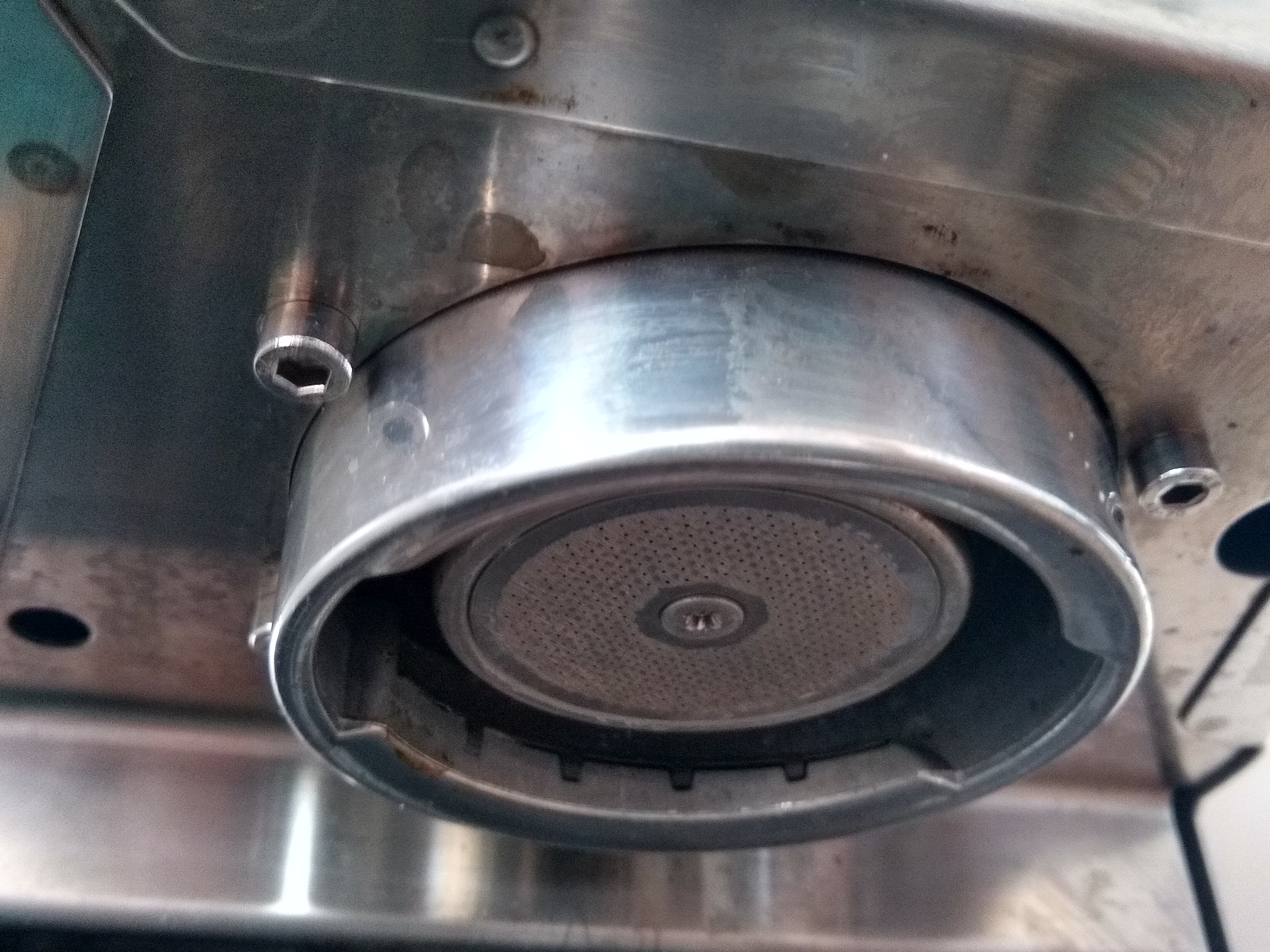 The Gaggia Classic 2015 group head
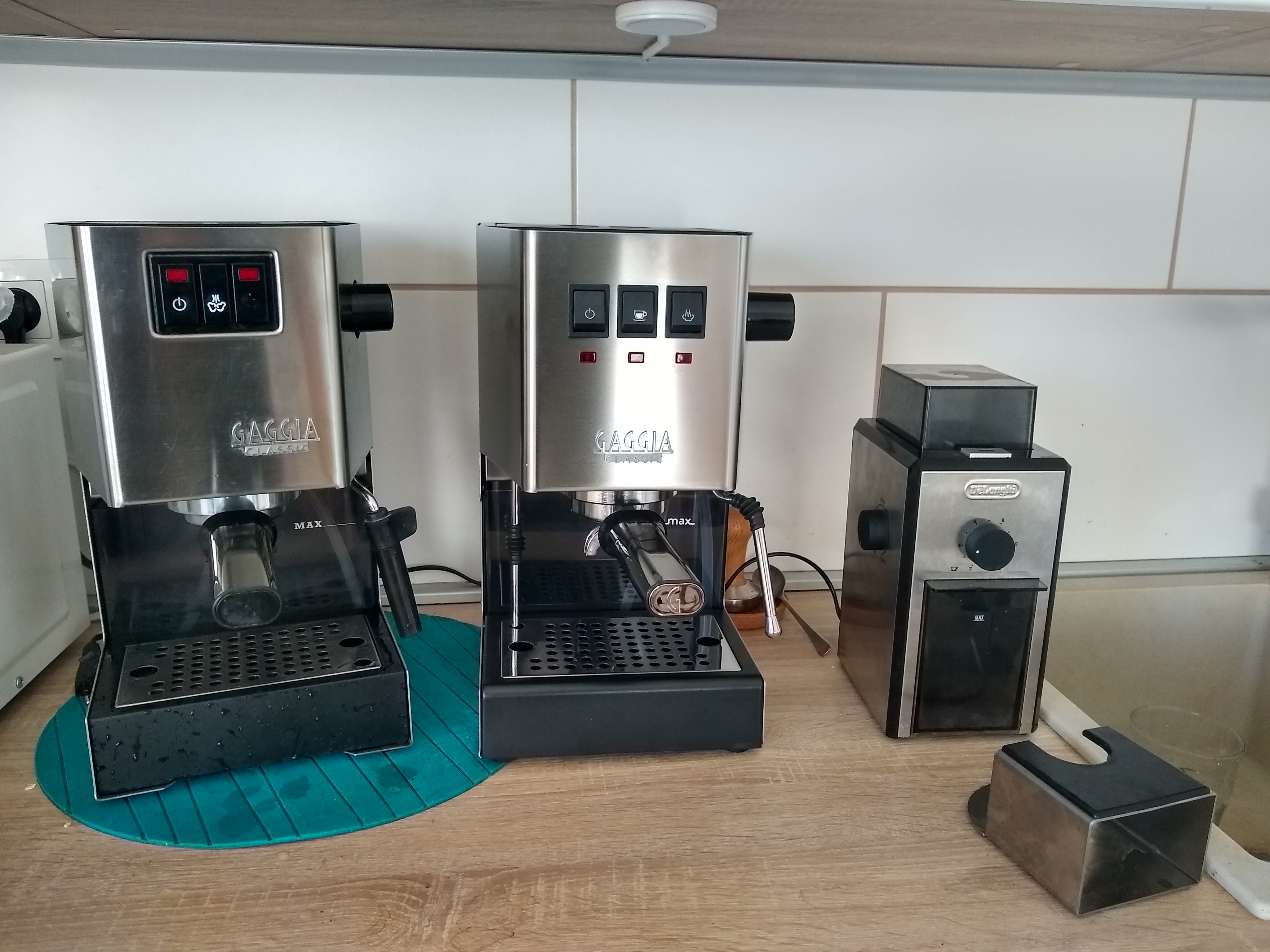 Gaggia Classic 2015 vs 2019
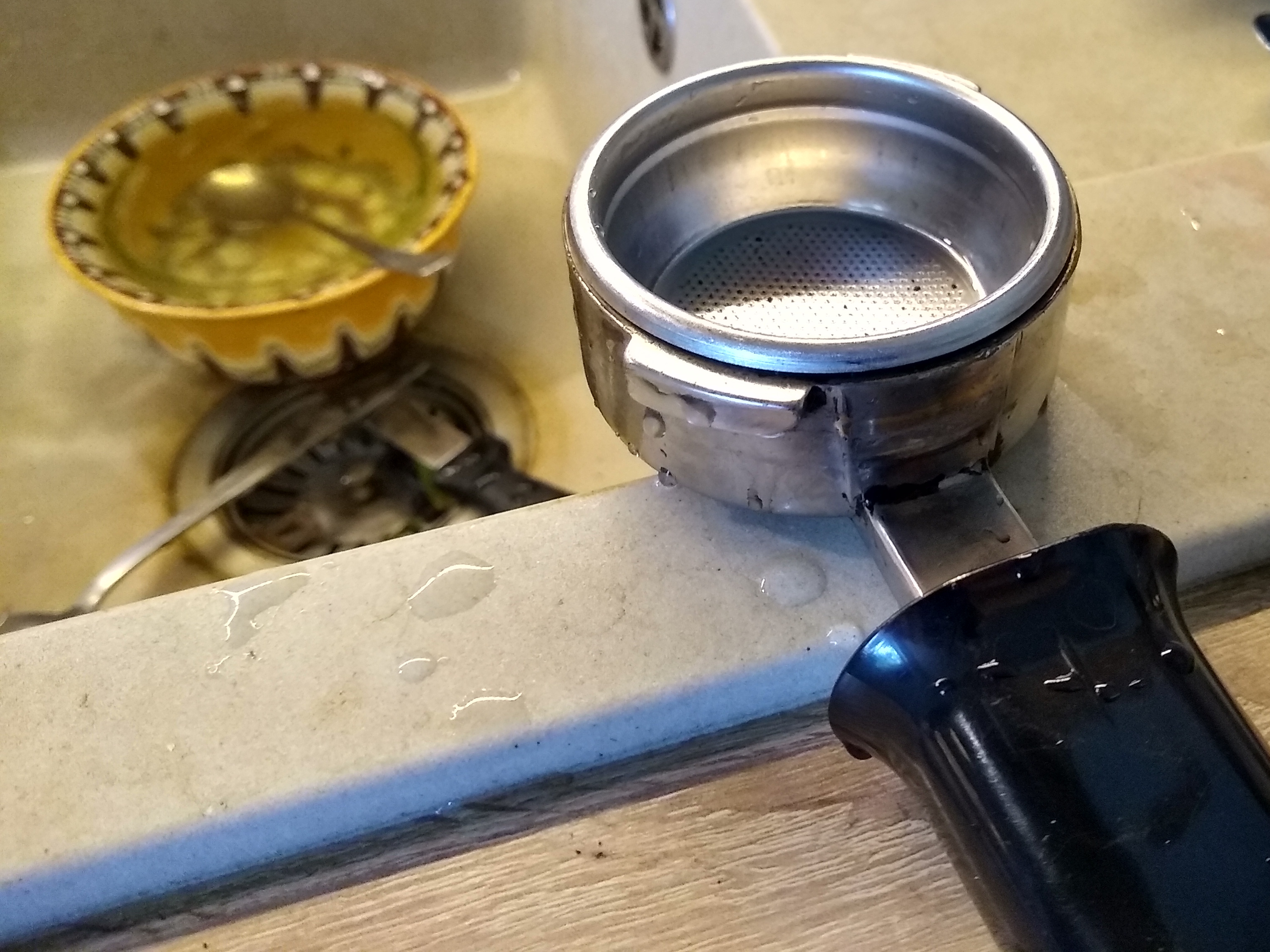
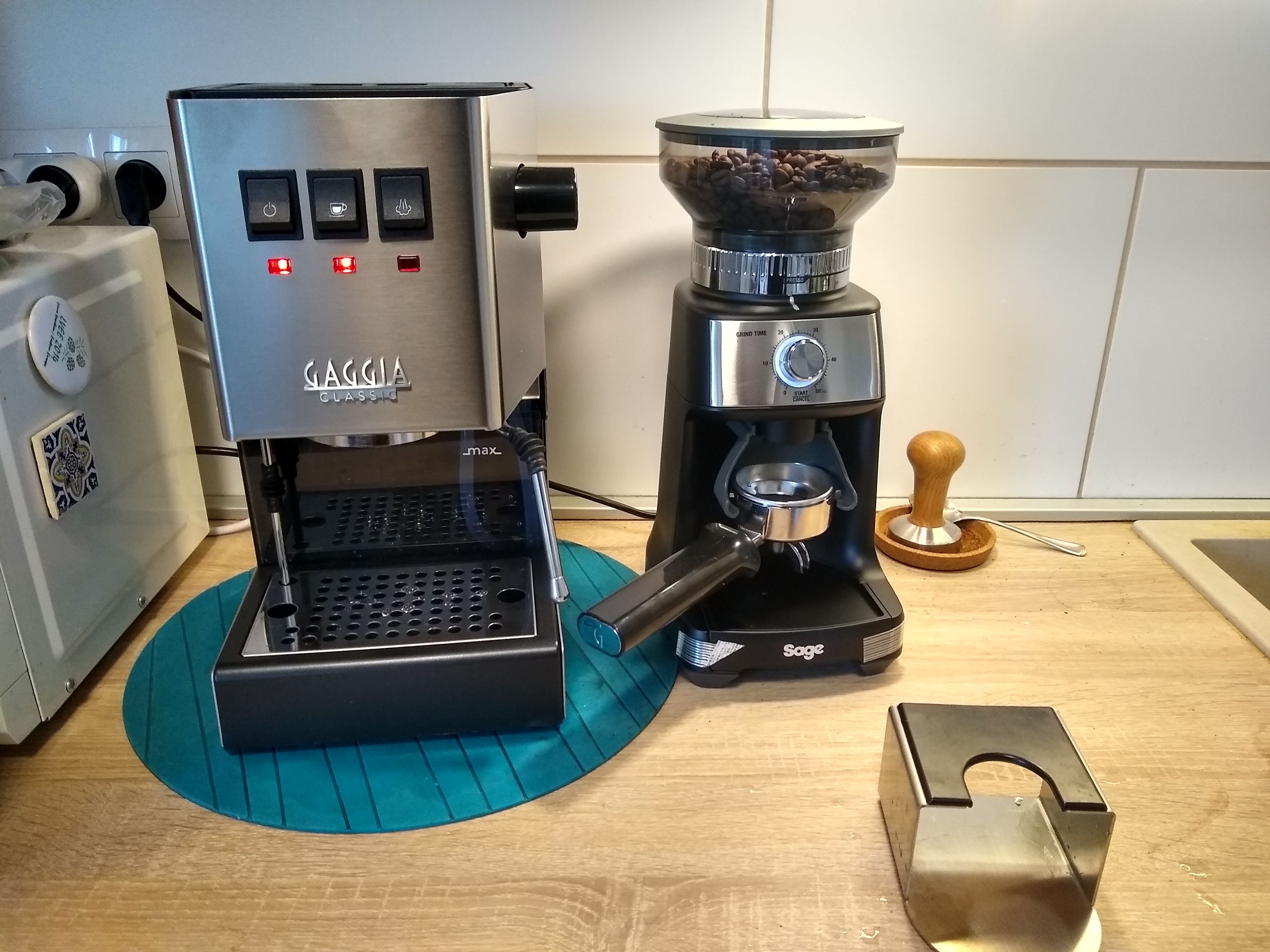 Gaggia Classic 2019 and Sage BCG600 Dose Control Pro
 Happy with my new purchase, I went to read this review and thought to myself: lucky me, my grinder is absolutely quiet! And then I realised that
the noise in my kitchen is not, in fact, produced by the fridge, but the grinder. Well, a cheap switched plug solved the issue completely (I wish
sockets here each had a switch like they usually to in the UK!)
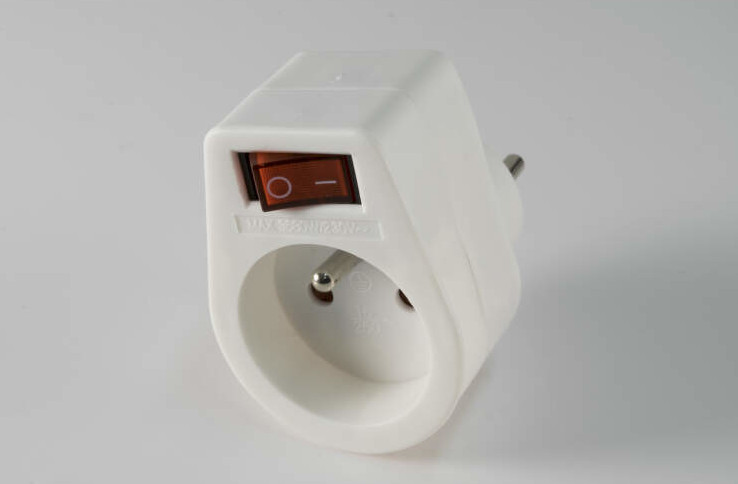
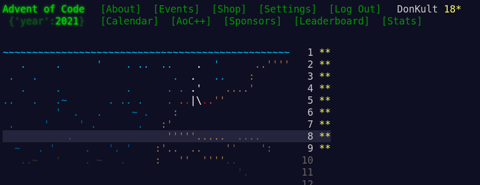

 Now that UDP was working, I was able to get TCP to work using two PlutoSDRs,
which allowed me to run the cURL command I pasted in the first post (both
simultaneously listen and transmit on behalf of my TAP interface).
It s my hope that someone out there will be inspired to implement their own
Layer 1 and Layer 2 as a learning exercise, and gets the same sense of
gratification that I did! If you re reading this, and at a point
where you ve been able to send IP traffic over your own Layer 1 / Layer 2,
please get in touch! I d be thrilled to hear all about it. I d love to link
to any posts or examples you publish here!
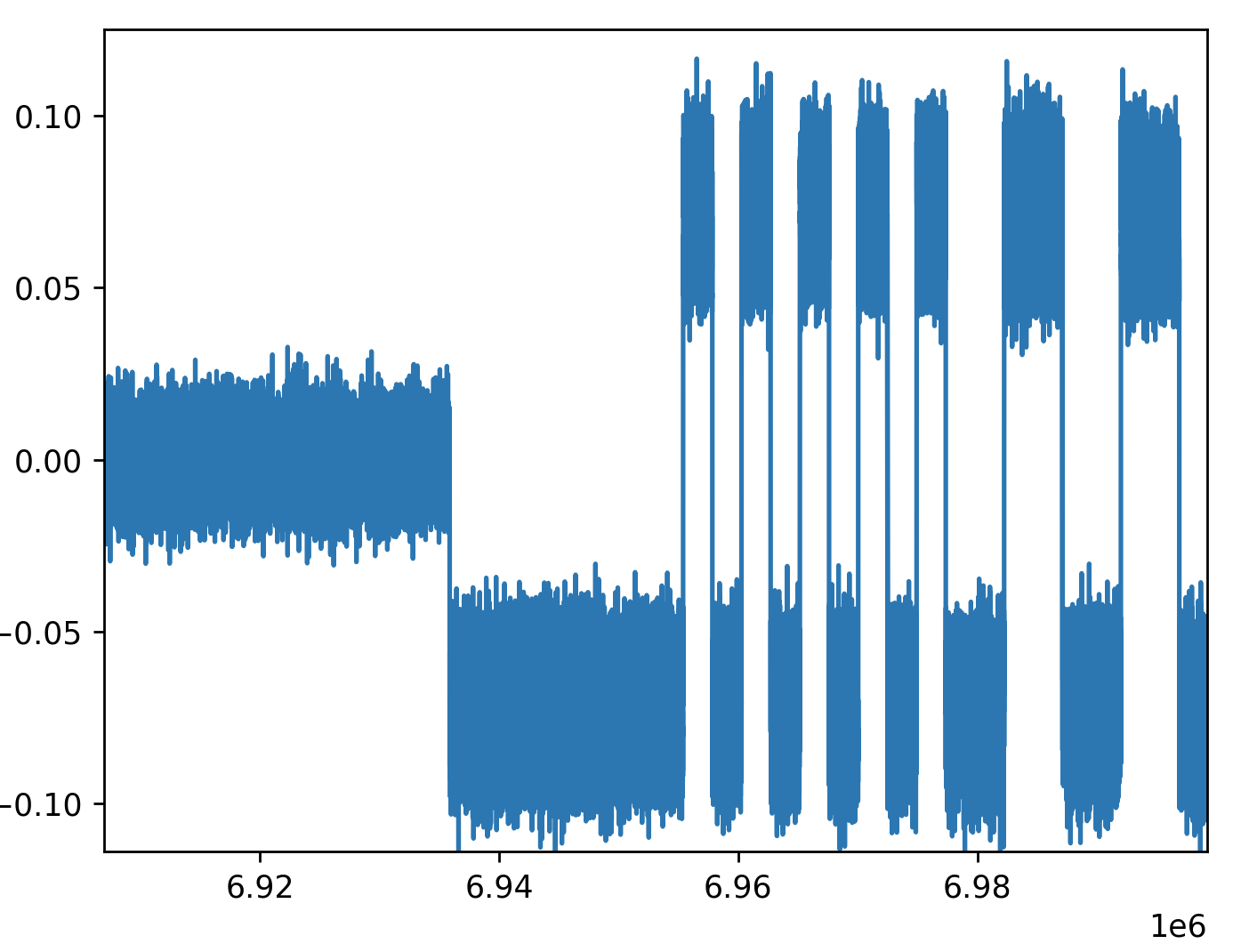

 A
 TL;DR: Zero-downtime upgrades are possible if you stick to the basic actor model.