Search Results: "rul"

30 January 2017

Francois Marier: Creating a home music server using mpd

I recently setup a music server on my home server using the Music Player Daemon, a cross-platform free software project which has been around for a long time.

Basic setup Start by installing the server and the client package:
apt install mpd mpc
then open /etc/mpd.conf and set these:
music_directory    "/path/to/music/"
bind_to_address    "192.168.1.2"
bind_to_address    "/run/mpd/socket"
zeroconf_enabled   "yes"
password           "Password1"
before replacing the alsa output:
audio_output  
   type    "alsa"
   name    "My ALSA Device"
 
with a pulseaudio one:
audio_output  
   type    "pulse"
   name    "Pulseaudio Output"
 
In order for the automatic detection (zeroconf) of your music server to work, you need to prevent systemd from creating the network socket:
systemctl stop mpd.service
systemctl stop mpd.socket
systemctl disable mpd.socket
otherwise you'll see this in /var/log/mpd/mpd.log:
zeroconf: No global port, disabling zeroconf
Once all of that is in place, start the mpd daemon:
systemctl start mpd.service
and create an index of your music files:
MPD_HOST=Password1@/run/mpd/socket mpc update
while watching the logs to notice any files that the mpd user doesn't have access to:
tail -f /var/log/mpd/mpd.log

Enhancements I also added the following in /etc/logcheck/ignore.server.d/local-mpd to silence unnecessary log messages in logcheck emails:
^\w 3  [ :0-9] 11  [._[:alnum:]-]+ systemd\[1\]: Started Music Player Daemon.$
^\w 3  [ :0-9] 11  [._[:alnum:]-]+ systemd\[1\]: Stopped Music Player Daemon.$
^\w 3  [ :0-9] 11  [._[:alnum:]-]+ systemd\[1\]: Stopping Music Player Daemon...$
and created a cronjob in /etc/cron.d/mpd-francois to update the database daily and stop the music automatically in the evening:
# Refresh DB once a day
5 1 * * *  mpd  MPD_HOST=Password1@/run/mpd/socket /usr/bin/mpc --quiet update
# Think of the neighbours
0 22 * * 0-4  mpd  MPD_HOST=Password1@/run/mpd/socket /usr/bin/mpc --quiet stop
0 23 * * 5-6  mpd  MPD_HOST=Password1@/run/mpd/socket /usr/bin/mpc --quiet stop

Clients To let anybody on the local network connect, I opened port 6600 on the firewall (/etc/network/iptables.up.rules since I'm using Debian's iptables-apply):
-A INPUT -s 192.168.1.0/24 -p tcp --dport 6600 -j ACCEPT
Then I looked at the long list of clients on the mpd wiki.

Desktop The official website suggests two clients which are available in Debian and Ubuntu: Both of them work well, but haven't had a release since 2011, even though there is some activity in 2013 and 2015 in their respective source control repositories. Ario has a simpler user interface but gmpc has cover art download working out of the box, which is why I might stick with it. In both cases, it is possible to configure a polipo proxy so that any external resources are fetched via Tor.

Android On Android, I got these two to work: I picked M.A.L.P. since it includes a nice widget for the homescreen.

iOS On iOS, these are the most promising clients I found: since MPoD and MPaD don't appear to be available on the AppStore anymore.

22 January 2017

Shirish Agarwal: Debian contributions and World History

Beware, this would be slightly longish. Debian Contributions In the last couple of weeks, was lucky to put up a patch against debian-policy which had been bothering me for a long-long time. The problem statement is simple, man-pages historically were made by software engineers for software-engineers. The idea, probably then was you give the user some idea of what the software does and the rest the software engineer would garner from reading the source-code. But over period of time, the audience has changed. While there are still software engineers who use GNU/Linux for the technical excellence, the man-pages have not kept up with this new audience who perhaps are either not technically so sound that or they do not want to take the trouble to reading the source-code to understand how things flow. An example or examples in a man-page gives us (the lesser mortals) some insight as how the command works, how the logic flows. A good example of a man-page is the ufw man-page
EXAMPLES
Deny all access to port 53: ufw deny 53 Allow all access to tcp port 80: ufw allow 80/tcp Allow all access from RFC1918 networks to this host: ufw allow from 10.0.0.0/8
ufw allow from 172.16.0.0/12
ufw allow from 192.168.0.0/16 Deny access to udp port 514 from host 1.2.3.4: ufw deny proto udp from 1.2.3.4 to any port 514 Allow access to udp 1.2.3.4 port 5469 from 1.2.3.5 port 5469: ufw allow proto udp from 1.2.3.5 port 5469 to 1.2.3.4 port 5469
Now if we had man-pages like the above which give examples, then the user at least can try to accomplish whatever s/he is trying to do. I truly believe not having examples in a man-page kills 50% of your audience and people who could potentially use your tool. Personal wishlist The only thing (and this might be my failure) is we need a good way to search through a man-page. The only way I know is using / and try to give a pattern. Lots of times it fails because I, the user doesn t know the exact keyword which the documenter was using. What would be nice, great if we do have some sort of parser where I tell it, $this is what I m looking for and the parser tries the pattern + all its synonyms and whatever seems to be most relevant passage from the content, in this case a manpage it tells me. It would make my life a lot easier while at the same time force people to document more and more. I dunno if there has been any research or study of the relationship between good documentation and popularity of a program. I know there are lots of different tiny bits which make or break a program, one of which would definitely be documentation and in that a man-page IF it s a command-line tool. A query on Quora gives some indication https://www.quora.com/How-comprehensible-do-you-find-Unix-Linux-Man-pages although the low response rate tells its own story. there have been projects like man2html and man2pdf and others which try to make the content more accessible to people who are not used to the man-page interface but till you don t have Examples the other things can work only so far. Also if anybody talks about X project which claims to solve this problem they will have to fight manpages who have been around like forever. As can be seen in the patch, did some rookie mistakes as can be seen. I also filed a lintian bug at the same time. Hope the patch does get merged at some point in debian-policy and then a check introduced in lintian in some future release. I do agree with anarcat s assertion that it should be at the level of the manpage missing level. I am no coder but finding 14,000 binary packages without a manpage left me both shocked and surprised. I came to know about manpage-alert from the devscripts package to know which all binary packages that have been installed but not have man-pages. I hope to contribute a manpage or two if I across a package I m somewhat comfortable with. I have made a beginning of sorts by running manpage alert and putting the output in a .txt file which I would grep through manually and see if something interesting jumps at me. The learning garnered from putting the patch to the debian package resulted in another patch but this time for an upstream project altogether. As can be seen all are just baby-steps that even a non-coder can take. Another couple of bugs I filed which were fixed were of a sim called unknown-horizons . A 2D realtime strategy simulation. I had filed three bugs, two of which were fixed in 2 days, the 3rd I hope is also fixed soonish. Lastly, I spent most of the week-end poring over packages who have left files in /etc/bash_completion.d/ . I spent almost 4-5 odd hours as each package in question as well as entries found in /etc/bash-completion.d/$filename I had to find which package it belonged to first

[$] dpkg -S /etc/bash_completion.d/git-prompt
git: /etc/bash_completion.d/git-prompt
I know that dpkg-query also does the same
[$] dpkg-query -S /etc/bash_completion.d/git-prompt
git: /etc/bash_completion.d/git-prompt
But I am used to plain dpkg although do know that dpkg-query can do lot more intimate searching in various ways than dpkg can. Once the package name was established, first simulate the purge [$] sudo aptitude -s purge git

[sudo] password for shirish:
The following packages will be REMOVED:
git p
0 packages upgraded, 0 newly installed, 1 to remove and 14 not upgraded.
Need to get 0 B of archives. After unpacking 29.5 MB will be freed.
The following packages have unmet dependencies:
libgit-wrapper-perl : Depends: git but it is not going to be installed
git-extras : Depends: git (>= 1.7.0) but it is not going to be installed
bup : Depends: git but it is not going to be installed
git-remote-gcrypt : Depends: git but it is not going to be installed
git-svn : Depends: git (> 1:2.11.0) but it is not going to be installed
Depends: git ( 1:2.11.0) but it is not going to be installed
Depends: git (= 1:1.8.1) but it is not going to be installed
git-core : Depends: git (> 1:1.7.0.2) but it is not going to be installed
The following actions will resolve these dependencies:
Remove the following packages:
1) bup [0.29-2 (now, testing, unstable)]
2) fdroidserver [0.7.0-1 (now, testing, unstable)]
3) git-annex [6.20161012-1 (now, testing)]
4) git-core [1:2.11.0-2 (now, testing, unstable)]
5) git-extras [4.2.0-1 (now, testing, unstable)]
6) git-remote-gcrypt [1.0.1-1 (now, testing, unstable)]
7) git-repair [1.20151215-1 (now, unstable)]
8) git-svn [1:2.11.0-2 (now, testing, unstable)]
9) gitk [1:2.11.0-2 (now, testing, unstable)]
10) libgit-wrapper-perl [0.047-1 (now, testing, unstable)]
11) python3-git [2.1.0-1 (now, testing, unstable)]
12) svn2git [2.4.0-1 (now, testing, unstable)] Leave the following dependencies unresolved:
13) devscripts recommends libgit-wrapper-perl
14) dh-make-perl recommends git
15) fdroidserver recommends git
16) git-annex recommends git-remote-gcrypt (>= 0.20130908-6)
17) gplaycli recommends fdroidserver
18) python-rope recommends git-core
Accept this solution? [Y/n/q/?] q
Abandoning all efforts to resolve these dependencies.
Abort.
Then I made a note of all the packages being affected, saw purging all of them wouldn t call others (the Package dependency Hell), made the purge and then reinstalled anew. The reason I did this is that many a times during upgrade, either during update/upgrade sometimes the correct action doesn t happen. To take the git s example itself, there were two files git-extras and git-prompt which were in /etc/bash_completion.d/ both of which were showing their source as git. Purging git and installing git afresh removed git-extras file and git-prompt is the only one remaining. While blogging about the package, did try to grep through changelog.Debian.gz and changelog.gz in git

[shirish@debian] - [/usr/share/doc/git] - [10046]
[$] zless changelog.gz
and similarly

[shirish@debian] - [/usr/share/doc/git] - [10046]
[$] zless changelog.Debian.gz
But failed to find any mention of the now gone git-extras. Doing this with all the packages took considerable time as didn t want to deal with any potential fallout later on. For instance, ufw (uncomplicated firewall) also had an entry in /etc/bash_completion.d/, hence before purging ufw, took backup of all the rules I have made, did a successful simulation

[$] sudo aptitude -s purge ufw gufw


The following packages will be REMOVED:
gufw p ufw p
0 packages upgraded, 0 newly installed, 2 to remove and 14 not upgraded.
Need to get 0 B of archives. After unpacking 4,224 kB will be freed.
Note: Using 'Simulate' mode.
Do you want to continue? [Y/n/?] y
Would download/install/remove packages.
purged the packages, reinstalled it and then re-added all the rules. Doing it all for various sundry packages, had to do it manually as there is no one size fits all solution. A sensitive one was grub which still has an entry in /etc/bash_completion.d/grub. Doing it wrong could have resulted in a non-bootable situation. There are workarounds for that, but it would have taken quite a bit of time, energy, notes and bit of recall factor what I did the last time something like that happened. Doing it manually, being present meant I could do it rightly the first time. So, was it worth it It would be if the package maintainers do the needful and the remaining entries are moved out of /etc/bash_completion.d/ to /usr/share/bash-completions and some to my favourite /usr/share/zsh/vendor-completions/ for instance

[shirish@debian] - [/usr/share/zsh/vendor-completions] - [10064]
[$] ll -h _youtube-dl
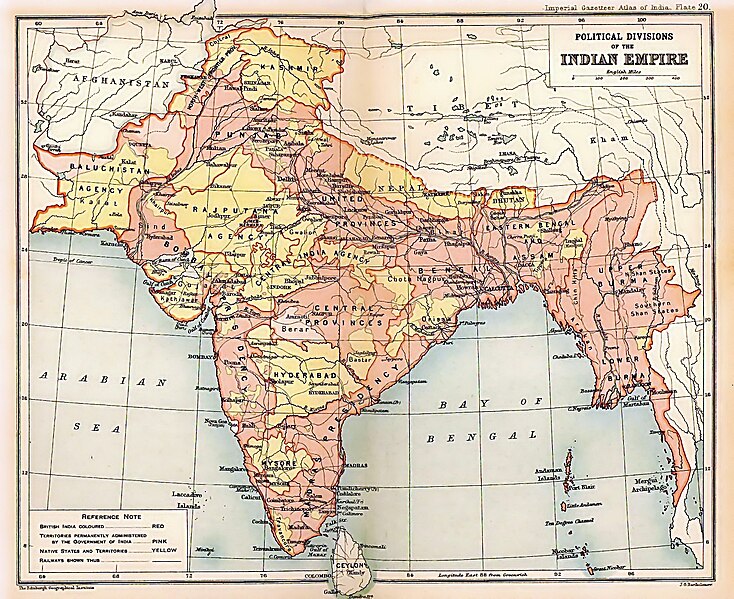
-rw-r--r-- 1 root root 3.2K 2016-12-01 08:48 _youtube-dl But trying to get all or even major packages to use zsh-completions would be hard work and would take oodles of time and this concerns upstream stuff, also very much outside what I was sharing. World History Before, during and even after South-African experience, I was left wondering why India and South Africa, two countries who had similar histories at least the last couple of hundred years or more, the final result of Independence was so different for both the countries. It took me quite sometime to articulate that in a form of question , while the answers were interesting, from what little I know of India itself, if I were an Englishman I would never leave Hindustan . What the people answering failed to take into account was that in that era it was Hindustan or un-divided India.
Pre-partition map of India

Pre-partition map of India

This map can be found at https://commons.wikimedia.org/wiki/File:British_Indian_Empire_1909_Imperial_Gazetteer_of_India.jpg and is part of quite a few Indian articles. I would urge people to look at the map in-depth. Except for the Central India Agency and Central India Provinces, most of the other regions were quite comfortable weather-wise. Hence I can t help but feel the assertion that Britishers didn t like India (as to live here) slightly revolting. See the excerpt/take on Dale Kennedy s The Magic Mountains: Hill Stations and the British Raj. Berkeley: University of California Press, 1996. xv + 264 pp. . A look at the list of hill stations of divided India is enough to tell that there were lot of places which either were founded by the Britishers or they chose to live there. And this is not all, there are supposed to lot of beautiful places even in Pakistan, especially in North East Frontier, Swat for instance. While today it s infamous for Taliban and Islamic Terrorism, there was a time it was known for its beauty.
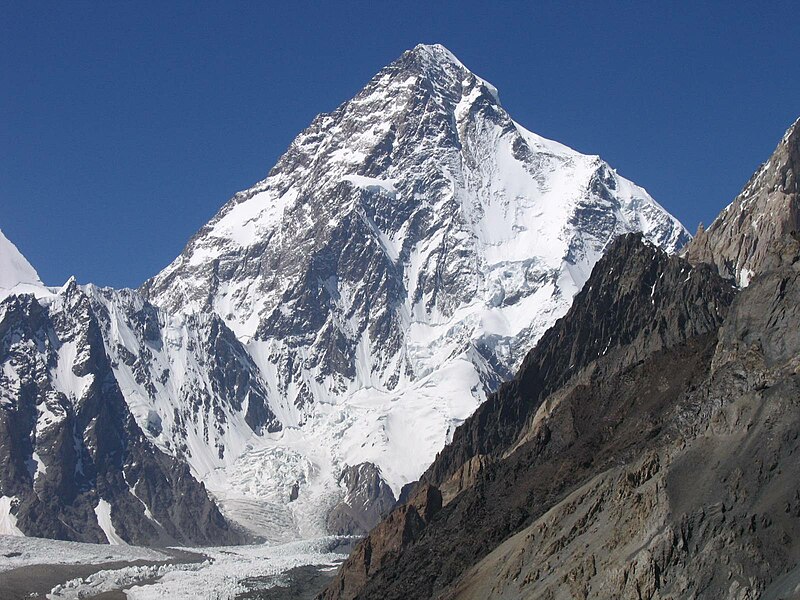
The second most difficult mountain in the world - K2, Pakistan

The second most difficult mountain in the world K2, Pakistan

Trivia After Everest, K2 is the smaller one although whatever I have read of people s accounts, most people who ascended all 14 8,000 metre peaks say K2 is technically more tougher than Everest and after Everest has the highest casualty rate. Also places like the disputed North half of Pakistan Occupied Kashmir, Gilgit Baltistan, Extreme northern Punjab of Pakistan , Northern half of Khyber-Pakhtunkhawa province and Northern Balochistan all of these places would have been more than conducive to the Britishers as it is near to the British climate (snow and pleasant weather all year round). It really is a pity that Pakistan chose to become a terrorist state where it could have become one of the more toured places of Asia. I really feel nauseous and sad at the multiple chances that Pakistan frittered away, it could have been something else.
Filed under: Miscellenous Tagged: #bash-completion, #British Raj, #contributions, #debian, #debian-policy, #Debian-QA, #Hill Stations, #India Independance Movement, #lintian, #obsolete-conffiles, #unknown-horizons, #weather, #World History, adequate, Pakistan, tourism

18 January 2017

Mike Hommey: Announcing git-cinnabar 0.4.0

Git-cinnabar is a git remote helper to interact with mercurial repositories. It allows to clone, pull and push from/to mercurial remote repositories, using git. Get it on github. These release notes are also available on the git-cinnabar wiki. What s new since 0.3.2?

Norbert Preining: Debian/TeX Live January 2017

As the freeze of the next release is closing in, I have updated a bunch of packages around TeX: All of the TeX Live packages (binaries and arch independent ones) and tex-common. I might see whether I get some updates of ConTeXt out, too.
texlive2016-debian The changes in the binaries are mostly cosmetic: one removal of a non-free (unclear-free) file, and several upstream patches got cherrypicked (dvips, tltexjp contact email, upmendex, dvipdfmx). I played around with including LuaTeX v1.0, but that breaks horribly with the current packages in TeX Live, so I refrained from it. The infrastructure package tex-common got a bugfix for updates from previous releases, and for the other packages there is the usual bunch of updates and new packages. Enjoy! New packages arimo, arphic-ttf, babel-japanese, conv-xkv, css-colors, dtxdescribe, fgruler, footmisx, halloweenmath, keyfloat, luahyphenrules, math-into-latex-4, mendex-doc, missaali, mpostinl, padauk, platexcheat, pstring, pst-shell, ptex-fontmaps, scsnowman, stanli, tinos, undergradmath, yaletter. Updated packages acmart, animate, apxproof, arabluatex, arsclassica, babel-french, babel-russian, baskervillef, beamer, beebe, biber, biber.x86_64-linux, biblatex, biblatex-apa, biblatex-chem, biblatex-dw, biblatex-gb7714-2015, biblatex-ieee, biblatex-philosophy, biblatex-sbl, bidi, calxxxx-yyyy, chemgreek, churchslavonic, cochineal, comicneue, cquthesis, csquotes, ctanify, ctex, cweb, dataref, denisbdoc, diagbox, dozenal, dtk, dvipdfmx, dvipng, elocalloc, epstopdf, erewhon, etoolbox, exam-n, fbb, fei, fithesis, forest, glossaries, glossaries-extra, glossaries-french, gost, gzt, historische-zeitschrift, inconsolata, japanese-otf, japanese-otf-uptex, jsclasses, latex-bin, latex-make, latexmk, lt3graph, luatexja, markdown, mathspec, mcf2graph, media9, mendex-doc, metafont, mhchem, mweights, nameauth, noto, nwejm, old-arrows, omegaware, onlyamsmath, optidef, pdfpages, pdftools, perception, phonrule, platex-tools, polynom, preview, prooftrees, pst-geo, pstricks, pst-solides3d, ptex, ptex2pdf, ptex-fonts, qcircuit, quran, raleway, reledmac, resphilosophica, sanskrit, scalerel, scanpages, showexpl, siunitx, skdoc, skmath, skrapport, smartdiagram, sourcesanspro, sparklines, tabstackengine, tetex, tex, tex4ht, texlive-scripts, tikzsymbols, tocdata, uantwerpendocs, updmap-map, uplatex, uptex, uptex-fonts, withargs, wtref, xcharter, xcntperchap, xecjk, xellipsis, xepersian, xint, xlop, yathesis.

9 January 2017

Petter Reinholdtsen: Where did that package go? geolocated IP traceroute

Did you ever wonder where the web trafic really flow to reach the web servers, and who own the network equipment it is flowing through? It is possible to get a glimpse of this from using traceroute, but it is hard to find all the details. Many years ago, I wrote a system to map the Norwegian Internet (trying to figure out if our plans for a network game service would get low enough latency, and who we needed to talk to about setting up game servers close to the users. Back then I used traceroute output from many locations (I asked my friends to run a script and send me their traceroute output) to create the graph and the map. The output from traceroute typically look like this:
traceroute to www.stortinget.no (85.88.67.10), 30 hops max, 60 byte packets
 1  uio-gw10.uio.no (129.240.202.1)  0.447 ms  0.486 ms  0.621 ms
 2  uio-gw8.uio.no (129.240.24.229)  0.467 ms  0.578 ms  0.675 ms
 3  oslo-gw1.uninett.no (128.39.65.17)  0.385 ms  0.373 ms  0.358 ms
 4  te3-1-2.br1.fn3.as2116.net (193.156.90.3)  1.174 ms  1.172 ms  1.153 ms
 5  he16-1-1.cr1.san110.as2116.net (195.0.244.234)  2.627 ms he16-1-1.cr2.oslosda310.as2116.net (195.0.244.48)  3.172 ms he16-1-1.cr1.san110.as2116.net (195.0.244.234)  2.857 ms
 6  ae1.ar8.oslosda310.as2116.net (195.0.242.39)  0.662 ms  0.637 ms ae0.ar8.oslosda310.as2116.net (195.0.242.23)  0.622 ms
 7  89.191.10.146 (89.191.10.146)  0.931 ms  0.917 ms  0.955 ms
 8  * * *
 9  * * *
[...]
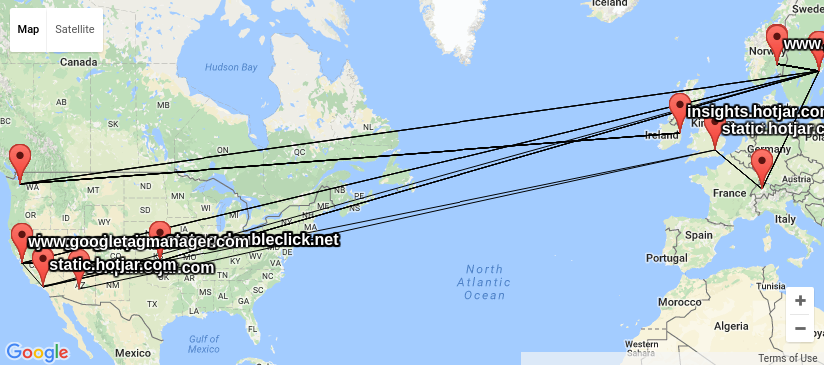
This show the DNS names and IP addresses of (at least some of the) network equipment involved in getting the data traffic from me to the www.stortinget.no server, and how long it took in milliseconds for a package to reach the equipment and return to me. Three packages are sent, and some times the packages do not follow the same path. This is shown for hop 5, where three different IP addresses replied to the traceroute request. There are many ways to measure trace routes. Other good traceroute implementations I use are traceroute (using ICMP packages) mtr (can do both ICMP, UDP and TCP) and scapy (python library with ICMP, UDP, TCP traceroute and a lot of other capabilities). All of them are easily available in Debian. This time around, I wanted to know the geographic location of different route points, to visualize how visiting a web page spread information about the visit to a lot of servers around the globe. The background is that a web site today often will ask the browser to get from many servers the parts (for example HTML, JSON, fonts, JavaScript, CSS, video) required to display the content. This will leak information about the visit to those controlling these servers and anyone able to peek at the data traffic passing by (like your ISP, the ISPs backbone provider, FRA, GCHQ, NSA and others). Lets pick an example, the Norwegian parliament web site www.stortinget.no. It is read daily by all members of parliament and their staff, as well as political journalists, activits and many other citizens of Norway. A visit to the www.stortinget.no web site will ask your browser to contact 8 other servers: ajax.googleapis.com, insights.hotjar.com, script.hotjar.com, static.hotjar.com, stats.g.doubleclick.net, www.google-analytics.com, www.googletagmanager.com and www.netigate.se. I extracted this by asking PhantomJS to visit the Stortinget web page and tell me all the URLs PhantomJS downloaded to render the page (in HAR format using their netsniff example. I am very grateful to Gorm for showing me how to do this). My goal is to visualize network traces to all IP addresses behind these DNS names, do show where visitors personal information is spread when visiting the page.

map of combined traces for URLs used by www.stortinget.no using GeoIP When I had a look around for options, I could not find any good free software tools to do this, and decided I needed my own traceroute wrapper outputting KML based on locations looked up using GeoIP. KML is easy to work with and easy to generate, and understood by several of the GIS tools I have available. I got good help from by NUUG colleague Anders Einar with this, and the result can be seen in my kmltraceroute git repository. Unfortunately, the quality of the free GeoIP databases I could find (and the for-pay databases my friends had access to) is not up to the task. The IP addresses of central Internet infrastructure would typically be placed near the controlling companies main office, and not where the router is really located, as you can see from the KML file I created using the GeoLite City dataset from MaxMind.

scapy traceroute graph for URLs used by www.stortinget.no I also had a look at the visual traceroute graph created by the scrapy project, showing IP network ownership (aka AS owner) for the IP address in question. The graph display a lot of useful information about the traceroute in SVG format, and give a good indication on who control the network equipment involved, but it do not include geolocation. This graph make it possible to see the information is made available at least for UNINETT, Catchcom, Stortinget, Nordunet, Google, Amazon, Telia, Level 3 Communications and NetDNA.

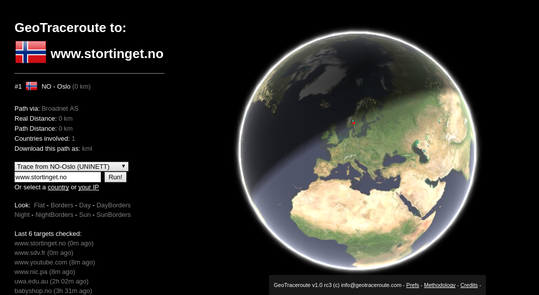
example geotraceroute view for www.stortinget.no In the process, I came across the web service GeoTraceroute by Salim Gasmi. Its methology of combining guesses based on DNS names, various location databases and finally use latecy times to rule out candidate locations seemed to do a very good job of guessing correct geolocation. But it could only do one trace at the time, did not have a sensor in Norway and did not make the geolocations easily available for postprocessing. So I contacted the developer and asked if he would be willing to share the code (he refused until he had time to clean it up), but he was interested in providing the geolocations in a machine readable format, and willing to set up a sensor in Norway. So since yesterday, it is possible to run traces from Norway in this service thanks to a sensor node set up by the NUUG assosiation, and get the trace in KML format for further processing.

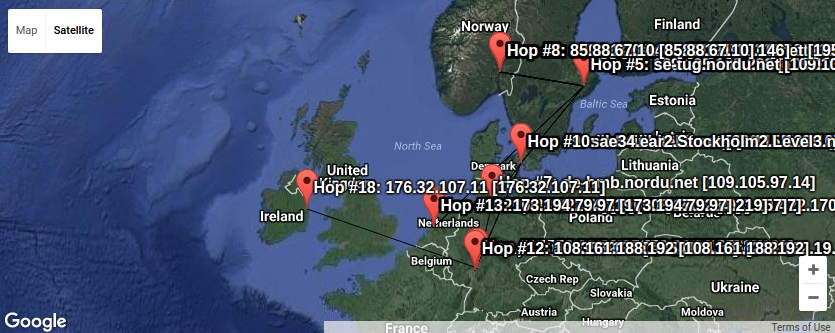
map of combined traces for URLs used by www.stortinget.no using geotraceroute Here we can see a lot of trafic passes Sweden on its way to Denmark, Germany, Holland and Ireland. Plenty of places where the Snowden confirmations verified the traffic is read by various actors without your best interest as their top priority. Combining KML files is trivial using a text editor, so I could loop over all the hosts behind the urls imported by www.stortinget.no and ask for the KML file from GeoTraceroute, and create a combined KML file with all the traces (unfortunately only one of the IP addresses behind the DNS name is traced this time. To get them all, one would have to request traces using IP number instead of DNS names from GeoTraceroute). That might be the next step in this project. Armed with these tools, I find it a lot easier to figure out where the IP traffic moves and who control the boxes involved in moving it. And every time the link crosses for example the Swedish border, we can be sure Swedish Signal Intelligence (FRA) is listening, as GCHQ do in Britain and NSA in USA and cables around the globe. (Hm, what should we tell them? :) Keep that in mind if you ever send anything unencrypted over the Internet. PS: KML files are drawn using the KML viewer from Ivan Rublev, as it was less cluttered than the local Linux application Marble. There are heaps of other options too. As usual, if you use Bitcoin and want to show your support of my activities, please send Bitcoin donations to my address 15oWEoG9dUPovwmUL9KWAnYRtNJEkP1u1b.

Dirk Eddelbuettel: RcppCCTZ 0.2.0

A new version, now at 0.2.0, of RcppCCTZ is now on CRAN. And it brings a significant change: windows builds! Thanks to Dan Dillon who dug deep enough into the libc++ sources from LLVM to port the std::get_time() function that is missing from the 4.* series of g++. And with Rtools being fixed at g++-4.9.3 this was missing for us here. Now we can parse dates for use by RcppCCTZ on Windows as well. That is important not only for RcppCCTZ but also particularly for the one package (so far) depending on it: nanotime. CCTZ is a C++ library for translating between absolute and civil times using the rules of a time zone. In fact, it is two libraries. One for dealing with civil time: human-readable dates and times, and one for converting between between absolute and civil times via time zones. It requires only a proper C++11 compiler and the standard IANA time zone data base which standard Unix, Linux, OS X, ... computers tend to have in /usr/share/zoneinfo -- and for which R on Windows ships its own copy we can use. RcppCCTZ connects this library to R by relying on Rcpp. The RcppCCTZ page has a few usage examples, as does the post announcing the previous release. The changes in this version are summarized here:

Changes in version 0.2.0 (2017-01-08)
  • Windows compilation was enabled by defining OFFSET() and ABBR() for MinGW (#10 partially addressing #9)
  • Windows use completed with backport of std::get_time from LLVM's libc++ to enable strptime semantics (Dan Dillon in #11 completing #9)
  • Timezone information on Windows is supplied via R's own copy of zoneinfo with TZDIR set (also #10)
  • The interface to formatDouble was cleaned up

We also have a diff to the previous version thanks to CRANberries. More details are at the RcppCCTZ page; code, issue tickets etc at the GitHub repository.

This post by Dirk Eddelbuettel originated on his Thinking inside the box blog. Please report excessive re-aggregation in third-party for-profit settings.

6 January 2017

Elena 'valhalla' Grandi: Candy from Strangers

Candy from Strangers

A few days ago I gave a talk at ESC https://www.endsummercamp.org/ about some reasons why I think that using software and especially libraries from the packages of a community managed distribution is important and much better than alternatives such as pypi, nmp etc. This article is a translation of what I planned to say before forgetting bits of it and luckily adding it back as an answer to a question :)

When I was young, my parents taught me not to accept candy from strangers, unless they were present and approved of it, because there was a small risk of very bad things happening. It was of course a simplistic rule, but it had to be easy enough to follow for somebody who wasn't proficient (yet) in the subtleties of social interactions.

One of the reasons why it worked well was that following it wasn't a big burden: at home candy was plenty and actual offers were rare: I only remember missing one piece of candy because of it, and while it may have been a great one, the ones I could have at home were also good.

Contrary to candy, offers of gratis software from random strangers are quite common: from suspicious looking websites to legit and professional looking ones, to platforms that are explicitly designed to allow developers to publish their own software with little or no checks.

Just like candy, there is also a source of trusted software in the Linux distributions, especially those lead by a community: I mention mostly Debian because it's the one I know best, but the same principles apply to Fedora and, to some measure, to most of the other distributions. Like good parents, distributions can be wrong, and they do leave room for older children (and proficient users) to make their own choices, but still provide a safe default.

Among the unsafe sources there are many different cases and while they do share some of the risks, they have different targets with different issues; for brevity the scope of this article is limited to the ones that mostly concern software developers: language specific package managers and software distribution platforms like PyPi, npm and rubygems etc.

These platforms are extremely convenient both for the writers of libraries, who are enabled to publish their work with minor hassles, and for the people who use such libraries, because they provide an easy way to install and use an huge amount of code. They are of course also an excellent place for distributions to find new libraries to package and distribute, and this I agree is a good thing.

What I however believe is that getting code from such sources and using it without carefully checking it is even more risky than accepting candy from a random stranger on the street in an unfamiliar neighbourhood.

The risk aren't trivial: while you probably won't be taken as an hostage for ransom, your data could be, or your devices and the ones who run your programs could be used in some criminal act causing at least some monetary damage both to yourself and to society at large.

If you're writing code that should be maintained in time there are also other risks even when no malice is involved, because each package on these platform has a different policy with regards to updates, their backwards compatibility and what can be expected in case an old version is found to have security issues.

The very fact that everybody can publish anything on such platforms is both their biggest strength and their main source of vulnerability: while most of the people who publish their libraries do so with good intentions, attacks have been described and publicly tested, such as the fun typo-squatting http://incolumitas.com/2016/06/08/typosquatting-package-managers/ one (archived on http://web.archive.org/web/20160801161807/http://incolumitas.com/2016/06/08/typosquatting-package-managers) that published harmless malicious code under common typos for famous libraries.

Contrast this with Debian, where everybody can contribute, but before they are allowed full unsupervised access to the archive they have to establish a relationship with the rest of the community, which includes meeting other developers in real life, at the very least to get their gpg keys signed.

This doesn't prevent malicious people from introducing software, but raises significantly the effort required to do so, and once caught people can usually be much more effectively prevented from repeating it than a simple ban on an online-only account can do.

It is true that not every Debian maintainer actually does a full code review of everything that they allow in the archive, and in some cases it would be unreasonable to expect it, but in most cases they are at least reasonably familiar with the code to do at least bug triage, and most importantly they are in an excellent position to establish a relationship of mutual trust with the upstream authors.

Additionally, package maintainers don't work in isolation: a growing number of packages are being maintained by a team of people, and most importantly there are aspects that involve potentially the whole community, from the fact that new packages that enter the distribution are publicity announced on a mailing list to the various distribution-wide QA efforts.

Going back to the language specific distribution platforms, sometimes even the people who manage the platform themselves can't be fully trusted to do the right thing: I believe everybody in the field remembers the npm fiasco https://lwn.net/Articles/681410/ where a lawyer letter requesting the removal of a package started a series of events that resulted in potentially breaking a huge amount of automated build systems.

Here some of the problems were caused by some technical policies that caused the whole ecosystem to be especially vulnerable, but one big issue was the fact that the managers of the npm platform are a private entity with no oversight from the user community.

Here not all distributions are equal, but contrast this with Debian, where the distribution is managed by a community that is based on a social contract https://www.debian.org/social_contract and is governed via democratic procedures established in its https://www.debian.org/devel/constitution.

Additionally, the long history of the distribution model means that many issues have already been met, the errors have already been done, and there are established technical procedures to deal with them in a better way.

So, shouldn't we use language specific distribution platforms at all? No! As developers we aren't children, we are adults who have the skills to distinguish between safe and unsafe libraries just as well as the average distribution maintainer can do. What I believe we should do is stop treating them as a safe source that can be used blindly and reserve that status to actual trustful sources like Debian, falling back to the language specific platforms only when strictly needed, and in that case:

actually check carefully what we are using, both by reading the code and by analysing the development and community practices of the authors;
if possible, share that work by becoming ourselves maintainers of that library in our favourite distribution, to prevent duplication of effort and to give back to the community whose work we get advantage from.

Edit: fixed broken typosquatting url

31 December 2016

Sean Whitton: Burkeman on time management

Burkeman: Why time management is ruining our lives Over the past semester I ve been trying to convince one graduate student and one professor in my department to use Inbox Zero to get a better handle on their e-mail inboxes. The goal is not to be more productive. The two of them get far more academic work done than I do. However, both of them are far more stressed than I am. And in the case of the graduate student, I have to add items to my own to-do list to chase up e-mails that I ve sent him, which only spreads this stress and tension around. The graduate student sent me this essay by Oliver Burkeman about how these techniques can backfire, creating more stress, tension and anxiety. It seems to me that this happens when we think of these techniques as having anything to do with productivity. Often people will say use this technique and you ll be less stressed, more productive, and even more productive because you re less stressed. Why not just say use this technique and you ll be less anxious and stressed ? This is a refusal to treat lower anxiety as merely a means to some further end. People can autonomously set their own ends, and they ll probably do a better job of this when they re less anxious. Someone offering a technique to help with their sense of being overwhelmed need not tell them what to do with their new calm. It might be argued that this response to Burkeman fails to address the huge sense of obligation that an e-mail inbox can generate. Perhaps the only sane response to this infinite to-do list is to let it pile up. If we follow a technique like Inbox Zero, don t we invest our inbox with more importance than it has? Like a lot of areas of life, the issue is that the e-mails that will advance truly valuable projects and relationships, projects of both ourselves and of others, are mixed in with reams of stuff that doesn t matter. We face this situation whenever we go into a supermarket, or wonder what to do during an upcoming vacation. In all these situations, we have a responsibility to learn how to filter the important stuff out, just as we have a responsibility to avoid reading celebrity gossip columns when we are scanning through a newspaper. Inbox Zero is a technique to do that filtering in the case of e-mail. Just letting our inbox pile up is an abdication of responsibility, rather than an intelligent response to a piece of technology that most of the world abuses.

26 December 2016

Francois Marier: Using iptables with NetworkManager

I used to rely on ifupdown to bring up my iptables firewall automatically using a config like this in /etc/network/interfaces:
allow-hotplug eth0
iface eth0 inet dhcp
    pre-up /sbin/iptables-restore /etc/network/iptables.up.rules
    pre-up /sbin/ip6tables-restore /etc/network/ip6tables.up.rules
allow-hotplug wlan0
iface wlan0 inet dhcp
    pre-up /sbin/iptables-restore /etc/network/iptables.up.rules
    pre-up /sbin/ip6tables-restore /etc/network/ip6tables.up.rules
but that doesn't seem to work very well in the brave new NetworkManager world. What does work reliably is a "pre-up" NetworkManager script, something that gets run before a network interface is brought up. However, despite what the documentation says, a dispatcher script in /etc/NetworkManager/dispatched.d/ won't work on my Debian and Ubuntu machines. Instead, I had to create a new iptables script in /etc/NetworkManager/dispatcher.d/pre-up.d/:
#!/bin/sh
LOGFILE=/var/log/iptables.log
if [ "$1" = lo ]; then
    echo "$0: ignoring $1 for \ $2'" >> $LOGFILE
    exit 0
fi
case "$2" in
    pre-up)
        echo "$0: restoring iptables rules for $1" >> $LOGFILE
        /sbin/iptables-restore /etc/network/iptables.up.rules >> $LOGFILE 2>&1
        /sbin/ip6tables-restore /etc/network/ip6tables.up.rules >> $LOGFILE 2>&1
        ;;
    *)
        echo "$0: nothing to do with $1 for \ $2'" >> $LOGFILE
        ;;
esac
exit 0
and then make that script executable:
chmod a+x /etc/NetworkManager/dispatcher.d/pre-up.d/iptables
With this in place, I can put my iptables rules in the usual place (/etc/network/iptables.up.rules and /etc/network/ip6tables.up.rules) and use the handy iptables-apply and ip6tables-apply commands to test any changes to my firewall rules.

25 December 2016

Russ Allbery: Review: A Man Called Ove

Review: A Man Called Ove, by Fredrik Backman
Translator: Henning Koch
Publisher: Washington Square
Copyright: 2012, 2014
Printing: May 2015
ISBN: 1-4767-3802-5
Format: Trade paperback
Pages: 337
Ove is 59 years old and drives a Saab. He's grumpy, often taciturn, very particular in how things should be done, and extremely judgmental about how other people do them. He is the sort of person who regularly rants about how poorly things are done these days and how much better they used to be. Ove does not like change. A Man Called Ove opens with him terrorizing the employees of an Apple Store, trying to buy a computer, but this incident is actually foreshadowing, and will only make sense at the very end of the book. The story actually begins in the second chapter, with Ove making his morning rounds of the neighborhood in which he lives, discovering an out-of-place bicycle and a mangy cat, and then starting to put a hook in his ceiling. But just as he's getting started, he's interrupted by new neighbors, who are incapable of backing up a trailer properly without scraping it against his house. Not that motor vehicles are allowed in the area anyway. That inauspicious beginning changes Ove's life, mostly through the sheer persistence of other people's disasters. It's not obvious at first that it will, and at the start A Man Called Ove could be a funny collection of stories about a curmudgeon. But as Backman shows more of Ove's life and tells more of his background and situation, it becomes something so much more, something satisfying and heart-breaking and deeply human. I've been struggling to review this book because I find it hard to capture what makes it so wonderful. Making that even harder, several key plot elements are introduced gradually in the story in ways that add a lot to the rhythm of the plot, and I don't want to spoil them. I think the closest I can get in a spoiler-free review is that A Man Called Ove is about empathy. It's about human connection, even when people seem unlikable, unreachable, or angrily off-putting. And it's a book about seeing the best inside other people, and about finding ways to be persistently oneself while still changing enough to find new connections, and about recognizing those moments when someone is showing you their best without getting caught up on the surface presentation. The man Ove is the center of this story, the subject of tight third person perspective for nearly all of the book. He's 59 when the story opens, but by the end of the book, mostly through flashback chapters, the reader knows his childhood and early adulthood and much of the story of his marriage. At first, he seems to be an obnoxious, surly, angry curmudgeon, the sort of old man who yells at clouds. But the joy of this book is how the reader's perception changes, how one gains sympathy, and then respect, first for Ove's unshakable inner sense of morality that he got from his father and then for his rule-based approach to how the world should work. One never entirely agrees with him, but Backman demystifies and explains Ove's thought process and ties it into a different generation and a different way of interacting with work (although Ove was still uncommon even in his youth, just not as unique). As I write this review, news and opinion in the United States are very focused on the plight of the white working class and how that does or does not explain recent election results. Backman is Swedish (I read this book in translation), so it's not coming from US culture and the cultural fault lines are not quite the same. But I think this book says something deeply valuable and fascinating about the working-class culture of Ove's youth, something that's much less about specific politics and much more about how it feels to make things with one's hands, to build or rebuild one's own house, or to work for thirty years at the same job and not be interested in a promotion to management. Backman does a truly spectacular job conveying the sense of angry frustration at the changes in work and life, the difficulty communicating one's internal feelings meaningfully, and the quiet joy of finding those places in life where one can do things properly. Ove is, of course, not the only character in this book, and every character here is a delight in their own idiosyncratic ways. The main story arc involves the various people in his neighborhood, particularly his new next-door neighbors: a pregnant Iranian woman and her very laid-back husband who is incapable of doing things around the house but keeps trying. I think Parvaneh, the woman, is my favorite character of the story except for Ove, and it's fitting that she's the first to work out the broad outlines of what's happening in Ove's life and the tricky path to effectively helping him. In a way, she's Ove's opposite: fiery, mercurial, talkative, and meddling. But she sees things in Ove that no one else seems to notice. (And the scene between her and Ove when she's learning to drive is a thing of beauty.) This is a book that could have been extremely sad, and yet isn't. It's a book about somber, depressing topics that somehow manages to be delightfully funny. And it's about a curmudgeon who persistently fails to have any sort of stereotyped heart of gold, but is nonetheless one of the most satisfying, fascinating, ethical, and good-willed characters I've ever read about. It manages to treat a collection of very different characters with individualized deep empathy and appreciation, while never pushing them all into the same mold. And the ending is wonderful. I rarely read slice of life stories, but this one is worth making an exception for. It's one of the best books I've ever read. Highly, highly recommended. Rating: 10 out of 10

22 December 2016

Shirish Agarwal: My letter to Government of Maharashtra on Real Estate Rules and Regulation Draft rules

While I try to minimize Politics and Economics as much as I can on this blog, it sometimes surfaces. It is possible that some people may benefit or at least be aware. A bit of background is necessary before I jump into the intricacies of the Maharashtra Real Estate Rules and Regulation Draft Rules 2016 (RERA) . Since ever, but more prominently since 2007/8 potential homeowners from across the country have been suffering at the hands of the builder/promoter for number of years. While it would be wrong to paint all the Real Estate Developers and Builders as cheats (we as in all tenants and homeowners hope there are good ones out there) many Real Estate Builders and promoters have cheated homeowners of their hard-earned money. This has also lessened the secondary (resale) market and tenants like me have to fight over morsels as supply is tight. There were two broad ways in which the cheating is/was done a. Take deposits and run away i.e. fly by night operators Here the only option for a homeowner is to file an FIR (First Information Report) and hope the culprits are caught. 99% of the time the builder/promoter goes somewhere abroad and the potential home buyers/home-owners are left holding the can. This is usually done by small real estate promoters and builders. b. The big boys would take all or most money of the project, may register or not register the flat in your name, either build a quarter or half-finished building and then make excuses. There are some who do not even build. The money given is used by the builder/developer either for his own needs or using that money in some high-profile project which is expensive and may have huge returns. They know that home-owners can t do anything, at the most go to the court which will take more than a decade or two during which time the developer would have interest-free income and do whatever he wants to do. One of the bigger stories which came up this year was when the Indian Cricket Captain, M.S. Dhoni (cricket is a religion in India, and the cricketers gods for millions of Indians) had to end his brand engagement and ambassadorship from Amrapali Housing Group. Apparently, his wife Sakshi was on the Board of directors at Amrapali Housing and had to resign The Government knew of such issues and had been working since last few years. Under the present Government, a Model Agreement and a Model Real Estate Rules and Regulation Bill was passed on 31st March and came into force on 1st May 2016. India, similar to the U.S. and U.K. follows a federal structure. While I have shared this before, most of the laws in India fall in either of three lists, Central List, Concurrent Lists and State Lists. Housing for instance, is a state subject so any laws concerning housing has to be made by the state legislature. Having a statutory requirement to put the bill in 6 months from 1st of May, the Government of Maharashtra chose to put the draft rules in public domain on 12th December 2016, about 10 days ago and there were efforts to let it remain low-key so people do not object as we are still in the throes of demonetisation. By law they should have given 30 days for people to raise objections and give suggestions. The State Government too could have easily asked an extension and as both the State and the Centre are of the same Political Party they would have easily got it. With that, below is the e-mail I sent to suggesstionsonrera@maharashtra.gov.in Sub Some suggestions for RERA biggest suggestion, need to give more time study the implications for house-owners. Respected Sir/Madame, I will be publishing the below mail as a public letter on my blog as well. I am writing as a citizen, a voter, a potential home owner, currently a tenant . If houses supply is not in time, it is us, the tenants who have the most to lose as we have to fight over whatever is in the market. I do also hope to be a home buyer at some point in time so these rules would affect me also somewhere in the hazy future. I came to know through the media that Maharashtra Govt. recently introduced draft rules for RERA Real Estate (Regulation and Development) Act, 2016 . I hope to impress upon you that these proposed Rules and Regulations need to be thoroughly revised and new draft rules shared with the public at large with proper announcement in all newspapers and proper time ( more than a month ) to study and give replies on the said matter. My suggestions and complaints are as under a. The first complaint and suggestion is that the date between the draft regulations and suggestions being invited by members of public is and was too little 12 December 2016 23 December 2016 (only 11 days) for almost 90 pages of Government rules and regulations which needs multiple rounds of re-reading to understand the implications of the draft rules . Add to that unlike the Central Building Legislation, Model Agreement which was prepared by Centre and also given wide publicity, the Maharashtra Govt. didn t do any such publicity to bring it to the
notice of the people. b. I ask where was the hurry to publish these draft rules now when everybody is suffering through the result of cash-crunch on top of other things. If the said draft rules were put up in January 2017, I am sure more people would have responded to the draft rules. Ir raises suspicion in the mind of everybody the timing of sharing the draft rules and the limited time given to people to respond. E.g. When TRAI (Telephone Regulatory Authority of India) asked for suggestion it gives more than a month, and something like housing which is an existential question for everybody, i.e. the poor, the middle and the rich, you have given pretty less time. While I could change my telephone service providers at a moment s notice without huge loss, the same cannot be said either for a house owner (in case of builder) or a tenant as well. This is just not done. c. The documents are at https://housing.maharashtra.gov.in/sitemap/housing/Rera_rules.htm under different sub-headings while the correct structure of the documents can be found at nared s site
http://naredco.in/notifications.asp . At the very least, the documents should have been in proper order. Coming to some of the salient points raised both in the media and elsewhere 1. On page 6 of Part IV-A Ext1.pdf you have written Explanation.-The registration of a real estate project shall not be required,- (i) for the purpose of any renovations or repair or redevelopment which does not involve marketing, advertisement, selling or new allotment of any apartment , plot or building as the case may be under
the real estate project; RERA draft rules What it means is that the house owner and by the same stroke the tenant would have absolutely no voice to oppose any changes made to the structure at any point of time after the building is built. This means the builder is free to build 12-14-16 even 20 stories building when the original plans were for 6-8-10. This rule gives the builder to do free for all till the building doesn t get converted into a society, a process which does and can take years to happen. 2. A builder has to take innumerable permissions from different authorities at each and every stage till possession of a said property isn t handed over to a home buyer and by its extension to the tenant. Now any one of these authorities could sit on the papers and there is no accountability of by when papers would be passed under a competent authority s desk. There was a wide belief that there would be some
rules and regulations framed in this regard but the draft rules are silent on the subject matter. 3. In Draft rule 5. page 8 of Part IV-A Ext1.pdf you write Withdrawal of amounts deposited in separate account.-(1) With regard to the withdrawal of amounts deposited under sub-clause (D) of clause (l) of sub-section (2) of section 4, the following provisions shall apply:- (i) For new projects which will be registered after commencement. Deposit in the escrow account is from now onwards. So what happens to the projects which are ongoing at the moment, either at the registration stage or at building stage, thousands of potential house owners would be left to fend for themselves. There needs to be some recourse for them as well. 3b. Another suggestion is that the house-owners are duly informed when promoters/builders are taking money from the bank and should have the authority to see that proper documents and procedure was followed. It is possible that unscrupulous elements may either bypass it or give some different documents which are not in knowledge of the house-owner, thus defeating the purpose of the escrow account itself. 4. On page 44 of Pt.IV-A Ext.161 in the Model Agreement to be entered
between the Promoter and the Alottee you have mentioned (i)The Allottee hereby agrees to purchase from the Promoter and the Promoter hereby agrees to sell to the Allottee one Apartment No. .. of the type .. of carpet area admeasuring .. sq. metres on floor in the building __________along with (hereinafter referred to as the Apartment ) as shown in the Floor plan thereof hereto annexed and marked Annexures C
for the consideration of Rs. . including Rs. . being the proportionate price of the common areas and facilities appurtenant to the premises, the nature, extent and description of the common/limited common areas and facilities which are more particularly described in the Second Schedule annexed herewith. (the price of the Apartment including the proportionate price of the limited common areas and facilities and parking spaces should be shown separately). (ii) The Allottee hereby agrees to purchase from the Promoter and the Promoter hereby agrees to sell to the Allottee garage bearing Nos ____ situated at _______ Basement and/or stilt and /or ____podium being
constructed in the layout for the consideration of Rs. ____________/- (iii) The Allottee hereby agrees to purchase from the Promoter and the Promoter hereby agrees to sell to the Allottee Car parking spaces bearing Nos ____ situated at _______ Basement and/or stilt and /or ____podium and/or open parking space, being constructed in the layout for the
consideration of Rs. ____________/-. The total aggregate consideration amount for the apartment including garages/car parking spaces is
thus Rs.______/- Draft rules. What has been done here is the parking space has been divorced from sale of the flat . It is against natural justice, logic, common sense as well-known precedents in jurisprudence (i.e. law) In September 2010, the bench of Justices R M Lodha and A K Patnaik had ruled in a judgement stating developers cannot sell parking spaces as independent real-estate units. The court ruled that parking areas are common areas and facilities . This was on behalf of a precedent in Mumbai High Court as well. http://www.reinventingparking.org/2010/09/important-parking-ruling-by-indias.html This has been reiterated again and again in courts as well as consumer
forums http://timesofindia.indiatimes.com/city/mumbai/Cant-charge-flat-buyer-extra-for-parking-slot/articleshow/22475233.cms and has been the norm in several Apartment Acts over multiple states http://apartmentadda.com/blog/2015/02/19/rules-pertaining-to-parking-spaces-in-apartment-complexes/ 5. In case of dispute, the case will high court which is inundated by huge number of pending cases. As recently as August 2016 there was a news item in Indian Express which talks about the spike in pending cases. Putting a case in the high court will weigh heavily on the homeowner, financially and
mentally http://indianexpress.com/article/cities/mumbai/more-cases-and-increased-staff-strength-putting-pressure-on-bombay-high-court-building-2964796/ It may be better to use the services of National Consumer Disputes Redressal Commission'(NCDRC) where there is possibility of quicker justice and quick resolution. There is possibility of group actions taking place which will reduce duplicity of work on behalf of the petitioners. 6. There is neither any clarity, incentive or punitive action against the promoter/builder if s/he delay conveyance to the society in order to get any future developmental and FSI rights. To delay handing over conveyance, the builders delay completion of the last building in a said project. there should be both a compensatory and punitive actions taken against the builder if he is unable to prove any genuine cause for the same. 7. There needs to be the provision with regard to need for developers to make public disclosures pertaining to building approvals. This while I had shared above needs to be explicitly mentioned so house-owners know the promoter/builder are on the right path. 8. There needs to be a provision that prohibits refusal to sell property to any person on the basis of his/her religion, marital status or dietary preferences. 9. There is lot of ambiguity if criminal proceedings can be initiated against a promoter/developer if s/he fails to deliver the flat on time. The developer should be criminally liable if he doesn t give the flat with all the amenities, fixtures and anything which was on agreement signed by both parties and for which the payment has been given in
full at time of possession of a flat. 10. Penalties for the promoter/builder is capped at 10% in case of any wrong-doing. Apart from proving the charge, the onus of which would lie on the house-owner, capping it at 10% is similar to A teacher telling a naughty student, do whatever you want to do, I am only going to hit you 5 times. Such a drafting encourages the Promoter/builder to play mischief. The builder knows his exposure is pretty limited. Liability is limited so he will try to get with whatever he can. Having a high penalty clause will deter him. 11. There was talk and shown in the Center s model agreement the precedent of providing names, addresses and contact details of other allot-tees or home-owners of a building that would have multiple dwelling units . This is nowhere either in the agreement or mentioned anywhere else in the four documents. 12. An addition to the above would be that the details provided should be correct and updated as per the records maintained by the Promoter/builder. 13. Today, there is no way for a potential house-owner to know if the builder had broken any norms or has any cases in court pending against him. There should be a way for the potential house-owner to find out. 14. A builder can terminate a flat purchase agreement by giving just a week s notice on email to the buyer who defaults on an instalment. But the developer can refund the money without interest to the
purchaser at leisure, within six months.Under MOFA (the earlier rules), the developer could cancel the agreement after giving a 15 days notice, and the builder could resell the flat only after refunding money to the original buyer. Under the new draft rules, a builder can immediately sell the flat after terminating the agreement. 15. The new draft rules say a buyer must pay 30% of the total cost while signing the agreement and 45% when the plinth of the building is constructed. The earlier state law stipulated 20% payment when the
agreement is signed with the developer. 16. The Central model agreement and rules proposed a fee of INR Rs 1,000 for filing complaints before housing authority; the state draft has proposed to hike this fee to Rs INR Rs. 10,000/- 17. Reading the Central Model Agreement, key disclosures under Section 4 (2)and Rule 3 (2) of the Central Model Rules have been excluded to be put up on the website of the Authority. These included carpet area of flat, encumbrance certificate (this would have disclosed encumbrances in respect of the land where the real estate project is proposed to be undertaken), copy of the legal title report and sanctioned plan of the building. Due to this house-owner would always be in dark and assume that everything is alright. There have been multiple instances of this over years Some examples http://www.deccanchronicle.com/140920/nation-current-affairs/article/builder-encroaches-%E2%80%98raja-kaluve%E2%80%99 http://indianexpress.com/article/cities/ahmedabad/surat-builder-grabs-tribal-land-using-fake-documents/ http://www.thehindu.com/news/cities/bangalore/bmtf-books-exmayor-wife-for-grabbing-ca-site/article7397062.ece http://timesofindia.indiatimes.com/city/thane/24-acre-ambernath-plot-usurped-with-fake-docus/articleshow/55654139.cms 18. The Central rule requires a builder to submit an annual report including profit and loss account, balance sheet, cash flow statement, directors report and auditors report for the preceding three financial years, among other things. However, the Maharashtra draft rules are silent on such a requirement. While the above is what I could perceive in the limited amount I came to know. This should be enough to convince that more needs to be done from the house-owner s side. Update Just saw Quint s Op-Ed goes in more detail.
Filed under: Miscellenous Tagged: #Draft Rules for Real Estate Rules and Regulation (2016), #hurry, #Name, #Response, Amrapali Group, Contact details of other hom-owners in a scheme., M.S. Dhoni

20 December 2016

Petter Reinholdtsen: Isenkram updated with a lot more hardware-package mappings

The Isenkram system I wrote two years ago to make it easier in Debian to find and install packages to get your hardware dongles to work, is still going strong. It is a system to look up the hardware present on or connected to the current system, and map the hardware to Debian packages. It can either be done using the tools in isenkram-cli or using the user space daemon in the isenkram package. The latter will notify you, when inserting new hardware, about what packages to install to get the dongle working. It will even provide a button to click on to ask packagekit to install the packages. Here is an command line example from my Thinkpad laptop:
% isenkram-lookup  
bluez
cheese
ethtool
fprintd
fprintd-demo
gkrellm-thinkbat
hdapsd
libpam-fprintd
pidgin-blinklight
thinkfan
tlp
tp-smapi-dkms
tp-smapi-source
tpb
%
It can also list the firware package providing firmware requested by the load kernel modules, which in my case is an empty list because I have all the firmware my machine need:
% /usr/sbin/isenkram-autoinstall-firmware -l
info: did not find any firmware files requested by loaded kernel modules.  exiting
%
The last few days I had a look at several of the around 250 packages in Debian with udev rules. These seem like good candidates to install when a given hardware dongle is inserted, and I found several that should be proposed by isenkram. I have not had time to check all of them, but am happy to report that now there are 97 packages packages mapped to hardware by Isenkram. 11 of these packages provide hardware mapping using AppStream, while the rest are listed in the modaliases file provided in isenkram. These are the packages with hardware mappings at the moment. The marked packages are also announcing their hardware support using AppStream, for everyone to use: air-quality-sensor, alsa-firmware-loaders, argyll, array-info, avarice, avrdude, b43-fwcutter, bit-babbler, bluez, bluez-firmware, brltty, broadcom-sta-dkms, calibre, cgminer, cheese, colord, colorhug-client, dahdi-firmware-nonfree, dahdi-linux, dfu-util, dolphin-emu, ekeyd, ethtool, firmware-ipw2x00, fprintd, fprintd-demo, galileo, gkrellm-thinkbat, gphoto2, gpsbabel, gpsbabel-gui, gpsman, gpstrans, gqrx-sdr, gr-fcdproplus, gr-osmosdr, gtkpod, hackrf, hdapsd, hdmi2usb-udev, hpijs-ppds, hplip, ipw3945-source, ipw3945d, kde-config-tablet, kinect-audio-setup, libnxt, libpam-fprintd, lomoco, madwimax, minidisc-utils, mkgmap, msi-keyboard, mtkbabel, nbc, nqc, nut-hal-drivers, ola, open-vm-toolbox, open-vm-tools, openambit, pcgminer, pcmciautils, pcscd, pidgin-blinklight, printer-driver-splix, pymissile, python-nxt, qlandkartegt, qlandkartegt-garmin, rosegarden, rt2x00-source, sispmctl, soapysdr-module-hackrf, solaar, squeak-plugins-scratch, sunxi-tools, t2n, thinkfan, thinkfinger-tools, tlp, tp-smapi-dkms, tp-smapi-source, tpb, tucnak, uhd-host, usbmuxd, viking, virtualbox-ose-guest-x11, w1retap, xawtv, xserver-xorg-input-vmmouse, xserver-xorg-input-wacom, xserver-xorg-video-qxl, xserver-xorg-video-vmware, yubikey-personalization and zd1211-firmware If you know of other packages, please let me know with a wishlist bug report against the isenkram-cli package, and ask the package maintainer to add AppStream metadata according to the guidelines to provide the information for everyone. In time, I hope to get rid of the isenkram specific hardware mapping and depend exclusively on AppStream. Note, the AppStream metadata for broadcom-sta-dkms is matching too much hardware, and suggest that the package with with any ethernet card. See bug #838735 for the details. I hope the maintainer find time to address it soon. In the mean time I provide an override in isenkram.

19 December 2016

Chris Lamb: 10 years of Debian

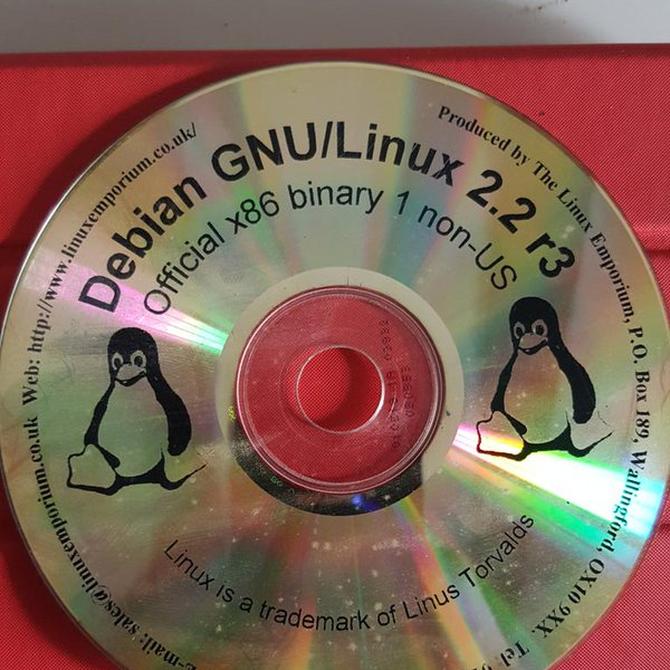
Today marks the 10-year anniversary of my first contribution to Debian GNU/Linux. I will not recount the full history here but my first experience with Debian was a happy accident. I had sent off for a 5-CD set of Red Hat from The Linux Emporium only to discover I lacked the required 12MB of RAM. Annoyed, I reached for the Debian "potato" CD that was included gratis in my order due to it being outdated at the time Fast-forwarding a few years, whilst my first contribution was trivial, it was Thomas Bushnell's infectious enthusiasm that led me to contribute more, eventually becoming a Google Summer of Code student under Daniel Baumann, and finally becoming an official Debian Developer in September 2008 with Thomas Viehmann as my Application Manager. (Some things may never change, however I still struggle with the bug tracker's control@ interface.)
The response I got to my patch always reminds me of the irrational power of providing attibution. I've always liked to tell myself I'm above such vanities but perhaps the truly mature approach would be to accept that ego is part of the human condition and as a community take steps to avoid handicapping ourselves by underestimating the value of "trivialities" such as having one's name listed. I've since been fascinated by the number of maintainers who do not attribute patches in changelogs, especially from newcomers or when the changes are non-trivial a handful in particular have stung me fairly deeply. I would certainly concede that it adds nothing technical and can even be distracting, but it seems a reasonable concession that dramatically increases the chance of future efforts or, frankly, is simply a kindly gesture of thanks and good will. Given our level of technical expertise, I fear we regularly suffer from not having sufficient empathy for newcomers or first-time users who lack the context or orientation that we possess. Anyway, here's to another ten

18 December 2016

Daniel Stender: How to cheat setuptools-scm (Debian diary)

[2016-12-19: some additions] This is another little issue from Python packaging for Debian which I came across lately packaging the compressed NumPy based data container Bcolz. Upstream uses setuptools-scm to determine the software s version during build time from the source code management environment the code is in. This method is convenient for the upstream development because with that the version number doesn t need to be hard-coded, and often people just forget to update that (and other version carrying files like doc/conf.py) when a new version of a project is released. python-setuptools just needs to be added to the setup.py to do its job, and in Bcolz the code goes like this:
setup(
    name="bcolz",
    use_scm_version= 
        'version_scheme': 'guess-next-dev',
        'local_scheme': 'dirty-tag',
        'write_to': 'bcolz/version.py'
The file the version number is written to is bcolz/version.py. This file isn t in the upstream code revision nor in the tarball which was released by the upstream developers, it s always generated during build time. In Debian there is an error if you try to build a package from a source tree which contains files which aren t to be found in the corresponding tarball, like cruft from a previous build, or if any files have changed therefore every new package should be test build also twice in a row in a non-chroot environment. Generally there a two ways to solve this, either you add cruft to debian/clean, or you add the file resp. a matching file pattern to extend-diff-ignore in debian/source/options. Which method is the better one could be discussed, I m generally using the clean option if something isn t in the upstream tarball, and the source/options solution if something is already in the upstream tarball, but gets changed during a build. This is related to your preferred Git procedures, if you remove a file which is in the upstream tarball these removals have to be checked in separately, and that means everytime a new upstream tarball is released that is not very convenient. Another option which is available is to strip certain files from the upstream tarball by putting them on the Files-Excluded in deb/copyright. By the way, the same complex applies to egg-info/: that folder is shipped or is not shipped in the upstream tarball, and files in that folder get changed during build. When the source code is put into a Git environment for Debian packaging, there could be problems with the version number setuptools-scm comes up with. This setuptools extension gets the recent version from the latest Git tag when there is a version number to be found, and that s all right. In Git environments for Debian packaging (like e.g. of the Debian Science group, the Python groups and the others) that is available, like the commonly used upstream tags have that1. The problem is, sometimes the upstream version which Debian has2 doesn t match the original upstream version number which is wanted for version in bcolz/version.py. For example, the suffix +ds is used if the upstream tarball has been stripped from prebuild files or embedded convenience shipments (like it s the case with the Bcolz package where c-blosc/ has been stripped because that s build for another package), of the suffix +dfsg shows that non-DFSG free software has been removed (which can t be distributed through the main archive section). For example, the version string for Bcolz which is found after the build currently (1.1.0+ds1-1) is 1.1.0+ds1:
# coding: utf-8
# file generated by setuptools_scm
# don't change, don't track in version control
version = '1.1.0+ds1'
But that s not wanted because this version never has been released, but appears everywhere:
$ pip list   grep bcolz
bcolz (1.1.0+ds1)
$ python3 -c 'import bcolz; bcolz.print_versions()'
-=-=-=-=-=-=-=-=-=-=-=-=-=-=-=-=-=-=-=-=-=-=-=-=-=-
bcolz version:     1.1.0+ds1
There are several different ways how to fix this. The one with the crowbar (like said in German) is to patch use_scm_version out from setup.py, but if you don t provide any version in exchange the version number which is used by Setuptools then is 0.0.0. The upstream version could be hard-coded into the patch, but then again it has not to be forgotten to update it manually by the maintainer, which is not very convenient. Plus, setup.py could change and the patch then might need to be unfuzzed, thus more work. Bad. A patch could be spared by manipulating and exporting the SETUPTOOLS_SCM_PRETEND_VERSION environment variable for setuptools-scm in debian/rules, which is sometimes used when I see the returns for that string on Debian Code Search. But how to prevent to hard code the version number, here? The dpkg-dev package (pulled by build-essential) ships a Makefile snippet /usr/share/dpkg/pkg-info.mk which could be included into debian/rules. It defines several variables which are useful for packaging, like DEB_SOURCE contains the source package name, they are extracted from debian/changelog. But, DEB_VERSION_UPSTREAM which is available through that puts out the upstream version without epoch and Debian revision, but it s not getting any finer grained out of the box. For a custom fix, a regular expression which removes the +... extensions (if present) from the bare upstream version string would be s/\+[^+]*//:
$ echo "1.1.0+ds1"   sed -e 's/\+[^+]*//'
1.1.0
$ echo "1.1.0"   sed -e 's/\+[^+]*//'
1.1.0
$ echo "1.1.0+dfsg12"   sed -e 's/\+[^+]*//'
1.1.0
With that, a custom variable VERSION_UPSTREAM could be set on the top of DEB_VERSION_UPSTREAM (from pkg-info.mk) in debian/rules:
include /usr/share/dpkg/pkg-info.mk
VERSION_UPSTREAM = $(shell echo '$(DEB_VERSION_UPSTREAM)'   sed -e 's/\+[^+]*//')
export SETUPTOOLS_SCM_PRETEND_VERSION = $(VERSION_UPSTREAM)
Bam, that works (see the commit here):
# coding: utf-8
# file generated by setuptools_scm
# don't change, don't track in version control
version = '1.1.0'
An addition, I ve seen that dh-python also takes care of SETUPTOOLS_SCM_PRETEND_VERSION since 2.20160609. The environment variable is set by the Debhelper build system if python 3, -setuptools-scm is among the build-dependencies in debian/control. The Perl code for that is in dh/pybuild.pm. I think the version number string above comes from dh-python s pretended version, and not from any of the Git tags (which are currently debian/1.1.0+ds1-1 and upstream/1.1.0+ds1).

  1. For Git in Debian packaging, e.g. see the DEP-14 proposal (Recommended layout for Git packaging repositories): http://dep.debian.net/deps/dep14/ [return]
  2. Following the scheme for package versions [epoch:]upstream_version[-debian-revision] [return]

13 December 2016

Shirish Agarwal: Eagle Encounters, pier Stellenbosch

Before starting, have to say hindsight as they say is always 20/20. I was moaning about my 6/7 hour trip few blog posts back but now came to know about the 17.5 hr. flights (17.5x800km/hr=14000 km.) which are happening around me. I would say I was whining about nothing seeing those flights. I can t even imagine how people would feel in those flights. Six hours were too much in the tin-can, thankfully though I was in the aisle seat. In 14 hours most people would probably give to Air rage . I just saw an excellent article on the subject. I also came to know that seat-selection and food on a long-haul flights are a luxury, hence that changes the equation quite a bit as well. So on these facts, it seems Qatar Airways treated me quite well as I was able to use both those options. Disclaimer My knowledge about birds/avian is almost non-existent, Hence feel free to correct me if I do go wrong anywhere. Coming back to earth literally , I will have to share a bit of South Africa as that is part and parcel of what I m going to share next. Also many of the pictures shared in this particular blog post belong to KK who has shared them with me with permission to share it with the rest of the world. When I was in South Africa, in the first couple of days as well as what little reading of South African History I had read before travelling, had known that the Europeans, specifically the Dutch ruled on South Africa for many years. What was shared to me in the first day or two that Afrikaans is mostly spoken by Europeans still living in South Africa, some spoken by the coloured people as well. This tied in with the literature I had already read. The Wikipedia page shares which language is spoken by whom and how the demographics play out if people are interested to know that. One of the words or part of the word for places we came to know is bosch as is used in many a places. Bosch means wood or forest. After this we came to know about many places which were known as somethingbosch which signified to us that area is or was a forest. On the second/third day Chirayu (pictured, extreme left) shared the idea of going to Eagle Encounters. Other people pictured in the picture are yours truly, some of the people from GSOC, KK is in the middle, the driver Leonard something who took us to Eagle Encounters on the right (pictured extreme right). Update I was informed that it was a joint plan between Chirayu and KK. They also had some other options planned which later got dropped by the wayside. The whole gang/group along with Leonard coming from eagle encounters It was supposed to be somewhat near, (Spier, Stellenbosch). While I was not able to able to see/figure out where Eagle Encounters is on Openstreetmap, somebody named Firefishy added Spier to OSM few years back. So thank you for that Firefishy so I can at least pin-point a closer place. I didn t see/know/try to figure out about the place as Chirayu said it s a zoo . I wasn t enthusiastic as much as I had been depressed by most zoos in India, while you do have national reserves/Parks in India where you see animals in their full glory. I have been lucky to been able to seen Tadoba and Ranthambore National parks and spend some quality time (about a week) to have some idea as to what can/happens in forests and people living in the buffer-zones but those stories are for a different day altogether. I have to say I do hope to be part of the Ranthambore experience again somewhere in the future, it really is a beautiful place for flora and fauna and fortunately or unfortunately this is the best time apart from spring, as you have the game of mist/fog and animals . North India this time of the year is something to be experienced. I wasn t much enthused as zoos in India are claustrophobic for animals and people both. There are small cages and you see and smell the shit/piss of the animals, generally not a good feeling. Chirayu shared with us also the possibility of being able to ride of Segways and range of bicycles which relieved me so that in case we didn t enjoy the zoo we would enjoy the Segway at least and have a good time (although it would have different expenses than the ones at Eagle Encounters). My whole education about what a zoo could be was turned around at Eagle Encounters as it seems to be somewhere between a zoo and what I know as national parks where animals roam free. We purchased the tickets and went in, the first event/happening was Eagle Encounters itself. One of the families at Eagle Encounter handling a snowy eagle Our introduction to the place started by two beautiful volunteer/trainers who were in charge of all the birds in the Eagle Encounters vicinity. The introduction started by every one of us who came for the Eagle Encounter show to wear a glove and to have/hold one of the pair of snowy owls to sit on the glove. That picture is of a family who was part of our show. Before my turn came, I was a little apprehensive/worried about holding a Owl -period. To my surprise, they were so soft and easy-going, I could hardly feel the weight on my hand. While the trainer/volunteers were constantly feeding them earthworm-bits (I didn t ask, just guessing) and we were all happy as they along with the visitors were constantly playing and interacting with the birds, sharing with us the life-cycle of the snowy Owl. It s only then I understood why in the Harry Potter Universe, the owl plays such an important part. They seem to be a nice, curious, easy-going, proud creatures which fits perfectly in the HP Universe. In hind-sight I should have videod the whole experience as the trainer/volunteer showed a battery of owls, eagles, vultures, Hawks (different birds of prey) what have you. I have to confess my knowledge of birds is and was non-existent. Vulture at the Eagle Encounters show Vulture, One of the larger birds we saw at the Eagle Encounters show. Some of the birds could be dangerous, especially in the wild. The other trainer showing off a Black Eagle at Eagle Encounters That was the other Volunteer-Trainer who was showing off the birds. I especially liked the t-shirt she was wearing. The shop at Eagle Encounters had whole lot of them, they were a bit expensive and just not my size Tidbit Just a few years ago, it was a shocker to me to know/realize that what commonly goes/known in the country as a parrot by most people is actually a Parakeet. As can be seen in the article linked, they are widely distributed in India. While I was young, I used to see the rose-ringed parakeets quite a bit around but nowadays due to probably pollution and other factors, they are noticeably less. They are popular as pets in India. I don t know what Pollito would think about that, don t think he would think good. Trainer showing off a Hawk at Eagle Encounters As I cannot differentiate between Hawk, Vulture, Eagle, etc. I would safely say a Bird of Prey as that was what he was holding. This photo was taken after the event was over where we all were curious to know about the volunteer/trainer, their day job and what it meant for them to be taking care of these birds. Update KK has shared with me what those specific birds are called, so in case the names or species are wrong, please take the truck with her and not me. While I don t remember the name of the trainer/volunteer, among other things it was shared that the volunteers/trainers aren t paid enough and they never have enough funds to take care of all the birds who come to them. Trainer showing Hawk and background chart Where the picture was shot (both this and earlier) was sort of open-office. If you look closely, you will see that there are names of the birds, for instance, people who loved LOTR would easily see Gandalf . that board lists how much food (probably in grams) did the bird eat in a day and week. While it was not shared, I m sure there would be a lot of paperwork, studies to get the birds as well as possible. From a computer science perspective, there seemed to be lot of potential for avian and big-data professionals to do lot of computer modelling and analysis and give more insight into the rehabilitation efforts so the process could be more fine-tuned, efficient and economic perhaps. Hawk on stand This is how we saw the majority of the birds. Most of them had a metal/plastic string which was tied to small artificial branches as the one above. I forgot to share a very important point. Eagle Encounters is not a zoo but a Rehabilitation Centre. While the cynic/skeptic part of me tried to not feel or see the before and after pictures of the birds bought to the rehabilitation centre, the caring part was moved to see most of the birds being treated with love and affection. From our conversations with the Volunteer-Trainer it emerged that every week they had to turn away lots of birds due to space constraints. It is only the most serious/life-threatening cases for which they could provide care in a sustainable way they would keep. Some of the birds who were in the cages were large, airy. I wouldn t say clean as what little I read before as well later is that birds shit enormously so cleaning cages is quite an effort. Most of the cages and near those artificial branches there were placards of people who were sponsoring a bird or two to look after them. From what was shared, many of the birds who came had been abused in many ways. Some of them had their bones crushed or/and other cruel ways. As I had shared that I had been wonderfully surprised by seeing birds come so close to me and most of my friends, I felt rage about those who had treated the birds in such evil, bad ways. What was shared with us that while they try to heal the birds as much as possible, it is always suspect how well the birds would survive on their own in nature, hence many of these birds would go to the sponsor or to some other place when they are well. The Secretary birds - cage- sponsors-adopted If you look at the picture closely, maybe look at the higher resolution photo in the gallery, you will see that both the birds have been adopted by two different couples. The birds as the name tag shows are called Secretaries . The Secretaries make a typical sound which is similar to the sound made by old typewriters. Just as woodpeckers make Morse Code noises when they are pecking with their beaks on trees, something similar to the sound of keys emitted by Old Remington typewriters when clicked on was done by the Secretaries. One of the birds in the cage, This is one of the birds in one of the few cages. If you see a higher-resolution picture of the earlier picture, the one which has Secretaries . Also as can be seen in the picture, there is wood-working happening and they are trying to expand the Rehabilitation Centre. All in all, an excursion which was supposed to be for just an hour, extended to something like 3 odd hours. KK shot more than a 1000 odd pictures while trying to teach/converse in Malyalam to some of the birds. She shot well over 1000 photos which would have filled something like 30 odd traditional photo albums. Jaminy (KK s partner-in-crime) used her selfie stick to desired effect, taking pictures with most of the birds as one does with celebrities. I had also taken some but most of them were over-exposed as was new to mobile photography at that time, still am but mostly it works. Lake with Barn Owls near Eagle Encounters That is the lake we discovered/saw after coming back from Eagle Encounters. We had good times. Lastly, a virtual prize distribution ceremony a. Chirayu and KK A platinum trophy for actually thinking and pitching the place in the first place. b. Shirish and Deven Bansod Metal cups for not taking more than 10 minutes to freshen up and be back after hearing the plan to go to Eagle Encounters. c. All the girls/women Spoons for actually making it to the day. All the girls took quite sometime to freshen up, otherwise it might have been possible to also experience the Segways, who knows. All-in-all an enjoyable day spent in being part of Eagle Encounters .
Filed under: Miscellenous Tagged: #Birds of Prey, #Debconf16, #Eagle Encounters, #Rehabilitation, #South African History, #Stellenbosch

12 December 2016

Jonathan McDowell: No longer a student. Again.

99 Problems (image courtesy of XKCD) Last week I graduated with a Masters in Legal Science (now taught as an MLaw) from Queen s University Belfast. I m pleased to have achieved a Distinction, as well an award for Outstanding Achievement in the Dissertation (which was on the infringement of privacy by private organisations due to state mandated surveillance and retention laws - pretty topical given the unfortunate introduction of the Investigatory Powers Act 2016). However, as previously stated, I had made the decision that I was happier building things, and wanted to return to the world of technology. I talked to a bunch of interesting options, got to various stages in the hiring process with each of them, and happily accepted a role with Titan IC Systems which started at the beginning of September. Titan have produced a hardware accelerated regular expression processor (hence the XKCD reference); the RXP in its FPGA variant (what I get to play with) can handle pattern matching against 40Gb/s of traffic. Which is kinda interesting, as it lends itself to a whole range of applications from network scanning to data mining to, well, anything where you want to sift through a large amount of data checking against a large number of rules. However it s brand new technology for me to get up to speed with (plus getting back into a regular working pattern rather than academentia), and the combination of that and spending most of the summer post DebConf wrapping up the dissertation has meant I haven t had as much time to devote other things as I d have liked. However I ve a few side projects at various stages of completion and will try to manage more regular updates.

Dirk Eddelbuettel: RcppCCTZ 0.1.0

A new version 0.1.0 of RcppCCTZ arrived on CRAN this morning. It brings a number of new or updated things, starting with new upstream code from CCTZ as well as a few new utility functions. CCTZ is a C++ library for translating between absolute and civil times using the rules of a time zone. In fact, it is two libraries. One for dealing with civil time: human-readable dates and times, and one for converting between between absolute and civil times via time zones. It requires only a proper C++11 compiler and the standard IANA time zone data base which standard Unix, Linux, OS X, ... computers tend to have in /usr/share/zoneinfo. RcppCCTZ connects this library to R by relying on Rcpp. A nice example is the helloMoon() function (based on an introductory example in the CCTZ documentation) showing the time when Neil Armstrong took a small step, relative to local time in New York and Sydney:
R> library(RcppCCTZ)
R> helloMoon(verbose=TRUE)
1969-07-20 22:56:00 -0400
1969-07-21 12:56:00 +1000
                   New_York                      Sydney 
"1969-07-20 22:56:00 -0400" "1969-07-21 12:56:00 +1000" 
R> 
The new formating and parsing functions are illustrated below with default arguments for format strings and timezones. All this can be customized as usual.
R> example(formatDatetime)
frmtDtR> now <- Sys.time()
frmtDtR> formatDatetime(now)            # current (UTC) time, in full precision RFC3339
[1] "2016-12-12T13:21:03.866711+00:00"
frmtDtR> formatDatetime(now, tgttzstr="America/New_York")  # same but in NY
[1] "2016-12-12T08:21:03.866711-05:00"
frmtDtR> formatDatetime(now + 0:4)     # vectorised
[1] "2016-12-12T13:21:03.866711+00:00" "2016-12-12T13:21:04.866711+00:00" "2016-12-12T13:21:05.866711+00:00"
[4] "2016-12-12T13:21:06.866711+00:00" "2016-12-12T13:21:07.866711+00:00"
R> example(parseDatetime)
prsDttR> ds <- getOption("digits.secs")
prsDttR> options(digits.secs=6) # max value
prsDttR> parseDatetime("2016-12-07 10:11:12",        "%Y-%m-%d %H:%M:%S");   # full seconds
[1] "2016-12-07 04:11:12 CST"
prsDttR> parseDatetime("2016-12-07 10:11:12.123456", "%Y-%m-%d %H:%M:%E*S"); # fractional seconds
[1] "2016-12-07 04:11:12.123456 CST"
prsDttR> parseDatetime("2016-12-07T10:11:12.123456-00:00")  ## default RFC3339 format
[1] "2016-12-07 04:11:12.123456 CST"
prsDttR> now <- trunc(Sys.time())
prsDttR> parseDatetime(formatDatetime(now + 0:4))               # vectorised
[1] "2016-12-12 07:21:17 CST" "2016-12-12 07:21:18 CST" "2016-12-12 07:21:19 CST"
[4] "2016-12-12 07:21:20 CST" "2016-12-12 07:21:21 CST"
prsDttR> options(digits.secs=ds)
R>
Changes in this version are summarized here:

Changes in version 0.1.0 (2016-12-11)
  • Synchronized with CCTZ upstream.
  • New parsing and formating helpers for Datetime vectors
  • New parsing and formating helpers for (two) double vectors representing full std::chrono nanosecond resolutions
  • Updated documentation and examples.

We also have a diff to the previous version thanks to CRANberries. More details are at the RcppCCTZ page; code, issue tickets etc at the GitHub repository.

This post by Dirk Eddelbuettel originated on his Thinking inside the box blog. Please report excessive re-aggregation in third-party for-profit settings.

5 December 2016

Shirish Agarwal: The Anti-Pollito squad arrest and confession

Disclaimer This is an attempt at humor and hence entirely fictional in nature. While some incidents depicted are true, the context and the story woven around them are by yours truly. None of the Mascots of Debian were hurt during the blog post . I also disavow any responsibility for any hurt (real or imagined) to any past, current and future mascots. The attempt should not be looked upon as demeaning people who are accused of false crimes, tortured and confessions eked out of them as this happens quite a lot (In India for sure, but guess it s the same world over in various degrees). The idea is loosely inspired by Chocolate:Deep Dark Secrets. (2005) On a more positive note, let s start Being a Sunday morning woke up late to find incessant knocking on the door, incidentally mum was not at home. Opening the door, found two official looking gentleman. They asked my name, asked my credentials, tortured and arrested me for Group conspiracy of Malicious Mischief in second and third degrees . The torture was done by means of making me forcefully watch endless reruns of Norbit . While I do love Eddie Murphy, this was one of his movies he could have done without . I guess for many people watching it once was torture enough. I *think* they were nominated for razzie awards dunno if they won it or not, but this is beside the point. Unlike the 20 years it takes for a typical case to reach to its conclusion even in the smallest court in India, due to the torture, I was made to confess (due to endless torture) and was given summary judgement. The judgement was/is as follows a. Do 100 hours of Community service in Debian in 2017. This could be done via blog posts, raising tickets in the Debian BTS or in whichever way I could be helpful to Debian. b. Write a confessional with some photographic evidence sharing/detailing some of the other members who were part of the conspiracy in view of the reduced sentence. So now, have been forced to write this confession As you all know, I won a bursary this year for debconf16. What is not known by most people is that I also got an innocuous looking e-mail titled Pollito for DPL . While I can t name all the names as investigation is still ongoing about how far-reaching the conspiracy is . The email was purportedly written by members of cabal within cabal which are in Debian. I looked at the email header to see if this was genuine and I could trace the origin but was left none the wiser, as obviously these people are far more technically advanced than to fall in simple tricks like this Anyways, secretly happy that I have been invited to be part of these elites, I did the visa thing, packed my bags and came to Debconf16. At this point in juncture, I had no idea whether it was real or I had imagined the whole thing. Then to my surprise saw this evidence of conspiracy to have Pollito as DPL, Wifi Password Just like the Illuminati the conspiracy was for all to see those who knew about it. Most people were thinking of it as a joke, but those like me who had got e-mails knew better. I knew that the thing is real, now I only needed to bide my time and knew that the opportunity would present itself. And few days later, sure enough, there was a trip planned for Table Mountain, Cape Town . Few people planned to hike to the mountain, while few chose to take the cable car till up the mountain. First glance of the cable car with table mountain as background Quite a few people came along with us and bought tickets for the to and fro to the mountain and back. Ticket for CPT Table mountain car cable Incidentally, I was thinking if the South African Govt. were getting the tax or not. If you look at the ticket, there is just a bar-code. In India as well as the U.S. there is TIN Tax Identification Number TIN displayed on an invoice from channeltimes.com Few links to share what it is all about . While these should be on all invoices, need to specially check when taking high-value items. In India as shared in the article the awareness, knowledge leaves a bit to be desired. While I m drifting from the incident, it would be nice if somebody from SA could share how things work there. Moving on, we boarded the cable car. It was quite spacious cable car with I guess around 30-40 people or some more who were able to see everything along with the controller. from inside the table mountain cable car 360 degrees It was a pleasant cacophony of almost two dozen or more nationalities on this 360 degrees moving chamber. I was a little worried though as it essentially is a bucket and there is always a possibility that a severe wind could damage it. Later somebody did share that some frightful incidents had occurred not too long ago on the cable car. It took about 20-25 odd minutes to get to the top of table mountain and we were presented with views such as below View from Table Mountain cable car looking down The picture I am sharing is actually when we were going down as all the pictures of going up via the cable car were over-exposed. Also, it was pretty crowded on the way up then on the way down so handling the mobile camera was not so comfortable. Once we reached up, the wind was blowing at incredible speeds. Even with my jacket and everything I was feeling cold. Most of the group around 10-12 people looked around if we could find a place to have some refreshments and get some of the energy in the body. So we all ventured to a place and placed our orders the bleh... Irish coffee at top of Table Mountain I was introduced to Irish Coffee few years back and have had some incredible Irish Coffees in Pune and elsewhere. I do hope to be able to make Irish Coffee at home if and when I have my own house. This is hotter than brandy and is perfect if you are suffering from cold etc if done right, really needs some skills. This is the only drink which I wanted in SA which I never got right . As South Africa was freezing for me, this would have been the perfect antidote but the one there as well as elsewhere were all bleh. What was interesting though, was the coffee caller besides it. It looked like a simple circuit mounted on a PCB board with lights, vibrations and RFID and it worked exactly like that. I am guessing as and when the order is ready, there is an interrupt signal sent via radio waves which causes the buzzer to light and vibrate. Here s the back panel if somebody wants to take inspiration and try it as a fun project backpanel of the buzz caller Once we were somewhat strengthened by the snacks, chai, coffee etc. we made our move to seeing the mountain. The only way to describe it is that it s similar to Raigad Fort but the plateau seemed to be bigger. The wikipedia page of Table Mountain attempts to share but I guess it s more clearly envisioned by one of the pictures shared therein. table mountain panaromic image I have to say while Table Mountain is beautiful and haunting as it has scenes like these Some of the oldest rocks known to wo/man. There is something there which pulls you, which reminds you of a long lost past. I could have simply sat there for hours together but as was part of the group had to keep with them. Not that I minded. The moment I was watching this, I was transported to some memories of the Himalayas about 20 odd years or so. In that previous life, I had the opportunity to be with some of the most beautiful women and also been in the most happening places, the Himalayas. I had shared years before some of my experiences I had in the Himalayas. I discontinued it as I didn t have a decent camera at that point in time. While I don t wanna digress, I would challenge anybody to experience the Himalayas and then compare. It is just something inexplicable. The beauty and the rawness that Himalayas shows makes you feel insignificant and yet part of the whole cosmos. What Paulo Cohello expressed in The Valkyries is something that could be felt in the Himalayas. Leh, Ladakh, Himachal , Garwhal, Kumaon. The list will go on forever as there are so many places, each more beautiful than the other. Most places are also extremely backpacker-friendly so if you ask around you can get some awesome deals if you want to spend more than a few days in one place. Moving on, while making small talk @olasd or Nicolas Dandrimont , the headmaster of our trip made small talk to each of us and eked out from all of us that we wanted to have Pollito as our DPL (Debian Project Leader) for 2017. Few pictures being shared below as supporting evidence as well The Pollito as DPL cabal in action members of the Pollito as DPL where am I or more precisely how far am I from India. While I do not know who further up than Nicolas was on the coup which would take place. The idea was this If the current DPL steps down, we would take all and any necessary actions to make Pollito our DPL. Pollito going to SA - photo taken by Jonathan Carter This has been taken from Pollito s adventure Being a responsible journalist, I also enquired about Pollito s true history as it would not have been complete without one. This is the e-mail I got from Gunnar Wolf, a friend and DD from Mexico
Turns out, Valessio has just spent a week staying at my house And
in any case, if somebody in Debian knows about Pollito s
childhood That is me. Pollito came to our lives when we went to Congreso Internacional de
Software Libre (CISOL) in Zacatecas city. I was strolling around the
very beautiful city with my wife Regina and our friend Alejandro
Miranda, and at a shop at either Ram n L pez Velarde or Vicente
Guerrero, we found a flock of pollitos. http://www.openstreetmap.org/#map=17/22.77111/-102.57145 Even if this was comparable to a slave market, we bought one from
them, and adopted it as our own. Back then, we were a young couple Well, we were not that young
anymore. I mean, we didn t have children. Anyway, we took Pollito with
us on several road trips, such as the only time I have crossed an
international border driving: We went to Encuentro Centroamericano de
Software Libre at Guatemala city in 2012 (again with Alejandro), and
you can see several Pollito pics at: http://gwolf.org/album/road-trip-ecsl-2012-guatemala-0 Pollito likes travelling. Of course, when we were to Nicaragua for
DebConf, Pollito tagged along. It was his first flight as a passenger
(we never asked about his previous life in slavery; remember, Pollito
trust no one). Pollito felt much welcome with the DebConf crowd. Of course, as
Pollito is a free spirit, we never even thought about forcing him to
come back with us. Pollito went to Switzerland, and we agreed to meet
again every year or two. It s always nice to have a chat with him. Hugs!
So with that backdrop I would urge fellow Debianities to take up the slogans LONG LIVE THE DPL ! LONG LIVE POLLITO ! LONG LIVE POLLITO THE DPL ! The first step to make Pollito the DPL is to ensure he has a @debian.org (pollito@debian.org) We also need him to be made a DD because only then can he become a DPL. In solidarity and in peace
Filed under: Miscellenous Tagged: #caller, #confession, #Debconf16, #debian, #Fiction, #history, #Pollito, #Pollito as DPL, #Table Mountain, Cabal, memories, south africa

29 November 2016

Shirish Agarwal: The Iziko South African Museum

This would be a bit long on my stay in Cape Town, South Africa after Debconf16. Before I start, let me share the gallery works, you can see some photos that I have been able to upload to my gallery . It seems we are using gallery 2 while upstream had made gallery 3 and then it sort of died. I actually asked in softwarerecs stackexchange site if somebody knows of a drop-in replacement for gallery and was told/shared about Pwigo . I am sure the admin knows about it. There would be costs to probably migrate from gallery to Pwigo with the only benefit that it would be something which would perhaps be more maintainable. The issues I face with the current gallery system are few things a. There is no way to know how much your progress your upload has taken.
b. After it has submit, it gives a fake error message saying some error has occurred. This has happened on every occasion/attempt. Now I don t know whether it is because I have slow upload speeds or something else altogether. I had shared the error page last time in the blog post hence not sharing again. Although, all the pictures which would be shared in this blog post would be from the same gallery Another thing I would like to share is a small beginner article I wrote about why I like Debian. Another interesting/tit-bit of news I came to know few days back that both Singapore and Qatar have given 96 hours visa free stopovers for Indians for select destinations. Now to start with the story/experience due to some unknown miracle/angel looking upon me I got the chance to go to Debconf16, South Africa. I m sure there was lot of backend discussions but in the end I was given the opportunity to be part of Debcamp and Debconf. While I hope to recount my Debcamp and Debconf experience in another or two blog posts, this would be exclusively the Post-Debconf Experiences I had. As such opportunities to visit another country are rare, I wanted to make the most of it. Before starting from Pune, I had talked with Amey about Visas, about Debconf as he had just been to Debconf15 the year before and various things related to travel. He was instrumental in me having a bit more knowledge about how to approach things. I was also lucky to have both Graham and Bernelle who also suggested, advised and made it possible to have a pleasant stay both during Debcamp and Debconf. The only quibble is I didn t know heaters were being made available to us without any cost. Moving on, a day or two before Debconf was about to conclude, I asked Bernelle s help even though she was battling a burn-out I believe as I was totally clueless about Cape Town. She accepted my request and asked me to look at hostels near Longmarket Street. I had two conditions a. It should not be very far from the airport
b. It should be near to all or most cultural experiences the city has to offer. We looked at hostelworld and from the options listed, it looked like Homebasecapetown looked to be a perfect fit. It was one of the cheaper options and they also had breakfast included in the pricing. I booked through hostelworld for a mixed dorm for 2 days as I was unsure how it would be (the first night effect I have shared about previously) . When I reached there, I found it to be as good as the pictures shared were, the dorm was clean (most important), people were friendly (also important) as well as toilets and shower were also clean while the water was hot, so all in all it was a win-win situation for me. Posters I saw at homebasecapetown While I m not much of an adrenaline-junkie it was nice to know the activities that could be done/taken. Brochures and Condoms just left of main hall. This was again interesting. While apologies for the poor shaky quality of the picture, I believe it is easy to figure out. There were Brochures of the city attractions as well as condoms that people could discreetly use if need be. I had seen such condoms in few toilets during and around Debconf and it felt good that the public were aware and prioritizing safety for their guests and students instead of having fake holier than thou attitudes that many places have. For instance, you wouldn t find something like this in toilets of most colleges in India or anywhere else for that matter. There are few vending machines in what are termed as red light areas or where prostitution is known/infamous to happen and even then most times it is empty. I have 2-3 social workers as friends and they are a source of news on such things. While I went to few places and each had an attraction to it, the one which had my literally eyes out of socket was the Iziko South African Museum . I have been lucky to been quite a few museums in India, the best rated science museum in India in my limited experience has been the Visvesvaraya Industrial & Technological Museum, Bengaluru India . A beer from me if a European can get it right. Don t worry if you mispronounce it, I mispronounce it couple of times till I get it right . Looking up the word Iziko the meaning of the word seems to be the hearth and if you look at the range of collections in the museum, you would think it fits. I was lucky to find couple of friends, one of whom was living at homebase and we decided to go to the museum together. Making friends on the road So Eduardo, my friend on the left and his friend, we went to the museum. While viewing the museum, there were no adjectives to describe it other than Wow and Endless . See fossils of fish-whale-shark ? OR Giant fish-whale-dolphin-shark some million years ago. and Reminder of JAWS ;) While I have more than a few pictures, the point is easily made. It seems almost inconceivable that creatures of such masses actually were on earth. While I played with the model of the jaws of a whale/shark in reality if something like that happened, I would have been fighting for my life. The only thing I missed or could have been better if they had some interactive installations to showcase the now universally accepted Charles Darwin s On the Origin of Species I had never seen anything like this. Sadly, there was nobody around to help us figure out things as I had read that most species of fish don t leave a skeleton behind so how were these models made? It just boggles the mind. Apart from the Science Museum I was also introduced to the bloody history that South Africa had. I saw The 1913 native land act which was not honored . I had been under the impression that India had got a raw deal when it was under British rule but looking at South African history I don t know. While we got our freedom in 1947 they got rid of apartheid about 20 years+ . I talked to lot of young African males and there was lot of naked hostility for the Europeans even today. It was a bit depressing but could relate to their point of view as similar sentiments were echoed by our forefathers. I read in the newspapers and it seemed to be a pretty mixed picture. I can t comment as only South Africans can figure out the way forward. For me, it was enough to know and see that we both had similar political histories as nations. It seemed the racial divide and anger was much more highly pronounced towards Europeans and divisive then the caste divisions here between Indians. I also shared with them my limited knowledge and understanding of the Indian history (as history is re-written all the time) and it was clear to them that we had common/similar pasts. As a result, what was surprising (actually not) is that many South Africans have no knowledge of Indian history. as well otherwise the political differences that South Africa and India has in the current scenario wouldn t have been. In the end, the trip proved to be fun, stimulating, educative, thought-provoking as questions about self-identity , national identity, our place in the Universe kinda questions which should be asked all the time. Thank you Bremmer and the team for letting me experience Cape Town, South Africa, I would have been poorer if I hadn t had the experience.
Filed under: Miscellenous Tagged: #Debconf16, #Dinosaur Fishes, #gallery, #Identity, #Iziko South African Museum, #Nation-state Identity, #pwigo

Next.

Previous.