John Goerzen: ARM is great, ARM is terrible (and so is RISC-V)
I ve long been interested in new and different platforms. I ran Debian on an Alpha back in the late 1990s and was part of the Alpha port team; then I helped bootstrap Debian on amd64. I ve got somewhere around 8 Raspberry Pi devices in active use right now, and the free NNCPNET Internet email service I manage runs on an ARM instance at a cloud provider.
ARM-based devices are cheap in a lot of ways: they use little power and there are many single-board computers based on them that are inexpensive. My 8-year-old s computer is a Raspberry Pi 400, in fact.
So I like ARM.
I ve been looking for ARM devices that have accelerated AES (Raspberry Pi 4 doesn t) so I can use full-disk encryption with them. There are a number of options, since ARM devices are starting to go more mid-range. Radxa s ROCK 5 series of SBCs goes up to 32GB RAM. The Orange Pi 5 Max and Ultra have up to 16GB RAM, as does the Raspberry Pi 5. Pine64 s Quartz64 has up to 8GB of RAM. I believe all of these have the ARM cryptographic extensions. They re all small and most are economical.
But I also dislike ARM. There is a terrible lack of standardization in the ARM community. They say their devices run Linux, but the default there is that every vendor has their own custom Debian fork, and quite likely kernel fork as well. Most don t maintain them very well.
Imagine if you were buying x86 hardware. You might have to manage AcerOS, Dellbian, HPian, etc. Most of them have no security support (particularly for the kernel). Some are based on Debian 11 (released in 2021), some Debian 12 (released in 2023), and none on Debian 13 (released a month ago).
That is exactly the situation we have on ARM. While Raspberry Pi 4 and below can run Debian trixie directly, Raspberry Pi has not bothered to upstream support for the Pi 5 yet, and Raspberry Pi OS is only based on Debian bookworm (released in 2023) and very explicitly does not support a key Debian feature: you can t upgrade from one Raspberry Pi OS release to the next, so it s a complete reinstall every 2 years instead of just an upgrade. OrangePiOS only supports Debian bookworm but notably, their kernel is mostly stuck at 5.10 for every image they have (bookworm shipped with 6.1 and bookworm-backports supports 6.12).
Radxa has a page on running Debian on one specific board, they seem to actually not support Debian directly, but rather their fork Radxa OS. There s a different installer for every board; for instance, this one for the Rock 4D. Looking at it, I can see that it uses files from here and here, with custom kernel, gstreamer, u-boot, and they put zfs in main for some reason.
From Pine64, the Quartz64 seems to be based on an ancient 4.6 or 4.19 kernel. Perhaps, though, one might be able to use Debian s Pine A64+ instructions on it. Trixie doesn t have a u-boot image for the Quartz64 but it does have device tree files for it.
RISC-V seems to be even worse; not only do we have this same issue there, but support in trixie is more limited and so is performance among the supported boards.
The alternative is x86-based mini PCs. There are a bunch based on the N100, N150, or Celeron. Many of them support AES-NI and the prices are roughly in line with the higher-end ARM units. There are some interesting items out there; for instance, the Radxa X4 SBC features both an N100 and a RP2040. Fanless mini PCs are available from a number of vendors. Companies like ZimaBoard have interesting options like the ZimaBlade also.
The difference in power is becoming less significant; it seems the newer ARM boards need 20W or 30W power supplies, and that may put them in the range of the mini PCs. As for cost, the newer ARM boards need a heat sink and fan, so by the time you add SBC, fan, storage, etc. you re starting to get into the price range of the mini PCs.
It is great to see all the options of small SBCs with ARM and RISC-V processors, but at some point you ve got to throw up your hands and go this ecosystem has a lot of problems and consider just going back to x86. I m not sure if I m quite there yet, but I m getting close.
Update 2025-09-11: I found a performant encryption option for the Pi 4, but was stymied by serial console problems; see the update post.
 Release 0.2.9 of our




 Back in March, with version 4.17.0, Lean introduced
 About 95% of my Debian contributions this month were

 For quite some time, I have been thinking about trying a bit of
patchwork, and English Paper Piecing looked like a technique suited to
my tastes, with the handsewing involved and the fact of having a paper
pattern of sort and everything.
The problem is, most of the scraps of fabric I get from my sewing aren t
really suitable for quilting, with a lot of them being either too black
and too thick or too white and too thin.
 On the other hand, my partner wears polo shirts at work, and while I
try to mend the holes that form, after a while the edges get worn, and
they just are no longer suitable for the office, even with some creative
mending, and they get downgraded to home wear. But then more office
shirts need to be bought, and the home ones accumulate, and there is
only so much room for polo shirts in the house, and the worst ones end
up in my creative reuse pile.
Some parts are worn out and they will end up as cabbage stuffing for
things, but some are still in decent enough conditions and could be used
as fabric.
But surely, for English Paper Piecing you d need woven fabric, not knit,
even if it s the dense piqu used in polo shirts, right? Especially if
it s your first attempt at the technique, right?
 Well, probably it wouldn t work with complex shapes, but what about some
5-ish cm tall Standard Compliant bestagon? So I printed out some
hexagons on thick paper, printed some bigger hexagons with sewing
allowance as a cutting aid, found two shirts in the least me colours I
could find (and one in grey because it was the best match for the other
two) and decided to sacrifice them for the experiment.
And as long as the paper was still in the pieces, the work went nicely,
so I persevered while trying to postpone the Moment of Truth.
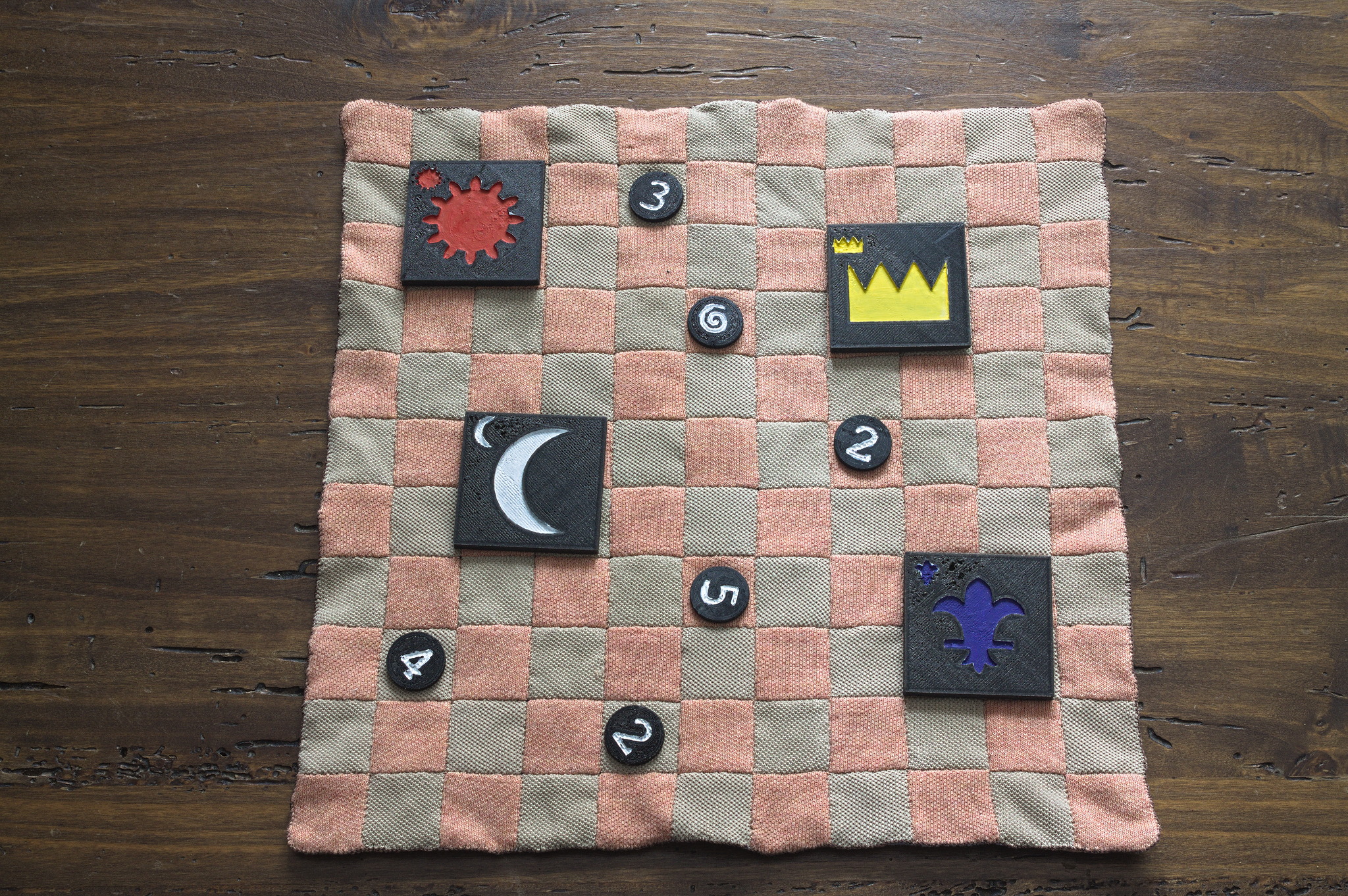 After a while I measured things out and saw that I could squeeze a 6.5
7 hexagon pattern into something resembling a square that was a multiple
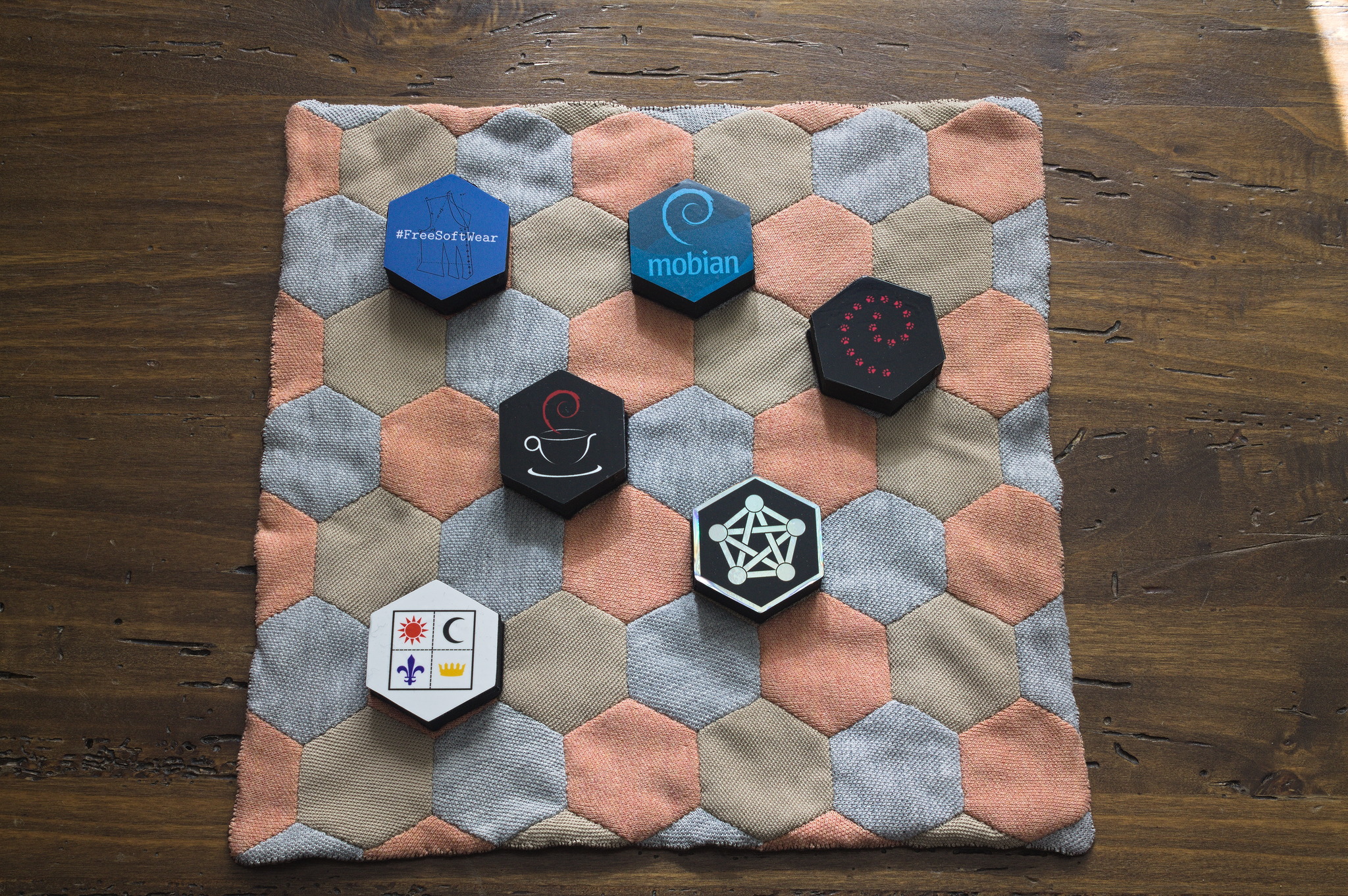
of the 2.5 cm square on the back of my Piecepack tiles, and decided to
go for another Standard for the back (because of course I wasn t going
to buy new fabric for lining the work).
I kept the paper in the pieces until both sides were ready, and used it
to sew them right sides together, leaving the usual opening in the
middle of one side.
Then I pressed, removed the paper, turned everything inside out, pressed
again and. It worked!
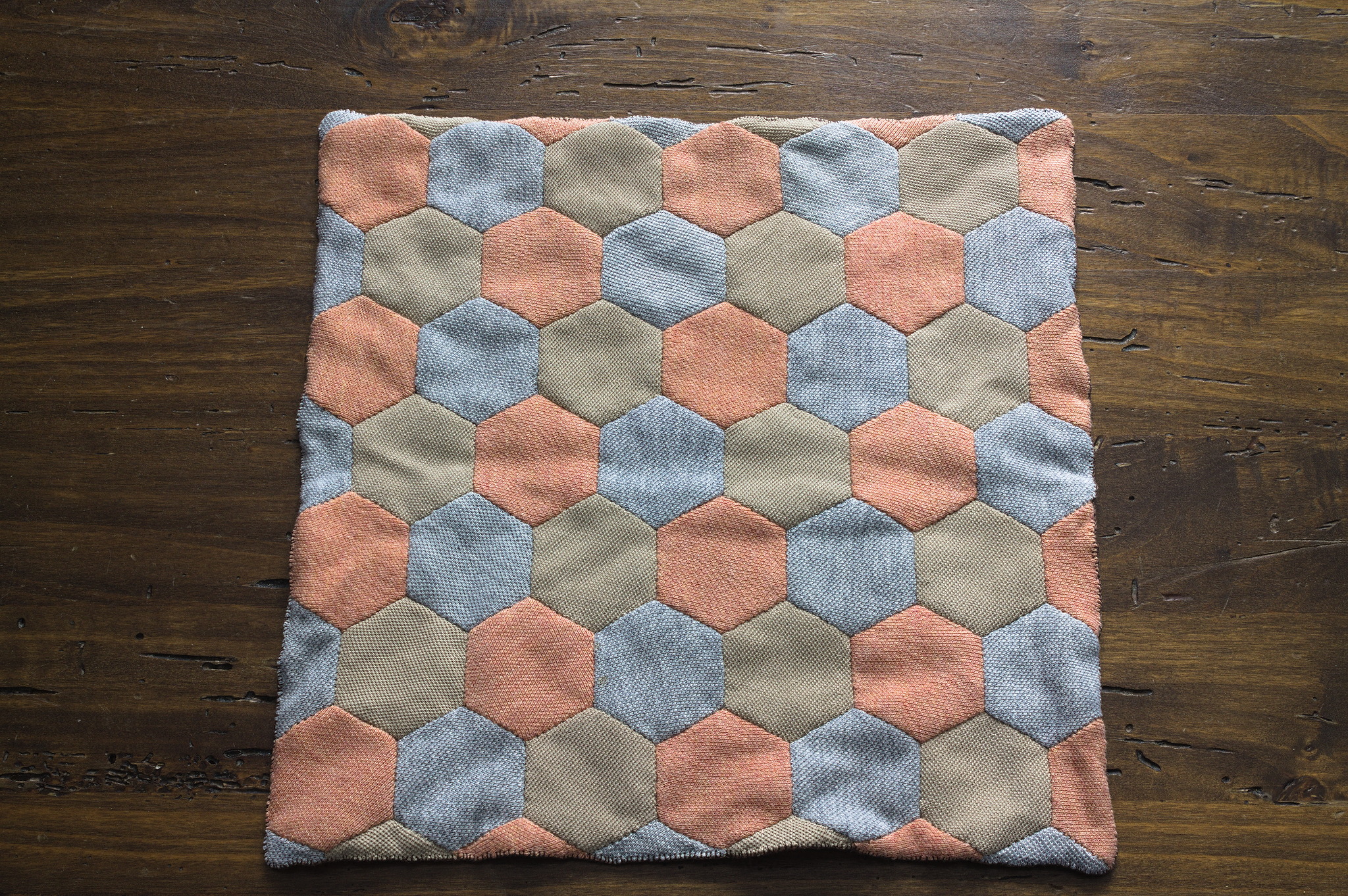
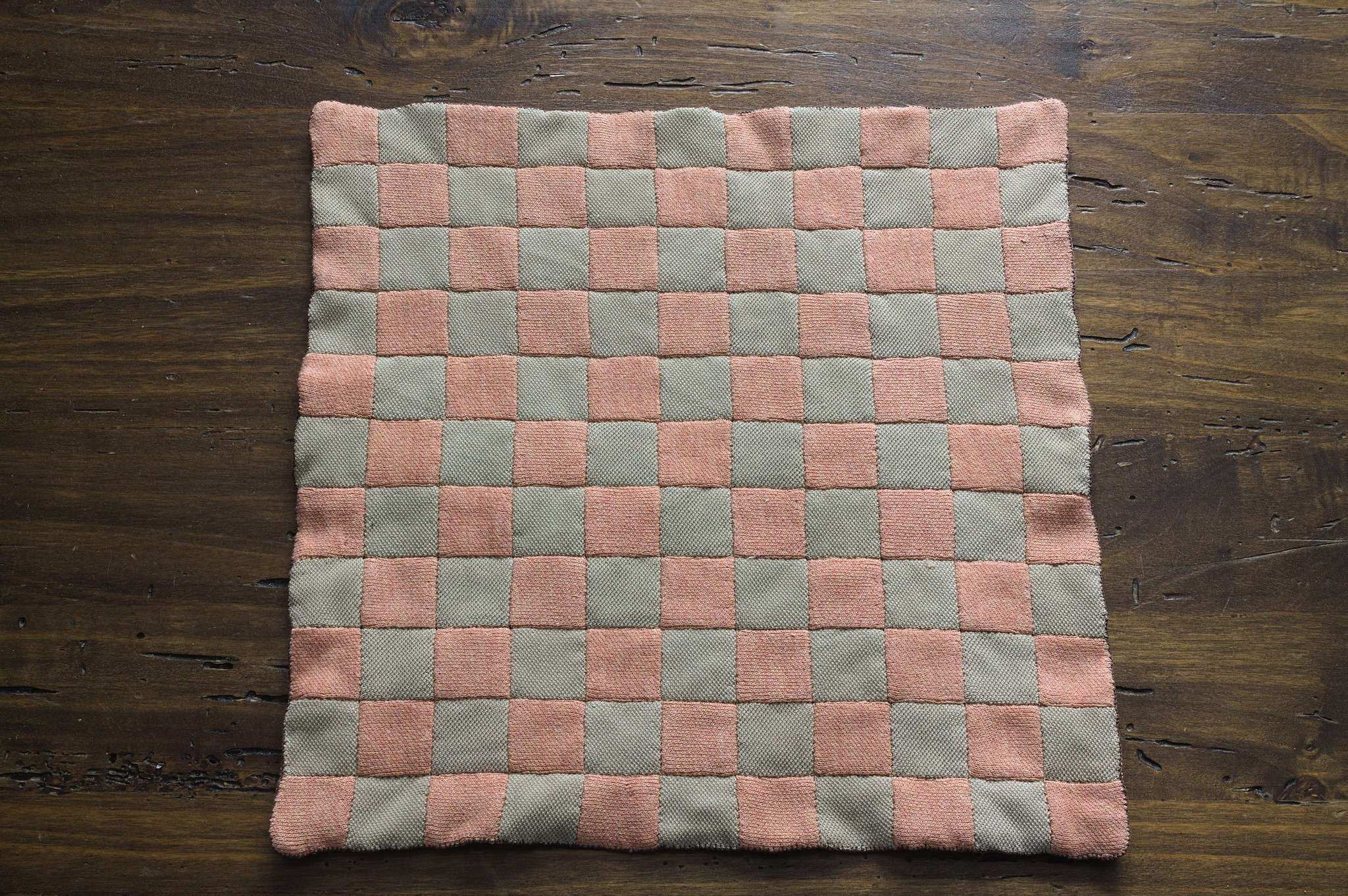
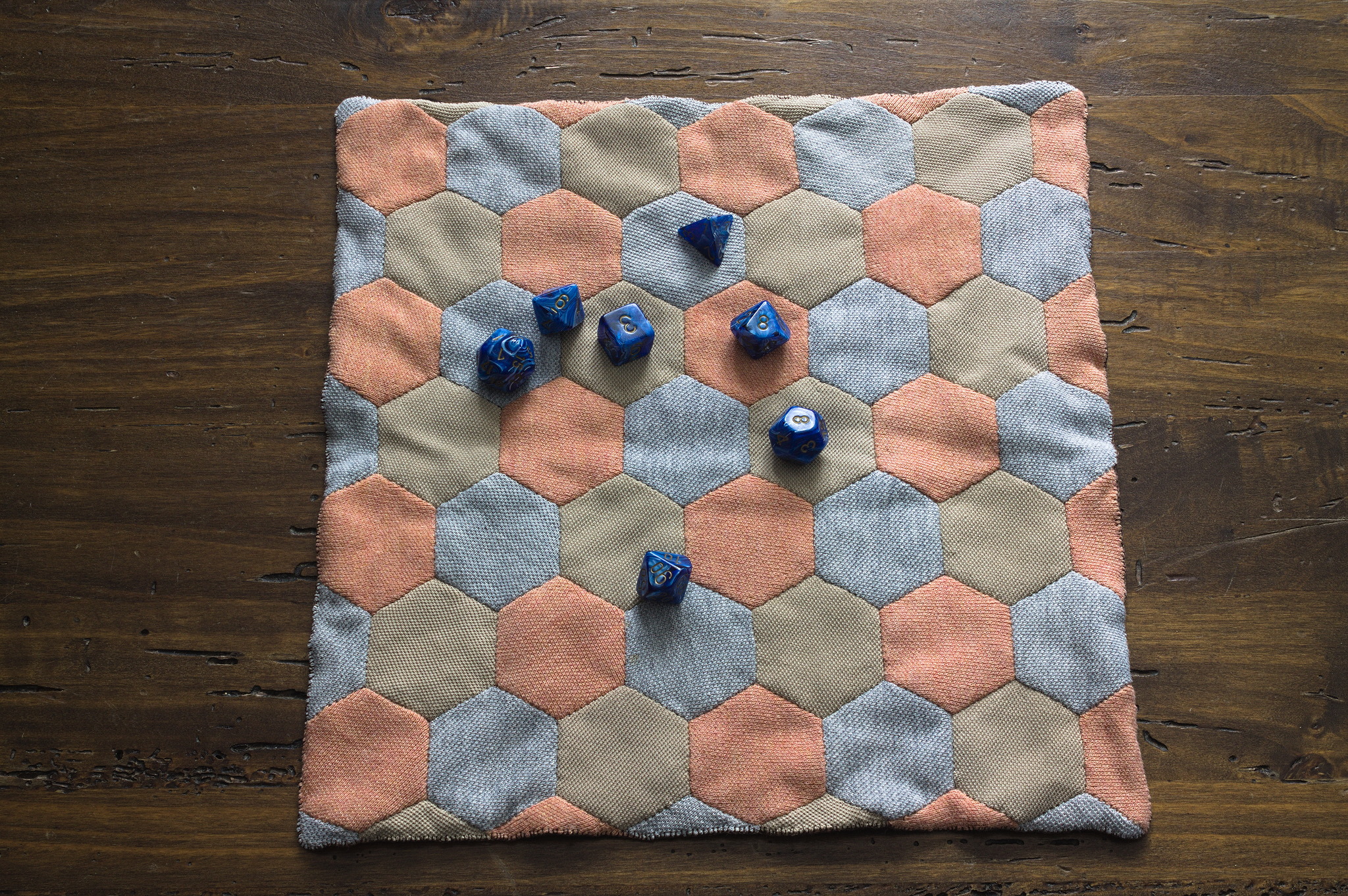 The hexagons look like hexagons, the squares look like squares, the
whole thing feels soft and drapey, but structurally sound. And it s a
bit lumpy, but not enough to cause issues when using it as a soft
surface to put over a noisy wooden table to throw dice on.
I considered adding some lightweight batting in the middle, but there
was really no need for it, and wondered about how to quilt the piece in
a way that worked with the patterns on the two sides, but for something
this small it wasn t really required.
However, I decided to add a buttonhole stitch border on all edges, to
close the opening I had left and to reinforce especially the small
triangles on the hexagons side, as those had a smaller sewing allowance
and could use it.
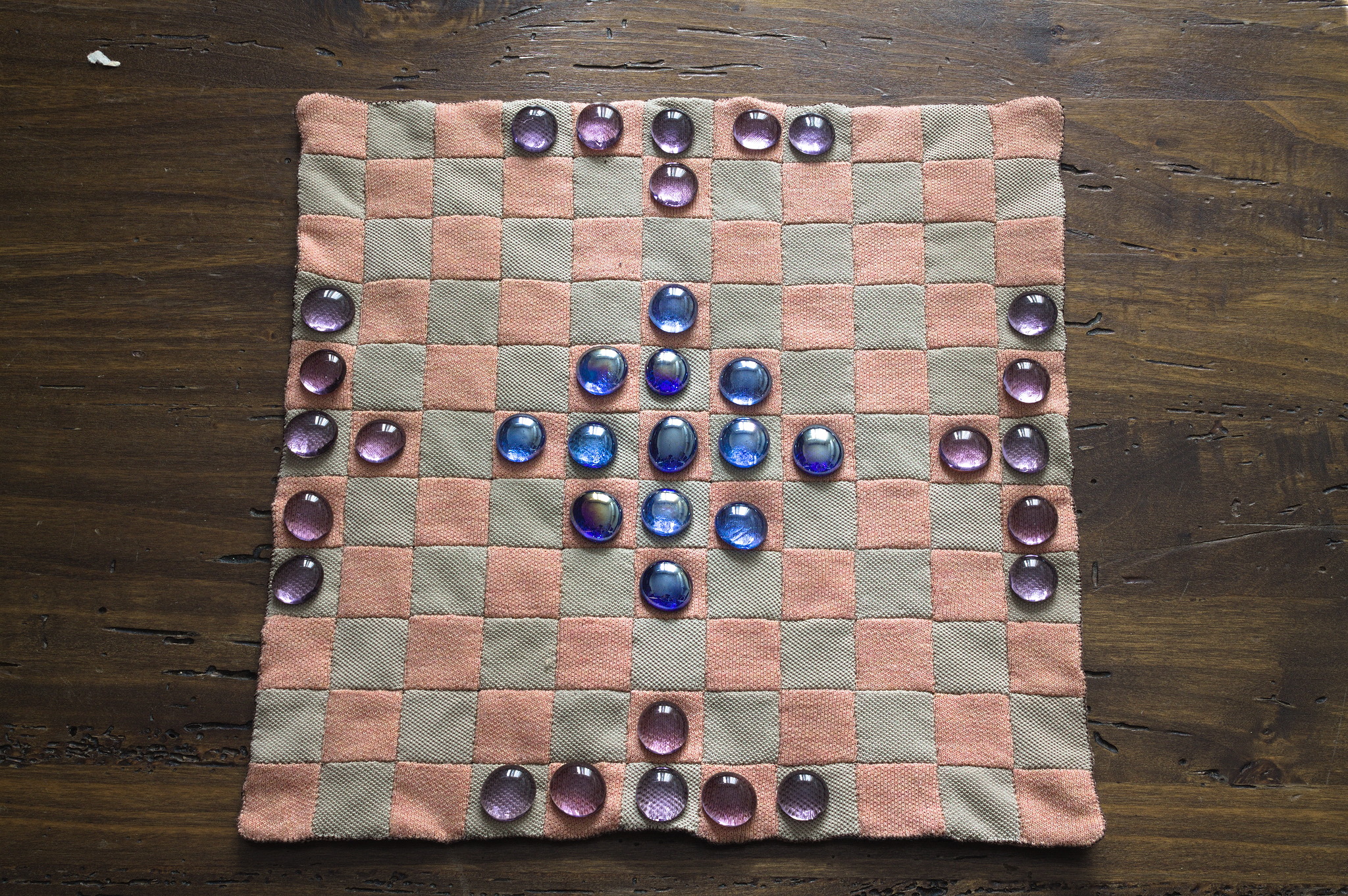 And of course, the 11 11 squares side wasn t completely an accident,
but part of A Plan.
For this project there isn t really a pattern, but I did publish
 For my birthday I was gifted copies of Eno's last two albums, Luminal and
Lateral, both of which are collaborations with Beatie Wolfe.
