Search Results: "nic"

7 March 2024

Petter Reinholdtsen: Plain text accounting file from your bitcoin transactions

A while back I wrote a small script to extract the Bitcoin transactions in a wallet in the ledger plain text accounting format. The last few days I spent some time to get it working better with more special cases. In case it can be useful for others, here is a copy:
#!/usr/bin/python3
#  -*- coding: utf-8 -*-
#  Copyright (c) 2023-2024 Petter Reinholdtsen
from decimal import Decimal
import json
import subprocess
import time
import numpy
def format_float(num):
    return numpy.format_float_positional(num, trim='-')
accounts =  
    u'amount' : 'Assets:BTC:main',
 
addresses =  
    '' : 'Assets:bankkonto',
    '' : 'Assets:bankkonto',
 
def exec_json(cmd):
    proc = subprocess.Popen(cmd,stdout=subprocess.PIPE)
    j = json.loads(proc.communicate()[0], parse_float=Decimal)
    return j
def list_txs():
    # get all transactions for all accounts / addresses
    c = 0
    txs = []
    txidfee =  
    limit=100000
    cmd = ['bitcoin-cli', 'listtransactions', '*', str(limit)]
    if True:
        txs.extend(exec_json(cmd))
    else:
        # Useful for debugging
        with open('transactions.json') as f:
            txs.extend(json.load(f, parse_float=Decimal))
    #print txs
    for tx in sorted(txs, key=lambda a: a['time']):
#        print tx['category']
        if 'abandoned' in tx and tx['abandoned']:
            continue
        if 'confirmations' in tx and 0 >= tx['confirmations']:
            continue
        when = time.strftime('%Y-%m-%d %H:%M', time.localtime(tx['time']))
        if 'message' in tx:
            desc = tx['message']
        elif 'comment' in tx:
            desc = tx['comment']
        elif 'label' in tx:
            desc = tx['label']
        else:
            desc = 'n/a'
        print("%s %s" % (when, desc))
        if 'address' in tx:
            print("  ; to bitcoin address %s" % tx['address'])
        else:
            print("  ; missing address in transaction, txid=%s" % tx['txid'])
        print(f"  ; amount= tx['amount'] ")
        if 'fee'in tx:
            print(f"  ; fee= tx['fee'] ")
        for f in accounts.keys():
            if f in tx and Decimal(0) != tx[f]:
                amount = tx[f]
                print("  %-20s   %s BTC" % (accounts[f], format_float(amount)))
        if 'fee' in tx and Decimal(0) != tx['fee']:
            # Make sure to list fee used in several transactions only once.
            if 'fee' in tx and tx['txid'] in txidfee \
               and tx['fee'] == txidfee[tx['txid']]:
                True
            else:
                fee = tx['fee']
                print("  %-20s   %s BTC" % (accounts['amount'], format_float(fee)))
                print("  %-20s   %s BTC" % ('Expences:BTC-fee', format_float(-fee)))
                txidfee[tx['txid']] = tx['fee']
        if 'address' in tx and tx['address'] in addresses:
            print("  %s" % addresses[tx['address']])
        else:
            if 'generate' == tx['category']:
                print("  Income:BTC-mining")
            else:
                if amount < Decimal(0):
                    print(f"  Assets:unknown:sent:update-script-addr- tx['address'] ")
                else:
                    print(f"  Assets:unknown:received:update-script-addr- tx['address'] ")
        print()
        c = c + 1
    print("# Found %d transactions" % c)
    if limit == c:
        print(f"# Warning: Limit  limit  reached, consider increasing limit.")
def main():
    list_txs()
main()
It is more of a proof of concept, and I do not expect it to handle all edge cases, but it worked for me, and perhaps you can find it useful too. To get a more interesting result, it is useful to map accounts sent to or received from to accounting accounts, using the addresses hash. As these will be very context dependent, I leave out my list to allow each user to fill out their own list of accounts. Out of the box, 'ledger reg BTC:main' should be able to show the amount of BTCs present in the wallet at any given time in the past. For other and more valuable analysis, a account plan need to be set up in the addresses hash. Here is an example transaction:
2024-03-07 17:00 Donated to good cause
    Assets:BTC:main                           -0.1 BTC
    Assets:BTC:main                       -0.00001 BTC
    Expences:BTC-fee                       0.00001 BTC
    Expences:donations                         0.1 BTC
It need a running Bitcoin Core daemon running, as it connect to it using bitcoin-cli listtransactions * 100000 to extract the transactions listed in the Wallet. As usual, if you use Bitcoin and want to show your support of my activities, please send Bitcoin donations to my address 15oWEoG9dUPovwmUL9KWAnYRtNJEkP1u1b.

Gunnar Wolf: Constructed truths truth and knowledge in a post-truth world

This post is a review for Computing Reviews for Constructed truths truth and knowledge in a post-truth world , a book published in Springer Link
Many of us grew up used to having some news sources we could implicitly trust, such as well-positioned newspapers and radio or TV news programs. We knew they would only hire responsible journalists rather than risk diluting public trust and losing their brand s value. However, with the advent of the Internet and social media, we are witnessing what has been termed the post-truth phenomenon. The undeniable freedom that horizontal communication has given us automatically brings with it the emergence of filter bubbles and echo chambers, and truth seems to become a group belief. Contrary to my original expectations, the core topic of the book is not about how current-day media brings about post-truth mindsets. Instead it goes into a much deeper philosophical debate: What is truth? Does truth exist by itself, objectively, or is it a social construct? If activists with different political leanings debate a given subject, is it even possible for them to understand the same points for debate, or do they truly experience parallel realities? The author wrote this book clearly prompted by the unprecedented events that took place in 2020, as the COVID-19 crisis forced humanity into isolation and online communication. Donald Trump is explicitly and repeatedly presented throughout the book as an example of an actor that took advantage of the distortions caused by post-truth. The first chapter frames the narrative from the perspective of information flow over the last several decades, on how the emergence of horizontal, uncensored communication free of editorial oversight started empowering the netizens and created a temporary information flow utopia. But soon afterwards, algorithmic gatekeepers started appearing, creating a set of personalized distortions on reality; users started getting news aligned to what they already showed interest in. This led to an increase in polarization and the growth of narrative-framing-specific communities that served as echo chambers for disjoint views on reality. This led to the growth of conspiracy theories and, necessarily, to the science denial and pseudoscience that reached unimaginable peaks during the COVID-19 crisis. Finally, when readers decide based on completely subjective criteria whether a scientific theory such as global warming is true or propaganda, or question what most traditional news outlets present as facts, we face the phenomenon known as fake news. Fake news leads to post-truth, a state where it is impossible to distinguish between truth and falsehood, and serves only a rhetorical function, making rational discourse impossible. Toward the end of the first chapter, the tone of writing quickly turns away from describing developments in the spread of news and facts over the last decades and quickly goes deep into philosophy, into the very thorny subject pursued by said discipline for millennia: How can truth be defined? Can different perspectives bring about different truth values for any given idea? Does truth depend on the observer, on their knowledge of facts, on their moral compass or in their honest opinions? Zoglauer dives into epistemology, following various thinkers ideas on what can be understood as truth: constructivism (whether knowledge and truth values can be learnt by an individual building from their personal experience), objectivity (whether experiences, and thus truth, are universal, or whether they are naturally individual), and whether we can proclaim something to be true when it corresponds to reality. For the final chapter, he dives into the role information and knowledge play in assigning and understanding truth value, as well as the value of second-hand knowledge: Do we really own knowledge because we can look up facts online (even if we carefully check the sources)? Can I, without any medical training, diagnose a sickness and treatment by honestly and carefully looking up its symptoms in medical databases? Wrapping up, while I very much enjoyed reading this book, I must confess it is completely different from what I expected. This book digs much more into the abstract than into information flow in modern society, or the impact on early 2020s politics as its editorial description suggests. At 160 pages, the book is not a heavy read, and Zoglauer s writing style is easy to follow, even across the potentially very deep topics it presents. Its main readership is not necessarily computing practitioners or academics. However, for people trying to better understand epistemology through its expressions in the modern world, it will be a very worthy read.

Valhalla's Things: Jeans, step two. And three. And four.

Posted on March 7, 2024
Tags: madeof:atoms, FreeSoftWear
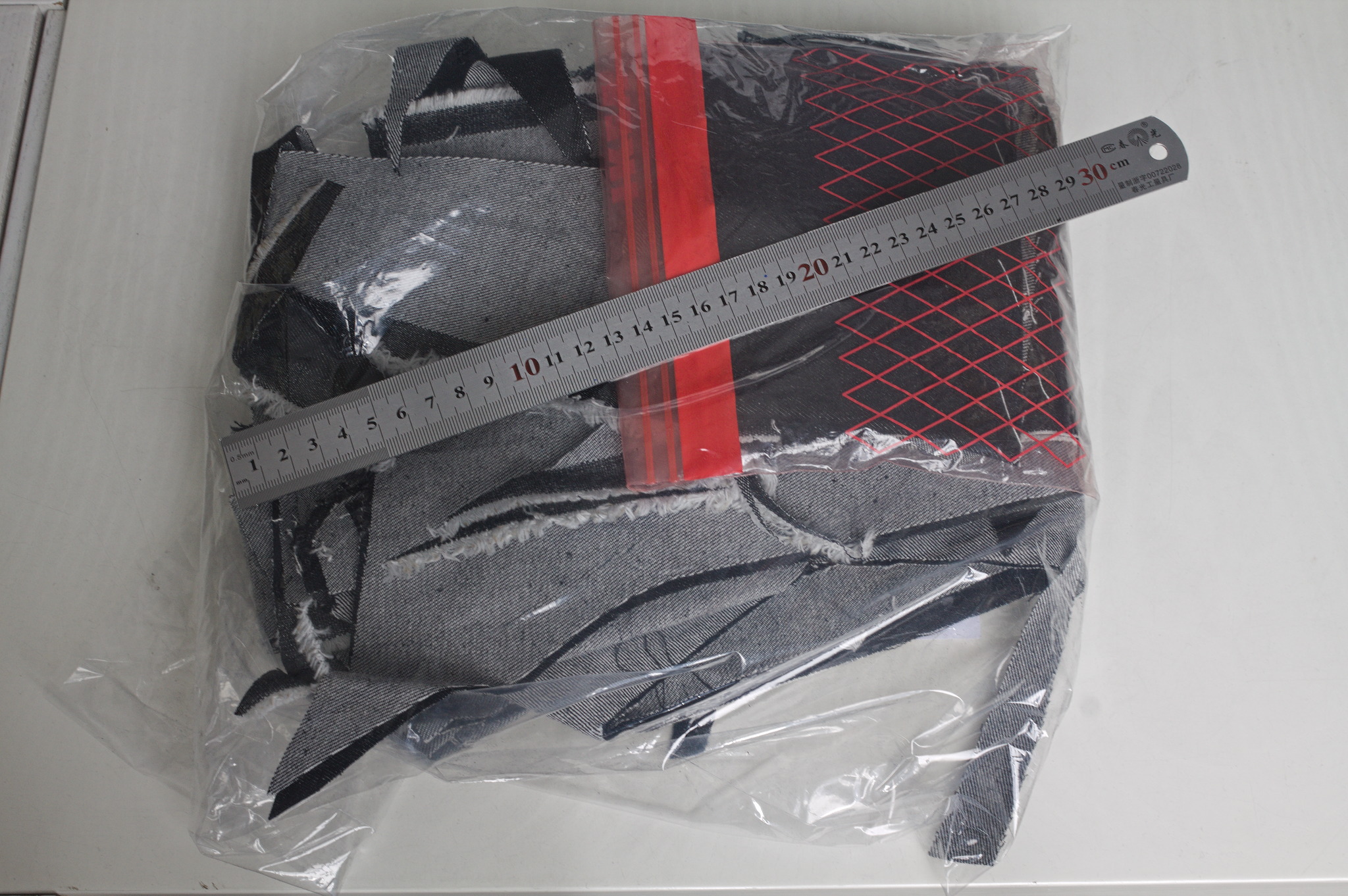
A woman wearing a regular pair of slim-cut black denim jeans. I was working on what looked like a good pattern for a pair of jeans-shaped trousers, and I knew I wasn t happy with 200-ish g/m cotton-linen for general use outside of deep summer, but I didn t have a source for proper denim either (I had been low-key looking for it for a long time). Then one day I looked at an article I had saved about fabric shops that sell technical fabric and while window-shopping on one I found that they had a decent selection of denim in a decent weight. I decided it was a sign, and decided to buy the two heaviest denim they had: a 100% cotton, 355 g/m one and a 97% cotton, 3% elastane at 385 g/m 1; the latter was a bit of compromise as I shouldn t really be buying fabric adulterated with the Scourge of Humanity, but it was heavier than the plain one, and I may be having a thing for tightly fitting jeans, so this may be one of the very few woven fabric where I m not morally opposed to its existence. And, I d like to add, I resisted buying any of the very nice wools they also seem to carry, other than just a couple of samples. Since the shop only sold in 1 meter increments, and I needed about 1.5 meters for each pair of jeans, I decided to buy 3 meters per type, and have enough to make a total of four pair of jeans. A bit more than I strictly needed, maybe, but I was completely out of wearable day-to-day trousers. a cardboard box with neatly folded black denim, covered in semi-transparent plastic. The shop sent everything very quickly, the courier took their time (oh, well) but eventually delivered my fabric on a sunny enough day that I could wash it and start as soon as possible on the first pair. The pattern I did in linen was a bit too fitting, but I was afraid I had widened it a bit too much, so I did the first pair in the 100% cotton denim. Sewing them took me about a week of early mornings and late afternoons, excluding the weekend, and my worries proved false: they were mostly just fine. The only bit that could have been a bit better is the waistband, which is a tiny bit too wide on the back: it s designed to be so for comfort, but the next time I should pull the elastic a bit more, so that it stays closer to the body. The same from the back, showing the applied pockets with a sewn logo. I wore those jeans daily for the rest of the week, and confirmed that they were indeed comfortable and the pattern was ok, so on the next Monday I started to cut the elastic denim. I decided to cut and sew two pairs, assembly-line style, using the shaped waistband for one of them and the straight one for the other one. I started working on them on a Monday, and on that week I had a couple of days when I just couldn t, plus I completely skipped sewing on the weekend, but on Tuesday the next week one pair was ready and could be worn, and the other one only needed small finishes. A woman wearing another pair of jeans; the waistband here is shaped to fit rather than having elastic. And I have to say, I m really, really happy with the ones with a shaped waistband in elastic denim, as they fit even better than the ones with a straight waistband gathered with elastic. Cutting it requires more fabric, but I think it s definitely worth it. But it will be a problem for a later time: right now three pairs of jeans are a good number to keep in rotation, and I hope I won t have to sew jeans for myself for quite some time. A plastic bag with mid-sized offcuts of denim; there is a 30 cm ruler on top that is just wider than the bag I think that the leftovers of plain denim will be used for a skirt or something else, and as for the leftovers of elastic denim, well, there aren t a lot left, but what else I did with them is the topic for another post. Thanks to the fact that they are all slightly different, I ve started to keep track of the times when I wash each pair, and hopefully I will be able to see whether the elastic denim is significantly less durable than the regular, or the added weight compensates for it somewhat. I m not sure I ll manage to remember about saving the data until they get worn, but if I do it will be interesting to know. Oh, and I say I ve finished working on jeans and everything, but I still haven t sewn the belt loops to the third pair. And I m currently wearing them. It s a sewist tradition, or something. :D



  1. The links are to the shop for Italy; you can copy the Codice prodotto and look for it on one of the shop version for other countries (where they apply the right vat etc., but sadly they don t allow to mix and match those settings and the language).

4 March 2024

Colin Watson: Free software activity in January/February 2024

Two months into my new gig and it s going great! Tracking my time has taken a bit of getting used to, but having something that amounts to a queryable database of everything I ve done has also allowed some helpful introspection. Freexian sponsors up to 20% of my time on Debian tasks of my choice. In fact I ve been spending the bulk of my time on debusine which is itself intended to accelerate work on Debian, but more details on that later. While I contribute to Freexian s summaries now, I ve also decided to start writing monthly posts about my free software activity as many others do, to get into some more detail. January 2024 February 2024

3 March 2024

Paul Wise: FLOSS Activities Feb 2024

Focus This month I didn't have any particular focus. I just worked on issues in my info bubble.

Changes

Issues

Review
  • Spam: reported 1 Debian bug report
  • Debian BTS usertags: changes for the month

Administration
  • Debian BTS: unarchive/reopen/triage bugs for reintroduced packages: ovito, tahoe-lafs, tpm2-tss-engine
  • Debian wiki: produce HTML dump for a user, unblock IP addresses, approve accounts

Communication
  • Respond to queries from Debian users and contributors on the mailing lists and IRC

Sponsors The SWH work was sponsored. All other work was done on a volunteer basis.

2 March 2024

Ravi Dwivedi: Malaysia Trip

Last month, I had a trip to Malaysia and Thailand. I stayed for six days in each of the countries. The selection of these countries was due to both of them granting visa-free entry to Indian tourists for some time window. This post covers the Malaysia part and Thailand part will be covered in the next post. If you want to travel to any of these countries in the visa-free time period, I have written all the questions asked during immigration and at airports during this trip here which might be of help. I mostly stayed in Kuala Lumpur and went to places around it. Although before the trip, I planned to visit Ipoh and Cameron Highlands too, but could not cover it during the trip. I found planning a trip to Malaysia a little difficult. The country is divided into two main islands - Peninsular Malaysia and Borneo. Then there are more islands - Langkawi, Penang island, Perhentian and Redang Islands. Reaching those islands seemed a little difficult to plan and I wish to visit more places in my next Malaysia trip. My first day hostel was booked in Chinatown part of Kuala Lumpur, near Pasar Seni LRT station. As soon as I checked-in and entered my room, I met another Indian named Fletcher, and after that we accompanied each other in the trip. That day, we went to Muzium Negara and Little India. I realized that if you know the right places to buy what you want, Malaysia could be quite cheap. Malaysian currency is Malaysian Ringgit (MYR). 1 MYR is equal to 18 INR. For 2 MYR, you can get a good masala tea in Little India and it costs like 4-5 MYR for a masala dosa. The vegetarian food has good availability in Kuala Lumpur, thanks to the Tamil community. I also tried Mee Goreng, which was vegetarian, and I found it fine in terms of taste. When I checked about Mee Goreng on Wikipedia, I found out that it is unique to Indian immigrants in Malaysia (and neighboring countries) but you don t get it in India!
Mee Goreng, a dish made of noodles in Malaysia.

For the next day, Fletcher had planned a trip to Genting Highlands and pre booked everything. I also planned to join him but when we went to KL Sentral to take the bus, his bus tickets were sold out. I could take a bus at a different time, but decided to visit some other place for the day and cover Genting Highlands later. At the ticket counter, I met a family from Delhi and they wanted to go to Genting Highlands but due to not getting bus tickets for that day, they decided to buy a ticket for the next day and instead planned for Batu Caves that day. I joined them and went to Batu Caves. After returning from Batu Caves, we went our separate ways. I went back and took rest at my hostel and later went to Petronas Towers at night. Petronas Towers is the icon of Kuala Lumpur. Having a photo there was a must. I was at Petronas Towers at around 9 PM. Around that time, Fletcher came back from Genting Highlands and we planned to meet at KL Sentral to head for dinner.
Me at Petronas Towers.
We went back to the same place as the day before where I had Mee Goreng. This time we had dosa and a masala tea. Their masala tea from the last day was tasty and that s why I was looking for them in the first place. We also met a Malaysian family having Indian ancestry dining there and had a nice conversation. Then we went to a place to eat roti canai in Pasar Seni market. Roti canai is a popular non-vegetarian dish in Malaysia but I took the vegetarian version.
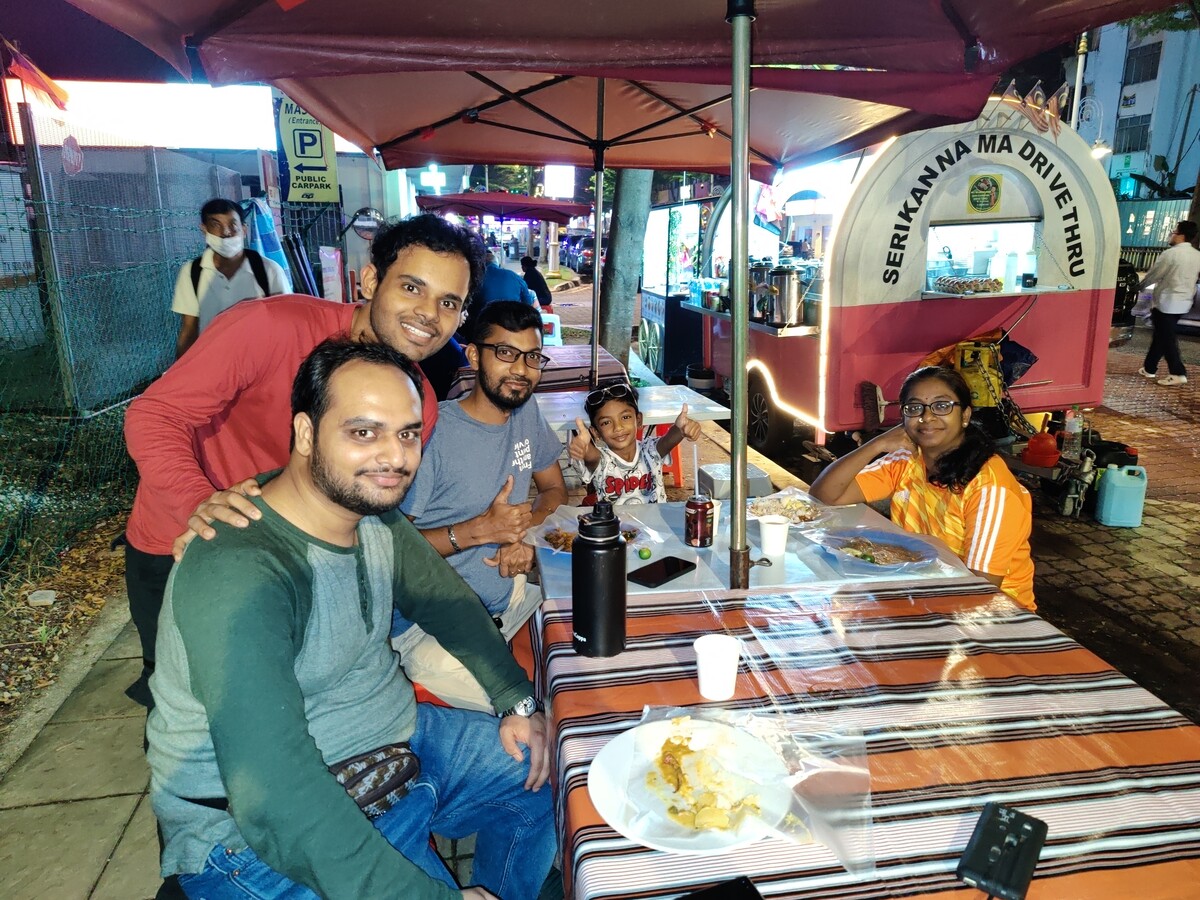
Photo with Malaysians.
The next day, we went to Berjaya Time Square shopping place which sells pretty cheap items for daily use and souveniers too. However, I bought souveniers from Petaling Street, which is in Chinatown. At night, we explored Bukit Bintang, which is the heart of Kuala Lumpur and is famous for its nightlife. After that, Fletcher went to Bangkok and I was in Malaysia for two more days. Next day, I went to Genting Highlands and took the cable car, which had awesome views. I came back to Kuala Lumpur by the night. The remaining day I just roamed around in Bukit Bintang. Then I took a flight for Bangkok on 7th Feb, which I will cover in the next post. In Malaysia, I met so many people from different countries - apart from people from Indian subcontinent, I met Syrians, Indonesians (Malaysia seems to be a popular destination for Indonesian tourists) and Burmese people. Meeting people from other cultures is an integral part of travel for me. My expenses for Food + Accommodation + Travel added to 10,000 INR for a week in Malaysia, while flight costs were: 13,000 INR (Delhi to Kuala Lumpur) + 10,000 INR (Kuala Lumpur to Bangkok) + 12,000 INR (Bangkok to Delhi). For OpenStreetMap users, good news is Kuala Lumpur is fairly well-mapped on OpenStreetMap.

Tips
  • I bought local SIM from a shop at KL Sentral station complex which had news in their name (I forgot the exact name and there are two shops having news in their name) and it was the cheapest option I could find. The SIM was 10 MYR for 5 GB data for a week. If you want to make calls too, then you need to spend extra 5 MYR.
  • 7-Eleven and KK Mart convenience stores are everywhere in the city and they are open all the time (24 hours a day). If you are a vegetarian, you can at least get some bread and cheese from there to eat.
  • A lot of people know English (and many - Indians, Pakistanis, Nepalis - know Hindi) in Kuala Lumpur, so I had no language problems most of the time.
  • For shopping on budget, you can go to Petaling Street, Berjaya Time Square or Bukit Bintang. In particular, there is a shop named I Love KL Gifts in Bukit Bintang which had very good prices. just near the metro/monorail stattion. Check out location of the shop on OpenStreetMap.

1 March 2024

Junichi Uekawa: March.

March. Busy days.

25 February 2024

Russ Allbery: Review: The Fund

Review: The Fund, by Rob Copeland
Publisher: St. Martin's Press
Copyright: 2023
ISBN: 1-250-27694-2
Format: Kindle
Pages: 310
I first became aware of Ray Dalio when either he or his publisher plastered advertisements for The Principles all over the San Francisco 4th and King Caltrain station. If I recall correctly, there were also constant radio commercials; it was a whole thing in 2017. My brain is very good at tuning out advertisements, so my only thought at the time was "some business guy wrote a self-help book." I think I vaguely assumed he was a CEO of some traditional business, since that's usually who writes heavily marketed books like this. I did not connect him with hedge funds or Bridgewater, which I have a bad habit of confusing with Blackwater. The Principles turns out to be more of a laundered cult manual than a self-help book. And therein lies a story. Rob Copeland is currently with The New York Times, but for many years he was the hedge fund reporter for The Wall Street Journal. He covered, among other things, Bridgewater Associates, the enormous hedge fund founded by Ray Dalio. The Fund is a biography of Ray Dalio and a history of Bridgewater from its founding as a vehicle for Dalio's advising business until 2022 when Dalio, after multiple false starts and title shuffles, finally retired from running the company. (Maybe. Based on the history recounted here, it wouldn't surprise me if he was back at the helm by the time you read this.) It is one of the wildest, creepiest, and most abusive business histories that I have ever read. It's probably worth mentioning, as Copeland does explicitly, that Ray Dalio and Bridgewater hate this book and claim it's a pack of lies. Copeland includes some of their denials (and many non-denials that sound as good as confirmations to me) in footnotes that I found increasingly amusing.
A lawyer for Dalio said he "treated all employees equally, giving people at all levels the same respect and extending them the same perks."
Uh-huh. Anyway, I personally know nothing about Bridgewater other than what I learned here and the occasional mention in Matt Levine's newsletter (which is where I got the recommendation for this book). I have no independent information whether anything Copeland describes here is true, but Copeland provides the typical extensive list of notes and sourcing one expects in a book like this, and Levine's comments indicated it's generally consistent with Bridgewater's industry reputation. I think this book is true, but since the clear implication is that the world's largest hedge fund was primarily a deranged cult whose employees mostly spied on and rated each other rather than doing any real investment work, I also have questions, not all of which Copeland answers to my satisfaction. But more on that later. The center of this book are the Principles. These were an ever-changing list of rules and maxims for how people should conduct themselves within Bridgewater. Per Copeland, although Dalio later published a book by that name, the version of the Principles that made it into the book was sanitized and significantly edited down from the version used inside the company. Dalio was constantly adding new ones and sometimes changing them, but the common theme was radical, confrontational "honesty": never being silent about problems, confronting people directly about anything that they did wrong, and telling people all of their faults so that they could "know themselves better." If this sounds like textbook abusive behavior, you have the right idea. This part Dalio admits to openly, describing Bridgewater as a firm that isn't for everyone but that achieves great results because of this culture. But the uncomfortably confrontational vibes are only the tip of the iceberg of dysfunction. Here are just a few of the ways this played out according to Copeland: In one of the common and all-too-disturbing connections between Wall Street finance and the United States' dysfunctional government, James Comey (yes, that James Comey) ran internal security for Bridgewater for three years, meaning that he was the one who pulled evidence from surveillance cameras for Dalio to use to confront employees during his trials. In case the cult vibes weren't strong enough already, Bridgewater developed its own idiosyncratic language worthy of Scientology. The trials were called "probings," firing someone was called "sorting" them, and rating them was called "dotting," among many other Bridgewater-specific terms. Needless to say, no one ever probed Dalio himself. You will also be completely unsurprised to learn that Copeland documents instances of sexual harassment and discrimination at Bridgewater, including some by Dalio himself, although that seems to be a relatively small part of the overall dysfunction. Dalio was happy to publicly humiliate anyone regardless of gender. If you're like me, at this point you're probably wondering how Bridgewater continued operating for so long in this environment. (Per Copeland, since Dalio's retirement in 2022, Bridgewater has drastically reduced the cult-like behaviors, deleted its archive of probings, and de-emphasized the Principles.) It was not actually a religious cult; it was a hedge fund that has to provide investment services to huge, sophisticated clients, and by all accounts it's a very successful one. Why did this bizarre nightmare of a workplace not interfere with Bridgewater's business? This, I think, is the weakest part of this book. Copeland makes a few gestures at answering this question, but none of them are very satisfying. First, it's clear from Copeland's account that almost none of the employees of Bridgewater had any control over Bridgewater's investments. Nearly everyone was working on other parts of the business (sales, investor relations) or on cult-related obsessions. Investment decisions (largely incorporated into algorithms) were made by a tiny core of people and often by Dalio himself. Bridgewater also appears to not trade frequently, unlike some other hedge funds, meaning that they probably stay clear of the more labor-intensive high-frequency parts of the business. Second, Bridgewater took off as a hedge fund just before the hedge fund boom in the 1990s. It transformed from Dalio's personal consulting business and investment newsletter to a hedge fund in 1990 (with an earlier investment from the World Bank in 1987), and the 1990s were a very good decade for hedge funds. Bridgewater, in part due to Dalio's connections and effective marketing via his newsletter, became one of the largest hedge funds in the world, which gave it a sort of institutional momentum. No one was questioned for putting money into Bridgewater even in years when it did poorly compared to its rivals. Third, Dalio used the tried and true method of getting free publicity from the financial press: constantly predict an upcoming downturn, and aggressively take credit whenever you were right. From nearly the start of his career, Dalio predicted economic downturns year after year. Bridgewater did very well in the 2000 to 2003 downturn, and again during the 2008 financial crisis. Dalio aggressively takes credit for predicting both of those downturns and positioning Bridgewater correctly going into them. This is correct; what he avoids mentioning is that he also predicted downturns in every other year, the majority of which never happened. These points together create a bit of an answer, but they don't feel like the whole picture and Copeland doesn't connect the pieces. It seems possible that Dalio may simply be good at investing; he reads obsessively and clearly enjoys thinking about markets, and being an abusive cult leader doesn't take up all of his time. It's also true that to some extent hedge funds are semi-free money machines, in that once you have a sufficient quantity of money and political connections you gain access to investment opportunities and mechanisms that are very likely to make money and that the typical investor simply cannot access. Dalio is clearly good at making personal connections, and invested a lot of effort into forming close ties with tricky clients such as pools of Chinese money. Perhaps the most compelling explanation isn't mentioned directly in this book but instead comes from Matt Levine. Bridgewater touts its algorithmic trading over humans making individual trades, and there is some reason to believe that consistently applying an algorithm without regard to human emotion is a solid trading strategy in at least some investment areas. Levine has asked in his newsletter, tongue firmly in cheek, whether the bizarre cult-like behavior and constant infighting is a strategy to distract all the humans and keep them from messing with the algorithm and thus making bad decisions. Copeland leaves this question unsettled. Instead, one comes away from this book with a clear vision of the most dysfunctional workplace I have ever heard of, and an endless litany of bizarre events each more astonishing than the last. If you like watching train wrecks, this is the book for you. The only drawback is that, unlike other entries in this genre such as Bad Blood or Billion Dollar Loser, Bridgewater is a wildly successful company, so you don't get the schadenfreude of seeing a house of cards collapse. You do, however, get a helpful mental model to apply to the next person who tries to talk to you about "radical honesty" and "idea meritocracy." The flaw in this book is that the existence of an organization like Bridgewater is pointing to systematic flaws in how our society works, which Copeland is largely uninterested in interrogating. "How could this have happened?" is a rather large question to leave unanswered. The sheer outrageousness of Dalio's behavior also gets a bit tiring by the end of the book, when you've seen the patterns and are hearing about the fourth variation. But this is still an astonishing book, and a worthy entry in the genre of capitalism disasters. Rating: 7 out of 10

Jacob Adams: AAC and Debian

Currently, in a default installation of Debian with the GNOME desktop, Bluetooth headphones that require the AAC codec1 cannot be used. As the Debian wiki outlines, using the AAC codec over Bluetooth, while technically supported by PipeWire, is explicitly disabled in Debian at this time. This is because the fdk-aac library needed to enable this support is currently in the non-free component of the repository, meaning that PipeWire, which is in the main component, cannot depend on it.

How to Fix it Yourself If what you, like me, need is simply for Bluetooth Audio to work with AAC in Debian s default desktop environment2, then you ll need to rebuild the pipewire package to include the AAC codec. While the current version in Debian main has been built with AAC deliberately disabled, it is trivial to enable if you can install a version of the fdk-aac library. I preface this with the usual caveats when it comes to patent and licensing controversies. I am not a lawyer, building this package and/or using it could get you into legal trouble. These instructions have only been tested on an up-to-date copy of Debian 12.
  1. Install pipewire s build dependencies
    sudo apt install build-essential devscripts
    sudo apt build-dep pipewire
    
  2. Install libfdk-aac-dev
    sudo apt install libfdk-aac-dev
    
    If the above doesn t work you ll likely need to enable non-free and try again
    sudo sed -i 's/main/main non-free/g' /etc/apt/sources.list
    sudo apt update
    
    Alternatively, if you wish to ensure you are maximally license-compliant and patent un-infringing3, you can instead build fdk-aac-free which includes only those components of AAC that are known to be patent-free3. This is what should eventually end up in Debian to resolve this problem (see below).
    sudo apt install git-buildpackage
    mkdir fdk-aac-source
    cd fdk-aac-source
    git clone https://salsa.debian.org/multimedia-team/fdk-aac
    cd fdk-aac
    gbp buildpackage
    sudo dpkg -i ../libfdk-aac2_*deb ../libfdk-aac-dev_*deb
    
  3. Get the pipewire source code
    mkdir pipewire-source
    cd pipewire-source
    apt source pipewire
    
    This will create a bunch of files within the pipewire-source directory, but you ll only need the pipewire-<version> folder, this contains all the files you ll need to build the package, with all the debian-specific patches already applied. Note that you don t want to run the apt source command as root, as it will then create files that your regular user cannot edit.
  4. Fix the dependencies and build options To fix up the build scripts to use the fdk-aac library, you need to save the following as pipewire-source/aac.patch
    --- debian/control.orig
    +++ debian/control
    @@ -40,8 +40,8 @@
                 modemmanager-dev,
                 pkg-config,
                 python3-docutils,
    -               systemd [linux-any]
    -Build-Conflicts: libfdk-aac-dev
    +               systemd [linux-any],
    +               libfdk-aac-dev
     Standards-Version: 4.6.2
     Vcs-Browser: https://salsa.debian.org/utopia-team/pipewire
     Vcs-Git: https://salsa.debian.org/utopia-team/pipewire.git
    --- debian/rules.orig
    +++ debian/rules
    @@ -37,7 +37,7 @@
     		-Dauto_features=enabled \
     		-Davahi=enabled \
     		-Dbluez5-backend-native-mm=enabled \
    -		-Dbluez5-codec-aac=disabled \
    +		-Dbluez5-codec-aac=enabled \
     		-Dbluez5-codec-aptx=enabled \
     		-Dbluez5-codec-lc3=enabled \
     		-Dbluez5-codec-lc3plus=disabled \
    
    Then you ll need to run patch from within the pipewire-<version> folder created by apt source:
    patch -p0 < ../aac.patch
    
  5. Build pipewire
    cd pipewire-*
    debuild
    
    Note that you will likely see an error from debsign at the end of this process, this is harmless, you simply don t have a GPG key set up to sign your newly-built package4. Packages don t need to be signed to be installed, and debsign uses a somewhat non-standard signing process that dpkg does not check anyway.
  1. Install libspa-0.2-bluetooth
    sudo dpkg -i libspa-0.2-bluetooth_*.deb
    
  2. Restart PipeWire and/or Reboot
    sudo reboot
    
    Theoretically there s a set of services to restart here that would get pipewire to pick up the new library, probably just pipewire itself. But it s just as easy to restart and ensure everything is using the correct library.

Why This is a slightly unusual situation, as the fdk-aac library is licensed under what even the GNU project acknowledges is a free software license. However, this license explicitly informs the user that they need to acquire a patent license to use this software5:
3. NO PATENT LICENSE NO EXPRESS OR IMPLIED LICENSES TO ANY PATENT CLAIMS, including without limitation the patents of Fraunhofer, ARE GRANTED BY THIS SOFTWARE LICENSE. Fraunhofer provides no warranty of patent non-infringement with respect to this software. You may use this FDK AAC Codec software or modifications thereto only for purposes that are authorized by appropriate patent licenses.
To quote the GNU project:
Because of this, and because the license author is a known patent aggressor, we encourage you to be careful about using or redistributing software under this license: you should first consider whether the licensor might aim to lure you into patent infringement.
AAC is covered by a number of patents, which expire at some point in the 2030s6. As such the current version of the library is potentially legally dubious to ship with any other software, as it could be considered patent-infringing3.

Fedora s solution Since 2017, Fedora has included a modified version of the library as fdk-aac-free, see the announcement and the bugzilla bug requesting review. This version of the library includes only the AAC LC profile, which is believed to be entirely patent-free3. Based on this, there is an open bug report in Debian requesting that the fdk-aac package be moved to the main component and that the pipwire package be updated to build against it.

The Debian NEW queue To resolve these bugs, a version of fdk-aac-free has been uploaded to Debian by Jeremy Bicha. However, to make it into Debian proper, it must first pass through the ftpmaster s NEW queue. The current version of fdk-aac-free has been in the NEW queue since July 2023. Based on conversations in some of the bugs above, it s been there since at least 20227. I hope this helps anyone stuck with AAC to get their hardware working for them while we wait for the package to eventually make it through the NEW queue. Discuss on Hacker News
  1. Such as, for example, any Apple AirPods, which only support AAC AFAICT.
  2. Which, as of Debian 12 is GNOME 3 under Wayland with PipeWire.
  3. I m not a lawyer, I don t know what kinds of infringement might or might not be possible here, do your own research, etc. 2 3 4
  4. And if you DO have a key setup with debsign you almost certainly don t need these instructions.
  5. This was originally phrased as explicitly does not grant any patent rights. It was pointed out on Hacker News that this is not exactly what it says, as it also includes a specific note that you ll need to acquire your own patent license. I ve now quoted the relevant section of the license for clarity.
  6. Wikipedia claims the base patents expire in 2031, with the extensions expiring in 2038, but its source for these claims is some guy s spreadsheet in a forum. The same discussion also brings up Wikipedia s claim and casts some doubt on it, so I m not entirely sure what s correct here, but I didn t feel like doing a patent deep-dive today. If someone can provide a clear answer that would be much appreciated.
  7. According to Jeremy B cha: https://bugs.debian.org/cgi-bin/bugreport.cgi?bug=1021370#17

24 February 2024

Niels Thykier: Language Server for Debian: Spellchecking

This is my third update on writing a language server for Debian packaging files, which aims at providing a better developer experience for Debian packagers. Lets go over what have done since the last report.
Semantic token support I have added support for what the Language Server Protocol (LSP) call semantic tokens. These are used to provide the editor insights into tokens of interest for users. Allegedly, this is what editors would use for syntax highlighting as well. Unfortunately, eglot (emacs) does not support semantic tokens, so I was not able to test this. There is a 3-year old PR for supporting with the last update being ~3 month basically saying "Please sign the Copyright Assignment". I pinged the GitHub issue in the hopes it will get unstuck. For good measure, I also checked if I could try it via neovim. Before installing, I read the neovim docs, which helpfully listed the features supported. Sadly, I did not spot semantic tokens among those and parked from there. That was a bit of a bummer, but I left the feature in for now. If you have an LSP capable editor that supports semantic tokens, let me know how it works for you! :)
Spellchecking Finally, I implemented something Otto was missing! :) This stared with Paul Wise reminding me that there were Python binding for the hunspell spellchecker. This enabled me to get started with a quick prototype that spellchecked the Description fields in debian/control. I also added spellchecking of comments while I was add it. The spellchecker runs with the standard en_US dictionary from hunspell-en-us, which does not have a lot of technical terms in it. Much less any of the Debian specific slang. I spend considerable time providing a "built-in" wordlist for technical and Debian specific slang to overcome this. I also made a "wordlist" for known Debian people that the spellchecker did not recognise. Said wordlist is fairly short as a proof of concept, and I fully expect it to be community maintained if the language server becomes a success. My second problem was performance. As I had suspected that spellchecking was not the fastest thing in the world. Therefore, I added a very small language server for the debian/changelog, which only supports spellchecking the textual part. Even for a small changelog of a 1000 lines, the spellchecking takes about 5 seconds, which confirmed my suspicion. With every change you do, the existing diagnostics hangs around for 5 seconds before being updated. Notably, in emacs, it seems that diagnostics gets translated into an absolute character offset, so all diagnostics after the change gets misplaced for every character you type. Now, there is little I could do to speed up hunspell. But I can, as always, cheat. The way diagnostics work in the LSP is that the server listens to a set of notifications like "document opened" or "document changed". In a response to that, the LSP can start its diagnostics scanning of the document and eventually publish all the diagnostics to the editor. The spec is quite clear that the server owns the diagnostics and the diagnostics are sent as a "notification" (that is, fire-and-forgot). Accordingly, there is nothing that prevents the server from publishing diagnostics multiple times for a single trigger. The only requirement is that the server publishes the accumulated diagnostics in every publish (that is, no delta updating). Leveraging this, I had the language server for debian/changelog scan the document and publish once for approximately every 25 typos (diagnostics) spotted. This means you quickly get your first result and that clears the obsolete diagnostics. Thereafter, you get frequent updates to the remainder of the document if you do not perform any further changes. That is, up to a predefined max of typos, so we do not overload the client for longer changelogs. If you do any changes, it resets and starts over. The only bit missing was dealing with concurrency. By default, a pygls language server is single threaded. It is not great if the language server hangs for 5 seconds everytime you type anything. Fortunately, pygls has builtin support for asyncio and threaded handlers. For now, I did an async handler that await after each line and setup some manual detection to stop an obsolete diagnostics run. This means the server will fairly quickly abandon an obsolete run. Also, as a side-effect of working on the spellchecking, I fixed multiple typos in the changelog of debputy. :)
Follow up on the "What next?" from my previous update In my previous update, I mentioned I had to finish up my python-debian changes to support getting the location of a token in a deb822 file. That was done, the MR is now filed, and is pending review. Hopefully, it will be merged and uploaded soon. :) I also submitted my proposal for a different way of handling relationship substvars to debian-devel. So far, it seems to have received only positive feedback. I hope it stays that way and we will have this feature soon. Guillem proposed to move some of this into dpkg, which might delay my plans a bit. However, it might be for the better in the long run, so I will wait a bit to see what happens on that front. :) As noted above, I managed to add debian/changelog as a support format for the language server. Even if it only does spellchecking and trimming of trailing newlines on save, it technically is a new format and therefore cross that item off my list. :D Unfortunately, I did not manage to write a linter variant that does not involve using an LSP-capable editor. So that is still pending. Instead, I submitted an MR against elpa-dpkg-dev-el to have it recognize all the fields that the debian/control LSP knows about at this time to offset the lack of semantic token support in eglot.
From here... My sprinting on this topic will soon come to an end, so I have to a bit more careful now with what tasks I open! I think I will narrow my focus to providing a batch linting interface. Ideally, with an auto-fix for some of the more mechanical issues, where this is little doubt about the answer. Additionally, I think the spellchecking will need a bit more maturing. My current code still trips on naming patterns that are "clearly" verbatim or code references like things written in CamelCase or SCREAMING_SNAKE_CASE. That gets annoying really quickly. It also trips on a lot of commands like dpkg-gencontrol, but that is harder to fix since it could have been a real word. I think those will have to be fixed people using quotes around the commands. Maybe the most popular ones will end up in the wordlist. Beyond that, I will play it by ear if I have any time left. :)

23 February 2024

Gunnar Wolf: 10 things software developers should learn about learning

This post is a review for Computing Reviews for 10 things software developers should learn about learning , a article published in Communications of the ACM
As software developers, we understand the detailed workings of the different components of our computer systems. And probably due to how computers were presented since their appearance as digital brains in the 1940s we sometimes believe we can transpose that knowledge to how our biological brains work, be it as learners or as problem solvers. This article aims at making the reader understand several mechanisms related to how learning and problem solving actually work in our brains. It focuses on helping expert developers convey knowledge to new learners, as well as learners who need to get up to speed and start coding. The article s narrative revolves around software developers, but much of what it presents can be applied to different problem domains. The article takes this mission through ten points, with roughly the same space given to each of them, starting with wrong assumptions many people have about the similarities between computers and our brains. The first section, Human Memory Is Not Made of Bits, explains the brain processes of remembering as a way of strengthening the force of a memory ( reconsolidation ) and the role of activation in related network pathways. The second section, Human Memory Is Composed of One Limited and One Unlimited System, goes on to explain the organization of memories in the brain between long-term memory (functionally limitless, permanent storage) and working memory (storing little amounts of information used for solving a problem at hand). However, the focus soon shifts to how experience in knowledge leads to different ways of using the same concepts, the importance of going from abstract to concrete knowledge applications and back, and the role of skills repetition over time. Toward the end of the article, the focus shifts from the mechanical act of learning to expertise. Section 6, The Internet Has Not Made Learning Obsolete, emphasizes that problem solving is not just putting together the pieces of a puzzle; searching online for solutions to a problem does not activate the neural pathways that would get fired up otherwise. The final sections tackle the differences that expertise brings to play when teaching or training a newcomer: the same tools that help the beginner s productivity as training wheels will often hamper the expert user s as their knowledge has become automated. The article is written with a very informal and easy-to-read tone and vocabulary, and brings forward several issues that might seem like commonsense but do ring bells when it comes to my own experiences both as a software developer and as a teacher. The article closes by suggesting several books that further expand on the issues it brings forward. While I could not identify a single focus or thesis with which to characterize this article, the several points it makes will likely help readers better understand (and bring forward to consciousness) mental processes often taken for granted, and consider often-overlooked aspects when transmitting knowledge to newcomers.

19 February 2024

Valhalla's Things: Jeans, step one

Posted on February 19, 2024
Tags: madeof:atoms, craft:sewing, FreeSoftWear
CW for body size change mentions A woman wearing a pair of tight jeans. Just like the corset, I also needed a new pair of jeans. Back when my body size changed drastically of course my jeans no longer fit. While I was waiting for my size to stabilize I kept wearing them with a somewhat tight belt, but it was ugly and somewhat uncomfortable. When I had stopped changing a lot I tried to buy new ones in the same model, and found out that I was too thin for the menswear jeans of that shop. I could have gone back to wearing women s jeans, but I didn t want to have to deal with the crappy fabric and short pockets, so I basically spent a few years wearing mostly skirts, and oversized jeans when I really needed trousers. Meanwhile, I had drafted a jeans pattern for my SO, which we had planned to make in technical fabric, but ended up being made in a cotton-wool mystery mix for winter and in linen-cotton for summer, and the technical fabric version was no longer needed (yay for natural fibres!) It was clear what the solution to my jeans problems would have been, I just had to stop getting distracted by other projects and draft a new pattern using a womanswear block instead of a menswear one. Which, in January 2024 I finally did, and I believe it took a bit less time than the previous one, even if it had all of the same fiddly pieces. I already had a cut of the same cotton-linen I had used for my SO, except in black, and used it to make the pair this post is about. The parametric pattern is of course online, as #FreeSoftWear, at the usual place. This time it was faster, since I didn t have to write step-by-step instructions, as they are exactly the same as the other pattern. Same as above, from the back, with the crotch seam pulling a bit. A faint decoration can be seen on the pockets, with the line art version of the logo seen on this blog. Making also went smoothly, and the result was fitting. Very fitting. A big too fitting, and the standard bum adjustment of the back was just enough for what apparently still qualifies as a big bum, so I adjusted the pattern to be able to add a custom amount of ease in a few places. But at least I had a pair of jeans-shaped trousers that fit! Except, at 200 g/m I can t say that fabric is the proper weight for a pair of trousers, and I may have looked around online1 for some denim, and, well, it s 2024, so my no-fabric-buy 2023 has not been broken, right? Let us just say that there may be other jeans-related posts in the near future.

  1. I had already asked years ago for denim at my local fabric shops, but they don t have the proper, sturdy, type I was looking for.

16 February 2024

David Bremner: Generating ikiwiki markdown from org

My web pages are (still) in ikiwiki, but lately I have started authoring things like assignments and lectures in org-mode so that I can have some literate programming facilities. There is is org-mode export built-in, but it just exports source blocks as examples (i.e. unhighlighted verbatim). I added a custom exporter to mark up source blocks in a way ikiwiki can understand. Luckily this is not too hard the second time.
(with-eval-after-load "ox-md"
  (org-export-define-derived-backend 'ik 'md
    :translate-alist '((src-block . ik-src-block))
    :menu-entry '(?m 1 ((?i "ikiwiki" ik-export-to-ikiwiki)))))
(defun ik-normalize-language  (str)
  (cond
   ((string-equal str "plait") "racket")
   ((string-equal str "smol") "racket")
   (t str)))
(defun ik-src-block (src-block contents info)
  "Transcode a SRC-BLOCK element from Org to beamer
         CONTENTS is nil.  INFO is a plist used as a communication
         channel."
  (let* ((body  (org-element-property :value src-block))
         (lang  (ik-normalize-language (org-element-property :language src-block))))
    (format "[[!format <span class="error">Error: unsupported page format &#37;s</span>]]" lang body)))
(defun ik-export-to-ikiwiki
    (&optional async subtreep visible-only body-only ext-plist)
  "Export current buffer as an ikiwiki markdown file.
    See org-md-export-to-markdown for full docs"
  (require 'ox)
  (interactive)
  (let ((file (org-export-output-file-name ".mdwn" subtreep)))
    (org-export-to-file 'ik file
      async subtreep visible-only body-only ext-plist)))

Mike Gabriel: Debian Edu 12 - Call for Testing

This is a call for testing of Debian Edu based on Debian bookworm. With the Debian 12.5 point release all required packages have landed in the Debian Edu ISO images that allow you to install a Debian Edu system based on Debian 12. ISO Image Downloads You can find the Blueray Disc ISO image (use for main server installation) at: http://cdimage.debian.org/cdimage/release/current/amd64/iso-bd/debian-ed... For standalone workstation installations or installations on an already up-and-running Debian Edu site, please use the netinst ISO image: http://cdimage.debian.org/cdimage/release/current/amd64/iso-cd/debian-ed... Quick Start HowTo For testing Debian Edu 12, set up e.g. LXD or libVirt and install (at least) three virtual machines. In your virtualization software prepare an internal network where the VMs can reach one another without needing access to your local network. The three VMs: Happy testing! Further Readings Overall installation profile concept of Debian Edu:

https://wiki.debian.org/DebianEdu/BeforeGettingStarted Debian Edu 12 manual:
https://jenkins.debian.net/userContent/debian-edu-doc/ Debian Edu 12 status page:
https://wiki.debian.org/DebianEdu/Status/Bookworm

13 February 2024

Arturo Borrero Gonz lez: Back to the Wikimedia Foundation!

Wikimedia Foundation logo In October 2023, I departed from the Wikimedia Foundation, the non-profit organization behind well-known projects like Wikipedia and others, to join Spryker. However, in January 2024 Spryker conducted a round of layoffs reportedly due to budget and business reasons. I was among those affected, being let go just three months after joining the company. Fortunately, the Wikimedia Cloud Services team, where I previously worked, was still seeking to backfill my position, so I reached out to them. They graciously welcomed me back as a Senior Site Reliability Engineer, in the same team and position as before. Although this three-month career detour wasn t the outcome I initially envisioned, I found it to be a valuable experience. During this time, I gained knowledge in a new tech stack, based on AWS, and discovered new engineering methodologies. Additionally, I had the opportunity to meet some wonderful individuals. I believe I have emerged stronger from this experience. Returning to the Wikimedia Foundation is truly motivating. It feels privileged to be part of this mature organization, its community, and movement, with its inspiring mission and values. In addition, I m hoping that this also means I can once again dedicate a bit more attention to my FLOSS activities, such as my duties within the Debian project. My email address is back online: aborrero@wikimedia.org. You can find me again in the IRC libera.chat server, in the usual wikimedia channels, nick arturo.

12 February 2024

Gunnar Wolf: Heads up! A miniDebConf is approaching in Santa Fe, Argentina

I realize it s a bit late to start publicly organizing this, but better late than never I m happy some Debian people I have directly contacted have already expressed interest. So, lets make this public! For all interested people who are reasonably close to central Argentina, or can be persuaded to come here in a month s time You are all welcome! It seems I managed to convince my good friend Mart n Bayo (some Debian people will remember him, as he was present in DebConf19 in Curitiba, Brazil) to get some facilities for us to have a nice Debian get-together in Central Argentina.

Where? We will meet at APUL Asociaci n de Personal no-docente de la Universidad Nacional del Litoral, in downtown Santa Fe, Argentina.

When? Saturday, 2024.03.09. It is quite likely we can get some spaces for continuing over Sunday if there is demand.

What are we planning? We have little time for planning but we want to have a space for Debian-related outreach (so, please think about a topic or two you d like to share with general free software-interested, not too technical, audience). Please tell me by mail (gwolf@debian.org) about any ideas you might have. We also want to have a general hacklab-style area to hang out, work a bit in our projects, and spend a good time together.

Logistics I have briefly commented about this with our dear and always mighty DPL, and Debian will support Debian-related people interested in attending; please check personally with me for specifics on how to handle this case by case. My intention is to cover costs for travel, accomodation (one or two nights) and food for whoever is interested in coming over.

More information As I don t want to direct people to keep an eye on my blog post for updates, I ll copy this information (and keep it updated!) at the Debian Wiki / DebianEvents / ar / 2024 / MiniDebConf / Santa Fe please refer to that page!

Contact

Codes of Conduct DebConf and Debian Code of Conduct apply. See the DebConf Code of Conduct and the Debian Code of Conduct.

Registration Registration is free, but needed. See the separate Registration page.

Talks Please, send your proposal to gwolf@debian.org

Freexian Collaborators: Monthly report about Debian Long Term Support, January 2024 (by Roberto C. S nchez)

Like each month, have a look at the work funded by Freexian s Debian LTS offering.

Debian LTS contributors In January, 16 contributors have been paid to work on Debian LTS, their reports are available:
  • Abhijith PA did 14.0h (out of 7.0h assigned and 7.0h from previous period).
  • Bastien Roucari s did 22.0h (out of 16.0h assigned and 6.0h from previous period).
  • Ben Hutchings did 14.5h (out of 8.0h assigned and 16.0h from previous period), thus carrying over 9.5h to the next month.
  • Chris Lamb did 18.0h (out of 18.0h assigned).
  • Daniel Leidert did 10.0h (out of 10.0h assigned).
  • Emilio Pozuelo Monfort did 10.0h (out of 14.75h assigned and 27.0h from previous period), thus carrying over 31.75h to the next month.
  • Guilhem Moulin did 9.75h (out of 25.0h assigned), thus carrying over 15.25h to the next month.
  • Holger Levsen did 3.5h (out of 12.0h assigned), thus carrying over 8.5h to the next month.
  • Markus Koschany did 40.0h (out of 40.0h assigned).
  • Roberto C. S nchez did 8.75h (out of 9.5h assigned and 2.5h from previous period), thus carrying over 3.25h to the next month.
  • Santiago Ruano Rinc n did 13.5h (out of 8.25h assigned and 7.75h from previous period), thus carrying over 2.5h to the next month.
  • Sean Whitton did 0.5h (out of 0.25h assigned and 5.75h from previous period), thus carrying over 5.5h to the next month.
  • Sylvain Beucler did 9.5h (out of 23.25h assigned and 18.5h from previous period), thus carrying over 32.25h to the next month.
  • Thorsten Alteholz did 14.0h (out of 14.0h assigned).
  • Tobias Frost did 12.0h (out of 10.25h assigned and 1.75h from previous period).
  • Utkarsh Gupta did 8.5h (out of 35.75h assigned), thus carrying over 24.75h to the next month.

Evolution of the situation In January, we have released 25 DLAs. A variety of particularly notable packages were updated during January. Among those updates were the Linux kernel (both versions 5.10 and 4.19), mariadb-10.3, openjdk-11, firefox-esr, and thunderbird. In addition to the many other LTS package updates which were released in January, LTS contributors continue their efforts to make impactful contributions both within the Debian community.

Thanks to our sponsors Sponsors that joined recently are in bold.

11 February 2024

Marco d'Itri: Extending access to the systemd RuntimeDirectory with a POSIX ACL

inn2 uses ephemeral UNIX domain sockets in /run/news/ to communicate with the ctlinnd program. Since the directory is only writeable by the "news" user, other unprivileged users are not able to use the command. I solved this by extending the inn2.service systemd unit with a drop-in file which uses setfacl to give access to my user "md" to the RuntimeDirectory created by systemd. This is the content of /etc/systemd/system/inn2.service.d/md-ctlinnd.conf:
[Service]
# innd will change the permissions of /run/news/ when started: without
# creating it now with mode 0775 then that will change the ACL mask.
RuntimeDirectoryMode=0775
# allow user md to run ctlinnd(8), which creates sockets in /run/news/
ExecStartPost=/usr/bin/setfacl --modify user:md:rwx $RUNTIME_DIRECTORY
The non-obvious issue here is that the innd daemon on startup will change the directory permissions in a way which sets a more restrictive (non group-writeable) ACL mask, and this would make the newly created user ACL ineffective. The solution is to create the directory group-writeable from start. (Beware: this creates a trivial privileges escalation from md to news.)

Junichi Uekawa: Adding a new date entry using GAS on Google Docs.

Adding a new date entry using GAS on Google Docs. When I am writing a diary, or having a weekly meeting, it is sometimes tedious to add today's date every time. I can automate such tasks with GAS. There's a onOpen method that gets called every time a doc is opened, and you can use that to implement adding the latest date when the latest date does not match.

7 February 2024

Jonathan Dowland: carbon

I got a new work laptop this year: A Thinkpad X1 Carbon (Gen 11). It wasn't the one I wanted: I'd ordered an X1 Nano, which had a footprint very reminiscent to me of my beloved x40. Never mind! The Carbon is lovely. Despite ostensibly the same size as the T470s it's replacing, it's significantly more portable, and more capable. The two USB-A ports, as well as the full-size HDMI port, are welcome and useful (over the Nano). I used to keep notes on setting up Linux on different types of hardware, but I haven't really bothered now for years. Things Just Work. That's good! My old machine naming schemes are stretched beyond breaking point (and I've re-used my favourite hostname, qusp, one too many times) so I went for something new this time: Riffing on Carbon, I settled (for now) on carbyne, a carbon allotrope which is of interest to nanotechnologists (Seems appropriate)

Next.

Previous.