Search Results: "ghe"

13 May 2011

Mike Hommey: Debian Squeeze + btrfs = FAIL

Executive summary: Don t use btrfs on Debian Squeeze.
Longer summary: Don t use btrfs RAID with the kernel Debian Squeeze comes with. About six months ago, I set up a new server to handle this web site, mail, and various other things. The system and most services (including web and mail) was set to use an MD RAID 1 array across two small partitions on two separate disks, and the remaining space was setup in three different btrfs file systems: Three days ago, this happened:
May 10 10:18:04 goemon kernel: [3545898.548311] ata4: hard resetting link
May 10 10:18:04 goemon kernel: [3545898.867556] ata4: SATA link up 1.5 Gbps (SStatus 113 SControl 310)
May 10 10:18:04 goemon kernel: [3545898.874973] ata4.00: configured for UDMA/33
followed by other ATA related messages, then, garbage such as:
May 10 10:18:07 goemon kernel: [3545901.28123] sd3000 d]SneKy:AotdCmad[urn][ecitr
May 10 10:18:07 goemon kernel: 4[550.821 ecio es aawt es ecitr i e)
May 10 10:18:07 goemon kernel: 6[550.824     20 00 00 00 00 00 00 00 <>3491225     16 44 <>3491216]s ::::[d]Ad es:N diinlsneifrain<>3491216]s ::::[d]C:Ra(0:2 00 03 80 06 0
3491217]edrqet / ro,dvsb etr2272
May 10 10:18:07 goemon kernel: 3[550.837 ad:sb:rshdln etr2252
May 10 10:18:07 goemon kernel: 6[551214]s ::::[d]Rsl:hsbt=I_Kdiebt=RVRSNE<>3491215]s ::::[d]SneKy:AotdCmad[urn][ecitr
May 10 10:18:07 goemon kernel: 4[550.833 ecitrsnedt ihsnedsrpos(nhx:<>3491216]    7 b0 00 00 c0 a8 00 00 0
Then later on:
May 10 12:01:18 goemon kernel: [3552089.226147] lost page write due to I/O error on sdb4
May 10 12:01:18 goemon kernel: [3552089.226312] lost page write due to I/O error on sdb4
May 10 12:10:14 goemon kernel: [3552624.625669] btrfs no csum found for inode 23642 start 0
May 10 12:10:14 goemon kernel: [3552624.625783] btrfs no csum found for inode 23642 start 4096
May 10 12:10:14 goemon kernel: [3552624.625884] btrfs no csum found for inode 23642 start 8192
etc. and more garbage. At that point, I wanted to shutdown the server, check the hardware, and reboot. Shutdown didn t want to proceed completely. Btrfs just froze on the sync happening during the shutdown phase, so I had to power off violently. Nothing seemed really problematic on the hardware end, and after a reboot, both disks were properly working. The MD RAID would resynchronize, and the btrfs filesystems would be automatically mounted. It would work for a while, until such things could be seen in the logs, with more garbage as above in between:
May 10 14:41:18 goemon kernel: [ 1253.455545] __ratelimit: 35363 callbacks suppressed
May 10 14:45:04 goemon kernel: [ 1478.717749] parent transid verify failed on 358190825472 wanted 42547 found 42525
May 10 14:45:04 goemon kernel: [ 1478.717936] parent transid verify failed on 358316642304 wanted 42547 found 42515
May 10 14:45:04 goemon kernel: [ 1478.717939] parent transid verify failed on 358190825472 wanted 42547 found 42525
May 10 14:45:04 goemon kernel: [ 1478.718128] parent transid verify failed on 358316642304 wanted 42547 found 42515
May 10 14:45:04 goemon kernel: [ 1478.718131] parent transid verify failed on 358190825472 wanted 42547 found 42525
Then there would be kernel btrfs processes going on and on sucking CPU and I/O, doing whatever it was doing. At such moment, most file reading off one of the btrfs volumes would either take very long or freeze, and un-mounting would only freeze. At that point, considering the advantages of btrfs (in my case, mostly, snapshots) were outweighed by such issues (this wasn t my first btrfs fuck up, but by large, the most dreadful) and the fact that btrfs is just so slow compared to other filesystems, I decided I didn t want to care trying to save these filesystems from their agonizing death, and that I d just go with ext4 on MD RAID instead. Also, I didn t want to just try (with the possibility of going through similar pain) again with a more recent kernel. Fortunately, I had backups of most of the data (only problem being the time required to restore that amount of data), but for the few remaining things which, by force of bad timing, I didn t have a backup of, I needed to somehow get them back from these btrfs volumes. So I created new file systems to replace the btrfs volumes I could directly throw away and started recovering data from backups. I also, at the same time, tried to copy a big disk image from the remaining btrfs volume. Somehow, this worked, with the system load varying between 20 and 60 (with a lot of garbage in the logs and other services deeply impacted as well) But when trying to copy the remaining files I wanted to recover, things got worse, so I had to initiate a shutdown, and power cycle again. Since apparently the kernel wasn t going to be very helpful, the next step was to just get other things working, and get the data back some other way. What I did was to use a virtual machine to get the data off the remaining btrfs volume. The kernel could become unusable all it wanted to, I could just hard reboot without impacting the other services. In the virtual machine, things got interesting . I did try various things I ve seen on the linux-btrfs list, but nothing really did anything at all except spew some more parent transid messages. I should mention that the remaining btrfs volume was a RAID 0. To mount those, you d mount one of the constituting disks like this:
$ mount /dev/sdb /mnt
Except that it would complain that it can t find a valid whatever (I don t remember the exact term, and I threw the VM away already) so it wouldn t mount the volume. But when mounting the other constituting disk, it would just work. Well, that s kind of understandable, but what is not is that on the next boot (I had to reboot a lot, see below), it would error out on the disk that worked previously, and work on the disk that was failing before. So, here is how things went: Ain t that fun? The good thing is that in the end, despite the pain, I recovered all that needed to be recovered. I m in the process of recreating my build chroots from scratch, but that s not exactly difficult. It would just have taken a lot more time to recover them the same way, 50 files at a time. Side note: yes, I did try newer versions of btrfsck ; yes I did try newer kernels. No, nothing worked to make these btrfs volumes viable. No, I don t have an image of these completely fucked up volumes.

9 May 2011

Gunnar Wolf: A different demonstration. What will it mean?

Today we had a very interesting demonstration. People who know me for some time know I like to be a part of demonstrations, adding my voice to the people. And even though I know most demonstrations, as massive as they might be, have no real and tangible effect... Well, I try to be there. Today we had a large demonstration in Mexico City of people angry with the government's tactics on the war on drugs Have you been to Mexico before 2007? You will remember we have always had our problems, but violence was basically limited to keeping an eye open, not flashing your money/jewels, and not looking too touristy. We were, all in all, a quiet country Known even as "the country where nothing happens, even if it happens". Five years later, a good portion of the country lives really in war-like conditions, and close to 45,000 people have been killed. At some point about a year ago (where the body count was at ~22,000), our oh-so-bright de-facto president said that "only" 10% of them were civilians. If that is still the case, and if proportions are held, we can now talk about ~4,500 people killed just because they were there Oh, but remember the country is not at war, and death penalty has very long been abolished, so we cannot give the other 90% a different status. We have had over 45,000 killed people. That means at least ~200,000 torn lifes. About six weeks ago, the cry from a father who lost his son started getting heard. And no, I do not want to talk about specific names or anything like that It is just the voice-bearer of many people who are fed up. Four days ago, he and a group of people left Cuernavaca city on a caravan and walked to Mexico city. Yesterday evening they arrived to the National University (UNAM), and were greeted by an amazing open-air concert: Mozart's Requiem. Today, our day started very early. My mother wanted to help, as many more anonymous citizens did, so we started making and packing sandwiches and apples at ~5:30AM, delivered them to the camp where they were staying and grouping with other people, and came back home for our breakfast. Later, at around 9AM, as the demonstration started going by our house (we live a block from UNAM), my girlfriend, father and me started walking with them. Why do I say this was a different demonstration than others I have been to?
  1. Much longer. We walked for close to 16Km, for about five hours. Most demonstrations I have been part of are 3-5Km long
  2. A different kind of support. I was surprised, even laughed at first when I saw a lady standing by us with a sign that read, I cannot join you today, but I'm there in spirit . But then I saw more, more people that just went out of their houses to a point close to where we walked on, and just stayed there on the streets. Not walking, yes, but being part of it.
  3. The march was silent And yes, this is the first time I see it for true. At the very beginning we heard some people chanting, cheering, but the cheerers were requested not to be noisy. People wearing political parties' logos were requested not to wear them (as political parties are at an all-time low prestige). No, we were not silent for the whole 5 hours; we were talking with each other, but it felt... just very different from any other times.
  4. Not only were people supporting, but this is the first time I saw this amount of people wanting to materially help. As I said, my mother delivered a little breakfast for 50 people, for those that slept at the camp, for those that had already walked ~70Km. But all along the road we were offered oranges, cookies, water, bread... Whatever people were able to offer, to somehow help. Very nice feeling of solidarity.
  5. Contrary to all other times, we were really spread out, it was a very low density walk, os it was quite pleasant. Of course, I have not even seen an estimation of the number of participants... And I doubt anyboy can be decently close to it
Will this change anything? I doubt it. I am happy that for the first time, the de-facto president (remember a large percentage of Mexicans still believe he lost the presidential election, and it was only due to his lack of legitimacy that he pushed the army to the streets to start this war on drugs) is recognizing that this might not be the best strategy but it is the only one he has... People are still, despite what I saw many felt, very far from organized. And, yes, no short-term concrete proposals are made on how to stop the killing I feel the population agrees that drugs should be legalized and regulated, that would at least shift the problem, reduce the direct violence (and money) related to it... But, of course, it is plainly not feasible with our current reality. Anyway, after a 5hr walk today (and even after a nice nap and shower), I don't want to dig into hypotheses anymore. I just wanted to share about a very interesting and different experience I had the opportunity to be part of.

6 May 2011

Rapha&#235;l Hertzog: People behind Debian: Steve Langasek, release wizard

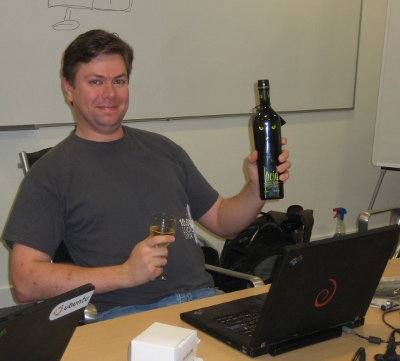
Steve Langasek has been contributing to Debian for more than a decade. He was a release manager for sarge and etch, and like many former release managers, he s still involved in the Debian release team although as a release wizard (i.e. more of an advisory role than a day-to-day contributor). Oh, and he did the same with Ubuntu: on the picture on the left, he just announced the release of Ubuntu 10.04 from his Debian-branded laptop. ;-) He has also been maintaining PAM in Debian for as long as can I remember and does a great job at that. He s very knowledgeable and fully deserves his place within the Debian Technical Committee. I m glad he still has the time to participate on several important Debian mailing lists because his contributions are always very useful. I m sure you ll notice this just by reading his answers below. My questions are in bold, the rest is by Steve. Who are you? I m 32 years old, have been running Linux since my first year in college back in 96, and have been a Debian developer now for ten years. Along the way I ve been involved in maintaining a variety of server packages, worked on the Alpha port for a while, did a stint as a release manager for a couple of years, and serve on the technical committee. This year I m also celebrating my ten year anniversary with my lovely wife Patty, who many know as an erstwhile front-desk volunteer at DebConf. God only knows why she puts up with my late-night hacking! These days in my day job I m a manager on the Ubuntu Platform team at Canonical, working to help make Ubuntu a daughter distribution that the Debian community can be proud of. What s your biggest achievement within Debian or Ubuntu? There s no doubt that my biggest achievement in Debian has been overseeing the release of two Debian releases as release manager. On the other hand, the scope of a release is so huge, and it represents the output of so many developers working together, that it would be arrogant to claim the release itself as an achievement of my own. Also, sarge and etch have long since been rotated off of the mirrors so no one cares about them anymore. ;) For a more personal and lasting contribution in the distro itself, I m very proud of writing pam-auth-update. It s a small piece of code, but one that Debian was missing for a long time it s made a big difference to PAM module integration in packages! What are your plans for Debian Wheezy? My top priority for this cycle is to see multiarch through. We re still not far enough along in Debian for most developers to see any difference and once we are, the first thing people are going to see is a fair bit of breakage when we start breaking a lot of assumptions about paths that have been hard-coded upstream. But I m still excited by the progress that is being made here. We should be able to ship wheezy without any ia32-libs package. We might even be able to get rid of all the biarch library packages, including those used by the toolchain itself. 54 packages in testing build-depend on gcc-multilib right now, in order to build 32-bit code to ship in the amd64 package; a bunch of those should go away with absolutely no reduction in functionality, saving us a bit of space in the archive and saving the maintainers a lot of complexity in their packages, while at the same time giving us much better support for cross-compilation than we ve ever had before. It s a tall order, certainly, but the pieces are falling into place one by one. My second priority is to get a policy in Debian around packages integrating upstart jobs. It would of course benefit Ubuntu to have many packages back in sync with Debian, but if all we wanted was to sync with Debian, we could mostly just make debhelper ignore upstart jobs in Debian, prefer them in Ubuntu, and call it good. I m interested in making sure Debian also gets the benefits of being able to use upstart, because as Linux has become increasingly asynchronous (doing more in parallel at start up), the traditional sysvinit has not been able to keep up. There are all kinds of bugs now related to network startup, for instance, that we don t have a good answer for in a sysvinit model but that we can fix with an event-based system. Upstart has been around for a while now, but we ve been slow to integrate it into Debian because it only works on Linux. It would be a shame if right after the first Debian GNU/kFreeBSD technology preview, packages all stopped working on kFreeBSD because they started to assume the availability of upstart! Unfortunately, having been so cautious we now have systemd on the scene, which not only doesn t support non-Linux but seems to be in the process of trying to gobble up other, non-Linux-specific components of the desktop stack. So I have to wonder what the future holds for the free desktop on non-Linux kernels. If you could spend all your time on Debian, what would you work on? Well, based on my previous experiences when I did spend all my time on Debian, I think the answer here is QA / release work. :) Otherwise, I don t know. My hands are full enough now with multiarch that it s hard for me to see what the Next Thing would be. You re a member of the technical committee. In the interview of Bdale Garbee, I have argued that it s not working well. What s your point of view on this topic? Well, I feel a constant low level guilt about my own poor level of activity in the TC; but that doesn t translate into a belief that the system is broken. This is, after all, the decision making body of last resort for technical disputes in Debian, and as such it should really be used sparingly. And if a reputation for glacial deliberation means more developers work out their disputes on their own rather than asking the TC to step in, I think that s actually a healthy thing! I do still wish we were more effective at resolving those issues that do come our way, but there s no silver bullet for this. Though the funny thing is, I ve noticed that the majority of issues that get referred to the TC nowadays never even need us to make a decision; a short conversation with the disputants is often enough to get them to come to an agreement. What s the biggest problem of Debian? By and large, I think Debian is still doing a great job at what it s best at delivering a rock-solid distribution that users can rely on. If I would highlight one problem in Debian, though, it would be that I think we re becoming less innovative as time goes on. Part of that comes from being such a large project that we re bound to be more conservative as an institution; but even though the three pet Debian projects of mine that I mentioned above are fairly innovative (multiarch, pam-auth-update, upstart), each of these has landed first in Ubuntu rather than in Debian. Always with a clear intent of pushing back up into Debian, of course, but it just wasn t possible to do this work within Debian for the first cut without much longer delays. I worry that if Debian is no longer the place to try new things, that we re going to miss out on attracting contributions from the folks who are inspired to make Free Software better and not simply to make it stable. I m not sure how to address this, though. Maybe improved conversations with derivatives such as (but not limited to) Ubuntu, about what crack of the day is being tried where and how that can be integrated into Debian once it s proven to work? I don t think that team-based maintenance or low-threshold NMUs do anything to address this, though, as the kinds of innovation that matter most are ones that require discussion and consensus-finding not just routing around inactive maintainers. Do you have wishes for Debian Wheezy? Well, I d like to see the armhf port get on its feet and become an official port. Over the lifetime of the arm and armel ports, the state of the art on ARM has changed quite a bit; it would be great to see Debian taking advantage of this richer platform, to let people make better use of their hardware via Debian. As a former release manager, you re now a release wizard . I guess you have seen it on debian-devel, there are proposals to not freeze testing and to use another distribution starting as a snapshot of testing to finalize the new stable release. According to your experience, what needs to happen to make this possible? Frankly, I ve stayed out of that discussion because I don t think what s being asked for is possible. I think proponents of a freezeless release have seriously underestimated the amount of work required on the part of the release team to wrangle testing into a releasable product, and that anything that makes propagation of fixes into the pending release more time consuming will make Debian worse on the whole, not better. If people really want to avoid long freezes for the Debian release, the best way they can help this happen is by making Debian more releasable on an ongoing basis, by helping to hold our packages to our shared standards for quality (i.e., by fixing RC bugs!). The biggest factor in long freezes for Debian is the slow rate at which we bring the RC bug count down during the freeze. Back in the sarge, etch days we used to have really great bug squashing parties that would get people together on weekends to hack through RC bugs by the dozens. I don t see that happening as much anymore. I d really like us to get back to that, but my few attempts at this so far since retiring as release manager have led me to think I m really terrible at organizing parties of any kind. :) On the other side, as seen at http://bugs.debian.org/release-critical/, the RC bug count for testing at the beginning of the release cycle keeps getting higher and higher. I d love to know why that is so we can address it. I know we ve gotten better at detecting some classes of RC bugs; that s part of it, but I don t think it explains the whole trend. Is there someone in Debian that you admire for their contributions? Wow, what kind of arrogant jerk would I be if I didn t admire anyone in Debian for their contributions? Debian is and always has been an amazing community of top-notch developers; there are certainly too many I admire to list them all here. Joey Hess certainly makes the list, for his longstanding example of code speaking louder than words and for his ability to get to the heart of common problems and come up with elegant solutions. So does Russ Allbery, who by all accounts had his ability to feel anger in response to email burned out of him at a young age in a flame-related accident on Usenet. ;-) The list goes on, but here I think I have to follow Joey s example and cut the words short.

Thank you to Steve for the time spent answering my questions. I hope you enjoyed reading his answers as I did. Subscribe to my newsletter to get my monthly summary of the Debian/Ubuntu news and to not miss further interviews. You can also follow along on Identi.ca, Twitter and Facebook.

3 comments Liked this article? Click here. My blog is Flattr-enabled.

5 May 2011

Andrew Pollock: [life] Zoe at 12 months

I got in early this time and started working on this post a day early. Well, we've made it. We've all managed to survive parenting to the 1 year mark. Zoe continues to do fabulously. Today she had her 12 month paediatrician appointment, and weighed in at 19 pounds and 8 ounces (8.8 kg), which has brought her up from the 25th percentile for weight to around the 50th percentile. She's also up from the 25th to the 50th percentile for height. She got four shots today, which she was singularly unimpressed about even before she was jabbed. Somewhat surprisingly (to us) Zoe still isn't walking. She'll stand on her own if you distract her with something, but otherwise she'll fall down and prefers to crawl everywhere. She'll cruise around with the help of furniture, and she'll happily walk while pushing something. Go figure. I really thought she'd be walking into her 12 month appointment at the paediatrician. Developmentally, she's waving and pointing now. I'll usually get a wave goodbye out of her when I head out the door to work in the mornings. She seems to be picking up things pretty quickly now. One of her traits has been she'd always toss her sippy cup on the floor when she was done taking a drink from it. She's been doing this for months. In one sitting, I taught her to hold it out to me and say "ta!" instead, which is great, because now at mealtimes, I'm not picking up the sippy cup off the floor a dozen times. We had another trip back to Australia last month, and this one was purely vacation, so we had a nice couple of weeks of pottering around with family. Zoe again handled the flights very well, although the jet lag upon returning to the US seemed a lot worse than I remembered after our first trip. The pilot was pretty punchy with the seat belt sign on the way to Australia, so we had to keep taking Zoe out of the bassinet while she was asleep. Incredibly we were able to do this about four times before she woke up. She had a bit of a cold before we left for Australia, and that turned into a nasty cough, which was diagnosed as bronchitis the first week we were there. We got some antibiotics for her, and that cleared the cough up. She also had a couple of spontaneous vomiting incidents, which were out of character for her (but Sarah contracted some kind of tummy bug herself, so it wasn't entirely surprising). Despite these health issues, she was still in excellent spirits the whole time, and I think she thoroughly enjoyed herself. We went to Surfers Paradise for a couple of nights in the first week, and rented an apartment on the 23rd floor of the Chevron Renaissance, and pottered around the Gold Coast a little bit. We went down to Palm Beach, where we used to holiday every year when I was a kid, and caught up with my cousin who lives there, and Zoe had fun on the beach. That weekend, we held an early first birthday party for family and friends in a park and had a barbecue lunch. The following week we spent a few days on the Sunshine Coast, with some of Sarah's extended family, and pottered around on the beaches up there. Our flight back ended up being delayed 9 hours, but fortunately we found out before we got to the airport, so we had a nice, unexpected extra day in Brisbane. It also meant that we flew back for Zoe's night time sleeping time, which made for a pretty good flight (but made the jet lag worse for her once we got back). I wonder what the next year will bring us? At a guess, more teeth, talking and walking. Zoe at (almost) 12 months

Russell Coker: Osama bin Laden

After almost 10 years the Americans finally found Osama bin Laden, unfortunately they were unable to take him alive. The Reid Report has a good summary of what happened [1]. Sam Varghese wrote an interesting analysis of the political aspects of this event in Pakistan [2], and he s a lot less positive about it than most people. Later he wrote about the inconsistencies in the reports, it seems that bin Laden was executed while unarmed [3]. When dealing with someone who is no stranger to suicide attacks and who has stated an intention to never be taken alive it s not unreasonable to shoot quickly, it s just a pity that they couldn t have been honest from the start. Dr. Pamela Gerloff wrote an insightful article for Psychology Today titled Why We Should Stop Celebrating Osama Bin Laden s Death [4]. She asks the rhetorical questions What kind of nation and what kind of species do we want to be? Do we want to become a species that honors life? Do we want to become a species that embodies peace? and suggests that we should mourn the series of tragedies that led up to this situation and to feel compassion for anyone who, because of their role in the military or government, American or otherwise, has had to play any role in killing another . Daniel R. Hawes wrote an insightful article for Psychology Today that s quite different from Dr. Gerloff s article [5]. He is quite glad that bin Laden is dead. But he considers how the people who have lost friends and relatives on 9-11 might feel about this and says that the shouts and celebratory chants that rang around America today seemed to me to carry a certain element of irreverence for those affected most deeply by the September 11 attacks and the entire military operations that followed . To represent the people who are partying now there is a post by Jenny Lind Schmitt that is totally unworthy of a site such as Psychology Today [6]. Jenny told her small children about al Quaeda: They hate you because you are American. Their god is destruction, and they would kill you, a little child, if they had the chance, just because you are American. She also describes al Quaeda as lunatics . Describing all your enemies as lunatics is quite common in general conversation, but it s not suitable for a web site that discusses psychology (where some respect for people with mental health issues is expected). Teaching children to be bigoted against Islam is a bad thing too. It seems to me that a factor in the violence that comes from the middle-east is a result of women just like her telling their children similar things but with country names and religions switched. Finally some capacity for empathy is required for someone to have any insight into psychology, someone who can t understand such things can t be competent to discuss psychology. In stark contrast to Jenny (who bears an irrational hatred in spite of apparently not having any close connection to the events in question) there is a TED talk by Phyllis Rodriguez (who s son was killed in the 9-11 attacks) and Aicha el-Wafi (who s son is in jail for being a member of al Quaeda and was accused of being part of the 9-11 plot) [7]. The two women became friends after 9-11 and work together in the cause of peace. From reading some interviews that Google turned up Aicha seems like a very intelligent woman, I think that the TED talk with her section translated from French to English didn t seem to show this. Perhaps people who speak French and English would get more from the TED talk than I did. Also perhaps if she gave a talk to a French audience and it was subtitled then the result would be better. Now of course the less intelligent people on the right-wing are trying to spin this to say that Bush deserves credit for getting bin Laden. The Reid Report has a good analysis of the history of the hunt for bin Laden and it doesn t make Bush look good [8]. Also the Reid Report has an interesting analysis of the operation to get bin Laden and the possibility for peace now that he s gone [9]. LA Times has an article about the use of the name Geronimo as a code-word for bin Laden [10]. But compared to the use of words such as crusade and paladin by the US armed forces this hardly rates a mention.

2 May 2011

Lucas Nussbaum: Debian rolling discussion on -devel@

Here is my attempt at a summary of the rolling discussion currently happening on debian-devel@. It might not be complete, it s probably a bit biased, but I hope that it s still better than nothing. It was also posted on debian-devel@. If you are involved in Debian development, please discuss it on debian-devel@, rather than in the comments of this blog. If you want to provide feedback about the Debian rolling idea, use this Doodle poll and/or the comments of this blog.

Update : Someone had the good idea to vandalize the poll, and remove all the votes from people in favor of rolling. Before the vadalism (log), the results were:
37 votes: I am a Debian user, I use testing or unstable, and I would like rolling to happen.
6 votes: I am a Debian user, I use testing or unstable, and I DON T want rolling to happen.
17 votes: I am a Debian user, I use stable, and I would like rolling to happen.
3 votes: I am a Debian user, I use stable, and I DON T want rolling to happen.
7 votes: I am NOT a Debian user, but I would probably use it if rolling happened.
1 vote: I am NOT a Debian user, and I don t care about rolling. Motivations There s some user demand for rolling releases. For evidence, one can look at the usage of Debian testing or unstable which clearly goes further than the Debian development community. Or at the quickly growing market share of ArchLinux. Or at the interest in LinuxMint and Aptosid. Or at the DPL s report of his interactions with the press. Debian s only official product is its stable releases. While it s a clearly great and useful product, many users and developers don t recognize themselves in it: it contains software that is too old for their needs. The success of Ubuntu is related to this problem: Ubuntu proposes a different compromise between stability and up-to-date-ness. While concurrencing Ubuntu with more frequent stable releases (released every 6-months, for example) doesn t look like the right thing to do, Debian is in a perfect position to provide a rolling release with marginal additional work, since Debian already has testing (and unstable) to build on. The rolling discussion investigates how we could endorse the concept of a rolling release, provided as a product in addition to stable releases. This rolling release would be based on the current testing branch. Benefits for Debian: Current proposed plan for rolling (Disclaimer: this is mostly my view. It is shared by others, but some details might not be) rolling is mostly about (external) communication. It is not expected to change our development processes fundamentally.
It would be a statement by the project (through a GR, for example). A very preliminary draft was proposed by Raphael Hertzog:
Title: Debian endorses usage of testing by end-users, and renames it to rolling The Debian project recognizes that the Debian testing distribution initially created to make it easier to prepare and test the next stable release has become a useful product of its own. It satisfies the needs of users who are looking for the latest stable versions of software and who can cope (or even appreciate) a system that s constantly evolving. The Debian project decides to endorse this usage and will strive to provide a good experience to users of testing . To better communicate this policy change to our users, testing will be renamed rolling .
Yes, it s mostly PR bullshit , and I don t expect it to significantly change Debian development processes. However, communication is necessary if we want to attract new users. What would change is more attention from developers to what happens in testing/rolling, which is a good thing since a better testing/rolling makes it easier to create stable releases from it. Open questions Most of the discussion is about the influence of the introduction of rolling on Debian development processes, and in particular, on the painful process resulting in stable releases. Many fear that, with rolling , it will be harder to get stable releases out. The root question is: if we do rolling, what do we do during freezes? Several options have been mentioned in the thread:
  1. We could decide not to do anything special: just freeze rolling for ~6 months, as we used to freeze testing. That might bore people who like the constant flux of new upstream releases, but if we decide that it s the only way to ensure high-quality stable releases, so be it.
  2. We could decide to fork a frozen branch when we freeze, and continue to manage rolling using migrations from unstable.
  3. We could mix both solutions: freeze rolling for 3 months, so that most of the stabilization work occurs with a single active branch, and then, for the final release preparation, fork frozen off rolling, and unfreeze rolling.
Two kinds of objections have been raised: Other things that were discussed: Tentative personal conclusion I have the impression that advertising testing as a rolling release usable by end-users is generally considered a good thing.
The renaming of testing to rolling is not as consensual, but most opponents have a whatever ; if you want position. How we deal with freezes is the hard point in this discussion. I m personnally in favor of the freeze rolling for 3 months, then fork frozen and unfreeze rolling plan, though it has some problems too (it is not clear whether the required manpower really decreases at the end of freezes). Where do we go from there? After another round of discussion, we might postpone the how to deal with freezes question to later, and proceed with a GR to measure the support for the testing for end-users + s/testing/rolling/ proposal.

1 May 2011

Christian Perrier: Preview of Debian Installer in Uyghur

Last week, I announced the activation of Uyghur language in Debian Installer. For once, I even went further: I rebuilt all D-I packages that include localization (at least for i386/amd64 architectures) and uploaded them. As a consequence, D-I daily builds now allow previewing how an install done in Uyghur can be like. For this, please go to the Debian Installer development page, download the netboot ISO image (not netinst) and launch D-I with "suite=unstable" passed as argument when booting the ISO image. You should end up with something like this, this or this. There are a few glitches, still: for instance, as the font we chose has no Bold variant, the screens "titles" do not use an Uyghur font but an Arabic or Persian one. As a consequence, glyphs ar enot properly joined together. I'm investigating this issue with Uyghur translators and we're trying to choose an appropriate font among the gazillion that have been created by UKIJ. Please notice that Uyghur looks like Arabic but, according to those who can read Arabic, is really different from Arabic (or Persian). I hope that this great work by Gheyret Tohti, Abduqadir Abliz and other people working on this will give ideas to other so-called "minorities", here or there in the world, who want to be able to install Debian in their language. There is still a lot of work to do, such as having end-user software localization for Uyghur and, then, a uyghur-desktop task, but this is at least the first language that gets added for wheezy. In case you would be wondering, the current count of activated languages in D-I is 71.

24 April 2011

Joey Hess: abc

Alphabetical order's not nice
But use it if no others suffice.
Can you think of a way to
Do better?
Each manual page option sorted, not by its
First letter, but
Grouped in a sequence, by sense.
Highly structured, to be scanned at a glance!
I think that is better, and "So Say We All".
Just think of the savings, in time for us all.
Kaleidoscopic knowledge, swirled around, then
Left to sit, on the page alone,
Makes me wish that in kindergarten,
No ABCs graced the top of the classroom.
Only... it's true, in printed
Pages of text,
Queries are satisfied best by
Running ones finger along, in order,
Stopping at the word one desires.
Truth. But...
Until these days of glittering screens and even e-ink pass,
Vacently staring at text all in order, or smudging the screen, is not best.
Wikipedia alphabetical? Surely you jest!
Xenophobia is best hyperlinked; not followed by xylophonists.
Years from now, will we care about
Zany alphabets? (Unicode could take this to a higher plane, but I'll stop here.)
Inspired by: Debian bug #499487 Debian bug #551741 Debian bug #561017 Debian bug #623890 and many more.

18 April 2011

Sjoerd Simons: Codec bitrate control

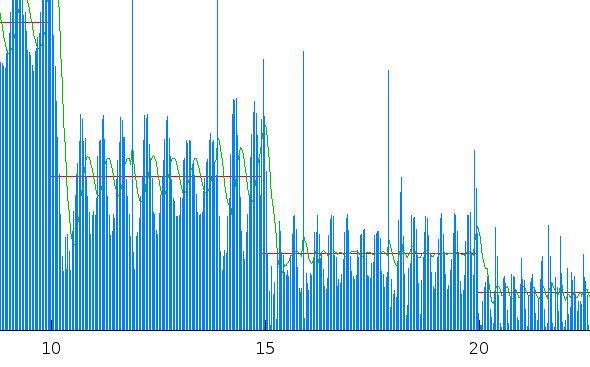
One of the more exciting upcoming features of Farsight is the ability to change the amount of required bandwidth depending on network conditions. Which means Telepathy based VoIP clients will be able to use higher resolutions and better audio/video quality if the network connectivity allows. And ofcourse, when the available bandwidth is low, the bandwidth usage can be lowered such that calls are still possible with lower but hopefully still acceptable quality. One side of the full story is measuring the available bandwidth, which hopefully Olivier will tell at some point. The other part is actually using less bandwidth. In case technical details are not that interesting to you, probably best to stop reading at this point.. An important way to control the bandwidth we're using in a call is setting the target bitrate on the encoding GStreamer element. While previously it was enough for us to set the bitrate before encoding started, we now need to be able to change it at runtime. And not only that, the codec implementation should ideally respond within a few frames and have a reasonable constant per-frame size. All in all, a lot of requirements on codecs we didn't really have before. Which usually means we need to retest the various codecs we often use and make sure we configure them correctly for the behaviour we'd like to see (and fix them if necessary). To do this I've written a small test program, which simply changes the target bitrate over time and outputs some numbers suitable to feed into gnuplot to turn into graphs. For example, when using x264enc with the current default farsight settings a part of the resulting graph looks something like this (full graph here): x264enc bitrate scaling The blue impulses is the per-frame size (scaled), the green line the bitrate average over 10 frames and the red line the target bitrate. Clearly this isn't an ideal picture, we will need to do some more tweaks to our default settings to make x264 behave the way we want. The same will be true for all other codecs and codec elements, at the moment the GStreamer VP8 element doesn't handle run-time bitrate changes at all and the Theora element acts it its very own interesting way (graph here)
17 April 2011

Russell Coker: More about the Xperia X10

I ve now had a Sony Ericsson Xperia X10 for almost two months (here is a link for my first review) [1]. This is a phone that people seem to really dislike because the battery life is poor and Sony doesn t allow replacing the kernel. I m happy with mine, happy enough that after buying one for my wife and trying it out I bought one for myself. I knew about it s problems in advance and wanted a relatively cheap phone with a large high resolution screen, and the Xperia X10 was the best match for my criteria.ChargingThere has been a recent trend towards using USB for charging devices. Sony provides a tiny wall-wart PSU which has a USB socket and a short (1m) USB cable that can be used to charge the phone from it s PSU or from a PC. The size is really convenient, as the phone has a short battery life I ll probably want to take the PSU to more places than I would for other phones I ve owned.The short USB cable saves weight and tangle when travelling, but can be inconvenient. I m currently working on the phone while it s plugged into my laptop, that works well and I can make calls while it s connected. If the phone was connected to a USB port on a tower computer that was on the ground then the cable could be too short to make a call, if it was charging on a power point near the floor then I wouldn t even be able to use the computer functionality let alone make calls without kneeling. My Viewty has a 175cm charging cable which alleviates these problems. I ve got a 50cm USB extension cable that I use for charging my phone while I m in bed that is just long enough to allow me to check my email without getting out of bed!The socket for connecting the USB cable is protected by a plastic lid that is connected by a strip of rubber. For a socket that will be used at least twice a day this isn t a good mechanical design. The plastic slide on the LG U990 Viewty seems like a much better design.As an aside it s a pity that they aren t designing cars with USB charging sockets built in. Some new cars have a socket for one USB flash drive to be attached to the radio, but really they need at least one USB charging port per seat. It would also be nice if they made power points with USB charging sockets built in, I d buy a few of those if they made them.Preserving the BatteryI ve been running Juice Defender to reduce the battery use, at the moment it is claiming to have extended battery life by 69%. That combined with turning off things that aren t needed (such as WiFi) has made the phone reasonably usable. I can survive more than 12 hours during which I use the phone a lot without charging it.XperiaX10.net has an interesting review of replacement batteries [5]. I m not going to buy them because the largest battery requires a replacement back case which prevents using an external case to prevent damage and the smaller one doesn t provide enough of a benefit and the design of the phone makes it difficult to change batteries so carrying a spare battery isn t a good option.Cursor Control KeysThe HP/Compaq iPaQs that I own from ~10 years ago have a single button that can be moved up/down/left/right to act as a cursor, it can also be pressed inwards to act as an ENTER key (or whatever the application might want for a fifth function). Having some sort of hardware cursor control is really handy, I often end up deleting several characters when I want to replace one because getting the cursor onto the desired character is too difficult.Adding more hardware keys would require making the phone bigger, but that would be fine by me. As described in my previous post about phone cameras I d like to have a phone that s thicker to have a better camera with a greater focal distance for a larger lens [2].Core Phone FunctionalityI really miss having separate green and red buttons for making/answering calls and for rejecting/ending calls.A really common operation is to call back the last person who called. To do this on my LG U990 Viewty I press the green button twice on my home screen which took less than a second. On the Xperia this involves selecting the phone icon from the home screen, then the call log icon, then the call that is desired, then the Call user line. That is four presses in different parts of the screen compared to pressing the same hardware button twice. I m investigating dialer applets right now, the Dialler One applet has a good interface for calling people who have called or been called recently but it still requires two presses on different parts of the screen. With my old Viewty I could call back the last person by feel without even looking at the phone!In the last 6 years the standard functionality of phones has been to include multiple profiles for noises. My Viewty has profiles named Normal , Silent , Vibrate only , Outdoor , Headset (automatically selected when a headset is connected), and three customised ones. The Xperia has only one setting, and that is three icon presses away from the home screen. It does allow changing the volume by hardware switches on the side which includes going to vibrate-only and silent mode. While this is useful, it s not the best way that two precious hardware keys could be used. It also doesn t allow control over all the different notifications, I d like to be able to activate a noise profile and have every application respond to it in an appropriate manner. This is a deficiency in Android 2.1 not in the phone itself.In many ways this phone has the worst phone functionality of any mobile phone I ve ever owned, I think that this is more the fault of the Android designers than Sony Ericsson.Android UpdatesSony had previously claimed that they wouldn t support Android later than 2.1. Now Sony has announced that they will support Gingerbread Android 2.3 [3]. So one of the major complaints about the Xperia will soon be addressed.TetheringThe build of Android that the Xperia runs at the moment doesn t support Wifi tethering. I m currently using with Easy Tether for USB tethering [4]. It s not free software and requires it s own code to run as root on your Linux system that is being tethered (which is easily locked down with SE Linux), but it basically works. The down-side with Easy Tether is that it proxies all the connections so you can t run traceroute etc and in the free version you can t use UDP.K9 MailK9 Mail fixes some of the problems in the default Android email program that I described in my previous post. It allows selection of SSL with a default port of 993 for IMAPs. It uses mail.example.com as the mail server address for an email address of user@example.com (so I ll add a mail CNAME to the domains I run). When I connected initially it told me that the SSL key was not signed by a CA and asked if I wanted to save it or reject it this is the correct and desired functionality. It also correctly parses URLs from the email (or at least has fixed the bug that I discovered in the default email app).One problem I ve found with K9 is that it seems to timeout on large folders. This is probably partly the fault of Virgin Mobile being slow for IP access, but I wonder whether K9 doesn t pipeline IMAP commands as Virgin can do bulk transfer at reasonable speeds (80KB/s) and it mainly fails on latency (900ms being typical). The result is that a folder with more than 500 messages that need to be copied to the phone will never get synchronised. When I started reading mail on my phone I had to move mail from some of the bigger folders into other folders to avoid timeouts. As an aside the amount of time I ve saved by reading email on the go has already paid for the phone.MediascapeThe Sony Mediascape software is used for categorising photos. One function of this is to assign names to photos, the names come from the contact list so if you photograph someone who you can t phone then you need to add a contact list entry for them. This also means that you couldn t conveniently add names to non-humans, I guess I could have added a contact list entry Mr Crash Dump for photos of system crash logs. But a bigger problem is that it decides what is a picture of a person, a picture of someone who is not centered in the photo or a profile picture can be regarded as not a photo of a person and therefore not subject to being associated with a contact list. Finally when selecting a name for a picture it displays the entire contacts list in a small font instead of displaying favorites, I have the phone numbers of many clients in my contacts list who I will never photograph Mediascape just isn t much good. If I feel the need to do something serious in this regard I ll search the app store for something free that s better.ProtectionFor $15 each I bought one grey and one clear Gel Case from J2K. This case covers the sides and back of the phone with a firm rubber layer that will hopefully allow it to bounce rather than break. It also extends slightly higher than the screen which should stop the screen being scratched if the phone is left face-down on a hard surface on the vibrate setting.One problem with the Gel Case is that by it s design it has to cover the buttons on the sides, due to a design or manufacturing problem the clear case that my wife uses can press slightly on the shutter button which disables the three main buttons on the front. So when the menu or back button stops working she has to slightly move the Gel Case out from the side. I m thinking of just cutting out a section of the Gel Case there, that will make it difficult to press the shutter button, but you can use the touch screen to take photos and there doesn t seem to be any other use for the shutter button so this shouldn t be a problem. The clear and grey cases have different designs, the grey one has a hole over the raised Sony logo which makes it fit a little better as well as not having the shutter problem, so it seems to be a later design I don t know whether all clear cases have the same problem but I recommend that someone who only has one Xperia X10 get the grey case just in case.Web BrowsingI m experimenting with using my own web proxy to compress the data sent to the phone. Unfortunately the Android settings for a web proxy only apply to the main web browser, not to all the other applications that use web services. Also the built-in web browser requires pressing the settings hardware button followed by at least two touch-screen presses to change between windows or close a window and it doesn t seem to support making the short-press action be to open a link in a new window. So I will have to find another web browser to use.Bandwidth UseThe 3G Watchdog applet is really good for tracking the data transfer and optionally cutting off 3G access before the quota is exceeded. Unfortunately Virgin has already sent me a bill with $234 in extra charges for bandwidth use because I used 1.6G instead of my 1.5G quota. A Virgin representative had told me over the phone that the billing period would be based on the end of the month, so while every calendar month has had less than 1.5G used because I used more than average in the end of March and the start of April that counts as excess data in the 14th March to 13th April period.I m going to appeal this to the Telecommunications Industry Ombudsman, I don t think that it s reasonable that I should be billed almost 7* the normal bill for exceeding the quota by 7.4% based on following the instructions of a Virgin employee. While I could have read the previous bill that they sent me to discover the end of billing period dates, I don t think that I should be expected to distrust everything that a Virgin employee says. If they billed me an extra $20 then I d just pay it, but $234 is unreasonable.ConclusionSince using the phone I ve found significant benefits in web browsing and reading email with the major limitation being the small screen (relative to a Netbook or Laptop). So if I was to buy another phone I would probably consider a Dell Streak which seems to be the largest Android phone on the market at the moment.Given the amount of use that I ve got I would be happy to spend more money and therefore consider a more expensive phone. But I don t regret the decision to save money by getting an Xperia X10.Finally when a telco tries to stick me with a $234 excess charge it really detracts from the value of having a phone contract. If I end up having to pay that then it s half the value of a smart-phone lost in one telco scam. This is enough to make a contract with Virgin a bad option, after this contract expires I may use VOIP and a pre-paid SIM from Telstra NextG if their network is still the best. Another possibility is to just use a small tablet and skip having a mobile phone, email and Jabber plus SMS from the people who lack net access will probably do.

16 April 2011

Russell Coker: Who is the Best Free Software Advocate?

TED is offering an audition for future TED.com talks in New York on the 24th of May [1]. It would be good if we could have someone advocate Free Software there. The audition is a 1 minute talk, the speakers who pass the audition may be offered full ~17 minute lecture slots at the next TED conference, and some of the minute long talks will be published on TED.com (which has many viewers).Larry Lessig has previously given a TED talk about laws that strange creativity [2], while this is fairly typical of the type of talk that TED promotes (in terms of politics and presentation quality), a talk doesn t have to be so well produced to make the grade. Firstly some TED talks seem to be accepted with a lower presentation quality due to the speaker having some special knowledge a TED presentation doesn t have to be so slick if the speaker is sufficiently famous or the talk is particularly interesting. Also there are TEDx events which are organised independently, have less international attention, and therefore less competition for speaking slots. Larry gave a more recent talk at the TEDxNYED event about re-examining the remix and lessons that people on the political left can learn from conservatives about remix legislation [3], this talk is much more informal and also unfortunately has a much lower recording quality. But as it s published on TED.com it will still get a large audience.Promoting Free Software to the TED audience (which includes many senior politicians and other VIPs) would be a major achievement. Even a TEDx talk that gets published on TED.com would get seen by a huge and important audience.Who is capable of giving such a talk? Larry got a standing ovation for his TED talk so it seems most likely that he can give another TED talk without going through the public audition process, but it seems that he has other priorities at this time. Probably most people who have more than 10 years experience doing Free Software development and who have a reasonable amount of experience giving lectures at Free Software conferences could at least manage the TEDx quality and a good portion of the speakers from any of the major Linux conferences could potentially give a talk of TED quality if they spent enough time preparing it.What methods of funding are available? There are probably very few people who would travel far to give a 1 minute talk, Mark Shuttleworth is one person who can afford to travel for such things and who could potentially give a great TED talk (his story is the sort of thing that seems popular with the TED audience). Would any of the Free Software organisations sponsor someone to give such an audition? I would support having Debian funds spent on travel for one of the better Debian advocates to travel to NY for the audition I m sure that there are many other Free Software things that can be done in NY to help justify the expense. Maybe this would be something that is suitable for corporate sponsorship.Finally it seems like a good idea to create some very short talks anyway. It would probably be useful to have leaders of the Free Software community publish minute-long video talks about their favorite projects anyway. In some ways a short talk is a higher form of art than a long lecture, I think that the best talk I ever gave was my 5 minute lightning talk about installing SE Linux.UpdateTED now has a blog post with a FAQ about the talks [4]. Larry Lessig is the first example they cite of how to give a great TED talk!Also you can submit a video without attending New York and there is no restriction on publishing the video elsehere. So if you want to make a great 1 minute video about something important you can just send it to TED and see what happens and then publish it on Youtube or one of the other video services too.

5 April 2011

Bernhard R. Link: Paternalism and Freedom

As seen in some mailinglist discussion:
"It seems to be a common belief between some developers that users should have to read dozens of pages of documentation before attempting to do anything.
"I m happy that not all of us share this elitist view of software. I thought we were building the Universal Operating System, not the Operating System for bearded gurus."
I think this is an interesting quote as it shows an important misunderstand of what Debian is for many people. Debian (and Linux in general) was in its beginnings quite complicated and often not very easy to use. People still felt a deep relieve to have it and a strong love. Why? Because it's not so much about about how you can use it, but how you can fix it. A system that only has a nice surface and hides everything below it, that does in a majority of cases just what you most likely want it is nice. But if the only options are "On", "Off" and perhaps some "something is not working as it should, try to fix it" (aka "Repair") it is essentially a form of paternalism: There is your superior that decided what is good for you, you would not understand it anyway, just swallow what you get. Not very surprisingly many people to be in the position of the inferior of a computer (the less the more stupid the computer is, but even modern computers are still stupid enough for most people). So what those people want is not necessarily a system that can only be used after reading a dozen pages of documentation, but a system they know they can force to do what they want even if that might then mean reading some pages of documentation. So a good software in that sense might have some nice interface and some defaults working most of the time. But more importantly it has a good documentation, easy enough internals so one can grasp them and be transparent enough that one can understand why it is currently not working and what to do against this and then allowing enough user interference to fix it. If all I get offered is some "interface for users too stupid to understand it anyway" and all options to fix it are checking and unchecking all boxes and restarting a lot or perhaps some gracious offer of "There is the source code, just read that spaghetti code, you can there see anything it does though you might need to build a debug version just to see why it does not work" then I would not call any strong feelings against this situation "elitist".

1 April 2011

Josselin Mouette: GNOME.Asia distribution collaboration session

Today we gathered the representatives of different distributions that are present at GNOME.Asia to discuss what GNOME could do to improve its support for distributions that distribute it, especially in matters of long-term support. It is kind of sad that there weren t any representatives from Canonical nor Red Hat, but the discussion turned out really interesting and we learned a lot about the packaging habits of each other. Furthermore, there were several concrete leads that were explored, which will lead to proposals from the GNOME foundation to all distributions. Helping with long-term support The most widespread GNOME version in the LTS releases that happened recently is 2.30, which is used by Debian squeeze, Ubuntu LTS 10.04, RHEL 6, and Solaris 11. It looks like an accident, but on the other hand: In the future, a decision to use a common GNOME release could, anyway, only come from the distributions themselves, not from GNOME. A proposal that many people agreed upon was to give distribution maintainers commit access to old branches that GNOME module maintainers don t touch anymore. This way they could share their patches more easily and make new releases of these old branches. This would imply, of course, setting up rules about what changes are allowed, that distributions would have to agree upon (how to treat feature additions for example). Managing bugs Currently it is hard to tell, for a distributor, whether other distributions are affected too and whether they have released a fix for that. It was agreed upon that Launchpad s feature of linking bugs between distributions, including version tracking, would exactly fill that need. One of the solutions would then be to add such a feature to Bugzilla, but it is a lot of work since currently it doesn t have any kind of version tracking. Another proposal was to deploy a new Launchpad instance to do serve as a hub between downstream bug systems and the GNOME Bugzilla. The condition for this to work would be to make it extremely easy to clone bugs between it and Bugzilla, and also if possible from the downstream bug systems. On the side-related topic of how not to crawl under bugs, it might be possible to get bugs forwarded with a single command from the Debian BTS to Bugzilla, using the XML-RPC interface. Upstream also considers that bugs sent to Debian are generally of higher quality than those from e.g. Ubuntu, and would be OK with us routing some of them directly to upstream (like we already do for Evolution). Communicating about the availability of patches Currently distributors are hardly ever informed that patches relevant for their distribution have been committed. They often learn of them by sheer luck while lurking on Bugzilla. The distributors-list ML is clearly the relevant media for that purpose, but it is clearly not used enough. It would need to be advertised more among both GNOME module maintainers, and among downstream maintainers as well. On this matter, the disappearance of the x.y.3 GNOME releases (starting with 2.28) was evoked. The problem was that most of those releases were about insufficient changes to justify e.g. stable updates in distributions. The proposed solution is to encourage maintainers of modules with bugs to fix to release new versions (through an annoucement on desktop-devel-announce), and to send a list of modules with new versions to downstream distributors so that they can integrate them. This avoids the GNOME release team the hassle of making a new release, while still giving distributions that use them some bugfixes. Providing a new service to LTS distributions The idea of having the GNOME foundation employ a person to gather, on the GNOME side, all changes that are relevant to older GNOME versions, and prepare new stable versions, was discussed. This would be a new service for which commercial distributions would need to pay a fee. It s not clear how this information would be privately disclosed and the impact on non-commercial distributions. But it doesn t seem likely that e.g. Red Hat would be interested since they employ a lot of core GNOME hackers who are already doing this job.
I don t know what impact these proposals can have on GNOME packaging in Debian, but apart from the last one that I find dubious, it seems that they could greatly improve our support of GNOME in stable Debian releases, be it by having more versions to upload during the freeze, or by having more stuff in point releases. Fr d ric Muller promised to come back to us with more concrete stuff.

29 March 2011

Christian Perrier: Bug #620000

Mike Gerber reported the Debian bug #620000 on Tuesday March 29th, against the imvirt package. Bug #610000 was reported as of January 14th. That makes 2.5 months for 10,000 bugs, a higher ratio than we had for 600000-610000. This is probably a consequence of the resumed development after the release of squeeze. And don't forget aboutthe bug prediction contest.

25 March 2011

Russell Coker: Is Asperger Syndrome a Good Thing?

A meme that keeps going around is that Asperger Syndrome (AS) is somehow universally good. The DSM doesn t list things that are beneficial, so any diagnostic criteria has to be for something that has some serious down-sides even if there are positive aspects to it. Of course on the Internet the debate won t just end there.Positive Aspects of ASThe main positive aspect of AS is intense concentration on topics of Special Interest, if a Special Interest is something that is related to a high paying job (such as computer programming) then that s a really good thing. Of course a Special Interest that isn t related to well paid employment or for which most people get paid little and only a lucky few get paid really well (such as music) isn t going to be a good thing by objective criteria.It seems that most people on the Autism Spectrum have sensory advantages over Neuro-Typical people (NTs). Better vision and hearing are quite common. It s good to be able to notice small and quiet things that most people miss, but that s not a benefit that most people seem to particularly desire. The down-side is that loud sounds and bright lights are more unpleasant and it s easy to be distracted by things that other people won t notice.The desire to give lectures has obvious benefits for any profession where giving lectures is a large part of the work, this is one reason why so many Aspies end up in academic careers. The down-side is that this is usually combined with a lack of ability to recognise when people aren t interested in receiving a lecture.Things can work out quite well for people on the Autism Spectrum who have a special interest that relates to a well paying career, who don t have any problems that prevent them from getting and keeping a job.Neutral Aspects of ASOn forums some Aspies report that they don t want to have friends, presumably their needs for friendship are met by the interaction with other forum members. As far as I can determine they are happy like that. I m sure that such people are a lot happier than people who want friends and don t have any.The incidence of asexuality among Aspies is apparently a lot higher than among the general population (something like 30% vs 1%). This isn t a bad thing for those people (I am not aware of any evidence to suggest that asexuals are less happy than people with average sexual desire), but it is evidence to suggest that Aspies are not the next stage in human evolution.Negative Aspects of ASThe DSM-IV diagnostic criteria for AS has as section C The disturbance causes clinically significant impairment in social, occupational, or other important areas of functioning , in the proposed changes for DSM-V it s merged into Autistic Disorder with section D being Symptoms together limit and impair everyday functioning [1]. These seem like clear disadvantages, it doesn t seem possible to be diagnosed as being on the Autism Spectrum without having some real disadvantage.Autism Spectrum Disorders (ASDs) seem to usually be correlated with Sensory Processing Disorder. Symptoms of SPD can include a lack of tolerance for noise, lights, certain types of clothing, dirt, and lots of other things as well as being physically clumsy. SPD is not in the diagnostic criteria for any ASD but it seems that most people on the Spectrum experience it to some degree and many regard it as the worst down-side of Autism.Spiritual Aspects of ASI ve seen a claim that AS gives them some advantage over NTs in terms of spiritual development. When someone manages to prove that their God exists or whatever other supernatural belief they have is based on fact then I ll consider this possibility.I think it s worth noting however that most religions seem to place some emphasis on humility, that seems to go against claiming that one s neuro-type is genetically predisposed to being successful at religion.ConclusionThere are many positive, neutral, and negative aspects of AS that I didn t list, I only mentioned some of the more common ones. How the positive and negative aspects compare differs on an individual basis, some people seem to be better off by objective criteria. But it seems that the best outcome is to have a different life experience that isn t objectively worse, which usually seems to involve a career in computers, science, engineering, or academia.Really if we were better then the Neuro-Typical people (NTs) would envy us, and I haven t seen much evidence of that. The NTs who do think that AS is a good thing seem to have little knowledge of AS.

Dirk Eddelbuettel: R inside Qt: A simple RInside application

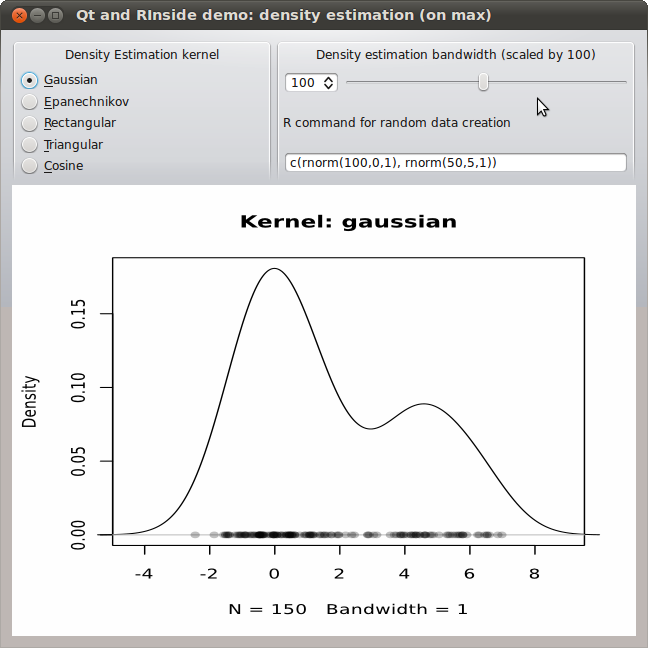
The RInside package makes it pretty simple and straightforward to embed R, the wonderful statistical programming environment and language, inside of a C++ application. This uses both the robust embedding API provided by R itself, and the higher-level abstractions from our Rcpp package. A number of examples are shown on this blog both here and here as well as on the RInside page; and the source package actually contains well over a dozen complete examples which cover anything from simple examples to parallel use via MPI for parallel computing. Beginning users sometimes ask about how to use RInside inside larger projects. And as I had meant to experiment with embedding inside of the powerful Qt framework anyway, I started to dabble a little. A first result is now in the SVN sources of RInside. My starting point was the classic tkdensity demo that comes with R itself. It is a good point of departure as Tcl/Tk makes it very portable---in fact it should run on every platform that runs R---and quite expressive. And having followed some of the GUI experiments around R over the years, I have also seen various re-implementations using different GUI frameworks. And so I am adding mine to this body of work: Example of embedding R via RInside into a Qt C++ application: density estimation for a mixture The problem I addressed first was actual buildability. For the RInside examples, Romain and I provide a Makefile that just works by making calls to R itself to learn about flags for R, Rcpp and RInside such that all required headers and libraries are found. That is actually relatively straightforward (and documented in our vignettes) but a little intimidating at first---which is why a ready-made Makefile is a good thing. Qt of course uses qmake and the .pro files to encode / resolve dependencies. So task one was to map what our Makefile does into its variables. Turns out that wasn't all that hard:

## -*- mode: Makefile; c-indent-level: 4; c-basic-offset: 4;  tab-width: 8; -*-
##
## Qt usage example for RInside, inspired by the standard 'density
## sliders' example for other GUI toolkits
##
## Copyright (C) 2011  Dirk Eddelbuettel and Romain Francois
TEMPLATE =              app
HEADERS =               qtdensity.h 
SOURCES =               qtdensity.cpp main.cpp
QT +=                   svg
## comment this out if you need a different version of R, 
## and set set R_HOME accordingly as an environment variable
R_HOME =                $$system(R RHOME)
## include headers and libraries for R 
RCPPFLAGS =             $$system($$R_HOME/bin/R CMD config --cppflags)
RLDFLAGS =              $$system($$R_HOME/bin/R CMD config --ldflags)
RBLAS =                 $$system($$R_HOME/bin/R CMD config BLAS_LIBS)
RLAPACK =               $$system($$R_HOME/bin/R CMD config LAPACK_LIBS)
## if you need to set an rpath to R itself, also uncomment
#RRPATH =               -Wl,-rpath,$$R_HOME/lib
## include headers and libraries for Rcpp interface classes
RCPPINCL =              $$system($$R_HOME/bin/Rscript -e \'Rcpp:::CxxFlags\(\)\')
RCPPLIBS =              $$system($$R_HOME/bin/Rscript -e \'Rcpp:::LdFlags\(\)\')
## for some reason when building with Qt we get this each time
## so we turn unused parameter warnings off
RCPPWARNING =           -Wno-unused-parameter 
## include headers and libraries for RInside embedding classes
RINSIDEINCL =           $$system($$R_HOME/bin/Rscript -e \'RInside:::CxxFlags\(\)\')
RINSIDELIBS =           $$system($$R_HOME/bin/Rscript -e \'RInside:::LdFlags\(\)\')
## compiler etc settings used in default make rules
QMAKE_CXXFLAGS +=       $$RCPPWARNING $$RCPPFLAGS $$RCPPINCL $$RINSIDEINCL
QMAKE_LFLAGS +=         $$RLDFLAGS $$RBLAS $$RLAPACK $$RCPPLIBS $$RINSIDELIBS
## addition clean targets
QMAKE_CLEAN +=          qtdensity Makefile
The double dollar signs and escaping of parentheses are a little tedious, but hey it works and expands the compiler and linker flags such that everything <emjust works="Works">. The code itself is pretty straightforward too. We instantiate the RInside object as well as the main Qt application object. We then instantiate a new object of class QtDensity that will launch the main widget; it is given a reference to the RInside object.
// -*- mode: C++; c-indent-level: 4; c-basic-offset: 4;  tab-width: 8; -*-
//
// Qt usage example for RInside, inspired by the standard 'density
// sliders' example for other GUI toolkits
//
// Copyright (C) 2011  Dirk Eddelbuettel and Romain Francois
#include <QApplication>
#include "qtdensity.h"
int main(int argc, char *argv[])
 
    RInside R(argc, argv);  		// create an embedded R instance
    QApplication app(argc, argv);
    QtDensity qtdensity(R);
    return app.exec();
 
The definition of the main object is pretty simple: a few private variables, and a few functions to interact with the GUI and get values from the radio buttons, slider or input field---as well as functions to update the chart or re-draw the random variables.
// -*- mode: C++; c-indent-level: 4; c-basic-offset: 4;  tab-width: 8; -*-
//
// Qt usage example for RInside, inspired by the standard 'density
// sliders' example for other GUI toolkits
//
// Copyright (C) 2011  Dirk Eddelbuettel and Romain Francois
#ifndef QTDENSITY_H
#define QTDENSITY_H
#include <RInside.h>
#include <QMainWindow>
#include <QHBoxLayout>
#include <QSlider>
#include <QSpinBox>
#include <QLabel>
#include <QTemporaryFile>
#include <QSvgWidget>
class QtDensity : public QMainWindow
 
    Q_OBJECT
public:
    QtDensity(RInside & R);
private slots:
    void getBandwidth(int bw);
    void getKernel(int kernel);
    void getRandomDataCmd(QString txt);
    void runRandomDataCmd(void);
private:
    void setupDisplay(void);    // standard GUI boilderplate of arranging things
    void plot(void);            // run a density plot in R and update the
    void filterFile(void);      // modify the richer SVG produced by R
    QSvgWidget *m_svg;          // the SVG device
    RInside & m_R;              // reference to the R instance passed to constructor
    QString m_tempfile;         // name of file used by R for plots
    QString m_svgfile;          // another temp file, this time from Qt
    int m_bw, m_kernel;         // parameters used to estimate the density
    QString m_cmd;              // random draw command string
 ;
#endif
Lastly, no big magic in the code either (apart from the standard magic provided by RInside). A bit of standard GUI layouting, and then some functions to pick values from the inputs as well as to compute / update the output. One issue is worth mentioning. The screenshot and code show the second version of this little application. I built a first one using a standard portable network graphics (png) file. That was fine, but not crisp as png is a pixel format so I went back and experimented with scalable vector graphics (svg) instead. One can create svg output with R in a number of ways, one of which is the cairoDevice package by Michael Lawrence (who also wrote RGtk2 and good chunks of Ggobi). Now, it turns out that Qt displays the so-called SVG tiny standard whereas R creates a fuller SVG format. Some discussion with Michael reveals that one can modify the svg file suitably (which is what the function filterFile below does) and it all works. Well: almost. There is a bug (and Michael thinks it is the SVG rendering) in which the density estimate does not get clipped to the plotting region.
// -*- mode: C++; c-indent-level: 4; c-basic-offset: 4;  tab-width: 8; -*-
//
// Qt usage example for RInside, inspired by the standard 'density
// sliders' example for other GUI toolkits -- this time with SVG
//
// Copyright (C) 2011  Dirk Eddelbuettel and Romain Francois
#include <QtGui>
#include "qtdensity.h"
QtDensity::QtDensity(RInside & R) : m_R(R)
 
    m_bw = 100;                 // initial bandwidth, will be scaled by 100 so 1.0
    m_kernel = 0;               // initial kernel: gaussian
    m_cmd = "c(rnorm(100,0,1), rnorm(50,5,1))"; // simple mixture
    m_R["bw"] = m_bw;           // pass bandwidth to R, and have R compute a temp.file name
    m_tempfile = QString::fromStdString(Rcpp::as<std::string>(m_R.parseEval("tfile <- tempfile()")));
    m_svgfile = QString::fromStdString(Rcpp::as<std::string>(m_R.parseEval("sfile <- tempfile()")));
    m_R.parseEvalQ("library(cairoDevice)");
    setupDisplay();
 
void QtDensity::setupDisplay(void)   
    QWidget *window = new QWidget;
    window->setWindowTitle("Qt and RInside demo: density estimation");
    QSpinBox *spinBox = new QSpinBox;
    QSlider *slider = new QSlider(Qt::Horizontal);
    spinBox->setRange(5, 200);
    slider->setRange(5, 200);
    QObject::connect(spinBox, SIGNAL(valueChanged(int)), slider, SLOT(setValue(int)));
    QObject::connect(slider, SIGNAL(valueChanged(int)), spinBox, SLOT(setValue(int)));
    spinBox->setValue(m_bw);
    QObject::connect(spinBox, SIGNAL(valueChanged(int)), this, SLOT(getBandwidth(int)));
    QLabel *cmdLabel = new QLabel("R command for random data creation");
    QLineEdit *cmdEntry = new QLineEdit(m_cmd);
    QObject::connect(cmdEntry,  SIGNAL(textEdited(QString)), this, SLOT(getRandomDataCmd(QString)));
    QObject::connect(cmdEntry,  SIGNAL(editingFinished()), this, SLOT(runRandomDataCmd()));
    QGroupBox *kernelRadioBox = new QGroupBox("Density Estimation kernel");
    QRadioButton *radio1 = new QRadioButton("&Gaussian");
    QRadioButton *radio2 = new QRadioButton("&Epanechnikov");
    QRadioButton *radio3 = new QRadioButton("&Rectangular");
    QRadioButton *radio4 = new QRadioButton("&Triangular");
    QRadioButton *radio5 = new QRadioButton("&Cosine");
    radio1->setChecked(true);
    QVBoxLayout *vbox = new QVBoxLayout;
    vbox->addWidget(radio1);
    vbox->addWidget(radio2);
    vbox->addWidget(radio3);
    vbox->addWidget(radio4);
    vbox->addWidget(radio5);
    kernelRadioBox->setMinimumSize(260,140);
    kernelRadioBox->setMaximumSize(260,140);
    kernelRadioBox->setSizePolicy(QSizePolicy::Fixed, QSizePolicy::Fixed);
    kernelRadioBox->setLayout(vbox);
    QButtonGroup *kernelGroup = new QButtonGroup;
    kernelGroup->addButton(radio1, 0);
    kernelGroup->addButton(radio2, 1);
    kernelGroup->addButton(radio3, 2);
    kernelGroup->addButton(radio4, 3);
    kernelGroup->addButton(radio5, 4);
    QObject::connect(kernelGroup, SIGNAL(buttonClicked(int)), this, SLOT(getKernel(int)));
    m_svg = new QSvgWidget();
    runRandomDataCmd();         // also calls plot()
    QGroupBox *estimationBox = new QGroupBox("Density estimation bandwidth (scaled by 100)");
    QHBoxLayout *spinners = new QHBoxLayout;
    spinners->addWidget(spinBox);
    spinners->addWidget(slider);
    QVBoxLayout *topright = new QVBoxLayout;
    topright->addLayout(spinners);
    topright->addWidget(cmdLabel);
    topright->addWidget(cmdEntry);
    estimationBox->setMinimumSize(360,140);
    estimationBox->setMaximumSize(360,140);
    estimationBox->setSizePolicy(QSizePolicy::Fixed, QSizePolicy::Fixed);
    estimationBox->setLayout(topright);
    QHBoxLayout *upperlayout = new QHBoxLayout;
    upperlayout->addWidget(kernelRadioBox);
    upperlayout->addWidget(estimationBox);
    QHBoxLayout *svglayout = new QHBoxLayout;
    svglayout->addWidget(m_svg);
    QVBoxLayout *outer = new QVBoxLayout;
    outer->addLayout(upperlayout);
    outer->addLayout(svglayout);
    window->setLayout(outer);
    window->show();
 
void QtDensity::plot(void)  
    const char *kernelstrings[] =   "gaussian", "epanechnikov", "rectangular", "triangular", "cosine"  ;
    m_R["bw"] = m_bw;
    m_R["kernel"] = kernelstrings[m_kernel]; // that passes the string to R
    std::string cmd1 = "Cairo(width=6,height=6,pointsize=10,surface='svg',filename=tfile); "
                       "plot(density(y, bw=bw/100, kernel=kernel), xlim=range(y)+c(-2,2), main=\"Kernel: ";
    std::string cmd2 = "\"); points(y, rep(0, length(y)), pch=16, col=rgb(0,0,0,1/4));  dev.off()";
    std::string cmd = cmd1 + kernelstrings[m_kernel] + cmd2; // stick the selected kernel in the middle
    m_R.parseEvalQ(cmd);
    filterFile();               // we need to simplify the svg file for display by Qt 
    m_svg->load(m_svgfile);
 
void QtDensity::getBandwidth(int bw)  
    if (bw != m_bw)  
        m_bw = bw;
        plot();
     
 
void QtDensity::getKernel(int kernel)  
    if (kernel != m_kernel)  
        m_kernel = kernel;
        plot();
     
 
void QtDensity::getRandomDataCmd(QString txt)  
    m_cmd = txt;
 
void QtDensity::runRandomDataCmd(void)  
    std::string cmd = "y <- " + m_cmd.toStdString();
    m_R.parseEvalQ(cmd);
    plot();                     // after each random draw, update plot with estimate
 
void QtDensity::filterFile()  
    // cairoDevice creates richer SVG than Qt can display
    // but per Michaele Lawrence, a simple trick is to s/symbol/g/ which we do here
    QFile infile(m_tempfile);
    infile.open(QFile::ReadOnly);
    QFile outfile(m_svgfile);
    outfile.open(QFile::WriteOnly   QFile::Truncate);
    
    QTextStream in(&infile);
    QTextStream out(&outfile);
    QRegExp rx1("<symbol"); 
    QRegExp rx2("</symbol");    
    while (!in.atEnd())  
        QString line = in.readLine();
        line.replace(rx1, "<g"); // so '<symbol' becomes '<g ...'
        line.replace(rx2, "</g");// and '</symbol becomes '</g'
        out << line << "\n";
     
    infile.close();
    outfile.close();
 
What the little application does is actually somewhat neat for the few lines. One key features is that the generated data can be specified directly by an R expression which allows for mixtures (as shown, and as is the default). With that it easy to see how many points are needed in the second hump to make the estimate multi-modal, and how much of a distance between both centers is needed and so on. Obviously, the effect of the chosen kernel and bandwidth can also be visualized. And with the chart the being a support vector graphics display, we can resize and scale at will and it still looks crisp. The code (for both the simpler png variant and the svg version shown here) is in the SVN repository for RInside and will be in the next release. Special thanks to Michael Lawrence for patiently working through some svg woes with me over a few emails.

Update: Some typos fixed.

Update 2: Two URLs corrected.

22 March 2011

Axel Beckert: Different Flavours of Planet Commandline

Since there were quite some requests for a Planet Commandline feed without the microblogging feeds included, I splitted Planet Commandline into different flavours. I m quite happy with that solution, because I must admit that the amount of microblogging postings in relation to normal blog postings was indeed higher than initially expected So from now on Planet Commandline has a basic flavour at http://planet-commandline.org/ and one with the microblogging feeds (climagic and commandlinefu) included at http://planet-commandline.org/+snippets/. For making this possible I hacked our Planet Venus wrapper to accept arbitary configuration snippets to be added at the end of the configuration as well as as sed-based modifications to the concatenated configuration before Planet Venus is run on them. This also allowed me to create further flavours of Planet Commandline: I hope nobody minds this diversification of Planet Commandline. Currently no combination of flavours is supported, but if there s a relevant demand for the one or the other combination of flavours I may have a look if that can be automated, too.

Pietro Abate: Xen brouter setup

A while ago I received a new desktop machine (8 cores, 8Gb of memory ...) at work. Since for the moment I kinda happy to work on my laptop using an external screen, I decided to put the hw to a good use and to explore a bit more some more exotic (at least for me) xen features. In particular I spend half a day playing with different xen network settings. The bridge model, that should work out of the shelf, is the easiest one. To setup this up, you basically need to specify a couple of options in the xend-config file and you're done. This is the "default" network configuration and is should work out of the box in most situations. Using this method, since all VMs' interfaces are bridged together (surprise !) with the public interface, your network card is left in promiscuous mode (not a big problem if you ask me...). Once your VMs are up, you can then decided to use your default dhcp server, autoconf your VMs with ipv6 only, or do nothing as you please. An other popular method, albeit a bit more complex, is to setup a natted network using the script network-nat (this one is an evolution of the third method that is 'network-routed') . I played with it, but since I wanted to have all my DomU on the same subnet, this setup wasn't satisfying for me. In particular, by default, 'network-nat' assigns a different subnet to each DomU. Using the natted set up you can also configure a local dhcp server to give private IPs to your VMs all done transparently by the xen network scripts. I've noticed that there is a bug in the xen script that does not make it very squeeze friendly. Since the default dhcp server in squeeze is isc-dhcp and few configuration files got shuffled in the process (notably /etc/dhcp3.conf is not /etc/dhcp/dhcp.conf) , the script needs a little fix to work properly. I'll report this bug sometimes soon... Goggling around I found a different setup that is called brouter, that is a hybrid between a bridge configuration and a routed configuration. This is the original (??) article well hidden in an old suse wiki.
 
I've done few modifications here to add natting. So basically, all virtual interfaces connected each to one DomU are linked together by a bridge (xenbr0). The bridge with address 10.0.0.1 is also the router of the subnet. All DomU are configured to used dhcp that assigns a new ip and specifies the router of the subnet. The dhcp server is configured to answer requests only on the xenb0 interface avoiding problems on the public network... routing is configured using iptables :
iptables -t nat -A POSTROUTING -o $ netdev -j MASQUERADE
iptables -A FORWARD -i $ bridge -j ACCEPT
echo 1 >/proc/sys/net/ipv4/ip_forward
/etc/init.d/isc-dhcp-server restart
Note that since the dhcp server is configured to give addresses only on the virtual network, we need to restart it after creating the bridge interface, otherwise isc-dhcp-server will refuse to run. Mum says that I should configure the bridge in /etc/network/interfaces to make the dhcp server happy at startup, but I felt a bit lazy, so I let to task to xen... In the next episode, I'll add ipv6 connectivity to the virtual subnet and then start playing with puppet... ipv6 is almost done, puppet... I started with the doc... The complete script from the suse wiki and with my modifications is below (only lightly tested):
#!/bin/sh
#============================================================================
# Default Xen network start/stop script.
# Xend calls a network script when it starts.
# The script name to use is defined in /etc/xen/xend-config.sxp
# in the network-script field.
#
# This script creates a bridge (default xenbr$ vifnum ), gives it an IP address
# and the appropriate route. Then it starts the SuSEfirewall2 which should have
# the bridge device in the zone you want it.
#
# If all goes well, this should ensure that networking stays up.
# However, some configurations are upset by this, especially
# NFS roots. If the bridged setup does not meet your needs,
# configure a different script, for example using routing instead.
#
# Usage:
#
# vnet-brouter (start stop status) VAR=VAL *
#
# Vars:
#
# bridgeip Holds the ip address the bridge should have in the
# the form ip/mask (10.0.0.1/24).
# brnet Holds the network of the bridge (10.0.0.1/24).
#
# vifnum Virtual device number to use (default 0). Numbers >=8
# require the netback driver to have nloopbacks set to a
# higher value than its default of 8.
# bridge The bridge to use (default xenbr$ vifnum ).
#
# start:
# Creates the bridge
# Gives it the IP address and netmask
# Adds the routes to the routing table.
#
# stop:
# Removes all routes from the bridge
# Removes any devices on the bridge from it.
# Deletes bridge
#
# status:
# Print addresses, interfaces, routes
#
#============================================================================

#set -x

dir=$(dirname "$0")
. "$dir/xen-script-common.sh"
. "$dir/xen-network-common.sh"

findCommand "$@"
evalVariables "$@"

vifnum=$ vifnum:-0
bridgeip=$ bridgeip:-10.6.7.1/24
brnet=$ brnet:-10.6.7.0/24
netmask=$ netmask:-255.255.255.0
bridge=$ bridge:-xenbr$ vifnum

##
# link_exists interface
#
# Returns 0 if the interface named exists (whether up or down), 1 otherwise.
#
link_exists()

if ip link show "$1" >/dev/null 2>/dev/null
then
return 0
else
return 1
fi


# Usage: create_bridge bridge
create_bridge ()
local bridge=$1

# Don't create the bridge if it already exists.
if [ ! -d "/sys/class/net/$ bridge /bridge" ]; then
brctl addbr $ bridge
brctl stp $ bridge off
brctl setfd $ bridge 0
fi
ip link set $ bridge up


# Usage: add_to_bridge bridge dev
add_to_bridge ()
local bridge=$1
local dev=$2
# Don't add $dev to $bridge if it's already on a bridge.
if ! brctl show grep -wq $ dev ; then
brctl addif $ bridge $ dev
fi


# Usage: show_status dev bridge
# Print interface configuration and routes.
show_status ()
local dev=$1
local bridge=$2

echo '============================================================'
ip addr show $ dev
ip addr show $ bridge
echo ' '
brctl show $ bridge
echo ' '
ip route list
echo ' '
route -n
echo '============================================================'
echo ' '
iptables -L
echo ' '
iptables -L -t nat
echo '============================================================'


op_start ()
if [ "$ bridge " = "null" ] ; then
return
fi

create_bridge $ bridge

if link_exists "$bridge"; then
ip address add dev $bridge $bridgeip
ip link set $ bridge up arp on
ip route add to $brnet dev $bridge
fi

if [ $ antispoof = 'yes' ] ; then
antispoofing
fi
iptables -t nat -A POSTROUTING -o $ netdev -j MASQUERADE
iptables -A FORWARD -i $ bridge -j ACCEPT
echo 1 >/proc/sys/net/ipv4/ip_forward
/etc/init.d/isc-dhcp-server restart


op_stop ()
if [ "$ bridge " = "null" ]; then
return
fi
if ! link_exists "$bridge"; then
return
fi

ip route del to $brnet dev $bridge
ip link set $ bridge down arp off
ip address del dev $bridge $bridgeip
##FIXME: disconnect the interfaces from the bridge 1st
brctl delbr $ bridge
/etc/init.d/isc-dhcp-server restart


case "$command" in
start)
op_start
;;

stop)
op_stop
;;

status)
show_status $ netdev $ bridge
;;

*)
echo "Unknown command: $command" >&2
echo 'Valid commands are: start, stop, status' >&2
exit 1
esac

14 March 2011

Gerfried Fuchs: Squeeze RC bugs, #2

Another week, though this one wasn't as fruitful as the last one. My excuse here is that I was overwhelmed with private stuff like acquiring a house and starting with cleaning it up so it can become a home. This is the list for my second week of my stable RC bug squashing: I know three isn't much, and actually it doesn't impact the list of stable RC bugs not much, we are at 172 open RC bugs against squeeze now. I can only attribute it to that new bugs were filed since, because I am aware that I'm not the only one working on this front, I've been contacted by at least two other people in the last week that are investing some time into this, too. Mostly for self-reference, the highest reported squeeze RC bugs in the list is 618295. This should help me to get a number of newly reported issues (ignoring severity-bump in lower bug numbers). Read you next week!

/debian permanent link Comments: 0 Flattr this

Russell Coker: Effective Computers for Schools

Sam Varghese has written an article that is very skeptical of the educational value of the OLPC project [1].Are Laptops Any Good for Schools?Sam cites an article in the New York Times by Winnie Hu about schools removing laptop programs due to a lack of success [2]. Winnie s article gives an example of a school shutting a program because of getting new teachers who lacked computer skills and some examples of schools which had issues with the repair cost. The solution to that would be computers that are more robust and easier to use by all accounts the OLPC systems are solidly constructed and easy to use!It is claimed that using laptops doesn t increase test scores. Using only test scores to compare educational methods is a way to lose, probably any school which does nothing other than try to increase test scores is worth avoiding. One example from Winnie s article is a report by Mr. Warschauer of students at a middle school in Yarmouth, Me., who used their laptops to create a Spanish book for poor children in Guatemala and debate Supreme Court cases found online . What value can you place on having students develop books for poor children in other countries and debate Supreme Court cases? If this sort of program became popular then it would lead to the countries which do it becoming better places to live in future decades!Mr. Warschauer also claims that If the goal is to get kids up to basic standard levels, then maybe laptops are not the tool. But if the goal is to create the George Lucas and Steve Jobs of the future, then laptops are extremely useful . I would go further than that, I think that providing the educational environment that involves international charity work and analysis of important court cases would lead to students having the skills to become good engineers, designers, and artists who work for people like George Lucas and Steve Jobs. No matter what you might do the vast majority of children will not grow up to be like George Lucas and Steve Jobs, there is a very limited number of positions for such people. But those people employ a huge number of creative people who do interesting and enjoyable work for good pay.I don t think that Winnie s article supports criticism of the OLPC project. I don t think that Winnie s article even contains sufficient evidence to match the headline.Playing GamesSam also cites an article about the misuse of school computers for playing games [3]. Of course there are ways of limiting access to games based on time etc. For a Linux system you could have a root cron job that runs chmod on /usr/games at various times, and preventing users from easily running programs that they install isn t difficult.Not that games are all bad, the flash-based games on www.physicsgames.net do teach kids some things about physics although I admit that much of that could be learned by playing with balls, skate-boards, etc.The Problem with the OLPC ProjectI think that the policy change to make OLPC systems only available to disadvantaged children was a mistake. The give one get one program was a great idea, maybe not the most effective way of getting funding but good for getting developers. While the new Sugar on a Stick project to put the OLPC GUI on a bootable USB device [4] it doesn t compare well to having dedicated hardware IMHO.Minimal Use of ComputersI have previously written about the weight of school bags and how laptops can alleviate the risk of health problems related to carrying heavy text books [5]. Since that time ebook readers and tablets have become incredibly cheap. Ebook readers are really light and the recent tablets are also very light (particularly the smaller ones). It seems to me that every school should at least be moving towards every student having an ebook reader and to use ebooks for all books that are part of the curriculum.At the moment there are a bunch of tablets on sale for about $150, that includes tablets that can access the Internet via Wifi or via 3G and a cheap 3G plan costs less than $150 per annum. If tablets were used for some of the computer tasks related to schools then a lot of the difficulty of repairing hardware would be removed. Tablets don t offer as many options for messing up the software configuration and if the hardware breaks it s easy to transfer the data onto a new tablet from the cloud with a maximum cost of $150 to replace the hardware.Also a cloud-based computing model could permit students to access all the same data from school and home while using desktop computers at both locations.Current SuccessNatalie Craig wrote an interesting article for The Age about The Lab a drop-in computer center for kids on the Autism Spectrum run by Dale Linegar and Stefan Schutt [6]. The fact that kids who have communication difficulties can find it easier to communicate electronically should be fairly obvious to everyone in the free software community, but the creation of an organisation to support such kids is noteworthy I think that such centers should be funded by the government and run in every city.Salman Khan gave an interesting TED talk about his project the Khan Academy [7] which is an online video-based teaching system that evolved from some Youtube videos he produced to tutor his cousins. Salman pointed out that his cousins said that they would rather watch his videos than have him teach them in person, it seems that they liked being able to pause and rewind the talk as well as avoiding the pressure of human interaction. The Khan Academy has videos in Adobe flash format, but conveniently they have download links so those of us who don t have the Flash plugin can still view the content [8].One of the interesting things about the Khan Academy is that in school use the videos are being assigned to kids as homework and the class time is used for teaching children to do worked examples what has traditionally been homework.So it seems that there are real examples of special-needs kids and average kids benefiting from different types of electronic learning.ConclusionI think that almost everything about the education system is broken. I also think that in many ways the education system has reached a local maximum, so there is no small way of improving things, and adding computers without making any of the significant changes needed to fix the big problems probably can t do a lot of good. In spite of this computers can provide some real benefits and I expect that those benefits can be better than the benefits of other potential ways of spending the money (IE it s worth the opportunity cost). I also have no doubt that almost anything can give a negative result if done badly enough, so I don t interpret examples of computer use failing in a school as anything other than evidence of a failing school.While the Khan Academy has some results that seem very positive I think that s only the first step of what needs to be done. It also seems to be based around users who have good Internet access which often isn t the case in places where the OLPC is being deployed. This implies that we need to get systems like the Khan Academy designed to operate in a disconnected manner, maybe with a remote server that s not connected to the Internet. This should be possible if funding is available.Sam suggested that there needs to be a scientific study of the effectiveness of the OLPC. I think that every project which involves significant amounts of public funding should be researched to ensure that it s an effective use of resources. 400,000 laptops is going to cost something more than $40,000,000 so it seems reasonable to devote a few person-years of research to determine how effective they are and which of the possible ways of using an OLPC will give the best results.I am confident that a good study of the effectiveness of the OLPC would demonstrate that it provides real educational benefits when correctly incorporated into an educational program. I also expect that such a study would show some significant differences in the effectiveness of various ways of using them. But we shouldn t be relying on confidence, we need some test results.

Next.

Previous.