Search Results: "bab"

14 September 2021

Joachim Breitner: A Candid explainer: Quirks

This is the fifth and final post in a series about the interface description language Candid. If you made it this far, you now have a good understanding of what Candid is, what it is for and how it is used. For this final post, I ll put the spotlight on specific aspects of Candid that are maybe surprising, or odd, or quirky. This section will be quite opinionated, and could maybe be called what I d do differently if I d re-do the whole thing . Note that these quirks are not serious problems, and they don t invalidate the overall design. I am writing this up not to discourage the use of Candid, but merely help interested parties to understand it better.

References in the wire format When the work on Candid began at DFINITY, the Internet Computer was still far away from being a thing, and many fundamental aspects about it were still in the air. I particular, there was still talk about embracing capabilities as a core feature of the application model, which would be implemented as opaque references on the system level, likely building on WebAssembly s host reference type proposal (which only landed recently), and could be used to model access permissions, custom tokens and many other things. So Candid is designed with that in mind, and you ll find that its wire format is not just a type table and a value table, but actually
a triple (T, M, R), where T ( type ) and M ( memory ) are sequences of bytes and R ( references ) is a sequence of references.
Also the wire format for values of function service tyeps have an extra byte to distinguish between public references (represented by a principal and possible a method name in the data part), and these opaque references. Alas, references never made it into the Internet Computer, so all Candid implementations simply ignore that part of the specification. But it s still in the spec, and if it confused you before, now you know why.

Hashed field names Candid record and variant types look like they have textual field names:
type T = record   syndactyle : nat; trustbuster: bool  
But that is actually only true superficially. The wire format for Candid only stores hashes of field names. So the above is actually equivalent to
type T = record   4260381820 : nat; 3504418361 : bool  
or, for that matter, to
type T = record   destroys : bool; rectum : nat  
(Yes, I used an english word list to find these hash collisions. There aren t that many actually.) The benefit of such hashing is that the messages are a bit smaller in most (not all) cases, but it is a big annoyance for dynamic uses of Candid. It s the reason why tools like dfx, if they don t know the Candid interface of a service, will print the result with just the numerical hash, letting you guess which field is which. It also complicates host languages that derive Candid types from the host language, like Motoko, as some records (e.g. record trustbuster: bool; destroys : int ) with field name hash collisions can not be represented in Candid, and either the host language s type system needs to be Candid aware now (as is the case of Motoko), or serialization/deserialization will fail at runtime, or odd bugs can happen. (More discussion of this issue).

Tuples Many languages have a built-in notion of a tuple type (e.g. (Int, Bool)), but Candid does not have such a type. The only first class product type is records. This means that tuples have to encoded as records somehow. Conveniently(?) record fields are just numbers after all, so the type (Int, Bool) would be mapped to the type
record   0 : int; 1 : bool  
So tuples can be expressed. But from my experience implementing the type mappings for Motoko and Haskell this is causing headaches. To get a good experience when importing from Candid, the tools have to try to reconstruct which records may have been tuples originally, and turn them into tuples. The main argument for the status quo is that Candid types should be canonical, and there should not be more than one product type, and records are fine, and there needs to be no anonymous product type. But that has never quite resonated with me, given the practical reality of tuple types in many host languages.

Argument sequences Did I say that Candid does not have tuple types? Turns out it does, sort of. There is no first class anonymous product, but since functions take sequences of arguments and results, there is a tuple type right there:
func foo : (bool, int) -> (int, bool)
Again, I found that ergonomic interaction with host languages becomes relatively unwieldy by requiring functions to take and return sequences of values. This is especially true for languages where functions take one argument value or return one result type (the latter being very common). Here, return sequences of length one are turned into that type directly, longer argument sequences turn into the host language s tuple type, and nullary argument sequences turn into the idiomatic unit type. But this means that the types (int, bool) -> () and (record 0: int, 1: bool ) -> () may be mapped to the same host language type, which causes problems when you hope to encode all necessary Candid type information in the host language. Another oddity with argument and result sequences is that you can give names to the entries, e.g. write
func hello : (last_name : text; first_name : text) -> ()
but these names are completely ignored! So while this looks like you can, for example, add new optional arguments in the middle, such as
func hello : (last_name : text; middle_name: opt text, first_name : text) -> ()
without breaking clients, this does not have the effect you think it has and will likely break. My suggestion is to never put names on function arguments and result values in Candid interfaces, and for anything that might be extended with new fields or where you want to name the arguments, use a single record type as the only argument:
func hello : (record   last_name : text; first_name : text ) -> ()
This allows you to add and remove arguments more easily and reliably.

Type shorthands The Candid specification defines a system of types, and then adds a number of syntactic short-hands . For example, if you write blob in a Candid type description, it ought to means the same as vec nat8. My qualm with that is that it doesn t always mean the same. A Candid type description is interpreted by a number of, say, consumers . Two such consumers are part of the Candid specification:
  • The specification that defines the wire format for that type
  • The upgrading (subtyping) rules
But there are more! For every host language, there is some mapping from Candid types to host language types, and also generic tools like Candid UI are consumers of the type algebra. If these were to take the Candid specification as gospel, they would be forced to treat blob and vec nat8 the same, but that would be quite unergonomic and might cause performance regressions (most language try to map blob to some compact binary data type, while vec t tends to turn into some form of array structure). So they need to be pragmatic and treat blob and vec nat8 differently. But then, for all practical purposes, blob is not just a short-hand of vec nat8. They are different types that just happens to have the same wire representations and subtyping relations. This affects not just blob, but also tuples (record blob; int; bool ) and field names , as discussed above.

The value text format For a while after defining Candid, the only implementation was in Motoko, and all the plumbing was automatic, so there was never a need for users to to explicitly handle Candid values, as all values were Motoko values. Still, for debugging and testing and such things, we eventually needed a way to print out Candid values, so the text format was defined ( To enable convenient debugging, the following grammar specifies a text format for values ). But soon the dfx tool learned to talk to canisters, and now users needed to enter Candid value on the command line, possibly even when talking to canisters for which the interface was not known to dfx. And, sure enough, the textual interface defined in the Candid spec was used. Unfortunately, since it was not designed for that use case, it is rather unwieldy:
  • It is quite verbose. You have to write record , not just . Vectors are written vec ; instead of some conventional syntax like [ , ]. Variants are written as variant error = " " with braces that don t any value here, and something like #error " " might have worked as well. With a bit more care, a more concise and ergonomic syntax might have been possible.
  • It wasn t designed to be sufficient to create a Candid value from it. If you write 5 it s unclear whether that s a nat or an int16 or what (and all of these have different wire representations). Type annotations were later added, but are relatively unwieldy, and don t cover all cases (e.g. a service reference with a recursive type cannot be represented in the textual format at the moment).
  • Not really the fault of the textual format, but some useful information about the types is not reflected in the type description that s part of the wire format. In particular not the field names, and whether a value was intended to be binary data (blob) or a list of small numbers (vec nat8), so pretty-printing such values requires guesswork. The Haskell library even tries to brute-force the hash to guess the field name, if it is short or in a english word list!
In hindsight I think it was too optimistic to assume that correct static type information is always available, and instead of actively trying to discourage dynamic use, Candid might be better if we had taken these (unavoidable?) use cases into account.

Custom wire format At the beginning of this post, I have a Candid is list. The list is relatively long, and the actual wire format is just one bullet point. Yes, defining a wire format that works isn t rocket science, and it was easiest to just make one up. But since most of the interesting meat of Candid is in other aspects (subtyping rules, host language integration), I wonder if it would have been better to use an existing, generic wire format, such as CBOR, and build Candid as a layer on top. This would give us plenty of tools and libraries to begin with. And maybe it would have reduced barrier of entry for developers, which now led to the very strange situation that DFINITY advocates for the universal use of Candid on the Internet Computer, so that all services can smoothly interact, but two of the most important services on the Internet Computer (the registry and the ledger) use Protobuf as their primary interface format, with Candid interfaces missing or an afterthought.

Sideways Interface Evolution This is not a quirk of Candid itself, but rather an idiom of how you can use Candid that emerged from our solution for record extensions and upgrades. Consider our example from before, a service with interface
service   add_user : (record   login : text; name : text  ) -> ()  
where you want to add an age field, which should be a number. The official way of doing that is to add that field with an optional type:
service   add_user : (record   login : text; name : text; age : opt nat  ) -> ()  
As explained above, this will not break old clients, as the decoder will treat a missing argument as null. So far so good. But often when adding such a field you don t want to bother new clients with the fact that this age was, at some point in the past, not there yet. And you can do that! The trick is to distinguish between the interface you publish and the interface you implement. You can (for example in your documentation) state that the interface is
service   add_user : (record   login : text; name : text; age : nat  ) -> ()  
which is not a subtype of the old type, but it is the interface you want new clients to work with. And then your implementation uses the type with opt nat. Calls from old clients will come through as null, and calls from new clients will come through as opt 42. We can see this idiom used in the Management Canister of the Internet Computer. The current documented interface only mentions a controllers : vec principal field in the settings, but the implementation still can handle both the old controller : principal and the new controllers field. It s probably advisable to let your CI system check that new versions of your service continue to implement all published interfaces, including past interfaces. But as long as the actual implementation s interface is a subtype of all interfaces ever published, this works fine. This pattern is related to when your service implements, say, http_request (so its implemented interface is a subtype of that common interface), but does not include that method in the published documentation (because clients of your service don t need to call it).

Self-describing Services As you have noticed, Candid was very much designed assuming that all parties always have the service type of services they want to interact with. But the Candid specification does not define how one can obtain the interface of a given service, and there isn t really a an official way to do that on the Internet Computer. That is unfortunate, because many interesting features depend on that: Such as writing import C "ic:7e6iv-biaaa-aaaaf-aaada-cai" in your Motoko program, and having it s type right there. Or tools like ic.rocks, that allow you to interact with any canister right there. One reason why we don t really have that feature yet is because of disagreements about how dynamic that feature should be. Should you be able to just ask the canister for its interface (and allow the canister to vary the response, for example if it can change its functionality over time, even without changing the actual wasm code)? Or is the interface a static property of the code, and one should be able to query the system for that data, without the canister s active involvement. Or, completely different, should interfaces be distributed out of band, maybe together with API documentation, or in some canister registry somewhere else? I always leaned towards the first of these options, but not convincingly enough. The second options requires system assistance, so more components to change, more teams to be involved that maybe intrinsically don t care a lot about this feature. And the third might have emerged as the community matures and builds such infrastructure, but that did not happen yet. In the end I sneaked in an implementation of the first into Motoko, arguing that even if we don t know yet how this feature will be implemented eventually, we all want the feature to exist somehow, and we really really want to unblock all the interesting applications it enables (e.g. Candid UI). That s why every Motoko canister, and some rust canisters too, implements a method
__get_candid_interface_tmp_hack : () -> (text)
that one can use to get the Candid interface file. The name was chosen to signal that this may not be the final interface, but like all good provisional solutions, it may last longer than intended. If that s the case, I m not sorry. This concludes my blog post series about Candid, for now. If you want to know more, feel free to post your question on the DFINTY developer forum, and I ll probably answer.

12 September 2021

Russ Allbery: DocKnot 5.00

This release is the culmination of a project that I've been wanting to do for two years, but nearly all the work was done in the past week. That experience made me rethink some of my skepticism, but I'll get to that part of the story later. In March of 1999, I got tired of writing HTML by hand and wrote a small program called spin that implemented a macro language that translated into HTML. This makes it one of the oldest programs for which I have a continuous development history, predating podlators by three months. I think only News::Gateway (now very dormant) and Term::ANSIColor (still under active development but very stable) are older, as long as I'm not counting orphaned packages like newsyslog. I've used spin continuously ever since. It's grown features and an ecosystem of somewhat hackish scripts to do web publishing things I've wanted over the years: journal entries like this one, book reviews, a simple gallery (with some now-unfortunate decisions about maximum image size), RSS feeds, and translation of lots of different input files into HTML. But the core program itself, in all those years, has been one single Perl script written mostly in my Perl coding style from the early 2000s before I read Perl Best Practices. My web site is long overdue for an overhaul. Just to name a couple of obvious problems, it looks like trash on mobile browsers, and I'm using URL syntax from the early days of the web that, while it prompts some nostalgia for tildes, means all the URLs are annoyingly long and embed useless information such as the fact each page is written in HTML. Its internals also use a lot of ad hoc microformats (a bit of RFC 2822 here, a text-based format with significant indentation there, a weird space-separated database) and are supported by programs that extract meaning from human-written pages and perform automated updates to them rather than having a clear separation between structure and data. This will be a very large project, but it's the sort of quixotic personal project that I enjoy. Maintaining my own idiosyncratic static site generator is almost certainly not an efficient use of my time compared to, say, converting everything to Hugo. But I have 3,428 pages (currently) written in the thread macro language, plus numerous customizations that cater to my personal taste and interests, and, most importantly, I like having a highly customized system that I know exactly how to automate. The blocker has been that I didn't want to work on spin as it existed. It badly needed a structural overhaul and modernization, and even more badly needed a test suite since every release involved tedious manual testing by pouring over diffs between generations of the web site. And that was enough work to be intimidating, so I kept putting it off. I've separately been vaguely aware that I have been spending too much time reading Twitter (specifically) and the news (in general). It would be one thing if I were taking in that information to do something productive about it, but I haven't been. It's just doomscrolling. I've been thinking about taking a break for a while but it kept not sticking, so I decided to make a concerted effort this week. It took about four days to stop wanting to check Twitter and forcing myself to go do something else productive or at least play a game instead. Then I managed to get started on my giant refactoring project, and holy shit, Twitter has been bad for my attention span! I haven't been able to sustain this level of concentration for hours at a time in years. Twitter's not the only thing to blame (there are a few other stressers that I've fixed in the past couple of years), but it's obviously a huge part. Anyway, this long personal ramble is prelude to the first release of DocKnot that includes my static site generator. This is not yet the full tooling from my old web tools page; specifically, it's missing faq2html, cl2xhtml, and cvs2xhtml. (faq2html will get similar modernization treatment, cvs2xhtml will probably be rewritten in Perl since I have some old, obsolete scripts that may live in CVS forever, and I may retire cl2xhtml since I've stopped using the GNU ChangeLog format entirely.) But DocKnot now contains the core of my site generation system, including the thread macro language, POD conversion (by way of Pod::Thread), and RSS feeds. Will anyone else ever use this? I have no idea; realistically, probably not. If you were starting from scratch, I'm sure you'd be better off with one of the larger and more mature static site generators that's not the idiosyncratic personal project of one individual. It is packaged for Debian because it's part of the tool chain for generating files (specifically README.md) that are included in every package I maintain, and thus is part of the transitive closure of Debian main, but I'm not sure anyone will install it from there for any other purpose. But for once making something for someone else isn't the point. This is my quirky, individual way to maintain web sites that originated in an older era of the web and that I plan to keep up-to-date (I'm long overdue to figure out what they did to HTML after abandoning the XHTML approach) because it brings me joy to do things this way. In addition to adding the static site generator, this release also has the regular sorts of bug fixes and minor improvements: better formatting of software pages for software that's packaged for Debian, not assuming every package has a TODO file, and ignoring Autoconf 2.71 backup files when generating distribution tarballs. You can get the latest version of DocKnot from CPAN as App-DocKnot, or from its distribution page. I know I haven't yet updated my web tools page to reflect this move, or changed the URL in the footer of all of my pages. This transition will be a process over the next few months and will probably prompt several more minor releases.

Russ Allbery: Pod::Thread 3.00

This Perl module converts POD documents to thread, the macro language I use for my static site builder (about which, more in another software release coming up shortly). This release fixes a whole ton of long-standing problems. In brief, a lot of the POD implementation was previously done by chasing bugs rather than testing comprehensively, as reflected by the 65% code coverage in the previous release. The test suite now achieves about 95% code coverage (most of the rest is obscure error handling around encoding) and cleans up a bunch of long-standing problems with internal links. I had previously punted entirely on section links containing markup, and as a result the section links shown in the navigation bar or table of contents were missing the markup and headings containing thread metacharacters were mangled beyond recognition. That was because I was trying to handle resolving links using regexes (after I got rid of the original two-pass approach that required a driver script). This release uses Text::Balanced instead, the same parsing module used by my static site generator, to solve the problem (mostly) correctly. (I think there may still be a few very obscure edge cases, but I probably won't encounter them.) The net result should hopefully be better conversion of my software documentation, including INN documentation, when I regenerate my site (which will be coming soon). You can get the latest release from CPAN or from the Pod::Thread distribution page.

11 September 2021

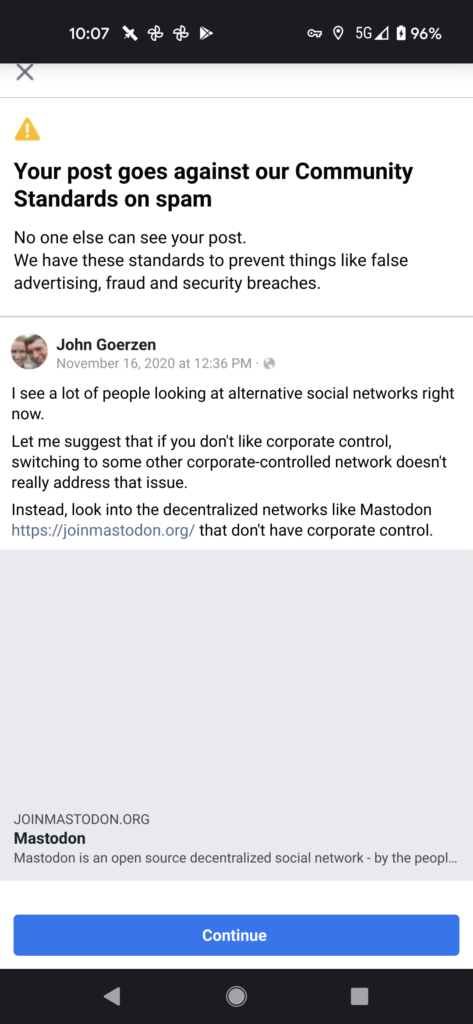
John Goerzen: Facebook Is Censoring People For Mentioning Open-Source Social Network Mastodon

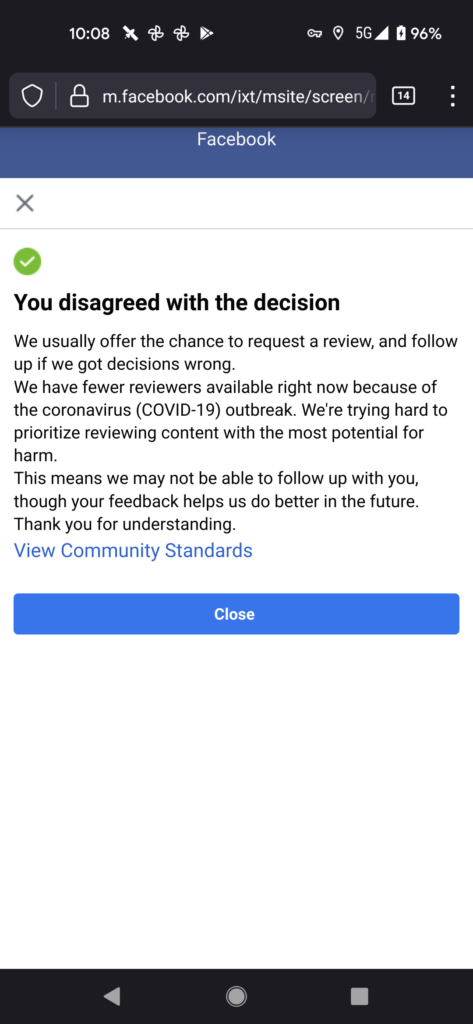
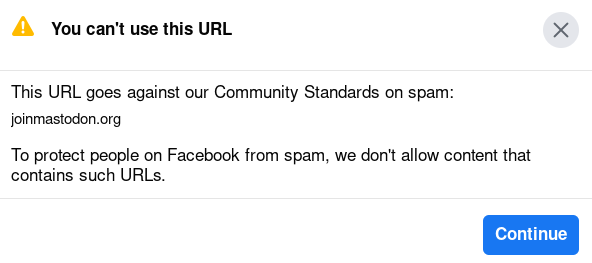
Update: Facebook has reversed itself over this censorship, but I maintain that whether the censorship was algorithmic or human, it was intentional either way. Details in my new post. Last November, I made a brief post to Facebook about Mastodon. Mastodon is an open-source and open social network, which is decentralized and all about user control instead of corporate control. I ve blogged about Mastodon and the dangers of Facebook before, but rarely mentioned Mastodon on Facebook itself. Today, I received this notice that Facebook had censored my post about Mastodon: Facebook censoring a post Wonder with me for a second what this one-off post I composed myself might have done to trip Facebook s filter . and it is probably obvious that what tripped the filter was the mention of an open source competitor, even though Facebook is much more enormous than Mastodon. I have been a member of Facebook for many years, and this is the one and only time anything like that has happened. Why they decided today to take down that post I have no idea. In case you wondered about their sincerity towards stamping out misinformation which, on the rare occasions they do something about, they deprioritize rather than remove as they did here this probably answers your question. Or, are they sincere about thinking they re such a force for good by connecting the world s people? Well, only so long as the world s people don t say nice things about alternatives to Facebook, I guess. Well, you might be wondering, Why not appeal, since they obviously made a mistake? Because, of course, you can t: Indeed I did tick a box that said I disagreed, but there was no place to ask why or to question their action. So what would cause a non-controversial post from a long-time Facebook member that has never had anything like this happen, to disappear? Greed. Also fear. Maybe I d feel sorry for them if they weren t acting like a bully. Edit: There are reports from several others on Mastodon of the same happening this week. I am trying to gather more information. It sounds like it may be happening on Twitter as well. Edit 2: And here are some other reports from both Facebook and Twitter. Definitely not just me. Edit 3: While trying to reply to someone on Facebook, that was trying to defend Facebook, I mentioned joinmastodon.org and got this: Anyone else seeing it? Edit 4: It is far more than just me, clearly. More reports are out there; for instance, this one and that one.

8 September 2021

Ian Jackson: Wanted: Rust sync web framework

tl;dr: Please recommend me a high-level Rust server-side web framework which is sync and does not plan to move to an async api. Why Async Rust gives somewhat higher performance. But it is considerably less convenient and ergonomic than using threads for concurrency. Much work is ongoing to improve matters, but I doubt async Rust will ever be as easy to write as sync Rust. "Even" sync multithreaded Rust is very fast (and light on memory use) compared to many things people write web apps in. The vast majority of web applications do not need the additional performance (which is typically a percentage, not a factor). So it is rather disappointing to find that all the review articles I read, and all the web framework authors, seem to have assumed that async is the inevitable future. There should be room for both sync and async. Please let universal use of async not be the inevitable future! What I would like a web framework that provides a sync API (something like Rocket 0.4's API would be ideal) and will remain sync. It should probably use (async) hyper underneath. So far I have not found one single web framework on crates.io that neither is already async nor suggests that its authors intend to move to an async API. Some review articles I found even excluded sync frameworks entirely! Answers in the comments please :-).

comment count unavailable comments

7 September 2021

Russell Coker: Oracle Cloud Free Tier

It seems that every cloud service of note has a free tier nowadays and the Oracle Cloud is the latest that I ve discovered (thanks to r/homelab which I highly recommend reading). Here s Oracle s summary of what they offer for free [1]. Oracle s always free tier (where presumable always is defined as until we change our contract ) currently offers ARM64 VMs to a total capacity of 4 CPU cores, 24G of RAM, and 200G of storage with a default VM size of 1/4 that (1 CPU core and 6G of RAM). It also includes 2 AMD64 VMs that each have 1G of RAM, but a 64bit VM with 1G of RAM isn t that useful nowadays. Web Interface The first thing to note is that the management interface is a massive pain to use. When a login times out for security reasons it redirects to a web page that gives a 404 error, maybe the redirection works OK if you are using it when it times out, but if you go off and spend an hour doing something else you will return to a 404 page. A web interface should never refer you to a page with a 404. There doesn t seem to be a way of bookmarking the commonly used links (as AWS does) and the set of links on the left depend on the section you are in with no obvious way of going between sections. Sometimes I got stuck in a set of pages about authentication controls (the identity cloud ) and there seems to be no link I could click on to get me back to cloud computing, I had to go to a bookmarked link for the main cloud login page. A web interface should never force the user to type in the main URL or go to a bookmark, you should be able to navigate from every page to every other page in a logical manner. An advanced user might have their own bookmarks in their browser to suit their workflow. But a beginner should be able to go to anywhere without breaking the session. Some parts of the interface appear to be copied from AWS, but unfortunately not the good parts. The way AWS manages IP access control is not easy to manage and it s not clear why packets are dropped, Oracle copies all this. On the upside Oracle has some good Datadog style analytics so for a new deployment you can debug IP access control by seeing records of rejected packets. Just to make it extra annoying when you create a rule with multiple ports specified the web interface will expand it out to multiple rules for one port each, having ports 80 and 443 on separate lines doesn t make things easier. Also it forces you to have IPv4 and IPv6 as separate rules, so if you want HTTP and HTTPS on both IPv4 and IPv6 (a common requirement) then you need 4 separate rules. One final annoying thing is that the web interface doesn t make your previous settings a default. As I ve created many ARM images and haven t created a single AMD image it should know that the probability that I want to create an AMD image is very low and stop defaulting to that. Recovery When trying a new system you will inevitably break things and have to recover things. The way to recover from a configuration error that prevents your VM from booting and getting to a state of allowing a login is to go to stop the VM, then go to the Boot volume section under Resources and use the settings button to detach the boot volume. Then you go to another VM (which must be running), go to the Attached block volumes menu and attach it as Paravirtualised (not iSCSI and not default which will probably be iSCSI). After some time the block device will appear and you can mount it and do stuff to it. Then after umounting it you detach it from the recovery VM and attach it again to the original VM (where it will still have an entry in the Boot volume section) and boot the original VM. As an aside it s really annoying that you can t attach a volume to a VM that isn t running. My first attempt at image recovery started with making a snapshot of the Boot volume, this didn t work well because the image uses EFI and therefore GPT and because the snapshot was larger than the original block device (which incidentally was the default size). I admit that I might have made a mistake making the snapshot, but if so it shouldn t be so easy to do. With GPT if you have a larger block device then partitioning tools complain about the backup partition table not being found, and they complain even more if you try to go back to the smaller size later on. Generally GPT partition tables are a bad idea for VMs, when I run the host I don t use partition tables, I have a separate block device for each filesystem or swap space. Snapshots aren t needed for recovery, they don t seem to work very well, and if it s possible to attach a snapshot to a VM in place of it s original Boot volume I haven t figured out how to do it. Console Connection If you boot Oracle Linux a derivative of RHEL that has SE Linux enabled in enforcing mode (yay) then you can go to the Console connection . The console is a Javascript console which allows you to login on a virtual serial console on device /dev/ttyAMA0. It tells you to type help but that isn t accepted, you have a straight Linux console login prompt. If you boot Ubuntu then you don t get a working serial console, it tells you to type help for help but doesn t respond to that. It seems that the Oracle Linux kernel 5.4.17-2102.204.4.4.el7uek.aarch64 is compiled with support for /dev/ttyAMA0 (the default ARM serial device) while the kernel 5.11.0-1016-oracle compiled by Oracle for their Ubuntu VMs doesn t have it. Performance I haven t done any detailed tests of VM performance. As a quick test I used zstd to compress a 154MB file, on my home workstation (E5-2620 v4 @ 2.10GHz) it took 11.3 seconds of CPU time to compress with zstd -9 and 7.2s to decompress. On the Oracle cloud it took 7.2s and 5.4s. So it seems that for some single core operations the ARM CPU used by the Oracle cloud is about 30% to 50% faster than a E5-2620 v4 (a slightly out of date server processor that uses DDR4 RAM). If you ran all the free resources in a single VM that would make a respectable build server. If you want to contribute to free software development and only have a laptop with 4G of RAM then an ARM build/test server with 24G of RAM and 4 cores would be very useful. Ubuntu Configuration The advantage of using EFI is that you can manage the kernel from within the VM. The default Oracle kernel for Ubuntu has a lot of modules included and is compiled with a lot of security options including SE Linux. Competitors https://aws.amazon.com/free AWS offers 750 hours (just over 31 days) per month of free usage of a t2.micro or t3.micro EC2 instance (which means 1GB of RAM). But that only lasts for 12 months and it s still only 1GB of RAM. AWS has some other things that could be useful like 1 million free Lambda requests per month. If you want to run your personal web site on Lambda you shouldn t hit that limit. They also apparently have some good offers for students. https://cloud.google.com/free The Google Cloud Project (GCP) offers $300 of credit. https://cloud.google.com/free/docs/gcp-free-tier#free-tier-usage-limits GCP also has ongoing free tier usage for some services. Some of them are pretty much unlimited use (50GB of storage for Cloud Source Repositories is a heap of source code). But for VMs you get the equivalent of 1*e2-micro instance running 24*7. A e2-micro has 1G of RAM. You also only get 30G of storage and 1GB of outbound data. It s clearly not as generous an offer as Oracle, but Oracle is the underdog so they have to try harder. https://azure.microsoft.com/en-us/free/ Azure appears to be much the same as AWS, free Linux VM for a year and then other less popular services free forever (or until they change the contract). https://www.ibm.com/cloud/free The IBM cloud free tier is the least generous offer, a VM is only free for 30 days. But what they offer for 30 days is pretty decent. If you want to try the IBM cloud and see if it can do what your company needs then this will do well. If you want to have free hosting for your hobby stuff then it s no good. Oracle seems like the most generous offer if you want to do stuff, but also one of the least valuable if you want to learn things that will help you at a job interview. For job interviews AWS seems the most useful and then GCP and Azure vying for second place.

5 September 2021

Reproducible Builds: Reproducible Builds in August 2021

Welcome to the latest report from the Reproducible Builds project. In this post, we round up the important things that happened in the world of reproducible builds in August 2021. As always, if you are interested in contributing to the project, please visit the Contribute page on our website.
There were a large number of talks related to reproducible builds at DebConf21 this year, the 21st annual conference of the Debian Linux distribution (full schedule):
PackagingCon (@PackagingCon) is new conference for developers of package management software as well as their related communities and stakeholders. The virtual event, which is scheduled to take place on the 9th and 10th November 2021, has a mission is to bring different ecosystems together: from Python s pip to Rust s cargo to Julia s Pkg, from Debian apt over Nix to conda and mamba, and from vcpkg to Spack we hope to have many different approaches to package management at the conference . A number of people from reproducible builds community are planning on attending this new conference, and some may even present. Tickets start at $20 USD.
As reported in our May report, the president of the United States signed an executive order outlining policies aimed to improve the cybersecurity in the US. The executive order comes after a number of highly-publicised security problems such as a ransomware attack that affected an oil pipeline between Texas and New York and the SolarWinds hack that affected a large number of US federal agencies. As a followup this month, however, a detailed fact sheet was released announcing a number large-scale initiatives and that will undoubtedly be related to software supply chain security and, as a result, reproducible builds.
Lastly, We ran another productive meeting on IRC in August (original announcement) which ran for just short of two hours. A full set of notes from the meeting is available.

Software development kpcyrd announced an interesting new project this month called I probably didn t backdoor this which is an attempt to be:
a practical attempt at shipping a program and having reasonably solid evidence there s probably no backdoor. All source code is annotated and there are instructions explaining how to use reproducible builds to rebuild the artifacts distributed in this repository from source. The idea is shifting the burden of proof from you need to prove there s a backdoor to we need to prove there s probably no backdoor . This repository is less about code (we re going to try to keep code at a minimum actually) and instead contains technical writing that explains why these controls are effective and how to verify them. You are very welcome to adopt the techniques used here in your projects. ( )
As the project s README goes on the mention: the techniques used to rebuild the binary artifacts are only possible because the builds for this project are reproducible . This was also announced on our mailing list this month in a thread titled i-probably-didnt-backdoor-this: Reproducible Builds for upstreams. kpcyrd also wrote a detailed blog post about the problems surrounding Linux distributions (such as Alpine and Arch Linux) that distribute compiled Python bytecode in the form of .pyc files generated during the build process.

diffoscope diffoscope is our in-depth and content-aware diff utility. Not only can it locate and diagnose reproducibility issues, it can provide human-readable diffs from many kinds of binary formats. This month, Chris Lamb made a number of changes, including releasing version 180), version 181) and version 182) as well as the following changes:
  • New features:
    • Add support for extracting the signing block from Android APKs. [ ]
    • If we specify a suffix for a temporary file or directory within the code, ensure it starts with an underscore (ie. _ ) to make the generated filenames more human-readable. [ ]
    • Don t include short GCC lines that differ on a single prefix byte either. These are distracting, not very useful and are simply the strings(1) command s idea of the build ID, which is displayed elsewhere in the diff. [ ][ ]
    • Don t include specific .debug-like lines in the ELF-related output, as it is invariably a duplicate of the debug ID that exists better in the readelf(1) differences for this file. [ ]
  • Bug fixes:
    • Add a special case to SquashFS image extraction to not fail if we aren t the superuser. [ ]
    • Only use java -jar /path/to/apksigner.jar if we have an apksigner.jar as newer versions of apksigner in Debian use a shell wrapper script which will be rejected if passed directly to the JVM. [ ]
    • Reduce the maximum line length for calculating Wagner-Fischer, improving the speed of output generation a lot. [ ]
    • Don t require apksigner in order to compare .apk files using apktool. [ ]
    • Update calls (and tests) for the new version of odt2txt. [ ]
  • Output improvements:
    • Mention in the output if the apksigner tool is missing. [ ]
    • Profile diffoscope.diff.linediff and specialize. [ ][ ]
  • Logging improvements:
    • Format debug-level messages related to ELF sections using the diffoscope.utils.format_class. [ ]
    • Print the size of generated reports in the logs (if possible). [ ]
    • Include profiling information in --debug output if --profile is not set. [ ]
  • Codebase improvements:
    • Clarify a comment about the HUGE_TOOLS Python dictionary. [ ]
    • We can pass -f to apktool to avoid creating a strangely-named subdirectory. [ ]
    • Drop an unused File import. [ ]
    • Update the supported & minimum version of Black. [ ]
    • We don t use the logging variable in a specific place, so alias it to an underscore (ie. _ ) instead. [ ]
    • Update some various copyright years. [ ]
    • Clarify a comment. [ ]
  • Test improvements:
    • Update a test to check specific contents of SquashFS listings, otherwise it fails depending on the test systems user ID to username passwd(5) mapping. [ ]
    • Assign seen and expected values to local variables to improve contextual information in failed tests. [ ]
    • Don t print an orphan newline when the source code formatting test passes. [ ]

In addition Santiago Torres Arias added support for Squashfs version 4.5 [ ] and Felix C. Stegerman suggested a number of small improvements to the output of the new APK signing block [ ]. Lastly, Chris Lamb uploaded python-libarchive-c version 3.1-1 to Debian experimental for the new 3.x branch python-libarchive-c is used by diffoscope.

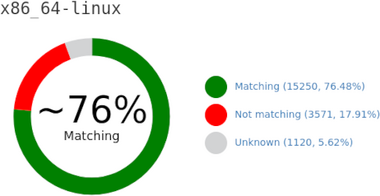
Distribution work In Debian, 68 reviews of packages were added, 33 were updated and 10 were removed this month, adding to our knowledge about identified issues. Two new issue types have been identified too: nondeterministic_ordering_in_todo_items_collected_by_doxygen and kodi_package_captures_build_path_in_source_filename_hash. kpcyrd published another monthly report on their work on reproducible builds within the Alpine and Arch Linux distributions, specifically mentioning rebuilderd, one of the components powering reproducible.archlinux.org. The report also touches on binary transparency, an important component for supply chain security. The @GuixHPC account on Twitter posted an infographic on what fraction of GNU Guix packages are bit-for-bit reproducible: Finally, Bernhard M. Wiedemann posted his monthly reproducible builds status report for openSUSE.

Upstream patches The Reproducible Builds project detects, dissects and attempts to fix as many currently-unreproducible packages as possible. We endeavour to send all of our patches upstream where appropriate. This month, we wrote a large number of such patches, including: Elsewhere, it was discovered that when supporting various new language features and APIs for Android apps, the resulting APK files that are generated now vary wildly from build to build (example diffoscope output). Happily, it appears that a patch has been committed to the relevant source tree. This was also discussed on our mailing list this month in a thread titled Android desugaring and reproducible builds started by Marcus Hoffmann.

Website and documentation There were quite a few changes to the Reproducible Builds website and documentation this month, including:
  • Felix C. Stegerman:
    • Update the website self-build process to not use the buster-backports suite now that Debian Bullseye is the stable release. [ ]
  • Holger Levsen:
    • Add a new page documenting various package rebuilder solutions. [ ]
    • Add some historical talks and slides from DebConf20. [ ][ ]
    • Various improvements to the history page. [ ][ ][ ]
    • Rename the Comparison protocol documentation category to Verification . [ ]
    • Update links to F-Droid documentation. [ ]
  • Ian Muchina:
    • Increase the font size of titles and de-emphasize event details on the talk page. [ ]
    • Rename the README file to README.md to improve the user experience when browsing the Git repository in a web browser. [ ]
  • Mattia Rizzolo:
    • Drop a position:fixed CSS statement that is negatively affecting with some width settings. [ ]
    • Fix the sizing of the elements inside the side navigation bar. [ ]
    • Show gold level sponsors and above in the sidebar. [ ]
    • Updated the documentation within reprotest to mention how ldconfig conflicts with the kernel variation. [ ]
  • Roland Clobus:
    • Added a ticket number for the issue with the live Cinnamon image and diffoscope. [ ]

Testing framework The Reproducible Builds project runs a testing framework at tests.reproducible-builds.org, to check packages and other artifacts for reproducibility. This month, the following changes were made:
  • Holger Levsen:
    • Debian-related changes:
      • Make a large number of changes to support the new Debian bookworm release, including adding it to the dashboard [ ], start scheduling tests [ ], adding suitable Apache redirects [ ] etc. [ ][ ][ ][ ][ ]
      • Make the first build use LANG=C.UTF-8 to match the official Debian build servers. [ ]
      • Only test Debian Live images once a week. [ ]
      • Upgrade all nodes to use Debian Bullseye [ ] [ ]
      • Update README documentation for the Debian Bullseye release. [ ]
    • Other changes:
      • Only include rsync output if the $DEBUG variable is enabled. [ ]
      • Don t try to install mock, a tool used to build Fedora packages some time ago. [ ]
      • Drop an unused function. [ ]
      • Various documentation improvements. [ ][ ]
      • Improve the node health check to detect zombie jobs. [ ]
  • Jessica Clarke (FreeBSD-related changes):
    • Update the location and branch name for the main FreeBSD Git repository. [ ]
    • Correctly ignore the source tarball when comparing build results. [ ]
    • Drop an outdated version number from the documentation. [ ]
  • Mattia Rizzolo:
    • Block F-Droid jobs from running whilst the setup is running. [ ]
    • Enable debugging for the rsync job related to Debian Live images. [ ]
    • Pass BUILD_TAG and BUILD_URL environment for the Debian Live jobs. [ ]
    • Refactor the master_wrapper script to use a Bash array for the parameters. [ ]
    • Prefer YAML s safe_load() function over the unsafe variant. [ ]
    • Use the correct variable in the Apache config to match possible existing files on disk. [ ]
    • Stop issuing HTTP 301 redirects for things that not actually permanent. [ ]
  • Roland Clobus (Debian live image generation):
    • Increase the diffoscope timeout from 120 to 240 minutes; the Cinnamon image should now be able to finish. [ ]
    • Use the new snapshot service. [ ]
    • Make a number of improvements to artifact handling, such as moving the artifacts to the Jenkins host [ ] and correctly cleaning them up at the right time. [ ][ ][ ]
    • Where possible, link to the Jenkins build URL that created the artifacts. [ ][ ]
    • Only allow only one job to run at the same time. [ ]
  • Vagrant Cascadian:
    • Temporarily disable armhf nodes for DebConf21. [ ][ ]

Lastly, if you are interested in contributing to the Reproducible Builds project, please visit the Contribute page on our website. You can get in touch with us via:

2 September 2021

Eddy Petrișor: Stretch to Buster upgrade issues: "Grub error: symbol grub_is_lockdown not found", missing RTL8111/8168/8411 Ethernet driver and RTL8821CE Wireless adapter on Linux Kernel 5.10 (and 4.19)

I have been Debian Stretch running on my HP Pavilion 14-ce0000nq laptop since buying it back in April 2019, just before my presence at Oxidizeconf where I presented "How to Rust When Standards Are Defined in C".Debian Buster (aka Debian 10) was released about 4 months later and I've been postponing the upgrade as my free time isn't what it used to be. I also tend to wait for the first or even second update of the release to avoid any sharp edges.As this laptop has a Realtek 8821CE wireless card that wasn't officially supported in the Linux kernel, I had to use an out-of-tree hacked driver to have the wireless work on Stretch kernels such as 4.19, it didn't even got along with DKMS, so all compilations and installations of it, I did them manually. More reason to wait for a newer release that would contain a driver inside the official kernel.I was waiting for the inevitable and dreading the wireless issues, but since mid-august Bullseye became stable, turning Stretch into oldoldstable, I decided that I had to do the upgrade, at least to buster.The Grub error and the fix

Everything went quite smooth, except that after the reboot, the laptop failed to boot with this Grub error:

error: symbol grub_is_lockdown not found
I looked for a solution and it seemed everyone was stuck or the solution was unclear.There is even a bug report in Debian about this error, bug #984760.
Adding to the pile of confusion my own confused solution: I tried supergrubdisk2/rescatux, it didn't work for me, it might have been a combination of me using LVM and grub-efi-amd64. I also tried to boot in rescue mode the Buster first DVD (to avoid the need for network), I was able to enter the partition, mount the EFI partition, too, but since I didn't want to mess the setup even more or depend on an external USB stick, I didn't know where should I try to write the Grub EFI config - the root partition is on an NVME storage.When buying the laptop it had FreeDOS installed on it and some HP rescue app, which I did not wipe when installing Debian. I even forgot where or how was the EFI installed on the disk and EFI, even if it should be more reliable and simpler, I never got the hang of it.
In the end, I realized that I could via BIOS actually select manually which EFI executable should be booted into, so I was able to boot with some manual intervention during boot into the regular system.I tried regenerating the grub configuration, installing it and also tried restoring the default proper boot sequence (and I even installed refind in the system during my fumbling), but I think somewhere between grub-efi-amd64 reconfiguration and its reinstallation I managed to do the right thing, as the default boot screen is the Grub one now.Hints for anyone reading this in the hope to fix the same issue, hopefully it will make things better, not worse (see the text below):1) regenerate the grub config:
update-grub2
2) reinstall grub-efi-amd64 and make Debian the default
dpkg-reconfigure -plow grub-efi-amd64
When reinstalling grub-efi-amd64 onto the disk, I think the scariest questions were to these:

Force extra installation to the EFI removable media path?

Some EFI-based systems are buggy and do not handle new bootloaders correctly. If you force an extra installation of GRUB to the EFI removable media path, this should ensure that this system will boot Debian correctly despite such a problem. However, it may remove the ability to boot any other operating systems that also depend on this path. If so, you will need to make sure that GRUB is configured successfully to be able to boot any other OS installations correctly.

and
Update NVRAM variables to automatically boot into Debian?

GRUB can configure your platform's NVRAM variables so that it boots into Debian automatically when powered on. However, you may prefer to disable this behavior and avoid changes to your boot configuration. For example, if your NVRAM variables have been set up such that your system contacts a PXE server on every boot, this would preserve that behavior.

I think the first can be safely answered "No" if you don't plan on booting via a removable USB stick, while the second is the one that does the restoring.The second question is probably safe if you don't use PXE boot or other boot method, at least that's what I understand. But if you do, I suspect by installing refind, by playing with the multiple efi* named packages and tools, you can restore that, or it might be that your BIOS allows that directly.
I just did a walk through of these 2 steps again on my laptop and answered "No" to the removable media question as it leads to errors when the media was not inserted (in my case the internal SD card reader), and "Yes" to making Debian the default.It seems that for me this broke the FreeDOS and HP utilities boot entries from Grub, but I still can boot via the BIOS options and my goal was to have Debian boot correctly by default.
Fixing the missing RTL811/8168/8411 Ethernet card issue
As a side note for people with computers having Realtek RTL8111/8168/8411 Gigabit Ethernet Controller and upgrading to Buster or switching to a newer kernel, please note that you might end up having the unpleasant surprise even your Ethernet card to disappear because the r8169 driver is not loader by default.I had to add it to /etc/modules so is loaded by default:
eddy@aptonia:/ $ cat /etc/modules
# /etc/modules: kernel modules to load at boot time.
#
# This file contains the names of kernel modules that should be loaded
# at boot time, one per line. Lines beginning with "#" are ignored.
r8169

The 5.10 compatible driver for RTL8821CE wireless adapterAfter the upgrade to Buster, the oldstable version of the kernel, 4.19, the hacked version of the driver I've been using on Stretch on 4.9 kernels was no longer compatible - failed to compile due to missing symbols.The fix for me was to switch to the DKMS compatible driver from https://github.com/tomaspinho/rtl8821ce, as this seems to work for both 4.19 and 5.10 kernels (installed from backports).
I installed it via a modification of the manual install method only for the 4.19 and 5.10 kernels, leaving the legacy 4.9 kernels working with the hacked driver. You can do the same if instead of running the provided script, you do its steps manually and you install only for the kernel versions you want, instead of the default to install for all:I looked inside the dkms-install.sh script to do the required steps:Copy the driver, add it to the dkms set of known drivers:
DRV_NAME=rtl8821ce
DRV_VERSION=v5.5.2_34066.20200325

cp -r . /usr/src/$ DRV_NAME -$ DRV_VERSION

dkms add -m $ DRV_NAME -v $ DRV_VERSION
But you just build and install them only for the select kernel versions of your choice:
dkms build -m $ DRV_NAME -v $ DRV_VERSION -k 5.10.0-0.bpo.8-amd64
dkms install -m $ DRV_NAME -v $ DRV_VERSION -k 5.10.0-0.bpo.8-amd64
Or, without the variables:
dkms build rtl8821ce/v5.5.2_34066.20200325 -k 4.19.0-17-amd64
dkms install rtl8821ce/v5.5.2_34066.20200325 -k 4.19.0-17-amd64
dkms status should confirm everything is in place and I think you need to update grub2 again after this.
Please note this driver is no longer maintained and the 5.10 tree should support the RTL8821CE wireless card with the rtw88 driver from the kernel, but for me it did not. I'll probably try this at a later time, or after I upgrade to the current Debian stable, Bullseye.

Ian Jackson: partial-borrow: references to restricted views of a Rust struct

tl;dr:
With these two crazy proc-macros you can hand out multipe (perhaps mutable) references to suitable subsets/views of the same struct. Why In Otter I have adopted a style where I try to avoid giving code mutable access that doesn't need it, and try to make mutable access come with some code structures to prevent "oh I forgot a thing" type mistakes. For example, mutable access to a game state is only available in contexts that have to return a value for the updates to send to the players. This makes it harder to forget to send the update. But there is a downside. The game state is inside another struct, an Instance, and much code needs (immutable) access to it. I can't pass both &Instance and &mut GameState because one is inside the other. My workaround involves passing separate references to the other fields of Instance, leading to some functions taking far too many arguments. 14 in one case. (They're all different types so argument ordering mistakes just result in compiler errors talking about arguments 9 and 11 having wrong types, rather than actual bugs.) I felt this problem was purely a restriction arising from limitations of the borrow checker. I thought it might be possible to improve on it. Weeks passed and the question gradually wormed its way into my consciousness. Eventually, I tried some experiments. Encouraged, I persisted. What and how partial-borrow is a Rust library which solves this problem. You sprinkle #[Derive(PartialBorrow)] and partial!(...) and then you can pass a reference which grants mutable access to only some of the fields. You can also pass a reference through which some fields are inaccessible. You can even split a single mut reference into multiple compatible references, for example granting mut access to mutually-nonverlapping subsets. The core type is Struct__Partial (for some Struct). It is a zero-sized type, but we prevent anyone from constructing one. Instead we magic up references to it, always ensuring that they have the same address as some Struct. The fields of Struct__Partial are also ZSTs that exist ony as references, and they Deref to the actual field (subject to compile-type borrow compatibility checking). Soundness and testing partial-borrow is primarily a nontrivial procedural macro which autogenerates reams of unsafe. Of course I think it's sound, but I thought that the last two times before I added a test which demonstrated otherwise. So it might be fairer to say that I have tried to make it sound and that I don't know of any problems... Reasoning about the correctness of macro-generated code is not so easy. One problem is that there is nowhere good to put the kind of soundness arguments you would normally add near uses of unsafe. I decided to solve this by annotating an instance of the macro output. There's a not very complicated script using diff3 to help fold in changes if the macro output changes - merge conflicts there mean a possible re-review of the argument text. Of course I also have test cases that run with miri, and test cases for expected compiler errors for uses that need to be forbidden for soundness. But this is quite hairy and I'm worried that it might be rather "my first insane unsafe contraption". Also the pointer/reference trickery is definitely subtle, and depends heavily on knowing what Rust's aliasing and pointer provenance rules really are. Stacked Borrows is not entirely trivial to reason about in fiddly corner cases. So for now I have only called it 0.1.0 and left a note in the docs. I haven't actually made Otter use it yet but that's the rather more boring software integration part, not the fun "can I do this mad thing" part so I will probably leave that for a rainy day. Possibly a rainy day after someone other than me has looked at partial-borrow (preferably someone who understands Stacked Borrows...). Fun! This was great fun. I even enjoyed writing the docs. The proc-macro programming environment is not entirely straightforward and there are a number of things to watch out for. For my first non-adhoc proc-macro this was, perhaps, ambitious. But you don't learn anything without trying...
edited 2021-09-02 16:28 UTC to fix a typo


comment count unavailable comments

1 September 2021

Holger Levsen: 20210901-Debian-Reunion-Hamburg-2021

Debian Reunion Hamburg 2021 Moin! I'm glad to finally be able to send out this invitation for the "Debian Reunion Hamburg 2021" taking place at the venue of the 2018 & 2019 MiniDebConfs! The event will run from Monday, Sep 27 2021 until Friday Oct 1 2021, with Sunday, Sep 26 2021 as arrival day. IOW, Debian people meet again in Hamburg. The exact format is less defined and structured than previous years, probably we will just be hacking from Monday to Wednesday, have talks on Thursday and a nice day trip on Friday. Please read https://wiki.debian.org/DebianEvents/de/2021/DebianReunionHamburg if you intend to attend, especially Probably having some video coverage would be very nice to have, though due to this very late announcement I'm not sure we'll really have talks and the need for video. The event is in 3.5 weeks and will take place, either as a very small hack meeting, or somewhat bigger. We certainly want videoing if we have talks - and if you could help with this that would be very great! Last and definitly not least, financial sponsors for the event would be great. If you can support the "Debian Reunion Hamburg 2021", please contact me directly! Now, late, after weeks of wondering if and how to do this event, I'm finally and very much looking forward to it, to meet some Debian folks at least & for some shared Debian hacking. Definitly not the 2021 event I had in mind after the 2019 one, but something I feel I can responsibly do & enjoy. So, hoping to see some of you soon & most of you later! ;-) Sad but true, and at least something for some people. We should all do more local events. And more online events too, eg I think this is a great idea too: https://wiki.debian.org/DebianEvents/internet/2021/MiniDebConfOnlineBookworm See you!

30 August 2021

Russell Coker: Links August 2021

Sciencealert has an interesting article on a game to combat misinformation by microdosing people [1]. The game seemed overly simplistic to me, but I guess I m not the target demographic. Research shows it to work. Vice has an interesting and amusing article about mass walkouts of underpaid staff in the US [2]. The way that corporations are fighting an increase in the minimum wage doesn t seem financially beneficial for them. An increase in the minimum wage means small companies have to increase salaries too and the ratio of revenue to payroll is probably worse for small companies. It seems that companies like McDonalds make oppressing their workers a higher priority than making a profit. Interesting article in Vice about how the company Shot Spotter (which determines the locations of gunshots by sound) forges evidence for US police [3]. All convictions based on Shot Spotter evidence should be declared mistrials. BitsNBites has an interesting article on the fundamental flaws of SIMD (Single Instruction Multiple Data) [4]. The Daily Dot has a disturbing article anbout the possible future of the QAnon movement [5]. Let s hope they become too busy fighting each other to hurt many innocent people. Ben Taylor wrote an interesting blog post suggesting that Web Assembly should be a default binary target [6]. I don t support that idea but I think that considering it is useful. Web assembly could be used more for non-web things and it would be a better option than Node.js for some things. There are also some interesting corner cases like games, Minecraft was written in Java and there s no reason that Web Assembly couldn t do the same things. Vice has an interesting article about the Phantom encrypted phone service that ran on Blackberry handsets [7]. Australia really needs legislation based on the US RICO law! Vice has an interesting article about an encrypted phone company run by drug dealers [8]. Apparently after making an encrypted phone system for their own use they decided to sell it to others and made millions of dollars. They could have run a successful legal business. Salon has an insightful interview with Michael Petersen about his research on fake news and people who share it because they need chaos [9]. Apparently low status people who are status seeking are a main contributor to this, they share fake news knowingly to spread chaos. A society with less inequality would have less problems with fake news. Salon has another insightful interview with Michael Petersen, about is later research on fake news as an evolutionary strategy [10]. People knowingly share fake news to mobilise their supporters and to signal allegiance to their group. The more bizarre the beliefs are the more strongly they signal allegiance. If an opposing group has a belief then they can show support for their group by having the opposite belief (EG by opposing vaccination if the other political side supports doctors). He also suggests that lying can be a way of establishing dominance, the more honest people are opposed by a lie the more dominant the liar may seem. Vice has an amusing article about how police took over the Encrochat encrypted phone network that was mostly used by criminals [11]. It s amusing to read of criminals getting taken down like this. It s also interesting to note that the authorities messed up by breaking the wipe facility which alerted the criminals that their security was compromised. The investigation could have continued for longer if they hadn t changed the functionality of compromised phones. A later vice article mentioned that the malware installed on Encrochat devices recorded MAC addresses of Wifi access points which was used to locate the phones even though they had the GPS hardware removed. Cory Doctorow wrote an insightful article for Locus about the insufficient necessity of interoperability [12]. The problem if monopolies is not just an inability to interoperate with other services or leave it s losing control over your life. A few cartel participants interoperating will be able to do all the bad things to us tha a single monopolist could do.

25 August 2021

Raphaël Hertzog: Freexian s report about Debian Long Term Support, July 2021

A Debian LTS logo
Like each month, have a look at the work funded by Freexian s Debian LTS offering. Debian project funding In July, we put aside 2400 EUR to fund Debian projects. We haven t received proposals of projects to fund in the last months, so we have scheduled a discussion during Debconf to try to to figure out why that is and how we can fix that. Join us on August 26th at 16:00 UTC on this link. We are pleased to announce that Jeremiah Foster will help out to make this initiative a success : he can help Debian members to come up with solid proposals, he can look for people willing to do the work once the project has been formalized and approved, and he will make sure that the project implementation keeps on track when the actual work has begun. We re looking forward to receive more projects from various Debian teams! Learn more about the rationale behind this initiative in this article. Debian LTS contributors In July, 12 contributors have been paid to work on Debian LTS, their reports are available: Evolution of the situation In July we released 30 DLAs. Also we were glad to welcome Neil Williams and Lee Garrett who became active contributors. The security tracker currently lists 63 packages with a known CVE and the dla-needed.txt file has 17 packages needing an update. We would like to thank Holger Levsen for the years of work where he managed/coordinated the paid LTS contributors. Jeremiah Foster will take over his duties. Thanks to our sponsors Sponsors that joined recently are in bold.

23 August 2021

Leandro Doctors: Clojure CLI Tools in Debian - GSoC 2021 Final Report

NOTE: this blog post is based on my "Clojure CLI Tools in Debian" GSoC 2021 project Final Report.

IntroMy name is Leandro Doctors ( allentiak on IRC), and I ve been the GSoC intern working with the Debian Clojure Team during 2021. This is my final report. You can also check my original proposal and my first report.

SummaryWhereas the raw data may not sound by itself very positive, my personal conclusion is. This is, whereas I didn t fully finish the required deliverables envisioned in my original proposal, I do feel I am much closer to, eventually, becoming a Debian Developer. So, by all means, I consider this project has had a positive outcome.

ProjectThe goal of the Clojure Build Tools in Debian project was to provide Clojure Debian users with some of the latest advanced build tools and libraries the upstream Clojure developers have been lately working on. These include tools.deps.alpha, a library for dependency graph resolution and classpath building, and the CLI tool clj, for REPL interaction. If time permitted, I was also to improve the quality of both new and existing Clojure packages, and the overall Debian Clojure packaging process. My mentor was Louis-Louis-Philippe V ronneau, and my co-mentor was Utkarsh Gupta.

MotivationWhy this project? On the one side, if you re a Clojure lover like me, you may have noticed that the Clojure experience in Debian is, as of mid 2021, well... still quiet limited. Additionally, this project aligned with my own background in Free Software community building and my research interest in Peer Production.When I mention how limited today s Clojure experience in Debian is, I can see two reasons for this, deeply intertwined. The first one is that there currently aren t many Clojure-specific packaging tools in Debian (such as a clojure-debian-helper). The second reason for which we only currently have a suboptimal Clojure experience in Debian, and probably the root of the previous one, is that many core build tools and libraries for the language have not simply been packaged yet. My project aimed to attack that seemingly root cause.As I said, another reason for me choosing this project is my own experience as the Co-founder and Leader of, probably, the first Free Software Community experience in my hometown of San Juan, Argentina. That interest in Free Software evolved in a first PhD attempt in what is now known as the field of Peer Production. A subject that has lived within me as a research interest during my day job at a University.Being a Clojure fan, it felt only logical combining all those interests somehow. And this project seemed like the ideal combination.

The Debian Clojure TeamI ve been working with a small, yet very warm team. The current incarnation of the Debian Clojure Team exists thanks to the hard work of three people.Elana Hashman (aka the Clojure necromancer ), revived the team around three years ago. Later on, the team gained the invaluable presence of Louis-Philippe V ronneau and Utkarsh Gupta (my mentor and co-mentor, respectively).Together, these Three Musketeers have maintained the team alive, allowing us, Debian users, to enjoy Clojure.

StatusDuring the first part of my project, I mainly worked on learning the basics of Debian packaging, and got my first package uploaded. I have to thank Louis-Philippe, Utkarsh, and Elana for their immense patience and support during that part, as it took me quite some effort grasping the basics of Debian packaging.During the second part of my project, I worked on my last packages, and almost completed the originally required scope of the project. I only have to finish working on the transition from the currently provided set of packages (based on a Debian-specific clojure runner) to the newly provided upstream clojure and clj runners.Unfortunately, I didn t have much time left to start working on the opportunities for improvement already identified by the Debian Clojure Team originally outlined in my proposal. Whereas I did update one older Clojure package not built using leiningen (tools-data-xml-clojure), I didn t write any Lintian tags to make Clojure packaging in Debian more robust, nor worked towards the automation of Clojure unit tests in autopkgtests via autodep8.

Deliverables: Data vs. ConclusionsIf we are to talk about deliverables, we should start with the data. According to my original proposal, I was required to provide both new and updated Clojure packages accepted into Debian unstable , and updated Clojure packaging documentation. Additionally, if time permitted, I was to also provide new Clojure Lintian tags merged by the Lintian maintainers, and new Clojure autodep8 scripts merged by the autodep8 maintainers. Whereas I partially accomplished both required tasks, I didn t manage to start working on any of the optional deliverables.When looked in isolation, those numbers may look somewhat disappointing for some people. However, I can draw a much more positive conclusion. Why?Firstly, GSoC is supposed to be a learning experience. Moreover, as I said in my original proposal, I approach[ed] this project as a great opportunity to, finally, start my journey towards becoming a Debian Developer . In that sense, I consider the time invested into this project fruitful. In this way, I have learned the basics of packaging, how to interact with the Debian Clojure Team, and and already got my first packages accepted. Plus, I m looking forward to continuing to work with the Debian Clojure Team so I can attain the original scope of the project. Therefore, all things considered, I can consider this experience as a moderate success.

Lessons LearnedTechnically speaking, if I have learned one thing during these weeks, is that packaging, although easy to be underestimated, is by no means a trivial process. As any Debian Developer surely knows, the onboarding process can take some time. Plus, what is easy for some people, can be difficult for others. In my case, this was quite evident. Whereas I can speak several languages and learning new ones takes me little effort, grasping the basics of packaging took me (literally!) blood, sweat and tears. Indeed, the packaging learning curve was quite steep for me.That being said, I did learn a thing or two about packaging. So, if I managed to get here, I m sure many others can. It may take them more or less time than what it took me, but learning (at least the basics) of packaging is an achievable goal.Technical skill learning aside, I value very highly the non-technical skills I have so far improved during this project.For instance, I also learned that it can take some time to adapt to real-time online communication. Before this project, remote working meant either exchanging emails or getting into video or audio calls, with a low emphasis on chat-based interaction. Early on, I realized that the Debian Clojure Team interacts almost exclusively via, well... chat! And those two approaches are very different indeed. It has taken me some time to adjust, but I ve improved greatly in this aspect as well.Finally, improving my time management skills has been also a key part of this process. Whereas I had already been working remotely for over a year and a half already, my day job is not so interaction-dependent as this project (specially in the beginning). So it took me some time to adapt to this way of working, and to plan my workload so I could use those waiting moments to advance in other parts of the project. Still a lot to improve here, but improving nevertheless.

AcknowledgmentsI first have to thank upstream. More specifically, one of the upstream developers of the clojure-tools, Alex Miller. Everytime I needed specific information on what do specific parts of the Clojure CLI tools s codebase do, tools.deps.alpha do, he popped up a reply in a matter of hours. He has shown genuine interest in the success of is project during by carefully replying to my emails with detailed explanations of code intent and form, both in private and in public conversations. Thank you for all that, Alex!Let s move on to the Debian Clojure Team.First, Elana. I thank Elana for her initial openness when I first contacted her about this idea. It was *her* who initially contacted Louis-Philippe so he would become my mentor. I wouldn t have started to work on this project if it wasn t for her. Plus, she provided quite a piece of advise in more that one ocassion. So, thank you very much for all that, Elana!I also thank Utkarsh, my co-mentor, for his overall technical advise. And a special mention to his initial help to setup my Matrix client for OFTC chat. At that moment, it was *him* who took the time to help me in real time so I could solve that problem. So, thank you very much for all that, Utkarsh!I finally have to thank Louis-Philippe, my mentor, for his patient guidance during the whole process. His dedication and hard work has been *instrumental* for my progress. And a special mention for his tolerance with respect to some unforeseen personal circumstances I had to endure during the first weeks. When one is playing the newbie, times abound when one depends on other people s feedback. And Debian is made of volunteers, who have a life outside it. Every time I asked, Louis-Philippe was there. I wouldn t have gotten here if it wasn t for him. So, thank you *so* much for all that, Louis-Philippe!

Final WordsI would like to close this report with a reflection.I have been using Debian for many, many years now, and I had been looking for a way to contribute back to the project for some time already. I even did some work on a non-packaging Debian project. That being said, I never managed to deliver much, really.So, the very existence of outreach programs as this one is, in my humble opinion, crucial. In my case, the funding I got through the GSoC program was instrumental in being able to allocate time for this endeavor, and to finally get started contributing to Debian. Plus, it has had a very positive impact on me; in many ways, some of which I am only starting to discover now that the project is ending.When I put things into perspective, this project is very important for me. Actually, it is nothing but the first step within a long-term journey: becoming a Debian member. Hopefully, I would like to be able to apply for Debian membership by the end of this year.

Questions?Thank you very much for your time reading this! I look forward to hearing (or reading) your feedback. Please come and meet with the Debian Clojure Team Moreover, I will be in the Clojure BoF on DebConf2021. Moreover, do not hesitate to send me an email.

Data

Task Status
  • Required Tasks:
    • T1: Setting up a full Debian packaging development environment and learning the basics of Debian packaging.
      • Successfully completed the first part during the Application period.
      • Successfully completed the second part during the Coding periods.
    • T2: Identifying and packaging the missing dependencies to package clojure-cli.
      • Successfully completed as of the end of Coding II.
    • T3: Packaging clojure-cli.
      • 90% done as of the end of Coding II.
    • T4: Updating clojure to use clojure-cli.
      • To be completed after GSoC.
    • T5: Updating the Clojure Packaging Guide with information on how to use the new clojure-cli scripts.
      • Improved existing documentation. To be completed after GSoC.
  • Optional Tasks:
    • T6: Writing Lintian tags to make Clojure packaging in Debian more robust.
      • To be completed after GSoC.
    • T7: Working to automate Clojure unit testing in autopkgtests using autodep8.
      • To be completed after GSoC.
    • T8: Updating older Clojure packages not built using leiningen or clojure-cli.
      • To be completed after GSoC.

Packages
  1. Updated packages:
  2. New packages:
    • tools-gitlibs-clojure -- Clojure API for programatically accessing git libraries. ITP: #905543 in NEW.
    • ITP: tools-deps-alpha-clojure -- functional API for dependency management and classpath creation https://bugs.debian.org/891136 Needs to be uploaded by Louis-Philippe.
  3. In-Progress packages:
    • ITP: clojure-cli -- upstream CLI entrypoints for Clojure https://bugs.debian.org/891141 90% done - Package completed. I only need to finish implementing the transition from existing clojure scripts. To be completed after GSoC.
  4. Opened ITPs:
  5. Reported bugs

Other
  1. Interactions with upstream in the Debian-Clojure mailing list:
    • Many productive interactions with one of the upstream developers, Alex Miller (June, August).
  2. Wiki page:
    1. https://wiki.debian.org/Clojure/Goals/ClojureCLIToolsInDebian

19 August 2021

Russ Allbery: Review: The Past is Red

Review: The Past is Red, by Catherynne M. Valente
Publisher: Tordotcom
Copyright: 2021
ISBN: 1-250-30112-2
Format: Kindle
Pages: 151
Tetley is nineteen and is the most hated person in Garbagetown. That's kind of horrible, but life is otherwise great. As she puts it:
I'm awfully lucky when you think about it. Garbagetown is the most wonderful place anybody has ever lived in the history of the world, even if you count the Pyramids and New York City and Camelot. I have Grape Crush and Big Bargains and my hibiscus flower, and I can fish like I've got bait for a heart so I hardly ever go hungry, and once I found a ruby ring and a New Mexico license plate inside a bluefin tuna. Everyone says they only hate me because I annihilated hope and butchered our future, but I know better, and anyway, it's a lie. Some people are just born to be despised. The Loathing of Tetley began small and grew bigger and bigger, like the Thames, until it swallowed me whole.
Garbagetown is a giant floating pile of garbage in the middle of the ocean, and it is, so far as anyone knows, the only "land" left in the world. Global warming has flooded everything until the remaining Fuckwits (as their future descendants call everyone who was alive at the time) took to the Misery Boats and searched hopelessly for land. Eventually they realized they could live on top of the now-massive Pacific Garbage Patch and began the Great Sorting, which is fifty years into Tetley's past. All of the types of garbage were moved into their own areas, allowing small micronations of scavengers to form and giving each area its own character.
Candle Hole is the most beautiful place in Garbagetown, which is the most beautiful place in the world. All of the stubs of candles the Fuckwits threw out piled up into hills and mountains and caverns and dells, votive candles and taper candles and tea lights and birthday candles and big fat colorful pillar candles, stacked and somewhat melted into a great crumbling gorgeous warren of wicks and wax. All the houses are cozy little honeycombs melted into hillside, with smooth round windows and low golden ceilings. At night, from far away, Candle Hole looks like a firefly palace. When the wind blows, it smells like cinnamon, and freesia, and cranberries, and lavender, and Fresh Linen Scent, and New Car Smell.
Two things should be obvious from this introduction. First, do not read this book looking for an accurate, technical projection of our environmental future. Or, for that matter, physical realism of any kind. That's not the book that Valente is writing and you'll just frustrate yourself. This is science fiction as concretized metaphor rather than prediction or scientific exploration. We Fuckwits have drowned the world with our greed and left our descendants living in piles of our garbage; you have to suspend disbelief and go with the premise. The second thing is that either you will like Tetley's storytelling style or you will not like this book. I find Valente very hit-and-miss, but this time it worked for me. The language is a bit less over-the-top than Space Opera, and it fits Tetley's insistent, aggressive optimism so well that it carries much of the weight of characterization. Mileage will definitely vary; this is probably a love-it-or-hate-it book. The Past is Red is divided into two parts. The first part is the short story "The Future is Blue," previously published in Clarkesworld and in Valente's short story collection of the same name. It tells the story of Tetley's early life, how she got her name, and how she became the most hated person in Garbagetown. The second part is much longer and features an older, quieter, more thoughtful, and somewhat more cynical Tetley, more life philosophy, and a bit of more-traditional puzzle science fiction. It lacks some of the bubbly energy of "The Future is Blue" but also features less violence and abuse. The overall work is a long novella or very short novel. This book has a lot of feelings about the environment, capitalism, greed, and the desire to let other people solve your problems for you, and it is not subtle about any of them. It's satisfying in the way that a good rant is satisfying, not in the way that a coherent political strategy is satisfying. What saves it from being too didactic or self-righteous is Tetley, who is happy to record her own emotions and her moments of wonder and is mostly uninterested in telling other people what to do. The setting sounds darkly depressing, and there are moments where it feels that way in the book, but the core of the story and of Tetley's life philosophy is a type of personal resilience: find the things that make you happy, put one foot in front of the other, and enjoy the world for what it is rather than what it could be or what other people want to convince you it might be. It's also surprisingly funny, particularly if you see the humor in bizarrely-specific piles of the detritus of civilization. The one place where I will argue with Valente a bit is that The Past is Red thoroughly embraces an environmental philosophy of personal responsibility. The devastating critique aimed at the Fuckwits is universal and undistinguished except slightly by class. Tetley and the other inhabitants of Garbagetown make no distinction between types of Fuckits or attempt to apportion blame in any way more granular than entire generations and eras. This is probably realistic. I understand why, by Tetley's time, no one is interested in the fine points of history. But the story was written today, for readers in our time, and this type of responsibility collapse is intentionally and carefully constructed by the largest polluters and the people with the most power. Collective and undifferentiated responsibility means that we're using up our energy fretting about whether we took two showers, which partly deflects attention from the companies, industries, and individuals that are directly responsible for the vast majority of environmental damage. We don't live in a world full of fuckwits; we live in a world run by fuckwits and full of the demoralized, harried, conned, manipulated, overwhelmed, and apathetic, which is a small but important difference. This book is not the right venue to explore that difference, but I wish the vitriol had not been applied quite so indiscriminately. The rest, though, worked for me. Valente tends to describe things by piling clauses on top of adjectives, which objectively isn't the best writing but it fits everything about Tetley's personality so well that I think this is the book where it works. I found her strange mix of optimism, practicality, and unbreakable inner ethics oddly endearing. "The Future is Blue" is available for free on-line, so if in doubt, read some or all of it, and that should tell you whether you're interested in the expansion. I'm glad I picked it up. Content warning for physical and sexual abuse of the first-person protagonist, mostly in the first section. Rating: 7 out of 10

16 August 2021

Russ Allbery: Review: The Galaxy, and the Ground Within

Review: The Galaxy, and the Ground Within, by Becky Chambers
Series: Wayfarers #4
Publisher: Harper Voyager
Copyright: April 2021
ISBN: 0-06-293605-0
Format: Kindle
Pages: 325
The name of the planet Gora is the Hanto word for useless. It's a bone-dry, resource-poor planet with nothing to recommend it except that it happened to be conveniently located between five other busy systems and had well-established interspacial tunnels. Gora is therefore a transit hub: a place lots of people visit for about half a day while waiting for a departure time, but where very few people stay. It is the interstellar equivalent of an airport. Ouloo is a Laru, a species physically somewhat similar to a giant dog. She is the owner of the Five-Hop One-Stop in a habitat dome on Gora, where she lives with her child (who is not yet old enough to choose a gender). On the day when this novel begins, she's expecting three ships to dock: one Aeluon, one Quelin, and, to Ouloo's significant surprise and moderate discomfort, an Akarak. But apart from that, it's a normal day. A normal day, that is, until maintenance work on the solar satellite array leads to a Kessler syndrome collision cascade that destroys most of the communication satellites and makes it unsafe to leave the surface of the planet. Ouloo and her guests are stuck with each other for longer than they expected. In a typical SF novel, you would expect the characters to have to fix the satellite cascade, or for it to be a sign of something more nefarious. That is not the case here; the problem is handled by the Goran authorities, the characters have no special expertise, and there is no larger significance to the accident. Instead, the accident functions as storm in a very old story-telling frame: three travelers and their host and her child, trapped together by circumstance and forced to entertain each other until they can go on their way. Breaking from the formula, they do not do that primarily by telling stories to each other, although the close third-person narration that moves between the characters reveals their backgrounds over the course of the book. Instead, a lot of this book is conversation, sometimes prompted by Ouloo's kid Tupo (who I thought was a wonderfully-written tween, complete with swings between curiosity and shyness, random interests, occasionally poor impulse control, and intense but unpredictable learning interest). That leads to some conflict (and some emergencies), but, similar to Record of a Spaceborn Few, this is more of a character study book than a things-happen book. An interesting question, then, is why is this story science fiction? A similar story could be written (and has been, many times) with human travelers in a mundane inn or boarding house in a storm. None of the aliens are all that alien; despite having different body shapes and senses, you could get more variation from a group of university students. And even more than with Chambers's other books, the advanced technology is not the point and is described only enough to provide some background color and a bit of characterization. The answer, for me, is that the cognitive estrangement of non-human characters relieves my brain of the baggage that I bring to human characters and makes it easier for me to empathize with the characters as individuals rather than representatives of human archetypes. With human characters, I would be fitting them into my knowledge of history and politics, and my reaction to each decision the characters make would be influenced by the assumptions prompted by that background. I enjoy the distraction of invented worlds and invented histories in part because they're simplified compared to human histories and therefore feel more knowable and less subtle. I'm not trying to understand the political angle from which the author is writing or wondering if I'm missing a reference that's important to the story. In other words, the science fiction setting gives the narrator more power. The story tells me the important details of the background; there isn't some true history lurking beneath that I'm trying to ferret out. When that's combined with interesting physical differences, I find myself imagining what it would be like to be the various aliens, trying to insert myself into their worlds, rather than placing them in a historical or political context. That puts me in a curious and empathetic mindset, and that, in turn, is the best perspective from which to enjoy Chambers's stories. The characters in this story don't solve any large-scale problems. They do make life decisions, some quite significant, but only on a personal scale. They also don't resolve all of their suspicions and disagreements. This won't be to everyone's taste, but it's one of the things I most enjoyed about the book: it shows a small part of the lives of a collection of average individuals, none of whom are close to the levers of power and none of whom are responsible for fixing their species or galactic politics. They are responsible for their own choices, and for how their lives touch the lives of others. They can make the people they encounter happier or sadder, they can chose how to be true to their own principles, and they can make hard choices without right answers. When I describe a mainstream fiction book that way, I often find it depressing, but I came away from The Galaxy, and the Ground Within feeling better about the world and more open-hearted towards other people. I'm not sure what Chambers does to produce that reaction, so I'm not sure if it will have the same effect on other people. Perhaps part of it is that while there is some drama, her characters do not seek drama for its own sake, none of the characters are villains, and she has a way of writing sincerity that clicks with my brain. There is a scene, about two-thirds of the way through the book, where the characters get into a heated argument about politics, and for me this is the moment where you will either love this book or it will not work for you. The argument doesn't resolve anything, and yet it's one of the most perceptive, accurate, and satisfying portrayals of a political argument among normal people that I've seen in fiction. It's the sort of air-clearing conversation in which every character is blunt with both their opinion and their emotions rather than shading them for politeness. Those positions are not necessarily sophisticated or deeply philosophical, but they are deeply honest.
"And you know what? I truly don't care which of them is right so long as it fixes everything. I don't have an... an ideology. I don't know the right terms to discuss these things. I don't know the science behind any of it. I'm sure I sound silly right now. But I just want everyone to get along, and to be well taken care of. That's it. I want everybody to be happy and I do not care how we get there." She exhaled, her broad nostrils flaring. "That's how I feel about it."
I am not Ouloo, but I think she represents far more people than fiction normally realizes, and I found something deeply satisfying and revealing in seeing that position presented so clearly in the midst of a heated argument. If you like what Chambers does, I think you will like this book. If it's not for you, this is probably not the book that will change your mind, although there is a bit less hand-wavy technology to distract the people whom that distracts. The Galaxy, and the Ground Within didn't have the emotional resonance that Record of a Spaceborn Few had for me, or the emotional gut punch of A Closed and Common Orbit. But I loved every moment of reading it. This will apparently be the last novel in the Wayfarers universe, at least for the time being. Chambers will be moving on to other settings (starting with A Psalm for the Wild-Built). Rating: 8 out of 10

14 August 2021

Gunnar Wolf: Bullseye arrives. Private ARM64 install fest!

So today is the day when a new Debian release comes out! Congratulations to everybody, and thanks a lot mainly to the Release Team. Lots of very hard work was put into making Debian 11 Bullseye a reality! My very personal way to celebrate this was to do a somewhat different Debian install at home. Why different? Well, I have quite a bit of old, older and frankly elderly laptops at home. And as many of you know, I have done more than my fair share of Raspberry Pi installs I have played and worked with assorted ARM machines at least since 2013, and I cannot consider myself a newbie with them by any means. But this is the first time I installed Debian on a mass-market, decently-specced ARM64-based laptop. Yes, I know the Pinebook has been there like for ages, but it really does feel like a computer to show off and not to use seriously (and I ve seen probably too many people fiddling with it, unable to get $foo to work). So I got myself a used Lenovo Yoga C630. Yes, a discontinued product it seems Lenovo was not able to properly market this machine, and it had a pretty short shelf life the machine was available for samples in late 2018 and for general sale in 2019! The specs are quite decent: Installing it via an almost-standard debian-installer is almost straightforward does require the installer to know what he is doing but is not too different from a regular Debian install. The AArch64 laptops project has done quite a feat in getting a d-i image ready to be inserted as a USB drive, and comprehensive instructions to help through the process. The shipped scripts even reap the Windows partition for the firmware images! I have reduced Windows to 25GB, but having only a 128GB drive, it still is a little bit too much.. I guess I ll blow it away sooner rather than later. The installer image has a regular GNOME install, which works beautifully, but I promptly replaced it with i3, as it s fundamental for me to work happily. Of course, the computer has quirks, more than I d expect from a regular x86 system, but well within what I expected to achieve during my first day with it. The issues I have most noted are: Of course, more quirks will surely appear with use. And I ll start trying to address some of them. So Happy Bullseye! Happy Debian 11! Enjoy a great release! \o/
10 August 2021

Shirish Agarwal: BBI, IP report, State Borders and Civil Aviation I

If I have seen further, it is by standing on the shoulders of Giants Issac Newton, 1675. Although it should be credited to 12th century Bernard of Chartres. You will know why I have shared this, probably at the beginning of Civil Aviation history itself.

Comments on the BBI court case which happened in Kenya, then and the subsequent appeal. I am not going to share much about the coverage of the BBI appeal as Gautam Bhatia has shared quite eloquently his observations, both on the initial case and the subsequent appeal which lasted 5 days in Kenya and was shown all around the world thanks to YouTube. One of the interesting points which stuck with me was that in Kenya, sign language is one of the official languages. And in fact, I was able to read quite a bit about the various sign languages which are there in Kenya. It just boggles the mind that there are countries that also give importance to such even though they are not as rich or as developed as we call developed economies. I probably might give more space and give more depth as it does carry some important judicial jurisprudence which is and which will be felt around the world. How does India react or doesn t is probably another matter altogether  But yes, it needs it own space, maybe after some more time. Report on Standing Committee on IP Regulation in India and the false promises. Again, I do not want to take much time in sharing details about what the report contains, as the report can be found here. I have uploaded it on WordPress, in case of an issue. An observation on the same subject can be found here. At least, to me and probably those who have been following the IP space as either using/working on free software or even IP would be aware that the issues shared have been known since 1994. And it does benefit the industry rather than the country. This way, the rent-seekers, and monopolists win. There is ample literature that shared how rich countries had weak regulation for decades and even centuries till it was advantageous for them to have strong IP. One can look at the history of Europe and the United States for it. We can also look at the history of our neighbor China, which for the last 5 decades has used some provision of IP and disregarded many others. But these words are of no use, as the policies done and shared are by the rich for the rich.

Fighting between two State Borders Ironically or because of it, two BJP ruled states Assam and Mizoram fought between themselves. In which 6 policemen died. While the history of the two states is complicated it becomes a bit more complicated when one goes back into Assam and ULFA history and comes to know that ULFA could not have become that powerful until and unless, the Marwaris, people of my clan had not given generous donations to them. They thought it was a good investment, which later would turn out to be untrue. Those who think ULFA has declined, or whatever, still don t have answers to this or this. Interestingly, both the Chief Ministers approached the Home Minister (Mr. Amit Shah) of BJP. Mr. Shah was supposed to be the Chanakya but in many instances, including this one, he decided to stay away. His statement was on the lines of you guys figure it out yourself. There is a poem that was shared by the late poet Rahat Indori. I am sharing the same below as an image and will attempt to put a rough translation.
kisi ke baap ka hindustan todi hain Rahat Indori
Poets, whether in India or elsewhere, are known to speak truth to power and are a bit of a rebel. This poem by Rahat Indori is provocatively titled Kisi ke baap ka Hindustan todi hai , It challenges the majoritarian idea that Hindustan/India only belongs to the majoritarian religion. He also challenges as well as asserts at the same time that every Indian citizen, regardless of whatever his or her religion might be, is an Indian and can assert India as his home. While the whole poem is compelling in itself, for me what hits home is in the second stanza

:Lagegi Aag to aayege ghat kayi zad me, Yaha pe sirf hamara makan todi hai The meaning is simple yet subtle, he uses Aag or Fire as a symbol of hate sharing that if hate spreads, it won t be his home alone that will be torched. If one wants to literally understand what he meant, I present to you the cult Russian movie No Escapes or Ogon as it is known in Russian. If one were to decipher why the Russian film doesn t talk about climate change, one has to view it from the prism of what their leader Vladimir Putin has said and done over the years. As can be seen even in there, the situation is far more complex than one imagines. Although, it is interesting to note that he decried Climate change as man-made till as late as last year and was on the side of Trump throughout his presidency. This was in 2017 as well as perhaps this. Interestingly, there was a change in tenor and note just a couple of weeks back, but that could be only politicking or much more. Statements that are not backed by legislation and application are usually just a whitewash. We would have to wait to see what concrete steps are taken by Putin, Kremlin, and their Duma before saying either way.

Civil Aviation and the broad structure Civil Aviation is a large topic and I would not be able to do justice to it all in one article/blog post. So, for e.g. I will not be getting into Aircraft (Boeing, Airbus, Comac etc., etc.) or the new electric aircraft as that will just make the blog post long. I will not be also talking about cargo or Visa or many such topics, as all of them actually would and do need their own space. So this would be much more limited to Airports and to some extent airlines, as one cannot survive without the other. The primary reason for doing this is there is and has been a lot of myth-making in India about Civil Aviation in general, whether it has to do with Civil Aviation history or whatever passes as of policy in India.

A little early history Man has always looked at the stars and envisaged himself or herself as a bird, flying with gay abandon. In fact, there have been many paintings, sculptors who imagined how we would fly. The Steam Engine itself was invented in 82 BCE. But the attempt to fly was done by a certain Monk called Brother Elmer of Malmesbury who attempted the same in 1010., shortly after the birth of the rudimentary steam engine The most famous of all would be Leonardo da Vinci for his amazing sketches of flying machines in 1493. There were a couple of books by Cyrano de Bergerac, apparently wrote two books, both sadly published after his death. Interestingly, you can find both the book and the gentleman in the Project Gutenberg archives. How much of M/s Cyrano s exploits were his own and how much embellished by M/S Curtis, maybe a friend, a lover who knows, but it does give the air of the swashbuckling adventurer of the time which many men aspired to in that time. So, why not an author???

L Autre Monde: ou les tats et Empires de la Lune (Comical History of the States and Empires of the Moon) and Les tats et Empires du Soleil (The States and Empires of the Sun). These two French books apparently had a lot of references to flying machines. Both of them were authored by Cyrano de Bergerac. Both of these were sadly published after his death, one apparently in 1656 and the other one a couple of years later. By the 17th century, while it had become easy to know and measure the latitude, measuring longitude was a problem. In fact, it can be argued and probably successfully that India wouldn t have been under British rule or UK wouldn t have been a naval superpower if it hadn t solved the longitudinal problem. Over the years, the British Royal Navy suffered many blows, one of the most famous or infamous among them might be the Scilly naval disaster of 1707 which led to the death of 2000 odd British Royal naval personnel and led to Queen Anne, who was ruling over England at that time via Parliament and called it the Longitude Act which basically was an open competition for anybody to fix the problem and carried the prize money of 20,000. While nobody could claim the whole prize, many did get smaller amounts depending upon the achievements. The best and the nearest who came was John Harrison who made the first sea-watch and with modifications, over the years it became miniaturized to a pocket-sized Marine chronometer although, I doubt the ones used today look anything in those days. But if that had not been invented, we surely would have been freed long ago. The assumption being that the East India Company would have dashed onto rocks so many times, that the whole exercise would have been futile. The downside of it is that maritime trade routes that are being used today and the commerce would not have been. Neither would have aircraft or space for that matter, or at the very least delayed by how many years or decades, nobody knows. If one wants to read about the Longitudinal problem, one can get the famous book Longitude .

In many mythologies, including Indian and Arabian tales, in which we had the flying carpet which would let its passengers go from one place to the next. Then there is also mention of Pushpak Vimana in ancient texts, but those secrets remain secrets. Think how much foreign exchange India could make by both using it and exporting the same worldwide. And I m being serious. There are many who believe in it, but sadly, the ones who know the secret don t seem to want India s progress. Just think of the carbon credits that India could have, which itself would make India a superpower. And I m being serious.

Western Ideas and Implementation. Even in the late and early 18th century, there were many machines that were designed to have controlled flight, but it was only the Wright Flyer that was able to demonstrate a controlled flight in 1903. The ones who came pretty close to what the Wrights achieved were the people by the name of Cayley and Langley. They actually studied what the pioneers had done. They looked at what Otto Lilienthal had done, as he had done a lot of hang-gliding and put a lot of literature in the public domain then.

Furthermore, they also consulted Octave Chanute. The whole system and history of the same are a bit complicated, but it does give a window to what happened then. So, it won t be wrong to say that whatever the Wright Brothers accomplished would probably not have been possible or would have taken years or maybe even decades if that literature and experiments, drawings, etc. in the commons were not available. So, while they did experimentation, they also looked at what other people were doing and had done which was in public domain/commons.

They also did a lot of testing, which gave them new insights. Even the propulsion system they used in the 1903 flight was a design by Nicolaus Otto. In fact, the Aircraft would not have been born if the Chinese had not invented kites in the early sixth century A.D. One also has to credit Issac Newton because of the three laws of motion, again without which none of the above could have happened. What is credited to the Wilbur brothers is not just they made the Kitty Hawk, they also made it commercial as they sold it and variations of the design to the American Air Force and also made a pilot school where pilots were trained for warfighting. 119 odd pilots came out of that school. The Wrights thought that air supremacy would end the war early, but this turned out to be a false hope.

Competition and Those Magnificent Men and their flying machines One of the first competitions to unlock creativity was the English Channel crossing offer made by Daily Mail. This was successfully done by the Frenchman Louis Bl riot. You can read his account here. There were quite a few competitions before World War 1 broke out. There is a beautiful, humorous movie that does dedicate itself to imagining how things would have gone in that time. In fact, there have been two movies, this one and an earlier movie called Sky Riders made many a youth dream. The other movie sadly is not yet in the public domain, and when it will be nobody knows, but if you see it or even read it, it gives you goosebumps.

World War 1 and Improvements to Aircraft World War 1 is remembered as the Great War or the War to end all wars in an attempt at irony. It did a lot of destruction of both people and property, and in fact, laid the foundation of World War 2. At the same time, if World War 1 hadn t happened then Airpower, Plane technology would have taken decades. Even medicine and medical techniques became revolutionary due to World War 1. In order to be brief, I am not sharing much about World War 1 otherwise that itself would become its own blog post. And while it had its heroes and villains who, when, why could be tackled perhaps another time.

The Guggenheim Family and the birth of Civil Aviation If one has to credit one family for the birth of the Civil Aviation, it has to be the Guggenheim family. Again, I would not like to dwell much as much of their contribution has already been noted here. There are quite a few things still that need to be said and pointed out. First and foremost is the fact that they made lessons about flying from grade school to college and afterward till college and beyond which were in the syllabus, whereas in the Indian schooling system, there is nothing like that to date. Here, in India, even in Engineering courses, you don t have much info. Unless until you go for professional Aviation or Aeronautical courses and most of these courses cost a bomb so either the very rich or the very determined (with loans) only go for that, at least that s what my friends have shared. And there is no guarantee you will get a job after that, especially in today s climate. Even their fund, grants, and prizes which were given to people for various people so that improvements could be made to the United States Civil Aviation. This, as shared in the report/blog post shared, was in response to what the younger child/brother saw as Europe having a large advantage both in Military and Civil Aviation. They also made several grants in several Universities which would not only do notable work during their lifetime but carry on the legacy researching on different aspects of Aircraft. One point that should be noted is that Europe was far ahead even then of the U.S. which prompted the younger son. There had already been talks of civil/civilian flights on European routes, although much different from what either of us can imagine today. Even with everything that the U.S. had going for her and still has, Europe is the one which has better airports, better facilities, better everything than the U.S. has even today. If you look at the lists of the Airports for better value of money or facilities, you would find many Airports from Europe, some from Asia, and only a few from the U.S. even though they are some of the most frequent users of the service. But that debate and arguments I would have to leave for perhaps the next blog post as there is still a lot to be covered between the 1930s, 1950s, and today. The Guggenheims archives does a fantastic job of sharing part of the story till the 1950s, but there is also quite a bit which it doesn t. I will probably start from that in the next blog post and then carry on ahead. Lastly, before I wind up, I have to share why I felt the need to write, capture and share this part of Aviation history. The plain and simple reason being, many of the people I meet either on the web, on Twitter or even in real life, many of them are just unaware of how this whole thing came about. The unawareness in my fellow brothers and sisters is just shocking, overwhelming. At least, by sharing these articles, I at least would be able to guide them or at least let them know how it all came to be and where things are going and not just be so clueless. Till later.

9 August 2021

Ian Wienand: nutdrv_qx setup for Synology DSM7

I have a cheap no-name UPS acquired from Jaycar and was wondering if I could get it to connect to my Synology DS918+. It rather unhelpfully identifies itself as MEC0003 and comes with some blob of non-working software on a CD; however some investigation found it could maybe work on my Synology NAS using the Network UPS Tools nutdrv_qx driver with the hunnox subdriver type. Unfortunately this is a fairly recent addition to the NUTs source, requiring rebuilding the driver for DSM7. I don't fully understand the Synology environment but I did get this working. Firstly I downloaded the toolchain from https://archive.synology.com/download/ToolChain/toolchain/ and extracted it. I then used the script from https://github.com/SynologyOpenSource/pkgscripts-ng to download some sort of build environment. This appears to want root access and possibly sets up some sort of chroot. Anyway, for DSM7 on the DS918+ I ran EnvDeploy -v 7.0 -p apollolake and it downloaded some tarballs into toolkit_tarballs that I simply extracted into the same directory as the toolchain. I then grabbed the NUTs source from https://github.com/networkupstools/nut. I then built NUTS similar to the following
./autogen.sh
PATH_TO_TC=/home/your/path
export CC=$ PATH_TO_CC /x86_64-pc-linux-gnu/bin/x86_64-pc-linux-gnu-gcc
export LD=$ PATH_TO_LD /x86_64-pc-linux-gnu/bin/x86_64-pc-linux-gnu-ld
./configure \
  --prefix= \
  --with-statepath=/var/run/ups_state \
  --sysconfdir=/etc/ups \
  --with-sysroot=$ PATH_TO_TC /usr/local/sysroot \
  --with-usb=yes
  --with-usb-libs="-L$ PATH_TO_TC /usr/local/x86_64-pc-linux-gnu/x86_64-pc-linux-gnu/sys-root/usr/lib/ -lusb" \
  --with-usb-includes="-I$ PATH_TO_TC /usr/local/sysroot/usr/include/"
make
The tricks to be aware of are setting the locations DSM wants status/config files and overriding the USB detection done by configure which doesn't seem to obey sysroot. If you would prefer to avoid this you can try this prebuilt nutdrv_qx (ebb184505abd1ca1750e13bb9c5f991eaa999cbea95da94b20f66ae4bd02db41). SSH to the DSM7 machine; as root move /usr/bin/nutdrv_qx out of the way to save it; scp the new version and move it into place. If you cat /dev/bus/usb/devices I found this device has a Vendor 0001 and ProdID 0000.
T:  Bus=01 Lev=01 Prnt=01 Port=00 Cnt=01 Dev#=  3 Spd=1.5  MxCh= 0
D:  Ver= 2.00 Cls=00(>ifc ) Sub=00 Prot=00 MxPS= 8 #Cfgs=  1
P:  Vendor=0001 ProdID=0000 Rev= 1.00
S:  Product=MEC0003
S:  SerialNumber=ffffff87ffffffb7ffffff87ffffffb7
C:* #Ifs= 1 Cfg#= 1 Atr=80 MxPwr=100mA
I:* If#= 0 Alt= 0 #EPs= 2 Cls=03(HID  ) Sub=00 Prot=00 Driver=usbfs
E:  Ad=81(I) Atr=03(Int.) MxPS=   8 Ivl=10ms
E:  Ad=02(O) Atr=03(Int.) MxPS=   8 Ivl=10ms
DSM does a bunch of magic to autodetect and configure NUTs when a UPS is plugged in. The first thing you'll need to do is edit /etc/nutscan-usb.sh and override where it tries to use the blazer_usb driver for this obviously incorrect vendor/product id. The line should now look like
static usb_device_id_t usb_device_table[] =  
    0x0001, 0x0000, "nutdrv_qx"  ,
    0x03f0, 0x0001, "usbhid-ups"  ,
  ... and so on ...
Then you want to edit the file /usr/syno/lib/systemd/scripts/ups-usb.sh to start the nutdrv_qx; find the DRV_LIST in that file and update it like so:
local DRV_LIST="nutdrv_qx usbhid-ups blazer_usb bcmxcp_usb richcomm_usb tripplite_usb"
This is triggered by /usr/lib/systemd/system/ups-usb.service and is ultimately what tries to setup the UPS configuration. Lastly, you will need to edit the /etc/ups/ups.conf file. This will probably vary depending on your UPS. One important thing is to add user=root above the driver; it seems recent NUT has become more secure and drops permissions, but the result it will not find USB devices in this environment (if you're getting something like no appropriate HID device found this is likely the cause). So the configuration should look something like:
user=root
[ups]
driver = nutdrv_qx
port = auto
subdriver = hunnox
vendorid = "0001"
productid = "0000"
langid_fix = 0x0409
novendor
noscanlangid
#pollonly
#community =
#snmp_version = v2c
#mibs =
#secName =
#secLevel =
#authProtocol =
#authPassword =
#privProtocol =
#privPassword =
I then restarted the UPS daemon by enabling/disabling UPS support in the UI. This should tell you that your UPS is connected. You can also check /var/log/ups.log which shows for me
2021-08-09T18:14:51+10:00 synology synoups[11994]: =====log UPS status start=====
2021-08-09T18:14:51+10:00 synology synoups[11996]: device.mfr=
2021-08-09T18:14:51+10:00 synology synoups[11998]: device.model=
2021-08-09T18:14:51+10:00 synology synoups[12000]: battery.charge=
2021-08-09T18:14:51+10:00 synology synoups[12002]: battery.runtime=
2021-08-09T18:14:51+10:00 synology synoups[12004]: battery.voltage=13.80
2021-08-09T18:14:51+10:00 synology synoups[12006]: input.voltage=232.0
2021-08-09T18:14:51+10:00 synology synoups[12008]: output.voltage=232.0
2021-08-09T18:14:51+10:00 synology synoups[12010]: ups.load=31
2021-08-09T18:14:51+10:00 synology synoups[12012]: ups.status=OL
2021-08-09T18:14:51+10:00 synology synoups[12013]: =====log UPS status end=====
Which corresponds to the correct input/output voltage and state. Of course this is all unsupported and probably likely to break -- although I don't imagine much of these bits are updated very frequently. It will likely be OK until the UPS battery dies; at which point I would reccommend buying a better UPS on the Synology support list.

Russ Allbery: Review: The Last Battle

Review: The Last Battle, by C.S. Lewis
Illustrator: Pauline Baynes
Series: Chronicles of Narnia #7
Publisher: Collier Books
Copyright: 1956
Printing: 1978
ISBN: 0-02-044210-6
Format: Mass market
Pages: 184
The Last Battle is the seventh and final book of the Chronicles of Narnia in every reading order. It ties together (and spoils) every previous Narnia book, so you do indeed want to read it last (or skip it entirely, but I'll get into that). In the far west of Narnia, beyond the Lantern Waste and near the great waterfall that marks Narnia's western boundary, live a talking ape named Shift and a talking donkey named Puzzle. Shift is a narcissistic asshole who has been gaslighting and manipulating Puzzle for years, convincing the poor donkey that he's stupid and useless for anything other than being Shift's servant. At the start of the book, a lion skin washes over the waterfall and into the Cauldron Pool. Shift, seeing a great opportunity, convinces Puzzle to retrieve it. The king of Narnia at this time is Tirian. I would tell you more about Tirian except, despite being the protagonist, that's about all the characterization he gets. He's the king, he's broad-shouldered and strong, he behaves in a correct kingly fashion by preferring hunting lodges and simple camps to the capital at Cair Paravel, and his close companion is a unicorn named Jewel. Other than that, he's another character like Rilian from The Silver Chair who feels like he was taken from a medieval Arthurian story. (Thankfully, unlike Rilian, he doesn't talk like he's in a medieval Arthurian story.) Tirian finds out about Shift's scheme when a dryad appears at Tirian's camp, calling for justice for the trees of Lantern Waste who are being felled. Tirian rushes to investigate and stop this monstrous act, only to find the beasts of Narnia cutting down trees and hauling them away for Calormene overseers. When challenged on why they would do such a thing, they reply that it's at Aslan's orders. The Last Battle is largely the reason why I decided to do this re-read and review series. It is, let me be clear, a bad book. The plot is absurd, insulting to the characters, and in places actively offensive. It is also, unlike the rest of the Narnia series, dark and depressing for nearly all of the book. The theology suffers from problems faced by modern literature that tries to use the Book of Revelation and related Christian mythology as a basis. And it is, most famously, the site of one of the most notorious authorial betrayals of a character in fiction. And yet, The Last Battle, probably more than any other single book, taught me to be a better human being. It contains two very specific pieces of theology that I would now critique in multiple ways but which were exactly the pieces of theology that I needed to hear when I first understood them. This book steered me away from a closed, judgmental, and condemnatory mindset at exactly the age when I needed something to do that. For that, I will always have a warm spot in my heart for it. I'm going to start with the bad parts, though, because that's how the book starts. MAJOR SPOILERS BELOW. First, and most seriously, this is a second-order idiot plot. Shift shows up with a donkey wearing a lion skin (badly), only lets anyone see him via firelight, claims he's Aslan, and starts ordering the talking animals of Narnia to completely betray their laws and moral principles and reverse every long-standing political position of the country... and everyone just nods and goes along with this. This is the most blatant example of a long-standing problem in this series: Lewis does not respect his animal characters. They are the best feature of his world, and he treats them as barely more intelligent than their non-speaking equivalents and in need of humans to tell them what to do. Furthermore, despite the assertion of the narrator, Shift is not even close to clever. His deception has all the subtlety of a five-year-old who doesn't want to go to bed, and he offers the Narnians absolutely nothing in exchange for betraying their principles. I can forgive Puzzle for going along with the scheme since Puzzle has been so emotionally abused that he doesn't know what else to do, but no one else has any excuse, especially Shift's neighbors. Given his behavior in the book, everyone within a ten mile radius would be so sick of his whining, bullying, and lying within a month that they'd never believe anything he said again. Rishda and Ginger, a Calormene captain and a sociopathic cat who later take over Shift's scheme, do qualify as clever, but there's no realistic way Shift's plot would have gotten far enough for them to get involved. The things that Shift gets the Narnians to do are awful. This is by far the most depressing book in the series, even more than the worst parts of The Silver Chair. I'm sure I'm not the only one who struggled to read through the first part of this book, and raced through it on re-reads because everything is so hard to watch. The destruction is wanton and purposeless, and the frequent warnings from both characters and narration that these are the last days of Narnia add to the despair. Lewis takes all the beautiful things that he built over six books and smashes them before your eyes. It's a lot to take, given that previous books would have treated the felling of a single tree as an unspeakable catastrophe. I think some of these problems are due to the difficulty of using Christian eschatology in a modern novel. An antichrist is obligatory, but the animals of Narnia have no reason to follow an antichrist given their direct experience with Aslan, particularly not the aloof one that Shift tries to give them. Lewis forces the plot by making everyone act stupidly and out of character. Similarly, Christian eschatology says everything must become as awful as possible right before the return of Christ, hence the difficult-to-read sections of Narnia's destruction, but there's no in-book reason for the Narnians' complicity in that destruction. One can argue about whether this is good theology, but it's certainly bad storytelling. I can see the outlines of the moral points Lewis is trying to make about greed and rapacity, abuse of the natural world, dubious alliances, cynicism, and ill-chosen prophets, but because there is no explicable reason for Tirian's quiet kingdom to suddenly turn to murderous resource exploitation, none of those moral points land with any force. The best moral apocalypse shows the reader how, were they living through it, they would be complicit in the devastation as well. Lewis does none of that work, so the reader is just left angry and confused. The book also has several smaller poor authorial choices, such as the blackface incident. Tirian, Jill, and Eustace need to infiltrate Shift's camp, and use blackface to disguise themselves as Calormenes. That alone uncomfortably reveals how much skin tone determines nationality in this world, but Lewis makes it far worse by having Tirian comment that he "feel[s] a true man again" after removing the blackface and switching to Narnian clothes. All of this drags on and on, unlike Lewis's normally tighter pacing, to the point that I remembered this book being twice the length of any other Narnia book. It's not; it's about the same length as the rest, but it's such a grind that it feels interminable. The sum total of the bright points of the first two-thirds of the book are the arrival of Jill and Eustace, Jill's one moment of true heroism, and the loyalty of a single Dwarf. The rest is all horror and betrayal and doomed battles and abject stupidity. I do, though, have to describe Jill's moment of glory, since I complained about her and Eustace throughout The Silver Chair. Eustace is still useless, but Jill learned forestcraft during her previous adventures (not that we saw much sign of this previously) and slips through the forest like a ghost to steal Puzzle and his lion costume out from the under the nose of the villains. Even better, she finds Puzzle and the lion costume hilarious, which is the one moment in the book where one of the characters seems to understand how absurd and ridiculous this all is. I loved Jill so much in that moment that it makes up for all of the pointless bickering of The Silver Chair. She doesn't get to do much else in this book, but I wish the Jill who shows up in The Last Battle had gotten her own book. The end of this book, and the only reason why it's worth reading, happens once the heroes are forced into the stable that Shift and his co-conspirators have been using as the stage for their fake Aslan. Its door (for no well-explained reason) has become a door to Aslan's Country and leads to a reunion with all the protagonists of the series. It also becomes the frame of Aslan's final destruction of Narnia and judging of its inhabitants, which I suspect would be confusing if you didn't already know something about Christian eschatology. But before that, this happens, which is sufficiently and deservedly notorious that I think it needs to be quoted in full.
"Sir," said Tirian, when he had greeted all these. "If I have read the chronicle aright, there should be another. Has not your Majesty two sisters? Where is Queen Susan?" "My sister Susan," answered Peter shortly and gravely, "is no longer a friend of Narnia." "Yes," said Eustace, "and whenever you've tried to get her to come and talk about Narnia or do anything about Narnia, she says 'What wonderful memories you have! Fancy your still thinking about all those funny games we used to play when we were children.'" "Oh Susan!" said Jill. "She's interested in nothing nowadays except nylons and lipstick and invitations. She always was a jolly sight too keen on being grown-up." "Grown-up indeed," said the Lady Polly. "I wish she would grow up. She wasted all her school time wanting to be the age she is now, and she'll waste all the rest of her life trying to stay that age. Her whole idea is to race on to the silliest time of one's life as quick as she can and then stop there as long as she can."
There are so many obvious and dire problems with this passage, and so many others have written about it at length, that I will only add a few points. First, I find it interesting that neither Lucy nor Edmund says a thing. (I would like to think that Edmund knows better.) The real criticism comes from three characters who never interacted with Susan in the series: the two characters introduced after she was no longer allowed to return to Narnia, and a character from the story that predated hers. (And Eustace certainly has some gall to criticize someone else for treating Narnia as a childish game.) It also doesn't say anything good about Lewis that he puts his rather sexist attack on Susan into the mouths of two other female characters. Polly's criticism is a somewhat generic attack on puberty that could arguably apply to either sex (although "silliness" is usually reserved for women), but Jill makes the attack explicitly gendered. It's the attack of a girl who wants to be one of the boys on a girl who embraces things that are coded feminine, and there's a whole lot of politics around the construction of gender happening here that Lewis is blindly reinforcing and not grappling with at all. Plus, this is only barely supported by single sentences in The Voyage of the Dawn Treader and The Horse and His Boy and directly contradicts the earlier books. We're expected to believe that Susan the archer, the best swimmer, the most sensible and thoughtful of the four kids has abruptly changed her whole personality. Lewis could have made me believe Susan had soured on Narnia after the attempted kidnapping (and, although left unstated, presumably eventual attempted rape) in The Horse and His Boy, if one ignores the fact that incident supposedly happens before Prince Caspian where there is no sign of such a reaction. But not for those reasons, and not in that way. Thankfully, after this, the book gets better, starting with the Dwarfs, which is one of the two passages that had a profound influence on me. Except for one Dwarf who allied with Tirian, the Dwarfs reacted to the exposure of Shift's lies by disbelieving both Tirian and Shift, calling a pox on both their houses, and deciding to make their own side. During the last fight in front of the stable, they started killing whichever side looked like they were winning. (Although this is horrific in the story, I think this is accurate social commentary on a certain type of cynicism, even if I suspect Lewis may have been aiming it at atheists.) Eventually, they're thrown through the stable door by the Calormenes. However, rather than seeing the land of beauty and plenty that everyone else sees, they are firmly convinced they're in a dark, musty stable surrounded by refuse and dirty straw. This is, quite explicitly, not something imposed on them. Lucy rebukes Eustace for wishing Tash had killed them, and tries to make friends with them. Aslan tries to show them how wrong their perceptions are, to no avail. Their unwillingness to admit they were wrong is so strong that they make themselves believe that everything is worse than it actually is.
"You see," said Aslan. "They will not let us help them. They have chosen cunning instead of belief. Their prison is only in their own minds, yet they are in that prison; and so afraid of being taken in that they cannot be taken out."
I grew up with the US evangelical version of Hell as a place of eternal torment, which in turn was used to justify religious atrocities in the name of saving people from Hell. But there is no Hell of that type in this book. There is a shadow into which many evil characters simply disappear, and there's this passage. Reading this was the first time I understood the alternative idea of Hell as the absence of God instead of active divine punishment. Lewis doesn't use the word "Hell," but it's obvious from context that the Dwarfs are in Hell. But it's not something Aslan does to them and no one wants them there; they could leave any time they wanted, but they're too unwilling to be wrong. You may have to be raised in conservative Christianity to understand how profoundly this rethinking of Hell (which Lewis tackles at greater length in The Great Divorce) undermines the system of guilt and fear that's used as motivation and control. It took me several re-readings and a lot of thinking about this passage, but this is where I stopped believing in a vengeful God who will eternally torture nonbelievers, and thus stopped believing in all of the other theology that goes with it. The second passage that changed me is Emeth's story. Emeth is a devout Calormene, a follower of Tash, who volunteered to enter the stable when Shift and his co-conspirators were claiming Aslan/Tash was inside. Some time after going through, he encounters Aslan, and this is part of his telling of that story (and yes, Lewis still has Calormenes telling stories as if they were British translators of the Arabian Nights):
[...] Lord, is it then true, as the Ape said, that thou and Tash are one? The Lion growled so that the earth shook (but his wrath was not against me) and said, It is false. Not because he and I are one, but because we are opposites, I take to me the services which thou hast done to him. For I and he are of such different kinds that no service which is vile can be done to me, and none which is not vile can be done to him. Therefore if any man swear by Tash and keep his oath for the oath's sake, it is by me that he has truly sworn, though he know it not, and it is I who reward him. And if any man do a cruelty in my name, then, though he says the name Aslan, it is Tash whom he serves and by Tash his deed is accepted. Dost thou understand, Child? I said, Lord, thou knowest how much I understand. But I said also (for the truth constrained me), Yet I have been seeking Tash all my days. Beloved, said the Glorious One, unless thy desire had been for me, thou wouldst not have sought so long and so truly. For all find what they truly seek.
So, first, don't ever say this to anyone. It's horribly condescending and, since it's normally said by white Christians to other people, usually explicitly colonialist. Telling someone that their god is evil but since they seem to be a good person they're truly worshiping your god is only barely better than saying yours is the only true religion. But it is better, and as someone who, at the time, was wholly steeped in the belief that only Christians were saved and every follower of another religion was following Satan and was damned to Hell, this passage blew my mind. This was the first place I encountered the idea that someone who followed a different religion could be saved, or that God could transcend religion, and it came with exactly the context and justification that I needed given how close-minded I was at the time. Today, I would say that the Christian side of this analysis needs far more humility, and fobbing off all the evil done in the name of the Christian God by saying "oh, those people were really following Satan" is a total moral copout. But, nonetheless, Lewis opened a door for me that I was able to step through and move beyond to a less judgmental, dismissive, and hostile view of others. There's not much else in the book after this. It's mostly Lewis's charmingly Platonic view of the afterlife, in which the characters go inward and upward to truer and more complete versions of both Narnia and England and are reunited (very briefly) with every character of the series. Lewis knows not to try too hard to describe the indescribable, but it remains one of my favorite visions of an afterlife because it makes so explicit that this world is neither static or the last, but only the beginning of a new adventure. This final section of The Last Battle is deeply flawed, rather arrogant, a little bizarre, and involves more lectures on theology than precise description, but I still love it. By itself, it's not a bad ending for the series, although I don't think it has half the beauty or wonder of the end of The Voyage of the Dawn Treader. It's a shame about the rest of the book, and it's a worse shame that Lewis chose to sacrifice Susan on the altar of his prejudices. Those problems made it very hard to read this book again and make it impossible to recommend. Thankfully, you can read the series without it, and perhaps most readers would be better off imagining their own ending (or lack of ending) to Narnia than the one Lewis chose to give it. But the one redeeming quality The Last Battle will always have for me is that, despite all of its flaws, it was exactly the book that I needed to read when I read it. Rating: 4 out of 10

4 August 2021

Junichi Uekawa: Wrote a tool to parse /sys/block/*/stat.

Wrote a tool to parse /sys/block/*/stat. It's probably impossible for a human brain to appreciate the numbers so I made a web page that you can paste the contents and parse it from JS to emit some processed numbers. Probably iostat is the tool you want, but hey, sometimes you need this kind of stuff.

Next.

Previous.