Search Results: "spa"

28 August 2007

DebConf team: DebConf Resources (Posted by Joerg Jaspert)

I just setup a DNS entry for panama.mini.debconf.org, on request of David Moreno Garza. He also got a mailing-list for that upcoming mini Debian Conference. Which reminded me to blog about debconf.org resources again, so that more people know/remember that there is something they can use whenever they organize a Debian meeting. If you happen to organize a meeting of Debian Developers / interested Debian people you can chose to use any debconf.org resource you need for it. This currently means:
DNSa name within .debconf.org. Either pointing to your host, if you have one, or see below for hosting.
Current style seems to be $something.mini.debconf.org, but we also have some miniconfX.debconf.org entries, so are pretty open. And in case it doesn’t fit into .debconf.org - there is always .debconf.net without restrictions (as its not really used currently).
Mailing-ListWant a mailing-list?
HostingDon’t have an own server for it? .debconf.org possibly has space for you.
You would manage the content via a svn repository.
CMSConference Management System - AKA pentabarf. Available in future, more info on that point when we finally switched to a version that let’s us easily give access to other people without giving out all personal data. :)
GalleryUse our gallery. Actually - don’t bother asking, just use it, as long as you use it for Debian related event pictures.
Want more? We have a page listing most of our resources, maybe you find something you need. Want something? Mail admins@debconf.org and describe what you want, most possibly we will make it happen. Or try to get one of us admins on IRC, you are looking for one of the nicks Ganneff, mhy, sgran, gwolf or h01ger. No, we do not bite … usually. :)

Russell Coker: The Silly BMW 745h

BMW has released a new prototype hydrogen powered car. The bmwworld.com web page about it claims the cruising range is 190 miles. Added to the 400-mile range of the normal fuel tank, the 745h can go 600 miles between fill-ups. The first issue is that 10 miles are not accounted for (maybe it finishes the 190 miles of hydrogen power at the top of a hill). But more seriously the hydrogen needed to drive for 190 miles would take as much space as petrol needed to drive for 646 miles (hydrogen needs 3.4* the volume to store an equivalent amount of energy). I wonder if that BMW has any space left in the boot/trunk? Now we have some green bloggers praising BMW. An internal combustion engine that burns hydrogen will not give no emissions other than water vapour, it will produce some nitrogen oxides. The processes to produce hydrogen for fuel all consume unreasonable amounts of energy (more than is required to charge a plug-in hybrid). BMW demonstrates their level of interest by giving the cars to some celebrities. This gets some PR but no analysis of the performance. They also introduce the prototype based on one of the most expensive models (the 745) which you almost never see on the roads. If they produced a 318 or 520 that ran on hydrogen it would demonstrate some level of interest in getting this working for the mass market. If BMW wanted to make their cars more environmentally friendly they would start by adopting some of the technology from the Prius. Rumour has it that part of Toyota’s plan to make money from Prius development is in licensing the technology that they patent. A couple of years ago I test drove a BMW 316 and a Prius. The Prius was very quiet and gave a smooth ride (you might call these luxury features), and also gave decent performance (it’s widely regarded that luxury cars should perform well - pity the BMW 316 is a slug). In Australia the concept of “badge engineering” of cars is well established. When government subsidies favoured large manufacturing runs the Ford Laser and Mazda 323 were essentially the same car. Maybe BMW could adopt this concept and sell a re-badged Prius i-tech with a few extra luxury features as a BMW 4 series (it’s a much better car than the 3 series BMW).

Kai Hendry: MBP versus X40

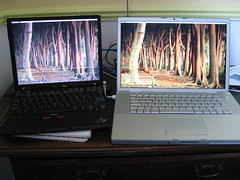
Thinkpad X40 vs MBP I’ve spent a bit of the bank holiday weekend by probably violating the warranty of a new 15” Macbook Pro (MBP) from work. I also was at the Debian bbq 2007 in Cambridge and met some friendly faces. :) More MBP & X40 porn So now I can boot into MacOSX and run Ubuntu or boot straight into Ubuntu from rEFIt. There are a couple of problems. There are some things I quite like about the MBP compared to the X40: Currently I remain not totally convinced about the Apple MBP. I’ll keep my Debian X40 my personal machine and the MBP for work. Now I can compile Webkit on Apple OSX (Debian can too) and see what’s happening in Ubuntu.

Alexis Sukrieh: Perl Console 0.3 released

A new version of PerlConsole is available. As you can see in the changelog, lots of goodness with this release comes to you (~/.perlconsolerc rules, thanks to S. Zachariah Sprackett for his patch). After reading the source code of Devel::REPL and learning from it (this is really a great library, congrats to mst) I decided not to orphan Perl Console. Yes, that was a possibility as Devel::REPL provides anything you need to build a console (and comes with “re.pl” which actually is a console itself). I decided not to give it up for one reason: Devel::REPL is great, and better written than Perl Console (it supports plugins and profiles and is Moose-based) but, it’s slow. When you launch it, you have to wait a couple of seconds before the console prompts you. This is because of Moose I suppose. I know that’s not blocker as a console is a development tool, but I feel like some of PerlConsole’s users would like to have the choice between a full featured, extensible and Moose-base console that’s slow, and a light one that is basic in design and implementation. I backported one of the most interesting plugin of Devel::REPL to PerlConsole, being the console’s lexical environement. Devel::REPL did a great thing there, using Lexical::Persistence to simulate a namespace in the console. Feel free to give your feedback about this, I wonder if there’s still an audience for PerlConsole when Devel::REPL is in the town. I think so, maybe I’m wrong, then tell me.

27 August 2007

Michal Čihař: Photo album generator wanted

After (again) searching for some good photo album generator, I'm more and more inclined to writing yet another tool to do this. Maybe I just want too much from this, but I haven't found solution that would fit my needs: So far I'm using a bit customised Matew which really does not fulfil everything, but at least works reasonably good (but extremely slow). However the more and more pictures are in my album, the slower this beast seems to be, so it's probably time to switch to something new. So far I haven't found anything that would actually fit, but PyAC seems to be usable as starting point for my new project for generating albums. Or is there a working solution?

26 August 2007

Christian Perrier: Back...and mail read

Less than one full day to read 8000+ mails. Not that bad. Among these were like 2000 spams that hadn't been detected by my spamassassin+CRM114 setup on my mail server, but properly identified by CRM114 on my laptop. Interesting thread in debian-devel after I reported bugs about the use of "Homepage: " in packages descriptions and Christoph Berg objected to it. Apparently, this could lead to the support of a "Homepage:" field in debian/control which is Good. New samba upstream release (3.0.25c) on its way. Steve Langasek did a release of the package while I was away, Peter Eisentraut did some bug triaging and No l K the prepared the release toay, searching for the bugs that are fixed. No real problem building the new version, except for the Python bindings which are nearly unmaintained (we are seriously considering to stop providing python-samba so please speak up *and* come helping if interested). The D-I l10n-sync script was hosed for 2 weeks because of a broken Swedish translation file (I hate poEdit for this, see #420685). I really should begin seeking for a backup for D-I l10n handling as Dennis Stampfer is now apparently completely MIA. Nothing really important apart from all this. Probably time now to begin preparing a possible trip to India for FOSS.in which I really would like to participate to, if I can find a way to fund the travel. Also time to think deeper about the proposed Extremadura i18n meeting which hasn't met a huge success, probably because we really want it to be focused on *one* goal this time (DDTP/Pootle).

25 August 2007

Martín Ferrari: Last GSoC update

It's been a long time without saying any word, my project completely drained any free time! So it's finished, as long as GSoC goes, but Pancut n still is a work in progress. What happened is that it turned out to be a lot more difficult that what I expected, so during the second part of the program —when I would write all the tests— the schedule ran away. Anyway, the tool is in a fully functional state: you can try it now and it —$DEITY forbids— will not crash on you; but it will not be able to spot many errors yet. So, if you can, please install it and try it out! Bug reports are welcomed, and code will be greatly appreciated. I've set up a debian repository with binaries (i386) and sources where you can grab it from, with all the dependencies, or you can check out the SVN repository. Bear in mind that it depends on a version of libcdio that's still not in the archive, so that can also be found in my private repository. As expected, my work with this tool doesn't end here; I will continue hacking on it as soon as I end my vacations; which brings me to the other subject of this post... Tomorrow I'll be leaving Lisbon, heading north to Porto and then the northern region of Spain: Galiza, Asturias, Euskadi and Catalunya; ending later in Madrid. After Spain I'll visit a friend in Paris and money and time will determine what I'll do after that. I am very excited, I love travelling and I really need some rest. PS: also I moved this blog to blosxom, which I expect to heavy hack on when I get back. Tags: Planet Lugfi, Planet Debian, Programaci n, Debian, Viajes

Christian Perrier: Back home

We're just back home after spending two weeks enjoying the wonders (and heat and forest fires...scirocco, mamma mia!) of Sicily. We had no network at the hotel and Italian (or sicilian, or just Cefal 's) Internet Caf s just suck (only a few computers running Windows while I forgot my special "Putty key" and no way to connect my laptop). So, 8000 mails to read (plus 6400 spams gently sorted by CRM114). I'll be busy for the next few days and I cross my fingers for no disasters on my packages. ...ah, apparently a KDE transition is in progress if I believe the output of "aptitude dist-upgrade" on my laptop...:-)

Gustavo R. Montesino: SoC Final Report

The Google Summer of Code coding period has ended earlier this week, so it seems to be a good time to stop and look what was done (and what wasn't). Let's start with an objective analysis, following the list of planned features:

Advanced query of bugs on the Debian BTS

In a 1-10 scale, I would give myself something like 6 or 7 here. bug-triage can query bugs by number, source package, package, maintainer and submitter. These parameters can be combined to make an query (reports must match all parameters) and more than one query may be added, subtracted and and'ed. A clearly missing feature is querying by usertag, support for it has been added on btsutils already and is just a question of adding a new input box on the query builder dialog (it should work if you enter the query manually in the bug-triage query line AFAICT).

Show all the information related to a bug report

bug-triage has a "goto" button which opens the bug in the user's preferred browser. Missing is the support to open the bug in a MUA, which I have promissed to Lo c.

Send additional information to a bug report

bug-triage has a "followup" button which opens the user's MUA with the right address. Maybe setting the subject would be nice...

Manipulate the tags of a bug report

I haven't had time to implement this at all. I've started it, the bugs have a context-sensitive menu which have each of the available tags as checkboxes on the right current status, but clicking on them does nothing currently.

Search for similar bugs in upstream developer BTS

This one would value something like 3 or 4 in a 1-10 scale. It searches upstream bugzillas by product and component, but doesn't do any cool trick like searching words in the bug subjects. The plus is that it does support KDE bugzilla, even though I haven't been brave enough to promisse it before SoC :P

Forward a bug report to the upstream developer BTS

There isn't really a good interface to report bugs programatically on GNOME bugzilla, which was disappointing. <rant>There is the bug-buddy xmlrpc(?) interface, but the developers say they will actively break anything using it, which I find very free-software-unlike.</rant>. The current bug-triage solution opens a browser with some of the fields filled. It would be nice to fill the full bug description, but its limited by the maximum size of an URL, so it fills only an introductory text (something like This bug was filled on Debian BTS #XXX) currently. Let's hope bugzilla 3 get on the GNOME world soon.

Conclusions

Unfortunately, this project hasn't evolved as much as I would like in the second half of the GSoC. As I said elsewhere, a lot of stuff has happened, some good, some bad, but on the end everything I hadn't been able to dedicate myself to anything I should. Even so, I think the project may be considered sucessful.

Maybe the more interesting product of this project, at least currently, is still on python-btsutils. As I said in the middle-term report, it'll be integrated in the debian_bundle soon, and might be powering important stuff like the devscripts in the future.

The bug-triage application has a lot to evolve yet, but is also an interesting tool IMHO. There are a lot of hurdles in the way to get different BTSes integrated, but the effort will for sure pay in the future. I plan to keep developing it (evon though keeping the GSoC pace is impossible) and am anxious to see the results ;)

Finally, as I said before, one of the main things on GSoC for me was the potential to learn cool stuff. The best choice I've made during all of this was to use Python. Even though it's still a new language for me, and i still have to search embarassingly simple things in the tutorial/reference, it was a lot more productive than if I was developing in C. Learning to use git was also a great. This goal was the more fulfilled one, I've really learnt a lot of things which will surely be useful in the future. BTOH, I still can't get used to glade :/

Dave Noble: Vodafone-Induced Anger

Around three months ago, I received my IBM/Lenovo X60s laptop (that has been fantastically well supported under Sid). As I was going to be doing a lot of travel in the future, I decided to go for the model with the built in 3G/GPRS radio... However, what I did not realise was that it was hardware locked to work only with Vodafone sim cards.
Considering I am moving to Norway in about a month; where Vodafone does not exist, it is obviously a drawback only being able to use a Vodafone SIM; so following the gude at thinkwiki.org; I proceeded to phone [UK] IBM/Lenovo technical support. This is where the problems began.
After waiting about 10 minutes, I got through to one support tech that didn't know they were shipping laptops with 3G modems built in, who then put me through to another, and yet another. Finally, I got through to a competent tech; who contacted Lenovo for the unlock code, and called back as promised the next day. However, this code did not work; returning an incorrect code error; and being the start of Debconf, I have had no time to call back the support people until now.
It makes me angry to think that all this hassle could have been spared by Vodafone not being utter cretins and locking hardware to their network! There was no mention of this network lock on the laptop retailer's page; and had I known of this, and how much hassle it would be, I would probably have bought a different model!

24 August 2007

Simon Richter: componentization tutorial #1: understanding what we are trying to do

This is the first post of a series on componentization, starting with a brief explanation of the problem(s) we are trying to solve. I expect some familiarity with programming in general, but no specific knowledge of any particular system; the terms "DLL" and "shared library" are used interchangeably. When you are writing a DLL, you are essentially committing to support whatever interface you are exporting forever. So it better be good on the first try. DLL hell is what happens if it was not good, and you end up making an incompatible change. The obvious way an interface can be "not good" is when you need to touch the header files that define it in order to implement some new functionality. You can get away with a few things, like the addition of new functions, if you can somehow make sure that users will always have a recent enough version of your DLL around, but in general any change to the interface is going to be incompatible. The traditional Unix way of solving the issue has been renaming the library. When you link a program against a shared library on a system that uses the ELF format, the linker looks inside the library for the SONAME field, which tells it what name the library wants to be known under, and the program will then attempt to load this file at startup (which usually is a symlink to the latest compatible version). This "official" name of the library usually contains a number (sometimes more than one), and when there is an incompatible change, you simply change that number, and the new version of the library can be installed in parallel with the old. There are additional mechanisms, like symbol versioning support, that allow a single library to provide different "versions" of exported functions, and have the program specify the desired version for each symbol. To run a system like this, one generally needs to keep track of programs' dependencies; this generally happens in the package manager with more (Debian) or less (Red Hat) support from package build scripts. If you built your system from scratch, you end up doing this work yourself. That's why you had highly paid system administrators in the old days, and very short shell scripts to replace them (with various degrees of success) in the current age. In the Windows world, things have been a bit different, because except in large installations, you generally do not have a clueful, benevolent system administrator who will take care of these things; rather, you have users that expect your software to work without having an insight into the inner workings. In general, software developers have not been taking chances and simply shipped all the DLLs they needed along with the main program. When they installed these DLLs into the same directory as the program, things were fine, if they installed them into the WINDOWS directory, not so much, because when you had two conflicting versions of the same DLL, you had to decide which one to keep, and a program that would only work with the one that you threw away would simply fail in curious and interesting ways. This is the original definition of DLL hell — you cannot do it right. To make matters worse, this is not the only way an interface could change. When you define a platform, you write up an "Application Binary Interface" (ABI) document that details conventions that should be followed; for example, the ARM processor does not have a dedicated stack pointer register, so the ABI document for Linux on ARM says that R13 is to be used as a stack pointer, functions may thus expect it to point to memory that is readable and writeable, and memory with an address lower than the stack pointer is considered "free". When the function is done, it is supposed to jump to the address in R14, which happens to be the register the ARM's "Branch with Link" instruction sets to the address of the instruction following it. If the function takes arguments, the ABI says where to find them, and if it returns a value, it also tells where to place that. For everything not in the ABI document, the compiler author gets to choose. The ABI document usually attempts to be rather minimal, so it defines how C functions are to be called, and calls it a day. Anything not in the C standard is not guaranteed to work between different compilers (or even different versions of the same compiler). That includes C language extensions such as the "long double" data type, language features in C++ and Java such as namespaces, nested types and exceptions, and the data structures used by the C library's malloc() function. The latter makes life difficult even for pure C programmers, as it disallows releasing memory from a different module than the one it was allocated in, because the different modules may link to different C libraries. In essence, this means you are not supposed to export anything from a DLL that is not a C function, and even then, there are additional requirements. You could in theory export data objects, but that is discouraged, as it exposes an implementation detail. Now, we're in a bit of a dilemma here. There is lots of interesting code out there that is not necessarily written in C, we'd like to reuse it and we don't want stuff to break. The Linux approach so far has been "we simply pretend the problem does not exist", and this has been working to a large extent, simply because everyone uses gcc, and when the ABI extensions the gcc people had made changed, recompiling everything that uses these extensions makes the problem go away. This has several drawbacks. For one, it mandates that the tools used to rebuild everything and keep the installation consistent be written in C or handle the transition gracefully (for the curious who have a Debian system handy: look at libapt-pkg's SONAME), and it also requires that we have the full source code for everything not just available but buildable in an automated way. Within the context of a Linux distribution, both of these are true, so we have survived the last major ABI transitions without too many losses. So we need an extension of the ABI document that specifies how modules written by different people and compiled with different compilers can interact. These are commonly called component models, and, to quote Andrew Tanenbaum, "[t]he good thing about standards is that there are so many to choose from". Next: "componentization tutorial #2: CORBA and COM"

Eddy Petri&#537;or: Dear lazyweb...

Why do I get these errors in a real etch system and I don't in a pbuilder login environment? Missing build-deps?


# Add here commands to compile the package.
/usr/bin/make
make[1]: Entering directory /home/eddy/usr/src/perso/build-area/svn-buildpackage-0.6.22~bpo40+1'
/usr/bin/make -C doc
make[2]: Entering directory /home/eddy/usr/src/perso/build-area/svn-buildpackage-0.6.22~bpo40+1/doc'
docbook2man uclean.sgml
Using catalogs: /etc/sgml/catalog
Using stylesheet: /usr/share/docbook-utils/docbook-utils.dsl#print
Working on: /home/eddy/usr/src/perso/build-area/svn-buildpackage-0.6.22~bpo40+1/doc/uclean.sgml
nsgmls:/home/eddy/usr/src/perso/build-area/svn-buildpackage-0.6.22~bpo40+1/doc/uclean.sgml:1:59:W: cannot generate system identifier for public text "-//OASIS//DTD DocBook V4.1//EN"
nsgmls:/home/eddy/usr/src/perso/build-area/svn-buildpackage-0.6.22~bpo40+1/doc/uclean.sgml:35:0:E: reference to entity "REFENTRY" for which no system identifier could be generated
nsgmls:/home/eddy/usr/src/perso/build-area/svn-buildpackage-0.6.22~bpo40+1/doc/uclean.sgml:1:0: entity was defined here
nsgmls:/home/eddy/usr/src/perso/build-area/svn-buildpackage-0.6.22~bpo40+1/doc/uclean.sgml:35:0:E: DTD did not contain element declaration for document type name
nsgmls:/home/eddy/usr/src/perso/build-area/svn-buildpackage-0.6.22~bpo40+1/doc/uclean.sgml:37:9:E: element "REFENTRY" undefined
nsgmls:/home/eddy/usr/src/perso/build-area/svn-buildpackage-0.6.22~bpo40+1/doc/uclean.sgml:38:15:E: element "REFENTRYINFO" undefined
nsgmls:/home/eddy/usr/src/perso/build-area/svn-buildpackage-0.6.22~bpo40+1/doc/uclean.sgml:39:12:E: element "ADDRESS" undefined
nsgmls:/home/eddy/usr/src/perso/build-area/svn-buildpackage-0.6.22~bpo40+1/doc/uclean.sgml:40:15:E: element "EMAIL" undefined
nsgmls:/home/eddy/usr/src/perso/build-area/svn-buildpackage-0.6.22~bpo40+1/doc/uclean.sgml:42:11:E: element "AUTHOR" undefined
nsgmls:/home/eddy/usr/src/perso/build-area/svn-buildpackage-0.6.22~bpo40+1/doc/uclean.sgml:43:19:E: element "FIRSTNAME" undefined
nsgmls:/home/eddy/usr/src/perso/build-area/svn-buildpackage-0.6.22~bpo40+1/doc/uclean.sgml:44:17:E: element "SURNAME" undefined
nsgmls:/home/eddy/usr/src/perso/build-area/svn-buildpackage-0.6.22~bpo40+1/doc/uclean.sgml:46:14:E: element "COPYRIGHT" undefined
nsgmls:/home/eddy/usr/src/perso/build-area/svn-buildpackage-0.6.22~bpo40+1/doc/uclean.sgml:47:11:E: element "YEAR" undefinednsgmls:/home/eddy/usr/src/perso/build-area/svn-buildpackage-0.6.22~bpo40+1/doc/uclean.sgml:48:13:E: element "HOLDER" undefined
nsgmls:/home/eddy/usr/src/perso/build-area/svn-buildpackage-0.6.22~bpo40+1/doc/uclean.sgml:50:12:E: element "DATE" undefinednsgmls:/home/eddy/usr/src/perso/build-area/svn-buildpackage-0.6.22~bpo40+1/doc/uclean.sgml:52:10:E: element "REFMETA" undefined
nsgmls:/home/eddy/usr/src/perso/build-area/svn-buildpackage-0.6.22~bpo40+1/doc/uclean.sgml:53:17:E: element "REFENTRYTITLE" undefined
nsgmls:/home/eddy/usr/src/perso/build-area/svn-buildpackage-0.6.22~bpo40+1/doc/uclean.sgml:55:15:E: element "MANVOLNUM" undefined
nsgmls:/home/eddy/usr/src/perso/build-area/svn-buildpackage-0.6.22~bpo40+1/doc/uclean.sgml:57:13:E: element "REFNAMEDIV" undefined
nsgmls:/home/eddy/usr/src/perso/build-area/svn-buildpackage-0.6.22~bpo40+1/doc/uclean.sgml:58:12:E: element "REFNAME" undefined
nsgmls:/home/eddy/usr/src/perso/build-area/svn-buildpackage-0.6.22~bpo40+1/doc/uclean.sgml:60:15:E: element "REFPURPOSE" undefined
nsgmls:/home/eddy/usr/src/perso/build-area/svn-buildpackage-0.6.22~bpo40+1/doc/uclean.sgml:62:17:E: element "REFSYNOPSISDIV" undefined
nsgmls:/home/eddy/usr/src/perso/build-area/svn-buildpackage-0.6.22~bpo40+1/doc/uclean.sgml:63:16:E: element "CMDSYNOPSIS" undefined

23 August 2007

Russell Coker: Cheney Flip-Flopped on Iraq

Here’s an interesting CSPAN interview with Dick Cheney from 1994. It’s amazing how accurate Dick’s analysis of the Iraq situation was in 1994 when justifying the decision to merely destroy Saddam’s army in Kuwait and not try to occupy Iraq or catpure Saddam. It’s a pity that he didn’t stick to that idea. Since the old CSPAN interview became popular the MSNBC show Countdown with Keith Olbermann covered it (youtube link). Keith initially said some ridiculous things about heart surgery affecting people’s emotions (that was the medical opinion about 2000 years ago, doctors have learned a lot since and Keith should learn from them). Then John Nichols of The Beat blog and author of Dick: The Man Who is President (Dick Cheney) makes some interesting comments. John interviewed the professors who taught Dick at university and their opinion of him matches the current observations - that he believes that the US government can do whatever it wants with no consequences.

Wouter Verhelst: Asterisk adventures, and the DECT gap.

A customer called me a while back, requesting whether I could help him set up asterisk. Since I hadn't previously played with asterisk, we agreed that I'd try out stuff, and then do a demo setup, so that he could decide whether that is okay for his needs. So I bought me a Linksys SPA-3102 ATA (with one FXO and one FXS port) and a Linksys SPA-921 IP phone, and started experimenting. Didn't take me long to figure out that the SPA-921 works, but that if I want to use a company-wide directory (which was a requirement for that customer), I have to use a Linksys proprietary protocol, which Asterisk obviously doesn't support. Someone then told me that Snom's hardware phones have LDAP support in their hardware phones; so I bought me the Snom 300 as well, and played a bit with the system. After experimenting for about two weeks or so, alltogether, I've now got a demo setup that fulfills most of his requirements, and I can show why others can't easily be implemented. Which is cool. Afterwards, I'll be stuck with an ATA and two IP phones that I have no immediate use for at the office, so I was thinking of taking them home and using them there. We've got way too many phones at home anyway (one upstairs, one downstairs, a fax, and a DECT basestation with no less than four handsets), so adding the ability to call eachother might be useful. Except that I can't seem to find a DECT basestation that appeals to me. The one we have doesn't have VoIP, so that'll need replacement. Just connecting it to the ATA could work, but then transferring a call from a regular phone to one of the DECT handsets would be troublesome, at best; what I would prefer is the ability to give each of my DECT handsets a separate asterisk extension; in effect, a DECT - SIP bridge. What I've found so far in DECT basestations that allow me to somehow link the DECT phones to a computer, is appaling. So now basically I'm left to conclude that there is a gap in what's available in DECT basestation products; one that allows me to connect a low number of DECT handsets to a network through SIP, and has nothing more. It'd be cool if one existed...

Eddy Petri&#537;or: my nslu2 runs an eabi kernel

Thanks to Riku Voipio's advice, my slug now runs an EABI kernel with OABI compat support. As a bonus I have the latest 2.6.18-5 abi kernel :-) .

Things to remember when trying to do the same with your slug:
I just chroot-ed into an armel chroot and rrdtool made some nice and meaningful graphs.

Instead of:


I got:


Some complaints:

22 August 2007

Jeff Bailey: Cincinnati, and a big hello to Planet Ubuntu!

Firstly, a big hello to Planet Ubuntu! As an Ubuntu community member and Ubuntu core-dev, I've decided to add my livejournal to there. Since I usually don't make any effort to sensor my thoughts on here, I chose not to add it while I was still with Canonical in order to make sure that there was no confusion as to the OfficialStatus(tm) of anything I write.

The last two days have taken us from Toronto through to Cincinnati. Andrew took us down to the Buffalo airport, we met Jason and Brian from Koolu on the way day and finally wound up down there at 22h30 despite having left NewMarket at 11am. When we stopped at Babur for lunch, we wound up seeing Nancy and Alexis walk past.

We stayed overnight at the Mum's Red Carpet Inn, just over the Pennsylvania border. It didn't have Red Carpet. It *did* have Orange Shag on the side of the bed, however. High class. The continental breakfast was Tang, Bananas, vegan doughnuts and twinkies. The vegan doughnuts were full of palm oil, I don't think my heart rate has recovered yet.

On the drive towards Kentucky, we got hungry (and tired of Subway) when we approached Columbus. We first tried to go to a place called "Leaf Restaurant", which it turns out can feed us exactly zero things. Down to the pre-made chef salad, and the spaghetti sauce having meat in it. We went a bit further, and decided to try the university district. We pulled over after seeing an Ethiopian place, and saw Ben Sostrom, whom we'd just met at Opus the week before! We spent the evening hanging out with him, michael dobson, amber, and the rest of their YA group. They meet on Tuesday nights a couple blocks from where we parked! It was nice to have a post-Opus day like that, but their stories of carjackings and cops randomly pulling people over are hopefully overstated by several orders of magnitude!

We continued the drive down to just outside of Cincinnati. We're meeting up with Stephanie Truax today for our tour of the Creationism Museum. After this, we'll turn west and try to find our way to California.

Neil Williams: Moving away from gedit to geany

gedit can be a real pain sometimes - mainly through what it still lacks: code folding, bookmarks and the ability to run two instances of gedit side by side (each with their own tabs) without having to start the second in a different workspace and then move it. Of these, code folding and bookmarks and the biggest problems with how I wanted to use gedit - for Perl source code.
Anjuta is overkill for perl (and doesn't support perl particularly well) and bluefish perl syntax highlighting is plain broken - it gets the syntax wrong frequently (especially when using copy and paste and then requires you to edit the line at which the syntax failed before it will move on and fail a few lines later. Bah!
So I've turned to geany - never used it before but it's great for Perl. It identifies all the objects in a Perl script or module and allows me to click on any object to go to that part of the file. It has code folding (and it works). It has bookmarks (although it would be nice to be able to click on a button to go from one mark to the next). It handles "projects" quite well too. It also makes no complaints about running in a second instance. This is really helpful because I can have apt-cross in one instance of geany - with all the relevant files in tabs - and dpkg-cross in another, with its files.
There's a 'scribble' area in geany too which is neat - no need to have an "untitled document" tab that takes up more space on the tab bar than it deserves AND nags you when you eventually close gedit.
I'll still use gedit for some things but I guess it's about time that I moved away from a simple but powerful text editor and used a proper IDE that can cope with Perl. For me, that is geany.

Ian Wienand: Fun with <tt>-funroll-loops</tt>

I was playing with loop unrolling, and decided to investigate it a little. The basis is this very simple program which looks like it could do with some loop unrolling.
#include <stdio.h>
#include <stdlib.h>
#include <assert.h>
#define SIZE (1500 * 1024 * 1024)
int fn(int *buf)  
        int i;
	for(i=0; i < (SIZE/sizeof(int)); i+=1)
		buf[i] = i;
	return 0;
 
int main(void)
 
        int *buf = malloc(SIZE);
        assert(buf);
	return fn(buf);
 
Firstly, lets have a look at what happens to the function when -funroll-loops is applied. Below is the de-compilation with some comments on what each line is doing.
Non-optimised
                           nop.m 0x0
r14=0                      mov r14=r0
save the "loop counter"    mov.i r2=ar.lc
                           nop.m 0x0
one less than iterations   movl r15=0x176fffff;;
                           nop.m 0x0
initalise loop counter     mov.i ar.lc=r15
                           nop.i 0x0;;
                           loop:
*buf = i, buf++            st4 [r32]=r14,4
i++                        adds r14=1,r14
dec lc, branch if > 0      br.cloop.sptk.few .loop
                           nop.m 0x0
restore loop counter       mov.i ar.lc=r2
Loop unrolled
                           nop.m 0x0
r26 = 0                    mov r26=r0
save lc                    mov.i r2=ar.lc
                           nop.m 0x0
iter / 32                  movl r14=0x2edffff;;
                           nop.m 0x0
setup loop counter         mov.i ar.lc=r14
                           nop.i 0x0
                           loop:
r3 = buf                   mov r3=r32
r8 = 1                     adds r8=1,r26
r25 = 3                    adds r25=3,r26
r23 = buf[3]               adds r23=12,r32
r24 = 4                    adds r24=4,r26
r22 = buf[4]               adds r22=16,r32;;
buf[0] = 0; r3=buf+1       st4 [r3]=r26,4
r21 = 5                    adds r21=5,r26
r19 = buf[5]               adds r19=20,r32
r20 = 6                    adds r20=6,r26
r18 = buf[6]               adds r18=24,r32
r16 = 7                    adds r16=7,r26;;
                           nop.m 0x0
buf[1] = 1, r3=buf+2       st4 [r3]=r8,4
r15 = buf[7]               adds r15=28,r32
r17 = 2                    adds r17=1,r8
r26 += 8                   adds r26=8,r26
buf += 8 (for next iter)   adds r32=32,r32;;
buf[2] = 2                 st4 [r3]=r17
buf[3] = 3                 st4 [r23]=r25
                           nop.i 0x0
buf[4] = 4                 st4 [r22]=r24
buf[5] = 5                 st4 [r19]=r21
                           nop.i 0x0
buf[6] = 6                 st4 [r18]=r20
buf[7] = 7                 st4 [r15]=r16
loop, dec branch           br.cloop.sptk.few .loop
                           nop.m 0x0
restore lc                 mov.i ar.lc=r2
                           br.ret.sptk.many b0;;
We can see that in the first case the loop counter is setup to run 393216000 times (e.g. 1500*1024*1024/sizeof(int)) and a very simple loop of storing the value and incrementing is undertaken. In the second version, the code becomes more complex. We can see the loop now executes 49152000 times (e.g. 1500*1024*1024/sizeof(int)/8) so we can infer that for each loop iteration, 8 values have been unrolled to be written into our buf array. Indeed, when pulled apart we can see the 8 stores (numbers just reflect the first time through). So, is it faster?
$ time ./loop
real    0m1.209s
user    0m0.388s
sys     0m0.820s
$ timme ./loop-unroll
real    0m1.056s
user    0m0.244s
sys     0m0.812s
Yes! Great. We can suggest a number of reasons why, but it would be interesting to get some hard statistics on why this is so. Thanks to the Itanium performance counters, we can. Firstly, lets start by seeing how cycles are being spent.
$ pfmon -e cpu_cycles,ia64_inst_retired_this,nops_retired,back_end_bubble_all ./loop
 547923609 CPU_CYCLES
1179995250 IA64_INST_RETIRED_THIS
    104431 NOPS_RETIRED
 154285534 BACK_END_BUBBLE_ALL
$ pfmon -e cpu_cycles,ia64_inst_retired_this,nops_retired,back_end_bubble_all ./loop-unroll
 311570590 CPU_CYCLES
1327451286 IA64_INST_RETIRED_THIS
 147560435 NOPS_RETIRED
  16088889 BACK_END_BUBBLE_ALL
Now, the Itanium can issue up to six instructions (IA64_INST_RETIRED_THIS) in two bundles of three instructions per cycle (CPU_CYCLES). However, you can't have dependencies between registers within a 3-instruction bundle (and branches and interruptions play havoc) so sometimes you need to pad with no-ops (this is why you need a good compiler). We can work out some figures from this, namely the useful instructions per cycle (e.g. instructions retired - nop instructions / cycles).
TestUseful instructions/cycle
loop1179995250 - 104431 / 547923609 = 2.15
unroll1327451286 - 147560435 / 311570590 = 3.78
This tells us that for each given cycle, the unrolled-loop version is doing more work (ideally we'd like that to be a the theoretical maximum of 6). So what is the unrolled version doing for all this time? Bubbles are where the CPU is waiting for something; a prime candidate is moving data from caches to registers. Bubbles make up (154285534/547823609) 28% of the cycles on the loop version, but only (16088889/311570590) 5% of the time for the unrolled version. This means the processor is spending a lot less time waiting for things to happen with the unrolled loop version. We can drill down further to see what bubbles are occurring.
$ pfmon -e be_l1d_fpu_bubble_all,be_exe_bubble_all,be_RSE_bubble_all,Back_end_bubble_fe ./loop
 14229581 BE_L1D_FPU_BUBBLE_ALL
    97669 BE_EXE_BUBBLE_ALL
     1260 BE_RSE_BUBBLE_ALL
131354866 BACK_END_BUBBLE_FE
$ pfmon -e be_l1d_fpu_bubble_all,be_exe_bubble_all,be_RSE_bubble_all,Back_end_bubble_fe ./loop-unroll
22676169 BE_L1D_FPU_BUBBLE_ALL
   83064 BE_EXE_BUBBLE_ALL
    1263 BE_RSE_BUBBLE_ALL
  718850 BACK_END_BUBBLE_FE
We are now breaking the stalls down to see where they are occuring. L1D_FPU_BUBBLES are essentially related to micro-architectural issues with the caches; things like the L1D cache being overwhelmend and interactions with the hardware page-table walker. BE_EXE bubbles are more simply described a waiting for data to come from caches (or even main memory) to registers. BE_RSE bubbles are related to the register stack engine, and "front end" bubbles (BACK_END_BUBBLE_FE) are where there are not enough instructions coming from the "front-end" for the "back-end" to issue out to functional units in the processor. In this case, the major cause of problems for the simple loop seems to be not being able to get enough instructions through to keep the processor busy. We can try to pin down what is happening in the front-end:
$ pfmon -e fe_bubble_imiss,fe_bubble_tlbmiss,fe_bubble_branch,fe_bubble_bubble ./loop
   27727 FE_BUBBLE_IMISS
    4910 FE_BUBBLE_TLBMISS
98094189 FE_BUBBLE_BRANCH
52615907 FE_BUBBLE_BUBBLE
$ pfmon -e fe_bubble_imiss,fe_bubble_tlbmiss,fe_bubble_branch,fe_bubble_bubble ./loop-unroll
780729 FE_BUBBLE_IMISS
  4858 FE_BUBBLE_TLBMISS
291620 FE_BUBBLE_BRANCH
111089 FE_BUBBLE_BUBBLE
What we can see here is that the increased code size of the unrolled version causes us a lot more i-cache misses, as expected. However, the problem for the unrolled version seems to be the time spent by the front-end dealing with the branch. This is not surprising since there is a rumor that there is a front-end buffer which fills up after 3 repeated cycles with branch instructions; apparently this is a problem addressed in the new Montecito chips (if anyone has one, I'll update this if you send me the numbers). Since we are doing 393216000 branches all within a single bundle its not surprising we've hit it! Just to confirm, we can break-down the BE_EXE bubbles. Remember, BE_EXE bubbles are caused by stalls in the execution phase primarily due to cache latencies or inter-register dependencies. Looking at our code, we don't re-use the same register over-and-over so we would not expect to spend a long time waiting for registers, and indeed this is what we see.
$ pfmon -e be_exe_bubble_grall,be_exe_bubble_grgr ./loop
79601 BE_EXE_BUBBLE_GRALL
  919 BE_EXE_BUBBLE_GRGR
$ pfmon -e be_exe_bubble_grall,be_exe_bubble_grgr ./loop-unroll
76627 BE_EXE_BUBBLE_GRALL
  918 BE_EXE_BUBBLE_GRGR
Therefore in this case, the speed increase isn't coming from better cache behaviour as we might have expected, but greater ability to keep the processor busy with instructions between branches. We can also examine the major events happening with the unrolled case. Here we see BE_L1D_FPU bubbles being the major overhead. On Itanium floating-point avoids the L1 cache (it is too big, and not re-used enough to make it useful) hence the concatenation of the event acronym. These bubbles can be broken down into the following events (measured in two runs, since you can only do 4 at a time).
$ pfmon -e be_l1d_fpu_bubble_l1d,be_l1d_fpu_bubble_l1d_dcurecir,\
  be_l1d_fpu_bubble_l1d_tlb,be_l1d_fpu_bubble_l1d_stbufrecir ./loop-unroll
 9623193 BE_L1D_FPU_BUBBLE_L1D_DCURECIR
     414 BE_L1D_FPU_BUBBLE_L1D_TLB
     282 BE_L1D_FPU_BUBBLE_L1D_STBUFRECIR
$ pfmon -e be_l1d_fpu_bubble_l1d_fullstbuf,\
    be_l1d_fpu_bubble_l1d_l2bpress,be_l1d_fpu_bubble_l1d_tlb ./loop-unroll
      23 BE_L1D_FPU_BUBBLE_L1D_FULLSTBUF
17220177 BE_L1D_FPU_BUBBLE_L1D_L2BPRESS
     425 BE_L1D_FPU_BUBBLE_L1D_TLB
These events expose micro-architectural details, the full extent of which is only gleaned by reading the processor manuals (a PhD in computer architecture probably helps too!). The store buffers are not an issue here -- the caches are more than able to keep up with our few writes. The TLB is also not involved; we have pretty good TLB coverage thanks to the virtual-linear page table and hardware page-table walker. The two clues are DCURECIR and L2BPRESS. Essentially DCURECIR happens when references have to "re-circulate"; this is a side-effect of the data not being available. The L2BPRESS figure suggests why this is so; this event happens when the L2 cache can not handle any more requests. The L2 cache keeps a queue of outstanding requests; when this queue is full (for example, full of long latency requests to get data from main memory) the L2 cache causes "back-pressure" which stops the L1 cache from issuing new requests. This suggests the program is chewing through a lot of data and not using the cache very effectively, which is exactly what we are doing. Pre-fetching hints can help (but as described in a previous entry on hacking Enigma may not always help), but in this case there probably isn't any spare bandwidth to pre-fetch in because essentially no processing is happening. What does all this mean? I don't know, but playing with performance monitors is fun!
21 August 2007

Russell Coker: Music Videos

I’ve been thinking about music videos recently while compiling a list of my favourite videos of all time. It seems that YouTube has changed things through the re-mixes of videos and the ability of anyone to publish for a mass-market (although without the possibility of directly making money from it). Also today all new PCs (and most PCs that are in use) are capable of being used for video editing and the compute power needed for 80’s and 90’s quality special effects is also commonly available (in most cases good art doesn’t need more technical quality than that). So anyone can produce videos (and a quick search of YouTube reveals that many people are producing videos for their favourite songs). I think that we need a music video for the Free Software Song. One possibility is to base it on the 1984 Apple advert (because it’s the free software community that is opposing Big Brother not Apple). I think it would be good to have multiple versions of the Free Software Song (with matching videos), there could be the version for young children, the Hip-Hop version, the Punk version, etc. Also I think that there is potential for the creation of other songs for the free software community. One possible way of doing this would be to have a contest for producing music and videos. Maybe a conference such as LCA or OLS could have the judging for such a contest. I would be prepared to donate some money towards the prize pool and I’m sure that other individuals and organisations would also be prepared to do so. If I get some positive feedback on this idea I’ll investigate how to run such a contest. Here are my favourite videos of the moment. Please let me know of any videos that you think I would like based on this list.
  • Smashing Pumpkins:
    Ava Adore, interesting way of changing scenes, and a very artistic and strange video (matches the song)
  • Duran Duran (who incidentally named their group after a character in Barbarella: Queen of the Galaxy - strangely the spelling is different though):
  • Too Much Information - they should re-do this and include a reference to the Internet in the lyrics. ;)
  • Wild Boys - Mad Max 3 as a film clip

  • UNKLE:
    • Eye for an Eye - strange and disturbing, as any serious art that is related to war must be
  • Rabbit in Your Headlights - surprising end, I wonder if anyone was injured trying to emulate this clip

  • Nine Inch Nails:
    Head Like a Hole, strange and a bit bizarre at times. Not the greatest of my favourite clips but the music makes up for it.
  • Queen:
    • I Want to Break Free, strangely amusing and very artistic


  • Chemical Brothers:
    • Let Forever Be - my favourite clip of all time. Fractally weird, you can watch it dozens of times and still be missing things.
  • Setting Sun - the world would be a better place if more cops could dance like that! Also is it just me or does the drummer guy look like a Narn from Babylon 5?
  • Out of Control - surprise ending. I would appreciate it if someone who knows the non-English language (probably Spanish) in the clip could point me to a translation.
  • Star Guitar - a real work of art but no plot and I didn’t enjoy the music, I recommend watching it once
  • The Golden Path - I used to wonder whether office work was really so grim in the 60s and 70s, but then I worked for a financial company recently…

  • Fat Boy Slim:
    Praise You - why can’t reality TV be this good?
  • Falco:
    Rock Me Amadeus - let’s represent two totally diffent cultures (bikers and Austraian high society) in a film clip, silly but amusing
  • Madonna:
    Like A Prayer - I wonder how many racist organizations banned that
  • A-Ha:
    Take On Me - mixing multiple art forms (in this case film and animation) can work really well. Beat Kill Bill to the idea by a couple of decades.
  • Robert Palmer:
    Simply Irresistable - pity that they didn’t hire more women who can dance or at least put the dancers in front of the models. It’s interesting to note that one of the models appears to be actually playing a guitar.
  • Garbage:
  • Michael Jackson:
    Billie Jean - class is timeless.
  • Romain Francoise: A study of file duplication in the Debian archive

    [Long post, sorry. If you're short on time skip to the end for the juicy parts.]

    It all started about a week ago when I decided to find out how many files were unique in the whole Debian archive, and how many were duplicated in the same package or in other packages. I had done some work on duplication detection before, and I knew that the process involves getting some kind of hash value of every document, then finding duplicate values in the list of hashes.

    I already had a local Debian mirror so the raw data was all there. I basically had two options: either compute the hash value of every file myself from the packages in my mirror, or find some other (ideally faster) way to determine if a file is unique. I quickly decided that the best option was to use the md5sums embedded in most Debian packages (in the DEBIAN/md5sums control file). That would give me MD5 hashes of all regular files, excluding conffiles.

    So the first step was to check how many packages have embedded md5sums, and a simple script showed that less than 3% don't have them. This first check exposed a bug in python-debian, which was duly reported. Along the way, my post prompted a discussion on debian-devel about the state of md5sums, and I set up a daily check to keep track of things.

    The next step was to make sure that all md5sum-enabled packages had usable information. It turned out that python-debian choked on 103 packages because of embedded spaces in filenames, and that it also had a blocker bug when used in Python 2.4. I filed two more bugs.

    All that remained was the easiest part: write the program to find duplicate files. I did that, and I now have all kinds of funny statistics:If you're still reading so far, thanks! You can see the report file, and the program itself. If you want to run it, note that it's optimized for speed rather than memory efficiency; it runs in under 3 minutes but uses up to 1.5GB of memory (my home desktop has 4GB).

    The grand conclusion is that all things considered, there is very little file duplication in the archive: the #1 duplicate represents less than 0.4% of the two million analyzed files, and it doesn't actually use any space since it's an empty file... :)

    Next.

    Previous.