Search Results: "pa"

30 August 2015

Dirk Eddelbuettel: RcppGSL 0.3.0

A new version of RcppGSL just arrived on CRAN. The RcppGSL package provides an interface from R to the GNU GSL using our Rcpp package. Following on the heels of an update last month we updated the package (and its vignette) further. One of the key additions concern memory management: Given that our proxy classes around the GSL vector and matrix types are real C++ object, we can monitor their scope and automagically call free() on them rather then insisting on the user doing it. This renders code much simpler as illustrated below. Dan Dillon added const correctness over a series on pull request which allows us to write more standard (and simply nicer) function interfaces. Lastly, a few new typedef declaration further simply the use of the (most common) double and int vectors and matrices. Maybe a code example will help. RcppGSL contains a full and complete example package illustrating how to write a package using the RcppGSL facilities. It contains an example of computing a column norm -- which we blogged about before when announcing an much earlier version. In its full glory, it looks like this:
#include <RcppGSL.h>
#include <gsl/gsl_matrix.h>
#include <gsl/gsl_blas.h>
extern "C" SEXP colNorm(SEXP sM)  
  try  
        RcppGSL::matrix<double> M = sM;     // create gsl data structures from SEXP
        int k = M.ncol();
        Rcpp::NumericVector n(k);           // to store results
        for (int j = 0; j < k; j++)  
            RcppGSL::vector_view<double> colview = gsl_matrix_column (M, j);
            n[j] = gsl_blas_dnrm2(colview);
         
        M.free() ;
        return n;                           // return vector
    catch( std::exception &ex )  
        forward_exception_to_r( ex );
    catch(...)  
        ::Rf_error( "c++ exception (unknown reason)" );
   
  return R_NilValue; // -Wall
 
We manually translate the SEXP coming from R, manually cover the try and catch exception handling, manually free the memory etc pp. Well in the current version, the example is written as follows:
#include <RcppGSL.h>
#include <gsl/gsl_matrix.h>
#include <gsl/gsl_blas.h>
// [[Rcpp::export]]
Rcpp::NumericVector colNorm(const RcppGSL::Matrix & G)  
    int k = G.ncol();
    Rcpp::NumericVector n(k);           // to store results
    for (int j = 0; j < k; j++)  
        RcppGSL::VectorView colview = gsl_matrix_const_column (G, j);
        n[j] = gsl_blas_dnrm2(colview);
     
    return n;                           // return vector
 
This takes full advantage of Rcpp Attributes automagically creating the interface and exception handler (as per the previous release), adds a const & interface, does away with the tedious and error-pronce free() and uses the shorter-typedef forms for RcppGSL::Matrix and RcppGSL::VectorViews using double variables. Now the function is short and concise and hence easier to read and maintain. The package vignette has more details on using RcppGSL. The NEWS file entries follows below:
Changes in version 0.3.0 (2015-08-30)
  • The RcppGSL matrix and vector class now keep track of object allocation and can therefore automatically free allocated object in the destructor. Explicit x.free() use is still supported.
  • The matrix and vector classes now support const reference semantics in the interfaces (thanks to PR #7 by Dan Dillon)
  • The matrix_view and vector_view classes are reorganized to better support const arguments (thanks to PR #8 and #9 by Dan Dillon)
  • Shorthand forms such as Rcpp::Matrix have been added for double and int vectors and matrices including views.
  • Examples such as fastLm can now be written in a much cleaner and shorter way as GSL objects can appear in the function signature and without requiring explicit .free() calls at the end.
  • The included examples, as well as the introductory vignette, have been updated accordingly.
Courtesy of CRANberries, a summary of changes to the most recent release is available. More information is on the RcppGSL page. Questions, comments etc should go to the rcpp-devel mailing list off the R-Forge page.

This post by Dirk Eddelbuettel originated on his Thinking inside the box blog. Please report excessive re-aggregation in third-party for-profit settings.

Sven Hoexter: 1960 SubjectAlternativeNames on one certificate

tl;dr; You can add 1960+ SubjectAlternativeNames on one certificate and at least Firefox and Chrome are working fine with that. Internet Explorer failed but I did not investigate why. So why would you want to have close to 2K SANs on one certificate? While we're working on adopting a more dynamic development workflow at my workplace we're currently bound to a central development system. From there we serve a classic virtual hosting setup with "projectname.username.devel.ourdomain.example" mapped on "/web/username/projectname/". That is 100% dynamic with wildcard DNS entries and you can just add a new project to your folder and use it directly. All of that is served from just a single VirtualHost. Now our developers started to go through all our active projects to make them fit for serving via HTTPS. While we can verify the proper usage of https on our staging system where we've validating certificates, that's not the way you'd like to work. So someone approached me to look into a solution for our development system. Obvious choices like wildcard certificates do not work here because we've two dynamic components in the FQDN. So we would've to buy a wildcard certificate for every developer and we would've to create a VirtualHost entry for every new developer. That's expensive and we don't want all that additional work. So I started to search for documented limits on the number of SANs you can have on a certificate. The good news: there are none. The RFC does not define a limit. So much about the theory. ;) Following Ivans excellent documentation I setup an internal CA and an ugly "find ... sed ... tr ..." one-liner later I had a properly formated openssl config file to generate a CSR with all 1960 "projectname.username..." SAN combinations found on the development system. Two openssl invocations (CSR generation and signing) later I had a signed certificate with 1960 SANs on it. I imported the internal CA I created in Firefox and Chrome, and to my surprise it worked. Noteworthy: To sign with "openssl ca" without interactive prompts you've to use the "-batch" option. I'm thinking about regenerating the certificate every morning so our developers just have to create a new project directory and within 24h serving via HTTPS would be enabled. The only thing I'm currently pondering about is how to properly run the CA in a corporate Windows world. We could of course ask the Windows guys to include it for everyone but then we would've to really invest time in properly running the CA. I'd like to avoid that hassle. So I'd guess we just stick to providing the CA for those developers who need it. This all or nothing model is a constant PITA, and you really do not want to get owned via your own badly managed CA. :( Regarding Internet Explorer it jumped in my face with a strange error message that recommended to enable TLS 1.0, 1.1 and 1.2 in the options menu. Of course that's already enable. I'll try to take a look at the handshake next week, but I bet we've to accept for the moment that IE will not work with so many SANs. Would be interesting to try out Windows 10 with Spartan, but well I'm not that interested in Windows to invest more time on that front. Other TLS implementations, like Java, would be also interesting to test.

Ben Hutchings: Securing www.decadent.org.uk

Sven Hoexter replied to my previous entry to say that WoSign also provides free DV TLS certificates. What's more, they allow up to 10 alternate names, unlike StartSSL. So I've gone ahead with a new certificate for www.decadent.org.uk and other virtual servers including git.decadent.org.uk. WoSign sensibly mandates a key length of 2048 bits, and together with the default TLS configuration for Apache in Debian 'jessie' this resulted in a A- rating from Qualys SSL Server Test. I then disabled non-PFS and otherwise weak cipher suites in /etc/apache2/mods-enabled/ssl.conf:
SSLCipherSuite HIGH:!aNULL:!kRSA:!3DES
This resulted in an A rating. Finally, I added redirection of all plaintext HTTP connections to HTTP-S (which is easier than working out how to make the virtual server work with and without TLS, anyway). I enabled HSTS for each VirtualHost:
Header always set Strict-Transport-Security "max-age=31536000; includeSubDomains"
This resulted in an A+ rating. These web sites will now be inaccessible to Java 6 and IE on Windows XP, but that's no great loss (1 in 1500 hits over the past few weeks).

Russ Allbery: Review: Pound Foolish

Review: Pound Foolish, by Helaine Olen
Publisher: Penguin
Copyright: 2012, 2013
Printing: 2013
ISBN: 1-59184-679-X
Format: Trade paperback
Pages: 241
For at least the last six years, it's not been surprising news that the relationship between the average person and the US financial system is tense at best, and downright exploitative at worst. The collapse of the housing bubble revealed a morass of predatory lending practices, spectacularly poor (or spectacularly cynical) investment decisions, and out-of-control personal debt coupled with erosion of bankruptcy law. Despite this, there's always a second story in all discussions of the finances of the US population: the problem isn't with financial structures and products, but with us. We're too stupid, or naive, or emotional, or uninformed, or greedy, or unprincipled, or impatient. Finances are complicated, yes, but that just means we have to be more thoughtful. All of these complex financial products could have been used properly. Helaine Olen's Pound Foolish is a systemtic, biting, well-researched, and pointed counter to that second story. The short summary of this book is that it's not us. We're being set up for failure, and there is a large and lucrative industry profiting off of that failure. And many (although not all) people in that industry know exactly what they're doing. Pound Foolish is one of my favorite forms of non-fiction: long-form journalism. This is an investigative essay into the personal finance and investment industry, developed to book length. Readers of Michael Lewis will feel right at home. Olen doesn't have Lewis's skill with characterization and biography, but she makes up for it in big-picture clarity. She takes a wealth of individual facts about who is involved in personal finance, how they make money, what they recommend, and who profits, and develops it into a clear and coherent overview. If you have paid any attention to US financial issues, you'll know some of this already. Frontline has done a great job of covering administrative fees in mutual funds. Lots of people have warned about annuities. The spectacular collapse of the home mortgage is old news now. But Olen does a great job of finding the connections between these elements and adding some less familiar ones, including an insightful and damning analysis of financial literacy campaigns and the widespread belief that these problems are caused by lack of consumer understanding. I've read and watched a lot of related material, including several full-book treatments of the mortgage crisis, so I think it's telling that I never got bored in the middle of Olen's treatment. I find the deep US belief in the power of personal improvement fascinating. It feels like one of the defining characteristics of US culture, for both good and for ill. We're very good at writing compelling narratives of personal improvement, and sometimes act on them. We believe that everyone can and should improve themselves. But that comes coupled to a dislike and distrust of expertise, even when it is legitimate and earned (Hofstadter's Anti-Intellectualism in American Life develops this idea at length). And I believe we significantly overestimate the ability of individuals to act despite systems that are stacked against us, and significantly overestimate our responsibility for the inevitable results. This was the main message I took from Pound Foolish: we desperately want to believe in the myth of personal control. We want to believe that our financial troubles are something we can fix through personal education, more will power, better decisions, or just the right investment. And so, we turn to gurus like Suze Orman and buy their mix of muddled financial advice and "tough love" that completely ignores broader social factors. We're easy marks for psychologically-trained investment sellers who mix fear, pressure, and a fantasy of inside knowledge and personal control. We're fooled by a narrative of empowerment and stand by while a working retirement system (guaranteed benefit pensions) is undermined and destroyed in favor of much riskier investment schemes... riskier for us, at least, but loaded with guaranteed profits for the people who "advise" us. And we cling to financial literacy campaigns that are funded by exactly the same credit card companies who fight tooth and nail against regulations that would require they provide simple, comprehensible descriptions of loan terms. One wonders if they support them precisely because they know they don't work. Olen mentions, in passing, the Stanford marshmallow experiment, which is often used as a foundation for arguments about personal responsibility for financial outcomes, but she doesn't do a detailed critique. I wish she had, since I think it's such a good example of the theme of this book. The Stanford marshmallow experiment was a psychological experiment from the late 1960s and early 1970s in delayed gratification. Children were put in a room in front of some treat (marshmallows, cookies, pretzels) and told that they could eat it if they wished. But if they didn't eat the treat before the monitor came back, they would get two of the treat instead. Long-term follow-up studies found that the children who refrained from eating the treat and got the reward had better life outcomes along multiple metrics: SAT scores, educational attainment, and others. On the surface, this seems to support everything US culture loves to believe about the power of self-control, self-improvement, and the Protestant work ethic. People who can delay gratification and save for a future reward do better in the world. (The darker interpretation, also common since the experiment was performed on children, is that the ability to delay gratification has a genetic component, and some people are just doomed to make poor decisions due to their inability to exercise self-control.) However, I can call the traditional interpretation into question with one simple question that the experimenters appeared not to ask: under what circumstances would taking the treat immediately be the rational and best choice? One answer, of course, is when one does not trust the adult to produce the promised reward. If the adult might come back, take the treat away, and not give any treat, it's to the child's advantage to take the treat immediately. Even if the adult left the treat but wouldn't actually double it, it's to the child's advantage to take the treat immediately. The traditional interpretation assumes the child trusts the adults performing the experiment a logical assumption for those of us whose childhood experience was that adults could generally be trusted and that promised rewards would materialize. If the child instead came from a chaotic family where adults weren't reliable, or just one where frequent unexpected money problems meant that promised treats often didn't materialize, the most logical assumption may be much different. One has to ask if such a background may have more to do with the measured long-term life outcomes than the child's unwillingness to trust in a future reward. And this is one of the major themes of this book. Problems the personal finance industry attributes to our personal shortcomings (which they're happy to take our money to remedy) are often systematic, or at least largely outside of our control. We may already be making the most logical choices given our personal situations. We're in worse financial shape because we're making less money. Our retirements are in danger because our retirement systems were dismantled and replaced with risky and expensive alternatives. And where problems are attributed to our poor choices, one can find entire industries that focus on undermining our ability to make good choices: scaring us, confusing us, hiding vital information, and exploiting known weaknesses of human psychology to route our money to them. These are not problems that can be solved by watching Suze Orman yell at us to stop buying things. These are systematic social problems that demand a sweeping discussion about regulation, automatic savings systems, and social insurance programs to spread risk and minimize the weaknesses of human psychology. Exactly the kind of discussion that the personal finance industry doesn't want us to have. Those who are well-read in these topics probably won't find a lot new here. Those who aren't in the US will shake their heads at some of the ways that the US fails its citizens, although many of Olen's points apply even to countries with stronger social safety nets. But if you're interested in solid long-form journalism on this topic, backed by lots of data on just how badly a focus on personal accountability is working for us, I recommend Pound Foolish. Rating: 8 out of 10

29 August 2015

Tassia Camoes Araujo: Report from the MicroDebconf Bras lia 2015

This was an event organized due to a coincidental meeting of a few DD s in the city of Brasilia on May 31st 2015. What a good thing when we can mix vacations, friends and Debian ;-)

Group photo

We called it Micro due to its short duration and planning phase, to be fair with other Mini DebConfs that take a lot more of organization. We also ended up having a translation sprint inside the event that attracted contributors from other cities. Our main goal was to boost the local community and bring new contributors to Debian. And we definitely made it! The meeting happened at University of Brasilia (UnB Gama). It started with a short presentation where each DD and Debian contributor presented their involvement with Debian and plans for the hacking session. This was an invitation for new contributors to choose the activities they were willing to engage, taking advantage of being guided by more experienced people. Then we moved to smaller rooms where participants were split in different groups to work on each track: packaging, translation and community/contribution. We all came together later for the keysigning party. Some of the highlights of the day: For more details of what happened, you can read our full report. The MicroDebconf wouldn t be possible without the support of prof. Paulo Meirelles from UnB Gama and all the LAPPIS team for the local organization and students mobilization. We also need to thank to Debian donnors, who covered the travel costs of one of our contributors. Last but not least, thanks to our participants and the large Brazilian community who is giving a good example of team work. A similar meeting happened in July during the Free Software International Forum (FISL) and another one is already planned to happen in October as part of the LatinoWare. I hope I can join those folks again in the near future!

Francois Marier: Letting someone ssh into your laptop using Pagekite

In order to investigate a bug I was running into, I recently had to give my colleague ssh access to my laptop behind a firewall. The easiest way I found to do this was to create an account for him on my laptop and setup a pagekite frontend on my Linode server and a pagekite backend on my laptop.

Frontend setup Setting up my Linode server in order to make the ssh service accessible and proxy the traffic to my laptop was fairly straightforward. First, I had to install the pagekite package (already in Debian and Ubuntu) and open up a port on my firewall by adding the following to both /etc/network/iptables.up.rules and /etc/network/ip6tables.up.rules:
-A INPUT -p tcp --dport 10022 -j ACCEPT
Then I created a new CNAME for my server in DNS:
pagekite.fmarier.org.   3600    IN  CNAME   fmarier.org.
With that in place, I started the pagekite frontend using this command:
pagekite --clean --isfrontend --rawports=virtual --ports=10022 --domain=raw:pagekite.fmarier.org:Password1

Backend setup After installing the pagekite and openssh-server packages on my laptop and creating a new user account:
adduser roc
I used this command to connect my laptop to the pagekite frontend:
pagekite --clean --frontend=pagekite.fmarier.org:10022 --service_on=raw/22:pagekite.fmarier.org:localhost:22:Password1

Client setup Finally, my colleague needed to add the folowing entry to ~/.ssh/config:
Host pagekite.fmarier.org
  CheckHostIP no
  ProxyCommand /bin/nc -X connect -x %h:10022 %h %p
and install the netcat-openbsd package since other versions of netcat don't work. On Fedora, we used netcat-openbsd-1.89 successfully, but this newer package may also work. He was then able to ssh into my laptop via ssh roc@pagekite.fmarier.org.

Making settings permanent I was quite happy settings things up temporarily on the command-line, but it's also possible to persist these settings and to make both the pagekite frontend and backend start up automatically at boot. See the documentation for how to do this on Debian and Fedora.

Norbert Preining: Kobo Glo and GloHD firmware 3.17.3 mega update (KSM, nickel patch, ssh, fonts)

I have updated my mega-update for Kobo to the latest firmware 3.17.3. Additionally, I have not built (and tested) updates for both Mark4 hardware (Glo) and Mark6 hardware (GloHD). Please see the previous post for details on what is included. The only difference that is important is the update to KSM (Kobo Start Menu) version 8, which is still in testing phase (thus a warning: the layout and setup of KSM8 might change till release). This is an important update as all version up to V7 could create database corruptions (which I have seen several times!) when used with Calibre and the Kepub driver. Kobo Logo Other things that are included are as usual: Metazoa firmware patches for the Glo (non HD) version I have activated the compact layout patch; koreader, pbchess, coolreader, the ssh part of kobohack, custom dictionaries support, and some side-loaded fonts. Again, for details please see the previous post You can check for database corruption by selecting tools - nickel diverse.msh - db chk integrity.sh in the Kobo Start Menu. If it returns ok, then all is fine. Otherwise you might see problems. I solved the corruption of my database by first dumping the database to an sql file, and reloading it into a new database. Assuming that you have the file KoboReader.sqlite, what I did is:

$ sqlite3  KoboReader.sqlite 
SQLite version 3.8.11.1 2015-07-29 20:00:57
Enter ".help" for usage hints.
sqlite> PRAGMA integrity_check;
*** in database main ***
Page 5237: btreeInitPage() returns error code 11
On tree page 889 cell 1: 2nd reference to page 5237
Page 4913 is never used
Page 5009 is never used
Error: database disk image is malformed
sqlite> .output foo.sql
sqlite> .dump
sqlite> .quit
$ sqlite3 KoboReader.sqlite-NEW
SQLite version 3.8.11.1 2015-07-29 20:00:57
Enter ".help" for usage hints.
sqlite> .read foo.sql
sqlite> .quit
The first part shows that the database is corrupted. Fortunately dumping succeeded and then reloading it into a new database, too. Finally I replaced (after backup) the sqlite on the device with the new database. Download Mark6 Kobo GloHD firmware: Kobo 3.17.3 for GloHD Mega update: Kobo-3.17.3-combined/Mark6/KoboRoot.tgz Mark4 Kobo Glo, Auro HD firmware: Kobo 3.17.3 for Glo and AuroHD Mega update: Kobo-3.17.3-combined/Mark4/KoboRoot.tgz Enjoy.

28 August 2015

Gunnar Wolf: 180

180 degrees people say their life has changed by 180 whenever something alters their priorities, their viewpoints, their targets in life. In our case, it's been 180 days. 183 by today, really. The six most amazing months in my life. We are still the same people, with similar viewpoints and targets. Our priorities have clearly shifted. But our understanding of the world, and our sources of enjoyment, and our outlook for the future... Are worlds apart. Not 180 , think more of a quantic transposition.
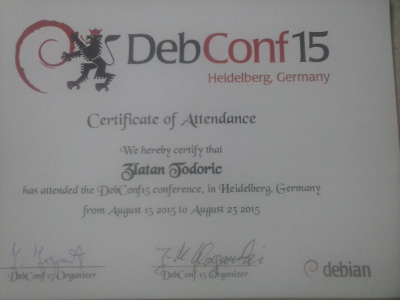
Zlatan Todori : The big life adventure called DebConf15

By the help of sponsorship I managed again to attend the conference where Debian family gathers. This is going to be a mix without any particular order of everything, anything and nothing else ;) attendance pic I arrived to Heidelberg Main Train Station around 9am on 15th August and almost right away found Debian people so it made my trip to hostel easier. After arrival I checked in but needed to wait for 3 hours to get the key (it seems that SA will not have that problem at all, which is already an improvement). Although waiting was 3 hours long, it wasn't actually difficult at all as I started hugging and saying hi to many old (the super old super friend of mine - moray, or how I call him, "doc") and new friends. I just must say - if you know or don't know Rhonda, try to get somehow into her hugs. With her hug I acknowledged that I really did arrive to reunion. Read more (14 min remaining to read)

Dimitri John Ledkov: Go enjoy Python3

Given a string, get a truncated string of length up to 12.

The task is ambiguous, as it doesn't say anything about whether or not 12 should include terminating null character or not. None the less, let's see how one would achieve this in various languages.
Let's start with python3

import sys
print(sys.argv[1][:12])

Simple enough, in essence given first argument, print it up to length 12. As an added this also deals with unicode correctly that is if passed arg is , it will correctly print . (note these are just random Unicode strings to me, no idea what they stand for).

In C things are slightly more verbose, but in essence, I am going to use strncpy function:

#include <stdio.h>
#include <string.h>
void main(int argc, char *argv[])
char res[12];
strncpy(res,argv[1],12);
printf("%s\n",res);

This treats things as byte-array instead of unicode, thus for unicode test it will end up printing just . But it is still simple enough.
Finally we have Go
package main

import "os"
import "fmt"
import "math"

func main()
fmt.Printf("%s\n", os.Args[1][:int(math.Min(12, float64(len(os.Args[1]))))])

This similarly treats argument as a byte array, and one needs to cast the argument to a rune to get unicode string handling. But there are quite a few caveats. One cannot take out of bounds slices. Thus a na ve os.Args[1][:12] can result in a runtime panic that slice bounds are out of range. Or if a string is known at compile time, a compile time error. Hence one needs to calculate length, and do a min comparison. And there lies the next caveat, math.Min() is only defined for float64 type, and slice indexes can only be integers and thus we end up writing ]))))])...

12 points for python3, 8 points for C, and Go receives nul points Eurovision style.

EDIT: Andreas R ssland and James Hunt are full of win. Both suggesting fmt.Printf("%.12s\n", os.Args[1]) for go. I like that a lot, as it gives simplicity & readability without compromising the default safety against out of bounds access. Hence the scores are now: 14 points for Go, 12 points for python3 and 8 points for C.

EDIT2: I was pointed out much better C implementation by Keith Thompson - http://pastebin.com/5i7rFmMQ in essence it uses strncat() which has much better null termination semantics. And Ben posted a C implementation which handles wide characters http://www.decadent.org.uk/ben/blog/truncating-a-string-in-c.html. I regret to inform you that this blog post got syndicated onto hacker news and has now become the top viewed post on my blog of all time, overnight. In retrospect, I regret awarding points at the end of the blog post, as that's just was merely an expression of opinion and is highly subjective measure. But this problem statement did originate from me reviewing go code that did "if/then/else" comparison and got it wrong to truncate a string and I thought surely one can just do [:12] which has lead me down the rabbit hole of discovering a lot about Go; it's compile and runtime out of bounds access safeguards; lack of universal Min() function; runes vs strings handling and so on. I'm only a beginner go programmer and I am very sorry for wasting everyone's time on this. I guess people didn't have much to do on a Throwback Thursday.

The postings on this site are my own and don't necessarily represent Intel s positions, strategies, or opinions.

Lucas Nussbaum: DebConf 15

I attended DebConf 15 last week. After being on semi-vacation from Debian for the last few months, recovering after the end of my second DPL term, it was great to be active again, talk to many people, and go back to doing technical work. Unfortunately, I caught the debbug quite early in the week, so I was not able to make it as intense as I wanted, but it was great nevertheless. I still managed to do quite a lot: DC15 was a great DebConf, probably one of the two bests I ve attended so far. I m now looking forward to DC16 in Cape Town!

Ben Hutchings: Securing debcheckout of git repositories

Some source packages have Vcs-Git URLs using the git: scheme, which is plain-text and unauthenticated. It's probably harder to MITM than HTTP, but still we can do better than this even for anonymous checkouts. git is now nearly as efficient at cloning/pulling over HTTP-S, so why not make that the default? Adding the following lines to ~/.gitconfig will make git consistently use HTTP-S to access Alioth. It's not quite HTTPS-Everywhere, but it's a step in that direction:
[url "https://anonscm.debian.org/git/"]
	insteadOf = git://anonscm.debian.org/
	insteadOf = git://git.debian.org/
Additionally you can automatically fix up the push URL in case you have or are later given commit access to the repository on Alioth:
[url "git+ssh://git.debian.org/git/"]
	pushInsteadOf = git://anonscm.debian.org/
	pushInsteadOf = git://git.debian.org/
Similar for git.kernel.org:
[url "https://git.kernel.org/pub/scm/"]
	insteadOf = git://git.kernel.org/pub/scm/
[url "git+ssh://ra.kernel.org/pub/scm/"]
	pushInsteadOf = git://git.kernel.org/pub/scm/
RTFM for more information on these configuration variables.

Ben Hutchings: Securing git imap-send in Debian

I usually send patches from git via git imap-send, which gives me a chance to edit and save them through my regular mail client. Obviously I want to make a secure connection to the IMAP server. The upstream code now supports doing this with OpenSSL, but git is under GPL and it seems that not all relevant contributors have given the extra permission to link with OpenSSL. So in Debian you still need to use an external program to provide a TLS tunnel. The commonly used TLS tunnelling programs, openssl s_client and stunnel, do not validate server certificates in a useful way - at least by default. Here's how I've configured git imap-send and stunnel to properly validate the server certificate. If you use the PLAIN or LOGIN authentication method with the server, you will still see the warning:
*** IMAP Warning *** Password is being sent in the clear
The server does see the clear-text password, but it is encrypted on the wire and git imap-send just doesn't know that. ~/.gitconfig
[imap]
	user = ben
	folder = "drafts"
	tunnel = "stunnel ~/.git-imap-send/stunnel.conf"
~/.git-imap-send/stunnel.conf
debug = 3
foreground = yes
client = yes
connect = mail.decadent.org.uk:993
sslVersion = TLSv1.2
renegotiation = no
verify = 2
; Current CA for the IMAP server.
; If you don't want to pin to a specific CA certificate, use
; /etc/ssl/certs/ca-certificates.crt instead.
CAfile = /etc/ssl/certs/StartCom_Certification_Authority.pem
checkHost = mail.decadent.org.uk
If stunnel chokes on the checkHost variable, it doesn't support certificate name validation. Unfortunately no Debian stable release has this feature - only testing/unstable. I'm wondering whether it would be worthwhile to backport it or even to make a stable update to add this important security feature.

27 August 2015

Norbert Preining: Kobo Japanese Dictionary Enhancer 1.1

Lots of releases in quick succession the new Kobo Japanese Dictionary Enhancer brings multi-dictionary support and merged translation support. Using the Wadoku project s edict2 database we can now add also German translations. kobo-japanese-dictionary-enhancer Looking at the numbers, we have now 326064 translated entries when using the English edict2, and 368943 translated entries when using the German Wadoku edict version. And more than that, as an extra feature it is now also possible to have merged translations, so to have both German and English translations added. kobo-dict-de-en Please head over to the main page of the project for details and download instructions. If you need my help in creating the updated dictionary, please feel free to contact me. Enjoy.

Alexander Wirt: Basic support for SSO Client certificates on paste.debian.net

Sometimes waiting for a delayed flight helps to implement things. I added some basic support for the new Debian SSO Client Certificate feature to paste.debian.net. If you are using such a certificate most anti-spam restrictions, code limitations and so on won t count for you anymore.

Ritesh Raj Sarraf: Laptop Mode Tools - 1.68

I am please to announce the release of Laptop Mode Tools, version 1.68. This release is mainly focused on integration with the newer init system, systemd. Without the help from the awesome Debian systemd maintainers, this would not have been possible. Thank you folks. While the focus now is on systemd, LMT will still support the older SysV Init. With this new release, there are some new files: laptop-mode.service, laptop-mode.timer and lmt-poll.service. All the files should be documented well enough for users. lmt-poll.service is the equivalent of the module battery-level-polling, should you need it. Filtered git log:
1.68 - Thu Aug 27 22:36:43 IST 2015
    * Fix all instances for BATTERY_LEVEL_POLLING
    * Group kill the polling daemon so that its child process get the same signal
    * Release the descriptor explicitly
    * Add identifier about who's our parent
    * Narrow down our power_supply subsystem event check condition
    * Fine tune the .service file
    * On my ultrabook, AC as reported as ACAD
    * Enhance lmt-udev to better work with systemd
    * Add a timer based polling for LMT. It is the equivalent of battery-polling-daemon,
      using systemd
    * Disable battery level polling by default, because most systems will have systemd running
    * Add documentation reference in systemd files
The md5 checksum for the tarball is 15edf643990e08deaebebf66b128b270

Categories:

Keywords:

Like:

Next.

Previous.