Search Results: "mak"

23 December 2010

Julien Viard de Galbert: Triage X Bugs of the Christmas Week (TXBW7)

For some reason1 bug #607242 did not make it to the debian-x@d.o mailing list, I got aware of it only by the message shirish sent to my blog.
If he didn t write to me, this bug will have waited for what about 3 years until I got all the 800+ bugs triaged ? So please you can help triaging X bugs, first subscribe to the debian-x mailing list so you can get the feeling of what to respond to some bugs, and join the TXBW effort ;) The X Strike Force (still) needs you ! You can have a look at the X Strike Force Bug Closing Procedure and check XSF unstable bugs sorted by date. Note 1: The Xorg.0.log file was so huge that the mailing list did not accept the mail.

Raphaël Hertzog: People behind Debian: Mehdi Dogguy, release assistant

Mehdi Dogguy

Picture of Mehdi taken by Antoine Madet

Mehdi is a Debian developer for a bit more than a year, and he s already part of the Debian Release Team. His story is quite typical in that he started there by trying to help while observing the team do its work. That s a recurrent pattern for people who get co-opted in free software teams. Read on for more info about the release team, and Mehdi s opinion on many topics. My questions are in bold, the rest is by Mehdi (except for the additional information that I inserted in italics). Who are you? I m 27 years old. I grew up in Ariana in northern Tunisia, but have been living in Paris, France, since 2002. I m a PhD Student at the PPS laboratory where I study synchronous concurrent process calculi. I became interested in Debian when I saw one of my colleagues, Samuel Mimram (first sponsor and advocate) trying to resolve #440469, which is a bug reported against a program I wrote. We have never been able to resolve it but my intent to contribute was born there. Since then, I started to maintain some packages and help where I can. What s your biggest achievement within Debian? I don t think I had time to accomplish a lot yet :) I ve been mostly active in the OCaml team where we designed a tool to compute automatically the dependencies between OCaml packages, called dh-ocaml. This was a joint work with St phane Glondu, Sylvain Le Gall and Stefano Zacchiroli. I really appreciated the time spent with them while developing dh-ocaml. Some of the bits included in dh-ocaml have been included upstream in their latest release. I ve also tried to give a second life to the Buildd Status Pages because they were (kind of) abandoned. I intend to keep them alive and add new features to them. If you had a wand and could change one thing in Debian, what would that be? Make OCaml part of a default Debian installation :D But, since I m not a magician yet, I d stick to more realistic plans:
  1. A lot of desktop users fear Debian. I think that the Desktop installation offered by Debian today is very user-friendly and we should be able to attract more and more desktop users. Still, there is some work to be done in various places to make it even more attractive. The idea is trying to enhance the usability and integration of various tools together. Each fix could be easy or trivial but the final result would be an improved Desktop experience for our users. Our packaged software run well. So, each person can participate since the most difficult part is to find the broken scenarios. Fixes could be found together with maintainers, upstream or other interested people.

    I ll try to come up with a plan, a list of things that need polishing or fixes and gather a group of people to work on it. I d definitely be interested in participating in such a project and I hope that I ll find other people to help. If the plan is clear enough and has well described objectives and criteria, it could be proposed to the Release Team to consider it as a Release Goal for Wheezy.

  2. NMUs are a great way to make things move forward. But, sometimes, an NMU could break things or have some undesirable effects. For now, NMUers have to manually track the package s status for some time to be sure that everything is alright. It could be a good idea to be auto-subscribed to the bugs notifications of NMUed packages for some period of time (let s say for a month) to be aware of any new issues and try to fix them. NMUing a package is not just applying a patch and hitting enter after dput. It s also about making sure that the changes are correct and that no regressions have been introduced, etc

  3. Orphaned packages: It could be considered as too strict and not desired, but what about not keeping orphaned and buggy packages in Testing? What about removing them from the archive if they are buggy and still unmaintained for some period? Our ftp archive is growing. It could make sense to do some (more strict) housekeeping. I believe that this question can be raised during the next QA meeting. We should think about what we want to do with those packages before they rot in the archive.
[Raphael Hertzog: I would like to point out that pts-subscribe provided by devscripts makes it easy to temporarily subscribe to bug notifications after an Non-Maintainer Upload (NMU).] You re a Debian developer since August 2009 and you re already an assistant within the Release Management team. How did that happen and what is this about? In the OCaml team, we have to start a transition each time we upload a new version of the OCaml compiler (actually, for each package). So, some coordination with the Release Team is needed to make the transition happen. When we are ready to upload a new version of the compiler, we ask the Release Team for permission and wait for their ack. Sometimes, their reply is fast (e.g. if their is no conflicting transition running), but it s not always the case. While waiting for an ack, I used to check what was happening on debian-release@l.d.o. It made me more and more interested in the activities of the Release Team. Then (before getting my Debian account), I had the chance to participate in DebConf9 where I met Luk and Phil. It was a good occasion to see more about the tools used by the Release Team. During April 2010, I had some spare time and was able to implement a little tool called Jamie to inspect the relations between transitions. It helps us to quickly see which transitions can run in parallel, or what should wait. And one day (in May 2010, IIRC), I got offered by Adam to join the team. As members of the Release Team, we have multiple areas to work on:
  1. Taking care of transitions during the development cycle, which means making sure that some set of packages are correctly (re-)built or fixed against a specific (to each transition) set of packages, and finding a way to tell Britney that those packages can migrate and it would be great if she also shared the same opinion. [Raphael Hertzog: britney is the name of the software that controls the content of the Testing distribution.]
  2. Paying attention to what is happening in the archive (uploads, reported RC bugs, etc ). The idea is to try to detect unexpected transitions, blocked packages, make sure that RC bug fixes reach Testing in a reasonable period of time, etc
  3. During a freeze, making sure that unblock requests and freeze exceptions are not forgotten and try to make the RC bug count decrease.
There are other tasks that I ll let you discover by joining the game. Deciding what goes (or not) in the next stable release is a big responsibility and can be incredibly difficult at times. You have to make judgement calls all the time. What are your own criteria? That s a very hard to answer question (at least, for me). It really depends on the case . I try to follow the criteria that we publish in each release update. Sometimes, an unblock request doesn t match those criteria and we have to decide what to accept from the set of proposed changes. Generally, new features and non-fixes (read new upstream versions) changes are not the kind of changes that we would accept during the freeze. Some of them could be accepted if they are not intrusive, easy and well defended. When, I m not sure I try to ask other members of the Release Team to see if they share my opinion or if I missed something important during the review. The key point is to have a clear idea on what s the benefit of the proposed update, and compare it to the current situation. For example, accepting a new upstream release (even if it fixes some critical bugs) is taking a risk to break other features and that s why we (usually) ask for a backported fix. It s also worth noticing that (most of the time) we don t decide what goes in, but (more specifically) what version of a given package goes in and try to give to the contributors an idea on what kind of changes are acceptable during the freeze. There are some exceptions though. Most of them are to fix a critical package or feature. Do you have plans to improve the release process for Debian Wheezy? We do have plans to improve every bit in Debian. Wheezy will be the best release ever. We just don t know the details yet :) During our last meeting in Paris last October, the Release Team agreed to organize a meeting after Squeeze s release to discuss (among other questions) Wheezy s cycle. But the details of the meeting are not fixed yet (we still have plenty of time to organize it and other more important tasks to care about). We would like to be able to announce a clear roadmap for Wheezy and enhance our communication with the rest of the project. We certainly want to avoid what happened for Squeeze. Making things a bit more predictable for developers is one of our goals. Do you think the Constantly Usable Testing project will help? The original idea by Joey Hess is great because it allows d-i developers to work with a stable version of the archive. It allows them to focus on the new features they want to implement or the parts they want to fix (AIUI). It also allows to have constantly available and working installation images. Then, there is the idea of having a constantly usable Testing for users. The idea seems nice. People tend to like the idea behind CUT because they miss some software disappearing from Testing and because of the long delays for security fixes to reach Testing. If the Release Team has decided to remove a package from Testing, I think that there must be a reason for that. It either means that the software is broken, has unfixed security holes or was asked for the removal by its maintainer. I think that we should better try to spend some time to fix those packages, instead of throwing a broken version in a new suite. It could be argued that one could add experimental s version in CUT (or sid s) but every user is free to cherry-pick packages from the relevant suite when needed while still following Testing as a default branch. Besides, it s quite easy to see what was removed recently by checking the archive of debian-testing-changes or by querying UDD. IMO, It would be more useful to provide a better interface of that archive for our users. We could even imagine a program that alerts the user about installed software that got recently removed from Testing, to keep the user constantly aware any issue that could affect his machine. About the security or important updates, one has to recall the existence of Testing-security and testing-proposed-updates that are used specifically to let fixes reach Testing as soon as possible when it s not possible to go through Unstable. I m sure that the security team would appreciate some help to deal with security updates for Testing. We also have ways to speed migrate packages from Unstable to Testing. I have to admit that I m not convinced yet by the benefits brought by CUT for our users.
Thank you to Mehdi for the time spent answering my questions. I hope you enjoyed reading his answers as I did. Subscribe to my newsletter to get my monthly summary of the Debian/Ubuntu news and to not miss further interviews. You can also follow along on Identi.ca, Twitter and Facebook.

2 comments Liked this article? Click here. My blog is Flattr-enabled.

22 December 2010

Andrew Pollock: [tech] Find of the day: pianobar

Cube-mate and friend, Kynan, put me on to pianobar today. This thing is 100% sheer awesome. A console Pandora client! No longer do I have to find the browser tab that Pandora is running in to pause it, or to see what the hell it is I'm listening to. Nor do I need to worry about Flash crashing. It's also extensible in that it can call out to an external program for various events, such as starting a new song. This makes desktop notifications of what the hell you're listening to trivial. It'll also read commands from a named pipe, so at work, where I have this crazy Microsoft Natural Keyboard with all sorts of multimedia keys, I've set up evrouter (which isn't in Debian for some strange reason) so that I can pause, skip and like/dislike using my keyboard (regardless of what application I'm in). So I can just kick off pianobar in a terminal somewhere and forget about it. This is so cool. Interestingly, it also doesn't play any advertising, so I've finally pulled my finger out and paid for a Pandora One account. Overall, this makes for a fantastic desktop Pandora client. Now I just need to figure out why I get weird HTTP errors from it at home...

Petter Reinholdtsen: How to test if a laptop is working with Linux

The last few days I have spent at work here at the University of oslo testing if the new batch of computers will work with Linux. Every year for the last few years the university have organized shared bid of a few thousand computers, and this year HP won the bid. Two different desktops and five different laptops are on the list this year. We in the UNIX group want to know which one of these computers work well with RHEL and Ubuntu, the two Linux distributions we currently handle at the university. My test method is simple, and I share it here to get feedback and perhaps inspire others to test hardware as well. To test, I PXE install the OS version of choice, and log in as my normal user and run a few applications and plug in selected pieces of hardware. When something fail, I make a note about this in the test matrix and move on. If I have some spare time I try to report the bug to the OS vendor, but as I only have the machines for a short time, I rarely have the time to do this for all the problems I find. Anyway, to get to the point of this post. Here is the simple tests I perform on a new model. By now I suspect you are really curious what the test results are for the HP machines I am testing. I'm not done yet, so I will report the test results later. For now I can report that HP 8100 Elite work fine, and hibernation fail with HP EliteBook 8440p on Ubuntu Lucid, and audio fail on RHEL6. Ubuntu Maverik worked with 8440p. As you can see, I have most machines left to test. One interesting observation is that Ubuntu Lucid has almost twice the framerate than RHEL6 with glxgears. No idea why.

Jonathan McDowell: Why Linux? (Part 4: Package Management)

(This is part of a series of posts on Why Linux?) I've run a number of distros in my time. I ended up on Debian near the end of 1999, and part of the drive for that was the number of packages available in one centralised location. Decent package management is a definite strength of Linux (or FreeBSD) over proprietary operating systems. It derives from the freedom aspect, but means you can end up with one source for all (or most) of your software, that's compiled against the same set of libraries, with one way to track what owns what. This may not seem like a big thing, especially if you're a hobbyist or are coming from a Windows background. Reinstalling is often seen as a necessary regular requirement. Personally I've got better things to do with my time. If I want to try out a piece of software I want to be able to install it safe in the knowledge I know exactly what files it owns and where there are. And I want it to be able to tell me what other common components it needs that I might not already have. Then if I decide it's not for me I can cleanly remove it and anything else it pulled in that I no longer need. Don't underestimate this. This is useful on all of my machines. I can query the version number of everything installed. I can check for updates with one command (no need for every piece of installed software to have its own updater implementation). Software can share libraries correctly rather than stashing their own private copies, meaning I get bug fixes and security updates. (Yes, sometimes authors bundle even in the Linux world. Stop it.) I'm a developer. I tend to interact with a lot of different systems, of different types. It's really handy to have access to a wide range of tools to help me with that, know that there's legally no problem with me installing them, be able to do so with a single command and, should they turn out to be unsuitable, know I can cleanly remove them with another single command. This is a definite win in the work context. Equally I've been a sysadmin for multiple machines at once. Being able to login to each of them and check that everything is up to date is damn handy. Being able to easily install software for customers tends to make you popular too. And being able to rebuild boxes (or build additional boxes to share load) with the same setup is a lot easier with a decent package manager too. And, to pre-empt any responses about how a lot of this is possible under, say, Windows, yes, it is. I've spent some time in the past building packages for commercial deployment using Novadigm's Radia tool. I'm aware that Windows integral package management has also got better over time. I still think dpkg/apt (or rpm/yum) is far more powerful. And, for the end user, mostly easier as well - distros are building pre-prepared packages for you, rather than you having to do it yourself like with Radia.

21 December 2010

Christian Perrier: German and French localization reach 100% for po-debconf

As of tonight, all translatable debconf templates for packages in squeeze are translated in German and French, after udev entered testing. Both teams are very happy to join the Russian team who was the very first to reach that goal on November 5th. Unfortunately, for our Russian friends, debian-edu-config is currently missing for them now. We of course hope for Debian Edu developers to correct this before squeeze. The Swedish team should join the 100% gang as soon as recently uploaded console-setup reaches testing. The Portuguese team is now only missing two complete packages to reach that 100%: sympa and (again) udev. udev is likely to be updated but, unfortunately, this is much less sure for sympa. The Czech team is only missing bugzilla. Again, unfortunately, that package needs an upload to testing-proposed-updates (that should fix and RC bug) and I am technically unable to do it (and the maintainer is apparently not motivated for doing it, arguing that a more recent upstream version should go in instead, which is unacceptable for the release team). The Spanish team made a great effort, but I'm not sure that the 16 packages they're missing will make it. Next time, folks! Full list for the "7 languages trying to reach 100%" at http://i18n.debian.net/debian-l10n/l10n-testing.txt

Andreas Metzler: exim testers

I would appreciate if you could test the proposed fixes for the exim4 privilege escalation bug CVE-2010-4345. Preliminary binary and source packages for squeeze/sid and lenny are available here:
deb http://www.bebt.de/debian/ sid exim4+cve
deb-src http://www.bebt.de/debian/ sid exim4+cve
deb http://www.bebt.de/debian/ lenny exim4+cve
deb-src http://www.bebt.de/debian/ lenny exim4+cve
You can also browse the changes in SVN (lenny and sid) or build your own binaries.
Changelog: NEWS entry: Exim versions up to and including 4.72 are vulnerable to CVE-2010-4345. This is a privilege escalation issue that allows the exim user to gain root privileges by specifying an alternate configuration file using the -C option. The macro override facility (-D) might also be misused for this purpose. In reaction to this security vulnerability upstream has made a number of user visible changes. This package includes these changes. If exim is invoked with the -C or -D option the daemon will not regain root privileges though re-execution. This is usually necessary for local delivery, though. Therefore it is generally not possible anymore to run an exim daemon with -D or -C options. However this version of exim has been built with TRUSTED_CONFIG_LIST=/etc/exim4/trusted_configs. TRUSTED_CONFIG_LIST defines a list of configuration files which are trusted; if a config file is owned by root and matches a pathname in the list, then it may be invoked by the Exim build-time user without Exim relinquishing root privileges. As a hotfix to not break existing installations of mailscanner we have also set WHITELIST_D_MACROS=OUTGOING. i.e. it is still possible to start exim with -DOUTGOING while being able to do local deliveries. If you previously were using -D switches you will need to change your setup to use a separate configuration file. The ".include" mechanism makes this easy. The system filter is run as exim_user instead of root by default. If your setup requies root privileges when running the system filter you will need to set the system_filter_user exim main configuration option.

Lars Wirzenius: On PDF restrictions and software freedom

Recently on IRC the issue of PDF's usage restrictions flags came up again. Should free software implement them? Here's my take on this. It is unethical for software to restrict what I can do with a PDF file that I have. The PDF format allows, for example, the creator to set a flag that prevents the user from saving a copy of the file. That is not a power that the creator should have, and it is wrong for software to implement the feature. Now, I'm fine with software implementing it as a suggestion: "the creator of the document would prefer it if you didn't save a copy of this file". Preventing the user from saving a copy, however, is not acceptable. I would welcome a Debian policy change to make software that implements these PDF features, or any other form of DRM, in a manner that makes them more than suggestions, unsuitable for the main part of the archive. Such software should go into non-free. Software that is used to directly undermine people's freedom should not be considered pro-freedom, even if it licensed using a DFSG-free license.

20 December 2010

Dirk Eddelbuettel: Rcpp 0.9.0 and RcppClassic 0.9.0

A new release 0.9.0 of Rcpp is now available at CRAN and has just been uploaded to Debian. As always, sources are also available from my local directory here. With this release, the older API which we have been referring to as the classic Rcpp API has been split off into its own new package RcppClassic to ensure backwards compatibility. Rcpp will now contain only the new API. We also fixes a number a minor bugs and applied a few contributed patches which extended functionality or documentation as detailed below in the NEWS entry:
0.9.0   2010-12-19
    o   The classic API was factored out into its own package RcppClassic which
        is released concurrently with this version.
    o   If an object is created but not initialized, attempting to use
        it now gives a more sensible error message (by forwarding an
        Rcpp::not_initialized exception to R).
    o   SubMatrix fixed, and Matrix types now have a nested ::Sub typedef.
  
    o   New unexported function SHLIB() to aid in creating a shared library on
        the command-line or in Makefile (similar to CxxFlags() / LdFlags()).
    o   Module gets a seven-argument ctor thanks to a patch from Tama Ma.
    o   The (still incomplete) QuickRef vignette has grown thanks to a patch
        by Christian Gunning.
    o   Added a sprintf template intended for logging and error messages.
    o   Date::getYear() corrected (where addition of 1900 was not called for); 
        corresponding change in constructor from three ints made as well.
    o   Date() and Datetime() constructors from string received a missing
        conversion to int and double following strptime. The default format
        string for the Datetime() strptime call was also corrected.
    o   A few minor fixes throughout, see ChangeLog.
Thanks to CRANberries, there is also a diff to the previous release 0.8.9. As always, even fuller details are on the Rcpp Changelog page and the Rcpp page which also leads to the downloads, the browseable doxygen docs and zip files of doxygen output for the standard formats. A local directory has source and documentation too. Questions, comments etc should go to the rcpp-devel mailing list off the R-Forge page

19 December 2010

Andrew Pollock: [life] Why Sarah's 30th birthday is a Big Deal

We had a small celebration with friends at our local Italian restaurant, Mario's Italiano today, to mark Sarah's 30th birthday. The reason this milestone is a big deal is because, to put it simply, two of her direct ancestors didn't make it to it. The undetermined genetic connective tissue disorder that Sarah has, claimed the lives of her father and paternal aunt when they were both in their twenties, suddenly and two weeks apart from each other. The case made the journal of the American College of Chest Physicians at the time. We're just very fortunate that with advances in medical diagnostic and surgical technology, Sarah was able to be diagnosed and have her aortic aneurysm repaired before it dissected. So there's the heart thing. That's a big deal. Then there's all the other crap that she's had to go through in only thirty years of life. She's had to endure more tragedies and medical challenges than some people have to go through in a lifetime. The fact that she's still such a happy, positive person is a testament to just what an amazing person she is, and it is an honour to be able to call her my wife. So happy birthday Sarah, here's to the next thirty years being a whole lot less eventful than the first thirty, and the last three in particular. Sarah and Zoe

Francois Marier: Peer-to-peer video-conferencing using free software

I was looking for a simple free software solution which would allow me to have a video call with someone else (I don't care about sound since I've already got that working through Asterisk) and I ended up writing a Gstreamer-based poor man's videoconf solution because I wasn't satisfied with the other options I considered.

EmpathyEmpathy was my first choice since it seems to be the preferred GNOME communication software nowadays.

While the quality of the video was excellent, the latency between New Zealand and Canada was unbearable: a full 6 seconds. I suspect that this is due to the fact that it runs everything through the Google Talk STUN server and I couldn't find how to force it to go directly from one host to the other.

EkigaEkiga was my second choice since I had used it succesfully in the past.

It was not too bad latency-wise, but the quality of the video was not as good as Empathy (it was smaller and choppier). Also, given that it was running over SIP, it was interfering with my VoIP phone.

Direct peer-to-peer streamingGiven that I wasn't gonna use the voice features of these video-conference tools, I figured that there must be an easy way to just stream video from one peer to the other. That's when I thought of looking into Gstreamer (apt-get install gstreamer0.10-tools on Debian/Ubuntu).

To stream video from my webcam onto port 5000, I ran:

gst-launch v4l2src device=/dev/video0 ! videorate ! video/x-raw-yuv,width=640,height=480,framerate=6/1 ! jpegenc quality=30 ! multipartmux ! tcpserversink port=5000

which is the best I could do within 85 kbps (100-120 kbps is about the maximum reliable synchronous bandwidth I get between New Zealand and Canada):On the other computer, I simply ran this to connect and display the remote stream:

gst-launch tcpclientsrc host=stream.example.com port=5000 ! multipartdemux ! jpegdec ! autovideosink

Then I swapped the roles around to also stream video the other way around. That's it: two-way peer-to-peer video link!

Small tweaks to the Gstreamer pipelineThere are quite a few plugins that can be used within Gstreamer pipelines.

If you have problems with autovideosink refusing to load (I did on one of the two computers), you can also install the gstreamer0.10-sdl package and replace autovideosink with sdlvideosink:

gst-launch tcpclientsrc host=example.com port=5000 ! multipartdemux ! jpegdec ! sdlvideosink

Another change I had to make on one of the machines was to flip the image coming out of the webcam (which insists on giving me a mirror image instead of acting like a real camera):

gst-launch v4l2src device=/dev/video0 ! videorate ! video/x-raw-yuv,width=640,height=480,framerate=6/1 ! videoflip method=horizontal-flip ! jpegenc quality=30 ! multipartmux ! tcpserversink port=5000

Possible improvementsI got down to about 1-2 seconds of latency, which isn't bad considering the processing to be done and the distance bits have to travel, but I would love to further reduce this.

Using jpegenc was a lot better than theoraenc which added an extra 3-4 seconds of latency. Is there a better codec I should be using?

Another thing I thought of trying was to switch from TCP to UDP. I'm currently using tcpserversink and tcpclientsrc but since I don't care about having a few dropped frames, maybe I should look into the udp and rtp plugins. It seems like it might help but it also seems to be quite a bit more complicated and I have yet to find an easy way to make use of the RTP stack in Gstreamer.

Please feel free leave a comment if you can suggest ways of improving my quick 'n dirty solution.

18 December 2010

Russell Coker: Locked Down Phones and Horrible Telcos

Choosing a PhoneI was considering renewing my Three contract and getting a HTC Desire HD [1]. What I need is a phone that is good for being a ssh client on 3G networks, has a good camera, and has all the fancy Google Apps.In the comments Lon recommended a Norwegian review of phone cameras which gave the Sony Ericsson Xperia X10 a much better review than the HTC Desire HD [2] the Xperia was the highest rating Android camera phone while the Nokia N8 was the best overall.Also the Xperia is a lot cheaper, I can get it on a $29 monthly cap from Virgin as opposed to $44 per month from Three. So just on hardware and price the Xperia beats the Desire HD.One of the advantages of the Xperia from Virgin being cheap is that my wife and I can use the same model of phone. This avoids having to solve two sets of phone related problems and also allows us to do things like swap batteries between the phones based on who can most conveniently charge their phone.The Need for RootBut one problem with e Xperia is that the CyanogenMod images for rooted Android phones can t be installed on an Xperia because the boot loader hasn t yet been cracked [3]. I would like to run CyanogenMod so I can get wireless proxy support, and support for tunneling IP over DNS, ICMP, and OpenVPN.The Three web site claims that they have 3G phone and net access in Bendigo, but on a recent holiday my phone said that it was roaming all the time and I couldn t get net access. I ended up having to use McDonalds Wifi net access which had ports such as 22 blocked and thus forced me to use Iodine IP over DNS to get proper net access. To avoid having to talk my mother through rebooting servers in future I need to have a mobile ssh client that can use all possible protocols. I could carry my EeePC with me all the time, but sometimes it s good to travel light.OTOH, as I feel compelled to fiddle with all my computers it would probably give me a more reliable mobile experience if I was unable to mess with my phone.Why Buying a Phone Outright Isn t ViableA $29 monthly plan is probably the cheapest plan that will do for anyone who uses a phone regularly, I have had a Three $29 plan for the last four years which allows up to $150 of calls to be made in a month and typically use about $60. So any plan which doesn t have such a cap will have to be no more than half the price of Three on a per-minute basis to compete. If I m going to pay $29 per month ($696 over a 24 month contract) then I can use a free phone. If I was to buy a phone then it would cost at least $500 for anything that I like and maybe a lot more.Buying a phone independently of a contract would about double the cost of owning a phone. It s really not a viable option.Therefore I am compelled to buy a phone that is on offer from a Telco. Things like the Nokia N900 are nice devices but as the Telcos don t offer them I can t consider them.No Discount if you Don t get a PhoneThe annoying thing is that the Telcos don t offer a discount if you choose not to get a phone. Obviously buying the hardware costs them some money, so a $29 cap with a phone included should have a matching offer of something less than $29 if you choose not to get the phone from them. I currently have a $29 per month contract with Three, I can renew that for another two years at the same rate and get a half-decent phone for free or I can renew for two years on a $19 per month contract and get a low-end phone for free but I can t get a price that is lower than $19 per month if I decide to keep my current phone.If Three was to offer such a discount then I would consider buying a phone outright over the net and staying with them. But as it is they don t provide good deals for buying a phone and give me an economic incentive to go to another provider. So I will probably use Virgin when my contract runs out in January.Locked PhonesMany Telcos still sell locked phones on a contract. When that happens it s really difficult to get a phone unlocked as the Telco employees usually aren t very helpful. There are a variety of web sites claiming to generate unlock codes for phones, most seem to charge $10 or more for this service and the free ones have a very small range of phones, so getting the unlock code from the Telco seems to be the only option for a phone at the end of it s contract period as it s not worth enough to justify the $10 expense.While some Telcos sell unlocked phones on plans the ones that lock their phones have a chilling effect on the industry. Most people don t test whether their old phone can be used with a different provider they just throw it out the phone stores conveniently provide bins for old phones that are apparently recycled for some good cause.ConclusionIf you make serious use of mobile phones (EG being ready to fix errors reported by Nagios 24*7) then choosing a new phone and plan is one of the most difficult things there is to do. All the plans are quite complicated and every Telco offers a different set of phones. The Telco web sites are usually poorly done, most of them don t have an option to search for Android phones or for phones with a certain minimum resolution they usually don t even state the resolution and use terms such as WQVGA which don t even have a fixed meaning in pixels. When it comes to choosing a plan most Telcos don t have a clear comparison of the different plans, writing your own spreadsheet comparing plan costs is a good idea.The fact that Telcos such as Virgin and Three/Vodaphone allow free calls to other people using the same company makes it even more tricky. I have to discuss my phone plans with several relatives as there is a good incentive for everyone to use the same provider.I think that we need government regulation on the way that phones are bundled. The market for phones that aren t associated with Telco contracts has been destroyed by the anti-competitive behavior of the Telcos.

Jonathan McDowell: Why Linux? (Part 3: It's cheap)

(This is part of a series of posts on Why Linux?) Linux, to me as an end user, is cheap. Even taking into account the fact most PCs come with a Windows licence included it's still cheaper for me to run Linux. I paid Steve minimal amounts for my first set of Debian install CDs. These days I can burn my own netinst CDs and pull the rest over the internet. I legally have access to a tremendous range of excellent software, for nothing. All the apps I need are available without having to shell out more. How is that not awesome? I get free updates, both for bugs and also for major features. I'm not left with the option of paying lots of money for the latest and greatest, or dealing with an unsupported old release with known bugs. The counter argument from my Windows using friends is often about how they didn't pay for their Windows updates nor their copy of Office. I'm unimpressed with anyone who tells me Windows is a better option, but is unprepared to pay for it. If you have to illegally obtain it in order for it to compete with Linux then you're not really comparing on equal terms, are you? Also don't tell me that Free software takes away jobs from software engineers and then pirate software, eh? Cost isn't just about the money though. I've put many hours into being involved in Debian. I've provided project resources when I was in a position to do so. I've contributed to the Linux kernel. Not quite the same as paying for it, but I think does indicate that I'm trying to give back a little too. I also accept that at an organisational level the basic cost of the software licences is often negligible compared to things like hardware, training and support. I still think cost is a compelling argument for the home user, and for decisions at an organisational level. As mentioned I realise there are issues with training and support, but I don't believe these costs are any higher than for alternative OSes. Linux also makes it remarkably easy to remotely administer machines, and perform common actions across an entire installed estate, without needing extra bolt ons from 3rd parties. Cost doesn't provide sufficient justification for an individual desktop in an organisation that has site licences for an alternative however (and in fact running Linux requires extra work on my part to do the install and maintenance compared to allowing central IT to manage my machine). So that's not a good enough reason.

Joey Hess: dadagoogoo

The Google books ngram datasets are a nice resource for playing with text generation. I've created a program that will, given a starting phrase, blather on by connecting phrases from the datasets. The results are much more varied, and seem to more often make sense than most Markov text generators I've seen before, such as dadadodo. It had better be -- it's working with data derived from 4% of all books ever written! Some examples. Do they tell a story? (The starting phrase I entered is in italics.) I have cheated slightly by picking where to stop quoting the blather each time. It tends to go on for quite a while otherwise. Although it often does manage some kind of sense at length too:
This was accomplished using only 99 lines of code. I imported the datasets into Xapian databases using this program. And this program is the text generator. I threw out the metadata, to keep the Xapian databases of reasonable size. By which I mean, only a dozen gigabytes. It might be interesting to include the publication year data in Xapian, so that it could prefer ngrams that were published around the same time as the input text. I'm still importing data. I may put up a web interface later if there's interest. PS: PPS:

Felipe Sateler: CDBS -- An introduction

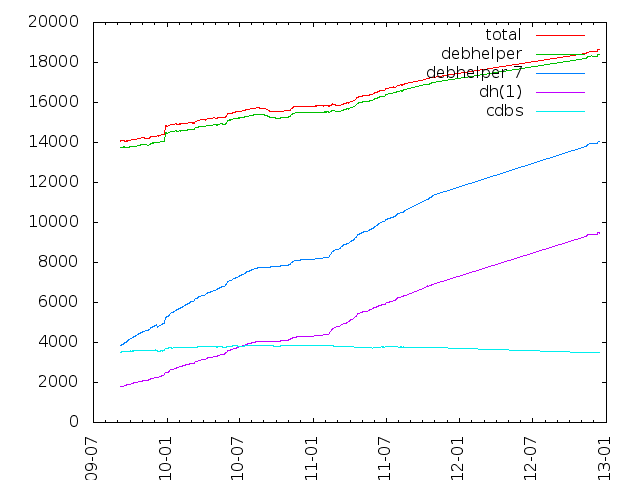
It seems the current trend is to use short-form dh. Some people have even thought that dh has superseded CDBS. Since I prefer CDBS for my own packaging, I will say that no, CDBS is not being deprecated and in fact has been active. Packaging with CDBS is very simple. I'll try to explain how it works, and how to package with it. This may turn into a blog post series, but I won't promise anything.

CDBS is a set of makefiles that do several tasks that are common while packaging software, so that you don't have to repeat them over and over on each package. The makefiles are classified into 2 groups: classes and rules. Classes implement the rules required for building and installing software. These are classes because they can and do inherit from others. For example, there is the makefile class, and the autotools, qmake and cmake classes inherit from it, and the gnome and kde (which is for kde 3) classes inherits from the autotools class. Rules implement several other general purpose rules that don't depend on the toolchain used to build the package. For example, there is the debhelper rules file, which takes care of creating the debian package using the usual dh_* commands. There are several rules files which do all sorts of useful stuff, from running license checks to downloading new upstream releases. If this post transforms into a series, we may look into some of them. For now, I'll demonstrate how to use CDBS to package some simple software (only the debian/rules file, of course).

The first task while running creating debian/rules is determining which build system the software uses. I will use qutecsound package as a guide. So, first things first, we start using CDBS!
#!/usr/bin/make -f

# Uncomment this to turn on verbose mode.
#export DH_VERBOSE=1

include /usr/share/cdbs/1/rules/debhelper.mk
include /usr/share/cdbs/1/class/qmake.mk


Now this would be all that is required if qutecsound where a standard qmake package where nothing needs to be customized. Alas, this is not the case. First, there are some variables that need to be passed to qmake to appropriately configure the build. Also, the projects .pro file is not standard-named. How do we fix this? The CDBS way of overriding this kind of behavior is through the use of variables. Since we are using the qmake class, we will be overriding variables named DEB_QMAKE_*:
DEB_QMAKE_CONFIG_VAL += build64
DEB_QMAKE_ARGS = qcs.pro


We add a configuration value (because CDBS is setting other config values), and we set the extra arguments to qmake.

Now, there is a problem: the resulting binary is not created with the name we want. How do we change that? We could patch the source to avoid that, but it is far easier to add a rule to the makefile to do that. We will modify the build to rename the file at the end (and then clean it up on clean because the upstream makefile will not spot it):
build/qutecsound::
[ -f bin/qutecsound ] mv bin/qutecsound-d bin/qutecsound

clean::
rm -f bin/qutecsound


So what did we just do? We extended the build and clean rules with extra stuff to do. In CDBS each package listed in debian/control gets a build/package rule (and several others at different stages of the build) so that one can add stuff specific to each package (this will be much more useful when dpkg finally learns about build-arch and build-indep).

For the final touch, we want to do a few more things. First, we want to ensure that we are using QT4's qmake, because the build will fail if QT3's is used. Second, since I created a manpage for the command, I want to install it. Finally, we want to use parallel building when the user has specified it, to build the project faster. How to do that? Again, via variables:
QMAKE = qmake-qt4
DEB_BUILD_PARALLEL = 1
DEB_INSTALL_MANPAGES_qutecsound = debian/qutecsound.1


CDBS creates several variables for each of the packages listed in debian/control, so we can customize each package build. In our case, this variable is passed to dh_installman from the debhelper rules file (CDBS will invoke the debhelper tools once for each binary package).

After all this we now have the complete debian/rules of a relatively simple package. How does it look like? Like this:
#!/usr/bin/make -f

# Uncomment this to turn on verbose mode.
#export DH_VERBOSE=1

include /usr/share/cdbs/1/rules/debhelper.mk
include /usr/share/cdbs/1/class/qmake.mk

QMAKE = qmake-qt4
DEB_QMAKE_CONFIG_VAL += build64
DEB_QMAKE_ARGS = qcs.pro
DEB_BUILD_PARALLEL = 1

DEB_INSTALL_MANPAGES_qutecsound = debian/qutecsound.1

build/qutecsound::
[ -f bin/qutecsound ] mv bin/qutecsound-d bin/qutecsound

clean::
rm -f bin/qutecsound

Tags: cdbs, packaging

Dirk Eddelbuettel: Introduction to ESS: talk and slides

We had another meeting of the Chicago R User Group last evening. This was scheduled somewhat belatedly once we learned that Drew Conway would be in town. Drew gave a very nice talk about his brand new infochimps package (for accessing the eponymous infochimps data service and marketplace). Slides are available on Drew's blog. In fact, he had already blogged about his talk before I had even started to write my slides... The user group meetings have a meme of showing how to use R with different editors, UIs, IDEs,... It started with a presentation on Eclipse and its StatET plugin. So a while ago I had offered to present on ESS, the wonderful Emacs mode for R (and as well as SAS, Stata, BUGS, JAGS, ...). And now I owe a big thanks to the ESS Core team for keeping all their documentation, talks, papers etc in their SVN archive, and particularly to Stephen Eglen for putting the source code to Tony Rossini's tutorial from useR! 2006 in Vienna there. This allowed me to quickly whip up a few slides though a good part of the presentation did involve a live demo missing from the slides. Again, big thanks to Tony for the old slides and to Stephen for making them accessible when I mentioned the idea of this talk a while back -- it allowed to put this together on short notice. And for those going to useR! 2011 in Warwick next summer, Stephen will present a full three-hour ESS tutorial which will cover ESS in much more detail.

David Welton: Do More Faster: TechStars Lessons to Accelerate Your Startup

<iframe frameborder="0" marginheight="0" marginwidth="0" scrolling="no" src="http://rcm.amazon.com/e/cm?lt1=_blank&amp;bc1=000000&amp;IS2=1&amp;bg1=FFFFFF&amp;fc1=000000&amp;lc1=0000FF&amp;t=dedasys-20&amp;o=1&amp;p=8&amp;l=as1&amp;m=amazon&amp;f=ifr&amp;md=10FE9736YVPPT7A0FBG2&amp;asins=0470929839" style="width: 120px; height: 240px;"></iframe> I got this to read on my trip to Oregon. Initially I was a bit dubious, after reading the chapter headings on Amazon. Indeed, if you read a lot of articles about tech startups, a lot of the material is not particularly novel, and are things that you've already read elsewhere. If, on the other hand, you're looking for a quick introduction to some of the common ideas behind web/tech startups, it's a pretty good list, written by a variety of people, with a lot of practical advice. The list of concepts includes "execution, not ideas", "fail fast", get feedback early", "get a co-founder", and a lot of similar advice that permeates discussions of early stage internet companies. Other people have different tastes, but for me, this passage was a strikingly effective advertisement for living in Boulder, Colorado:

With this as the backdrop, it was natural to make cycling a central part of my work with Everlater's founders, Nate Abbott and Natty Zola. Nate, Natty, and I scheduled regular weekly rides (sometimes several times a week) and while we didn't keep a formal agenda, each ride had a number of topics planned out for us to cover. In this way, we worked through many of the early challenges the business faced as it moved from idea to reality in the course of the summer of 2009. Our typical rides lasted from 60 to 90 minutes during which time we were able to focus on the business without interruption. And while getting some fresh air helps bring perspective, it's hard to avoid thinking about problems in a new way when you're out of the office, surrounded by the beauty of the Boulder foothills while your mind is completely clear. Startups, cycling, mountains... sign me up! Another tidbit I found interesting:

We often talk about the Number One startup killer at TechStars making a product for which there is no interesting market. TechStars accepts just 10 of more than 600 startups that apply and presumably they are among the best. But still, we find that at least one-third of those startups are attempting to build a product that they want, or that no one wants, instead of what the market wants But wait, I thought "execution is everything", and "ideas are worthless". It seems like avoiding bad ideas is potentially worth a whole lot of money in wasted time and energy though, no? The bit about ideas being worthless is a load of crap. The reason there is no market for ideas is that they are not "excludable". There was never a market for lighthouses either, the classic example in economics of a public good. So the government built them, and they were valuable to people operating ships. Ideas for startups may not have a lot of value compared to people executing them well, but to say they are worthless is hyperbole. In any case, though, if you're interested in startups, or especially if you happen to be interested in the TechStars program, it's book full of good advice, even if none of it will come as a revalation to anyone who follows that sort of thing regularly.

17 December 2010

Andrew Pollock: [tech] Probable solution for Pandora 417 errors on Google TV

This has been bugging me ever since we got our Sony Internet TV, and I think I've finally figured out what's going on. Pandora hasn't been working on the Google TV ever since we got it, it just spits out Unexpected HTTP error occurred code: 417 while StartupAsyncTask and that's the end of that. I have vague recollections seeing this on my phone in the past also, but this doesn't appear to be the case any longer. My phone has version 1.5.2 on it, and the TV has 1.0, so I think I see the problem here. I took a full packet capture while starting up Pandora, and it was a lot more revealing. I could see that it was my Squid proxy (I transparently run all HTTP traffic through Squid) was barfing. That'd explain the errors I was seeing in Squid's cache.log
parseHttpRequest: Unsupported method ''
clientTryParseRequest: FD 153 (172.16.1.5:55001) Invalid Request
Looking at the headers of the HTTP request that the Pandora client is sending out, I see Expect: 100-Continue, and the text that accompanies a HTTP 417 error is "Expectation Failed", so I think this is the culprit. Searching for Expect: 100-Continue squid turns up information for an ignore_expect_100 directive, but this appears to only be available if Squid is compiled with --enable-http-violations, which the Debian Squid package doesn't appear to be compiled with. I may have to adjust my transparent proxying rules to not transparently proxy the TV, but this makes me a bit sad. Update I tried adding ignore_expect_100 on anyway, and Squid took it, and now Pandora isn't barfing. Yay!

John Goerzen: KR0L: Amateur Radio, Wikis, and Linux

Since I got my amateur radio license back in July, I ve had a lot of fun with it. It s a great hobby for anyone technically-inclined or anyone socially-inclined, and between those categories that includes a lot of people. I ve learned quite a bit over the last few months and really enjoyed it all. I passed my extra class exam back this fall, and thus got my new callsign, KR0L. So long, KD0MJT. I ve enjoyed some contesting, as well as general conversations on the system. I ve also done some work with the keyboard-to-keyboard digital modes on HF. Debian includes a very nice program called fldigi for this. Of late, I have developed an interest in packet radio. Packet radio uses a networking protocol called AX.25 over RF links. AX.25 bears a familial resemblance to TCP/IP, and in fact, you can run TCP/IP over AX.25 and AX.25 over TCP/IP. My learning curve on packet was somewhat steep. It has declined in popularity significantly since the growth of generally-available Internet access, though seems to be once again growing now. So a lot of information about it is 10 years old. As I was learning about packet, I of course was using my Debian system. The Linux kernel has long had AX.25 support integrated as a first-class networking protocol. You can open AX.25 sockets, monitor AX.25 traffic, etc. from the Linux kernel. You can use soundmodem to make a software-defined packet modem (called a TNC), or you can use kissattach to hook up to a traditional TNC via a serial port and a protocol strongly similar to SLIP (which, for those of you with shorter memories, is a predecessor to PPP). Linux can do what you d expect out of a modern networking system: multiplexing with AX.25, handling lots of simultaneous users, etc. So I was a bit surprised and baffled to keep running into systems that only supported 1 user at a time, couldn t easily do some things I was taking for granted, etc. Until I realized that Linux is the only major operating system with integrated AX.25 support in the kernel. Things started to make a bit more sense. I hadn t realized just how awesome a setup I had until I started learning about the hoops some other people went through. It is pretty easy to run a basic client on Windows, but to run the server side of things as I am doing well some of the features just aren t there or are really kludgy. Anyhow, I have decided to start documenting things I learn as I go. Beyond amateur radio, I also have sometimes wanted places to stick bits of information. Things that other people might benefit from if they Google, but that maybe aren t the best blog fodder or website material. So I have set up a wiki, openly editable of course, at http://wiki.complete.org/. To date, only the amateur radio section has much content in it. I m also sending in patches and bug reports to the various projects involved in amateur radio in Linux, and am glad to see development has resumed on several of those.

Next.

Previous.