Search Results: "ana"

13 August 2007

Uwe Hermann: Linux on the Fujitsu Siemens Lifebook S-4572 Subnotebook

I recently bought a Fujitsu-Siemens LIFEBOOK S-4572 (sub)notebook on eBay for less than 150 Euros, a really great little machine. It's a Pentium III, 750 MHz, 256 MB RAM (the chipset cannot handle more than that unfortunately), 12.1" screen, ethernet, 2x USB 1.1, CD-ROM/DVD reader + CD-ROM writer, PCMCIA, IrDA, modem, and a 15 GB hard drive. No floppy, no serial ports, no parallel port. There's no wireless builtin, but I use a cheapo PCMCIA adapter. The greatest feature compared to all other laptops I previously owned is that the battery life is really great, it lasts almost 3 hours (compare that to 45 minutes on my current "main" laptop). I'm running Debian unstable on the box (of course). Here's the Linux support status as far as I have tested things: Networking Works out of the box using the e100 driver. Sound Works out of the box using the snd_intel8x0 driver. X11 Works out of the box, using either the vesa or the ati driver (at a max. resolution of 1024x768). Touchpad Works out of the box. Using the Option "SHMConfig" "on" line in /etc/X11/xorg.conf's InputDevice section (using the synaptics driver) also works fine and allows you to scroll using the touchpad, e.g. in a browser. More info in the SynapticsTouchpad page on the Debian wiki. CDROM, DVD Reading CD-ROMs and DVDs as well as burning CD-ROMs works fine. I don't think the drive is capable of writing DVDs. External VGA Displaying the screen contents on an external VGA monitor (or beamer) works just fine, switching is done using Fn+F10. PCMCIA Works fine, tested using the Sitecom WL-112 wireless card. The driver installation for that is straight-forward, too:
$ apt-get install rt2500-source
$ m-a a-i rt2500-source
$ dpkg -i /usr/src/rt2500*deb
Special keys All the Fn-keys work fine (brightness, volume, etc.). There are five other special keys (for starting a browser or something) which I haven't tested, but I don't really care... USB Works fine, but it's only USB 1.1, so some higher-speed devices will not work (DVB-T USB devices for example; PCMCIA DVB-T adapters might work). IrDA, Modem Untested, I don't care. Powersaving, Suspend to RAM It seems this CPU (Pentium III, Coppermine) doesn't support frequency scaling, so cpufreq-set doesn't work. I'm using laptop-mode-tools to improve battery life a bit more, though. Also, Suspend-to-RAM works fine out of the box:
$ apt-get install hibernate
$ hibernate-ram
I haven't tested Suspend-to-Disk yet, but I'm not sure it'll work anyway, as I'm using a dm-crypt'ed disk (+ LVM), as with all my boxes. lspci
00:00.0 Host bridge [0600]: Intel Corporation 82440MX Host Bridge [8086:7194] (rev 01)
00:00.1 Multimedia audio controller [0401]: Intel Corporation 82440MX AC'97 Audio Controller [8086:7195]
00:00.2 Modem [0703]: Intel Corporation 82440MX AC'97 Modem Controller [8086:7196]
00:07.0 Bridge [0680]: Intel Corporation 82440MX ISA Bridge [8086:7198] (rev 01)
00:07.1 IDE interface [0101]: Intel Corporation 82440MX EIDE Controller [8086:7199]
00:07.2 USB Controller [0c03]: Intel Corporation 82440MX USB Universal Host Controller [8086:719a]
00:07.3 Bridge [0680]: Intel Corporation 82440MX Power Management Controller [8086:719b]
00:12.0 Ethernet controller [0200]: Intel Corporation 82557/8/9 [Ethernet Pro 100] [8086:1229] (rev 09)
00:13.0 CardBus bridge [0607]: O2 Micro, Inc. OZ6933/711E1 CardBus/SmartCardBus Controller [1217:6933] (rev 02)
00:13.1 CardBus bridge [0607]: O2 Micro, Inc. OZ6933/711E1 CardBus/SmartCardBus Controller [1217:6933] (rev 02)
00:14.0 VGA compatible controller [0300]: ATI Technologies Inc Rage Mobility P/M [1002:4c52] (rev 64)
01:00.0 Network controller [0280]: RaLink RT2500 802.11g Cardbus/mini-PCI [1814:0201] (rev 01)
Other resources I'm really considering making this my "main" box even though it's a bit older/slower, as my current laptop with 45 minutes battery life is a major pain when travelling...
12 August 2007

Per Olofsson: Xorg and widescreen

When I got myself a widescreen LCD monitor, it didn't quite work as expected. The image showed up on the screen, but squeezed down to the wrong format. Fixing it was not trivial. Apparently, X uses the video mode supplied by the monitor through EDID, but the video mode is wrong. Whether this is because the monitor sends the wrong information, or because of a limitation in the EDID format, I don't know. Anyway, here's how I got it working. Note that I have an Intel graphics card and I use the new "intel" video driver. It might not work for your particular configuration. First, I generated a modeline with the cvt command. CVT means "Coordinated Video Timing", and it's some kind of VESA standard. Run the cvt command with the horizontal and vertical resolution as arguments:
$ cvt 1680 1050
# 1680x1050 59.95 Hz (CVT 1.76MA) hsync: 65.29 kHz; pclk: 146.25 MHz
Modeline "1680x1050_60.00"  146.25  1680 1784 1960 2240  1050 1053 1059 1089 -hsync +vsync
Now, put the modeline in the Monitor section of /etc/X11/xorg.conf:
Section "Monitor"
    Identifier  "Generic Monitor"
    # 1680x1050 59.95 Hz (CVT 1.76MA) hsync: 65.29 kHz; pclk: 146.25 MHz
    Modeline "1680x1050_60.00"  146.25  1680 1784 1960 2240  1050 1053 1059 1089 -hsync +vsync
    #
    Option "Preferred Mode" "1680x1050_60.00"
EndSection
The Preferred Mode option is needed so that the mode is actually chosen. In my case, I have a laptop, so there's also a built-in display, but the mode will not be used on it (the card knows the supported resolutions somehow). In order to be able to switch to a higher resolution when initially using a lower one, the framebuffer needs to be initialized to be big enough. This can be done in the Display subsection:
Section "Screen"
    ...
    SubSection "Display"
        Virtual 1680 1050
    EndSubSection
EndSection
Here's an interesting thing: the old Modes directives are not needed anymore. They are ignored by the intel driver. You only need one generic Display subsection. That's about it. The display should work automatically if it is connected when X is started. If it is connected afterwards, you can enable it with:
xrandr --output VGA --auto
It can be disabled with:
xrandr --output VGA --off
At least when running Gnome, the window manager automatically fits everything to the right screen size. See the xrandr(1) manual page for more options.

Clint Adams: ZOMG goes cutting-edge

ZOMG has now been updated for Audioscrobbler 1.2, and is now in a Mercurial repo. Users should be aware that the caching of credentials and the caching of unsubmitted tracks have both changed in incompatible ways, so be sure to flush or remove your old data before upgrading. Probably the only exciting user-visible change is that currently-playing tracks will now show up on last.fm as now listening .

Jeff Bailey: Opus and ConCentric

Hah! Usually I don't like to post when I'm travelling so that I don't advertise when a good place to break into my house is. But hey, since we don't actually live anywhere anymore...

Angie, Leif and I are at Opus and ConCentric cooking with Chris Wulff and Sera Star! We're having lots of fun. Everyone's giving Leif all the lovin' he wants, and there's still time for both swimming, worships, and all the cooking that needs to happen. After the chaos that was last year's kitchen, it's not hard to improve on it, but I think we're managing to recreate the type of kitchen environments that got me into hanging out in the kitchen in the first place.

I miss lots of you who are usually here but aren't this year. Hugs&Love to y'all!

Bernhard R. Link: Using Xephyr

When debugging window managers or testing your X applications in other window managers, running them in an dedicated fake X server can be quite nice. While every reasonable complete window manager (even the old twm and vtwm can, and of course all of fvwm, qvwm, wmaker, ratpoison, ...) can replace itself with any other, running a window manager in a window of its own makes many things easier: single-stepping a window manager within a debugger when that debugger runs in an Xterm on the same server is no fun. And if some testing needs a more complicated setting, switching may destroy that. And it is just more comfortable to have the editor handled by your favorite WM, while you need another WM to test some aspects of an program. (It&aposs hard to see if inital sizes and layouts work well, when your WM does allow windows to choose their size. And if your WM does not have a bug another has, it&aposs easier to test a work around in the other than trying to port the bug ;-> )

So, here is some example invocation I use:
     #!/bin/sh
     Xephyr :2 -reset -terminate -screen 580x724 -nolisten tcp -xkbmap ../../../../../home/brl/.mystuff/dekeymap -auth ~/.Xauthority &
     export DISPLAY=:2
     icewm


Which Options are useful depends on what to use it for:

-reset -terminate means to terminate when the last child exited. This is usefull if you want it go away fast. Not usefull if you want to switch window managers without other clients running.

-screen 580x724 tells how big the window should be. This is just the size of one of my working frames, so it integrates well into my workspace. (It would be nice if Xephyr could change its resolution uppon resize of the window, though i fear programs will either be confused when the size of their X server changes unadvertised or because of too many advertisements of its changing).

-nolisten tcp as there i no need to let the world speak to your X server

-xkbmap ../../../../../home/brl/.mystuff/dekeymap I gave up figuring out how to select a German keyboard, so it justs gets 8 lines of fake description only specifing German keyboard.

-auth ~/.Xauthority tells Xephyr to require authentication. Without this everyone is allowed to control your sub X-server and all programs within it. Don&apost forget to create an token before with xauth add, though.

Martin-Éric Racine: GR: Debian Maintainer

Rumor has it that the General Resolution on acknowledging the concept of Debian Maintainers (mere participant who are granted limited upload rights, just enough to freely work on their own packages) has passed. I'm wondering what sort of timeframe we're looking at for deploying the infrastructure needed to manage this and then start accepting requests to be added to the separate GPG keyring. Would anyone know?

Martin-Éric Racine: Telling Network Manager to prefer home AP?

I'm running Network Manager on my Ubuntu laptop. It's a really neat tool when it comes to selecting an open wireless network when traveling, but it has one major flaw: you cannot tell it to prefer some "homebase" among a swarm of available Access Points; it insists upon using the first AP it finds, regardless. Has anyone figured out a solution to this common situation? Meanwhile, the OpenVPN front-end that Network Manager offers only covers a fraction of available parameters, which means that I cannot use it to connect to my dayjob's LAN from outside the company, because the few Windows clients we have connecting to it expect a VPN to work in a specific way and cannot adapt to non-Microsoft approaches to VPN concept, which means that we Ubuntu users are the ones who have to adapt. Thus, the OpenVPN front-end would need to be able to configure MTU, MSS and other arbitrary parameters supported by OpenVPN. Looking at various BTS, I notice that I'm not the only one who needs this. Are Network Manager developers listening? :-)

Dirk Eddelbuettel: The amazing Prof. Ripley (cont'ed)

A little mini-meme got started on August 1 when Ben Bolker posted the following code to the r-devel list (and here I substituted the more standard '-' assignment operator for the less standard though-now permitted '='):
x <- readLines("http://developer.r-project.org/R.svnlog.2007")
rx <- x[grep("^r",x)]
who <- gsub(" ","",sapply(strsplit(rx,"\\ "),"[",2))
twho <- table(who)
twho["ripley"]/sum(twho)
In five lines (that could be shortened to three at the expense of some readibility), the SVN log for R is downloaded directly from the website, the revision authors are extraced and then tabulated by submitter. The relative percentage of Brian Ripley is found to be a staggering 74.8% -- or about three times as much as the other fifteen committers combined. Smokes. [ Oh, and for those who don't know him, he's also got a day job which presumably entails looking after his graduate students at Oxford. Who knows, he may even teach. Kidding aside, he's actually one of the nicest persons you'll ever meet in real life. ] Now yesterday, Simon Jackman who had at first simply repeated Ben's analysis on his own blog followed up with a nice analysis (albeit typeset in a way that rendered the code inoperational, which has now been fixes) that creates both a histogram and a dotplot of commits per hour of the day. Omitting Ben's code which Simon reuses, we have the following for histogram and dotchart:
tod <- unlist(sapply(rx,function(x)strsplit(x,split=" ")[[1]][6]))
tod <- tod[who=="ripley"]
tz <- sub(pattern=".*(-[0-9] 4 ).*",replacement="\\1",x=rx)
tz <- tz[who=="ripley"]
tz <- as.numeric(tz)/100
offset <- 3600*tz
z <- strptime(tod,format="%H:%M:%S")
hist(z,"hours",main="Ripley Commit Times in SVN TZ")
h <- z - offset
h <- format(h,format="%H")
h <- factor(as.numeric(h), levels=0:23)
dotchart(table(h), main="Ripley Commit Times, By Hour in GMT",
         labels=paste(0:23,1:24,sep=":"))
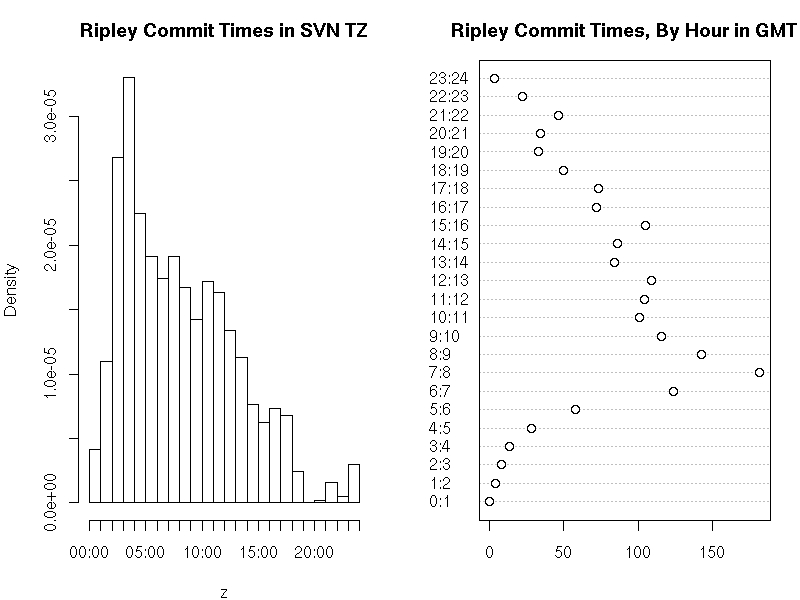
This extracts the commit times, subsets to the ones by Prof. Ripley, extracts the timezones component (as strptime seemingly doesn't do that which is a pain), extracts the tz-less time via strptime into a variable 'z' for which the histogram is drawn. He then corrects the times by the tz offset expressed in seconds, formats is as hour of the day and turns it into a 'factor' (an R data type for qualitative variables which may be ordered as is the case here) and draws a dotplot. This results in the following chart: Simon Jackman's per-hour charts of Brian Ripley's commit patterns Now, nobody has looked at the time series. So we correct this and add the following:
## rather extract both  date and time
dat <- unlist(sapply(rx, function(x)  
  txt <- strsplit(x,split=" ")[[1]]
  paste(txt[5], txt[6])
 ))
## subset on Prof Ripley
dat <- dat[who == "ripley"]
## and convert to POSIXct, correcting by tz as well
datpt <- as.POSIXct(strptime(dat,format="%Y-%m-%d %H:%M:%S")) - offset
## turn into zoo -- we use a constant series of ones as each
## committ is taken as a timestamped event
datzoo <- zoo(1, order.by=datpt)
## and use zoo to aggregate into commits per date
daily <- aggregate(datzoo, as.Date(index(datzoo)), sum)
## now plot as grey bars
plot(daily, col='darkgrey', type='h', lwd=2,
     ylab="Nb of SVN commits, three-week median",
     xlab="R release dates 2.5.0 and 2.5.1 shown in orange",
     main="The amazing Prof. Ripley")
## mark the two R releases of 2007
abline(v=c(as.Date("2007-04-24"),as.Date("2007-06-28")),col='orange',lwd=1.5)
## and do a quick centered rolling median
lines(rollmedian(daily, 21, align="center"), lwd=3)
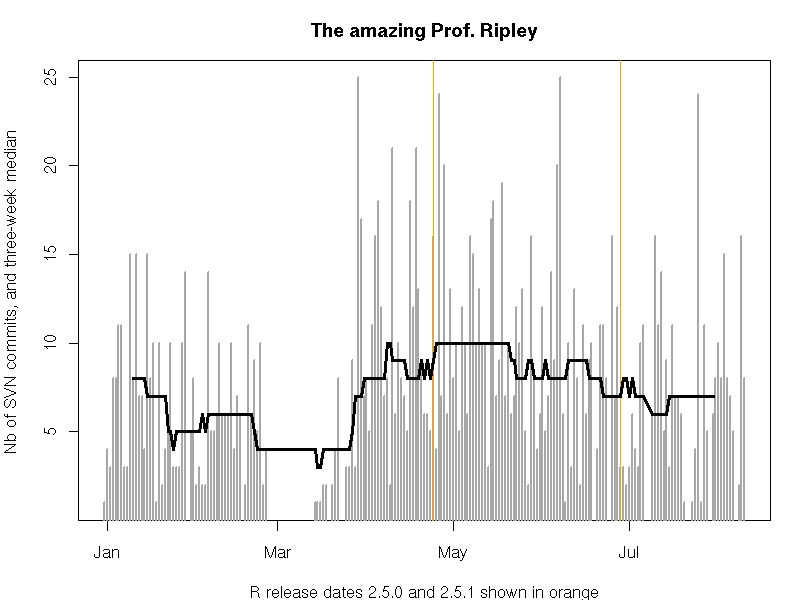
This extracts both date and time, creates a proper R time object (a so-called POSIXct type) from it, fills a zoo ('the' magic class for time series) object with it, uses zoo to aggregate commits per day and plots those in a barchart-alike (I know, I know, ...) plot to which we add the two releases as well as a rolling and centered three-week median (as a real quick hack rather than a proper smooth). Timeseries of Brian Ripley's commit patterns This shows that Prof Ripley averaged about ten commits a day before and after the release of R 2.5.0, and that he has slowed down ever so slightly since then to end up at around a mere seven commits a day. Every day. For the seven-plus months we looked at. So, anyone for analysing his r-help posting frequencies ?

11 August 2007

Dirk Eddelbuettel: UseR! 2007: Two talks and a new R package 'RDieHarder'

The first UseR! conference in North America ended yesterday. I gave two talks and updated my presentations page accordingly. One talk was joint work with Steffen Moeller (who had also presented our work in Italy in June, and I added that presentation too), David Vernazobres and Albrecht Gebhard and concerns automated building of around two thousand (!!) new Debian source packages for all CRAN and BioConductor packages for GNU R. I plan to send something to debian-devel on that in a day or two as well because the time is right for some feedback on this. The other talk was on about RDieHarder. This is joint work with Robert G. Brown and uses his DieHarder library for random number testing (that I've added to Debian a few months back). It allows R to both runs these tests, and to further analyse and visualize the test results. I finally uploaded RDieHarder to CRAN a few days ago -- in fact, my CRANberries rss feed of new CRAN packages had it show up the morning of the presentation. And now that I've added a webpage about RDieHarder I can finally say it's been released.

Steve Kemp: Are you talking to me?

My GNOME desktop is broken upon my primary machine, and it has taken me too long to get it sorted out. Short version: metacity will not run:
skx@vain:~$ metacity
metacity: symbol lookup error: /usr/lib/libgthread-2.0.so.0: undefined symbol: g_thread_gettime
The .so file referenced is a symlink to libgthread-2.0.so.0.1200.13, and using nm I can see there are no symbols listed:
skx@vain:~$ nm /usr/lib/libgthread-2.0.so.0.1200.13
nm: /usr/lib/libgthread-2.0.so.0.1200.13: no symbols
That seems weird to me, but libraries are mysterious beasts, so I might be expecting this behaviour? Anyway dpkg claims this file is installed by libglib2.0-0, and the package hasn't had an upload since July 17th, so I can't believe this is the reason for the recent breakage (Even given that I don't logout often..) Reinstalling both packages (metacity + libglib2.0-0) has failed to fix the problem so I'm lost. Right now I'm running GNOME with a different window manager, icewm, via a ~/.gnome2/session file:
gnome-wm --default-wm /usr/bin/icewm-gnome --sm-client-id default0
This works almost perfectly - it is better than metacity in the sense that new windows don't overlap existing ones if there is spare screen space, but worse in that alt-TAB shows two windows "Top extended Edge Panel" and "Bottom Extended Edge Panel" - which I don't need/want to see. I'd be happy to stay with IceWM if I could fix those two problems, but I'd love to know why metacity is broken, and how I can fix it. I can't see any obvious bug reports - and I'm not 100% certain that the gthread package is the source of the error... Any suggestions welcome.
ii  metacity       1:2.18.5-1     A lightweight GTK2 based Window Manager
ii  libglib2.0-0   2.12.13-1      The GLib library of C routines

MJ Ray: Deutschland-Tour and Volta a Portugal

The Deutschland-Tour 2007 is broadcast to Europe until next Saturday on ARD at 19 east and 13 east. After a wet start, Gerolsteiner's Robert F rster is leading them into today's team time trial, but it's only the second stage. The 69th Volta a Portugal is broadcast worldwide until next Wednesday on RTP Internacional and RTP Africa at all sorts of satellite positions. Candido Barbosa of Liberty Seguros (yet another cooperative cycling sponsor ) leads, but the advantage is small.

10 August 2007

Russell Coker: CAPTCHAs that don t work

One thing that I don’t like is blogs that provide no method of feedback. When I want to read something with little or no possibility of feedback I’ll read one of the many newspapers that are available. Craige McWhirter’s blog is one of them. The CAPTCHA system doesn’t work (I must have tried at least 20 times with both Konqueror and Iceweasel) and he doesn’t provide an email address. He does provide a mobile phone number which is handy for people in the same country. AKISMET works fairly well on my blog and makes the spam quite managable. As the number of legit comments are not that great I manually approve them thus avoiding having a spam ever appear on my blog - showing a spam encourages more of the same. The comment I wanted to make on his post was to reference my previous blog post on this topic and suggest that one thing that can be done is to improve public transport which will increase the area of land available to people who work in central city areas. This means that the land prices can decrease and housing prices will follow. Another issue is that he suggests assisting people in paying rent. While this may sound like a good thing the current system of Negative Gearing is designed to decrease rent, but instead merely increases the price of owning a house.

9 August 2007

Filip Van Raemdonck: Dell's soon to be missing segment?

Last monday I had to order a computer for use as a workstation for a graphic designer. When I called Dell and asked for a specification on a Dimension system, the — overall very helpful and friendly — account manager stated that the Dimension range was discontinued for business customers and available for consumers only. He told me that the new Vostro line was their new SMB offer.

When I pointed out to him that not only was the Dimension still listed on their SMB web pages, but that the Vostro was inattractive because it could not be upgraded beyond 4GB of memory, he was surprised at first and then stated that a 64 bit OS was needed anyway to be able to use more than 4GB of memory'.
But if I needed more memory, a Precision workstation would be a good alternative. Well, any Precision I could configure on the Dell website would end up costing 1.5 times as much as a similarly configured Dimension. (which means that I had to add a graphics card with higher 3D performance on the Dimension as what was needed, since this computer was meant for 2D graphic design)
At this point, the sales representative tried building a Precision configuration himself to specifications I had provided him with, but with maximum discount he could apply the price still came out over 30% (meaning, over 300 EUR) more than a Dimension to these same specs. At which point he gave in :)

I seriously hope that the sales person was mistakenly saying that the Dimension would go away as a Dell business offer (though that means that some review of internal communications would be in order). While I'm sure the Vostro line has it's merit, these are some points that make it a lousy or at least undesirable option in some cases: The way I see it, the Vostro should be a valuable add-on to Dell's SMB offering at the bottom segment. Throwing out the Dimension would leave a hole between Vostro and Precision. And I'm not sure where exactly the Optiplex fits in; it appears to be more along the Vostro looking at specs, but it's price tag is closer to Precision — it's main feature seems to be a highr default support level.

Wouter Verhelst: Voting tactics, again.

In response to my blog post about voting tactics yesterday, Russell claims that there are no tactical voting problems in instant runoff voting, immediately following that in the next paragraph with an explanation of how there actually is tactical voting in Australia's Instant Runoff. Err. In my opinion, every instance of tactical voting is a problem. Your mileage may vary, of course. Next, "proportional representation" does not equal "everyone is a candidate everywhere". For the house of representatives, Belgium is divided into a number of "kieskringen" each of which elects a predefined number of candidates into parliament (the number of candidates per kieskring depends on the number of people living in that kieskring). This way, we have proportional representation while still having the members of the lower house representing geographic regions. Note that I'm not claiming proportional representation is the best election system ever; it still doesn't allow me to fully explain what my vote preference is. However, proportional representation does not have the brokenness of Instant Runoff voting in that with IR it may happen that placing one candidate before another on your ballot may actually hurt the cause of the former in favour of the latter.

Eddy Petri&#537;or: small commits

Update: I have been informed that git and mercurial have support for the hunk commit feature, excellent! See the comments section if you want to know the details. IIRC, The last time someone talked about this feature was when John Gorzen analyzed his options for another VCS (still now I can't find any reference to this issue).


Lars, darcs allows this and, as a supplement that is missing from any other VCS I know, is the ability to select individually changes in a file. That means you can commit only some of the changes affecting a file and leave others for later commits.

So for this diff:

$ darcs diff -u
diff -rN -u old-asd/asdnbfnd new-asd/asdnbfnd
--- old-asd/asdnbfnd 2007-08-08 18:12:17.000000000 +0300
+++ new-asd/asdnbfnd 2007-08-08 18:12:17.000000000 +0300
@@ -1,3 +1,3 @@
-#!/bin/ash
+#!/bin/sh

-echo "intentionaol spelling error"
+echo "intentional spelling error"

you can do this:

$ darcs rec -m "spelling correction"
hunk ./asdnbfnd 1
-#!/bin/ash
+#!/bin/sh
Shall I record this change? (1/?) [ynWsfqadjkc], or ? for help: n
hunk ./asdnbfnd 3
-echo "intentionaol spelling error"
+echo "intentional spelling error"
Shall I record this change? (2/?) [ynWsfqadjkc], or ? for help: y
Finished recording patch 'spelling correction'

$ darcs rec -m "make the script run on posix shell"
hunk ./asdnbfnd 1
-#!/bin/ash
+#!/bin/sh
Shall I record this change? (1/?) [ynWsfqadjkc], or ? for help: y
Finished recording patch 'make the script run on posix shell'

Of course, being able to unrecord/uncommit or to rollback is a nice thing to have.

8 August 2007

Julien Danjou: rebuildd 0.2.1 released

Running rebuildd for real since 48 hours, I've found some nasty bugs I have been able to fix. One of the biggest was me trying to do things that Python understood in a different maner, so it was quite interesting. I'm now very happy about that project. From my point of view, I really managed to write a build handler daemon in a very better and more modern way that buildd used to do. It really fits my needs, and it's a real pleasure to use it. Ok, ok. stopping the self-congrats stuff. I've updated the Web page to be more close to the 0.2.1 version.

Russell Coker: Tactical Voting

In response to a blog conversation on Planet Debian, Wouter Verhelst writes about voting tactics in which he claims that Instant-Runoff (wikipedia) (the method used in Australia to elect members of the house of representatives) is broken. I have read the Wikipedia review and neither it nor my previous understanding of Instant-Runoff leads me to believe that it is broken or prone to tactical voting problems. The main tactical voting issue in Australian elections is to give first preference to a small party (such as The Greens) in a seat where there is almost no chance of the small party winning. The idea is to have the vote effectively be a vote for whichever of the two major parties the voter prefers while also sending a message (by the first-preference votes which are widely publicised) as to their desires. If a major party wins a seat while 20% of the first preferences went to the Greens then they might find it an incentive to try and get some Green policies adopted if they want to win the next election (whether this actually works is debatable but it is a fact that people try it). There are many people who don’t understand how the Australian voting system works and believe that they have to vote for one of the major parties to avoid a “wasted vote”. This is not due to the voting system but due to American media - and ill-educated Australians who can’t work out which parts of the news apply to them. Wouter has an advantage in living in a country where English is not the primary language - English news does not directly concern him and his country-men can probably work out that English-language voting instructions should not be followed! The condorcet.org site has a useful analysis which demonstrates one theoretical flaw in IR, but realistically getting the average voter to use Condorcet would essentially be an IQ test as a pre-requisite to voting (numbering all the candidates in order for IR is difficult enough). The fact that an election system is not theoretically fair is not a valid criticism unless there is a viable alternative which is better. If the lower house is to actually represent the people of each electorate (which is rarely the case nowadays) then IR seems to be the best option. If members of the lower house are not expected to represent geographic regions then Wouter’s advocacy of proportional representation makes sense. As for the Australian Senate, the voting system for that is far too complex and I think that as a matter of principle any voting system which can not be understood by the majority of voters is wrong. A good case could be made for proportional representation in the senate. Update: In response to Wouter’s post - tactical voting that doesn’t change the outcome of the election and merely sends a message to a political party is OK IMHO. But if you convince enough people that tactical voting is the only option in the US then the result may change.

MJ Ray: SPI Elections: Corrections

Well, yesterday I asked
"WTF? There seem to be some 30 or 40 voters who really dislike me, but didn't tell me that straight, preferring to be silent then vote me down. Are you cowards, or what?"
Not the most polite of questions(!), but it's what I was wondering at the time. I had some good replies in the comments and a reply by Pingback that I didn't like, but it turned out to be a very educational reply in the end. A comment from Filipus Klutiero included:
"Sometimes, it's not really possible to explain a bad opinion of someone, because we forget the reasons for that opinion. However, if you think that voting based on reputation is a bad idea, you probably can't understand these "cowards"."
I've mentioned before that I don't seem to fit the debian developers stereotype, so I guess it's not surprising if I don't understand them sometimes. If reputation is always going to be such a big factor, one problem I need to overcome in debian and SPI is that some other participants do make crap up about me. You can usually spot it by phrases like "seems to think" (there are not that many mind-readers out there), but eventually, mud sticks. How to overcome this? Patiently post corrections, or is that futile? Here are posts from Andrew Pollock and Matt Palmer which I think are wrong on several points:- First off, I haven't decided to call anyone cowards - it was a question, albeit a bit "nasty, british and short". The underlying sentiment was continued disappointment and puzzlement at why voters behave like that in a non-secret vote, not rage. It was not really an "outburst," coming a week after the results. I'm not unhappy with the results - I've congratulated the winners by several methods, including the last post, although I mentioned my mixed feelings. Isn't that usual? I think very few non-elected candidates express unbridled joy about the experience. After all, it's not an easy decision to stand, but I did it for two main reasons: shortage of other candidates I really liked, at the time I chose to stand (as I mentioned in my platform); and for practical experience of how Condorcet behaves. I'm not rabid - I've even written against the Rabid Right recently - and I'm not rabidly anti-Google. I had polite chats with various people from Sun, Microsoft and Google at debconf - I don't like those companies, but I don't feel a need to tell their workers that at every point. I think reasons to like and dislike Sun and Microsoft are old and well-known, but a few years ago, I got so bored of explaining why I don't agree that Google is God's Gift to our communities that I posted a FAQ-ish page about it, which I update as I look at its new developments. Let's politely disagree, until Google fix the bugs which brought me to that view. Andrew Pollock's point about debian-legal is vague and maybe fair comment. It's not often a fun or popular thing. But "precious ego"? Ha! Yes, a guy who humiliates himself with cheap stunts for environmental protests is clearly very precious about his ego(!) (Sorry if that's rude, but I find it hilarious.) I don't mind people having different opinions, but it would be nice if their opinions about me were mostly based on reality, instead of misunderstandings. One fair point from Matt Palmer's post and also, I discovered eventually, from Antti-Juhani Kaijanaho's site, is that SPI's elections apparently are meant to be secret, as far as I can tell from the starts of Article Five and Article Seven of the SPI by-laws. I tend to value practice more than theory and the current voting practice is merely confidential, not secret. I think that's part of why I didn't understand the approach taken by some voters - they were treating it as a secret ballot. That's fine and now that I realise it's meant to be secret, I've suggested making it a secret ballot. (2007-08-08: 1 comment)

Neil Williams: Requesting adoption of glipper

RFA: glipper -- A clipboard manager for GNOME #436550.

Glipper is currently my package in Debian at 0.95.1-3 and that version
is written in C and uses a binary data file which has raised one bug
(#436078 - wishlist severity). It currently has no other bugs.

There is now a
new release
that closes this bug, my problem is that
v1.0 is a ground-up rewrite in Python! Essentially, glipper v1.0 is a
completely different package internally. (Previous translations have
also been lost.)

I have no python experience, no python packages and no ability to do
anything if (when) python code goes wrong. I don't want to have to
learn python just for glipper (don't have time).

So - I don't see what I can do except request adoption of glipper, it
just seems so weird to leave a package which is active while I am also
active.

Anyone fancy taking on glipper?

I don't think there's any point retaining the old C package - that code
is already dead upstream.

Currently, there is no RCS for the debian packaging for glipper - I was
using CDBS and the current watch file needs editing to look for a
tar.bz2 instead of the previous tar.gz.

There are two issues with migrating from 0.95.1 to 1.0:
  1. the ~/.glipper directory needs to be removed.

  2. Glipper v1.0 is also now GNOME only, support for other window managers
    has not been implemented in the python version.


7 August 2007

Evan Prodromou: 19 Thermidor CCXV

I'm on the plane down from Vancouver to San Francisco this morning. My flight from Taipei hit Vancouver around 8PM last night, so I stayed at the Fairmont Hotel at the airport. It was definitely a special treat -- the Fairmont's pretty pricey -- but this trip has been really low-budget and I needed a lot of rest and recharge. I had a good room with a view of the airport and the city beyond. My flight over was uneventful -- sleep, eat, Spiderman 3 -- which was good since I'd had such a big last day in Taipei. In the morning, I'd gone out to see Taipei 101, which claims to be the tallest building in the world by some standards. I think there are lots of ways to slice the "tallest building" category -- the CN Tower has a strong claim, but that's only counting the huge antenna on top. And there's an unfinished tower in Dubai that's already close to, or taller than, Taipei 101. Regardless, Taipei 101 is a real interesting site. The elevators are the fastest in the world -- 38 seconds to go from floor 5 to floor 87. The windowed observation deck is interesting, and there's an outdoor deck two flights above it. The outdoor deck is racked by Taipei's scorching heat -- when I was there, it was 31C, up above the city's protective smog belt. The sun and empty sky make for an otherworldly experience. After 101, I took Taipei's local subway, the MRT, to the National Palace Museum. I've found the MRT easy to get around on -- most of the information was available in English as well as Chinese -- but I got a little lost looking for the museum. I was disappointed that the information booth in the Taiwan Main Station had so little tourism information, and all of it in Chinese. (Yeah, I forgot to print out the Wikitravel Taipei guide before leaving the hotel. My bad.) But I managed to wend my way out to Shilin Station and took a cab to the museum. It was worth the search. When the Chinese Nationalists left the mainland for Taiwan, they took with them many of the treasures of the Imperial Palace (much to the chagrin of the victorious Communists). These form the core of the museum's collection, and they're really quite amazing -- articles in bronze, ivory and gold from the Neolithic era to the modern day. While Western culture has gone through so many distinct and discontinuous phases -- Egypt and Mesopotamia, Greco-Roman, Medieval and Modern -- China's has varied much more smoothly and continuously. It's a little disconcerting to see artistic themes from 4000BC that are echoed in items for sale in the stores today. I had to get back to the Wikimania site -- by then almost empty -- to do a GChat conference with Niko. There were a passel of Wikimaniacs still around after the conference looking around Taiwan like I was, and after consulting Wikitravel we decided to go to Taipei's most famous restaurant, Din Something Something. It's got a short menu of delicious steamed dumplings -- pork, veggie, crab and shrimp. The shop's claim to fame is the elastic skin that keeps a pocket of hot broth inside the dumplings. Hey: if you do something well, why vary the menu? It was the best meal I've had in a long time. The dumplings themselves were incredibly good -- moist and rich with complex flavors. But the company was even better -- about 14 Wikimedians from all continents and walks of life, some of the most fascinating and important people on the planet. We were a big enough group to be stowed in our own party room, and with basket after basket of steamed dumplings piled onto the table, washed down with shared bottles of the ubiquitous Taiwan Beer, we had a crazy chaotic and fun time. I'm so glad I took an extra day after the conference to see a bit of the city. I think there's a lot more that I missed, but I'm glad that I got a taste. tags:

Wikimania 2008 Inevitably the conversation at Din Something Something turned to Wikimania 2008 and possible venues for it. Right now, the only serious bid is from Alexandria, Egypt, home of the Biblioteca Alexandrina. This is a modern reconstruction of the famous Library of Alexandria, centre of learning for the ancient world and repository of all of its knowledge. The bid is to use the sleek, glamourous conference centre attached to the Biblioteca -- offered to us free of charge. You couldn't put together a more powerful metaphor -- Wikimedia being itself a project to capture the world's knowledge and share it with all humanity. Having our event on the African continent would also send a great message about the Foundation's commitment to making free information accessible to the developing world. North Africa is definitely the most accessible part of the continent for Europeans and North Americans -- many of whom balked at the price and distance of travel to Taipei. The big problem with planning Wikimanias (Wikimaniae?) in the past has been the short time-frame. Typically bids for the event don't start until after the previous one, and the bidding process takes several months. By the time a venue is selected, there may be only 6-8 months of planning time available. For an international conference of several hundred people, this is a stressful, breakneck schedule. The idea was floated to do a little stutter-step and put Wikimania on a more long-term planning schedule. The event committee would short-circuit the bidding process this year, and declare Alexandria the site for Wikimania 2008 unless other groups insisted on bids for other cities. Then, bidding for Wikimania 2009 would start in September or October, with a decision made by the end of 2007. This would give 20 months for the Wikimania 2009 organizing team to prepare. Most importantly, they'd be able to shadow the 2008 team, learn how the job is done, attend the 2008 conference, and present about their venue for the next year. I think this is a really good idea. The Biblioteca conference centre staff will be able to provide us some professional services, making the shorter schedule (still about 11 months) a lot easier. There are some concerns about fairness of the process, or appearance of same, but my guess is that if the 2009 bid process starts soon after, people won't have a big beef. There are two major concerns with going to Alexandria, though. First is Egypt's worrying problem with human rights -- specifically gay rights. Homosexual Egyptian men are subject to arrest, and the laws are occasionally enforced. One foreigner was arrested in 2002. That's enough to put Egypt on a no-visit list with some gay-rights groups. Depressing as it is, I think it might be too much to hope for a venue in a country with an absolutely spotless human rights record. Maybe parts of Scandinavia...? There's a cruel calculus needed to evaluate which national human rights abuses can be reluctantly overlooked, and which are unacceptable. It's also clear that my personal judgment might be clouded, since this particular human rights issue is not one I would be directly targeted by. My hope is that an official statement by the Foundation would make it clear to the Egyptian government that this kind of policy is not conducive to attracting overseas business and tourism. The second concern is that Egypt and the Arab world in general have only embryonic local Wikimedian communities. While there are many people who contribute to Arabic Wikipedia, there is not a Wikimedia chapter in Egypt, nor are there regular meetups in the country or region. This might be a chicken-and-egg problem: choosing Alexandria would probably kick-start local groups. I hope that ar: Wikimedians pick up the mantle of leadership that the world Wikimedia community is offering them. tags:

Next.

Previous.