Search Results: "mak"

7 January 2011

Simon Josefsson: On Password Hashing and RFC 6070

The RFC Editor has announced a new document, RFC 6070, with test vectors for PKCS5 PBKDF2. The document grow out of my implementation of SCRAM for GNU SASL. During interop testing, more than one other implementation turned out to have mistakes in the PBKDF2 implementation. It didn t help that there weren t any stable test vectors for PBKDF2, so that we could do black-box testing of our PBKDF2 implementations against well-known and stable test vectors. Debugging this was time consuming. The document addresses this problem. So what is PBKDF2?

Briefly, the PBKDF2 is the state of the art way to convert a password string into a cryptographic binary key. There are many ways to design such an algorithm. To understand why PBKDF2 is designed the way it is we need some basic understanding. The typical attack you would be concerned with is if someone compromises your authentication servers and steals the credential database. This is what happened with the recent Gawker attack, where passwords were apparently stored in clear text. The first security improvement compared to storing passwords in clear text is to only store a hashed or encrypted form of the password. Hashing is preferable over encryption in this context, because with encryption it is possible to go back to the unencrypted form (if you know the key) whereas with a hash it is computationally infeasible to do so. The downside of hashing is that it is impossible to be compatible with all kind of authentication systems: the hash of the password in the database needs to be computed using the same algorithm as the system will be using. Unfortunately there are many different schemes out there to do password hashing, including the old Unix crypt(3) algorithm and the Windows LM-hash. You normally never know in advance what kind of systems your hashed credential database needs to work for, so you have to pick some set of algorithms and hope for the best. The next security improvements are iterations and salting. Iterations means to run the hash function not once, but hundreds or even thousands of times, on the input data (e.g., password). The extra time is hardly noticeable for the user, but for an attacker who is testing an entire dictionary of common passwords against your hash, making the work cost thousand times higher quickly makes the attack vector computationally infeasible. Salting means to include something other than the password in the input to the hash function, typically a random string. Without salting, a pre-computed rainbow table would provide a dictionary attack against all hashed password databases (one rainbow table per hashing algorithm). By using a sufficiently long and random salt, a rainbow table for one system is not applicable to another system. Since generating a rainbow table is time consuming, this adds another barrier to the attacker. PBKDF2 combines these three concepts hashing, iteration and salting into one construct, and it is designed flexible enough so that it can work on any pseudo-random function. In practice, I ve only ever seen HMAC-SHA1 be used. Some final words on the publication behind RFC 6070: Out of my earlier publications, this was the document that (by a large margin) spent the least time in the IETF process. You see various milestones of the document in the RFC 6070 datatracker history page. The time in the publication process was from 2010-08-09 to 2011-01-06. One month was in the AUTH48 state, of which the initial 20 days were waiting for me to respond. Thank you to my sponsoring AD, Sean Turner, for making this possible!

Paul Wise: Another year, another log entry

It has been almost a full year since my last log entry. It has been a busy work year, I attended some nice conferences and did minimal FLOSS stuff. On the work side of things I was a third of an Australian VoIP startup that came and went. I setup Debian servers, installed OpenSIPS and associated software, wrote OpenSIPS scripts, wrote peripheral software and did customer support. We had a good thing going there for a while, some fans on the Whirlpool forums but in the end there wasn't enough money for the requisite marketing and local market circumstances were squeezing Australian VoIP providers anyway. On the conference side of things I went to LCA 2010, the Thai Mini-DebCamp 2010, DebConf10 and FOSSASIA 2010. Had a great time at all of them. At LCA 2010 in windy Wellington, New Zealand the distributions summit organised by Martin Krafft was one of the highlights. It was dominated by Debian/Ubuntu talks but there were some other interesting ones, especially the one on GoboLinux's integration of domain-specific package managers. Also excellent were the keynotes given by Gabriella Coleman (Best & worst of times), Mako Hill (Antifeatures) and others, which I felt gave LCA an improved and very welcome focus on software freedom. There were quite a few Debian folks at LCA, it was great to hang out with them during the week and afterwards. Monopedal sumo with mako and others was hilarious fun. At the Thailand Mini-DebCamp 2010 in Khon Kaen, I was glad to see Andrew Lee (Taiwan) and Christian Perrier (France) again and meet Yukiharu YABUKI (Japan) and Daiki Ueno (Japan). In addition to the five international folks, there were quite a few locals, including Thailand's currently sole Debian member, Theppitak Karoonboonyanan. The event was hosted at Khon Kaen University and opened with my talk about the Debian Social Contract and the Debian Free Software Guidelines. This was followed by a number of talks about Debian package building, a 3-day BSP where we touched 57 bugs, a great day of sightseeing and talks about i18n, derivative distros, keysigning, mirrors, contribution and a discussion about DebConf. During the week there was also the usual beersigning, combined with eating of unfamiliar and "interesting" Thai snacks. After the conference Andrew and I roamed some markets in Bangkok and got Thai massages. Beforehand I also visited a friend from my travels on the RV Heraclitus in Chiang Mai, once again experiencing the awesomeness of trains in Asia, unfortunately during the dry season this time. I took a lot of photos during my time in Thailand and ate a lot of great and spicy food. As a vegetarian I especially appreciated the organiser's efforts to accommodate this during the conference. At DebConf10 in New York City, by far the highlight was Eben Moglen's vision of the FreedomBox. Negotiating the hot rickety subways was fun, the party at the NYC Resistor space was most excellent, Coney Island was hot and the water a bit yuck, zack threw a ball, the food and campus was really nice. Really enjoyed the lintian BoF, ARM discussions, shy folks, GPLv3 question time, paulproteus' comments & insights, wiki BoF, puppet BoF, derivatives BoF, Sita, astronomy rooftop, cheese, virt BoF, Libravatar, DebConf11, Brave new Multimedia World, bagels for breakfast, CUT, OpenStreetMap & lightning talks. Having my power supply die was not fun at all. Afterwards I hung out with a couple of the exhausted organisers, ate awesome vegan food and fell asleep watching a movie about dreams. One weird thing about DebConf10 was that relatively few folks used the DebConf gallery to host their photos, months later only myself and Aigars Mahinovs posted any photos there. At FOSSASIA 2010 in H Ch Minh City (HCMC) was a mini-DebConf. I arrived at the HCMC airport and was greeted by Huyen (thanks!!), one of FOSSASIA's numerous volunteers, who bundled me into a taxi bound for the speakers accommodation and pre-event meetup at The Spotted Cow Bar. The next day the conference opened at the Raffles International College and after looking at the schedule I noticed that I was to give a talk about Debian that day. Since I didn't volunteer for such a talk and had nothing prepared, the schedule took me by surprise. So shortly after an awesome lunch of Vietnamese pancakes we gathered some Debian folks and a random Fedora dude and prepared a short intro to Debian. The rest of the day the highlights were the intro, video greetings and the fonts, YaCy and HTML5 talks. The next day the Debian MiniConf began with Arne Goetje and everyone trying to get Debian Live LXDE USB keys booted on as many machines in the classroom as possible (many didn't boot). Once people started showing up we kicked off with Thomas Goirand's introduction to the breadth of Debian. Others talked about Debian pure blends, Gnuk and building community and packages. The second last session was about showing the Vietnamese folks in the room how to do l10n and translation since Debian had only one Vietnamese translator (Clytie Siddall). After manually switching keyboard layouts (seems LXDE doesn't have a GUI for that) on the English LXDE installs, the two Cambodian folks were able to do some Khmer translation too. This was a great session and it resulted in two extra Vietnamese translators joining Debian. It went over time so I didn't end up doing my presentation about package reviewing. We rushed off to a university where the random Fedora ch^Wambassador was hosting a Fedora 14 release party in a huge packed classroom. There were a lot of excited faces, interesting and advanced questions and it was in general a success. Afterwards we had some food, joined up with some other speakers and ended up in a bar in the gross tourist zone. On the final day we hung around in the Debian room, went downstairs for the group photo and final goodbyes. Later we found a place with baked goods, coffee and juices and navigated the crazy traffic to a nice local restaurant. The next morning Arne & I went to the airport, others went on a Mekong Delta tour and Jonas hung out with the organisers. I took less photos than at other events but got a few interesting ones. I avoided doing a lot of FLOSS stuff over the last year, I hope to work on some things in the coming months; I'm also planning some interesting travel and acquiring some new technological goods, more on those in some later posts.

6 January 2011

Michael Prokop: Booting ISO images from within GRUB2

You might be aware of GRUB s loopback option for booting an ISO, I wrote about it in Boot an ISO via Grub2 more than a year ago. A few months ago Goswin von Brederlow came up with this idea:
grml functions great as rescue system. So it would be nice to have a boot entry for it in grub instead of having to go look for the CD when needed. To make installing and updating simple it would be great if one could install this as a normal debian package which would register itself in grub (and maybe lilo too).
What a lovely idea: no need for a CD or USB stick as long as the bootloader and the harddisk are still working. Minimal manual intervention needed to keep it up2date and working sounds like the perfect rescue system. 8-) Now since end of 2010 a new stable version of sysadmin s favorite live system (AKA Grml 2010.12) is available and the great news is that we came up with two independent solutions known as grml-rescueboot and grub-imageboot. Having shipped them to one of my customers already I d like to write some words about it and why you should also consider using it on all your systems where GRUB2 is available. grml-rescueboot uses GRUB2 and its loopback feature for booting. Grml as well as Ubuntu provide all what s needed out-of-the-box. If you re interested in the details check out Jordan Uggla s excellent Loopback.cfg webpage in the supergrubdisk wiki. The best about it: you can provide custom bootoptions automatically when booting Grml. For example just set CUSTOM_BOOTOPTIONS= ssh=grml2011 in /etc/default/grml-rescueboot and the Grml rescue system will automatically start the OpenSSH server with the specified argument as password for user grml. Of course you can use all the other nifty bootoptions like scripts/netscript/ to further customize your Grml rescue system. [A note to other distributions like Ubuntu: I'd be interested to establish a mechanism to pass kernel options for loopback boot in a standardized way, drop me a note if you're interested in this.] grub-imageboot uses GRUB2 and syslinux memdisk to boot ISOs and floppy images. It doesn t rely on the loopback feature but instead maps the ISO into the memory directly. This is great for Linux ISOs that can t and won t support the the loopback feature (and have everything inside their initrd so the ISO doesn t have to find itself during booting), like BIOS or firmware updates. Also for example FreeDOS and Alpharev are known to work just fine. But sadly memdisk ISO emulation doesn t work with all Linux systems, as documented in the syslinux wiki. The good news is that Grml supports the memdiskfind/phram/mtdblock approach out-of-the-box. As far as I know therefore Grml is the first Debian based live system supporting memdisk ISO boot, though my patches already went to the Debian-Live project so if you re using live-boot >=2.0.14-1 or >=2.0.12-1+grml.04 your live system should be able to boot via memdisk ISO emulation as well. Summary: If you want to boot a Linux system which supports loopback.cfg use grml-rescueboot as its a more powerful tool to boot Linux live systems like Grml and Ubuntu. If you want to boot non-Linux systems (BIOS-/Firmware-Updates/FreeDOS/ .) use grub-imageboot. Alright how do you deploy this solution? Just grab and install grml-rescueboot and/or grub-imageboot. To deploy grml-rescueboot (adjust $VERSION if you want to use another flavour):
# choose Grml version:
VERSION=grml64-medium_2010.12
# create directory
mkdir -p /boot/grml
# download and verify ISO
cd /boot/grml
wget download.grml.org/$ VERSION .iso ,.md5 
md5sum -c $ VERSION .iso.md5
To deploy grub-imageboot:
# choose Grml version:
VERSION=grml64-medium_2010.12
# create directory
mkdir -p /boot/images
# download and verify ISO
cd /boot/images
wget download.grml.org/$ VERSION .iso ,.md5 
md5sum -c $ VERSION .iso.md5
That s it! Now when running update-grub you should get something like:
# update-grub
Generating grub.cfg ...
Found linux image: /boot/vmlinuz-2.6.36-grml64
Found initrd image: /boot/initrd.img-2.6.36-grml64
Found memtest86+ image: /boot/memtest86+.bin
Found memtest86+ multiboot image: /boot/memtest86+_multiboot.bin
  No volume groups found
Found Grml ISO image: /boot/grml/grml64-medium_2010.12.iso
Found memdisk: /boot/memdisk
Found iso image: /boot/images/grml64-medium_2010.12.iso
done
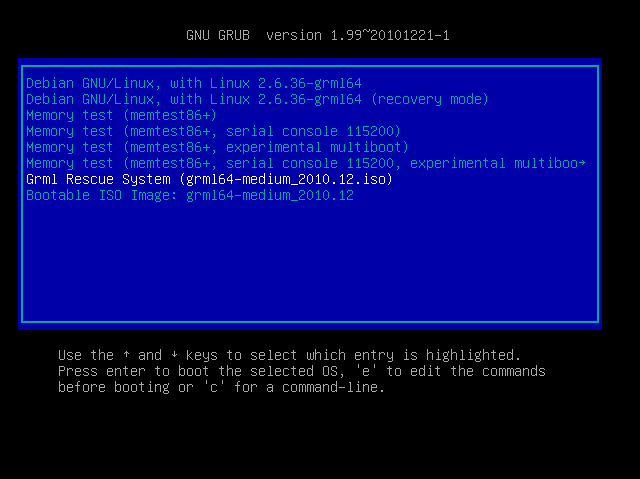
Voil , when rebooting your system you should see something like: Screenshot: grml-rescueboot The Grml Rescue System entry is what grml-rescueboot provides and Bootable ISO Image is what s provided by grub-imageboot. Just select the entry you d like to use, press enter and and you should get the bootsplash of the according ISO. BTW: I ve tested this with Ubuntu 10.10 too, grml-rescueboot works out-of-the-box with the Ubuntu ISO as well, it just doesn t support the memdisk ISO boot by grub-imageboot (yet). Tip: if you want to use grml-rescueboot and grub-imageboot with the same ISOs without having them twice on the disk just point the configuration option IMAGES in /etc/default/grub-imageboot to the according directory (like /boot/grml). Note: if you re using the ext 2,3,4 filesystem on the partition that s being used for /boot please be aware that you need GRUB >=1.98+20100804-12 (newer version is already available in Debian/unstable and hopefully migrates to squeeze in time) or GRUB >=1.99~20101122-1 because of the INDIRECT_BLOCKS support, see #543924 for the details. PS: We think about providing grml-rescueboot and grub-imageboot within official Debian. If you re interested in seeing integration support for other distributions as well please help and drop us a note.

Christian Perrier: [life] [running] 2010 summary and early 2011 plans

So, 2010 ended and it's now time for me to make a small summary for my running activities. At first, it's more and more obvious that running became an increasing part of my life. Sometimes eating the free time I was using for Debian work....and sometimes just filling holes in my daily activities, where I was just doing nothing..:-) According to my running watch(es) records, I ran for 2172km this year in about 196 hours (8.25 days) at an average speed of 11.1km/h. Indeed, the speed ranges from 10km/h in the hardest trail runs up to 13.5km/h in the fastest (and shortest) asphalt runs. I actually never run at "slow" paces, which is probably not the best for training as all official training plans do include slow runs. But, eh, this is how it works for me..:) I ran 12 official or semi official races, ranging from 5km cross-country races up to marathons. More proeminently speaking, I ran 3 half-marathons, 2 marathons and one long distance trail race (33km) that is worth being counted as a marathon..:). I also broke my personal best times for 10km (48'05", ran alone), half-marathon (1h37') and marathon (3h40'). Quite a good year, indeed..:-) I'm currently busy building my plans for 2011. Some are already decided: In general, I'll probably put more focus on trail and ultra (above martahon) runs. 2012 could then be the year of my first 100km race..:-) What will be fun will be reading this in January 2012 and see what I have completed among all these goals..:-)

Michal Čihař: Finding a GPL violation

As the communication in this case seems to be stuck and the issue is almost one year old, it's time to make bits of it public. The first post will just describe how I've discovered it, later will bring more details. All started innocently with bug report on Gammu that it fails to work with some Sonim phones. We started to dig some information about what extensions does Sonim use and one of obvious ways was to try their software. I picked up software for Sonim XP3.20 Quest and started to look at it (if you are not going to install them, but want to look, you need unrar and unshield to unpack it). At first look the names of DLLs looked familiar to me and running strings on the DLLs just confirmed my suspicion - the phone which is not supported by Gammu bases it's official software on it. I was able to recognize at least seven DLLs derived from (GPL licensed) Gammu (they even use same names as Gammu modules had in that time): To make the thing more interesting they use several other components released under free software licenses, where they also should provide sources for them: There might be more, but I did not want to spend more time on deep analysis, because I already had enough information.

Filed under: English Gammu Gpl 6 comments Flattr this!

Gunnar Wolf: Back with Ruby on Debian polemics

Once again, a polemic regarding how to properly integrate the Ruby language and libraries with the Debian distribution has been ignited. Similar arguments were presented in November and December 2008 and September 2010 And excuse me for just refering to my own blog, but there are links to some other posts from there... and there will surely be many others I just missed. There were even nice collaboration attempts (such as DebGem, announced in January 2009... But which apparently never stuck on, as it is still listed as in its public Beta period and lists only support for Debian 4.0 and Ubuntu 8.04 and 8.10). Some days ago, while I was on vacation, I received a mail from Lucas Nussbaum expressing the burnout he had been suffering from this situation. Some days after that, he posted a corresponding blog post - Giving up on Ruby packaging. The comments following his post are most interesting The one comment I'd like to highlight (noting I skimmed a whole deal of them) is by Paul Brannan, one of the original RubyGems authors. Yes, possibly the design criteria for Gems included some mutually-conflicting goals, and they cover some of Debian's goals. Unfortunately, this conflicting criteria... Was resolved to the opposite way we would have wanted (specifically, that a sysadmin should be able to install software with the same tools he was already familiar with). And of course, there are deeper disagreements, which are rightly stemmed from different priorities: Debian (+derivatives) is meant to make user's and sysadmin's lifes simpler. Gems are meant to make developers' lifes simpler. And while all developers are some sort of users, and sysadminsthe reverse is (obviously) not so. A developer maintaining several different codebases will surely suffer (well, this particular developer has surely suffered) if he has to maintain them all using coherent versions of system libraries. When a system is programmed, its developers want to use the greatest, latest tools to offer the best experience and functionality. And it's natural for libraries to evolve over time. However, any sysadmin will grind their teeth at the prospect of having many different versions of libraries, as the Gem model proposes. Why? Well, I was bitten by a minor example of it Bug fixes do not get backported. Of course, if simple bugs are not backported, security and stability of the system as a whole suffers. Often, new software versions will not only add functionality, but improve on how things are done. Not only bugs get corrected, but we get better response times, better memory handling, etc. It might sound harsh to say this, and even more, as a developer it feels I am talking against myself But while development time should be minimized during the system design/implementation, once systems are in production, it should be used to allow for friendlier sysadmin relations. I have to wear both hats at my real-life job. So, what is my take on this? Of course, blaming myself for choosing the wrong version is a no-go. When evaluating a library before using it in my projects, I try to look at its history and API-stability. APIs that change often speak about immature libraries which are still trying to get the right way to implement their functionality; just-started projects might be great and revolutionary, but they do not yet show any kind of long-term committment... And can lead (and have often led me) to painful rewrites when the Next Big Thing is reached. As for the users: Even if your favorite language has the best and friendliest distribution method, users just do not care about what language was a particular piece of software implemented in. Users want to be able to install and uninstall with their system's usual tools. Directly using Gems, CPAN, PEAR and whatnot is just unnatural for users, however convenient they are for developers. Distributions offer a non-technical advantage in this regard as well: A human filter. As an example, as I write this there are 19392 Ruby Gems and 19092 Perl modules in CPAN (note that CPAN stores some older versions but discourages authors from keeping too many - So no, they are still very different in size). Debian has around 30,000 packages. Why is that? Because all Debian packages _must_ be human-generated, human-reviewed, human-submitted. This means, a person must think each packaged piece of code is worth packaging, is stable enough and provides value to users as it is, and is fit for being part of a stable release. I am not saying with this that 90% of CPAN and Gems are crap I am saying that they are probably early implementations, to be installed, tested and improved by developers, and still not apt for general public use. Or maybe not interesting enough to be packaged as a service for the non-techie public at large. Oh, and one last point: Ruby is not a new language anymore. It is a mature, powerful language with different implementations, every time more stable... But it is a language deeply affected by the (not so new anymore either) the appearance of Rails. Why do I say this? Because although the language is in no way tied to Web development, many of its strongest uses are Web-oriented. How does this affect the current discussion? Well, because many people argue that users are no longer needed to install the software. Web systems are installed by sysadmins and used via a Web browser, and sysadmins are expected be more skilled than casual users. Still, in Debian (and in other distributions, surely) we try to make sysadmin's lives simpler I have (again, talking out of personal experience) installed several webapps (and system tools, and whatnot) for which I never followed any instructions besides aptitude install foo Using different languages, frameworks, and so on. Can I troubleshoot their installs? Probably, as there is a common logic for how the distribution I have chosen and specialized in works. Can I find causes for bugs in them? Possibly, although there are some languages and frameworks I dare not touch. Can I get help on getting them out of a tight spot? Surely, as there is a central bug tracking system for my distribution And one of the maintainer's tasks is to separate the problems related to the distribution (packaging, installing, simple user questions and misconceptions) to those derived from real bugs upstream. Anyway I am not saying that our way is the best way. No, by a long shot. Again, developers should have an easy, convenient way for installing whatever they want to play with. And to publish it without jumping through hoops. With this post, I'm only trying to express again why Debian works the way it does. And hope for better cooperation in the future. And as for several comments of what I read in Lucas' post, I think that there is interest for this synergy among some of the most committed Ruby people.

Daniel Kahn Gillmor: Liberating Knowledge: A Librarian's Manifesto

A friend just pointed me to Liberating Knowledge: A Librarian's Manifesto for Change by Barbara Fister, an academic librarian who also happens to write mystery novels. She has an excellent perspective on the meaning of libraries, and the tradeoffs involved with the current societal trend toward privatizing knowledge through so-called "intellectual property" regulations. In a great critique of the passivity of academia and libraries in the face of attempts at intellectual enclosure by private corporations, she writes:
This uninformed indifference is laying the groundwork for a new tragedy of the commons: a world in which knowledge is turned into intellectual property, monetizied, and made artificially scarce.
She closes with a six-point manifesto that begins:
Liberation bibliography arises out of outrage at the injustice of the current system. It s not about saving money, it s about the empowering nature of knowledge and the belief that it shouldn t be a luxury good for the few.
The article abounds in examples of heinous arrangements in the current system that seem to be accepted as standard procedure, and clear thinking about what the actual tradeoffs are (and how we, as a society, are making them poorly). If i had one objection, it would be that she neglects to mention increased surveillance as one of the problems that come with privatization of knowledge. Our abilities to read privately and anonymously, and to correspond confidentially are at risk because of these systems of control. Anyway, I'd love to see more open allegiances between librarians and free software folks; the ideals and struggles are very much in parallel. Go talk to your librarian friends about this stuff today!Tags: academia, freedom, intellectual property, libraries

Matthew Palmer: Tethering to an Android phone

Whilst my philosophy with mobile phones has always been "if it can make and receive calls and SMSes, it's good enough for me", the geek in me occasionally lusts for a smartphone. So I now have an Android phone. Once you have a smartphone, you need a plan that includes data. Once you've got that, you realise that your USB mobile internet dongle is somewhat redundant, as long as you can get your laptop talk through the phone. It turns out, with Android, it's pretty easy. First, root your phone. There are a couple of tethering apps that don't require rooting, but the tradeoff is you end up having to install proprietary drivers in your laptop, and if I'm going to have a security hole somewhere, I prefer it to be in my phone, not my laptop. Rooting an Android phone is trivially easy with Universal Androot. Despite warnings I've seen to the contrary, it didn't even wipe my phone's apps and settings, although that might be a lucky coincidence. Backups, people! Then we need the tethering app -- I use Barnacle Wifi Tether, because it's open source, easy to use, and fully featured. Trivial to install from the market, you just start it up and it's ready to go. It acts as an ad-hoc wireless router, with a DHCP server and NAT to make life easy. In theory it supports WPA and WEP, but that doesn't appear to work for me. If anyone on the train is desperate enough to leech off my wireless, they're welcome to it. The hardest part, ironically, was getting the laptop to connect. Having never played with ad-hoc mode before, it took me a little while to sort out exactly what was supposed to happen, but within 5 minutes I'd worked it out and was pinging The Internet. Win!

5 January 2011

Wouter Verhelst: Substituting gdb debug paths

Gdb is a debugger with many, many, many(1) options. Some of them are rather obscure, others... less so. While it's always had the ability to read source files and do useful stuff with them, recent versions of gdb have gained another interface (which you get by calling "gdb -tui") that makes it a bit easier to watch the source as you step through the code. Additionally (and I don't know how long that feature's been there), you can do some interesting things with source paths. Such as substituting a source path prefix by another prefix -- useful if you've moved sources around. This is accomplished by way of the 'set substitute-path' command:
(gdb) set substitute-path /home/buildd /home/wouter
Now whenever gdb is told by the debugging info to search for a file /home/buildd/foo/bar/baz.c, it will instead search for /home/wouter/foo/bar/baz.c. Very useful. One problem with the above approach, however, is that you need to know what the original path is the /home/buildd in our example. If you've built the binary yourself, you just need to remember where you built it, and you're all set. But what if you haven't built the binary yourself? I used to use strings for that, and look for any likely candidates, but that isn't very reliable and requires a bit of hunting through many many lines that just happen to look like strings to what really is a fairly naive program. Additionally, it doesn't work when the debugging symbols are in a separate file (as implemented by dh_strip), amongst others. But no worries! There's a simple solution. Rather than using strings, use readelf -w instead, and grep for DW_AT_comp_dir, which will give you the correct source directory to substitute. I'm happily single-stepping through a library now. If that isn't nice. 1 no really, many

4 January 2011

Mark Brown: Building firmware images for Nexus S

Since I couldn t seem to readily find any useful instructions for building firmware images for the Nexus S I thought I d publish some. In a clean directory this sequence of commands should result in a working set of application layer images. They assume you ve already got all the Android build dependencies installed:
repo init -u git://android.git.kernel.org/platform/manifest.git -b gingerbread
repo sync
MYDROID=$(pwd)
export MYDROID
. ./build/envsetup.sh
make PRODUCT-full_crespo-user
The resulting images will be in the directory out/target/product/crespo. You can get this running on your device by flashing the boot, recovery and system images:
out/host/linux-x86/bin/fastboot flash boot out/target/product/crespo/boot.img
out/host/linux-x86/bin/fastboot flash recovery out/target/product/crespo/recovery.img
out/host/linux-x86/bin/fastboot flash system out/target/product/crespo/system.img
Note that using these firmware images will void any warranty you have on the phone you ll need to unlock the phone using fastboot oem unlock, but note that this is irreversible. Similar instructions should work for Nexus One too, using passion instead of crespo in the make command above.

John Goerzen: Looking back at 2010: reading

A year ago, I posted my reading list for 2010. I listed a few highlights, and a link to my Goodreads page, pointing out that this wasn t necessarily a goal, just a list of things that sounded interesting. I started off with Homer s Iliad, which I tremendously enjoyed and found parallels to modern life surprisingly common in that ancient tale. I enjoyed it so much, in fact, that I quickly jumped to a book that wasn t on my 2010 list: The Odyssey. I made a somewhat controversial post suggesting that the Old Testament of the Bible can be read similar to how we read The Odyssey. Homer turned out to be much more exciting than I d expected. Jordan s Fires of Heaven (WoT #5) was a good read, though it is one of those books that sometimes is action-packed and interesting, and other times slow-moving and almost depressing. I do plan to continue with the series but I m not enjoying it as much as I did at first. War and Peace is something I started late last year. I m about 400 pages into it, which means I ve not even read a third of it yet. It has some moving scenes, and is a fun read overall, but the work it takes to keep all the many characters straight can be a bit frustrating at times. Harvey Cox s The Future of Faith was one of the highlights of the year. A thought-provoking read by someone that embraces both science and religion, and shows a vision of religion that returns to its earlier roots, less concerned about what particular truths a person believes in than it is about more fundamental issues. Marcus Borg s Jesus: Uncovering the Life, Teachings, and Relevance of a Religious Revolutionary began with a surprisingly engaging history lesson on how agriculture caused the formation of domination societies. It also described in a lot of detail how historians analyze ancient texts their drafting, copying, etc. It paints a vivid portrait of Jewish society in the time that Jesus would have lived, and follows the same lines of thought as Cox regarding religion finally moving past the importance of intellectual assent to a set of statements. Among books that weren t on my 2010 list, I also read and here I m not listing all of them, just some highlights: The Cricket on the Hearth in something of a Christmastime tradition of reading one of the shorter Dickens works. I enjoyed it, but not as much as I enjoyed A Christmas Carol last year. Perhaps I made up for that by watching Patrick Stewart as Scrooge instead. How to Disappear Completely was a fun short humorous read, with a very well-developed first-person narrative. Paralleling my interest in amateur radio, I read and studied three books in order to prepare myself for the different exams. In something of a surprise, I laughed a lot at Sh*t My Dad Says, which was more interesting and funny than I expected it to be. All I can say is that Justin s got quite the dad and quite the interesting childhood. I even read two other recent releases: The Politician (about John Edwards) and Game Change (about the 2008 presidential race). Both were interesting, vibrant, and mostly unsourced so hard to know exactly how much to take from them. And finally, reflecting on and travel before my first trip to Europe, Travel as a Political Act, which encourages us to find the fun in my cultural furniture rearranged and my ethnocentric self-assuredness walloped. And that was fun. Now to make up the 2011 list

Gregor Herrmann: RC bugs 2010/50 - 2010/52

the release team has started to usertag [0] the remaining RC bugs yeah, another step towards the release!

here are my small contributions around RC bugs: [0] if I got it right: update: all tags combined: http://tinyurl.com/squeeze-sort (thanks to the RT for the URL & to zack for the pointer)

3 January 2011

Mike Hommey: The measured effect of I/O on application startup

I did some experiments with the small tool I wrote in previous post in order to gather some startup data about Firefox. It turns out it can t flush directories and other metadata from the page cache, making it unfortunately useless for what I m most interested in. So, I gathered various startup information about Firefox, showing how page cache (thus I/O) has a huge influence on startup. The data in this post are mean times and 95% confidence interval for 50 startups with an existing but fresh profile, in a mono-processor GNU/Linux x86-64 virtual machine (using kvm) with 1GB RAM and a 10GB raw hard drive partition over USB, running, except when said otherwise, on an i7 870 (up to 3.6GHz with Intel Turbo Boost). The Operating System itself is an up-to-date Debian Squeeze running the default GNOME environment. Firefox startup time is measured as the difference between the time in ms right before starting Firefox and time in ms as returned by javascript in a data:text/html page used as home page. Startup vs. page cache
Average startup time (ms)
Entirely cold cache (drop_caches) 5887.62 0.88%
Cold cache after boot 3382.0 0.51%
Selectively cold cache (see below) 2911.46 0.48%
Hot cache (everything previously in memory) 250.74 0.18%
The selectively cold cache case makes use of the flush program from previous post and a systemtap script used to get the list of files read during startup. This script will be described in a separate post. As you can see, profiling startup after echo 3 > /proc/sys/vm/drop_caches takes significantly more time than in the normal conditions users would experience, because of all system libraries that would normally be in the page cache being flushed, hence biasing the view one can have of the actual startup performance. Mozilla build bots were running, until recently, a ts_cold startup test that, as I understand it, had this bias (which is part of why it was stopped). The Hot cache value is also interesting because it shows that the vast majority of cold startup time is due to hard disk I/O (and no, there is no page faults number difference). I/O vs CPU Interestingly, testing on a less beefy machine (Core 2 Duo 2.2GHz) with the same USB disk and kvm setup shows something not entirely intuitive:
Average (ms)
Entirely cold cache 6748.42 1.01%
Cold cache after boot 3973.64 0.53%
Selectively cold cache 3445.7 0.43%
Hot cache 570.58 0.70%
I, for one, would have expected I/O bound startups to only be slower by around 320ms, which is roughly the hot cache startup difference, or, in other words, the CPU bound startup difference. But I figured I was forgetting an important factor. I/O vs. CPU scaling Modern processors do frequency scaling, which allows the processor to run slowly when underused, and faster when used, thus saving power. It was first used on laptop processors to reduce power drawn from the battery, allowing batteries to last longer, and is now used on desktop processors to reduce power consumption. It unfortunately has a drawback, in that it introduces some latency when the scaling kicks in. A not so nice side effect of frequency scaling is that when a process is waiting for I/O, the CPU is underused, making the CPU usually run at its slowest frequency. When the I/O ends and the process runs again, the CPU can go back to full speed. This means every I/O can induce, on top of latency because of, e.g. disk seeks, CPU scaling latency. And it actually has much more impact than I would have thought. Here are results on the same Core 2 Duo, with frequency scaling disabled, and the CPU forced to its top speed :
Average (ms)
Entirely cold cache 5824.1 1.13%
Cold cache after boot 3441.8 0.43%
Selectively cold cache 3025.72 0.29%
Hot cache 576.88 0.98%
(I would have liked to do the same on the i7, but Intel Turbo Boost complicates things and I would have needed to get two new sets of data) Update: I actually found a way to force one core at its max frequency and run kvm processes on it, giving the following results:
Average (ms)
Entirely cold cache 5395.94 0.83%
Cold cache after boot 3087.47 0.31%
Selectively cold cache 2673.64 0.21%
Hot cache 258.52 0.35%
I haven t gathered enough data to have accurate figures, but it also seems that forcing the CPU frequency to a fraction of the fastest supported frequency gives the intuitive results where the difference between all I/O bound startup times is the same as the difference for hot cache startup times. As such, I/O bound startup improvements would be best measured as an improvement in the difference between cold and hot cache startup times, i.e. (cold2 - hot2) - (cold1 - hot1), at a fixed CPU frequency. Startup vs. desktop environment We saw above that the amount of system libraries in page cache directly influences application startup times. And not all GNU/Linux systems are made equal. While the above times were obtained under a GNOME environment, some other desktop environments don t use the same base libraries, which can make Firefox require to load more of them at cold startup. The most used environment besides GNOME is KDE, and here is what cold startup looks like under KDE:
Average startup time (ms)
GNOME cold cache 3382.0 0.51%
KDE cold cache 4031.9 0.48%
It s significantly slower, yet not as slow as the entirely cold cache case. This is due to KDE not using (thus not pre-loading) some of the GNOME core libraries, yet using libraries in common, like e.g. libc (obviously), or dbus.

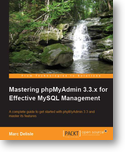
Michal Čihař: Mastering phpMyAdmin 3.3.x for Effective MySQL Management

The book Mastering phpMyAdmin 3.3.x for Effective MySQL Management is already available for some time, but I still think I should promote a little bit in my blog so here it is :-). The book covers all you might want to know about using phpMyAdmin. It really does not make sense to copy text from book description, so feel free to find yourself what all it does cover. As every time, this book is written by Marc Delisle, who is for several years project admin, so probably the person who knows most about hidden features. Usually technical review of the book is done by some other developers and this time it was me doing this job (among other reviewers). I hope we did good job and you will like this book. Mastering phpMyAdmin 3.3.x for Effective MySQL Management book cover PS: As a nice bonus, the phpMyAdmin project receives money from every purchased book.

Filed under: English Phpmyadmin 0 comments Flattr this!

Raphaël Hertzog: 16 Debian contributors that you can thank

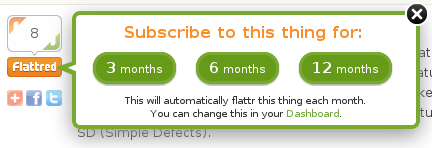
I put 5 EUR in Flattr each month and I like to spend those among other Debian contributors. That s why I keep a list of Debian people that I have seen on Flattr (for most of them I noticed through an article on Planet Debian). Directory of Debian contributors that you can thank I thought this list could be useful for others so I put it on a web page. Then I realized that limiting this to Flattr was not a good idea, and indeed several developers already propose multiple ways to be thanked. I went back through my list and looked up each developer s website to identify a Thank me page (it can be Donate , Support me , Amazon Wishlist , etc.). Obviously this means that Debian contributors who are not on Flattr do not appear on the initial list even if they have some Thank me page please help me fix this and send me the missing entries if you know of any. Click here to view the directory. The initial listing contains 16 developers and 8 of them have an additional (non-Flattr) Thank me link. Please note the warning I put on the page: the inclusion in the directory should not be taken as an endorsement of the amount or quality of the work done for Debian. You are supposed to make up your own judgment when deciding who you want to thank (but the links can help you learn more about what each contributor is doing). Flattr subscriptions explained Since this article replaces the traditional Flattr FOSS issue for this month, I wanted to introduce a new Flattr feature I recently discovered. With Flattr you have to click on some things every month or your monthly fee is given to a random charity. Now you can avoid this pitfall by subscribing to some things that you like. A subscription acts like an automatic click during a period of 3/6/12 months. If you want to subscribe to something, you just have to click a second time on the Flattr button and you will see this:
Screenshot with Flattr subscription choices Once you clicked on the desired duration, the subscription is recorded and the button will appear like this:

Screenshot with a subscribed flattr button Easy, isn t it? PS: I installed a WordPress plugin to make it super easy to share my articles on the most common social networks.

One comment Liked this article? Click here. My blog is Flattr-enabled.

2 January 2011

Lucas Nussbaum: Giving up on Ruby packaging

I have finally reached a decision regarding my involvement in the Debian Ruby packaging efforts. I have decided to stop. This has been a very hard decision to make. I have invested huge amounts of time in that work over the years. I still love the language, and will continue to use it on a daily basis for my own developments. I still hope that it will succeed. I know that some people will be disappointed by that decision (and that others will think your work was useless anyway, people should use RVM and rubygems ). But I also know that I won t be able to push for all the required changes alone. I just don t have the time, nor the motivation. For the record, here are the changes I would have liked to see in the Ruby community. The core Ruby development community should mature.
The core Ruby development community is still dominated by Japanese developers. While not a bad thing in itself, it is easily explained by the fact that the main development mailing list, where most of the important decisions are taken, is in japanese. ruby-dev@ should be closed, and all the technical discussions should happen on the english-speaking ruby-core@ list instead. The release management process should also improve. Currently, it looks like a total mess. The following Ruby development branches are actively maintained:
ruby_1_8 (106 commits over the last six months)
ruby_1_8_6 (4 commits over the last six months)
ruby_1_8_7 (35 commits over the last six months)
ruby_1_9_1 (4 commits over the last six months)
ruby_1_9_2 (227 commits over the last six months)
trunk (1543 commits over the last six months) While the state of the ruby_1_8_6 and ruby_1_9_1 branches is clear (very important bugfixes only), the state of all of the other branches is rather unclear.
What s the stable Ruby branch? 1.8 or 1.9? If it s 1.9, why are people still actively developing in the ruby_1_8 branch? How long will they continue to be maintained in parallel, dividing the manpower? Is a Ruby 1.8.8 release to be expected? Will it be ABI/API compatible with 1.8.7? Is the ruby_1_8_7 branch really bugfixes-only? How much testing of it has been done? If it s bugfixes-only and regression-free, I should push it to Debian squeeze, due to be released in a few weeks. But would you recommend that? Due to past breakages in the ruby_1_8_7 branch, it s unlikely that we will do it.
Is the ruby_1_9_2 a regression-free, bugfix-only branch? If yes, isn t 227 commits over 6 months a lot? What will be the version of the next release of trunk ? When is it expected? Will it be ABI-compatible with the current ruby_1_9_2 branch? API-compatible?
New releases in the 1.8.7 and 1.9.2 branches were done on december 25th. Why were they no betas or RCs allowing wider testing? How much testing has been done behind the scenes? Most of those questions have no clear answer. The Ruby development community should build a common understanding of the status of the various branches, and of their release expectations. Releasing on december 25th of each year sounds fun, but is releasing when everybody is on vacation really a good idea? It would be fantastic to have something similar to Python Enhancement Proposals in the Ruby community. But having open discussions in english about the major issues would already be great. Ruby is not just the interpreter.
The Ruby development community should clearly define what the Ruby platform is. There are some big players, like Rails, and newer interpreter releases should not be done before ensuring that those big players still work. Also, since we have alternative Ruby interpreters, like JRuby, Rubinius and MacRuby, we need a clear process on how they integrate with the rest of the ecosystem. For example, having each of them rely on their own outdated fork of the whole stdlib is ridiculous, since it s not where they compete. The Ruby community should acknowledge that RVM and Rubygems are not for everybody. People who say so should be laughed at. Of course, RVM and Rubygems are nice tools for some people. But it is completely wrong to believe that compiling from source using RVM should be the standard way of installing Ruby, or that all people interested in installing Redmine should know that Ruby has its own specific packaging system. The Ruby community should work with their target platforms to improve how Ruby is distributed instead of reinventing the wheel. That includes Debian, but also RedHat-based distros, for example. It is likely that it won t be possible to reach a one-size-fits-all situation. But that s real life. Some people in the Ruby community should stop behaving like assholes. As one of the Debian Ruby maintainers, I have been routinely accused of creating crippled packages on purpose (FTR, I don t think that the Debian packages are crippled, despite what the rumors says). Debian is not the only target of that. Just yesterday, someone called for abandonning YARV (the new Ruby VM in Ruby 1.9), calling it Yet Another Random Vailure. This kind of comments is really hurting the people who are investing their free time in Ruby, and is turning away people who consider getting involved. In Debian, we have had a lot of problems getting people to help with Ruby maintenance since they are getting shit from the community all the time. So, what s the future for Ruby in Debian? Update: there s also a number of interesting comments about this post on this site.
Update 2: First, thanks a lot for all the interesting comments. I will make some follow-up posts trying to summarize what was said. It seems that this post also triggered some reactions on ruby-core@, with Charles Olivier explaining the JRuby stdlib fork, and Yui Naruse clarifying that all questions are welcomed on ruby-core@. This is great, really.

Jonathan Wiltshire: RCBW, week three

This week: The remaining bugs are either removal candidates or no longer low-hanging-fruit, so I don t expect to keep squashing very many more before Squeeze is released.
Comments flattr this!

31 December 2010

Dirk Eddelbuettel: R / Finance 2011 Call for Papers: Updated and expanded

One week ago, I sent the updated announcement below to the r-sig-finance list; this was kindly blogged about by fellow committee member Josh and by our pal Dave @ REvo. By now. I also updated the R / Finance conference website. So to round things off, a quick post here is in order as well. It may even get a few of the esteemed reader to make a New Year's resolution about submitting a paper :) Dear R / Finance community, The preparations for R/Finance 2011 are progressing, and due to favourable responses from the different sponsors we contacted, we are now able to offer

  1. a competition for best paper, which given the focus of the conference will award for both an 'academic' paper and an 'industry' paper
  2. availability of travel grants for up to two graduate students provided suitable papers were accepted for presentations
More details are below in the updated Call for Papers. Please feel free to re-circulate this Call for Papers with collegues, students and other associations. Cheers, and Season's Greeting, Dirk (on behalf of the organizing / program committee) Call for Papers: R/Finance 2011: Applied Finance with R April 29 and 30, 2011 Chicago, IL, USA The third annual R/Finance conference for applied finance using R will be held this spring in Chicago, IL, USA on April 29 and 30, 2011. The two-day conference will cover topics including portfolio management, time series analysis, advanced risk tools, high-performance computing, market microstructure and econometrics. All will be discussed within the context of using R as a primary tool for financial risk management, portfolio construction, and trading. Complete papers or one-page abstracts (in txt or pdf format) are invited to be submitted for consideration. Academic and practitioner proposals related to R are encouraged. We welcome submissions for full talks, abbreviated lightning talks, and for a limited number of pre-conference (longer) seminar sessions. Presenters are strongly encouraged to provide working R code to accompany the presentation/paper. Data sets should also be made public for the purposes of reproducibility (though we realize this may be limited due to contracts with data vendors). Preference may be given to presenters who have released R packages. The conference will award two $1000 prizes for best paper: one for best practitioner-oriented paper and one for best academic-oriented paper. Further, to defray costs for graduate students, two travel and expense grants of up to $500 each will be awarded to graduate students whose papers are accepted. To be eligible, a submission must be a full paper; extended abstracts are not eligible. Please send submissions to: committee at RinFinance.com The submission deadline is February 15th, 2011. Early submissions may receive early acceptance and scheduling. The graduate student grant winners will be notified by February 23rd, 2011. Submissions will be evaluated and submitters notified via email on a rolling basis. Determination of whether a presentation will be a long presentation or a lightning talk will be made once the full list of presenters is known. R/Finance 2009 and 2010 included attendees from around the world and featured keynote presentations from prominent academics and practitioners. 2009-2010 presenters names and presentations are online at the conference website. We anticipate another exciting line-up for 2011---including keynote presentations from John Bollinger, Mebane Faber, Stefano Iacus, and Louis Kates. Additional details will be announced via the conference website as they become available. For the program committee:
Gib Bassett, Peter Carl, Dirk Eddelbuettel, Brian Peterson,
Dale Rosenthal, Jeffrey Ryan, Joshua Ulrich

Lars Wirzenius: Micro-optimizing btree

Benchmark results before:
num_operations: 1000000
insert      : 191.090 s (  5238.3/s) CPU; 191.106 s (  5237.7/s) wall clock
lookup      : 30.430 s ( 33068.8/s) CPU; 30.428 s ( 33064.0/s) wall clock
lookup_range: 85.700 s ( 11694.5/s) CPU; 85.700 s ( 11693.6/s) wall clock
insert2     : 143.320 s (  6986.7/s) CPU; 143.315 s (  6986.6/s) wall clock
remove      : 246.010 s (  4068.0/s) CPU; 246.013 s (  4067.9/s) wall clock
remove_range: 225.210 s (  4444.0/s) CPU; 225.286 s (  4442.4/s) wall clock
That's insert, lookup, and remove operations (and range operations) on a B-tree with one million keys. insert2 is insertions where keys are sorted. All nodes are stored in memory, not on disk. After some micro-optimization (replacing my own flexible bsearch implementation with the Python standard library one):
num_operations: 1000000
insert      : 97.850 s ( 10237.5/s) CPU; 97.860 s ( 10237.1/s) wall clock
lookup      : 12.430 s ( 81566.1/s) CPU; 12.429 s ( 81609.8/s) wall clock
lookup_range: 52.670 s ( 19047.6/s) CPU; 52.669 s ( 19050.0/s) wall clock
insert2     : 72.600 s ( 13806.4/s) CPU; 72.595 s ( 13808.6/s) wall clock
remove      : 134.510 s (  7443.8/s) CPU; 134.512 s (  7444.0/s) wall clock
remove_range: 169.740 s (  5897.3/s) CPU; 169.795 s (  5895.6/s) wall clock
Not bad, for a train ride's work, with some additional improvements late at night in a hotel room. Code is clearer too, now, at least mostly. And there's less of it: duplicating standard library functionality always maks me feel icky. The numbers for removals look bad, really bad. Espcially range removal should be much better. If anyone wanted to get familiar with my btree code base, that would be an excellent place to start from. See the README for instructions.

Joey Hess: on not coding late

It's midnight and I really want to be coding. I'm half way or so through adding a git-annex-shell to git-annex, which will enable some nice features with ssh access. I've done the research, and written the documentation[1], laid all the necessary refactoring groundwork, and written much of the code and just have to connect it all up and test it. This is a dangerous point to be at, because I have it all in my head, but I'm tired. If I start coding now, I could make a stupid mistake and find myself stuck in a blind alley at 5 am. I've been there before. Even if I avoid hard stuff, I'd surely look up and an hour or more would have gone by, it'd be past 1 am -- and I know that once I stop coding it can take me hours to spin my thoughts back down to the point where I can go to sleep. Also, I can feel the back of my mind still working on something. Some bits feel like they might not quite mesh up right in my mental model. I don't consciously know what the problem is. I need to sleep on it; it will probably be clearer later. Like yesterday when I lifted a bag of groceries into the car and paused, realizing code I'd written two months ago had a major bug, one I'd never seen, in an edge case that had never came up, but was surely there. I always assumed that when programmers got older and stopped coding late it was because they couldn't take the strain. Nah. We're just coding even as we sleep. :)
[1] Documentation is where I do my design. This is why git-annex has quantities of documentation that Linux Weekly News finds surprising.

Next.

Previous.